
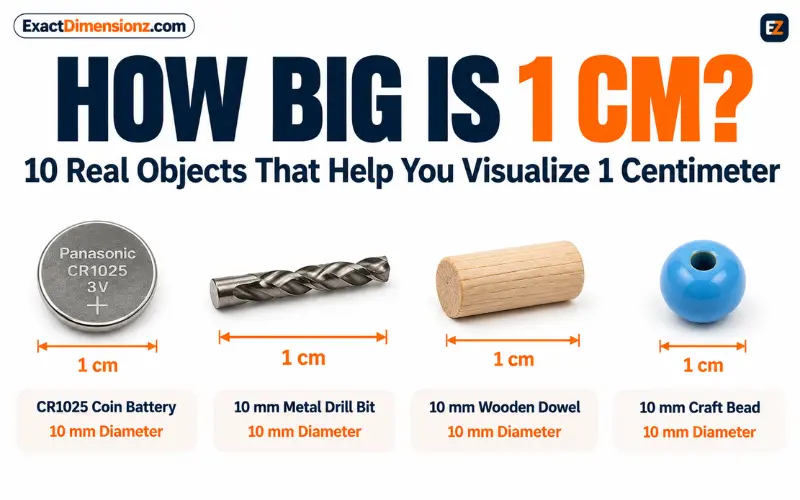
1 cm is exactly 10 millimeters (mm), 0.3937 inches, and 0.01 meters. It is a very small measurement, just under 0.4 inch and slightly less than half an inch. On a metric ruler, 1 cm is the distance from the 0 mark to the 1 cm mark.
If you are asking how big is 1 cm, the easiest way to understand it is to compare the measurement with something you can actually see and hold. A 10 mm drill bit, a CR1025 battery, a 10 mm wooden dowel, or a 10 mm steel ball can give you a much better mental picture than the number alone.
I also checked current articles competing for this topic. Many use the same familiar examples, such as fingernails, shirt buttons, peas, blueberries, pencils, staples, paper clips, dice, and USB parts. This guide takes a different route by using 10 less-common, clearly dimensioned objects, while separating exact 10 mm examples from approximate comparisons.
How Big Is 1 cm?
1 centimeter = 10 millimeters = 0.3937 inches = 0.01 meters.
Here is the quick conversion:
| Unit | Equivalent to 1 cm |
| Centimeters | 1 cm |
| Millimeters | 10 mm |
| Inches | 0.3937 in |
| Meters | 0.01 m |
| Feet | 0.0328 ft |
| Yards | 0.0109 yd |
The relationship between centimeters and millimeters is exact: 10 mm equals 1 cm. NIST lists 10 millimeters as 1 centimeter and states that the international inch is exactly 25.4 mm.
So when someone asks, “How big is 1cm?”, the simplest answer is:
1 cm is a short distance measuring 10 mm, or about 0.39 inches.
Related Post: How long is 10 feet
What Does 1 cm Look Like?
One centimeter is small enough that it can be difficult to picture from the number alone.
Imagine a metric ruler. Find the 0 cm mark and then look for the 1 cm mark. The space between those two marks is exactly 1 cm.
That same distance contains ten individual millimeters:
1 mm + 1 mm + 1 mm + 1 mm + 1 mm + 1 mm + 1 mm + 1 mm + 1 mm + 1 mm = 1 cm
Another useful way to think about it is that 1 cm is less than half an inch. Since an inch equals exactly 2.54 cm, 1 cm represents about 39.37% of an inch.
The tricky part is that an object can have one dimension of 1 cm while being much larger overall.
For example, a 10 mm drill bit has a diameter of 1 cm, but the entire drill bit is much longer. Likewise, a 10 mm wooden dowel can be 1 cm across while being several centimeters or even meters long.
That is why it is better to say “1 cm wide,” “1 cm in diameter,” or “1 cm thick” instead of simply saying an object is 1 cm big.
Related Post: How long is 9 feet
10 Things That Are 1 cm
The objects below were selected to give you a different set of references from the common comparisons found on competing pages. Several have manufacturer-listed 10 mm dimensions, so they provide more dependable references than naturally varying objects.
| Object | 1 cm Reference | Exact or Approximate |
| CR1025 coin battery | 10 mm diameter | Exact |
| 10 mm metal drill bit | 10 mm diameter | Exact |
| 10 mm wooden dowel | 10 mm diameter | Exact |
| 10 mm craft bead | 10 mm diameter | Exact |
| 10 mm disc magnet | 10 mm diameter | Exact |
| 10 mm watch spring bar | 10 mm size | Specified size |
| M10 bolt | 10 mm nominal diameter | Exact nominal size |
| 10 mm steel ball | 10 mm diameter | Exact |
| Silicone tubing | 10 mm inner diameter | Exact |
| Glass mosaic tile | 10 mm thickness | Exact |
Let’s look at each one more closely.
1. CR1025 Coin Battery
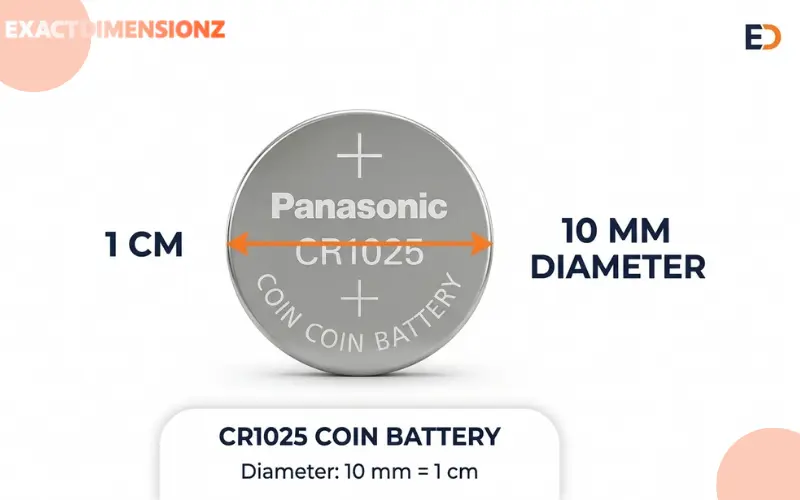
A CR1025 coin battery is one of the best exact physical references for 1 cm.
Panasonic lists the CR1025 with a maximum diameter of 10.0 mm and a maximum height of 2.5 mm. That means the circular battery is exactly 1 cm across its diameter.
That makes it much more useful than simply saying “a small battery is about 1 cm.” The actual manufacturer specification gives us a precise measurement.
If you have this type of battery available, look straight across its circular face. From one outside edge to the opposite outside edge is 10 mm.
Keep in mind that the diameter is the 1 cm measurement. The battery is not 1 cm thick. Its listed height is only 2.5 mm.
This is a good example of why the word dimension matters when answering how big is 1 cm. An object can be 1 cm across but much thinner.
Panasonic CR1025 official specifications
2. 10 mm Metal Drill Bit
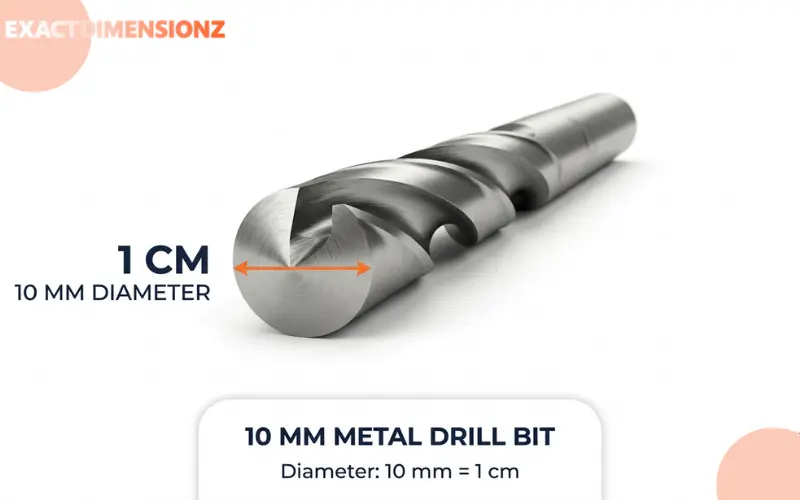
A 10 mm drill bit gives you an excellent technical reference for 1 cm because its diameter is specified directly.
Bosch Professional lists a HSS-TiN metal drill bit with a 10.00 mm diameter. The same product has a total length of 133 mm, showing the difference between the bit’s diameter and its overall length.
So if you look at the cutting end of the drill bit, its diameter is exactly 10 mm, which equals 1 cm.
This is particularly helpful if you work with tools or have a drill-bit set at home. You may see sizes such as 6 mm, 8 mm, 10 mm, 12 mm, and so on.
The 10 mm bit is the one that gives you the 1 cm reference.
Don’t measure the entire drill bit from end to end. That would give you a completely different measurement.
For visualization, imagine taking a cross-section straight through the widest part of the bit. That circular width is 1 cm.
Bosch Professional 10 mm drill bit specifications
3. 10 mm Wooden Dowel
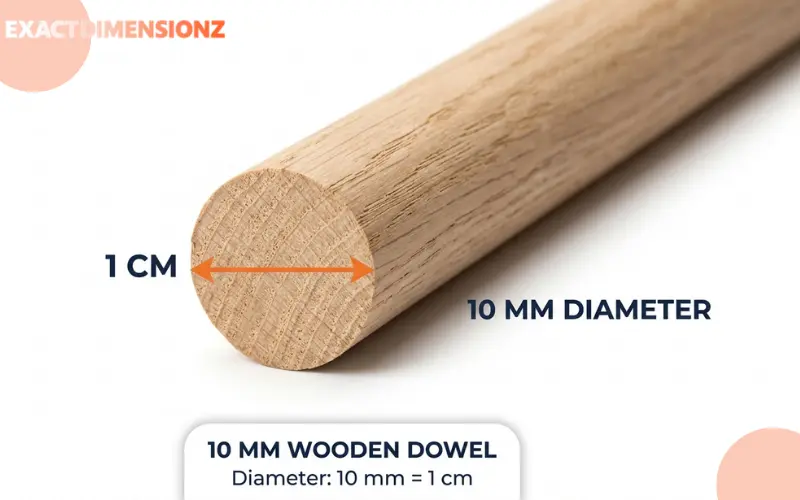
A 10 mm wooden dowel is another clear example.
Vijayshree Wood lists its round wooden dowels with a 10 mm diameter. The dowels are made for woodworking, crafts, model building, furniture projects, and other DIY uses.
Because the diameter is 10 mm, the width of the round dowel from one side to the other through its center is exactly 1 cm.
The length of the dowel can be much greater. That does not change its diameter.
This makes a wooden dowel particularly useful when explaining the difference between length and width. A long dowel might be 30 cm long while still being only 1 cm thick.
If you have a 10 mm dowel, hold it upright and look at its circular end. The diameter of that circle represents 1 cm.
It is also a practical example for people interested in woodworking or DIY because 10 mm dowels are a real, commonly specified product size.
4. 10 mm Craft Bead
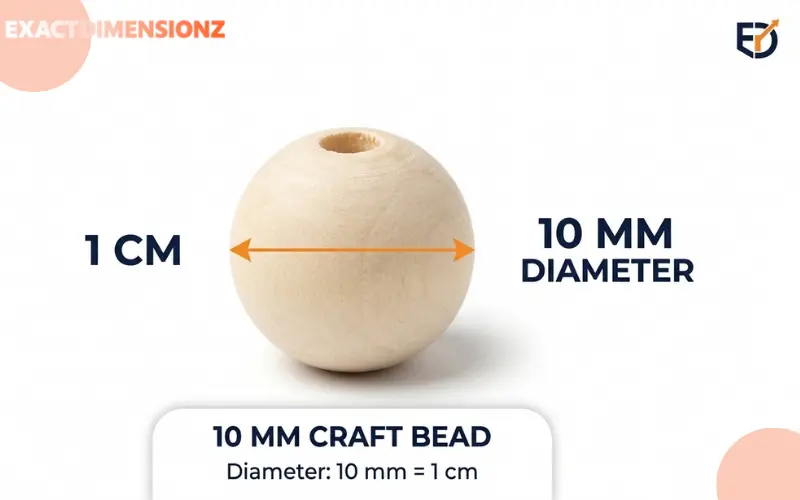
A 10 mm craft bead is another exact visual comparison.
NABBI, a manufacturer of ironing beads, lists its Jumbo beads as 10 mm in diameter.
That means the bead measures exactly 1 cm across its widest point.
Craft beads are especially useful because they are small, round, and easy to hold. If you put a 10 mm bead next to a metric ruler, its diameter lines up with the 1 cm distance.
This example is also different from using a random button or food item because the bead has a stated manufactured dimension.
Of course, not every craft bead is 10 mm. Beads are available in many sizes, so you need to check the package or product listing.
A bead labeled 10 mm is the one to use when you want an exact 1 cm visual reference.
5. 10 mm Disc Magnet
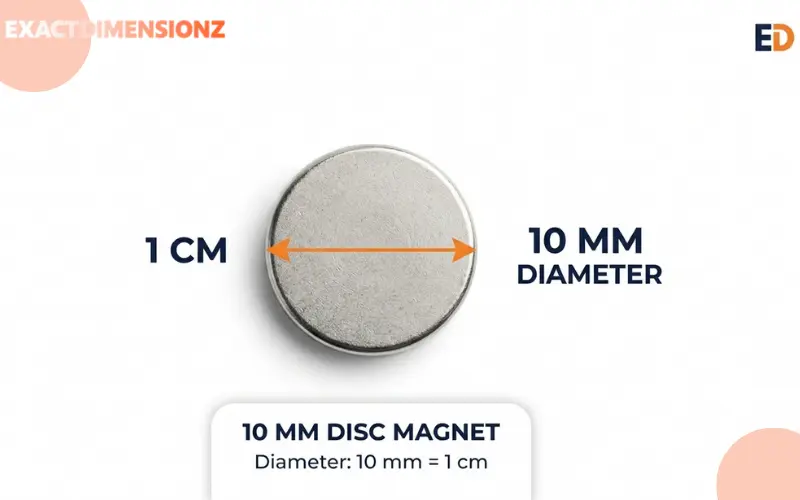
A small 10 mm disc magnet gives you another circular example.
Magnet catalogs commonly list round neodymium discs at 10 mm diameter. One supplier’s catalog, for example, lists several 10 mm diameter disc magnets in different thicknesses, including 10 × 2 mm, 10 × 3 mm, and 10 × 5 mm versions.
The first number refers to the diameter in these examples.
So a 10 mm × 2 mm disc has:
- 10 mm diameter = 1 cm
- 2 mm thickness
This is a useful comparison because it shows that the same object can contain several different measurements.
A 10 mm magnet does not mean the entire magnet is 1 cm in every direction. Only its diameter is 1 cm in those examples.
If you place the magnet flat on a ruler, measure across the middle of the circular face rather than around the edge.
6. 10 mm Watch Spring Bar
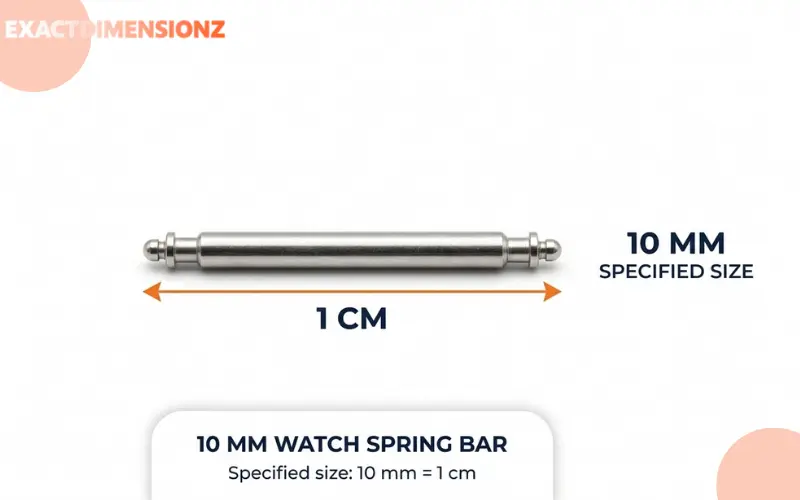
A watch spring bar is a tiny metal component used to attach a watch strap to the watch case.
Watch accessory suppliers list spring bars in different widths, including 10 mm sizes.
This gives you another very small manufactured reference.
The important point here is that the spring-bar measurement refers to its specified size for a particular watch connection. It should not be confused with the diameter of the metal pin itself.
A spring bar is much smaller than many everyday objects people normally use for size comparisons. That makes it a useful reminder of how short 1 cm actually is.
If you are looking for a physical object that represents 1 cm, a 10 mm watch spring bar can work well when its listed size is confirmed.
It is also a good example for the keyword things that are 1 cm, because it introduces a small precision component that is often overlooked in general size guides.
7. M10 Bolt
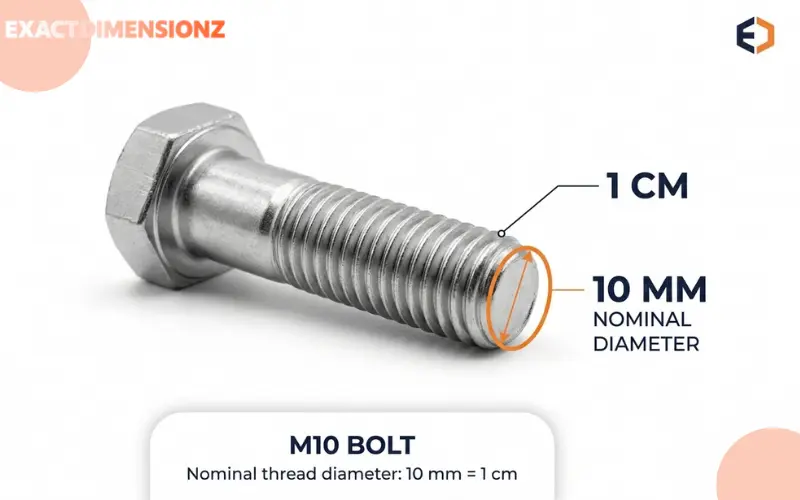
An M10 bolt provides an interesting reference because the “10” in M10 relates to its nominal thread diameter.
A RECA DIN 601 M10 bolt is listed with a 10 mm nominal diameter. Its other dimensions are larger, including the bolt head, so the 10 mm measurement should not be mistaken for the width of the entire bolt head.
In simple terms:
M10 = 10 mm nominal thread diameter = 1 cm.
This gives you a practical example of 1 cm in hardware.
If you look at the threaded portion of an M10 bolt, the nominal diameter is 10 mm. The bolt itself may be 16 mm, 50 mm, 90 mm, or much longer depending on the product.
This is another reason why the phrase “how large is 1 cm” needs context. One measurement can describe a small part of a much larger object.
8. 10 mm Stainless Steel Ball
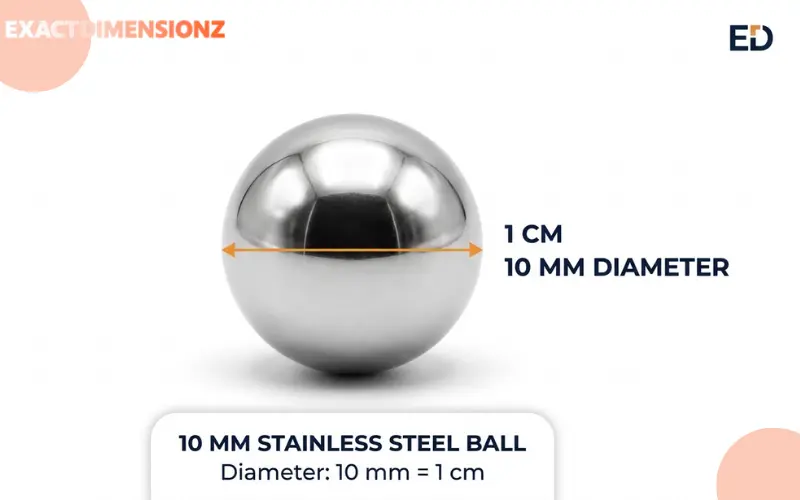
A 10 mm stainless steel ball is almost like having a tiny physical centimeter marker.
AUB Bearing lists stainless steel balls with a 10 mm diameter, with a stated tolerance around that nominal size.
The measurement is straightforward: draw an imaginary line through the center of the ball from one side to the other. That diameter is 10 mm, or 1 cm.
Because it is a sphere, you can hold it between your fingers and immediately get a sense of its size.
It is important not to confuse diameter with circumference. The ball’s circumference would be much greater than 1 cm.
This is also different from natural objects such as peas or berries. Those can vary significantly in size, while a manufactured steel ball is produced to a specified diameter and tolerance.
For someone looking for the actual how big is 1 cm rather than a loose estimate, a verified 10 mm steel ball is a very clear example.
Related Post: How long is 8 feet
9. Silicone Tubing With a 10 mm Inner Diameter
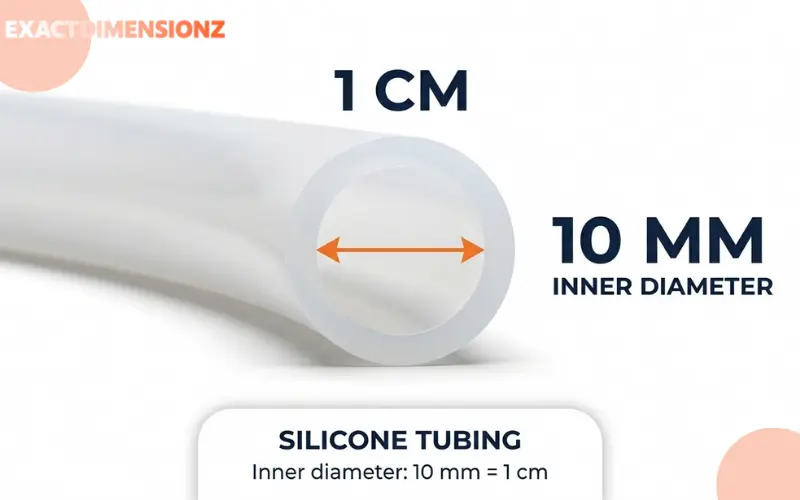
Some silicone tubing is manufactured with an inner diameter of 10 mm.
Thermo Fisher Scientific lists Sterilin silicone tubing with a 10 mm metric inner diameter and a 14 mm outer diameter for one configuration.
This gives us an unusual but useful 1 cm reference.
The hollow opening inside the tubing is 10 mm across. That opening is therefore exactly 1 cm in diameter.
Notice the difference between the two dimensions:
- Inner diameter: 10 mm = 1 cm
- Outer diameter: 14 mm = 1.4 cm
This is a great example of why you should always identify the exact dimension being discussed.
If someone says “the tube is 1 cm wide,” they could mean the inside opening or another part of the tube. The manufacturer specification removes that uncertainty.
Thermo Fisher Scientific silicone tubing specifications
10. Glass Mosaic Tile With 10 mm Thickness
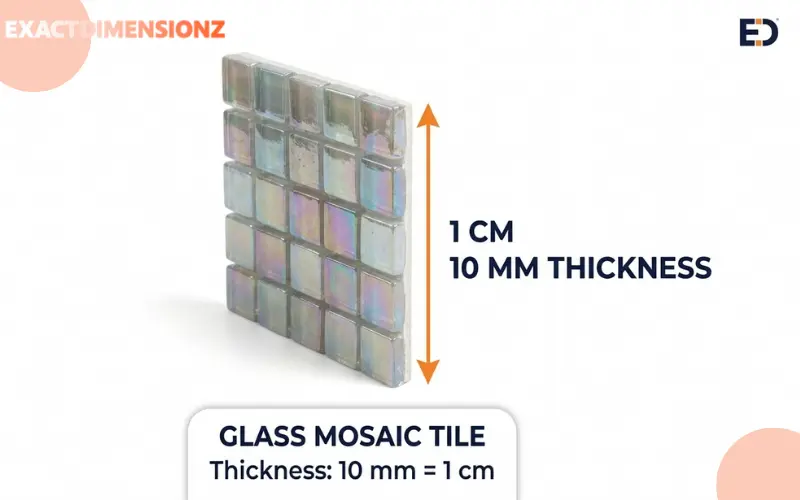
A glass mosaic tile can also provide a 1 cm comparison, although in this case the measurement is its thickness rather than its face width.
X-iS lists a mosaic-tile product with a 10 mm thickness.
Since 10 mm equals 1 cm, that tile’s thickness is exactly 1 cm.
This is a useful example because it shows that 1 cm can describe depth or thickness just as easily as length or diameter.
Imagine looking at the tile from the side. The distance from its bottom surface to its top surface is 10 mm.
The tile itself is much larger across its face, so you would not call the entire tile “1 cm.” Instead, the accurate description is:
“The tile is 1 cm thick.”
That wording is much more precise and helps readers understand how measurements are actually used in product specifications.
How Big Is 1 cm in Inches?
1 cm is approximately 0.3937 inches.
NIST gives the exact relationship of 1 inch = 2.54 cm, which means:
1 cm ÷ 2.54 = 0.3937 inches
For everyday use, you can remember:
1 cm ≈ 0.39 inches
That is slightly less than 0.4 inch.
It is also smaller than half an inch.
1 cm Compared With Common Imperial Measurements
| Measurement | Centimeters |
| ¼ inch | 0.635 cm |
| 1 cm | 1 cm |
| ½ inch | 1.27 cm |
| 1 inch | 2.54 cm |
So if you are wondering how big is 1 cm in inches, the answer is about 0.39 inch.
How Many Millimeters Are in 1 cm?
There are exactly 10 millimeters in 1 centimeter.
This is one of the easiest metric conversions to remember:
1 cm = 10 mm
NIST confirms this relationship in its SI length information.
That means:
- 5 mm = 0.5 cm
- 10 mm = 1 cm
- 15 mm = 1.5 cm
- 20 mm = 2 cm
- 25 mm = 2.5 cm
- 50 mm = 5 cm
- 100 mm = 10 cm
If a product specification says 10 mm, you already know that dimension is exactly 1 cm.
How Large Is 1 cm Compared With Half an Inch?
Half an inch is 1.27 cm, while 1 cm is only 0.3937 inch.
So half an inch is:
1.27 cm − 1 cm = 0.27 cm
That is 2.7 mm longer than 1 cm.
Visually, this means 1 cm and half an inch are fairly close, but they are not the same measurement.
If you picture half an inch, shortening it by about 2.7 mm gets you to 1 cm.
How Can You Measure 1 cm Without a Ruler?
If you do not have a ruler, you can estimate 1 cm using a known object.
Use a 10 mm Object
This is the most reliable option.
A product specifically labeled 10 mm gives you a direct physical reference.
Examples include:
- 10 mm drill bit
- 10 mm craft bead
- 10 mm steel ball
- 10 mm wooden dowel
- 10 mm disc magnet
These are better references than guessing from an object that only looks close to 1 cm.
Use a Metric Ruler
If you have a metric ruler, find the 1 cm mark.
The distance from zero to that mark is exactly 1 cm, and there are ten 1 mm divisions within it.
Use Your Fingernail Only as a Rough Estimate
A fingernail can provide a rough visual comparison, but it should not be treated as an exact 1 cm reference. Human body dimensions vary.
Several competing pages use fingernail width as a comparison, but a manufactured 10 mm object is a better choice when accuracy matters.
What Is 1 cm on a Ruler?
On a metric ruler, 1 cm is easy to find.
Look for:
0 → 1 cm
The distance between those marks is exactly 1 centimeter.
Inside that space are ten millimeter divisions:
0 mm → 1 → 2 → 3 → 4 → 5 → 6 → 7 → 8 → 9 → 10 mm
The tenth millimeter mark is equal to 1 cm.
This is one reason metric rulers are useful for small measurements. You can switch between centimeters and millimeters without changing the physical distance.
Is 1 cm Big or Small?
1 cm is small.
It is:
- 10 mm
- 0.3937 inches
- 0.01 meters
- Less than half an inch
- One hundredth of a meter
A centimeter is useful for relatively small dimensions. You might see it used for the size of small objects, product dimensions, crafts, hardware, thicknesses, diameters, and other short measurements.
For larger distances, meters, feet, yards, or other units are usually more convenient.
For tiny details, millimeters can be more useful than centimeters.
Why Saying “1 cm Big” Can Be Misleading
The phrase “1 cm big” sounds simple, but it does not tell us which dimension is 1 cm.
Consider an M10 bolt.
Its nominal diameter is 10 mm, but its head is wider and the bolt may be many centimeters long.
The same thing happens with a 10 mm wooden dowel. Its diameter is 1 cm, but its length can be much greater.
So these are better descriptions:
- 1 cm long
- 1 cm wide
- 1 cm thick
- 1 cm in diameter
- 10 mm across
That small wording change makes the comparison much more accurate.
1 cm vs 1 Inch
People sometimes confuse centimeters and inches because both are common units for everyday measurements.
| Measurement | Equivalent |
| 1 cm | 0.3937 inch |
| 1 inch | 2.54 cm |
| 10 mm | 1 cm |
| 25.4 mm | 1 inch |
One inch is more than twice as long as 1 cm.
NIST identifies 2.54 cm as the exact length of an international inch.
A simple way to remember the relationship is:
1 cm ≈ 0.39 inch
1 inch = 2.54 cm
1 cm vs 10 mm
There is no size difference between 1 cm and 10 mm.
They are two names for the same distance.
1 cm = 10 mm
For example, a Bosch drill bit listed at 10.00 mm diameter has a diameter of 1 cm.
Likewise, Panasonic’s CR1025 battery has a listed maximum diameter of 10.0 mm, which is 1 cm.
So if you see 10 mm on a product package, you can immediately translate it to 1 cm.
Common Mistakes When Estimating 1 cm
Confusing 1 cm With 1 Inch
They are not equal.
One inch is 2.54 times the length of 1 cm.
Assuming Every Small Object Is 1 cm
Small objects come in many sizes. Something that looks close to 1 cm could actually be 7 mm, 8 mm, 12 mm, or another measurement.
Measuring the Wrong Part
A 10 mm bolt does not have a 10 mm head. Its nominal diameter is 10 mm.
Forgetting Diameter and Circumference Are Different
A 10 mm ball has a diameter of 10 mm. Its circumference is much greater.
Treating an Approximate Object as Exact
A naturally occurring object can vary in size. For an exact reference, use an object with a manufacturer-listed 10 mm dimension.
How Big Is 1 cm Dilated?
The phrase “1 cm dilated” has a medical meaning that is different from simply asking how large 1 cm is.
During labor, cervical dilation describes how much the cervix has opened. A measurement of 1 cm dilation means the cervical opening is approximately 1 cm.
The cervix continues to open during labor. The NHS explains that the cervix needs to open to around 10 cm for the baby to pass through during vaginal birth.
So:
1 cm dilated = approximately a 1 cm cervical opening.
That does not mean the baby is 1 cm in size, and it does not mean the birth is necessarily about to happen.
The early stage of labor can vary considerably. NHS guidance notes that the latent stage can last many hours or, in some cases, days.
ACOG materials identify the active phase of labor as beginning at about 6 cm dilation, while complete dilation is 10 cm.
Because cervical dilation is a medical measurement, it should be assessed by a qualified healthcare professional rather than estimated with everyday objects.
If someone is pregnant and has questions about their own dilation, contractions, bleeding, fluid leakage, reduced fetal movement, or other symptoms, they should follow the advice of their maternity team.
Does 1 cm Dilated Mean Labor Is Starting?
Not necessarily.
A person can be 1 cm dilated without being in established labor. Cervical dilation is only one part of the changes that happen during labor.
The NHS describes an early or latent stage in which the cervix begins to soften and open, and contractions may be irregular. It can take considerable time before established labor begins.
This is why 1 cm dilated should not be used by itself to predict when a baby will be born.
What Is the Best Way to Picture 1 cm?
If you want the simplest mental picture, think of a 10 mm diameter.
A 10 mm drill bit, 10 mm bead, 10 mm steel ball, 10 mm wooden dowel, or CR1025 battery provides a physical object that represents the measurement.
The important thing is to remember which dimension is 10 mm.
For example:
- CR1025 → 10 mm diameter
- Drill bit → 10 mm diameter
- Wooden dowel → 10 mm diameter
- Craft bead → 10 mm diameter
- Steel ball → 10 mm diameter
- Silicone tubing → 10 mm inner diameter
- Glass mosaic tile → 10 mm thickness
That gives you several different ways to understand the same physical distance.
FAQs
How big is 1 cm?
1 cm is exactly 10 mm or approximately 0.3937 inches. It is slightly less than half an inch.
How big is 1cm in inches?
1 cm = 0.3937 inches, which can be rounded to about 0.39 inch.
How many mm are in 1 cm?
There are exactly 10 mm in 1 cm.
What does 1 cm look like?
It is the distance between the 0 and 1 cm marks on a metric ruler. A 10 mm object, such as a CR1025 battery’s diameter or a 10 mm drill bit, can provide a physical comparison.
What things are 1 cm?
Examples include a 10 mm drill bit, CR1025 battery diameter, 10 mm wooden dowel diameter, 10 mm craft bead, 10 mm disc magnet, 10 mm steel ball, and 10 mm watch spring bar size.
How can I measure 1 cm without a ruler?
Use a known object with a verified 10 mm dimension for a rough comparison. For exact work, use a metric ruler or caliper.
Is 1 cm smaller than half an inch?
Yes. Half an inch equals 1.27 cm, so 1 cm is 2.7 mm shorter.
How big is 1 cm dilated?
It means the cervix has opened to approximately 1 cm. Full cervical dilation is about 10 cm.
Does 1 cm dilated mean labor is near?
Not necessarily. Early cervical dilation can occur before established labor, and the timing varies between people.
Is 1 cm the same as 10 mm?
Yes. 1 cm and 10 mm represent exactly the same distance.
Conclusion
1 cm is a small distance equal to 10 mm, 0.3937 inches, and 0.01 meters. It is slightly smaller than half an inch.
If you need to visualize how big is 1 cm, a confirmed 10 mm object is one of the easiest references. A CR1025 battery has a 10 mm diameter, Bosch lists a drill bit with a 10.00 mm diameter, and 10 mm wooden dowels and craft beads provide other physical examples.
The biggest thing to remember is that 1 cm describes a distance, not necessarily the entire size of an object. Always check whether the measurement refers to length, width, thickness, diameter, inner diameter, or another dimension.
And if you searched “how big is 1 cm dilated,” that refers to cervical dilation during labor. A 1 cm cervical opening is much earlier than complete 10 cm dilation, and the measurement by itself cannot tell you exactly when delivery will happen.