
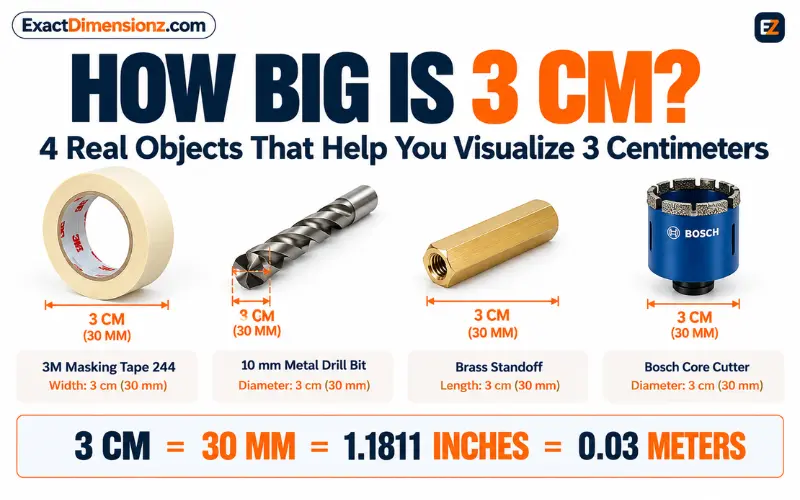
If you are wondering how big is 3 cm, the answer is simple: 3 centimeters is 30 millimeters, 1.1811 inches, and 0.03 meters. It is a little longer than 1 inch, but nowhere near 2 inches.
The easiest way to understand 3 cm is to connect the measurement to something you can actually see. Instead of relying only on fingers, bottle caps, or other objects that vary in size, this guide uses eight products with a clearly specified 30 mm dimension. That makes the comparisons more useful when you want a dependable reference.
How Big Is 3 cm?
3 cm = 30 mm = 1.1811 inches = 0.03 meters.
NIST lists the international inch as exactly 2.54 cm, so converting 3 cm to inches gives approximately 1.1811 inches.
In everyday terms, 3 cm is:
- Slightly longer than 1 inch
- About 18% longer than 1 inch
- Exactly 30 mm
- 0.03 meters
- About 0.0984 feet
- About 0.0328 yards
- Close to 1 3/16 inches when using a ruler marked in common fractions
3 cm Conversion Table
| Measurement | Equivalent |
| 3 centimeters | 3 cm |
| Millimeters | 30 mm |
| Inches | 1.1811 in |
| Meters | 0.03 m |
| Feet | 0.0984 ft |
| Yards | 0.0328 yd |
So if a product specification says 30 mm, you already know that particular dimension is exactly 3 cm.
Related Post: How big is 2 CM
What Does 3 Centimeters Look Like?
Three centimeters is a small but noticeable distance.
On a metric ruler, find the 0 cm mark and move to the 3 cm mark. That distance contains exactly 30 millimeter divisions.
Visually, 3 cm is:
0 cm → 1 cm → 2 cm → 3 cm
It is a little more than one inch. Since 1 inch equals exactly 2.54 cm, the difference between 3 cm and 1 inch is:
3.00 cm − 2.54 cm = 0.46 cm
That is 4.6 mm.
This is why saying that 3 cm is “about an inch” can be useful for a rough estimate, but it is not accurate enough for precise work.
Another important point is that 3 cm describes a distance, not necessarily the entire size of an object.
An object may be:
- 3 cm long
- 3 cm wide
- 3 cm high
- 3 cm thick
- 3 cm in diameter
- 3 cm across an opening
- 30 mm in a specified or nominal dimension
Always identify which dimension is actually 3 cm.
8 Real Objects That Measure or Specify 3 cm
Many competing pages use objects that are only approximately 3 cm, including bottle caps, paper clips, buttons, fingers, grapes, and other naturally variable items.
For a more reliable comparison, the examples below use products with a manufacturer or technical specification identifying a 30 mm dimension.
| Object | 3 cm Reference | Type |
| 3M Scotch Performance Masking Tape 244 | 30 mm width | Exact specified width |
| Bosch PRO Ceramic Dry Core Cutter | 30 mm diameter | Exact specified diameter |
| Milwaukee 30 mm Socket | 30 mm socket size | Specified size |
| Würth Elektronik Brass Standoff | 30 mm overall length | Exact specified length |
| PBC Linear Sleeve Bearing | 30 mm length | Exact specified length |
| Bosch EXPERT Circular Saw Blade | 30 mm bore | Exact specified bore |
| Grainger Quick-Detachable Bushing | 30 mm bore diameter | Exact specified diameter |
| TONE Ultra-Mini Stubby Screwdriver | 30 mm overall length | Exact specified length |
These examples are deliberately different from the objects used in the previous 1 cm article.
Related Post: How big is 1 cm
1. 3M Scotch Performance Masking Tape 244
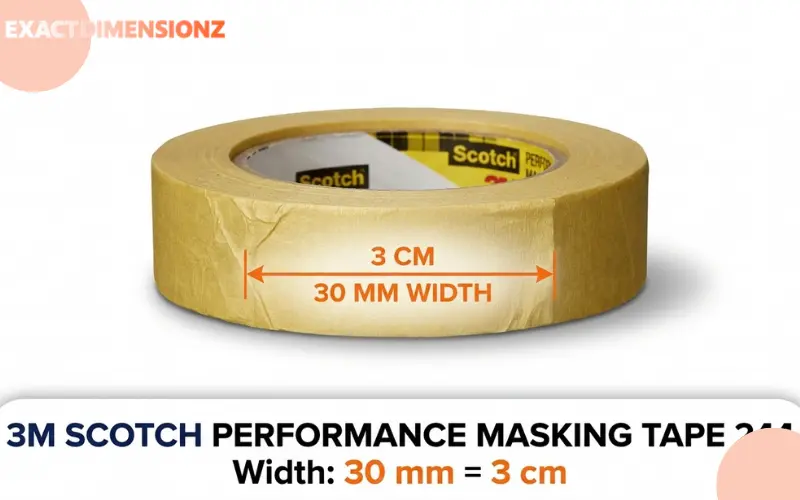
A useful 3 cm reference comes from Scotch Performance Masking Tape 244. 3M lists a version with an overall width of 30 mm.
That means the width of the tape is exactly 3 cm.
The roll itself is much larger because the tape is 50 meters long. The important measurement here is the 30 mm width, not the length of the roll or the diameter of the roll.
If you look at the strip from the front, the distance from one side of the tape to the other is 3 cm.
3 cm reference: 30 mm wide.
This is a good example because it shows that 3 cm can describe the width of a long, thin product.
Source: 3M Scotch Performance Masking Tape 244 specifications
2. Bosch PRO Ceramic Dry Core Cutter
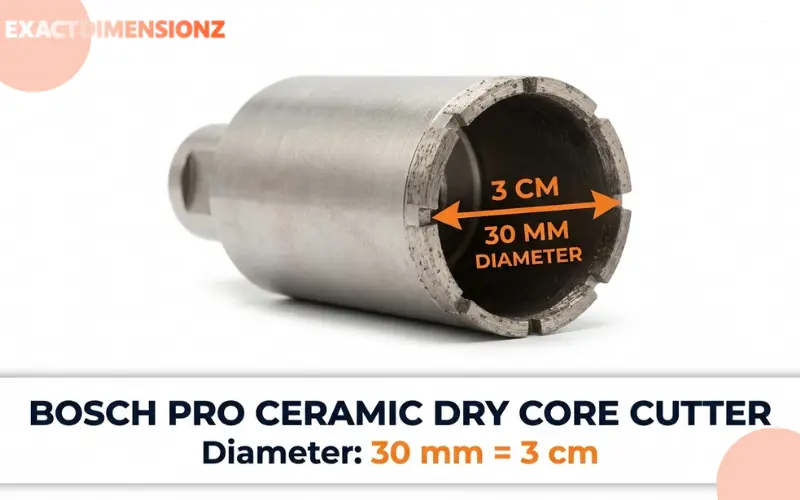
The Bosch PRO Ceramic Dry Core Cutter is another precise 3 cm reference.
Bosch lists this core cutter with a 30 mm diameter and a 35 mm working length. That means the circular cutting diameter is exactly 3 cm.
The important measurement is the diameter.
Do not measure the tool from end to end and call that 3 cm. Its overall working length is different.
To visualize 3 cm, imagine looking directly at the circular cutting edge. The distance across that circle through its center is 30 mm.
3 cm reference: 30 mm diameter.
Source: Bosch PRO Ceramic Dry Core Cutter 30 mm
3. Milwaukee 30 mm Socket
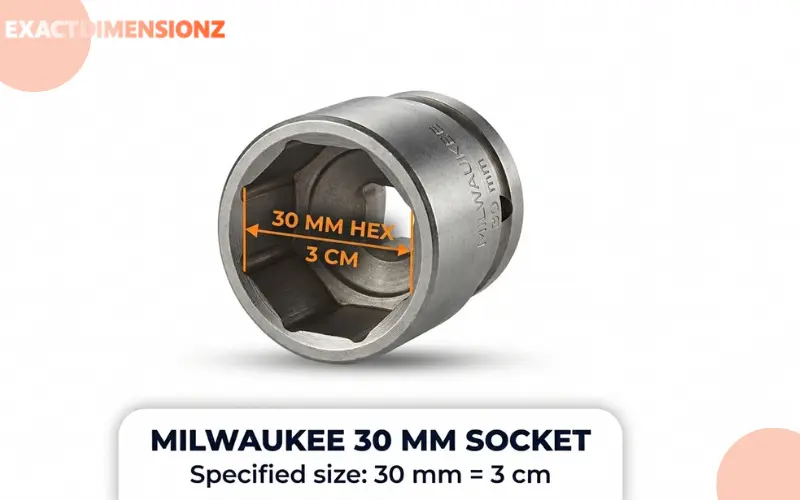
A Milwaukee 30 mm socket provides another useful hardware reference.
Milwaukee identifies its 1/2-inch-drive socket as a 30 mm socket. The 30 mm measurement refers to the socket’s metric size for the fastener it is designed to fit.
This is important because the socket itself is not simply a 30 mm-long object.
Instead, 30 mm is its specified socket size.
So this example is best described as:
30 mm socket size = 3 cm specified measurement
It is a good reminder that a number printed on a product can describe a functional or nominal dimension rather than the object’s complete exterior size.
Source: Milwaukee 1/2-Inch Drive 30 mm Socket
4. Würth Elektronik Brass Standoff
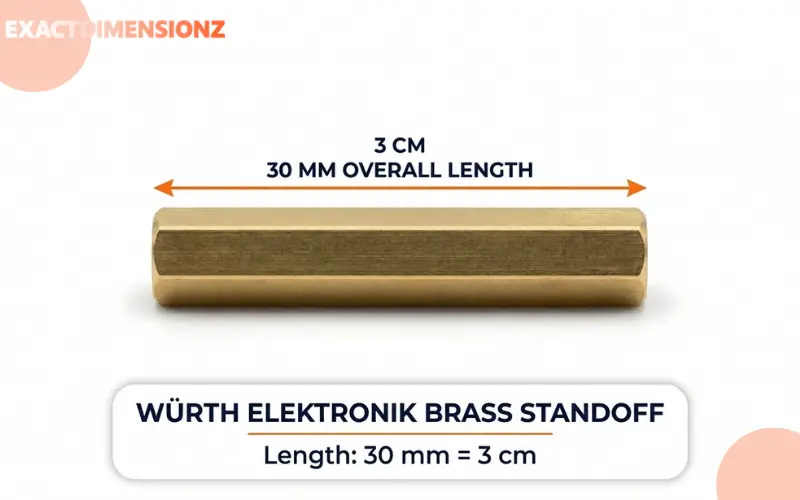
A small electronic component can also give you an exact 3 cm reference.
Würth Elektronik lists a brass hex female-female standoff with an overall length of 30 mm. Its external width is only 5 mm, so the 3 cm measurement applies specifically to its length.
Imagine placing the standoff horizontally on a ruler.
From one end to the other:
30 mm = 3 cm
This is a much more precise example than saying a small screw or piece of hardware is “around 3 cm.”
3 cm reference: 30 mm overall length.
Source: Würth Elektronik 30 mm brass standoff specifications
5. PBC Linear Sleeve Bearing
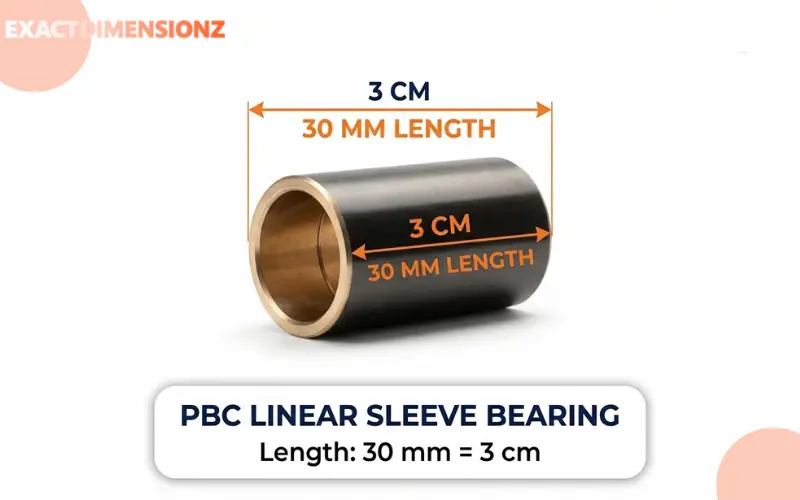
A PBC Linear sleeve bearing gives another exact 30 mm measurement.
The PSM3035-30 bearing is listed with an inside diameter of 30 mm and a length of 30 mm. Its outside diameter is 35.06 mm.
That means this one object gives you two separate ways to understand 3 cm:
- Length = 30 mm = 3 cm
- Inside diameter = 30 mm = 3 cm
The outside diameter is larger, so the entire bearing should not be described as simply “3 cm wide.”
This is a useful example of why the exact dimension must always be named.
3 cm reference: 30 mm length and 30 mm inside diameter.
Source: PBC Linear 30 mm sleeve bearing specifications
6. Bosch EXPERT Circular Saw Blade With a 30 mm Bore
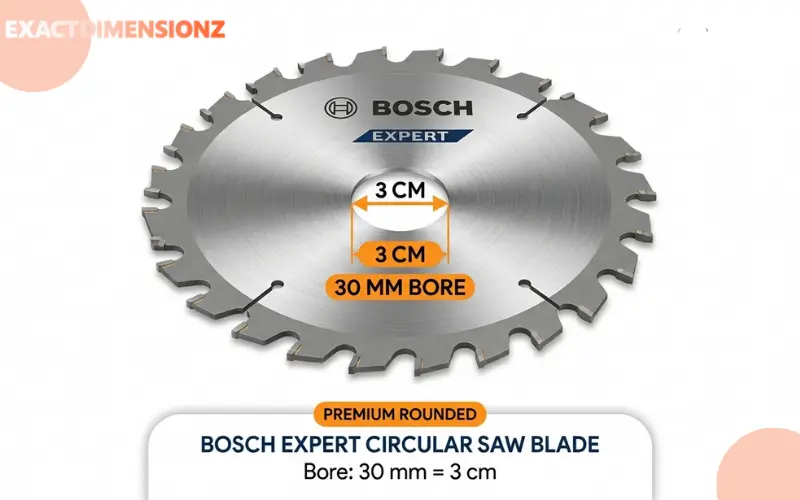
A large circular saw blade can also contain a 3 cm measurement.
Bosch lists its EXPERT circular saw blades with a 30 mm bore size on selected variants. The blade itself can have a diameter of 254 or 305 mm, so the 30 mm measurement refers specifically to the center hole.
This is a good visual comparison because the 3 cm measurement is easy to isolate.
Look at the center opening:
30 mm = 3 cm
Do not mistake the blade’s much larger outer diameter for 3 cm.
3 cm reference: 30 mm center bore.
Source: Bosch EXPERT Multi Material Circular Saw Blade specifications
7. Grainger Quick-Detachable Bushing
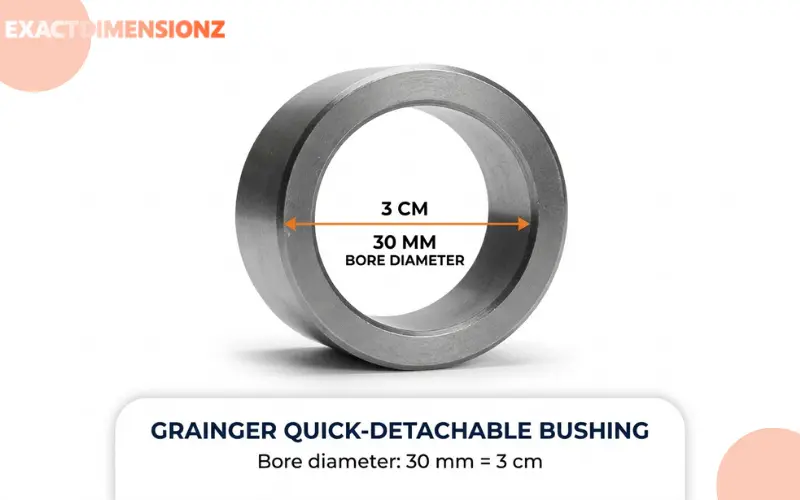
A quick-detachable bushing provides another precise 3 cm diameter.
Grainger lists an approved-vendor SDS bushing with a 30 mm bore diameter. Its overall diameter and overall length are considerably larger, so the 3 cm measurement applies only to the bore.
The bore is the opening through the center of the bushing.
Imagine measuring straight across that opening through its center:
30 mm = 3 cm
This is another example where the specific dimension matters more than the overall appearance of the object.
3 cm reference: 30 mm bore diameter.
Source: Grainger 30 mm bore quick-detachable bushing
8. TONE Ultra-Mini Stubby Screwdriver
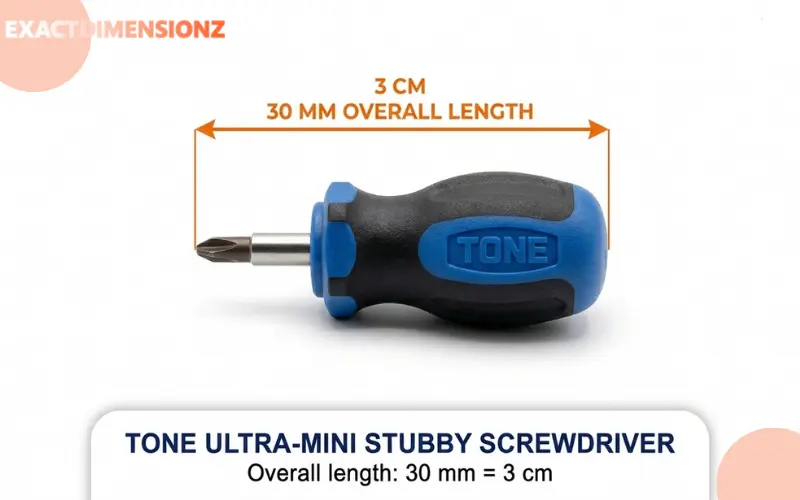
A small tool can give you an even more direct comparison.
MISUMI lists a TONE ultra-mini stubby screwdriver with an overall length of 30 mm.
That makes its complete length a direct 3 cm reference.
Place the screwdriver beside a metric ruler and the distance from one end to the other is:
30 mm = 3 cm
This is different from a screwdriver with a 30 mm shaft because here the listed measurement is the overall length.
3 cm reference: 30 mm overall length.
Source: MISUMI TONE ultra-mini stubby screwdriver specifications
How Big Is 3 cm in Inches?
If you are more familiar with inches, 3 cm is approximately:
3 cm = 1.1811 inches
NIST gives the exact relationship:
1 inch = 2.54 cm
So:
3 ÷ 2.54 = 1.1811 inches
For everyday use, you can remember:
3 cm ≈ 1.18 inches
On a ruler marked in common fractions, 3 cm is very close to 1 3/16 inches.
It is not exactly 1 inch, however.
The difference is:
3 cm − 1 inch = 4.6 mm
So 3 cm is noticeably longer than one inch.
3 cm Compared With 1 Inch
| Measurement | Length |
| 1 inch | 2.54 cm |
| 3 cm | 3.00 cm |
| Difference | 0.46 cm |
| Difference in mm | 4.6 mm |
A simple mental picture is to start with one inch and extend it by about 4.6 mm.
That gives you 3 cm.
3 cm Compared With 2 cm
The difference between 2 cm and 3 cm is exactly:
1 cm = 10 mm
So 3 cm is 50% longer than 2 cm.
| Measurement | Millimeters |
| 1 cm | 10 mm |
| 2 cm | 20 mm |
| 3 cm | 30 mm |
| 4 cm | 40 mm |
This is useful when comparing nearby measurements because every additional centimeter adds another 10 mm.
How Can You Measure 3 cm Without a Ruler?
A known 30 mm object is the most reliable physical reference.
For example, you could use:
- A product specified as 30 mm wide
- A 30 mm diameter tool
- A 30 mm-long component
- A 30 mm bore
- A 30 mm socket size
However, remember that these references only work if you know which part is 30 mm.
A 30 mm socket does not mean the entire socket is 3 cm long. A 30 mm bore does not mean the entire bushing is 3 cm wide.
Use a Metric Ruler
If you have a metric ruler, this is the easiest exact method.
Find the zero mark and count to:
3 cm
There are 30 individual millimeter intervals between 0 and 3 cm.
Use an Inch Ruler
If your ruler only shows inches, 3 cm is approximately:
1.181 inches
The nearest common 1/16-inch mark is 1 3/16 inches.
For rough measuring, this is close enough for many everyday situations.
For precise work, use a metric ruler or caliper.
Avoid Guessing From Fingers
A finger can give you a rough mental comparison, but finger sizes vary considerably.
The same applies to bottle caps, buttons, grapes, paper clips, and similar objects.
That is one of the main weaknesses of many online 3 cm guides: they present variable objects as if they were fixed measurements.
How Big Is a 3 cm Tumor?
A 3 cm tumor is 30 mm across in its largest reported dimension if the measurement is given as 3 cm.
For a simple visual comparison, the National Cancer Institute uses a grape as an illustration for 3 cm in its tumor-size diagrams.
But the physical size of a tumor does not tell you everything about what it means medically.
Tumor significance depends on factors such as:
- Where the tumor is located
- What type of tumor it is
- Whether it is cancerous
- Whether it has spread
- Its exact dimensions
- Its biological characteristics
- The specific cancer staging system being used
NCI explains that cancer staging can include tumor size, location, lymph-node involvement, and whether cancer has spread elsewhere.
For example, in non-small-cell lung cancer, a tumor 3 cm or smaller can fall within a particular stage category when other criteria are also met. That does not mean that every 3 cm tumor anywhere in the body has the same meaning.
So 3 cm is a physical measurement, not a diagnosis or a stage by itself.
How Big Is a 3 cm Cyst?
A 3 cm cyst measures 30 mm in the relevant dimension.
But there is no single medical answer to what a 3 cm cyst means because cysts can occur in different organs and can have different appearances and causes.
For example, ovarian cyst management depends on factors such as size, appearance, symptoms, and whether someone is premenopausal or postmenopausal. NHS guidance specifically notes that treatment decisions depend on the cyst’s size and appearance and other clinical factors.
Some NHS guidance for simple ovarian cysts uses 3 cm as an important measurement point, but those recommendations apply to particular patient groups and cyst types rather than every cyst in the body.
Kidney cysts are different again. NIDDK says simple kidney cysts can range from about the size of a pea to the size of a golf ball, and many simple kidney cysts do not require treatment unless they cause problems.
So if a scan says “3 cm cyst,” the number tells you its measured size, but the meaning depends on where the cyst is and what the imaging shows.
Related Post: How big is 10 feet
How Big Is 3 cm Dilated?
When someone says they are 3 cm dilated, they are usually referring to the cervix during labor.
A 3 cm dilation means the cervical opening has reached approximately 3 cm.
That is very different from saying that the cervix itself is 3 cm long.
NHS maternity guidance explains that the cervix gradually softens, thins, and opens during labor, reaching about 10 cm by the end of labor. Some NHS guidance describes the process as properly underway at around 3 cm.
However, 3 cm does not tell you exactly when birth will occur.
ACOG considers 6 cm to be the start of the active phase of labor in its clinical guidance.
So:
3 cm dilated = approximately a 3 cm cervical opening
It does not mean that delivery is necessarily close.
Labor can progress at different rates, and cervical dilation should be assessed by a midwife, doctor, or other qualified maternity professional.
How Big Is a 3 cm Kidney Stone?
A 3 cm kidney stone is 30 mm across in the dimension being reported.
That is considerably larger than the small stones that can sometimes pass through the urinary tract without treatment.
NIDDK explains that treatment for kidney stones depends on factors including size, location, and composition. Larger stones, stones that block the urinary tract, or stones causing significant pain may require treatment.
A 3 cm stone is therefore not something to treat as an ordinary small stone simply because it can be visualized as “grape-sized.”
Kidney stones can also have very different shapes. NIDDK notes that stones vary in size and shape, so a 3 cm stone does not necessarily look like a perfect 3 cm sphere.
If a scan reports a 3 cm kidney stone, the treating clinician needs to consider the actual location, shape, obstruction, symptoms, and other findings.
Is 3 cm Big or Small?
For an everyday length, 3 cm is small.
It is only:
- 30 mm
- 1.1811 inches
- 0.03 meters
But the significance of 3 cm depends completely on what is being measured.
For a piece of tape, a 30 mm width is small.
For a small mechanical component, 30 mm can be a normal product dimension.
For a tumor, cyst, or kidney stone, 3 cm is a medical measurement whose meaning depends on the body part and clinical context.
That distinction is important.
The same 3 cm physical distance can mean very different things in different situations.
Why Saying “3 cm Big” Can Be Misleading
The phrase “3 cm big” does not tell you what dimension was measured.
For example:
- A tape can be 3 cm wide.
- A tool can be 3 cm in diameter.
- A component can be 3 cm long.
- A hole can be 3 cm across.
- A cyst can measure 3 cm in one dimension.
- A tumor can have a largest dimension of 3 cm.
- A cervix can be 3 cm dilated.
These are all different measurements.
This is why a strong measurement guide should always identify the dimension being measured rather than simply calling an object “3 cm big.”
3 cm vs 30 mm
There is no difference between these two measurements.
3 cm = 30 mm
Centimeters and millimeters are simply two different units describing the same physical distance.
| Centimeters | Millimeters |
| 1 cm | 10 mm |
| 2 cm | 20 mm |
| 3 cm | 30 mm |
| 4 cm | 40 mm |
| 5 cm | 50 mm |
If a product specification says 30 mm, you can immediately convert that dimension to 3 cm.
3 cm vs 1.18 Inches
3 cm is slightly larger than 1.18 inches.
The more precise conversion is:
3 cm = 1.1811 inches
So 1.18 inches is a rounded value.
The difference between 1.18 inches and the exact conversion is very small, but when precision matters, use 1.1811 inches rather than treating 1.18 as exact.
Common Mistakes When Estimating 3 cm
Confusing 3 cm With 3 mm
This is a ten-times error.
3 cm = 30 mm
3 mm = 0.3 cm
They are not close measurements.
Assuming 3 cm Is Exactly 1 Inch
It is not.
1 inch = 2.54 cm
3 cm is 4.6 mm longer.
Measuring the Wrong Part of an Object
A product can have a 30 mm bore while its outside diameter is much larger.
A circular saw blade can have a 30 mm center bore while the blade itself is hundreds of millimeters across.
Treating an Approximate Object as Exact
A grape, bottle cap, paper clip, finger, or button can vary.
Use a manufacturer-specified 30 mm dimension when you need a dependable reference.
Confusing Diameter With Circumference
A 30 mm diameter does not mean the circumference is 30 mm.
The circumference of a 30 mm circle is much larger.
The Best Way to Picture 3 cm
If you want one simple mental picture, think:
3 cm = 30 mm = a little longer than 1 inch.
For a physical reference, use a product with a verified 30 mm dimension.
The examples in this guide give you several ways to see the same measurement:
- 30 mm tape width
- 30 mm core-cutter diameter
- 30 mm socket size
- 30 mm component length
- 30 mm bearing length
- 30 mm saw-blade bore
- 30 mm bushing bore
- 30 mm screwdriver length
That is more reliable than memorizing the apparent size of a random household object.
FAQs
How big is 3 cm?
3 cm is exactly 30 mm, approximately 1.1811 inches, and 0.03 meters. It is slightly longer than 1 inch.
How big is 3cm in inches?
3 cm equals approximately 1.1811 inches. It is close to 1 3/16 inches on a ruler.
How large is 3 cm?
3 cm is a small distance measuring 30 mm. It is 4.6 mm longer than one inch.
What does 3 centimeters look like?
3 centimeters looks like a distance slightly longer than 1 inch. On a metric ruler, it is the distance from 0 cm to 3 cm.
How many millimeters are in 3 cm?
There are exactly 30 millimeters in 3 centimeters.
Is 3 cm bigger than 1 inch?
Yes. One inch is exactly 2.54 cm, while 3 cm is 0.46 cm longer.
How big is a 3 cm tumor?
A 3 cm tumor has a measured dimension of 3 cm. NCI uses a grape as a visual illustration for 3 cm tumor size, but the medical significance depends on the tumor’s location, type, staging system, and whether it has spread.
How big is a 3 cm cyst?
A 3 cm cyst measures 30 mm in the reported dimension. What that means medically depends on the type and location of the cyst, its appearance, symptoms, and other clinical factors.
How big is 3 cm dilated?
3 cm dilated means the cervical opening is approximately 3 cm wide. It does not by itself predict when a baby will be born. ACOG identifies 6 cm as the beginning of active labor.
How big is a 3 cm kidney stone?
A 3 cm kidney stone measures 30 mm in the reported dimension. Kidney stone treatment depends on size, location, composition, obstruction, and symptoms. Larger stones may require treatment rather than passing naturally.
What is the easiest way to measure 3 cm?
Use a metric ruler and measure from 0 to 3 cm. If you do not have one, a verified 30 mm object can provide a physical reference, but you should identify exactly which dimension is 30 mm.
Conclusion
3 cm is exactly 30 mm, 0.03 meters, and approximately 1.1811 inches. It is a small measurement, but it is noticeably longer than 1 inch.
The best way to understand how big is 3 cm is to connect it to a dimension you can actually see. A 30 mm tape width, 30 mm core cutter, 30 mm socket size, 30 mm component, 30 mm bearing dimension, 30 mm saw-blade bore, 30 mm bushing bore, or 30 mm screwdriver gives you a concrete reference.
The most important point is to identify what part of the object measures 3 cm. A diameter, length, width, bore, thickness, and nominal size are not interchangeable.
And when the 3 cm measurement comes from a medical report—such as a tumor, cyst, kidney stone, or cervical dilation—the number describes size, but it should not be interpreted by size alone. The location, type, appearance, symptoms, and clinical context matter.