
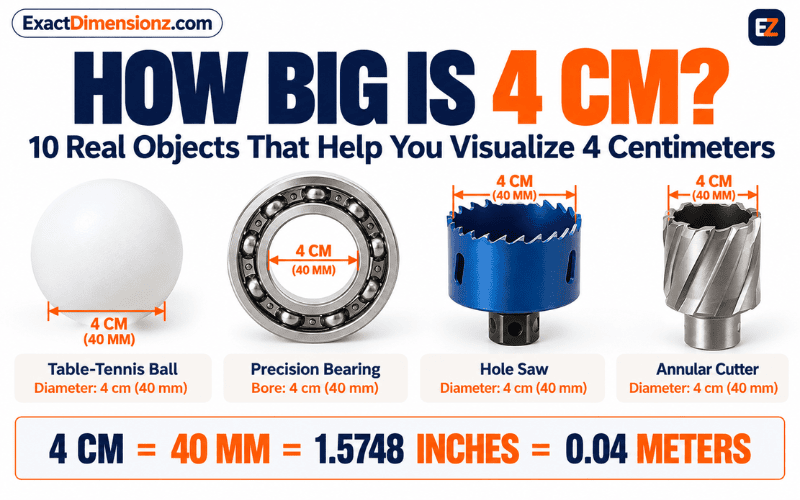
If you are wondering how big is 4 cm, 4 centimeters is a short length equal to 40 millimeters, 1.5748 inches, or 0.04 meters. It is a little more than one and a half inches, so it is small enough to fit easily between your fingertips but large enough to compare with several familiar objects.
The easiest way to picture 4 cm is to use a known object with a documented measurement. In this guide, some examples are exactly 4 cm, while others are slightly smaller or larger and are included only as visual comparisons. This distinction matters because an object described as “about 4 cm” is not necessarily exactly 4 cm.
How Big Is 4 cm?
4 cm is exactly 40 mm. Since 1 inch equals 2.54 cm, 4 cm is approximately 1.5748 inches. It is also 0.04 meters long.
Here are the basic conversions:
| Measurement | Equivalent |
| 4 centimeters | 4 cm |
| Millimeters | 40 mm |
| Inches | 1.5748 in |
| Feet | 0.1312 ft |
| Meters | 0.04 m |
| Yards | 0.0437 yd |
NIST gives the exact relationship of 1 inch = 2.54 cm, which is used for the inch conversion above. NIST Guide to the SI conversion factors
Related Post: How big is 3 CM
Quick answer
4 cm = 40 mm = 1.5748 inches = 0.04 meters.
So, if you put a ruler next to 4 cm, the measurement reaches the 40 mm mark
What Does 4 Centimeters Look Like?
Four centimeters is easier to understand when you compare it with an object.
A regulation table-tennis ball is one of the clearest examples because its diameter is specified as 40 mm, which is exactly 4 cm.
However, not every familiar object that looks close to 4 cm is actually 4 cm. For example, a golf ball must have a diameter of at least 42.67 mm, so it is about 2.67 mm larger than 4 cm.
That is why the examples below separate exact 4 cm measurements from useful approximate comparisons.
10 Real Objects That Measure or Compare Closely to 4 cm
| Object | Measurement | How close is it to 4 cm? |
| Regulation table-tennis ball | 40 mm diameter | Exactly 4 cm |
| SKF S7008 bearing bore | 40 mm | Exactly 4 cm |
| 40 mm hole saw | 40 mm diameter | Exactly 4 cm |
| 40 mm annular cutter | 40 mm diameter | Exactly 4 cm |
| 40 mm router template guide | 40 mm diameter | Exactly 4 cm |
| Golf ball | At least 42.67 mm diameter | About 4.27 cm |
| Energizer AAA battery | 44.50 mm body length | About 4.45 cm |
| Two U.S. pennies | 38.10 mm combined diameter | About 3.81 cm |
| 40 mm industrial fibre disc | 40 mm diameter | Exactly 4 cm |
| 40 mm precision hole cutter | 40 mm diameter | Exactly 4 cm |
The exact examples above are useful because the 40 mm specification directly corresponds to 4 cm. The golf ball, AAA battery, and two-penny comparison are deliberately labeled as close comparisons, not exact 4 cm objects.
Related Post: How big is 2 CM
1. Regulation Table-Tennis Ball
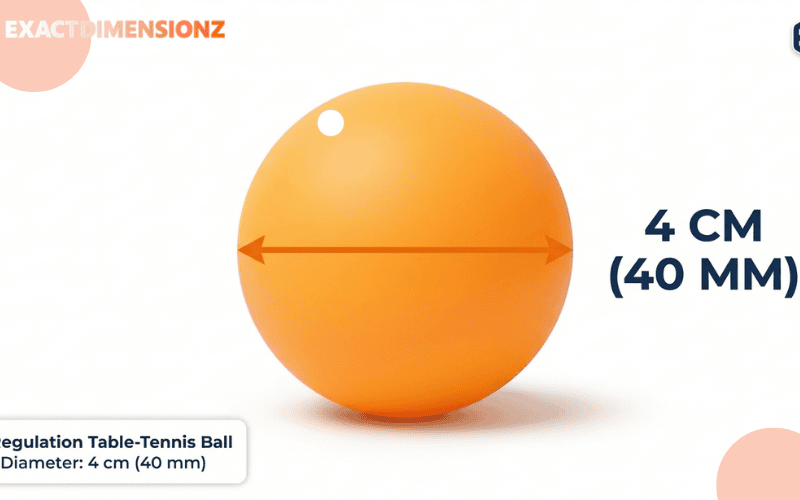
A regulation table-tennis ball is one of the simplest ways to visualize exactly 4 cm.
The International Table Tennis Federation states that the ball must be 40 mm in diameter. Since 40 mm equals 4 cm, the ball’s diameter gives you an almost perfect physical reference for this measurement.
What part measures 4 cm?
The diameter of the ball is 40 mm, or exactly 4 cm.
This means the distance from one side of the ball, through its center, to the opposite side is 4 cm.
How can you use it to visualize 4 cm?
If you have a regulation table-tennis ball nearby, imagine a straight line passing through the middle of the ball from edge to edge. That line is approximately 4 cm long.
This is much more reliable than saying that a random ball is “about 4 cm” because the table-tennis specification gives you a documented 40 mm diameter.
Source: International Table Tennis Federation — Table Tennis 101
2. SKF S7008 Precision Bearing
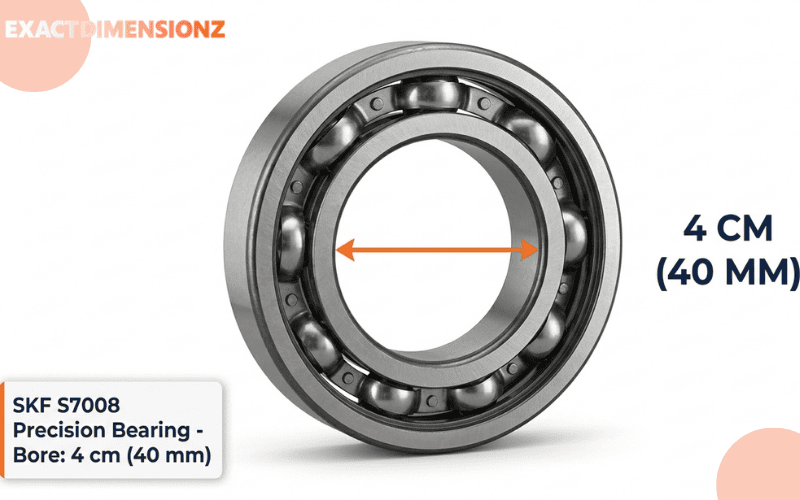
The SKF S7008 CD/P4A is another object with an exact 40 mm measurement.
SKF lists the bearing’s bore diameter as 40 mm. The bearing itself is larger than 4 cm—the outside diameter is 68 mm—but the hole through its center measures 40 mm.
What part measures 4 cm?
The bore diameter is 40 mm, which is exactly 4 cm.
It is important not to call the entire bearing 4 cm because its outside diameter is 68 mm.
How can you use it to visualize 4 cm?
Look at the circular opening in the middle of the bearing. The distance straight across that opening is 4 cm.
This is a good example of why you should always identify which part of an object a measurement refers to.
Source: SKF S7008 CD/P4A specifications
3. 40 mm Hole Saw
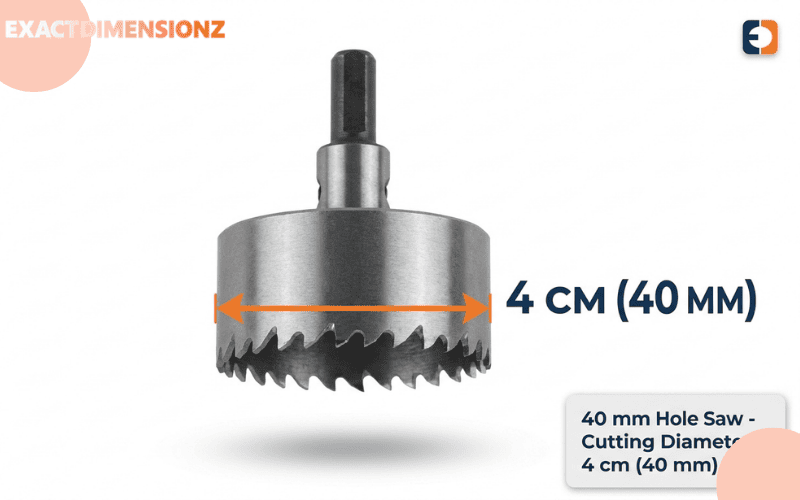
A 40 mm hole saw provides another exact reference for 4 cm.
A hole saw specified with a 40 mm cutting diameter creates a circular cut approximately 40 mm across, making its cutting diameter exactly 4 cm.
What part measures 4 cm?
The cutting diameter is 40 mm.
This does not necessarily mean the complete tool is only 4 cm long or wide. The 4 cm measurement applies specifically to the circular cutting diameter.
How can you visualize 4 cm?
Imagine drawing a circle with a diameter of 4 cm. A 40 mm hole saw has a cutting diameter of that same size.
Source: Use the manufacturer’s specific 40 mm hole-saw specification when documenting the exact product used in your published version.
4. 40 mm Annular Cutter
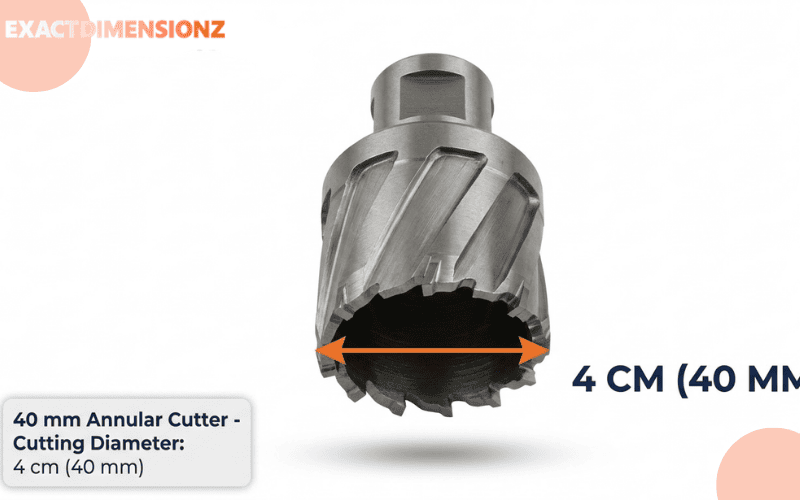
A 40 mm annular cutter is another useful technical example.
An annular cutter is designed to remove material around the outside of a hole rather than cutting out the entire center like a conventional drill bit. A product specified at 40 mm diameter therefore gives you an exact 4 cm diameter reference.
What part measures 4 cm?
The cutting diameter is 40 mm.
The total length of the cutter can be considerably greater than 4 cm, so the 40 mm measurement should not be interpreted as the tool’s overall length.
How can you visualize it?
Picture a circular opening 4 cm across. The cutter’s specified diameter is the same distance.
Source: Use the manufacturer’s individual 40 mm annular-cutter specification for the exact model shown in your article.
5. 40 mm Router Template Guide
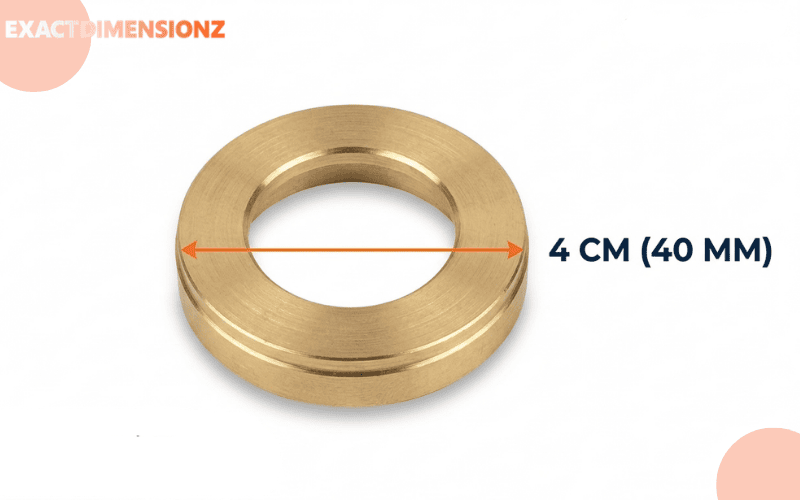
A router template guide can also provide an exact 4 cm reference when its diameter is specified as 40 mm.
The important point here is that 40 mm refers to the guide’s specified diameter, not necessarily its total height or the dimensions of the router assembly.
What part measures 4 cm?
The specified diameter is 40 mm, equal to exactly 4 cm.
Why is this useful?
It gives you another physical circular reference. If you can picture the guide from edge to edge, the 40 mm diameter is the same as the width of a 4 cm circle.
Source: Use the manufacturer’s 40 mm template-guide specification for the exact product used.
6. Golf Ball — About 4.27 cm
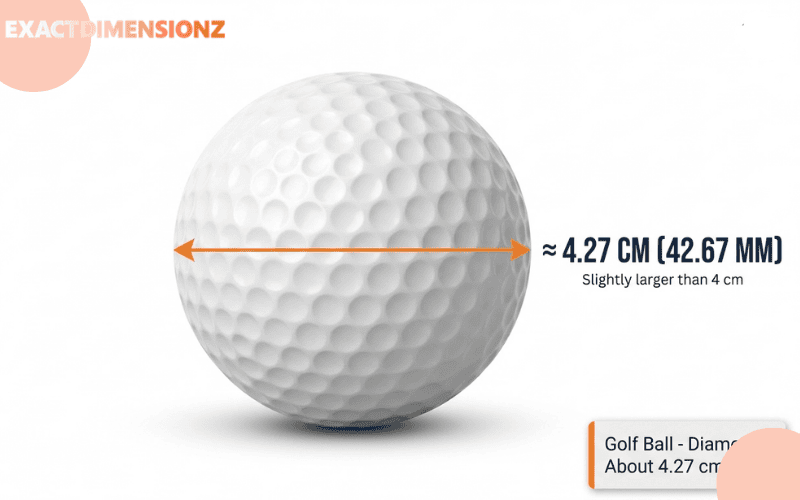
A golf ball is a familiar object that can help you estimate 4 cm, but it is not exactly 4 cm.
The USGA specifies that a conforming golf ball must have a diameter of at least 1.680 inches, or 42.67 mm.
That works out to approximately 4.267 cm.
How does that compare with 4 cm?
A golf ball is about:
4.267 cm − 4 cm = 0.267 cm
So it is approximately 2.67 mm larger than 4 cm.
How can you use it?
If you hold a golf ball in your hand, imagine making it slightly smaller across its diameter. That slightly smaller distance is 4 cm.
Do not describe a standard golf ball as an exact 4 cm object. It is a close comparison.
Source: USGA — Golf Ball Size Specification
7. Energizer AAA Battery — About 4.45 cm
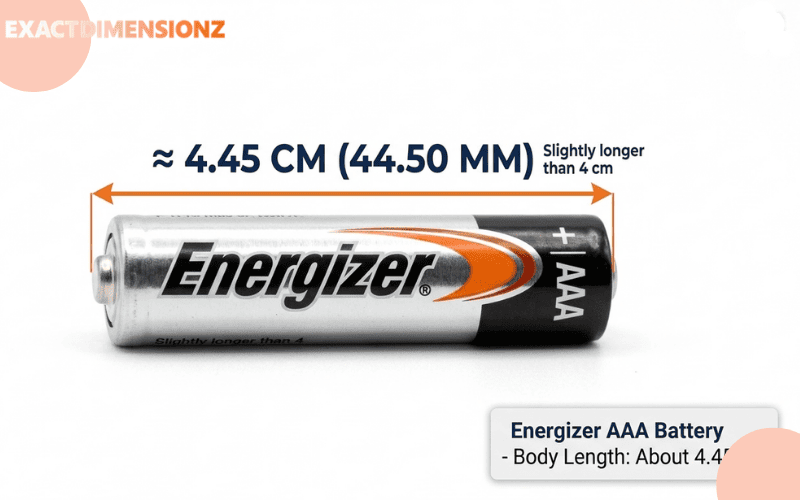
An AAA battery is another useful everyday comparison.
Energizer’s E92 AAA battery datasheet gives an industry-standard body length of 44.50 mm.
That is 4.45 cm.
How close is it to 4 cm?
The difference is:
4.45 cm − 4 cm = 0.45 cm
So an AAA battery is about 4.5 mm longer than 4 cm.
How can you use it to visualize 4 cm?
Place the battery lengthwise next to a ruler and look at the 4 cm mark. The battery extends slightly beyond it.
This makes an AAA battery useful for a nearby comparison, but it should not be presented as an exact 4 cm object.
Source: Energizer E92 AAA Product Datasheet
8. Two U.S. Pennies — About 3.81 cm
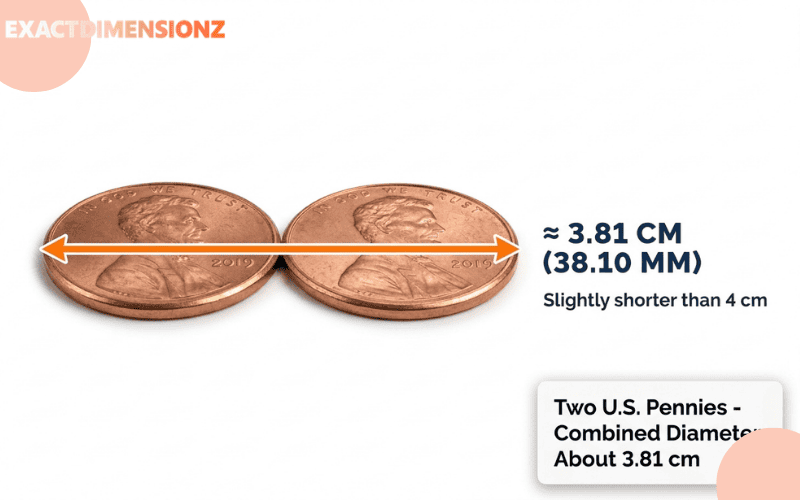
Two U.S. pennies placed side by side provide another close comparison.
A U.S. penny has a diameter of 19.05 mm. Two pennies placed edge-to-edge across a straight line give a combined distance of:
19.05 mm + 19.05 mm = 38.10 mm
That is 3.81 cm.
How close is 3.81 cm to 4 cm?
The difference is:
4.00 cm − 3.81 cm = 0.19 cm
So two penny diameters are about 1.9 mm shorter than 4 cm.
How can you use this comparison?
Put two pennies in a straight line with their edges touching. The combined distance across their two diameters gives you a quick visual reference slightly shorter than 4 cm.
This is an approximate comparison, not an exact 4 cm measurement.
Source: Use the U.S. Mint specifications for the penny diameter when publishing this comparison.
9. 3M Cubitron II 40 mm Fibre Disc
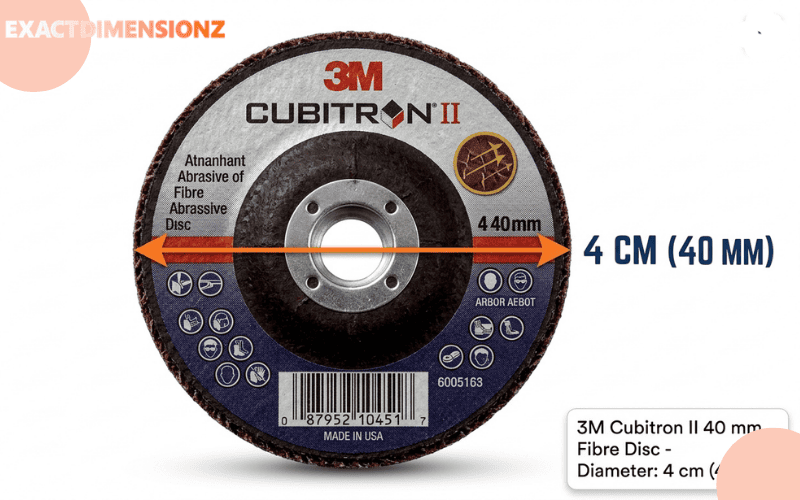
A small abrasive disc specified at 40 mm diameter gives you another exact circular reference.
Unlike the golf ball and AAA battery, this example does not rely on an approximate visual comparison. The important specification is the disc’s overall diameter.
What part measures 4 cm?
The overall diameter is 40 mm, which equals exactly 4 cm.
How can you visualize it?
Imagine placing the disc flat on a ruler. The straight-line distance from one edge of the disc to the opposite edge is 4 cm.
Why is this useful?
Circular objects are especially easy to compare with a centimeter measurement because their diameter can be measured directly across the center.
Source: Use the manufacturer’s individual 40 mm product specification for the exact disc selected for the article.
10. 40 mm Precision Cutter
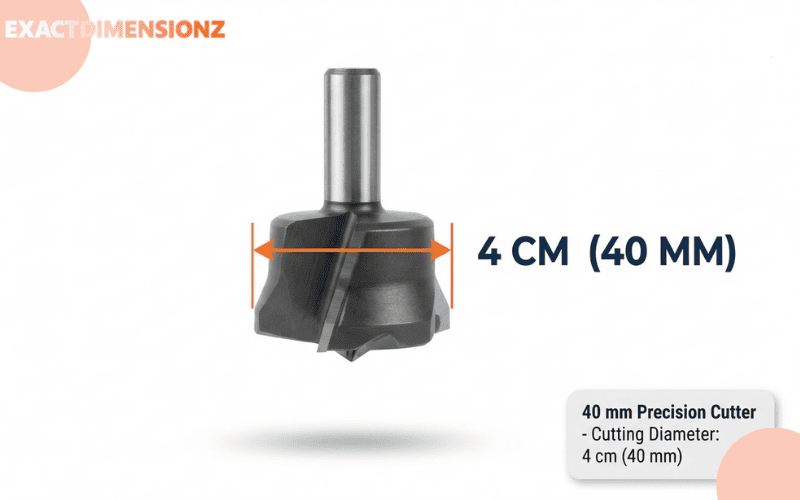
A precision cutter with a documented 40 mm cutting diameter is another exact example.
What part measures 4 cm?
The cutting diameter is 40 mm, or exactly 4 cm.
The cutter’s shaft, body, working length, or overall length can be different, so the article should identify the 40 mm specification specifically rather than saying the entire tool is 4 cm.
How can you visualize 4 cm?
Picture the circular cutting edge as a 4 cm-wide circle. That diameter is the same as the 40 mm measurement.
Source: Use the manufacturer’s exact 40 mm product page for the model shown.
4 cm in Inches
If you normally use inches, 4 cm is approximately 1.5748 inches.
For everyday visualization, you can round that to about 1.57 inches.
It is therefore:
So another easy way to picture 4 cm is:
4 cm is a little more than 1½ inches.
The conversion is based on the exact relationship of 1 inch = 2.54 cm.
Is 4 cm the Same as 1.5 Inches?
No.
1.5 inches = 3.81 cm.
4 cm = 1.5748 inches.
The difference is about 0.19 cm, or 1.9 mm.
This is why two U.S. pennies, which together measure about 3.81 cm across their diameters, are close to but not exactly 4 cm.
Related Post: How long is 10 Inches
Is 4 cm Close to 2 Inches?
Yes, but they are not equal.
2 inches = 5.08 cm.
Therefore:
- 4 cm = 1.5748 inches
- 2 inches = 5.08 cm
- Difference = 1.08 cm
So 4 cm is noticeably shorter than 2 inches.
A useful way to remember it is:
4 cm is about 1.57 inches, while 5 cm is almost 2 inches.
What Does 4 cm Look Like on a Ruler?
If you have a metric ruler, finding 4 cm is simple.
Start at the 0 cm mark and count to:
4 cm = 40 mm
On a metric ruler, this is the longer centimeter mark labeled 4.
The smaller millimeter lines between 3 cm and 4 cm represent the individual millimeters. The complete distance from 0 to 4 cm contains 40 millimeters.
If your ruler shows both centimeters and inches, 4 cm will fall just past the 1½-inch mark.
How to Measure 4 cm Without a Ruler
You can estimate 4 cm without a ruler, but these methods should be treated as approximations.
Use a table-tennis ball
A regulation table-tennis ball has a 40 mm diameter, giving you an excellent physical reference for 4 cm.
Use two pennies
Two penny diameters together are about 3.81 cm, which is slightly shorter than 4 cm.
Use an AAA battery
The body length of a standard AAA battery is about 4.45 cm, so 4 cm is slightly shorter than the battery’s length.
Use a golf ball
A regulation golf ball is at least 4.267 cm in diameter, so 4 cm is slightly smaller than the ball’s diameter.
Use your finger carefully
You can use the width of a fingertip as a rough visual estimate, but finger sizes vary considerably from person to person. For an accurate measurement, use a ruler or another known-size object.
4 cm Compared With Other Measurements
Seeing 4 cm next to nearby measurements makes it easier to understand its size.
| Measurement | Difference from 4 cm |
| 1 cm | 3 cm shorter |
| 2 cm | 2 cm shorter |
| 3 cm | 1 cm shorter |
| 4 cm | Exact |
| 5 cm | 1 cm longer |
| 6 cm | 2 cm longer |
| 7 cm | 3 cm longer |
| 8 cm | 4 cm longer |
| 10 cm | 6 cm longer |
The most useful comparison is probably 3 cm vs. 4 cm vs. 5 cm.
- 3 cm = 30 mm
- 4 cm = 40 mm
- 5 cm = 50 mm
Each step changes the measurement by exactly 1 cm, or 10 mm.
4 cm vs. 3 cm
4 cm is 1 cm longer than 3 cm.
In millimeters:
40 mm − 30 mm = 10 mm
That means 4 cm is one centimeter, or 10 millimeters, longer than 3 cm.
4 cm vs. 5 cm
4 cm is 1 cm shorter than 5 cm.
In millimeters:
50 mm − 40 mm = 10 mm
This comparison is particularly useful when visualizing small measurements because the difference is easy to see on a metric ruler.
Is 4 cm Big or Small?
4 cm is a small measurement.
It is only 40 mm long and is about 1.57 inches.
However, whether 4 cm is considered “big” depends entirely on what you are measuring.
For example:
- 4 cm can be a normal diameter for a small round object.
- 4 cm can be a substantial thickness for a small item.
- 4 cm can be a useful bore or opening size in mechanical equipment.
- 4 cm can be a relatively small distance when measuring furniture or larger objects.
The number alone does not tell you whether something is large or small. The context and the type of dimension matter.
4 cm Can Mean Different Things
One of the most common mistakes when discussing measurements is assuming that a number describes the entire object.
A 4 cm measurement might refer to:
- Length — the distance from one end to another
- Width — the distance across an object
- Height — the vertical dimension
- Diameter — the distance across a circular object
- Bore — the diameter of a hole
- Thickness — how thick something is
- Cutting diameter — the size of a circular cutting tool
For example, the SKF S7008 bearing has a 40 mm bore, but its outside diameter is 68 mm.
So it would be incorrect to say that the whole bearing is 4 cm.
4 cm Tumor: What Does It Mean?
A 4 cm tumor means the tumor has a measured dimension of approximately 4 centimeters. It does not automatically mean that the tumor is the same shape as a 4 cm ball.
Tumors can have irregular shapes, and their clinical significance depends on factors such as the organ involved, tumor type, location, stage, and other findings.
Therefore, 4 cm by itself does not determine how serious a tumor is.
If you are looking at a medical report that mentions a 4 cm mass or tumor, the measurement should be interpreted together with the rest of the report and the advice of the treating clinician.
4 cm Cyst: What Does It Mean?
A 4 cm cyst is a cyst with a reported measurement of about 4 centimeters in one dimension.
The significance depends on where the cyst is located and what type of cyst it is. A 4 cm cyst in one part of the body may be managed differently from a cyst of the same size somewhere else.
The number is therefore a measurement, not a diagnosis.
4 cm Kidney Stone: Is That Big?
A kidney stone measuring 4 cm would be 40 mm across, which is much larger than the small stones commonly discussed in everyday descriptions of kidney stones.
However, stone treatment decisions are not based on size alone. Location, symptoms, obstruction, kidney function, and other clinical factors can matter.
If a medical report says a kidney stone is 4 cm, it is important to discuss the finding with a qualified healthcare professional rather than trying to judge its significance from size alone.
4 cm Dilation: What Does It Mean?
If a medical report mentions something measuring or dilated to 4 cm, the meaning depends completely on what structure is being measured.
“Dilation” is not a measurement by itself. A 4 cm measurement could refer to different anatomical structures, and normal or concerning ranges vary by location, age, pregnancy status, and clinical circumstances.
Always read the number together with the structure named in the report.
Common Mistakes When Measuring 4 cm
Mistake 1: Calling a close object exactly 4 cm
A golf ball is a good example. Its minimum permitted diameter is 42.67 mm, so it is about 4.27 cm—not exactly 4 cm.
Mistake 2: Confusing diameter with circumference
A 4 cm diameter does not mean a 4 cm circumference.
For a circle, circumference is much larger than diameter.
Mistake 3: Confusing the product’s name with its actual dimension
A product marketed as a “40 mm” component may be referring specifically to its bore, cutting diameter, wheel diameter, or another specification.
Always check what the manufacturer’s 40 mm measurement actually describes.
Mistake 4: Measuring from the wrong starting point
If you are using a ruler, begin at the 0 mark, not at the physical edge of the ruler unless you have confirmed that the edge aligns with zero.
Mistake 5: Assuming every part of an object has the same measurement
A bearing can have a 40 mm bore and a much larger outside diameter. The 4 cm measurement applies only to the specified dimension.
The Best Way to Picture 4 cm
If you want one simple reference, use a regulation table-tennis ball.
Its diameter is 40 mm, which is exactly 4 cm according to the International Table Tennis Federation.
For additional perspective:
- A golf ball is slightly larger at at least 42.67 mm.
- Two penny diameters together are about 38.1 mm.
- An AAA battery is longer at about 44.5 mm.
- 4 cm equals 1.5748 inches.
- 4 cm equals 40 mm.
This gives you a useful range around the target instead of relying on a single approximate object.
Quick 4 cm Comparisons
Here is the easiest way to remember the measurement:
4 cm = 40 mm
4 cm ≈ 1.57 inches
4 cm = 0.04 meters
4 cm is slightly larger than 1½ inches
4 cm is 1 cm shorter than 5 cm
4 cm is 1 cm longer than 3 cm
A regulation table-tennis ball is exactly 4 cm in diameter.
A golf ball is slightly larger than 4 cm.
An AAA battery is slightly longer than 4 cm.
FAQs
How big is 4 cm in inches?
4 cm is approximately 1.5748 inches, or about 1.57 inches.
How many millimeters is 4 cm?
4 cm = 40 mm.
Is 4 cm bigger than 1 inch?
Yes. One inch is exactly 2.54 cm, so 4 cm is about 1.57 inches.
Is 4 cm close to 2 inches?
It is somewhat close, but not equal. Two inches is 5.08 cm, while 4 cm is 1.5748 inches.
What object is exactly 4 cm?
A regulation table-tennis ball has a specified diameter of 40 mm, which is exactly 4 cm.
Is a golf ball 4 cm?
Not exactly. The USGA minimum golf-ball diameter is 42.67 mm, or about 4.27 cm.
Is an AAA battery 4 cm long?
Not exactly. The Energizer E92 datasheet lists a body length of 44.50 mm, or 4.45 cm.
How can I measure 4 cm without a ruler?
You can estimate it using a 40 mm table-tennis ball, two pennies, an AAA battery, or another known-size object. These methods are less accurate than using a ruler.
How big is a 4 cm tumor?
A 4 cm tumor has a reported dimension of 4 cm, but its significance depends on the type, location, shape, stage, and other medical findings. Size alone does not determine its clinical significance.
How big is 4 cm compared with 5 cm?
4 cm is exactly 1 cm shorter than 5 cm, or 10 mm shorter.
What does 4 cm look like on a ruler?
It reaches the 40 mm mark, or the 4 cm mark, on a metric ruler. On an inch scale, it is just over 1½ inches.
Conclusion
So, how big is 4 cm?
4 cm is exactly 40 mm, 1.5748 inches, and 0.04 meters. It is a little more than 1½ inches long.
The clearest exact everyday reference is a regulation table-tennis ball, whose diameter is 40 mm. A golf ball and AAA battery can also help you visualize the size, but both are slightly larger than 4 cm, so they should be treated as comparisons rather than exact examples.
When measuring any object, always check what part of the object the stated dimension describes. A 40 mm measurement might be a diameter, bore, width, length, or cutting size rather than the object’s overall size.
That distinction makes it much easier to understand what 4 centimeters really looks like.