
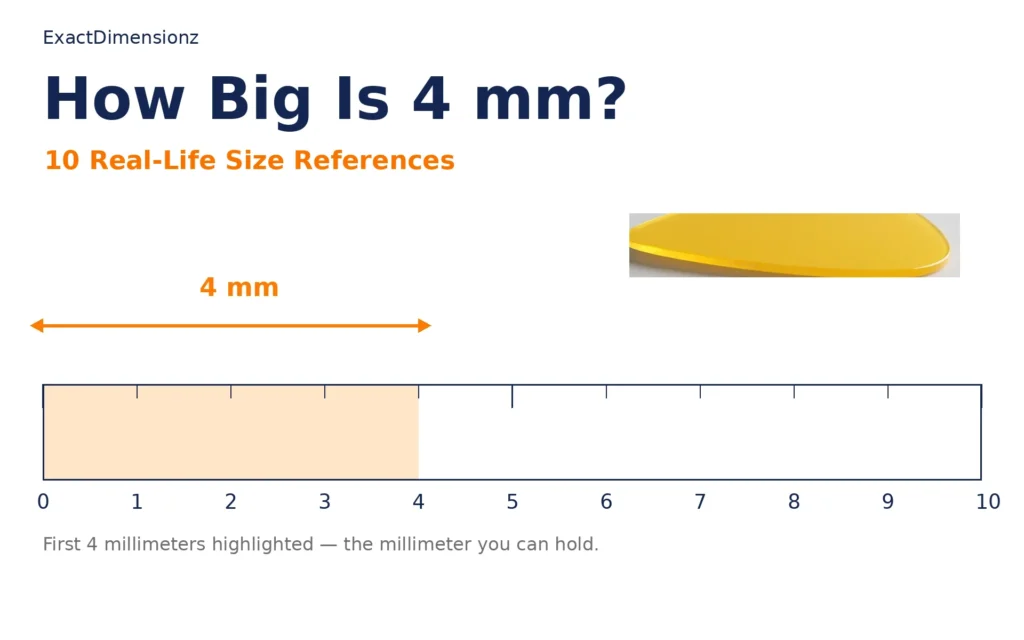
How big is 4mm? It’s the first millimeter size you can genuinely feel between your fingers. It is exactly 0.4 centimeters, about 0.15748 inches, and four times the length of a single millimeter. On a ruler it’s four ticks past zero — the thickness of a heavy guitar pick, the diameter of a knitting needle, the width of an M4 screw thread.
This article gives you ten verified real-world references for 4 mm, each one tied to a named product and a primary source. Every reference carries an evidence label — official specification, published dimension, standardized measurement, or nominal/toleranced size — so you always know exactly what kind of “4 mm” you’re looking at. If 3 mm is the size you build with, 4 mm is the size you feel.
How big is 4mm?
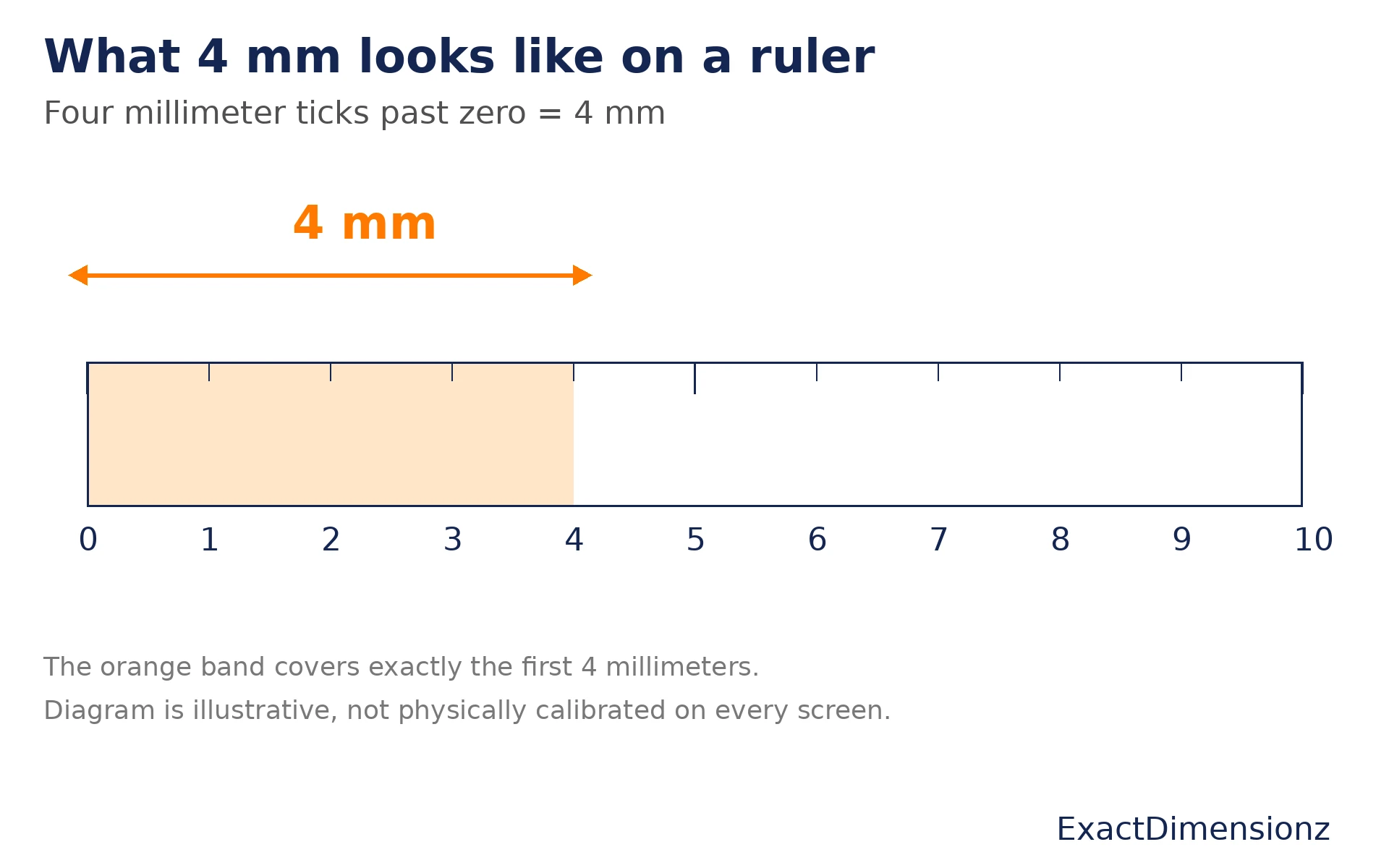
Four millimeters is exactly 0.4 centimeters — about 0.15748 inches. On a metric ruler, it is four millimeter ticks past zero.
Total: 4 mm
The scale explains the measurement but is not physically calibrated on every screen. Screen size and browser zoom can change its displayed length.
4 mm Conversion Table
| Unit | 4 mm equals | Exact or rounded |
|---|---|---|
| Centimeters | 0.4 cm | Exact |
| Meters | 0.004 m | Exact |
| Micrometers | 4,000 µm | Exact |
| Inches (fraction) | 20/127 in | Exact |
| Inches (decimal) | 0.15748 in | Rounded display |
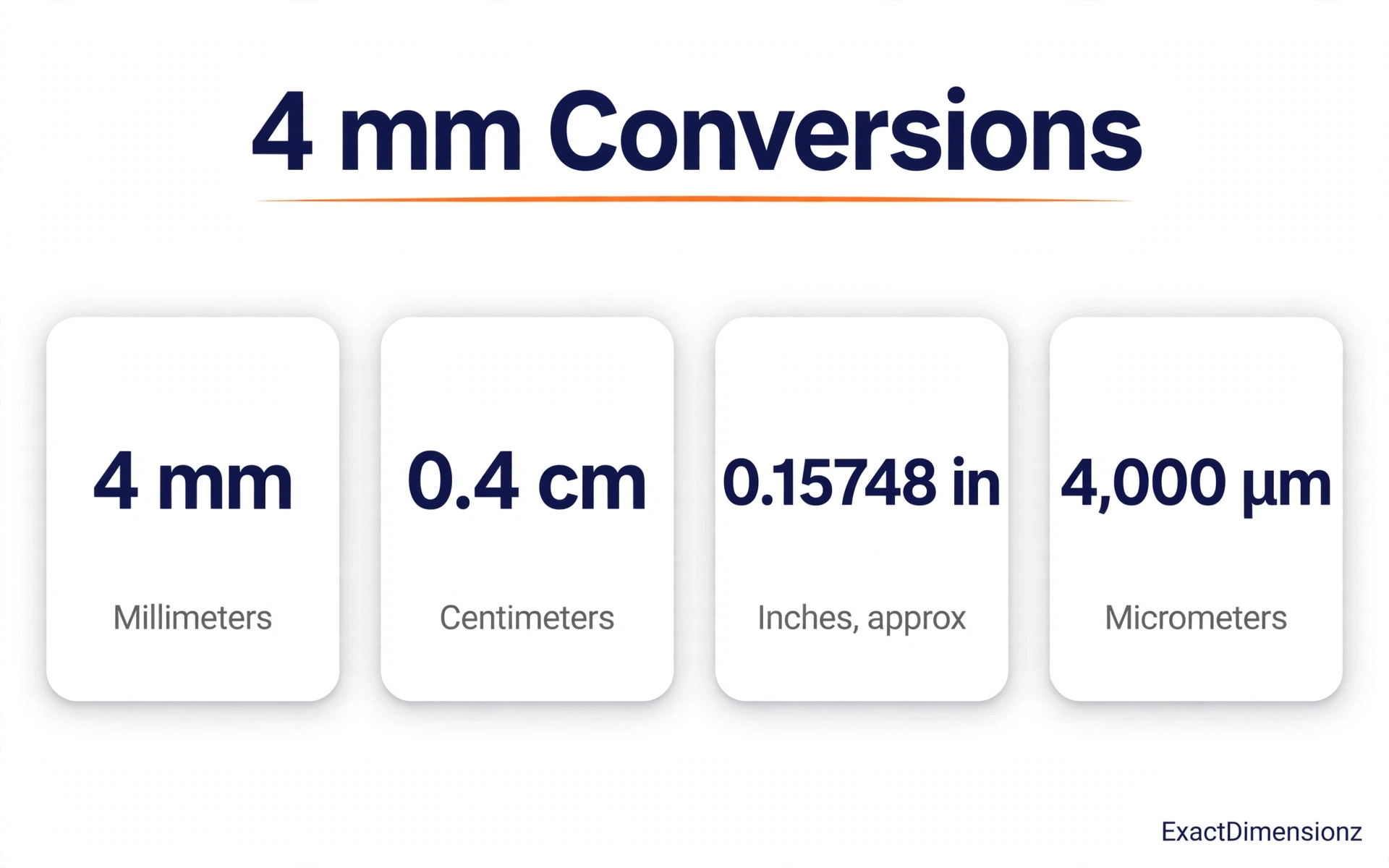
The inch is defined as exactly 25.4 millimeters, so 4 mm works out to the exact fraction 20/127 of an inch. The familiar decimal 0.15748 is a rounded display of that fraction — fine for quick math, but not mathematically exact. Our guide on how long 1 inch is covers the imperial side in full.
One conversion trap to clear up early: 5/32 of an inch equals 3.96875 mm, which is 0.03125 mm — one thirty-second of a millimeter — short of 4 mm. In conversation the two get treated as the same size, but on paper they are different numbers, and the gap is real even if you need calipers to see it.
What Does 4 mm Look Like on a Ruler?
Find the centimeter marks and count the small millimeter ticks between any two of them. Four millimeters is four ticks: not quite halfway from 0 to the 1 cm mark. Since 1 cm contains 10 mm, 4 mm is simply 0.4 cm — and it is exactly twice the length of 2 mm, if you want a smaller anchor you already know.
Try this: lay a 4.0 mm knitting needle across the ruler with its tip at zero and watch where the shaft ends. It lands on the fourth tick — which is the whole point of sizing needles by number, as you will see below. And if 4 mm still feels abstract next to those centimeter marks, our guide on how big 2 cm is gives you a larger anchor — five times this length.
Thickness vs Diameter vs Pitch vs Bore
Before the references, one piece of honesty. A “4 mm” value can describe different axes, and this article names each one explicitly:
- Thickness is the distance through a flat object — a guitar pick, a feeler gauge blade.
- Diameter is the distance straight across a round face — a lens, a needle tip, the outside of a tube.
- Pitch is the center-to-center spacing between repeated features — the poles along a terminal block.
- Bore is the diameter of an inner hole — the opening a shaft passes through.
This list adds a fifth wrinkle worth knowing: height along an axis. The M4 screw below carries two different 4 mm measurements on one product — the thread diameter and the head height — and they are measured on completely different axes. Every section says which axis it means.
10 Objects and Products Listed at 4 mm
A note on evidence before we begin. The ten references below come from different kinds of sources. An official specification comes from an authority. A published dimension is printed in a manufacturer’s own catalog or datasheet for a specific model. A standardized measurement is defined by an industry standard. A nominal/toleranced size is a manufacturer’s size designation that real units only approximate.
A published 4 mm designation does not mean every manufactured unit measures 4.000 mm. The label on each reference tells you which kind of evidence you are looking at, and each section states the limitation in plain words.
These ten fall naturally into four stops. First, in the hand, where 4 mm is something you grip. Then the toolbox, where it is drilled, threaded, and checked. Then inside the machine and the clinic, where it hides in optics, electronics, instruments, and air lines. And finally, on the living room floor, where it cushions a yoga mat.
In the hand. Start where 4 mm is most honest: between your fingers. These are objects people choose, hold, and feel every day — which makes them the fastest way to learn the size.
1. Gravity Picks Acrylic Guitar Pick, 4.0 mm
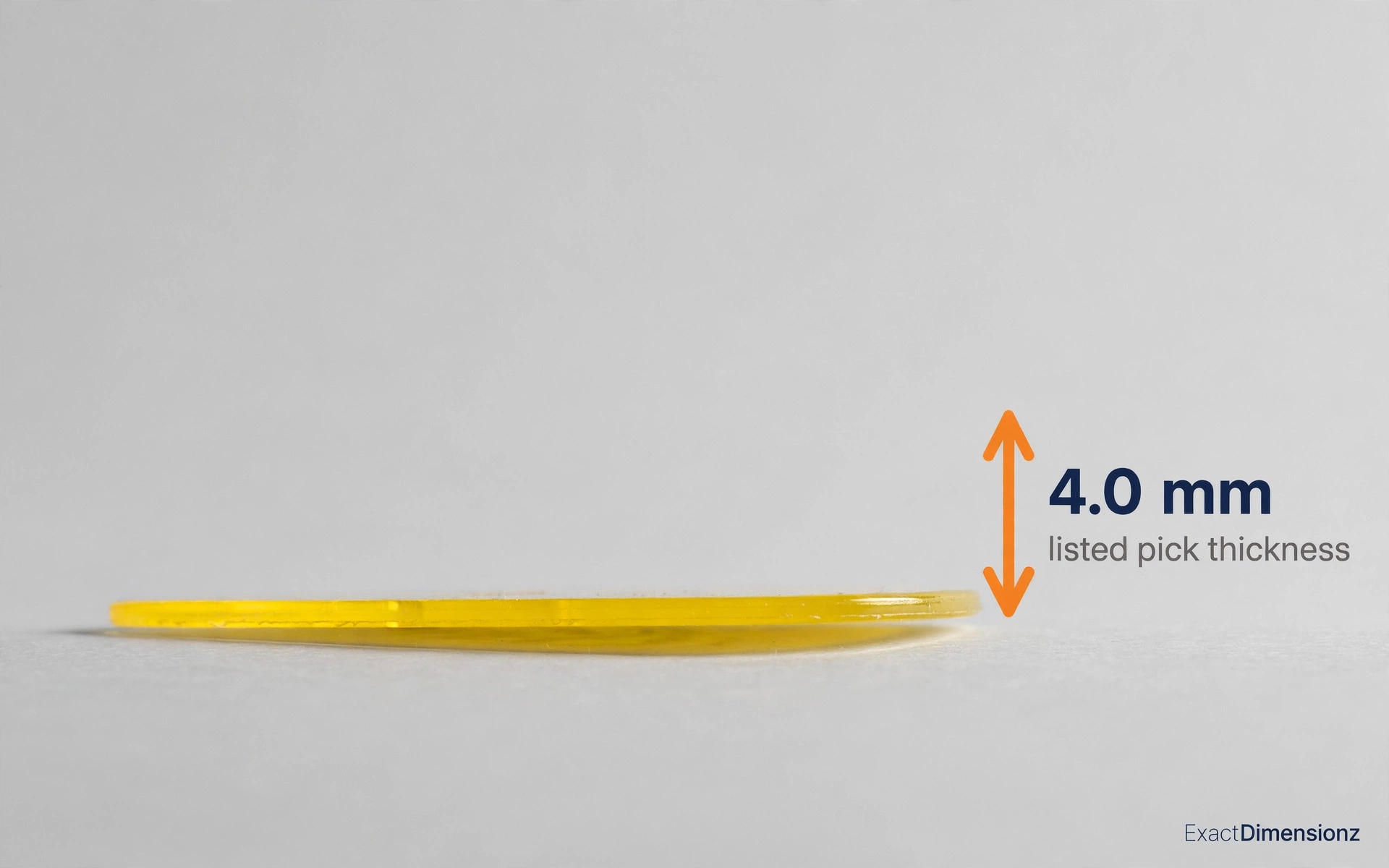
Guitar picks are sold by thickness the way drill bits are sold by diameter, and Gravity Picks lists its acrylic picks in explicit millimeter variants — including the 4.0 mm option, sold as the “4.0mm Yellow.” Pick a 4.0 mm pick off the rack and you are holding a published 4 mm you can feel.
The axis is the pick’s thickness: face to face, the thin dimension you squeeze between thumb and forefinger. The pick’s width and length are separate facts — the 4 mm lives entirely across that slab. Press it and notice how substantial it feels; this is near the top of how thick picks get, which is exactly why 4 mm reads as “a lot of pick” to a guitarist.
The honest framing: no numeric tolerance is published for the thickness, and these picks are hand-shaped and polished from acrylic, so the label is published dimension with a real-world caveat — a manufacturer’s listed variant, never 4.000 mm on every pick. For a size you learn by touch, the listed variant is precisely what makes it trustworthy.
Source: Gravity Picks acrylic picks page — Published dimension.
2. addi addiUnicorn Circular Knitting Needle, 4.0 mm (US 6)
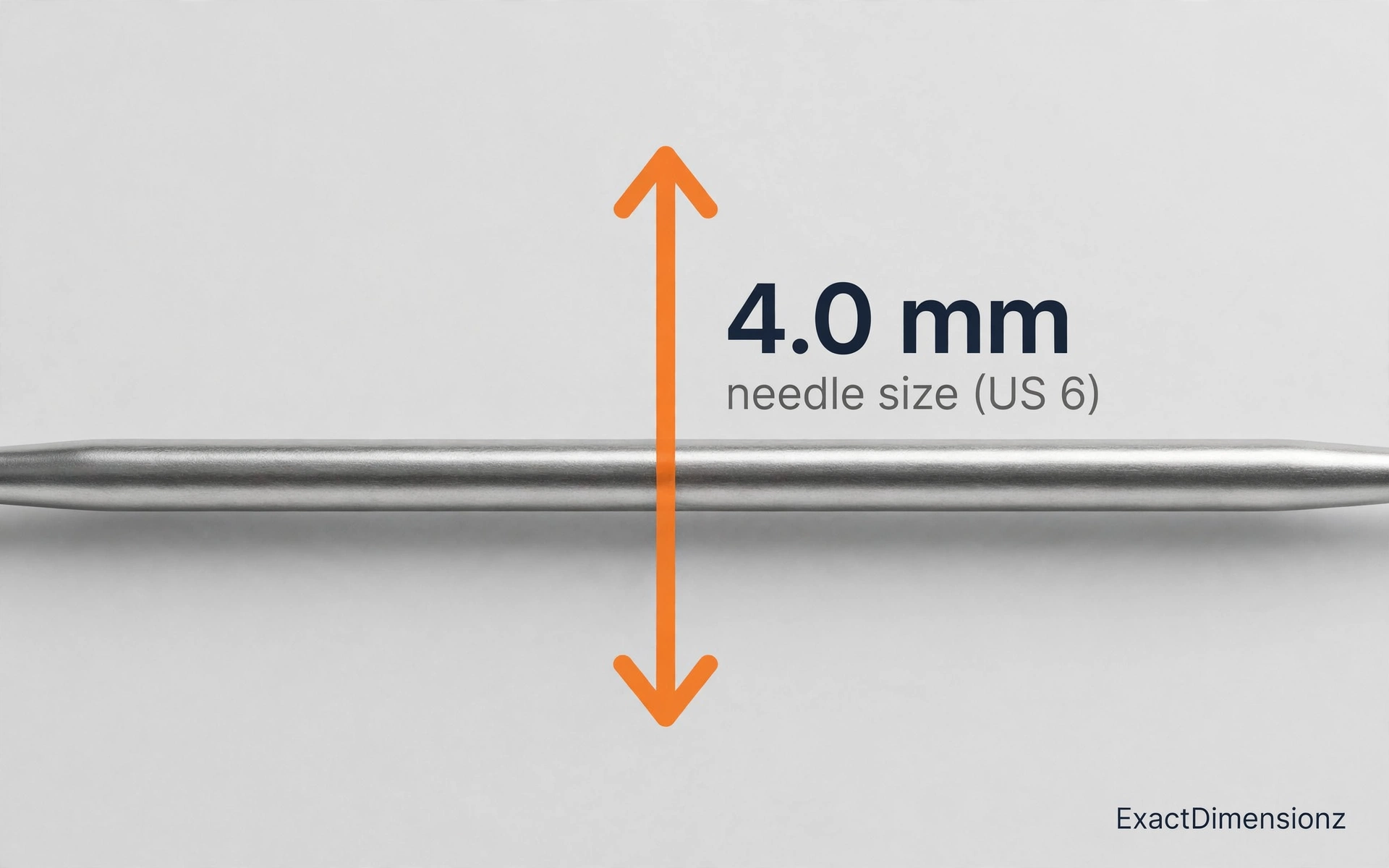
Knitters buy needles by number, and addi’s official Product Variants page lists the addiUnicorn circular knitting needle at 4.0 mm — US size 6, SKU 115-7. It is the same addiUnicorn line that appeared in the 2 mm article at 2.0 mm; this is simply the 4.0 mm variant of that needle, which is no problem at all since each size is its own published product.
The 4.0 mm is the needle tip diameter — the shaft size that sets every stitch the needle makes. Roll it between your fingers and compare it with the pick above: the needle’s diameter and the pick’s thickness are the same published number on two different objects, and your fingers can confirm the match. That cross-check is the whole reason tactile references work.
As with any craft tool, the evidence label does real work: nominal/toleranced size, a manufacturer size grade with no published tolerance. Real needles vary microscopically around the designation, so never read 4.0 mm here as a physical guarantee — it is the size the maker names and the knitter shops for.
Source: addi addiUnicorn product page — Nominal/toleranced size.
In the toolbox. This is where 4 mm earns its keep: drilled into material, threaded into metal, and slipped into gaps to check them.
3. Bosch PointTeQ HSS Twist Drill Bit, 4.00 mm
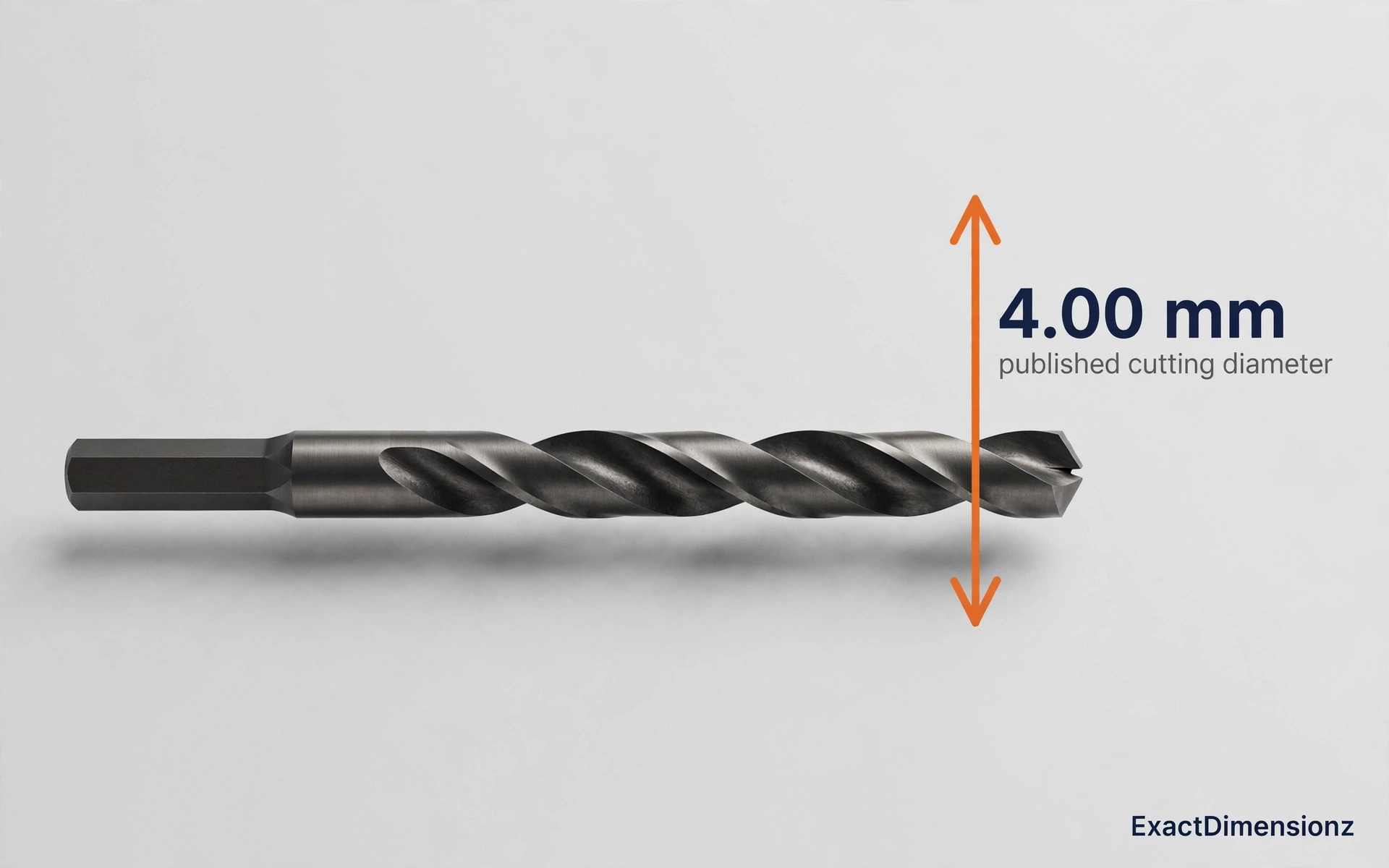
Bosch Professional’s own page for its PointTeQ HSS twist drill bits lists the specification plainly: “Diameter, mm: 4.00.” The 4.00 mm variant — part number 2 608 577 208 — is one row in the diameter family, and it is the row a metalworker reaches for when a hole needs to be just over five-thirty-seconds of an inch wide. (It is not, as you now know, exactly 5/32.)
The 4 mm is the cutting diameter across the flutes: the width of the hole the bit leaves behind. Picture the split-point tip biting into steel — the measurement arrow belongs across that cutting end, never along the shank. HSS twist drills are the general-purpose workhorses of the shop, and 4 mm sits right in the middle of the sizes people actually buy.
Twist drills are made to DIN 338 Type N tolerances, so 4.00 mm is a size designation and the honest label is published dimension with real manufacturing tolerance — no production line turns out bits that all measure 4.000 mm. What the Bosch page gives us is a manufacturer-primary published diameter, and the article treats it as exactly that.
Source: Bosch Professional PointTeQ drill bit page — Published dimension.
4. Ettinger M4 Socket Head Screw, DIN 912 / ISO 4762
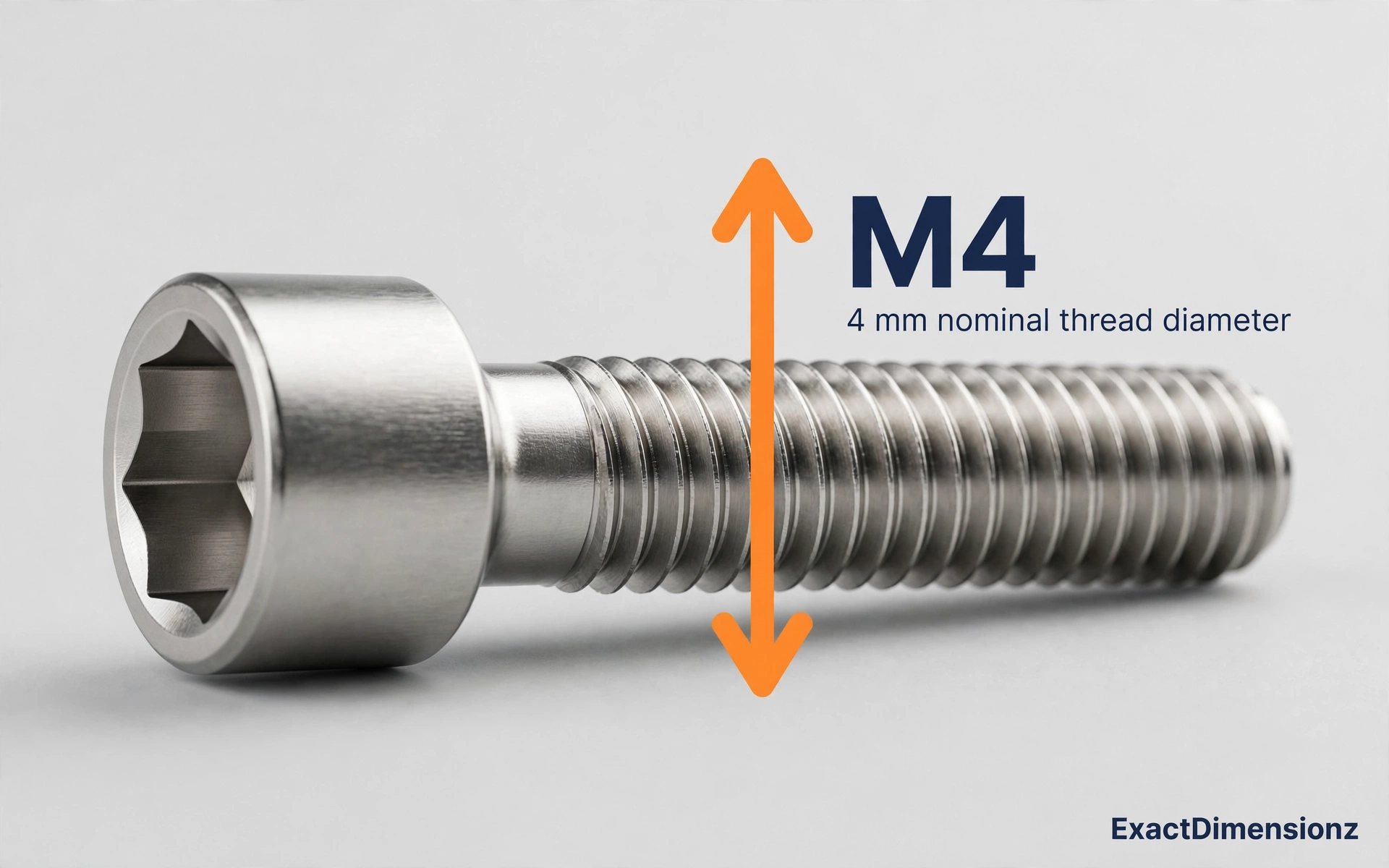
This one product carries 4 mm twice, on two different axes — which makes it the best teaching reference in the list. Take the Ettinger 001.16.495, an M4×55 socket head cap screw in steel 8.8, zinc plated, made to DIN 912 / ISO 4762. The “4” in M4 is the thread story: under ISO 68-1 and ISO 261, an M4 thread has a 4 mm nominal major diameter, measured across the thread crests. And under ISO 4762, the socket head of an M4 screw is 4 mm tall, measured from the bearing surface to the top of the head.
Two axes, one product, one number. Measure across the threads and you get the major diameter; measure the head’s height and you get the other 4 mm. Confusing them would mean measuring the wrong feature entirely — which is why the article keeps hammering the axis question. The standardization is the point of both numbers: M4 is a promise that any M4 nut fits any M4 bolt, and the head dimensions are part of the same deal.
The required honesty, stated qualitatively: production threads are cut to ISO 965 tolerance classes, so real thread crests sit slightly under the nominal 4 mm. There is no single exact number to quote — the tolerance is a band, not a point — so the right claim is simply that a real M4 screw measures a touch under 4 mm across its threads. That does not make the designation wrong; it makes it a standard.
Source: Ettinger M4 socket head screw datasheet — Standardized measurement.
5. DSCF001-M400 Feeler Gage Blade
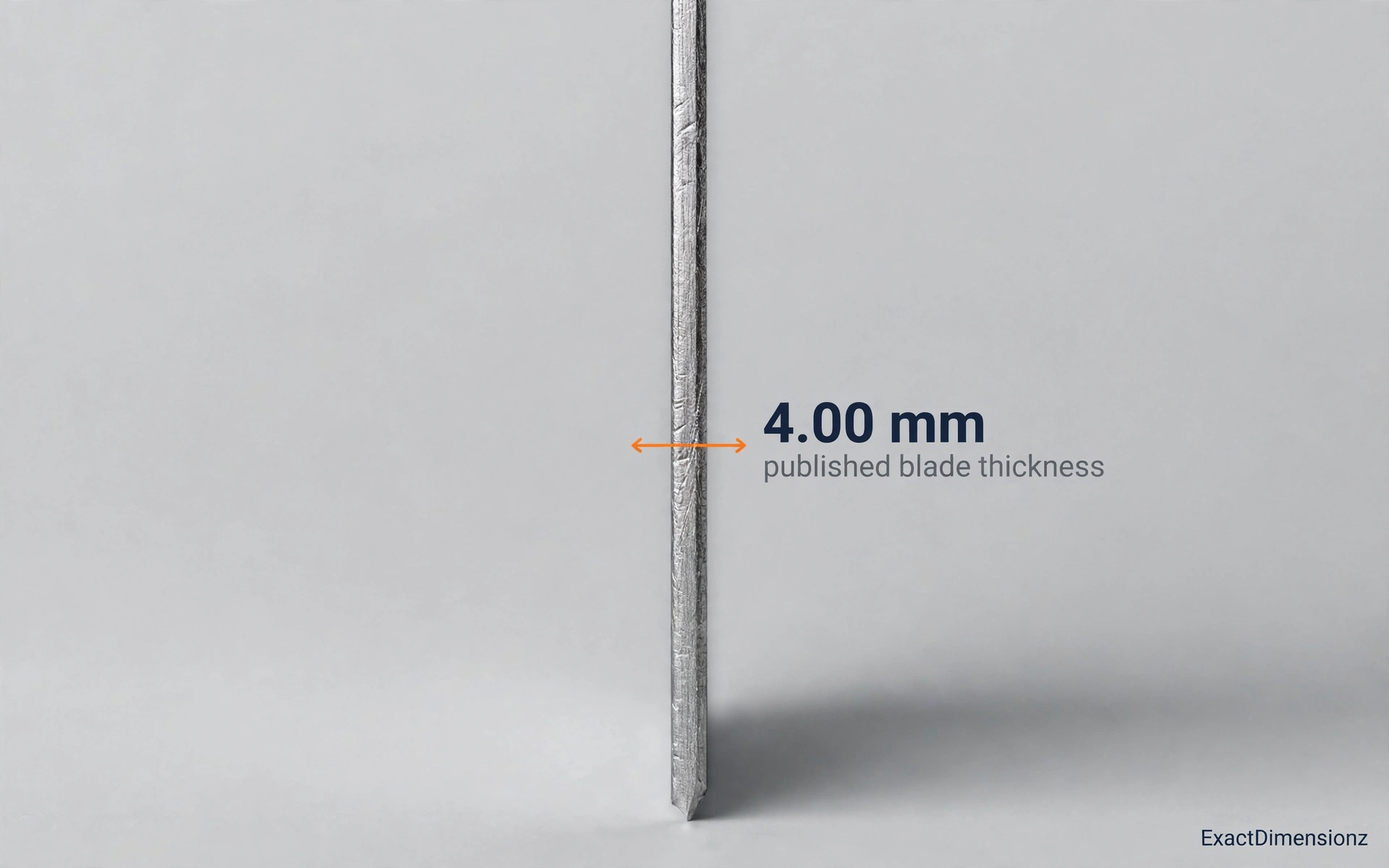
The part number says it outright: DSCF001-M400 is catalogued by the Douglas Stamping Company of Madison Heights, Michigan as a “4.00mm Feeler Gage Blade.” A feeler gauge is a fan of thin steel blades, and each blade has exactly one job — being a known thickness. This blade’s job is 4.00 mm.
Look at the thin edge of the strip, the axis a mechanic slides into a gap to check it. The 4 mm lives entirely between the blade’s two faces; the width and length of the strip are irrelevant to the measurement. It is about as literal as a size reference gets — the product exists to be the dimension, and a 4 mm blade is one you would actually reach for, sitting a full 2 mm above the 2 mm blade from the earlier article.
The catalog states no tolerance for the blade, so the careful framing is that 4.00 mm is the manufacturer’s published blade thickness: a catalog value, not a guarantee that every blade measures 4.000 mm to the micron. For a shop tool whose entire purpose is a known thickness, the published value is precisely what makes it trustworthy.
Source: Douglas Stamping Co. catalog — Published dimension.
Inside the machine and the clinic. Shrink down and step inside the equipment around you — and, in one case, inside a doctor’s instrument tray. Lenses bend light at 4 mm across, terminal poles sit 4 mm apart, a biopsy blade cuts a 4.0 mm circle, and pneumatic tubing carries air through a 4 mm outer diameter of industrial polyurethane tubing.
6. Edmund Optics #45-223 Plano-Convex Lens
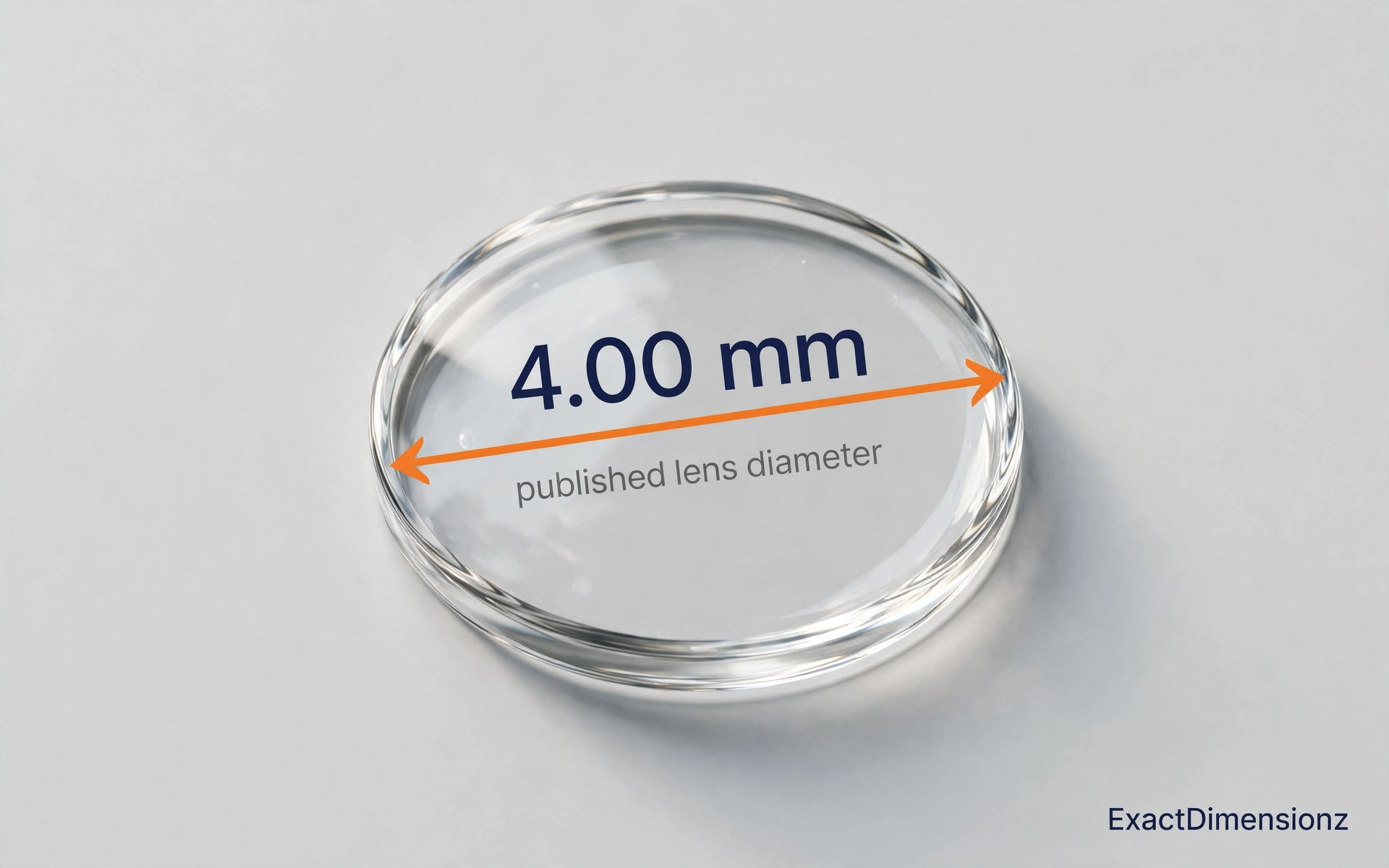
This part number is a small trap for the careless, which is exactly why it belongs here. Edmund Optics sells the TECHSPEC #45-223 as a “4.0mm Dia. x 4.0mm FL” uncoated plano-convex lens — and the product page lists three different 4.0-ish numbers on three different axes: the diameter is 4.00 mm (tolerance +0.0/−0.025 mm), the center thickness is a separate 1.70 ±0.05 mm, and the focal length is 4.00 mm ±1%. This section is about the diameter only.
Imagine a glass disc about the width of a pencil eraser’s smaller cousin, the kind of component that sits inside lasers, sensors, and optical instruments. The 4 mm spans straight across its circular face. An arrow drawn across that face shows the supported axis; an arrow through the lens’s depth would show 1.70 mm, and an arrow to the focal point would show something else again. One part, three numbers — the axis is everything.
The +0.0/−0.025 mm diameter tolerance is unusually tight — the diameter may only ever come in under 4.00 mm, never over — which is what you expect from a TECHSPEC optic. The label is published dimension: the manufacturer’s own number for this exact stock part, with its real tolerance printed alongside.
Source: Edmund Optics #45-223 specsheet — Published dimension.
7. PTR Hartmann AK4091 KD-4.0 PCB Terminal Blocks
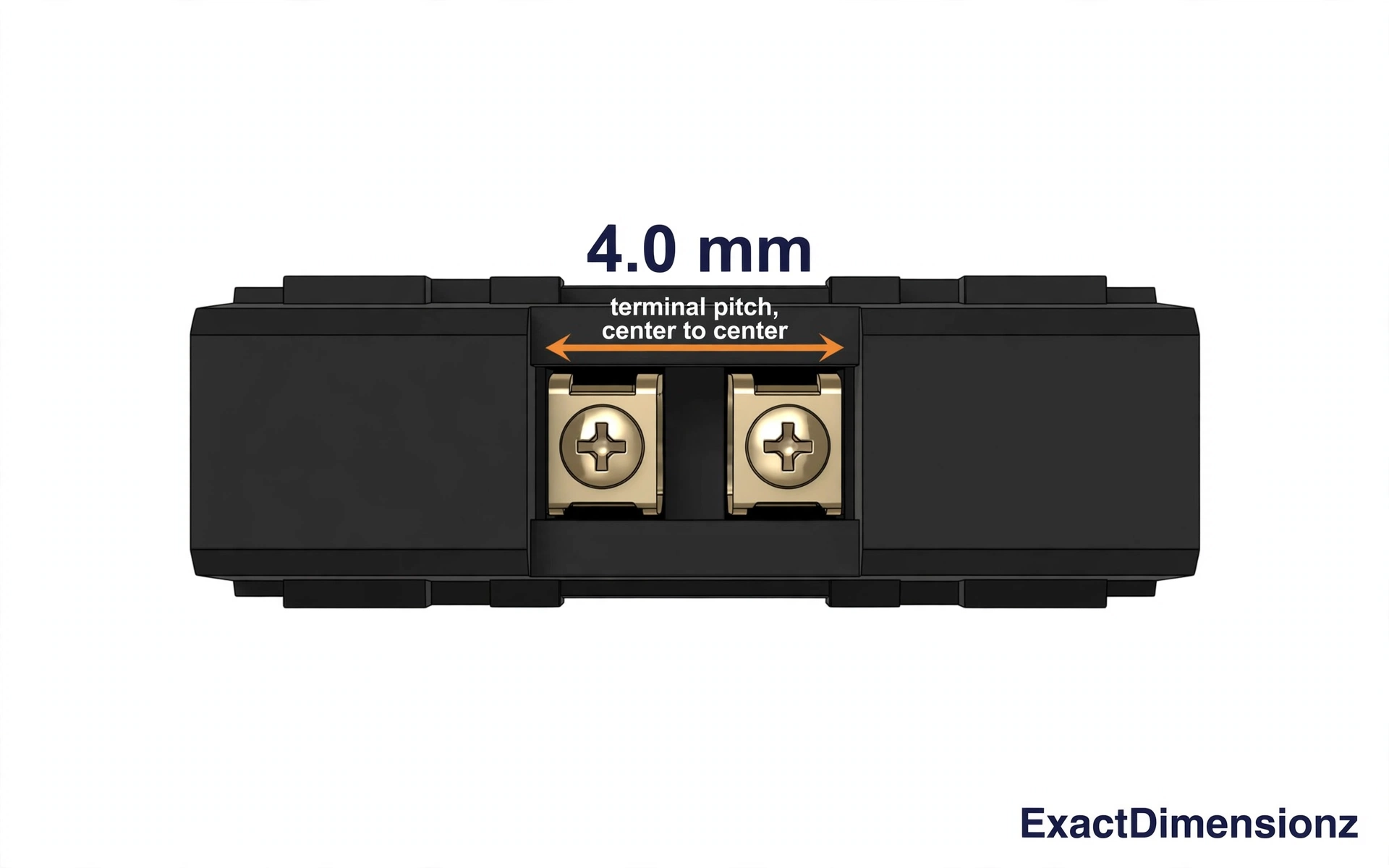
Measure between — not across. The PTR Hartmann AK4091/..KD-4.0-WH-SMD family is a series of PCB terminal blocks, and the “4.0” in the series name is the pin pitch: 4.0 mm centerline along the terminal row, the distance from the center of one pole to the center of its neighbor. A single-pole module is 4.00 mm wide, which is the same number on a different feature of the same product.
This is the caveat the section requires, stated plainly: 4.0 mm is the pole spacing, not the housing width, which grows with the pole count. An image must draw its arrow spanning two adjacent pole centerlines and label it “4.0 mm pitch (center to center)” — an arrow across a six-pole housing would teach the wrong fact, since that housing is far wider than 4 mm.
Because the 4.0 mm pitch is a manufacturer-published dimension of a standardized terminal-block series, the evidence label is standardized measurement. These blocks live on circuit boards inside equipment, quietly connecting wires on a 4 mm grid you will never see unless you open the case.
Source: PTR Hartmann AK4091 KD-4.0 product page — Standardized measurement.
8. Integra Miltex 33-34 Sterile Disposable Biopsy Punch
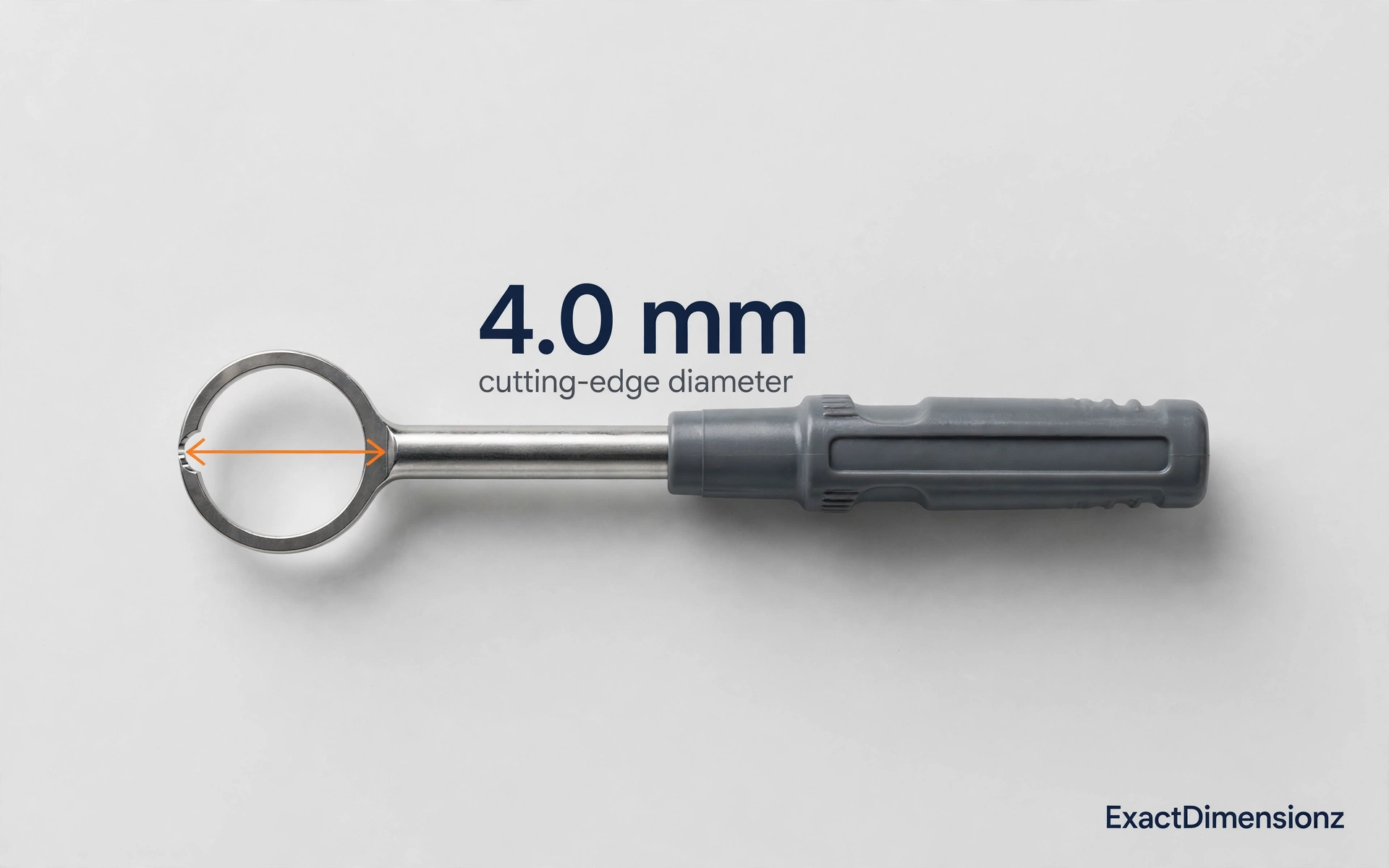
The clinic delivers the most literal 4 mm circle in the list. Integra’s Miltex dermatology brochure tabulates its sterile disposable biopsy punches by size, and model 33-34 is listed at 4.0 mm — the cutting-edge diameter across the circular blade. Press one into skin and it removes a 4.0 mm disc of tissue; the number is the diameter of the hole it is designed to cut.
The axis is the cutting edge: straight across the circular blade’s opening, the part that does the work. Measure between the outer edges of that circle, not along the handle, which is a separate and much longer dimension.
Two qualifications keep this reference straight. First, no cutting-edge tolerance is published in the brochure, so 4.0 mm is the designated size — the label is published dimension, a manufacturer’s stated size for a specific model. Second, this is a sterile single-use device: you would never keep one around as a measuring reference, and the article does not suggest doing so. The size is a published fact about a real product, and that is what makes it a reference, not a tool.
Source: Integra Miltex dermatology brochure (PDF) — Published dimension.
9. SMC TU0425 Polyurethane Tubing
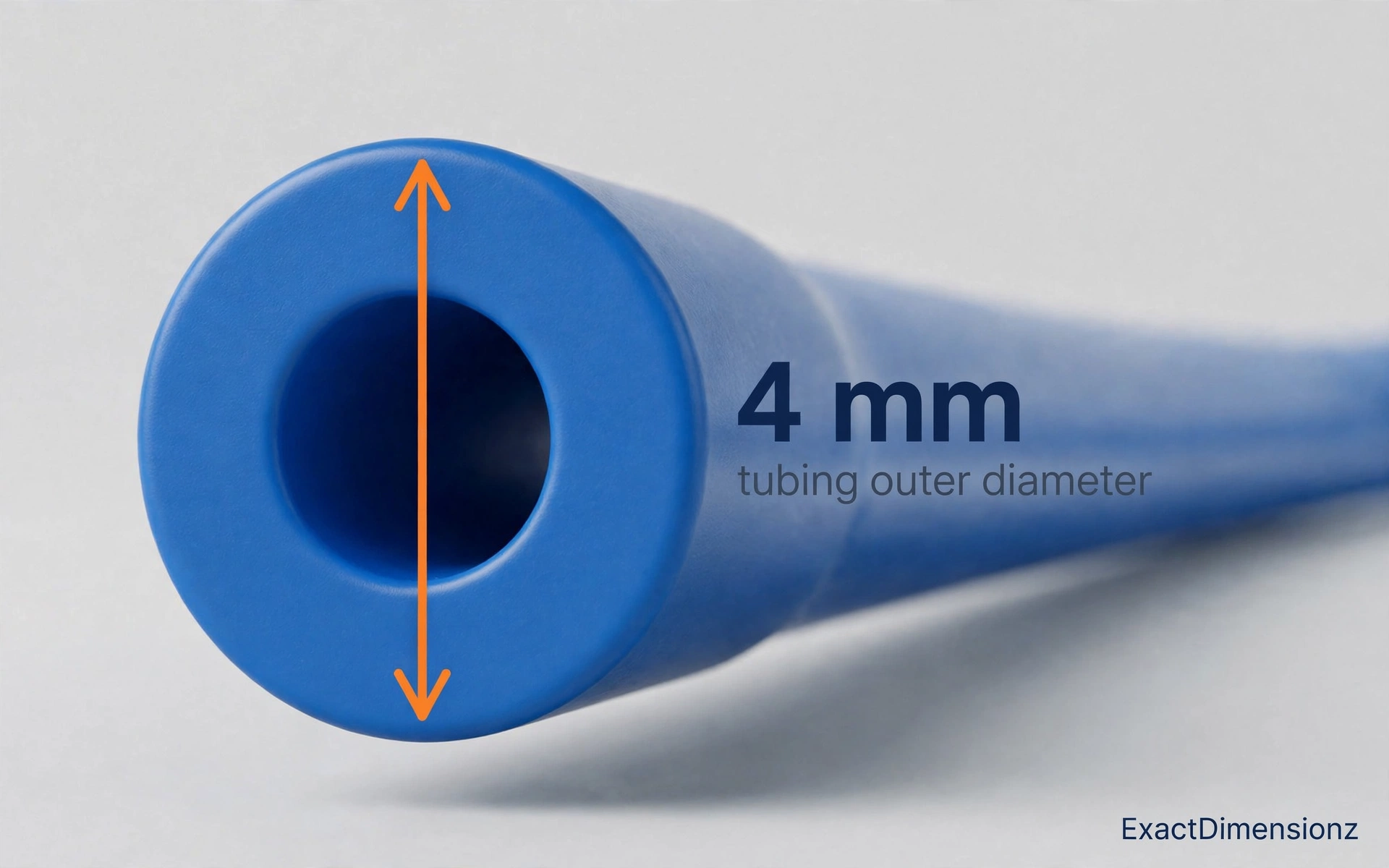
The factory floor closes the list — almost. SMC’s TU series polyurethane tubing in size TU0425 — for example TU0425BU-20 — is designated by its outside diameter: 4 mm O.D. with a 2.5 mm I.D., the outer diameter of the extruded tube measured wall to wall. Squeeze a length of it and the 4 mm is the number your fingers are spanning.
The axis is the outer diameter: across the full tube, outer wall to outer wall — not the 2.5 mm inner bore, which is a different fact about the same tube. The endpoints matter here because tubing has two diameters and only one of them is 4 mm.
Two qualifications, both firm. First, no OD tolerance is published, so the label is nominal/toleranced size: an extruded size designation, never 4.000 mm on every meter. Second, and critically: this is industrial pneumatic tubing, rated to a maximum 0.8 MPa at 20 °C — it is not medical-grade, and the article never presents it as such. Air lines in automation are its world, and the 4 mm belongs there.
Source: SMC TU tubing catalog (PDF) — Nominal/toleranced size.
From the workshop to the living room. We’ve drilled it, threaded it, cut it, and plumbed air through it. Now let’s unroll it on the floor — because 4 mm also shows up where you’d least expect a precise measurement: under your hands and knees.
10. Manduka eKO Lite Natural Rubber Yoga Mat, 4 mm
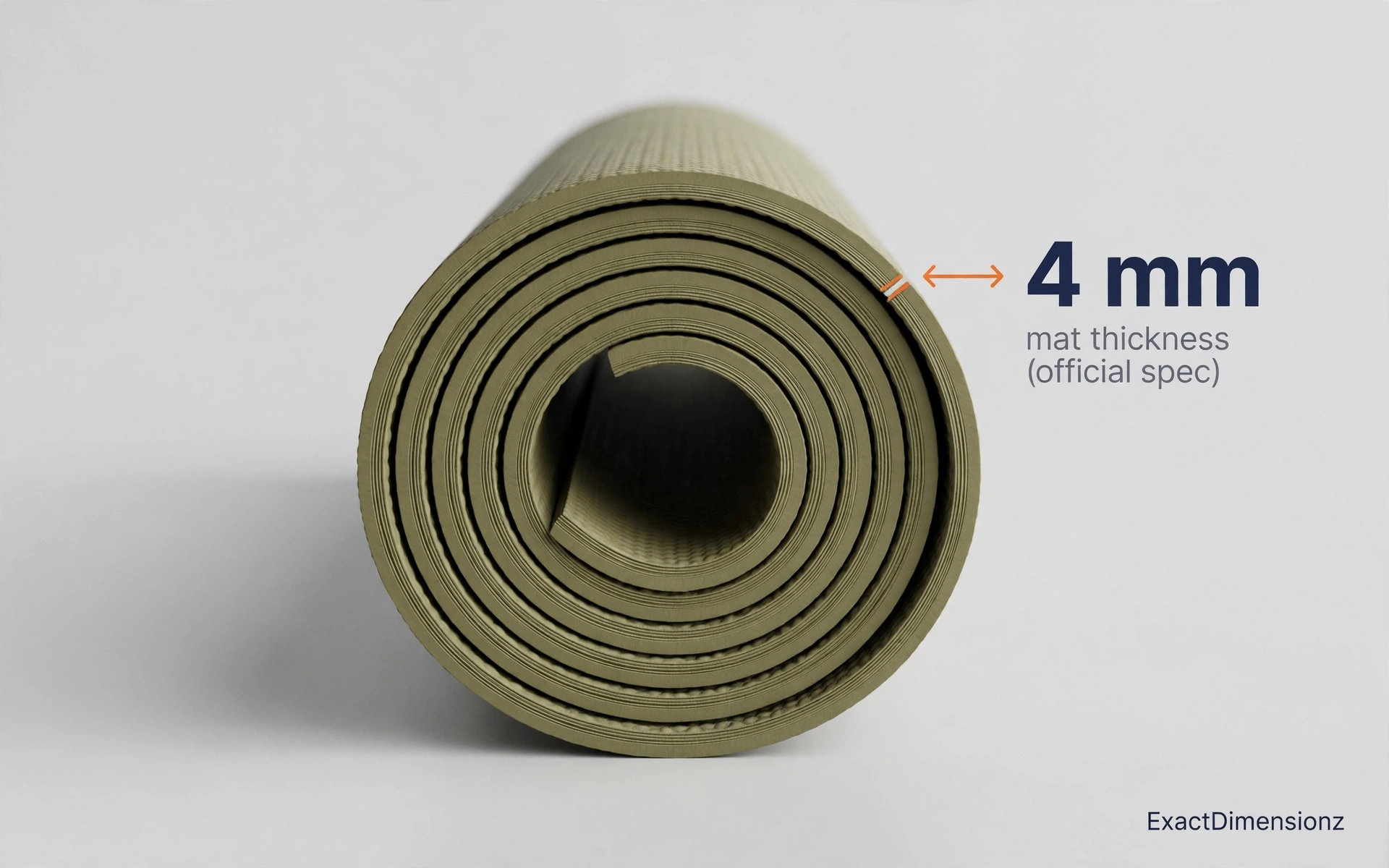
Manduka sells this mat with the thickness right in the official product name: the “eKO Lite Natural Rubber Yoga Mat 4mm.” Not buried in a spec table three clicks deep — the 4 mm is in the title, which tells you something about how much this number defines the product. It’s a natural rubber mat with a slightly thinner, lighter profile than standard mats, and its closed-cell construction keeps moisture from seeping in.
The axis is the mat’s thickness: top surface to bottom surface, the slab your thumb presses into when you pick it up by the edge. Unroll it on a hard floor and 4 mm is what stands between your knees and the ground. This is the same “thickness through a flat object” axis as the guitar pick in section 1 — just scaled up to the size of a room.
Honestly framed: no per-unit tolerance is published, so the label is official specification — the manufacturer’s own listed thickness for this exact product, never a claim that every mat measures 4.000 mm. And here’s why it works as a reference: pinch the mat’s edge between your fingers. That slab you’re feeling is 4 mm — the same number you learned on a guitar pick, now hiding in your living room.
Source: Manduka eKO Lite Yoga Mat 4mm product page — Official specification.
What the Evidence Labels Mean
Since the list mixes evidence types deliberately, here is what each label promises — and what it does not:
- Official specification: published by an authoritative body. The strongest tier, but still subject to rounding and production tolerance.
- Published dimension: printed in a manufacturer’s own catalog or datasheet for a specific model. Direct primary evidence for that product’s stated size.
- Standardized measurement: a dimension defined by an industry standard or a standardized product series. Real and meaningful, but still manufactured within tolerances.
- Nominal/toleranced size: a manufacturer’s size designation. The number names the size grade; individual units vary around it. Never read these as “exactly 4.000 mm.”
No reference in this article was inferred from a photograph, and none rests on a retailer listing alone.
Near 4 mm Comparisons, With the Difference Calculated

Sometimes the most useful reference is the one that almost matches. These three sit close enough to 4 mm to picture it against, with the exact gap stated:
| Object | Published size | Difference from 4 mm |
|---|---|---|
| 5/32 inch | 3.96875 mm | 0.03125 mm thinner |
| 3/16 inch | 4.7625 mm | 0.7625 mm thicker |
| V-Picks Diamond pick | 3.75 mm | 0.25 mm thinner |
The 5/32 inch is the interesting one: a single thirty-second of a millimeter short of 4 mm, close enough that workshops treat them as interchangeable in rough talk — but not the same number. The 3/16 inch overshoots by three-quarters of a millimeter, which your fingers would notice. And the V-Picks Diamond shows that even guitar picks come in near sizes: a quarter millimeter thinner than our 4.0 mm Gravity reference. These near-misses do not count as 4 mm references, which is why they sit in their own section.
How to Measure 4 mm Accurately
For most purposes a metric ruler is enough: count four millimeter ticks past zero. When you need more confidence, a feeler gauge set — the DSC blade above belongs to one — lets you compare a gap directly against a known 4.00 mm blade.
Digital calipers are the next step up, and they deserve a precise explanation. A caliper’s resolution (the smallest increment its display shows, often 0.01 mm) is not the same as its accuracy (how close its readings come to the true value, which depends on the instrument’s quality and calibration). A display that reads to 0.01 mm does not automatically measure to 0.01 mm. For a fuller tour of the instruments, see our measurement tools guide.
Whatever tool you use, measure the right axis. The single most common 4 mm measuring error is not instrument error at all — it is measuring a diameter when you meant a thickness, a pitch when you meant a width, or, on an M4 screw, the head when you meant the thread.
Common Mistakes About 4 mm
- Calling 5/32 inch “equal to” 4 mm. It is 3.96875 mm — a thirty-second of a millimeter short, close but not equal.
- Treating 0.15748 inches as mathematically exact. It is a rounded decimal display of the exact fraction 20/127.
- Saying 4 mm is “four times as big” as 1 mm. Say four times the length — “big” is vague and misleading.
- Assuming nominal products are physically exact. A 4.00 mm drill bit, a 4.0 mm needle, and 4 mm tubing are size designations made to tolerances, not 4.000 mm guarantees.
- Calling SMC pneumatic tubing medical-grade. It is industrial tubing rated for air lines — never present it as medical.
- Mixing up the lens’s three numbers. On the #45-223, diameter, center thickness, and focal length are three different axes — check which one the 4.00 mm describes.
- Reading pitch as housing width. On the PTR Hartmann blocks, 4.0 mm is the pole spacing; the housing grows with pole count.
- Mixing up the M4’s two 4 mm axes. Thread diameter and head height are different measurements on the same screw.
- Treating the biopsy punch as a measuring tool. Its 4.0 mm is the cutting-edge diameter of a sterile single-use device — a published fact, not a workshop reference.
Frequently Asked Questions
How many centimeters are in 4 millimeters?
Exactly 0.4 cm. A centimeter contains 10 millimeters, so 4 mm is four-tenths of a centimeter.
How many inches is 4 mm?
About 0.15748 inches — a rounded decimal display of the exact fraction 20/127 inch.
Is 4 mm equal to 5/32 of an inch?
Not exactly. 5/32 inch equals 3.96875 mm, so it falls 0.03125 mm short of 4 mm. Fine for rough conversation, but they’re different numbers.
What does M4 mean on a screw?
M4 means a 4 mm nominal major diameter under ISO 68-1/261. On an ISO 4762 socket head screw, the head is also 4 mm tall — two different 4 mm axes on the same product. Real threads are cut to tolerance classes, so the crests sit slightly under 4 mm.
Can SMC 4 mm tubing be used for medical applications?
No. SMC TU tubing is industrial pneumatic tubing rated for air lines (maximum 0.8 MPa at 20 °C). It is not medical-grade and should never be presented as such.
How do I measure 4 mm without calipers?
Count four millimeter ticks past zero on a metric ruler. Or hold up something you know: the thickness of a 4.0 mm guitar pick or the diameter of a 4.0 mm knitting needle.
Final Thoughts
Four millimeters turns out to be the size where measurement becomes touch. Below it, sizes are numbers you read off instruments; at 4 mm, a pick, a needle, and a screw thread are all things your fingers can actually know. That is why one number keeps showing up in hands, toolboxes, machines, and clinics all at once.
Keep the evidence labels with you, and keep asking which axis the number describes. A published 4 mm tells you what the designer intended; the tolerance tells you what the factory is allowed; the axis tells you where to put your calipers — or your fingers. With those habits, 4 mm stops being abstract and becomes a size you can hold.
