
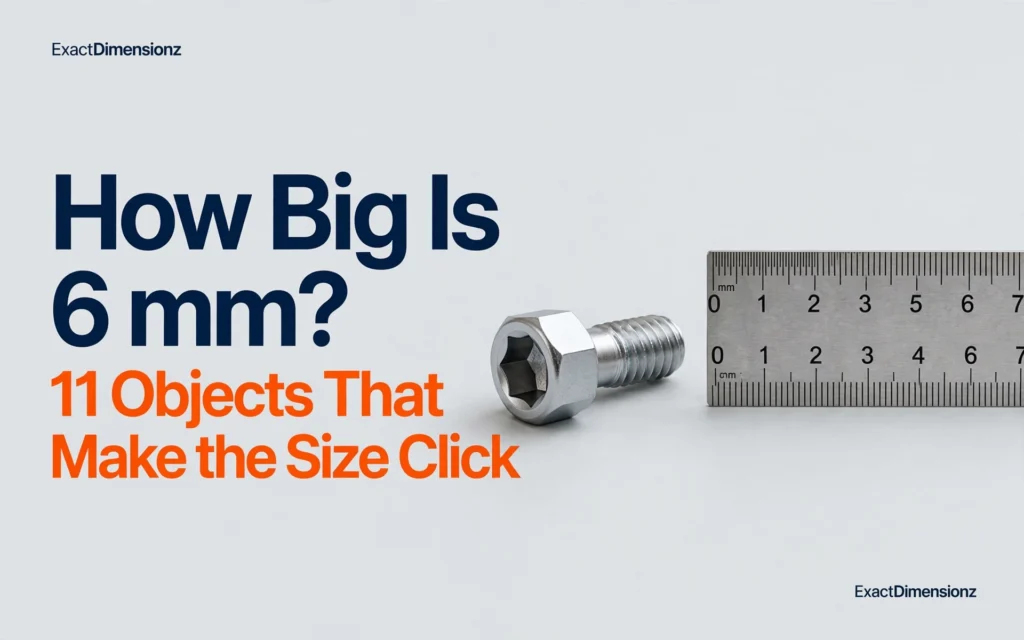
How big is 6mm? Think quarter-inch — then shave off a whisper. It is exactly 0.6 centimeters, about 0.23622 inches, and six times the length of a single millimeter. On a ruler, it’s six ticks past zero — the diameter of an airsoft BB, the thread size stamped on the most common bolt in the hardware store, the thickness of a yoga mat that doesn’t bottom out your knees.
Six millimeters is the metric size living next door to the imperial quarter-inch (1/4 inch equals 6.35 mm), and that neighborhood is exactly why it shows up everywhere. It is the most standardized small millimeter: M6 threads hold together machinery, furniture, and bicycles across the planet. This article gives you eleven verified real-world references for 6 mm, each tied to a named product and a primary source. Every reference carries an evidence label — official specification, published dimension, standardized measurement, or nominal/toleranced size — so you always know what kind of “6 mm” you’re looking at. If 5 mm is the half-centimeter you can feel, 6 mm is the millimeter that does the work.
How big is 6mm?
Six millimeters is exactly 0.6 centimeters — about 0.23622 inches. On a metric ruler, it is six millimeter ticks past zero.
Total: 6 mm
The scale explains the measurement but is not physically calibrated on every screen. Screen size and browser zoom can change its displayed length.
11 Objects and Products Listed at 6 mm
A note on evidence before we begin. The eleven references below come from different kinds of sources. An official specification comes from the manufacturer itself. A published dimension is printed in a manufacturer’s own catalog or datasheet for a specific model. A standardized measurement is defined by an industry standard. A nominal/toleranced size is a manufacturer’s size designation that real units only approximate.
A published 6 mm designation does not mean every manufactured unit measures 6.000 mm. The label on each reference tells you which kind of evidence you are looking at, and each section states the limitation in plain words.
These eleven sort themselves into four neighborhoods. First, the threaded world — screws and the tools that cut threads for them. Then the spinning world — things that rotate at 6 mm. Then the precision you can’t see, components so small the 6 mm hides inside them. And finally, the everyday 6 mm: the ones sitting in your gear bag, your craft drawer, your gym corner, your window frame.
The threaded world. More M6 fasteners exist than any other metric size in this range, and the tooling that makes their threads lives at 6 mm too. Start here, because this is where 6 mm is a standard — not just a measurement.
1. Unbrako M6 Socket Head Cap Screw, DIN 912 / ISO 4762

This one product carries 6 mm twice, on two different axes — which makes it the best teaching reference in the list, and a familiar rhythm for readers who met the M4 and M5 versions in earlier articles. Take the Unbrako M6 socket head cap screw, made to DIN 912 / ISO 4762. The “6” in M6 is the thread story: under ISO 68-1 and ISO 261, an M6 thread has a 6 mm nominal major diameter, measured across the thread crests. And under ISO 4762, the socket head of an M6 screw is 6.0 mm tall — the head height H, published right in Unbrako’s own catalog row (M6 / 1.00 / A 10.0 / W 5.0 / H 6.0).
Two axes, one product, one number. Measure across the threads and you get the major diameter; measure the head’s height and you get the other 6 mm. Confusing them would mean measuring the wrong feature entirely — which is why the axis question keeps getting asked. The standardization is the point of both numbers: M6 is a promise that any M6 nut fits any M6 bolt anywhere in the world, and the head dimensions are part of the same deal.
The required honesty, stated qualitatively: production threads are cut to ISO 965 tolerance classes, so real thread crests sit slightly under the nominal 6 mm. There is no single exact number to quote — the tolerance is a band, not a point — so the right claim is simply that a real M6 screw measures a touch under 6 mm across its threads. That does not make the designation wrong; it makes it a standard. The head height is likewise a nominal 6.0 mm under ISO 4762 tolerances.
Source: Unbrako M6 socket head cap screw catalog — Standardized measurement.
2. Walter Paradur Eco Plus Machine Tap, EP2053302-M6

If the screw above is the result, this is the tool that makes the result. A machine tap cuts internal M6 threads into a drilled hole, and Walter’s datasheet for the Paradur Eco Plus EP2053302-M6 names the size twice on two different axes. The first axis is the M6 thread itself: pitch 1 mm, tolerance class 6GX — the designation of the internal thread this tap produces. The second axis is the tap’s connection, the shank diameter d1 = 6 mm: the part the tapping chuck grips.
That shank number is worth a pause. It runs at tolerance class h9, which means it sits at or below 6.000 mm — up to 0.030 mm under. This is the honest face of manufacturing: a 6 mm shank that is allowed to be slightly smaller, because the chuck must grip it. Never read it as “exactly 6 mm” — the h9 tolerance says plainly that it isn’t.
Put the two axes side by side and you get the full picture of this object: a 6 mm grip driving an M6 thread. The tap’s body is the everyday handle; the thread it cuts is the standardized promise. And the evidence label, official specification, is direct primary evidence — Walter’s own datasheet for this exact part number.
Source: Walter Paradur Eco Plus EP2053302-M6 product page — Official specification.
The spinning world. Some 6 mm values rotate. Drill bits, bearings, and shafts all live at this size, and each one puts the 6 mm on a different spinning axis.
3. DeWalt EXTREME 6mm HSS-G Gold Drill Bit, DT5549-QZ

The workshop standard arrives in gold. DeWalt’s EXTREME HSS-G gold ferrous metal drill bits are listed with the specification plainly: “Product Diameter [mm] 6” — and the product name itself carries it: “these 6mm diameter EXTREME 2 Metal Drill Bits.” The DT5549-QZ variant is the 6 mm member of the family, sold in a 10-pack.
The 6 mm is the cutting diameter across the flutes: the width of the hole the bit leaves behind. Picture the split-point tip biting into steel — the measurement arrow belongs across that cutting end, never along the bit’s length. HSS-G twist drills are the general-purpose workhorses of the metal shop, and 6 mm sits right where everyday work happens: one step up from the 5 mm bit of the previous article, one step down from the 1/4-inch bit people confuse it with.
The honest framing: no ground-tolerance class is published on this page, so the label is official specification — the manufacturer’s own stated cutting diameter for this exact product — with a real-world caveat that production bits vary within their manufacturing tolerances. It is a Delrin-free, catalog-real 6 mm. And as a deliberate choice, this is a DeWalt bit rather than a Bosch one, because the 4 mm and 5 mm articles already used Bosch — variety keeps the series honest.
Source: DeWalt EXTREME 6mm drill bit product page — Official specification.
4. NSK 626ZZ1 Miniature Ball Bearing

Open up a small motor, a card reader, or a cooling fan and you may find a bearing like this one: the 626ZZ1 miniature deep-groove ball bearing. NSK’s own datasheet lists the boundary dimensions as d = 6 mm bore, D = 19 mm outer diameter, B = 6 mm width — and there is a second 6 mm hiding in plain sight: the bearing’s width is also 6 mm, two different axes on one tiny part.
The headline 6 mm lives strictly on the bore axis: the inner hole the shaft passes through. The measurement arrow belongs across that hole and nowhere else — never across the 19 mm outer diameter, which is a different fact entirely. At this scale the bore is the working surface, the part the bearing is actually for. The width axis is the bearing’s thickness through the housing, and it just happens to be 6 mm as well.
The careful framing is standardized measurement: a standardized nominal boundary dimension, with no tolerance class stated on the datasheet page — real bearings follow ISO tolerance classes, so no unit is literally 6.0000 mm. The datasheet is NSK-authored, direct primary evidence for the part NSK sells.
Source: NSK 626ZZ1 bearing datasheet (PDF) — Standardized measurement.
5. MISUMI E-SFJ Linear Shaft, D = 6 mm
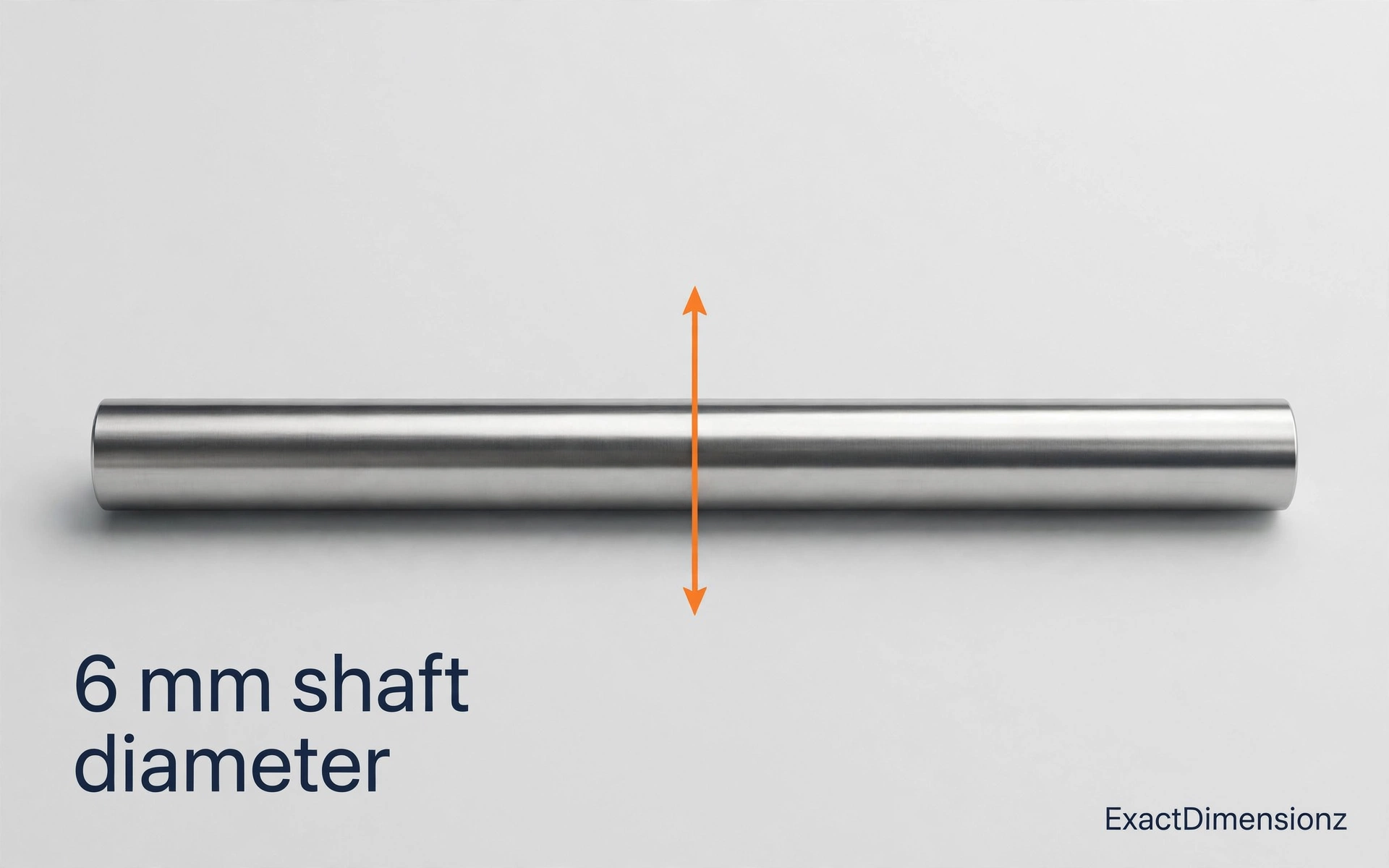
This is the most honest number in the entire list. MISUMI’s E-SFJ straight linear shaft in size D = 6 is a 6 mm diameter steel rod — the kind of shaft that slides through a linear bushing in a 3D printer, a small CNC machine, or a packaging line. You pick the length (20 to 800 mm); the 6 mm is the shaft’s diameter, the round cross-section the bushing rides on.
Here is what makes it special: MISUMI publishes the actual tolerance. The D dimension is made to tolerance class g7, which for a 6 mm shaft means it measures 5.984 to 5.996 mm — that is, 0.004 to 0.016 mm under 6.000 mm. No guessing, no “approximately”: a real, printed band. It has to run under 6.000 mm, because a bushing bore sized for a nominal 6 mm shaft needs clearance to slide.
That is why the evidence label is nominal/toleranced size, and why this section is the list’s tolerance showcase. Most references in these articles can only promise “there is a tolerance” — this one can print the numbers. Read it as exactly what it is: a 6 mm designation with a published 5.984–5.996 mm reality. If you only remember one lesson from this article, make it this one.
Source: MISUMI E-SFJ linear shaft page — Nominal/toleranced size.
The precision you can’t see. Shrink down. Lenses bend light at 6 mm across and switches sit on 6 × 6 mm grids — a 6 mm you will probably never notice, but the electronics do.
6. Thorlabs Ø6.0 mm N-BK7 Plano-Convex Lens, LA1417

Optics returns with a new maker. Thorlabs sells the LA1417 as a Ø6.0 mm N-BK7 plano-convex lens — a small glass disc that sits inside lasers, sensors, and optical instruments, focusing light the way the Edmund lenses of earlier articles did. This is the 6.0 mm variant of that family, and it is here because Thorlabs publishes its numbers plainly.
The 6.0 mm is the lens diameter: straight across the circular face. This is a plano-convex lens — flat on one side, curved on the other — so the axis question matters the way it did for the 4 mm Edmund lens: the diameter is the supported axis, while the center thickness is a separate, smaller number. An arrow across the face shows the right thing; an arrow through the glass does not.
The honest framing is unusually good for a component this small: Thorlabs publishes a diameter tolerance of +0.00/−0.10 mm, which means the lens measures between 5.9 and 6.0 mm — never over, allowed a tenth under. That is real precision grinding, and it is still not literal 6.000 mm. The label is official specification: the manufacturer’s own number for this exact stock part, with its real tolerance printed alongside. Thorlabs replaces Edmund here deliberately — the 4 mm and 5 mm articles already used Edmund, and the series keeps its makers fresh.
Source: Thorlabs LA1417 lens product page — Official specification.
7. Omron B3F Tactile Switch, 6 × 6 mm

The smallest axis in the list belongs to your keyboard, your remote, and your microwave panel. Omron’s B3F tactile switches — the clicky little buttons under countless device faces — come in a lineup table with a “6 × 6mm” column. That 6 × 6 mm is the switch body’s footprint: the square the component occupies on the circuit board, six millimeters on each side.
Read the axis carefully, because this one is a size class, not a single dimension. The 6 × 6 mm names the body-package family — the outline on the PCB layout — the way a shoe size names a last rather than a measured foot. The actual molded body sits within that class, and the plunger’s travel is a fraction of a millimeter. Confusing the package class with a toleranced measurement would be the whole error this article exists to prevent.
So the evidence label does quiet work here: published dimension, a nominal catalog package class, stated without inflating it into an exact measurement. It is direct primary evidence from Omron’s own features page — the maker’s own name for the size — and the article treats it as exactly that, nothing more.
Source: Omron B3F tactile switch features page — Published dimension.
The everyday 6 mm. Back out in the open. Airsoft players, crocheters, yogis, and glaziers all handle 6 mm without thinking about it — and each one puts it on a different axis.
8. Elite Force .28g Precision 6mm Airsoft BBs, 2700 ct

The most relatable 6 mm in the list, and the one most readers can go hold right now. Airsoft as a sport is built on the 6 mm caliber: Umarex’s Elite Force .28-gram precision BBs carry “6mm” right in the official product title, 2,700 to the tub. Every airsoft barrel in the world is bored to fire these.
The axis is the BB’s diameter: straight across the sphere. Roll one between your fingers and you are feeling the same published number as the drill bit’s cutting diameter above, on two completely different objects — one that cuts steel, one that stings at a skirmish. That cross-check is the whole reason tactile references work.
The honest framing is published dimension with a real-world caveat: 6 mm is the nominal airsoft caliber, and plastic-molded BBs carry inherent diameter tolerances — no molded sphere comes out at exactly 6.000 mm. The label names the caliber the maker sells and the player buys. And here is a sizing note that travels with the image: all BBs look identical across weights, so any image must be labeled “6mm” explicitly.
Source: Umarex Elite Force 6mm BBs product page — Published dimension.
9. Tulip ETIMO Red Crochet Hook, 6.00 mm (Size 10/0, US J-10)
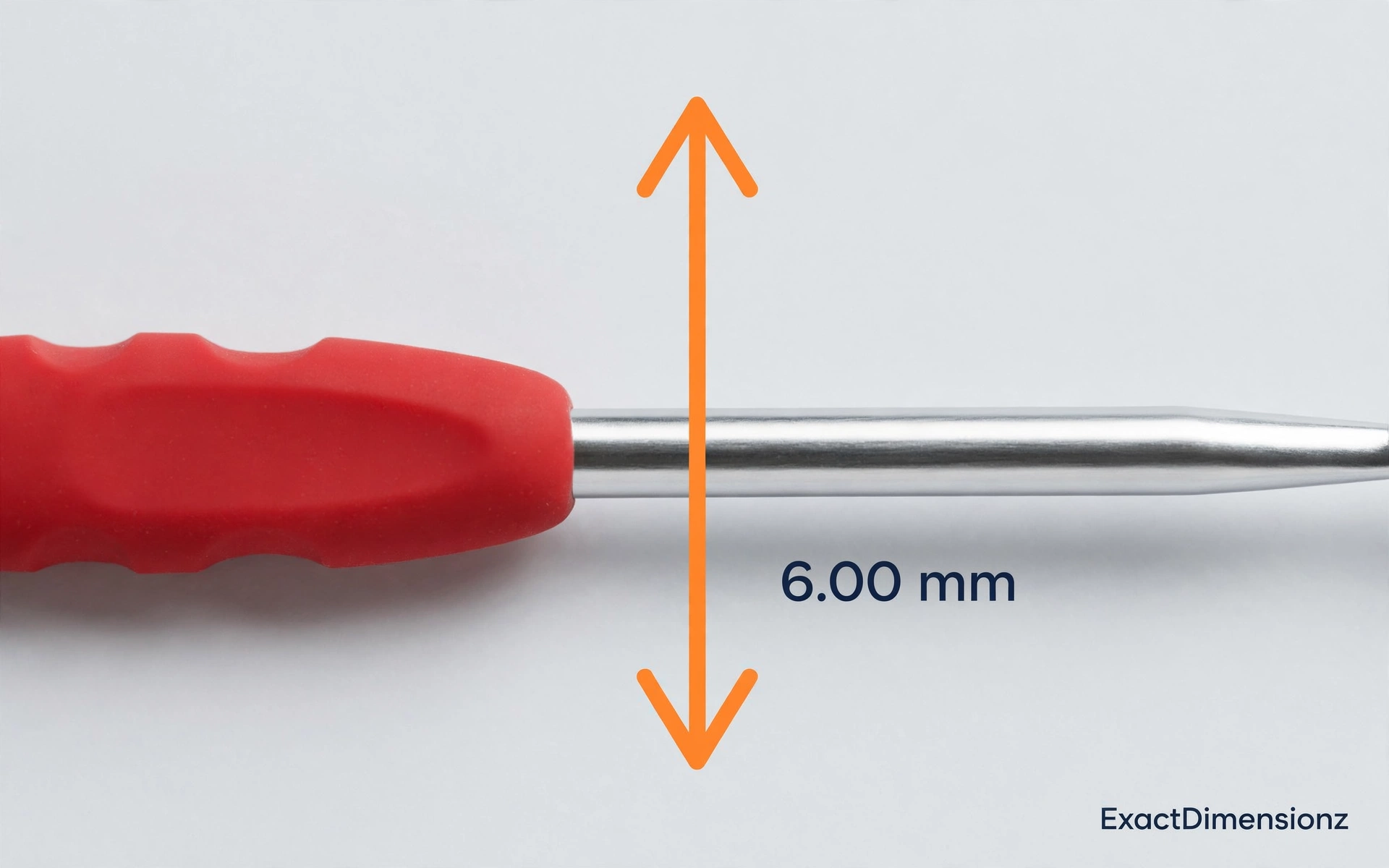
The craft drawer returns with a new brand. Tulip’s ETIMO Red crochet hook with cushion grip, article TED-100e, is catalogued by Tulip itself at 6.00 mm — Size 10/0, US J-10. Tulip’s own catalog PDF carries the size, not a retailer chart: the manufacturer’s own grade for this exact hook.
The 6.00 mm is the size-grade designation, corresponding to the shaft diameter just behind the hook’s head — the diameter class that decides the size of the stitches the hook makes. Roll the shaft between your fingers and you are holding a maker’s size name, the way knitters hold a needle number. This is the third hook-maker in the series’ history, and the choice is deliberate: ED-002 and ED-004 used Clover, ED-003 used addi needles, so Tulip keeps the craft shelf fresh.
The evidence label does real work: official specification — the manufacturer’s own stated size grade — with the plain limitation that 6.00 mm is the designation, not a guaranteed exact measurement. Real hooks vary microscopically around the grade, so never read it as a physical guarantee. It is the size the maker names and the crafter shops for.
Source: Tulip ETIMO catalog (PDF) — Official specification.
10. Gaiam Essentials Yoga Mat, 6 mm

Yoga returns with a thicker mat and a different brand. Gaiam’s Essentials yoga mat is sold as “6mm thick, standard size” — 68 inches long, 24 inches wide, 6 mm thick, PVC. The 6 mm is right in the product’s official listing, the way the 4 mm was in the Manduka mat’s name in the previous article. This is the thicker sibling of that reference: the mat you buy when 4 mm doesn’t cushion enough.
The axis is the mat’s thickness: top surface to bottom surface, the slab your knees press into. Unroll it on a hard floor and 6 mm is what stands between you and the ground — half again as much as the 4 mm Manduka, and you can feel the difference immediately. This is the same “thickness through a flat object” axis as the guitar pick two articles ago, scaled up to the size of a room.
Honestly framed: nominal foam thickness, official specification — the manufacturer’s own listed thickness, with the plain limitation that foam compresses and manufacturing tolerances vary. Never a claim that every mat measures 6.000 mm. And the brand choice is deliberate: ED-003 used Manduka, so Gaiam keeps the series from repeating its makers.
Source: Gaiam Essentials Yoga Mat product page — Official specification.
11. Pilkington Optifloat Opal Glass, 6 mm
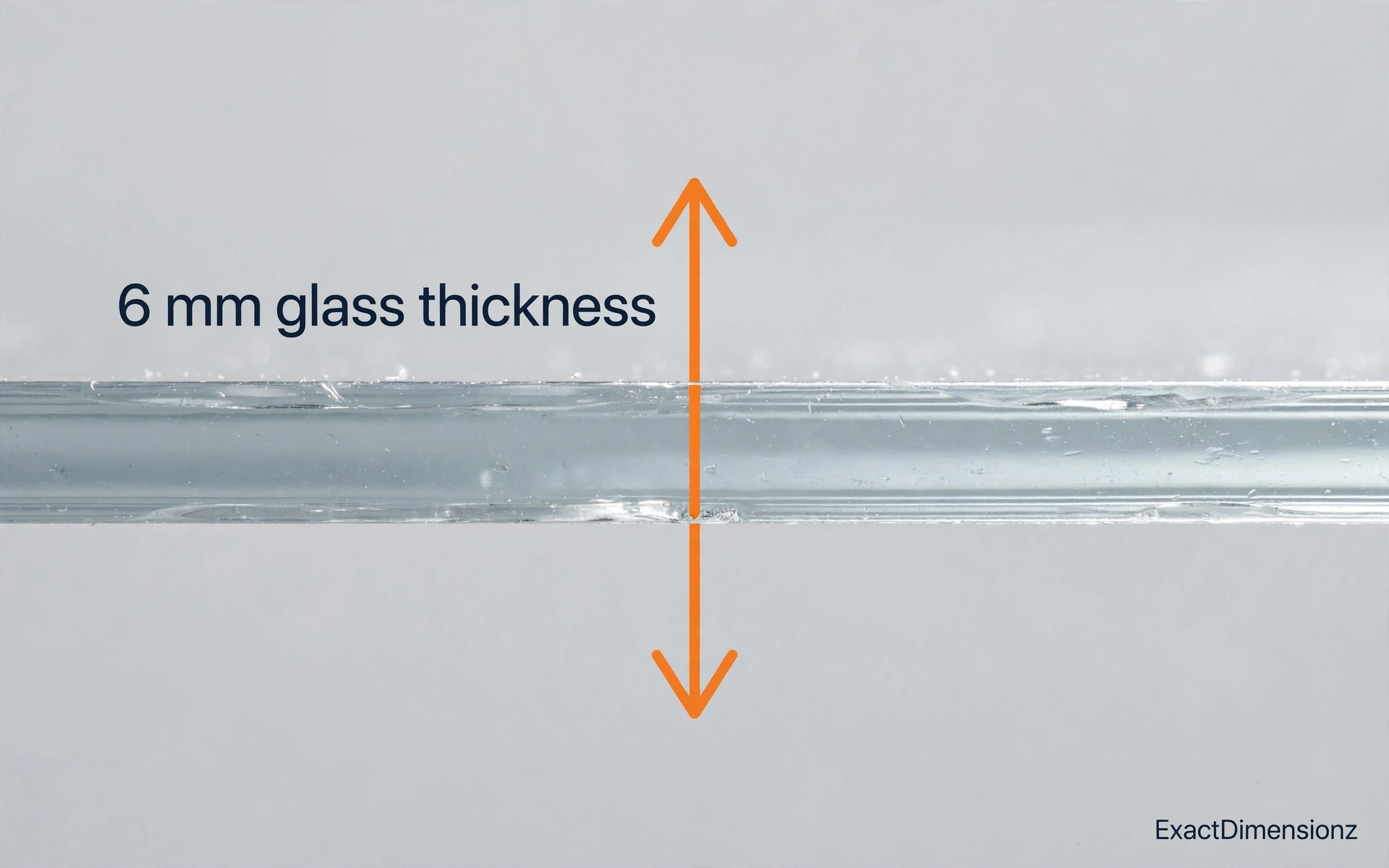
The list closes with the 6 mm you look through. Pilkington’s Optifloat Opal — a translucent float glass from the NSG Group — is “readily available in 4 mm and 6 mm thicknesses,” per Pilkington’s own hosted document. Stock sheets run 3210 × 2250 mm; the 6 mm is the sheet’s thickness, the dimension that decides its strength, its weight, and where building codes allow it.
The axis is the glass thickness: face to face across the sheet, the thin dimension of a very large object. Hold the edge of a 6 mm sheet and you are spanning the same published number as the yoga mat’s foam above — one rigid and transparent, one soft and opaque, the same thickness class. That is the cross-check habit working again.
The careful framing is published dimension with a real standard behind it: nominal manufactured thickness, produced to thickness tolerances per EN 572-2 — float glass sheets are not exactly 6.000 mm, and the standard says how far they may stray. The document is Pilkington’s own, hosted on Pilkington’s own file server. A primary source for the thickness of glass the world actually buys.
Source: Pilkington Optifloat document — Published dimension.
What Does 6 mm Look Like on a Ruler?
Find the centimeter marks and count the small millimeter ticks between any two of them. Six millimeters is six ticks: just past halfway from 0 to the 1 cm mark. Since 1 cm contains 10 mm, 6 mm is simply 0.6 cm — and it is three times the length of 2 mm, if you want a smaller anchor you already know.
Try this: stand an airsoft BB at the ruler’s zero line and read its far edge. It lands on the sixth tick — which is the whole point of a caliber, as you saw above. And if 6 mm still feels abstract next to those centimeter marks, our guide on how big 2 cm is gives you a larger anchor — a little over three times this length.

6 mm Conversion Table
| Unit | 6 mm equals | Exact or rounded |
|---|---|---|
| Centimeters | 0.6 cm | Exact |
| Meters | 0.006 m | Exact |
| Micrometers | 6,000 µm | Exact |
| Inches (fraction) | 30/127 in | Exact |
| Inches (decimal) | 0.23622 in | Rounded display |
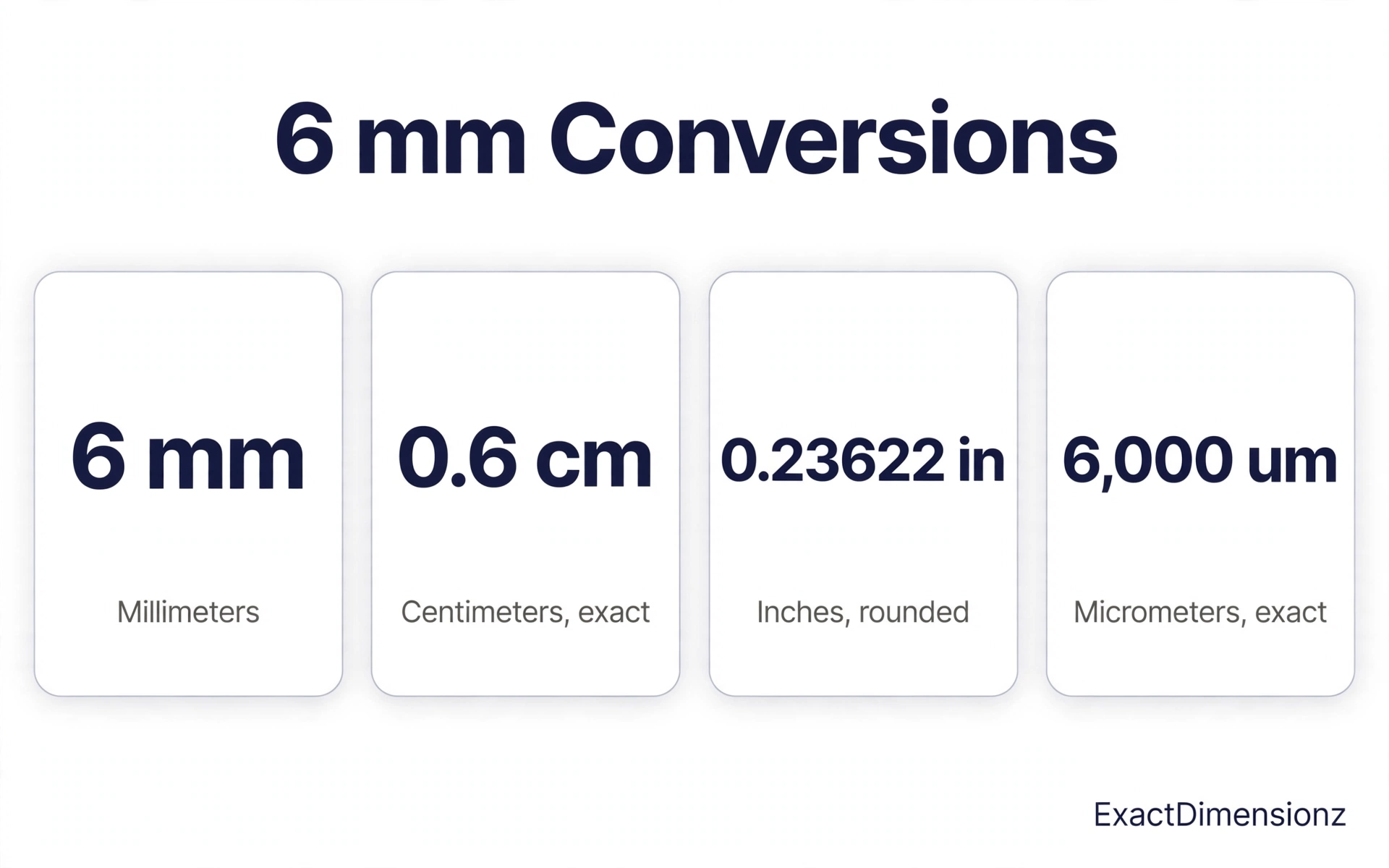
The inch is defined as exactly 25.4 millimeters, so 6 mm works out to the exact fraction 30/127 of an inch. The familiar decimal 0.23622 is a rounded display of that fraction — handy for quick math, but not mathematically exact. Our guide on how long 1 inch is covers the imperial side in full.
One conversion trap to clear up early: 1/4 of an inch equals 6.35 mm, which is 0.35 mm — more than a third of a millimeter — thicker than 6 mm. In conversation the two get treated as the same size, but on paper they are different numbers, and a third of a millimeter is a real gap at this scale. The near-miss section below runs the full comparison.
Thickness vs Diameter vs Pitch vs Bore vs Length
Before we close the loop, one piece of honesty. A “6 mm” value can describe different axes, and this article names each one explicitly:
- Thickness is the distance through a flat object — a yoga mat, a sheet of glass.
- Diameter is the distance straight across a round face — a drill bit’s cutting end, an airsoft BB, a lens, a shaft.
- Pitch is the center-to-center spacing between repeated features — the poles along a terminal block, or the threads along a screw (on our M6 tap, the thread pitch is 1 mm, a separate number from the 6 mm designation).
- Bore is the diameter of an inner hole — the opening a shaft passes through, like our 626ZZ1’s 6 mm bore.
- Length is the end-to-end extent along an axis — the MISUMI shaft comes in lengths from 20 to 800 mm, a completely different axis from its 6 mm diameter.
This list is especially axis-rich: the M6 screw and the Walter tap each carry 6 mm twice on different axes, and the bearing hides a second 6 mm in its width. Every section says which axis it means.
What the Evidence Labels Mean
Since the list mixes evidence types deliberately, here is what each label promises — and what it does not:
- Official specification: the manufacturer’s own stated specification for a specific product. Direct primary evidence — but still subject to manufacturing tolerance.
- Published dimension: printed in a manufacturer’s own catalog or datasheet for a specific model. Direct primary evidence for that product’s stated size.
- Standardized measurement: a dimension defined by an industry standard or a standardized product series. Real and meaningful, but still manufactured within tolerances.
- Nominal/toleranced size: a manufacturer’s size designation. The number names the size grade; individual units vary around it. Never read these as “exactly 6.000 mm.”
No reference in this article was inferred from a photograph, and none rests on a retailer listing alone.
Near 6 mm Comparisons, With the Difference Calculated

Sometimes the most useful reference is the one that almost matches. These three sit close enough to 6 mm to picture it against, with the exact gap stated:
| Object | Published size | Difference from 6 mm |
|---|---|---|
| 1/4 inch | 6.35 mm | 0.35 mm thicker |
| 15/64 inch | 5.953125 mm | 0.046875 mm thinner |
| 7/32 inch | 5.55625 mm | 0.44375 mm thinner |
The 1/4 inch is the classic near-miss: close enough that people treat M6 hardware and quarter-inch hardware as interchangeable in rough talk, but 0.35 mm apart — a real gap, and the reason an M6 nut will never properly fit a 1/4-inch bolt. The 15/64 inch is the sneaky one: less than five-hundredths of a millimeter under 6 mm, close enough to fool a ruler but not a caliper. And the 7/32 inch undershoots by nearly half a millimeter. These near-misses do not count as 6 mm references, which is why they sit in their own section.
How to Measure 6 mm Accurately
For most purposes a metric ruler is enough: count six millimeter ticks past zero — just past the halfway mark to 1 cm, one of the easier small measurements to find by eye.
Digital calipers are the next step up, and they deserve a precise explanation. A caliper’s resolution (the smallest increment its display shows, often 0.01 mm) is not the same as its accuracy (how close its readings come to the true value, which depends on the instrument’s quality and calibration). A display that reads to 0.01 mm does not automatically measure to 0.01 mm. The MISUMI shaft above is the perfect illustration: its 5.984–5.996 mm band is narrower than many calipers’ accuracy, so even the instrument has limits. For a fuller tour of the instruments, see our measurement tools guide.
Whatever tool you use, measure the right axis. The single most common 6 mm measuring error is not instrument error at all — it is measuring a diameter when you meant a thickness, a bore when you meant a width, or, on an M6 screw, the head when you meant the thread.
Common Mistakes About 6 mm
- Calling 1/4 inch “equal to” 6 mm. It is 6.35 mm — more than a third of a millimeter thicker, and an M6 nut will never fit a 1/4-inch bolt.
- Treating 0.23622 inches as mathematically exact. It is a rounded decimal display of the exact fraction 30/127.
- Saying 6 mm is “six times as big” as 1 mm. Say six times the length — “big” is vague and misleading.
- Assuming nominal products are physically exact. A 6 mm drill bit, a 6.00 mm hook, and a 6 mm BB are size designations made to tolerances, not 6.000 mm guarantees.
- Reading the MISUMI shaft as “exactly 6 mm.” Its published g7 tolerance is 5.984–5.996 mm — the most honest number in this list, and it is deliberately under 6.000.
- Mixing up the M6’s two 6 mm axes. Thread diameter and head height are different measurements on the same screw.
- Mixing up the tap’s two 6 mm axes. The M6 thread it cuts and the 6 mm shank the chuck grips are different features.
- Reading the bearing’s 6 mm as the outside. The 6 mm is the bore; the outer diameter is 19 mm.
- Treating the Omron 6 × 6 mm as a measured dimension. It is a package size class, not a toleranced measurement.
- Reading glass or mat thickness as exact. Float glass follows EN 572-2 tolerances; foam compresses — both are nominal.
Frequently Asked Questions
How many centimeters is 6 mm?
Exactly 0.6 cm. Ten millimeters make a centimeter, so six millimeters is six-tenths of one.
How many inches is 6 mm?
About 0.23622 inches — a rounded decimal display of the exact fraction 30/127 inch.
Is 6 mm the same as 1/4 inch?
No. A quarter inch equals 6.35 mm, which is 0.35 mm — more than a third of a millimeter — thicker than 6 mm. Close enough for rough talk, but an M6 nut won’t fit a 1/4-inch bolt.
What does M6 mean on a screw?
M6 means a 6 mm nominal major diameter under ISO 68-1/261. On a DIN 912 / ISO 4762 socket head cap screw, the head is also 6.0 mm tall — two different 6 mm axes on the same product. Real threads are cut to tolerance classes, so the crests sit slightly under 6 mm.
What is the most honest 6 mm measurement on this list?
The MISUMI E-SFJ linear shaft: its 6 mm diameter is made to tolerance class g7, published as 5.984–5.996 mm. A real, printed band — no guessing.
How can I measure 6 mm without calipers?
Count six millimeter ticks past zero on a metric ruler — just past the halfway mark to 1 cm. Or hold up something you know: the diameter of a 6 mm airsoft BB or the thickness of a 6 mm yoga mat’s edge.
Final Thoughts
Six millimeters turns out to be the size where the metric system does its real work. Below it, sizes are things you squint at; at 6 mm, bolts hold machines together, shafts slide through bushings, and a BB flies true down a barrel. That is why one number keeps showing up in workshops, electronics, and gear bags all at once.
Keep the evidence labels with you, and keep asking which axis the number describes. A published 6 mm tells you what the designer intended; the tolerance tells you what the factory is allowed; the axis tells you where to put your calipers — or your fingers. With those habits, 6 mm stops being abstract and becomes the millimeter that holds the world together.
