
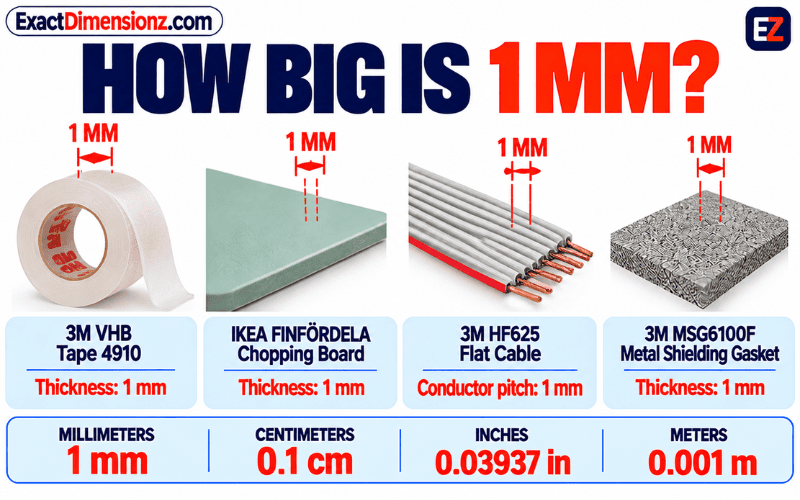
How big is 1 mm? One millimeter is a tiny measurement equal to 0.1 centimeters, 0.03937 inches, or 0.001 meters. It is one-tenth of a centimeter and approximately one twenty-fifth of an inch. On a metric ruler, 1 mm is the distance between two neighboring small division marks.
Although 1 millimeter looks extremely small, it is used in everyday measurements, manufacturing, jewelry, electronics, and medicine. This guide explains what 1 mm looks like in actual size, how to find it on a ruler or tape measure, and how it compares with seven real objects. It also explains measurements such as a 1 mm kidney stone or tumor.
How Big Is 1 mm?
One millimeter is one of the smallest divisions commonly shown on an ordinary metric ruler. There are 10 millimeters in 1 centimeter and 1,000 millimeters in 1 meter.
| Measurement unit | 1 mm equals |
| Centimeters | 0.1 cm |
| Inches | 0.03937 in |
| Meters | 0.001 m |
| Micrometers | 1,000 µm |
| Feet | 0.003281 ft |
| Fraction of an inch | Approximately 1/25.4 inch |
The word millimeter is commonly used in American English, while millimetre is the British spelling. Both describe the same unit, abbreviated mm.
Related Post: How Big is 10 CM
What Does 1 Millimeter Look Like?
Imagine the tiny gap between two consecutive millimeter marks on a ruler. That distance is exactly 1 mm.
Unlike a centimeter, which is relatively easy to see, a millimeter is small enough that careful alignment matters.
One millimeter can describe the thickness of a sheet of material, the diameter of a thin wire, the width of a small opening, or the length of a miniature component.
The examples below distinguish between these dimensions instead of treating every object as though it measures 1 mm in every direction.
7 Real Objects That Help You Visualize 1 Millimeter
The following examples use measurements published by manufacturers. Some show 1 mm thickness, while others demonstrate 1 mm spacing. The dimension is identified for each item so you can compare the correct part of the object.
| Object | Measurement | Dimension type |
| 3M VHB Tape 4910 | 1 mm | Tape thickness |
| IKEA FINFÖRDELA Chopping Board | 1 mm | Board thickness |
| 3M Extreme Sealing Tape 4411B+ | 1 mm | Tape thickness |
| IKEA METOD Cover Strip | 1 mm | Strip thickness |
| 3M HF625 Flat Cable | 1 mm | Conductor pitch |
| 3M Metal Shielding Gasket MSG6100F | 1 mm | Gasket thickness |
| 3M High Flex Life Cable 3250 | 1 mm | Wire spacing |
1. 3M VHB Tape 4910

Measurement: 1 mm thickness
The 3M VHB Tape 4910 is a clear, double-sided acrylic adhesive tape used for bonding different materials.
According to 3M, the tape has a total thickness of 1 mm without its protective liner.
To visualize this measurement, imagine looking at the tape from the side rather than from above. The distance between its two adhesive surfaces is approximately 1 millimeter.
This example helps explain how small 1 mm looks as a material thickness.
Verified source: 3M — VHB Tape 4910 Specifications.
2. IKEA FINFÖRDELA Bendable Chopping Board

Measurement: 1 mm thickness
The IKEA FINFÖRDELA is a flexible plastic chopping board designed to make transferring chopped food easier.
IKEA lists its thickness as 1 mm, while its length and width are much greater.
This means the board is only 1 mm thick when viewed from its edge. Its thin construction also explains why it can bend.
It is a useful household example for comparing 1 mm with a real object rather than trying to estimate the size from a picture.
Verified source: IKEA — FINFÖRDELA Chopping Board.
3. 3M Extreme Sealing Tape 4411B+

Measurement: 1 mm thickness
The 3M Extreme Sealing Tape 4411B+ is a black sealing tape designed for outdoor and industrial applications.
The manufacturer lists its thickness as 1 mm without the release liner.
Although the tape comes in a roll, the 1 mm measurement does not refer to the roll’s diameter or the tape’s width. It describes the thickness of one layer.
Looking at a cross-section of the tape is the best way to understand the measurement.
Verified source: 3M — Extreme Sealing Tape 4411B+.
4. IKEA METOD Vertical Cover Strip

Measurement: 1 mm thickness
The IKEA METOD vertical cover strip is a flexible finishing accessory used around kitchen cabinets.
IKEA lists the strip as 220 cm long, 3 cm deep, and 1 mm thick.
The strip is therefore much longer and wider than it is thick.
If you look at its thin edge, that thickness represents 1 millimeter.
This example demonstrates how a tiny measurement can describe just one part of a much larger object.
Verified source: IKEA — METOD Cover Strip.
5. 3M HF625 Round Conductor Flat Cable

Measurement: 1 mm conductor pitch
The 3M HF625 is a flat electrical cable containing multiple conductors arranged side by side.
3M specifies a 1 mm pitch, meaning the center-to-center distance between neighboring conductors is 1 millimeter.
This is different from saying that each wire is 1 mm thick.
Imagine two parallel conductors. The distance from the center of one to the center of the next is 1 mm.
It is a useful example of how millimeters are used in electronics.
Verified source: 3M — HF625 Round Conductor Flat Cable.
Related Post: How Big Is 9 cm
6. 3M Metal Shielding Gasket MSG6100F

Measurement: 1 mm thickness
The 3M MSG6100F is a metal-shielding gasket used in electronic assemblies.
Its manufacturer-published specifications include a thickness of 1 mm.
The gasket is much larger in length and width, but the layer itself measures just 1 millimeter through its thickness.
This provides an industrial example of how a very small measurement can matter when fitting components into limited spaces.
Verified source: 3M — Metal Shielding Gasket MSG6100F.
7. 3M High Flex Life Cable 3250 Series

Measurement: 1 mm wire spacing
The 3M High Flex Life Cable 3250 Series is designed for electrical connections that require flexibility.
3M specifies 1 mm pitch, or center-to-center spacing, between adjacent conductors.
This makes it another useful example of how small distances are controlled in electronic components.
The measurement does not describe the cable’s total width or an individual wire’s diameter. It describes the regular spacing of the conductors.
Verified source: 3M — High Flex Life Cable 3250 Series.
How Big Is 1 mm on a Ruler?
One millimeter on a metric ruler is the distance between two neighboring small marks. There are ten equal millimeter intervals between the 0 cm and 1 cm marks.
Magnified ruler illustration highlighting one millimeter. Not actual physical size.
To find 1 mm, locate the zero mark and move to the first small division. That is 1 millimeter.
If your ruler only shows centimeters without smaller divisions, you may need a ruler with millimeter markings.
How Big Is 1 mm on a Tape Measure?
On a metric tape measure, 1 mm is usually represented by one of the smallest divisions.
However, not every tape measure displays individual millimeters clearly. Some use centimeter marks with intermediate divisions, while others primarily show inches.
For small measurements, a rigid metric ruler or digital caliper is often easier to use than a flexible tape measure.
How Big Is 1 mm in Inches?
One millimeter equals approximately 0.03937 inches.
The conversion is:
An inch contains exactly 25.4 millimeters, so 1 mm is approximately 3.94% of an inch.
| Millimeters | Inches |
| 1 mm | 0.03937 in |
| 2 mm | 0.07874 in |
| 3 mm | 0.11811 in |
| 5 mm | 0.19685 in |
| 10 mm | 0.39370 in |
Related Post: How Big Is 6 cm
What Is 1 mm in Fractions of an Inch?
One millimeter does not convert neatly into a common fractional inch measurement.
The exact conversion is:
For ordinary imperial rulers, the nearest common fractions are:
| Fraction | Decimal inches | Equivalent millimeters |
| 1/32 inch | 0.03125 | 0.79375 mm |
| 1/25 inch | 0.04 | 1.016 mm |
| 3/64 inch | 0.046875 | 1.190625 mm |
| 1/16 inch | 0.0625 | 1.5875 mm |
The closest common 1/64-inch ruler marking is 3/64 inch, although it is not an exact match.
For an accurate 1 mm measurement, use a metric scale instead of rounding to an inch fraction.
How Big Is 1 mm in Centimeters?
One millimeter equals exactly 0.1 centimeters.
Because 1 cm contains 10 mm:
This means ten 1 mm intervals placed end to end make 1 centimeter.
How Big Is 1 Millimeter in Meters?
One millimeter equals exactly 0.001 meters.
Since 1 meter contains 1,000 millimeters:
Millimeters are more practical than meters when measuring thin materials, small mechanical components, and narrow gaps.
How Big Is 1 mm in Actual Size?
One millimeter is a very small distance that is visible to the naked eye under suitable lighting and viewing conditions.
To understand its actual size, look at the first millimeter interval on a physical ruler.
A 1 mm-thick flexible chopping board or a 1 mm-thick adhesive tape also provides a useful reference when viewed from the side.
Images on phones and computers cannot reliably show 1 mm at actual physical size because screen dimensions, resolution, and zoom settings vary.
How Big Is 1 mm Visually Compared to Everyday Objects?
Many ordinary objects have features around a millimeter in size, but their dimensions are not always standardized.
For example, a U.S. dime has a thickness of 1.35 mm, according to the United States Mint. This makes its edge slightly thicker than 1 mm.
A dime is therefore useful as an approximate visual reference, but it should not be described as exactly 1 mm thick.
U.S. Mint
Similarly, a thin mechanical-pencil lead may have a diameter below or around 1 mm depending on its specification.
For exact comparisons, manufacturer-published dimensions are more reliable than estimates.
How Big Is a 1 mm Kidney Stone?
A 1 mm kidney stone measures just 0.1 cm or approximately 0.039 inches.
That is a very small stone. Small kidney stones may pass through the urinary tract without an invasive procedure, but size alone cannot predict what will happen.
Its location, shape, symptoms, and whether it obstructs urine flow all matter.
Even a small stone can cause considerable pain when moving through the urinary tract.
Seek urgent medical attention for suspected kidney stones accompanied by fever, chills, inability to urinate, or severe uncontrolled pain.
Medical source: NHS — Kidney Stones
How Big Is a 1 mm Tumor?
A tumor measuring 1 mm has a reported dimension of 0.1 cm, or approximately 0.039 inches.
That is a very small physical measurement, but it does not determine whether a growth is benign or malignant.
Medical significance depends on the type of tissue, location, pathology, imaging findings, and other clinical information.
Some tiny abnormalities may be discovered through imaging, microscopy, or tissue examination. The meaning of a 1 mm finding depends on what is actually being measured.
Medical source: National Cancer Institute — What Is Cancer?
Common Mistakes When Measuring 1 mm
The most frequent mistake is confusing 1 mm with 1 cm. One centimeter is ten times larger than one millimeter.
Another mistake is treating 1 mm as exactly 1/32 or 1/16 inch. Neither fraction is an exact conversion.
It is also easy to confuse thickness with width. A tape measuring 1 mm thick may be several centimeters wide.
Finally, a magnified image of a millimeter should not be mistaken for an actual-size illustration.
Quick Comparison: 1 mm vs. 5 mm vs. 10 mm
| Measurement | Centimeters | Inches |
| 1 mm | 0.1 cm | 0.0394 in |
| 2 mm | 0.2 cm | 0.0787 in |
| 3 mm | 0.3 cm | 0.1181 in |
| 5 mm | 0.5 cm | 0.1969 in |
| 10 mm | 1 cm | 0.3937 in |
Ten millimeters is ten times longer than one millimeter.
See Also
Explore more measurement guides on ExactDimensionz:
FAQs
How big is 1 mm in inches?
One millimeter equals approximately 0.03937 inches.
How big is 1 mm on a ruler?
It is the distance between two consecutive millimeter division marks on a metric ruler.
What is an example of 1 millimeter?
The IKEA FINFÖRDELA bendable chopping board has a listed thickness of 1 mm.
Is 1 mm the same as 1 cm?
No. One millimeter equals 0.1 cm, while 1 cm equals 10 mm.
How big is 1 mm compared to an inch?
One millimeter is approximately 1/25.4 of an inch.
What is 1 mm as an inch fraction?
Exactly 5/127 inch. The nearest common 1/64-inch ruler marking is 3/64 inch.
Can you see 1 mm with the naked eye?
Yes. A 1 mm distance is generally visible under suitable lighting, although measuring it precisely requires an appropriate tool.
How big is a 1 mm kidney stone?
It measures 0.1 cm. Although small, it can still cause symptoms and may require medical assessment.
How big is a 1 mm tumor?
It measures approximately 0.039 inches. Its clinical importance cannot be determined from size alone.
How do you measure 1 mm accurately?
Use a metric ruler with clear millimeter markings or a suitable caliper for greater precision.
Conclusion
One millimeter equals 0.1 cm, 0.03937 inches, or 0.001 meters. It is a tiny distance represented by one small interval on a metric ruler.
You can visualize it using the thickness of 3M VHB tape, an IKEA FINFÖRDELA chopping board, or the 1 mm conductor spacing found in certain electronic cables.
The key is to identify exactly what is being measured—thickness, diameter, length, or spacing. For accurate measurements, use a metric ruler or caliper rather than relying on an enlarged picture.
