
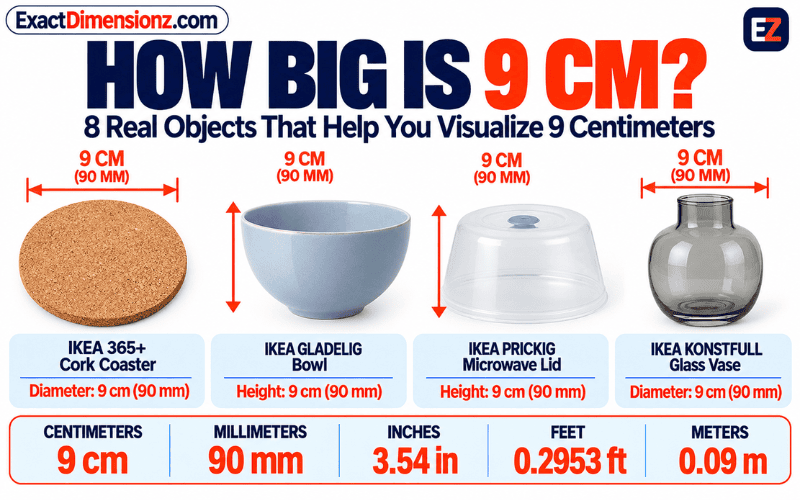
If you are wondering how big is 9 cm, the answer is 90 millimeters — exactly. That is about 3.54 inches, a touch over three and a half inches, and a size that sits comfortably in the palm of your hand: the width of a coaster, the height of a small bowl, the diameter of a tealight holder. It is one centimeter longer than 8 cm and one centimeter shorter than 10 cm, which makes it easy to bracket once you know either neighbour.
The tricky part is not the math. It is knowing which part of a real object actually measures 9 cm — because a “9 cm” bowl is 9 cm only in its height, a “9 cm” vase is 9 cm only in its diameter, and a “9 cm” plant pot can be 9 cm tall while being considerably wider. Below are 8 real household objects with a published 9 cm dimension, each one labelled with exactly which side counts, so you can picture 9 cm without guessing.
How big is 9 cm?
9 cm is exactly 90 mm — about 3.54 inches. The centimeter-to-millimeter conversion is exact (1 cm = 10 mm by definition), and the inch is defined as exactly 2.54 cm, so 9 cm is 9 ÷ 2.54 = 3.5433 inches, shown as 3.54 for readability. It is slightly longer than three and a half inches.
The one rule: name the dimension
A product described as “9 cm” is not 9 cm in every direction, and that single fact causes most of the confusion around this measurement. A coaster is 9 cm across its diameter. A bowl is 9 cm tall. A plant pot can be 9 cm tall and 12 cm wide at the same time. The number 9 cm is always the same — but the edge it describes changes with every product.
One more distinction matters. The conversions in this article are exact by definition: 9 cm is exactly 90 mm, exactly 0.09 meters, and exactly 90,000 micrometers. The inch and foot figures are rounded for readability (3.543 inches, 0.295 feet). The objects, on the other hand, are listed at 9 cm — those are the retailer’s published specifications, and this article grades them as such rather than pretending someone went out with calipers. IKEA publishes dimensions in whole centimeters, so 9 cm is the published figure for each product below, not a guarantee that every unit measures 9.000 cm. That honesty is the whole point: a published 9 cm tells you what the designer intended, and the axis tells you where to look.
1. IKEA 365+ Cork Coaster
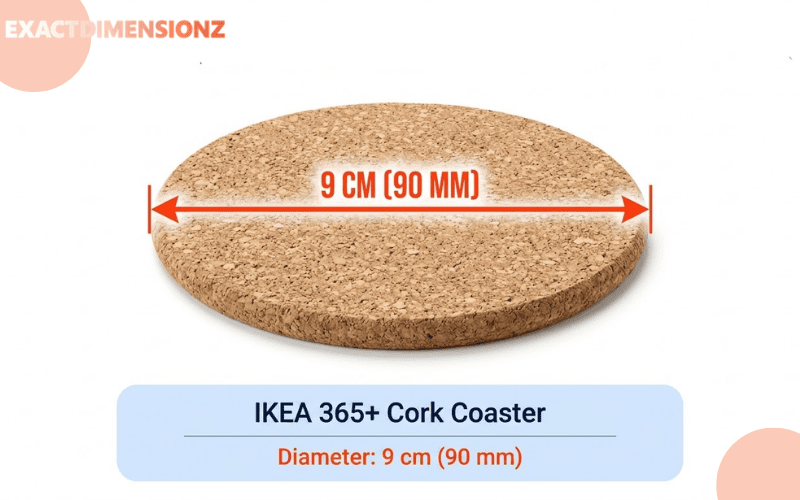
The IKEA 365+ cork coaster is the simplest 9 cm reference on this list: a flat, round disc used beneath cups and glasses, with a published diameter of 9 cm. Imagine placing a ruler across the center of the coaster. The distance from one outer edge to the opposite edge is 9 centimeters, or about 3.54 inches.
This is one of the easiest examples to visualize because the coaster is flat, round, and commonly found on dining tables. Diameter is the axis: measure straight through the center, not around the rim — the circumference of a 9 cm circle is about 28.3 cm, a much bigger number that describes a different thing.
Measurement: 9 cm diameter. Evidence: LISTED (retailer specification). Source: IKEA 365+ cork coaster.
2. IKEA GLADELIG Bowl
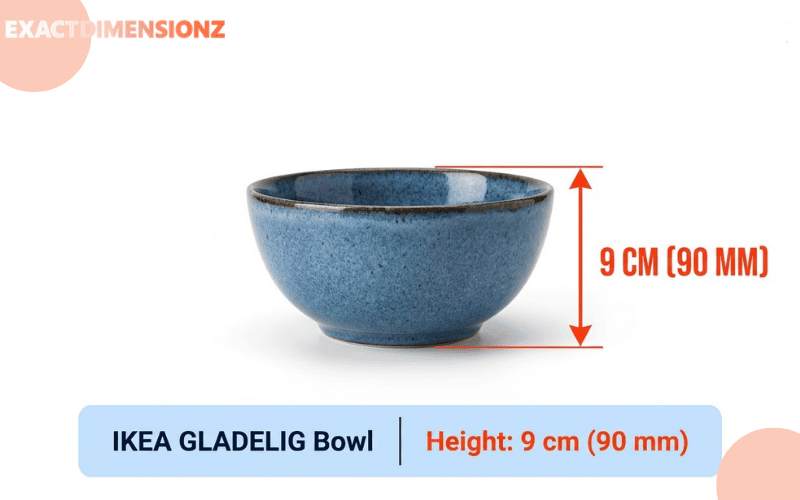
The IKEA GLADELIG bowl is a stoneware bowl with a published height of 9 cm and a diameter of 19 cm. If you place the bowl on a flat surface and measure vertically from the bottom to its upper rim, that height is 9 cm.
It is a useful example for understanding how tall 9 centimeters looks, rather than how wide it is — the bowl is more than twice as wide as it is tall, so anyone who pictured “9 cm” as the bowl’s overall size would be picturing the wrong edge. Height is the axis here, and the 19 cm diameter is the reminder to check.
Measurement: 9 cm height (19 cm diameter). Evidence: LISTED (retailer specification). Source: IKEA GLADELIG bowl specifications.
3. IKEA PRICKIG Microwave Lid
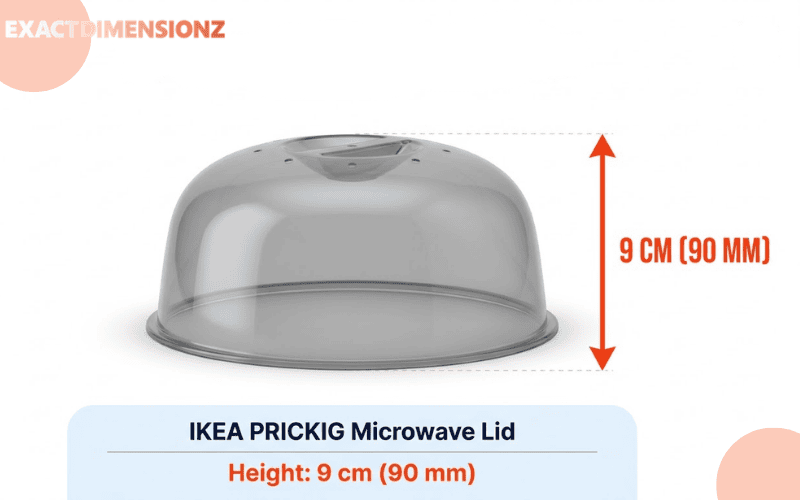
The IKEA PRICKIG microwave lid is designed to cover food while heating and help prevent splashes. According to IKEA, it measures 9 cm in height and 26 cm in diameter.
The 9 cm measurement refers to its vertical height, not its overall width. When placed on a countertop, the lid rises approximately 3.54 inches above the surface — while its 26 cm width spans nearly three times that distance. This is the clearest height-versus-width warning on the list: a lid that is 9 cm in one direction and 26 cm in the other can only be a reference if you say which direction you mean.
Measurement: 9 cm height (26 cm diameter). Evidence: LISTED (retailer specification). Source: IKEA PRICKIG microwave lid.
4. IKEA KONSTFULL Glass Vase
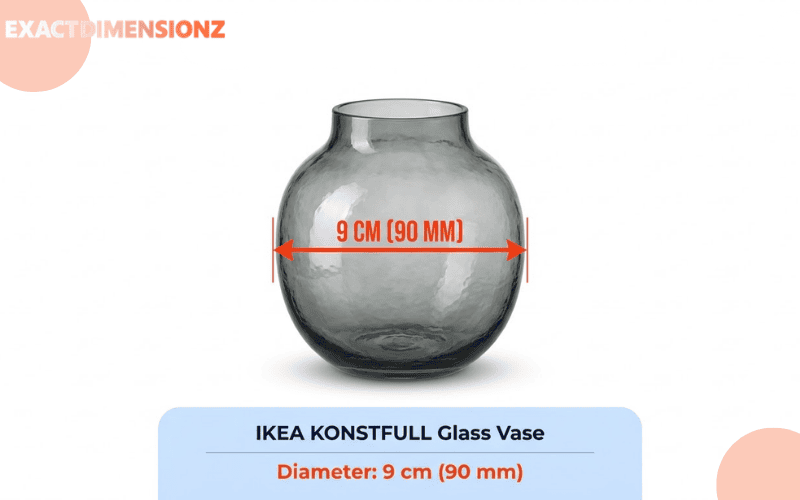
The IKEA KONSTFULL glass vase is a compact decorative vase with a diameter of 9 cm and a height of 10 cm. Its diameter provides a good circular size comparison: imagine a horizontal line across the widest specified circular dimension of the vase, and that distance is 9 cm.
The vase also teaches the difference between 9 cm and 10 cm in a single object, since its listed height is one centimeter greater than its diameter. Hold it and you can feel the gap — the vase is a touch taller than it is wide, and that one centimeter is exactly the step from this article to the next size up.
Measurement: 9 cm diameter (10 cm height). Evidence: LISTED (retailer specification). Source: IKEA KONSTFULL glass vase.
5. IKEA PÅVEFINK Bamboo Tealight Holder
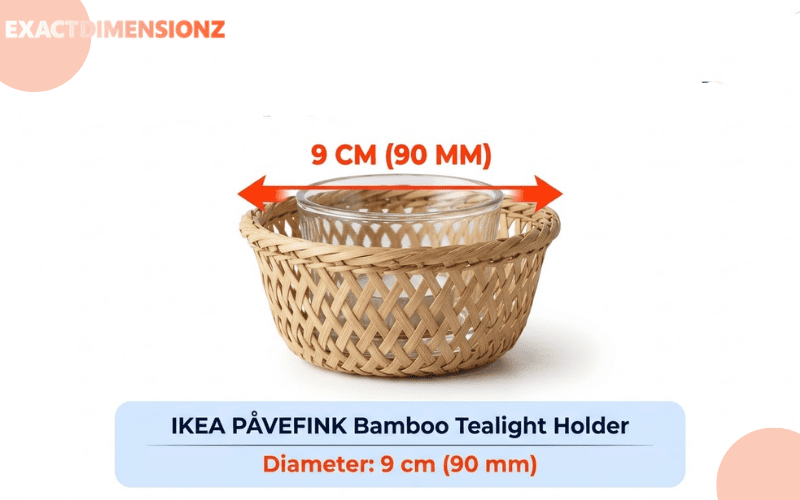
The IKEA PÅVEFINK tealight holder combines a glass candleholder with an outer bamboo covering. Its published dimensions are 9 cm in diameter and 8 cm in height.
The 9 cm measurement describes its width across the circular body. It is one centimeter wider than it is tall — the mirror image of the vase above, which was one centimeter taller than wide. Pairing the two is a neat way to see how close measurements behave: two objects, both near 9 cm, with their 1 cm differences pointing in opposite directions.
Measurement: 9 cm diameter (8 cm height). Evidence: LISTED (retailer specification). Source: IKEA PÅVEFINK tealight holder.
6. IKEA BUSKVERK Plant Pot
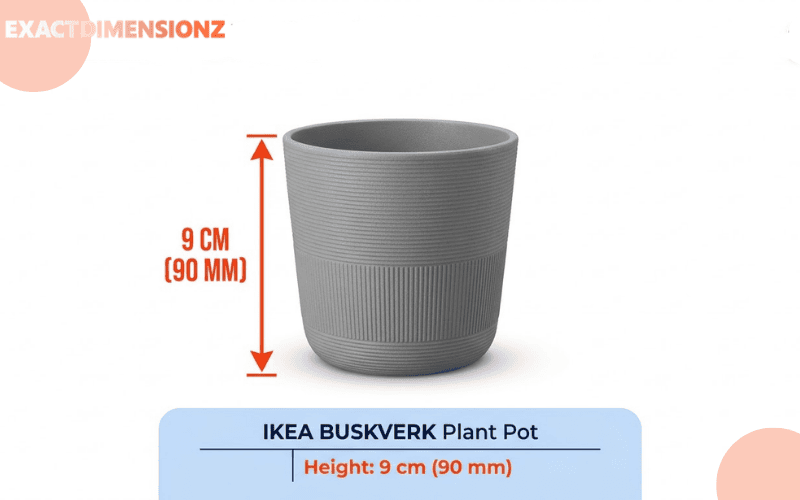
The IKEA BUSKVERK plant pot is a lightweight container designed for small plants. IKEA lists its height as 9 cm, with an outside diameter of 12 cm.
To picture the 9 cm measurement, imagine a vertical line running from the bottom of the empty pot to its top edge. Although the pot is wider than 9 cm, its height provides a reliable reference for this measurement — and it is the third height example on this list, after the bowl and the lid, which makes the pattern hard to miss: plant pots and bowls are usually sold by height, and height is where their 9 cm lives.
Measurement: 9 cm height (12 cm outside diameter). Evidence: LISTED (retailer specification). Source: IKEA BUSKVERK plant pot.
7. IKEA CACTACEAE Potted Cactus
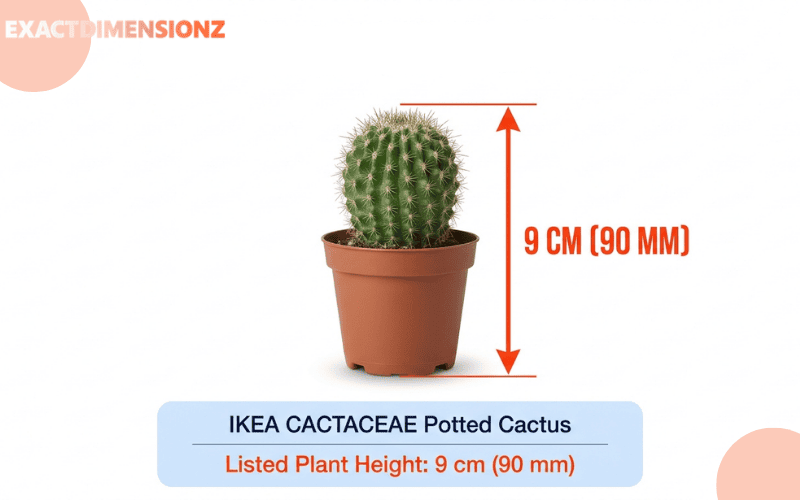
The IKEA CACTACEAE potted cactus is a small indoor plant sold in a compact container. The product specifications list a plant height of 9 cm and a plant-pot diameter of 9 cm — two different 9 cm figures on one product.
Read this one with the honesty note attached: living plants vary in shape and growth, so the published size is the listed product measurement, not a guarantee that every individual cactus is identical. The pot’s 9 cm diameter is the stable reference; the plant’s 9 cm height is the listed size at sale. For a size reference you can trust, use the pot, not the plant.
Measurement: 9 cm listed plant height and 9 cm pot diameter. Evidence: LISTED (retailer specification, with the natural-variation caveat). Source: IKEA CACTACEAE potted cactus.
8. IKEA DAIDAI Metal Plant Pot
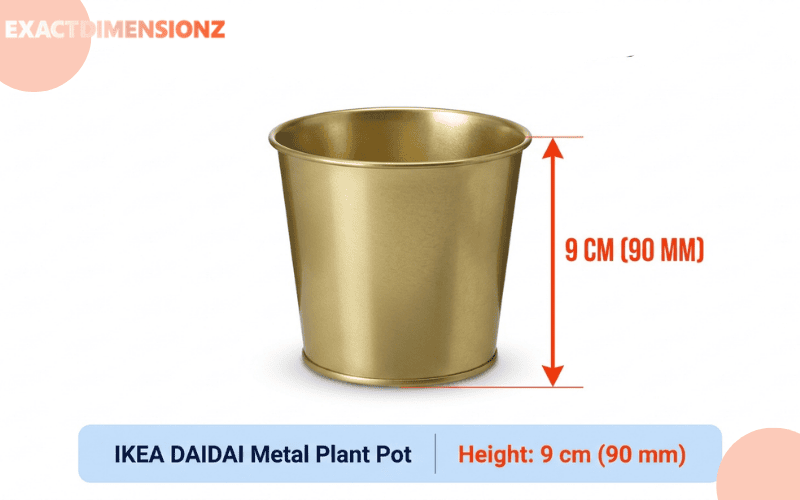
The IKEA DAIDAI is a brass-coloured metal plant pot with a published height of 9 cm. Its outside diameter is 11 cm, while its listed maximum compatible flowerpot diameter is 9 cm.
The easiest way to visualize 9 cm using this product is to measure vertically from the base to the rim. It is another example of why a product’s advertised size may refer to a specific dimension rather than the object’s overall width — and it closes the list with a small trap of its own: the pot itself is 11 cm wide, so the only 9 cm figures here are its height and the flowerpot it accepts, never its width.
Measurement: 9 cm height (11 cm outside diameter). Evidence: LISTED (retailer specification). Source: IKEA DAIDAI metal plant pot.
All eight, at a glance
Eight objects, two axes — this is why the article names the axis every time:
| # | Object | 9 cm axis | Other dimension |
|---|---|---|---|
| 1 | 365+ cork coaster | Diameter | — |
| 2 | GLADELIG bowl | Height | 19 cm diameter |
| 3 | PRICKIG microwave lid | Height | 26 cm diameter |
| 4 | KONSTFULL glass vase | Diameter | 10 cm height |
| 5 | PÅVEFINK tealight holder | Diameter | 8 cm height |
| 6 | BUSKVERK plant pot | Height | 12 cm outside diameter |
| 7 | CACTACEAE potted cactus | Plant height + pot diameter | — |
| 8 | DAIDAI metal plant pot | Height | 11 cm outside diameter |
Four heights, four diameters (counting the cactus twice, once each way) — and not one object where 9 cm means “the whole thing, every way.”
Close to 9 cm — but not 9 cm
Some familiar things look about 9 cm but are not, and naming them keeps you from using a wrong reference. Three and a half inches is 8.89 cm — 0.11 cm, or about 0.04 inches, shorter than 9 cm. Close enough to fool the eye, wrong enough to matter when a part must fit: never round 9 cm down to 3½ inches for exact work. Nine millimeters is a different trap entirely — one tenth of 9 cm, not a rounding of it. And 10 cm is exactly 1 cm longer, the next step up, which the KONSTFULL vase above demonstrates in a single object.
The other trap is the one that is not a measurement at all. Fruit is the classic example: a medium-sized orange or a small apple may measure around 9 cm across, but fruit sizes vary considerably by variety and growing conditions — one orange might be 7 cm wide while another is closer to 9 cm. Fruit is useful for a rough mental picture and never for exact measurement. The same applies to hands, fingers, and any other natural object: use them to picture 9 cm, never to certify it.
9 cm on a ruler, and every conversion that matters
On a standard metric ruler, 9 cm is the distance between the 0 cm and 9 cm marks. Each centimeter contains 10 smaller millimeter divisions, so 9 cm covers 90 millimeters. To measure an object, align its starting edge with the ruler’s zero mark — not necessarily the physical end of the ruler — and its other edge should reach the 9 cm mark. A phone or computer screen cannot reliably show this measurement at actual size, because screen dimensions and zoom settings differ; a physical ruler or an object with a verified 9 cm measurement gives a far more dependable comparison.
| Unit | 9 cm equals | Exact or rounded |
|---|---|---|
| Millimeters | 90 mm | Exact |
| Meters | 0.09 m | Exact |
| Micrometers | 90,000 µm | Exact |
| Inches (decimal) | ≈ 3.543 in | Rounded display |
| Feet | ≈ 0.295 ft | Rounded display |
| Yards | ≈ 0.098 yd | Rounded display |
| Three and a half inches | 8.89 cm | Exact — but 0.11 cm under 9 cm |
The inch is defined as exactly 2.54 cm, so 9 cm is 9 ÷ 2.54 = 3.5433… inches; 3.54 is the rounded display. And the fraction trap, one more time with numbers: 3½ inches is exact at 8.89 cm, which is exact-but-different from 9 cm. Exactness and sameness are not the same thing.
How to measure 9 cm without a ruler
If you have no measuring tool handy, use a product with a verified 9 cm dimension — the IKEA 365+ coaster’s diameter is the cleanest single reference on this list, because it is flat, round, and exactly the measurement. Place it beside the object you are checking and compare edge to edge. A measuring tape, a caliper, or a correctly printed centimeter scale all work too.
For scale against nearby sizes: 9 cm sits 1 cm past 8 cm and 1 cm short of 10 cm, 2 cm past 7 cm and 3 cm past 6 cm, and it is nine times 1 cm — while the smaller anchors, 9 mm and 8 mm, show how fast this scale grows: 9 cm is ten times 9 mm. In the other direction, 1 inch is 2.54 cm, so 9 cm is about three and a half inches — near enough for a picture, never enough for a fit. For anything that must fit, avoid relying on finger widths or hand spans, since body measurements differ from person to person.
When 9 cm shows up in a medical report
Measurements like 9 cm also appear in medical reports — for a cyst, a fibroid, a tumor, or a kidney stone — and the rule there is different from the rule for coasters. A reported 9 cm describes size only: 90 mm, about 3.54 inches, in the reported dimension. It does not by itself say whether a growth is benign or malignant, or what treatment follows. Cancer staging, for example, considers tumor size alongside factors such as lymph node involvement and whether cancer has spread, and a report may list three dimensions, such as 9 × 7 × 6 cm, which describe one growth in different directions rather than three separate growths.
Two cautions belong here plainly. A kidney stone measuring 9 cm would be exceptionally large — large stones generally cannot be expected to pass naturally — so if a scan report mentions one, confirm the measurement and unit with the treating clinician. And a 9 cm ovarian cyst should be assessed by a healthcare professional: decisions about monitoring or treatment depend on its appearance, symptoms, size, and factors such as menopausal status. Severe pain, fever, or chills with suspected kidney stones requires urgent medical attention. Size is a number; interpretation belongs to the clinician with the full findings.
Frequently asked questions
How big is 9 cm in inches?
9 cm is approximately 3.54 inches. The inch is defined as exactly 2.54 cm, so 9 ÷ 2.54 = 3.5433 inches, shown as 3.54 for readability. It is slightly longer than three and a half inches.
Is 9 cm bigger than 3 inches?
Yes. Nine centimeters is approximately 3.54 inches, or 0.54 inches longer than 3 inches. Three inches is only 7.62 cm, so 9 cm clears it by well over a centimeter.
What everyday things are 9 cm?
Verified examples include an IKEA cork coaster’s 9 cm diameter, a GLADELIG bowl’s 9 cm height, a PRICKIG microwave lid’s 9 cm height, a KONSTFULL vase’s 9 cm diameter, a PÅVEFINK tealight holder’s 9 cm diameter, a BUSKVERK plant pot’s 9 cm height, a CACTACEAE cactus pot’s 9 cm diameter, and a DAIDAI plant pot’s 9 cm height. The coaster’s diameter and the bowl’s height are the easiest references to picture.
Is 9 cm the same as 9 mm?
No. Nine centimeters equals 90 millimeters, making it ten times longer than 9 mm. Confusing centimeters with millimeters is the single easiest error in this size range — always check the unit letter, not just the number.
Is 9 cm the same as 3½ inches?
No, but it is close. Three and a half inches is exactly 8.89 cm, which is 0.11 cm (about 0.04 inches) shorter than 9 cm. For a rough visual comparison “about three and a half inches” works; for exact work, use 3.54 inches.
How can I measure 9 cm without a ruler?
Use a known object with a verified 9 cm dimension — the IKEA 365+ coaster’s diameter is the cleanest reference — and compare edge to edge. A measuring tape, a caliper, or a correctly printed centimeter scale also works. Finger widths and hand spans are unreliable, since body measurements differ from person to person.
How big is a 9 cm cyst?
It measures approximately 3.54 inches in its reported dimension. Its medical importance depends on its location, appearance, and symptoms — for example, an ovarian cyst measuring 9 cm should be assessed by a healthcare professional, and large, persistent, or symptomatic cysts may require treatment. Source: NHS — Ovarian Cyst Treatment.
What does 9 cm dilated mean?
During labor, cervical dilation refers to how widely the cervix has opened. At 9 cm dilated, the cervical opening measures approximately 3.54 inches across — close to the 10 cm dilation generally associated with complete cervical dilation. Unlike an ordinary object measurement, cervical dilation is part of a medical assessment during childbirth, and progress and next steps depend on the individual labor and the care team’s findings.
Final Thoughts
So, how big is 9 cm? It is 90 mm, about 3.54 inches, 0.09 meters — and, more usefully, it is the width of a coaster, the height of a small bowl, and the diameter of a tealight holder. The single habit that will serve you best is the one this article opened with: always ask which dimension the 9 cm belongs to. Diameter, height, and listed plant size are three different answers, and knowing which one you are looking at is the difference between measuring right and guessing wrong.
Keep the second habit too: check the evidence before you trust the number. A published 9 cm tells you what the designer intended; the axis tells you where to look. With those two habits, 9 cm stops being abstract — and the next time a listing just says “9 cm” with no dimension attached, you will know exactly which question to ask before you trust it.
