
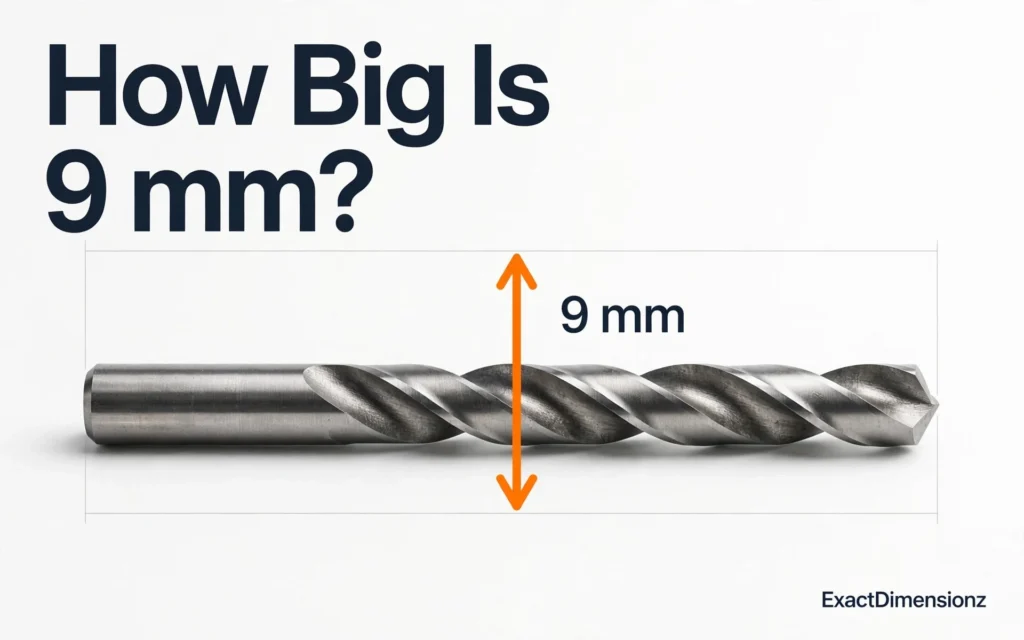
How big is 9mm? It is 0.9 centimeters — a span you can cover with the width of your smallest fingernail — and it shows up in places you would never expect, from a bicycle’s front axle to a sheet of birch plywood. But here is the part most size guides skip: a published “9 mm” almost never means a physical object measuring exactly 9.000 mm. A 9mm bullet is closer to 9.02 mm across. A 9mm dowel pin is deliberately made a hair oversize. A 9mm plywood panel can legally leave the factory anywhere between 8.8 and 9.5 mm thick.
That is why this guide is organized differently. Instead of one flat list, the ten objects below are grouped by how the number 9 mm was earned: printed by the manufacturer, fixed by an engineering standard, or used as a nominal designation inside a tolerance band. Every object names its product or standard, identifies the exact axis being measured, and carries an evidence label so you can see how much trust each number deserves.
How big is 9 mm?
9 mm is 0.9 cm — about the width of your smallest fingernail. Real objects listed at 9 mm include a 9.0 mm Bosch drill bit, a 9 mm Bondhus hex key (across flats), a 9 mm Gates timing belt (width), and nominal 9 mm plywood and MDF. Note: a published “9 mm” is a designation, not a guarantee of 9.000 mm — tolerances vary by product.
9 mm = nine equal 1 mm segments
The scale explains the measurement but is not physically calibrated on every screen. Screen size and browser zoom can change its displayed length.
Why these ten are grouped by evidence
A measurement is only as honest as the paperwork behind it. A drill bit’s diameter is ground to a published specification you can check. A bullet’s diameter is set by an international proof standard. A plywood panel’s thickness is a nominal target with a published tolerance range. All three can fairly be called “9 mm,” but they are not the same kind of 9 mm — and mixing them up is how people buy the wrong part.
The three tiers below keep those kinds apart. Read the label on each object before you borrow its size for a decision.
Tier 1 — The manufacturer prints 9.0 mm
These five objects come from companies that publish 9.0 mm as an official product dimension. The number is on the spec sheet, the catalog page, or the datasheet — not inferred, not rounded for convenience.
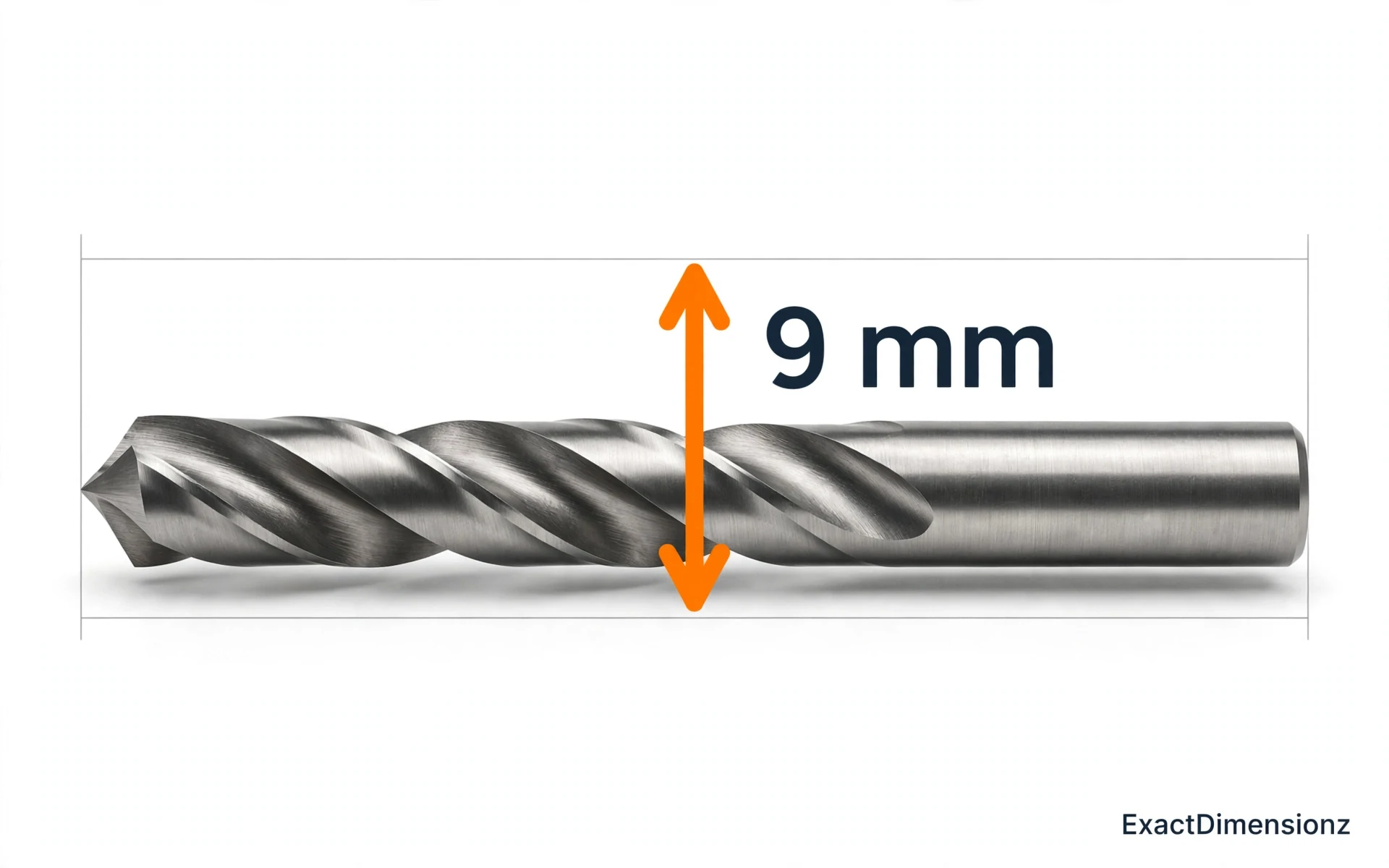
1. Bosch PRO Metal HSS-G twist drill bit — 9.0 mm cutting diameter
Evidence: Official specification
Bosch lists the 9.00 mm diameter as a standard option in its PRO Metal HSS-G twist drill bit range, built to DIN 338 with an h8 diameter tolerance. The 9 mm here is the cutting diameter: the width of the hole the bit is designed to drill, ground into high-speed steel with a split-point tip.
Hold one next to a ruler and the fluted body spans exactly nine millimeter marks. That makes it one of the cleanest physical references for 9 mm you can buy — a drill bit’s whole job is to be the size it claims. Just remember the h8 tolerance: the bit itself is made a whisper under or at 9.00 mm so the drilled hole finishes at the intended size, and a worn or resharpened bit will read slightly under on calipers.
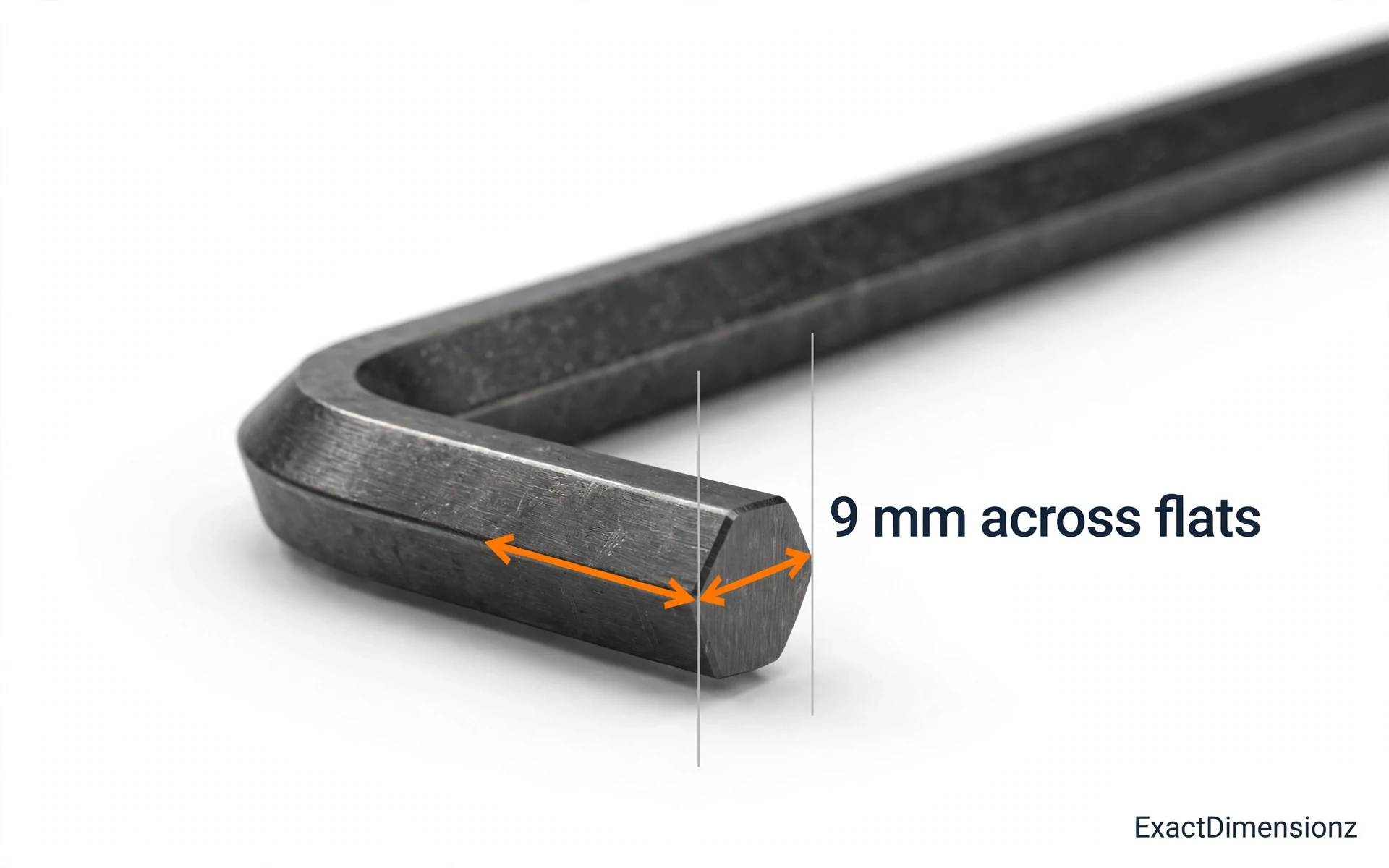
2. Bondhus 9 mm hex key — 9 mm across flats
Evidence: Published dimension
Bondhus catalogs a 9 mm L-wrench (model HKBLM-9, part 12174) in its ball-end hex key line, and 9 mm is one of the standard metric hex key sizes defined by ISO 2936. The 9 mm dimension is the across-flats measurement: the distance between two opposite flat faces of the hexagonal bar.
This is a useful axis to understand because it is not a diameter. Lay the key on a table and measure straight across two parallel flats — that span is the 9 mm. Measure corner to corner and you will get a larger number, which is exactly the mistake people make when they eyeball hex keys. If you own a metric hex key set, the 9 mm key is usually one of the larger ones, sitting between the 8 and the 10.
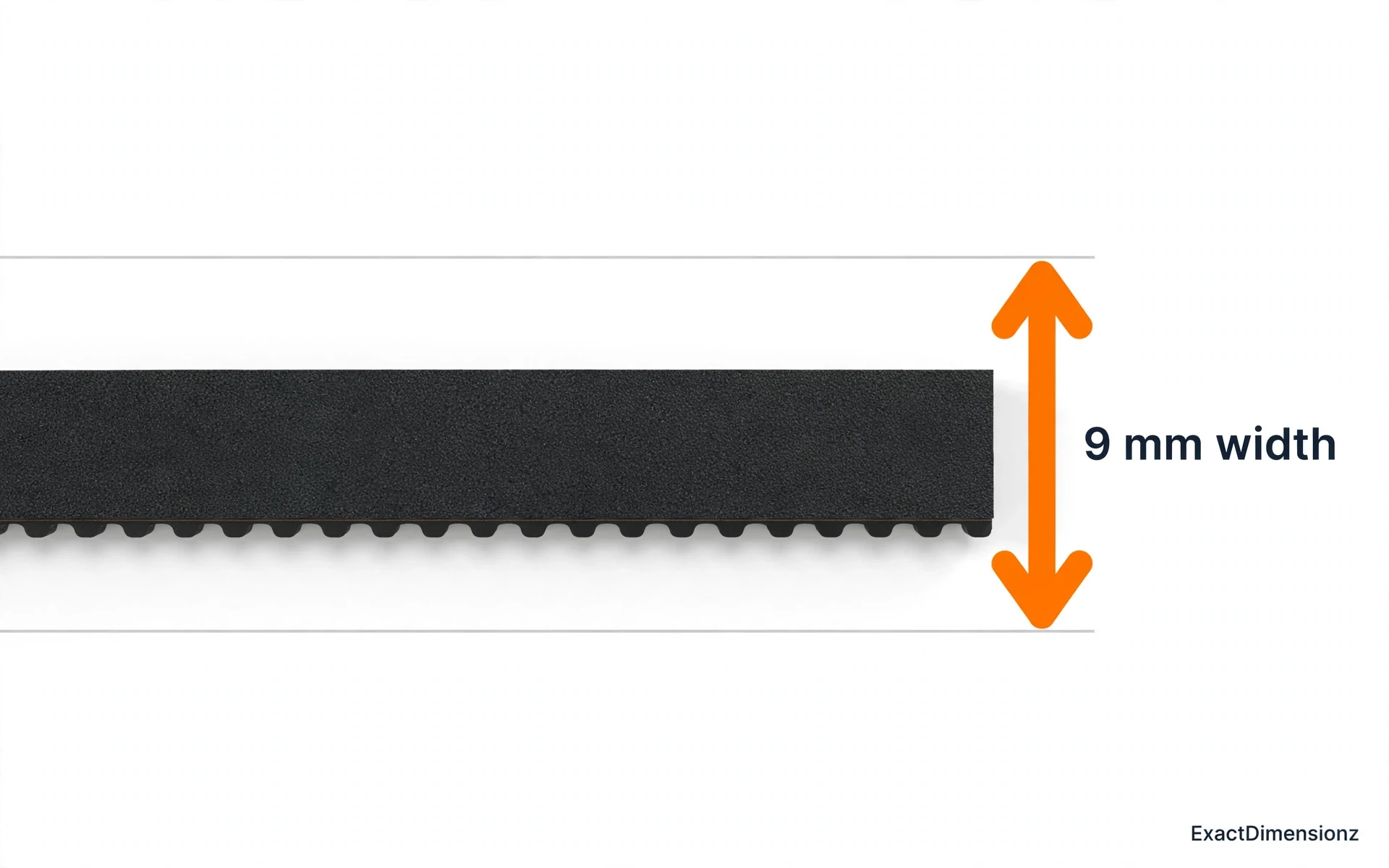
3. Gates PowerGrip GT3 timing belt — 9 mm belt width
Evidence: Official specification
Gates publishes 9 mm as a standard belt width for its PowerGrip GT3 synchronous belts — it is one of the standard widths for the 3MGT pitch (3, 6, and 9 mm) and appears across the range. The 9 mm here is the belt’s width, measured straight across the belt at right angles to its direction of travel.
You will meet this belt inside 3D printers, small automation equipment, and office machines, where a 9 mm wide loop of toothed rubber carries the motion. The width matters because the belt has to match its pulley exactly: a 9 mm belt on a 6 mm pulley overhangs, and on a 15 mm pulley it wanders. For visualizing the size, picture the belt’s edge — that 9 mm band is about as wide as the nail on your little finger.
4. Ruland MCL-9 clamp shaft collar — 9 mm bore
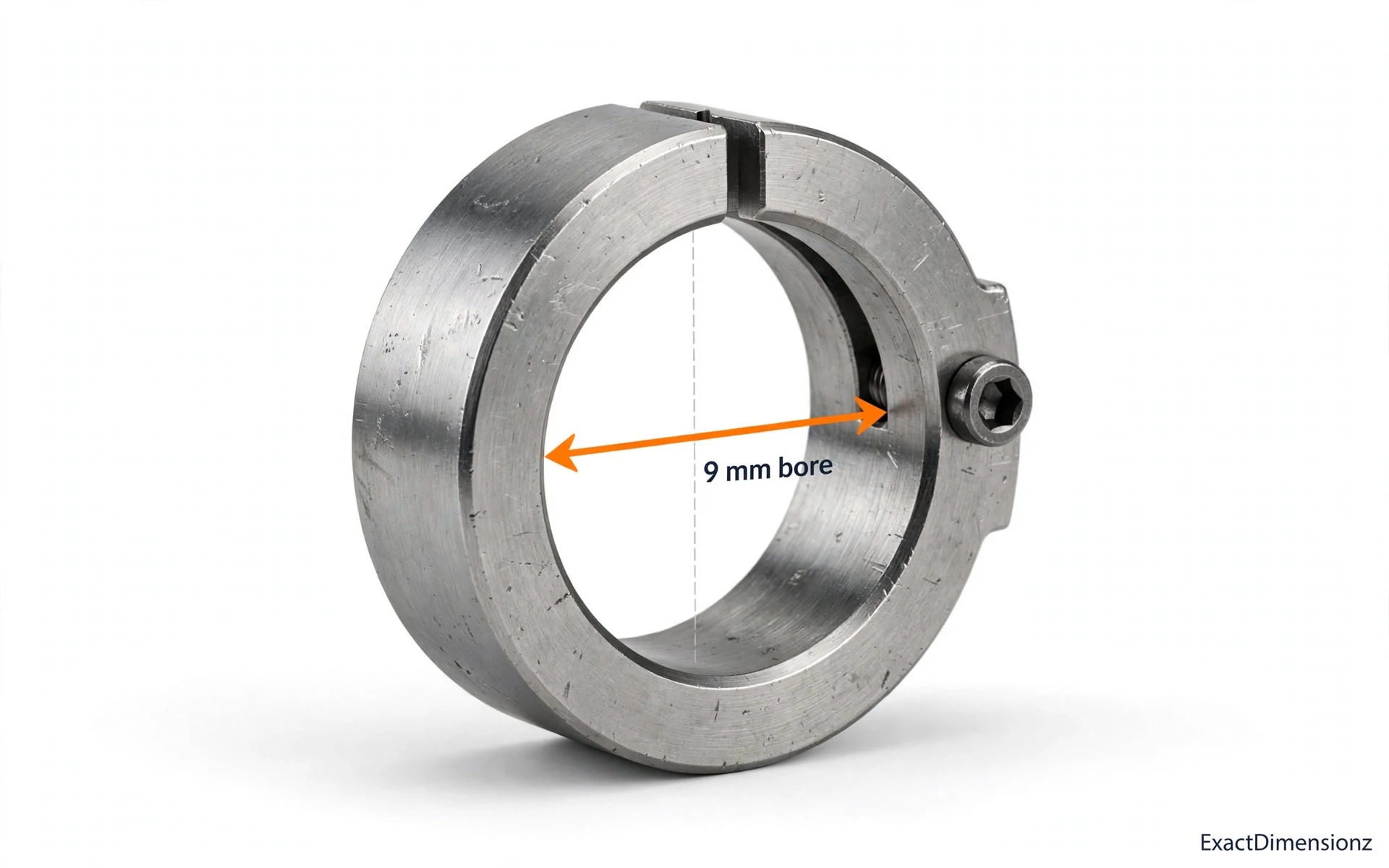
Evidence: Published dimension
Ruland’s catalog lists the MCL-9 one-piece clamp shaft collar with a 9 mm bore — the precision-honed hole through the middle of the collar, sized to clamp onto a 9 mm shaft. The collar’s own outside diameter is 24 mm, so the 9 mm is hidden inside the part, which is precisely why the label matters.
This is the only object in Tier 1 where the 9 mm is an internal dimension rather than an external one. Slide the collar onto a 9 mm shaft and the fit is snug by design; that snugness is the whole product. If you are sizing a replacement collar, measure the shaft it rides on, not the collar’s outside — a 24 mm outside diameter tells you nothing about the 9 mm bore.
5. Shimano traditional front quick-release axle — 9 mm diameter
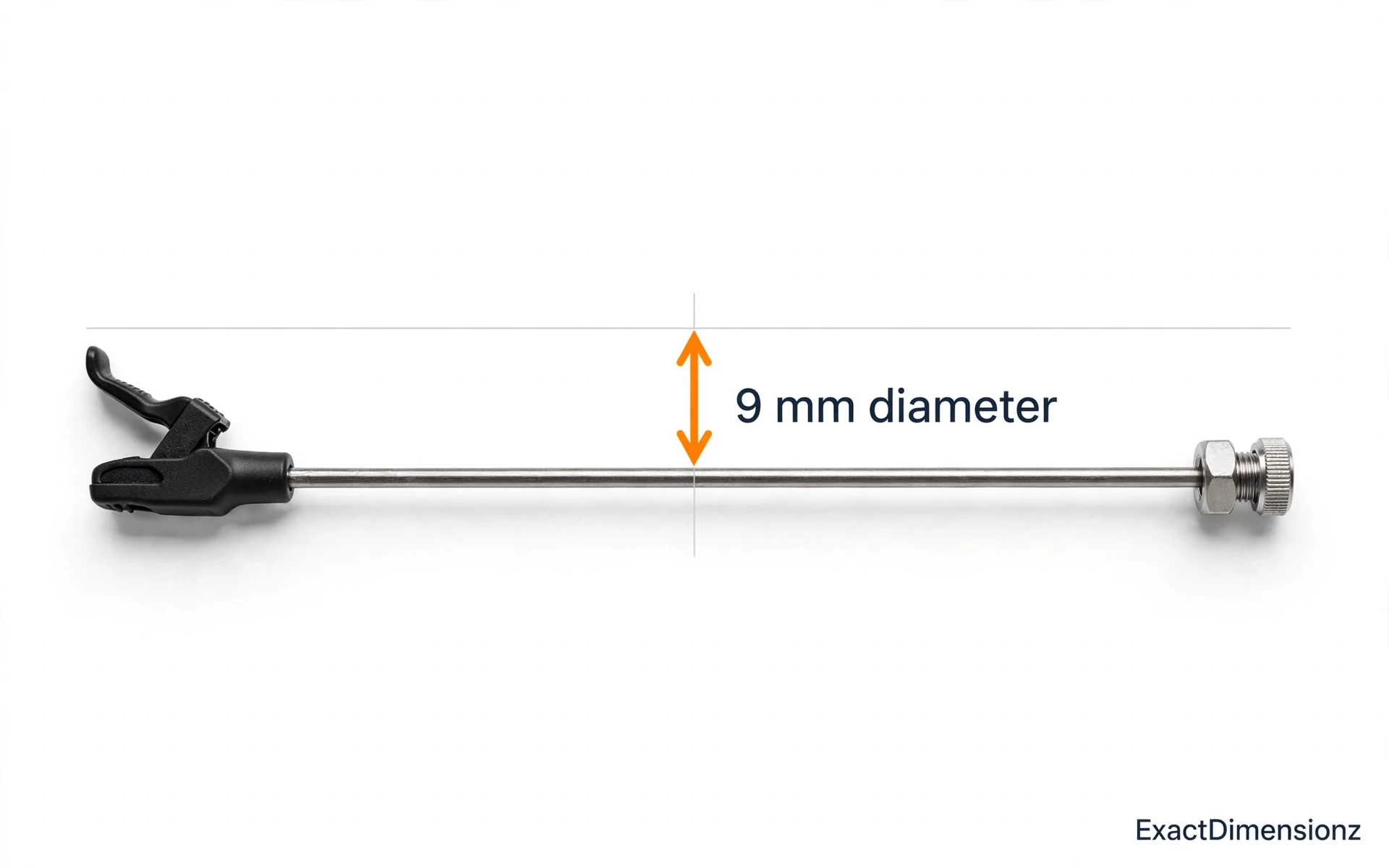
Evidence: Published dimension
Shimano’s own technical materials describe the traditional front quick-release hub as a “9 mm quick release front axle system” — the 9 mm is the diameter of the hollow axle (and the skewer that passes through it) on a standard front wheel. The rear equivalent is 10 mm, which is a handy built-in comparison: front 9, rear 10.
Anyone who has removed a front bicycle wheel has held this 9 mm in their hand without knowing it. The skewer rod that slides through the hub is 9 mm across — noticeably slimmer than a pencil, and a full millimeter slimmer than the rear axle. Modern thru-axle bikes have moved to 12 or 15 mm up front, so this reference belongs specifically to the quick-release era, which still covers millions of bikes on the road.
Tier 2 — A standard defines the 9 mm
These two objects get their 9 mm from an engineering standard rather than a single company’s catalog. The number is real and binding — but as you will see, “standardized at 9 mm” and “measuring 9.000 mm” are two different statements.
6. 9×19mm Parabellum bullet — about 9.01 mm bullet diameter
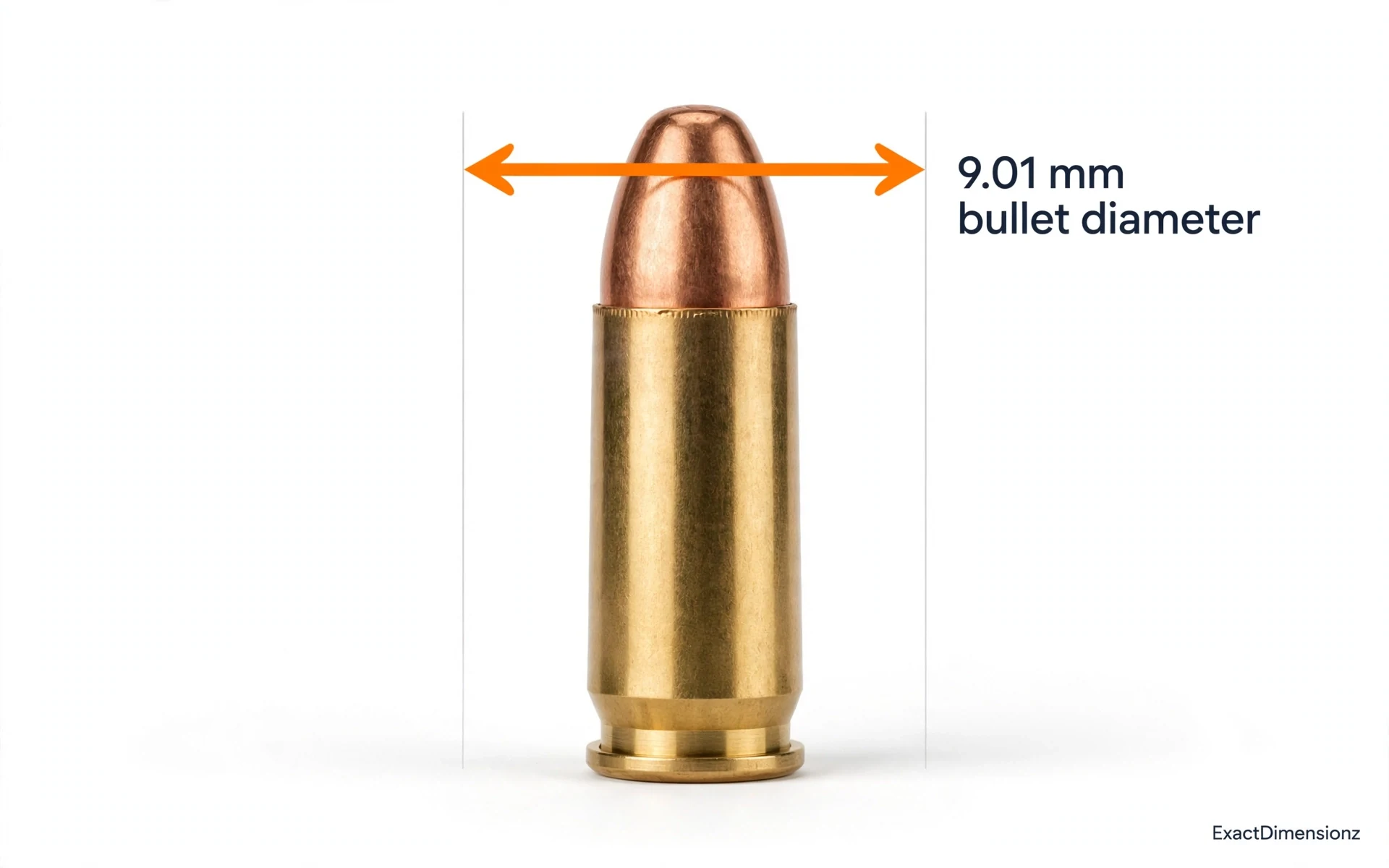
Evidence: Standardized measurement
The 9×19mm Parabellum — the cartridge most people mean when they say “9mm” — is standardized with a bullet diameter of 9.01 mm (0.355 in) under CIP, the European proof standard; American references commonly round the same dimension to 9.02 mm. The “9” in the name is the nominal bore designation, not a caliper reading of any single bullet.
This is the perfect illustration of the designation-versus-dimension gap this article keeps flagging. The bullet must be a touch over the bore’s land diameter so the rifling can grip it, which is why the standardized bullet finishes at roughly nine millimeters and two hundredths — not nine point zero zero zero. When someone pictures “9mm” as the bullet, they are picturing something 0.01–0.02 mm wider than the label suggests. At human scale that difference is invisible; in a standards document it is the entire point.
7. DIN 7 parallel dowel pin, 9 mm — 9 mm diameter, tolerance m6
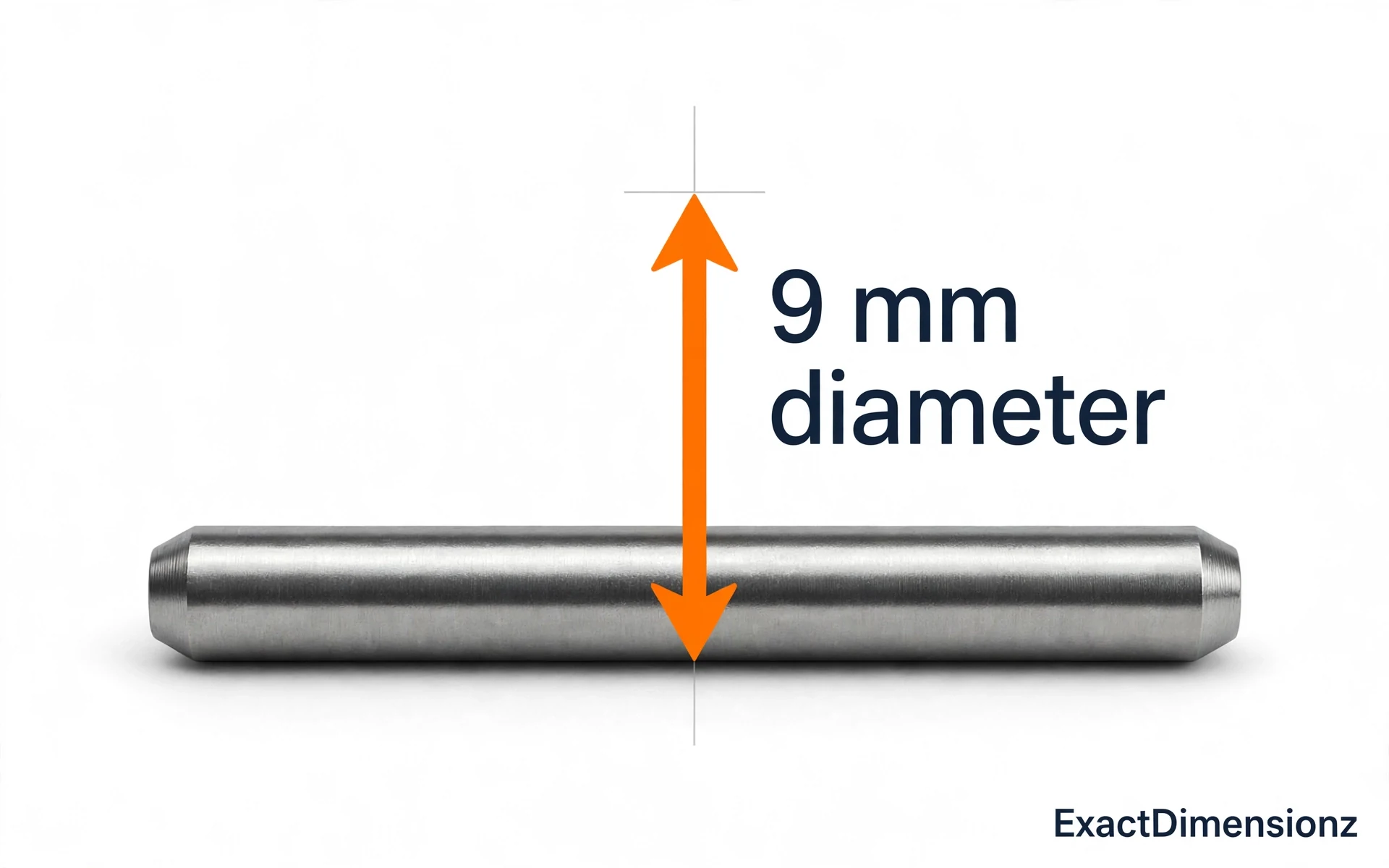
Evidence: Standardized measurement
DIN 7 defines metric parallel dowel pins from 1 to 50 mm in diameter, and 9 mm is one of the standard sizes, normally supplied in tolerance class m6. For a 9 mm pin that means an actual diameter of 9.006 to 9.015 mm — deliberately a few microns over nominal so the pin presses firmly into a reamed hole and stays put.
Dowel pins are the unsung heroes of machine assembly: small, hardened steel pins that align two parts so precisely they can be separated and reassembled in exactly the same position. The 9 mm here is the pin’s outside diameter, measured across the ground cylindrical surface — not the length, which varies independently. If you ever need to picture nine millimeters as pure precision, this is it: a pin whose entire value lies in being 9 mm plus six to fifteen microns, no more, no less.
Tier 3 — Nominal 9 mm: the label, not the caliper reading
These three objects are sold and specified as 9 mm, but the manufacturer only promises a tolerance band around that number. They belong in this guide because “listed at 9 mm” is a legitimate, published claim — as long as nobody pretends the band is a single exact value.
8. Petzl PUSH 9 mm kernmantle rope — 9 mm diameter (nominal)
Evidence: Nominal-toleranced size
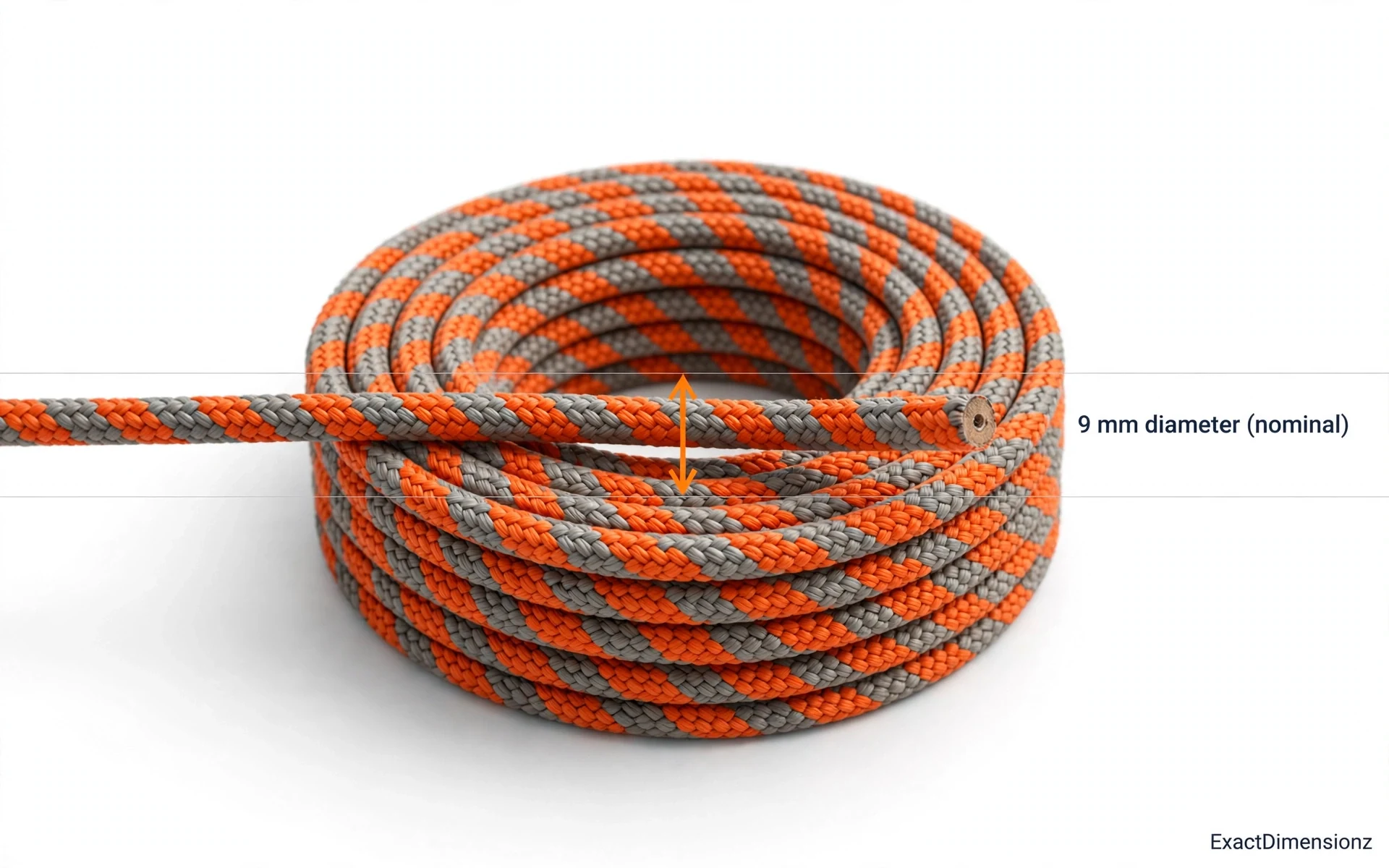
Petzl designates its PUSH canyoning rope as 9 mm — a low-stretch kernmantle rope whose published diameter is 9 mm. Rope diameters are nominal by nature: the sheath compresses, the core shifts, and independent caliper readings of “9 mm” ropes routinely land a few tenths above the label.
That is worth knowing rather than worrying about. For the person holding the rope, 9 mm describes the handling class — thin, fast through a descender, light in the pack — not a laboratory measurement. When you coil it in your hand, the loop of cord crossing your palm is the 9 mm. Just do not use a rope as a calibration reference; use it as a feel reference.
9. UPM WISA-Birch plywood, 9 mm — 9 mm nominal thickness
Evidence: Nominal-toleranced size
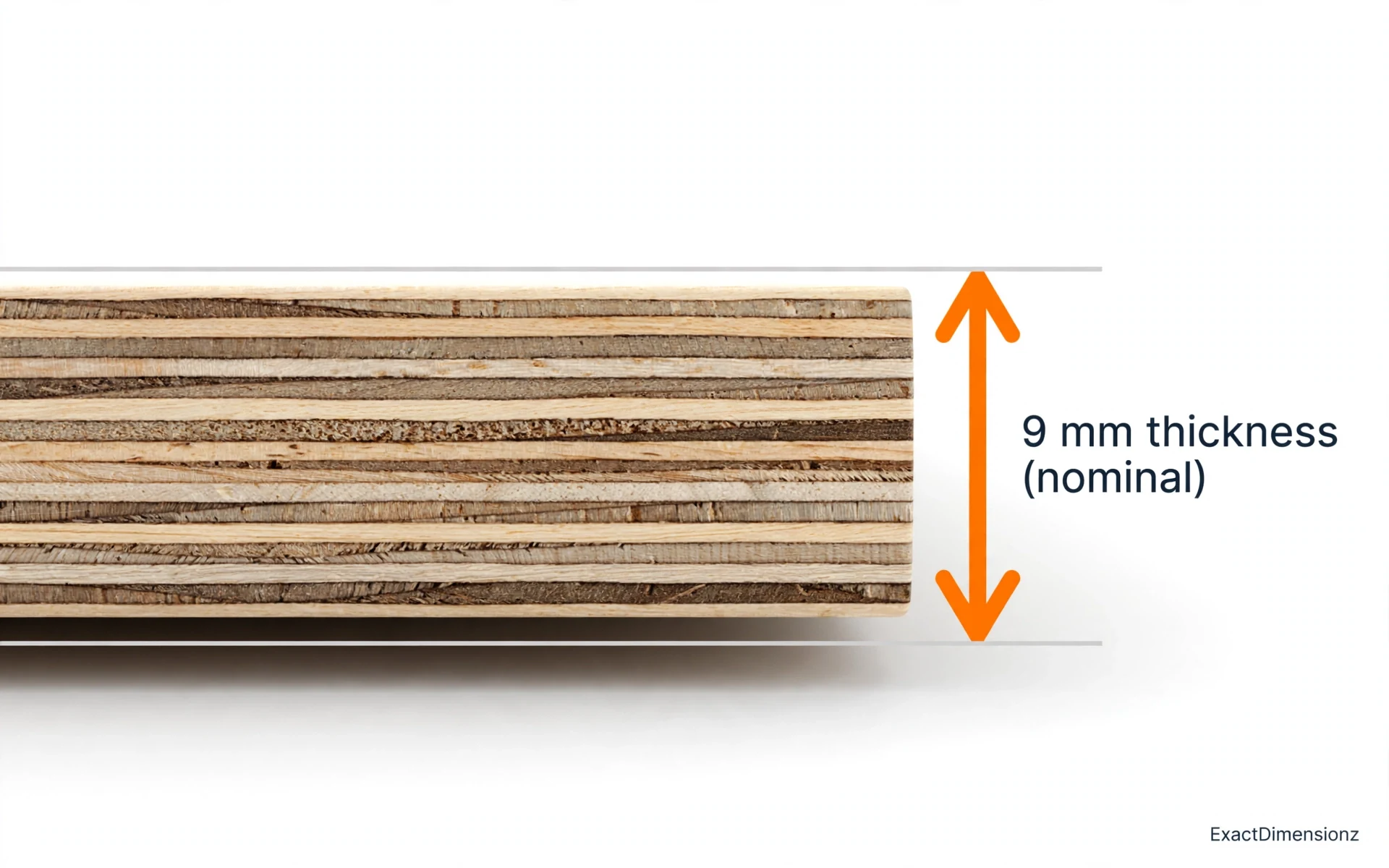
UPM’s WISA-Birch plywood is produced in a nominal 9 mm thickness (7 plies), and the company’s technical fact sheet gives the actual thickness range as 8.8 to 9.5 mm. The 9 mm is the panel thickness — the distance between the two faces — and it is a manufacturing target with a published tolerance, not a guarantee.
This is the most familiar object in the tier, and the most misunderstood. A sheet stamped 9 mm can measure 9.4 mm at one corner and 8.9 at another and still be perfectly within specification, because wood moves with humidity and veneer thicknesses vary. If you are cutting joinery to fit 9 mm plywood, measure your actual sheet with calipers and cut to the reading, not the label. For visualizing the size, though, the edge of the sheet is ideal: nine millimeters of layered birch edge is easy to see and instantly recognizable.
10. EGGER raw MDF, 9 mm — 9 mm nominal thickness
Evidence: Nominal-toleranced size
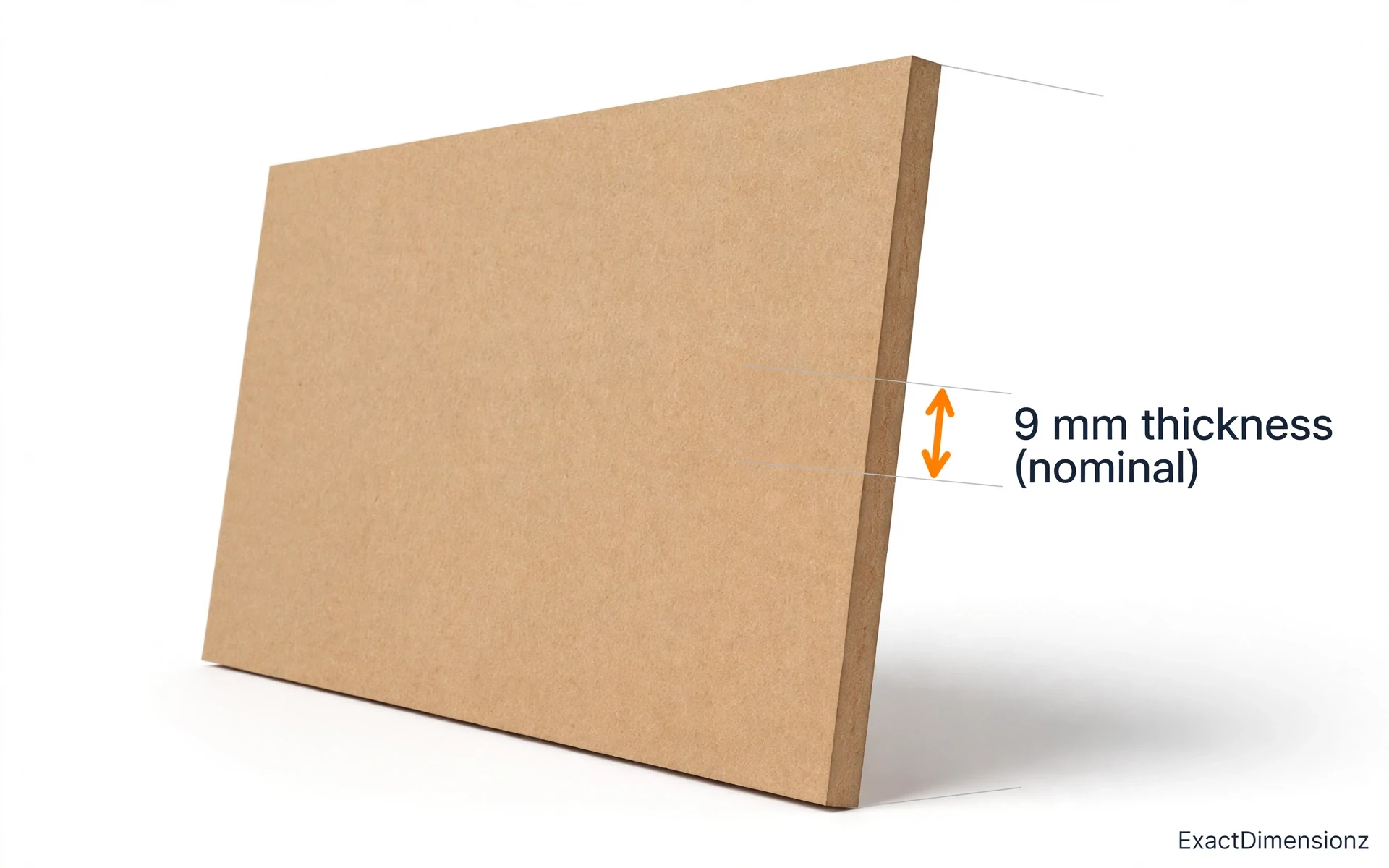
EGGER’s technical data sheet for raw MDF covers nominal 9 mm boards (in the over-6-to-9 mm class) with a thickness tolerance of ±0.2 mm per EN 324-1 — so a board sold as 9 mm may actually measure anywhere from 8.8 to 9.2 mm. As with plywood, the 9 mm is the board thickness between the two faces.
MDF is the steadier cousin of plywood: no grain, no voids, a uniform fiber mat that takes paint beautifully, which is why 9 mm MDF turns up as drawer bottoms, cabinet backs, and craft panels. Its tolerance band is tighter than plywood’s, but the principle is identical — nominal means “aimed at,” not “equal to.” Hold the edge of a 9 mm MDF offcut next to the plywood edge from the previous section and you can see the two materials’ different ideas of what 9 mm looks like.
9 mm on a ruler
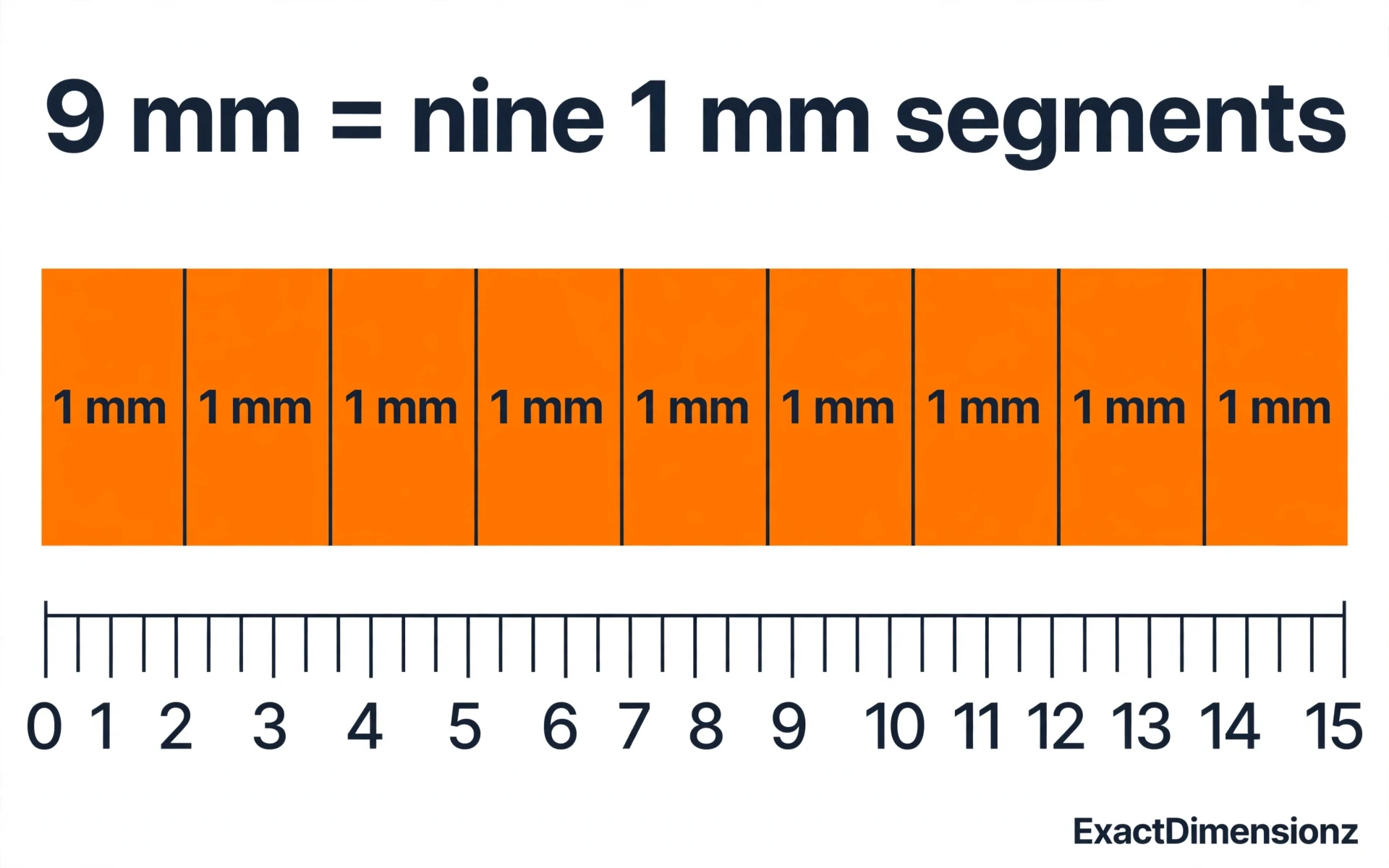
A millimeter ruler tells the story faster than any paragraph. Nine millimeters is nine of the small divisions past zero — just short of the 1 cm mark, with exactly one millimeter to spare. On a standard 15 cm ruler the 9 mm span covers a little more than half the width of your smallest fingernail. The orange bar above divides the span into nine equal 1 mm segments, so you can count the size rather than guess it.
9 mm conversions, verified twice
| From | To | Result |
|---|---|---|
| 9 mm | centimeters | 0.9 cm (exact) |
| 9 mm | inches | 0.354 in (rounded) |
| 9 mm | feet | 0.0295 ft (rounded) |
| 9 mm | 16ths of an inch | just under 6/16 in (0.375 in = 9.525 mm) |
Each conversion was calculated independently from the exact constants (1 in = 25.4 mm) and checked against the table. Rounded values are marked; nothing here was copied from a search snippet. If you are converting in the other direction, the companion guides to how big 6 mm is and how big 7 mm is use the same method.
Which axis is 9 mm on each object
| Object | The 9 mm axis |
|---|---|
| Bosch 9.0 mm drill bit | cutting diameter |
| Bondhus 9 mm hex key | across flats |
| Gates PowerGrip GT3 belt | belt width |
| Ruland MCL-9 shaft collar | bore (internal diameter) |
| Shimano front QR axle | axle diameter |
| 9×19mm Parabellum bullet | bullet diameter (~9.01 mm) |
| DIN 7 dowel pin | pin diameter (9.006–9.015 mm) |
| Petzl PUSH rope | rope diameter (nominal) |
| WISA-Birch plywood | panel thickness (8.8–9.5 mm) |
| EGGER MDF | board thickness (8.8–9.2 mm) |
Near sizes: what 9 mm is not
Two familiar measurements sit close enough to 9 mm to cause real confusion, so they get their own clearly labeled section. Neither counts toward the ten objects above.
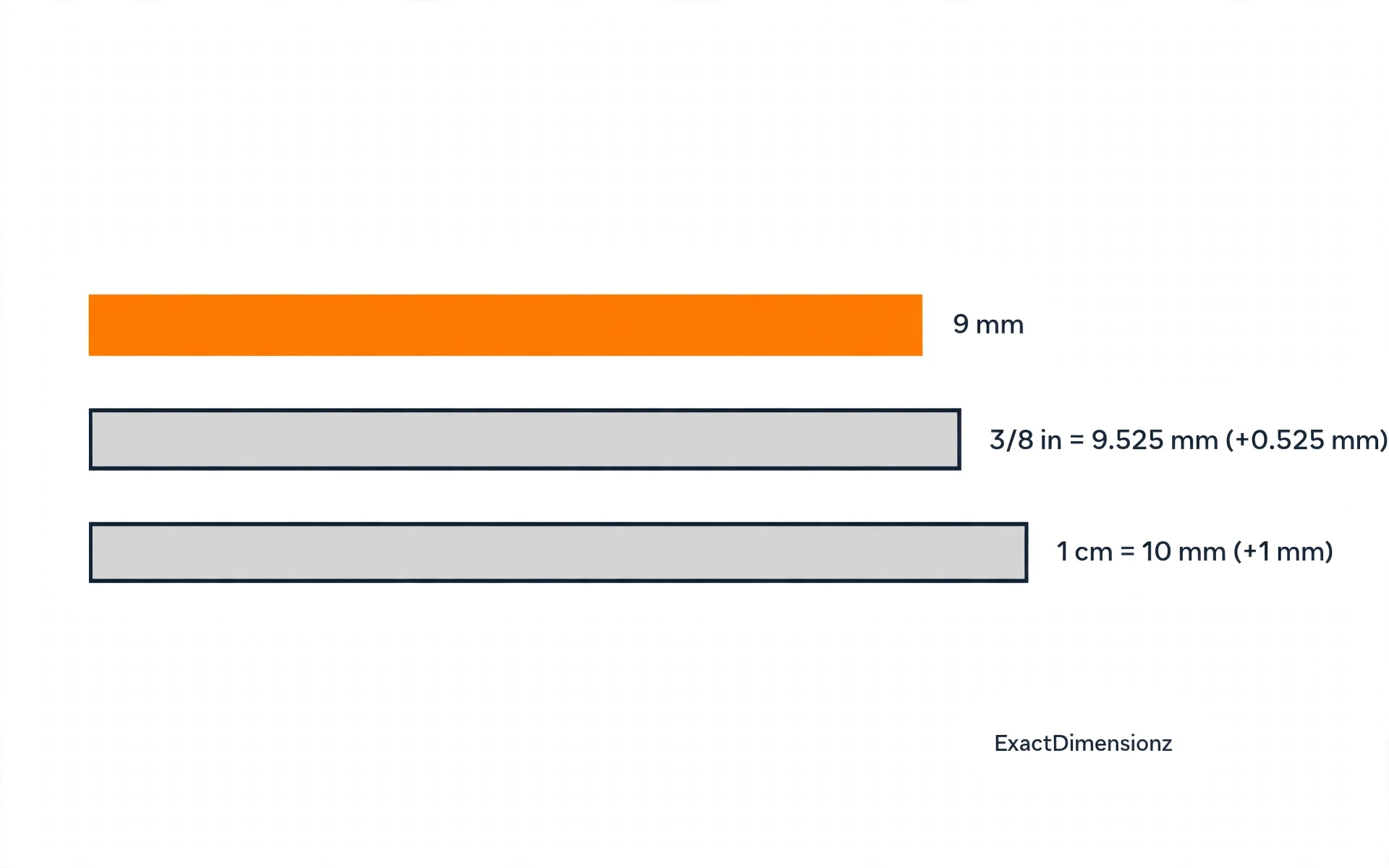
3/8 inch is 9.525 mm — about half a millimeter larger than 9 mm. This is the classic workshop mix-up: a 3/8-inch drill bit will not make a 9 mm hole, and a 9 mm wrench will slip on a 3/8-inch bolt head. The 0.525 mm gap sounds tiny until it is the difference between a press fit and a rattle.
1 centimeter is 10 mm — exactly one millimeter larger than 9 mm. On a ruler it is the next big mark over, which makes it the easiest mental anchor: picture 1 cm, then shave off a tenth. Readers coming from the 7 mm guide will recognize the pattern — near sizes are for orientation, never for substitution.
Check Any 9 mm Claim in 60 Seconds
Calipers beat rulers at this scale — a printed line can swallow a few tenths of a millimeter — but technique beats the tool. Close the jaws with light, even pressure, read at eye level, and match the axis to the tier before you believe the number.
Tier 1: measure the feature the maker controls. On the Bosch bit, caliper the fluted cutting section near the tip, never the shank — on reduced-shank bits the two differ. On the Bondhus key, measure straight across two parallel flats; corner to corner gives a bigger number and a wrong conclusion. On the Gates belt, measure the width at right angles to travel. On the Ruland collar, use the inside jaws on the bore and rock gently to find the maximum — that is the true diameter. On the Shimano skewer, measure the rod itself. A ruler can orient you — nine divisions is unmistakable — but for any decision that matters, the caliper is the instrument.
Tier 2: expect the standard, not the round number. A 9×19mm bullet calipers at about 9.01 mm, because the CIP standard says so — the “9” is the nominal bore designation, and the bullet must run a touch over the lands so the rifling grips it. A DIN 7 dowel pin in m6 reads 9.006 to 9.015 mm by design, deliberately oversize so it presses into a reamed hole and stays. If your caliper shows 9.01 where the name says 9, the part is right and your expectation was wrong.
Tier 3: read the band, average the reality. Rope is a feel reference, never a calibration standard — the sheath compresses and the core shifts. On WISA-Birch plywood and EGGER MDF, take three readings across the panel and average them; the spread tells you more than any single number. A 9 mm panel reading 9.4 at one corner is not defective — it is inside its published band.
When 9 mm Is the Wrong Number
Sometimes the error isn’t in the measuring — it’s in reaching for 9 mm at all.
Substituting 3/8-inch hardware. No — 9 mm is not the same as 3/8 inch. Three-eighths is exactly 9.525 mm, more than half a millimeter larger. A 3/8-inch drill bit will not drill a 9 mm hole, and a 9 mm wrench will slip on a 3/8-inch bolt head. For rough visualization they are neighbors; for fasteners they are not interchangeable, no matter how close 9.525 looks on paper.
Cutting joinery to the label. A panel sold as 9 mm birch plywood can legally measure anywhere from 8.8 to 9.5 mm. Cut your joints to the caliper reading on your actual sheet, not to the number on the stack — measure the material you own, as the 5 mm guide’s measuring section also recommends.
Confusing the name with the thing. “9mm” on a cartridge box is a nominal designation; the bullet is ~9.01 mm and the bore it flies through is something else again. The number on the package is a name with a tolerance story behind it, and the story differs for every product class. Read the standard, not just the label.
The Honest 9 mm
Nine millimeters turns out to be a working size rather than a showroom size: it holds bicycles together, times 3D-printer axes, aligns machine parts to within microns, and still has room left over to be the thickness of the shelf in your workshop. The honest way to picture it is not as a single perfect span but as a family of published nines — some ground to the hundredth of a millimeter, some standardized by international agreement, some sold inside an honest tolerance band.
Pick the reference that matches your task. Reaching for a drill bit? Use the Bosch 9.0 mm. Fitting a collar? Measure the bore, not the outside. Buying sheet goods? Trust your calipers over the label. The number is only as useful as the axis and the evidence behind it — and now you know both.
