
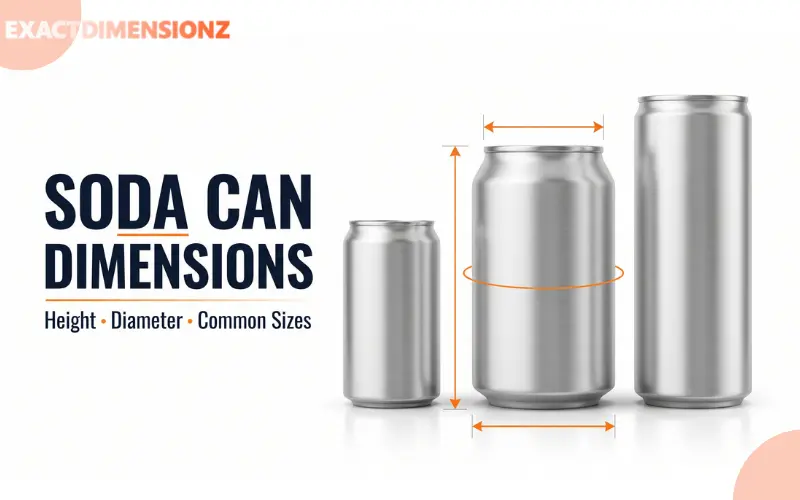
A soda can looks like the simplest object in the fridge — until you try to buy the right one. A 12 oz can of cola, a 12 oz sleek can of sparkling water and a 12 oz slim can of energy drink all hold the same 355 ml, yet they stand at three very different heights and fit three different cup holders.
The can most people picture is the standard 12 oz format: 4.81 inches tall and 2.60 inches wide (122.22 × 66 mm), the dimensions Crown publishes for its standard 355 ml can. Everything else — sleek, slim, mini and tall cans — is a variation on that shape, and this guide gives you the verified numbers for each one, in inches, centimetres and millimetres.
Quick Answer: Soda Can Dimensions
A standard 12 oz (355 ml) soda can is 4.81 inches tall and 2.60 inches wide (122.22 × 66 mm, Crown specification). Sleek, slim and mini cans hold similar volumes in very different shapes — check the can family, not just the ounces.
4.81 in / 122.22 mm
2.60 in / 66 mm
12 fl oz / 355 ml
8.18 in / 207.66 mm
Soda Can Dimensions at a Glance
The table below is the standard 12 oz format in full. Crown publishes the headline figures for its standard 355 ml can; the remaining measurements come from a can manufacturer’s published specification for the same 211-body format. All figures are nominal — small production tolerances apply, and no single figure is a guarantee for every brand.
| Measurement | Inches | Metric |
| Height | 4.81 in | 122.22 mm |
| Body diameter | 2.60 in | 66 mm |
| Body radius | 1.30 in | 33 mm |
| Circumference | 8.18 in | 207.66 mm |
| Inside neck diameter | 2.06 in | 52.4 mm |
| Stand diameter | 1.86 in | 47.24 mm |
| Easy-open end | 202 (lid about 2.13 in / 54.1 mm) | 202 |
| Nominal capacity | 12 US fl oz | 355 ml |
| Brimful capacity | about 12.8 US fl oz | 379 ml |
The manufacturer gives the empty open-can height as 122.22 ± 0.30 millimetres, so tiny differences between production runs are normal. Some manufacturer tables list the body diameter as 66.1 mm — that is the same nominal 211 body, measured to a tenth of a millimetre, not a different can.
How Tall Is a Standard Soda Can?
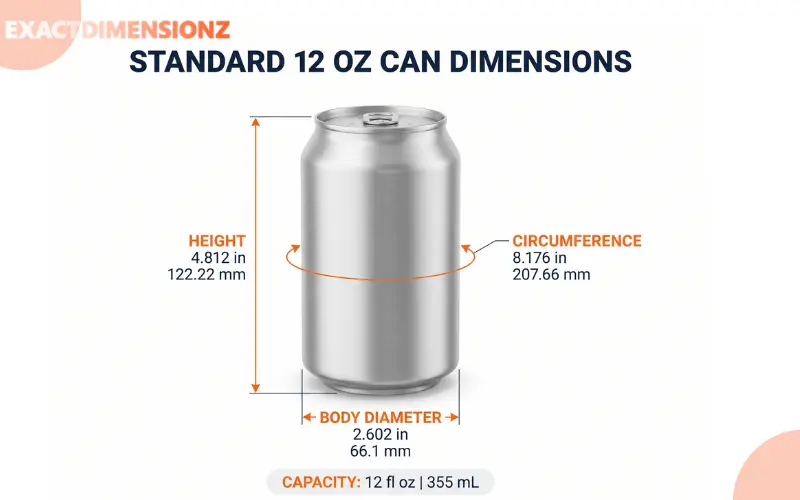
A manufacturer-specified standard 12 oz soda can is 122.22 millimetres high, which converts to 4.81 inches or 12.22 centimetres. In everyday descriptions this is often rounded to 4.8 inches.
That height is measured vertically from the lowest part of the base to the upper edge of the empty open can. The body includes a concave bottom, a straight sidewall, a tapered neck, a flange and, once finished, the easy-open end.
If you have seen the same can listed as 4.83 inches tall, neither number is wrong. The 4.83-inch figure (122.7 mm) comes from rounding a finished-can measurement, while 4.81 inches is Crown’s published open-can specification of 122.22 mm. Guides that quote 4.83 inches are rounding; this guide uses Crown’s exact published figure so the inches, millimetres and centimetres all agree with each other. A standard can stands just under 5 inches tall.
How Wide Is a Soda Can?
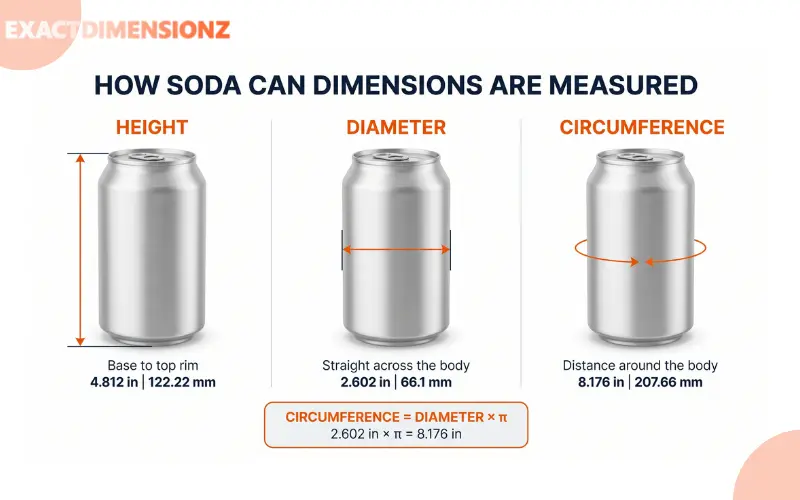
The standard 355 ml can has an outside body diameter of 66 millimetres, equal to 2.60 inches or 6.6 centimetres. Because the can is cylindrical, its width and its body diameter are the same straight measurement across its widest section.
Measure that distance through the centre of the body rather than across the smaller lid. A standard can narrows near the top, so measuring only the end gives a smaller result: the inside neck is 52.4 millimetres and the 202 end lid is about 54.1 millimetres across.
Soda Can Sizes Compared
“Soda can” describes several container formats rather than one universal size. The chart below compares standard, slim and sleek aluminium cans. Standard-format figures are Crown catalogue specifications; slim and sleek figures are published manufacturer specifications for those can families. Tooling and tolerances differ slightly between suppliers, so packaging projects should always use the technical drawing for the selected container.
| Can style | Capacity | Height | Body diameter | Common use |
| Standard | 250 ml / 8.4 oz | 3.62 in / 92 mm | 2.60 in / 66 mm | Mini and portion cans |
| Standard | 330 ml / 11.2 oz | 4.54 in / 115.2 mm | 2.60 in / 66 mm | Europe and the UK |
| Standard | 355 ml / 12 oz | 4.81 in / 122.22 mm | 2.60 in / 66 mm | Everyday soda in the US |
| Standard | 473 ml / 16 oz | 6.19 in / 157.23 mm | 2.60 in / 66 mm | Tall boys |
| Standard | 500 ml / 16.9 oz | 6.61 in / 167.84 mm | 2.60 in / 66 mm | Large single-serve, Europe |
| Slim | 250 ml / 8.4 oz | 5.28 in / 134 mm | 2.10 in / 53.4 mm | Energy drinks |
| Sleek | 330 ml / 11.2 oz | 5.75 in / 146.05 mm | 2.26 in / 57.4 mm | Sparkling water and seltzer |
| Sleek | 355 ml / 12 oz | 6.17 in / 156.59 mm | 2.28 in / 58 mm | Hard seltzer and sparkling water |
The pattern is easy to read: the standard body stays 66 millimetres wide while the height grows with capacity, and the slim and sleek families trade width for height at the same volume.
Standard vs Sleek vs Slim: Which Can Is Which?
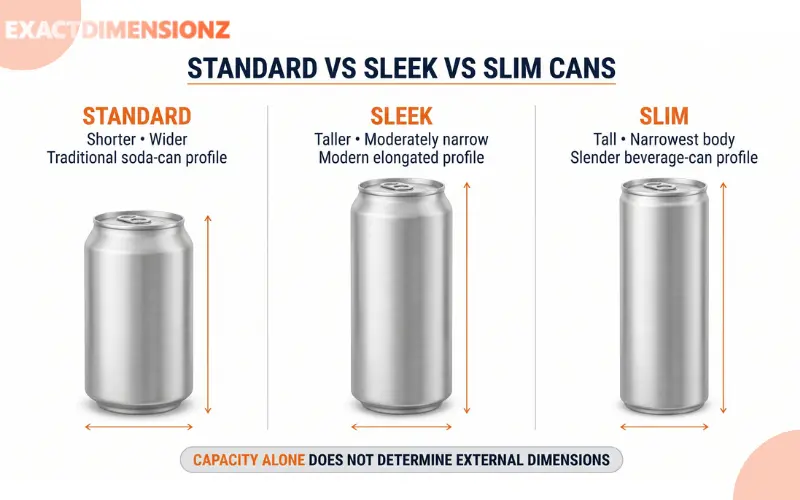
The three names describe different body families, not different drinks. A standard can is short and broad; a sleek can is tall and narrow; a slim can is the narrowest of the three.
| Feature | Standard | Sleek | Slim |
| Example capacity | 355 ml | 355 ml | 250 ml |
| Example height | 122.22 mm | 156.59 mm | 134 mm |
| Example diameter | 66 mm | 58 mm | 53.4 mm |
| Profile | Shorter and wider | Tall and narrow | Narrowest |
| Example body code | 211 | 204 | 202/201 |
| Typical end | 202 | 202 | 200 |
Coca-Cola sells the same cola in standard and sleek cans — the full breakdown by Coke format is in our Coke can dimensions guide.
Hard seltzer is the drink most people meet in a sleek can. White Claw’s 12 oz cans use the tall CrownSleek profile, which is why they look so different from a cola can despite holding the same volume — see our White Claw can dimensions guide for the brand’s full size range.
Slim cans belong mostly to energy drinks. Red Bull’s 250 ml can is a slim-format can at 5.24 inches tall and 2.09 inches wide, and Monster’s 16 oz cans use the standard 66 mm body at a taller 6.19 inches — both are covered in our Red Bull can dimensions and Monster can dimensions guides.
If you have seen a sleek 12 oz can listed at both 57.4 mm and 58 mm wide, neither number is a typo. Crown’s CrownSleek 355 ml can measures 58 mm across and 156.59 mm tall; another supplier publishes its own sleek tooling at 57.4 mm for its 330 ml sleek format. The two differ by a fraction of a millimetre — a different production tool, not a different can family. This guide uses Crown’s 58 × 156.59 mm as the lead figure for the 355 ml sleek can because it comes from the can maker’s own catalogue.
Mini Soda Cans
“Mini can” is a consumer-facing name rather than one universal engineering format. Mini soda products may use different body families, capacities, diameters and heights depending on the beverage company and the packaging supplier.
Two verified examples show how wide the range is. A 250 ml standard-format can measures 92 millimetres high and 66 millimetres in diameter (3.62 × 2.60 inches), while a 250 ml slim can measures 134 millimetres high and 53.4 millimetres in diameter (5.28 × 2.10 inches) — the same nominal volume in two completely different shapes.
For that reason, never estimate mini soda can dimensions from capacity alone. Check the brand, the market, the body style and the manufacturer drawing.
16 oz and 500 ml Tall Cans
A manufacturer-specified standard 473 ml (16 oz) can measures 157.23 millimetres high and 66 millimetres in body diameter — 6.19 inches high and 2.60 inches wide. The body diameter matches the 355 ml standard can; the extra height is what holds the additional 118 millilitres.
The published standard 500 ml can measures 167.84 millimetres high and 66 millimetres in diameter (6.61 × 2.60 inches). It holds 16.9 US fluid ounces and is 10.61 millimetres taller than the 473 ml can — a difference that matters when designing cartons, shelves and dispensing equipment.
A 16 oz can should not automatically be assumed to match every other can marketed at that volume. Supplier tooling, end profiles, specialty shapes and regional packaging systems can produce different dimensions.
Soda Can Sizes in the USA and Around the World
North American soda packaging regularly uses the 355 ml (12 US fl oz) size. The standard container sits at 122.22 millimetres high and 66 millimetres in diameter.
The 330 ml format is established in European and other metric markets. Ardagh Metal Packaging lists 330 ml in its European standard-can range, along with 375 ml, 440 ml and 470 ml formats.
Capacity also varies by individual brand and product line. A company can offer standard, sleek or slim packaging within the same regional market, so when comparing soda can dimensions internationally, check the nominal liquid capacity, the standard/sleek/slim body, the body diameter, the finished height, the end size, the manufacturer tolerance and the country or sales region.
What Do 202 and 211 Mean on a Beverage Can?
Can manufacturers use traditional three-digit industry codes to describe nominal diameters. These codes are not decimal inches: the first digit represents whole inches and the final two digits represent sixteenths of an inch.
So 202 means 2 inches plus 2/16 inch, or a nominal 2⅛ inches. 211 means 2 inches plus 11/16 inch, or a nominal 2¹¹⁄₁₆ inches. 204 means 2 inches plus 4/16 inch, or a nominal 2¼ inches.
A standard can has a 211 body and a 202 end. The upper body is necked inward before the smaller lid is attached, which reduces the amount of metal the end needs. The industry code should never replace the current technical drawing — the actual metric specifications and tolerances from the manufacturer remain the correct values for packaging design and equipment fit.
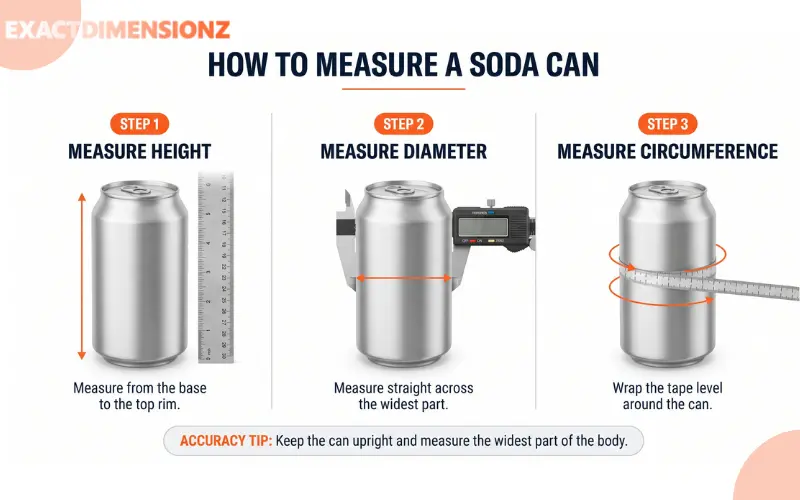
How to Measure a Soda Can
Height
Place the empty or finished can upright on a level surface. Measure vertically from the lowest supporting point of the base to the highest point of the top seam, and record whether the measurement applies to an open empty body or a completed can with its end installed.
Body diameter
Measure straight across the widest cylindrical section through its centre. Do not measure only one side, the curved base or the narrowed neck. A digital caliper gives a more dependable reading than a flexible tape.
Circumference
Wrap a flexible tape around the straight body section and keep it level, without crossing the tapered shoulder. Or calculate it by multiplying the verified diameter by pi: 3.14159265 × 66 mm = 207.66 mm (8.18 inches). That is a calculated value based on the specified body diameter, not the size of a printed label — a label wrapped around the body needs extra material for overlap, bleed and production tolerances, so never use the calculated circumference as a final artwork template without the can supplier’s current design file.
Capacity
Capacity cannot be determined accurately from height and outside diameter alone, because the base dome, shoulder, wall profile and headspace all affect internal volume. Use the manufacturer’s nominal fill volume and brimful-capacity specification.
Use a digital caliper for diameter and a rigid height gauge or steel rule for height. Take at least three body-diameter readings, rotating the can between measurements, and never crush, dent or press the container while measuring — even small deformations change the result, especially on an empty aluminium body. Record the can’s brand, capacity, country, packaging style and production code: these details explain why a measurement may differ from another can carrying the same nominal volume. For commercial packaging, artwork, filling lines, vending machines or custom holders, request the current technical drawing from the can supplier. A consumer measurement is not a substitute for production specifications.
Will a Soda Can Fit? Cup Holders, Koozies & Fridge Shelves
A cup holder needs an internal opening larger than the can’s maximum body diameter. For a 66-millimetre soda can, the rigid opening must exceed 66 millimetres before allowing for manufacturing tolerance and usable clearance — a holder measuring exactly 66 millimetres internally would leave no practical clearance, and the can could bind because of surface finish, condensation or deformation. Tapered automotive cup holders also need enough depth and support; diameter alone does not determine stability. For comparison, a standard 16.9 oz water bottle is taller and narrower than a soda can, so a holder that fits one may not fit the other — see our water bottle dimensions guide.
A standard foam sleeve must accommodate a can body measuring 66 millimetres (2.60 inches) across. Flexible foam can stretch, but the sleeve’s internal shape must also support the base and the body height. Slim and sleek cans fit loosely inside sleeves designed for standard cans — a 53.4-millimetre slim can is 12.7 millimetres narrower than the standard format — so choose a sleeve made for the correct body family rather than relying only on the beverage capacity printed on the can.
A standard 355 ml can needs more vertical space than its listed container height: extra clearance lets the can be inserted, removed and tilted without striking the shelf above. Packaging rings, shelf lips, trays and carton material can all increase the space required. Sleek 355 ml cans need significantly more vertical clearance because their published height reaches 156.59 millimetres. Cans share fridge space with snack tubes, too — a standard Pringles can stands around 10 inches tall, so it needs a very different shelf than a soda can; see our Pringles can dimensions guide.
FAQs
What are the dimensions of a standard soda can?
A specified standard 355 ml can measures 122.22 millimetres high and 66 millimetres in body diameter. That equals 4.81 inches high and 2.60 inches wide. Manufacturer tolerances and alternative tooling can produce small differences.
How tall is a 12 oz soda can?
A standard 12 oz can is 4.81 inches (122.22 mm) tall. A 12 oz sleek can is taller — 6.17 inches (156.59 mm) in Crown’s CrownSleek specification — because it uses a narrower 58 mm body to hold the same 355 ml.
What is the diameter of a soda can?
The specified standard 355 ml can has a 66-millimetre body diameter, equal to 2.60 inches. Its neck and lid are narrower than its main body. Slim cans use a 53.4 mm body and sleek cans a 58 mm body.
What is the circumference of a standard soda can?
A 66-millimetre body diameter produces a calculated circumference of 207.66 millimetres. That equals 20.77 centimetres or 8.18 inches. Label artwork needs supplier templates, because printing requires allowances beyond the mathematical circumference.
Are all 12 oz soda cans the same size?
No — equal capacity does not guarantee equal physical dimensions. A standard 355 ml can measures 122.22 × 66 millimetres, while a 355 ml sleek can measures 156.59 × 58 millimetres in Crown’s catalogue. Always identify the can family and the supplier specification before assuming two cans match.
Why do some guides say a 12 oz can is 4.83 inches tall?
The 4.83-inch figure (122.7 mm) comes from rounding a finished-can measurement, while 4.81 inches is Crown’s published open-can specification of 122.22 mm. Both describe the same standard can; the difference is rounding and where the measurement is taken, not a different can. This guide uses Crown’s exact published figure.
Will a standard soda can fit in a cup holder?
It fits any holder whose rigid internal opening is wider than 66 millimetres (2.60 inches), with a little clearance to spare. A holder measuring exactly 66 millimetres will bind, and tapered car cup holders also need enough depth to hold the can steady.
What size is a mini soda can?
There is no single mini-can size — it is a marketing name, not an engineering format. Two verified examples are the 250 ml standard-format can at 92 × 66 millimetres (3.62 × 2.60 inches) and the 250 ml slim can at 134 × 53.4 millimetres (5.28 × 2.10 inches). Check the brand, market and body style before buying or designing around one.
Final Thoughts
A manufacturer-specified standard soda can holds 355 ml (12 US fluid ounces) and measures 122.22 millimetres high by 66 millimetres in body diameter, with a calculated body circumference of 207.66 millimetres and a 202 end that is narrower than its 211 body.
Those measurements do not apply universally to mini, slim, sleek, 16 oz or international cans — and the two numbers that cause the most confusion online, 4.81 versus 4.83 inches and 57.4 versus 58 millimetres, both come down to rounding and supplier tooling rather than different cans. For reliable planning, compare the capacity, height, body diameter, end size, manufacturer tolerance and regional format before designing packaging or checking whether a soda can will fit.
