
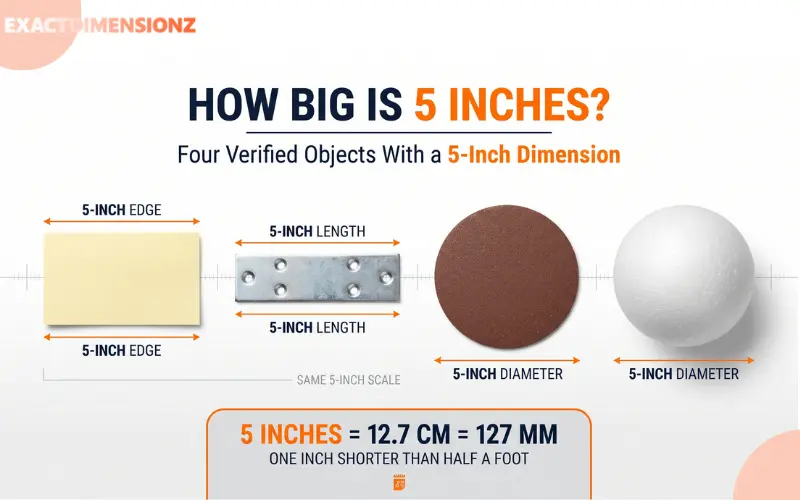
Five inches is exactly 12.7 centimeters or 127 millimeters. It also equals 5/12 of a foot, making it one inch shorter than half a foot.
Still, knowing the conversion does not always help you picture the distance. It becomes easier when you connect it with products that have a documented 5 inches dimension.
This guide includes 14 manufacturer-specified examples. Unlike general comparisons involving phones, coffee mugs, or computer mice, every item below has a five-inch length, edge, diameter, opening, or working dimension supported by a product specification. See every inches size from 1 to 100 for the full range.
The Exact Size of 5 Inches
The international inch is defined as exactly 25.4 millimeters. Multiplying that figure by five gives us:
5 × 25.4 = 127 millimeters
Therefore, five inches converts to exactly 12.7 centimeters. This conversion is based on the international inch recognized by the National Institute of Standards and Technology.
| Unit | Five Inches Equals |
| Inches | 5 in |
| Millimeters | 127 mm |
| Centimeters | 12.7 cm |
| Feet | 0.4167 ft |
| Yards | 0.1389 yd |
| Meters | 0.127 m |
The millimeter, centimeter, and meter conversions are exact. The decimal values for feet and yards are rounded for easier reading.
What Does 5 Inches Look Like?
Imagine the distance from zero to the number five on a standard ruler. That span is five inches.
On a 12-inch ruler, which is a foot long, it reaches one inch short of the halfway point. It is a manageable size that can fit inside an adult hand, although individual hand dimensions vary too much for accurate measurement.
Five inches may describe different parts of an object:
- Overall length
- One edge of a flat product
- Diameter through a circle
- Inside width of a container
- Cutting width
- Blade length
- Mounting or working dimension
Understanding which part is being measured is more useful than simply finding something advertised as “5 inches.”
14 Things With a Verified 5-Inch Dimension
These are verified 14 objects that are exact 5 inches in size:
1. The Long Edge of a 3 × 5 Post-it Note
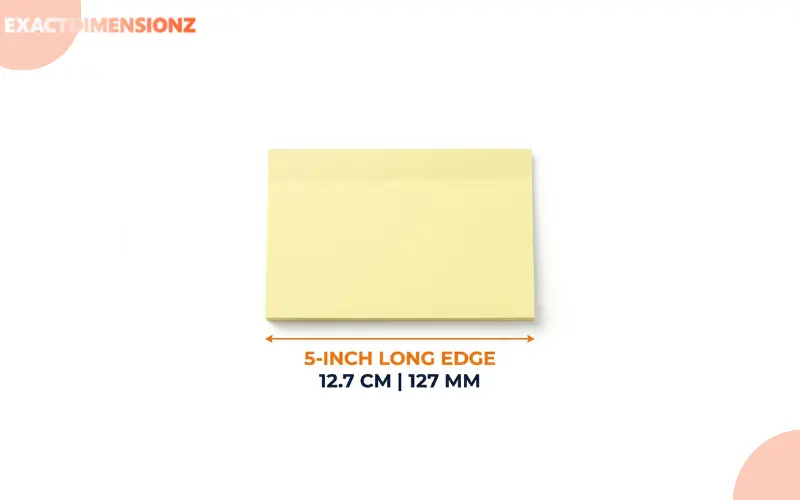
A 3 × 5 Post-it note has a five-inch long edge and a three-inch short edge. The five-inch side provides a clean straight-line representation of the measurement. Because the paper lies flat, it is easy to place beside another small item for comparison.
Keep in mind that the complete pad may have additional thickness, but thickness does not affect the edge length. Measure one horizontal long edge rather than moving diagonally across the sheet. Post-it’s official product collection includes notes specified at 3 inches by 5 inches.See the official Post-it note sizes.
2. The Short Edge of 5 × 7 Photo Paper

A sheet of 5 × 7 photo paper has one edge measuring five inches and another measuring seven inches. The shorter edge is exactly 127 millimeters according to the standard conversion. Its straight corners and flat surface make the paper an excellent visual guide.
Make sure you use an untrimmed physical sheet rather than a digital photograph displayed on a screen. Printer scaling, borderless printing, and manual trimming can change the final image area, even when the paper itself retains its stated dimensions. Canon lists compatible 5 × 7 photo media as 127 × 177.8 millimeters. View Canon’s supported photo-paper dimensions.
3. The Short Edge of a 5 × 7 Invitation Card

Avery’s 3325 invitation card is another flat product with a documented five-inch edge. Its complete listed dimensions are 5 × 7 inches. In portrait orientation, the card is five inches wide and seven inches tall.
This example can be easier to find at home than specialist hardware or workshop tools. It also shows the size in a familiar format used for invitations, announcements, and printed photographs. Measure the flat card itself before it is folded or placed inside an envelope. See Avery’s 5 × 7 invitation card.
4. A 5 × 5 × 5 Shipping Box
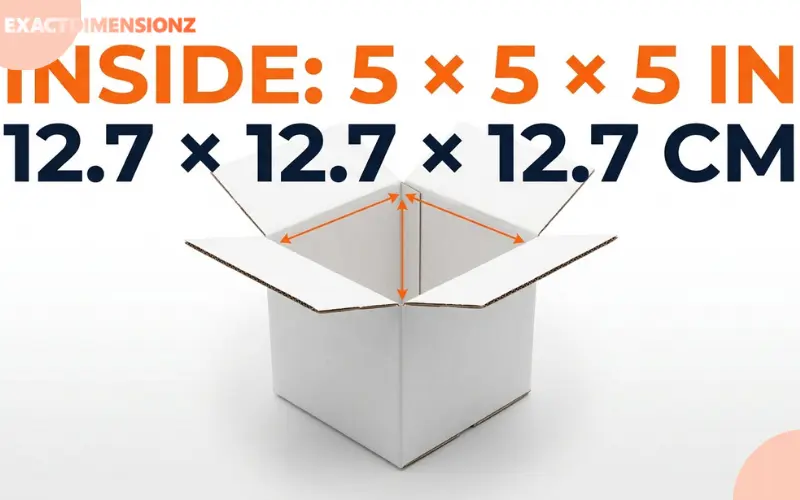
A cubic shipping box can demonstrate the measurement in three directions. Uline’s S-4948 corrugated box has listed inside dimensions of 5 × 5 × 5 inches. Its interior length, width, and height are therefore all five inches.
This example is particularly useful when you want to understand the volume created by repeating five inches across three dimensions. The outside measurements are slightly greater because corrugated cardboard has thickness. For an accurate comparison, measure the usable space inside the assembled box rather than its exterior. View Uline’s 5 × 5 × 5 box specifications.
5. A 5-Inch Steel Mending Plate
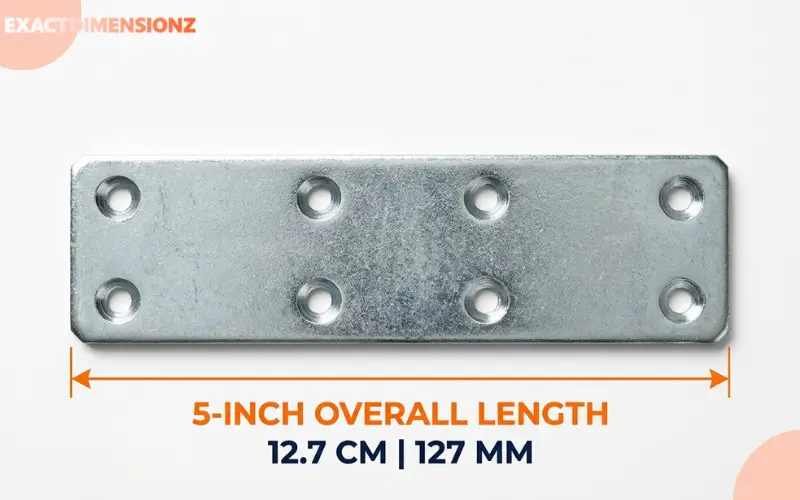
A mending plate is a flat strip of metal used to reinforce joints, seams, or cracks. Everbilt sells a zinc-plated steel model with a listed length of five inches. Its narrow rectangular shape makes the length simple to recognize.
Position one end of the plate at zero on a ruler, and its other end should meet the five-inch mark. The screw holes do not determine the stated length; the two outside ends do. This provides a sturdier measurement reference than paper or cardstock. See the Everbilt five-inch mending plate specifications.
6. A 5-Inch Hex Cap Screw
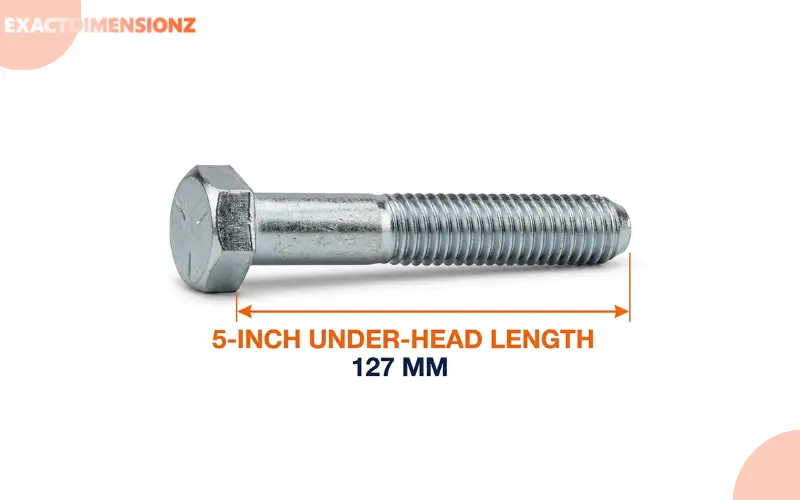
Fastenal lists a 5/8″-11 × 5″ Grade 5 hex cap screw. The five-inch figure refers to the screw’s length measured from beneath its hexagonal head to the tip. The total end-to-end size is longer when the head is included.
This measurement convention matters when using the screw as a visual reference. Align the underside of the head with the ruler’s zero line instead of placing the outside face of the head at zero. The tip should then reach the five-inch mark. View Fastenal’s five-inch hex cap screw.
7. A 5-Inch Kitchen-Knife Blade
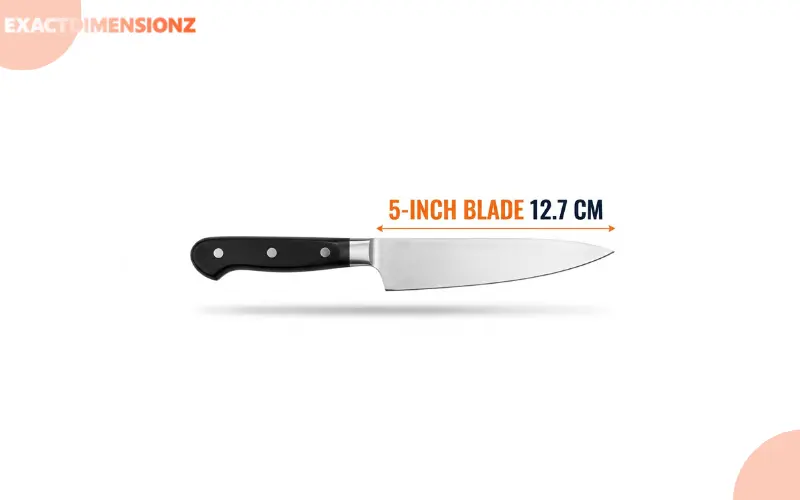
Wüsthof produces utility knives with a listed five-inch blade. The measurement applies to the cutting blade, not the knife’s complete length. Its handle extends the finished tool well beyond five inches.
A knife blade creates a narrow, easy-to-understand representation of the distance. Start measuring where the usable blade begins near the handle and continue to the tip. Do not place the complete knife beside a five-inch line and assume its overall length will match. See Wüsthof’s five-inch Classic Utility Knife.
8. A 5-Inch Sanding Disc
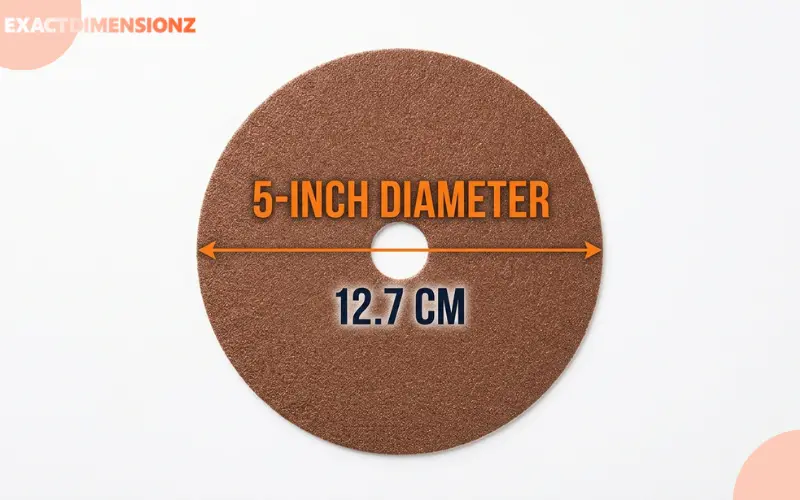
The 3M Ultra Durable Power Sanding Disc has a listed overall diameter of five inches. The diameter runs from one outside edge to the opposite edge through the circle’s center. It does not describe the distance around the disc.
Because a sanding disc is flat and circular, its widest section provides a clear five-inch reference. Its radius—the distance from the center to the edge—is 2.5 inches. A line that misses the center will be shorter than the full diameter. Check 3M’s five-inch sanding-disc specification.
9. A 5-Inch Hole Saw
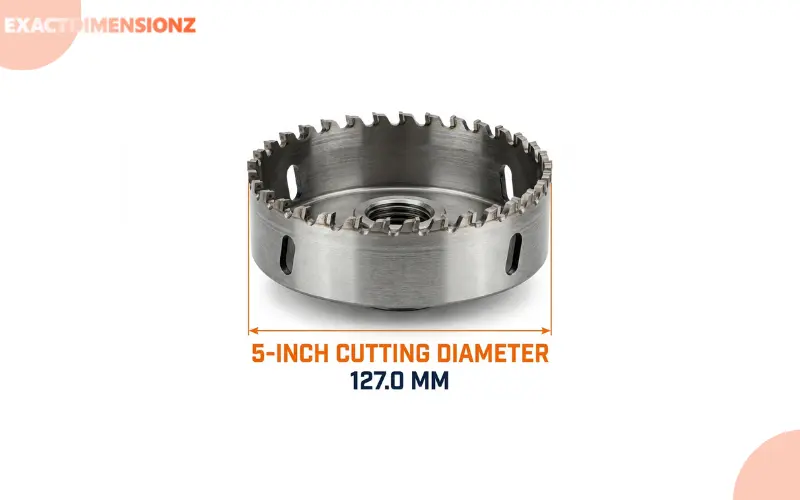
Milwaukee manufactures a Hole Dozer with a specified five-inch cutting diameter. The diameter is measured across its circular cutting edge. Its cutting depth is a separate specification and is substantially smaller than five inches.
This tool helps visualize the opening created by a five-inch circle. The attached arbor and pilot drill are not included in the cutting-diameter measurement. When viewed directly from the front, the widest distance across the teeth represents five inches. View Milwaukee’s five-inch Hole Dozer.
10. A 5-Inch Caster Wheel
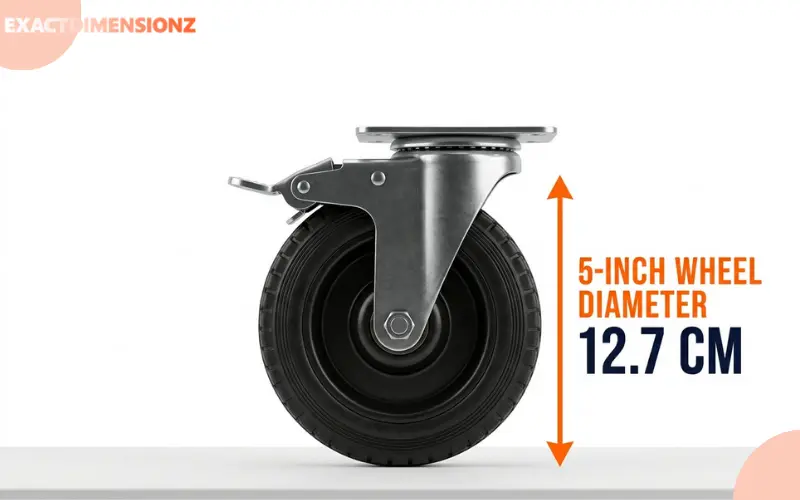
A caster with a five-inch wheel has a wheel diameter of five inches. The measurement passes through the axle from the bottom of the tread to the top. It does not include the steel fork, swivel housing, brake, or mounting plate.
A caster wheel is useful for visualizing how tall 5 inches is because its diameter can be viewed vertically while it rests on a surface. The complete installed caster will stand taller than the wheel itself. Home Depot lists heavy-duty caster models with a wheel diameter of five inches and a wheel width of two inches. See the five-inch caster-wheel specifications.
11. A 5-Inch Foam Craft Ball

Bright Creations produces foam craft balls with a specified five-inch diameter. The measurement passes through the sphere’s center from one outer surface to the other. Because it is a sphere, the same diameter can be measured through its center in multiple directions.
This object provides a three-dimensional idea of the size of 5 inches. Its curved surface can make it appear smaller in a photograph, so visual estimates from online images are unreliable. Calipers or two parallel straightedges provide a better physical measurement than a flexible tape. See the five-inch foam-ball listing.
12. A 5-Inch Embroidery Hoop

Embroidery hoops are sold according to their circular working size. Snuggly Monkey lists a wooden hoop option at five inches, with a metric equivalent of 12.7 centimeters. The measurement refers to the hoop’s circular diameter.
The adjustment screw and outer hardware may extend beyond the five-inch circle. Measure across the working ring through its center rather than including the screw assembly. This example makes a convenient reference for sewing rooms, classrooms, and craft spaces. See the five-inch wooden embroidery-hoop option.
13. The Inside Diameter of a Kraft Mailing Tube
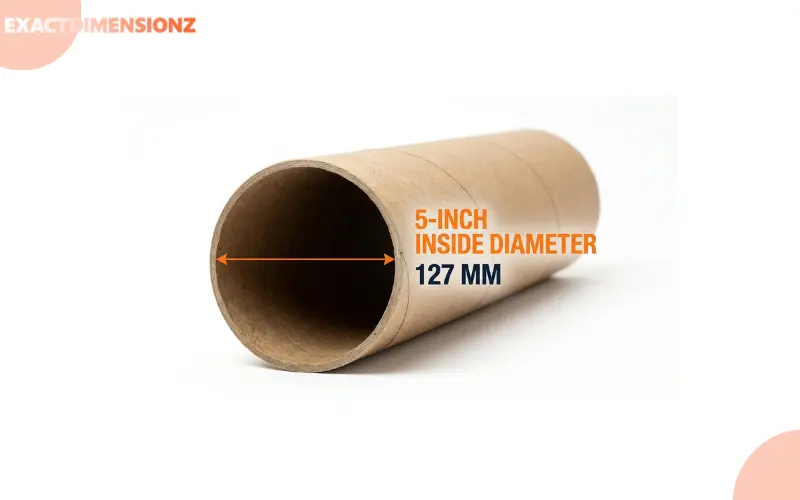
Uline’s S-10723 kraft mailing tube has a specified five-inch inside diameter. The usable length is the two-foot mark, so the tube itself is much longer than the measurement discussed here. Only the circular opening provides the five-inch reference.
Measure from one inside wall to the opposite inside wall through the center. Measuring across the outside includes the tube’s 0.125-inch wall thickness and produces a larger result. This distinction is especially important when selecting a tube for an item that needs to fit inside it. View Uline’s five-inch mailing-tube specification.
14. A Shelf Bracket With a 5-Inch Arm

A shelf bracket can contain more than one dimension. Lowe’s lists a Grip Tight Tools bracket at 5 inches long, 4 inches wide, and 2 inches deep. Its five-inch section provides the measurement reference.
The bracket should be identified by the specific product dimensions instead of judged by its general appearance. Similar brackets can have arms measuring six, eight, ten, or more inches. Measure the stated five-inch section from one outer endpoint to the other. See the Grip Tight Tools five-inch bracket listing.
Five-Inch Objects: Quick Reference
| Object | Part Measuring 5 Inches | Measurement Type |
| 3 × 5 Post-it note | Long edge | Length |
| 5 × 7 photo paper | Short edge | Width |
| 5 × 7 invitation card | Short edge | Width |
| Shipping box | All three inside edges | Inside dimensions |
| Mending plate | End-to-end span | Overall length |
| Hex cap screw | Under the head to the tip | Fastener length |
| Utility knife | Blade only | Blade length |
| Sanding disc | Across the center | Diameter |
| Hole saw | Across the cutting edge | Cutting diameter |
| Caster wheel | Across the wheel center | Wheel diameter |
| Foam craft ball | Through the center | Sphere diameter |
| Embroidery hoop | Across the working ring | Hoop diameter |
| Mailing tube | Across the internal opening | Inside diameter |
| Shelf bracket | Specified bracket arm | Product length |
“Exactly Five Inches” and Manufacturing Tolerance
Five inches as a unit is exact. It always equals 127 millimeters.
A physical product is manufactured to a specification. Cutting, printing, forming, coating, and assembly can introduce a small permitted tolerance. For example, a five-inch paper product may differ by a tiny fraction after trimming, while a metal component may have an engineering tolerance documented separately.
That does not make its listed size meaningless. It means “five inches” is the intended or specified dimension, while the individual product should still be measured for precision work.
Use a ruler or caliper when:
- A replacement component must fit precisely
- You are drilling mounting holes
- A printed design needs accurate borders
- A product must fit inside packaging
- You are cutting material for assembly
- Small dimensional differences could create a safety issue
Five Inches Compared With Familiar Measurements
Five inches falls between four and 6 inches — one inch longer. It is also one inch shorter than half of a 12-inch ruler.
| Comparison | Result |
| 5 inches vs 10 cm | 5 inches is 2.7 cm longer |
| 5 inches vs 12 cm | 5 inches is 0.7 cm longer |
| 5 inches vs half a foot | 5 inches is 1 inch shorter |
| 5 inches vs 1 foot | 5 inches is 7 inches shorter |
| 5 inches vs 15 cm | 5 inches is 2.3 cm shorter |
Readers building a mental scale from smaller measurements can also compare how long is 1 inch, how long is 2 inches, how long is 3 inches, and how long is 4 inches. Each step adds another 25.4 millimeters.
How Big Is 5 Inches in Your Hand?
Five inches can fit within the open hand of many adults, but a hand is not a standard measuring device. Palm width, finger length, and hand span vary significantly from one person to another.
You may be able to hold a five-inch card or tool comfortably in one hand. That experience is useful for remembering the general scale, but it does not prove an unknown object is five inches long.
If you want to create a personal reference, measure the width of your own palm with a ruler. Record the exact result rather than assuming it is five inches. Your hand can then serve as a personalized estimation tool.
How Tall Is 5 Inches?
When oriented vertically, five inches is a height of exactly 12.7 centimeters.
A five-inch cube would rise 127 millimeters from the surface supporting it. A caster with a five-inch wheel diameter also shows the distance vertically from the bottom of the wheel to its top, although the full caster assembly is taller.
The unit does not change with direction. Five inches long, five inches wide, five inches deep, and five inches tall all describe the same linear distance.
Measuring Five Inches on a Ruler
The simplest method is to align one end of the object with the ruler’s zero line. The other end should reach the line marked five.
A typical inch ruler divides each inch into fractions. Across five inches, you will find:
| Ruler Division | Number in 5 Inches |
| Whole inches | 5 |
| Half-inches | 10 |
| Quarter-inches | 20 |
| Eighth-inches | 40 |
| Sixteenth-inches | 80 |
You do not need to begin at zero. An object extending from the 2-inch mark to the 7-inch mark is also five inches long:
7 − 2 = 5 inches
Check whether the ruler has a blank margin before its zero line. Measuring from the physical end instead of the printed zero mark can produce an incorrect result.
Measuring Five Inches Without a Ruler
A verified 3 × 5 note, 5 × 7 card, or five-inch mending plate can work as a temporary reference. Use only the product’s documented five-inch edge.
A printable ruler is another option, but it must be printed at 100% or “actual size.” Disable settings such as “fit to page,” “shrink oversized pages,” or automatic scaling. Confirm the printout against a trusted physical ruler before relying on it.
Avoid using a photograph displayed on your phone or computer. Screen dimensions, browser zoom, pixel density, and image resizing affect the visible scale.
Your hand can provide a fast estimate, but it should not be used for cutting, drilling, printing, or purchasing precision-fit products.
Common Items That Are Not Exactly 5 Inches
Several objects mentioned in general size guides are only approximate:
A Standard Soda Can
A common 12-fluid-ounce beverage can is closer to 4.8 inches tall than five inches. Can dimensions can also vary by manufacturer and package format.
A Computer Mouse
Computer mice have no universal five-inch length. Compact, standard, vertical, gaming, and travel models all use different dimensions.
A Smartphone
A phone’s advertised screen size is measured diagonally, not from the top to the bottom of its body. Modern phone bodies also vary considerably in height.
A Coffee Mug
Coffee mugs are available in many shapes and capacities. Two mugs holding the same amount of liquid can still have different heights and diameters.
Five Paper Clips
Paper clips do not share one universal length. Placing five unverified clips in a row does not guarantee a five-inch line.
A Teaspoon
The term “teaspoon” can describe a volume unit or a piece of flatware. Household teaspoon handles and overall lengths are not standardized at five inches.
These items can help with rough visualization, but they should not be presented as exact five-inch objects without a model-specific specification.
Where a Five-Inch Measurement Matters
Five inches appears in several practical settings:
Printing and Photography
Photo paper, cards, labels, and invitations use fixed dimensions. Confusing a five-inch edge with a seven-inch edge can alter cropping, margins, and layout.
Hardware and Repairs
Fasteners, brackets, and mending plates must fit the intended project. Always confirm whether the listed length includes a head, mounting plate, or other attachment.
Packaging
A box may list inside dimensions, outside dimensions, or both. The usable five-inch interior of a box is not the same as its exterior width.
Circular Cutting
Hole saws and sanding discs use diameter measurements. A five-inch diameter is different from a five-inch circumference.
Crafts
Embroidery hoops and foam spheres use circular dimensions. Measure through the center to find the full diameter.
FAQs
How long is 5 inches in centimeters?
Five inches is exactly 12.7 centimeters.
How many millimeters are in 5 inches?
There are exactly 127 millimeters in five inches.
Is 5 inches half a foot?
No. Half a foot is six inches, so five inches is one inch shorter.
What item is exactly 5 inches long?
A manufacturer-specified five-inch mending plate has a five-inch overall length. A five-inch hex cap screw also has a five-inch under-head length.
Is a 3 × 5 index card exactly 5 inches long?
Its stated long edge is five inches. Individual cards can have a small cutting tolerance, so measure the physical card when precision is required.
Are five paper clips equal to 5 inches?
Not necessarily. Paper clips come in several sizes, and there is no rule requiring each one to measure exactly one inch.
Is a five-inch circle five inches around?
No. Five inches describes the circle’s diameter. A perfect five-inch-diameter circle has a circumference of approximately 15.71 inches.
What is the radius of a five-inch circle?
The radius is 2.5 inches because it is half of the five-inch diameter.
Can I use my phone to measure five inches?
Only if you use a properly calibrated measurement application. A phone’s body or an uncalibrated image should not be assumed to measure five inches.
Conclusion
Five inches equals exactly 12.7 centimeters, 127 millimeters, or 0.127 meter. It is one inch shorter than half a foot. It is also far short of the five-foot mark.
A 3 × 5 note, the short edge of 5 × 7 photo paper, a five-inch mending plate, and a five-inch screw provide clear straight-line references. A sanding disc, caster wheel, foam craft ball, and hole saw demonstrate five inches as a diameter.
The key is to identify the measured part. A five-inch product label may refer to overall length, blade length, an inside opening, or a circular diameter—not necessarily the object’s complete end-to-end size.
