
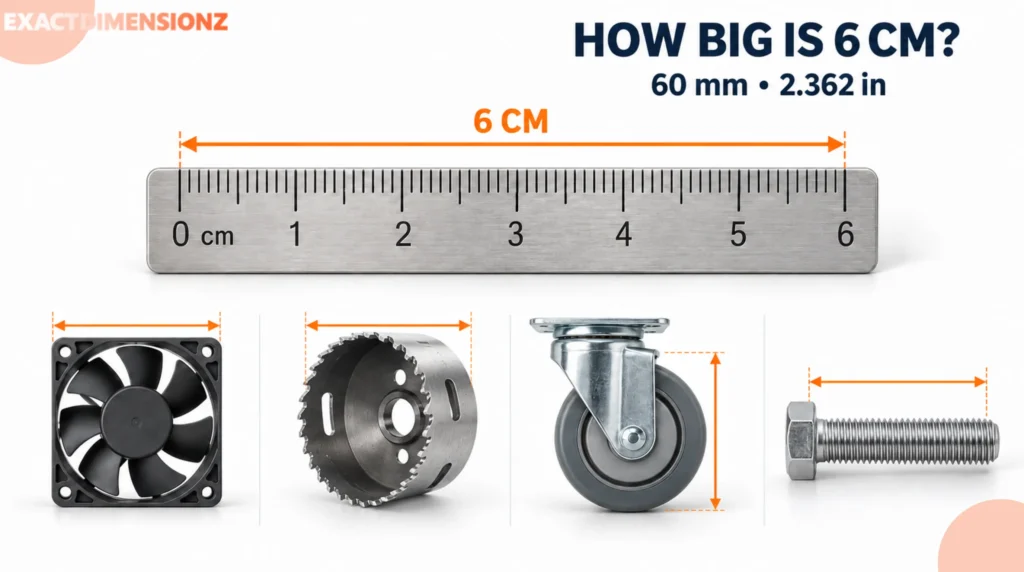
Six centimeters is a short length that you can hold easily between two fingers. It equals exactly 60 millimeters and 0.06 meter. Converted to U.S. customary units, it is 2.3622 inches or 0.19685 foot when rounded.
That number becomes easier to picture when you stop treating 6 cm as an abstract line. A 60 mm computer fan measures 6 cm across its square frame. A 60 mm hole saw cuts a circle with a 6 cm nominal diameter. A 60 mm caster wheel uses the same measurement across its wheel.
This guide does more than list objects that happen to look similar. It shows which dimension is 6 cm, where the specification comes from, and how nearby everyday items differ from the target length.
How Big Is 6 cm?
Six centimeters is exactly 60 millimeters. It equals 2.3622 inches, 0.19685 foot, or 0.06 meter. On a metric ruler, it is the distance from the 0 cm mark to the 6 cm mark.
First, Build a Clear Picture of 6 cm
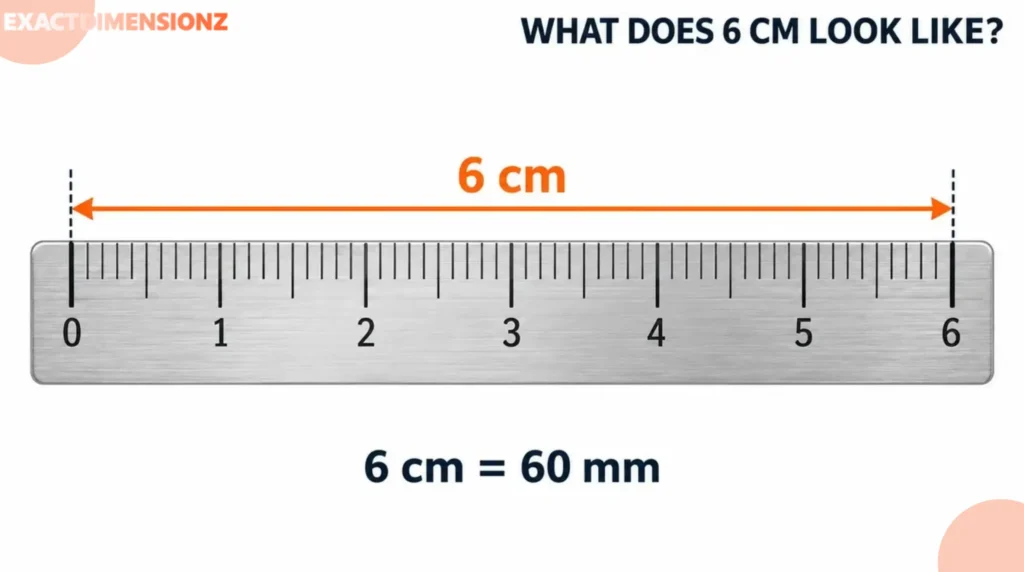
Place a ruler flat on a table. Find zero, then move to the sixth numbered centimeter mark. The gap between those two marks is 6 cm.
There are several other ways to understand that distance:
- It contains six 1 cm sections.
- It contains three 2 cm sections.
- It contains two 3 cm sections.
- It contains 60 individual millimeters.
- It is slightly less than 2⅜ inches.
Those relationships are useful because they divide the length into smaller pieces you may already recognize. If you have read our guides on how big is 2 cm and how big is 3 cm, place three 2 cm spans or two 3 cm spans end to end. Both arrangements produce exactly 6 cm.
6 cm Conversion Table
| Unit | Equivalent to 6 cm | Status |
|---|---|---|
| Millimeters | 60 mm | Exact |
| Meters | 0.06 m | Exact |
| Inches | 2.3622047 in | Rounded display |
| Feet | 0.1968504 ft | Rounded display |
| Feet and inches | 0 ft 2.3622 in | Rounded display |
| Fraction of a foot | 25/127 ft | Exact |
| Micrometers | 60,000 µm | Exact |
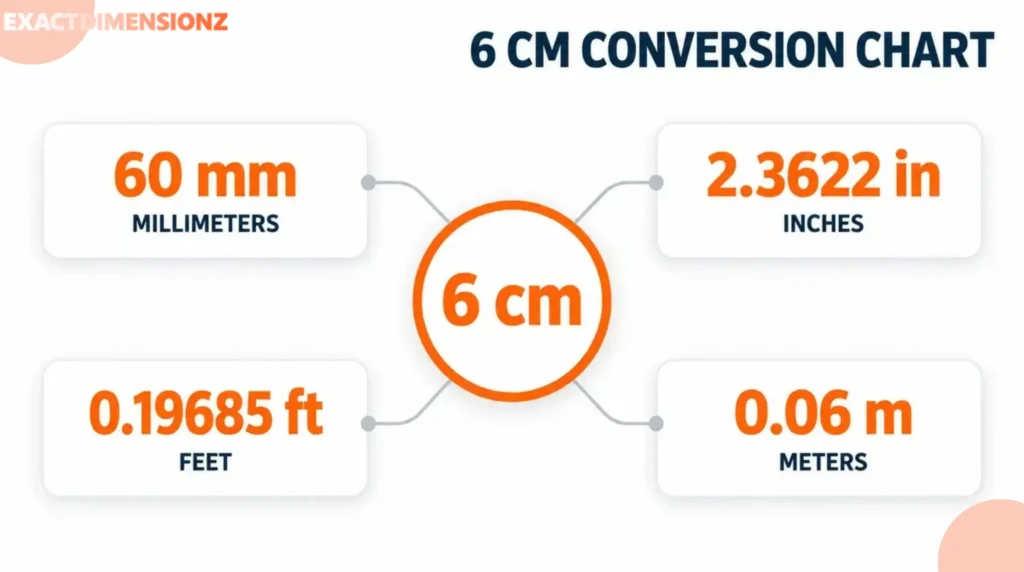
The metric conversions are direct because one centimeter contains exactly 10 millimeters. Therefore:
6 × 10 = 60 mm
To calculate 6 cm in inches, divide by the exact conversion factor of 2.54 centimeters per inch:
6 ÷ 2.54 = 2.3622047 inches
NIST states that the international inch is exactly equivalent to 25.4 mm. That makes the calculation traceable rather than an estimate. See the NIST explanation of length units.
6 cm in feet
Six centimeters equals 0.1968504 foot when rounded to seven decimal places. Another useful way to say it is 0 feet and 2.3622 inches.
People sometimes search for “6 cm in feets,” but feet is already the plural of foot. The correct wording is “6 cm in feet.”
A Verified 60 mm Reference Set
The items below do not merely resemble 6 cm. Each named product has a published 60 mm dimension. Read the “dimension used” column carefully because 6 cm can describe a length, height, width, diameter, or working length.
| Verified reference | Dimension used | Published measurement |
|---|---|---|
| Noctua NF-A6x25 5V fan | Frame height and width | 60 × 60 mm |
| Bosch PRO Multi Material hole saw | Cutting diameter | 60 mm |
| Tente Series 1670 caster | Wheel diameter | 60 mm |
| Fischer STST 6 × 60 hanger bolt | Nominal length | 60 mm |
| Karl Storz HOPKINS tele-otoscope | Working length | 6 cm |
| ZinCo KS 6/30 inspection chamber | Product height | 6 cm |
| Gedore 133 60 strike wrench | Width across flats | 60 mm |
These are model-specific references. A different fan, wheel, bolt, instrument, or wrench can have a different size.
Things That Are Exactly 6 cm in a Named Dimension
1. A Noctua 60 mm computer fan frame
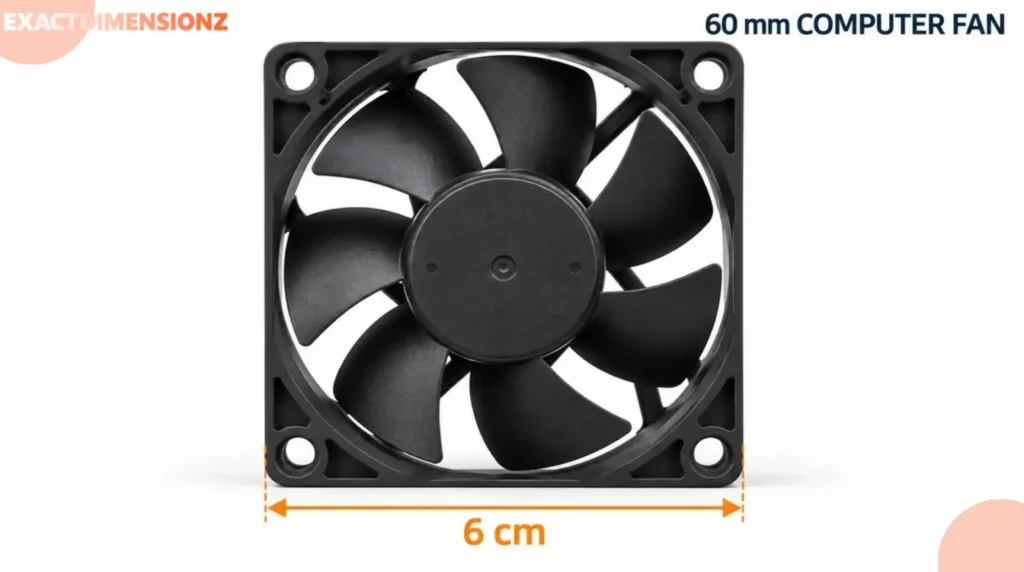
Noctua lists the NF-A6x25 5V fan at 60 × 60 × 25 mm. The square frame is therefore exactly 6 cm high and 6 cm wide in the published form factor. Its depth is only 25 mm, so the object is not a 6 cm cube.
This is an excellent visual reference because the relevant endpoints are easy to identify. Measure from one outside edge of the square frame to the opposite edge. That span shows how long 6 cm looks on a straight horizontal or vertical axis.
The manufacturer also identifies the product as a 60 mm design, but the full specification is more useful than the category name. The Noctua NF-A6x25 specification page confirms its 60 × 60 mm face and 25 mm depth.
2. A Bosch 60 mm hole saw
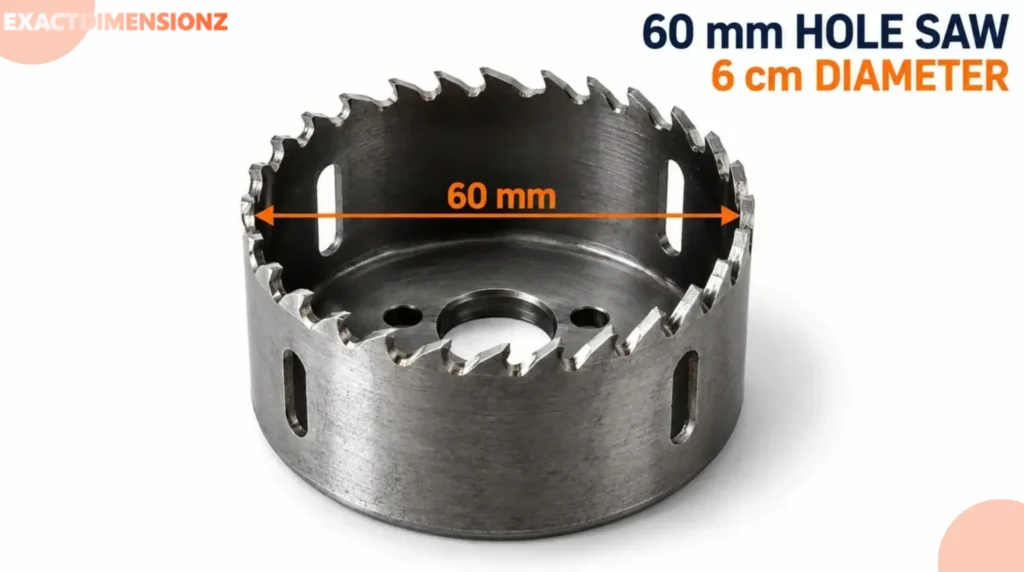
Bosch offers its PRO Multi Material Power Change Plus hole saw in a 60 mm diameter version. The product specification lists part number 2608594394 and a 44 mm working length.
Here, 6 cm describes the nominal circular cutting diameter. It does not describe the tool’s overall height or the arbor attached during use. Place a 6 cm line across the center of the cutting circle to understand the measurement.
This reference is useful for picturing 6 cm as a round opening rather than a straight object. Bosch publishes the exact diameter on its 60 mm hole-saw listing.
3. A 60 mm Tente caster wheel
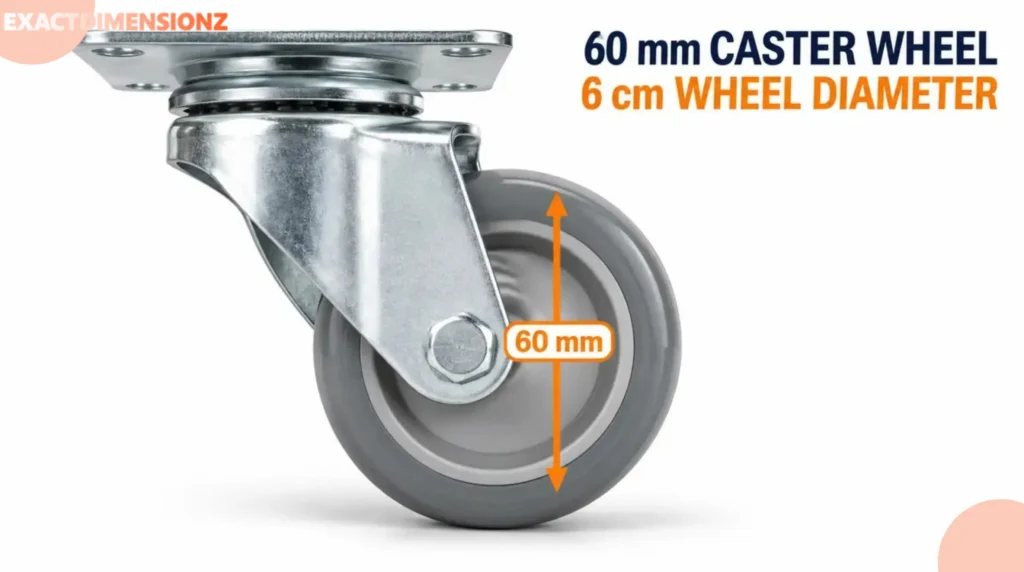
The Tente Series 1670 swivel caster sold under manufacturer part number 1670UOO060P40PAF has a 60 mm wheel diameter. Its wheel width is 22 mm, while the full caster assembly stands 82.5 mm high.
Only the distance across the wheel is 6 cm. The metal bracket makes the complete assembly taller than the target measurement. This distinction is important whenever a product name includes one featured size.
A small caster like this may appear under carts, equipment stands, furniture, or light-duty workshop units. The published Tente caster specification makes the wheel a dependable circular reference.
4. A Fischer STST 6 × 60 hanger bolt
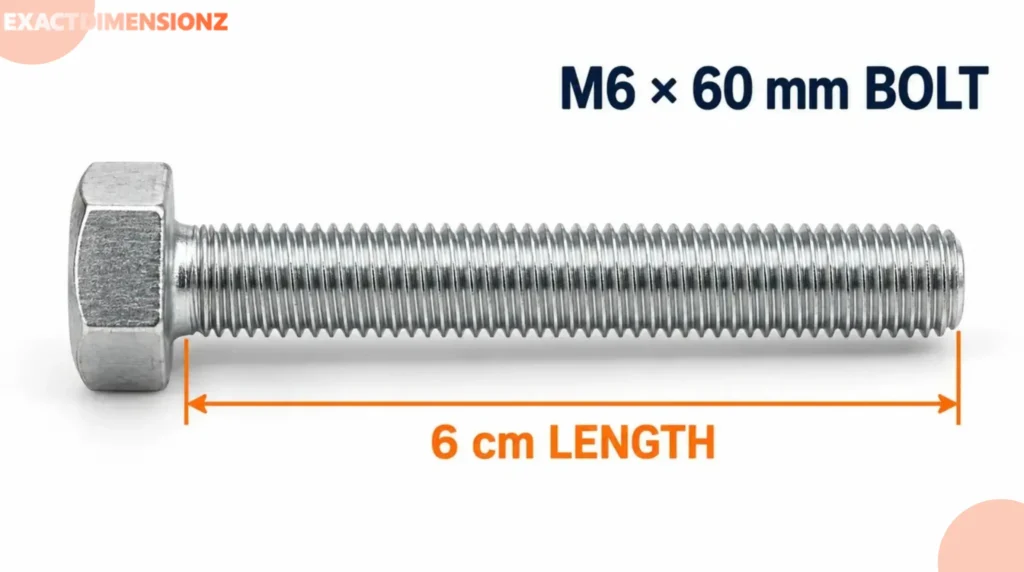
Fischer’s product catalog lists an STST 6 × 60 hanger bolt with a 6 mm thread size and a 60 mm nominal length. The two numbers describe different parts of the product, so they should not be confused.
The 60 mm length provides a straight end-to-end reference for how long 6 cm is. However, threaded hardware is normally specified according to a defined measurement convention. Do not assume that every visible part, head, or installed projection is included in the named length.
The useful lesson is that hardware labels often encode size. In “6 × 60,” the second value is the length in millimeters, while the first refers to the thread diameter. Fischer publishes the model and 60 mm length in its installation-system catalog.
5. A Karl Storz tele-otoscope working section
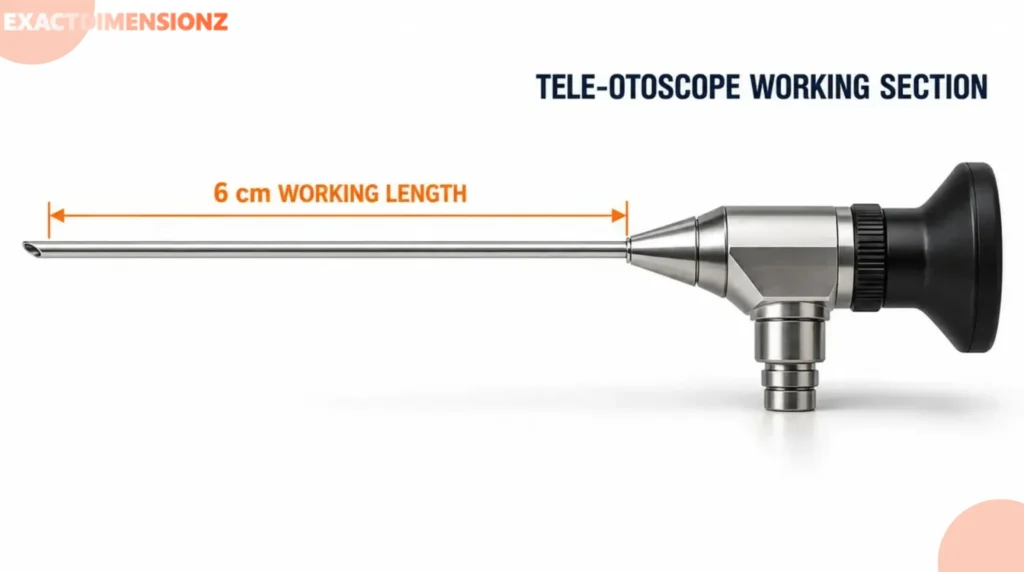
Karl Storz lists a HOPKINS tele-otoscope with a 6 cm working length and 3 mm outer diameter. The instrument is designed for medical examination, so the specified working length refers to its functional shaft rather than every part of the complete device.
This example shows why “how tall is 6 cm?” and “how long is 6 cm?” can have the same numerical answer but refer to different axes. The shaft’s working direction is longitudinal, so length is the clearest term.
The Karl Storz product specification identifies both the 6 cm working length and the much smaller 3 mm diameter.
6. A ZinCo KS 6/30 inspection chamber
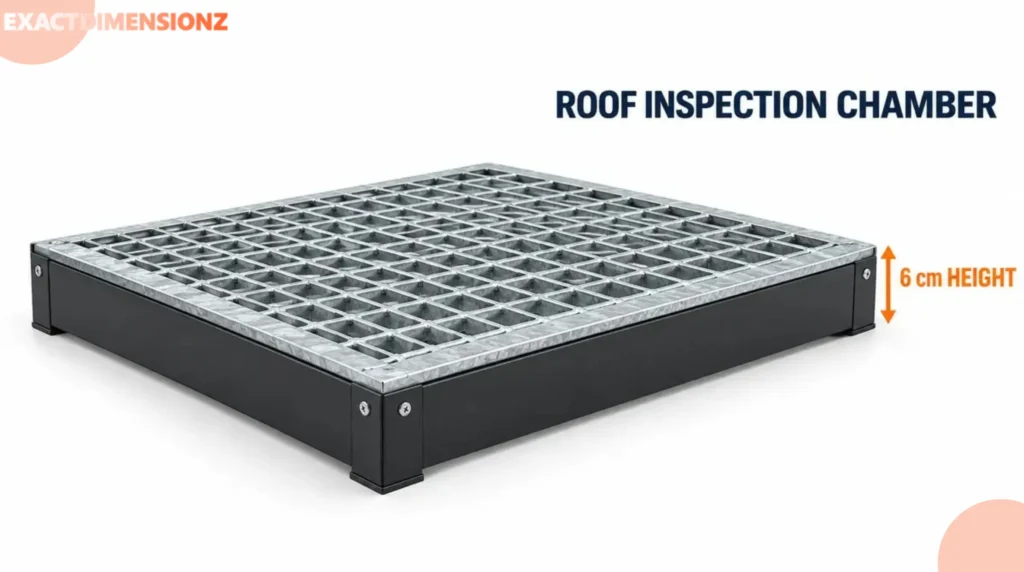
ZinCo specifies the KS 6/30 roof inspection chamber at 6 cm high. Unlike the previous references, this example uses height rather than length or diameter.
Visualize the product standing on a level surface. The vertical distance from its base to its specified top level is 6 cm. The chamber’s other dimensions are much larger, so only its height answers the target query.
The ZinCo KS 6/30 product page repeatedly identifies it as the 6 cm-high version.
7. A Gedore wrench opening marked 60 mm
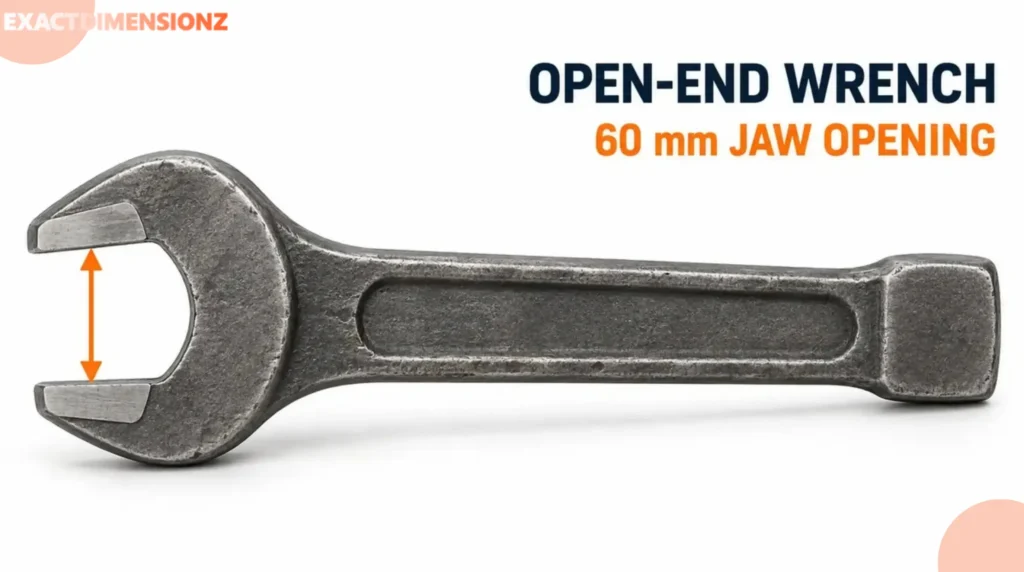
Gedore’s 133 60 strike open-end wrench has a 60 mm width across flats. This does not mean the entire wrench is only 6 cm long. It means the gap is designed for a fastener with 60 mm across-flat dimensions.
The space between the working faces is the reference to examine. It turns 6 cm into an opening that another object can fit inside rather than an outside product measurement.
Gedore publishes the 60 mm across-flats value on its 133 60 product page.
Familiar Objects Near 6 cm—With the Difference Shown
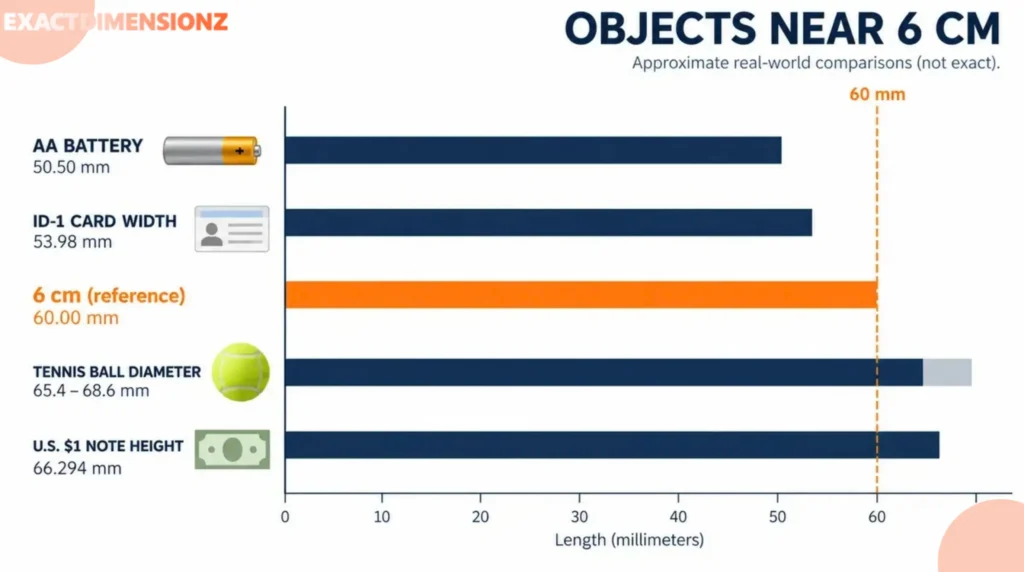
The following objects are useful for visualization, but none is exactly 6 cm in the stated dimension. Showing the difference is more honest and more useful than calling every nearby object a 6 cm example.
| Familiar object | Relevant published size | Difference from 60 mm |
|---|---|---|
| ID-1 bank or identification card | 53.98 mm high | 6.02 mm shorter |
| Duracell MN1500 AA battery | 50.5 mm maximum height | 9.5 mm shorter |
| U.S. Federal Reserve note | 2.61 in / 66.294 mm high | 6.294 mm taller |
| Regulation tennis ball | 65.4–68.6 mm diameter | 5.4–8.6 mm wider |
A card is noticeably shorter
ISO/IEC 7810 gives the ID-1 card format as 85.60 × 53.98 mm. That format covers the physical size used by many bank and identification cards. Its short edge falls 6.02 mm short of 6 cm.
Put the short edge of a card beside a 60 mm ruler span. The missing 6.02 mm is a little more than half a centimeter, so 6 cm should extend visibly beyond the card. The ISO standard preview provides the nominal ID-1 dimensions.
An AA battery is almost one centimeter shorter
The Duracell MN1500 AA specification gives a maximum height of 50.5 mm. Subtracting that value from 60 mm leaves 9.5 mm.
Therefore, an AA battery is a convenient starting point, but it does not reach the full 6 cm. Add 9.5 mm—just under 1 cm—to the battery’s maximum height to reach the target.
A U.S. bill is a little taller than 6 cm
The U.S. Currency Education Program gives a Federal Reserve note size of 6.14 × 2.61 inches. The short side converts to 66.294 mm.
That makes a U.S. bill 6.294 mm taller than 6 cm across its short dimension. Fold nothing and do not use the long side; simply compare the note’s height with a 60 mm ruler span. See the official $1 note dimensions.
A regulation tennis ball is wider
The 2026 tennis rules specify a standard ball diameter range of 6.54 to 6.86 cm. Even the smallest permitted value is 5.4 mm greater than 6 cm.
This makes the ball a useful “slightly larger” reference, not an exact example. A 60 mm circle would fit within the permitted tennis-ball diameter with at least 2.7 mm of extra radius on every side.
How Tall, Long, or Far Is 6 cm?
All three questions describe the same magnitude: 60 mm. The wording changes only the direction or context.
- How tall is 6 cm? Picture a vertical line rising 60 mm from a flat surface.
- How long is 6 cm? Picture a straight 60 mm line from one endpoint to another.
- How far is 6 cm? Picture two points separated by a 60 mm gap.
- How wide is 6 cm? Picture a horizontal opening, face, or diameter spanning 60 mm.
The number does not change when the line rotates. A 6 cm vertical line, horizontal line, and diagonal line have equal length, provided their endpoints stay 60 mm apart. If you ask how far is 6 cm, the answer is the same 60 mm separation measured between the two stated points.
Measure 6 cm Correctly
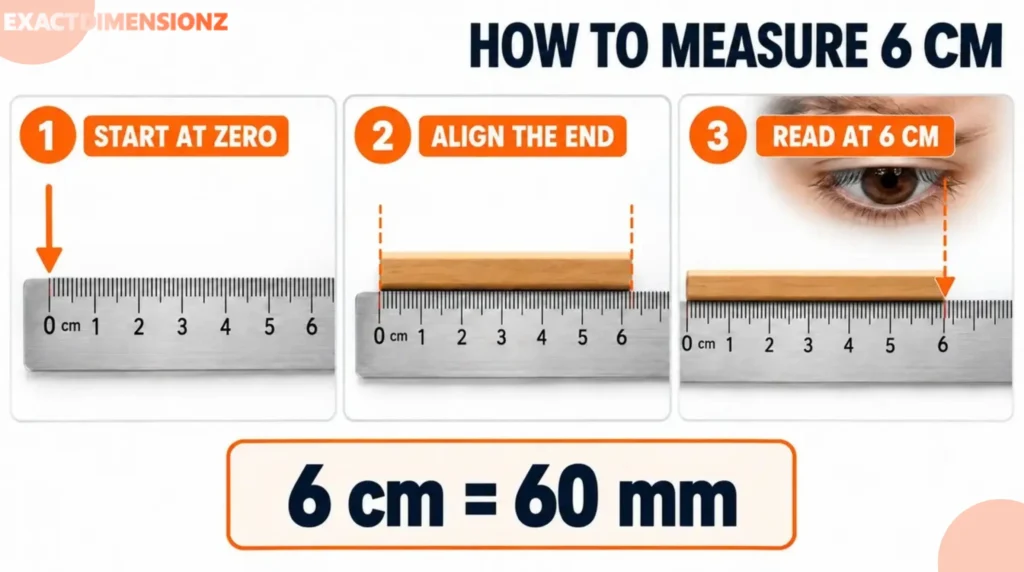
Use a metric ruler whenever accuracy matters:
- Place the object and ruler on a stable surface.
- Align the first endpoint with the ruler’s 0 mark, not automatically with the plastic edge.
- Keep the ruler parallel to the dimension being measured.
- Read the position of the second endpoint.
- Confirm that it ends at 6 cm or 60 mm.
- Repeat the measurement to catch alignment errors.
If your ruler begins before its printed zero line, using the physical edge will produce an incorrect result. The printed zero mark is the actual reference point.
You can also open our free measurement tools for conversions and a printable metric ruler. Print at 100% or “Actual Size,” then verify its calibration line against a physical ruler before relying on it.
Can You Estimate 6 cm Without a Ruler?
You can estimate it, but you cannot verify an exact 6 cm measurement without a known reference or measuring tool.
The strongest no-ruler method is to use a product with a confirmed 60 mm dimension, such as the named fan frame, caster wheel, or hole saw above. A nearby object can also help if you apply the difference correctly:
- Start with the 53.98 mm short edge of an ID-1 card and add 6.02 mm.
- Start with a 50.5 mm AA battery and add 9.5 mm.
- Start with the 66.294 mm short side of a U.S. note and subtract 6.294 mm.
Finger widths, coins, matchboxes, spoons, USB drives, and toy cars vary too much to verify 6 cm. They can suggest scale, but they should not be presented as exact measuring tools.
Where a 6 cm Measurement Matters
Selecting hardware
Diameter and length determine whether wheels, fasteners, cutters, openings, and fittings are compatible. A 60 mm wheel is not interchangeable with a 60 mm bolt simply because both labels contain the same number.
Planning clearances
An object measuring exactly 6 cm may not fit comfortably inside an opening measuring exactly 6 cm. Real installations need clearance for insertion, manufacturing variation, movement, coatings, and measurement error.
For a 60 mm item, a 60 mm compartment represents a zero-clearance theoretical fit. The appropriate extra space depends on the product and application.
Crafting and printing
Templates can scale incorrectly when a printer uses “Fit to Page.” If a pattern needs a 6 cm line or circle, include a calibration mark and verify the printed output before cutting material.
Online shopping
Product pages may list width, height, depth, diameter, thread size, or working length. Before comparing “6 cm dimensions,” identify which axis the seller measured. The exact number is useful only when the direction matches your need.
Common 6 cm Mistakes
Treating 6 cm as 2.4 inches exactly
The precise conversion is not 2.4 inches. Six centimeters equals 2.3622047 inches when displayed to seven decimal places. Rounding to 2.36 inches is suitable for general explanation; 2.4 inches is a rougher one-decimal approximation.
Confusing diameter with circumference
A circle with a 6 cm diameter has a calculated circumference of:
π × 6 = 18.8496 cm
A circle with a 6 cm circumference is much smaller, with a diameter of about 1.91 cm. Always check which circular measurement is being given.
Assuming the named product size describes every dimension
A 60 mm fan may have a 60 × 60 mm face but a 25 mm depth. A 60 mm caster refers to wheel diameter, while the complete assembly is taller. A 60 mm wrench refers to its working opening, not its total length.
Calling a nearby object exact
A tennis ball, AA battery, card, or banknote can help you picture the scale. Their documented measurements show that none of them is exactly 6 cm in the dimension discussed.
Quick Questions About 6 cm
How big is 6 cm on a ruler?
It is the distance from the 0 cm mark to the 6 cm mark. That span contains 60 individual millimeter divisions.
How long is 6 cm in inches?
Six centimeters equals 2.3622047 inches when rounded to seven decimal places. For general use, 2.36 inches is a clear rounded value.
What is 6 cm in feet?
It equals 0.1968504 foot when rounded, or exactly 25/127 of a foot. Written as feet and inches, it is 0 feet and 2.3622 inches.
Is 6 cm the same as 60 mm?
Yes. One centimeter contains exactly 10 millimeters, so 6 × 10 equals exactly 60 mm.
Is 6 cm bigger than 2 inches?
Yes. Two inches equals exactly 50.8 mm, while 6 cm equals 60 mm. The difference is 9.2 mm, or 0.92 cm.
Is a tennis ball 6 cm wide?
No. The regulation range is 6.54 to 6.86 cm in diameter, so a compliant standard ball is wider than 6 cm.
What common object is closest to 6 cm?
That depends on the dimension and model. A specified 60 mm fan frame, hole saw, or caster wheel provides an exact named reference. A card, AA battery, U.S. note, and tennis ball are useful nearby comparisons but are not exact.
How many 6 cm lengths make 1 meter?
Sixteen complete 6 cm lengths cover 96 cm, leaving 4 cm. A meter therefore contains 16⅔ lengths of 6 cm.
Here we have more guides for you to check:
The Practical Takeaway
Six centimeters is exactly 60 millimeters. It is 2.3622 inches and 0.19685 foot when rounded. The simplest way to see it is a line running from zero to six on a metric ruler.
For a physical reference, use an item with a published 60 mm dimension and pay attention to the axis: a fan-frame width, hole-saw diameter, caster-wheel diameter, bolt length, instrument working length, or product height. Familiar objects can help with scale, but their differences should be stated rather than hidden.
That distinction—exact specification versus visual estimate—is what makes a size comparison useful for real decisions, not just easy to read.
Sources and Verification Notes
- NIST: SI Units—Length
- Noctua NF-A6x25 5V specifications
- Bosch Professional 60 mm hole saw
- Fischer installation-system catalog
- Tente Series 1670 60 mm caster listing
- Karl Storz 6 cm tele-otoscope
- ZinCo KS 6/30 product page
- Gedore 133 60 wrench specification
- ISO/IEC 7810 ID-1 card dimensions
- Duracell technical data-sheet library
- U.S. Currency Education Program: $1 note
- 2026 tennis rules: ball-size table
Verification date: October 10, 2026
Editorial note: Product references apply only to the named models and stated dimensions. Specifications may change; verify the current manufacturer documentation before precision work.