
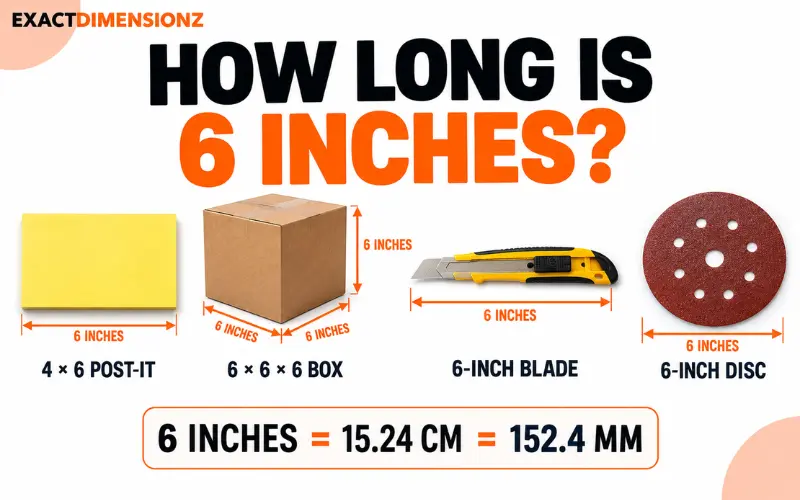
Six inches is exactly 15.24 centimeters or 152.4 millimeters. It is also exactly half of one foot, since 12 inches make a foot — see the complete inches size guide.
Knowing the conversion is simple, but the number can still be difficult to picture in real life. A measurement becomes easier to understand when you compare it with physical objects that have a documented six-inch dimension.
This guide uses 14 examples with a specified six-inch length, width, diameter, height, blade length, or other measurable dimension. Some objects are six inches from end to end, while others use six inches as a diameter or another specific measurement. The important part is knowing exactly which part of the object measures six inches.
Related Post: How Long is 5 inches
The Exact Size of 6 Inches
An international inch is defined as exactly 25.4 millimeters. Multiplying 25.4 millimeters by six gives 152.4 millimeters.
6 × 25.4 = 152.4 millimeters
Therefore, six inches is exactly 15.24 centimeters. The conversion is fixed because the inch has an exact relationship with the metric system. The National Institute of Standards and Technology (NIST) states that one inch is exactly equivalent to 25.4 millimeters.
| Unit | Six Inches Equals |
| Inches | 6 in |
| Millimeters | 152.4 mm |
| Centimeters | 15.24 cm |
| Feet | 0.5 ft |
| Yards | 0.1667 yd |
| Meters | 0.1524 m |
The millimeter, centimeter, and meter values are exact. The feet and yard values are shown in rounded decimal form for easier reading.
What Does 6 Inches Look Like?
The easiest way to picture six inches is to look at a standard ruler. Start at the zero mark and move to the line labeled six. The distance between those two points is exactly six inches.
On a 12-inch ruler, six inches reaches the exact halfway point. This makes six inches especially easy to remember because it is half of one foot — a step up to 7 inches takes you just past the halfway mark.
Six inches can describe several different parts of an object. It may refer to:
- Overall length
- One edge of a rectangular item
- Diameter of a circular object
- Blade length
- Wheel diameter
- Inside dimension
- Width or height
- Working or cutting dimension
This difference matters. A product described as “6 inches” does not always mean the entire object is six inches long. For example, a six-inch hole saw refers to its cutting diameter, while a six-inch utility knife refers to the blade length. Manufacturer specifications make this distinction clear.
14 Things With a Verified 6-Inch Dimension
The following examples use products or objects with a documented six-inch measurement. The measured part is identified so you know exactly what the six-inch reference means.
1. The Long Edge of a 4 × 6 Post-it Note
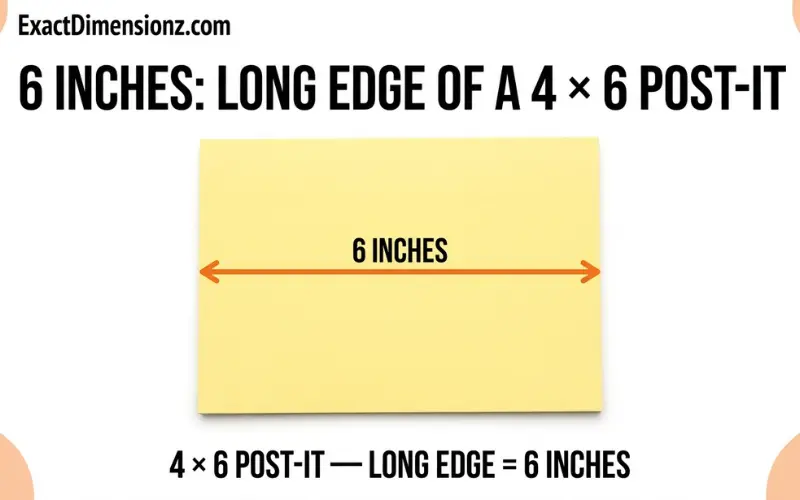
A 4 × 6-inch Post-it note has a long edge measuring six inches. This gives you a simple, flat reference that is easy to find in an office, classroom, or home.
The sheet is four inches wide and six inches long. If you place the long edge next to a ruler, it should extend from the zero mark to the six-inch mark. The long straight edge is the useful part for visualizing the distance.
3M lists its Post-it Notes in a 4 × 6-inch size, with the dimensions also shown as approximately 101 × 152 millimeters.
A 4 × 6 note is useful because it gives you both a six-inch length and a four-inch width at the same time. You can place the note on a table and see how far six inches extends without needing a measuring tape.
The thickness of the paper does not change the six-inch edge. If you are using it as a reference, measure along the straight six-inch side rather than across the diagonal.
See the 4 × 6-inch Post-it Note specifications from 3M
2. A 6 × 6 × 6-Inch Shipping Box

A small cubic shipping box is another useful way to understand six inches because the measurement appears in three directions.
ULINE lists a corrugated box with inside dimensions of 6 × 6 × 6 inches. This means the usable interior length, width, and height are each six inches.
This gives you a three-dimensional example of the measurement. Imagine a cube where every straight edge is six inches long. The distance from one inside corner to the next along any single edge is six inches.
The outside dimensions are larger because cardboard has thickness. ULINE lists the outside dimensions of this particular box as approximately 6⅜ × 6⅜ × 6⅝ inches. Therefore, you should use the inside dimensions when referring to the documented six-inch measurement.
This example is especially useful if you are trying to understand not just six inches of length but the amount of space contained inside a six-inch cube.
View ULINE’s 6 × 6 × 6-inch box specifications
3. A 6-Inch Steel Mending Plate

A steel mending plate can provide a straight-line example of six inches. Everbilt lists a galvanized mending plate with a 6-inch product length. The same product is listed as six inches wide in that particular model.
A mending plate is a flat metal piece used to reinforce joints, cracks, seams, and connections. Its straight shape makes the six-inch length easy to understand.
If you place one end at the zero mark on a ruler, the opposite end should reach the six-inch mark according to the product specification. The screw holes in the plate do not define the length. The six-inch measurement refers to the product’s specified dimensions.
Home Depot’s specifications list the product length as six inches.
This is a stronger physical reference than an object that is only approximately six inches because the manufacturer provides a specific dimension.
See the Everbilt 6-inch mending plate specifications
4. A 6-Inch Shelf Bracket

A shelf bracket can also provide a documented six-inch measurement. Lowe’s lists a Federal Brace steel shelf bracket with a 6-inch length, along with a width of 1.75 inches and a depth of 1.5 inches.
The six-inch measurement applies to the specified length of the bracket. The mounting plate and other parts have different dimensions, so the complete object should not automatically be assumed to be six inches in every direction.
This type of example is helpful because shelf brackets are common hardware products. They also show why you should always check which dimension a manufacturer is giving.
When using the bracket to visualize six inches, measure from the appropriate endpoints of the six-inch length. Do not measure diagonally across the bracket or include parts that extend outside the listed dimension.
Lowe’s identifies the product length as six inches in its specifications.
View the six-inch Federal Brace shelf bracket specifications at Lowe’s
5. A 6-Inch Hex Cap Screw
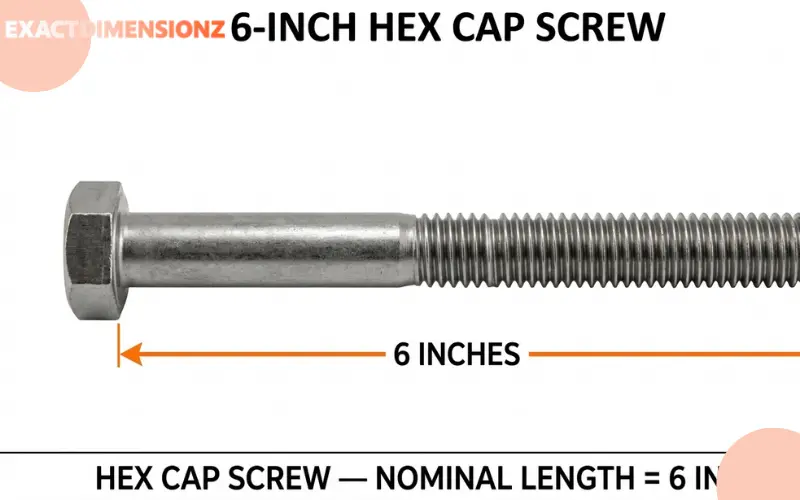
A six-inch hex cap screw gives you another straight-line reference. Fastenal’s product listings include a 5/8″-11 × 6-inch hex cap screw.
With threaded fasteners, the stated length can follow a particular industry measurement convention. For a typical hex cap screw, the nominal length is measured from beneath the head to the end of the screw rather than including the height of the head.
That distinction is important if you are using the screw to visualize six inches.
A screw measuring six inches according to its specified fastener length may have a greater overall end-to-end measurement when the head is included. Therefore, do not simply place the entire screw beside a six-inch ruler and assume the outside edges must match.
This example demonstrates an important lesson about dimensional specifications: always check what the manufacturer means by the listed length.
View Fastenal’s listed 5/8″-11 × 6-inch hex cap screw specification
6. A 6-Inch Utility Knife Blade
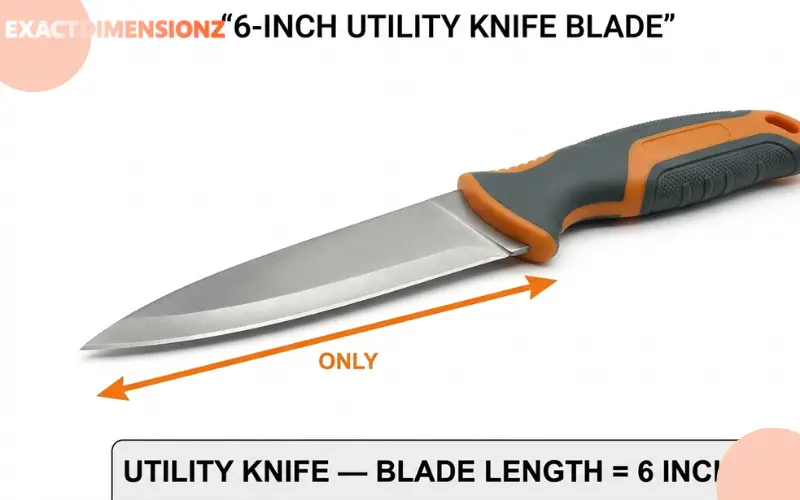
A six-inch utility knife blade is one of the clearest narrow examples of the measurement. WÜSTHOF lists its Gourmet 6-inch Utility Knife with a 6.0-inch blade length.
The six-inch measurement applies to the blade rather than the entire knife. WÜSTHOF separately lists the handle length as 4.9 inches, so the complete knife is considerably longer than six inches.
This makes the blade itself a useful way to picture a six-inch straight-line distance. Imagine placing the beginning of the blade at zero on a ruler and following it to the tip. The blade reaches the six-inch point.
The example is also a good reminder that product names often describe only one component of a larger object. A “6-inch knife” does not necessarily mean the complete knife is six inches long.
When measuring a blade, start from the point where the blade length is specified rather than including the handle.
See WÜSTHOF’s 6-inch utility knife specifications
7. A 6-Inch Sanding Disc
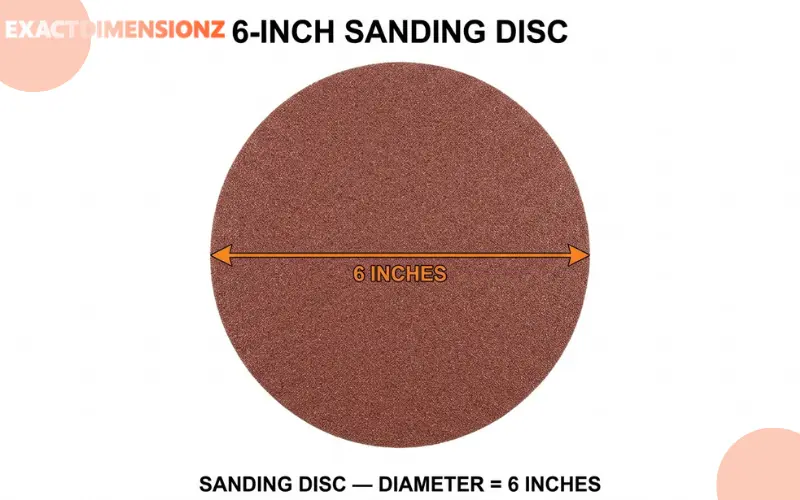
A sanding disc provides a circular example of six inches. 3M lists its Hookit Finishing Film Abrasive Disc with an overall diameter of six inches, which is also listed as 152.4 millimeters.
Diameter is measured straight across a circle through its center. Therefore, a six-inch sanding disc has a distance of six inches from one outer edge to the opposite outer edge when the measurement passes through the center.
The radius is half of the diameter. So, the radius of a six-inch circle is three inches.
Do not confuse diameter with circumference. A six-inch disc is not six inches around its outer edge. The six-inch specification describes the distance across the circle.
Because the sanding disc is flat and circular, it is easy to place beside a ruler and visualize the size. The center point should divide the six-inch diameter into two equal three-inch sections.
Check 3M’s six-inch sanding-disc specification
8. A 6-Inch Hole Saw
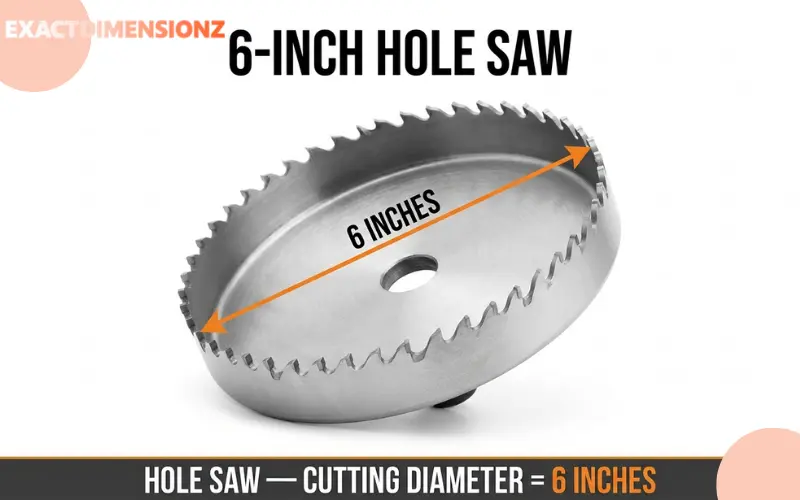
A hole saw is another circular object that demonstrates six inches as a diameter. Milwaukee sells a Hole Dozer with a 6-inch hole saw diameter. The product specifications list both a six-inch bit diameter and a six-inch hole saw diameter.
The six-inch measurement refers to the circular cutting diameter. It does not describe the length of the attached arbor, pilot bit, or the depth of the saw.
When viewed from the front, the widest distance across the cutting circle is six inches. That distance passes through the center.
The tool is useful for understanding the difference between a diameter and a length. If you look at the hole saw from the side, its physical depth is much smaller than six inches. The six-inch specification describes the size of the circular opening it is designed to cut.
Milwaukee’s product specifications identify the hole saw diameter as six inches and the drilling depth as a separate measurement.
View Milwaukee’s 6-inch Hole Dozer specifications
9. A 6-Inch Caster Wheel
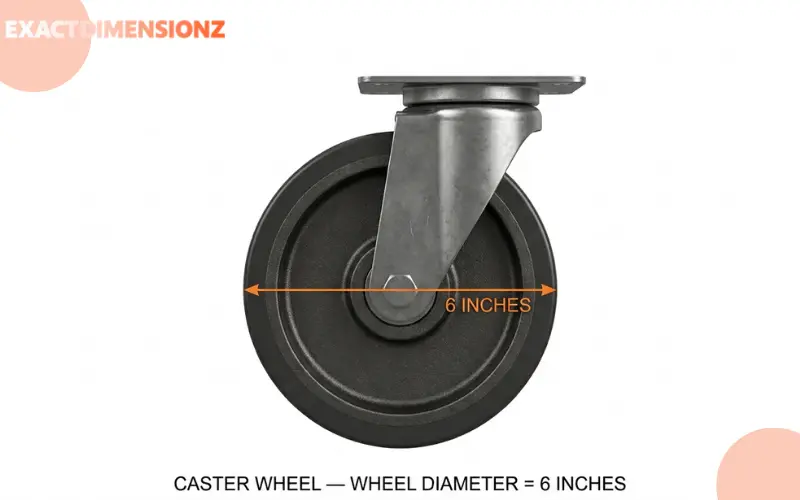
A caster wheel can show six inches as a vertical diameter. Home Depot lists multiple caster products with a 6-inch nominal wheel diameter.
The wheel diameter is measured across the circular wheel through its center. If the wheel is standing upright, the distance from the bottom of the wheel to the top is approximately six inches based on the nominal diameter.
The complete caster is taller than the wheel because it includes the mounting plate, swivel mechanism, fork, brake, or other hardware.
That distinction is important when using a caster as a six-inch reference. The wheel itself is the six-inch part, not necessarily the complete assembled caster.
A caster wheel is also useful because it provides a real-world example of six inches in a vertical position. You can think of the wheel as a six-inch circle standing on its edge.
Home Depot’s caster listings specifically allow products to be filtered by a six-inch wheel diameter.
See six-inch caster-wheel options at Home Depot
10. A 6-Inch Foam Craft Ball
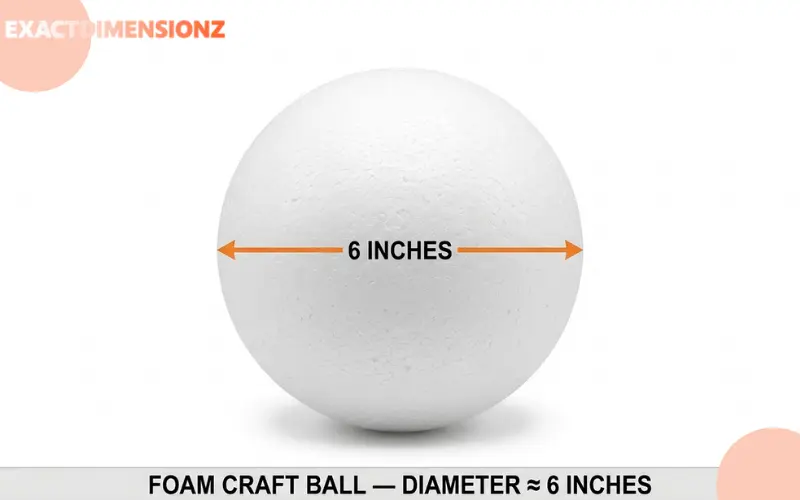
A foam craft ball provides a three-dimensional example of six inches. Michaels lists craft foam spheres with an approximately six-inch diameter.
Because the object is spherical, the diameter passes through the center from one outside surface to the opposite outside surface.
A six-inch sphere therefore has a three-inch radius. You could place a straight ruler across the center of the sphere to understand the full six-inch width, although measuring a curved object can be more difficult than measuring a flat one.
This example is useful because a six-inch measurement does not always appear as a straight object. A sphere gives you a better idea of what six inches looks like in three dimensions.
The word “approximately” matters here. Foam products can have manufacturing variation, and the listing itself describes the diameter as approximately six inches. For precision work, a physical measurement should be taken rather than relying only on the product description.
See the six-inch foam craft ball listing at Michaels
11. A 6-Inch Embroidery Hoop

A six-inch embroidery hoop is a familiar circular reference for people who sew, embroider, or do craft projects. Several retailers and manufacturers list embroidery hoops in a six-inch size. Michaels, for example, lists a wood embroidery hoop measuring six inches.
The six-inch measurement refers to the hoop size rather than the total length of the screw or other hardware attached to it.
A round embroidery hoop gives you another way to picture six inches as a diameter. Imagine drawing a straight line from one side of the hoop to the other through its center. That distance represents the six-inch size.
The center opening can be somewhat smaller than the outside diameter depending on the thickness of the wooden ring. This means you should not assume every part of the hoop measures six inches.
For a simple visual reference, however, a six-inch embroidery hoop is easy to recognize and useful for understanding the scale of the measurement.
See the six-inch wood embroidery hoop at Michaels
12. A 6-Inch Round Cake Pan
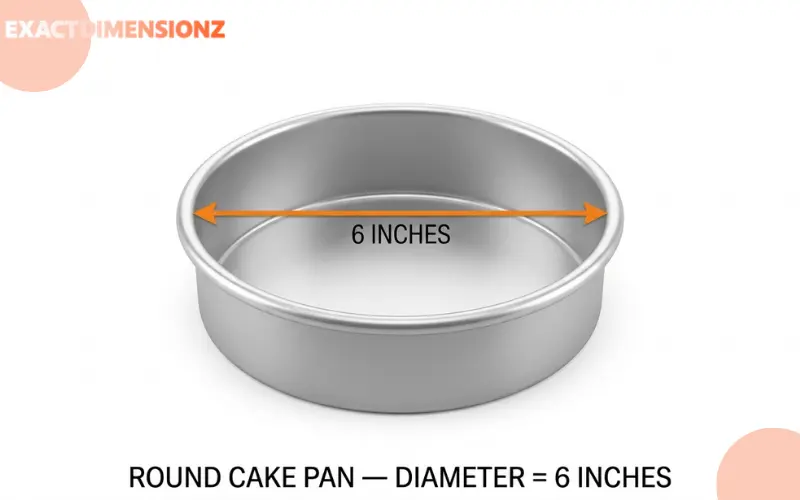
A small round cake pan is another familiar way to visualize six inches. Wilton lists a round cake pan specifically as a 6-inch cake pan, and its six-inch size is intended for small cakes and layered baking projects.
The six-inch measurement refers to the pan’s nominal round size. Retail specifications for six-inch cake pans commonly identify the diameter as six inches. One Wilton listing describes its six-inch pans as measuring six inches in diameter and two inches deep.
This makes a cake pan a useful household reference. Place it flat on a table and imagine a line running from one side to the opposite side through the center. That line is about six inches.
Remember that the pan’s depth is a different measurement. A six-inch cake pan does not mean the pan is six inches tall.
See Wilton’s six-inch cake pan range
13. A 6-Inch Recessed-Light Trim
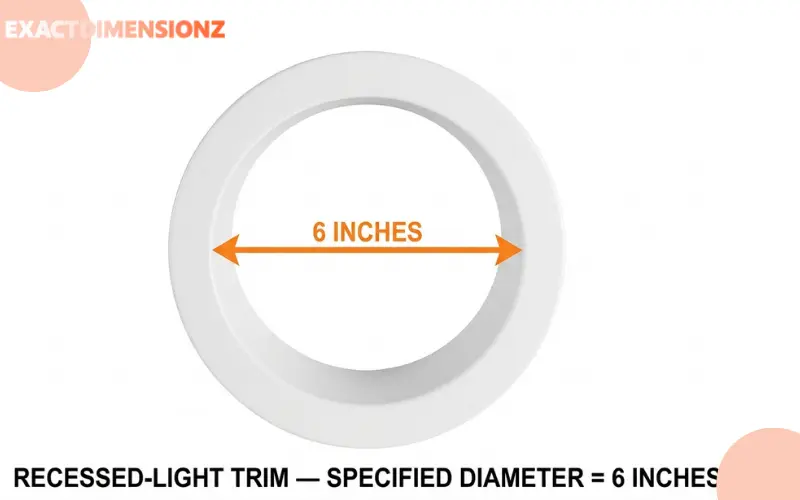
Recessed lighting provides another example where the six-inch number describes a particular dimension. Home Depot lists recessed-light products with a 6-inch product diameter, including a HALO recessed ceiling light trim.
This type of example is important because recessed lighting often uses “six-inch” as a nominal housing or trim size. Individual products can have different actual outside dimensions.
For example, the HALO trim listed by Home Depot has a six-inch product diameter and a five-inch product height.
This means you should check the actual product specifications instead of assuming every part of a six-inch recessed light is six inches.
As a visual reference, however, the specified six-inch diameter provides a useful circular comparison. The diameter runs straight across the specified circular portion of the product.
View the HALO six-inch recessed-light trim specifications
14. A 6-Inch Round Irrigation Valve Box
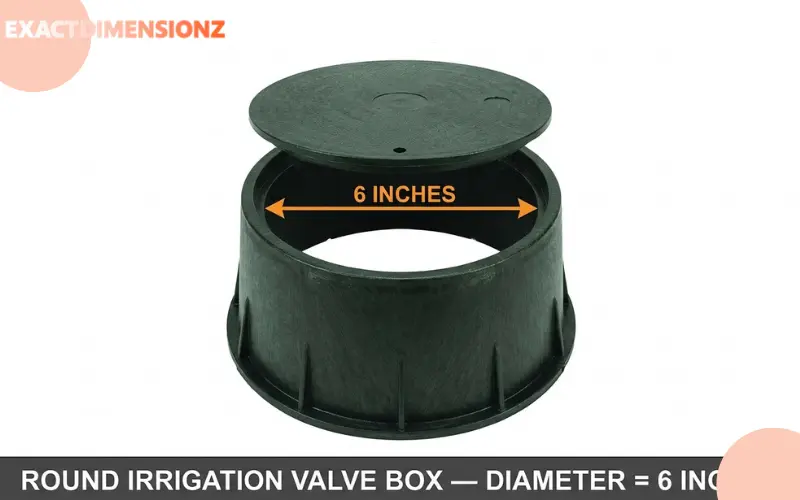
A round irrigation valve box can also provide a documented six-inch diameter reference. Home Depot lists a six-inch round irrigation valve box with a 6-inch diameter.
The box is designed to protect irrigation valves and provide access for maintenance. The six-inch figure refers to the round diameter, not the depth or height of the entire box.
This makes it similar to the sanding disc, caster wheel, foam ball, and embroidery hoop examples. Each uses six inches as a diameter rather than as a straight end-to-end length.
When looking at a round object, remember that diameter is measured through the center. Measuring from an edge toward the center gives you only half of the full diameter.
This type of object also shows why product specifications are useful. A product can be called six inches even though its complete exterior dimensions may be larger because of walls, flanges, covers, or other components.
See the six-inch round valve-box specifications at Home Depot
Six-Inch Objects: Quick Reference
| Object | Part Measuring 6 Inches | Measurement Type |
| 4 × 6 Post-it Note | Long edge | Length |
| 6 × 6 × 6 Shipping Box | Inside edges | Inside dimensions |
| Steel mending plate | Overall length | Product length |
| Shelf bracket | Specified length | Product length |
| Hex cap screw | Nominal fastener length | Fastener length |
| Utility knife | Blade | Blade length |
| Sanding disc | Across center | Diameter |
| Hole saw | Cutting edge | Cutting diameter |
| Caster wheel | Across wheel center | Wheel diameter |
| Foam craft ball | Through center | Sphere diameter |
| Embroidery hoop | Circular size | Hoop diameter |
| Cake pan | Across round pan | Diameter |
| Recessed-light trim | Specified circular portion | Diameter |
| Irrigation valve box | Round opening/box size | Diameter |
“Exactly Six Inches” and Manufacturing Tolerance
Six inches as a unit is exact. It always equals 152.4 millimeters.
A physical product, however, is manufactured according to a specification. Cutting, molding, printing, machining, forming, and assembly can introduce small differences.
For example, a manufacturer may describe a paper product as 4 × 6 inches even though an individual sheet could differ by a very small amount after cutting. A metal component may also have a documented manufacturing tolerance.
This does not mean the six-inch measurement is incorrect. It means there is a difference between an exact unit conversion and the physical tolerance of a manufactured object.
For everyday visualization, these differences are usually insignificant. For precision work, you should measure the actual object.
Use a ruler, caliper, or other suitable measuring tool when:
- A replacement component must fit precisely
- You are drilling mounting holes
- A printed design requires accurate dimensions
- An object must fit inside a specific space
- You are cutting material for assembly
- A small dimensional difference could affect safety
Six Inches Compared With Familiar Measurements
Six inches sits directly between five and seven inches. It is also exactly half of a 12-inch foot.
| Comparison | Result |
| 6 inches vs 10 cm | 6 inches is 5.24 cm longer |
| 6 inches vs 12 cm | 6 inches is 3.24 cm longer |
| 6 inches vs half a foot | Exactly equal |
| 6 inches vs 1 foot | 6 inches shorter |
| 6 inches vs 15 cm | 6 inches is 0.24 cm longer |
| 6 inches vs 20 cm | 6 inches is 4.76 cm shorter |
Since one inch equals 25.4 millimeters, every additional inch increases the measurement by exactly 25.4 millimeters.
If you are building a mental scale, you can also compare six inches with smaller measurements. Six inches is:
2 × 3 inches
3 × 2 inches
6 × 1 inch
12 × 0.5 inch
This can make the measurement easier to visualize when you already know what one, two, or three inches look like.
How Big Is 6 Inches in Your Hand?
Six inches can fit comfortably across or along the hand of many adults, but a hand should not be treated as a standard measuring instrument.
People have different palm widths, finger lengths, and hand spans. One person’s hand may be much larger or smaller than another person’s.
If you hold a six-inch card, ruler, or tool in your hand, you can develop a general sense of its scale. That can help you estimate an unknown object later.
However, your hand cannot prove that an object is exactly six inches.
If you want to use your hand as a personal reference, measure a specific part of your own hand with a ruler. For example, you could record the distance across your palm or the length of a finger. Then you will know your personal reference rather than relying on an assumed average.
For accurate work, always use a ruler or another known measurement.
How Tall Is 6 Inches?
When six inches is positioned vertically, it is a height of exactly 15.24 centimeters or 152.4 millimeters.
A six-inch cube, for example, would rise six inches from the surface to its top edge. A six-inch caster wheel would also have a six-inch vertical distance from its bottom to its top when the wheel is standing upright, assuming the six-inch diameter specification is used.
The direction does not change the measurement.
Six inches long, six inches wide, six inches deep, and six inches tall all describe the same linear distance.
This is why a six-inch cube is such a useful mental picture. Every straight edge of the cube represents six inches.
Measuring Six Inches on a Ruler
The easiest way to measure six inches is to place one end of the object at the ruler’s zero mark.
The other end should reach the line marked six.
A standard inch ruler usually divides each inch into smaller fractions. Across six inches, those divisions become:
| Ruler Division | Number in 6 Inches |
| Whole inches | 6 |
| Half-inches | 12 |
| Quarter-inches | 24 |
| Eighth-inches | 48 |
| Sixteenth-inches | 96 |
You do not always need to start at zero.
For example, if one end of an object is at the two-inch mark and the other end is at the eight-inch mark:
8 − 2 = 6 inches
The important point is to read the actual ruler markings rather than measuring from the physical edge of the ruler.
Some rulers have a small blank margin before the zero mark. If you place an object against the physical end instead of the zero line, your measurement can be wrong.
Measuring Six Inches Without a Ruler
You can estimate six inches without a ruler by using an object with a known dimension.
A 4 × 6 Post-it note is one convenient reference because its long edge is six inches according to the product specification.
A 6 × 6 × 6 shipping box can also help. One inside edge is six inches according to ULINE’s listed dimensions.
A six-inch cake pan is another useful reference if you have one available. Its stated round size provides a visual idea of the diameter.
You can also use your hand for a rough estimate. However, hand sizes vary, so this method should only be used for casual visualization.
A phone screen or photograph is not a reliable physical measurement unless the measurement tool has been properly calibrated. A picture can be resized, cropped, or displayed at a different scale.
If accuracy matters, use a physical ruler.
Common Items That Are Not Exactly 6 Inches
Many everyday objects are sometimes described as being six inches long, but they should not automatically be treated as exact six-inch references.
A U.S. Dollar Bill
A U.S. banknote is very close to six inches but is not exactly six inches long. Standard U.S. currency measures 6.14 × 2.61 inches.
That means a dollar bill is about 0.14 inches longer than six inches.
It is a useful object for rough visualization, but it should not be called an exact six-inch object.
A Smartphone
Smartphones vary considerably in physical height.
For example, Apple’s iPhone 17 measures 5.89 inches in height, while Samsung’s Galaxy S26 is listed at approximately 5.89 inches tall as well.
This makes some phones close to six inches, but phone models do not share a universal six-inch body length.
Also remember that a phone’s advertised screen size is normally measured diagonally. A “6.3-inch display” does not mean the phone body is 6.3 inches tall. Apple’s specifications clearly separate display diagonal from the phone’s physical height.
A Pencil
Pencils are available in different lengths and designs. A new standard pencil is often around seven inches or longer, while a used pencil becomes shorter as it is sharpened.
Because there is no universal requirement that every pencil be six inches long, a pencil is better treated as an approximate comparison.
A Coffee Mug
Coffee mugs do not have a standard six-inch height or diameter.
Two mugs can have the same capacity while having very different shapes. One may be tall and narrow, while another is short and wide.
A particular mug could happen to measure six inches, but you should measure it rather than assuming it does.
Six Paper Clips
Paper clips come in multiple sizes. Six paper clips placed end-to-end do not automatically create a six-inch line.
The exact result depends on the size of each clip and how they are positioned.
Paper clips can be useful for rough estimation, but they are not a reliable exact measurement reference.
A Six-Inch Phone Screen
A phone with a six-inch screen is not necessarily six inches long.
Screen sizes are commonly measured diagonally from one corner to the opposite corner. The phone’s body has separate width, height, and depth dimensions.
For example, the iPhone 17 has a 6.3-inch display but a physical height of 5.89 inches.
These examples can help you visualize six inches, but they should not be presented as exact six-inch objects without checking their specific dimensions.
Where a Six-Inch Measurement Matters
Six inches appears in many practical situations.
Printing and Photography
Paper, cards, notes, and photographs often use fixed dimensions. A 4 × 6-inch note, for example, has a six-inch long edge.
Knowing the exact dimension helps when designing layouts, printing images, creating borders, or choosing frames.
Hardware and Repairs
Mending plates, brackets, screws, and other hardware may use six-inch dimensions.
Always check whether the listed measurement refers to the complete product or a particular section. A six-inch screw, for example, follows a specific fastener-length convention.
Packaging
Six-inch measurements are also common in packaging. ULINE sells boxes with 6 × 6 × 6-inch inside dimensions.
This distinction between inside and outside dimensions is important when determining whether an item will actually fit.
Circular Cutting
Hole saws and sanding discs demonstrate six inches as a diameter rather than a straight length.
A six-inch hole saw is designed around a six-inch cutting diameter, while a six-inch sanding disc has a six-inch overall diameter.
Crafts and Baking
Six-inch measurements are also useful for craft projects and baking.
Embroidery hoops are sold in six-inch sizes, while small round cake pans are available in six-inch sizes.
These objects are particularly useful because they are easy to recognize and give you a practical sense of the scale.
See Also
Here are a few more dimension guides you may find useful:
- How Long Is 3 Inches?
- How Long Is 2 Inches?
- Soda Can Dimensions
- Coke Can Dimensions
- Red Bull Can Dimensions
- Water Bottle Dimensions
- Monster Can Dimensions
FAQs
How long is 6 inches in centimeters?
Six inches is exactly 15.24 centimeters.
How many millimeters are in 6 inches?
There are exactly 152.4 millimeters in six inches.
Is 6 inches half a foot?
Yes. One foot contains 12 inches, so half of a foot is exactly six inches.
What is 6 inches equal to in feet?
Six inches equals 0.5 feet, or one-half of a foot.
What object is exactly 6 inches long?
Several products have manufacturer-specified six-inch dimensions. Examples include a six-inch mending plate, a six-inch shelf bracket, and a six-inch utility knife blade.
Is a 4 × 6 note exactly 6 inches long?
Its stated long edge is six inches. 3M lists its Post-it Notes in a 4 × 6-inch size. Individual paper products can have small manufacturing or cutting tolerances.
Is a dollar bill exactly 6 inches long?
No. A standard U.S. banknote measures 6.14 inches long, making it about 0.14 inches longer than six inches.
Is a six-inch circle six inches around?
No. Six inches describes the diameter if the circle is specified as six inches in diameter.
The circumference of a perfect six-inch-diameter circle is approximately 18.85 inches.
What is the radius of a six-inch circle?
The radius is 3 inches because the radius is half the diameter.
Is a 6-inch phone six inches long?
Not necessarily. A phone with a six-inch or larger display is usually referring to the screen’s diagonal measurement, not the physical height of the phone.
Can I use my hand to measure 6 inches?
You can use your hand for a rough estimate, but hand sizes differ between people. For an accurate six-inch measurement, use a ruler or another verified reference.
How big is 6 inches compared with 15 centimeters?
Six inches is slightly larger than 15 centimeters. Six inches equals 15.24 centimeters, so the difference is 0.24 centimeter.
How tall is 6 inches?
Six inches is exactly 15.24 centimeters tall when measured vertically.
How does 6 inches compare with half a foot?
Six inches is exactly half a foot. A foot contains 12 inches.
Conclusion
Six inches equals exactly 15.24 centimeters, 152.4 millimeters, or 0.5 feet. It is also exactly half of a standard 12-inch foot. The international inch is defined as exactly 25.4 millimeters.
Several physical objects can help you understand what six inches looks like. A 4 × 6 Post-it note provides a straight six-inch edge, while a six-inch mending plate and shelf bracket give you solid hardware references. A utility knife blade shows six inches as blade length, while a sanding disc, hole saw, caster wheel, cake pan, and embroidery hoop demonstrate the measurement as a diameter.
The most important thing is to identify which part of an object measures six inches. A product may use six inches for its overall length, blade, diameter, inside dimension, or another specified measurement.
For a quick estimate, familiar objects can help. For precision work, always use a ruler, tape measure, or suitable measuring instrument rather than relying on visual comparison.
