
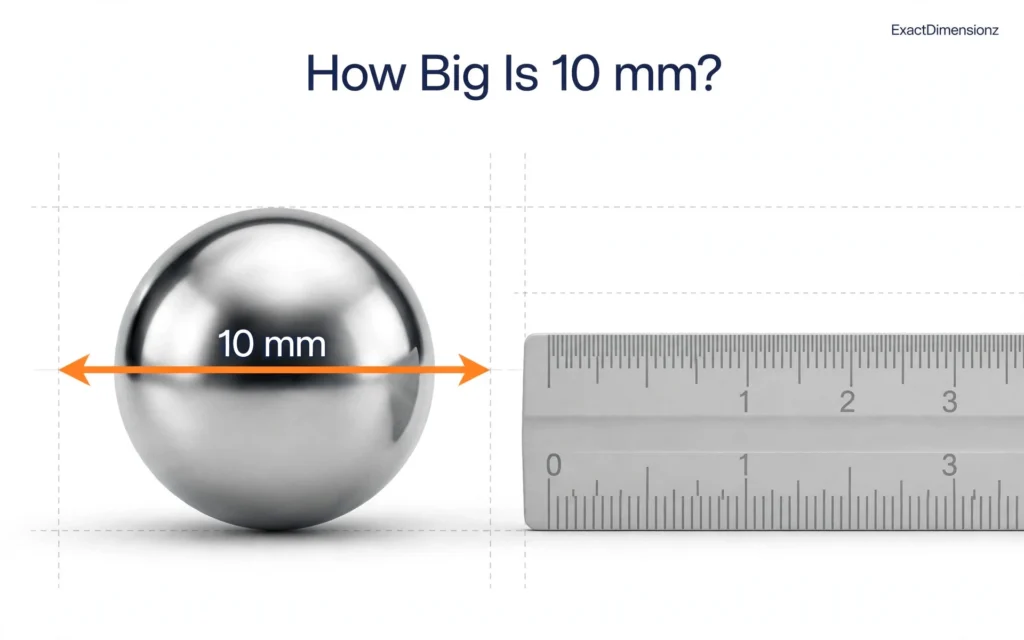
If you’re wondering how big is 10mm, here’s the shortest honest answer: it’s exactly one centimeter — 1 cm — or about 0.39 inches, roughly two-fifths of an inch. Picture the width of your pinky fingernail, or a single square on standard graph paper, and you’re standing right on top of it. If you’ve worked through the smaller end of the series, 10 mm feels like a payoff after 5 mm’s fiddly details.
But a useful warning before the objects begin: when a manufacturer or a standard says “10 mm,” that published designation doesn’t mean every single unit measures mathematically 10.000 mm. Threads run slightly under for fit, molded parts carry tolerances, and wood moves with humidity. Each of the thirteen objects below is labeled with its evidence type — official specification, published dimension, or standardized measurement — so you always know what the number actually promises.
Why 10 mm Is a Milestone, Not Just a Number
Millimeters 2 through 9 are orphans. They don’t line up with anything else in the metric system, so your brain has to hold each one as an isolated fact. Ten millimeters is different: it’s the first millimeter count that collapses into a bigger unit. 10 mm = 1 cm. Exactly. No rounding, no “about.” The moment a measurement hits 10 mm, it becomes a centimeter, and centimeters are the unit most of the world actually thinks in.
That’s why 10 mm shows up everywhere as a design anchor. Engineers pick M10 bolts because the number is clean. Toolmakers cut 10 mm hex keys and drill bits because workshops stock them by the dozen. Electronics are spaced on 10 mm standoffs because a centimeter of clearance is easy to verify with any ruler on the planet. If the smaller sizes in this series — 6 mm, 7 mm — felt like fiddly details, 10 mm is the first one that feels like a landmark.
How big is 10 mm?
10 millimeters is exactly 1 centimeter — about 0.39 inches (roughly two-fifths of an inch). Think of the width of your pinky fingernail, an M10 bolt’s thread, or a standard 10 mm drill bit.
The scale explains the measurement but is not physically calibrated on every screen. Screen size and browser zoom can change its displayed length. For exact work, verify with a ruler or calipers.
Which 10 mm Are We Talking About? Name the Axis First
Ten millimeters can describe completely different spans on the same object, so lock down the axis before you picture anything:
- Diameter — the straight line through the center of a round cross-section. This is the axis for the steel ball, the LED dome, the magnet, the dowel, the drill bit, and the copper tube’s outside.
- Bore / inside diameter — the opening through a ring or tube. The SKF 6000 bearing and the O-ring are 10 mm here, on the hole, not the outside.
- Across flats — the distance between two parallel flat sides of a hexagon. That’s the 10 mm on the hex key.
- Thickness — the separation between two faces. The polycarbonate sheet is 10 mm thick.
- Length — the long axis. The M3 standoff is 10 mm long; the test tube is 10 mm across but 75 mm tall.
- Nominal major diameter — the designated thread size. An M10 bolt is called 10 mm because the standard says so, even though the physical thread crests sit a hair under.
Keep that list in mind. Every object below names its axis in the first paragraph, and every image draws its orange arrow on exactly that axis.
13 Everyday Objects Listed at 10 mm
These are grouped by where you’re most likely to meet them: the toolbox, the machine and hardware world, and the workshop, lab, and garden. Because the list mixes official specs, published dimensions, and standardized measurements, it’s titled honestly — “listed at 10 mm.”
In the Toolbox
1. M10 Hex Bolt — 10 mm Nominal Thread Diameter

The “10” in M10 is the ISO metric thread designation: it names the nominal major diameter of the thread in millimeters, measured crest to crest across the threaded shank. ISO’s metric thread profile defines the designation this way worldwide, which is why an M10 bolt from any reputable maker fits an M10 nut from any other (ISO metric thread reference).
Hold the bolt sideways and look at the threaded section — not the head, not the unthreaded shank. The 10 mm span runs straight across the outside of the threads, the widest part of the threaded portion. On a typical M10 hex bolt that threaded cylinder is about as thick as your pinky fingernail is wide.
Evidence label: Standardized measurement. And here’s the honest footnote the standard itself implies: “nominal” means designated, not measured. Real external threads are cut slightly under 10 mm so they actually assemble into internal threads. Never assume a caliper will read 10.000 mm on one.
2. TengTools 10 mm Hex Key — 10 mm Across Flats

TengTools lists its 310510 hex key as “HEX KEY METRIC 10MM,” manufactured to DIN 2936, with the size given as 10 mm (TengTools 310510 datasheet). On a hex key, the size always means one thing: the distance across the flats of the hexagonal cross-section — the span a 10 mm socket in a bolt head must accept.
Lay the L-shaped key flat and look at either arm end-on. The hexagon you see there measures 10 mm from one flat side to the opposite flat side. That’s the business dimension: it decides which bolt heads this key will drive. A 10 mm key is one of the larger sizes in a standard metric set, the one you reach for on furniture frames, bicycle crank bolts, and machinery guards.
Evidence label: Official specification.
3. Bosch PRO Metal HSS-G Twist Drill Bit — 10.00 mm Diameter

Bosch’s PRO Metal HSS-G twist drill bit line is sold in exact diameter steps, and 10.00 mm is one of the standard catalog sizes (Bosch Professional). These bits are ground to DIN 338 with an h8 diameter tolerance, which is the metalworking way of saying the cutting diameter is controlled tightly around the stated size.
The 10 mm is the diameter of the hole the bit cuts — measured across the cutting edges at the tip, perpendicular to the bit’s axis. Chuck it in a drill press and the business end scribes a 10 mm circle. If you’ve ever needed a hole that an M10 bolt slides through with a whisper of clearance, this is the bit that drills it.
Evidence label: Official specification.
In Machines and Hardware
4. PGN 10 mm G500 Chrome Steel Ball — 10 mm Diameter

PGN Bearings catalogs a 10 mm G500 chrome steel ball among its precision steel ball sizes (PGN Bearings steel balls). A steel ball’s only meaningful dimension is its diameter, and on a 10 mm ball that diameter is — satisfyingly — the same whichever way you turn it. About the size of a large marble, it would sit on your fingertip with room to spare.
These balls live inside bearings, valves, drawer slides, and locking mechanisms, which is why they’re made to grade standards: G500 is a general-purpose precision grade, not the ultra-tight G25 used in high-speed bearings. For picturing 10 mm, though, the distinction hardly matters — what matters is that a perfect sphere 10 mm across is a real, purchasable thing.
Evidence label: Published dimension.
5. SKF 6000 Deep-Groove Ball Bearing — 10 mm Bore Diameter

Here’s the axis twist the bearing deserves: SKF’s 6000 deep-groove ball bearing is a 10 mm object on its inside, not its outside. SKF’s own specification sheet gives a bore diameter of 10 mm, an outside diameter of 26 mm, and a width of 8 mm (SKF 6000 specification). The 10 mm is the hole through the middle — the shaft it rides on is 10 mm across.
Look at the bearing face-on. The dark ring of the inner race frames a 10 mm opening; the whole bearing is roughly the diameter of a US quarter but much thinner. It’s a lovely reminder that “how big is 10 mm” sometimes means the empty space, not the metal.
Evidence label: Official specification.
6. supermagnete S-10-10-N Disc Magnet — 10 mm Diameter

The supermagnete S-10-10-N is a neodymium disc whose datasheet states a diameter of 10 mm and a height of 10 mm, with a ±0.1 mm manufacturing tolerance (supermagnete datasheet). It’s one of those rare objects that’s 10 mm on two axes at once — a little silver cylinder as wide as it is tall.
Measure across the flat circular face and you get the 10 mm diameter; the datasheet’s tolerance note is worth absorbing. Even on a precision-sintered magnet, the maker only promises 10 mm within a tenth of a millimeter either way. Published dimensions are targets with honest error bars, not mathematical certainties.
Evidence label: Official specification.
7. EN 1057 Copper Tube — 10 mm Outside Diameter
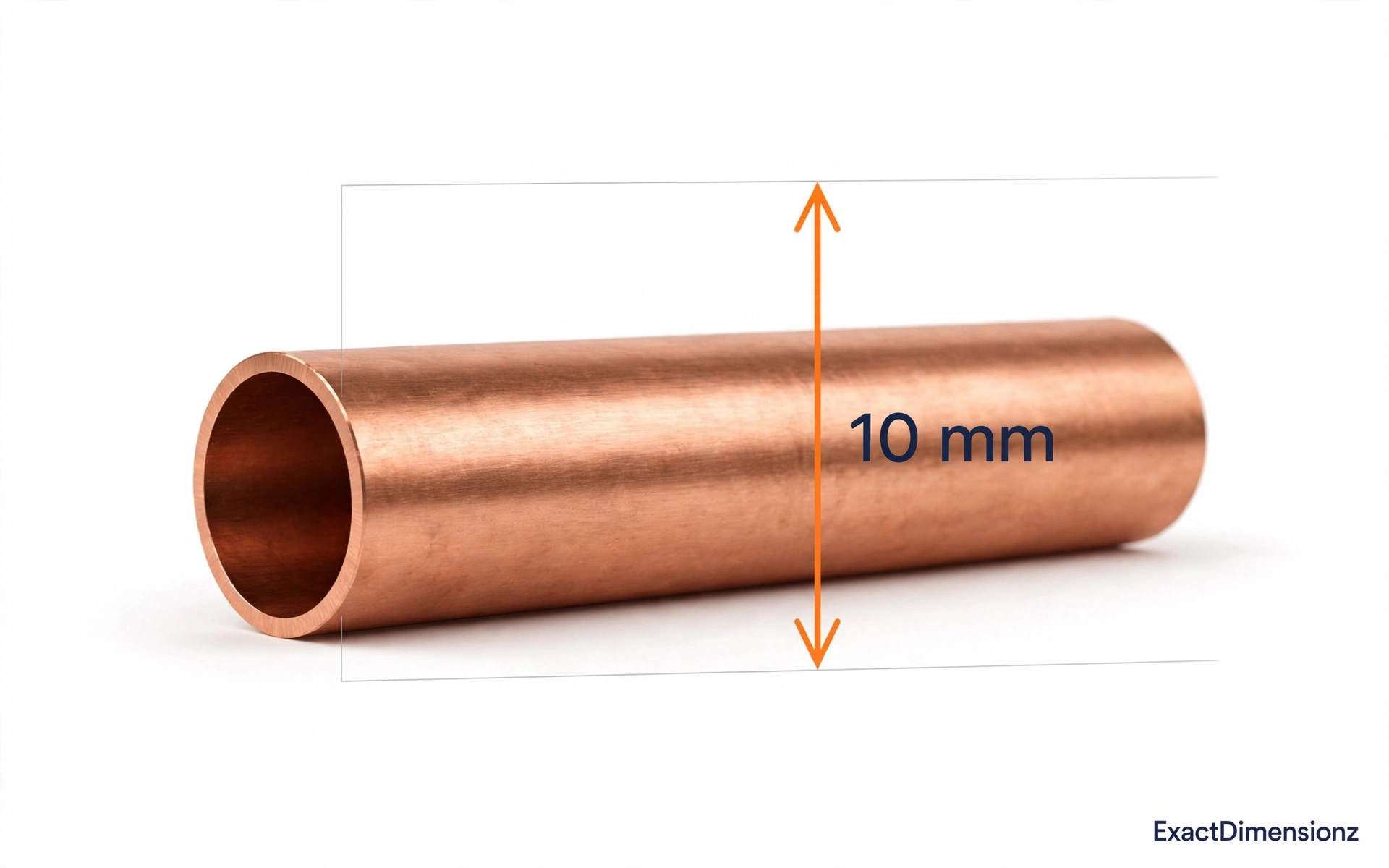
Copper tube for plumbing and heating is made to EN 1057, and 10 mm outside diameter is one of the standard metric sizes in that system (BS EN 1057 documentation). Cut a cross-section and the 10 mm runs straight across the outside of the circle — the dimension every compression fitting in the size is built around.
A 10 mm copper tube is slim: about the thickness of a standard pencil, and the size you’d find feeding a small radiator or running a short water line. Because it’s a standardized size, any EN 1057 10 mm tube from any licensed maker shares that outside diameter by design.
Evidence label: Standardized measurement.
8. ISO 3601 O-Ring — 10 mm Inside Diameter

O-rings are sized by their inside diameter and cross-section, and ISO 3601-1 — the international O-ring standard — lists 10 mm as one of its standard inside diameters (ISO 3601-1 size tables). So a metric O-ring designated around 10 mm ID has a hole exactly in the 10 mm class: the ring’s opening, unstretched, spans 10 mm.
Picture a small rubber band with real body to it — the opening is the 10 mm, while the rubber cord itself adds a couple of millimeters all around. This is the counterpart to the bearing above: two rings, both “10 mm,” one measured on the hole you’d push a shaft through, and the distinction is the entire point of naming the axis.
Evidence label: Standardized measurement.
9. Kingbright L-813ID LED — 10 mm Diode Diameter

Kingbright’s L-813ID is cataloged as a 10 mm round LED, and its datasheet gives the diode diameter as 10 mm (Kingbright L-813ID datasheet). The 10 mm is the width of the domed epoxy lens — the glowing part — measured across the round face, not counting the wire leads underneath.
If you’ve ever built an electronics kit, you know 5 mm LEDs as the common small ones; the 10 mm version is the big sibling, twice the face width, used where an indicator needs to be seen across a room. Hold one lens-up and the dome is almost exactly the width of your pinky nail.
Evidence label: Official specification.
In the Workshop, Lab, and Garden
10. Trend 10 mm Wooden Dowel — 10 mm Diameter
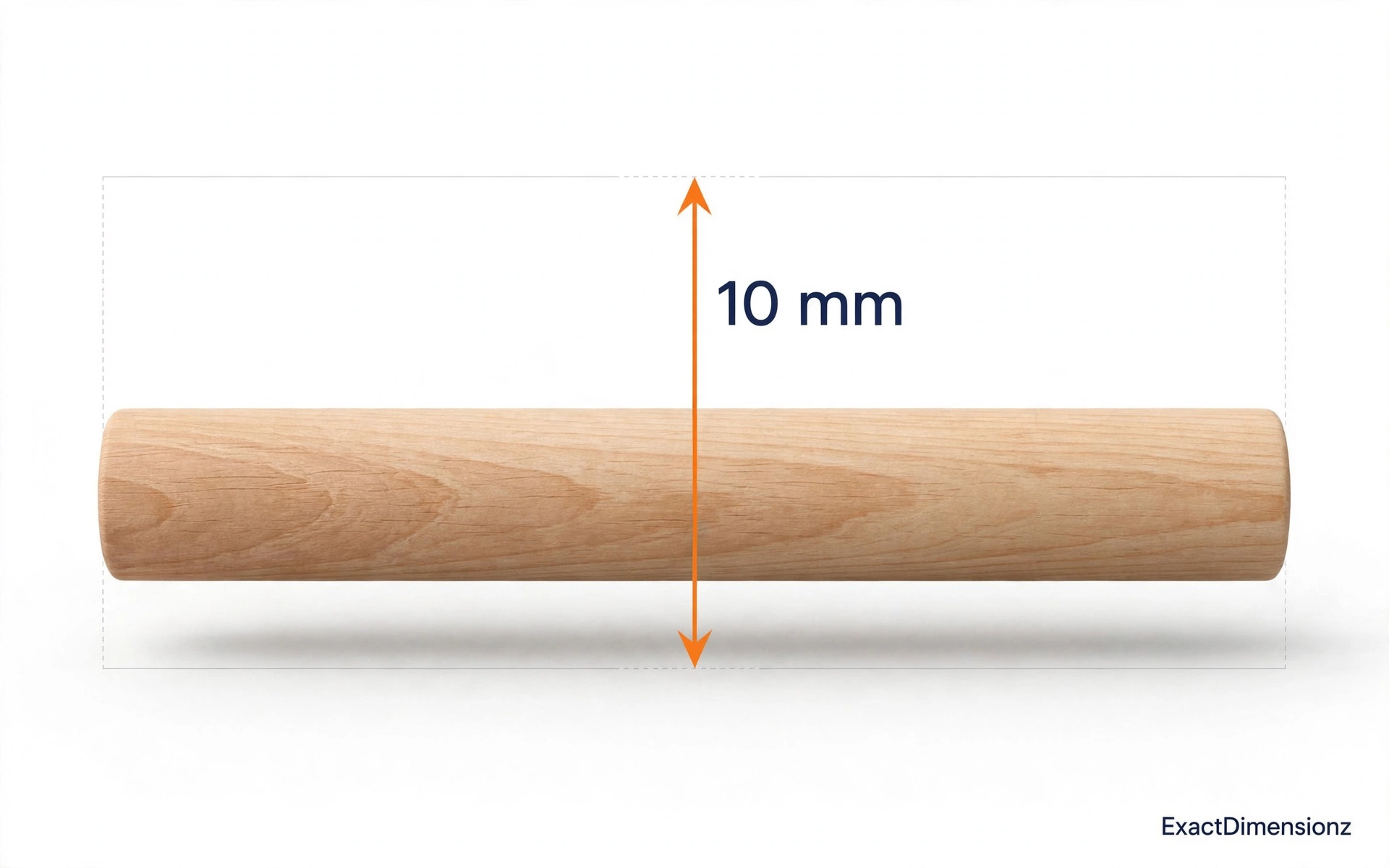
Trend’s wooden dowel range is machined in 6, 8, and 10 mm diameters, and the 10 mm dowel is the heavy-duty end of the lineup — the one used for real furniture joinery rather than craft projects (Trend wooden dowel specifications). The diameter runs straight across the round cross-section, and it has to: the dowel must match its drilled hole within a whisper.
A 10 mm dowel feels substantial between your fingers, noticeably thicker than a pencil. One honest caveat, which is why this carries a “published” rather than “official” label: wood is hygroscopic. A beech dowel can swell or shrink a fraction with humidity, so 10 mm here is the manufactured target, not a laboratory constant.
Evidence label: Published dimension.
11. DFRobot M3 × 10 Hex Standoff — 10 mm Spacer Length

DFRobot’s M3 × 10 hexagonal standoff kit specifies a 10 mm spacer length — the distance the brass hex body holds between two circuit boards (DFRobot product page). The “M3” names the thread; the “10” names the length of the standoff body itself, end to end, not counting the threaded stud.
Stack two boards with these and the gap between them is one centimeter — enough to clear tall capacitors, and exactly what a ruler confirms in one glance. It’s the most literal centimeter in electronics: a physical spacer whose whole job is being 10 mm long.
Evidence label: Published dimension.
12. PYREX 9800-10 Test Tube — 10 mm Outside Diameter

Corning’s PYREX 9800-10 test tube is specified at 10 mm OD × 75 mm high (Corning PYREX 9800-10). The 10 mm is the outside diameter of the glass tube; the 75 mm is its length, so don’t mix the axes. It’s a slim tube — narrower than your little finger.
These are the small tubes of the lab world, used for micro-scale reactions and sample storage, and the 10 mm OD is what decides which rack holes and caps fit. The tube’s height (75 mm) being seven and a half times its width makes the 10 mm feel even smaller than it is.
Evidence label: Official specification.
13. Palram SUNLITE 10 mm Twin-Wall Polycarbonate — 10 mm Thickness

Palram’s SUNLITE multi-wall polycarbonate sheet is produced in a 10 mm twin-wall structure, and the company’s official dimensions table lists the 10 mm thickness directly (Palram SUNLITE dimensions). Here the axis is thickness: the distance between the two outer faces of the sheet, with the hollow flutes sandwiched between.
This is greenhouse and patio-roof material — a 10 mm panel is rigid enough to span a meter between supports while still letting through about 80% of light in clear form. Run your fingers across the cut edge and the 10 mm depth is obvious: it’s a real slab, not a film.
Evidence label: Official specification.
10 mm in Other Units
| From | To | Result |
|---|---|---|
| 10 mm | Centimeters | 1 cm exactly |
| 10 mm | Inches | 0.3937 in (rounded) |
| 10 mm | Meters | 0.01 m exactly |
| 10 mm | Nearest common fraction | about 25/64 in (9.92 mm) |
| 1 cm | Millimeters | 10 mm exactly |
The inch conversion is the one people actually use: 10 ÷ 25.4 = 0.3937007…, shown rounded to four decimal places. In the workshop, “just under 13/32 of an inch” or “a hair over 3/8 of an inch” both land close enough for a visual.
10 mm on a Ruler

On any metric ruler, 10 mm is the distance from the zero mark to the first numbered centimeter line — the “1.” The ten tiny millimeter ticks between them are each 1 mm, and the slightly longer tick at the halfway point marks 5 mm. If your ruler only shows inches, find the 3/8″ mark (9.525 mm) and go a half millimeter past it; you’re at 10 mm. The Quick Answer graphic at the top draws this to scale with ten equal 1 mm segments.
Near-Size Comparisons — Close, but Not 10 mm

These familiar objects sit near 10 mm without matching it — at 10 mm we’re well past the 3 mm and 4 mm references. Each shows its real dimension and the exact difference, so nothing here pretends to be a 10 mm reference:
- 3/8 inch = 9.525 mm — exactly 0.475 mm under 10 mm. This is why a 3/8″ wrench almost — but not quite — fits a 10 mm bolt head. Almost is the operative word: that half-millimeter gap is how bolt heads get rounded off.
- Standard LEGO brick height = 9.6 mm — 0.4 mm under (LEGO dimensions reference). A single brick (studs excluded) stacked on a table is a near-perfect visual anchor, just a hair short.
- USB-C port opening ≈ 8.34 mm wide — about 1.7 mm under (USB connector dimensions). The little oval port on your phone or laptop is noticeably narrower than 10 mm; hold a 10 mm dowel next to it and the difference is obvious.
- Adult pinky fingernail ≈ 10 mm wide — a rough visual only, not a verified dimension. Nail widths vary person to person, so use this as a memory hook, never as a measurement.
Notice the pattern: the imperial near-misses (3/8″) and the toy-brick near-miss (9.6 mm) both fall just short, which is exactly why metric’s clean 10 exists as its own anchor.
The 1 cm Test: 10 mm as Your Pocket Ruler
No ruler? No problem — 10 mm is the one size in this series you can carry on your body. Your pinky fingernail is roughly 10 mm wide: hold it against anything and you have an instant go/no-go gauge. A single square on standard graph paper is 10 mm on the side. An M10 bolt’s threaded shank spans 10 mm crest to crest. A 10 mm drill bit cuts a 10 mm circle. The PYREX 9800-10 test tube is 10 mm across the outside.
Use them the same way every time: hold the reference edge-to-edge with the unknown, sight straight down to kill parallax, and ask “bigger or smaller?” rather than “how much?” Field references answer the first question beautifully and the second one badly — they tell you whether you’re in the right neighborhood, never the exact address. When the answer matters — a shaft that must fit a bearing bore, a dowel going into a glued joint — go back to calipers: zero them, close gently on the diameter (not at an angle), and take two readings rotated 90° apart, because round stock is rarely perfectly round.
Where 10 mm Goes Wrong
Ten millimeters is a clean number, which makes it a confident mistake. The traps are all the same shape: the right number on the wrong feature.
Reading the head instead of the thread. An M10 bolt’s head is far wider than 10 mm across flats — typically 16–17 mm. The 10 mm lives on the threaded shank. Size your wrench by the head and you’ll reach for the wrong tool every time.
Confusing the O-ring’s inside with its outside. A 10 mm ID O-ring with a 2 mm cord measures about 14 mm across the outside. Name the axis before you measure: the 10 mm is the hole, and the hole is the whole product.
Measuring the whole LED instead of the lens. The 10 mm on the Kingbright is the diode diameter — the glowing dome. The wire leads below don’t count, and including them turns a clean 10 into a meaningless 25.
Trusting a nominal size as a physical one. “10 mm” copper tube and M10 threads are designations governed by standards and tolerances — calipers may read 9.9x, and that’s correct. The supermagnete disc even prints its honesty: ±0.1 mm. The designation names the standard size; the tolerance names the allowed reality.
One Centimeter, Thirteen Witnesses
Ten millimeters earns its keep as the metric system’s first clean milestone — the point where millimeters become a centimeter and the numbers start feeling friendly. Whether you’re matching a drill bit to a bolt, checking a standoff’s clearance, or just trying to picture a centimeter, the thirteen objects above give you thirteen independent, evidence-labeled ways to hold 10 mm in your mind. And if you ever doubt a “10 mm” label, remember the axis rule from the start of this article: name what was measured, check what the number promises, and measure twice.
Related reading in this series: how big is 2 mm, plus the 3 mm, 4 mm, 6 mm, and 7 mm guides linked above.
Sources: every dimension above traces to a manufacturer datasheet, official product specification, or published standard (TengTools, Bosch Professional, SKF, Corning, Palram, supermagnete, Kingbright, PGN Bearings, DFRobot, Trend, ISO 3601-1, BS EN 1057, ISO metric threads), accessed 2026-10-18; conversions independently recalculated.
