
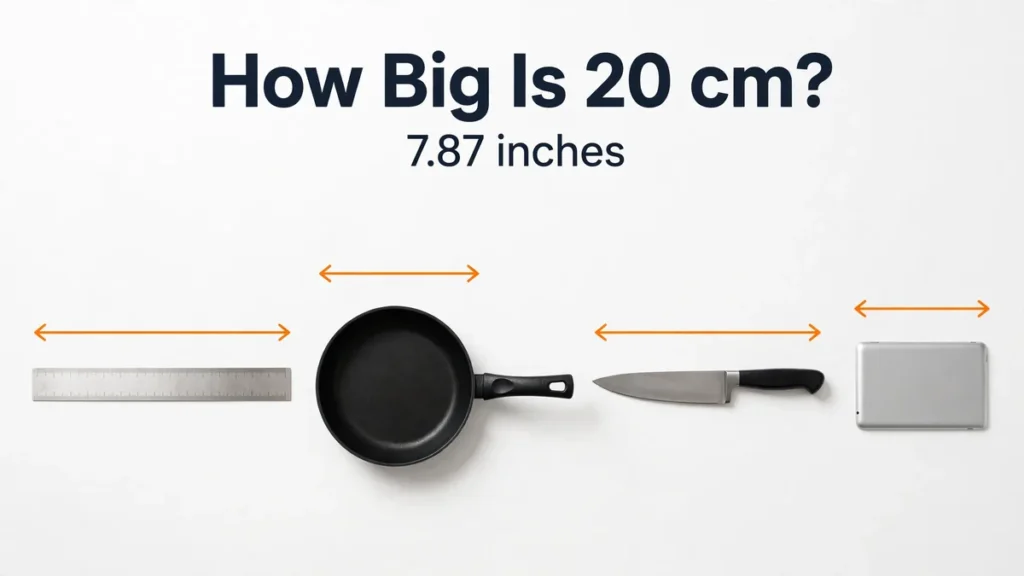
Cut a board at the 8-inch mark on your tape measure when the plan says 20 cm, and the board comes back 3.2 millimetres too long. That is the whole problem with how big is 20 cm: nearly every guide rounds it to “about 8 inches” and stops, and the rounding is exactly where the mistakes live — a drawer slide that binds, a pan that overhangs its burner by a hair, a craft cut that will not square up. Three millimetres sounds like nothing until the thing has to fit.
Twenty centimetres is 7.87 inches, 200 millimetres, and one-fifth of a metre. It is two-thirds of a standard 30 cm ruler and one centimetre shorter than the short side of an A4 sheet. The seven objects below are the closest honest answers to it: four land on 20 cm exactly, three miss by less than a centimetre with the miss printed in full, and every one of them carries the source that proves it.
Quick Answer
20 cm is 7.87 inches — just under 8.
Twenty centimetres is 7.87 inches, 200 millimetres, and one-fifth of a metre. Four everyday objects land on it exactly — a 200 mm steel rule, a 20 cm frying pan, an 8-inch chef’s knife blade, and a 200 mm saw blade — and three more miss by less than a centimetre, with the miss printed in full.
The bar above shows twenty 1 cm segments, but it is a diagram, not a ruler: screen sizes vary, so it explains the measurement rather than measuring it. For a real measurement, use the objects below or a tape measure.
How to Read the Seven Objects Below
The seven objects are ordered by how close they land on 20 cm, closest first, and each one carries its evidence grade in the heading. EXACT means the figure is a standard’s or an authority’s own dimension for the named thing. LISTED means the figure is the manufacturer’s or operator’s published specification for the named model. AVERAGE means the figure is an authority’s published average or range for the named thing. REPORTED means the figure is the largest verified measurement an expert source reports for the named thing. Four of the seven land on 20 cm exactly, and the three that do not carry their miss in the open, in millimetres, where you can see it — and the point of the ordering is that the miss grows as you read, so the last object is the one that stretches the number furthest.
A published 20 cm designation does not mean every manufactured unit measures mathematically 20.000 cm. Pans are sold by a nominal size, knives by a rounded blade length, and paper by a standard with a tolerance. What follows is what the source actually says, with the axis named every time, so you can check it yourself.
1. A 200 mm Steel Rule — 20.0 cm Exactly (EXACT)
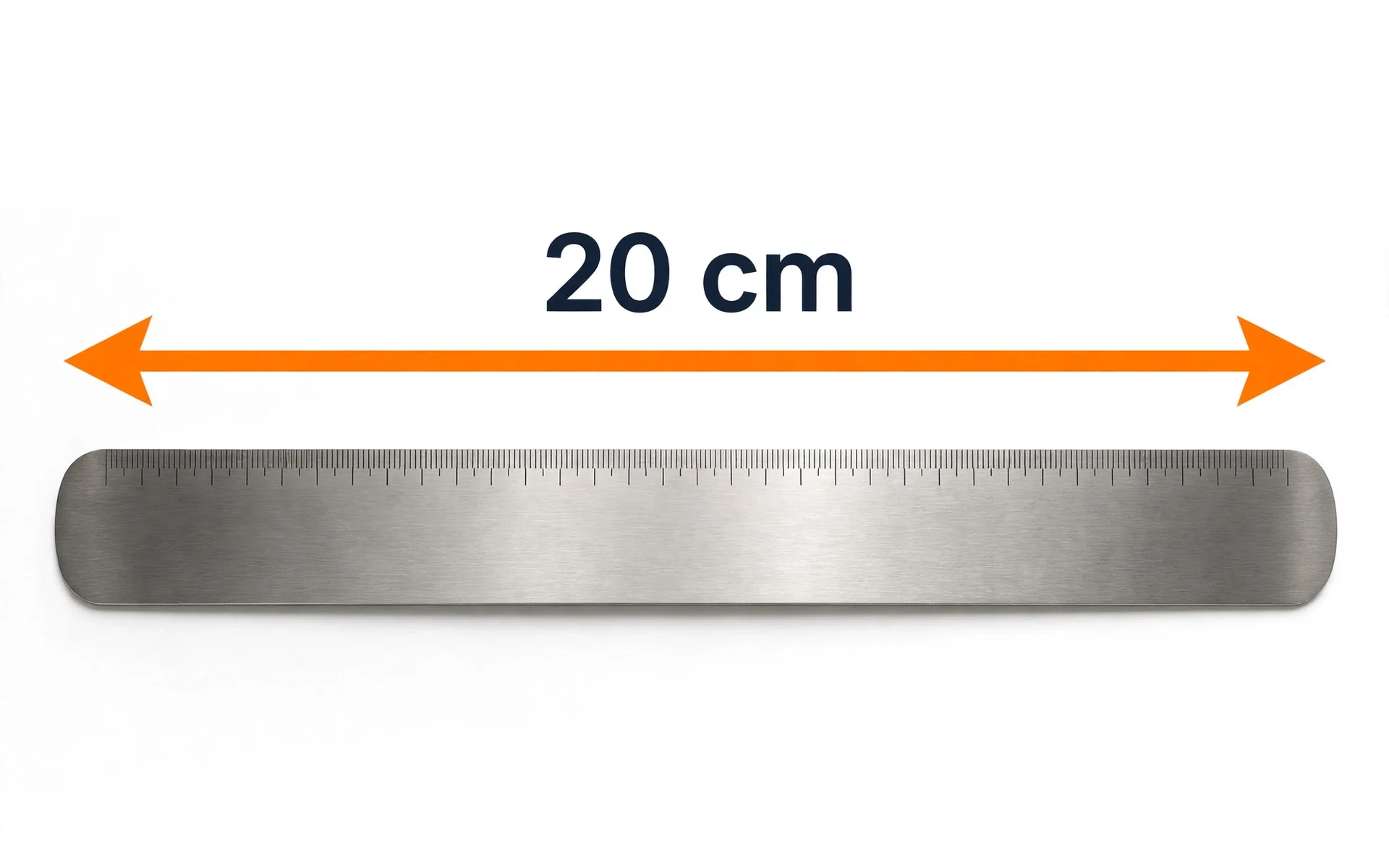
The steel rule is the article’s cleanest land-on, because its 20 cm is not a measurement of a thing that happens to be 20 cm long — it is the thing itself, a scale that runs from 0 to 200 millimetres. A 200 mm engineer’s rule is a standard designated size: the Indian standard for engineer’s squares, IS 2103, designates its sizes by the blade length, and “200” is one of those designations, sold as “200 mm” by every tool brand that makes one. Lay it on a bench and the distance from the 0 mark to the 200 mark is 20 cm by definition, not by luck, and the same on every 200 mm rule ever sold, because the scale is the product.
The fitting check is the 0 mark, because the rule’s 20 cm starts at the 0 line and not at the end of the steel. Most steel rules carry a few millimetres of blank metal past the last graduation, so if you measure from the physical end of the rule instead of from the 0 mark you will read long by that margin — the same trap that catches people with a 30 cm school ruler, whose plastic body usually runs a few millimetres past the 30 mark. Measure from 0, and the rule is the most honest 20 cm you own. The grade is exact because the figure is the standard’s own designation for the named size.
2. A Tefal Easy Cook & Clean Frying Pan, 20 cm — Rim Diameter 20 cm (LISTED)
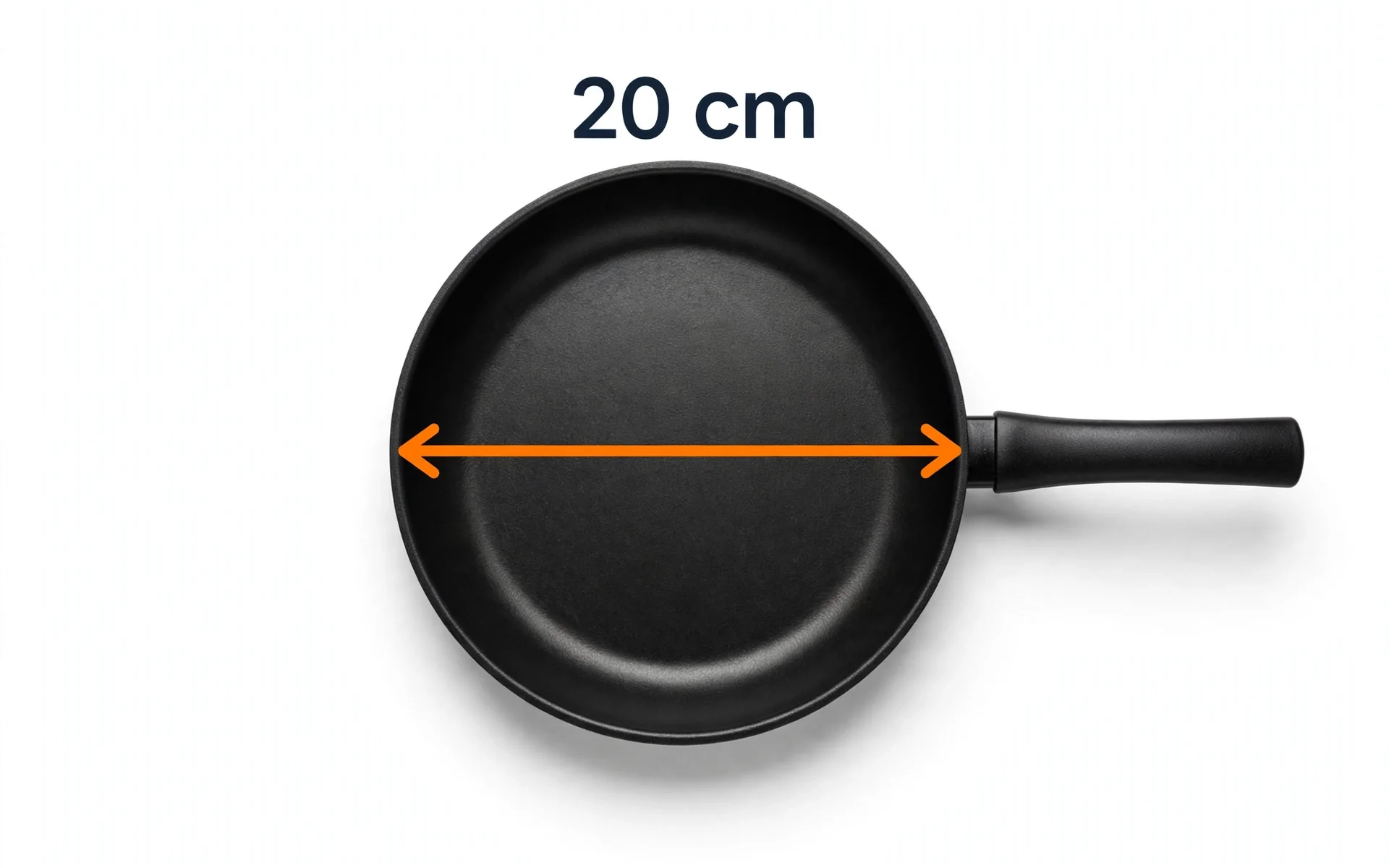
The frying pan is the article’s most useful land-on, because 20 cm is a size you actually buy: it is the small pan in most cookware ranges, the one-egg pan, the single-portion pan, and Tefal sells it by that number. The Tefal Easy Cook & Clean Frying Pan 20 cm, reference B5550233, lists “Dimension: 20 CM” in its official specifications — that is the diameter across the top rim, the opening you cook in, and the number on the box. Set it on a burner and the rim spans 20 cm edge to edge, which is why a 20 cm pan fits a small hob ring and overhangs a smaller one.
The fitting check is the base, because the pan’s 20 cm is the rim and not the part that touches the heat. Tefal’s own specification table gives the diameter of the bottom — the part in contact with the cooking plate — as 144.5 mm, a full 55.5 mm narrower than the rim, because the sides slope outward from the base. Buy a pan by its rim size and then measure the hob ring against the base, or the pan will sit on a ring it does not cover. The same warning applies to every pan sold by diameter: the headline number is the top, and the base is always smaller. The grade is listed because the figure is the manufacturer’s own specification for the named model, with the axis — rim diameter — stated in full.
3. A Victorinox Fibrox Pro 8-Inch Chef’s Knife — Blade 20 cm (LISTED)
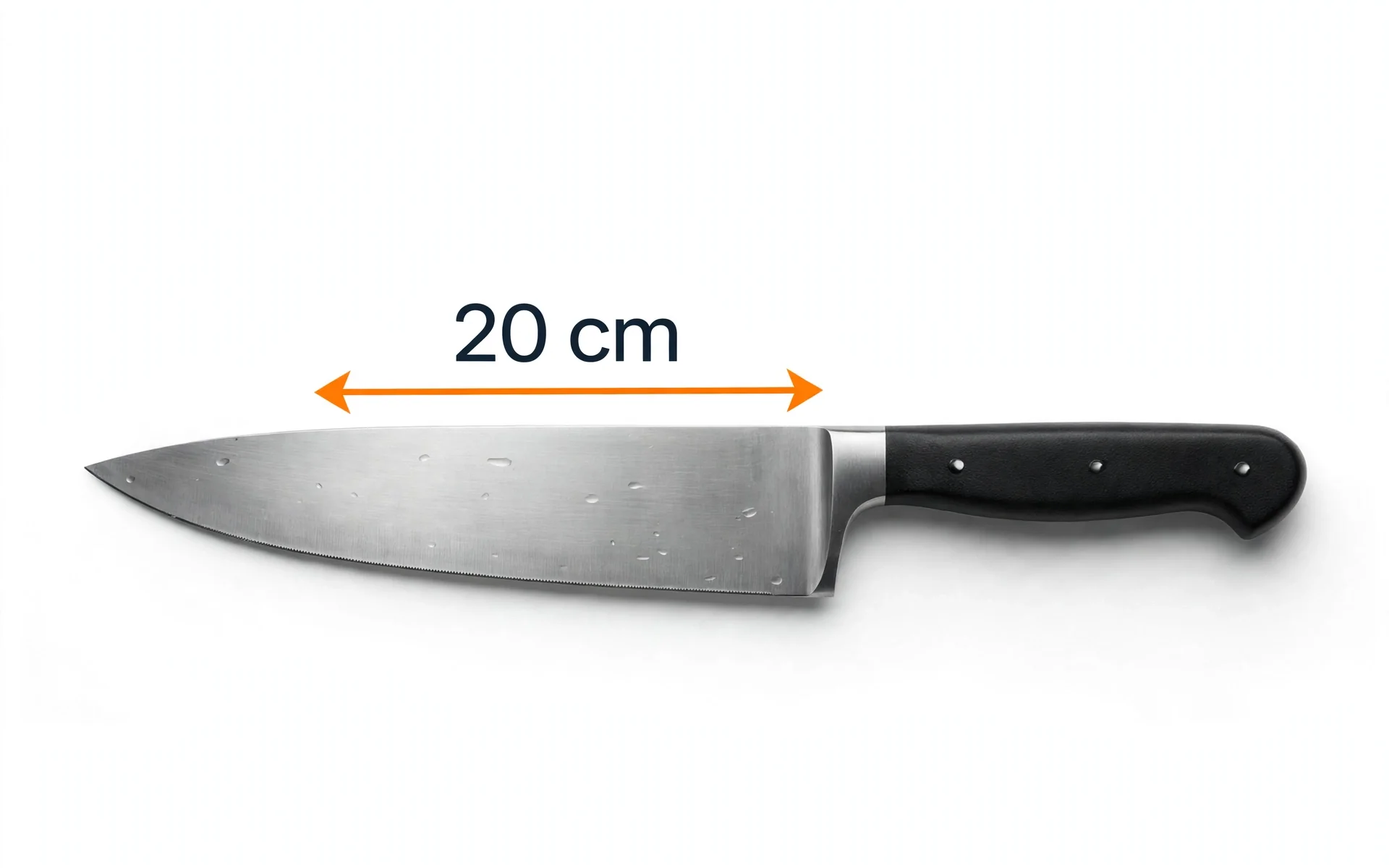
The chef’s knife is the article’s most deceptive land-on, because it lands on 20 cm while wearing a name that says otherwise. The Victorinox Fibrox Pro 8-inch chef’s knife, model 5.2063.20, lists its blade length as 20 cm — 7.9 inches — in the maker’s own specifications. Hold it by the handle and measure from the tip to the bolster and the cutting edge runs 20 cm, which is why the 8-inch chef’s knife is the default knife in professional kitchens: long enough to slice a cabbage in one stroke, short enough to control with one hand.
The fitting check is the name, because “8-inch” is a nominal size and 8 inches is actually 20.32 cm — 3.2 mm longer than the blade Victorinox sells you. Knife makers round the blade length to the nearest inch for the name, so an “8-inch” blade is 20 cm, a “10-inch” blade is 25 cm, and the name is a label, not a tape reading. If you buy a knife sheath or a blade guard by the inch name, the 3.2 mm works in your favour; if you cut a slot for the blade to the inch figure, it will be 3.2 mm too long. The grade is listed because the figure is the manufacturer’s own specification for the named model, with the nominal-name trap printed in full: 20 cm on the blade, 20.32 cm in the name.
4. A Bosch Expert 200 mm Circular Saw Blade — Diameter 20.0 cm (LISTED)
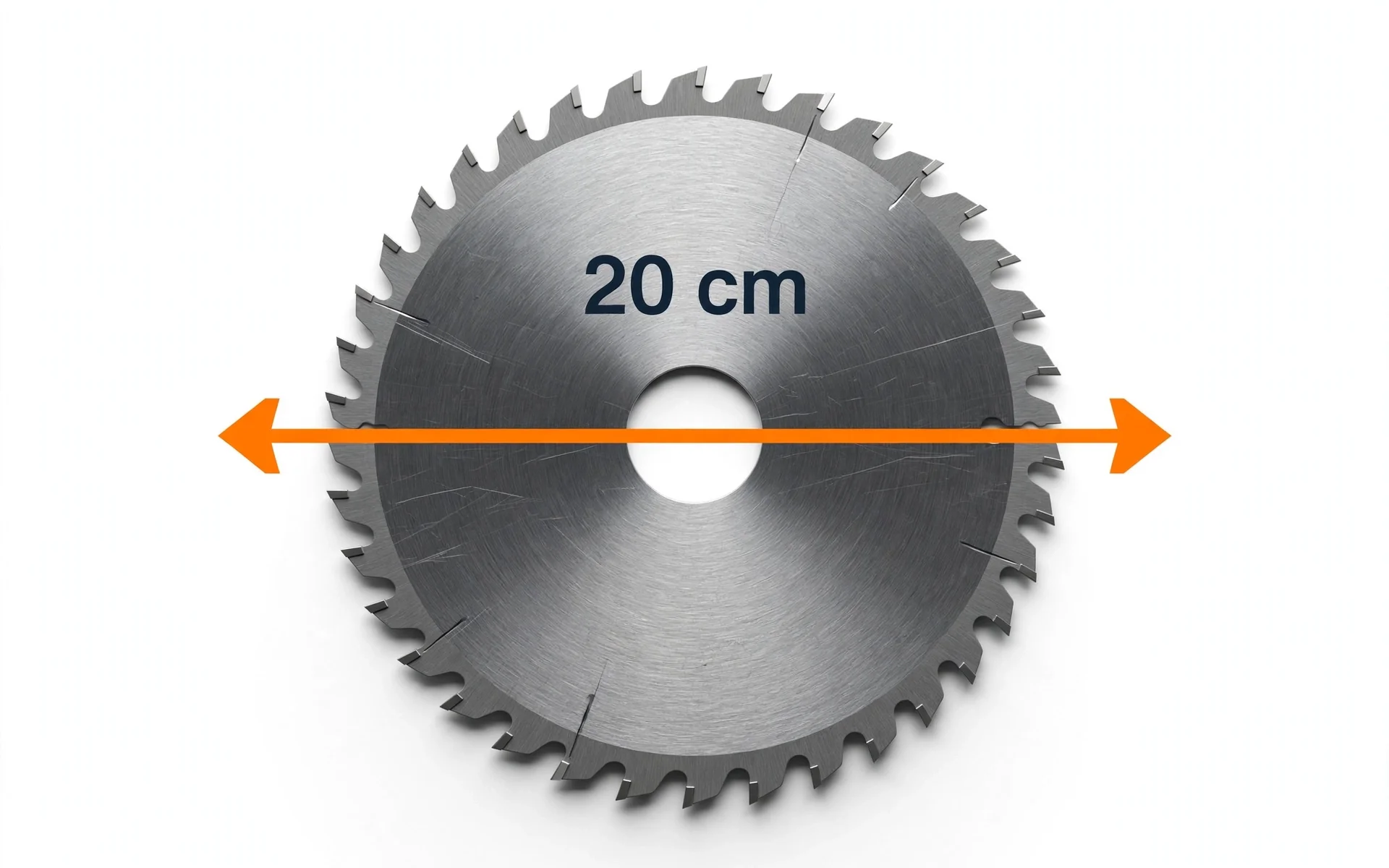
The saw blade is the article’s roundest land-on, because its 20 cm is a diameter, not a length, and it shows the number from a different axis than everything else on this page. The Bosch Expert 200 mm circular saw blade is listed at a saw-blade diameter of 200 mm — 20.0 cm across the disc, tooth tip to tooth tip — in the maker’s specification, which also gives the 30 mm bore and the 2.8 mm kerf. Hold it up and the disc spans 20 cm in every direction, which is why a 200 mm blade is the standard size for a small circular saw: big enough to cut a 65 mm board in one pass, small enough to hold in one hand.
The fitting check is the teeth, because the 200 mm is measured across the tips of the teeth and not across the steel body beneath them. The disc itself is a few millimetres smaller than 200 mm, and the teeth are what do the cutting and what set the diameter, so a blade guard or a case bought against “200 mm” must clear the teeth, not just the plate. The same rule applies to every round thing measured by diameter: say which circle you measured, because the rim and the body are rarely the same number. The grade is listed because the figure is the manufacturer’s own specification for the named model, with the axis — diameter across the tooth tips — stated in full.
5. An iPad mini (6th Generation) — Height 19.54 cm (EXACT)
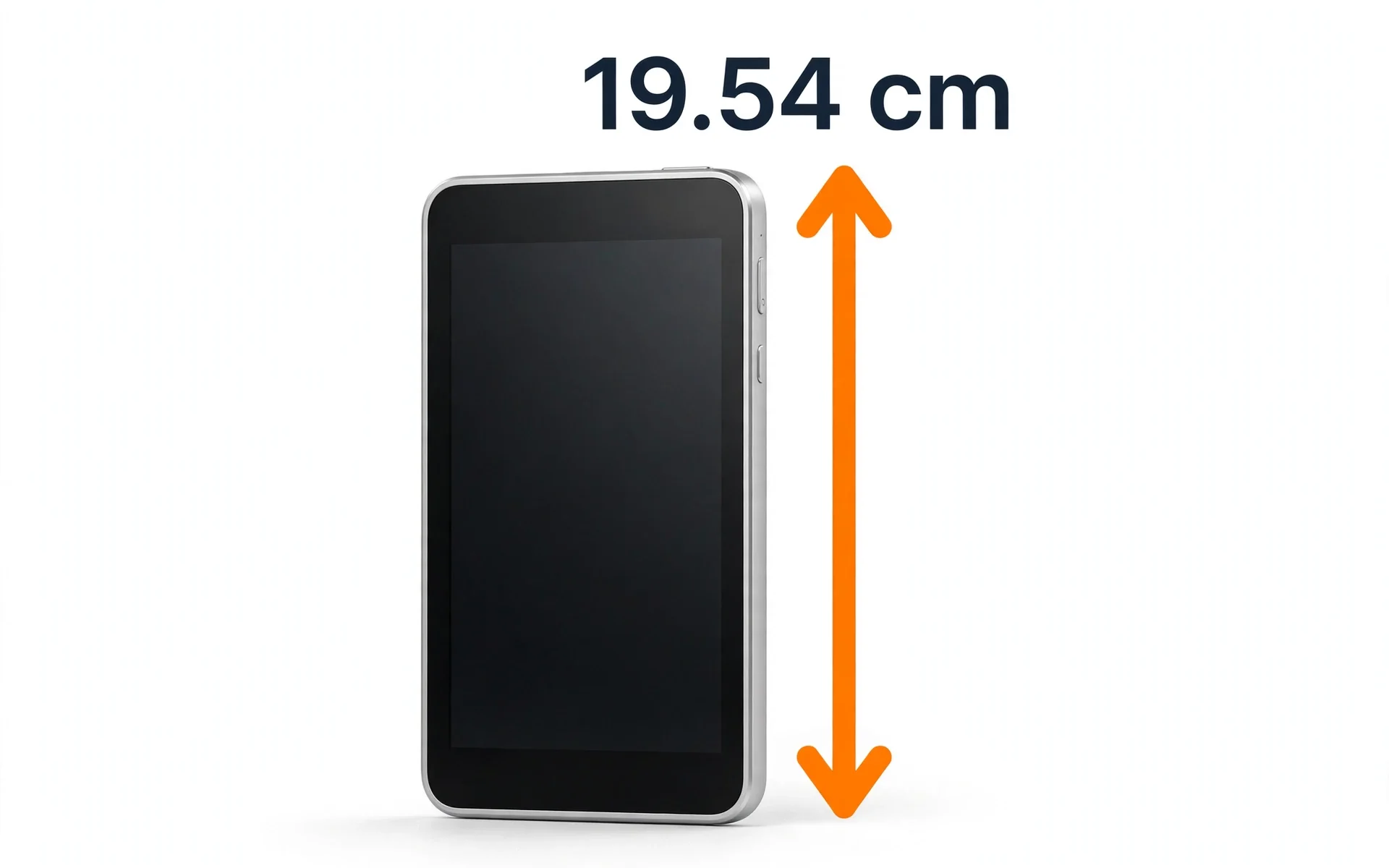
The iPad mini is the article’s closest miss, and the one most readers already own. Apple’s own technical specifications list the iPad mini (6th generation) at a height of 195.4 mm — 19.54 cm, 7.69 inches — for both the Wi-Fi and the Wi-Fi + Cellular models, with a width of 134.8 mm and a depth of 6.3 mm. Stand it on its short edge and it rises 19.54 cm, which is 4.6 mm short of 20 cm — about the thickness of a pencil line, or the width of the tablet’s own bezel at the top. It is the handiest 20 cm in the house, because it is the thing you reach for when you want to know whether something is about 20 cm tall.
The fitting check is the orientation, because the 19.54 cm is the height with the tablet held vertically, home button at the bottom, and the number changes completely if you turn it sideways: laid flat it is 13.48 cm across, and measured diagonally the screen is 8.3 inches. A sleeve bought against “20 cm” fits the iPad mini with 4.6 mm to spare in height and swallows it in width, which is why sleeves are sold by the diagonal screen size and not by the height. The grade is exact because the figure is the manufacturer’s own dimension for the named model, with the deviation printed in full: 19.54 cm, 4.6 mm short.
6. Eight US Quarters in a Row — 19.41 cm (EXACT)
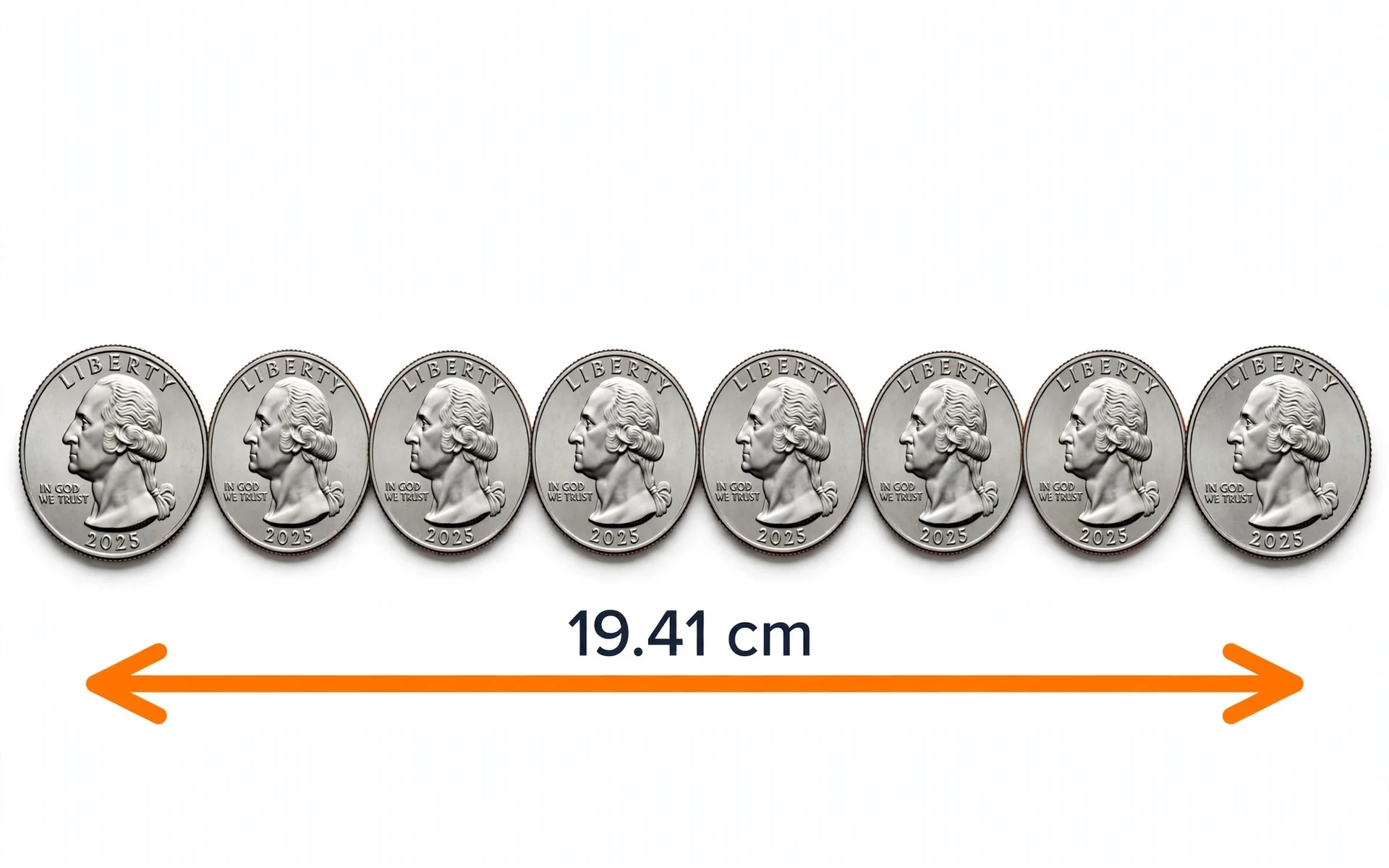
The quarters are the article’s most checkable miss, because the number comes from the Mint, not from a tape measure, and anyone with eight coins in a pocket can verify it on a kitchen table. The United States Mint lists the quarter dollar at a diameter of 0.955 inches — 24.26 mm — and eight of them laid edge to edge run 8 × 24.26 mm = 194.08 mm, which is 19.41 cm. Line them up on a flat surface, push them together so no gaps show between the rims, and the row ends 5.9 mm short of 20 cm — about the width of a pencil eraser, or the thickness of three quarters stacked.
The fitting check is the gap, because the 19.41 cm assumes the coins touch. Leave a hairline between each pair and the row grows by a millimetre per gap, which is how a careless row of quarters reaches 20 cm without any coin being the wrong size — seven gaps of a millimetre each add 7 mm, more than the 5.9 mm shortfall. Push them tight and count eight, and the row is a repeatable 19.41 cm, the same on every quarter minted since 1965, because the diameter is the specification, not the wear. The grade is exact because the figure is the authority’s own dimension for the named coin, with the arithmetic shown and the deviation printed in full: 19.41 cm, 5.9 mm short.
7. A New Unsharpened No. 2 Pencil — 19.05 cm (REPORTED)
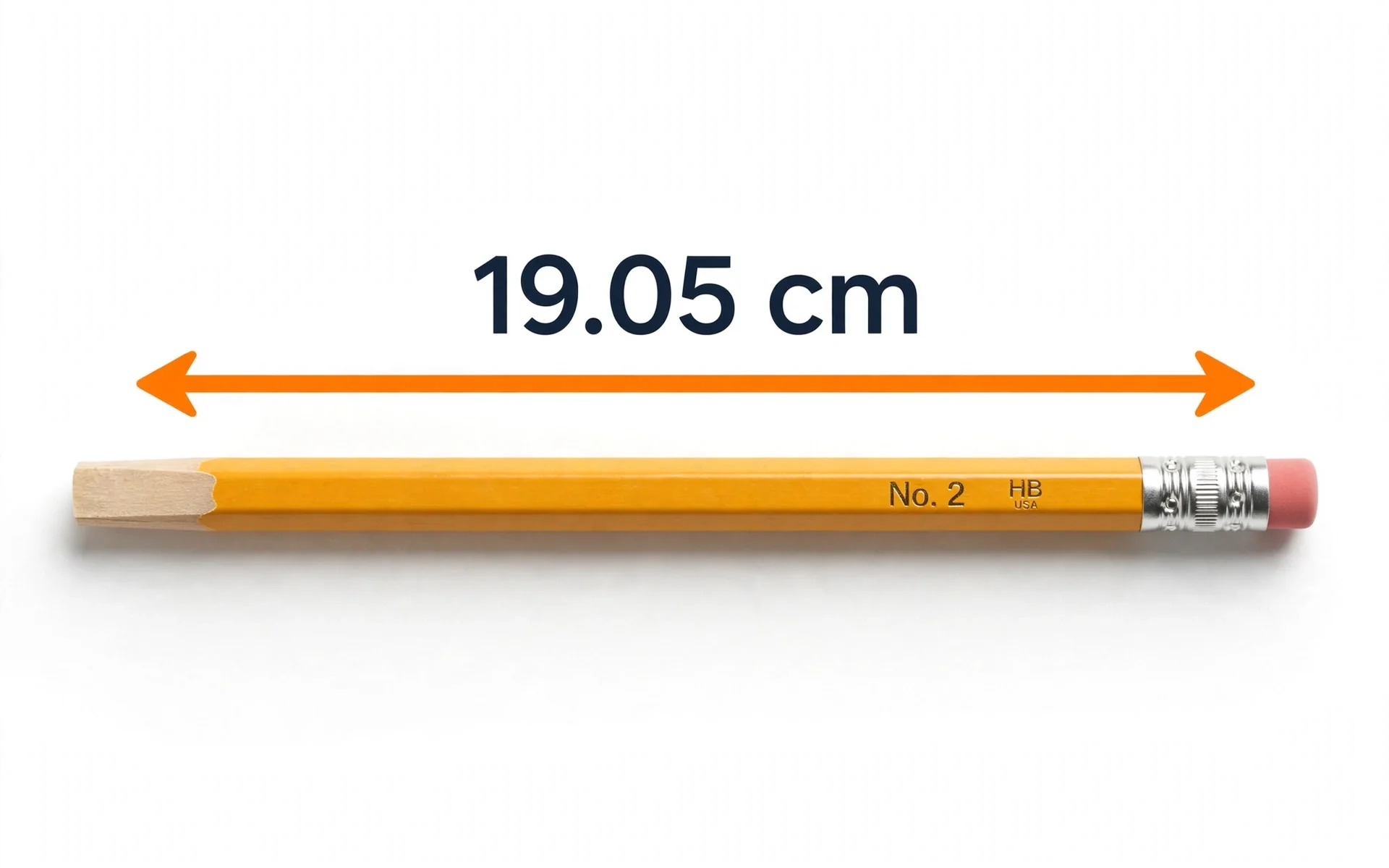
The pencil is the article’s furthest miss, and the one every classroom gets wrong. A new, unsharpened No. 2 — HB — pencil measures 7.5 inches long, which is 19.05 cm from the flat end to the tip of the eraser, and that 7.5-inch figure is the trade standard printed in pencil makers’ catalogues and repeated in every school-supply listing. Hold one next to a 20 cm mark and it falls 9.5 mm short — about a centimetre, or the length of the eraser and its metal ferrule combined — which is why “a pencil is 20 cm” is the most repeated wrong answer on this question: it is close enough to feel right and a centimetre off.
The fitting check is the word “new”, because the 19.05 cm is the length before the pencil is ever used. Sharpen it once and it loses several millimetres; use it for a term and it loses centimetres, so a half-used pencil is nowhere near 20 cm and only a fresh one from the box counts. The grade is reported rather than exact because no pencil maker publishes the unsharpened length as a formal specification for a named model — the 7.5-inch figure is the industry’s stated standard, not a manufacturer’s spec sheet — and the deviation is printed in full: 19.05 cm, 9.5 mm short.
What 20 cm Is NOT
Most of the wrong answers about 20 cm are not wild guesses. They are real measurements attached to the wrong object, and they survive because nobody prints the correction next to the claim. This table does that.
| What people say | What it actually measures | The difference |
|---|---|---|
| An A4 sheet is 20 cm | The short side of A4 is 21 cm (ISO 216: 210 × 297 mm) | 20 cm is 1 cm shorter |
| 20 cm is 8 inches | 8 inches is 20.32 cm | 20 cm is 3.2 mm short of 8 in |
| A standard ruler is 20 cm | A standard school ruler is 30 cm; 20 cm is two-thirds of it | 10 cm longer |
| A dinner plate is 20 cm | A standard dinner plate is about 26–27 cm across | About 6–7 cm longer |
| A smartphone is 20 cm | Most phones are 15–16 cm tall | About 4–5 cm shorter |
| A tennis ball is 20 cm | A tennis ball is about 6.7 cm across; its circumference is 20.5–21.6 cm | The diameter is not 20 cm — the circumference is |
| A dinner fork is 20 cm | Dinner forks run 18–21 cm by set; most are 18–19 cm | Usually 1–2 cm shorter |
Two of these deserve a longer correction. The tennis ball is the one a rival list gets wrong in print: it gives the circumference as “20–20.7 cm”, but the International Tennis Federation’s ball specification sets the diameter at 6.54–6.86 cm, and a circle’s circumference is its diameter times pi, which puts the real circumference at 20.5–21.6 cm. And the ruler is the one a rival list gets wrong in the other direction: 20 cm is two-thirds of a 30 cm ruler, not half of it, and anyone who cuts at the halfway mark of a ruler when they need 20 cm ends up 5 cm short.
How to Measure 20 cm Without a Ruler
| Method | What you get | How close it is |
|---|---|---|
| The short side of an A4 sheet, minus 1 cm | 21 cm minus 1 cm | Exact to the paper’s ±2 mm tolerance |
| Two 10 cm lengths end to end — or ten 2 cm segments end to end | 20 cm | Exact, if you mark the join |
| Eight US quarters in a row, pushed tight | 19.41 cm | 5.9 mm short — add a thumbnail’s width |
| A new unsharpened pencil, plus about 1 cm | 19.05 cm plus 1 cm | About 1 cm short before the addition |
| Two-thirds of a 30 cm ruler | 20 cm | Exact at the 20 mark — measure from 0, not from the edge |
Related Post: how big 10 cm looks — double it, and you have 20 cm.
The A4 method is the best of the five, because the paper is a standard: ISO 216 fixes A4 at 210 × 297 mm with a tolerance of ±2 mm, so the short side is 21 cm on every sheet, and a centimetre in from the edge is 20 cm. The quarters method is the most checkable, because the Mint’s 24.26 mm diameter is a specification you can look up. The pencil method is the weakest, because it depends on the pencil being new, and it is the one to use only when nothing else is at hand.
Where 20 cm Shows Up When You Shop
Twenty centimetres is a buying size, not just a measuring size. Frying pans are sold in 20 cm, 24 cm and 28 cm, and the 20 cm is the small one — the egg pan, the single-portion pan, the one that fits a small hob. Saucepans, cake tins and plant pots are sold in 20 cm too, and the number means the same thing in each case only if you check which axis the seller measured: a 20 cm cake tin is 20 cm across the top, a 20 cm plant pot is 20 cm across the rim, and a 20 cm saucepan is 20 cm across the top while its base is narrower, exactly like the Tefal pan above. Knives are sold the same way — an “8-inch” chef’s knife is a 20 cm blade — and craft supplies follow the pattern: embroidery hoops, cake rings and saw blades are all sold in 200 mm sizes, which is 20 cm by another name.
The rule for shopping is the rule for this whole article: ask which diameter, which edge, and which end. A 20 cm pan whose base is 14.45 cm will not sit flat on a 20 cm hob ring; a 20 cm hoop whose inner diameter is 20 cm will hold a 19 cm cloth; a 200 mm blade whose teeth measure 200 mm will not fit a guard built for a 195 mm plate. The headline number is the start of the question, not the answer to it.
20 cm in Every Unit
| Unit | Value |
|---|---|
| Millimetres | 200 mm |
| Metres | 0.2 m |
| Inches | 7.87 in (7⅞ in) |
| Feet | 0.66 ft |
| Yards | 0.22 yd |
Twenty centimetres is one-fifth of a metre, and a metre is 100 cm, so the conversion is a division by five that never needs a calculator. In inches it is 20 divided by 2.54, which is 7.874 inches, rounded to 7.87 — and the rounding is honest, because 7.87 inches times 2.54 is 19.99 cm, a hundredth of a centimetre from the mark. Five centimetres is a quarter of 20 cm, and 15 cm is three-quarters of it, which is why the two sizes sit next to each other in cookware ranges and on ruler scales. 17 cm is 3 cm short of 20 cm, so a 17 cm object plus a thumb’s width gets you there.
Frequently Asked Questions
Is 20 cm equal to 8 inches?
No. Twenty centimetres is 7.87 inches, and 8 inches is 20.32 cm, so 20 cm falls 3.2 mm short of 8 inches. Call it “just under 8 inches” and you are right; call it “8 inches” and you are 3.2 mm wrong, which matters when the thing has to fit.
How many inches is 20 cm?
Twenty centimetres is 7.87 inches, or about 7⅞ inches on a tape measure. The conversion is 20 divided by 2.54, because one inch is defined as exactly 2.54 cm.
What does 20 cm look like in real life?
It looks like a 200 mm steel rule, a 20 cm frying pan across the rim, an 8-inch chef’s knife blade, or an iPad mini standing on its short edge — the tablet is 19.54 cm, a pencil-line short of the mark. Any one of those four is a better picture than a number on a screen.
How can I measure 20 cm without a ruler?
Take an A4 sheet and measure 1 cm in from the short edge — the short side is 21 cm. Or lay two 10 cm lengths end to end, or line up eight US quarters edge to edge for 19.41 cm and add a thumbnail’s width. Two-thirds of a standard 30 cm ruler is 20 cm as well, measured from the 0 mark.
Is 20 cm longer than a smartphone?
Yes. Most smartphones are 15–16 cm tall, so 20 cm is a clear 4–5 cm longer than the phone in your pocket. A small tablet such as the iPad mini, at 19.54 cm, is the closest common screen to 20 cm.
Is a pencil 20 cm long?
No. A new, unsharpened No. 2 pencil is 19.05 cm — 7.5 inches — which is about a centimetre short of 20 cm. A sharpened or half-used pencil is shorter still, so only a fresh pencil from the box comes close.
How many millimetres is 20 cm?
Two hundred millimetres. One centimetre is 10 millimetres, so 20 cm is 20 × 10 = 200 mm, and the figure is exact rather than rounded.
What is 20 cm in feet and metres?
Twenty centimetres is 0.2 metres — one-fifth of a metre — and 0.66 feet, which is about two-thirds of a foot. In yards it is 0.22 yards.
Final Thoughts
Twenty centimetres is a small length with a large margin for error, because it sits close to so many round numbers — 8 inches, a ruler’s half, a pencil’s length — without being any of them. The four objects that land on it exactly, a steel rule, a frying pan, a chef’s knife blade and a saw blade, are all things sold by the number, and the three that miss it, a tablet, eight quarters and a pencil, are all things you already own, which is what makes them useful: you can check 20 cm tonight, on your kitchen table, without buying anything.
The habit worth keeping is the one this article is built on. Do not take the round number. Ask which edge was measured, look up the specification, and print the miss when there is one. A measurement you can verify is worth more than a measurement that merely sounds right, and 20 cm is small enough that the difference between the two fits on the edge of a coin.
