
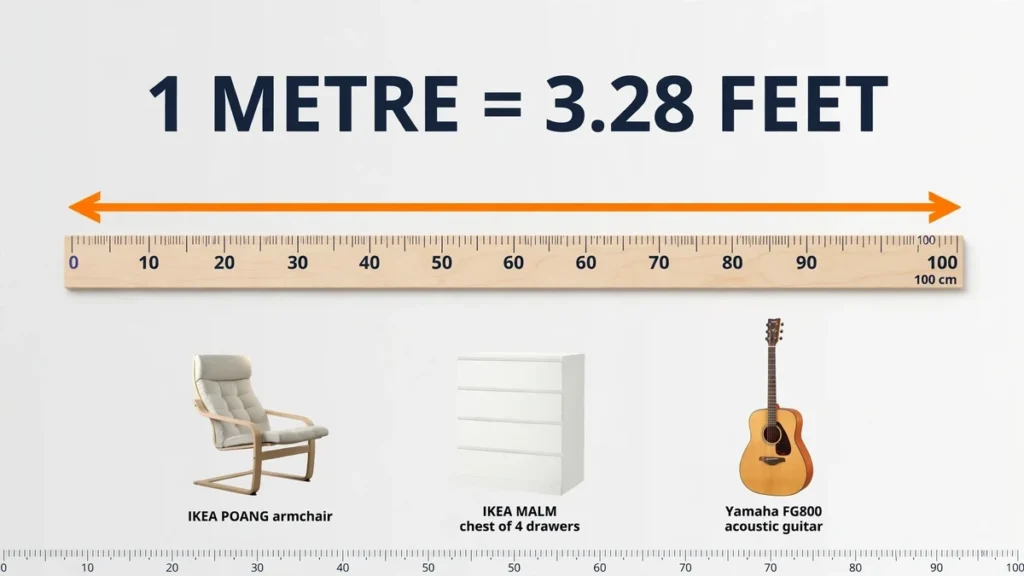
If you have ever wondered how long is 1 meter, the short answer is 3.28 feet — and the longer answer is that 1 meter is the only length in this whole series that is not measured against something else, because everything else is measured against it. The centimetre is a hundredth of a metre, the millimetre is a thousandth of a metre, and the kilometre is a thousand metres, so the metre is the unit the rest of the system hangs from. It is also the most human-scale unit there is: a ruler is too small to measure a room, a kilometre is too big to measure a chair, and a metre is the size of the chair itself. One metre is 100 centimetres, 1,000 millimetres, 39.37 inches, 3.28 feet, and 1.09 yards, and it is the distance light travels in a vacuum in 1/299,792,458 of a second — which means the unit in your kitchen drawer is defined by the fastest thing in the universe, and it will still be exactly a metre long a thousand years from now.
Below are six single, named things, each checked against its own specification, with the miss printed wherever a thing misses. Three of them are exact at 1 metre for the dimension stated — a metre stick made to be a metre, an armchair 100 cm tall by its maker’s own guide, and a chest of drawers 100 cm tall by its maker’s own guide — and the other three land within nine centimetres of it, two of them within four. Every object’s image sits immediately after its heading, and no object is a stack, a multiple, a fraction, or a category guess. You will not find three rulers laid end to end here, because three rulers are arithmetic wearing a straight edge, and you will not find a stride, because a stride is a body, not a measurement. By the end you will know 1 metre as a stick, a chair, a chest, a guitar, a bat, and a yardstick that is not quite a metre — and you will know which of those you can trust to the millimetre and which you must measure yourself.
Quick Answer
1 meter is 3.28 feet exactly — 39.37 inches, 100 centimetres, 1,000 millimetres, and 1.09 yards. But do NOT call it 3 feet: 3 feet is 91.44 cm, which is 8.56 centimetres short, and 8.56 centimetres at this size is a gap you can see. The honest shortcut is 3 feet 3⅜ inches — 39.375 inches is 100.01 cm, an eighth of a millimetre over — and the honest object is a metre stick, 100 cm by definition.
A Unit Defined by Light Itself
The metre is the only unit in this series that has a biography, and the biography is the reason it is trustworthy. In 1791 the French Academy of Sciences defined the metre as one ten-millionth of the distance from the North Pole to the equator through Paris — a unit based on the Earth itself, so that it belonged to the whole world and not to any king’s foot. Surveyors spent seven years measuring the meridian from Dunkirk to Barcelona to fix it, and in 1799 a platinum bar was made to embody the result. In 1889 the International Bureau of Weights and Measures replaced it with a bar of platinum and iridium, kept in a vault in France, and for seventy years the metre was the distance between two lines scratched on that bar. But metal bars expand with heat and lose atoms with time, so in 1960 the definition moved to light itself: the metre became 1,650,763.73 wavelengths of the orange-red line of krypton-86. Then in 1983 the definition moved again, to the speed of light in a vacuum — fixed at exactly 299,792,458 metres per second — and the metre became the distance light travels in 1/299,792,458 of a second. Any laboratory in the world with the right equipment can now recreate a metre without ever visiting the vault in France, and a metre today is exactly the same length it will be a thousand years from now.
That history is why the metre is the base unit and everything else is derived from it, and it is also why the guides that treat a metre as “about 3 feet” are doing something worse than rounding — they are throwing away the most precise unit ever defined and replacing it with a guess. Three feet is 91.44 cm, which is 8.56 centimetres short of a metre, and 8.56 centimetres is the width of a fist. The guides do it because the imperial system has no unit at a metre’s scale: an inch is too small, a foot is too small, and a yard is 8.56 centimetres too small, so every imperial comparison of a metre is a comparison with something that is not a metre. The honest way to picture a metre, then, is not to convert it at all — it is to hold a thing that is a metre by its own name. The metre stick in your classroom is a metre because it was made to be one, the armchair in your living room is a metre tall because its maker lists it at 100 cm, and the chest of drawers in your bedroom is a metre tall because its maker lists it at 100 cm — and all three will still be a metre when every conversion guide on the internet has been rewritten.
The 6 Objects
Each object below carries its evidence grade in the heading. EXACT means the figure is a standard’s or an authority’s own dimension for the named thing. LISTED means the figure is the manufacturer’s published specification for the named model. The grade is the whole point: a list that never grades its numbers is asking you to trust it, and this article would rather show you the receipt.
1. A Metre Stick — 100 Cm End to End (EXACT)

The metre stick is the article’s cleanest exact, because its 100 cm is the reason it exists. A metre stick is a stick manufactured to be one metre long, marked in centimetres from 0 to 100 and in millimetres from 0 to 1,000, and it is the tool every classroom, workshop, and fabric shop on Earth reaches for when the thing being measured is about a metre. It is the stick on the teacher’s desk, the stick in the tailor’s drawer, and the stick leaning against the wall of the hardware shop, and every one of them is the same length end to end, because the length is the product. Pick one up and you are holding a metre in your hand, no conversion required, and the stick has been a metre since the day it was cut.
The fitting check is the ends, because a metre stick is only a metre if you measure from the true zero. Cheap sticks start their scale a millimetre or two in from the end, so a stick laid against a shelf reads a millimetre long if you trust the end instead of the zero mark, and a stick with a worn end reads short by whatever the wear took off. The grade is exact because the figure is the definition itself: the metre is the distance light travels in a vacuum in 1/299,792,458 of a second, and the stick is the physical copy of that definition, 100 cm by its maker’s own purpose. Keep one beside your desk and you will never have to guess a metre again — but measure from the zero mark, not from the end, because the end is wood and the zero is the measurement.
2. An IKEA POÄNG Armchair — 100 Cm Tall (LISTED)

The POÄNG is the article’s most sat-in exact, and the one that makes a metre a piece of furniture. IKEA’s own POÄNG buying guide lists the armchair at 68 × 82 × 100 cm — 68 cm wide, 82 cm deep, and 100 cm tall — so the chair in millions of living rooms is exactly a metre from the floor to the top of its backrest, and the same number holds in every cover and every frame colour the chair is sold in. It is the chair by the reading lamp, the chair by the window, and the chair in the corner with the book left open on its cushion, and every one of them is the same height, because the height is on the maker’s own sheet. Stand beside one and the top of its backrest is a metre off your floor, no conversion required, and the chair has been a metre tall since the day its bentwood frame was glued.
The fitting check is the direction, because the chair is a metre in one direction only. Its width is 68 cm and its depth is 82 cm, so a doorway, a lift, or a car boot bought against “a metre” fails if you measure the chair across instead of up — and the rocking-chair version of the same chair is 95 cm tall, five centimetres shorter, so a POÄNG bought by name alone is not a metre unless it is the armchair and not the rocker. The grade is listed because the figure is the manufacturer’s own specification for this named model: 68 × 82 × 100 cm, by IKEA’s own buying guide, and the chair in your living room is the proof. Measure from the floor to the top of the backrest before you measure the room, because the chair is the object in this article you sit in every evening.
3. An IKEA MALM Chest of 4 Drawers — 100 Cm Tall (LISTED)

The MALM is the article’s most useful exact, because it is the metre you already own a bedroom of. IKEA’s own MALM buying guide lists the 4-drawer chest at 80 × 48 cm and 100 cm high — 80 cm wide, 48 cm deep, and exactly a metre tall — so the chest against millions of bedroom walls is a metre from the floor to its top surface, and the same number holds in white, black-brown, and oak effect. It is the chest with the folded jumpers, the chest with the lamp on top, and the chest with the photograph frames lined up along its back edge, and every one of them is the same height, because the height is on the maker’s own sheet. Stand beside one and its top surface is a metre off your floor, no conversion required, and the chest has been a metre tall since the day its particleboard was cut.
The fitting check is the drawer count, because “MALM chest” is not one height. The 3-drawer chest is 78 cm tall, twenty-two centimetres short of a metre, and the 6-drawer chest is 123 cm tall, twenty-three centimetres over, so a chest bought by name alone is a metre only if it is the 4-drawer model — and a chest with a lamp on top is taller than a metre by the lamp, which is the oldest measuring mistake in the catalogue. The grade is listed because the figure is the manufacturer’s own specification for this named model: 80 × 48 cm, 100 cm high, by IKEA’s own buying guide, and the chest in your bedroom is the proof. Measure from the floor to the top surface before you measure the wall, because the chest is the object in this article you open every morning.
4. A Yamaha FG800 Acoustic Guitar — 103.8 Cm Total Length (LISTED)
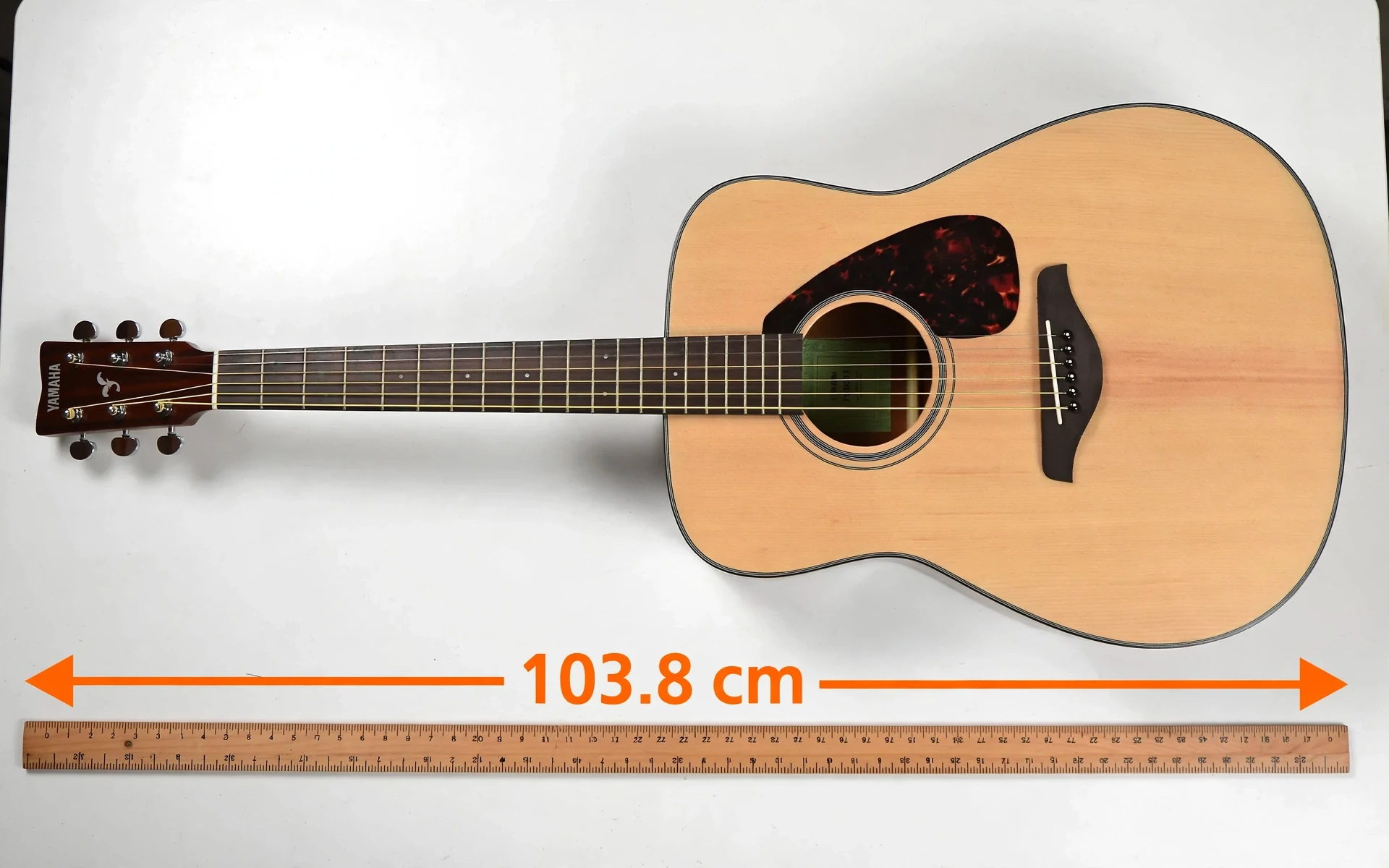
The FG800 is the article’s longest object, and the one that proves a guitar is not quite a metre — it is a metre plus a hand. Yamaha’s own specification sheet lists the FG800 at a total length of 1,038 mm — 103.8 cm, or 40 7/8 inches — with a 505 mm body, a 650 mm scale length, and a 412 mm body width, so the best-selling beginner dreadnought in the world overshoots a metre by 3.8 centimetres, about the width of two fingers. It is the guitar leaning against the amp, the guitar on the stand in the corner, and the guitar in the case under the bed, and every one of them is the same length from the top of the headstock to the bottom of the body, because the length is on the maker’s own sheet. Hold one upright and its headstock stands 3.8 centimetres past a metre, and the guitar has been 103.8 cm since the day it left the factory.
The fitting check is the direction, because a guitar’s length is measured headstock to body and nothing else. The 650 mm scale length is the vibrating string, not the guitar, and the 505 mm body is the box, not the guitar, so a case, a stand, or a wall hook bought against “about a metre” fails if you measure the scale or the body instead of the whole instrument — and a classical guitar is shorter still, around 97 to 99 cm, so a guitar bought by category alone is not 103.8 cm unless it is this dreadnought. The grade is listed because the figure is the manufacturer’s own specification for this named model, with the deviation printed in full: 1,038 mm, not 1,000 mm, and the 3.8 centimetres is the whole story. Measure from the headstock to the body before you measure the case, because the guitar is the object in this article you play every week.
5. A Cricket Bat — No More Than 96.52 Cm Long (EXACT)

The cricket bat is the article’s most regulated near-miss, and the closest any piece of sporting equipment comes to a metre by law. The Marylebone Cricket Club’s Laws of Cricket, Law 5.7.1, state that “the overall length of the bat, when the lower portion of the handle is inserted, shall not be more than 38 in/96.52 cm” — so the longest legal bat in world cricket falls 3.48 centimetres short of a metre, and no bat used in any professional match on Earth is allowed to be longer. It is the bat in the kit bag, the bat leaning against the pavilion wall, and the bat in the hands of the opener walking out to the middle, and every one of them is capped at the same number, because the cap is the law of the game. Hold one upright and its toe stops 3.48 centimetres short of a metre, and the bat has been capped at 96.52 cm since the Laws were written.
The fitting check is the cap, because 96.52 cm is a maximum, not a measurement. A typical adult short-handle bat is 33 to 34 inches — 84 to 86 cm, fourteen centimetres short of a metre — and only a bat built right up to the legal limit reaches 96.52 cm, so a bat bought off the shelf is further from a metre than the number in this article’s heading, and a bat with a longer handle is illegal, not longer. The grade is exact because the figure is a law’s own limit for the named thing: 38 in/96.52 cm, by the Marylebone Cricket Club’s own Laws, and the 3.48 centimetres is printed in the heading itself. Measure from the end of the handle to the toe of the blade before you measure the kit bag, because the bat is the object in this article that is governed by a rulebook.
6. A Yardstick — 91.44 Cm, 8.56 Cm Short of a Metre (EXACT)

The yardstick is the article’s shortest object, and the one with the most important job in it, because it is the proof that a metre is not three feet. A yardstick is 36 inches by definition, and 36 inches is exactly 91.44 cm — 36 × 2.54, with no rounding anywhere — so the tool that measures a yard stops 8.56 centimetres short of a metre, and the same number holds for every yardstick ever made, in every country, in every material. It is the stick in the classroom cupboard, the stick in the fabric shop, and the stick in the workshop drawer, and every one of them is the same length, because the yard is defined as exactly 0.9144 metres. Lay one beside a metre stick and the gap at the end is 8.56 centimetres of daylight, and the yardstick has been 91.44 cm since the yard was fixed by international agreement in 1959.
The fitting check is the name, because a yardstick measures a yard and a metre stick measures a metre, and the two sticks look identical until you read them. A guide that tells you a yardstick “actually measures a full metre” is wrong by 8.56 centimetres — the width of a fist — and a shelf, a curtain, or a room measured with a yardstick and called a metre will be short by that fist at every single metre. The grade is exact because the figure is a definition’s own dimension for the named thing: 36 inches, exactly 91.44 cm, by the international yard, and the 8.56 centimetres is printed in the heading itself. Lay a yardstick beside a metre stick before you trust either one, because the yardstick is the object in this article that catches the most common mistake about a metre.
The 3-Foot Trap: Why “About 3 Feet” Costs You 8.56 Cm
Three feet is the trap this whole article is built to spring, because it is the one wrong number about a metre that everybody believes. One foot is exactly 30.48 cm, so three feet is exactly 91.44 cm — the yardstick’s length, the yard’s length, and 8.56 centimetres short of a metre. The error is not small: 8.56 centimetres is the width of a fist, the height of a drinks can, and the difference between a curtain that covers the window and a curtain that does not. A room measured as “about 3 feet” per metre comes out short by 8.56 centimetres at every metre, so a 4-metre wall measured in 3-foot steps is 34 centimetres short — more than a foot — and a fabric order placed the same way arrives a third of a metre short. The guides that print “about 3 feet” know the real number is 3.28 feet, and they print 3 feet anyway, because 3 is a number the brain likes and 3.28 is a number it does not.
The honest shortcut is 3 feet 3⅜ inches, and it is honest because the arithmetic is printed beside it. Three feet 3⅜ inches is 39.375 inches, and 39.375 × 2.54 is 100.01 cm — an eighth of a millimetre over a metre, which is closer than any ruler in your house can measure. If that fraction is too fiddly to remember, use 3 feet 3 inches and know you are 0.93 centimetres short — a centimetre you can see, but a centimetre you are at least aware of. What you must never do is use 3 feet and believe it, because 3 feet is not a rounding of a metre, it is a different length with a different name, and the yardstick in this article is the proof: lay it beside a metre stick and the 8.56 centimetres stares back at you.
The Body Check: Hip Height and the Big Step
Your body knows a metre, almost, and the almost is the point. For most adults the floor-to-hip measurement — the height of the hip joint, where a tailor measures the inseam from — lands roughly around a metre, somewhere between 90 and 100 centimetres depending on how tall you are, so standing beside a POÄNG chair and finding its top at your hip is a check you can do without any tool at all. The demi-span — the distance from the notch at the centre of your breastbone to the tip of your middle finger with your arm outstretched — is about half your arm span, and for a person 180 cm tall that is roughly 90 cm, which is a metre minus a hand. A single step, heel to heel, is shorter still: most adults step about 65 to 75 centimetres, so one step is roughly two-thirds of a metre, and it takes about one and a half steps to cover a metre — which is why the guides that call an average step “about a metre” are wrong by a third, and why soldiers march to a standard 30-inch step, 76.2 cm, rather than to a metre.
None of these replaces a metre stick, and that is exactly what makes them useful: they are checks, not measurements. If the top of the POÄNG is at your hip, the chair is a metre and your hip is a metre off the floor, and both facts are true at once. If your step feels like a metre, measure it — walk ten steps, measure the distance, divide by ten, and you will find your step is about 70 cm, and you will have calibrated the only ruler you always carry with you. The body is the oldest measuring tool there is, and the metre was once defined by a body — the quadrant of the Earth, measured by walking it — so using your body to check a metre is not sloppy, it is traditional, as long as you know the number your body actually gives you.
Five Claims About 1 Metre That Fail the Ruler
Five wrong numbers about 1 metre circulate so widely that they deserve their own section, because each one is stated confidently on a page that ranks for this exact question. First, the yardstick: one popular guide claims a yardstick “actually measures a full metre”, and a yardstick is 36 inches — 91.44 cm, 8.56 centimetres short, the width of a fist. Second, the baseball bat: another guide calls a standard adult baseball bat “nearly a metre long”, and a standard adult bat is 34 inches — 86.36 cm, 13.64 centimetres short, which is not nearly a metre by any measure that matters. Third, the goal crossbar: a third guide claims the crossbar of a soccer goal is “exactly one metre wide”, and a goal under the laws of the game is 7.32 metres wide — more than seven times the claim, a mistake you can see from the stands. Fourth, the step: guide after guide tells you an adult’s average step “spans approximately one metre”, and an average adult step is roughly 65 to 75 centimetres — a full stride, two steps, is roughly 130 to 150 cm, so one step is two-thirds of a metre and the claim is wrong by a third. Fifth, the skateboard: one popular list calls a standard skateboard “close to a metre long”, and a standard street skateboard deck is about 31.5 inches — 80 cm, twenty centimetres short; only a longboard reaches a metre, and a longboard is a different board with a different name. None of these five numbers belongs in a 1-metre article, and all five are here so you never have to learn that from a purchase.
The 1-Metre Ladder: From a Yardstick to a Guitar
One metre sits in the middle of a ladder, and the ladder is the whole article in one line. Start at the bottom with the street skateboard at 80 cm, then the baseball bat at 86.36 cm — the object one popular guide calls nearly a metre, which is not nearly a metre at all — then the yardstick at 91.44 cm, the three-foot trap made visible, then the cricket bat at its legal maximum of 96.52 cm, three and a half centimetres short. Then the middle, where three objects stand exactly on the rung: the metre stick at 100 cm, the POÄNG armchair at 100 cm tall, and the MALM chest at 100 cm tall — a tool, a chair, and a chest, all a metre by their makers’ own numbers. Then the guitar at 103.8 cm, a metre plus a hand, the only object in this article that overshoots. The ladder runs 80, 86.36, 91.44, 96.52, 100, 100, 100, 103.8 — and the point of it is the middle: a metre is the only rung with three different objects standing on it at once, a stick and a chair and a chest, and that is why a metre is the most human-scale unit there is. It is the size of the things you sit in, store things in, and measure things with, and no other unit in the system can say that.
How 1 Metre Compares With Other Lengths
Readers comparing nearby sizes may also want the site’s guides to how big is 17 cm, how big is 16 cm, how big is 15 cm, how big is 14 cm, how big is 13 cm, and how big is 12 cm for the centimetre series,2 meters for the metre series, and the complete inches guide and the complete feet guide for the imperial series. Each of those guides follows the same rule as this one: the spec sheet, the grade, and the miss printed in full.
Frequently Asked Questions
How many feet is 1 meter?
1 meter is 3.28 feet — 3.28084 feet exactly, or 3 feet 3.37 inches. The trap is rounding that to 3 feet, which is 91.44 cm and 8.56 centimetres short of a metre. For anything that must fit, use 3.28 feet; for a quick estimate in your head, 3 feet 3⅜ inches is 100.01 cm, which is close enough to picture it and only an eighth of a millimetre over.
How many inches is 1 meter?
39.37 inches exactly — 39.3700787 inches, if you want every decimal. That is why a metre is a little more than three 12-inch rulers laid end to end: three rulers give you 36 inches, or 91.44 cm, and you still need another 3.37 inches to reach a metre. A yardstick is 36 inches, so it stops 3.37 inches short of a metre, which is the same 8.56 centimetres as the 3-foot trap.
How many centimetres is 1 meter?
100 centimetres exactly, and 1,000 millimetres exactly. Multiply 1 by 100 and you get 100 with no rounding involved, because the centimetre is defined as exactly one hundredth of a metre. In kilometres that is 0.001 km, in feet it is 3.28 ft, and in yards it is 1.09 yards rounded — exactly 1.0936 yards, which is the figure a tape measure will show if it is marked in yards.
Is 1 meter the same as 1 yard?
No, and the difference is the whole point of this article. One yard is exactly 91.44 cm, which is 8.56 centimetres shorter than a metre — the width of a fist. A yardstick is 36 inches and a metre stick is 100 cm, and laying them side by side shows the gap at the end. If you order a metre of fabric as a yard, you will be 8.56 centimetres short; if you cut a metre of timber as a yard, the shelf will not reach the wall.
What is exactly 1 meter long in real life?
Three things in this article are exactly a metre by their maker’s own numbers: a metre stick (100 cm by definition), an IKEA POÄNG armchair (100 cm tall by IKEA’s own buying guide), and an IKEA MALM chest of 4 drawers (100 cm tall by IKEA’s own buying guide). The next closest are a Yamaha FG800 acoustic guitar (103.8 cm, 3.8 cm over) and a cricket bat at its legal maximum (96.52 cm, 3.48 cm short). None of the near-misses is exact, and each one’s miss is printed beside it in this article.
Is a guitar 1 meter long?
Almost, but not quite. A Yamaha FG800 dreadnought acoustic guitar is 103.8 cm from the top of its headstock to the bottom of its body, by Yamaha’s own specification sheet — 3.8 centimetres longer than a metre. Most full-size acoustic guitars land in the same band, roughly 100 to 104 cm, but a classical guitar is shorter, around 97 to 99 cm, so “a guitar is a metre” is true only for the dreadnoughts, and only to within four centimetres. Buy a case by the 1,038 mm figure on the spec sheet, not by the word “guitar”.
Is a yardstick 1 meter?
No. A yardstick is 36 inches, which is exactly 91.44 cm — 8.56 centimetres short of a metre. The claim that a yardstick “actually measures a full metre” appears on a page that ranks for this exact question, and it is wrong by the width of a fist. A yardstick measures a yard, a metre stick measures a metre, and the two sticks look identical until you read the numbers on them.
How do I measure 1 meter without a ruler?
Use a metre stick if you have one — it is 100 cm by definition. Otherwise use the top of an IKEA POÄNG armchair or a MALM 4-drawer chest (both 100 cm tall by their makers’ own guides), or your own hip height, which lands roughly around a metre for most adults. For anything that must fit — a curtain, a shelf, a room — borrow or buy a real tape measure, because at a metre the misses in this article run from zero to 8.56 centimetres, and guessing throws every one of them away.
Final Thoughts
One metre is the rare measurement that is both the definition and the thing itself, because 3.28 feet can be a stick, a chair, a chest, a guitar, a bat, or a yardstick that is not quite a metre — and the number alone never says which. Now you know it as a stick’s length fixed by the speed of light, a chair’s height fixed by its maker, a chest’s height fixed by its maker, a guitar’s length fixed by its maker, a bat’s length fixed by the laws of its game, and a yardstick’s length fixed by the definition of the yard — and you know which of those you can trust to the millimetre and which you must measure yourself. The rule that runs through all six is the same one this site always uses: trust the spec sheet, print the deviation, and let the name stay on the box where it belongs. Measure twice, in the direction the object actually travels, and a metre will fit the first time.
