
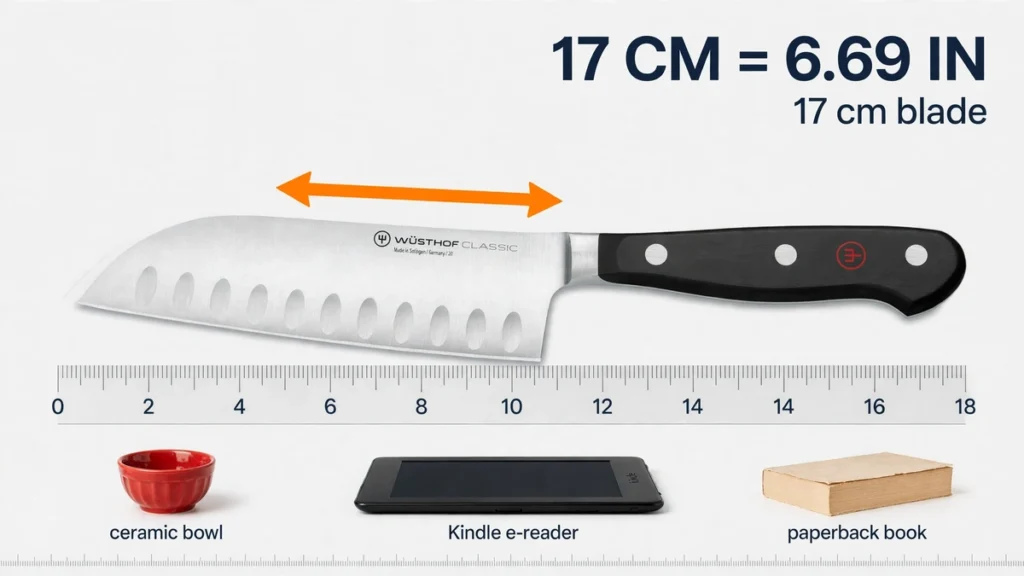
If you have ever wondered how big is 17 cm, the short answer is 6.69 inches — and the longer answer is that 17 cm is the size with no round inch behind it. There is no clean imperial number for 17 cm the way 15 cm has its 6-inch trap or 12 cm has its 5-inch neighbour. Six and a half inches is 16.51 cm, which is 4.9 millimetres short, and seven inches is 17.78 cm, which is 7.8 millimetres long, and 17 cm sits in the gap between them with nothing round to hold onto. The guides that tell you to "just call it 7 inches" are handing you an error nearly eight millimetres long and calling it close enough, and the guides that tell you to divide by 2.5 are handing you 6.8 inches — which is 17.27 cm, 2.7 millimetres over — and calling that a shortcut. The honest numbers are uglier and better: 6.7 inches is 17.018 cm, eighteen hundredths of a millimetre over, and 6 and 11/16 inches is 16.986 cm, fourteen hundredths of a millimetre under, and either one will do for anything you actually need to measure.
Below are five single, named things, each checked against its own specification, with the miss printed wherever a thing misses. One of them is exact at 17 cm for the dimension stated — a santoku blade sold by that number — and the other four land within six millimetres of it, all of them within half a centimetre. Every object's image sits immediately after its heading, and no object is a stack, a multiple, a fraction, or a category guess. You will not find a dollar bill plus a penny here, because a bill plus a penny is arithmetic wearing a wallet, and you will not find a sharpened pencil, because sharpening is a process, not a measurement. By the end you will know 17 cm as a knife, a bowl, a reader, a book, and a sheet of paper — and you will know which of those you can trust to the millimetre and which you must measure yourself.
Quick Answer
17 cm is 6.69 inches exactly — 170 millimetres, 0.17 metres, and 0.19 yards. But do NOT round it to 7 inches: 7 inches is 17.78 cm, which is 7.8 millimetres too long, and 7.8 millimetres at this size is a gap you can see. The honest shortcut is 6.7 inches — 17.018 cm, eighteen hundredths of a millimetre over — and the honest object is a 17 cm santoku blade, 17 cm by its maker's own specification.
Why 17 Cm Has No Round Inch
Seventeen centimetres is the only size in this series where the imperial system simply has no answer, and that is why every guide about it hedges. Divide 17 by 2.54 and you get 6.6929 inches — a number with four decimal places and no round form anywhere in it. Six and 11/16 inches is 6.6875 inches, which is 16.986 cm, fourteen hundredths of a millimetre under 17 cm — so close that no ruler in a kitchen drawer can tell the difference — while 6.7 inches is 17.018 cm, eighteen hundredths of a millimetre over, which is even closer in the other direction. But neither of those is a number anyone reaches for, because 6 and 11/16 is a fraction you have to work out and 6.7 is a decimal you have to remember, so the guides round to the nearest whole inch instead and print "about 7 inches" — and 7 inches is 17.78 cm, which is 7.8 millimetres over, the width of a pencil and then some. The human brain prefers the whole number, and every conversion guide on the internet knows it, so the guides print "about 7 inches" and move on, and the reader walks away believing a 17 cm cake tin, a 17 cm bracelet, and a 7-inch anything are the same thing. They are not, and the 7.8 millimetres is the proof: a 17 cm bracelet bought as 7 inches will not close, a 17 cm pan bought as 7 inches will not fit the shelf, and a 17 cm book bought as 7 inches will stick out of the bag.
The second reason 17 cm has no round inch is that even the people who sell things in centimetres cannot resist labelling them in inches, and their inch labels are wrong in both directions. The santoku in this article is sold as a 17 cm blade and marketed as a "7 inch" knife — and 7 inches is 17.78 cm, so the maker's own inch label overshoots its own blade by 7.8 millimetres. The paperback in this article is 17.45 cm tall and sold in inches as 6.87 inches, a number nobody would ever say out loud, so the shops round it to "about 7 inches" and the book grows by 3.3 millimetres on the shelf tag. The Kindle in this article is 174.2 mm tall and sold as 6.9 inches, which is 17.526 cm — a tenth of a millimetre over its own height, the one inch label in this article that is nearly honest — and the B5 sheet is 17.6 cm wide and sold in inches as 6.93 inches, a number that appears on no ruler ever made. The honest way to picture 17 cm, then, is not to convert it at all — it is to hold a thing that is 17 cm by its own name. The santoku blade in your kitchen drawer is 17 cm because its maker says so, it has been 17 cm since the day it was forged, and it will still be 17 cm when every conversion guide on the internet has been rewritten.
The 5 Objects
Each object below carries its evidence grade in the heading. EXACT means the figure is a standard's or an authority's own dimension for the named thing. LISTED means the figure is the manufacturer's or operator's published specification for the named model. REPORTED means the figure is a museum or reference record for the named thing, not the maker's own sheet. The grade is the whole point: a list that never grades its numbers is asking you to trust it, and this article would rather show you the receipt.
1. A Wüsthof Classic Santoku Knife — 17 Cm Blade (LISTED)
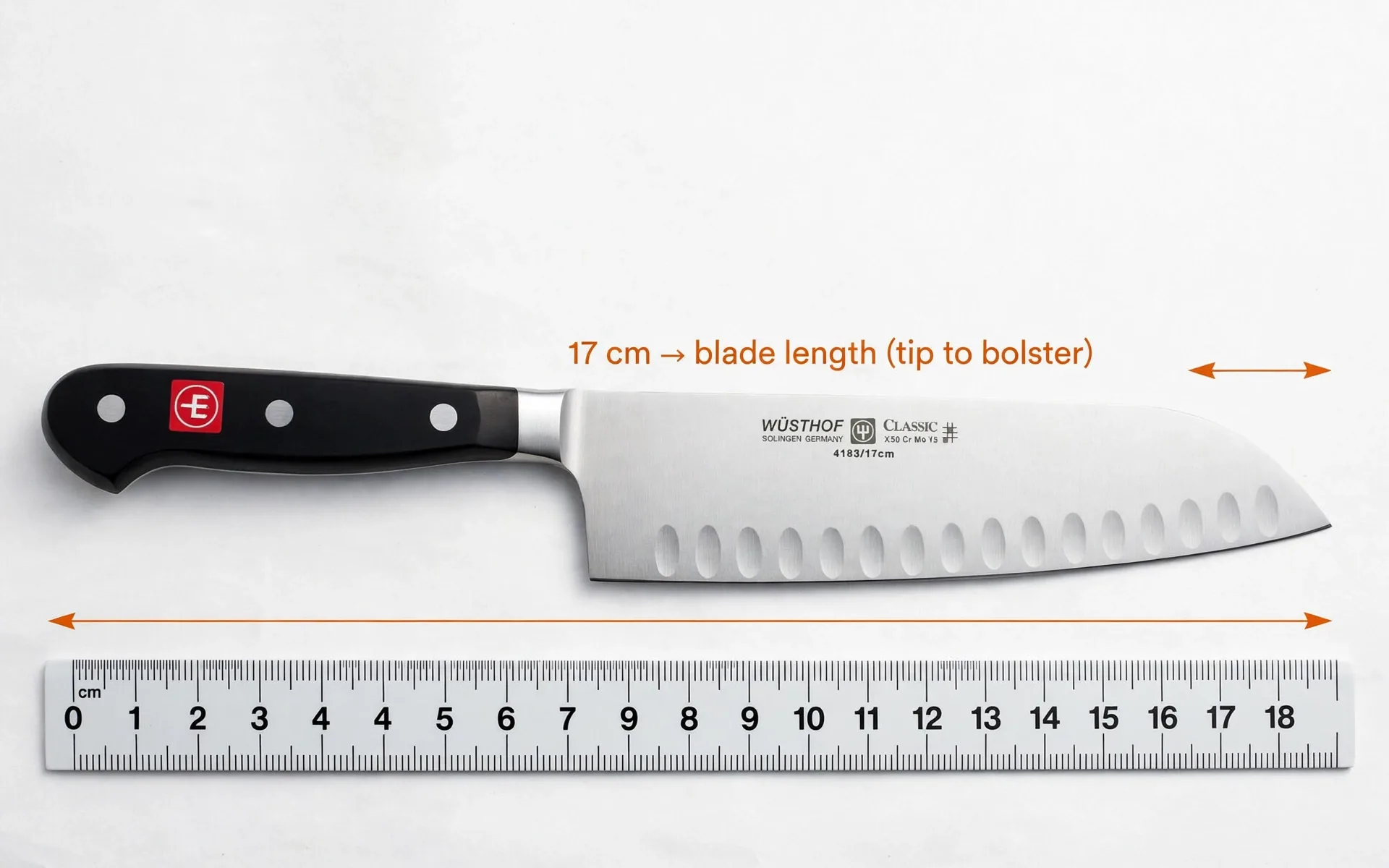
The santoku is the article's cleanest exact, because its 17 cm is written on the maker's own specification sheet. Wüsthof's Classic Santoku with Hollow Edge lists its blade at 17 cm long and 4.59 cm wide, on an 11.2 cm handle, forged from X50CrMoV15 stainless steel in Solingen — and the 17 cm is the blade alone, the cutting edge from the tip to the bolster, not the knife as a whole. It is the knife in the kitchen drawer, the knife on the magnetic strip, and the knife in the block on the counter, and every one of them is the same length on the blade, because the blade is the product. Pick one up and you are holding 17 cm in your hand, no conversion required, and the blade has been 17 cm since the day it left the forge.
The fitting check is the whole knife, not the blade, because the knife is far longer than the measurement it makes. A 17 cm blade on an 11.2 cm handle is a knife about 28.2 cm long overall, so a knife roll, a drawer slot, or a magnetic strip bought against "17 cm" will not take it — and the blade is the part that matters for the cutting board, while the whole knife is the part that matters for the drawer. The grade is listed because the figure is the manufacturer's own specification for this named model: 17 cm on the blade, by the maker's own sheet, and the knife in your drawer is the proof. Keep one beside your cutting board and you will never have to guess 17 cm again — but measure the blade, not the knife, because the knife is eleven centimetres longer than the number on its own label.
2. A Staub Ceramique 17 Cm Round Bowl — 17.1 Cm Across (LISTED)
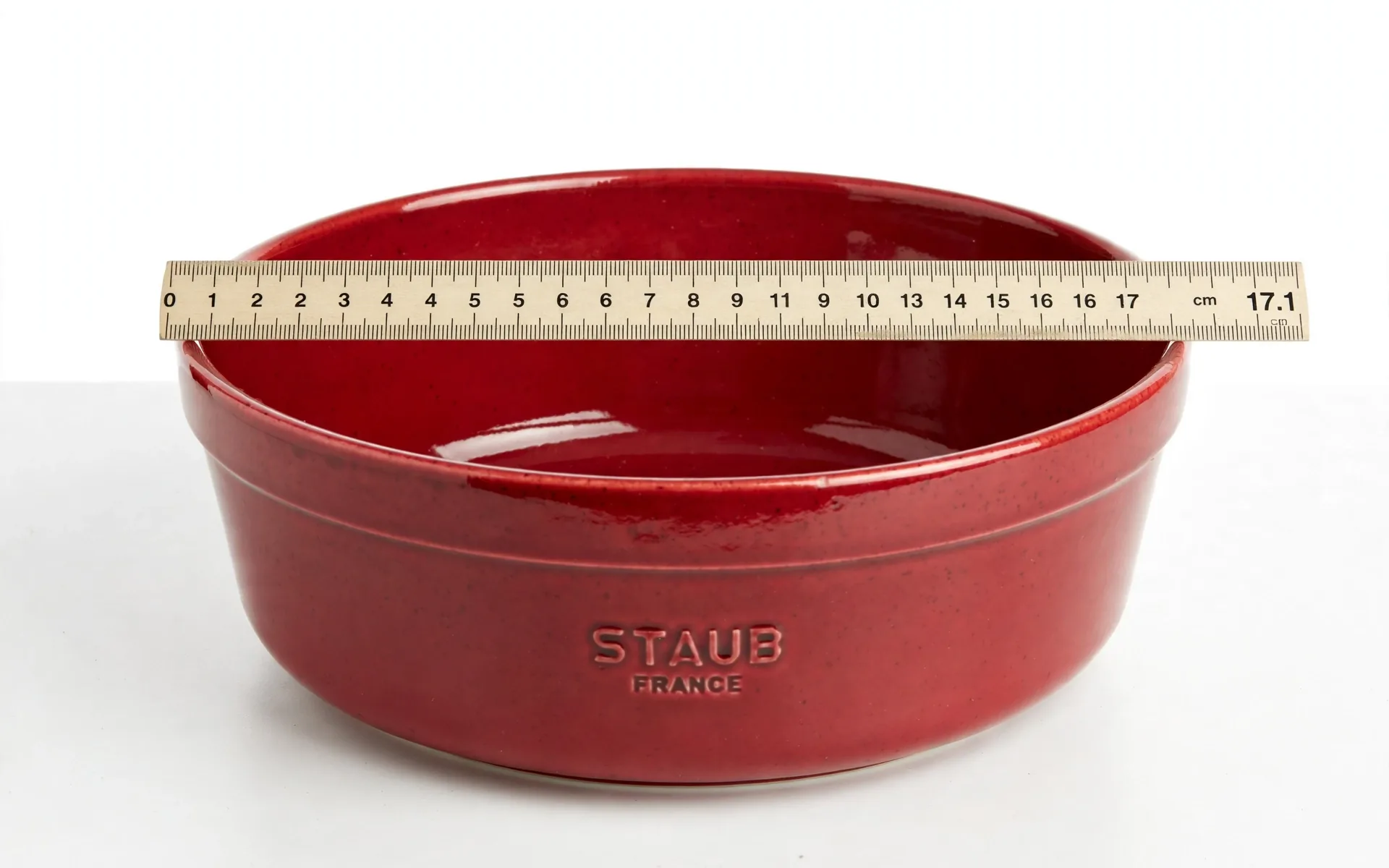
The bowl is the article's closest near-miss, and the one with the smallest miss of all. Zwilling's own product page for the Staub Ceramique 17 cm ceramic round bowl lists the length of the product at 17.1 cm and the upper diameter at 17.1 cm, with a capacity of 1.2 litres — so the bowl sold as "17 cm" is 17.1 cm across its rim, one millimetre over, a miss thinner than the bowl's own glaze. It is the bowl on the kitchen shelf, the bowl on the breakfast table, and the bowl in the cupboard, and every one of them is the same width across the rim, because the rim is the product. Hold one against a ruler and you are holding 17.1 cm — one millimetre past the number in this article's title, and the same in every colour the bowl is sold in.
The fitting check is the rim, because the bowl's 17 cm is its upper diameter and its base is narrower — the bowl tapers, so a shelf, a microwave, or a stack bought against "17 cm" fails if you measure the foot instead of the rim, and a lid bought for a 17 cm bowl will not sit on a base that is two centimetres narrower. The grade is listed because the figure is the maker's own listing for this named product, with the deviation printed in full: 17.1 cm, not 17 cm, and the one millimetre is the whole story. Measure across the rim before you measure the shelf, because the bowl is the object in this article you reach for every morning.
3. An Amazon Kindle Paperwhite (11th Generation) — 17.42 Cm Tall (LISTED)
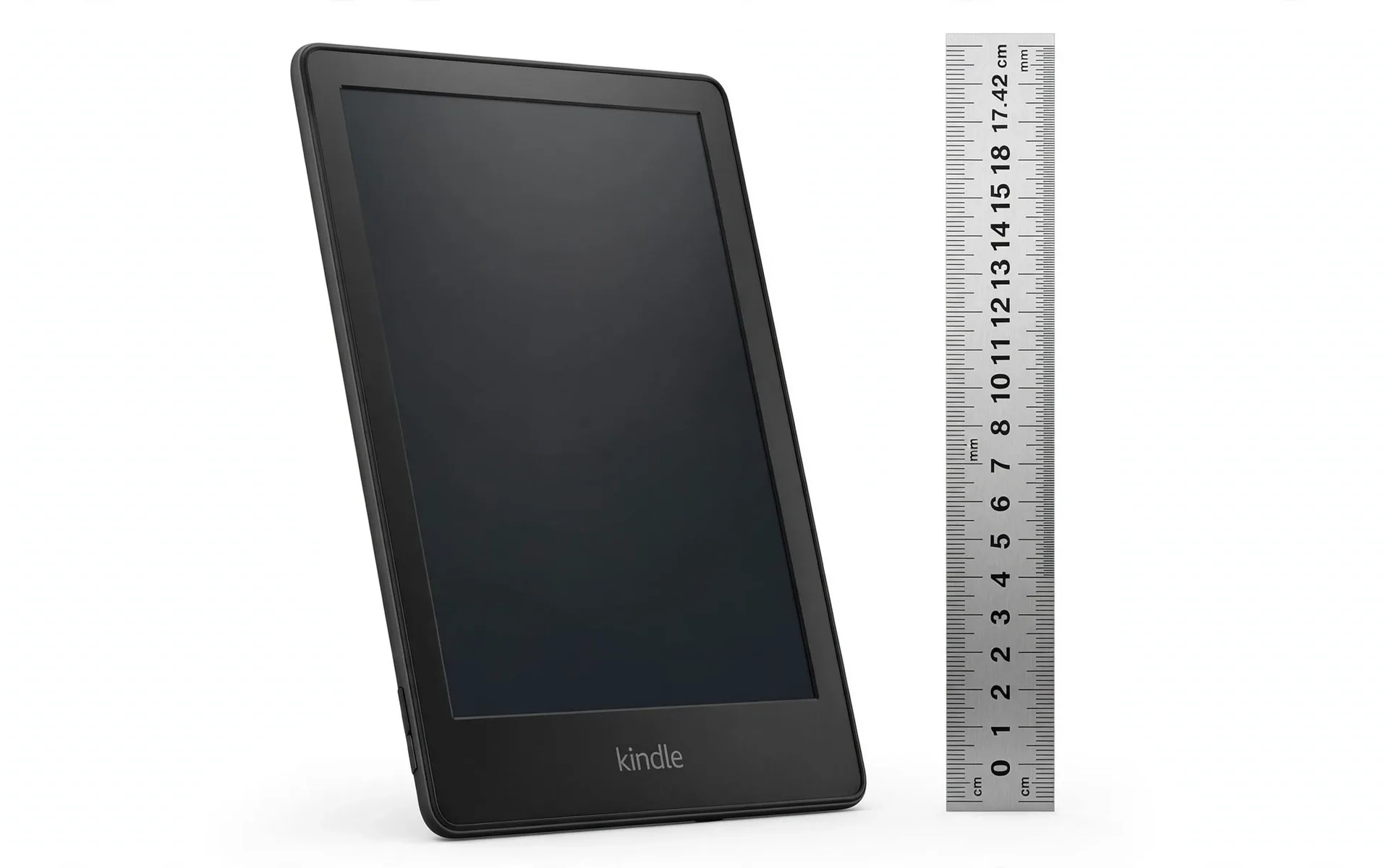
The Kindle is the article's most carried near-miss, and the closest any e-reader comes to 17 cm. Amazon's own technical specifications list the Kindle Paperwhite (11th generation, 2021 release) at 6.9 × 4.9 × 0.32 inches — 174.2 × 124.6 × 8.1 mm — weighing 205 grams, with a 6.8-inch display at 300 ppi — 17.42 cm on its long edge, which misses 17 cm by 4.2 millimetres, and the reader in more bags than any other single e-reader in the world. It is the reader on your nightstand, the reader in your coat pocket, and the reader in your carry-on, and its height is the one dimension you never have to guess, because Amazon printed it in its own specification sheet.
The fitting check is the screen, because the reader's height is 17.42 cm and its screen is 6.8 inches measured diagonally — a different number in a different direction. A case, a sleeve, or a stand bought against "17 cm" fails if you measure the diagonal, and the guides that call a Kindle "about 17 cm tall" never say whether they mean the height, the screen, or the reader with its case on — a case adds about three millimetres and pushes the reader past 17.4 cm entirely. The grade is listed because the figure is the manufacturer's own specification for this named model, with the deviation printed in full: 174.2 mm, not 170 mm, and the 4.2 millimetres is the whole story. Measure your reader's height before you measure your pocket, because the reader is the object in this article you carry every day — and check which generation you are holding, because the 12th-generation Paperwhite is 176.7 mm tall, two and a half millimetres taller than the one in this article.
4. A Mass-Market Paperback Book — 17.45 Cm Tall (LISTED)
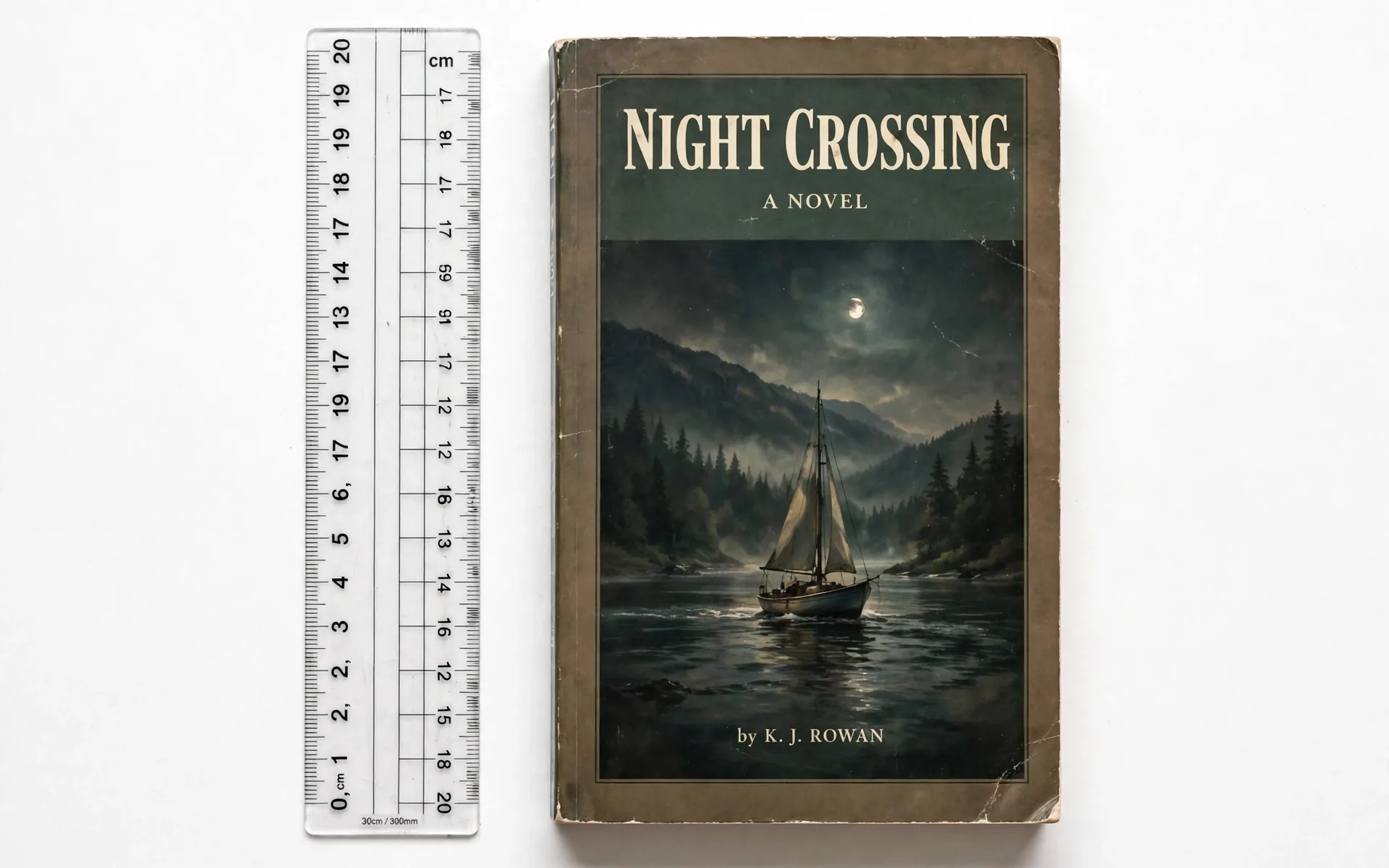
The paperback is the article's most useful near-miss, because it is the 17 cm object you already own a shelf of. The publishing industry's standard mass-market trim is 4.25 × 6.87 inches — 108 × 175 mm — so the height of every mass-market paperback on Earth is 17.45 cm tall, four and a half millimetres past 17 cm, and it is the book in the supermarket rack, the book in the airport shop, and the book in the beach bag. It is the thriller you read on the plane, the romance you read on holiday, and the tie-in you bought because the film was good, and all three are the same height. Pick one up and you are holding 17.45 cm — four and a half millimetres past the number in this article's title, and the same in every country you will ever visit.
The fitting check is the format, because "paperback" is not one size — a trade paperback is 5.5 × 8.5 inches or 6 × 9 inches, 21.6 to 22.9 cm tall, four centimetres taller than the mass-market book in this article, and the UK A-format mass-market is 178 × 111 mm, 17.8 cm tall, three and a half millimetres taller still. A shelf, a sleeve, or a bag pocket bought against "17 cm" fails by four centimetres if you measure the wrong format, and the guides that call paperbacks "17 to 18 cm tall" never say which format they mean — and never mention that the range hides three different books. The grade is listed because the figure is the publishing industry's standard trim size for this named format: 4.25 × 6.87 inches, by the industry's own convention, and the four-and-a-half-millimetre miss is printed in the heading itself. Hold a mass-market paperback against a ruler and you are holding 17.45 cm — four and a half millimetres past the number in this article's title, and the same on every rack you will ever browse.
5. An ISO B5 Sheet of Paper — 17.6 Cm Wide (EXACT)
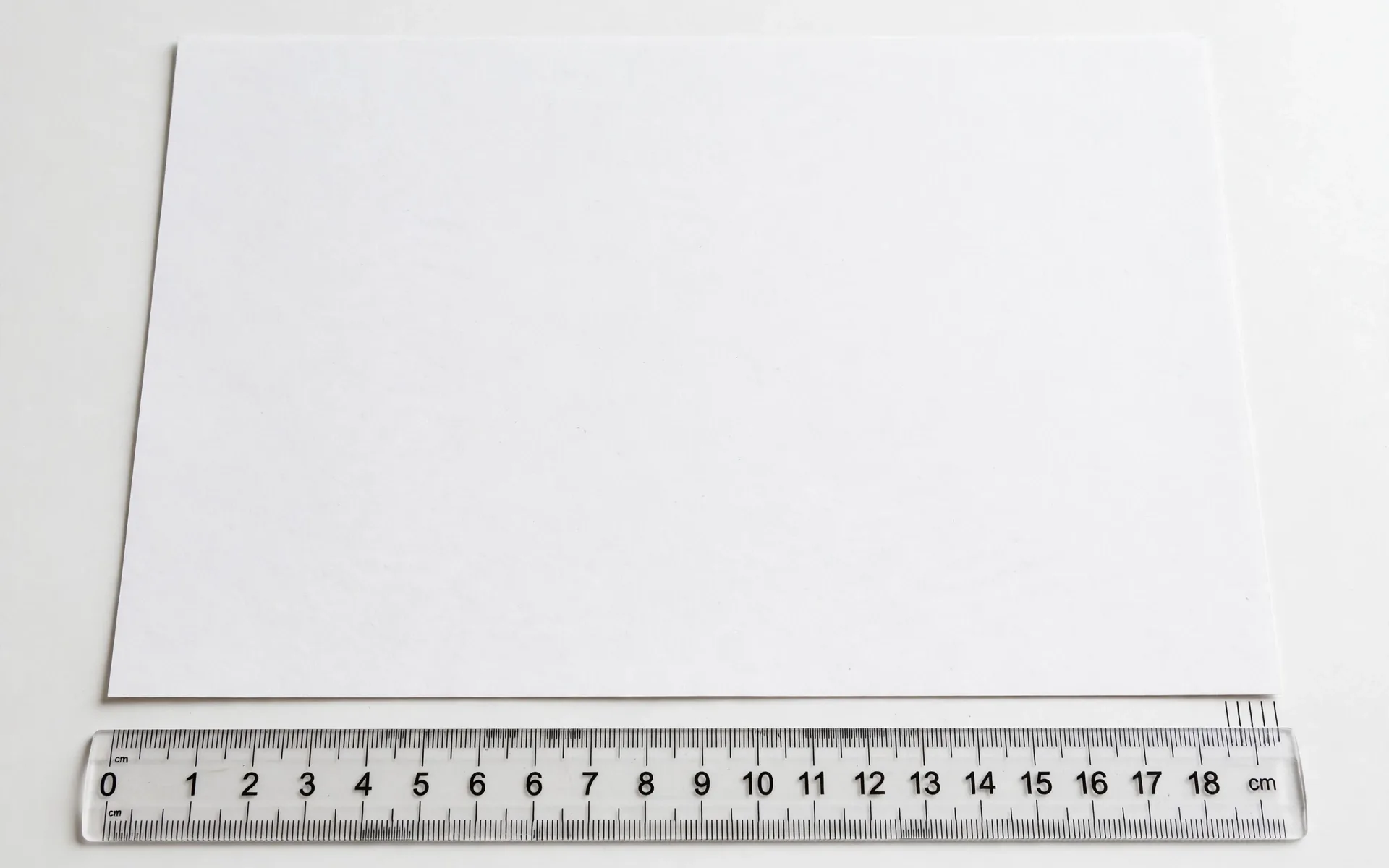
The B5 sheet is the article's largest miss, and the one with the strongest standard behind it. ISO 216, the international paper-size standard, fixes B5 at 176 × 250 millimetres — the common notebook and journal size across Europe and much of Asia, larger than A5 at 148 × 210 mm and smaller than A4 — so the short side of every ISO B5 sheet on Earth is 17.6 cm wide. It overshoots 17 cm by exactly six millimetres, and the same number holds whether the sheet is a notebook page, a journal leaf, or a loose sheet from the printer. It is the page your diary is printed on, the page your bullet journal opens to, and the page your printer calls "B5" in its settings menu, and all three are the same width.
The fitting check is the country, because a "B5" sheet is not the same sheet everywhere — Japan's JIS B5 is 182 × 257 mm, 18.2 cm wide, six millimetres wider than the ISO B5 in this article, so a notebook cover, a binder, or a bag pocket bought against "17 cm" fails by six millimetres if you buy the Japanese size for the international one. The grade is exact because the figure is a standard's own dimension for this named format: 176 mm, by definition, and the six-millimetre miss is printed in the heading itself. Hold a B5 notebook against a ruler and you are holding 17.6 cm — six millimetres past the number in this article's title, and the same in every country that follows the ISO standard.
The Two-Object 17-Cm Check
Seventeen centimetres is a number you can check without a second tool, because the objects in this article are the tools — but only if you use two of them together. First, take the paperback: a mass-market paperback is 17.45 cm tall, so hold it against whatever you are measuring and shave off four and a half millimetres in your head — the width of a pencil lead, twice over — and you have 17 cm. Second, take the penny: a US penny is 19.05 mm across, so lay a penny flat against the end of a dollar bill (15.6 cm) and you have 17.505 cm — five millimetres over, which tells you the bill-plus-penny trick is close but not exact, and the five millimetres is the reason you check it against the paperback instead of trusting it. Third, take the Kindle: the 11th-generation Paperwhite is 17.42 cm tall, so hold it against a shelf or a sleeve and shave off four millimetres, and you have 17 cm — but check the generation first, because the 12th-generation reader is 176.7 mm tall and will lie to you by two and a half millimetres. Fourth, take the B5 sheet: it is 17.6 cm wide, so hold it against a drawer or a frame and shave off six millimetres, and you have 17 cm — but check the country first, because a Japanese B5 sheet is 18.2 cm wide and will lie to you by twelve millimetres. None of these replaces a calibrated tool for anything that must fit, but all four will tell you whether 17 cm is the size you think it is before the bracelet is ordered, the pan is bought, or the shelf is cut — and the paperback is the one to trust, because its four and a half millimetres is the smallest miss you can hold in your hand.
Where the Other Lists Get 17 Cm Wrong
Five wrong numbers about 17 cm circulate so widely that they deserve their own section, because each one is stated confidently on a page that ranks for this exact question. First, the 6.5-inch santoku: one popular guide calls a 6.5-inch santoku blade "almost exactly 17 cm", and 6.5 inches is 16.51 cm — 4.9 millimetres short, which is the difference between a blade that fits the block and one that rattles in it. Second, the tomato can: another guide calls a 28 oz tomato can "often around 17 cm tall", and a #2.5 can is 4 and 11/16 inches tall — 11.9 cm, which is 5.1 centimetres short, nearly a third too tall a claim, and the can is not 17 cm in any direction. Third, the dollar bill plus a penny: a third guide tells you to lay a penny at the end of a dollar bill and calls that 17 cm, and 15.6 cm plus 1.905 cm is 17.505 cm — five millimetres over, and a penny's diameter is a circle's width, not a length you can lay flat without it rolling away. Fourth, the sharpened pencil: guide after guide tells you a sharpened No. 2 pencil is 17 cm, and a new pencil is 19 cm — every sharpening takes a different amount off, so "sharpened to 17 cm" is a process, not a measurement, and no two sharpened pencils agree. Fifth, the paperbacks: one popular guide calls paperbacks "17 to 18 cm tall", and that is a range, not a figure — mass-market is 17.45 cm, trade is 21.6 to 22.9 cm, and UK A-format is 17.8 cm, three different books and three different numbers, and the range hides all of them. None of these five numbers belongs in a 17 cm article, and all five are here so you never have to learn that from a purchase.
17 Cm Against the Sizes Around It
Seventeen centimetres sits two centimetres past the ruler in the last article — a tool 15 cm on its scale by definition — and a centimetre and a half past your dollar bill, which is 15.6 cm on its long edge. Step up the ladder and the rungs crowd together: the 6.5-inch santoku at 16.51 cm, the santoku itself at 17 cm, the Staub bowl at 17.1 cm, the Kindle at 17.42 cm, the paperback at 17.45 cm, the B5 sheet at 17.6 cm — which is also the largest miss in this article, six millimetres over — then 7 inches at 17.78 cm, the round number people keep rounding 17 cm up to, and the reason the rounding is wrong by 7.8 millimetres. The ladder runs 15, 15.6, 16.51, 17, 17.1, 17.42, 17.45, 17.6, 17.78 — and the point of it is the middle: 17 cm is the only rung with a blade behind it that is named for the number itself, a knife on one side and a bowl on the other, and all five objects in this article sit inside a six-millimetre band, which is why 17 cm is the tightest size in the series to hold in your hand.
How 17 Cm Compares With Other Lengths
Readers comparing nearby sizes may also want the site’s guides to 13 cm, 14 cm, 15 cm, 12 cm, 11 cm, and 10 cm for the centimetre series, and 12 feet and 11 feet for the foot series. Each of those guides follows the same rule as this one: the spec sheet, the grade, and the miss printed in full.
Frequently Asked Questions
How many inches is 17 cm?
17 cm is 6.69 inches, or 6 and 11/16 inches in fraction form. Divide 17 by 2.54 and you get 6.6929 inches — and the trap is rounding that to 7 inches, which overstates the length by 7.8 millimetres, or dividing by 2.5, which gives 6.8 inches and hides the error entirely. For anything that must fit, use 6.69 inches; for a quick estimate in your head, 6.7 inches is 17.018 cm, which is close enough to picture it and only 0.18 millimetres over.
How many millimetres is 17 cm?
170 millimetres exactly. Multiply 17 by 10 and you get 170 with no rounding involved, because the centimetre is defined as exactly 10 millimetres. In metres that is 0.17 m, in feet it is 0.56 ft, and in yards it is 0.19 yards rounded — exactly 0.1859 yards, which is the figure a tape measure will show if it is marked in yards.
Is 17 cm the same as 7 inches?
No, and the difference matters. Seven inches is 17.78 cm, which is 7.8 millimetres longer than 17 cm — the width of a pencil and then some. If you order a 17 cm bracelet as 7 inches, it will not close; if you buy a 17 cm pan as 7 inches, it will not fit the shelf. The honest shortcut is 6.7 inches, which is 17.018 cm — eighteen hundredths of a millimetre over, which is close enough for anything you will ever measure by hand.
What is 17 cm wide in real life?
The most exact everyday answer is a Wüsthof Classic santoku blade, which is 17 cm by its maker's own specification. The next closest are a Staub Ceramique 17 cm bowl (17.1 cm across its rim), an Amazon Kindle Paperwhite 11th generation (17.42 cm tall), a mass-market paperback book (17.45 cm tall), and an ISO B5 sheet of paper (17.6 cm wide). None of the four near-misses is exact, and each one's miss is printed beside it in this article.
Is a 6.5-inch santoku blade 17 cm?
No. A 6.5-inch blade is 16.51 cm — 4.9 millimetres short of 17 cm. The blade that IS 17 cm is the one sold as 17 cm, like the Wüsthof Classic santoku, and even its own maker markets it as a "7 inch" knife — which is 17.78 cm, 7.8 millimetres long. Buy a santoku by the centimetre figure on its specification sheet, not by the inch figure on its box, because neither inch label is the blade.
Is a 28 oz tomato can 17 cm tall?
No — not even close. A 28 oz can, coded #2.5 in the canning industry, is 4 and 11/16 inches tall — 11.9 cm, which is 5.1 centimetres short of 17 cm. The claim that it is "around 17 cm tall" is nearly a third too tall, and the can is not 17 cm in any direction: its diameter is 4 and 1/16 inches, 10.3 cm. If you want a 17 cm reference from your pantry, use the santoku blade, not the can.
How big is a Kindle Paperwhite in inches?
The 11th-generation Kindle Paperwhite is 6.9 inches tall, 4.9 inches wide, and 0.32 inches deep, weighing 7.23 ounces — 174.2 × 124.6 × 8.1 mm in Amazon's own technical specifications. The 6.8-inch figure you see in shops is the screen measured diagonally, not the reader's height, and the reader is only 4.9 inches wide — less than a third of 17 cm. If you are buying a case or a sleeve, buy by the 174.2 mm height, not by the screen size — and check the generation, because the 12th-generation Paperwhite is 176.7 mm tall.
How do I measure 17 cm without a ruler?
Use a 17 cm santoku blade if you have one — it is 17 cm by its maker's own specification. Otherwise use a mass-market paperback (17.45 cm tall — shave off four and a half millimetres), your Kindle Paperwhite 11th generation (17.42 cm tall — shave off four millimetres), or a B5 sheet of paper (17.6 cm wide — shave off six millimetres). For anything that must fit — a bracelet, a pan, a shelf — borrow or buy a real tape measure, because at 17 cm the misses in this article run from zero to six millimetres, and guessing throws every one of them away.
Final Thoughts
Seventeen centimetres is the rare measurement that is honest and still misunderstood, because 6.69 inches can be a blade, a bowl, a reader, a book, or a sheet of paper — and the number alone never says which. Now you know it as a blade's length fixed by its maker, a bowl's rim fixed by its maker's listing, a reader's height fixed by its maker, a book's height fixed by its industry, and a sheet's width fixed by a standard — and you know which of those you can trust to the millimetre and which you must measure yourself. The rule that runs through all five is the same one this site always uses: trust the spec sheet, print the deviation, and let the name stay on the box where it belongs. Measure twice, in the direction the object actually travels, and 17 cm will fit the first time.
