

If you are wondering how big is 8 mm, the answer is 0.8 centimeters — exactly. That is about 0.315 inches, a touch under a third of an inch, and a size that quietly runs your house, your toolbox, and your weekend. A laminate plank under your feet is 8 mm thick. The bolt holding your bookshelf together is called M8 because its thread measures 8 mm across. The bearing spinning inside a skateboard wheel has an 8 mm bore.
One honest note before the tour, because precision is the whole point of this site: a published “8 mm” designation does not mean every manufactured unit measures mathematically 8.000 mm. Threads, ropes, and molded parts all carry tolerances, and nominal sizes name a design target rather than a guaranteed physical measurement. Every object below carries an evidence label and names the exact axis the 8 mm describes — thickness, diameter, bore, thread, or across-flats — so you can see not just what 8 mm looks like, but which claims you can trust.
How big is 8 mm?
8 mm is exactly 0.8 cm — about 0.315 inches. On a metric ruler, it is eight millimeter ticks past zero: the thickness of a laminate plank, the thread of an M8 bolt, the bore of a skateboard bearing. The millimeter-to-centimeter conversion is exact; the inch figure is rounded for display.
The one rule: name the axis
A product described as “8 mm” is not 8 mm in every direction, and that single fact causes most of the confusion around this measurement. A bolt is 8 mm across its thread, not across its head. A bearing is 8 mm across its bore, not its outside. A copper tube is 8 mm across its outside, not its hole. A laminate plank is 8 mm thick, not wide. The number 8 mm is always the same — but the edge it describes changes with every product.
One more distinction matters. The conversions in this article are exact by definition: 8 mm is exactly 0.8 cm, exactly 0.008 m, and exactly 8,000 micrometers. The inch figure is rounded (8 ÷ 25.4 = 0.3149606…, shown as 0.315). The objects, on the other hand, are listed at 8 mm — those are the makers’ and retailers’ published specifications, and this article grades them as such rather than pretending someone went out with calipers. Three labels are used throughout. Official specification means the maker’s own spec sheet for that exact product. Published dimension means the manufacturer’s catalogued size with no per-unit tolerance stated. Standardized measurement means the number comes from an industry standard — authoritative, but nominal by design. None of them means “every unit is 8.000 mm,” and now you know which is which.
First, the near misses: what 8 mm is almost
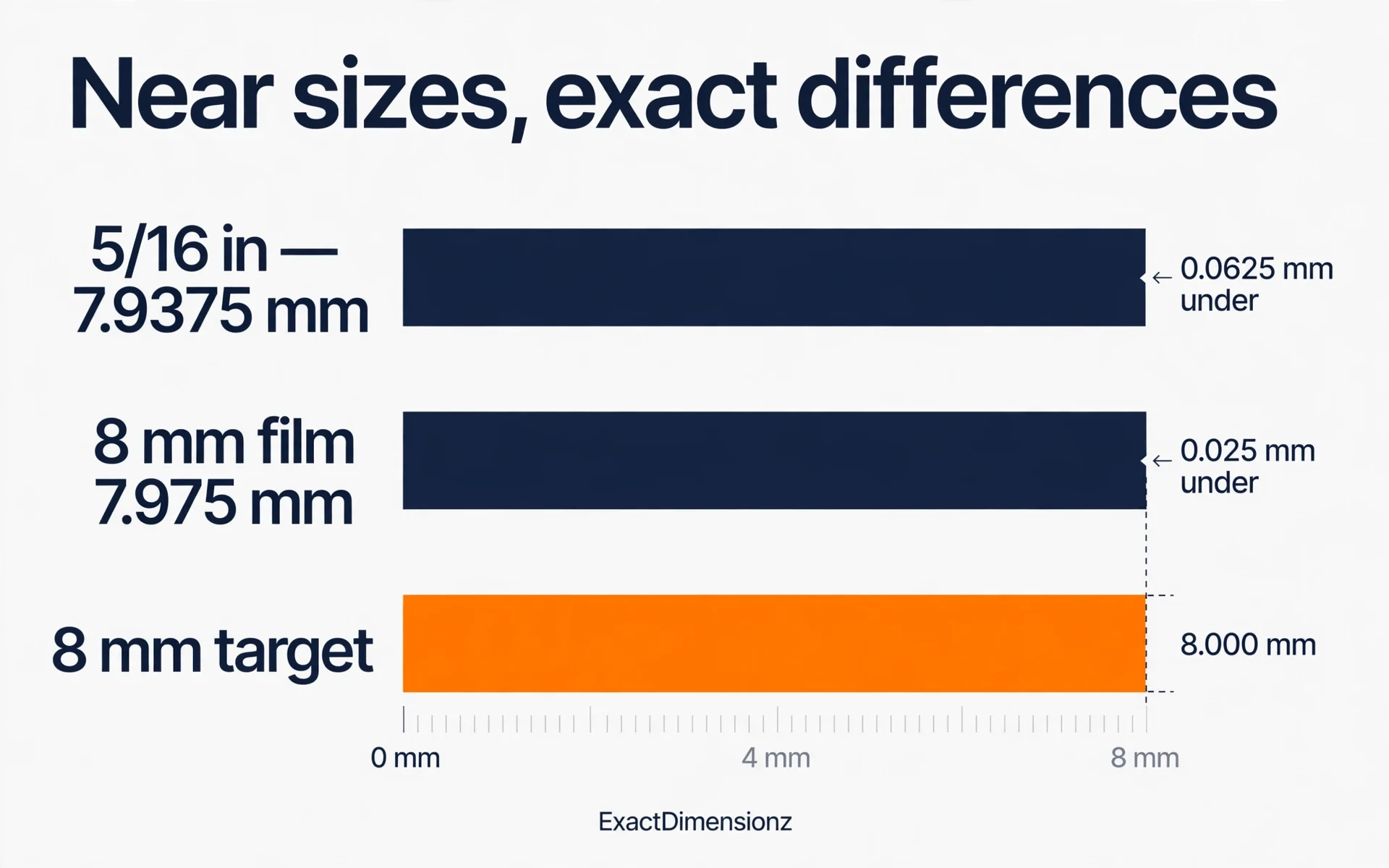
Before the eleven, three impostors worth meeting — because 8 mm has famous almost-twins, and mixing them up costs real money at the hardware store. None of these count toward the eleven below; they live in this separately labeled section so the core list stays honest.
5/16 of an inch is 7.9375 mm — exactly 0.0625 mm thinner than 8 mm. This is the classic trap: an M8 bolt will not thread into a 5/16″ nut, and a 5/16″ drill bit leaves a hole an 8 mm dowel won’t quite fill. Close enough to fool the eye, different enough to matter.
Standard 8 mm movie film is 7.975 mm wide — 0.025 mm thinner, per the ANSI/SMPTE and ISO standards behind both Standard 8 and Super 8 formats. The name says 8 mm; the standard says 7.975. A lovely reminder that names are nominal and standards are specific.
21/64 of an inch is 8.334375 mm — 0.334 mm thicker, the next common fractional step above. If 5/16″ is the twin that undershoots, 21/64″ is the one that overshoots.
1. Pergo Presto Walden Oak Laminate Flooring

Pergo’s official installation guide for its Presto line names the plank thickness plainly: the Walden Oak board is 8 mm thick, 7-5/8 inches wide, and 47-5/8 inches long. If your bedroom floor is laminate, there is a real chance you have been walking on 8 mm all morning without knowing it.
The axis here is thickness — the vertical stack from the wear layer down through the HDF core to the backing. Eight millimeters of engineered plank is the industry’s sweet spot: thick enough to feel solid underfoot and to click together without flexing, thin enough to slip under most doors. Stand barefoot on a laminate floor and the 8 mm is the distance between your sole and the subfloor.
Measurement: 8 mm plank thickness. Evidence: LISTED (published dimension — a manufacturer’s catalogued thickness, not a per-plank measured guarantee; boards vary microscopically from the press, which is why installers leave expansion gaps at the walls). Source: Pergo Presto installation guide.
2. Daltile Briton Bone 12 in. x 12 in. x 8 mm Mosaic Wall Tile

Daltile’s own specification sheet for the Briton Bone mosaic (BT0121BWHD1P2) lists the tile at 8 mm thick — the number sits right in the product name, the way it does for most tile lines. Kitchen backsplash, bathroom wall: that cool, hard surface your coffee steam hits is an 8 mm slab of glazed ceramic.
Thickness again, but a different material story than the laminate. Tile thickness is set by the press and the kiln, and 8 mm is the workhorse gauge for wall tile — substantial enough to survive handling and setting, light enough not to drag itself off the wall. Run a fingernail across the edge of a backsplash tile and the 8 mm is the little cliff your nail drops off.
Measurement: 8 mm tile thickness. Evidence: LISTED (official specification — the manufacturer’s own spec sheet for this exact SKU; tile carries a firing tolerance the sheet doesn’t publish, so treat 8 mm as the specified target). Source: Daltile Briton Bone specification sheet.
3. supermagnete S-08-08-K Neodymium Disc Magnet
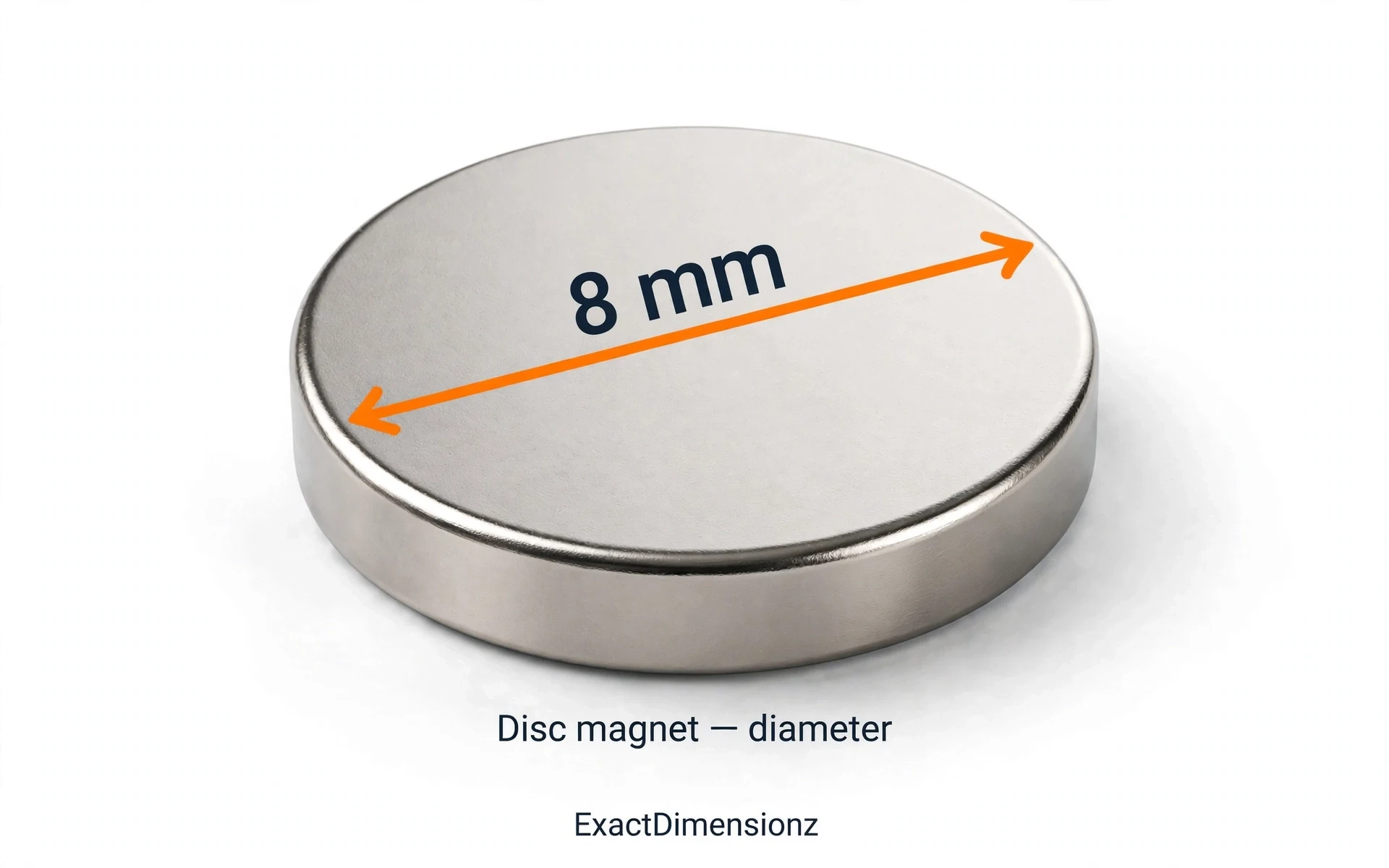
Webcraft GmbH sells magnets the way a bakery sells bread — by exact recipe — and its data sheet for article S-08-08-K states the disc is 8 mm in diameter and 8 mm tall, with a ±0.1 mm tolerance. It is the strong little disc holding your shopping list to the fridge: smaller than a shirt button, strong enough to pinch a finger.
The 8 mm that matters is the diameter, measured straight across the round face; the height happens to be 8 mm too, which makes this a perfect little cube-cylinder for visualization. Slide it off the fridge and roll it between your fingers: the face your thumb covers is an 8 mm circle.
Measurement: 8 mm diameter (and 8 mm height), ±0.1 mm tolerance. Evidence: LISTED (official specification, with the rare honesty of a published tolerance — this is what “8 mm” looks like when a manufacturer tells you the whole truth: the target, and how far reality is allowed to wander from it). Source: supermagnete S-08-08-K data sheet.
4. Würth M8 Hexagon Head Bolt, ISO 4017
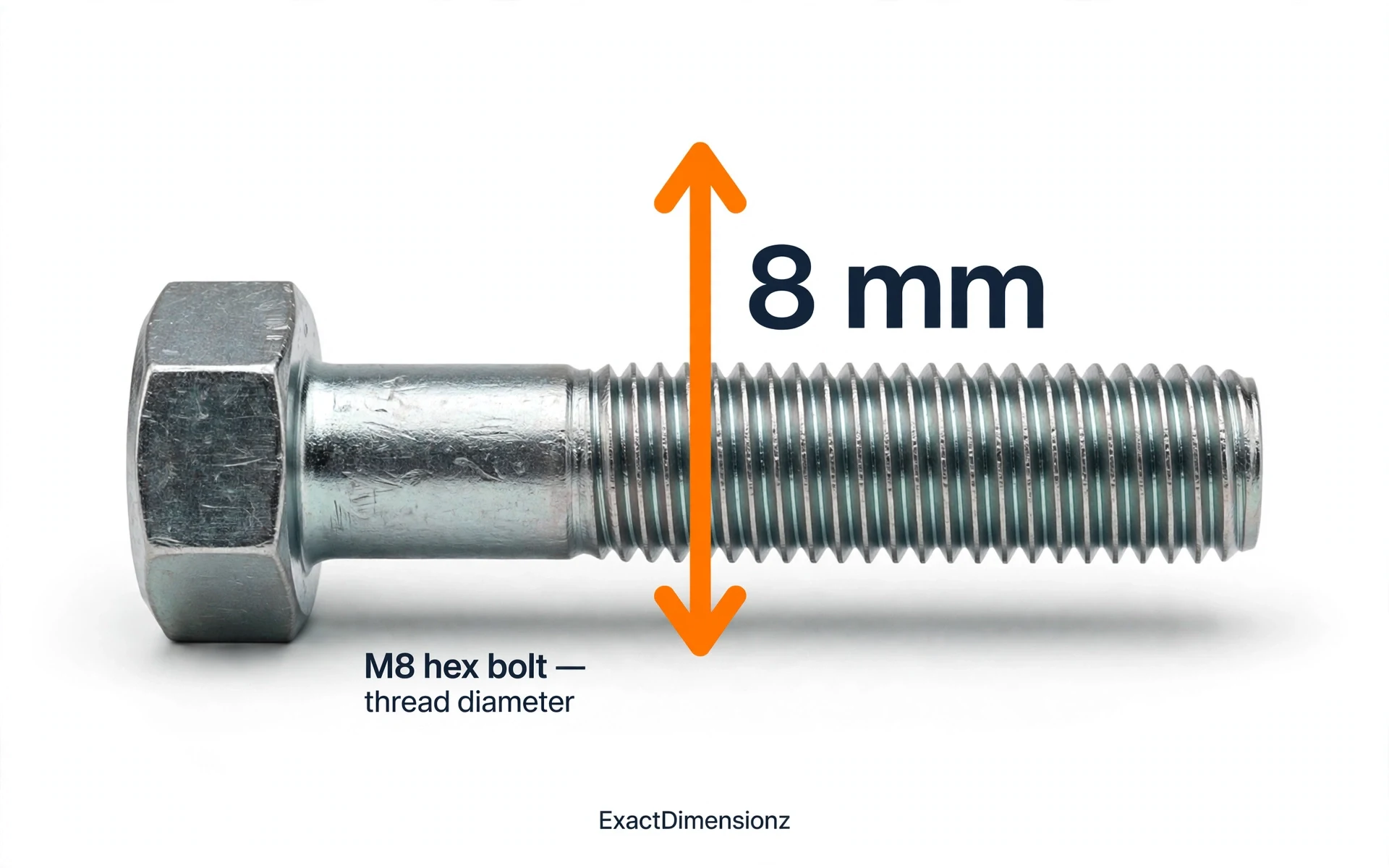
The “8” in M8 is the whole story: Würth’s official spec sheet for its ISO 4017 hexagon head bolts lists the thread diameter as M8 — an 8 mm nominal major diameter, the distance across the thread crests. Grab any M8 bolt from a parts bin and the threaded section is your 8 mm reference, probably the most-handled 8 mm in the building trades.
Mind the axis, because bolts punish carelessness. The 8 mm is the thread diameter, not the 13 mm hex head your wrench grabs, not the bolt’s length, not the 1.25 mm thread pitch. The measurement arrow belongs across the threaded shank. This is also the bolt from the near-miss section: M8 and 5/16″ look like twins until you try to mate them.
Measurement: 8 mm nominal thread diameter (actual major diameter tops out at 7.968 mm per the standard). Evidence: LISTED (standardized measurement — the 8 mm comes from the ISO metric thread system itself, a designation with real standards behind it but a tolerance that keeps it nominal). Source: Würth ISO 4017 hex bolt spec sheet.
5. Bondhus 8 mm Ball-End Hex Key
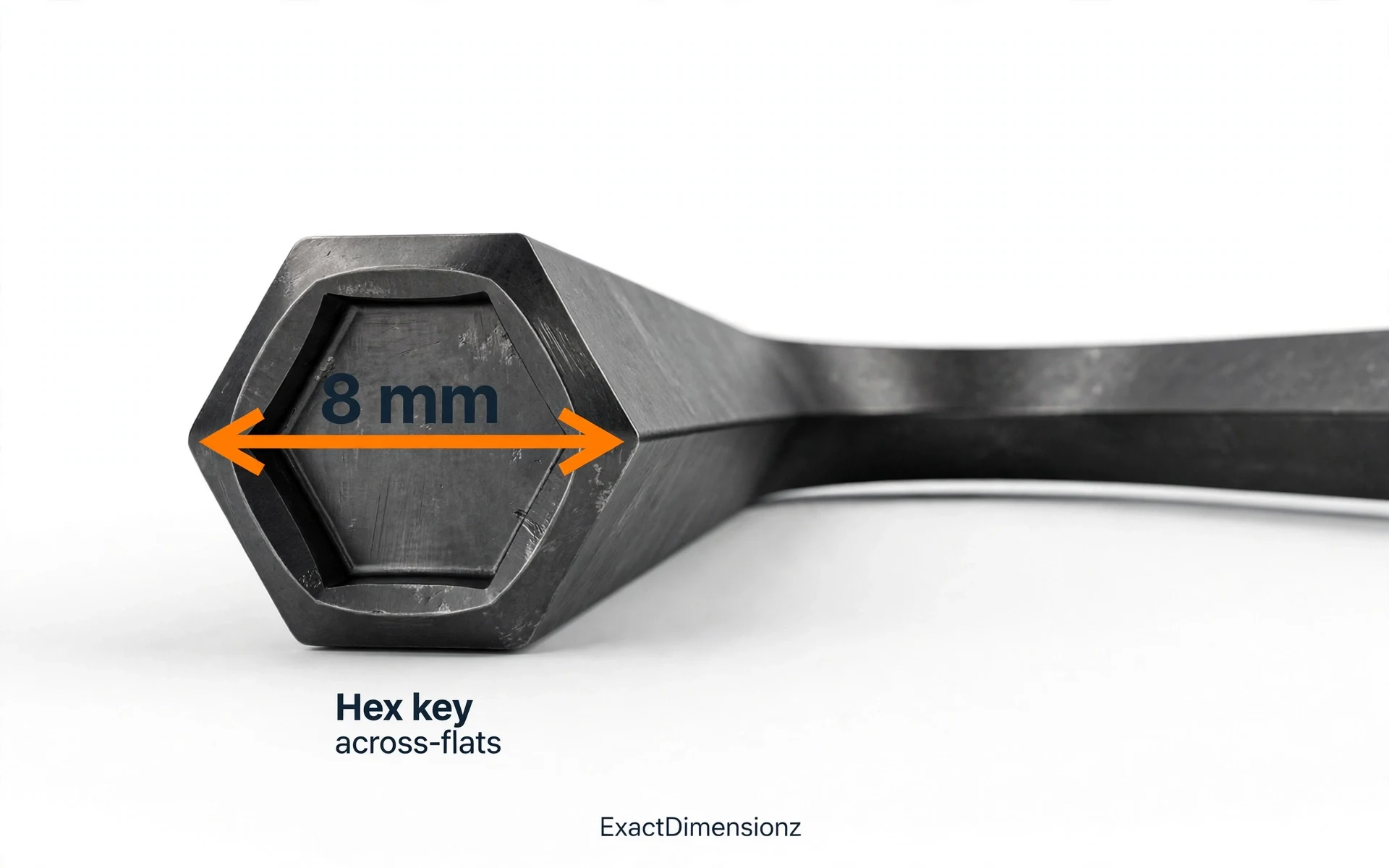
Bondhus catalogues its ball-end L-wrenches by the hex size they fit, and the 8 mm member of the family — part R215772 in the ProGuard line — is the key that turns M8 socket screws. If you’ve ever assembled flat-pack furniture and reached for the chunky end of the key set, you’ve probably held this one: it is the tool whose working tip measures 8 mm across the flats.
Across-flats is the axis: the distance between two parallel faces of the hexagonal tip, the dimension that has to match the screw’s socket. The key’s arms are far longer (152 mm and 35 mm on this model), so the arrow goes across the little hex end, nowhere else. And note the partnership: the M8 bolt above needs a 13 mm wrench for its head but an 8 mm hex key for its socket-head cousin — two different 8 mm-adjacent numbers on related fasteners.
Measurement: 8 mm across the flats of the hex tip. Evidence: LISTED (published dimension — a manufacturer size grade with no per-unit tolerance published; it is the size the tool is made to and sold as). Source: Bondhus 8 mm ball-end hex key listing.
6. SKF 608-2Z Deep Groove Ball Bearing
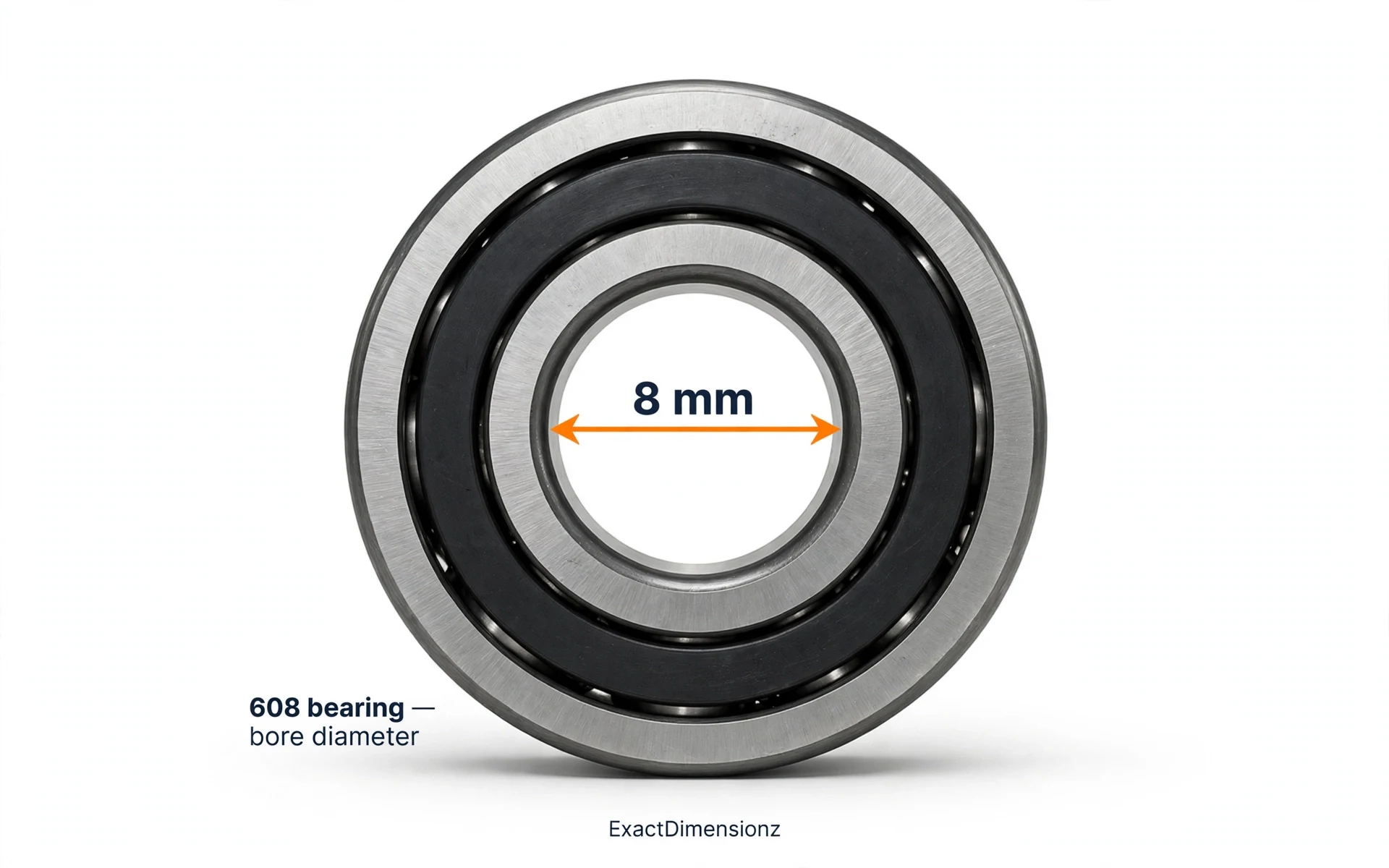
SKF’s official product page for the 608-2Z states the bore diameter as 8 mm, with a bore tolerance of −0.007 to 0 mm — and if that part number rings a bell, it should: this is the skateboard bearing, the most-produced small bearing on earth. Eight of them are spinning under a standard skateboard right now; each one’s inner ring is an 8 mm hole.
Bore is the axis, and it deserves its moment because it is this list’s only inner diameter. The 8 mm is the hole the axle passes through, not the 22 mm outside diameter or the 7 mm width. Picture the axle sliding through: the ring of steel around it is 8 mm across inside. For a size reference, think of the hole, not the donut.
Measurement: 8 mm bore diameter (real bores land between 7.993 and 8.000 mm). Evidence: LISTED (official specification, and a precise one — SKF publishes the actual tolerance band). Source: SKF 608-2Z product page.
7. 8 × 1 mm Copper Tube (EN 1057)

Copper tube sold as “8×1” is 8 mm in outside diameter with a 1 mm wall — a stocked size under EN 1057, the European standard for copper plumbing tube, and the product pages (this example from LDM Tuning’s Art. No. 7572) list outside 8 mm, inside 6 mm. It is the skinny copper line feeding a refrigerator ice maker or a model steam engine: bendable by hand, solderable, unmistakably copper.
Outside diameter is the axis — the number the standard controls, and the one your compression fitting has to match. The 1 mm wall is the supporting actor: it explains why the inside is only 6 mm, and why you must never read the tube’s “8 mm” as the hole. Measure across the outside with calipers; that is where the 8 mm lives.
Measurement: 8 mm outside diameter (6 mm inside, 1 mm wall). Evidence: LISTED (standardized measurement — the 8 mm is a nominal OD set by EN 1057, confirmed by the product listing; tube standards allow small OD tolerances). Source: Copper pipe 8×1 product page.
8. PLEXIGLAS® XT Sheet, 8 mm
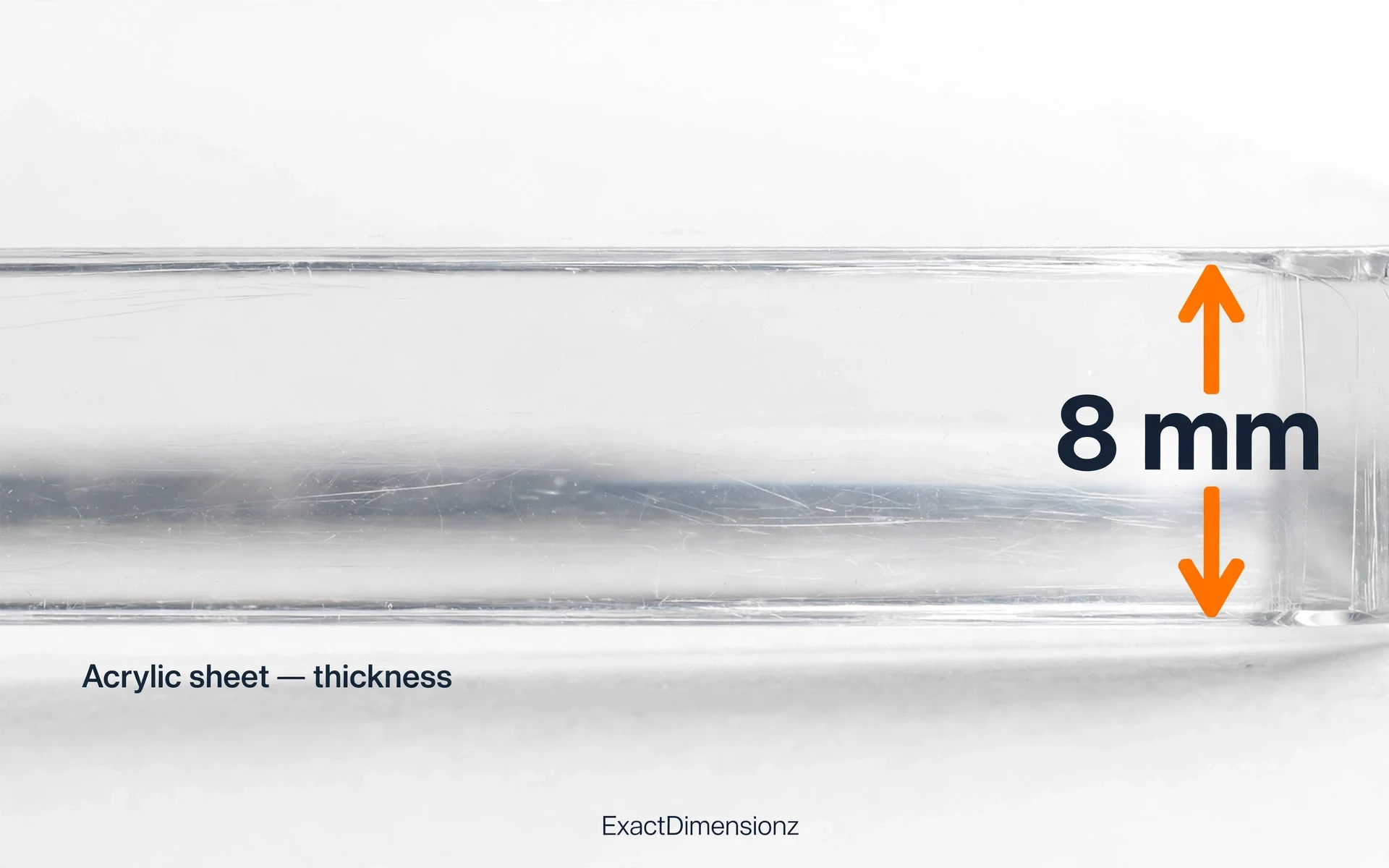
Röhm, the manufacturer of PLEXIGLAS®, lists 8 mm among the stocked thicknesses of its XT extruded acrylic sheet line — the Antimicrobial variant’s product page names 3, 5, and 8 mm outright. Sneeze guards, machine windows, DIY aquariums: that glass-clear panel you can drill and saw is very often 8 mm of acrylic.
Thickness, the third appearance of this axis, and the most visual one yet. Hold a sheet edge-on and the 8 mm is the transparent band between the two faces — noticeably heftier than 5 mm, clearly slimmer than 10. Extruded sheet holds tight thickness control, which is why fabricators trust it for glazing.
Measurement: 8 mm sheet thickness. Evidence: LISTED (official specification — the manufacturer’s own published thickness for the product line; the kind of 8 mm you can order by the sheet and receive by the sheet). Source: Röhm PLEXIGLAS® XT product page.
9. Lighthouse LEDs 8 mm Straw-Hat LED

Lighthouse LEDs’ datasheet for its 8 mm straw-hat LED names the package plainly: an 8 mm body, tolerance ±0.2 mm, in the warm-white 0.5 W version documented. It is the wide, flat-topped LED glowing inside model railroads, guitar pedals, and hobby dashboards — bigger and friendlier-looking than the classic 5 mm dome.
The axis is the body (package) diameter across the round lens face — the number that decides whether it fits your panel hole or bezel. The two wire leads dangle below and don’t count; the arrow sits across the hat’s brim. Next to a 5 mm LED it looks like the 5 mm’s burly older sibling, which is roughly the truth.
Measurement: 8 mm body diameter, ±0.2 mm tolerance. Evidence: LISTED (published dimension — the datasheet’s package designation with its tolerance stated; LEDs are sold by package size, and the package is what your fingers and your drill bit meet). Source: Lighthouse LEDs 8 mm straw-hat datasheet.
10. Mammut Pos 8 mm Accessory Cord

Mammut’s Pos cord is sold as 8 mm, and the published technical specs list the diameter as 8.00 mm — the skinny orange (or blue) line coiled on a climber’s harness for prusiks, anchors, and lashing gear to a pack. Coil it in your palm and the loop of cord between your fingers is 8 mm thick: about the diameter of a wooden pencil’s fat cousin.
Diameter of the rope is the axis, measured across the round cross-section. Rope diameters are nominal by nature — cord compresses, swells with moisture, and flattens under load — so read 8.00 mm as the maker’s stated size, not a laboratory constant. For a climber choosing a prusik loop, though, the stated size is the whole decision.
Measurement: 8 mm rope diameter (nominal). Evidence: LISTED (published dimension, with the rope caveat attached: textiles don’t hold tolerances like steel does; it is the size Mammut designs, tests, and sells). Source: Mammut Pos 8 mm rope specifications.
11. Swarovski 5000 Round Bead, 8 mm

Swarovski’s official crystal size chart lists article 5000 — the classic round faceted bead — in an 8 mm size, and authorized sellers stock exactly that. It is the bead at the center of a bracelet or the sparkle on a bridal hairpin: hold one up and the 8 mm sphere catches light from every facet.
Diameter across the round bead is the axis, measured through the middle, perpendicular to the thread hole. The hole itself is tiny and doesn’t count — the 8 mm is the bead’s full roundness, the dimension your eye actually sees. In jewelry terms 8 mm is a statement bead: bigger than a peppercorn, smaller than a marble, right in the look-at-me zone.
Measurement: 8 mm bead diameter. Evidence: LISTED (published dimension from the manufacturer’s own size chart — about as primary as a bead size gets; crystal beads are precision-made, and the 8 mm here is a catalogued, stocked, orderable size). Source: Swarovski crystal size chart (article 5000).
What “8 mm” actually measures: axes and evidence at a glance
Eleven objects, five different axes — this is why the article names the axis every time:
| # | Object | Axis | Evidence label |
|---|---|---|---|
| 1 | Pergo laminate flooring | Thickness | Published dimension |
| 2 | Daltile mosaic tile | Thickness | Official specification |
| 3 | supermagnete disc magnet | Diameter | Official specification |
| 4 | Würth M8 bolt | Thread diameter (nominal) | Standardized measurement |
| 5 | Bondhus hex key | Across-flats | Published dimension |
| 6 | SKF 608 bearing | Bore (inner diameter) | Official specification |
| 7 | Copper tube 8×1 | Outside diameter (nominal) | Standardized measurement |
| 8 | PLEXIGLAS® XT sheet | Thickness | Official specification |
| 9 | Straw-hat LED | Body/package diameter | Published dimension |
| 10 | Mammut cord | Diameter (nominal) | Published dimension |
| 11 | Swarovski bead | Diameter | Published dimension |
8 mm on a ruler, and every conversion that matters

Find any metric ruler and count eight small ticks past zero — just short of the 1 cm mark. Eight millimeters is four-fifths of a centimeter, a distance your eye can learn in a glance once you’ve seen the laminate edge or the magnet face above. If the 7 mm article taught you seven ticks, this is one tick further — and noticeably chunkier than the 6 mm guide describes.
| Unit | 8 mm equals | Exact or rounded |
|---|---|---|
| Centimeters | 0.8 cm | Exact |
| Meters | 0.008 m | Exact |
| Micrometers | 8,000 µm | Exact |
| Inches (decimal) | ≈ 0.315 in | Rounded display |
| Inches (fraction) | 5/16 in = 7.9375 mm | Exact — but 0.0625 mm under 8 mm |
The inch is defined as exactly 25.4 mm, so 8 mm is 8/25.4 = 0.3149606… inches; 0.315 is the rounded display. And the fraction trap from the near-miss section, one more time with numbers: 5/16″ is exact at 7.9375 mm, which is exact-but-different from 8 mm. Exactness and sameness are not the same thing. For scale against nearby sizes: 8 mm sits one millimeter past 7 mm and one short of 9 mm, two past 6 mm, and well under 10 mm — while the smaller anchors, 2 mm, 3 mm, and 4 mm, show how fast this scale grows. Step up to 1 cm and you have added a full 2 mm — a quarter more than 8 mm itself.
Buying 8 mm parts without getting burned
Knowing what 8 mm looks like is half the job. The other half is buying the right 8 mm — because the hardware aisle is where the near-misses from the top of this article turn into real money lost. Four rules cover nearly every mistake.
Buy the designation, not the eyeball. An M8 bolt is not “about 8 mm” — it is a nominal M8 thread under the ISO metric system, with a maximum major diameter of 7.968 mm. So is an M8 bolt exactly 8 mm in diameter? No — and it doesn’t need to be. The designation is what mates with an M8 nut. What you must never do is substitute by looks: a 5/16″ nut is 7.9375 mm, close enough to start threading and different enough to seize halfway. If the label says M8, buy M8.
Match the bit to the dowel, not the number to the number. An 8 mm dowel needs an 8 mm hole, and an 8 mm twist drill cuts one — but test-fit before glue. Dowels run a whisper over or under nominal depending on material and humidity, and a hole drilled this morning may grip differently than the dowel you bought last month. Drill scrap first.
Order sheet goods by the name, install by the feel. Laminate and tile are sold by their published thickness — the 8 mm on the box is the product you are buying. But boxes are priced by coverage, and thickness only matters at transitions: door thresholds, tile-to-laminate joints, the edge your bare foot finds. Order one spare box; planks from different dye lots can vary microscopically.
Fit the key to the flats. An 8 mm hex key drives an 8 mm socket — across the flats, the only axis that matters. And the wrench question everyone asks: can you use a 5/16″ wrench on an 8 mm bolt head? In practice it never comes up, because an M8 head is 13 mm anyway. The dangerous confusion is thread-to-thread — never force an M8 bolt into a 5/16″ nut. One more yes while we’re here: a 608 bearing does fit an 8 mm shaft — that is the entire point of the number. Just remember the 22 mm outside and 7 mm width when you check the housing.
You don’t need calipers to think like someone who owns them. Run three checks on any “8 mm” you meet: name the axis (thread diameter, across-flats, bore, outside diameter, thickness, pitch — “8 mm” without an axis is a rumor, not a measurement); read the evidence label (official specification, published dimension, or standardized measurement — none of them means “every unit is 8.000 mm”); and check the tolerance (the supermagnete disc admits ±0.1 mm, the M8 thread tops out at 7.968 mm, the SKF bore lands between 7.993 and 8.000 mm — then ask one question: does my job care? Gluing a dowel — probably not. Pressing a bearing — absolutely).
Frequently asked questions
How many centimeters are in 8 mm?
8 mm is exactly 0.8 centimeters. One centimeter is 10 millimeters, so 8 ÷ 10 = 0.8 cm. For the same reason 8 mm is exactly 0.008 meters and exactly 8,000 micrometers — the metric conversions are exact, not rounded.
How many inches is 8 mm?
8 mm is about 0.315 inches, a touch under a third of an inch. The inch is defined as exactly 25.4 mm, so 8 ÷ 25.4 = 0.3149606… inches, shown as 0.315 for readability. In feet that is 0.0315 feet — a small fraction of a foot, which is why millimeter sizes are almost always quoted in mm or cm instead.
Is 8 mm the same as 5/16 of an inch?
No, but it is close. 5/16 of an inch is exactly 7.9375 mm, which is 0.0625 mm thinner than 8 mm. That gap is invisible to the eye and decisive in hardware: an M8 bolt will not thread into a 5/16″ nut, and an 8 mm dowel won’t quite fill a 5/16″ hole. Treat them as near-twins, never as substitutes.
Is an M8 bolt exactly 8 mm in diameter?
No. M8 is a nominal designation under the ISO metric thread system: the thread’s major diameter tops out at 7.968 mm, and the “8” names the design target, not a guaranteed measurement. That doesn’t make the label wrong — the designation is what mates with an M8 nut — but it does mean you should never measure an M8 bolt with calipers and declare it “not really 8 mm.” It is 8 mm by designation, 7.968 mm at most by measurement.
What everyday things are 8 mm?
Verified examples include an 8 mm thick laminate floor plank, an 8 mm thick wall tile, an 8 mm diameter fridge magnet, an M8 bolt thread, an 8 mm hex key tip, the 8 mm bore of a skateboard bearing, an 8 mm outside-diameter copper tube, an 8 mm acrylic sheet, an 8 mm LED package, an 8 mm climbing cord, and an 8 mm crystal bead. The plank edge and the magnet face are the easiest references to picture.
Is 8 mm movie film really 8 mm wide?
Not quite. Standard 8 mm movie film is 7.975 mm wide per the ANSI/SMPTE and ISO standards behind both Standard 8 and Super 8 formats — 0.025 mm thinner than the name. The name is nominal; the standard is specific. It is the same lesson as the M8 bolt, in a format where the difference never mattered to anyone except the projector.
How can I measure 8 mm without calipers?
Use a metric ruler and count eight small ticks past zero — just short of the 1 cm mark. If you have no ruler, compare against a known 8 mm object from this article: the edge of a laminate plank, the face of a small fridge magnet, or the bore of a 608 skateboard bearing. For anything that must fit — a bolt, a bearing, a tube — nothing replaces calipers, because the difference between 8 mm and its 7.9375 mm twin is invisible without them.
Why is a product sold as 8 mm sometimes not exactly 8 mm?
Because the 8 mm may describe only one dimension — a thread, a bore, an outside diameter, a thickness, or an across-flats measurement — while the rest of the object measures something else, or because the listed size is a nominal designation with a tolerance behind it. A magnet sold as 8 mm may be 7.9 or 8.1 mm within its ±0.1 mm tolerance; an M8 bolt tops out at 7.968 mm; a rope sold as 8 mm swells and flattens with use. Always check the specification for the exact axis and the tolerance before treating an object as an exact 8 mm reference.
Final Thoughts
So, how big is 8 mm? It is 0.8 cm, about 0.315 inches, 8,000 micrometers — and, more usefully, it is the thickness of the floor under your feet, the thread of the bolt in your bookshelf, and the hole in the bearing under a skateboard. The single habit that will serve you best is the one this article opened with: always ask which axis the 8 mm belongs to. Thickness, diameter, bore, thread, and across-flats are five different answers, and knowing which one you are looking at is the difference between measuring right and guessing wrong.
Keep the second habit too: check the evidence label before you trust the number. A published 8 mm tells you what the designer intended; the tolerance tells you what the factory is allowed. With those two habits, 8 mm stops being abstract — and the next time a listing just says “8 mm” with no axis attached, you will know exactly which question to ask before you trust it.
