
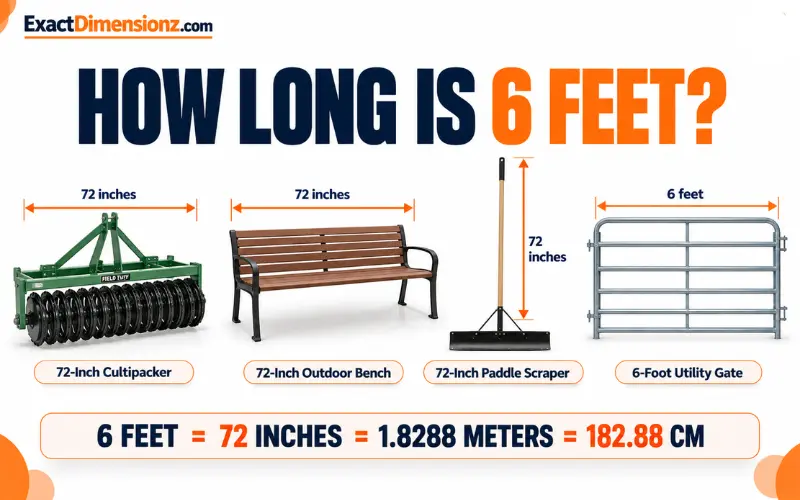
Wondering how long is 6 feet? Six feet is 72 inches — two yards, or six 12-inch rulers laid end to end. It is the height people mean when they say someone is “six feet tall,” the width of a full-size farm gate, and the length of a long park bench. Once you can picture one real 6-foot object, the number stops being abstract. For every size, see the complete feet size guide.
This guide gives you that picture. Below you will find eight verified objects with a genuine 6-foot dimension, each one checked against a published specification, plus the conversions, the measuring traps, and the answers to the questions people actually ask about 6 feet. One rule runs through the whole article: a product is only called 6 feet in the direction its maker actually measured.
How long is 6 feet?
6 feet is 72 inches — exactly 2 yards. In metric it is 182.88 cm, or 1.8288 meters. The foot is defined against the meter (one foot is exactly 0.3048 meters), so these conversions are exact, not rounded estimates.
The one rule: which dimension is 6 feet?
A product described as “6 feet” is not always 6 feet in every direction, and that is where most confusion comes from. A rotary tiller can have a 6-foot working width while its overall width is several inches more. A gate sold as 6 feet is 6 feet wide, not 6 feet tall. A projector screen sold as 72 inches is measured diagonally, not across. Every object below tells you plainly which dimension measures 6 feet, so you never have to guess.
One more distinction matters. The conversions in this article are exact by definition: 6 feet is exactly 72 inches, exactly 1.8288 meters, and exactly 182.88 cm. The objects, on the other hand, are listed at 6 feet — those are the makers’ published specifications, and this article grades them as such rather than pretending someone went out with a tape measure. Where a maker gives a nominal size, the article says so.
1. Field Tuff 72-Inch 3-Point Cultipacker

The Field Tuff 3-Point Cultipacker is a farm implement that firms a seedbed before planting, and its working width is the 6-foot dimension here. The maker’s manual lists a working width of 72 inches, or 6 feet, with a frame measuring 72 inches by 18 inches. That means the machine works a strip of soil 6 feet wide on every pass — the number describes the ground it covers, not the machine in every direction.
Measurement: 72-inch working width. Evidence: LISTED (maker’s manual specification). Source: Field Tuff 72 in. 3-Point Cultipacker — Tractor Supply.
2. Packer MAXX PMX6HD 6-Foot Cultipacker

The Packer MAXX PMX6HD is the second cultipacker on this list, and it earns its place because it shows the same 6-foot idea in a different build: a heavy-duty poly drum instead of cast-iron wheels. The maker lists a 6-foot working width with a drum width of 72 inches (6 feet). If you have ever watched a food plot being rolled, that drum rolling a 6-foot path is exactly what 6 feet looks like in motion.
Measurement: 72-inch drum width, 6-foot working width. Evidence: LISTED (maker’s product specification). Source: Packer MAXX PMX6HD 6 Ft Pro Series — Packer MAXX.
3. CountyLine 72-Inch Rotary Tiller

The CountyLine RT6CL rotary tiller is the best warning in this article against reading a product name and stopping there. It is sold as a 72-inch tiller, and its working width — the strip of soil its tines actually turn — is 6 feet. But its listed overall dimensions are 38 inches high by 79 inches wide by 28 inches long. The machine itself is 79 inches across, seven inches wider than its working width, because the frame, gearbox, and guards stick out past the tilled strip.
So the honest sentence is: this tiller works a 6-foot width, but it is not a 6-foot-wide machine. That distinction is the whole point of this guide.
Measurement: 72-inch working width; 79-inch overall width. Evidence: LISTED (retailer’s published dimensions). Source: CountyLine 72 in. Rotary Tiller, RT6CL — Tractor Supply.
4. Behlen Country 6-Foot Utility Gate

A gate is the simplest 6-foot object most people will ever meet, and the Behlen Country utility gate is sold in a 6-foot size. The 6 feet here is the width — the distance from one side of the gate to the other, the gap it closes. It is not the height: gates in this 6-foot-by-50-inch class stand about 50 inches tall, and tube gates are commonly made a few inches shorter than their listed length to leave room for hinges, latches, and clearance.
Picture a driveway or pasture opening with a gate swung across it. That span, post to post, is the 6 feet. If you need the height, measure upward instead — it is a different number, and confusing the two is the most common gate-measuring mistake there is.
Measurement: 6 feet wide (nominal size); about 50 inches tall. Evidence: LISTED (maker and retailer size class). Source: Behlen Country 6-Foot Utility Square Corner Gate — Behlen Country.
5. 72-Inch Outdoor Bench

Not everyone has stood next to a cultipacker, but almost everyone has sat on a bench — which makes this the most useful object in the article. The bench is listed at 72 inches overall length, and that length runs end to end, from one arm or end cap straight to the other. Sit down on a bench like this and stretch your arms along the seat: the distance your hands span is close to 6 feet, and the bench itself is the full 6 feet.
Unlike the farm implements above, there is no working-width trick here. Overall length is the whole story, which is why a 72-inch bench is the object this article recommends when someone asks for one thing to remember 6 feet by.
Measurement: 72 inches overall length. Evidence: LISTED (retailer’s published dimensions). Source: Grainger 72-Inch Outdoor Bench — Grainger.
6. 72-Inch Paddle Scraper

A paddle scraper is a long-handled cleaning tool, and its listed overall length is 72 inches. The scraper end itself is small; the long handle makes up nearly all of the 6 feet. Hold it upright next to you and the top of the handle lands right around the 6-foot mark — a surprisingly handy way to sense the height, since the tool is basically a 6-foot stick with a scraper on the end.
Measurement: 72 inches overall length. Evidence: LISTED (retailer’s published dimensions). Source: Grainger 72-Inch Paddle Scraper — Grainger.
7. VIVIDSTORM 72-Inch Projector Screen

Here is the trap object. VIVIDSTORM sells screens with a 72-inch size option, and that 72 inches is the diagonal — corner to corner — not the width. A 72-inch 16:9 screen is only about 62.7 inches wide and about 35.3 inches tall. If you bought it expecting a screen 6 feet across, you would be nearly 10 inches short.
That is exactly why this article keeps repeating its one rule. Screen sizes in this industry are diagonal by convention, so a “72-inch” screen belongs on a list of 6-foot measurements only with the word diagonal attached. Remember that and you will never be caught out by a television or screen size again — and yes, the same diagonal rule is why a 40-inch television is nowhere near 40 inches wide, and 32 inches short of 6 feet. See how long is 40 inches for that comparison.
Measurement: 72-inch diagonal size. Evidence: LISTED (maker’s size options). Source: VIVIDSTORM Phantom Projector Screen — VIVIDSTORM.
8. Drive Medical 72-Inch Suction Tubing

Six feet does not have to belong to something solid. Drive Medical’s universal suction tubing kit includes 72-inch suction tubing — a flexible length you can coil in your hand and then stretch out straight to see the full 6 feet. It is a good closing object because it proves the point the whole article has been making: 6 feet is a distance, not a shape, and it shows up in flexible materials just as honestly as in steel and wood.
Measurement: 72-inch tubing length. Evidence: LISTED (maker’s product description). Source: Drive Medical Universal Suction Tubing and Filter Kit — Drive Medical.
Close to 6 feet — but not 6 feet
Some familiar things look about 6 feet but are not, and they are worth naming so you do not use them as references. A tall person is often described as “about six feet” but may be anywhere from 5 feet 10 inches to 6 feet 2 inches. A sofa, a bed, a curtain, or a dining table can all sit near 6 feet in one direction while measuring something quite different in the other. A 10-inch tablet, for reference, is less than a seventh of 6 feet — see how long is 10 inches if you want that scale. For anything that matters — a gate opening, a piece of furniture, a building material — use a tape measure or a product with a published dimension, not a guess.
How to picture 6 feet without a tape measure
If you have no measuring tool handy, build the distance from parts you already know. Two 3-foot sections make 6 feet. Three 2-foot sections make 6 feet. Six standard 12-inch rulers laid end to end make 6 feet. Two yards — the length of two yardsticks — make 6 feet. And a standard interior door is 80 inches tall, so a 6-foot person standing in that doorway has about 8 inches of clearance above their head.
For scale in the other direction: 6 feet is exactly one foot longer than 5 feet, exactly 12 inches shorter than 7 feet, and exactly half of 12 feet. If you know any one of those lengths, you can find 6 feet from it.
Frequently asked questions
How many inches are in 6 feet?
There are 72 inches in 6 feet. One foot is exactly 12 inches, so 6 × 12 = 72. That is also why people write 6 ft to inches as simply 72 — no fractions, no rounding.
How long is 6 feet in cm and meters?
6 feet is 182.88 cm, which is 1.8288 meters. The international foot is defined as exactly 0.3048 meters, so 6 × 0.3048 = 1.8288 meters, and 6 × 30.48 = 182.88 cm. For a quick estimate you can round to 183 cm or 1.83 meters, but the exact figures are 182.88 cm and 1.8288 meters. That makes 6 feet 82.88 cm longer than a single meter.
How many yards is 6 feet?
6 feet is exactly 2 yards. One yard is 3 feet (36 inches), so 2 yards = 72 inches = 6 feet. If you work with fabric, fencing, or landscaping materials sold by the yard, two yards is the number to order.
How tall is 6 feet compared to a person?
A person who is 6 feet tall stands 72 inches from the floor to the top of their head. For context, the average adult man in the United States is about 5 feet 9 inches, so a 6-foot person stands about 3 inches above that average, and about 8 inches below the top of a standard 80-inch interior door.
Is a 72-inch projector screen 72 inches wide?
No. Screen sizes are measured diagonally, corner to corner. A 72-inch 16:9 screen is about 62.7 inches wide and about 35.3 inches tall. Always check whether a size is a diagonal, a width, or a length before you buy — the number alone does not tell you.
Why is a gate sold as 6 feet not 6 feet tall?
Because the 6 feet is the width, not the height. A gate sold in the 6-foot size closes a 6-foot opening, but its height is a separate number — about 50 inches for the utility gates in this article’s class. Tube gates are also commonly made a few inches shorter than their listed length so the hinges and latch have room to work.
What everyday things are 6 feet long?
Verified examples include a 72-inch outdoor bench, a 72-inch paddle scraper, 72-inch suction tubing, a 6-foot-wide utility gate, and farm implements with a 6-foot working width such as a 72-inch cultipacker or rotary tiller. The bench is the easiest one to remember, because its 72 inches run straight from end to end.
How can I measure 6 feet without a tape measure?
Use two 3-foot sections, three 2-foot sections, six 12-inch rulers end to end, or two yards. A standard interior door frame also helps: the door itself is usually 80 inches tall, so 6 feet stops about 8 inches short of the top. For an exact result, though, nothing replaces a proper tape measure.
Final Thoughts
So, how long is 6 feet? It is 72 inches, 182.88 cm, 1.8288 meters, and 2 yards — and, more usefully, it is the width of a farm gate, the length of a park bench, and the working width of the machines that prepare a field. The single habit that will serve you best is the one this article opened with: always ask which dimension the 6 feet belongs to. Width, length, height, working width, and diagonal are five different answers, and knowing which one you are looking at is the difference between measuring right and guessing wrong.
If you work in metric day to day, the small end of the scale has its own guides — for instance, how big is 6 cm — but for anything around two yards, the objects above are now your reference set. Pick one you have actually seen, a bench or a gate, and 6 feet will stop being a number and start being a distance you can feel.
