
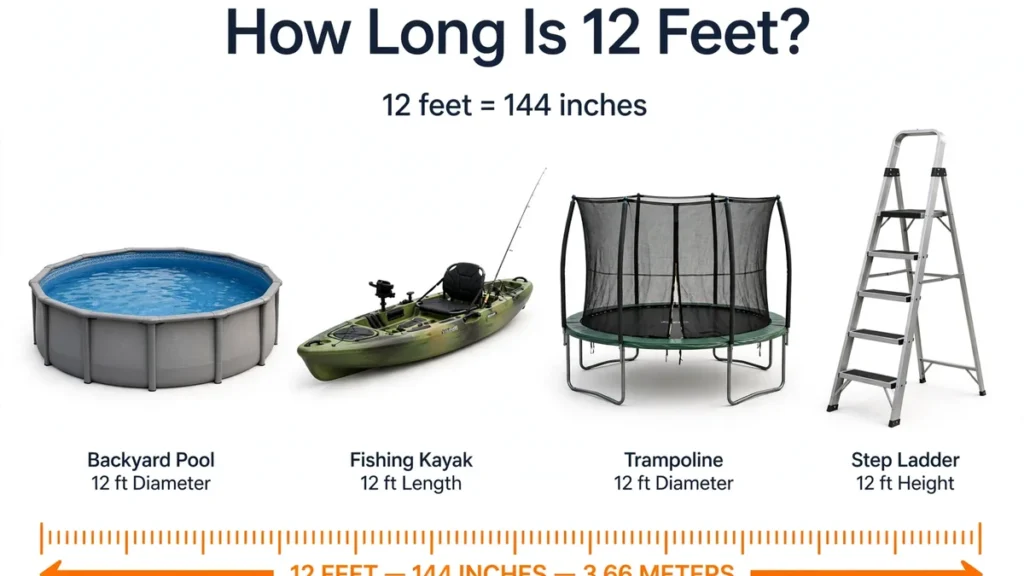
If you are asking how long is 12 feet, start with the cleanest fact in this article: 12 feet is 144 inches, exactly, and exactly 4 yards. Thirteen feet is one foot longer. No rounding, no repeating decimal — twelve twelves make 144, and twelve feet divided by three makes four yards. In metric it is 365.76 centimeters exactly, or 3.6576 metres, which most people round to 3.66 metres in conversation. The number itself is beautifully tidy. What is messy is everything people claim is 12 feet long, because most lists stack things, count buried fence posts, or call a range 12 feet and move on.
This article, part of the complete feet size guide, does not do that. It gives you six single, named objects, each one sold or specified at 12 feet, each one checked against a primary source — a manufacturer’s own specification, catalogue, or model listing — and each one labelled with its dimension type and its evidence grade. No stacks, no fractions, no two of these plus a bit of that. One object, one measurement, one source you can open yourself. Along the way you will also learn the two things that make 12 feet hard to picture: that length, height, width, and diameter are different claims, and that a 12-foot thing rarely fits in a 12-foot space.
Quick Answer
12 feet = 144 inches exactly = 4 yards exactly = 365.76 cm = 3.6576 m (about 3.66 m). It is twice the height of an average adult, taller than a standard 8- or 9-foot ceiling, and about the width of a single-car garage door. But a 12-foot pool needs more than 12 feet of yard, a 12-foot ladder needs clearance above it, and a 12-foot rug needs a room bigger than 12 feet — the fit notes below say how much.
Length, Height, Width, or Diameter? Read the Label Before You Trust the Number
Twelve feet of what? That question decides everything. A 12-foot pool is 12 feet across its diameter — a circle, not a straight line. A 12-foot kayak is 12 feet long from bow to stern. A 12-foot garage door is 12 feet wide. A 12-foot ladder is 12 feet tall when it is standing up, and a 9-by-12 rug is 12 feet on its long side only. Competitor lists blur these together constantly, which is how a basketball hoop (rim at 10 feet, not 12) ends up filed as a 12-foot object and a shipping container (8 feet 6 inches high) ends up called 12 feet tall. Every object below states its dimension type in its heading, so you never have to guess which kind of 12 feet you are looking at.
How the Grades Work
EXACT means the manufacturer’s specification for that exact model states the figure. LISTED means the product is sold or listed at that size — an available ordered size or a model listing — and the article says where that matters, for example where a rug’s nominal size can vary by an inch or two, or where a trampoline’s 12 feet is the frame, not the jumping surface. No object below is an average or a report, because 12 feet turns out to be a size manufacturers actually sell, which is good news for accuracy.
The 6 Objects
1. A 12-Foot Round Pool — 12 Feet Across the Diameter (EXACT)

An Intex Easy Set round pool in the 12-foot size measures 12 feet in diameter — 144 inches from one side of the circle to the other — and 30 inches deep. The manufacturer’s own documentation lists the 12-foot size at 12 feet (366 centimeters) in diameter, and the model’s manual states the footprint as 144 inches by 144 inches. That is EXACT: the maker’s own figure, for that exact model size.
The fit note is the useful part. A 12-foot pool does not fit in a 12-foot yard. You need the 12-foot circle plus room to walk around it, plus space for the pump and the ladder, plus the ground cloth underneath, which is wider than the pool itself. Plan on at least 15 to 16 feet of clear, level ground in every direction the pool will sit, and check that no fence, tree root, or slope eats into that circle. The diameter is exact; the yard you need is bigger.
External link: Intex manufacturer documentation (12 ft diameter pool).
2. A 12-Foot Fishing Kayak — 12 Feet Bow to Stern (EXACT)
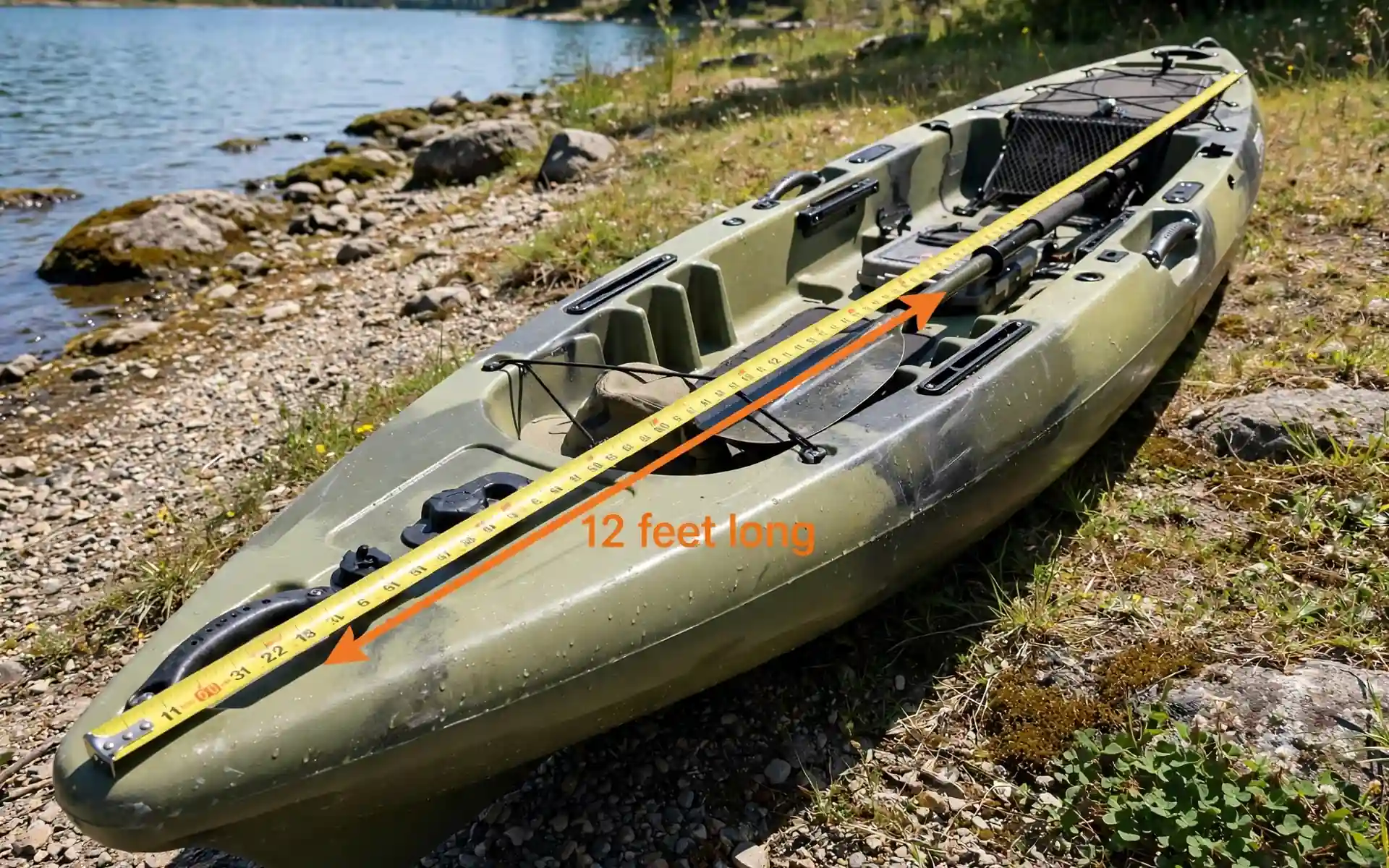
The Perception Pescador Pro 12.0 is a fishing kayak whose name tells the truth: the manufacturer’s catalogue specification gives its length as 12 feet (365 centimeters), with a beam of 32.5 inches. That is a length, bow to stern, for one named model — EXACT, from the maker’s own catalogue table.
Here is why a 12-foot kayak matters as a mental picture. Twelve feet is longer than most cars are wide, longer than a tall adult lying down twice over, and long enough that it will not fit across the back of a short-bed pickup without the tailgate down or a bed extender. If you own a 12-foot kayak, you already own a 12-foot measuring stick — stand it on end (carefully, on grass) and you are looking at a ceiling-height-plus length. For storage, measure your garage wall, not your garage door: a 12-foot kayak needs 12 feet of wall, plus room to carry it in.
External link: Perception manufacturer catalogue (Pescador Pro 12.0, length 12 ft / 365 cm).
3. A 12-Foot Round Trampoline — 12 Feet of Frame, Not Jumping Surface (LISTED)
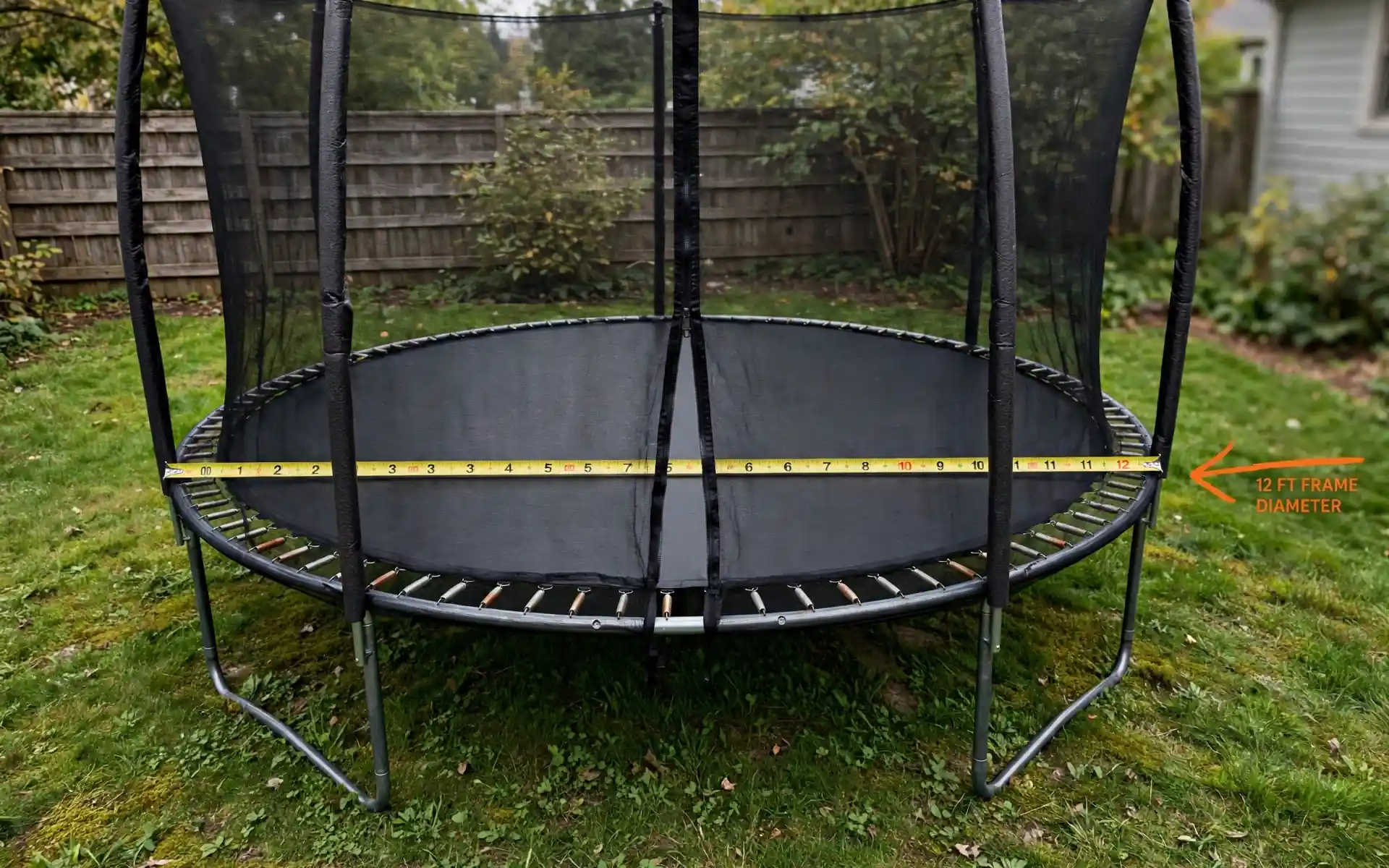
A Skywalker 12-foot round trampoline is listed with assembled dimensions of 12 feet by 12 feet, and a frame size of 12 feet. That is the LISTED grade: the model is sold as a 12-foot trampoline, and the frame circle is 12 feet across.
The honest caveat, which most lists skip, is that the jumping surface is not 12 feet across. The springs and the pad eat into the diameter, so the mat you actually bounce on is roughly 10 feet across. If you are buying for a child’s bounce space, shop by the mat, not the frame; if you are measuring the yard, measure by the frame, plus a safety clearance zone around it — the safety guidance for trampolines asks for clear space on every side, so a 12-foot trampoline wants a yard footprint several feet wider than 12 in every direction. Same product, two different 12-foot questions, and now you know which one you are asking.
External link: Skywalker 12-foot trampoline model listing (frame size 12 feet).
4. A 12-Foot-Wide Garage Door — 12 Feet of Ordered Width (LISTED)

Clopay’s Classic Wood garage doors are available in widths from 6 feet to 18 feet in one-inch increments, and the three-panel designs run from 6 feet through 12 feet wide. So a 12-foot-wide garage door is a real, orderable thing: LISTED, as an available ordered width rather than a single fixed model, and the article says so plainly.
This is the 12-foot width most homeowners actually meet. A single-car garage door is often 8 or 9 feet wide; a 12-foot door is the wider single door, or the narrow double, that swallows a car with room for the mirrors and the door swing. The practical test: a 12-foot door needs a 12-foot opening plus the framing, the tracks, and the opener hardware, so the wall it sits in is wider than 12 feet. And if you are wondering whether a 12-foot kayak fits through a 12-foot door — it does, lengthwise, with the door open, but only if you carry it straight, because the door’s 12 feet is width, and the kayak’s 12 feet is length, and those are different directions.
External link: Clopay manufacturer literature (widths 6 ft to 18 ft; three-panel designs through 12 ft).
5. A 12-Foot Step Ladder — 12 Feet of Standing Height (LISTED)
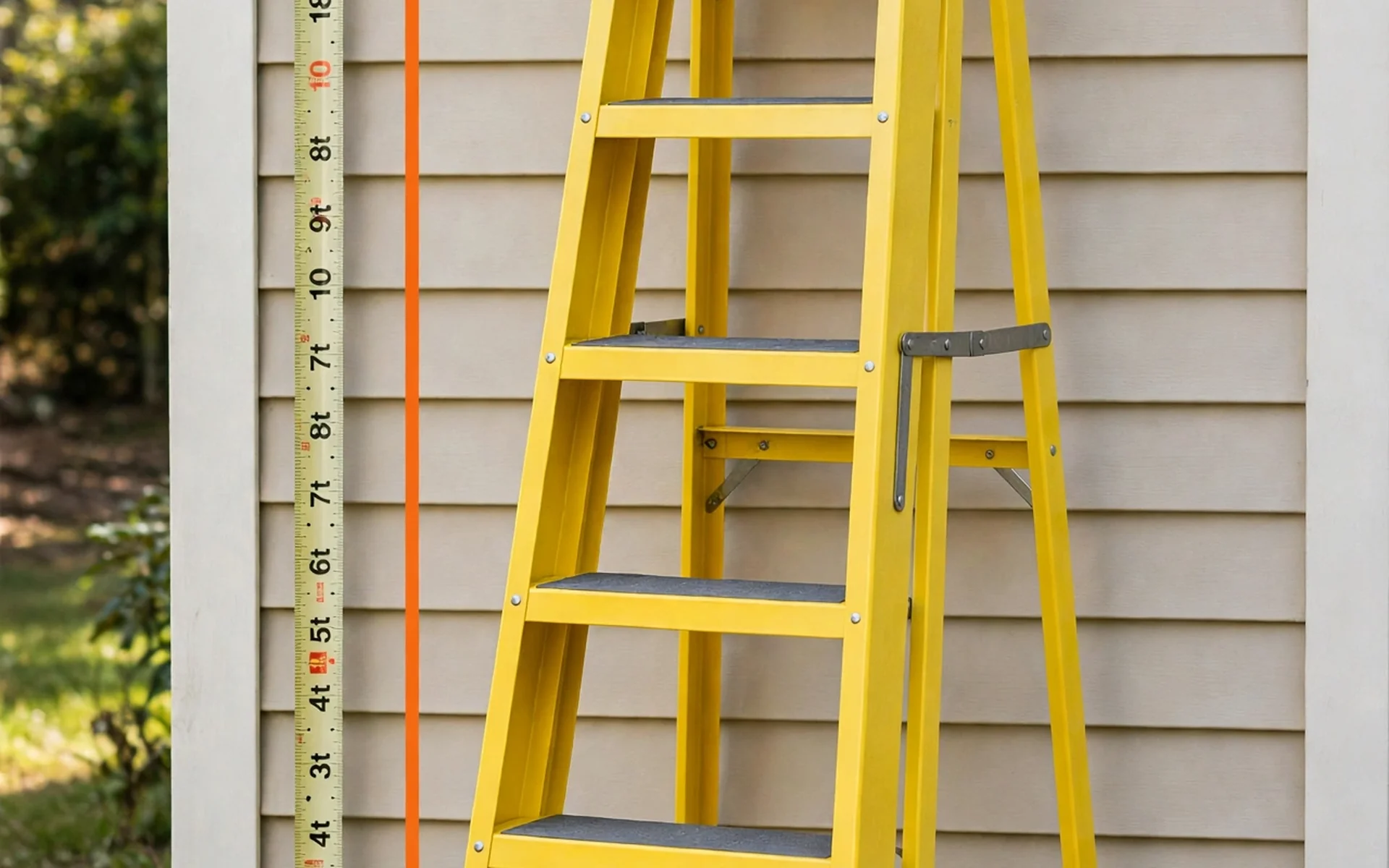
Werner’s 6212 fiberglass step ladder is the 12-foot model in its series: the model number’s 12 is the height, and retailer specifications list the product at 144 inches. That is LISTED — a model sold at 12 feet — and it is the ladder to picture when someone says 12 feet tall.
Two safety notes that lists never give you. First, you do not stand on the top of a step ladder: the safe standing level is a couple of steps down, so a 12-foot ladder gives you a working reach well above 12 feet, but a standing height below it. Second, a 12-foot ladder is taller than a standard 8- or 9-foot ceiling, so it does not open fully inside most rooms — it is an outdoor, garage, and tall-wall tool, not a living-room tool. Measure the ceiling before you buy the ladder, not after.
External link: Werner 6212 ladder specification (12 ft model; 144 in).
6. A 9-by-12-Foot Rug — 12 Feet on the Long Side (LISTED)
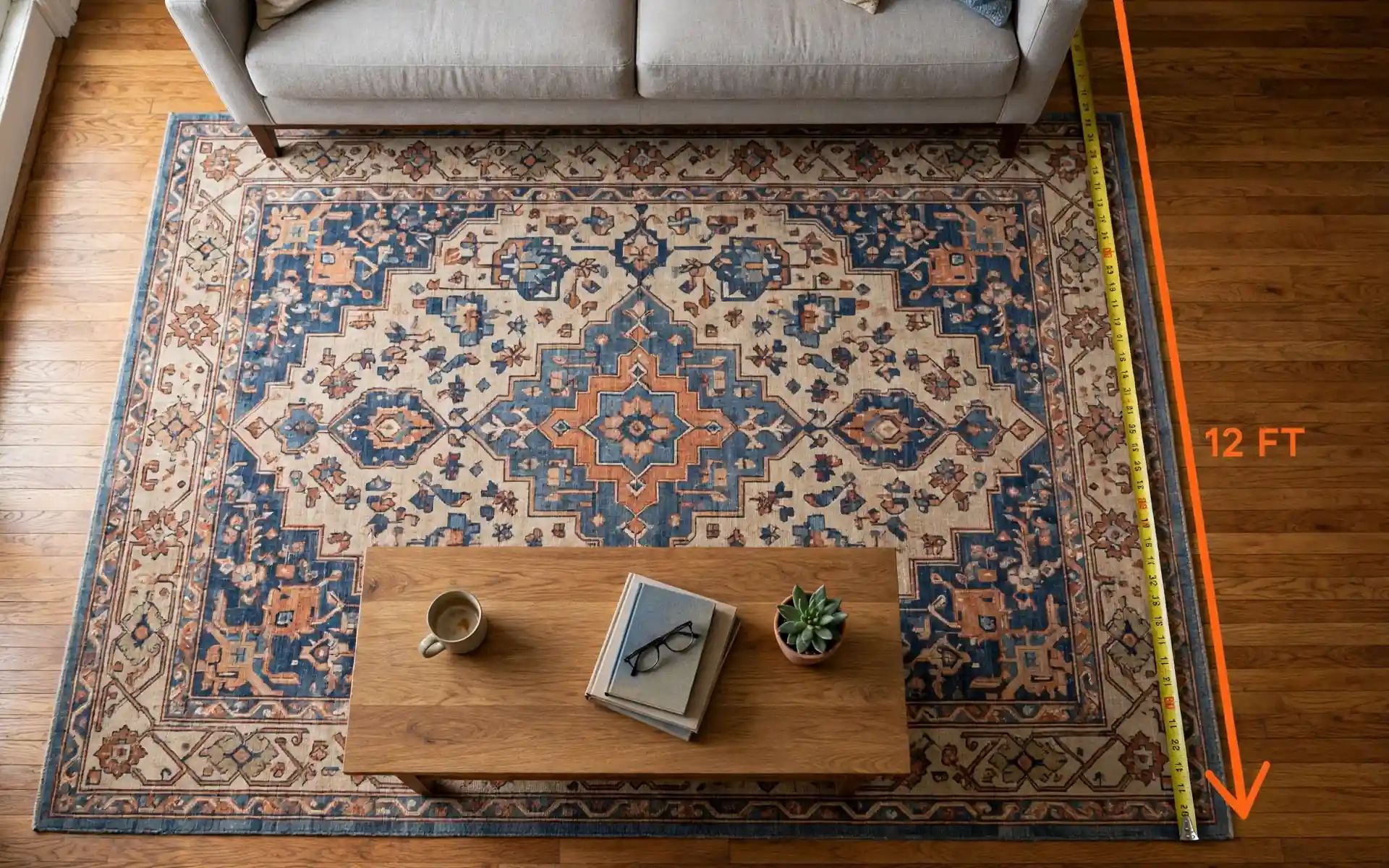
A 9-by-12-foot area rug is 12 feet long on its long side — 144 inches by 108 inches in the exact-size listing used here. That is LISTED, with one warning that matters: 9 by 12 is also a nominal rug category, and hand-knotted rugs in that category can vary by an inch or two from the label. The listing used for this article states the exact size as 9 feet by 12 feet, so the 144-inch figure is the listed figure for that product, not a category guess.
The room-size rule is the payoff. A 9-by-12 rug belongs in a room comfortably larger than 9 by 12 feet — the rug should sit under the front legs of the seating, with bare floor showing around it, which means the room wants to be at least a couple of feet longer and wider than the rug on every side it shows. If your room is exactly 12 feet long, a 12-foot rug will run wall to wall and look like wall-to-wall carpet that gave up halfway. Measure the room, then buy the rug that leaves floor showing.
External link: 9 ft x 12 ft rug exact-size listing (144 in x 108 in).
Will It Fit? The 12-Foot Clearance Cheat Sheet
| Thing | Its 12 feet is | Space you actually need |
|---|---|---|
| Round pool | Diameter | 15–16 ft of level ground |
| Kayak | Length | 12 ft of wall + carrying room |
| Trampoline | Frame diameter | Frame + safety clearance all round |
| Garage door | Width | Opening + framing + tracks |
| Step ladder | Height | Ceiling taller than 12 ft to open fully |
| Rug | Long side | Room larger than the rug on all sides |
Conversion Table
| Unit | 12 feet equals |
|---|---|
| Inches | 144 in |
| Yards | 4 yd exactly |
| Centimetres | 365.76 cm |
| Millimetres | 3,657.6 mm |
| Metres | 3.6576 m (about 3.66 m) |
| Compared with an average adult (about 5 ft 9 in) | About twice as tall |
| Compared with a standard ceiling (8–9 ft) | 3–4 ft taller |
How 12 Feet Compares With Other Lengths
Twelve feet is one foot longer than 11 feet, and twelve times 12 inches — a useful reminder that a foot and an inch share a name but not a scale. In inches it is 144, so it is nearly five times 29 inches and more than seven times 20 inches, and nearly five times 30 inches. If you have just pictured 40 inches, triple it and add a little: 12 feet is 3.6 times that length. Smaller spans such as 11 inches and 13 inches are the units most people measure first before they scale up to a full 12 feet.
Frequently Asked Questions
How many inches are in 12 feet?
144 inches. Multiply feet by 12: 12 times 12 is 144, exactly.
How many meters and centimeters is 12 feet?
12 feet is 365.76 centimeters, or 3.6576 metres. In everyday speech, 3.66 metres. Some lists round to 3.658 metres or 365.8 centimeters; the exact figures are 3.6576 and 365.76.
How many yards is 12 feet?
Exactly 4 yards. Divide feet by 3: 12 divided by 3 is 4, with nothing left over.
How tall is 12 feet compared to a person and a standard ceiling?
Twelve feet is about twice the height of an average adult, and 3 to 4 feet taller than a standard 8- or 9-foot ceiling. Stand two adults on each other’s shoulders (do not try this) and you are roughly at 12 feet.
What everyday things are actually 12 feet long?
A 12-foot pool (diameter), a 12-foot kayak (length), a 12-foot trampoline (frame), a 12-foot-wide garage door (width), a 12-foot step ladder (height), and the long side of a 9-by-12 rug. Each one is a different kind of 12 feet, which is why the article labels the dimension type for every object.
Is 12 feet longer than a car, and will a 12-foot item fit in a garage?
Twelve feet is shorter than most cars are long (a typical sedan is 14 to 16 feet long) but wider than a car is wide. A 12-foot kayak fits in most garages lengthwise along a wall; a 12-foot pool or trampoline does not belong in a garage at all. Always measure the space in the same direction as the object’s 12 feet.
How can I measure or picture 12 feet without a tape measure?
Walk it: about five adult steps covers 12 feet. Or picture two adults standing on each other’s shoulders, or a single-car garage door with room to spare. For a quick check, a standard interior door is 6 feet 8 inches tall — stack two door heights in your mind and you are close, though a little over.
What room size works for a 9-by-12 rug, and how much clearance does a 12-foot ladder or trampoline need?
A 9-by-12 rug wants a room larger than 9 by 12 feet, with floor showing around it. A 12-foot ladder wants a ceiling taller than 12 feet to open fully, and a 12-foot trampoline wants its 12-foot frame plus a clear safety zone on every side — measure the yard, not just the trampoline.
Final Thoughts
Twelve feet is one of the friendliest numbers in measurement — 144 inches, 4 yards, 3.6576 metres, all exact — and one of the easiest to misuse, because a diameter, a length, a width, and a height can all be 12 feet while fitting completely different spaces. The six objects above keep those claims separate, and the fit notes turn the number into decisions: how much yard, how much wall, how much ceiling, how much room. That is what a measurement article is for — not a longer list, but a number you can use without measuring twice.
