

How long is a foot? One foot is exactly 12 inches — 30.48 centimeters, 304.8 millimeters, and one-third of a yard. It is the length of the wooden ruler from grade school, the width of a US license plate, and the unit most people picture first when they think in feet and inches.
This guide answers the question properly: the exact definition and why it is exact, the conversions you actually need, a short history of where the foot came from, where you still meet it every day, and how to measure it without the usual mistakes. Then comes the complete directory — every feet size guide on this site, from 1 foot to 100 feet, in one place.
How long is a foot?
One foot is exactly 12 inches (30.48 centimeters, 304.8 millimeters) — one-third of a yard. On a ruler, it is the span from the zero mark to the 12 mark.
Total: 1 foot
The scale explains the measurement but is not physically calibrated on every screen. Screen size and browser zoom can change its displayed length.
What Is a Foot, Exactly?
A foot is a unit of length in the British imperial and United States customary systems of measurement. Its standard symbol is ft, and the plural is feet. It is defined as exactly 12 inches and one-third of a yard, and it is also written with a single prime: ′. So 5 feet 7 inches can be written as 5′ 7″, with a single prime for feet and a double prime for inches.
The foot is the middle unit of the imperial system: 12 inches make a foot, 3 feet make a yard, and 5,280 feet make a mile. It is the unit the whole system pivots on — small enough to hold in your hand as a ruler, big enough to measure a room, a person, or a football field.
The foot is named after the body part, and the name is honest about its origin: for most of history, a foot was the length of a person's foot. An adult's foot is typically about 15.3% of their height, so a person 175 cm (5 ft 9 in) tall has a foot about 268 mm (10.6 in) long on average — shorter than the 12-inch unit. The modern foot matches a much larger foot: it corresponds to a human foot with a UK shoe size 13, a US men's 14, a US women's 15.5, or an EU 48.
How Long Is a Foot in Inches, Centimeters, Millimeters, Meters, and Yards?
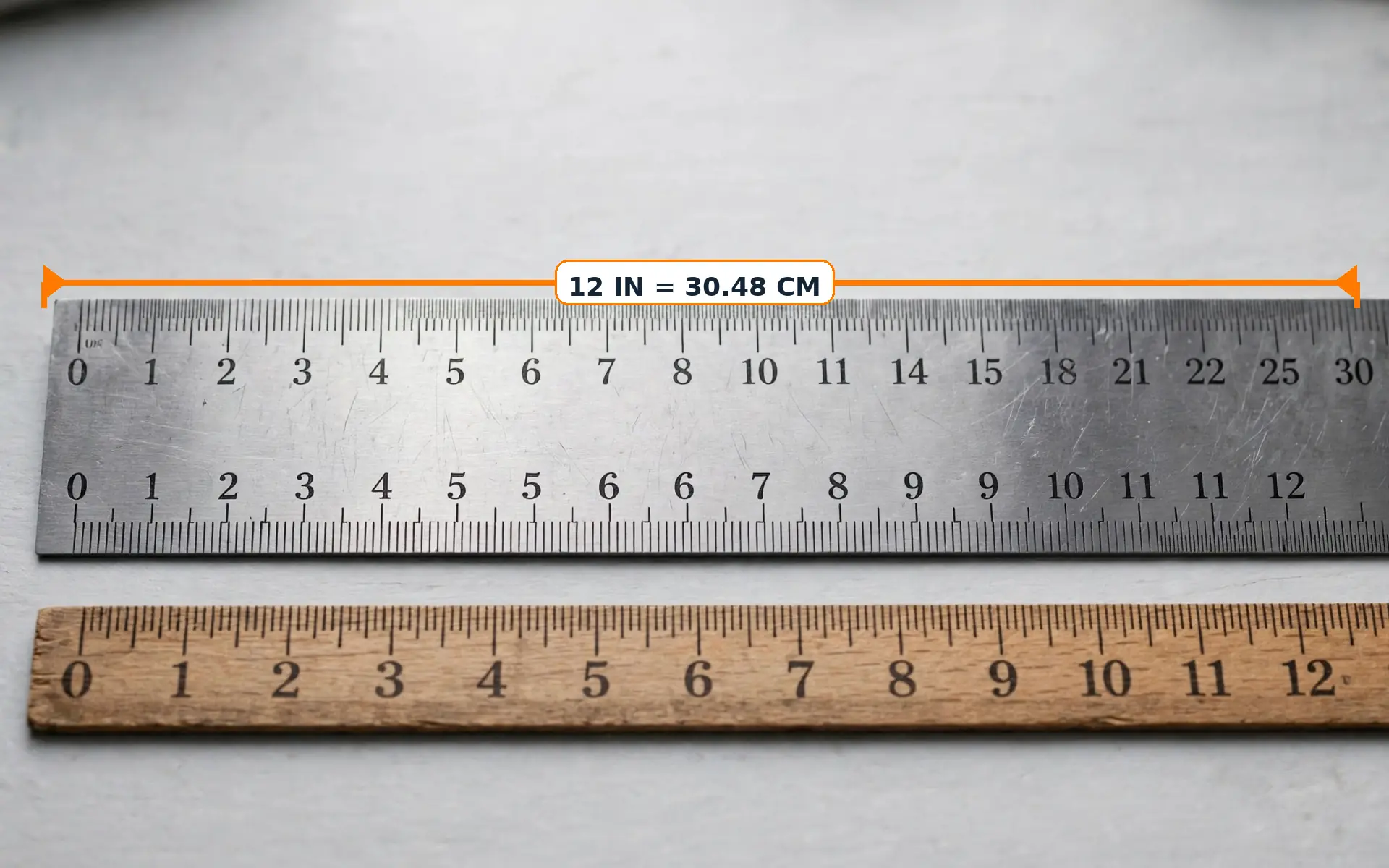
One foot converts exactly into metric units, because the foot is defined in metric terms. These are definitions, not measurements, so there is no rounding error in them:
| 1 foot equals | Value | Exact or rounded |
|---|---|---|
| Inches | 12 in | Exact |
| Centimeters | 30.48 cm | Exact |
| Millimeters | 304.8 mm | Exact |
| Meters | 0.3048 m | Exact |
| Yards | 1/3 yd (0.3333 yd) | Exact fraction; decimal rounded |
Going the other way, the factors are rounded for display:
| 1 unit equals | In feet | Exact or rounded |
|---|---|---|
| 1 inch | 0.08333 ft | Rounded |
| 1 centimeter | 0.0328084 ft | Rounded |
| 1 meter | 3.28084 ft | Rounded |
| 1 yard | 3 ft | Exact |
The two formulas to remember are simple. To turn feet into centimeters, multiply by 30.48. To turn centimeters into feet, divide by 30.48. So 6 feet × 30.48 = 182.88 cm, and 100 cm ÷ 30.48 = 3.28084 feet (rounded). For feet and inches together, convert both parts: centimeters = (feet × 30.48) + (inches × 2.54). A person who is 5 feet 7 inches is (5 × 30.48) + (7 × 2.54) = 152.4 + 17.78 = 170.18 cm. Keep the full precision during a calculation and round only the final answer — rounding 30.48 down to 30 looks harmless, but at 100 feet it costs you a full 48 centimeters.
Why 30.48 Is Exact: The 1959 Definition
Before 1959, the foot was a physical thing rather than a definition, and different countries kept slightly different feet. The United States foot worked out to 304.8006096 mm; the British foot to 304.799724 mm. The difference was about three millionths of a foot — invisible on any tape, but a real problem for precision engineering.
On 1 July 1959, the national standards bodies of the United States, the United Kingdom, Canada, Australia, New Zealand, and South Africa agreed that the international yard would be exactly 0.9144 meters. A yard is 3 feet, so one foot became 0.9144 ÷ 3 = 0.3048 meters — exactly 30.48 centimeters. The United Kingdom brought the definition into force on 1 January 1964, and it has not changed since.
The National Institute of Standards and Technology (NIST) lists the conversion as exact in NIST Special Publication 811, its guide for the use of the International System of Units. Because the factor is a definition rather than a measurement, it carries no uncertainty: any calculation that uses 30.48 introduces no conversion error of its own.
One loose end survived for decades: the old U.S. survey foot, defined as 1,200/3,937 of a meter (about 0.30480061 m), which surveyors kept using for land records. NIST retired the survey foot on 1 January 2023, so today one foot is one foot everywhere in the United States — exactly 30.48 centimeters.
A Short History of the Foot
The foot is one of the oldest units still in daily use, and it began as a body measurement. The Greek foot (pous) was about 302 mm (11.9 in), a six-hundredth of a stadion. The standard Roman foot (pes) was normally about 295.7 mm (11.6 in) — 97% of today's foot — though in the provinces the so-called pes Drusianus ran about 334 mm (13.1 in). Originally both peoples divided the foot into 16 digits, but in later years the Romans divided it into 12 unciae — and that twelfth part is where both "inch" and "ounce" come from.
In AD 790, Charlemagne tried to reform the measures in his domains. His units of length were based on the toise, the distance between the fingertips of a man's outstretched arms, and the toise held 6 pieds (feet) of 326.6 mm (12.9 in) each. Across the centuries the foot's length wandered between about 250 and 335 mm from place to place and trade to trade — every town could have its own foot, and sometimes every trade did.
England settled on 12 inches to the foot, and that foot traveled with English trade, law, and building around the world. The 1959 agreement simply fixed that foot to the meter for good: 0.3048 meters, exactly, everywhere.
Where You Still Meet Feet Every Day

The foot survives because it is the natural size for the things people measure with their bodies and their homes. Human height is still given in feet and inches across the United States and the United Kingdom — a person is 5 feet 9 inches, not 175 centimeters, in everyday speech. Room dimensions, ceiling heights, and real estate are sold in feet and square feet: a standard ceiling is 8 feet, a standard interior door is 80 inches tall (6 feet 8 inches), and a house is listed by its square footage.
Construction runs on feet. Lumber, drywall, and fencing are cut and sold in foot lengths, and a tape measure's foot marks are the ones a builder reads first. Sports fields are measured in feet and yards: an American football field is 300 feet (100 yards) long, and a bowling lane runs exactly 60 feet from the foul line to the head pin. Aviation measures altitude in feet worldwide — a cruising airliner flies at about 35,000 feet, and pilots everywhere read the same unit.
That is why the foot matters even if you live in a metric country: you will meet it on a floor plan, a property listing, a sports broadcast, or a flight display. Knowing that one foot is exactly 30.48 centimeters lets you convert any of those numbers without guessing.
How to Measure a Foot Correctly
Measuring in feet sounds too simple to get wrong, and that is exactly why it goes wrong. Four habits cover almost every mistake.
First, measure from the zero mark, not from the end of the tape. The end of a tape measure is a metal hook that moves slightly by design — it accounts for its own thickness — so hook it over the edge and read from the zero, or butt the tape's case against the start and read the number at the far end.
Second, read the foot marks, not just the inches. A long tape marks each foot with a number and a small arrow or a bold tick, and the inches restart after each one. If your reading says 7 feet 3 inches, the 7 is the foot mark and the 3 is the inches past it — do not add them together as 73 inches in your head unless you mean to.
Third, match the precision to the job. For room dimensions and furniture, the nearest inch is usually enough. For trim and cabinetry, work in fractions of an inch. And when the length is a person's height, measure barefoot, back flat against a wall, looking straight ahead — shoes add an inch or more, and hair adds another.
Fourth, keep the tape honest on long spans. A tape sags in the middle over ten feet or more, and a sagging tape reads long. Pull it taut, support the middle on a long run, measure twice, and write the number down before you move.
The Complete Feet Size Directory: 1 to 100 Feet
This directory links every feet size guide on ExactDimensionz — 37 guides covering 1 to 30 feet and the round tens from 40 to 100 feet. Each guide gives the exact conversions for its size and the real everyday objects verified at that length.
1 to 10 Feet: Everyday Sizes
| Size | Inches | Centimeters | Millimeters | What the guide covers |
|---|---|---|---|---|
| 1 foot | 12 in | 30.48 cm | 304.8 mm | The base unit itself — exact conversions and everyday objects that measure exactly one foot. |
| 2 feet | 24 in | 60.96 cm | 609.6 mm | Double the base unit — conversions and real objects at exactly this length. |
| 3 feet | 36 in | 91.44 cm | 914.4 mm | One yard — conversions and objects verified at three feet. |
| 4 feet | 48 in | 121.92 cm | 1,219.2 mm | Exact conversions plus everyday objects that match this length. |
| 5 feet | 60 in | 152.4 cm | 1,524 mm | Five feet in cm and mm, with objects that measure exactly five feet. |
| 6 feet | 72 in | 182.88 cm | 1,828.8 mm | A tall person's height — conversions and verified objects at six feet. |
| 7 feet | 84 in | 213.36 cm | 2,133.6 mm | Exact conversions and real objects that measure seven feet. |
| 8 feet | 96 in | 243.84 cm | 2,438.4 mm | A standard ceiling height — conversions and objects at eight feet. |
| 9 feet | 108 in | 274.32 cm | 2,743.2 mm | How long it looks on a tape, with objects verified at this length. |
| 10 feet | 120 in | 304.8 cm | 3,048 mm | A high ceiling — conversions and objects at exactly ten feet. |
11 to 21 Feet: Room Sizes
| Size | Inches | Centimeters | Millimeters | What the guide covers |
|---|---|---|---|---|
| 11 feet | 132 in | 335.28 cm | 3,352.8 mm | One foot short of twelve — conversions and matching everyday objects. |
| 12 feet | 144 in | 365.76 cm | 3,657.6 mm | A small room's length — conversions and objects verified at twelve feet. |
| 13 feet | 156 in | 396.24 cm | 3,962.4 mm | A foot past twelve — conversions and verified objects at this length. |
| 14 feet | 168 in | 426.72 cm | 4,267.2 mm | Exact conversions and real objects that measure fourteen feet. |
| 15 feet | 180 in | 457.2 cm | 4,572 mm | Five yards — conversions and objects at exactly fifteen feet. |
| 16 feet | 192 in | 487.68 cm | 4,876.8 mm | How long it looks on a tape, with objects verified at this size. |
| 17 feet | 204 in | 518.16 cm | 5,181.6 mm | Exact conversions plus everyday objects that match this length. |
| 18 feet | 216 in | 548.64 cm | 5,486.4 mm | Six yards — conversions and objects verified at eighteen feet. |
| 19 feet | 228 in | 579.12 cm | 5,791.2 mm | Exact conversions and real objects verified at nineteen feet. |
| 20 feet | 240 in | 609.6 cm | 6,096 mm | Twenty feet in cm and meters, with objects that match it exactly. |
| 21 feet | 252 in | 640.08 cm | 6,400.8 mm | Seven yards — the largest single-foot guide before the tens. |
22 to 29 Feet: Boats, Trailers and Big Lengths
| Size | Inches | Centimeters | Millimeters | What the guide covers |
|---|---|---|---|---|
| 22 feet | 264 in | 670.56 cm | 6,705.6 mm | Eight verified objects — a wake boat, a travel trailer, a box truck and more. |
| 23 feet | 276 in | 701.04 cm | 7,010.4 mm | Seven verified objects — a whale calf, an elephant, a three-point line and more. |
| 24 feet | 288 in | 731.52 cm | 7,315.2 mm | Five verified objects — a soccer goal, a keelboat, a container and more. |
| 25 feet | 300 in | 762 cm | 7,620 mm | Six verified objects — a tape measure, a garden hose, a flagpole and more. |
| 26 feet | 312 in | 792.48 cm | 7,924.8 mm | Eight verified objects — an aircraft, a pool, boats, a truck and more. |
| 27 feet | 324 in | 822.96 cm | 8,229.6 mm | Seven verified objects — boats, a round pool, a Routemaster bus and more. |
| 28 feet | 336 in | 853.44 cm | 8,534.4 mm | Six verified objects — a landing craft, a giant goose, a record snake and more. |
| 29 feet | 348 in | 883.92 cm | 8,839.2 mm | Eight verified objects — a bowrider, a spaceplane, a cannon and more. |
30 to 100 Feet: Big Sizes in Tens
| Size | Inches | Centimeters | Millimeters | What the guide covers |
|---|---|---|---|---|
| 30 feet | 360 in | 914.4 cm | 9,144 mm | Ten yards — conversions and objects at exactly thirty feet. |
| 40 feet | 480 in | 1,219.2 cm | 12,192 mm | Over twelve meters — conversions and matching objects at forty feet. |
| 50 feet | 600 in | 1,524 cm | 15,240 mm | Conversions and objects verified at fifty feet. |
| 60 feet | 720 in | 1,828.8 cm | 18,288 mm | A bowling lane — conversions and objects at sixty feet. |
| 70 feet | 840 in | 2,133.6 cm | 21,336 mm | Conversions and objects verified at seventy feet. |
| 80 feet | 960 in | 2,438.4 cm | 24,384 mm | Conversions and matching objects at eighty feet. |
| 90 feet | 1,080 in | 2,743.2 cm | 27,432 mm | Thirty yards — conversions and objects at ninety feet. |
| 100 feet | 1,200 in | 3,048 cm | 30,480 mm | The cluster's biggest size — 30.48 meters, or 1,200 inches. |
Landmark Sizes Worth Memorizing
Most foot measurements you meet will be one of a few landmarks. These five are worth knowing by heart:
| Landmark | Feet | Inches | Centimeters | Why it matters |
|---|---|---|---|---|
| One yard | 3 ft | 36 in | 91.44 cm | Three feet; the step between feet and yards. |
| A small room | 12 ft | 144 in | 365.76 cm | About the length of a small bedroom. |
| A two-car garage | 24 ft | 288 in | 731.52 cm | About the width of a wide two-car garage. |
| A bowling lane | 60 ft | 720 in | 1,828.8 cm | Foul line to head pin — the standard lane length. |
| A third of a football field | 100 ft | 1,200 in | 3,048 cm | 30.48 meters; a football field is 300 feet long. |
Three and twelve are the two to memorize first: almost every conversion you do in your head will pass through one of them. A yard is 91.44 cm, so two yards is 182.88 cm, and anything in whole feet is just a multiple of 30.48.
Feet or Centimeters: Which Should You Use?
Use feet where the world already does: heights, room dimensions, real estate, construction, sports fields, and aviation altitude in the United States and the United Kingdom. Use centimeters where the world already does: science, medicine, most of Europe and Asia, and any product made to metric standards. Neither unit is better in the abstract — the right one is the one your reader's tape already shows.
If you work mostly in inches, browse the Inches size guides. If you work mostly in metric, the Centimeter size guides cover the same ground in centimeters. And when a conversion is all you need, the rule stays the same: multiply feet by 30.48, or divide centimeters by 30.48.
Common Mistakes When Working With Feet

Reading decimal feet as feet and inches. This is the most common foot mistake there is. 5.5 feet is 5 feet 6 inches — not 5 feet 5 inches — because 0.5 of a foot is 6 inches. The same trap catches 5.83 feet (5 feet 10 inches, not 5 feet 8 inches) and 7.5 feet (7 feet 6 inches, not 7 feet 5 inches). Always multiply the decimal part by 12 to get the inches.
Rounding 30.48 down to 30. At one foot the error is 0.48 cm and nobody notices. At 100 feet it is 48 cm — the difference between a fence that fits the lot and one that does not. Keep the 30.48.
Using the old survey foot. Until 2023 the United States kept a second, slightly longer foot for land surveying, defined as 1,200/3,937 of a meter. The difference was about two parts per million, and NIST retired it on 1 January 2023. Old survey documents may still show it, but for every current purpose the foot is exactly 30.48 cm.
Measuring a TV in feet across the width. Screen sizes are diagonal measurements in inches. A "65-inch TV" is 65 inches corner to corner — and it needs about 5 feet of wall width, not 65 inches of it. Work out the width from the diagonal before you buy the stand.
Measuring with your shoe. A real human foot averages about 10.6 inches long — not 12. Your shoe is not a ruler, and pacing off a room in shoe-lengths will leave you short by more than a foot in ten.
Measuring height with shoes on. Shoes add an inch or more, and hair adds another. Measure barefoot, back flat against a wall, looking straight ahead — or the number is not your height.
Mixing feet and inches mid-calculation. Pick one unit for a calculation and convert at the end. Turn everything into inches first (feet × 12, then add the inches), multiply by 2.54 for centimeters, and only then convert back to feet if you need to. Adding 5 feet to 7 inches as 12 of anything is how rooms end up a foot short.
Frequently Asked Questions
How long is a foot in centimeters?
One foot is exactly 30.48 centimeters. This is a definition fixed by international agreement in 1959, not a rounded approximation, so the conversion has no error.
How many inches are in a foot?
There are exactly 12 inches in a foot. That is the definition of the foot in both the imperial and US customary systems, and it is why a standard ruler is one foot long.
How do I convert feet to cm?
Multiply the number of feet by 30.48. For example, 6 feet × 30.48 = 182.88 cm. To convert the other way, divide centimeters by 30.48: 100 cm ÷ 30.48 = 3.28084 feet (rounded).
How do I convert feet and inches to cm?
Convert both parts and add them: centimeters = (feet × 30.48) + (inches × 2.54). A person who is 5 feet 7 inches is (5 × 30.48) + (7 × 2.54) = 152.4 + 17.78 = 170.18 cm.
Is a foot exactly 30.48 cm, or approximately?
Exactly. Since the international yard and pound agreement of 1959, the foot has been defined as exactly 0.3048 meters, and NIST lists the factor as exact in Special Publication 811. Any rounding you see comes from the number of decimal places displayed, not from the conversion.
What is the symbol for a foot?
The international symbol is ft, and the traditional symbol is the single prime ′. A measurement written as 5′ 7″ means 5 feet 7 inches, with a single prime for feet and a double prime for inches.
How many feet are in a yard? How many in a meter?
There are exactly 3 feet in a yard. A meter is about 3.28084 feet (rounded) — more precisely 3.2808399 feet — because one meter is 100 cm and 100 ÷ 30.48 = 3.2808399.
How long is a foot on a ruler?
A standard 12-inch ruler is exactly one foot long — the ruler is the foot. If you have no ruler, a US license plate is exactly 12 inches wide by national standard, which makes it a government-certified foot you can borrow from the driveway.
Final Thoughts
A foot is the most human unit in the imperial system: twelve inches long, 30.48 centimeters by exact definition since 1959, and the size of the ruler, the room, and the person all at once. Once you know that one number, every foot conversion is a single multiplication, and every size in the directory above is one click away.
Start with the size you actually need: the 1-foot guide if you want to see the base unit up close, the 6-foot guide for a tall person's height, or the 100-foot guide for the biggest size in the cluster.
Sources: conversions verified against NIST Special Publication 811, Guide for the Use of the International System of Units (linked in the definition section above), accessed 8 November 2026.
