
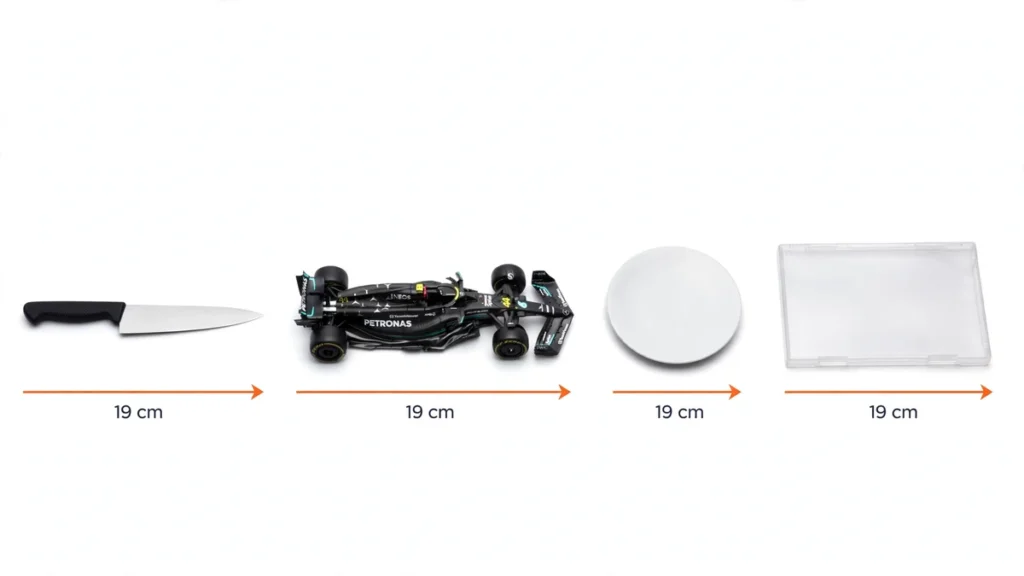
Every site on the internet will tell you that how big is 19 cm is a settled question: 19 cm is 7½ inches, end of story. They are all rounding — and the rounding hides half a millimetre. Half a millimetre is nothing until it is the difference between a case that closes and a case that does not, a blade that slides into its slot and one that catches, a shelf bracket that seats and one that rocks. This article is about that half-millimetre: what 19 cm actually is, seven things that really measure it, and why “7.5-inch” labels keep misleading shoppers.
Nineteen centimetres is 7.48 inches, 190 millimetres, and 0.19 metres. It is 63% of a school ruler, 0.5 mm shorter than a true 7½ inches, and 1.22 cm longer than 7 inches. The seven objects below are the closest honest answers to it: four land on 19 cm exactly, three miss by 3 to 8 millimetres with the miss printed in full, and every one of them carries the source that proves it.
Quick Answer
19 cm is 7.48 inches — half a millimetre short of 7½ inches.
Nineteen centimetres is 7.48 inches, 190 millimetres, and 0.19 metres. Four objects land on it exactly — a chef’s knife, a LEGO F1 car, a side plate and a DVD case — and three more miss by 0.3 to 0.8 centimetres, with the miss printed in full.
The bar above shows nineteen 1 cm segments, but it is a diagram, not a ruler: screen sizes vary, so it explains the measurement rather than measuring it. For a real measurement, use the objects below or a tape measure.
The 0.5 mm Trap: Why 19 cm Is Not 7.5 Inches
Seven and a half inches is 19.05 cm by definition — one inch is exactly 25.4 mm since the 1959 international agreement on the yard and the pound — so 19 cm is half a millimetre shorter than 7½ inches, and the gap is about the thickness of a sheet of printer paper. A space built to a true 7.5 inches is 19.05 cm wide, which means a 19 cm object fits in it with 0.5 mm to spare; a space built to 19 cm is 0.5 mm too narrow for a true 7.5-inch object, and that is the direction the trap bites. The rounding is harmless on a shopping listing and expensive in a 3D print, a tight case, or a shelf bracket cut to the label instead of the tape.
The error most people make is rounding one inch to 2.5 cm instead of 2.54: 19 divided by 2.5 is 7.6 inches, which is 0.12 inches (3.0 mm) too high, and the 2.5 shortcut is how “19 cm is 7.6 inches” survives in conversion guides that never check their own arithmetic. Seven inches converts to 17.78 cm, so 19 cm sits 1.22 cm past the 7-inch mark and half a millimetre short of the 7½-inch mark — closer to 7½ inches than to 7 inches, but not on either of them. The honest shorthand is “just under 7½ inches” — “7½ inches” hides the half-millimetre, and “7.6 inches” invents three millimetres that are not there.
| Tape mark | Value | Against 19 cm |
|---|---|---|
| 7 in | 17.78 cm | 1.22 cm short |
| 7 15/32 in | 18.97 cm | 0.3 mm short |
| 7 1/2 in | 19.05 cm | 0.5 mm over |
| 7 9/16 in | 19.21 cm | 2.1 mm over |
On a tape measure, the nearest sixteenth-inch mark is 7½ inches at 19.05 cm, which is 0.5 mm over — close enough for a cut, not close enough for a tight fit. The honest fraction is 7 15/32 inches at 18.97 cm, which is 0.3 mm short, but thirty-seconds are not printed on most tapes, so the practical reading is the 7½-inch mark minus a hair. If your tape has sixteenths, read the 7½ mark and shave a hair inside it; if it has thirty-seconds, the 7 15/32 mark is the closest honest reading there is. And 19 cm is 63% of a 30 cm ruler — mark off 19 of the 30 centimetres and the remaining 11 cm is the length you have left over.
7 Things That Are 19 cm
The seven objects are ordered by how close they land on 19 cm, closest first, and each one carries its evidence grade in the heading. EXACT means the figure is a standard’s or an authority’s own dimension for the named thing. LISTED means the figure is the manufacturer’s published specification for the named model. AVERAGE means the figure is an authority’s published average for the named thing. Four of the seven land on 19 cm exactly, and the three that do not carry their miss in the open, in millimetres, where you can see it — and the point of the ordering is that the miss grows as you read, so the last object is the one that stretches the number furthest.
A published 19 cm designation does not mean every manufactured unit measures mathematically 19.000 cm. Knives are sold by a blade length that the maker states to the centimetre, toy cars by a length rounded to the nearest half-inch, plates by a diameter that varies by a fraction of a millimetre between firings, books by a trim height that varies a few millimetres by publisher. What follows is what the source actually says, with the axis named every time, so you can check it yourself.
1. Victorinox Fibrox Chef’s Knife, 19 cm — Exactly 19.00 cm (LISTED)
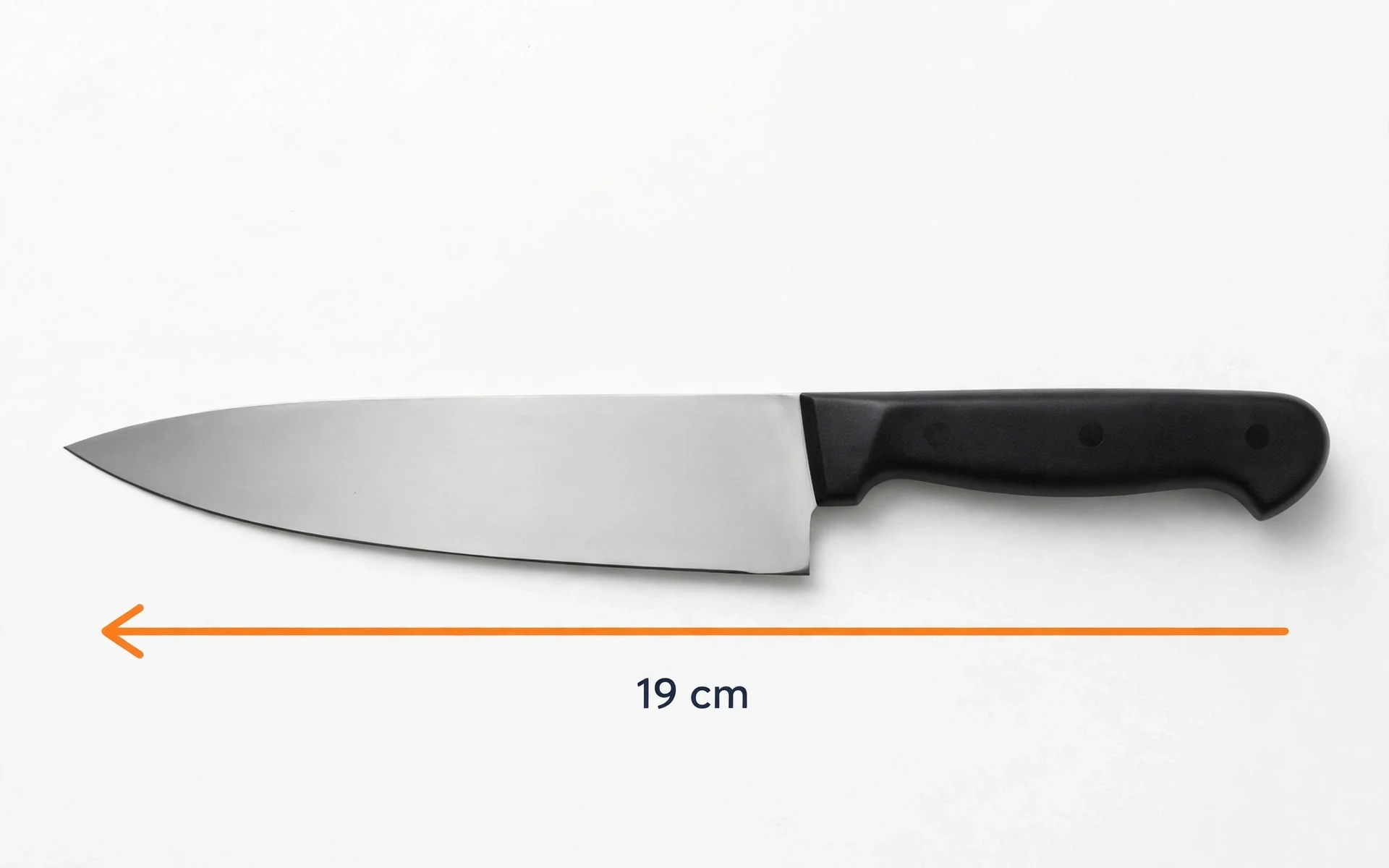
The knife is the article’s cleanest land-on, because its 19 cm is not a measurement of a thing that happens to be 19 cm long — it is the thing itself, a knife sold by its blade length. Victorinox’s Fibrox collection lists a Chef’s Knife, 19 cm, in both straight and wavy edge, so the blade runs 19.00 cm from tip to bolster, with no deviation to print, and the same on every 19 cm Fibrox chef’s knife of this line, because the length is the product. Lay it on the bench and the distance from the tip to the bolster is 19 cm — the whole number, nothing added, nothing missing.
The fitting check is the blade, because the 19 cm is the blade alone and the knife as a whole is longer. A knife block slot or a blade guard bought against “19 cm” fits the blade; a drawer bought against “19 cm” for the whole knife does not, because the handle adds roughly another 12 cm past the bolster. The grade is listed because the figure is the manufacturer’s own specification for the named model, with the deviation printed in full: 19.00 cm, zero millimetres off. Note that this is a different knife from the 20 cm Victorinox Fibrox chef’s knife in our 20 cm article — same brand and line, different model and size — so the two are not interchangeable, and neither is a substitute for the other.
2. LEGO Speed Champions 76909 Mercedes-AMG F1 W12 E Performance — 19 cm Long (LISTED)
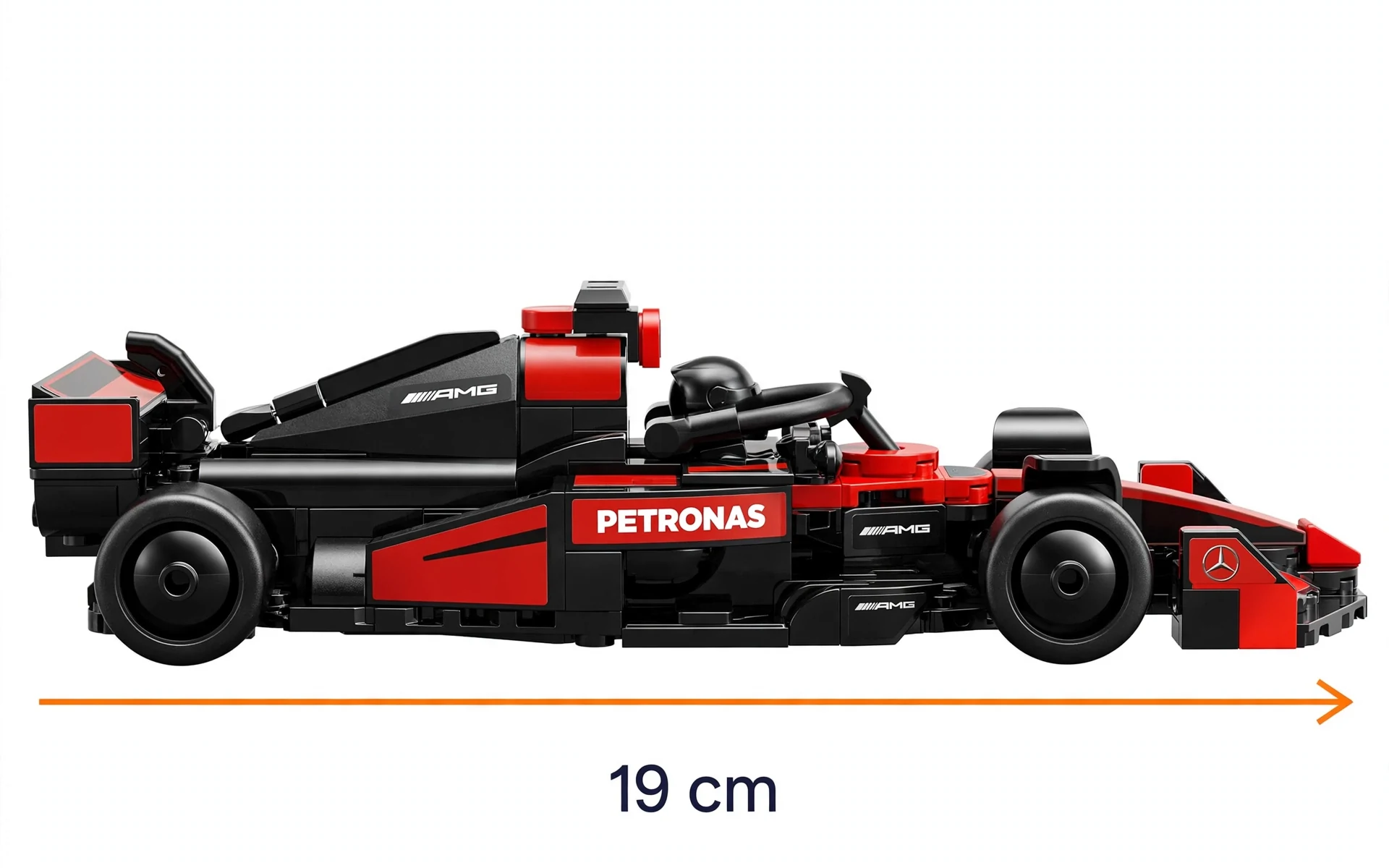
The LEGO car is the article’s most surprising land-on, because a toy that looks like a handful of bricks turns out to be a precision measurement. LEGO’s own product page for set 76909, the Mercedes-AMG F1 W12 E Performance with the Mercedes-AMG Project One, states that the model measures over 1.5 in. (4 cm) high, 7.5 in. (19 cm) long and 2.5 in. (7 cm) wide — so the car runs 19.00 cm from nose to rear wing, with no deviation to print. Hold it in your palm and its longest axis is the closest thing to 19 cm in the toy box, which is why it sits second on this page and why it is the object to reach for when someone asks what 19 cm looks like.
The fitting check is the axis, because the 19 cm is the length and the car is only 7 cm wide. A display shelf bought against “19 cm” holds it lengthways; a shelf bought against “19 cm” for the width does not exist, because the width is a third of the length. The grade is listed because the figure is the manufacturer’s published specification for the named set, with the deviation printed in full: 19.00 cm, zero millimetres off. And the “7.5 in.” in LEGO’s own listing is the rounded imperial equivalent of 19 cm, not a true 7.5 inches — the trap again, printed on the manufacturer’s own page.
3. IKEA OFTAST Side Plate, White, 19 cm — Diameter Exactly 19.00 cm (LISTED)
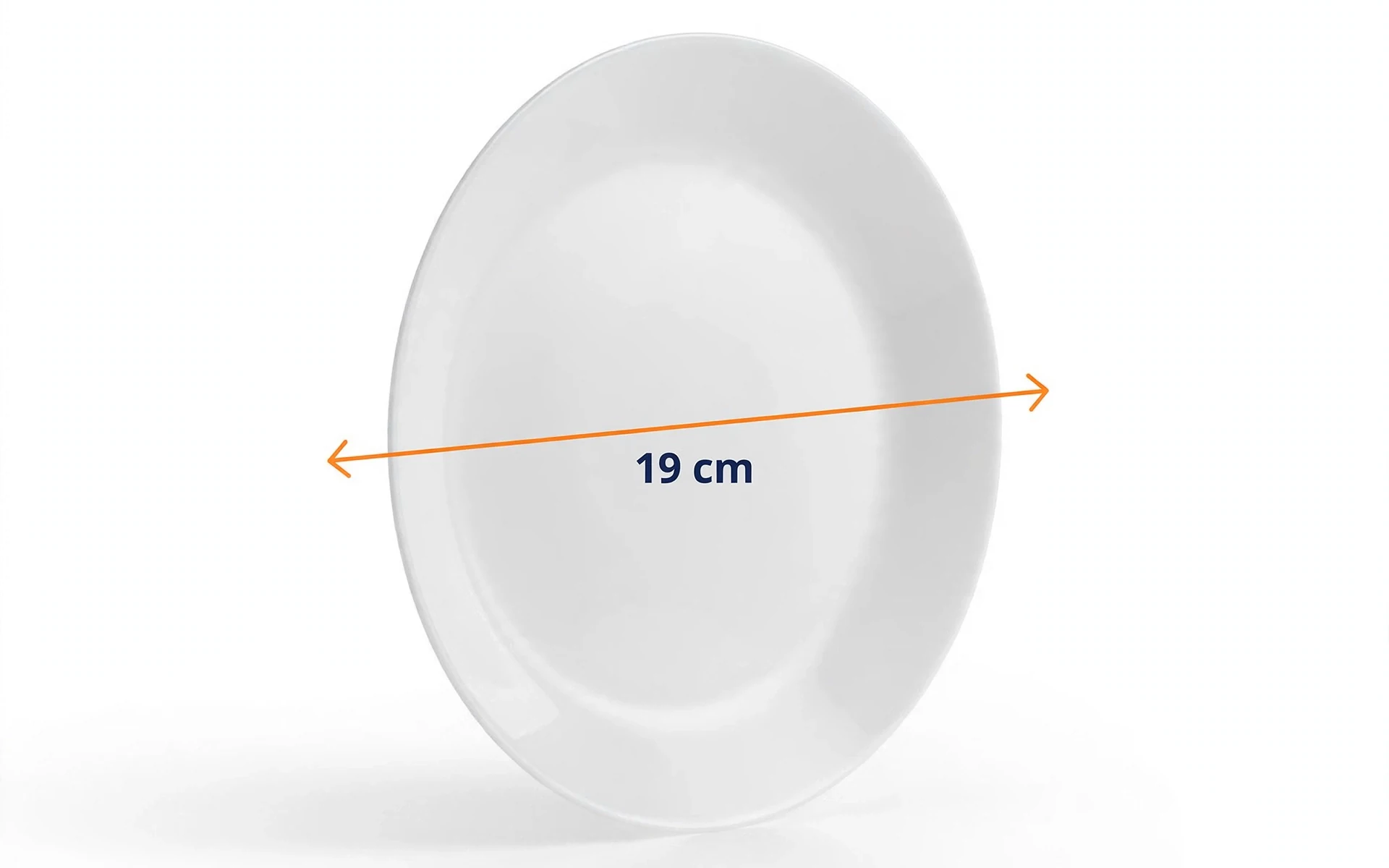
The plate is the article’s most useful land-on, because it is the one you already own and can measure tonight. IKEA’s product page lists the OFTAST side plate, white, at 19 cm — the diameter across the rim — so the plate measures 19.00 cm edge to edge, with no deviation to print. Set it on the table and its width is the number itself, which is why it is the pocket reference in the measuring section below, and why it is the object that settles the dinner-plate argument in the corrections section.
The fitting check is the word “side”, because the 19 cm belongs to the side plate and not to plates in general. A dinner plate is roughly 25 to 27 cm across, a centimetre and a half wider on every side, and a plate rack bought against “19 cm” holds the OFTAST and not the dinner plate. The grade is listed because the figure is the manufacturer’s published specification for the named product, with the deviation printed in full: 19.00 cm, zero millimetres off. If your kitchen has an OFTAST, you have a 19 cm ruler that also holds your toast.
4. Standard DVD Keep Case (Amaray) — Height Exactly 19.00 cm (EXACT)

The DVD case is the article’s second pocket reference, and the one that carries the trap inside the object list itself. The height and width of a closed keep case are fixed at 190 mm and 135 mm by the format standard — the VSDA recommendation, carried in the Amaray brochure — so the case stands 19.00 cm tall, with no deviation to print. Stand it on its edge and its height is the number itself, which is why it is the measuring tool in the section below, and why it is the object that proves the trap is not a theory but a label you can hold.
The fitting check is the label, because the case is sold as “7.5 in” in imperial and that is the rounded equivalent, not the exact figure. Say “height 190 mm” and you are exact; say “the DVD case is 7.5 inches tall” as if it were exact and you are 0.5 mm wrong, because 190 mm is 19.00 cm and a true 7.5 inches is 19.05 cm. The grade is exact because the figure is the format standard’s own dimension for the named thing, with the deviation printed in full: 19.00 cm, zero millimetres off. The case is labelled 7.5 inches and measures 19 cm, and both statements are honest — which is the whole trap in one object.
5. Average Adult Man’s Hand — Median 19.3 cm (AVERAGE)

The hand is the article’s only body measurement, and the one that comes with a caveat printed next to it. The ANSUR II survey — Gordon and colleagues, 2015, the US Army’s anthropometric survey — reports a median hand length of 193 mm for men, measured from the wrist crease to the tip of the middle finger, so the average man’s hand runs 19.3 cm — 3.0 mm past 19 cm, about the thickness of a coin edge. Lay your hand flat, fingers together, and the distance from the crease at your wrist to the tip of your middle finger is the closest thing to 19 cm you carry with you, which is why it is the measuring tool in the section below.
The fitting check is the sample, because the 193 mm is the median for US Army personnel in the 2012 survey, not a civilian average, and the median for women in the same survey is 180 mm — 1 cm short of 19 cm. Your hand is a reference, not a ruler: measure your own hand once against a tape and write the number down, and from then on it is calibrated to you. The grade is average because the figure is an authority’s published median for the named group, with the deviation printed in full: 19.3 cm, 3.0 mm over. A hand that measures 19 cm is not average — it is 3 mm short of the military median, and the difference is the caveat.
6. Standard VHS Cassette — Width 18.70 cm (EXACT)
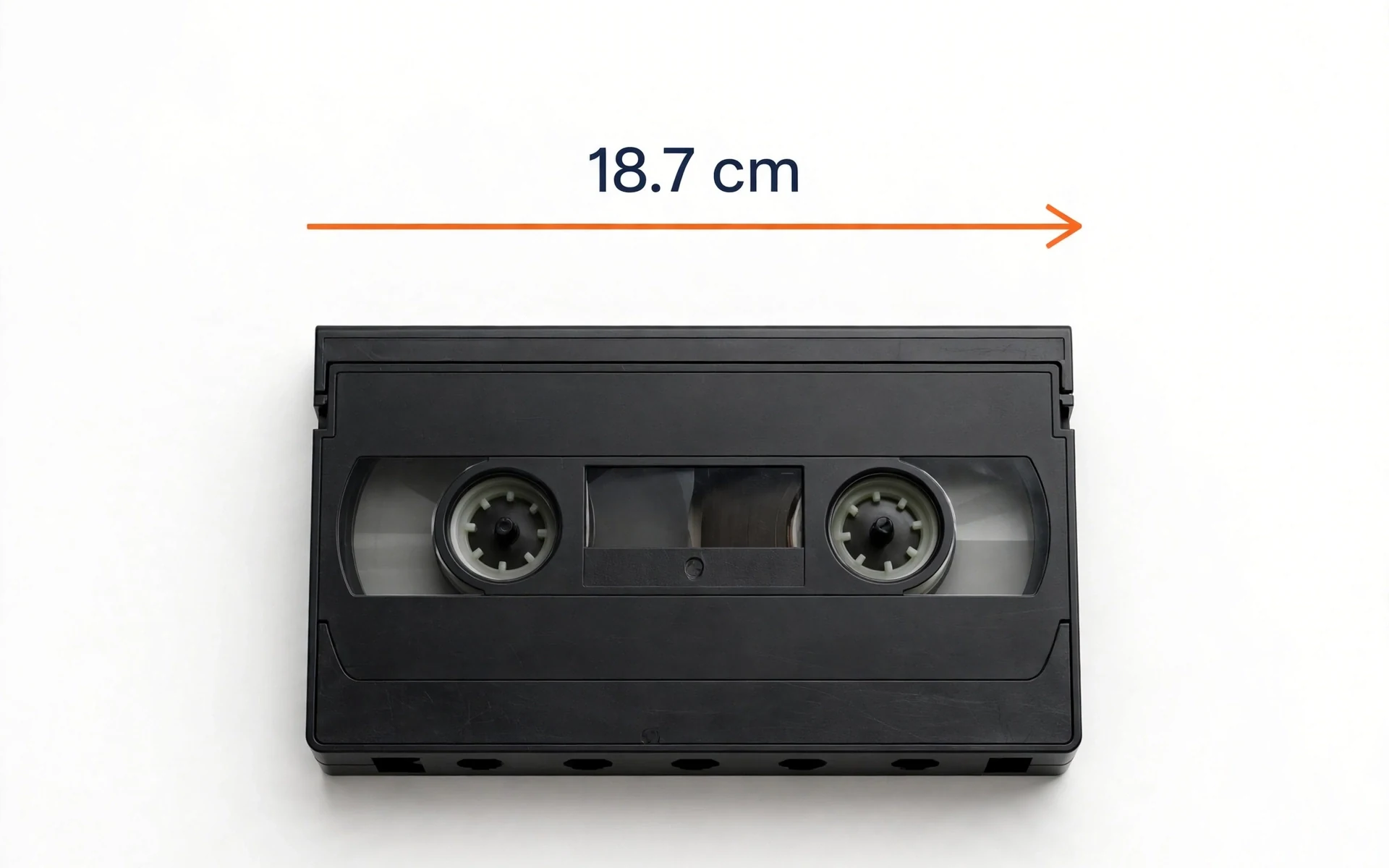
The VHS cassette is the article’s furthest undershoot and its best story, because it is 3 mm short of 19 cm and 3 mm short of the DVD case that replaced it. Fuji’s specification for a VHS cassette lists the dimensions as 187 × 103 × 25 mm, corroborated by the Canadian Conservation Institute at 18.7 × 10.3 × 2.5 cm, so the cassette runs 18.70 cm wide — 3.0 mm short of 19 cm, about the thickness of a coin edge. Lay it flat and its long edge ends visibly short of the mark, and “add three millimetres” is the honest instruction for closing the gap.
The fitting check is the axis, because the 187 mm is the width and the cassette is 103 mm deep. A shelf slot cut to 19 cm holds the cassette with 3 mm to spare; a slot cut to 18.7 cm holds it exactly, with nothing to spare. Some sources round the width to 188 mm — use 187 mm, the Fuji specification, and note the 1 mm rounding if it comes up. The grade is exact because the figure is the format standard’s own dimension, carried by the manufacturer’s specification, with the deviation printed in full: 18.70 cm, 3.0 mm short.
7. B-Format Paperback (UK Fiction Standard) — Height 19.80 cm (EXACT)

The paperback is the article’s furthest miss, and the weakest fit on the page — which is why it is last, and why the miss is printed largest. B-format is the UK fiction standard at 129 × 198 mm, so the book stands 19.80 cm tall — 8.0 mm past 19 cm, just under a centimetre, or about the width of a fingernail. Set it on the shelf and it ends visibly past the mark, and “take off eight millimetres” is the honest instruction for closing the gap.
The fitting check is the word “standard”, because 198 mm is the standard trim height and individual books vary a few millimetres by publisher. A B-format paperback from one publisher may stand 197 mm and from another 199 mm, and neither is wrong — the standard is the trim, not every copy. The grade is exact because the figure is the industry standard’s own dimension for the named format, with the deviation printed in full: 19.80 cm, 8.0 mm over. If the book on your shelf is 19 cm tall, it is not a B-format paperback — it is a book that happens to be 19 cm, and the standard is the reason it is close.
The DVD Case and the VHS Tape: Two Formats, One Shelf
The DVD case and the VHS cassette sit next to each other on this page for a reason that has nothing to do with nostalgia: the keep case was deliberately designed to match the VHS cassette’s height, so that the two formats could share a shelf. The DVD case stands 190 mm tall and the VHS cassette is 187 mm wide — 3 mm apart, one shelf, two eras. Put a DVD case and a VHS cassette side by side and the DVD case is taller by the thickness of a coin edge, which is the whole difference between the format that replaced the other and the format it replaced.
The 3 mm is also the trap again, inside our own object list. The DVD case is labelled “7.5 in” in imperial, and the VHS cassette is not labelled in inches at all — but if you convert the cassette’s 187 mm you get 7.36 inches, and if you convert the case’s 190 mm you get 7.48 inches, and neither of them is 7.5. The labels round, the millimetres do not, and the shelf does not care about either: it cares about 190 mm against 187 mm, and the 3 mm between them. That is why the two objects belong in one section and not two — they are the same measurement, three millimetres apart, from two decades that never met.
Three “19 cm” Claims That Don’t Measure Up
| What a rival list claims | What it actually measures | The difference |
|---|---|---|
| An A5 notebook is about 19 cm tall | A5 is 148 × 210 mm — 21 cm tall | 2 cm over — it is a 21 cm object, not a 19 cm one |
| Santoku knives come in a standard 19 cm blade | Santoku blades run 16.5–18 cm | Up to 2.5 cm over — no major maker sells a 19 cm santoku |
| A standard dinner plate is about 19 cm across | A dinner plate is roughly 25–27 cm across | 6–8 cm over — 19 cm is a side plate, not a dinner plate |
Three of these deserve a longer correction. The A5 notebook is the most repeated error in the ranking pages: a rival list calls it “approximately 19 cm in height” because A5 sounds small, and the writer never checked ISO 216. A5 is 148 × 210 mm — 21 cm tall, 2 cm longer than 19 cm — which makes it a near-miss for our 20 cm article, not an object for this one. The santoku is the most confident error: a rival list claims 19 cm is a standard blade length and names Global, Shun and Wüsthof as makers of 19 cm santoku models, but the Global G-48 is 18 cm, the Shun Classic 7-inch Santoku is 17.8 cm, the Wüsthof Classic 7-inch Santoku is 17.8 cm, and the Zwilling Professional S 7-inch Santoku lists a blade of 7.09 inches, which is 18.01 cm. No major maker sells a 19 cm santoku, and the claim collapses the moment you open a manufacturer’s catalogue. And the dinner plate is the most ordinary error: a rival list calls a dinner plate about 19 cm across, but dinner plates run roughly 25 to 27 cm, and 19 cm is the side plate — which is exactly what our verified IKEA OFTAST side plate proves, sitting on the same page as the correction.
One near-miss deserves a line of its own. A new unsharpened #2 pencil is 19.05 cm long — 0.5 mm longer than 19 cm, the same half-millimetre as the trap, in the other direction. We measured it in our 20 cm article, where it belongs as a near-miss, and it is the pencil that proves the trap cuts both ways: 19 cm is half a millimetre short of 7½ inches, and the pencil is half a millimetre long of 19 cm, and the two half-millimetres cancel exactly.
How to Measure 19 cm Without a Ruler
| Method | What you get | How close it is |
|---|---|---|
| DVD keep case, standing on its edge | 19.00 cm | Exact — the best pocket reference |
| Average man’s hand, wrist crease to middle fingertip | 19.3 cm | 3.0 mm over — measure your own hand first |
| Tape measure, 7 1/2 in mark | 19.05 cm | 0.5 mm over — shave a hair inside the mark |
| VHS cassette, long edge | 18.70 cm | 3.0 mm short — add three millimetres |
| B-format paperback, standing upright | 19.80 cm | 8.0 mm over — take off eight millimetres |
The DVD-case method is the best of the five, because the miss is zero and the case is in almost every home. The hand method is the one to use when there is nothing to measure with — hold your hand flat, fingers together, and the distance from the wrist crease to the middle fingertip is 19.3 cm on the military median, so measure your own hand once and the number is yours. The tape method is the most accurate, because the 7½-inch mark is 0.5 mm from the number and the tape is the tool the number came from. The VHS method is the one to use when you need a shortfall rather than an overshoot — measure the thing against the cassette’s long edge and add three millimetres.
The fitting check is the zero mark, because 19 cm starts at the 0 line and not at the end of the ruler. Most plastic rulers carry a few millimetres of blank plastic past the last graduation, so if you measure from the physical edge of the ruler instead of from the 0 mark you will read long by that margin — about 3 mm on a cheap ruler, which is six times the 0.5 mm gap this whole article is about. Measure from 0, and the ruler is honest; measure from the edge, and the ruler lies by more than the trap.
19 cm in Every Unit
| Unit | Value |
|---|---|
| Millimetres | 190 mm |
| Metres | 0.19 m |
| Inches | 7.48 in (7 15/32 in) |
| Feet | 0.62 ft |
| Yards | 0.21 yd |
Nineteen centimetres is 190 millimetres, and a centimetre is 10 millimetres, so the conversion is a multiplication by ten that never needs a calculator. In inches it is 19 divided by 2.54, which is 7.4803 inches, rounded to 7.48 — and the rounding is honest, because 7.48 inches times 2.54 is 18.999 cm, a hundredth of a millimetre from the mark. In feet it is 0.62, or 0 ft 7.48 in if you want feet and inches rather than a decimal. 18 cm is just 1 cm shorter than 19 cm, and 40 cm is more than twice 19 cm, and 19 cm is nearly four times 5 cm, which is why the sizes sit next to each other in cases, shelves and tablet sleeves. Centimetres are the unit on shopping listings, inches are the unit in US hardware, and millimetres are the unit in engineering and 3D printing — and 19 cm is the size where all three meet, because it is a knife, a toy car, a plate and a DVD case at once. Eight inches is 20.32 cm, so 19 cm sits between the 7- and 8-inch marks, closer to the top of the gap than to the bottom.
The 19 cm Fit-Check: Before You Buy
– Kids’ shoes: a 19 cm foot takes US Kids 13, EU 31 and UK 12.5 in Nike’s kids’ size chart, typically around ages 6 to 7. Measure both feet to the longest toe, buy to the longer foot, and add growing room — if the measurement falls between sizes, size up.
– Bracelet: bracelets are sold by wrist circumference, and a 19 cm wrist is a medium-large in most size guides. Measure the wrist snugly with a tape and add a finger’s width of slack; a bracelet bought against “19 cm” that turns out to be the bracelet’s length rather than your wrist’s circumference will not close.
– Tablet and e-reader case: never trust a “7.5-inch” label alone. The 7.5 inches is usually the screen diagonal, and the body height is a different number — the DVD case on this page is labelled 7.5 inches and measures 19.00 cm, which is 0.5 mm short of a true 7.5 inches. Check the body height in the specifications, not the screen size on the box.
– Tableware: order by the plate’s name, not by “19 cm”. A side plate is 19 cm and a dinner plate is roughly 25 to 27 cm, so a “19 cm plate” that arrives as a dinner plate is a listing error, not a bargain. The OFTAST on this page is the reference: if the plate you are buying is not an OFTAST, check its own listing before you order.
The rule underneath all four is the same: measure the space, add clearance, and never trust a “7.5-inch” label alone. The label is a screen size, a nominal size, or a rounded size; the tape is the size. Half a millimetre is the price of trusting the label, and a case that does not close is the receipt.
Frequently Asked Questions
Is 19 cm exactly 7.5 inches?
No. Nineteen centimetres is 7.48 inches, and 7.5 inches is 19.05 cm, so 19 cm falls 0.5 mm short of 7½ inches. Call it “just under 7½ inches” and you are right; call it “7.5 inches” and you are half a millimetre wrong, which matters when the thing has to fit.
How many inches is 19 cm?
Nineteen centimetres is 7.48 inches, or 7 15/32 inches as a fraction. The conversion is 19 divided by 2.54, because one inch is defined as exactly 2.54 cm. On a tape measure, the nearest sixteenth-inch mark is 7½ inches at 19.05 cm.
What everyday objects are 19 cm long?
Seven verified objects, tightest first: a Victorinox Fibrox chef’s knife at exactly 19.00 cm, a LEGO Speed Champions 76909 Mercedes-AMG F1 W12 E Performance at 19 cm long, an IKEA OFTAST side plate at 19.00 cm across, a standard DVD keep case at exactly 19.00 cm tall, an average adult man’s hand at 19.3 cm, a standard VHS cassette at 18.70 cm wide, and a B-format paperback at 19.80 cm tall. Every one is verified against the manufacturer’s own specification or the format standard.
Is a new pencil 19 cm long?
Almost: a new unsharpened #2 pencil is 19.05 cm, which is 0.5 mm longer than 19 cm. It is the trap in reverse — 19 cm is half a millimetre short of 7½ inches, and the pencil is half a millimetre long of 19 cm.
What shoe size is a 19 cm foot?
A 19 cm foot takes US Kids 13, EU 31 and UK 12.5 in Nike’s kids’ size chart, typically around ages 6 to 7. Measure both feet to the longest toe and buy to the longer foot, and if the measurement falls between sizes, size up rather than down.
How do I measure 19 cm without a ruler?
Stand a DVD keep case on its edge for exactly 19.00 cm, or take your own hand from the wrist crease to the middle fingertip — 19.3 cm on the military median, so measure your own hand once first — or read the 7½-inch mark on a tape measure for 19.05 cm and shave a hair inside it. Measure from the ruler’s zero mark, not from the plastic edge, or you will read about 3 mm long.
What is 19 cm in mm, feet and meters?
Nineteen centimetres is 190 millimetres, 0.62 feet, and 0.19 metres. In inches it is 7.48, or 7 15/32 on a tape measure.
Will a 19 cm item fit in a 7.5-inch space?
Yes, with 0.5 mm to spare — but only if the space is a true 7.5 inches. A “7.5-inch” screen or label is usually a diagonal or a rounded nominal size, so measure the body, not the label. A 19 cm item does not fit in a space that is only 19 cm wide with no clearance, so allow a millimetre or two and buy the case or cubby made for your model rather than for a screen size. It is a medium, handheld size — clearly bigger than 10 cm, clearly smaller than a 30 cm ruler — which is why it shows up in kitchen drawers and media shelves rather than in rooms.
Final Thoughts
Nineteen centimetres is a length that lives half a millimetre short of 7½ inches, and the half-millimetre is the whole article. The seven objects that measure it — a chef’s knife, a LEGO Formula 1 car, a side plate, a DVD case, a hand, a VHS cassette and a paperback — are all things you can find tonight without buying anything, and every one of them carries the number its source actually publishes, with the miss printed next to it. That is the difference between a measurement and a slogan: the measurement can be checked, and the slogan cannot.
The habit worth keeping is the one this article is built on. Do not take the round number, and do not take the name. Ask which axis was measured — the blade or the whole knife, the screen diagonal or the body height, the width or the depth — look up the specification, and print the miss when there is one. A case that does not close is a half-millimetre lesson; a ruler measured from the 0 mark is 19 cm, exactly, every time.
