

Cut a shelf “a foot long” at 30 cm, and it comes back 4.8 millimetres short — about the width of a pencil line, and exactly enough for the shelf to rattle in a 12-inch slot or to leave a gap you can see from across the room. That is the whole story of how big is 30 cm: it lives 4.8 mm from a foot, close enough that every guide rounds it to “about a foot” and stops, and the rounding is where the mistakes live. A shelf cut short, a frame that does not sit square, a pizza that does not cover the pan — all of them start with treating 30 cm and 12 inches as the same number.
Thirty centimetres is 11.81 inches, 300 millimetres, and 0.3 metres. It is the length of a standard school ruler’s scale, 3 mm longer than an A4 sheet, and 4.8 mm shorter than 12 inches. The nine objects below are the closest honest answers to it: one lands on 30 cm exactly, eight miss by 2 to 14 millimetres with the miss printed in full, and every one of them carries the source that proves it.
Quick Answer
30 cm is 11.81 inches — just under a foot.
Thirty centimetres is 11.81 inches, 300 millimetres, and 0.3 metres. One object lands on it exactly — a standard school ruler’s scale — and eight more miss by 2 to 14 millimetres, with the miss printed in full.
The bar above shows thirty 1 cm segments, but it is a diagram, not a ruler: screen sizes vary, so it explains the measurement rather than measuring it. For a real measurement, use the objects below or a tape measure.
The 4.8 mm Gap: Why 30 cm Is Not a Foot
A foot is 30.48 cm by definition — 12 inches, and one inch is exactly 25.4 mm since the 1959 international agreement on the yard and the pound — so 30 cm is 0.984 feet, and the gap is 4.8 mm. On a tape measure, 30 cm falls at 11 13/16 inches, which is 11.8125 inches, off the true figure by only 0.0015 inches: if your tape has sixteenths, the 13/16 mark is the closest honest reading, and the 11 3/4 mark is a sixteenth short. The error most people make is rounding one inch to 2.5 cm instead of 2.54: twelve times 2.5 is 30, which is how “30 cm is a foot” survives, and the 0.48 cm it costs is the gap in the shelf.
The gap is also the reason the phrase “just under a foot” is the only honest shorthand. “About a foot” hides the 4.8 mm; “a foot” denies it; “just under a foot” prints it. Every object below is measured against 30 cm with its own gap printed next to it, because a list that hides the gaps is a list that cannot be checked, and this one is built to be checked.
How to Read the Nine Objects Below
The nine objects are ordered by how close they land on 30 cm, closest first, and each one carries its evidence grade in the heading. EXACT means the figure is a standard’s or an authority’s own dimension for the named thing. LISTED means the figure is the manufacturer’s or operator’s published specification for the named model. AVERAGE means the figure is an authority’s published average or range for the named thing. REPORTED means the figure is the largest verified measurement an expert source reports for the named thing. One of the nine lands on 30 cm exactly, and the eight that do not carry their miss in the open, in millimetres, where you can see it — and the point of the ordering is that the miss grows as you read, so the last object is the one that stretches the number furthest.
A published 30 cm designation does not mean every manufactured unit measures mathematically 30.000 cm. Rulers are sold by the scale length, laptops by a width that varies by model, pizzas by a nominal diameter that the kitchen stretches by hand. What follows is what the source actually says, with the axis named every time, so you can check it yourself.
1. A Standard School Ruler — Scale 0–30 cm (EXACT)

The school ruler is the article’s cleanest land-on, because its 30 cm is not a measurement of a thing that happens to be 30 cm long — it is the thing itself, a scale that runs from 0 to 300 millimetres. A standard 30 cm ruler is designated by its scale: Staedtler, Linex and every school-supply maker sell the size as “30 cm”, and the graduations run from the 0 mark to the 300 mm mark. Lay it on a desk and the distance from 0 to 300 is 30 cm by definition, not by luck, and the same on every 30 cm ruler ever sold, because the scale is the product.
The fitting check is the 0 mark, because the ruler’s 30 cm starts at the 0 line and not at the end of the plastic. Most school rulers carry a few millimetres of blank plastic past the last graduation — the body is often 31 or 32 cm long — so if you measure from the physical end of the ruler instead of from the 0 mark you will read long by that margin. A rival list makes exactly this mistake in print, calling the ruler “exactly 30 cm end to end”, and the end-to-end length is not the scale. Measure from 0, and the ruler is the most honest 30 cm you own. The grade is exact because the figure is the standard’s own designation for the named size, with the axis — the scale, not the body — stated in full.
2. Two BIC Cristal Pens, End to End — 29.8 cm (LISTED)
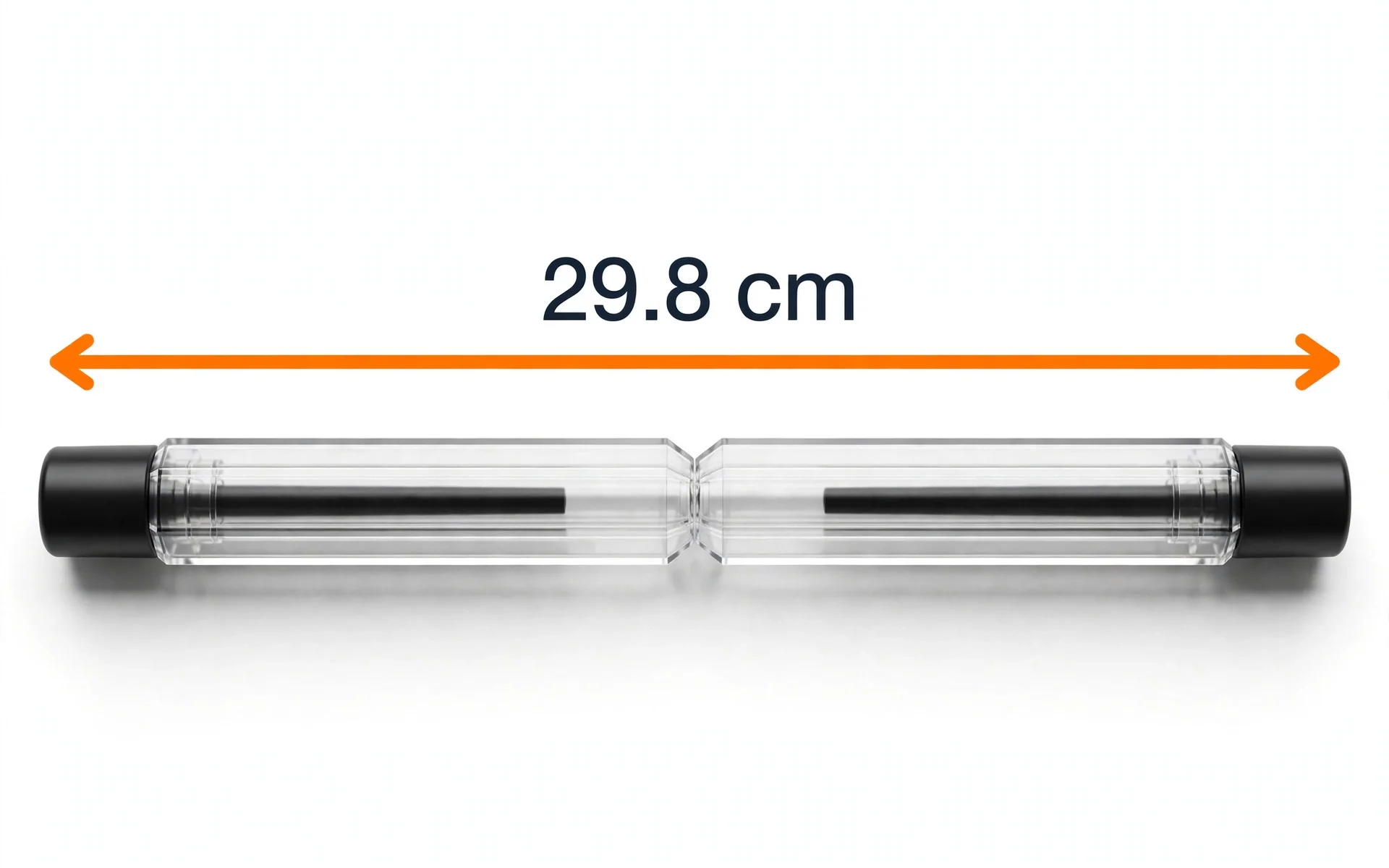
The two pens are the article’s closest miss, and the cheapest one: two ballpoint pens from a desk drawer, capped, laid end to end. The BIC Cristal is 14.9 cm long with its cap on — the Museum of Modern Art’s design-collection record gives the dimensions as 14.9 × 1.3 cm for the pen it holds as a design object — so two of them end to end run 29.8 cm, which is 2 mm short of 30 cm. Two millimetres is the thickness of a coin edge, or the width of the line a pen draws, and it is the smallest miss on this page after the ruler itself.
The fitting check is the cap, because the 14.9 cm is the capped length and the pen is shorter without it. Uncap both pens and the pair loses the length of two caps; cap one and not the other and the pair is neither 29.8 cm nor anything else you can name. The same rule applies to every object made of two parts: say which parts were measured, because the cap is part of the pen when it is on and part of the desk when it is off. The grade is listed because the figure is a published dimension for the named model, with the deviation printed in full: 29.8 cm, 2 mm short.
3. An A4 Sheet of Paper, Long Edge — 29.7 cm (EXACT)

The A4 sheet is the article’s most available miss, because there is one within arm’s reach of almost every reader. ISO 216 fixes A4 at 210 × 297 mm, with a tolerance of ±2 mm, so the long edge is 29.7 cm — 3 mm short of 30 cm, about the thickness of a matchstick. Hold a sheet upright and its long edge is the closest thing to 30 cm in the office, which is why it is the first thing people reach for when they need to picture the number, and why it is also the first thing they get wrong by 3 mm.
The fitting check is the paper size, because A4 is not the only sheet in the drawer. A3’s short side is also 29.7 cm — the same figure, a different sheet — and US Letter is 27.9 cm long, which is 2.1 cm short of 30 cm, so a Letter sheet is a worse anchor by a visible margin. The lead rival page uses A3’s short side for its 29.7 cm and calls it an “exactly 30 cm” object; it is not exact, it is 3 mm short, and the 3 mm is printed here instead of rounded away. The grade is exact because the figure is the standard’s own dimension for the named size, with the deviation printed in full: 29.7 cm, 3 mm short.
4. A 13-inch MacBook Air — Width 30.41 cm (EXACT)

The MacBook Air is the article’s most precise overshoot, and the one that shows why a model name is worth more than a category. Apple’s own technical specifications list the 13-inch MacBook Air at a width of 30.41 cm — 11.97 inches — with a depth of 21.5 cm and a height of 1.13 cm. Close the lid and measure across the front edge and the laptop spans 30.41 cm, which is 4.1 mm past 30 cm — about the width of a pencil eraser — and the same on every 13-inch MacBook Air of this generation, because the enclosure is the product.
The fitting check is the model, because the width belongs to the 13-inch MacBook Air and not to laptops in general. A 15-inch MacBook Air is 33.9 cm wide, a 14-inch MacBook Pro is 31.3 cm, and a “small laptop” with no model attached is a guess, not a measurement — which is why a rival list’s “small laptops” entry cannot be verified and does not appear on this page. Buy a sleeve against “30 cm” and the MacBook Air fits with 4 mm to spare in width; buy one against “13-inch laptop” and you have bought a screen size, not a width. The grade is exact because the figure is the manufacturer’s own dimension for the named model, with the deviation printed in full: 30.41 cm, 4.1 mm over.
5. A 12-inch Vinyl LP Record — Diameter 30.48 cm (EXACT)

The LP record is the article’s roundest overshoot, because its 30 cm is a diameter, and the number comes from a format standard rather than a single manufacturer. A 12-inch vinyl LP is 12 inches across by the format’s own designation — 30.48 cm — and pressing-plant specifications list the diameter as 12 inches (30.48 cm) for the format. Hold one up and the disc spans 30.48 cm in every direction, which is 4.8 mm past 30 cm, the same 4.8 mm as the gap between 30 cm and a foot, because 12 inches is a foot and the record is a foot wide by name.
The fitting check is the pressing, because a real disc is not always exactly 12 inches. One pressing source measures finished discs at about 30.2 cm, a couple of millimetres under the nominal diameter, because vinyl shrinks slightly as it cools and the edge is trimmed — so the record is presented here as the 12-inch nominal standard, not as a guarantee that your copy measures 30.48 cm to the tenth of a millimetre. A sleeve bought against “12-inch” fits any LP; a frame bought against 30.48 cm needs the real disc measured first. The grade is exact for the nominal standard, with the pressing variation printed in full: 30.48 cm nominal, 4.8 mm over.
6. A Domino’s Medium Pizza — Diameter 30.48 cm (LISTED)

The medium pizza is the article’s tastiest overshoot, and the one that proves a menu size is a real measurement. Domino’s sells its medium pizza at 12 inches across — 30.48 cm — with the small at 10 inches, the large at 14 and the extra-large at 16, and the sizes were verified against Domino’s own online ordering menu at three stores in October 2026. Set a medium down on the table and it spans 12 inches edge to edge, which is 4.8 mm past 30 cm — the same 4.8 mm as the foot gap, because the pizza is a foot wide by the menu’s own number.
The fitting check is the hand, because a pizza is stretched by a person and not stamped by a machine. A medium that comes out of the oven at 12 inches can cool a few millimetres smaller, and one stretched generously can come out a few millimetres larger, so the 30.48 cm is the size Domino’s sells and not a promise about any single pizza on any single night. A rival list calls a 12-inch pizza pan “about 30 cm” and stops there; the pan is 12 inches, the pizza is 12 inches, and 12 inches is 30.48 cm, not 30. The grade is listed because the figure is the operator’s published size for the named product, with the deviation printed in full: 30.48 cm, 4.8 mm over.
7. Twelve US Quarters in a Row — 29.11 cm (EXACT)

The quarters are the article’s most checkable miss, because the number comes from the Mint and anyone with twelve coins can verify it on a kitchen table. The United States Mint lists the quarter dollar at a diameter of 0.955 inches — 24.26 mm — and twelve of them laid edge to edge run 12 × 24.26 mm = 291.12 mm, which is 29.11 cm. Line them up on a flat surface, push them together so no gaps show between the rims, and the row ends 8.9 mm short of 30 cm — about the width of a thumbnail, or the thickness of five quarters stacked.
The fitting check is the gap, because the 29.11 cm assumes the coins touch. Leave a hairline between each pair and the row grows by a millimetre per gap, and eleven gaps of a millimetre each add 11 mm — more than the 8.9 mm shortfall — which is how a careless row of quarters reaches 30 cm without any coin being the wrong size. A rival list claims twelve quarters “are 30 cm” and prints no figure at all; the Mint’s figure is 29.11 cm, and the 8.9 mm is printed here instead of rounded away. The grade is exact because the figure is the authority’s own dimension for the named coin, with the arithmetic shown and the deviation printed in full: 29.11 cm, 8.9 mm short.
8. Two US Dollar Bills, End to End — 31.19 cm (EXACT)
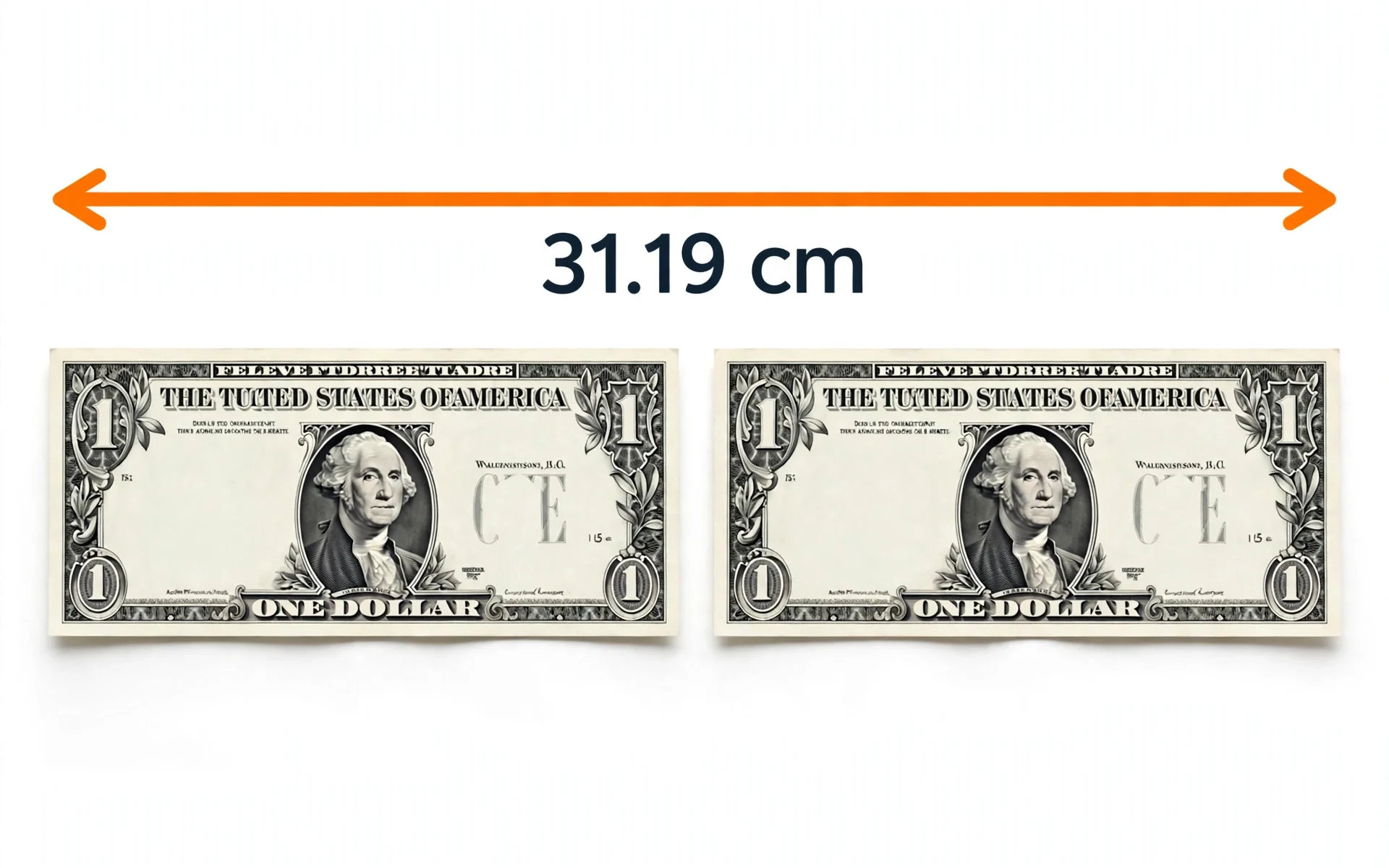
The dollar bills are the article’s furthest overshoot that still fits in a wallet, and the one that catches people who count in sixes. The Bureau of Engraving and Printing makes every US note 6.14 inches long — 15.6 cm — and the US Currency Education Program publishes the figure, so two bills laid end to end run 31.19 cm, which is 11.9 mm past 30 cm — about the width of a fingernail. Two bills are not 30 cm; they are a centimetre and a bit past it, and the extra centimetre is the difference between a measurement and a guess.
The fitting check is the count, because the arithmetic is unforgiving in both directions. One bill is 15.6 cm, which is about half of 30 cm, and two bills are 31.19 cm, which is past it — so there is no whole number of dollar bills that equals 30 cm, and a rival list that claims “two dollar bills are 30 cm” is 12 mm wrong in the direction that costs you a centimetre. Fold a bill and the length changes; crease one and it shortens by a millimetre or two, so the 31.19 cm assumes crisp, flat notes. The grade is exact because the figure is the authority’s own dimension for the named note, with the arithmetic shown and the deviation printed in full: 31.19 cm, 11.9 mm over.
9. One and a Half Unsharpened No. 2 Pencils — 28.6 cm (LISTED)

The pencils are the article’s furthest miss, and the weakest fit on the page — which is why it is last, and why the miss is printed largest. A new, unsharpened No. 2 — HB — pencil is 7.5 inches long, the trade standard, which is 19.05 cm; one and a half of them end to end run 28.6 cm, which is 14 mm short of 30 cm — about the length of a thumbnail, or the eraser and ferrule of the second pencil. Lay a whole pencil and a sawn half-pencil in a line and the pair ends visibly short of the mark, and “add a thumbnail” is the honest instruction for closing the gap.
The fitting check is the word “new”, because the 19.05 cm is the length before the pencil is ever used. Sharpen it once and it loses several millimetres; use it for a term and it loses centimetres, so a half-used pencil is nowhere near 30 cm and only fresh pencils from the box count — and a half-pencil is a workshop cut, not a thing you find in a drawer. The grade is listed rather than exact because no pencil maker publishes the unsharpened length as a formal specification for a named model, and the deviation is printed in full: 28.6 cm, 14 mm short.
How to Measure 30 cm Without a Ruler
| Method | What you get | How close it is |
|---|---|---|
| The long edge of an A4 sheet | 29.7 cm | 3 mm short — add a matchstick’s thickness |
| Two BIC Cristal pens, capped, end to end | 29.8 cm | 2 mm short — the closest household method |
| Twelve US quarters in a row, pushed tight | 29.11 cm | 8.9 mm short — add a thumbnail’s width |
| A 13-inch MacBook Air, closed, across the front | 30.41 cm | 4.1 mm over — the closest overshoot |
| A medium pizza box, edge to edge | 30.48 cm | 4.8 mm over — the box is 12 inches, like the pizza |
The pens method is the best of the five, because the 2 mm miss is smaller than the width of a line and the pens are in almost every drawer. The A4 method is the most available, because the paper is a standard and the 3 mm is fixed. The quarters method is the most checkable, because the Mint’s 24.26 mm diameter is a specification you can look up. The laptop method is the one to use when you need an overshoot rather than a shortfall — measure the thing against the laptop’s width and cut 4 mm inside it. 15 cm is half of 30 cm, so two 15 cm lengths end to end make the mark exactly; 17 cm is 13 cm short of 30 cm. 30 inches is two and a half feet — a different scale from the 30 cm on this page, and the easiest way to confuse the two.
The Footlong Lesson: When 12 Inches Isn’t 12 Inches
In 2013, Subway was sued because its Footlong sandwiches did not measure 12 inches. Customers measured them at about 11 inches, and the case ended with Subway committing to make its Footlongs a full 12 inches — 30.48 cm — at every store. The sandwiches had been sold by a name that sounded like a measurement, and the name had drifted from the tape.
The lesson is the same one this article is built on: a name is not a measurement until somebody puts a ruler to it. “Footlong” was a product name. “Twelve inches” is a measurement. “Thirty centimetres” is a measurement. The distance between the name and the tape was about an inch, which is why the lawsuit happened, and why every object on this page carries the number its source actually publishes rather than the number its name suggests. A medium pizza is 12 inches because the menu says 12 inches; a footlong is 12 inches because a court made it so; and 30 cm is 11.81 inches because arithmetic says so, whatever the menu calls it.
What 30 cm Is NOT
| What people say | What it actually measures | The difference |
|---|---|---|
| 30 cm is precisely 11.8 inches | 30 cm is 11.81 inches | “Precisely 11.8” contradicts itself — 11.8 is a rounding |
| Six golf tees make 30 cm | A standard golf tee is about 7 cm, so six are about 42 cm | 12 cm over — the rival arithmetic is wrong |
| A box fan is about 30 cm | A common 20-inch box fan is about 51 cm across | About 21 cm over |
| A standard ruler is 30 cm end to end | The scale is 30 cm; the body is usually 31–32 cm | The body is longer than the scale |
| 30 cm is a foot | A foot is 30.48 cm | 30 cm is 4.8 mm short of a foot |
| A laptop keyboard is 30 cm | Keyboards vary by model; only a named model counts — the 13-inch MacBook Air is 30.41 cm wide | No standard keyboard width exists |
Two of these deserve a longer correction. The golf tees are the worst arithmetic on any rival page: a standard tee is roughly 7 cm long, so six of them end to end are roughly 42 cm, not 30 — the claim fails by 12 cm, which is more than a third of the number it is trying to illustrate. And the “precisely 11.8 inches” is the worst wording: 11.8 is a rounding of 11.811, and a rounding cannot be precise, so the honest figure is 11.81 inches, or 11 13/16 on a tape measure.
30 cm in Every Unit
| Unit | Value |
|---|---|
| Millimetres | 300 mm |
| Metres | 0.3 m |
| Inches | 11.81 in (11 13/16 in) |
| Feet | 0.984 ft |
| Yards | 0.328 yd |
Thirty centimetres is three-tenths of a metre, and a metre is 100 cm, so the conversion is a division by ten that never needs a calculator. In inches it is 30 divided by 2.54, which is 11.811 inches, rounded to 11.81 — and the rounding is honest, because 11.81 inches times 2.54 is 29.997 cm, three hundredths of a millimetre from the mark. Twenty centimetres is two-thirds of 30 cm, and 10 cm is a third of it, which is why the two sizes sit next to each other in cookware ranges and on ruler scales; a foot is 30.48 cm, which is why 30 cm is always just short of one.
Frequently Asked Questions
Is 30 cm equal to 12 inches?
No. Thirty centimetres is 11.81 inches, and 12 inches is 30.48 cm, so 30 cm falls 4.8 mm short of 12 inches. Call it “just under a foot” and you are right; call it “a foot” and you are 4.8 mm wrong, which matters when the thing has to fit.
How many inches is 30 cm?
Thirty centimetres is 11.81 inches, or 11 13/16 inches on a tape measure. The conversion is 30 divided by 2.54, because one inch is defined as exactly 2.54 cm.
Is 30 cm the same as 1 foot?
No. Thirty centimetres is 0.984 feet — 4.8 mm, or about 3/16 of an inch, short of a foot. A foot is 12 inches, and 12 inches is 30.48 cm.
How many millimetres are in 30 cm?
Three hundred millimetres. One centimetre is 10 millimetres, so 30 cm is 30 × 10 = 300 mm, and the figure is exact rather than rounded.
What does 30 cm look like in real life?
It looks like a standard school ruler’s scale, an A4 sheet 3 mm shorter than the mark, or a 13-inch MacBook Air 4 mm wider than it. Any one of those three is a better picture than a number on a screen, and the ruler is the one you already own.
How can I measure 30 cm without a ruler?
Lay two capped BIC Cristal pens end to end for 29.8 cm, or take the long edge of an A4 sheet for 29.7 cm, or line up twelve US quarters edge to edge for 29.11 cm and add a thumbnail’s width. A medium pizza box, edge to edge, is 12 inches — 30.48 cm, 4.8 mm over.
How big is 30 cm in feet and inches?
Thirty centimetres is 0 feet 11.81 inches — just under a foot, and 11 13/16 inches on a tape measure.
Is a standard ruler 30 cm long?
The scale runs 0–30 cm, yes. The plastic or wood body is often a few millimetres longer, so measure from the 0 mark, not from the edge of the ruler, or you will read long.
Final Thoughts
Thirty centimetres is a length that lives 4.8 mm from a foot, and the 4.8 mm is the whole article. The nine objects that measure it — a ruler’s scale, two pens, a sheet of paper, a laptop, a record, a pizza, twelve quarters, two dollar bills and a pencil and a half — are all things you can find tonight without buying anything, and every one of them carries the number its source actually publishes, with the miss printed next to it. That is the difference between a measurement and a slogan: the measurement can be checked, and the slogan cannot.
The habit worth keeping is the one this article is built on. Do not take the round number, and do not take the name. Ask which edge was measured, look up the specification, and print the miss when there is one. A footlong that measures 11 inches is a lawsuit; a shelf cut at 30 cm for a 12-inch slot is a gap you can see from across the room; and a ruler measured from the 0 mark is 30 cm, exactly, every time.
