
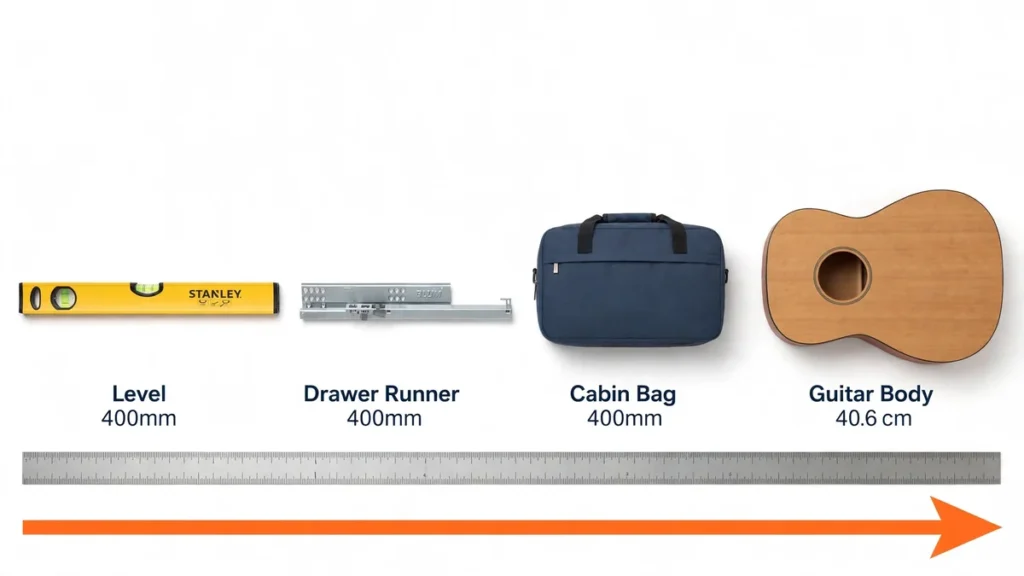
The gate agent is holding the metal sizer, and your bag is either going to slide into it or it is not. There is no arguing with the frame, no repacking that buys you a centimetre, and no “nearly” that counts — the sizer is a box, the bag is a shape, and one of them wins. That is the moment when the question stops being abstract: how big is 40 cm, really, when the answer is the difference between flying free and paying at the gate?
Forty centimetres is 15.75 inches, 400 millimetres, and 0.4 metres — and it is the longest side of the free bag every Ryanair fare includes, which is why the sizer’s longest side is exactly 40 cm. The eight objects below are the closest honest answers to it: three land on 40 cm exactly, three miss by 6.4 millimetres, and two miss by 2 centimetres, with every miss printed in full and every figure traced to the source that publishes it.
Quick Answer
40 cm is 15.75 inches — the size that decides whether things fit.
Forty centimetres is 15.75 inches, 400 millimetres, and 0.4 metres. Three objects land on it exactly — a Stanley level, a Blum drawer runner and a Ryanair personal bag — and five more miss by 6.4 millimetres to 2 centimetres, with the miss printed in full.
The bar above shows forty 1 cm segments, but it is a diagram, not a ruler: screen sizes vary, so it explains the measurement rather than measuring it. For a real measurement, use the objects below or a tape measure.
Why 40 cm Is a “Standard Size”
Four hundred millimetres is a manufacturing module. Toolmakers build spirit levels in 400 mm because it is a useful working length and a round number in the system the factory already uses; furniture hardware is sold by nominal length, and 400 mm is one of the standard steps in the Blum range, which runs in 50 mm increments; and an airline that needs a personal-item limit picks a number its sizers can be built to and its passengers can remember. Three unrelated industries landing on the same number is not a coincidence — it is what happens when everyone works in tens and hundreds.
The number also survives because it is easy to halve and double. Half of 40 cm is 20 cm, and double it is 80 cm, so a 400 mm level is two 200 mm rules, a 400 mm drawer runner is twice a 200 mm one, and a shelf cut at 40 cm takes exactly two of the 20 cm boards a shop sells. Round numbers in a decimal system get used more, and used numbers get standardised, and standardised numbers get built into sizers, catalogues and spec sheets — which is why a length that looks arbitrary turns out to be one of the most repeated measurements in a home, a workshop and an airport.
How to Read the Eight Objects Below
The eight objects are ordered by how close they land on 40 cm, closest first, and each one carries its evidence grade in the heading. EXACT means the figure is a standard’s or an authority’s own dimension for the named thing. LISTED means the figure is the manufacturer’s or operator’s published specification for the named model. AVERAGE means the figure is an authority’s published average or range for the named thing. REPORTED means the figure is the largest verified measurement an expert source reports for the named thing. Three of the eight land on 40 cm exactly, three miss by 6.4 mm, and the last two miss by 2 cm — and the point of the ordering is that the miss grows as you read, so the last object is the one that stretches the number furthest.
A published 40 cm designation does not mean every manufactured unit measures mathematically 40.000 cm. Levels are sold by a nominal length, backpacks by a height that varies with how full they are, guitars by a body width that is exact for the model and not for every instrument ever built to the shape. What follows is what the source actually says, with the axis named every time, so you can check it yourself.
1. A Stanley Classic Box Level STHT1-43102 — 400 mm (EXACT)

The Stanley level is the article’s cleanest land-on, because its 400 mm is not a measurement of a thing that happens to be 40 cm long — it is the thing itself, a tool sold by its length. The Stanley catalogue lists the STHT1-43102 at 400 mm, with two vials, and the 400 mm is the length of the box from end cap to end cap. Lay it on a wall and the distance from one end to the other is 40 cm by designation, not by luck, and the same on every STHT1-43102 ever sold, because the length is the product code’s promise.
The fitting check is the model number, because Stanley sells the same Classic box level in 300, 400, 600, 900 and 1200 mm, and only the 400 mm one is 40 cm. A 600 mm level is half as long again, a 300 mm one is a quarter short, and a level with no model number attached is a guess, not a measurement — which is why the anonymous “400 mm spirit level” on a rival list cannot be verified and does not appear on this page. Buy the STHT1-43102 and the level is 40 cm; buy “a spirit level” and it is whatever length the shelf had. The grade is exact because the figure is the manufacturer’s own catalogue dimension for the named model, with the deviation printed in full: 400 mm, 0.0 cm from 40 cm.
2. A Blum MOVENTO Drawer Runner 760H4000S — 400 mm Nominal Length (EXACT)
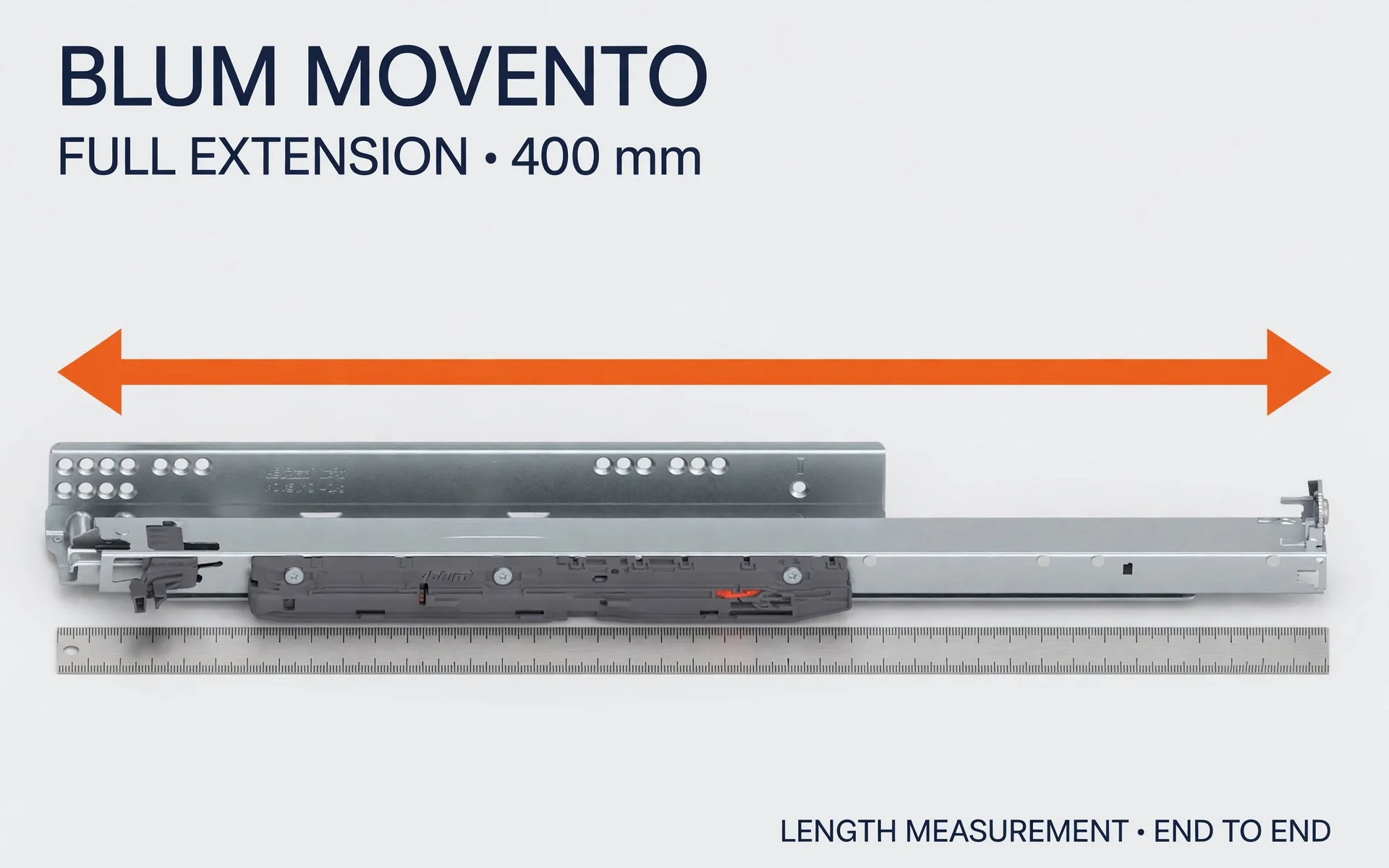
The Blum runner is the article’s second land-on, and the one that shows why a part number is worth more than a category. Blum’s catalogue lists the 760H4000S at nominal length 400 — the “4000” in the part number is the length in millimetres, so the runner is 40 cm long by its own name. Hold it against a cabinet side and the rail spans 400 mm from its front end to its back end, which is the dimension the cabinetmaker designs the drawer around.
The fitting check is the word “nominal”, because a drawer runner’s nominal length is the length of the closed rail, and the runner extends further when the drawer is pulled out. A 400 mm MOVENTO runner opens to roughly twice its closed length, so if you measure the extended rail you will read nearer 800 mm and conclude the catalogue is wrong — it is not; you measured the wrong state. Buy a 400 mm runner for a 400 mm deep drawer and it fits; buy one for a 450 mm drawer and the drawer bottoms out 50 mm short of the back. The grade is exact because the figure is the manufacturer’s own catalogue dimension for the named part, with the deviation printed in full: 400 mm nominal, 0.0 cm from 40 cm.
3. A Ryanair Free Small Personal Bag — 40 × 30 × 20 cm (EXACT)
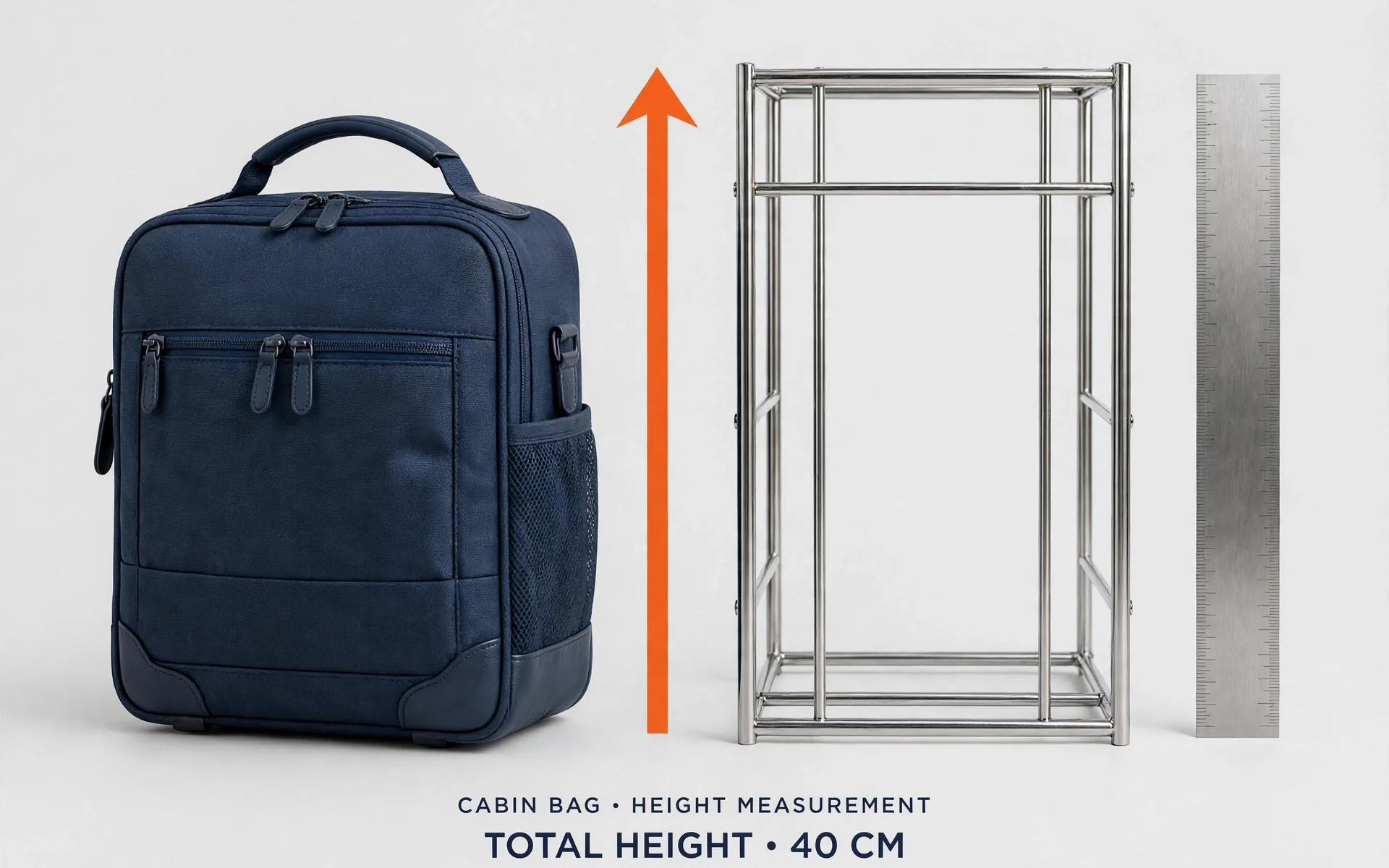
The Ryanair bag is the article’s third land-on, and the one that costs money when you get it wrong. Ryanair’s Help Centre states the free small personal bag is 40 × 30 × 20 cm, included on every fare, and it must fit under the seat in front of you and inside the metal sizer at the gate. The longest side is 40 cm, the width is 30 cm and the depth is 20 cm, and a bag that measures 40 cm on its longest side passes the test that matters — the sizer — provided the other two sides are within their limits too.
The fitting check is the date, because the size changed on 4 September 2025 from 40 × 20 × 25 cm to the current 40 × 30 × 20 cm, and older guides still print the old numbers. The longest side is still exactly 40 cm either way, but a bag built to the old depth of 25 cm is now 5 cm too deep, and a bag built to the old width of 20 cm wastes 10 cm of space you are allowed. A rival list calls 40 cm “the cabin luggage height cap” and it is not — most airlines allow 55 cm cabin bags, and 40 cm is only the free personal-item limit on fares like Ryanair’s. The grade is exact because the figure is the operator’s own published limit for the named allowance, with the deviation printed in full: 40 cm on the longest side, 0.0 cm from 40 cm.
4. A Taylor 214ce Grand Auditorium Guitar — Lower Bout Width 16 in, 40.64 cm (LISTED)
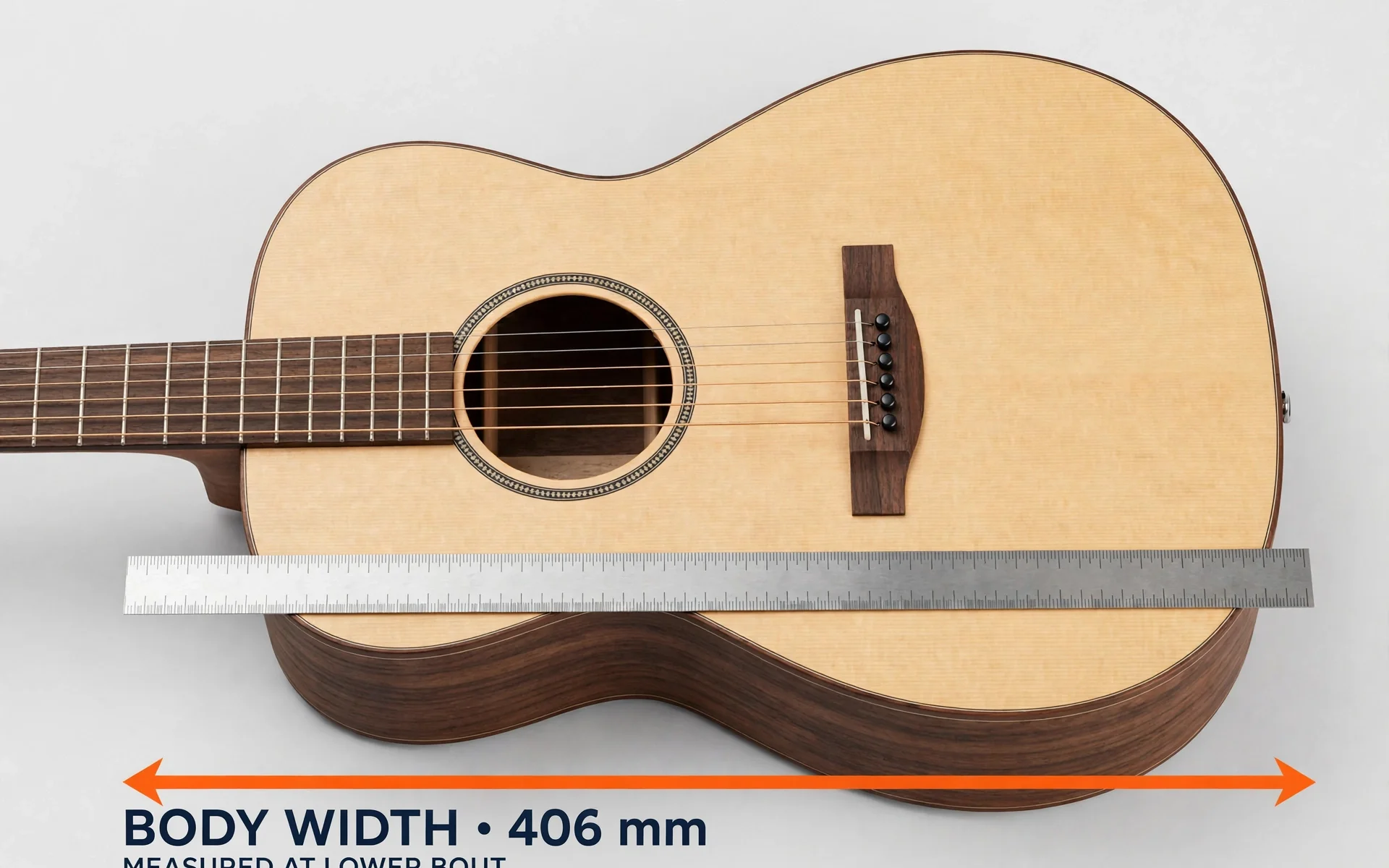
The Taylor is the article’s first honest near-miss, and the one that corrects a mistake two rival lists print. Taylor’s specification sheet lists the 214ce’s lower bout width at 16 inches (40.6 cm), with a body length of 20 inches and a depth of 4⅝ inches. Measure across the widest part of the body — the lower bout, the big curve at the bottom — and the guitar spans 16 inches, which is 40.64 cm, or 6.4 mm past 40 cm: about the thickness of a pencil.
The fitting check is the axis, because the 40 cm dimension on a guitar is the body width, not the neck. A guitar neck is about 46 cm from the nut to the body joint, so a rival list that calls the neck “about 40 cm” is 6 cm wrong in the direction that costs you a case that does not close. Buy a gig bag against “16-inch body width” and the 214ce fits; buy one against “40 cm guitar” and you have bought a number, not a dimension. The grade is listed because the figure is the manufacturer’s published specification for the named model, with the deviation printed in full: 40.64 cm, 6.4 mm over.
5. A Pearl Export 16 × 16 Floor Tom — Diameter 16 in, 40.64 cm (LISTED)
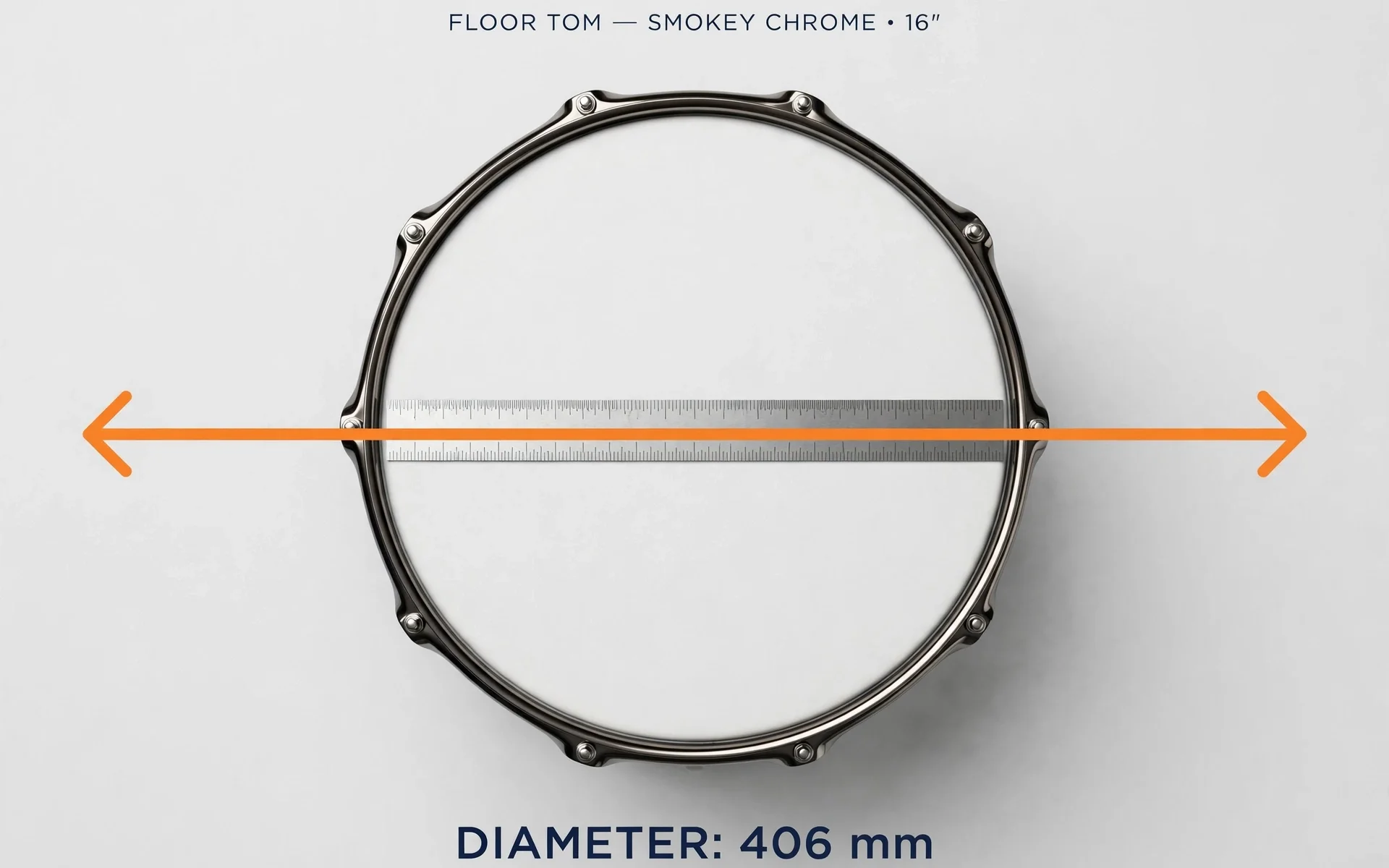
The floor tom is the article’s second 6.4 mm overshoot, and the one that shows why drum sizes are read diameter first. Pearl’s specification lists a 16 × 16 floor tom in the Export range — 16 inches in diameter and 16 inches deep — and drum naming is always diameter × depth, so the 16-inch figure is the width across the drumhead. Lay a tape across the head, rim to rim, and the drum spans 16 inches, which is 40.64 cm, or 6.4 mm past 40 cm.
The fitting check is the configuration, because not every Export kit carries a 16-inch floor tom. The fusion and rock configurations ship with the 16 × 16, while the studio configuration ships with a 14 × 14, which is 35.56 cm — 4.4 cm short of 40 cm — so the model number on the kit matters as much as the brand on the badge. A 16-inch drum head is the same 16 inches as the Taylor’s body width, which is why both objects sit at the same 40.64 cm, and why both of them are the honest answer to “about 40 cm” rather than the exact one. The grade is listed because the figure is the manufacturer’s published specification for the named configuration, with the deviation printed in full: 40.64 cm, 6.4 mm over.
6. Two US Standard Bricks, End to End — 2 × 8 in, 40.64 cm (LISTED)

The two bricks are the article’s third 6.4 mm overshoot, and the cheapest measuring tool on the page. The Brick Industry Association specifies the standard brick at 3⅝ × 2¼ × 8 inches, so two standard bricks laid end to end run 2 × 8 inches = 16 inches, which is 40.64 cm — 6.4 mm past 40 cm, about the thickness of a pencil. Push them together so no gap shows between the ends and the pair is the closest thing to 40 cm in a builder’s yard.
The fitting check is the word “standard”, because a modular brick is 7⅝ inches long, not 8, and two modular bricks end to end run 38.74 cm — 1.26 cm short of 40 cm, in the opposite direction. A rival list that says “two bricks are 40 cm” without naming the brick is wrong by whichever brick you happen to pick up. Check the brick first: if it measures 8 inches, the pair is 40.64 cm; if it measures 7⅝, it is a modular brick and the pair is not. The grade is listed because the figure is the authority’s published dimension for the named standard, with the deviation printed in full: 40.64 cm, 6.4 mm over.
7. A Fjällräven Kånken Classic Backpack — Height 38 cm (LISTED)
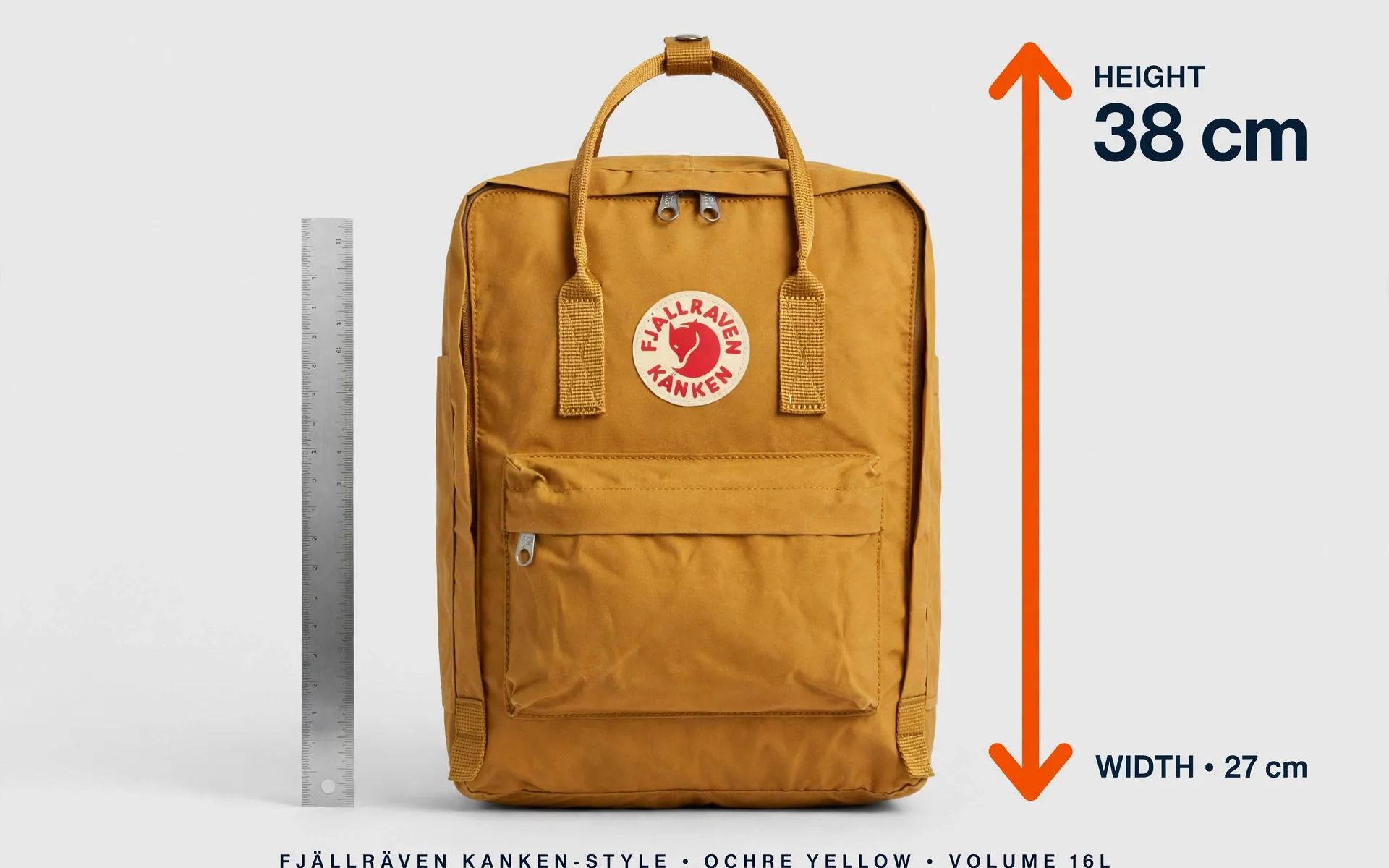
The Kånken Classic is the article’s furthest shortfall that still belongs on the page, and the one that proves why the manufacturer’s own page is the only source that counts. Fjällräven’s own Kånken size guide lists the Classic at 38 × 27 × 13 cm, with a volume of 16 litres, so the pack stands 38 cm tall — 2 cm short of 40 cm, about the width of a thumb. Stand it upright and measure from the base to the top of the main compartment and the pack ends visibly short of the mark, which is exactly why it is here: a famous backpack that looks 40 cm tall and is not.
The fitting check is the model, because the Kånken family has two different heights and the wrong one is the trap. The Kånken Laptop 15 was listed at 40 cm in older size guides, but Fjällräven’s live product page now lists it at 38 cm tall — 38 × 26 × 17 cm — so a writer who quoted the old guide would print 40 cm for a pack that measures 38. The Classic is the honest entry: 38 cm, listed, with the 2 cm printed in full, and the lesson is to check the live page rather than the guide you saved last year. The grade is listed because the figure is the manufacturer’s published dimension for the named model, with the deviation printed in full: 38 cm, 2.0 cm short.
8. An A3 Sheet of Paper, Long Edge — 420 mm (EXACT)
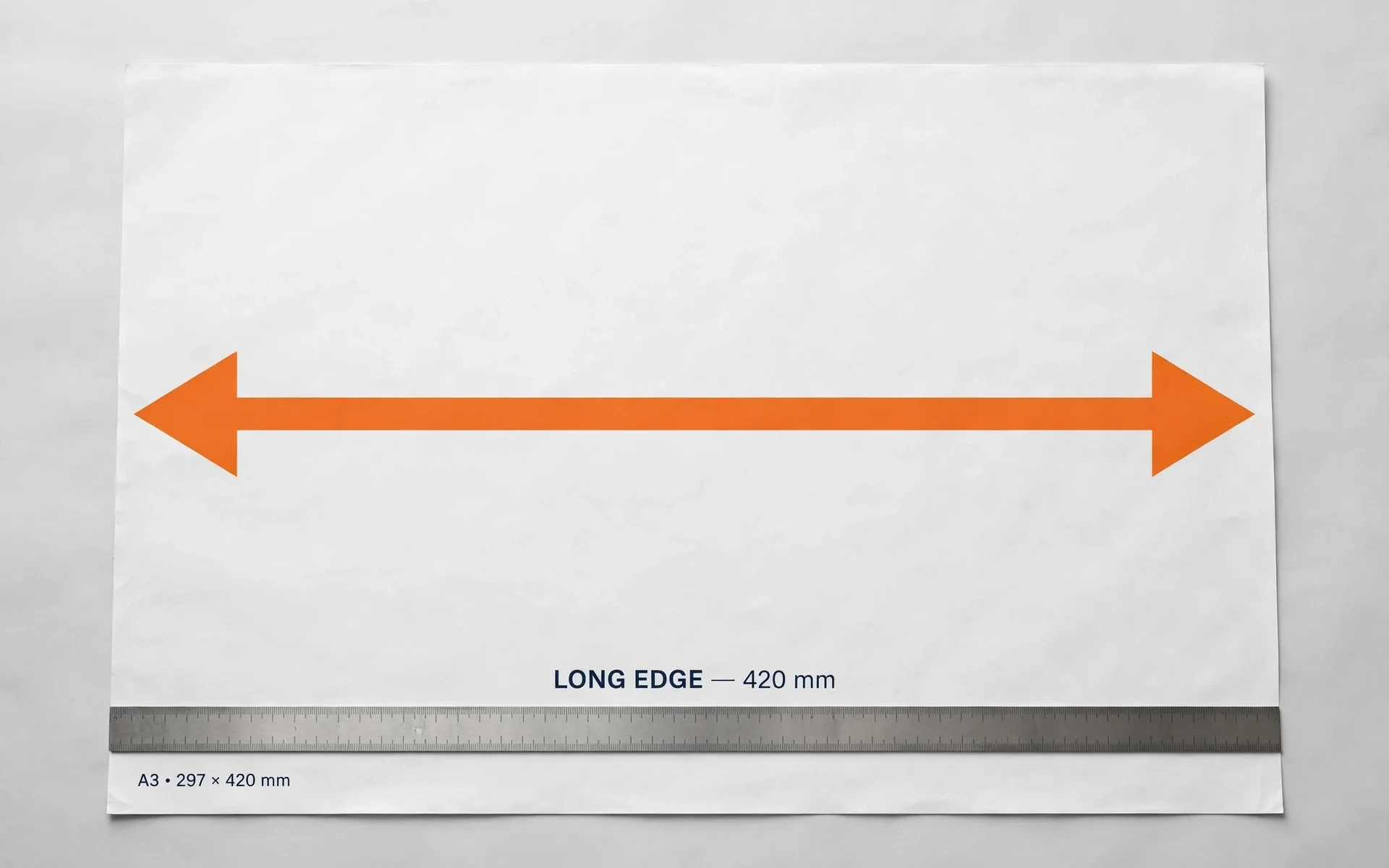
The A3 sheet is the article’s furthest overshoot, and the most available one. ISO 216 fixes A3 at 297 × 420 mm, and Adobe’s A3 guide gives the sheet as 297 × 420 mm, so the long edge is 42.0 cm — 2 cm past 40 cm, about the width of a thumb. Hold a sheet upright and its long edge is the closest thing to 40 cm in the office, which is why it is the last thing people reach for when they need to picture the number, and why it is also the one they get wrong by the most.
The fitting check is the fold, because A3 is exactly twice A4: fold an A3 sheet in half along its long edge and you get an A4 sheet, 210 × 297 mm, and the A4’s long edge is 29.7 cm. That is the teaching point — a 40 cm measurement is an A3 sheet with 2 cm cut off, or an A4 sheet with 10.3 cm added — and it is also the reason the two sizes sit next to each other in this series: the 30 cm article used A4, and this one uses its parent sheet. The grade is exact because the figure is the standard’s own dimension for the named size, with the deviation printed in full: 42.0 cm, 2.0 cm over.
The 16-Inch Trap: Why 16 Inches Is NOT 40 cm
Sixteen inches is 40.64 cm, and 40 cm is 15.75 inches, and the 6.4 mm between them is the trap this article is built to catch. It is a quarter of an inch — the width of a pencil — and it is the reason three of the objects above are listed at 40.64 cm rather than 40 cm. A tape measure that reads in sixteenths will show 40 cm at 15¾ inches, the closest mark — 15.75 inches is 40.005 cm, five hundredths of a millimetre past the mark; 16 inches on the same tape is a quarter-inch further along, and the quarter-inch is the gap.
The trap matters exactly when the thing has to fit. A 400 mm drawer runner in a 16-inch-deep cabinet leaves 6.4 mm of slack, which is fine; a 16-inch-wide guitar in a 40 cm case does not fit at all, because the case is 6.4 mm too narrow. When 6.4 mm matters — drawer runners, sizers, cases — measure in the unit the thing was built in; when it does not — picturing a length, estimating a shelf — 16 inches is a fair picture of 40 cm, provided you say so. The honest sentence is “16 inches is 6.4 mm past 40 cm”, and every object on this page that measures 16 inches carries that sentence with it.
The Fit Test: Where 40 cm Decides Yes or No
Forty centimetres is the size that decides whether things fit, and the test is always the same: the thing either goes in or it does not. At the Ryanair gate the test is the sizer — a bag 40 cm on its longest side slides in, a bag 42 cm does not, and the fee is the price of the 2 cm. In a kitchen the test is the drawer — a 400 mm runner needs a cabinet at least 400 mm deep, and a 380 mm cabinet is 20 mm too shallow, so the runner never reaches the back. On a wall the test is the shelf — a 400 mm level marks a 40 cm line, and a bracket drilled at 16 inches sits 6.4 mm past it, which is enough to see.
The buying checklist is short. Measure the space first, in the unit the product is sold in. Check the model number, not the category — a 400 mm runner and a 450 mm runner look identical on a shelf. And remember that a sizer has no tolerance: a bag that is 40 cm on its longest side passes, a bag that is 40 cm on its longest side plus a handle that sticks out 2 cm does not, because handles and wheels count unless the airline says otherwise. The fit test has no rounding.
How to Measure 40 cm Without a Ruler
| Method | What you get | How close it is |
|---|---|---|
| Two US standard bricks, end to end | 40.64 cm | 6.4 mm over — the closest household method |
| An A3 sheet, long edge, minus 2 cm | 40.0 cm | Exact if you mark the 2 cm off |
| A Kånken Classic, height, plus 2 cm | 40.0 cm | Exact if you add a thumb’s width on top |
| A hand span, thumb tip to little-finger tip | About 20–23 cm for most adults, so two spans | Rough — measure your own span first and write it down |
The bricks method is the best of the four, because the 6.4 mm miss is smaller than the width of a pencil and the bricks are in almost every garden. The A3 method is the most available, because the paper is a standard and the 2 cm is fixed. The Kånken method is the one to use when you need a shortfall rather than an overshoot — measure the thing against the pack’s height and add 2 cm. The hand-span method is the roughest: a span varies by centimetres between people, so measure yours once, write the number on the inside of a cupboard door, and never trust anyone else’s span. What none of these methods is: counting finger widths. Five groups of four fingers is not 40 cm, because fingers are not a standard, and a rival list that prints finger arithmetic is printing a guess with numbers on it.
40 cm vs 30 cm vs 50 cm
| Size | Inches | What it fits |
|---|---|---|
| 30 cm | 11.81 in | A school ruler, an A4 sheet, a medium pizza |
| 40 cm | 15.75 in | A 400 mm level, a Ryanair personal bag, a 16-inch guitar body |
| 50 cm | 19.69 in | A large pizza box, a small suitcase side, a newborn’s length |
Thirty centimetres is 10 cm short of 40 cm, and 50 cm is 10 cm past it, so the three sizes sit a hand’s width apart and the jobs split cleanly between them. Thirty is the ruler size, the size you carry; 40 is the fit size, the size things are built to; 50 is the carry size, the size you lift with two hands. 15 cm is 25 cm short of 40 cm, which is why a 15 cm object never helps you picture 40 — it is barely more than a third of it. If you are choosing between the three, the question is not which is closest to the thing you own but which side of the fit the thing sits on: under 40 cm it fits the sizer, over 40 cm it does not.
40 cm in Every Unit
| Unit | Value |
|---|---|
| Millimetres | 400 mm |
| Metres | 0.4 m |
| Inches | 15.75 in (15¾ in) |
| Feet | 1.31 ft |
| Yards | 0.437 yd |
Forty centimetres is four-tenths of a metre, and one metre is 100 cm, so the conversion is a division by ten that never needs a calculator. In inches it is 40 divided by 2.54, which is 15.748 inches, rounded to 15.75 — and the rounding is honest, because 15.75 inches times 2.54 is 40.005 cm, five hundredths of a millimetre from the mark. Twenty centimetres is half of 40 cm, and 10 cm is a quarter of 40 cm, which is why the sizes sit next to each other in tool ranges and on ruler scales. Do not confuse 40 cm with 40 inches: 40 inches is 101.6 cm, more than two and a half times as long, and the confusion is the most expensive one on this page — a 40-inch shelf is a metre long, and a 40 cm shelf is not.
Frequently Asked Questions
Is 40 cm the same as 16 inches?
No. Forty centimetres is 15.75 inches, and 16 inches is 40.64 cm, so 40 cm falls 6.4 mm short of 16 inches. Call it “just under 16 inches” and you are right; call it “16 inches” and you are 6.4 mm wrong, which matters when the thing has to fit.
How many inches is 40 cm?
Forty centimetres is 15.75 inches, or 15¾ inches on a tape measure. The conversion is 40 divided by 2.54, because one inch is defined as exactly 2.54 cm.
How long is 40 cm in feet?
Forty centimetres is about 1.31 feet — a little over one foot. A foot is 12 inches, and 12 inches is 30.48 cm, so 40 cm is 9.52 cm past a foot.
Is 40 cm longer than a standard ruler?
Yes, 10 cm longer than a 30 cm school ruler. A standard ruler’s scale runs 0–30 cm, so 40 cm is the ruler plus a third of another ruler — and that third is 10 cm, not a guess: 30.48 cm plus 10.16 cm is 40.64 cm, not 40, so one ruler plus a third of a 12-inch ruler overshoots by 6.4 mm.
What is 40 cm in millimeters?
Four hundred millimetres exactly. One centimetre is 10 millimetres, so 40 cm is 40 × 10 = 400 mm, and the figure is exact rather than rounded.
Can I take a 40 cm bag on Ryanair for free?
Yes. The free small personal bag on every Ryanair fare is 40 × 30 × 20 cm, the current size since 4 September 2025, and it must fit under the seat in front of you and inside the sizer at the gate. There is no published weight limit for it.
How can I measure 40 cm without a ruler?
Lay two US standard bricks end to end for 40.64 cm, or take the long edge of an A3 sheet and mark 2 cm off it, or stand a Kånken Classic upright and add 2 cm above it. A hand span works only if you have measured your own span first.
Is 40 cm bigger than a foot?
Yes. Forty centimetres is 15.75 inches against 12 inches for a foot — about 3¾ inches longer, or 9.52 cm past the foot.
Final Thoughts
Forty centimetres is a length that decides whether things fit, and the fit is the whole article. The eight objects that measure it — a level, a drawer runner, a cabin bag, a guitar, a drum, two bricks, a backpack and a sheet of paper — are all things you can find tonight without buying anything, and every one of them carries the number its source actually publishes, with the miss printed next to it. Three land on 40 cm exactly, three miss by 6.4 mm, and two miss by 2 cm, and the mean miss across all eight is 0.74 cm — under a centimetre, with nothing further than 2 cm out.
The habit worth keeping is the one this article is built on. Do not take the round number, and do not take the name. Ask which edge was measured, look up the specification, and print the miss when there is one. A bag that measures 40 cm on its longest side flies free; a bag that measures 42 cm costs you a fee at the gate; and a ruler measured from the 0 mark is 40 cm only if the ruler is 400 mm long — which is why the level, the runner and the bag are the three that land on it exactly, and why the rest are honest near-misses with their numbers in the open.
