
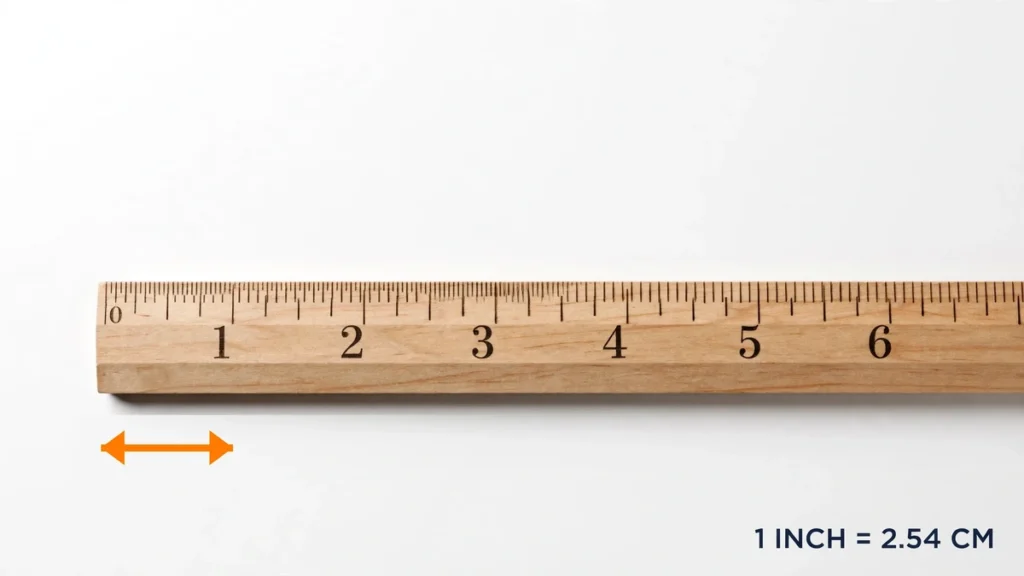
How long is an inch? One inch is exactly 2.54 centimeters — 25.4 millimeters, one-twelfth of a foot, and one-thirty-sixth of a yard. It is the small unit behind screen sizes, tire rims, pipe fittings, and rainfall totals, and it is the base unit the whole imperial length system is built on.
This guide answers the question properly: the exact definition and why it is exact, the conversions you actually need, a short history of where the inch came from, where you still meet it every day, and how to measure it without the usual mistakes. Then comes the complete directory — every inches size guide on this site, from 1 inch to 100 inches, in one place.
How long is an inch?
One inch is exactly 2.54 centimeters (25.4 millimeters) — one-twelfth of a foot. On a ruler, it is the span from the zero mark to the 1 mark.
Total: 1 inch
The scale explains the measurement but is not physically calibrated on every screen. Screen size and browser zoom can change its displayed length.
What Is an Inch, Exactly?
An inch is a unit of length in the British imperial and United States customary systems of measurement. It is defined as one-twelfth of a foot and one-thirty-sixth of a yard. Its international symbol is in, and it is also written with a double prime: ″. So 5 feet 7 inches can be written as 5′ 7″, with a single prime for feet and a double prime for inches.
On an imperial ruler, the inch is divided into halves, quarters, eighths, and sixteenths — dyadic fractions with odd numerators, so you will see 3/8″ rather than 6/16″. Engineers and machinists usually work in decimals instead, commonly to three or four decimal places. Either way, the inch itself is not a rough estimate: it is defined exactly, and every larger imperial unit — the foot, the yard, the mile — is built from it.
If you have no ruler handy, the width of an adult thumb is a fair rough check for an inch. It is only an approximation, never a measurement, but it is where the unit started: in many European languages the word for "inch" is the same as the word for "thumb."
How Long Is an Inch in Centimeters, Millimeters, Feet, and Yards?
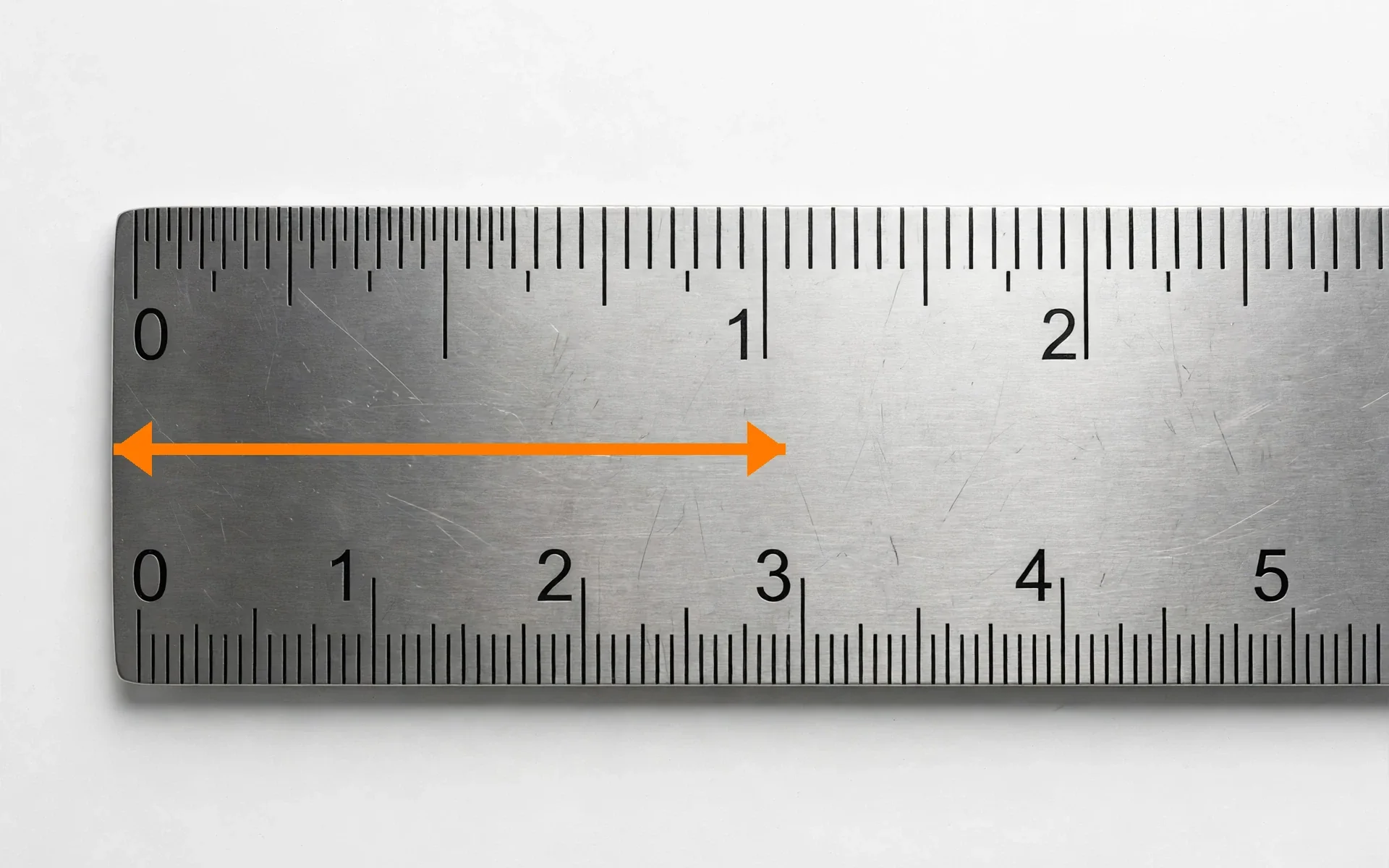
One inch converts exactly into metric units, because the inch is defined in metric terms. These are definitions, not measurements, so there is no rounding error in them:
| 1 inch equals | Value | Exact or rounded |
|---|---|---|
| Millimeters | 25.4 mm | Exact |
| Centimeters | 2.54 cm | Exact |
| Meters | 0.0254 m | Exact |
| Feet | 1/12 ft (0.08333 ft) | Exact fraction; decimal rounded |
| Yards | 1/36 yd (0.02778 yd) | Exact fraction; decimal rounded |
Going the other way, the factors are rounded for display:
| 1 unit equals | In inches | Exact or rounded |
|---|---|---|
| 1 millimeter | 0.03937 in | Rounded |
| 1 centimeter | 0.3937 in | Rounded |
| 1 meter | 39.37 in | Rounded |
| 1 foot | 12 in | Exact |
| 1 yard | 36 in | Exact |
The two formulas to remember are simple. To turn inches into centimeters, multiply by 2.54. To turn centimeters into inches, divide by 2.54. So 12 inches × 2.54 = 30.48 cm, and 100 cm ÷ 2.54 = 39.37 inches (rounded). Keep the full precision during a calculation and round only the final answer — rounding 2.54 down to 2.5 looks harmless, but at 100 inches it costs you a full 4 centimeters.
Why 2.54 Is Exact: The 1959 Definition
Before 1959, the inch was a physical thing rather than a definition, and different countries kept slightly different inches. The United States inch worked out to 25.4000508 mm; the British inch to 25.399977 mm. The difference was about two millionths of an inch — invisible on any ruler, but a real problem for precision engineering.
On 1 July 1959, the national standards bodies of the United States, the United Kingdom, Canada, Australia, New Zealand, and South Africa agreed that the international yard would be exactly 0.9144 meters. A yard is 36 inches, so one inch became 0.9144 ÷ 36 = 0.0254 meters — exactly 2.54 centimeters. The United Kingdom brought the definition into force on 1 January 1964, and it has not changed since.
The National Institute of Standards and Technology (NIST) lists the conversion as exact in NIST Special Publication 811, its guide for the use of the International System of Units. Because the factor is a definition rather than a measurement, it carries no uncertainty: any calculation that uses 2.54 introduces no conversion error of its own.
One loose end survived for decades: the old U.S. survey inch, defined as 1/39.37 of a meter, which surveyors kept using for land records. NIST retired the survey foot and survey inch on 1 January 2023, so today one inch is one inch everywhere in the United States — exactly 2.54 centimeters.
A Short History of the Inch
The word "inch" comes from the Latin uncia, meaning "a twelfth part" — the inch was the twelfth part of a foot, just as the ounce (uncia again) was the twelfth part of a Roman pound. Old English borrowed it as ynce, and it became the modern "inch." That shared root is why "inch" and "ounce" are cognates.
For centuries the inch was defined by whatever was at hand. The earliest known English reference, in the Laws of Æthelberht from the early 7th century, already uses the inch for fines measured by wound depth. In 1324, a statute of Edward II defined the inch as "three grains of barley, dry and round, placed end to end, lengthwise" — three barleycorns to the inch — and that definition stood for centuries. King David I of Scotland is said to have defined the Scottish inch around 1150 as the width of an average man's thumb at the base of the nail, taking the average of a small, a medium, and a large man's thumb.
The modern inch was fixed by industry, not by kings. In 1896, Carl Edvard Johansson invented gauge blocks for precision factory measurement, and in 1912 he began making them in inch sizes based on an inch of exactly 25.4 mm. His blocks were so widely adopted that they became the de facto standard: the British Standards Institution adopted the 25.4 mm inch in 1930, the American Standards Association followed in 1933, and by 1935 industry in 16 countries had adopted it. The 1959 agreement simply made that industrial inch the legal one.
Where You Still Meet Inches Every Day
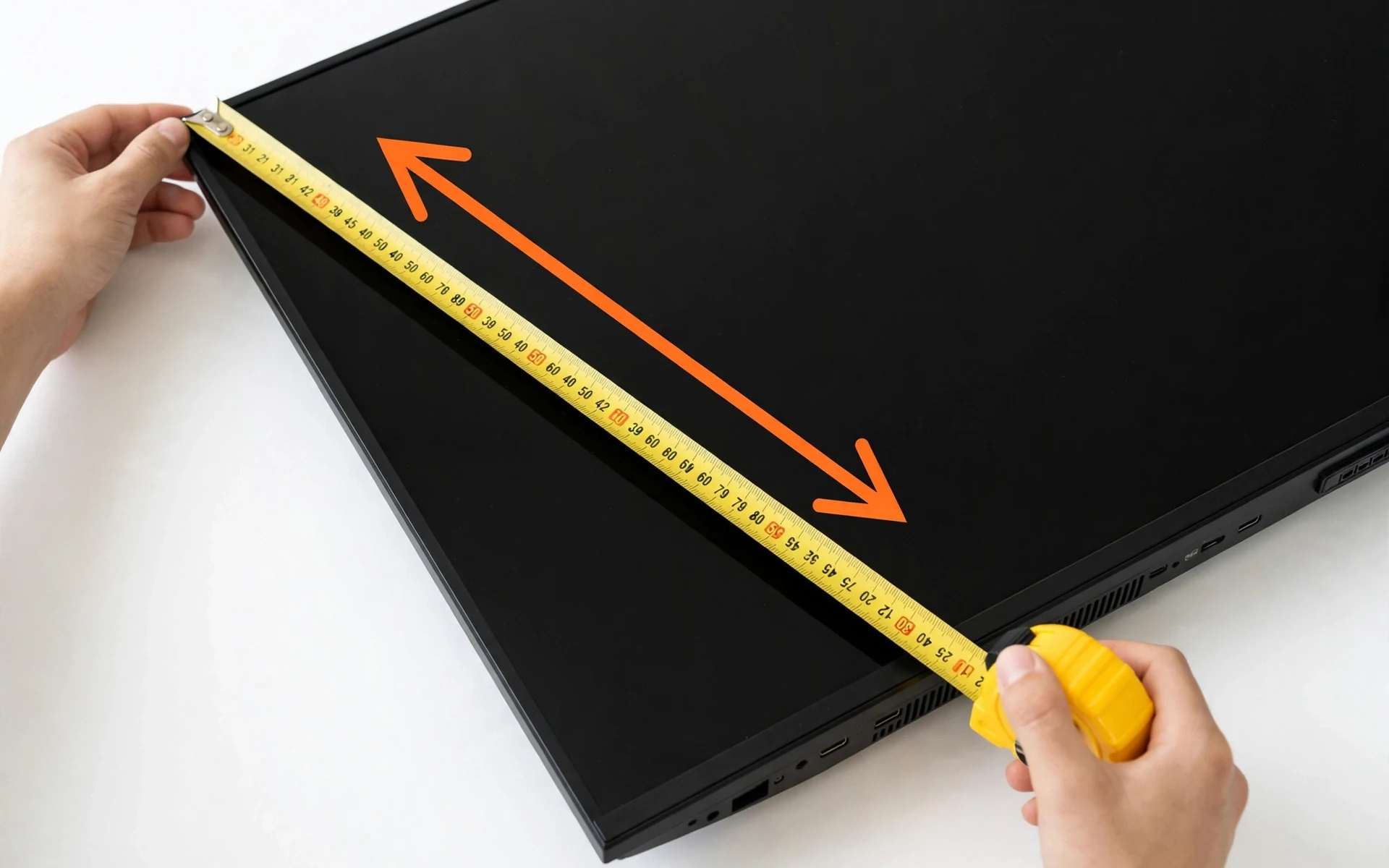
The inch survives because whole industries still measure in it. Television and computer screens are sold by their diagonal size in inches almost everywhere in the world — including in metric countries, where a 55-inch TV is still a 55-inch TV. Vehicle wheel rims are specified by diameter in inches, and the matching tire sizes follow. Many international pipe standards are derived from inch-based sizes. In the United States, rainfall is reported in inches, and in the United Kingdom the inch remains a primary unit for road-traffic signs.
That is why the inch matters even if you live in a metric country: you will meet it on a screen box, a tire sidewall, a plumbing fitting, or a product listing. Knowing that one inch is exactly 2.54 centimeters lets you convert any of those numbers without guessing.
How to Measure an Inch Correctly
Measuring an inch sounds too simple to get wrong, and that is exactly why it goes wrong. Three habits cover almost every mistake.
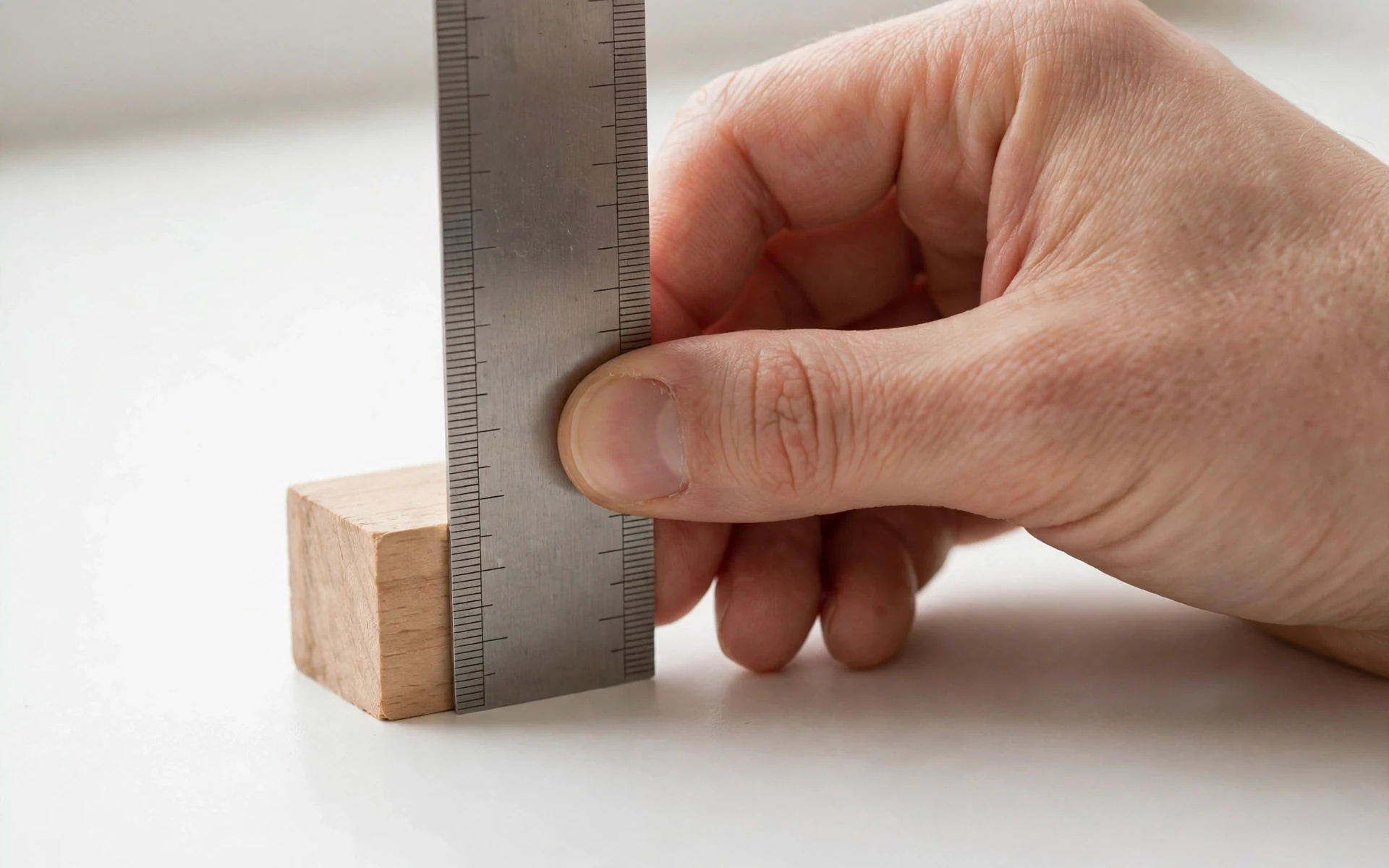
First, measure from the zero mark, not from the end of the ruler. The end of a wooden or steel ruler is a worn edge, not a measurement point — on many rulers the zero sits a little way in from the end. Line the zero up with one edge of what you are measuring, then read the other edge.
Second, read the right scale. A combination ruler carries inches on one edge and centimeters on the other, and the two scales start at the same end but count differently. If the number you read is about two and a half times what you expected, you are reading centimeters.
Third, match the precision to the job. For woodworking and DIY, the nearest sixteenth of an inch is usually enough. For engineering, use decimals. And when the length is a screen, measure diagonally from one corner of the visible display to the opposite corner — never across the width, and never including the bezel.
The Complete Inches Size Directory: 1 to 100 Inches

This directory links every inches size guide on ExactDimensionz — 37 guides covering 1 to 30 inches and the round tens from 40 to 100 inches. Each guide gives the exact conversions for its size and the real everyday objects verified at that length. Sizes 31 to 39 inches have no guide in this cluster, so the directory jumps from 30 to 40 inches.
1 to 10 Inches: Small Sizes
| Size | Centimeters | Millimeters | What the guide covers |
|---|---|---|---|
| 1 inch | 2.54 cm | 25.4 mm | The base unit itself — exact conversions and everyday objects that measure exactly one inch. |
| 2 inches | 5.08 cm | 50.8 mm | Double the base unit — conversions and real objects at exactly this length. |
| 3 inches | 7.62 cm | 76.2 mm | How long it looks on a ruler, with objects verified at this size. |
| 4 inches | 10.16 cm | 101.6 mm | Exact conversions plus everyday objects that match this length. |
| 5 inches | 12.7 cm | 127 mm | What measures five inches in real life, with exact conversions. |
| 6 inches | 15.24 cm | 152.4 mm | Half a foot — conversions and objects that measure exactly six inches. |
| 7 inches | 17.78 cm | 177.8 mm | Exact conversions and verified everyday objects at this length. |
| 8 inches | 20.32 cm | 203.2 mm | How long it looks on a ruler, with objects verified at this size. |
| 9 inches | 22.86 cm | 228.6 mm | Exact conversions plus real objects that match nine inches. |
| 10 inches | 25.4 cm | 254 mm | A quarter of 40 inches — conversions and objects at exactly this size. |
11 to 20 Inches: Everyday Sizes
| Size | Centimeters | Millimeters | What the guide covers |
|---|---|---|---|
| 11 inches | 27.94 cm | 279.4 mm | One inch short of a foot — conversions and matching everyday objects. |
| 12 inches | 30.48 cm | 304.8 mm | A full foot — the most-used landmark size in the whole cluster. |
| 13 inches | 33.02 cm | 330.2 mm | An inch past a foot — conversions and objects verified at this length. |
| 14 inches | 35.56 cm | 355.6 mm | Exact conversions and real objects that measure fourteen inches. |
| 15 inches | 38.1 cm | 381 mm | How long it looks on a ruler, with objects verified at this size. |
| 16 inches | 40.64 cm | 406.4 mm | Exact conversions plus everyday objects that match this length. |
| 17 inches | 43.18 cm | 431.8 mm | Conversions and verified everyday objects at exactly this size. |
| 18 inches | 45.72 cm | 457.2 mm | Half a yard — conversions and objects that measure eighteen inches. |
| 19 inches | 48.26 cm | 482.6 mm | Exact conversions and real objects verified at nineteen inches. |
| 20 inches | 50.8 cm | 508 mm | Twenty inches in cm and mm, with objects that match it exactly. |
21 to 30 Inches: Larger Everyday Sizes
| Size | Centimeters | Millimeters | What the guide covers |
|---|---|---|---|
| 21 inches | 53.34 cm | 533.4 mm | How long it looks on a ruler, with objects verified at this size. |
| 22 inches | 55.88 cm | 558.8 mm | Exact conversions plus everyday objects that match this length. |
| 23 inches | 58.42 cm | 584.2 mm | Conversions and verified everyday objects at exactly this size. |
| 24 inches | 60.96 cm | 609.6 mm | Two feet — the size of many small TVs and monitors, measured diagonally. |
| 25 inches | 63.5 cm | 635 mm | Exact conversions and real objects that measure twenty-five inches. |
| 26 inches | 66.04 cm | 660.4 mm | How long it looks on a ruler, with objects verified at this size. |
| 27 inches | 68.58 cm | 685.8 mm | Exact conversions plus everyday objects that match this length. |
| 28 inches | 71.12 cm | 711.2 mm | Conversions and verified everyday objects at exactly this size. |
| 29 inches | 73.66 cm | 736.6 mm | One inch short of thirty — conversions and objects at this length. |
| 30 inches | 76.2 cm | 762 mm | Two and a half feet — conversions and objects verified at thirty inches. |
40 to 100 Inches: Big Sizes in Tens
| Size | Centimeters | Millimeters | What the guide covers |
|---|---|---|---|
| 40 inches | 101.6 cm | 1,016 mm | Over a meter long — conversions and objects at exactly forty inches. |
| 50 inches | 127 cm | 1,270 mm | Ten inches short of five feet — conversions and matching objects. |
| 60 inches | 152.4 cm | 1,524 mm | Five feet — a full yard and two feet, at 152.4 cm exactly. |
| 70 inches | 177.8 cm | 1,778 mm | Nearly two yards — conversions and objects at seventy inches. |
| 80 inches | 203.2 cm | 2,032 mm | Two yards plus eight inches — conversions and matching objects. |
| 90 inches | 228.6 cm | 2,286 mm | Seven and a half feet — conversions and objects at ninety inches. |
| 100 inches | 254 cm | 2,540 mm | The cluster's biggest size — 254 cm, or 8 feet 4 inches. |
Landmark Sizes Worth Memorizing
Most inch measurements you meet will be one of a few landmarks. These five are worth knowing by heart:
| Landmark | Inches | Centimeters | Why it matters |
|---|---|---|---|
| One foot | 12 in | 30.48 cm | The base of the imperial system — a standard ruler. |
| Two feet | 24 in | 60.96 cm | A small TV or monitor, measured diagonally. |
| One yard | 36 in | 91.44 cm | Three feet; the step between feet and yards. |
| Five feet | 60 in | 152.4 cm | A common shelf, table, and workbench length. |
| 100 inches | 100 in | 254 cm | 8 feet 4 inches, or 2.54 meters — the cluster's biggest size. |
Twelve and twenty-four are the two to memorize first: almost every conversion you do in your head will pass through one of them. A foot is 30.48 cm, so two feet is 60.96 cm, and anything in whole feet is just a multiple of 30.48.
Inches or Centimeters: Which Should You Use?
Use inches where the world already does: screens, tires, pipe fittings, US product listings, and anything measured with an imperial tape. Use centimeters where the world already does: science, medicine, most of Europe and Asia, and any product made to metric standards. Neither unit is better in the abstract — the right one is the one your reader's ruler already shows.
If you work mostly in feet, browse the Feet size guides. If you work mostly in metric, the Centimeter size guides cover the same ground in centimeters. And when a conversion is all you need, the rule stays the same: multiply inches by 2.54, or divide centimeters by 2.54.
Common Mistakes When Working With Inches
Rounding 2.54 down to 2.5. At one inch the error is 0.04 cm and nobody notices. At 100 inches it is 4 cm — the difference between a shelf that fits and one that does not. Keep the 2.54.
Using the old survey inch. Until 2023 the United States kept a second, slightly different inch for land surveying, defined as 1/39.37 of a meter. The difference was about two parts per million, and NIST retired it on 1 January 2023. Old survey documents may still show it, but for every current purpose the inch is exactly 2.54 cm.
Measuring a TV across the width. Screen sizes are diagonal measurements of the visible display only. A "55-inch TV" is 55 inches from one corner of the screen to the opposite corner — the bezel does not count, and the width is much less than 55 inches.
Treating a nominal pipe size as a measured diameter. A "3-inch pipe" is not 3 inches across. Pipe sizes are nominal designations from inch-based standards, and the actual outside diameter is different. Always check the specification table for the pipe standard you are using.
Measuring from the end of the ruler. The end of a ruler is a worn edge, not the zero. Start at the zero mark, or measure from the 1-inch mark and subtract one inch from the reading.
Mixing fractions and decimals mid-calculation. Pick one system for a calculation and convert at the end. Turning 3/8″ into 0.375 halfway through a cut list is how boards end up a sixteenth short.
Frequently Asked Questions
How long is an inch in centimeters?
One inch is exactly 2.54 centimeters. This is a definition fixed by international agreement in 1959, not a rounded approximation, so the conversion has no error.
How many millimeters is an inch?
One inch is exactly 25.4 millimeters. Multiply any inch value by 25.4 to get millimeters: 12 inches is 304.8 mm, and 100 inches is 2,540 mm.
How many inches are in a foot?
There are exactly 12 inches in a foot. That is the definition of the foot in both the imperial and US customary systems, and it is why the inch is sometimes called the twelfth part of a foot.
How do I convert inches to cm?
Multiply the number of inches by 2.54. For example, 5 inches × 2.54 = 12.7 cm. To convert the other way, divide centimeters by 2.54: 100 cm ÷ 2.54 = 39.37 inches (rounded).
Is an inch exactly 2.54 cm, or approximately?
Exactly. Since the international yard and pound agreement of 1959, the inch has been defined as exactly 2.54 centimeters, and NIST lists the factor as exact in Special Publication 811. Any rounding you see comes from the number of decimal places displayed, not from the conversion.
How long is an inch on a ruler?
On a standard imperial ruler, one inch runs from the zero mark to the 1 mark, and it is divided into 16 sixteenth-inch ticks. Roughly, it is about the width of an adult thumb — a useful check when no ruler is handy, but never a substitute for measuring.
How many inches are in a yard? How many in a meter?
There are exactly 36 inches in a yard. A meter is about 39.37 inches (rounded) — more precisely 39.3700787 inches — because one meter is 100 cm and 100 ÷ 2.54 = 39.3700787.
What is the symbol for an inch?
The international symbol is in, and the traditional symbol is the double prime ″. A measurement written as 5′ 7″ means 5 feet 7 inches, with a single prime for feet and a double prime for inches.
Final Thoughts
An inch is small, but it carries a lot of weight: it is the base unit of the imperial system, the unit screens and tires are still sold in worldwide, and — since 1959 — an exact 2.54 centimeters by definition. Once you know that one number, every inch conversion is a single multiplication, and every size in the directory above is one click away.
Start with the size you actually need: the 1-inch guide if you want to see the base unit up close, the 12-inch guide for the foot, or the 100-inch guide for the biggest size in the cluster.
Sources: conversions verified against NIST Special Publication 811, Guide for the Use of the International System of Units (linked in the definition section above), accessed 8 November 2026. Historical details corroborated against Merriam-Webster's inch entry and the Inch reference article; full source record in the research notes below.
