
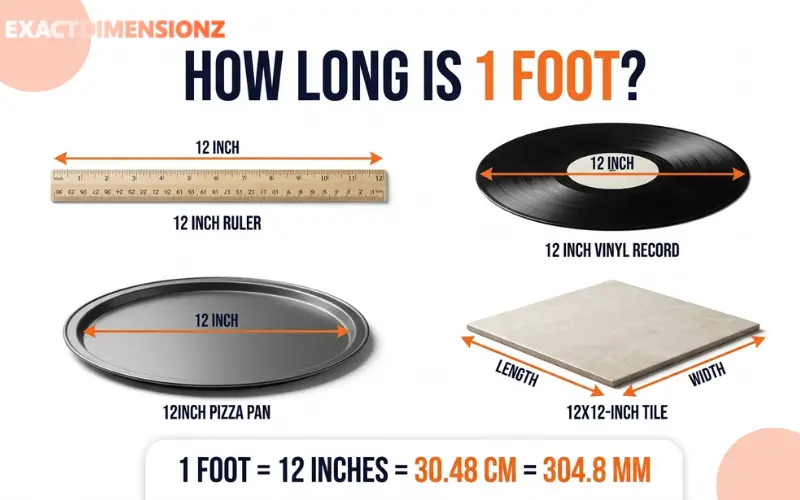
If you are wondering how long is a foot, the answer is refreshingly simple: exactly 12 inches. That is 30.48 centimeters, 304.8 millimeters, or 0.3048 meters — one-third of a yard, and the length of a standard ruler from its 0 mark to its 12-inch mark.
The tricky part is not the number. It is knowing which edge of a real object actually measures 12 inches — because a “12-inch” pizza pan is 12 inches across but under an inch tall, a “12-inch” cake pan is 12 inches only on its baking surface, and a “12-inch” record is 12 inches in diameter, not in length. Below are 10 real objects with a verified 12-inch dimension, each one labelled with exactly which side counts, so you can picture a foot without guessing.
How long is a foot?
A foot is exactly 12 inches — 30.48 cm, or 0.3048 meters. Think of a standard 12-inch ruler: the distance from its 0 mark to its 12-inch mark is one foot, no estimating required.
The one rule: name the dimension
A product described as “12 inches” is not 12 inches in every direction, and that single fact causes most of the confusion around this measurement. A ruler is 12 inches long. A pizza pan is 12 inches across. A tile is 12 inches on each side. A cake pan is 12 inches on its baking surface but larger outside. A steel rod is 12 inches long within a stated manufacturing tolerance. Same number, five different meanings — and the honest sentence always names which one applies.
One more distinction matters. The conversions in this article are exact by definition: the international foot is defined as exactly 0.3048 meters, so 1 foot is exactly 12 inches, exactly 30.48 cm, and exactly 304.8 mm. The objects, on the other hand, are listed at 12 inches — those are the makers’ and retailers’ published specifications, and this article grades them as such rather than pretending someone went out with a tape measure. Where a size is nominal, rounded, or tolerance-bound, the article says so.
The ten objects below come from measuring tools, kitchens, floors, and workshops — the places where 12 inches shows up most often in daily life. Each one states its 12-inch dimension plainly, so there is no guessing about which edge counts. For other sizes, see the complete feet size guide.
1. WESTCOTT 12-Inch Ruler

A 12-inch ruler is the simplest real-life example of one foot, and the WESTCOTT 10562 is the cleanest version of it: Grainger lists it with a 12-inch SAE length and markings in both inches and millimeters. The calibrated scale itself is the measurement — the distance from the 0 mark to the 12-inch mark is exactly one foot, even if the plastic body extends a little past the scale at either end.
That is why a ruler beats every other object on this list as a reference. It is not just 12 inches in some dimension; it is a tool built to show you 12 inches.
Measurement: 12-inch scale length. Evidence: LISTED (retailer listing). Source: WESTCOTT 12-inch ruler — Grainger.
2. A 12-Inch Vinyl LP Record

A standard vinyl LP is the most recognizable round example of a foot. The University of Illinois Preservation Self-Assessment Program identifies a vinyl LP record as 12 inches in diameter — measured from one edge straight through the center to the opposite edge. That makes it a perfect width reference: hold a record flat and you are holding one foot across.
The honest caveat is that “12-inch record” is also a standard format name, not a claim that every LP in the world measures exactly 12 inches to the fraction. But as a format, the 12-inch diameter is the defining figure, and it is the one to picture.
Measurement: 12-inch diameter. Evidence: LISTED (authority reference guide). Source: University of Illinois vinyl disc collection guide — University of Illinois.
3. Vollrath 12-Inch Solid Press-Cut Pizza Pan

Vollrath’s PC12SN solid press-cut pizza pan is a good real-life example because the manufacturer clearly identifies which measurement is 12 inches: the diameter. The pan lists a 12-inch diameter and a height of only 0.74 inches, and the manufacturer gives the diameter as 30.5 cm — a rounded figure for the exact 30.48 cm.
This is the object that teaches the diameter lesson best. Nobody would call this pan “one foot tall” — it is under an inch tall. It is one foot across, and only across.
Measurement: 12-inch diameter. Evidence: LISTED (manufacturer specification). Source: Vollrath 12-inch solid press-cut pizza pan — Vollrath.
4. Vollrath 12-Inch Coupe Pizza Pan

A second Vollrath pan earns its place because it shows the same 12-inch idea in a different build. The CP12 coupe pizza pan is specified with a 12-inch diameter, equivalent to 30.48 cm, while its height is only 0.3 inches. Two pans, same diameter, different heights — and the 12-inch figure describes the diameter in both cases, never the height.
Measurement: 12-inch diameter. Evidence: LISTED (manufacturer specification). Source: Vollrath 12-inch coupe pizza pan — Vollrath.
5. USA Pan 12-Inch Round Cake Pan

The USA Pan 12-inch round cake pan is the most instructive object in this guide, because its specifications draw a line most listings blur. The company lists a baking surface of 12 × 12 × 2 inches — but outer dimensions of 12.5 × 12.5 × 2 inches. So the 12-inch measurement applies to the baking surface, not to the complete outside width of the pan.
Calling the entire pan “exactly one foot wide” would be wrong by half an inch. That half inch is the whole point: always check whether a listed 12 inches means the working surface or the outside of the object.
Measurement: 12-inch baking surface (outer dimensions 12.5 inches). Evidence: LISTED (manufacturer specification). Source: USA Pan 12-inch round cake pan — USA Pan.
6. Daltile 12 × 12-Inch Tile

Some tiles genuinely measure 12 inches by 12 inches, and the Daltile Core Classic tile is one of them: Lowe’s lists it with a 12 × 12-inch common measurement and 12-inch actual width and 12-inch actual length. Each side is one foot long, which makes a single tile a square foot you can stand on and see.
The caution still applies in general — another product sold under the same “12 × 12” common size can have smaller actual dimensions, such as 11.88 × 11.88 inches — but for this specific tile, the listed actual dimensions are 12 by 12.
Measurement: 12 × 12-inch actual dimensions. Evidence: LISTED (retailer listing). Source: Daltile 12 × 12-inch tile — Lowe’s.
7. Anatolia 12 × 12-Inch Tile

A second tile earns its place because it confirms the first: Lowe’s also lists an Anatolia Ritz Gray tile with a 12 × 12-inch common measurement and actual dimensions of 12 inches by 12 inches. Two different tiles, same honest square foot — and a useful reminder that the only tiles worth using as a reference are the ones whose actual dimensions, not just their common size, read 12 by 12.
Measurement: 12 × 12-inch actual dimensions. Evidence: LISTED (retailer listing). Source: Anatolia 12 × 12-inch tile — Lowe’s.
8. D2 Tool Steel Rod

Grainger lists a D2 tool steel rod with an overall length of 12 inches. Unlike a pizza pan or a record, the 12-inch measurement here is a straight-line length from one end of the rod to the other — the simplest kind of foot there is. Grainger also states the rod’s diameter and length tolerance, which is exactly the kind of detail that keeps a listing honest: the rod is specified at 12 inches within a stated tolerance, not claimed as physically exact to the thousandth of an inch.
Measurement: 12-inch overall length (with stated tolerance). Evidence: LISTED (retailer listing). Source: D2 tool steel rod — Grainger.
9. A2 Tool Steel Rod

A second rod confirms the pattern. Grainger’s A2 tool steel rod is likewise specified with a 12-inch overall length, again with a stated length tolerance. Same straight-line measurement, same honest caveat — and a useful pair with the D2 rod, because it shows that industrial listings treat 12 inches as a specification with a tolerance band, not as a promise of perfection.
Measurement: 12-inch overall length (with stated tolerance). Evidence: LISTED (retailer listing). Source: A2 tool steel rod — Grainger.
10. General Tools 12-Inch Steel Rule

The General Tools CF1247ME steel rule closes the list with a correction worth knowing. Grainger lists it as 12 inches / 300 mm long, with both inch and metric graduations — but 300 mm is not exactly one foot. One foot is 304.8 mm. The product is a 12-inch rule whose metric description is rounded to 300 mm, and the 4.8 mm gap is the difference between a rounded label and an exact conversion.
That makes this rule a better teaching object than a plain ruler: it shows both the right answer (12 inches) and the common rounding trap (300 mm) in a single tool.
Measurement: 12-inch rule length (metric marking rounded to 300 mm; exact equivalent 304.8 mm). Evidence: LISTED (retailer listing). Source: General Tools 12-inch steel rule — Grainger.
Close to 1 foot — but not 1 foot
Some familiar things look about a foot but are not, and naming them keeps you from using a wrong reference. A 30 cm ruler is 0.48 cm — about 4.8 mm — shorter than a foot, close enough for a quick estimate but not exact. A laptop advertised with a 12-inch screen is not 12 inches wide or tall, because screen size is measured diagonally. A “footlong” sandwich is a commercial size name, not a precision measuring standard. And a tile sold as 12 × 12 inches may actually measure 11.88 × 11.88 inches — check the actual dimensions, not just the common size.
The rule from the top of this article covers all of them: ask which part of the object measures 12 inches, and whether the figure is a measured dimension, a rounded label, or a product name.
How to measure 1 foot without a ruler
If you have no measuring tool handy, build the distance from parts you already know. Two 6-inch sections laid end to end make 12 inches. Three 4-inch sections make 12 inches. Four 3-inch sections make 12 inches. Twelve 1-inch sections make 12 inches. If you have a metric tool, measure 30.48 cm — and remember that a rough 30 cm estimate falls 0.48 cm short.
For scale against other lengths: 2 feet is exactly twice a foot; 3 feet is three times; 4 feet is four times; 6 feet is six times; 7 feet is seven times; 12 feet is twelve times; 10 inches falls two inches short of a foot; and 9 inches falls three inches short. For anything that matters — a shelf, a tile layout, a piece of trim — use a ruler or a product with a published dimension, not a guess.
Frequently asked questions
How long is a foot in inches?
A foot is exactly 12 inches. One foot is defined as 12 inches, so “how long is 1 foot” and “how many inches is 1 foot” have the same answer: 12. Halves and quarters follow directly: half a foot is 6 inches, a quarter foot is 3 inches, and three-quarters of a foot is 9 inches.
How long is 1 foot in cm and meters?
1 foot is 30.48 cm, which is 0.3048 meters. The international foot is defined as exactly 0.3048 meters, so 12 × 2.54 = 30.48 cm with no rounding involved. For a quick estimate you can round to about 30 cm, but the exact figure is 30.48 cm — and the conversion tables published by NIST use the same exact definition.
How many yards is 1 foot?
1 foot is one-third of a yard, or about 0.333 yards. One yard is exactly 3 feet (36 inches), so three one-foot lengths laid end to end make exactly one yard. Do not confuse the two directions: 3 feet make a yard, but a yard is three times a foot, not the same length.
How tall is 1 foot?
One foot of height is 12 inches measured straight up from a surface. The direction is what matters: a 12-inch pizza pan is not 12 inches tall — its diameter is 12 inches and its height is under an inch. A 12-inch ruler held upright is 12 inches tall; laid flat, it is 12 inches long. Same distance, different direction.
Is 30 cm exactly 1 foot?
No. One foot is 30.48 cm, so 30 cm is 0.48 cm — 4.8 mm, or about 0.189 inches — shorter than a foot. In inches, 30 cm is 11.811 inches, not 12. A 30 cm ruler gives you a close visual idea of a foot, but for precise work, use 30.48 cm.
What everyday things are 1 foot long?
Verified examples include a 12-inch ruler, a 12-inch vinyl record (diameter), 12-inch pizza pans (diameter), 12 × 12-inch tiles with actual 12-inch dimensions, and products manufactured with a specified 12-inch overall length such as tool steel rods. The ruler is the clearest reference; the pan and the record are the clearest diameter references.
Is a 12-inch object always exactly 1 foot long?
No. The 12-inch measurement may refer to a specific dimension — length, width, diameter, baking surface, or overall length within a tolerance — rather than the whole object. The USA Pan cake pan is 12 inches on its baking surface but 12.5 inches outside; the steel rods are specified at 12 inches within a stated tolerance; and a “12-inch” product name can be a nominal size. Check the specification for the exact dimension word before treating an object as an exact one-foot reference.
How can I measure 1 foot without a ruler?
Use a verified 12-inch object, measure 30.48 cm with a metric tool, or build the distance from smaller known sections: two 6-inch sections, three 4-inch sections, four 3-inch sections, or twelve 1-inch sections. These are useful estimation methods, but when accuracy matters, use a ruler or tape measure.
Final Thoughts
So, how long is a foot? It is 12 inches, 30.48 cm, 304.8 mm, and one-third of a yard — and, more usefully, it is the length of a ruler, the diameter of a record, and the side of a square tile. The single habit that will serve you best is the one this article opened with: always ask which part of the object measures 12 inches. Length, width, diameter, baking surface, and nominal size are five different answers, and knowing which one you are looking at is the difference between measuring right and guessing wrong.
Pick one object you have actually held — a ruler is the obvious one — and a foot will stop being a number and start being a distance you can feel. And the next time a listing just says “12-inch” with no dimension attached, you will know exactly which question to ask before you trust it.
