

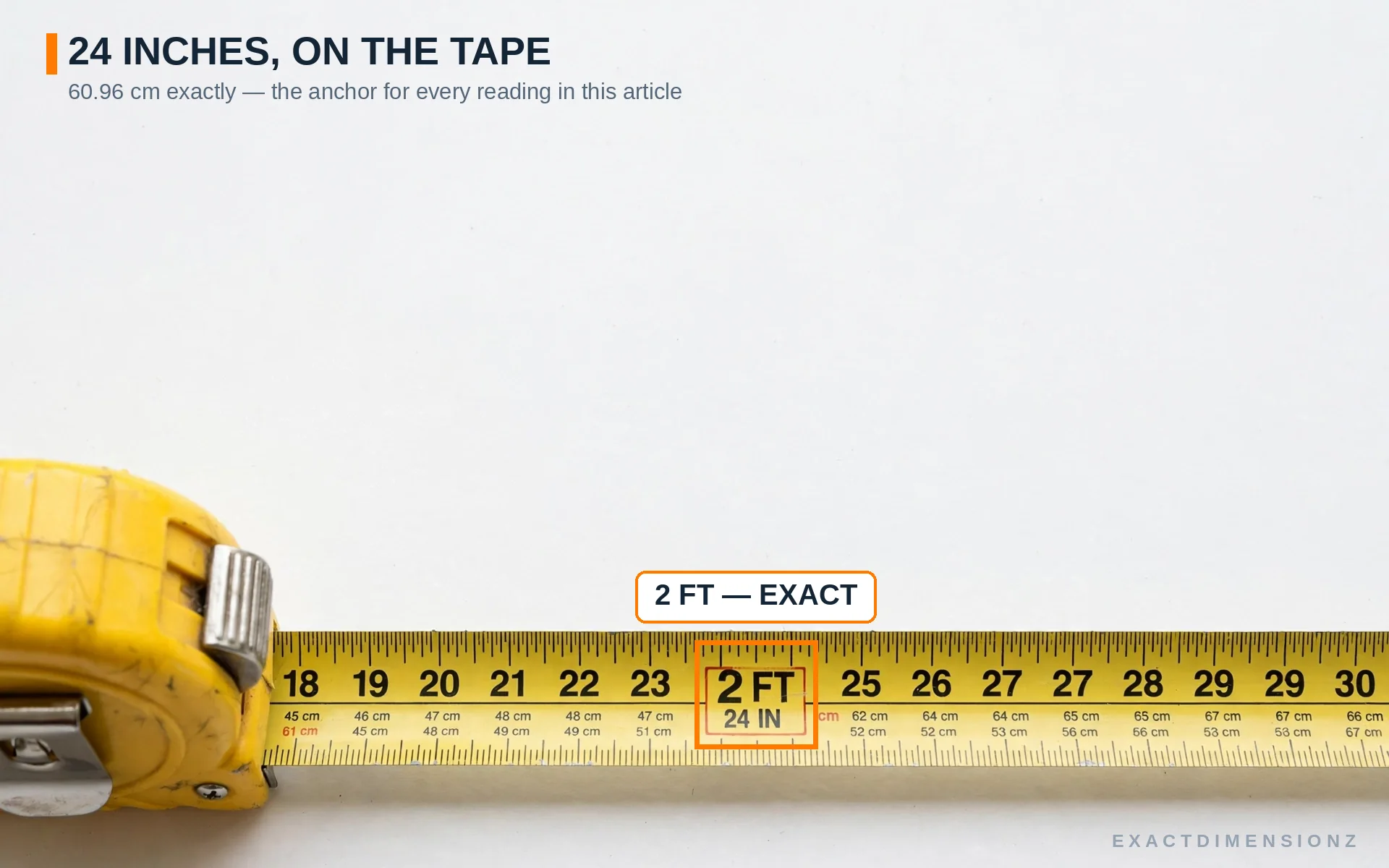
If you are asking how long is 24 inches, you have picked the one size in the complete inches size guide whose conversion needs no apology: 24 inches is exactly two feet — 60.96 centimetres exactly, 609.6 millimetres exactly, and 0.6667 yards, the only figure in the set that has to be rounded. Two 12-inch rulers laid end to end. Four of them would make a yard and a third. It is a clean, satisfying number — which is exactly why so many products borrow it and so few of them deserve it. A computer sold as a “24-inch” machine has a screen that measures 23.5 inches. A wiper blade sold as 24 inches is 600 millimetres long, which is 23.62. A suitcase sold as a 24-incher hides almost four extra inches of wheels and handles above its case. So this article does what the number deserves: it stands thirteen suspects against a wall. Take a step down to 23 inches or a step up to 25 inches to compare the neighbouring sizes.
Picture a police height chart — the ruled wall behind every lineup photograph, with one bold line ruled across it at exactly 24 inches, two feet off the ground. Every suspect below is stood against that wall and measured in the direction its name promises. Each one gets an On the chart line — the claim, the tape reading, and the direction that was measured — and a wall test, the thirty-second check you can run yourself with a tape, a spec page or a piece of arithmetic. Five suspects stand at full height. Six need their fine print read aloud. Two never reach the line at all.
QUICK ANSWER
24 inches is exactly 60.96 centimetres — precisely two feet. But the things sold as 24 inches split three ways. True 24: a kitchen base cabinet’s depth, a 24×80 door slab, a MidWest iCrate dog crate, the shortest tee-ball bat, and a 24-inch chain — five objects whose tape reading is their name. True, with fine print: a Dell “24” monitor (23.8-inch viewable diagonal), a Bosch 24A wiper blade (600 mm = 23.62 in), a Fender Jaguar (only its scale length is 24), a 24-inch bike wheel (507 mm bead seat, about 24.4 in with a tire), a Samsonite 24 checked spinner (24-inch case, 27.9-inch bag), and a GE “24-inch” dishwasher (23¾ in wide — its depth is the true 24). 24 in name only: Apple’s iMac 24 (actual diagonal 23.5 in, by Apple’s own footnote) and an Insignia 24-inch class TV (actual screen 23.8 in). Thirteen suspects, measured below.
The Wall and the Rules
Three rules govern every measurement below. First, the evidence must be a primary source: the manufacturer’s own specification sheet, catalog or size chart, or a standard you can look up — quoted and linked, so you can check the reading yourself. Second, the direction must be named. “24 inches” is not a measurement until somebody says 24 inches of what — a depth, a width, a diagonal, a scale length, a bead seat — and half the suspects below pass or fail entirely on that question. Third, nobody is graded on a curve: a number that is a class, a nominal size or a rounded translation is reported as exactly that, never upgraded to “exact.”
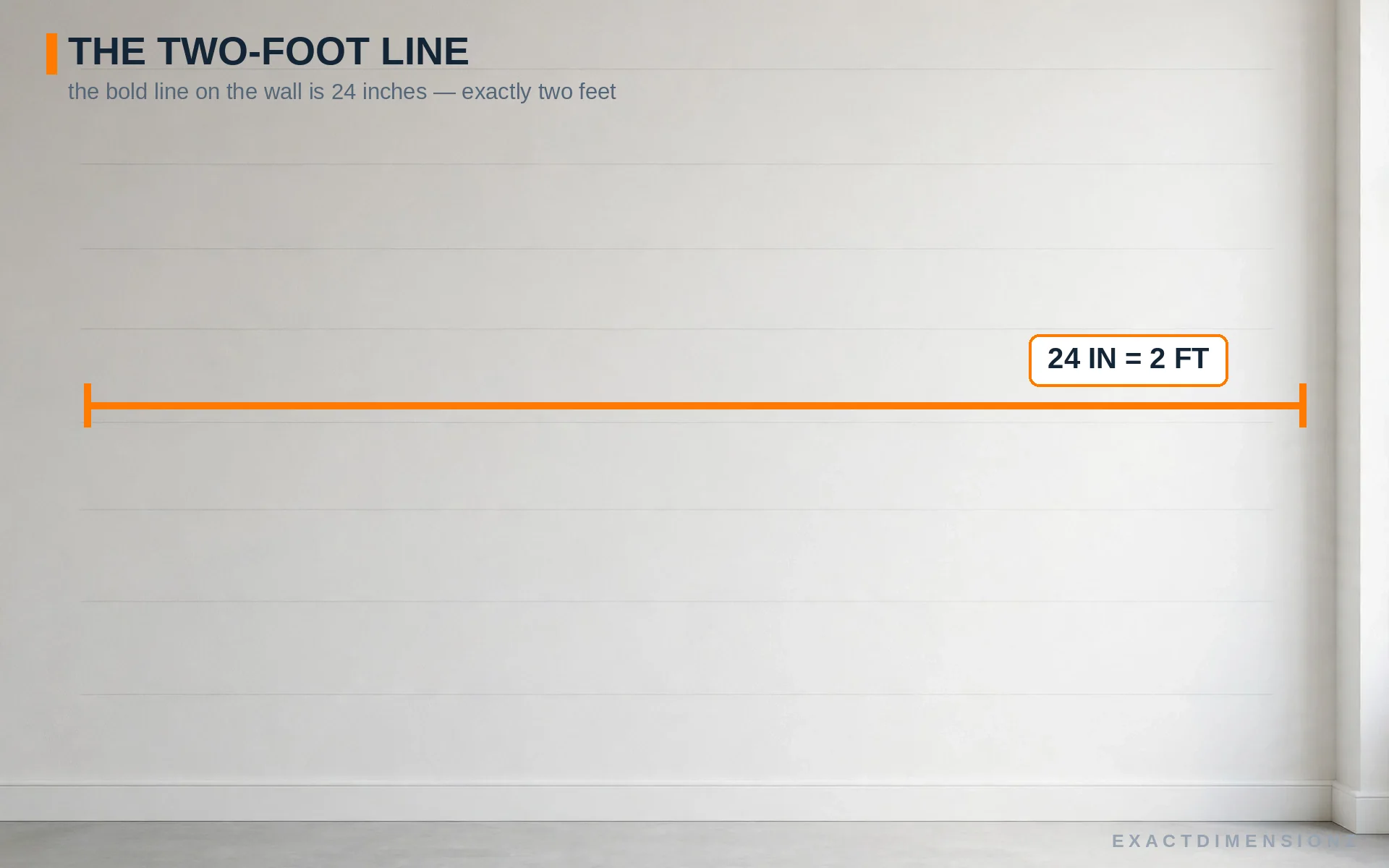
The wall itself is worth one look before the suspects file in. Twenty-four inches is the height of two stacked shoeboxes, roughly the distance from a toddler’s foot to hip — no, hold that thought; the Corrections Desk at the end of this article deals with a rival page that turned “roughly a toddler” into a measurement, and got it wrong by ten inches. The honest anchors are simpler: a standard doorway is 80 inches tall, so 24 is a little under a third of it; a kitchen counter stands 36 inches, so 24 is two-thirds of the way up. And the tape does not care about any of it. Here is the line, at full size:
Full Height: The True 24s. Five suspects whose name and tape reading are the same fact. No asterisks, no classes, no rounding — the number on the label is the number on the wall.
1. The Kitchen Base Cabinet
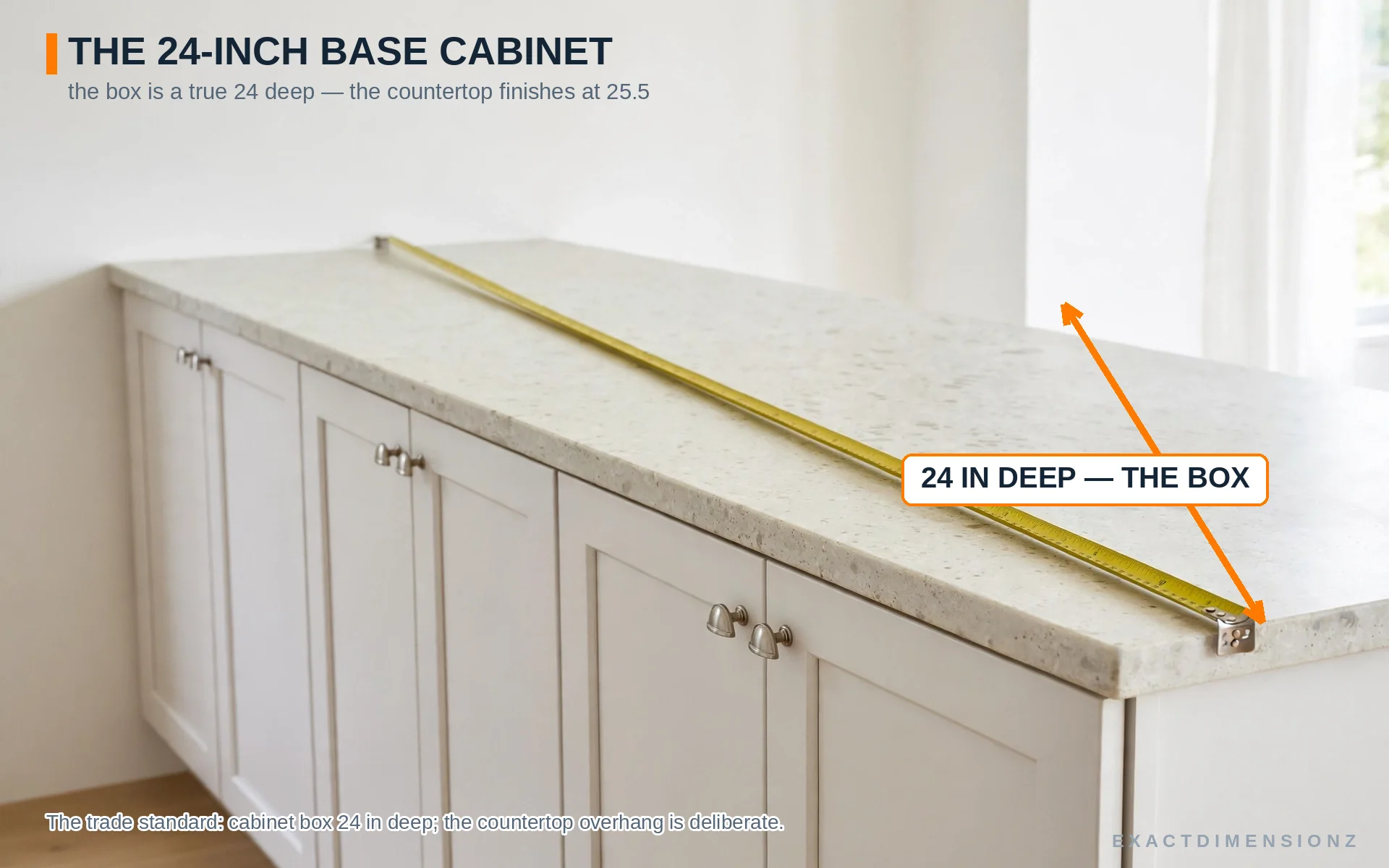
On the chart: Claim — 24 in deep, the industry standard. Tape — 24.00 in, for the cabinet box. Direction — depth, wall to front face.
Every kitchen in the country is planned around this suspect, and it holds up. A standard base cabinet — the floor cabinet under your counter — is built 24 inches deep, a convention so settled that cabinet makers’ dimension guides, such as the base-cabinet depth reference at EngineerFix, state it as the definition of the category: the 24-inch measurement refers to the cabinet box itself, and major makers like KraftMaid build their base lines 34½ inches tall and 24 inches deep, in widths that climb in 3-inch steps from 12 to 48. Appliance openings, range clearances and dishwasher cutouts are all drawn against this box. It is not a marketing size. It is the grid the room is built on.
The one refinement — and it is a refinement, not a fine-print escape — is the countertop. The finished working surface is deliberately made deeper than the box, typically 25.5 inches, so spills drip clear of the drawer faces below and the slab tolerates walls that are not perfectly plumb. So the object you lean against measures 25.5 inches deep while the cabinet you ordered measures 24. Both numbers are honest; they are measurements of two different parts, and the trade says which is which. That is all this article ever asks of a suspect.
Wall test: measure your own base cabinet from the wall to the front of the wooden box — not the stone on top. You will read 24 inches. Then measure the countertop: about 25.5. Two numbers, two parts, no contradiction.
2. The 24×80 Interior Door Slab
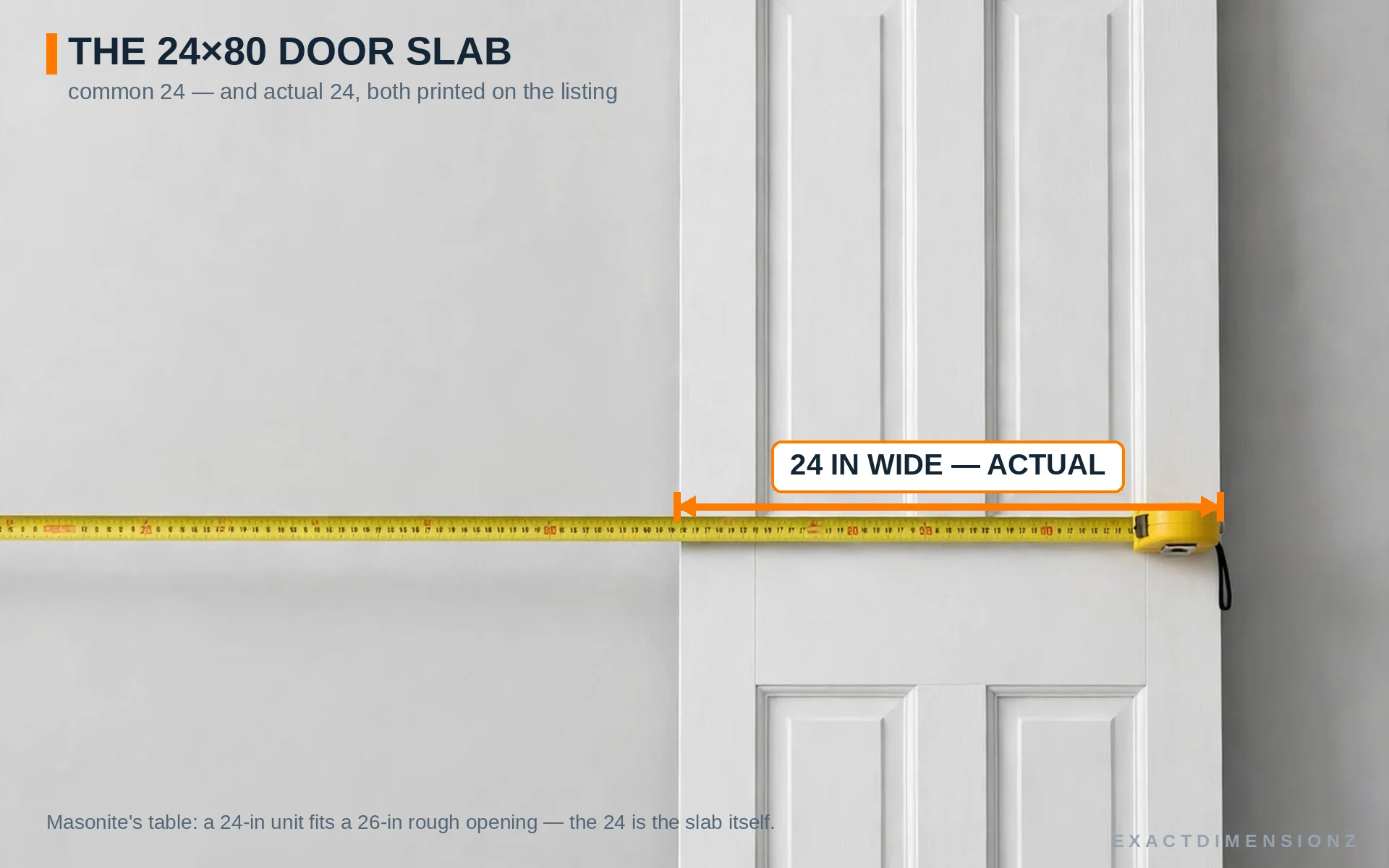
On the chart: Claim — 24 in wide. Tape — 24.00 in, actual. Direction — width, edge to edge.
Door listings carry two sizes: a “common” size, which is the trade’s name for the slab, and an “actual” size, which is what the slab measures — and on some products the two quietly disagree. Not here. The Masonite Traditional slab listing at Lowe’s prints both lines side by side: Common Size 24-in × 80-in, Actual 24-in × 80-in. The slab is a true two feet wide and six feet eight tall, a full-size object whose small dimension is exactly the number on this wall. Masonite’s own installation tables add the working context: a 24-inch unit wants a rough opening 26 inches wide, the extra room going to the jamb and shims — the 24 belongs to the door itself.
One honest placement note: the 24 is the narrowest standard slab in the ladder (which climbs 28, 30, 32, 36), the size used for closets, linen cupboards and small bathrooms, while most passage doors are 30 or 32 inches wide. A rival page in the Corrections Desk’s raw material claims “most standard interior doors” are about 24 inches wide; most are not — but the ones that are sold as 24 are, verifiably, 24. The suspect is acquitted even if its fan club exaggerates its popularity.
Wall test: measure any narrow closet door slab edge to edge, ignoring the frame. If it is a 24, the tape reads 24.00 — the frame and trim around it are somebody else’s inches.
3. The MidWest iCrate 24 Dog Crate
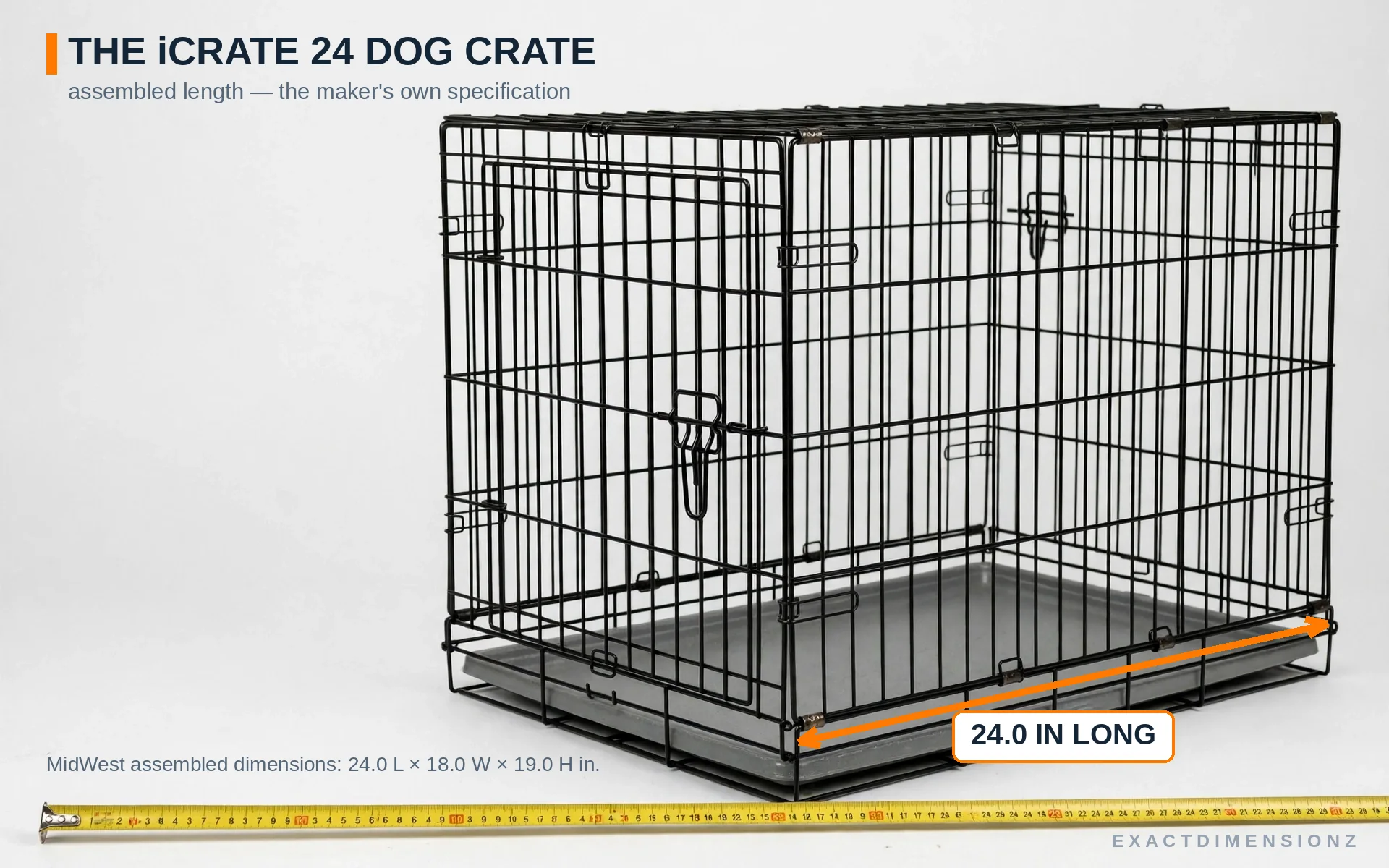
On the chart: Claim — 24 in long. Tape — 24.0 in, per the maker’s assembled dimensions. Direction — length, the long side.
MidWest Homes for Pets sells its iCrate in a ladder of sizes — 18, 22, 24, 30, 36, 42, 48 — and the 24 rung is specified the way a size ladder should be: Petco’s listing for the iCrate 24 gives the assembled crate as 24 inches long × 18 wide × 19 high, the length being the dimension the size name promises. This is a wire crate: there is no diagonal convention, no case-versus-whole split, nowhere for a discrepancy to hide. The number is the longest side of the object, and the longest side is the number.
Full disclosure, because this wall runs on it: one retail dimension feed prints 23.60 inches as the “item length” for this model, against the manufacturer’s assembled specification of 24.0. Feeds like that are compiled from packaging data and are wrong often enough that the maker’s assembled dimensions govern — and the assembled crate is what a dog lives in. The suspect stands at full height on the manufacturer’s own testimony, with the dissenting figure read into the record rather than buried. That is what evidence grading looks like when the answer is still yes.
Wall test: assemble any 24-inch iCrate and run a tape along the long side, corner to corner of the wire frame. Expect 24 inches — and if a listing somewhere says 23.6, you now know which document to trust: the one that describes the crate standing up, not the box it shipped in.
4. The 24-Inch Tee-Ball Bat
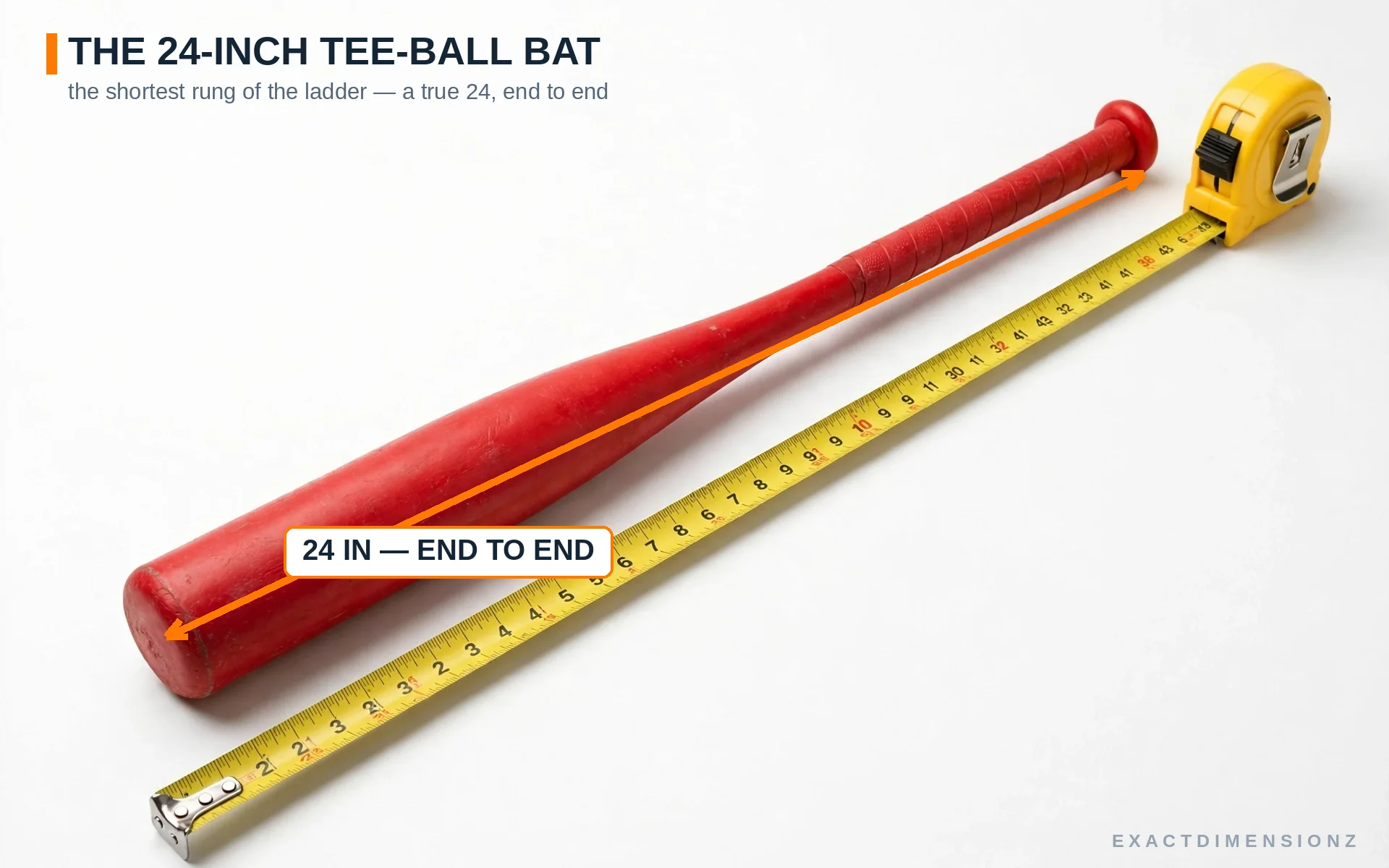
On the chart: Claim — 24 in long. Tape — 24.00 in, manufactured length. Direction — end to end, knob to barrel cap.
Bats are sized the honest way: by their whole length, the only dimension the name could mean. The Rawlings and Worth bat sizing guide — published by the company that makes the bats — opens its length advice at the bottom of the ladder: “For the little tykes starting off in T-Ball, you want to look at bats between 24 and 26 inches,” and nothing shorter than 27 once a player leaves tee-ball. So the 24-inch bat is a real, manufactured, stocked object: the shortest rung of the youth ladder, built for the smallest players in the sport, and specified in the maker’s own guide at exactly the length on its label.
There is nowhere for fine print to attach. A bat has no class system, no diagonal, no nominal bore; its drop weight is computed from its length, so the length has to be true for the rest of the specification to work. Sandwiched between the door slab and the dog crate, it completes a pattern the rest of this lineup keeps breaking: when an object’s name is its longest dimension, and its longest dimension is the thing you buy, the number behaves.
Wall test: stand any tee-ball bat on its knob beside a tape and read the top of the barrel. The smallest bats in the shop read 24 — the guide’s floor, and this wall’s line, in one object.
5. The 24-Inch Chain Necklace
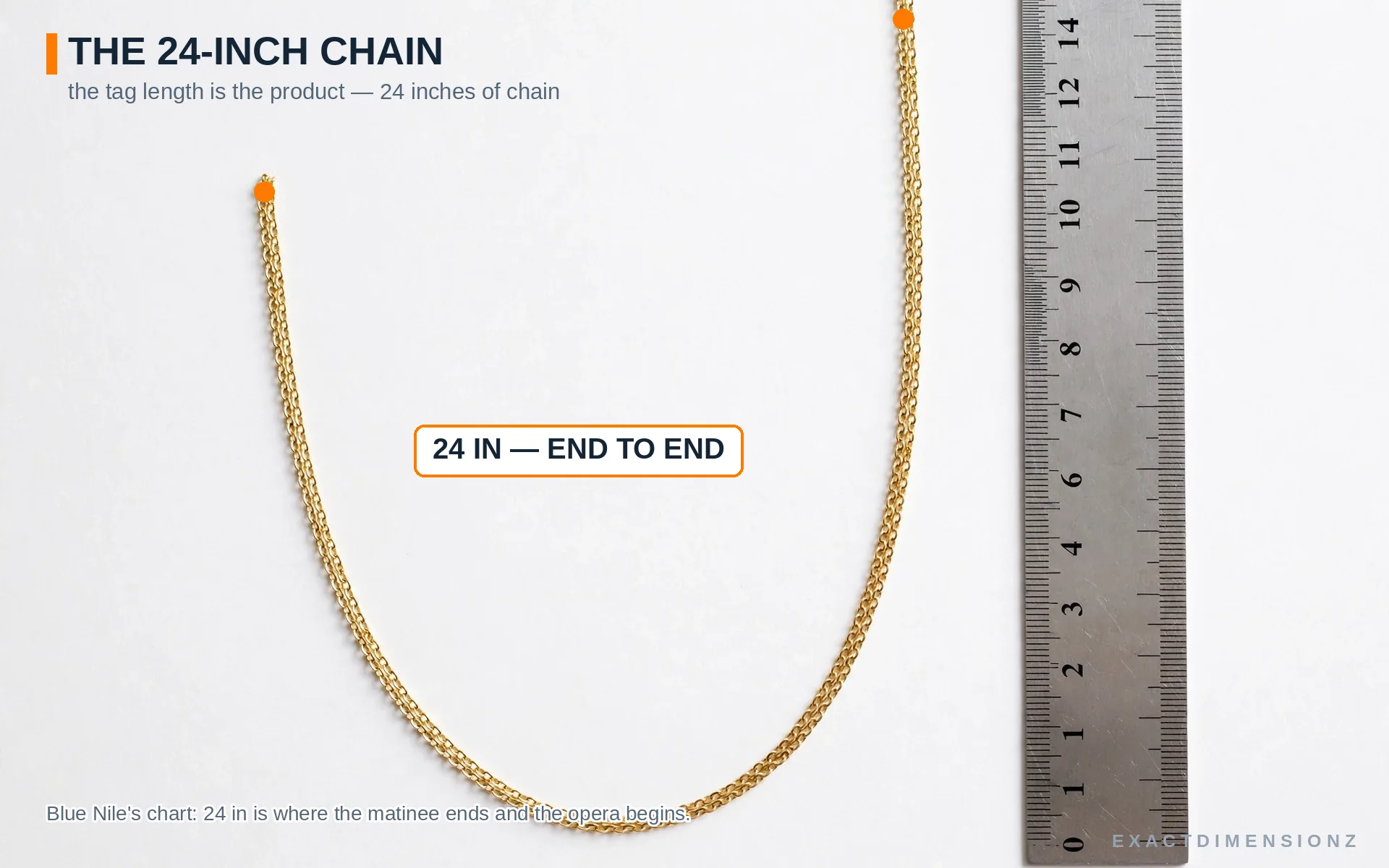
On the chart: Claim — 24 in of chain. Tape — 24.00 in, end to end. Direction — the full length of the product.
Jewellery is the one trade in this lineup where the name is not a size, a class or a part — it is the inventory. A chain is manufactured, stocked and sold by its length, so a 24-inch chain is twenty-four inches of chain, clasp to clasp, and the number is the whole product in a way no screen or suitcase can match. The length charts confirm where the 24 sits: Blue Nile’s necklace length chart places the matinee at 20–24 inches and the opera at 24–30, which makes 24 the hinge of the whole system — the longest matinee and the shortest opera, the length that falls at the upper chest on men and just above the bust on women.
Two honest footnotes, neither of which moves the tape. Makers differ on whether a pendant’s drop is counted in the stated length, so a pendant chain can wear longer than 24 while still being 24 inches of chain. And a worn chain hangs in a curve, so the vertical drop is always less than the length — geometry, not deception. The length itself, laid straight, is what was sold, and it reads what the tag says.
Wall test: lay any chain you own straight beside a ruler, clasps at both ends of the measurement. The tag length and the tape will agree to within the clasp — a standard of honesty the electronics aisle, coming up next, does not attempt.
Fine Print on the Chart. Six suspects where a real 24 is present — but attached to a qualifier the headline left off: a rounded diagonal, a metric truth, one part of the object, or the wrong side of it. Read the fine print and each one is defensible. Skip it, and each one misleads.
6. The Dell P2425H “24 Monitor”
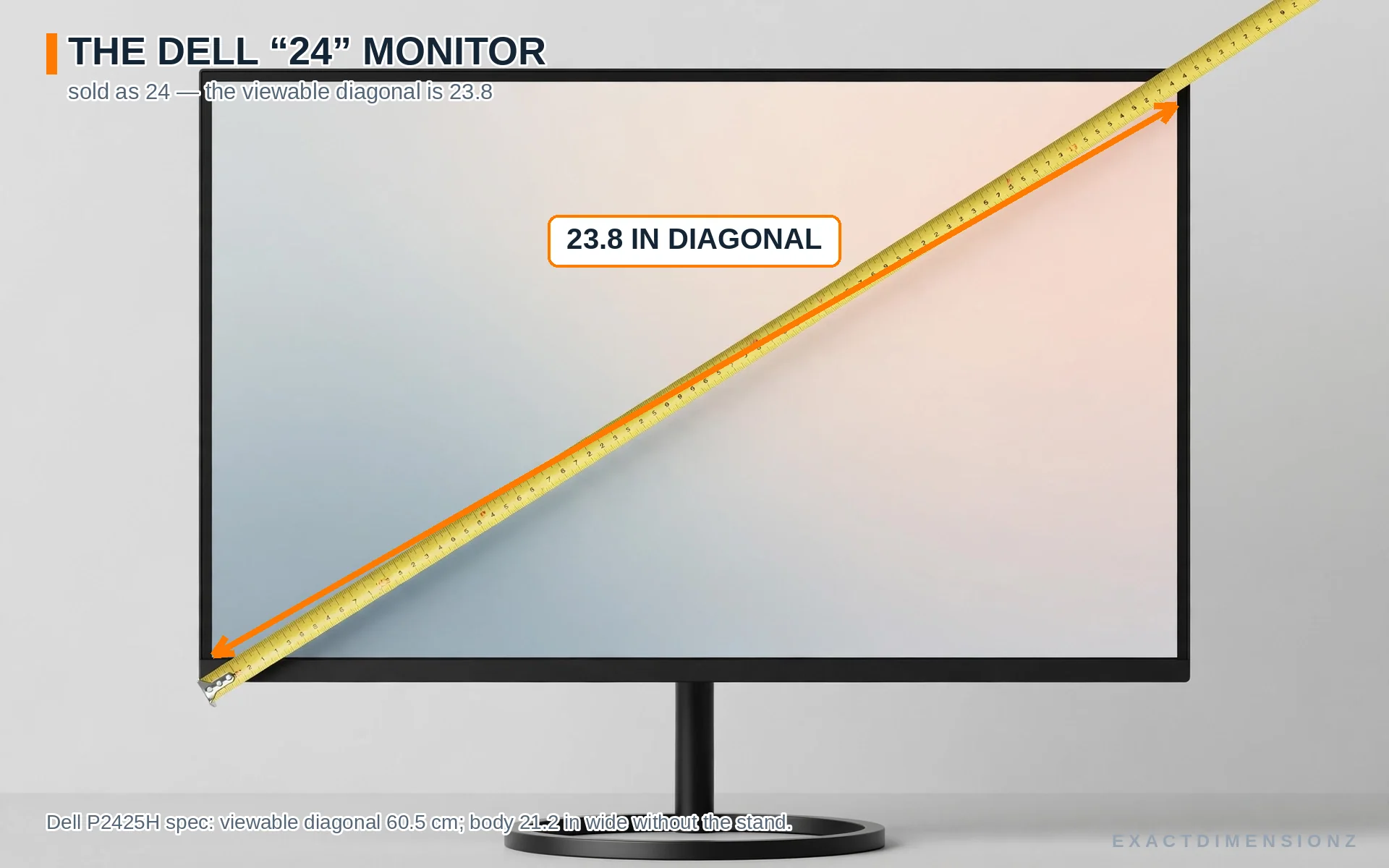
On the chart: Claim — 24 in. Tape — 23.8 in viewable diagonal; 20.75 in viewable width; 21.2 in body width. Direction — diagonal, rounded up to a class.
Dell sells the P2425H as a “24 Monitor,” and Dell’s own specification sheet is where the 24 quietly becomes 23.8. The viewable diagonal is 60.5 centimetres — 23.8 inches — and the viewable image area measures 527.04 mm across, which is 20.75 inches of actual lit width inside a body 538.6 mm (21.2 inches) wide without its stand, as the P2425H specification listings confirm. So the “24-inch monitor” offers you a choice of true numbers — 23.8, 21.2, 20.75 — and the name is none of them. It is the class: the shelf the monitor sits on, labelled with the nearest whole number, rounded in the seller’s favour.
This is the most respectable fine print in the lineup, because the industry is uniform about it and the spec sheet prints the real figure for anyone who looks. But as a measurement reference — the job this article hires objects for — a 24-class monitor will under-deliver on every axis you can measure. Picture 24 inches as this screen’s diagonal and you have pictured 23.8; picture it as the width and you are nearly three inches out.
Wall test: measure the lit area of any “24-inch” monitor corner to corner. Expect 23.8 inches, on every brand, every time — the class rounds up so reliably that the exception would be news.
7. The Bosch ICON 24A Wiper Blade
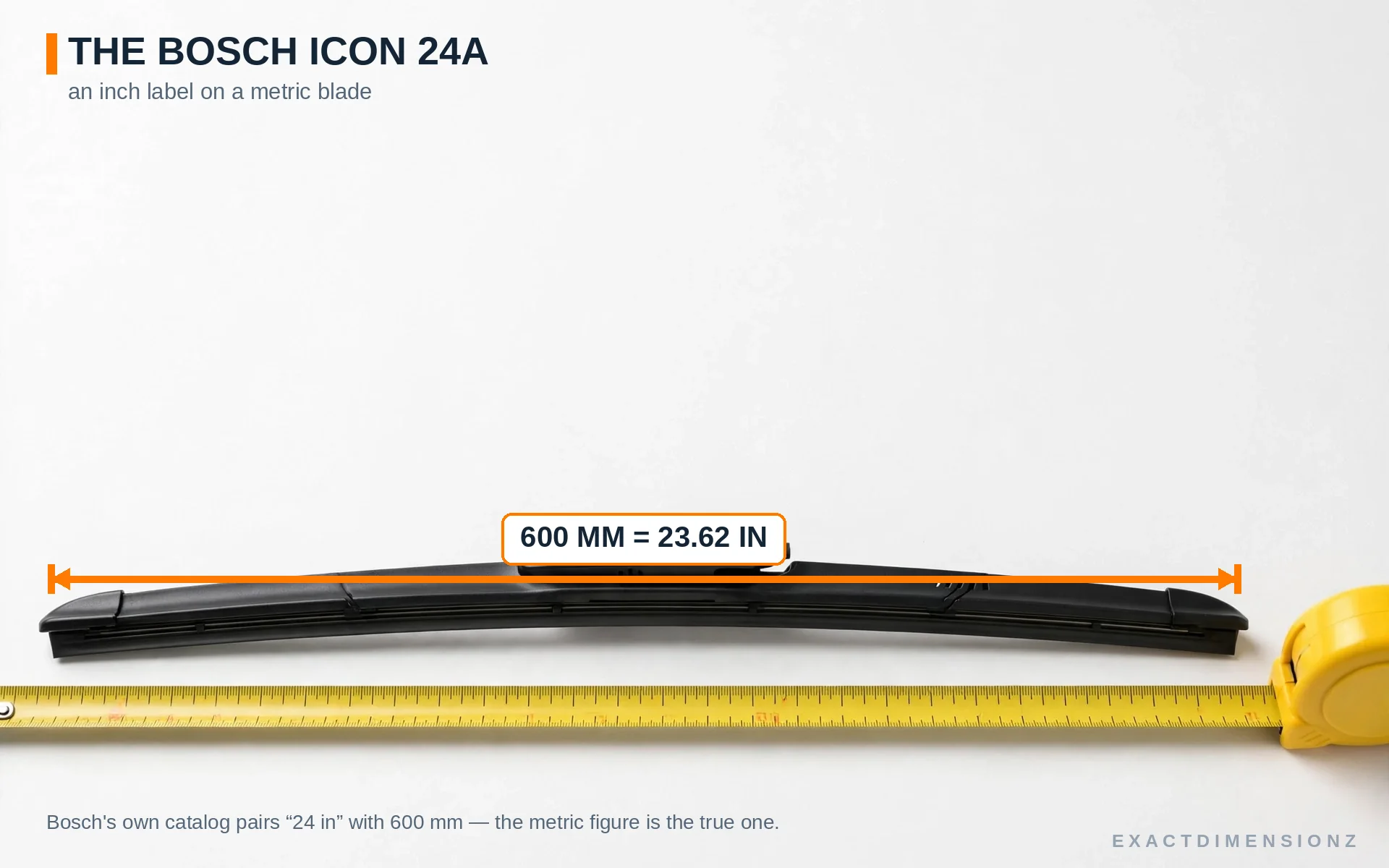
On the chart: Claim — 24 in. Tape — 600 mm = 23.62 in. Direction — length of the blade, end to end.
The wiper blade is a metric product wearing an inch costume. Bosch’s own 2025 wiper blade catalog lists the ICON 24A with two numbers side by side: 24 inches, 600 mm. Convert the second one — 600 ÷ 25.4 — and you get 23.62 inches. Read down Bosch’s whole ladder and the truth shows its structure: 340, 380, 400, 425, 450, 475, 500, 530, 550, 600, 650, 700 mm. Those are the real sizes, marching in metric steps; the inch column is a translation, and translations round. The 24A’s “24” is the rounded name of a 600-millimetre blade.
Does the missing 0.38 of an inch matter at the windshield? Not in the slightest — the blade covers its arc, the fitment guide matches it to your car, and no driver has ever measured a wiper in anger. It matters here, on the wall, because it is the cleanest example in the lineup of a number that is a translation rather than a measurement: true in the unit it was born in, approximate in the unit it was sold in.
Wall test: run a tape along any blade sold as 24 inches. You will read about 23⅝ inches — 600 mm — and the catalog’s metric column will have told you so all along.
8. The Fender Jaguar Guitar
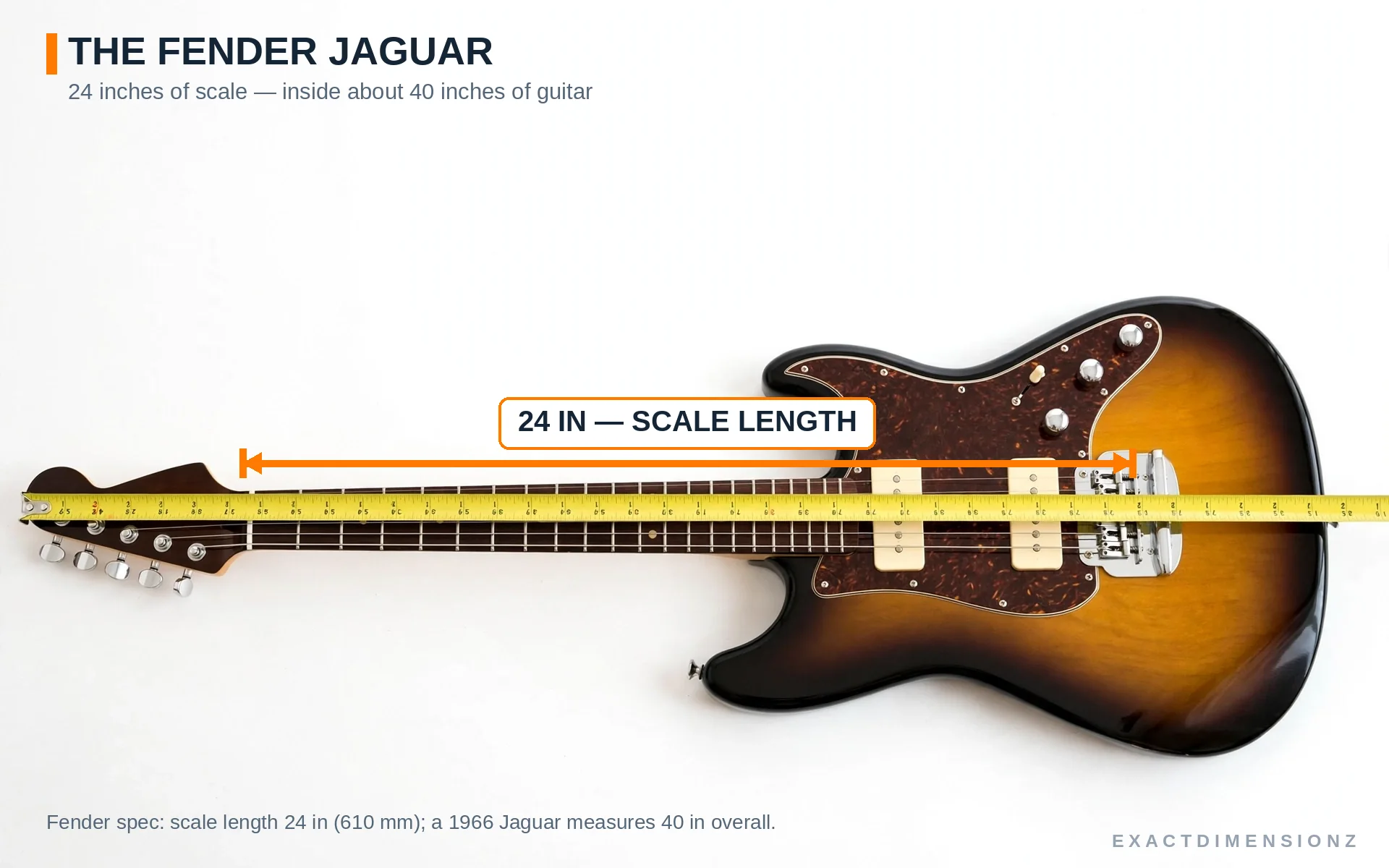
On the chart: Claim — 24 in. Tape — 24.00 in of scale length; about 40 in of guitar. Direction — nut to bridge, one part of the instrument.
Ask a guitarist what is 24 inches about a Jaguar and you will get the right answer instantly — the scale. Fender’s specification sheets for the Jaguar, from the American Professional Classic to the Vintera II, list scale length 24″ (610 mm): the vibrating length of the strings, measured from the nut to the bridge saddles. It is a genuine, musically important 24 — the short scale is the Jaguar’s whole character, the reason its strings feel slinkier and its tone rounder than its 25.5-inch-scale siblings.
But hold the whole instrument against the wall and the suspect towers over the line: a Jaguar measures about 40 inches overall, as period examples confirm — a measured 1966 Jaguar is listed at 40 inches overall length, 14 inches wide at the lower bout. The 24 is real, precisely specified, and describes less than two-thirds of the object. A reader who pictured “a 24-inch guitar” pictured a child’s instrument; the Jaguar is a full-size guitar carrying a 24-inch measurement in its middle, the way the bike frame in earlier volumes of this series carried its size in a single tube.
Wall test: measure any Jaguar-style guitar twice — tip to tail (about 40 inches), then nut to bridge (24). Both numbers are Fender’s. Only one of them is the guitar.
9. The 24-Inch Bicycle Wheel

On the chart: Claim — 24 in. Tape — 507 mm (19.96 in) at the bead seat; about 24.4 in overall with a typical tire. Direction — diameter, two different ones.
Bicycle wheels are where inch names go to retire. The “24-inch” wheel is a class, and the number that actually governs it is metric: the ETRTO bead seat diameter, 507 mm, printed in tyre size charts as the defining figure for the 24-inch trekking and city class. Five hundred and seven millimetres is 19.96 inches — the metal rim, where the tire bead locks on, is a hair under twenty inches across. Fit a typical 57 mm tire (a 57-507, in the sidewall code) and the arithmetic runs the other way: 507 + 57 + 57 = 621 mm, about 24.4 inches overall. The wheel you can measure is 24.4; the wheel that decides which tires fit is 19.96; the wheel in the name, 24.00, is neither — it is the class label the two of them share.
This is not carelessness; it is archaeology. Inch wheel names date from an era when the tire was included and sizes were approximate, and the industry now specifies the one number that must be exact — the bead seat — in millimetres, leaving the inch as a family name. The 24-inch wheel is the top rung of the kids’ ladder, a few sizes past the 16 inches most children start on, and it shares its naming logic with every wheel in the shop: no bicycle wheel in any size measures its name with the tire off, and most overshoot it with the tire on.
Wall test: stand a 24-inch bike wheel against a tape, tire on: about 24.4 inches. Then read the sidewall — the 507 in the tire code is the number a replacement tire has to match, and it is under 20 inches. The name is the rough average of the two.
10. The Samsonite Freeform 24 Checked Spinner
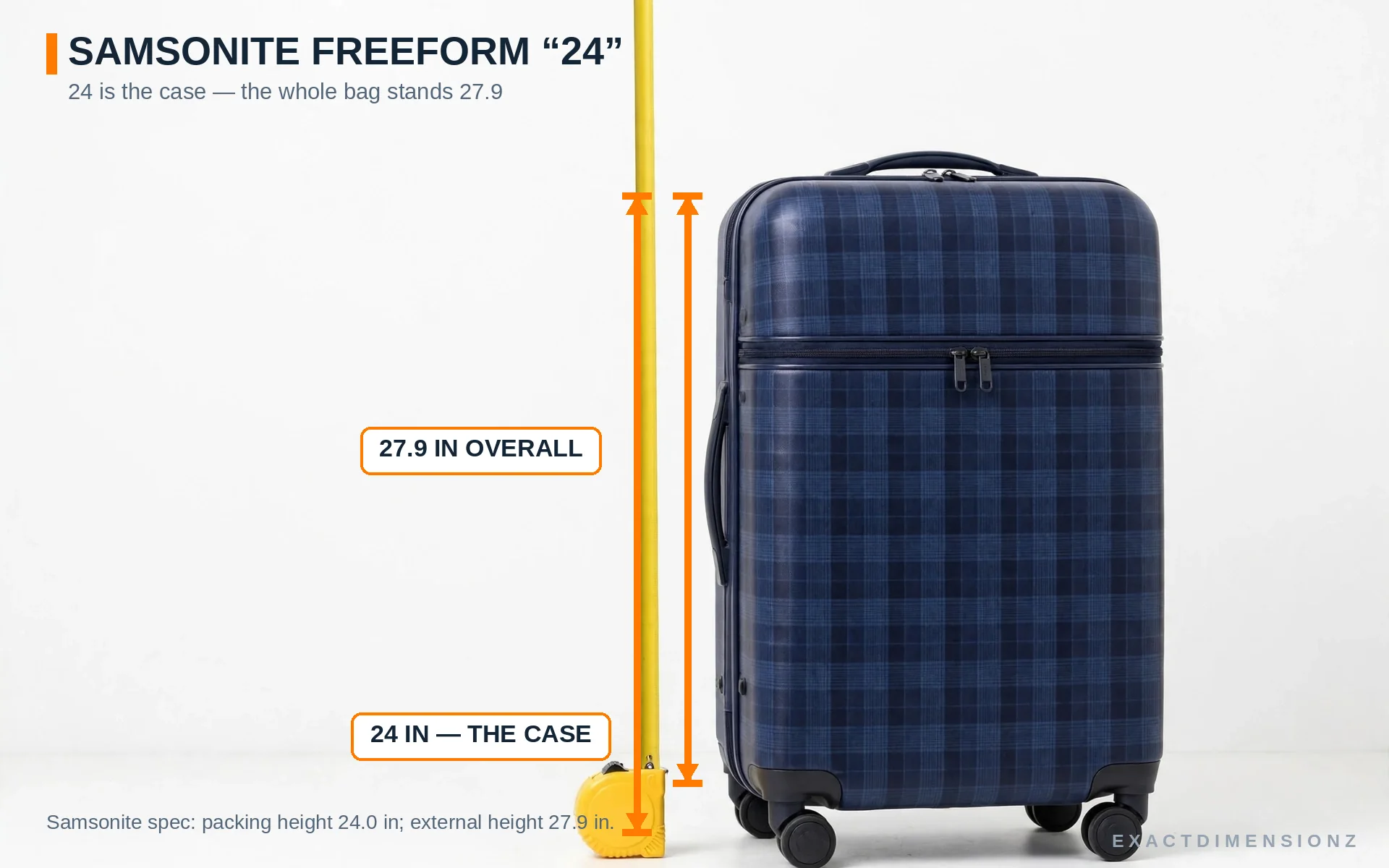
On the chart: Claim — 24 in. Tape — 24.0 in of case; 27.9 in of bag. Direction — height, with and without the wheels.
Luggage is the lineup’s repeat offender, and this is its clearest file. Samsonite’s Freeform line sells a “Checked-Medium 24-Inch,” and its published specification tables split the bag in two: packing dimensions 24 × 18 × 11.5 inches — the case body, which is a genuine 24 inches tall — against external dimensions of 27.9 inches in height. The difference, nearly four inches, is the spinner wheels below and the handle hardware above: the parts that touch the world. As with the carry-on in an earlier volume of this series, the name measures the box; the traveller wheels the whole.
Context exonerates the bag itself: this is a checked suitcase, sold for the hold, where no 22-inch sizer waits to judge it — which is precisely why it can honestly carry a 24-inch case. Try to wheel it aboard instead and the split becomes a problem: at 27.9 inches overall it towers over the 22-inch height limit, and its 18-inch width busts the 14 inches of width the big airlines allow a carry-on. The trouble starts only when roundup pages recycle “24-inch suitcase” as a carry-on reference, a crime the Corrections Desk prosecutes below. On its own testimony the Freeform is fine print, fairly printed: the case is 24, the bag is 27.9, and Samsonite publishes both.
Wall test: measure any spinner suitcase twice — floor to top of the shell, then floor to the highest point of the wheel-and-handle assembly standing as it rolls. If the two readings differ by three or four inches, you own the same split this bag has.
11. The GE 24-Inch Dishwasher
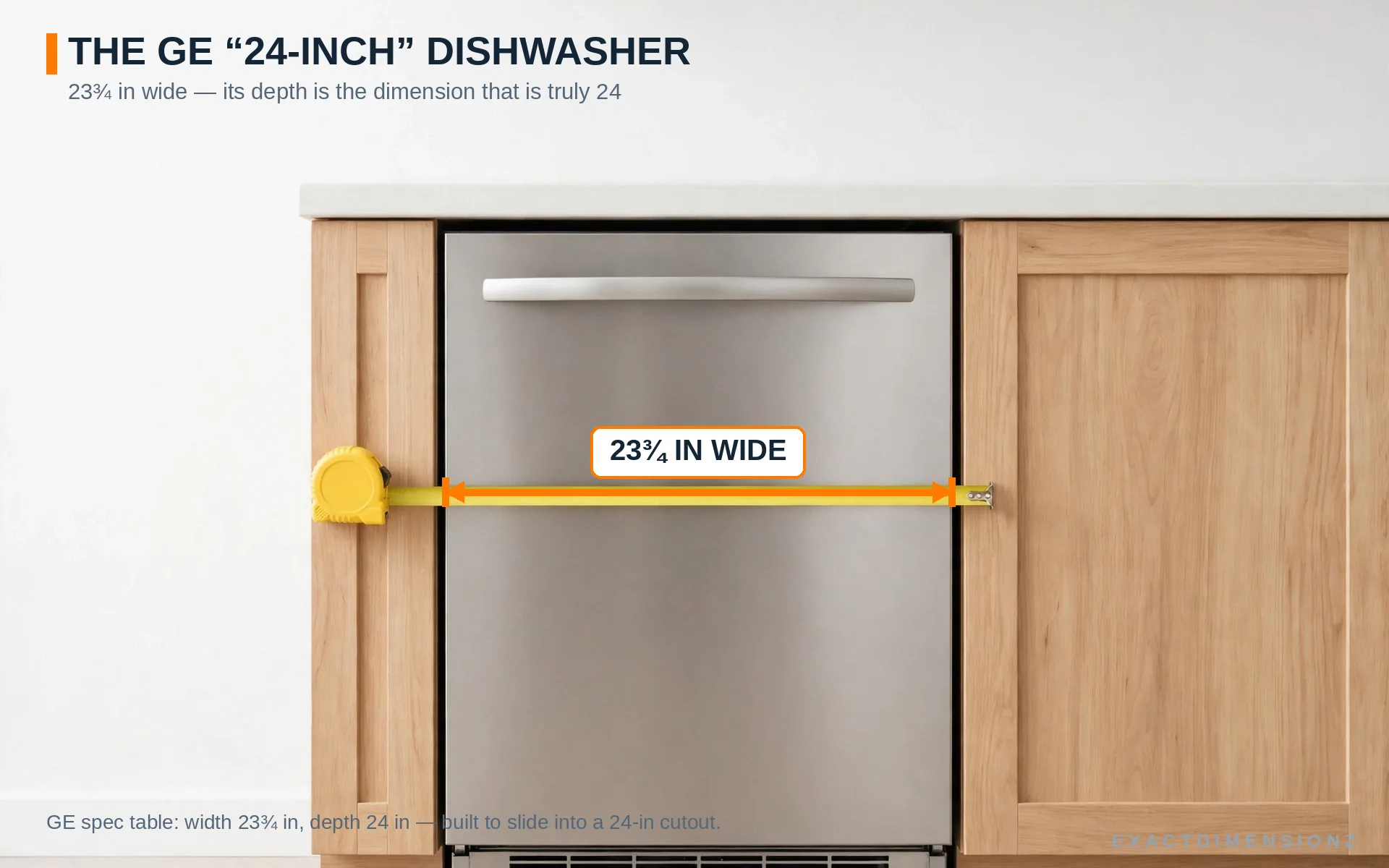
On the chart: Claim — 24 in. Tape — 23¾ in wide; 24.00 in deep. Direction — the class is the width; the true 24 is the depth.
The dishwasher is the lineup’s plot twist. It is sold as a “24-inch” machine, and the number refers to the width of the kitchen cutout it slides into — so the machine itself must be narrower than its name, or it would not fit. The specification tables for GE’s 24-inch built-ins, such as the GDF530PGMWW’s dimensions at Best Buy, read: product width 23¾ inches, product height 34, product depth — 24 inches. The true two feet is on the machine, exactly where nobody quotes it: front to back, matching the 24-inch-deep base cabinets from Suspect 1 that flank it on both sides.
This is fine print of the most benign kind — an installation class doing exactly what installation classes should do, with the real dimensions printed in every spec table. But it makes the dishwasher useless as a visual reference for “24 inches wide” and perfect as a reference for 24 inches deep, and it completes the kitchen’s testimony: in the room built on the two-foot grid, the cabinet box is 24 deep, the dishwasher is 24 deep, and the only thing that is not 24 is the width both of them are filed under.
Wall test: run a tape across the front of any built-in dishwasher: about 23¾ inches. The 24-inch figure is the hole it lives in — measure the empty cutout during a remodel and the class name resolves itself.
12. The Apple iMac 24
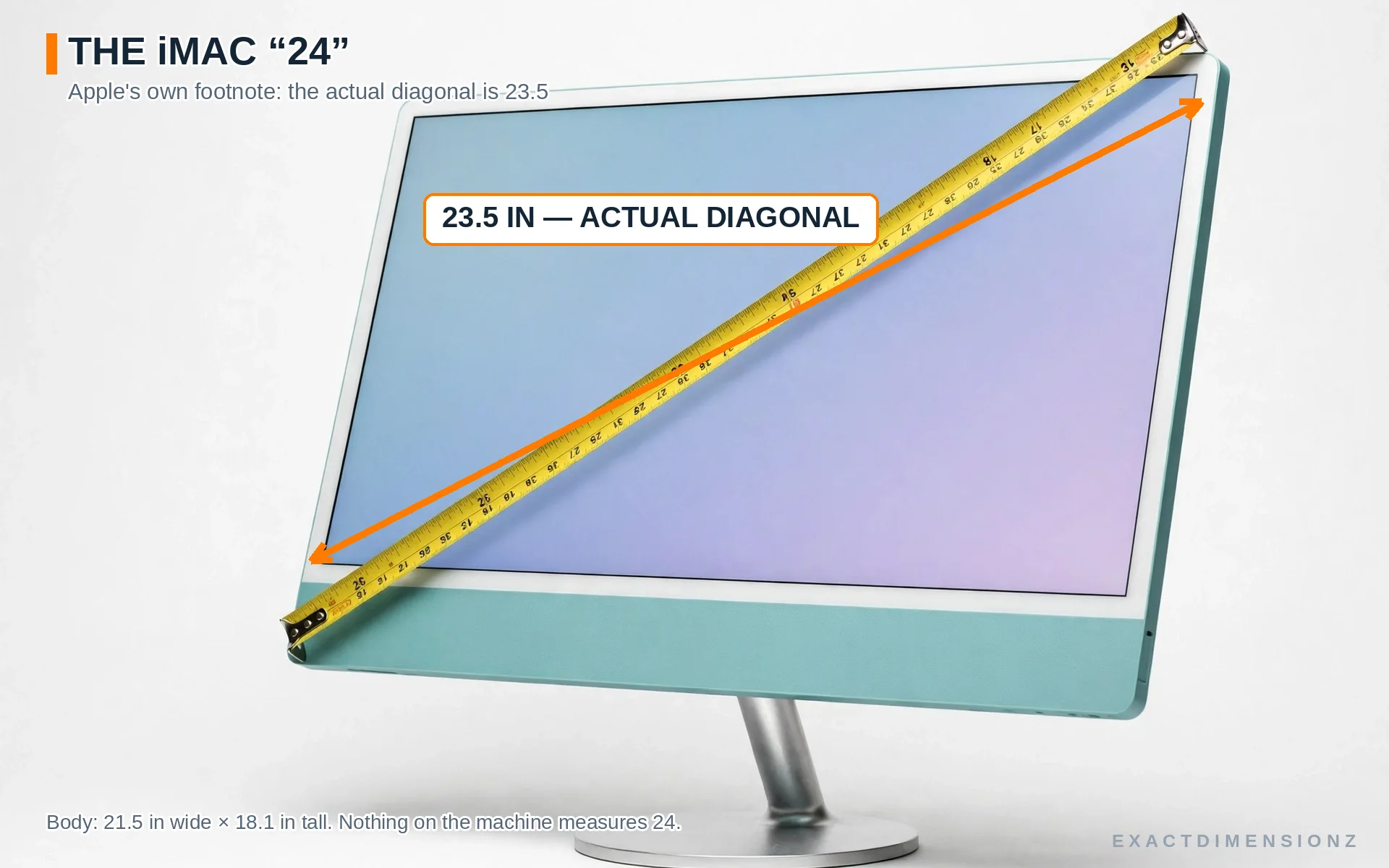
On the chart: Claim — 24 in. Tape — 23.5 in diagonal; 21.5 in wide; 18.1 in tall. Direction — all of them. None reaches the line.
The iMac is the only suspect whose own maker testifies against the name in writing. Apple markets a “24-inch 4.5K Retina display,” and then, in the technical specifications for the machine (Apple’s document, mirrored PDF), prints the footnote: “Actual diagonal screen size is 23.5 in.” Half an inch of the name simply does not exist — not as a diagonal (23.5), not as a width (the body is 21.5 inches across), not as a height (18.1 inches). The 24 is a class rounded up by a full half inch, further than the Dell in Suspect 6 dared, and the computer stands against the wall a half-inch short in the only direction its name could plausibly mean.
To be fair to the suspect: Apple discloses the real figure in its own documents, the display is superb, and screen-class rounding is an industry-wide convention this article has met at every size. But the lineup grades measurements, not intentions. A reference object for “how long is 24 inches” that tops out at 23.5 on its longest possible line is not a 24-inch object with fine print. It is a 23.5-inch object with a 24-inch name.
Wall test: measure the lit screen of an iMac 24 corner to corner: 23.5 inches, exactly as Apple’s footnote confesses. The name is the only part of the computer that measures 24, and it is not a part you can measure.
13. The Insignia 24-Inch Class TV

On the chart: Claim — 24 in class. Tape — 23.8 in diagonal; 21.9 in wide. Direction — diagonal class, rounded.
The final suspect is the most honest failure in the lineup, because its spec sheet prints the acquittal and the conviction on adjacent lines. Best Buy’s specification table for the Insignia 24″ Class F20 Series lists, in the same breath: Screen Size Class — 24 inches; Screen Size — 23.8 inches. The word “class” is doing all the work, and to the industry’s credit it is printed right there in the product name, not buried. The television’s body, for the record, is 21.9 inches wide: picture a “24-inch TV” as your mental ruler and every direction you can measure will betray you, the diagonal by two-tenths, the width by more than two inches.
TVs are measured diagonally by law and custom, and the class system exists so that a 23.8 and a 24.0 panel can share a shelf label. None of that is a scandal. It is simply the furthest a name can drift from a tape while staying legal — which makes the 24-class TV the right suspect to close the lineup: proof that the gap between a size and a measurement is not an error in the system. It is the system, and the only defence is to ask which line was measured.
Wall test: measure the screen of any “24-inch class” TV corner to corner: 23.8 inches or less. Then check its spec table for the two lines — class and size — printed side by side, and watch the whole convention confess itself.
The Full Lineup on One Wall
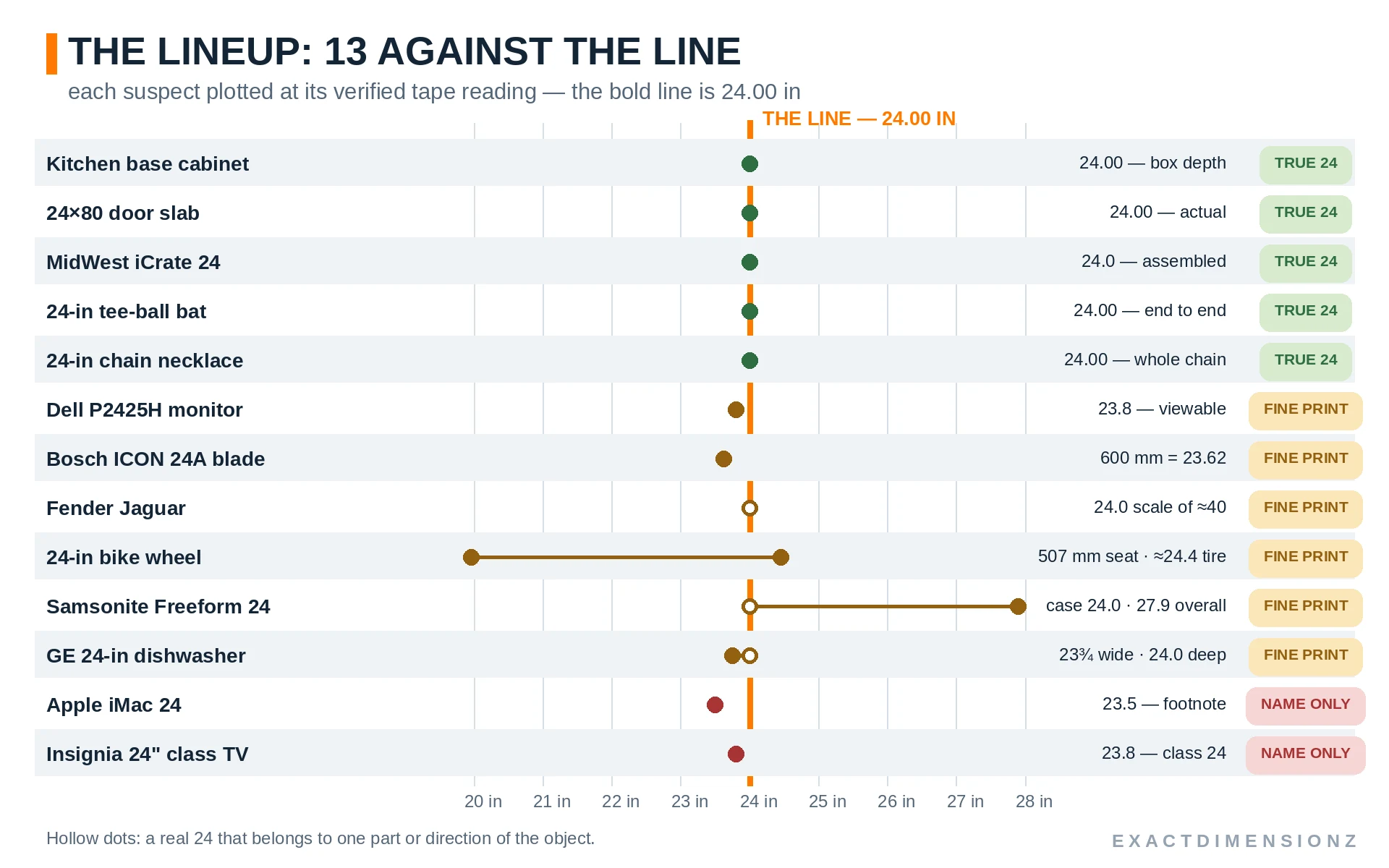
Thirteen suspects, one line. Read the tape column and the whole article compresses into a single habit: every suspect that failed did so because its number measured something other than what the reader pictured — a class, a translation, a part, a cutout. Every suspect that passed measured the thing itself, in the direction the buyer cares about, with the figure published where it could be checked.
| Suspect | The claim | The tape reads | Standing |
|---|---|---|---|
| Kitchen base cabinet | 24 in deep | 24.00 in (the box) | TRUE 24 |
| 24×80 door slab | 24 in wide | 24.00 in actual | TRUE 24 |
| MidWest iCrate 24 | 24 in long | 24.0 in assembled | TRUE 24 |
| 24-in tee-ball bat | 24 in long | 24.00 in | TRUE 24 |
| 24-in chain necklace | 24 in of chain | 24.00 in end to end | TRUE 24 |
| Dell P2425H monitor | “24” class | 23.8 in diagonal | FINE PRINT |
| Bosch ICON 24A blade | 24 in | 600 mm = 23.62 in | FINE PRINT |
| Fender Jaguar | 24 in scale | 24 in of a 40-in guitar | FINE PRINT |
| 24-in bike wheel | 24 in class | 507 mm seat; ≈24.4 in with tire | FINE PRINT |
| Samsonite Freeform 24 | 24 in case | 27.9 in overall | FINE PRINT |
| GE 24-in dishwasher | 24 in class | 23¾ in wide; 24.00 in deep | FINE PRINT |
| Apple iMac 24 | 24 in | 23.5 in diagonal, by footnote | NAME ONLY |
| Insignia 24″ class TV | 24 in class | 23.8 in diagonal | NAME ONLY |
Build Two Feet Yourself
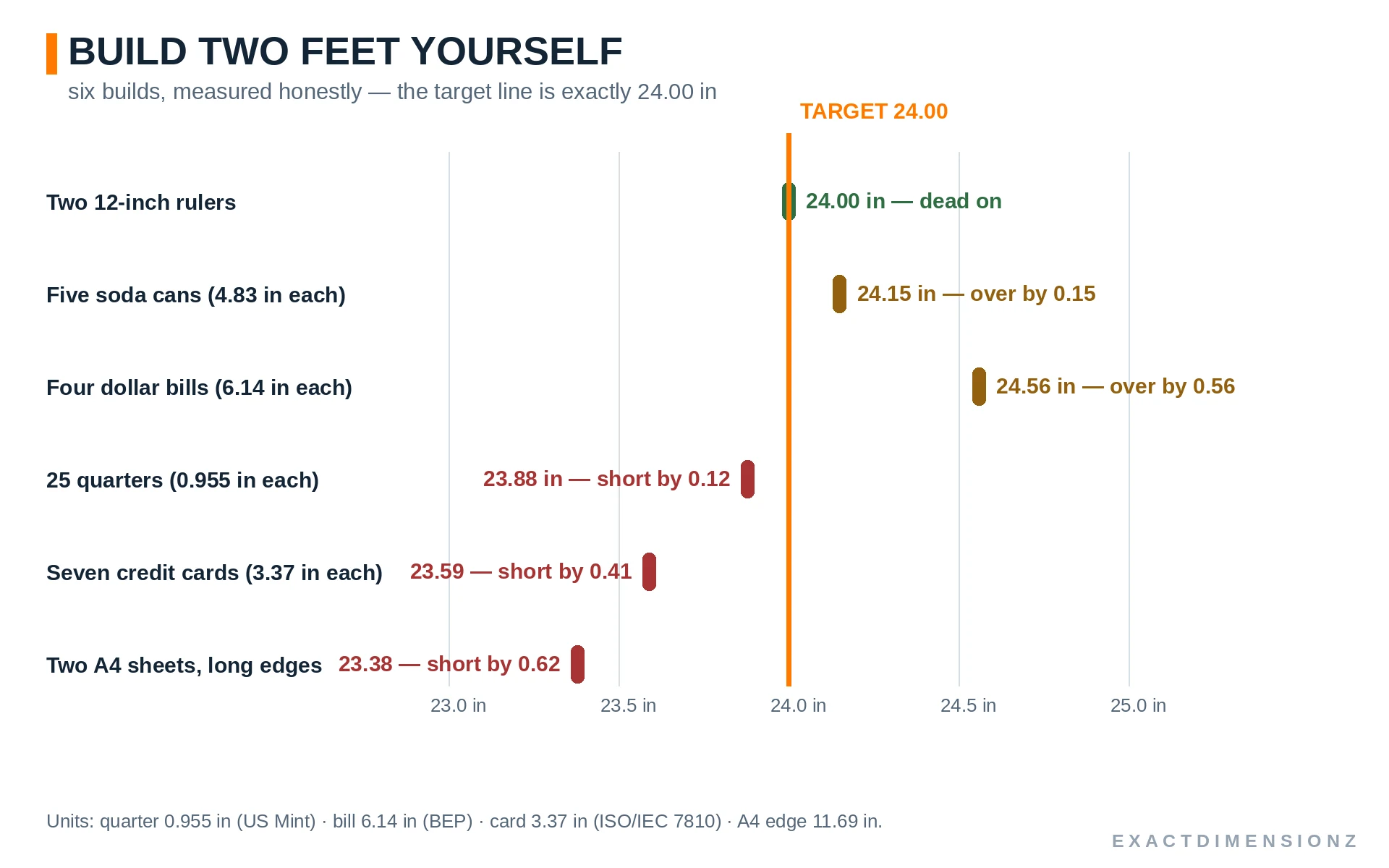
You do not need a suspect to show someone two feet. You need two rulers — or, failing those, the contents of a kitchen drawer, measured honestly. Every total below is computed from the standard unit: the US Mint’s quarter at 0.955 inches across, the Bureau of Engraving and Printing’s dollar bill at 6.14 inches long, the ISO-standard bank card at 3.37 inches on its long edge, and the standard 12-ounce can at 4.83 inches tall.
- Two 12-inch rulers, end to end: 24.00 in — dead on. The only build that needs no apology, and the reason this size is the easiest in the series to show exactly.
- 25 quarters in a row: 23.88 in — short by an eighth. Twenty-four quarters would be the poetic build; poetry is 23 inches’ problem. The twenty-fifth quarter still leaves you 0.125 short, because 0.955 is not 1.
- 5 soda cans, end to end: 24.15 in — over by 0.15. The closest everyday overshoot; five cans standing in a line run a sixth of an inch past the line.
- 4 dollar bills, end to end: 24.56 in — over by half an inch. Bills feel like they should tile neatly into feet. They do not; four of them overshoot two feet by more than two bill-widths’ worth of good intentions.
- 7 credit cards, long edges: 23.59 in — short by 0.41. Rival pages love card builds because the card is a standard size; the standard size is 3.37 inches, and seven of them cannot reach two feet.
- Two A4 sheets, long edges: 23.38 in — short by 0.62. An A4 sheet is 8 inches and change wide (210 mm) and 11.69 inches long; two of them end to end still stop over half an inch short of the line. Letter paper is worse: two sheets make exactly 22.
The Corrections Desk
The pages this article replaces were measured against the same wall, and some of their claims never reached the line either. Seven corrections, each with its source.
1. “A typical carry-on suitcase stands exactly 24 inches tall.” The flagship error of this keyword, repeated in several forms: One rival page states it outright, another calls a 24-inch bag “often the largest size considered as carry-on by most airlines,” and a third puts airline carry-on caps “in the 22-to-24-inch range.” The airlines disagree. Travelpro’s published airline limit table lists the carry-on limits of the three largest US carriers — American, Delta and United — identically: 22 × 14 × 9 inches. Only Southwest allows a 24-inch-tall carry-on. At the big three, a bag that “stands exactly 24 inches tall” is not a carry-on at all; it is a checked bag with ambitions, which is why every honest 24-inch suitcase, including Suspect 10, is sold as checked luggage.
2. “A 6-inch sub sandwich typically measures 24 inches when laid flat.” One rival page’s most geometrically confused claim. A 6-inch sub is six inches long standing up, lying down, or travelling; orientation is not a dimension. Four subs end to end would make 24 inches. One sub, however arranged, makes a sandwich.
3. “24 inches is about the height of an average two-year-old.” From the same rival page. The World Health Organization’s Child Growth Standards put the median height at 24 months at 87.1 cm for boys and 86.4 cm for girls, as tabulated in the WHO comparison literature — about 34 inches either way. The average two-year-old does not stand at the two-foot line; she stands ten inches over it, which is why toddler analogies should be checked against the one growth chart the whole world uses.
4. The invented federal standard. A rival list attributes the prevalence of 24-inch dimensions to authority: “According to the U.S. Consumer Product Safety Commission, standard furniture and appliance dimensions are often built around 2-foot increments.” No such CPSC standard exists. The CPSC regulates product safety — crib slats, drawstrings, tip-over hazards — not a two-foot dimensional grid, and no CPSC publication states the quoted claim. The real 24s in this article come from trade conventions documented maker by maker: cabinet standards, door ladders, crate ladders. An invented citation is worse than no citation, because it borrows the credibility of an agency that never spoke.
5. “Your elbow to your fingertips is close to 24 inches for most adults.” A rival list again. Standard anthropometric tables put the median elbow-to-fingertip length at about 430 mm — 16.9 inches — and even the 95th percentile reaches only about 460 mm, 18.1 inches. For “most adults” the claim overshoots by roughly 7 inches: the average forearm-and-hand would need to grow by more than a third to touch the line. Body-based references are charming and almost always wrong; this one is wrong by the length of a pencil.
6. “A basketball hoop and backboard stand approximately 24 inches wide.” The same rival page, once more. A regulation backboard is 72 inches wide by 42 inches tall under NBA and NCAA rules — three full two-foot lines side by side. The 24-inch figure does exist on a backboard: it is the width of the shooter’s square painted above the rim, 24 by 18 inches. Somewhere between the square and the board, the correction writes itself: the part was mistaken for the whole, the single most common error on this entire wall.
7. “Two iPad Pros placed side by side equal exactly 24 inches.” One rival page’s arithmetic, and it fails in both directions. The current 13-inch iPad Pro stands 281.6 mm tall — 11.09 inches, per the model’s published dimensions — so two of them stacked reach 22.18 inches, nearly two inches short. The original 12.9-inch model from 2015 stood 12.04 inches tall, so two of those reach 24.08 — over, and still not “exactly 24.” No iPad Pro ever made has stood exactly 12.00 inches tall, which is what the claim requires twice over. “Exactly” is the hardest word in measurement writing; it should be spent only where a standard guarantees it — as it does, once, at the top of this article: 24 inches is exactly two feet.
How to Read Any “24 Inches” Claim
The lineup dismisses, but the wall stays up, and every size you meet from now on can be stood against it with three questions. Which direction? A diagonal, a depth, a scale length and a bead seat are all “inches,” and they are not interchangeable; the honest suspects above named theirs. Class or measurement? If the word “class” appears — or silently applies, as with monitors, dishwashers and wheels — the name is a shelf label, and the spec sheet holds a different, smaller, truer number. Whose figure is it? The maker’s specification, or a roundup’s paraphrase? Every correction in the Desk above was born when a real manufacturer’s number passed through a page that did not check it.
Ask those three and the two-foot line stops being a fact about thirteen products and becomes what it should have been all along: a way of seeing. Twenty-four inches is exactly two feet. Everything else is a suspect.
