
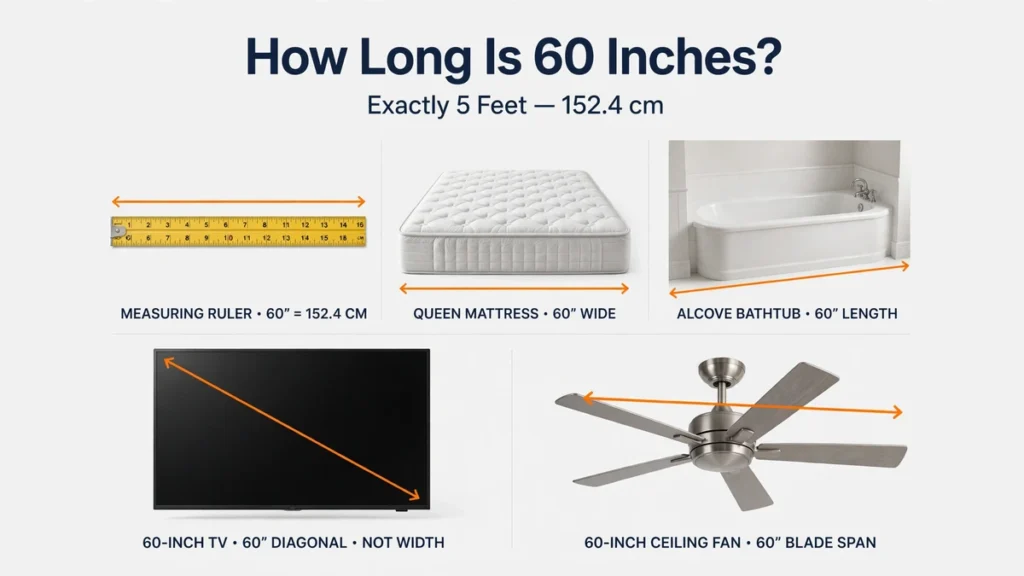
If you have ever asked how long is 60 inches, the short answer is almost too tidy to trust: exactly 5 feet. No rounding, no “about,” no range — 60 divided by 12 is 5, and 60 times 2.54 is 152.4 centimetres exactly. Yet 5 feet still does not tell your eyes anything, because a 5-foot width, a 5-foot length, a 5-foot diagonal, and a 5-foot turning circle are four different shapes that happen to share one number. That is why vague lists fail here: they hand you the conversion and leave you to guess which dimension anyone meant.
This article fixes the dimension first and the number second. Below are seven single, named things, each with its real specification and its honest distance from 60 inches. Six are exact at 60 inches for the dimension stated, and one is a labelled near-miss that falls exactly one inch short — kept in because it teaches the most useful lesson in the whole article: check the spec sheet, not the model name. Every object’s image sits immediately after its heading, and every object carries its evidence grade, so you can see at a glance which figures are exact, which are listed, and which one is short. For the full range, see the complete inches size guide.
Quick Answer
60 inches = 5 feet 0 inches exactly = 152.4 cm exactly = 1.524 m = 1.67 yards (1 yard and 24 inches). It is exactly five feet, not “about five feet” — but whether that five feet is a width, a length, a diagonal, or a diameter changes everything about fitting it into a room.
Five Feet, Five Different Dimensions
Before the objects, one discipline that makes all seven readable. A queen mattress is 60 inches wide and 80 inches long, so “60 inches” there is the shorter side. An alcove bathtub is 60 inches long, so the same number is the longer side. A television’s 60 inches is a diagonal, corner to corner, and its width is roughly eight inches less. A ceiling fan’s 60 inches is a swept circle, tip to tip. A wheelchair turning space’s 60 inches is a minimum diameter, a floor area you must keep clear, not an object you buy. Same number, five meanings — and every object below names its meaning in its heading, so you never have to guess.
The grades are simple. EXACT means a manufacturer or authority figure states 60 for the dimension measured. LISTED means a product is sold at the 60-inch size. There are no range objects in this article and no stacked multiples: no pile of rulers, no row of banknotes, no “five of these make 60 inches.” Each entry is one thing you can walk up to and measure.
The 7 Objects
1. Queen-Size Mattress — 60 Inches Wide, 80 Inches Long (EXACT)
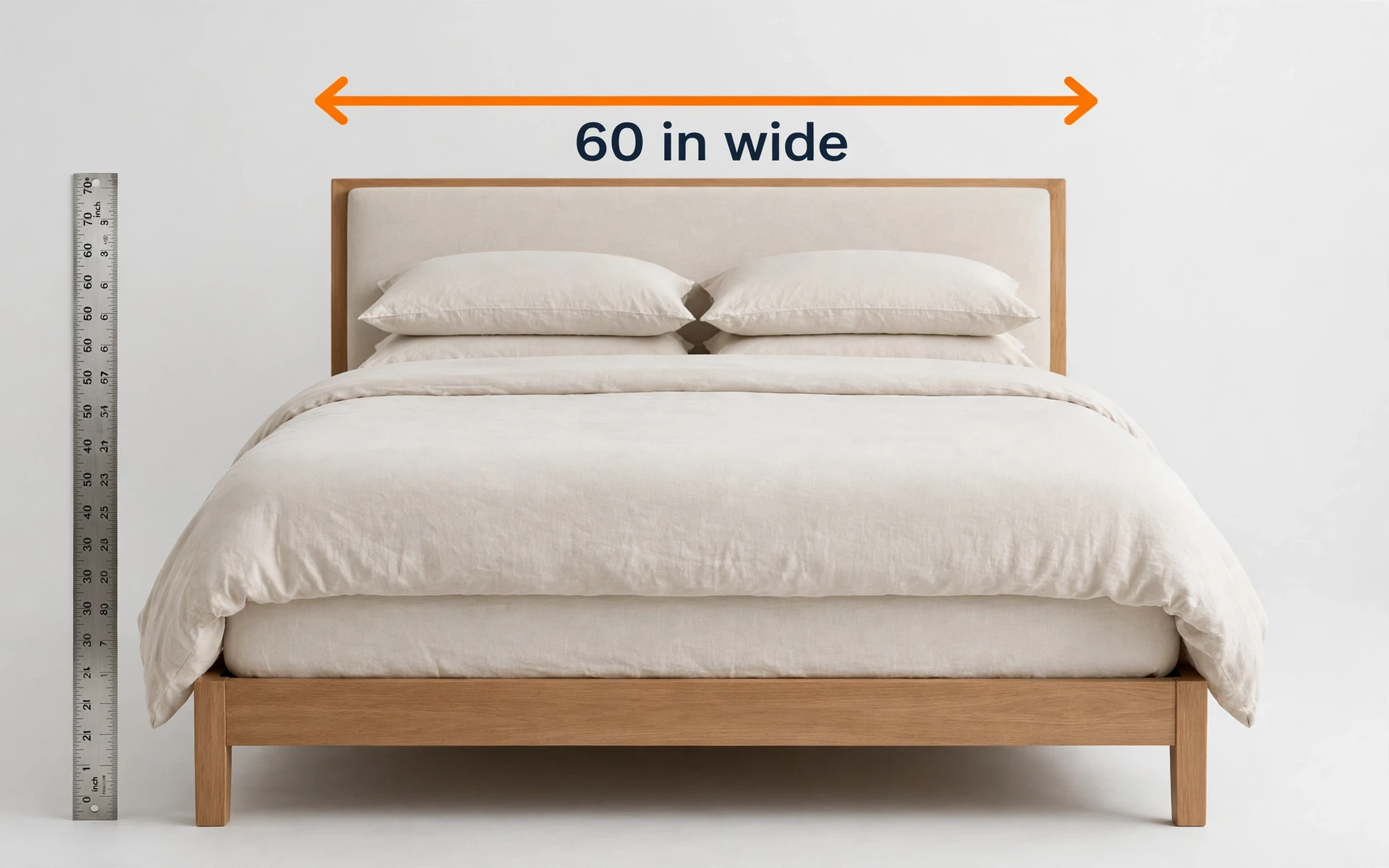
The queen mattress is the most useful 60-inch object in any home, because almost everyone has slept beside one. A standard queen lists a queen at 60 by 80 inches, which makes 60 inches the width — the side-to-side measurement across the bed — while the length runs 80 inches, a full 20 inches longer. That distinction matters when you buy sheets, a frame, or a room layout: a queen needs a wall at least 60 inches wide, and a room that can also swallow 80 inches of length plus walking space at the foot.
The honest footnote is small but worth stating. Foam and construction vary slightly by model, so individual mattresses can differ by a fraction of an inch from the standard, but the queen size standard itself is 60 by 80 inches, and that is the figure every retailer, frame maker, and sheet maker builds to. If your bedroom wall measures 62 inches, a queen fits with an inch to spare on each side; if it measures 59 inches, it does not fit at all, and no amount of pushing makes a standard queen narrower.
2. Kohler Bellwether Alcove Bathtub — 60 Inches Long (EXACT, Nominal)
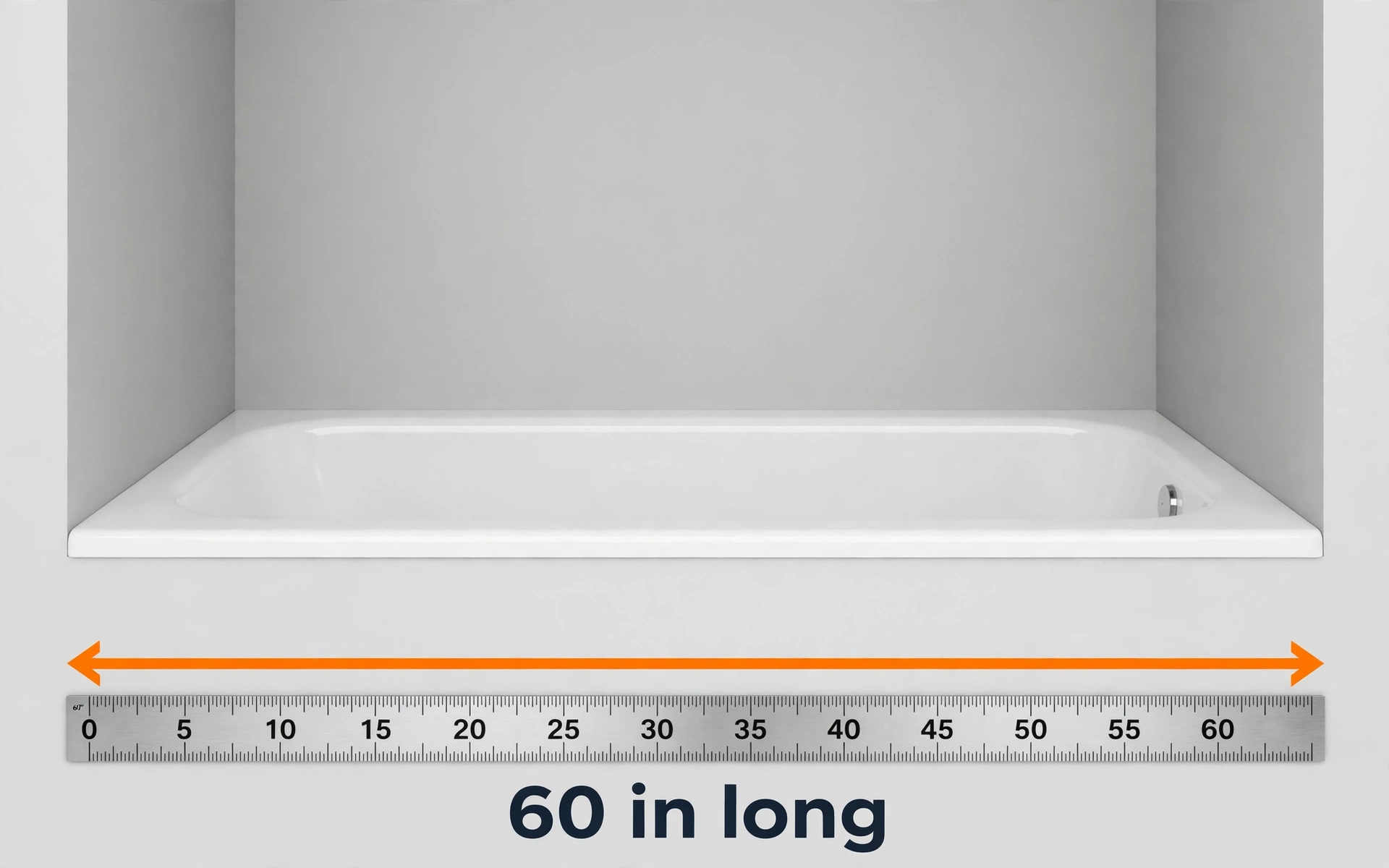
The standard alcove bathtub is the reason so many bathrooms are built around a 60-inch opening. The Kohler Bellwether K-837 specification sheet gives 60 inches by 30 and a quarter inches, a length that has become the default for three-wall alcove bathrooms across North America. When a builder says “five-foot tub,” this is the tub they mean: long enough to stretch out in, short enough to fit the standard alcove.
Kohler’s own caveat belongs in the same paragraph, not in fine print. The specification sheet states that all product dimensions are nominal, which means you should measure the actual tub before roughing in plumbing or cutting tile. Nominal 60 inches is the size class and the design target, and in practice the tub lands on it, but a rough-in built to exactly 60 inches with zero tolerance is a rough-in built to fail. Give yourself a fraction of play, and the standard tub rewards you with the easiest bathroom fit in the article.
3. Samsung 60-Inch-Class TV — 60.0 Inches Diagonally, About 52 Inches Wide (EXACT, Diagonal Only)
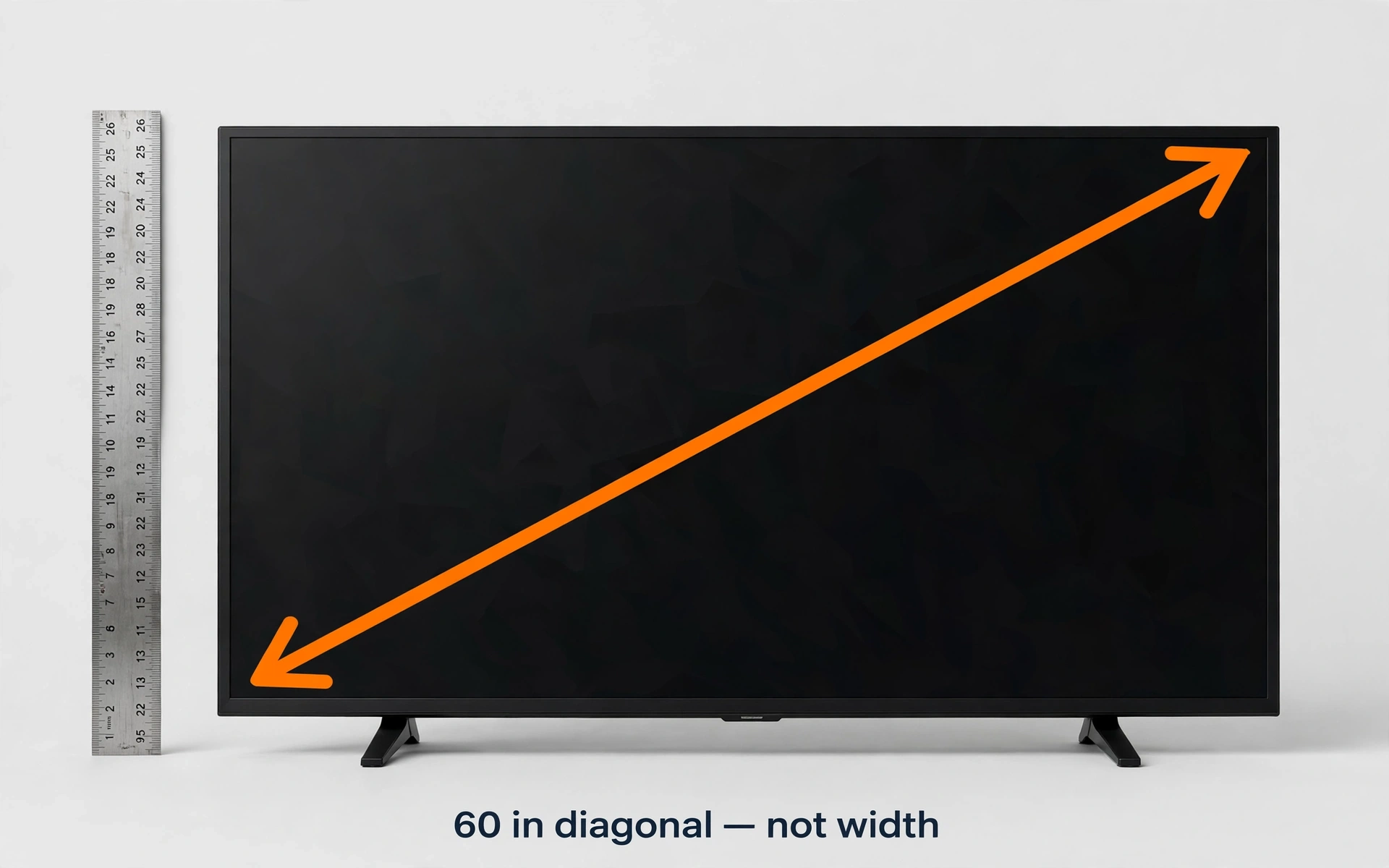
Here is the trap, stated with a named manual. Samsung’s manual lists the 60-inch class at 60.0 inches measured diagonally, which is exact — for the diagonal. For a 16:9 screen, the geometry gives a visible screen roughly 52.3 inches wide and 29.4 inches tall, and the outer television with its frame is wider still, varying by model. A 60-inch TV is therefore not 60 inches wide, not 5 feet wide, and not something you measure a TV stand against using the number 60.
This is the single most expensive 60-inch mistake in the article, because stands and wall units are bought against width. A stand 54 inches wide holds most 60-inch-class sets comfortably; a stand 48 inches wide leaves the set overhanging on both sides. The rule from the previous articles holds and gets sharper here: measure the outer width on your specific model’s spec sheet, never the class name. The diagonal tells you the screen size; the width tells you whether it fits your furniture, and only one of those numbers is 60.
4. Hunter Aerodyne Ceiling Fan — 60-Inch Blade Span (EXACT)
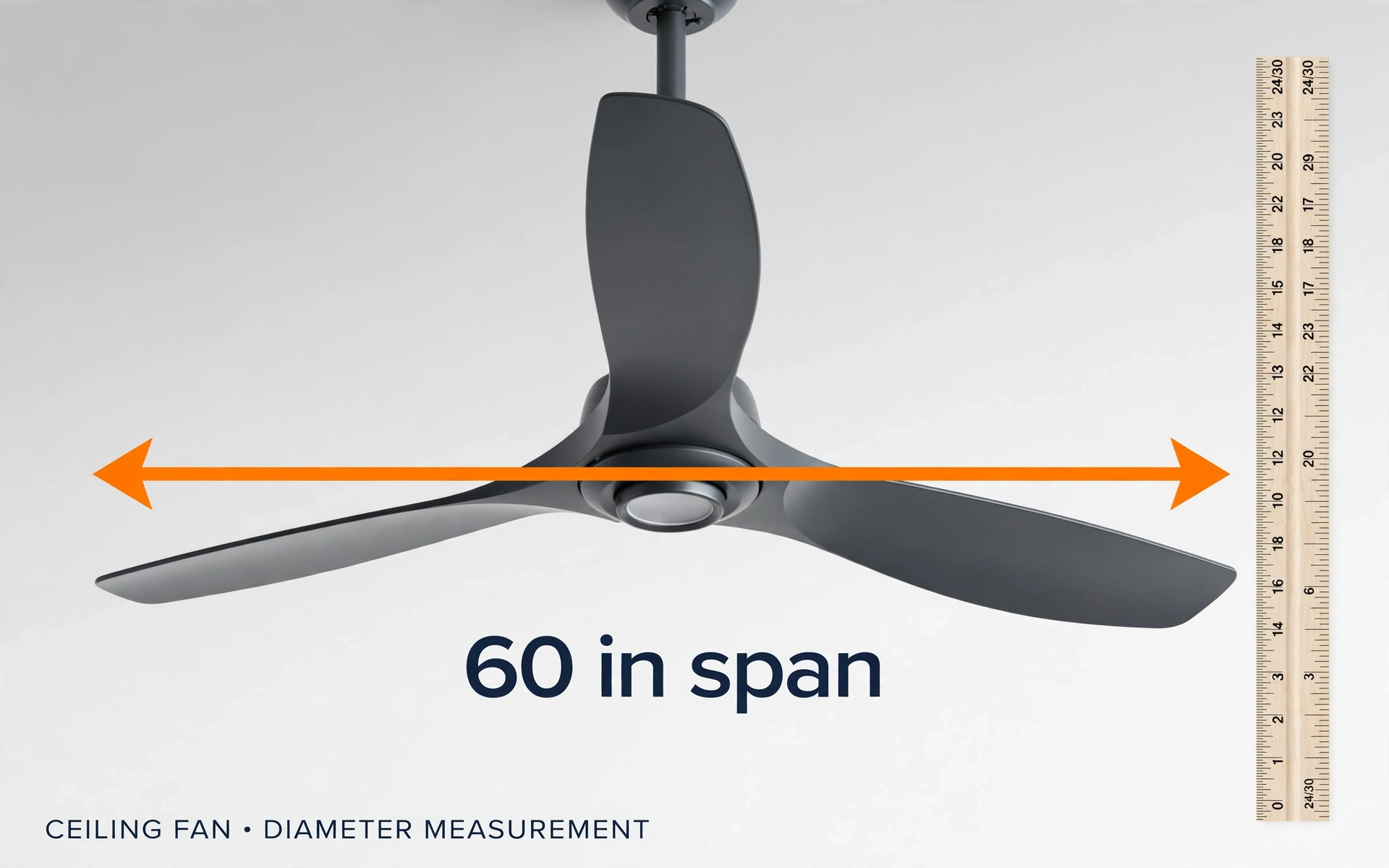
A ceiling fan’s inches are a circle, not a line. Hunter’s product page names it the 60-inch Aerodyne, and the blade span — tip to tip across the swept circle — is 60 inches. No single blade is 60 inches long; each blade is roughly half the span minus the motor housing, and the 60 inches is the full diameter of the air the fan moves. That is why fan sizing is room sizing: the span must match the room, not just the ceiling.
A 60-inch fan suits a large room, the kind of great room or open living space where a smaller fan would look lost and move air nobody feels. The clearance logic matters as much as the span: blades need clear space from walls and a safe height above the floor, so a 60-inch span in a small bedroom is not merely oversized, it is unusable. Measure the room across in both directions first, then match the span to the room — a fan’s inches are only useful when the room’s feet agree with them.
5. Wheelchair Turning Space — 60-Inch Diameter Minimum (EXACT, Authority Standard)
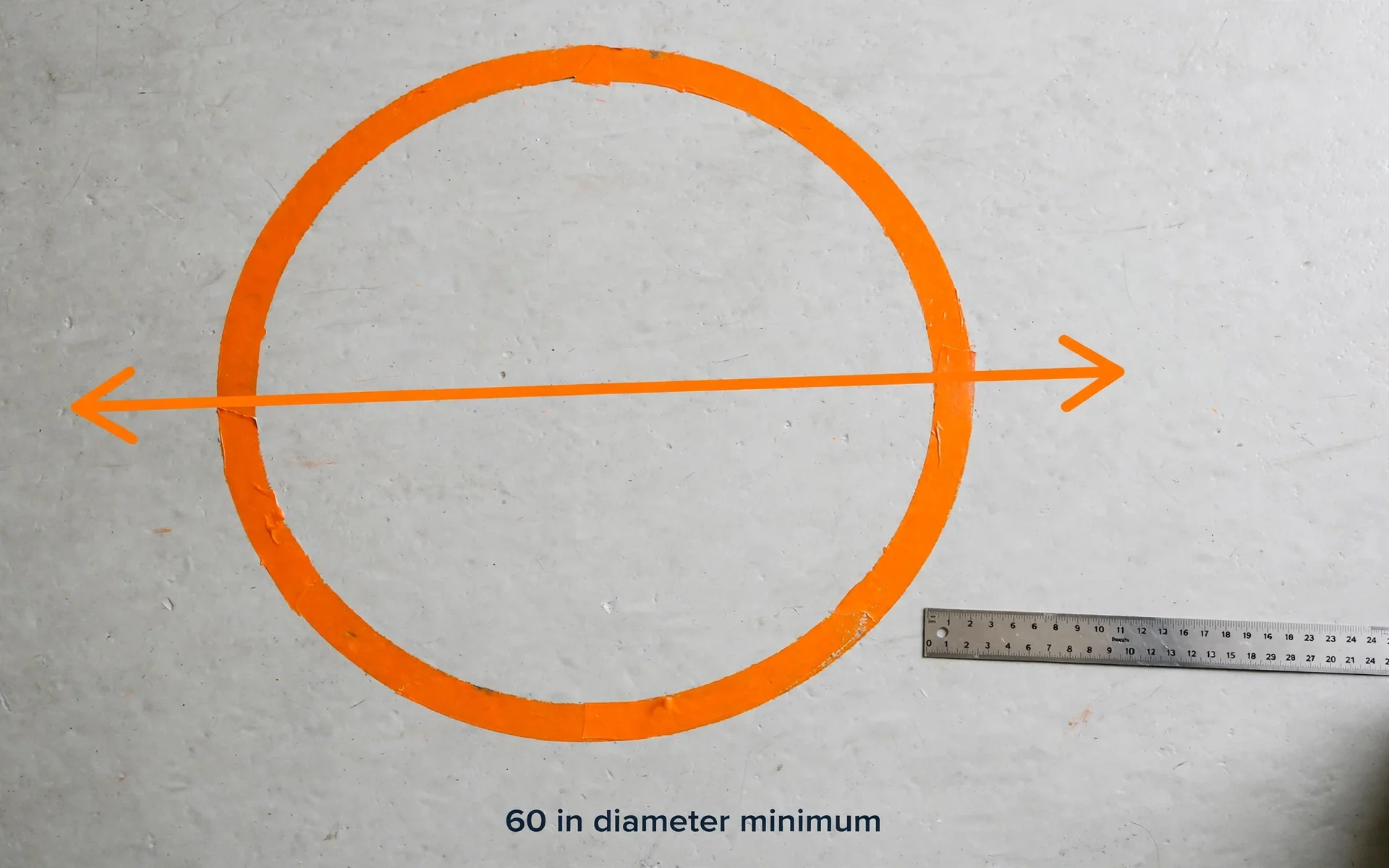
Not every 60-inch object is something you buy. The accessibility standard for a wheelchair turning space requires a circular space with a 60-inch minimum diameter, or a T-shaped space fitting within a 60 by 60 inch square. This is a minimum clearance, not a recommended room size and not a product dimension: it is the floor you must keep clear so a wheelchair user can turn around, and larger is always easier to turn in.
The millimetre footnote is worth one honest sentence. The accessibility text rounds this figure to 1,525 mm, while the exact conversion of 60 inches is 1,524 mm; this article quotes the standard as 60 inches and does not silently “correct” its millimetre figure. For anyone planning a bathroom, hallway, or kitchen, this object reframes 60 inches entirely: it is not a length to admire, it is a circle to protect, and a room that cannot spare a 60-inch circle cannot be called accessible no matter how wide its door is.
6. Regency Commercial Work Table — 60 Inches Long (EXACT)
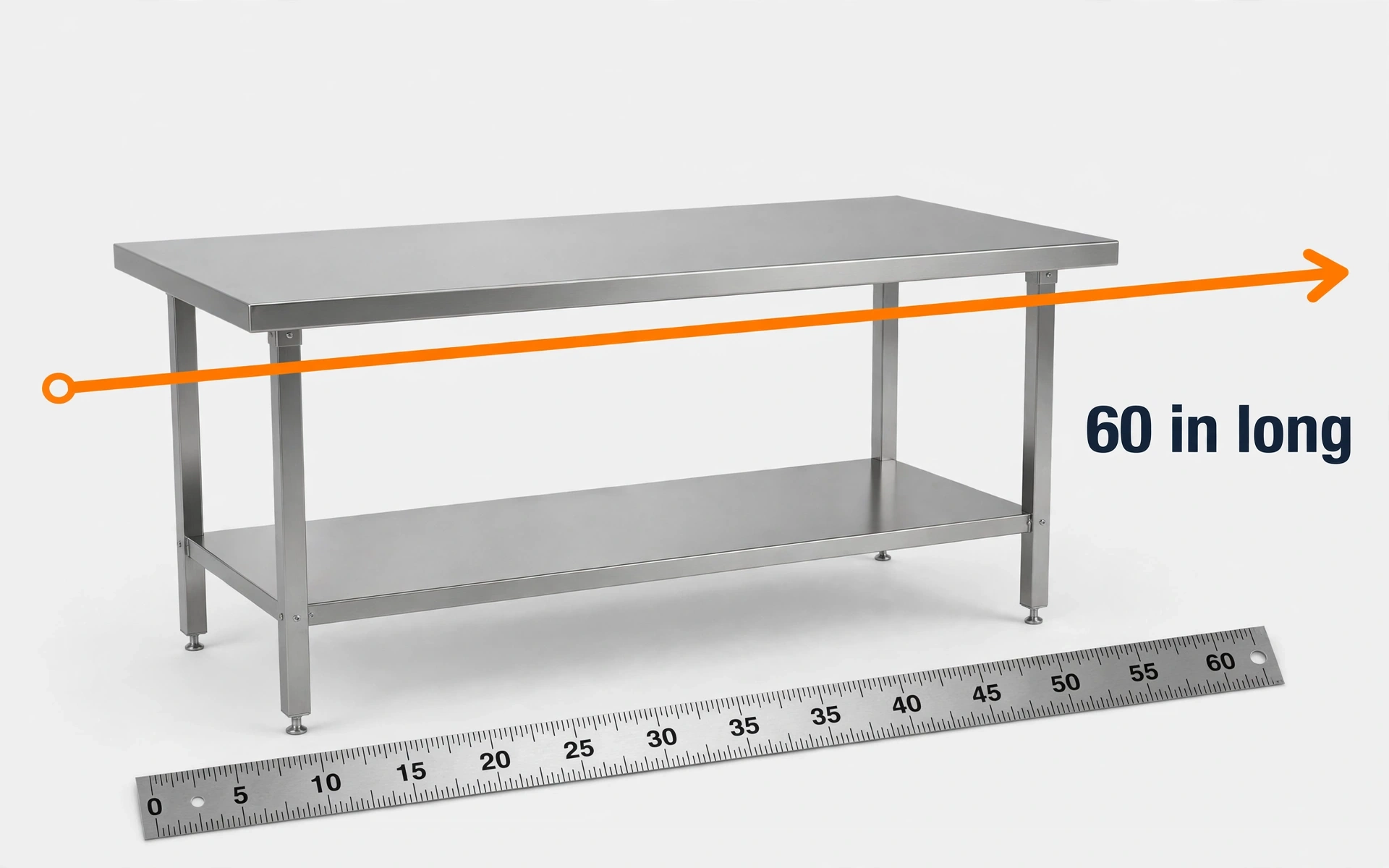
The work table is the article’s plainest object, and that plainness is its virtue. The manufacturer’s spec sheet lists length 60 inches, with a width of 36 inches and a height of 35 inches, for a kitchen and work table with a wood top. The 60 inches is the long edge, a clean, uninterrupted five feet you can stand beside and see in one glance, with no diagonal, no span, and no clearance to interpret.
Do not dress this table up as dining guidance — it is a work table, not a dining table, and seating counts do not apply to it. Its value is as a measuring stick you already understand: a five-foot table edge is the length of a tall person’s height laid on its side, the width of a queen bed, and the length of a standard bathtub, all in one object. If you need to picture 60 inches in a kitchen or workshop, picture this table’s long side, and you have pictured it exactly.
7. UPLIFT Whiteboard Desktop — Sold as 60 by 30, Measures 59 Inches (NEAR-MISS, 1 Inch Short)
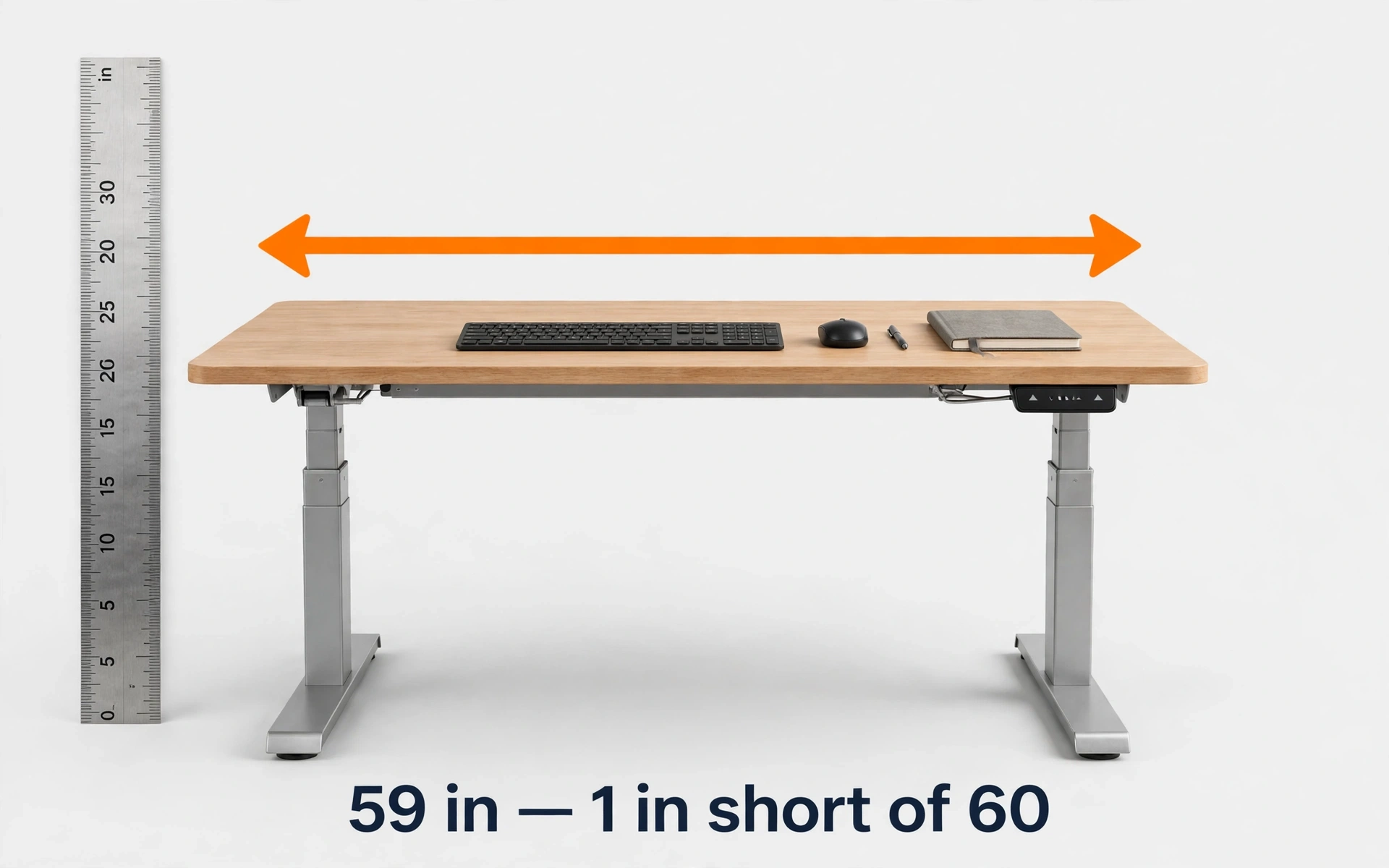
The final object is the one that proves the article checks rather than rounds. The UPLIFT whiteboard desktop is sold in a “60 by 30” size, but the desktop spec sheet measures the 60 by 30 size at 59 inches, with a depth of 29.5 inches. That is one inch short of a full five feet, and this article says so in the heading, the body, and the image description — because a desk bought to fill an exact 60-inch alcove leaves a one-inch gap, and a monitor arm or cable tray planned to the inch inherits the same gap.
The lesson generalises beyond this one desk and beyond this one brand: model names round, spec sheets measure. Other UPLIFT tops and sizes differ, so do not generalise this 59-inch figure to every desk the brand sells; do generalise the habit, which is to open the spec sheet before you order. A one-inch shortfall is small, and that smallness is the point: at 60 inches, one inch is the difference between flush and a gap you notice every day.
Room by Room: What 60 Inches Means Where You Live
In the bedroom, 60 inches is the queen’s width and the wall it needs. In the bathroom, it is the alcove the tub fills and the turning circle an accessible bathroom must keep clear. In the living room, it is a television diagonal that is not a width and a fan span that must match the room. In the kitchen and workshop, it is a work table’s long edge and a desk that falls one inch short of the alcove it was bought for. The same five feet behaves differently in every room because the dimension changes, and the fitting question changes with it: width against a wall, length against an alcove, diagonal against a stand, diameter against a floor plan.
How to Measure 60 Inches at Home Without a Long Tape Measure
A standard yardstick is 36 inches, so a yardstick plus two feet — 24 inches, about the length of a sheet of paper turned longways twice — reaches 60. Or use the objects in this article: a queen bed’s width, a bathtub’s length, or a work table’s long edge are all 60 inches you can stand beside. Two relaxed adult steps cover roughly 60 inches, though strides vary, so check your stride against a known distance first. For anything that must fit — a tub alcove, a TV stand, a desk nook — use a real tape measure, because at 60 inches one inch is the whole difference between flush and a gap.
Conversion Table
| Unit | 60 inches equals |
|---|---|
| Feet and inches | 5 ft 0 in exactly |
| Feet (decimal) | 5.0 ft |
| Centimetres | 152.4 cm exactly |
| Millimetres | 1,524 mm |
| Metres | 1.524 m |
| Yards | 1.67 yd (1 yd 24 in) |
| Compared with 4 feet | 12 inches past 4 feet |
| Compared with 6 feet | 12 inches short of 6 feet |
| Compared with 50 inches | 10 inches longer |
| Compared with a standard door (6 ft 8 in) | 20 inches shorter |
How 60 Inches Compares With Other Lengths
Sixty inches is ten inches past 50 inches and twenty inches past 40 inches, and it dwarfs 30 inches and 20 inches — three 20-inch lengths make exactly 60. On the other side, a step up to 70 inches is ten inches longer. Against the foot series it is far short: 12 feet is nearly two and a half times as long, 13 feet longer still, and 14 feet and 15 feet longer again.
Frequently Asked Questions
How many feet is 60 inches?
Exactly 5 feet. Divide 60 by 12 and you get 5 with no remainder, so 60 inches is 5 feet 0 inches — not “about 5 feet,” but exactly 5 feet.
Is 60 inches the same as 5 feet 0 inches?
Yes. Five feet 0 inches is the feet-and-inches way of writing exactly 60 inches. The two phrases describe the same length, with no inches left over.
How many centimetres is 60 inches — and how many metres?
152.4 centimetres exactly, which is 1.524 metres. Multiply 60 by 2.54 to get 152.4 cm, with no rounding involved; divide by 100 for metres.
How many yards is 60 inches?
1.67 yards, rounded — exactly 1 yard and 24 inches. Divide 60 by 36 to get 1.6667 yards, so “about 1.67 yards” is the honest phrasing, while the feet and centimetre figures are exact.
How wide is a 60-inch TV really? Is it 60 inches wide?
No. A 60-inch TV is about 52 inches wide on the screen for a 16:9 set, and wider still with its frame, depending on the model. The 60 inches is the screen diagonal measured corner to corner — Samsung’s manual for the set above lists it at 60.0 inches diagonally — so measure your stand against the outer width, not against 60.
Is a queen mattress really 60 inches wide?
Yes, by the size standard: a queen is 60 inches wide and 80 inches long. Individual foam models can vary by a fraction of an inch, but the standard every frame and sheet maker builds to is 60 by 80 inches.
How long is a standard bathtub — and why is it 60 inches?
A standard alcove bathtub is 60 inches long, which is why so many bathrooms are built around a 60-inch opening. The Kohler Bellwether above measures 60 inches by 30 and a quarter inches, and that five-foot length has become the default three-wall alcove size.
How do I measure 60 inches at home if I do not have a long enough tape measure?
Use a yardstick (36 inches) plus 24 inches, or stand beside a known 60-inch object from this article — a queen bed’s width, a bathtub’s length, or a work table’s long edge. For anything that must fit exactly, borrow or buy a real tape measure, because one inch is the difference between flush and a gap.
Final Thoughts
Sixty inches is the rare measurement that is exact and still misunderstood, because five feet can be a width, a length, a diagonal, a span, or a turning circle, and the number alone never says which. Now you know it as a queen bed’s width, a bathtub’s length, a television diagonal that is not a width, a fan’s swept circle, a turning circle you must keep clear, a work table’s long edge, and a desk that measures 59 inches despite its 60-inch name. Six exact objects and one honest near-miss, each with its dimension named and its grade printed — that is what 60 inches looks like, and the next time someone says “five feet,” you will know to ask the only question that matters: five feet of what?
