
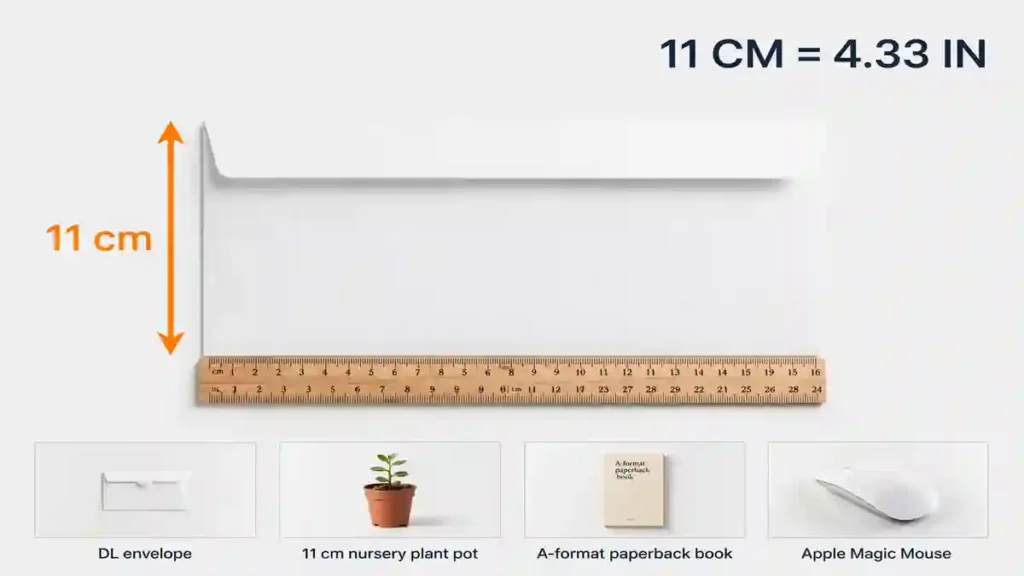
If you have ever wondered how big is 11 cm, the short answer is 4.33 inches — and the longer answer is that 11 cm is the size almost nothing is exactly, which is precisely what makes it hard to picture. Eleven centimetres is a standard envelope width, a standard plant-pot diameter, and a standard paperback width, all at once — three very different shapes that happen to share one number. It is a little longer than a credit card, a little shorter than a DVD, and almost exactly the length of the mouse sitting on your desk right now.
Below are five single, named things, each checked against its own specification, with the miss printed wherever a thing misses. One is exact at 11 cm for the dimension stated, and the other four land within half a centimetre of it — close enough to trust, honest enough to print. Every object’s image sits immediately after its heading, and no object is a stack, a multiple, or a category guess. You will not find four quarters lined up or half a ruler here, because a chain of small things is not a thing that is 11 cm long — it is arithmetic wearing a trench coat. By the end you will know 11 cm as an envelope, a plant pot, a paperback, a mouse, and a popsicle stick — and you will know which of those you can trust to the millimetre and which you must measure yourself.
Quick Answer
11 cm is 4.33 inches exactly — 110 millimetres, 0.11 metres, and 0.12 yards. But do NOT buy a frame, a pot, or a shelf against the number 11 without checking which dimension it is: a DL envelope is 11 cm on its short side and 22 cm on its long side, and the two numbers are not interchangeable.
The 11-Centimetre Problem: Why This Size Has Almost No Exact Objects
Eleven centimetres is a strange size to hunt for, because it sits in a gap between the standards. Most everyday objects are built in inches first and centimetres second, and the inch standards land on round centimetre numbers only by accident: 4 inches is 10.16 cm, 4.5 inches is 11.43 cm, and 5 inches is 12.7 cm. Nothing in the imperial system is 11 cm on purpose, so the objects that hit 11 cm exactly are the ones built in metric from the start — the envelope standard, the paperback format, the nursery pot. That is why four of the five objects below are near-misses rather than exact hits: the imperial world simply does not manufacture at 11 cm, and the metric world manufactures at it only where a standard says so. The honest way to picture 11 cm, then, is not to pretend the near-misses are exact — it is to print the miss, in millimetres, beside every object, so you know whether you are 3.5 millimetres over or 8.4 millimetres under before you trust it with a purchase.
The 5 Objects
1. A DL Business Envelope — 11 Cm Wide, 22 Cm Long (EXACT)

The envelope is the article’s cleanest exact, because its 11 cm is written into an international standard. A DL envelope — the business envelope used for letters across most of the world — measures 110 millimetres by 220 millimetres under ISO 269, which makes its short side exactly 11 cm and its long side exactly 22 cm. It is the envelope an A4 sheet folds into in thirds, which is why business letters put the address block where they do: it has to land behind the window after that specific fold and no other. Pick one up from any office drawer and you are holding 11 cm in your hand, no measuring required.
The fitting check is the direction, not the number. Eleven centimetres is the short side — the width across the envelope — and the long side is double it, so a shelf, a drawer, or a frame bought against "11 cm" fails by a factor of two if you measure the wrong edge. The grade is exact because the figure is a standard’s own dimension for this named format, not a size family: 110 mm, by definition, and the envelope in your drawer is the proof. Keep one beside your ruler and you will never have to guess 11 cm again.
2. An 11 Cm Nursery Plant Pot — 11 Cm Across the Top (LISTED)
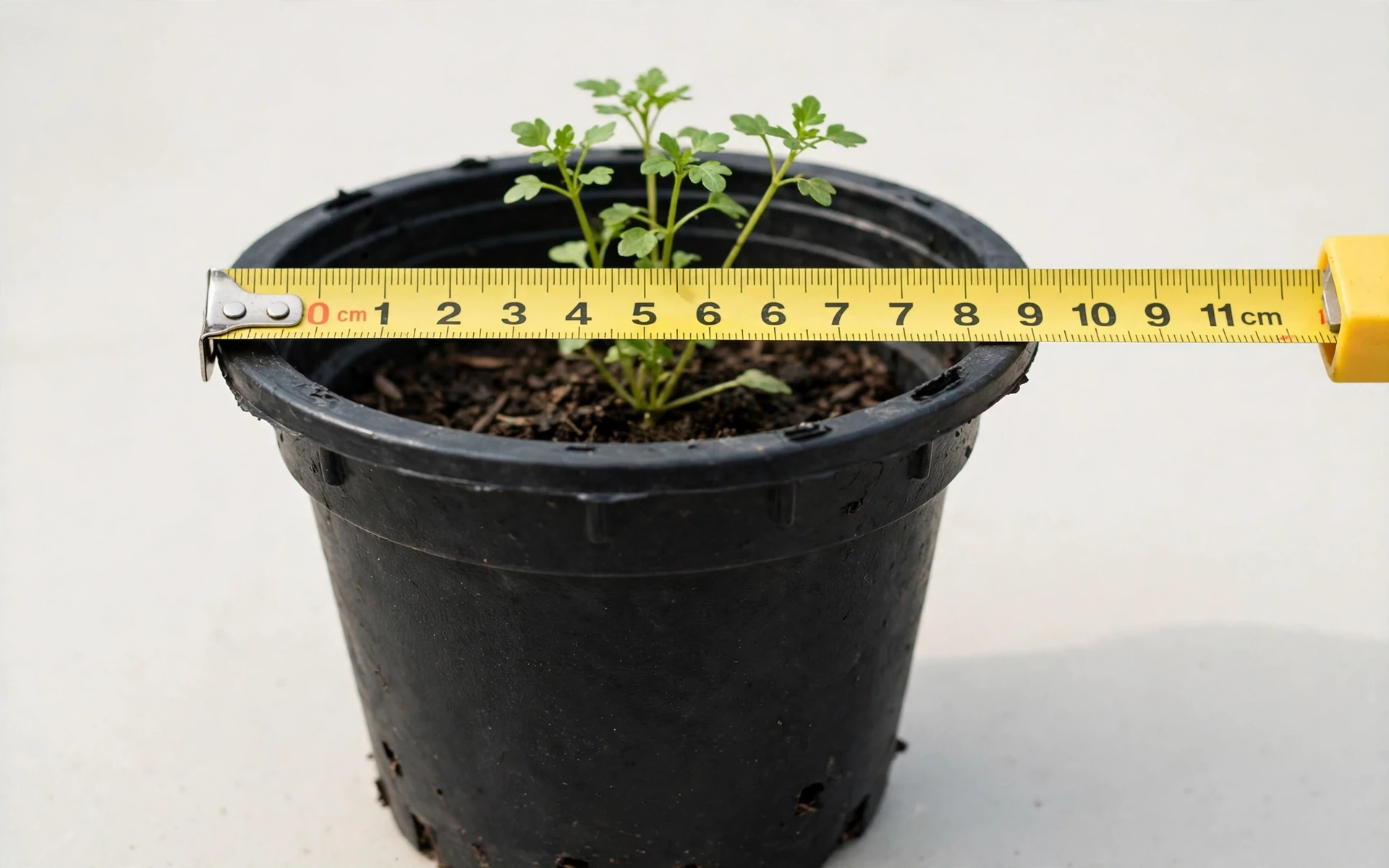
The plant pot is the article’s most useful 11 cm, because it is sold by that number. Nurseries and garden centres sell small plants in pots listed as "11 cm pot", and that 11 cm is the diameter across the top rim — the measurement the pot is named for. A typical one stands about 9.5 cm tall, so the pot is slightly wider than it is high, and it holds roughly half a litre of soil. It is the pot size for a young yucca, a baby’s tears plant, or a coffee seedling, and it is the first pot size most gardeners buy by the dozen rather than one at a time.
The fitting check is the saucer, and it is stricter than the pot. An 11 cm pot needs a saucer at least 11 cm across before a single drop of water is added, but the pot tapers toward the base — about 8 cm across at the bottom — so a saucer bought against the base measurement leaves the rim overhanging by a centimetre and a half on each side. The grade is listed, not exact, because pot sizes are a retail standard and the height varies by maker: the diameter is the listed 11 cm, the height is whatever the mould made it, and the label on the shelf is the authority. Measure the rim, not the base, and the pot will fit the saucer the first time.
3. An A-Format Mass-Market Paperback — 11 Cm Wide (LISTED)
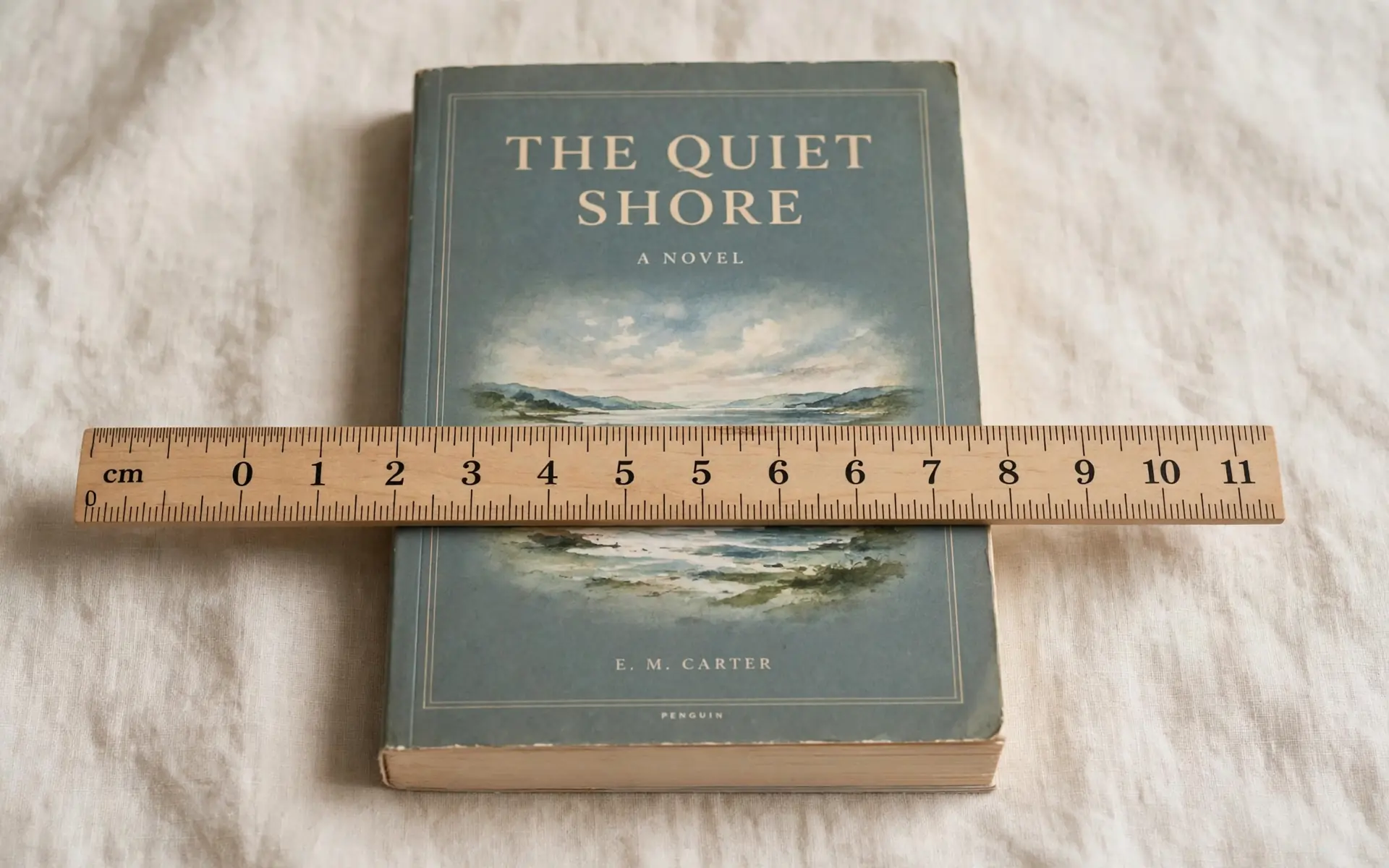
The paperback is the article’s most literary 11 cm, and the one most readers already own. A-format is the standard size for UK mass-market paperbacks — the airport thrillers, the crime novels, the film tie-ins — and it measures 110 millimetres wide by 178 millimetres tall. That makes the width of the book in your bag exactly 11 cm, or within a millimetre of it: some publishers list the format as 111 mm wide, so the honest figure is 110 to 111 mm, and the difference is the thickness of a fingernail. The book is 17.8 cm tall, which is the number that decides whether it fits your pocket; the 11 cm is the number that decides whether it fits your hand.
The fitting check is the shelf, and it is the width that matters. A-format paperbacks stand 17.8 cm tall, so a shelf built for them needs 18 cm of clearance, but the 11 cm width is what decides how many fit in a row: ten A-format paperbacks take 11 cm of shelf each, so a metre of shelf holds nine of them with room to spare. The grade is listed because the format is a publishing standard with a one-millimetre spread across publishers: 110 mm on most lists, 111 mm on others, and 11 cm either way once you round to the unit that matters. Pick up the thriller on your nightstand and measure its width — you are holding 11 cm, give or take a millimetre.
4. An Apple Magic Mouse — 11.35 Cm Long (LISTED)

The mouse is the article’s most familiar near-miss, and the one sitting closest to your hand. Apple’s own technical specifications list the Magic Mouse at 11.35 cm long, 5.71 cm wide, and 2.16 cm high — so the mouse is 3.5 millimetres longer than 11 cm, a miss smaller than the width of a pencil line. It is the low, flat mouse that ships with every iMac, and its length is the reason it fits a small hand and frustrates a large one: 11.35 cm is short for a mouse, and most full-size mice run 12 to 13 cm. If your mouse is a Magic Mouse, your hand already knows 11 cm — it just knows it as 3.5 millimetres too long.
The fitting check is the hand, not the desk. A mouse 11.35 cm long suits a palm about 17 cm from wrist to fingertip, and a larger hand will find its fingers overhanging the front edge — which is the most common complaint about this mouse, and the reason many owners replace it with a longer one. The grade is listed because the figure is the manufacturer’s own specification for this named model, with the deviation printed in full: 11.35 cm, not 11 cm, and the 3.5 millimetres is the whole story. Measure your mouse before you measure your desk, because the mouse is the object in this article you touch every day.
5. A Standard Popsicle Stick — 11.43 Cm Long (LISTED)
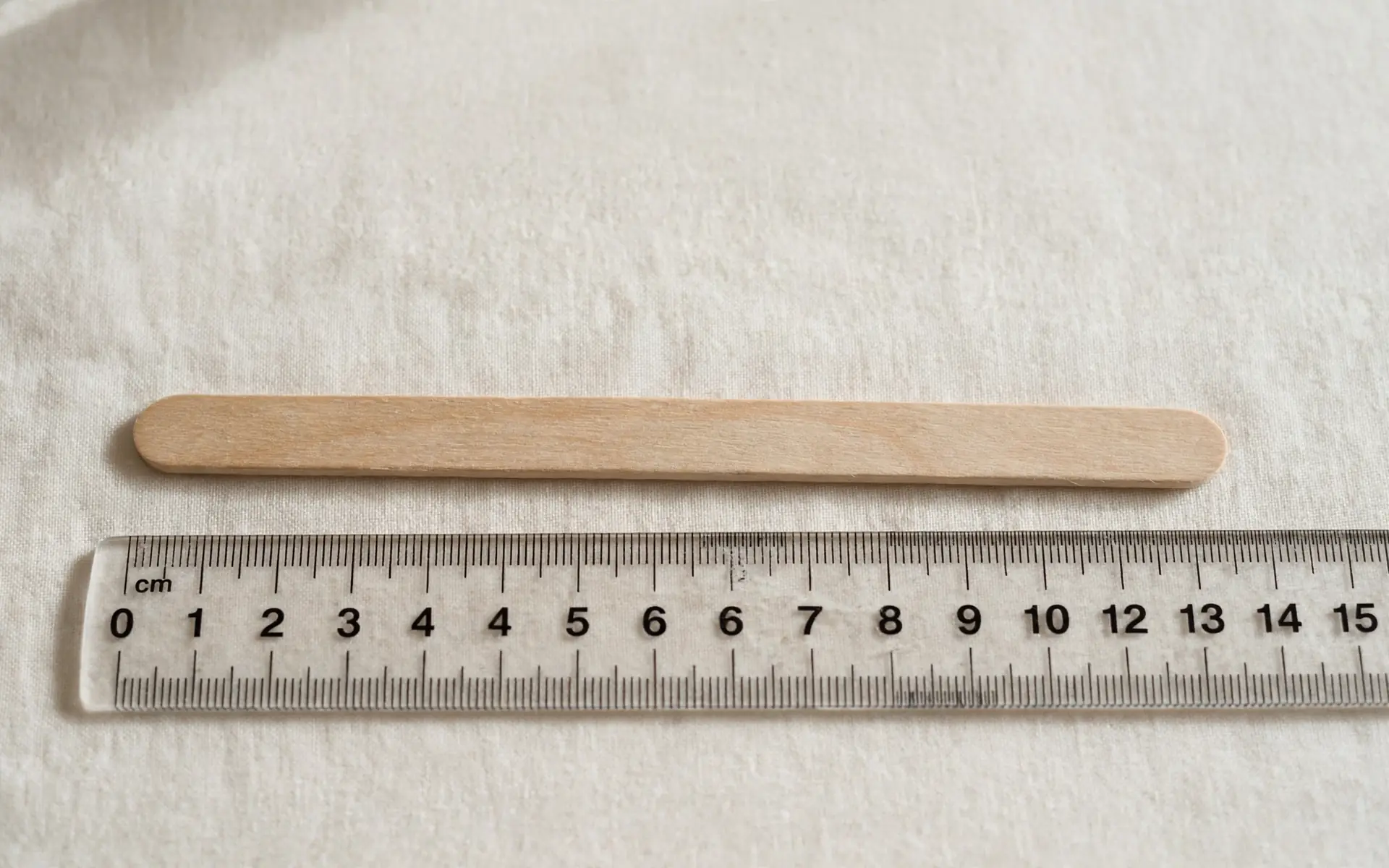
The popsicle stick is the article’s cheapest near-miss, and the one you can verify with a pack from any craft store. A standard popsicle stick — the wooden stick in an ice lolly, and the craft stick sold by the hundred — measures 4.5 inches long and 3/8 of an inch wide, which is 11.43 cm by 0.95 cm. It overshoots 11 cm by 4.3 millimetres, a miss you can see if you hold it against a ruler and cannot see if you hold it against anything else. Supplier specifications allow a tolerance of about 1/16 of an inch on the length, so two packs that both say "4.5 inch" can differ by a visible amount — and the honest figure is a range around 11.43 cm, not a single number.
The fitting check is the craft, not the stick. A popsicle stick is 11.43 cm of straight, flat wood, which is why it is the default ruler for school projects and model building: it is long enough to span a small gap and thin enough to glue in layers, and its 4.3-millimetre overshoot is smaller than the glue line on most joints. The grade is listed because the figure is the industry standard for this named size, with the tolerance printed beside it: 11.43 cm, plus or minus 1.6 mm, and the 4.3 millimetres over 11 cm is stated in the heading itself. Keep a stick in your desk drawer and you have an 11 cm ruler that costs less than a penny.
What 11 Cm Is NOT: Three Claims the Internet Gets Wrong
Three wrong numbers about 11 cm circulate so widely that they deserve their own section, because each one is stated confidently on a page that ranks for this exact question. First, the smartphone: one popular guide says a large smartphone is "about 11 cm" wide, and it is not — the widest common phone, the iPhone Pro Max, is 7.7 cm wide and 16.3 cm tall, so the 11 cm figure is neither its width nor its height, and the claim fails in both directions. Second, the credit card: another guide calls 11 cm "about the length of a credit card", and a credit card is 8.56 cm long under the ISO/IEC 7810 ID-1 standard — 2.44 cm short — though its diagonal, 10.12 cm, is the closest a card ever gets to 11 cm. Third, the baseball: a third guide calls 11 cm "roughly the diameter of a baseball", and a baseball’s diameter is 7.3 to 7.5 cm under the Major League Baseball specification of a 9 to 9.25 inch circumference — the ball is a full 3.5 cm short of 11 cm, and the claim mistakes the circumference for the diameter. None of these three objects belongs in an 11 cm article, and all three are here so you never have to learn that from a purchase.
Measure 11 Cm Without a Ruler: The Card, the Stick, and the Thumb
Before you buy anything in this article, run the test that catches the mistakes the spec sheets cannot. First, the credit card: a standard card is 8.56 cm long and its diagonal is 10.12 cm, so lay a card flat, add the width of your thumbnail — about 1 cm for most adults — and you are at 11 cm within a millimetre. Second, the popsicle stick: a standard stick is 11.43 cm, so hold it against the thing you are measuring and shave off 4 millimetres in your head — the width of a match head — and you have 11 cm. Third, the envelope: a DL envelope is 11 cm on its short side by definition, so if you have one in a drawer, you have a ruler that never needs batteries and never lies. Fourth, the hand: the width of four fingers held together is about 7 to 8 cm for most adults, and the length from the tip of your index finger to the first knuckle is about 2.5 cm — so four fingers plus one finger-length is 11 cm, near enough to check a pot or a book before you commit. None of these replaces a tape measure for anything that must fit, but all four will tell you whether 11 cm is the size you think it is before the box arrives.
11 Cm Against the Sizes Around It
| Measurement | Centimetres | How it compares with 11 cm |
|---|---|---|
| A credit card, long side | 8.56 | 2.44 cm shorter |
| A deck of playing cards, tall | 8.9 | 2.1 cm shorter |
| A 4×6 photo print, short side | 10.16 | 0.84 cm shorter |
| A compact cassette, long side | 10.16 | 0.84 cm shorter |
| 11 cm | 11 | 4.33 in, 110 mm, 0.11 m, 0.12 yd |
| A CD or DVD, diameter | 12 | 1 cm longer |
| A standard soda can, tall | 12.2 | 1.2 cm taller |
| A US passport, tall | 12.5 | 1.5 cm taller |
How 11 Cm Compares With Other Lengths
Readers comparing nearby sizes may also want the site’s guides to 10 cm, 9 cm, 8 cm, and 5 cm for the centimetre series, and 11 feet, 12 feet, 40 inches, and 50 inches for the foot and inch series. Each of those guides follows the same rule as this one: the spec sheet, the grade, and the miss printed in full.
Frequently Asked Questions
How many inches is 11 cm?
11 cm is 4.33 inches, or 4 and 5/16 inches in fraction form. Divide 11 by 2.54 and you get 4.3307 inches — and the trap is rounding that to 4.4 inches, which is the mental-math shortcut (multiply by 4, divide by 10) and overstates the length by nearly a millimetre. For anything that must fit, use 4.33 inches; for a quick estimate in your head, 4.4 inches is close enough to picture it and wrong enough to misbuy by.
How many millimetres is 11 cm?
110 millimetres exactly. Multiply 11 by 10 and you get 110 with no rounding involved, because the centimetre is defined as exactly 10 millimetres. In metres that is 0.11 m, and in yards it is 0.12 yards rounded — exactly 4 and 5/16 inches, which is the figure a tape measure will show.
Is 11 cm the same as 4.5 inches?
No, and the difference matters. Four and a half inches is 11.43 cm, which is 4.3 millimetres longer than 11 cm — the length of a standard popsicle stick, which is the closest object in this article. If you cut a board to 4.5 inches for an 11 cm gap, you will be 4.3 millimetres too long, and 4.3 millimetres at this size is a gap that shows, not a rounding error.
What is 11 cm wide in real life?
The most exact everyday answer is a DL business envelope, which is 11 cm wide by the ISO 269 standard — the short side, not the long side. The next closest are an 11 cm nursery plant pot (11 cm across the top rim), an A-format paperback (110 to 111 mm wide), an Apple Magic Mouse (11.35 cm long), and a standard popsicle stick (11.43 cm long). None of the four near-misses is exact, and each one’s miss is printed beside it in this article.
Is a smartphone 11 cm wide?
No. The widest common smartphone, the iPhone Pro Max, is 7.7 cm wide and 16.3 cm tall, so 11 cm is neither its width nor its height. The claim that a large phone is "about 11 cm wide" appears on a page that ranks for this question, and it is wrong in both directions — the phone is 3.3 cm narrower than 11 cm and 5.3 cm taller than it. If you want a phone-sized reference for 11 cm, use the phone’s height minus a third, not its width.
Is a credit card 11 cm long?
No. A standard credit card is 8.56 cm long and 5.4 cm wide under the ISO/IEC 7810 ID-1 standard, so it is 2.44 cm short of 11 cm. Its diagonal is 10.12 cm, which is the closest a card gets — still 0.88 cm short. A card plus the width of your thumbnail, about 1 cm, is 11 cm within a millimetre, and that is the only honest way to use a card as an 11 cm ruler.
How tall is a standard coffee mug?
Most classic ceramic mugs are 9 to 11 cm tall, which is a range, not a measurement — and that is why no mug appears as an object in this article. A mug sold as "about 11 cm" is usually 9.5 cm tall, and the 1.5 cm difference is the difference between a mug that fits under your coffee machine and one that does not. Measure the mug you own before you trust the range.
How do I measure 11 cm without a ruler?
Use a DL envelope (11 cm on its short side, by standard), a standard popsicle stick (11.43 cm — shave off 4 millimetres in your head), or a credit card plus your thumbnail (8.56 cm plus about 1 cm, with the diagonal at 10.12 cm as a check). For anything that must fit — a pot, a frame, a shelf — borrow or buy a real tape measure, because at 11 cm the misses in this article run from 1 millimetre to 4.3 millimetres, and guessing throws every one of them away.
Final Thoughts
Eleven centimetres is the rare measurement that is honest and still misunderstood, because 4.33 inches can be a width, a diameter, a length, or a height — and the number alone never says which. Now you know it as an envelope width fixed by a standard, a plant pot sold by its diameter, a paperback width fixed by a publishing format, a mouse length that overshoots by 3.5 millimetres, and a popsicle stick that overshoots by 4.3 millimetres — and you know which of those you can trust to the millimetre and which you must measure yourself. The rule that runs through all five is the same one this site always uses: trust the spec sheet, print the deviation, and let the name stay on the box where it belongs. Measure twice, in the direction the object actually travels, and 11 cm will fit the first time.
