

If you have ever wondered how long is 50 inches, you have probably been handed the same lazy answer: a pile of small things stacked until the arithmetic lands near 50. Eight banknotes, fifteen cards, ten cans, a fraction of a putter — none of those is a 50-inch thing, and none of them helps you picture 50 inches when you are standing in a shop deciding whether something fits. Fifty inches is 4 feet 2 inches, or 127 centimetres exactly, which puts it just past four feet and just short of the height of a tall seven-year-old. It is a length you meet in living rooms, bedrooms, and gyms far more often than in lists of stacked coins.
This article does the opposite of the stacked lists. Below are eight single, named things, each with its real specification and its honest distance from 50 inches, stated in inches. Some are exact, some are ranges, and two are deliberate near-misses kept in because they prove the checking: a tank that falls 1.75 inches short and a desk that stops three-quarters of an inch short. Every object carries its evidence grade, and every object’s image sits immediately after its heading. By the end you will know 50 inches as a TV diagonal that is not a width, a belt you can walk on, a fan span you can measure across a ceiling, and a board you can stand on. For the wider series, see the complete inches size guide.
Quick Answer
50 inches = 4 feet 2 inches exactly = 127 cm exactly = 1.27 m = 1 yard, 1 foot, 2 inches. It is 2 inches past 4 feet and 10 inches short of 5 feet. As a height it reaches about the shoulder of an average adult woman; as a width it is wider than a standard doorway, so a 50-inch-wide object does not pass through one straight-on. For the next size, a step up to 60 inches is ten inches longer than 50 inches.
The 50-Inch Trap: A Diagonal Is Not a Width
The single most common 50-inch mistake is the television. A “50-inch TV” is not 50 inches wide. The 50 inches is the screen diagonal, measured corner to corner, and on a typical 50-inch-class set the actual diagonal measures 49.5 inches while the width is only about 43.9 inches. That six-inch gap is the difference between a TV that fits your stand and one that overhangs it, and it is the gap every vague list ignores when it calls a TV “50 inches” without saying which dimension it means. Whenever this article says a TV is 50 inches, it means the diagonal class — and it prints the width beside it, so you never have to guess. The same diagonal trap at 100 inches is even bigger — two of the objects there are not 100 inches wide at all.
The same discipline applies to everything below. A fan’s 50 inches is a tip-to-tip span, not a blade length. A treadmill’s 50 inches is a belt length, not the machine’s footprint. A snowboard’s 50 inches is its length, end to end. Saying which dimension you mean is not pedantry; it is the whole difference between a measurement you can use and a number you can only repeat.
How the Grades Work
EXACT means the figure is exact by definition or by a fixed setting: 127 centimetres is 50 inches by arithmetic, and an adjustable rod set to 50 inches is 50 inches because you set it there. LISTED means the product is sold or listed at that size, and the article gives the exact listed figure alongside it, including how many inches over or under 50 inches it sits. AVERAGE means an authority range or typical figure, not a measurement of one individual — used here only for the dog. REPORTED means a near-miss or a manufacturer’s figure reproduced second-hand, labelled as such. No object below is presented as exactly 50 inches unless its listed figure is 50 inches or the arithmetic makes it so.
The 8 Objects
Screens and Ceilings: The Living Room
1. 50-Inch-Class TV — 49.5-Inch Diagonal, About 43.9 Inches Wide (LISTED)

The television is the object most readers come looking for, and it is the one most often misdescribed. A current 50-inch-class set lists the diagonal screen size at 49.5 inches, with a width of roughly 43.9 inches and a height near 25 inches without the stand. That is LISTED: the class name says 50, the measured diagonal says 49.5, and the width — the number that decides whether it fits your furniture — is a full six inches smaller than the headline number.
This is the trap, stated plainly. If your TV stand is 44 inches wide, a 50-inch TV fits with a finger to spare; if your stand is 40 inches wide, it overhangs by nearly four inches no matter what the box says. Measure the stand, not the class name. And when you plan viewing distance, use the diagonal: the usual rule of thumb is one-and-a-half to two-and-a-half times the diagonal, which puts a comfortable seat for a 50-inch TV roughly 6 to 10 feet back — a distance this article’s own living-room section can help you pace out.
2. Casablanca 50-Inch Ceiling Fan — 50-Inch Blade Span (LISTED)

A 50-inch ceiling fan is measured tip to tip across the blades, and the Casablanca model’s specs list a 50-inch blade span. That is LISTED: the span is the selling size, and it is the number that decides whether the fan suits the room. A single blade on a fan like this is roughly 20 inches long; the 50 inches is the full circle the blades sweep, not any one blade.
Room size is where the span earns its keep. A 50-inch fan suits a medium room — the usual rule of thumb is a room of roughly 150 to 225 square feet, the size of a generous bedroom or a modest living room. In a smaller room the same span looks oversized and pushes air you do not need; in a great room it looks lost and moves air you cannot feel. Measure the room across, in both directions, before you buy the span: a fan’s inches are only useful when they match the room’s feet.
Made to Move: A Belt and a Board
3. LifeSpan TR1200-DT3 Under-Desk Treadmill — 50-Inch Walking Belt (LISTED)
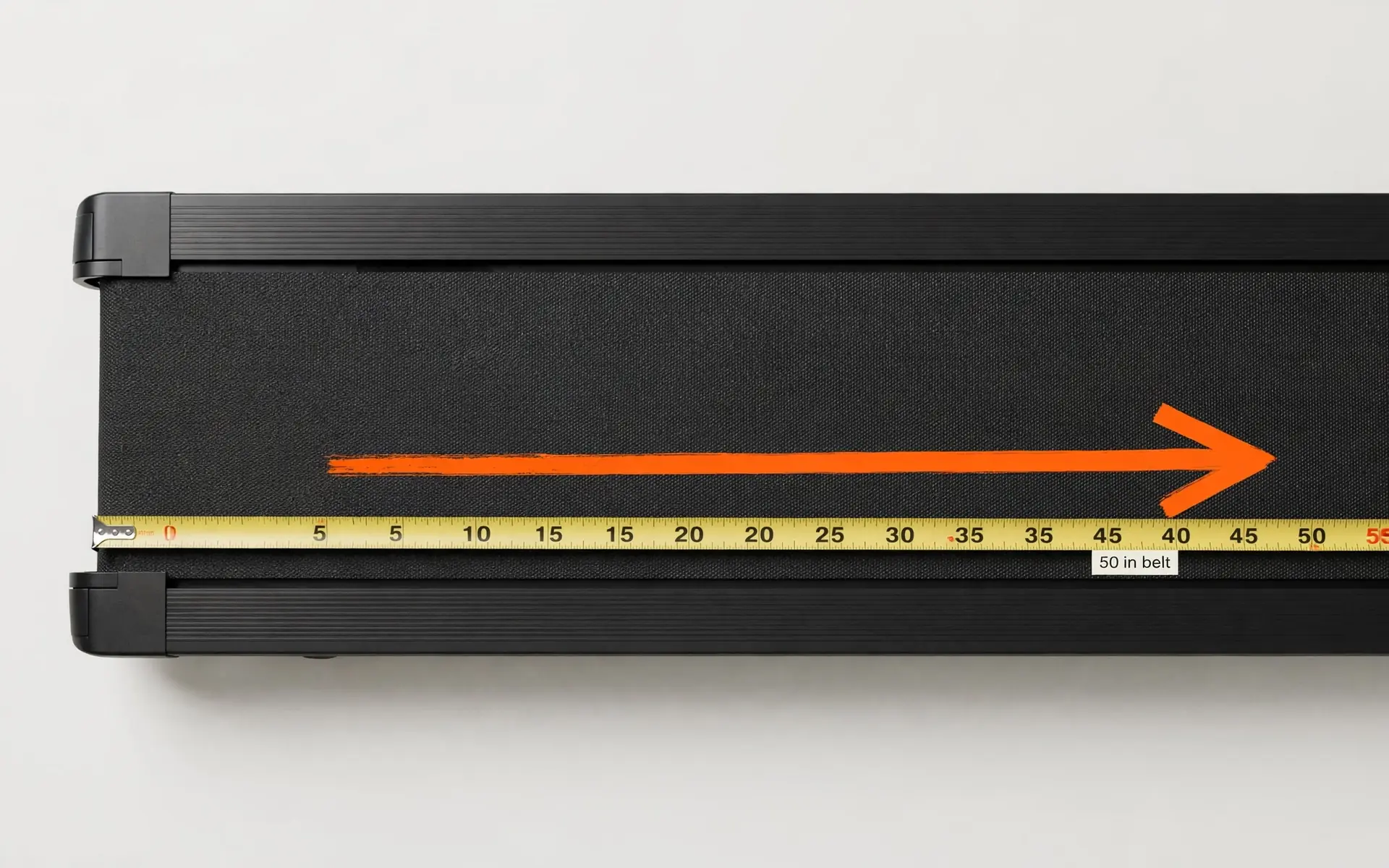
The LifeSpan TR1200-DT3 is an under-desk treadmill whose spec table lists the belt at 20 by 50 inches. That is LISTED: the belt itself is the 50-inch dimension, not the machine, which is longer once the motor housing and frame are counted. Fifty inches of belt is a generous walking surface — long enough for a natural stride at desk-walking speeds, which is exactly what the machine is built for.
Honesty requires one footnote. One independent lab measured the belt slightly smaller, at about 49 by 19.5 inches, so this article presents 50 inches as the manufacturer’s listed belt size, not as a lab-verified exact measurement. The difference is one inch, and for walking it does not matter; for the article’s standard it matters, because a listed figure and a measured figure are different claims and should never be blurred. As a walking belt, 50 inches is plenty; as a running belt it would be short, since running belts usually run 55 to 60 inches — which is why this machine is a walking desk, not a running machine.
4. Youth Snowboard Sold as 127 cm — Exactly 50.0 Inches Long (EXACT)
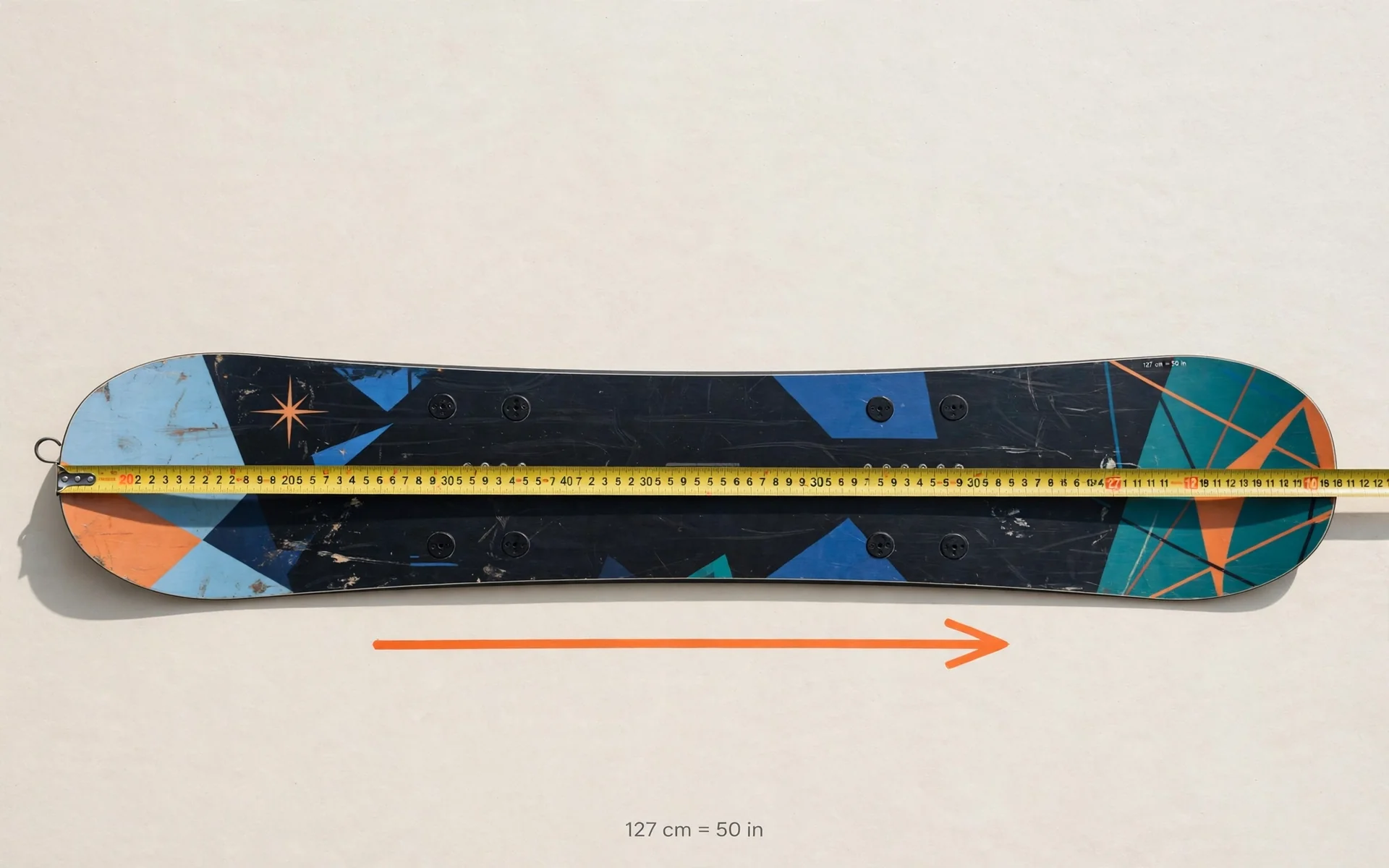
A snowboard listed at 127 centimetres is 50 inches long, by definition: 127 divided by 2.54 is exactly 50. That is EXACT, and it is the article’s cleanest conversion — no rounding, no range, no “about.” Youth boards are commonly sold in centimetre sizes, and 127 cm is a standard step in the range, so a board carrying that size is a genuine 50-inch object you can stand next to in a shop.
The sizing table equates 50 inches with 127 cm, which is also why this object doubles as a conversion lesson. Snowboard sizes step in centimetres, and every centimetre step is 0.39 inches — so the neighbouring sizes, 122 cm and 132 cm, are 48 and 52 inches, a full two inches either side. If you are buying for a growing rider, those two inches are the whole fitting decision: 127 cm today, 132 cm next season, and the board you outgrow is the one that taught you the size.
Living and Adjustable
5. Adult Male Golden Retriever — About 48 to 52 Inches, Nose to Tail (AVERAGE)
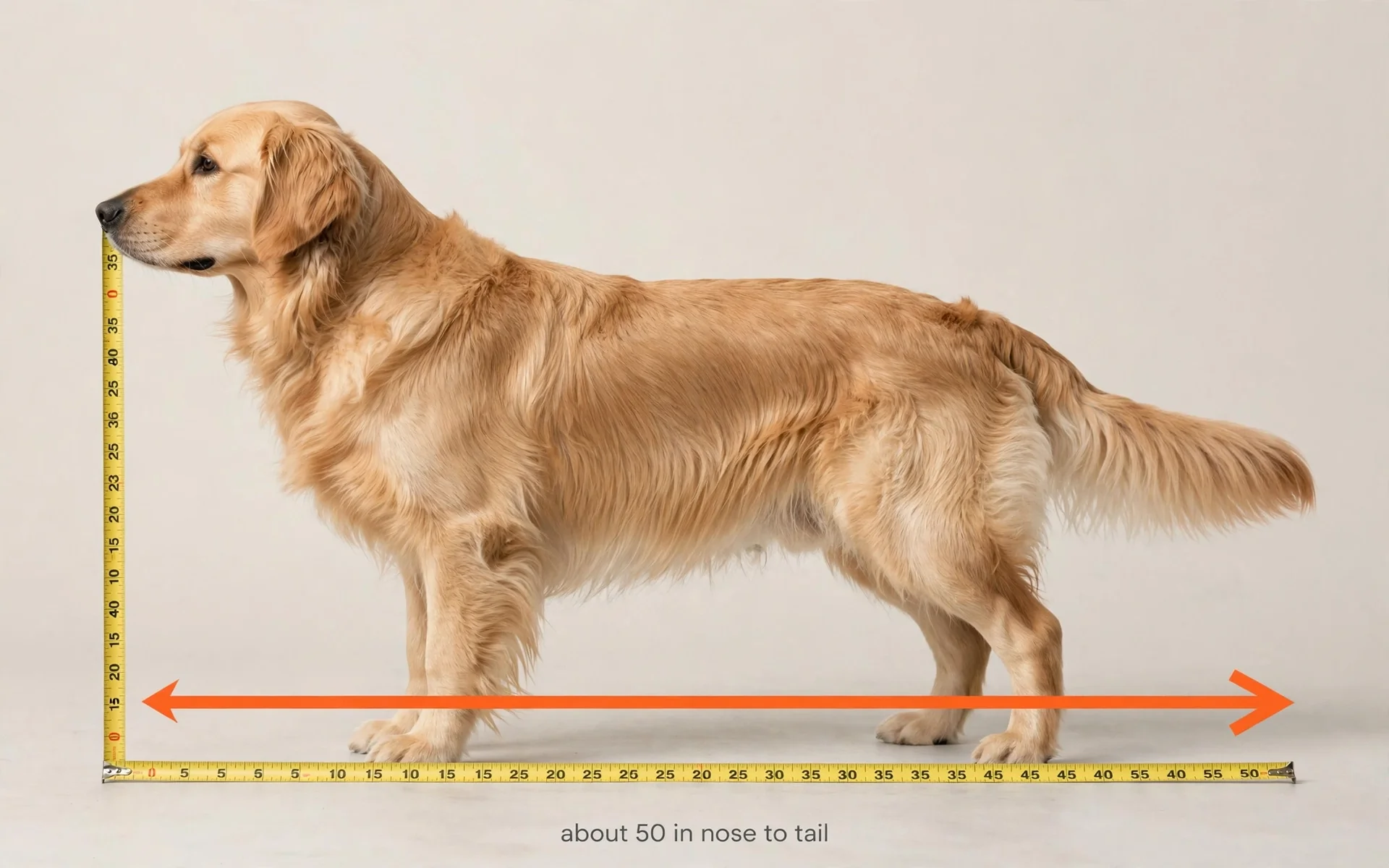
A Golden Retriever is the article’s living yardstick, and it comes with a range, not a point. The breed standard puts males at 23 to 24 inches at the withers, with body length slightly greater than height, and adding a tail of roughly 12 to 14 inches gives a nose-to-tail total of about 48 to 52 inches. That is AVERAGE: a real dog, measured honestly, lands somewhere in that band, and 50 inches sits inside it — not at its centre by decree, but as a fair middle of the range.
That range is more useful than a fake exact figure, because dogs are the thing readers actually meet at dog height. Stand a Golden beside a 50-inch mark on a wall and you will see the point: nose at one end, tail tip at the other, and the dog filling the space between. But do not quote “a Golden is 50 inches” as a fact about any one dog — quote the range, and let the individual dog be whatever inches it is. The same honesty applies to the child-height question in the FAQs: a tall seven-year-old, or an average eight-year-old, is around 50 inches; the average seven-year-old is closer to 48.
6. Adjustable Closet Hang Rod — Set to Exactly 50 Inches (EXACT by Setting)

A closet rod that is adjustable from 48 to 72 inches can be set to exactly 50 inches, and that setting is exact because you chose it. That is EXACT by setting, a different kind of exact from the snowboard’s arithmetic but no less real: extend the rod, lock it at the 50-inch mark, and the span between its supports is 50 inches. It is the article’s proof that an adjustable object can be a precise object, as long as you print the range it came from.
The practical note matters more than the novelty. At longer spans an adjustable rod needs a centre support, or a loaded rod sags and eventually slips; at 50 inches, inside a standard closet, a single span with solid end brackets holds a full rail of clothes. Measure the closet wall to wall first, because a rod set to 50 inches needs a 50-inch opening — and a closet that measures 49 inches needs the rod set to 49, not wished to 50.
Near-Misses We Checked and Kept Honest
7. 55-Gallon Aquarium (Aqueon) — 48.25 Inches, 1.75 Inches Short (REPORTED Near-Miss)
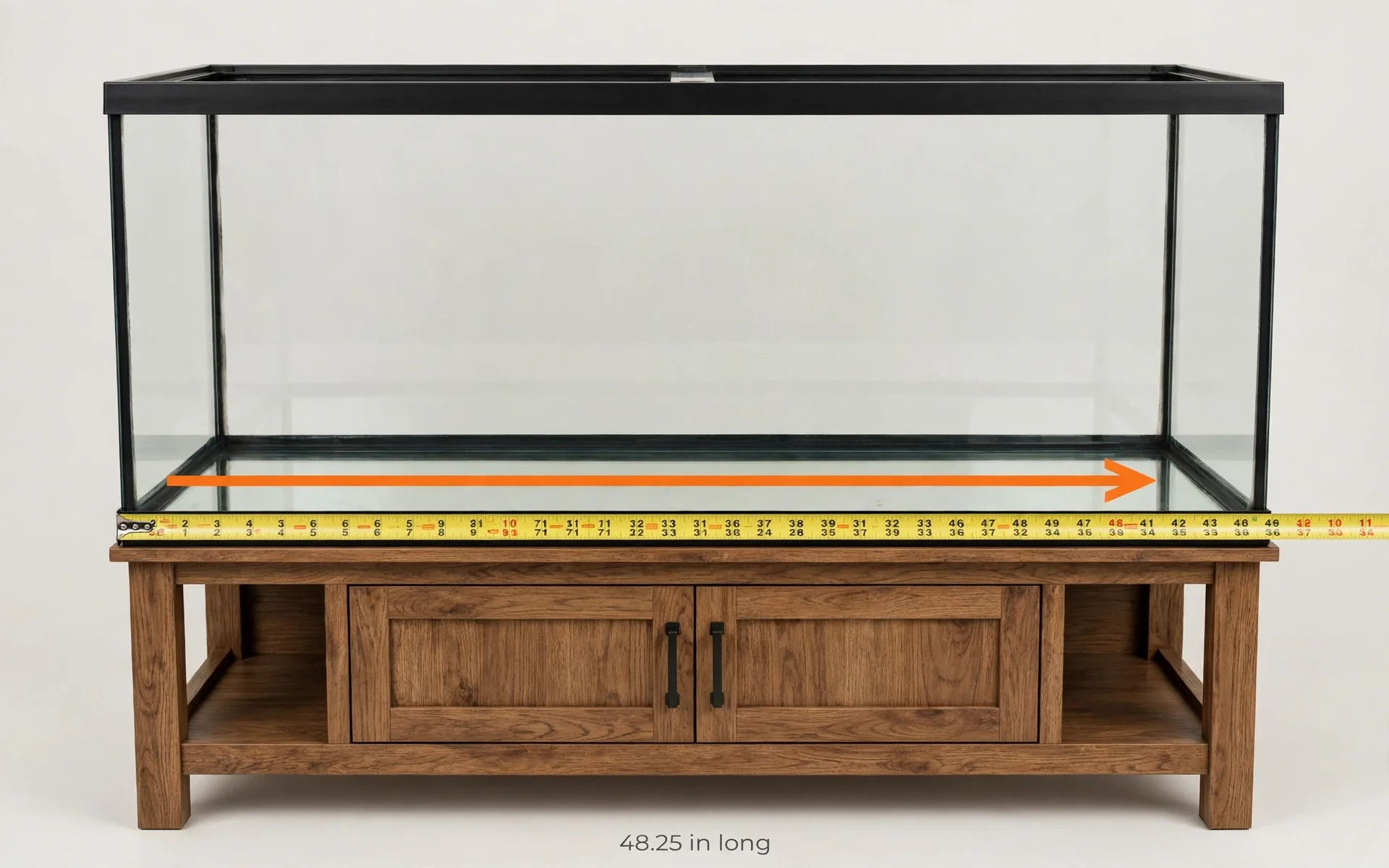
A standard 55-gallon aquarium is the near-miss every vague list rounds up to 50 inches, and this article refuses the rounding. The manufacturer sizing table gives 48 and a quarter inches for the tank’s length, which is 1.75 inches short of 50. With a top frame and hood it approaches 50, but the glass tank itself is 48.25 inches, and the article says so in the heading, not in a footnote.
Why keep an object that fails the test? Because the failure is the lesson. A stand built for a 50-inch tank holds this aquarium with room to spare; a cabinet cut to exactly 48.25 inches holds it exactly; and a buyer who believed “55-gallon equals 50 inches” would order the wrong stand either way. The 1.75 inches is small, and that smallness is the point: at 50 inches, two inches is the difference between a fit and a return.
8. BEKANT Sit/Stand Corner Desk — 49.25 Inches at Maximum Height, 0.75 Inches Short (REPORTED Near-Miss)
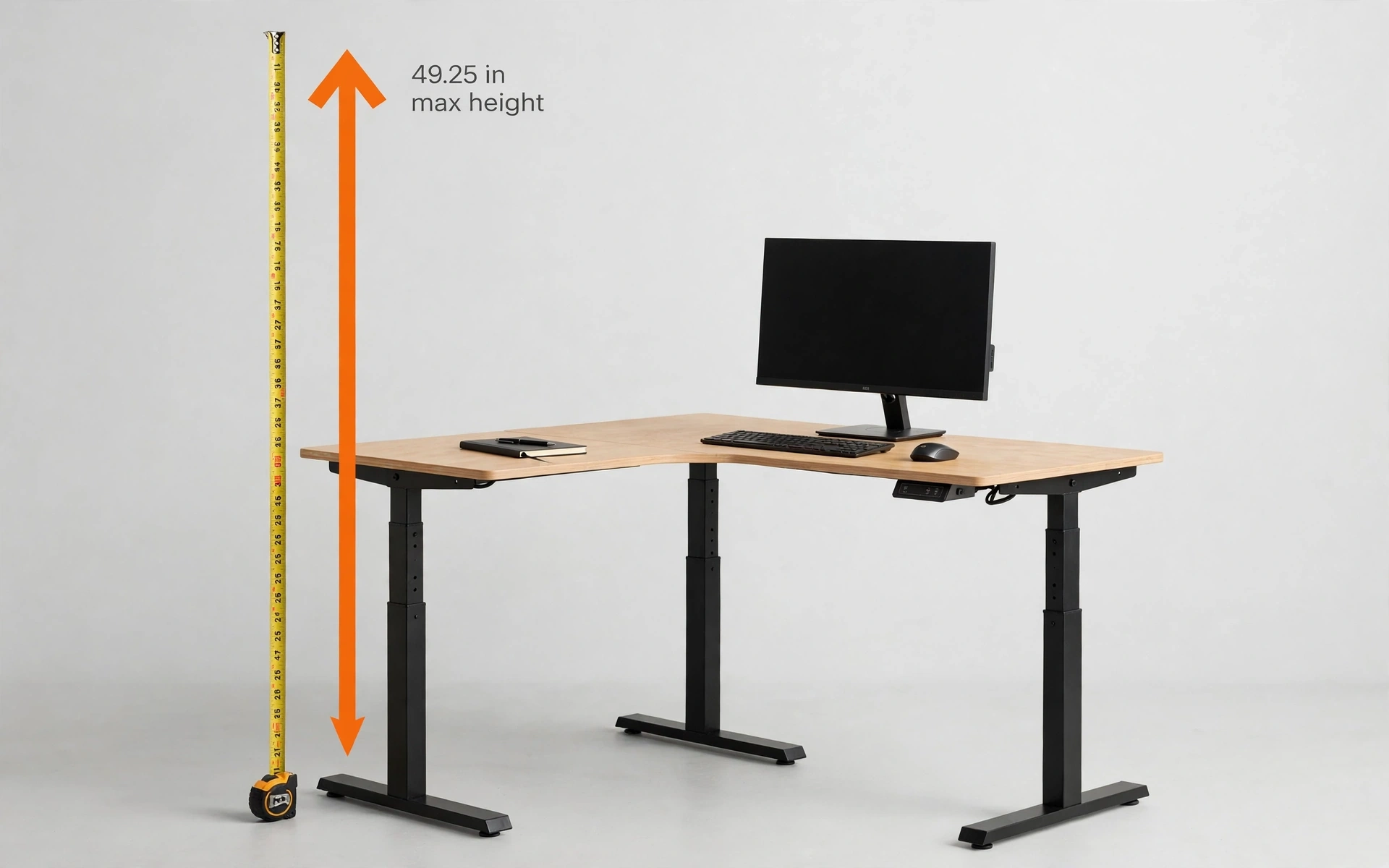
The BEKANT corner desk is the second near-miss, and the closest one in the article: its manual lists the height range as 25 and five-eighths to 49 and a quarter inches, so even at its highest setting it stops three-quarters of an inch short of 50. That is REPORTED, from the manual’s own figures, and the article keeps the “just under” wording in the heading, the body, and the image description.
Three-quarters of an inch is a fingertip. It matters anyway, because desk height is an ergonomic number: a standing desk set to 49.25 inches suits a taller user, and a user who needs a true 50-inch surface must look one size up or add a monitor riser. The desk earns its place the same way the aquarium does — not by being 50 inches, but by being honestly 0.75 inches short of it, in an article that checks rather than rounds.
Will It Fit? Doorways, Stands, and Wall Space
Fifty inches behaves differently as a width, a height, and a length, and the fitting question changes with the direction. As a width, 50 inches does not pass through a standard interior doorway, which is roughly 30 to 36 inches wide; a 50-inch-wide object needs a double door, a removed door, or a tilt that trades width for diagonal clearance. As a height, 50 inches clears every standard doorway easily and sits below a 6-foot-8-inch door by 30 inches. As a length, 50 inches is a wall segment: it fits along any wall longer than itself, and it is the segment to measure when you are placing a TV stand, a desk, or a treadmill against that wall. Measure the direction the object travels, not just the object.
How to Measure 50 Inches at Home Without a Tape Measure
A standard yardstick is 36 inches, so a yardstick plus 14 inches — about the length of a sheet of paper turned sideways twice — gets you to 50. Or use your own body: 50 inches is roughly the height of a tall seven-year-old, the length of a Golden Retriever, or the span of a 50-inch fan. Or pace it: two relaxed adult steps cover roughly 50 inches, though strides vary, so check your stride against a known distance first. For anything that must fit — a stand, a closet, a doorway — use a real tape measure, because at 50 inches a single inch is the whole difference between fitting and returning.
Conversion Table
| Unit | 50 inches equals |
|---|---|
| Feet and inches | 4 ft 2 in |
| Feet (decimal) | 4.1667 ft (about 4.17 ft) |
| Centimetres | 127 cm exactly |
| Millimetres | 1,270 mm |
| Metres | 1.27 m |
| Yards | 1 yd 1 ft 2 in (1.3889 yd) |
| Compared with 4 feet | 2 inches past 4 feet |
| Compared with 5 feet | 10 inches short of 5 feet |
| Compared with a standard door (6 ft 8 in) | 30 inches shorter |
| Compared with 40 inches | 10 inches longer |
How 50 Inches Compares With Other Lengths
Fifty inches is ten inches past 40 inches and twenty inches past 30 inches, but it is far short of the foot series: 11 feet is more than two and a half times as long, 12 feet longer still, and 13 feet longer again. Against the inch series it dwarfs 20 inches, 13 inches, and 12 inches — four 12-inch lengths make 48 inches, two short of 50.
Frequently Asked Questions
Is 50 inches the same as 4 feet?
No. Fifty inches is 4 feet 2 inches — two inches past 4 feet. Four feet is 48 inches, so “50 inches is 4 feet” loses two inches, which is enough to matter when something has to fit.
How many centimetres is 50 inches?
127 centimetres exactly. Multiply 50 by 2.54 and you get 127, with no rounding involved. In metres that is 1.27 m.
How wide is a 50-inch TV really — is it 50 inches wide?
No. A 50-inch TV is about 43.9 inches wide. The 50 inches is the screen diagonal (measured at 49.5 inches on a typical current set), and the width is roughly six inches smaller. Measure your stand against 44 inches, not 50.
How far should I sit from a 50-inch TV?
Roughly 6 to 10 feet, using the usual rule of thumb of one-and-a-half to two-and-a-half times the screen diagonal. Closer than 6 feet and the picture can feel overwhelming; much past 10 feet and you lose the detail a 4K panel is built to show.
Is 50 inches tall for a 7-year-old child?
It is tall, but inside the normal range. The authority growth-chart median for age 7 is about 48 inches, so 50 inches describes a tall seven-year-old, or an average eight-year-old, rather than the average seven-year-old. Do not repeat “the average 7-year-old is 50 inches” — it overstates the median by two inches.
Will a 50-inch-wide item fit through a standard doorway?
Not straight-on. Standard interior doorways are roughly 30 to 36 inches wide, so a 50-inch-wide object needs a double door, a removed door frame, or a tilt that trades width for diagonal clearance. A thin object like a TV can often be angled through; a rigid 50-inch-wide cabinet usually cannot.
Is a 50-inch treadmill belt long enough for walking?
Yes, comfortably. Fifty inches gives a natural walking stride room at desk-walking speeds, and the LifeSpan belt above is built for exactly that use. For running, look longer: running belts usually run 55 to 60 inches, because a running stride needs the extra length.
What size room suits a 50-inch ceiling fan?
A medium room of roughly 150 to 225 square feet — a generous bedroom or a modest living room. Smaller rooms make a 50-inch span look oversized, and larger rooms leave it feeling lost. Measure the room in both directions before choosing the span.
Final Thoughts
Fifty inches is not a round number, and that is why it deserves an honest article. It is 4 feet 2 inches, 127 centimetres exactly, a TV diagonal that is not a width, a belt you can walk on, a fan span you can measure across a ceiling, a board that converts exactly from centimetres, a dog measured as a range, a rod set to the inch, and two near-misses kept in because they prove the checking rather than hide it. No stacks, no fractions, no ranges dressed up as exact values. Just eight real things, with their real inches printed beside them, so that the next time someone says “50 inches,” you do not have to picture a pile of banknotes. You have already seen it, eight times over, and you know exactly how many inches each one was off.
