
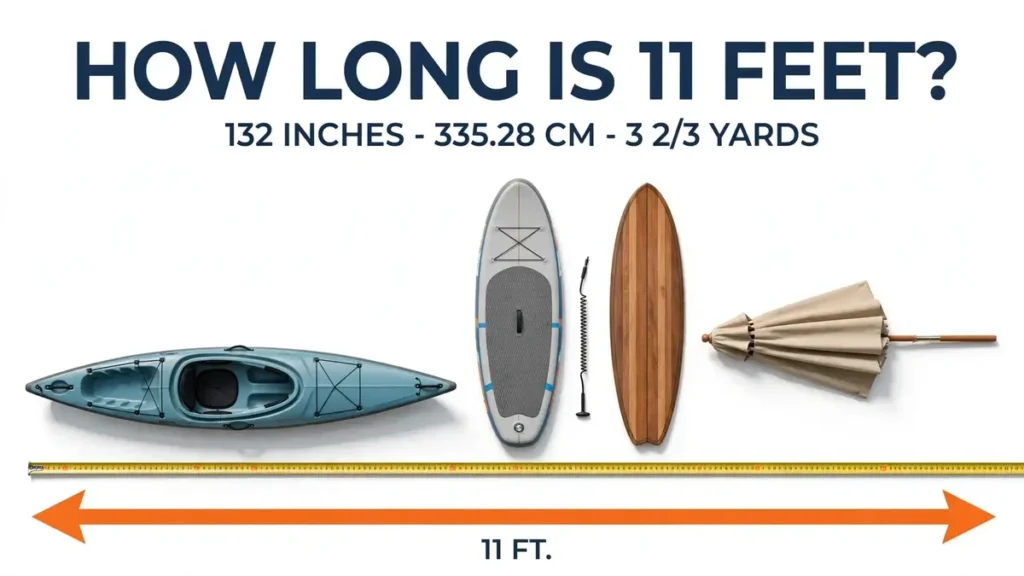
If you have ever wondered how long is 11 feet (11 ft), here is the number without any mystery attached: 132 inches, exactly. Ten feet is one foot shorter, and 12 feet is one foot longer. Not roughly, not about — exactly, because every foot holds twelve inches and eleven twelves leave nothing over. In metric it is just as clean: 335.28 centimetres, or 3.3528 metres if you prefer. But a number on a tape is not the same as a number on a product box, and that gap is where this article lives — because plenty of things sold as “11 feet” are 11 feet in only one direction, only as a rounded figure, only on average, or, in one case you will meet below, not at all.
So instead of another list, this is an audit from the complete feet size guide. Eleven real objects — a kayak, a paddleboard, a surfboard, a fishing rod, a tarp, a hammock, a rug, an umbrella, a boat, an alligator, and one stray piece of rocket — each checked against the document that is supposed to back it: the maker’s own spec, the official average, the expert’s report. By the end you will not just know the conversion. You will know which 11-foot claims to trust, which ones to read carefully, and how to spot a false one in seconds.
How long is 11 feet?
11 feet is exactly 132 inches — 335.28 centimetres, 3.3528 metres. But the things called “11 feet” split by how honest the number is: six are exact on the maker’s own figure, three are listed sizes, one is an average, one is a report. Here is the short version before the audit begins:
How the Audit Works
Every object was checked the same way: against a primary source, never against another list. For a product, that means the manufacturer’s own specification table — the document written for dealers and engineers, where a wrong number costs the company money — or, where the maker’s own page was not reachable, the maker’s manual or a dealer listing that reproduces the maker’s spec, labelled as such. For an animal, the authority’s published average. For the rocket stage, an expert’s reported measurement carried by a reputable magazine. Each object names and links its source, so the audit is never taken on trust: open the spec, find the line, and the grade explains itself. Where a figure comes from a retailer table of the manufacturer’s specifications, the article says so, because a fact’s chain of custody matters.
The audit stamps four grades. EXACT: the manufacturer’s spec for that exact model. LISTED: the product is sold or listed at that size — a nominal product size that may measure a few inches short in practice, and the article says so wherever it applies. AVERAGE: an authority average for a class, not a measurement of any individual. REPORTED: an expert attestation reported by a reputable outlet, not a manufacturer spec. Every object also states its measurement kind — length, width, diameter, or class average — in its Audit line, so no object is misread: a diameter is never filed as a length, and an average is never mistaken for a promise about one individual. The mix is deliberate: eight lengths, two widths or diameters, and one class average. Where the evidence is mixed, the title makes no exactness claim, and no object is called “exactly” 11 feet unless its grade is EXACT.
The Measure Itself: 132 Inches, 335.28 Centimetres, Three and Two-Thirds Yards
The standard is exact in every direction a reader is likely to convert it. One inch is exactly 2.54 centimetres by international definition, so 11 feet is exactly 335.28 centimetres and exactly 3,352.8 millimetres. In feet the conversion is this keyword’s one clean pleasure: 11 times 12 is 132, so 11 feet is 132 inches — no rounding, no repeating decimal. In yards it is 11 divided by 3, which is 3.666…; the exact fraction is three and two-thirds yards, and 3.67 is the rounded figure, labelled as such wherever this audit uses it. Hold the four apart — 132 in exact, 335.28 cm exact, 3.3528 m exact, 3.67 yd rounded — and you already read specifications more carefully than most pages this article replaces.
For a mental picture, comparisons beat conversions, provided they are true. A yardstick is 36 inches, so 11 feet is three yardsticks plus a ruler and a half — 108 inches plus 24, and the gap is paced. Against the metre, 11 feet overshoots by more than three times over: the metre is 100 centimetres, this is 335.28, and the difference is roughly another 7.75 feet, so anyone filing 11 feet as “about three metres” is short-changing you by more than a third of a metre. One habit is worth forming before the objects begin. Exactness here is a property of conversions, not of objects. Eleven feet converts to 335.28 centimetres exactly because the inch is defined exactly; no manufactured thing is thereby “exactly” anything, because manufacturing runs on tolerances, trimming and rounding. That is why the Audit lines grade the claim, not just the object: a kayak whose maker publishes an 11-foot length, a rug whose seller lists an 8-by-11 size, an alligator whose average rounds to 11, and a rocket stage reported at 11 feet across are four different relationships between a number and the truth.
Object 1: The Perception Hi Life 11.0, a Kayak That Is Also a Paddleboard
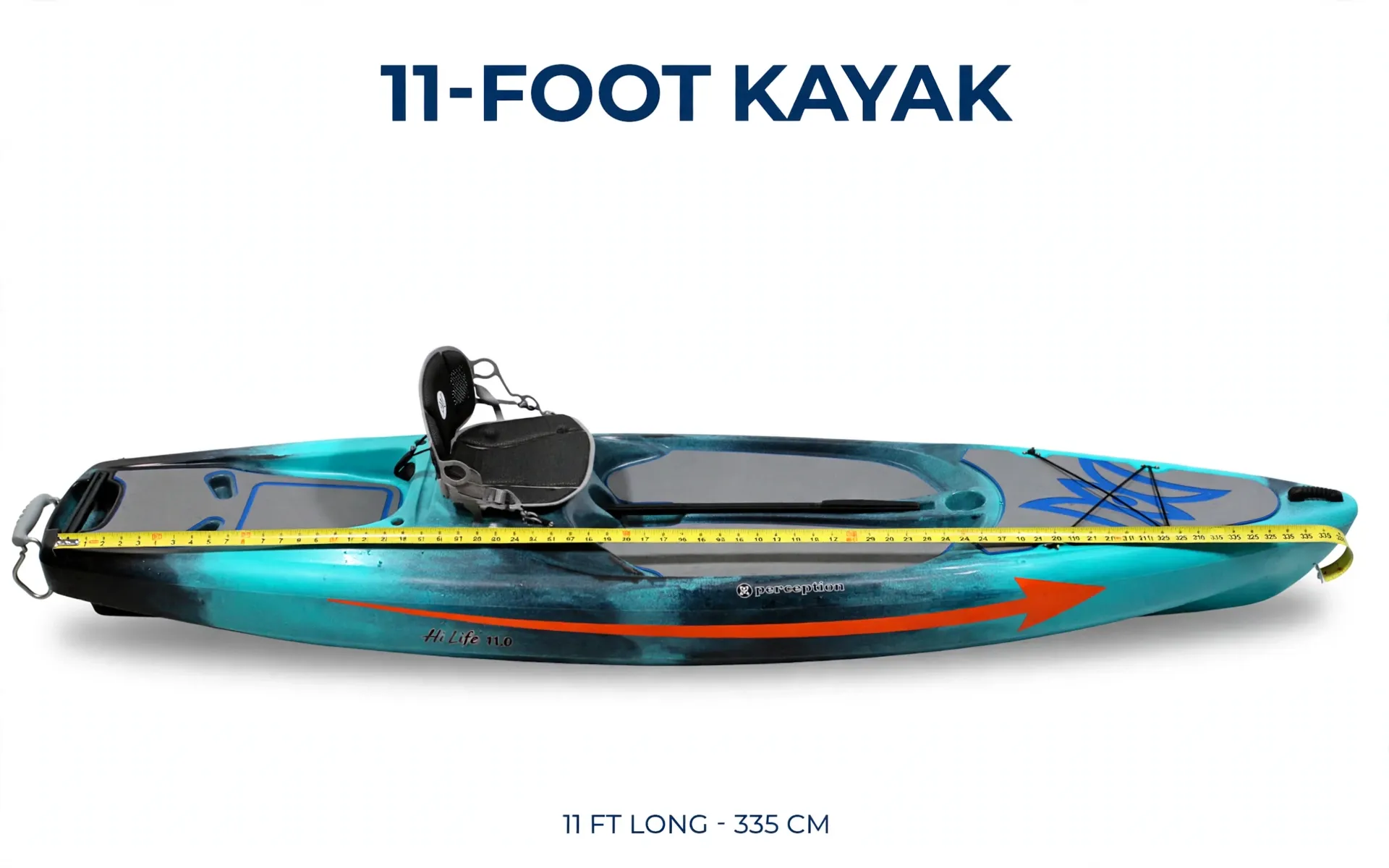
The first object on the shelf is a hybrid, and hybrids are where audits earn their keep, because a thing with two identities invites two different measurements. The Perception Hi Life 11.0 is sold as a kayak that paddles like a stand-up board: a sit-on-top hull you can also stand on. The number that matters is its length, and the document that carries it is the dealer listing of the manufacturer’s specification. In the dealer listing for the Perception Hi Life 11.0, the spec line reads “Length: 11′ / 335 cm”, with a 34-inch beam beside it. The metric figure confirms the imperial one: 335 centimetres converts to 10.99 feet, and the maker’s own rounding to 11 feet is the honest kind — the spec’s own two figures agree to within a hundredth of a foot.
The beam deserves its own sentence, because beam is the dimension a buyer feels on the water and the dimension a careless list would confuse with length. Thirty-four inches of beam makes this a wide, stable platform — wide enough to stand on, which is the whole point of the hybrid — and it is a different measurement from the 11-foot length, in a different direction, for a different purpose. A kayak’s length decides its speed and tracking; its beam decides its stability. The audit keeps them apart. What the tape reads along the keel is 11 feet; what it reads across the widest point is 34 inches. Both figures come from the same spec line, and neither borrows the other’s authority.
Audit: EXACT — length. The manufacturer’s spec, via its dealer listing, gives the Hi Life 11.0 a length of 11 feet (335 cm), so the name and the tape agree in the direction the boat travels.
Object 2: The iROCKER All Around 11, an Inflatable Board With a Manual to Prove It
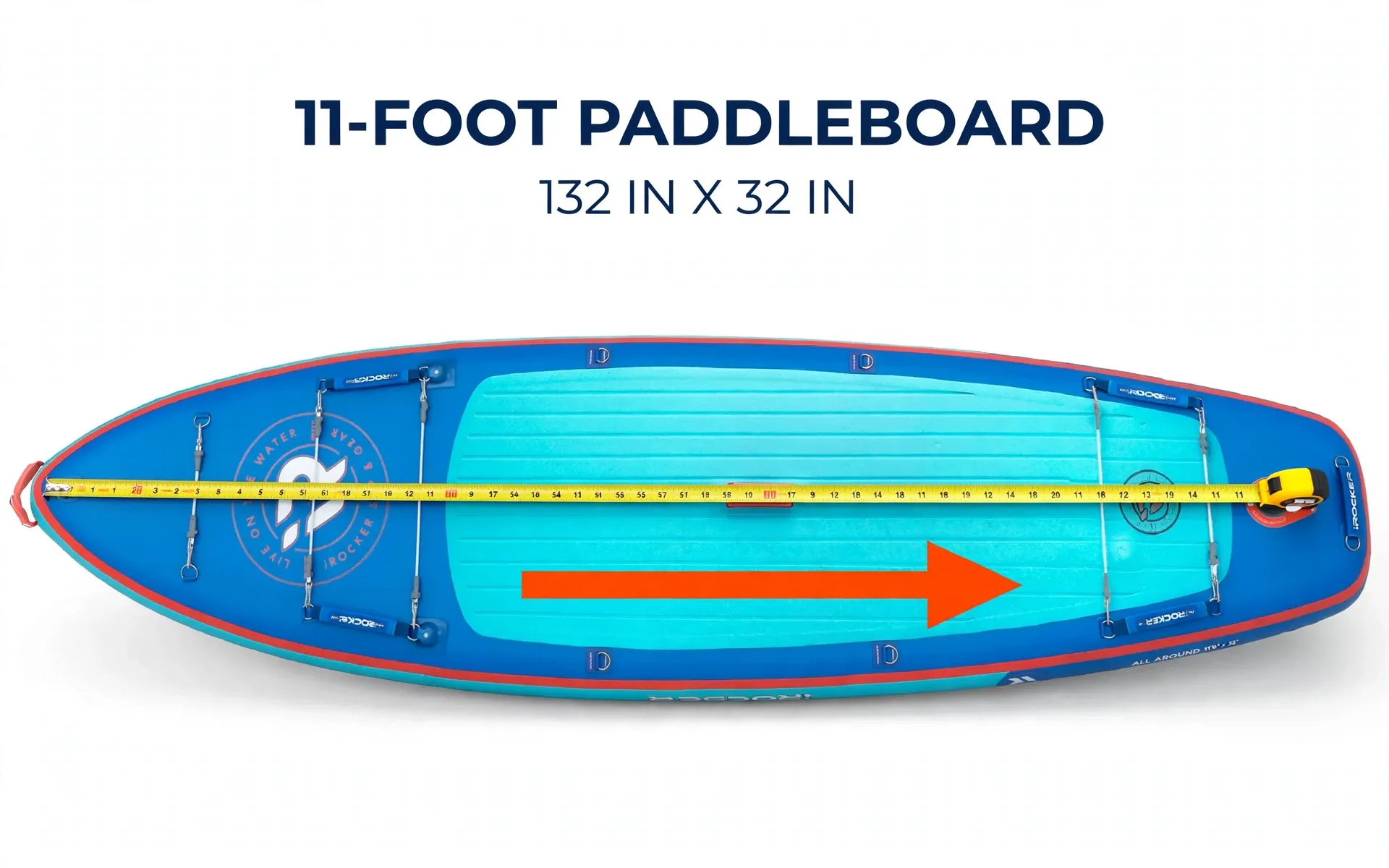
Inflatable paddleboards are the audit’s friendliest subjects, because a board that must hold air at pressure cannot afford a vague size: the manual prints the dimensions the warranty depends on. The iROCKER All Around 11 is the company’s general-purpose inflatable, and its manual spec table is unusually complete. In the iROCKER All Around 11 manual, the spec table lists the board at 132 inches by 32 inches, six inches thick. One hundred and thirty-two inches is 11 feet by definition, so the manual’s own figure is the audit’s figure with no conversion in between — the rare case where the source and the headline number are the same number.
The other two figures complete the picture and discipline the reading. The 32-inch beam is just under twice 17 inches — two of those spans would overshoot to 34 — and it is the width that makes an all-around board stable for a beginner. The six-inch thickness is the inflated depth, the dimension that decides stiffness: a thinner board flexes, a thicker one rides high. None of these is the headline number, and the audit does not let them borrow it. Length is 11 feet; beam is 32 inches; thickness is 6 inches. Three measurements, three directions, one spec table, and the headline survives because the table is exact about which is which.
Audit: EXACT — length. The maker’s manual spec table lists the All Around 11 at 132 inches long, which is 11 feet exactly, so this object passes the audit on its own document.
Object 3: The NSP Elements Longboard, Eleven Feet of Surfboard

Surfboards are measured the way kayaks are — nose to tail, one straight line — and longboards are where the scale gets serious. The NSP Elements Longboard is a foam-core learner’s board in the maker’s Elements range, and its size chart is the document that matters. In the NSP size chart for the Elements Longboard, the largest size is listed as 11′0″, with a width of 25¾ inches and a volume of 123.8 litres beside it. Eleven feet of surfboard is a lot of board: it catches waves a shorter board cannot, and it needs a roof rack rather than a back seat.
The width line is worth pausing on, because it shows how a size chart disciplines a headline. Twenty-five and three-quarter inches falls just short of 29 inches — three and a quarter inches short, to be exact — and it is the width that decides whether a beginner can balance on the board at all. Volume, 123.8 litres, is the third figure, and it is the one that decides float: a heavier rider needs more of it. None of these figures competes with the headline; they complete it. A longboard’s length is its identity in a way a kayak’s length is not — boards are sold, racked and waved by their foot-mark — and the chart’s 11′0″ is the identity, printed by the maker, in feet and inches.
Audit: EXACT — length. The manufacturer’s size chart lists the Elements Longboard at 11 feet 0 inches, so the headline number is the maker’s own figure for this exact board.
Object 4: The Ugly Stik Bigwater Rod, Eleven Feet of Fishing Rod
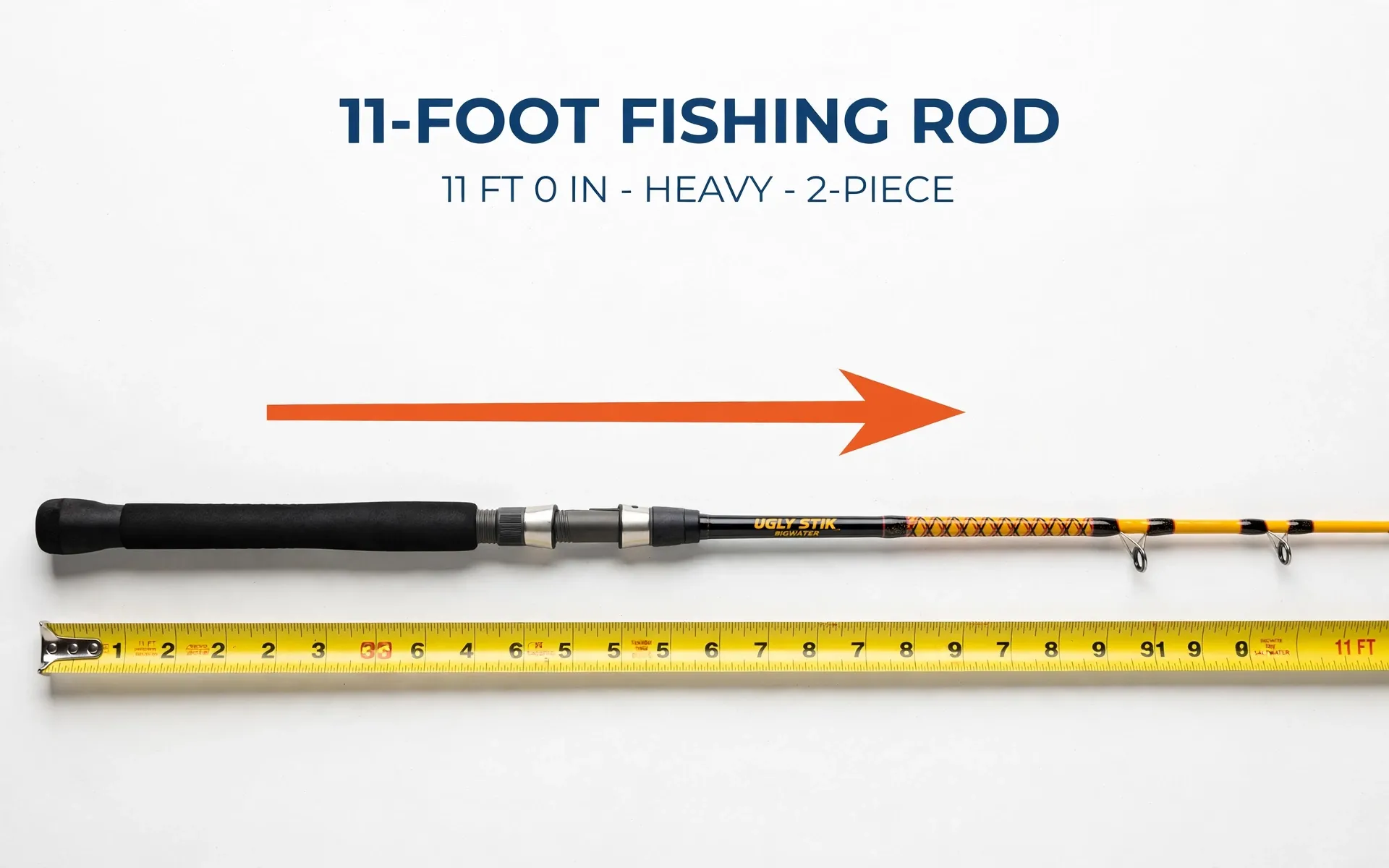
Fishing rods are sold by length the way surfboards are, and the audit’s job is to check that the variant on the shelf is the variant on the spec sheet — because rods come in families, and only one member of the family may be 11 feet. The Ugly Stik Bigwater is a saltwater spinning rod sold in several lengths, and the variant that matters here is the heavy, two-piece, 11-foot model. In the retailer variant list for the Ugly Stik Bigwater spinning rod, the variants include “11’0\”/Heavy/2pc” — length, power and piece-count in one line, exactly the way a rod buyer reads a rack.
The variant discipline matters more here than in any other object so far, because a careless list could point at the Bigwater family and claim 11 feet for all of it. Shorter Bigwaters exist, and they are not 11 feet; only the 11-foot variant is. Heavy power is the second half of the line’s meaning: it is the rod’s backbone rating, the weight of fish and lure it is built to handle, and it has nothing to do with length — but it is part of the variant’s identity, the way a kayak’s beam is part of its identity. An 11-foot rod is just under five 27 inches spans laid end to end — five would overshoot to 135 — and that span is the one a surf caster feels when the rod loads on a cast: a long lever, built to throw bait past the breakers.
Audit: EXACT — length. The variant list gives the Bigwater’s 11-foot heavy two-piece model by name, so the headline number belongs to this exact variant, not merely to the rod family.
Object 5: The Warbonnet Superfly Tarp, Eleven Feet of Ridgeline

Hammock tarps are measured by their ridgeline — the seam along the top that the tarp hangs from — and the ridgeline is the only length that matters when rain is falling, because it decides how much hammock stays dry. The Warbonnet Superfly is a four-season tarp with doors, sold in several ridgeline lengths, and the variant that matters here is the 11-foot model. In Warbonnet’s own Superfly builder page, the maker states the rule plainly: “all our tarp models in 11′, 12′ and 13′ lengths. This length refers to the length of the Ridge-seam.” The maker defines its own measurement before giving the number, which is the most audit-friendly sentence a manufacturer can write.
The width line completes the shelter picture and disciplines the headline. The Superfly’s width is 10 feet — a full foot shorter than its ridgeline — and that foot is the difference between a tarp that covers a hammock and a tarp that covers a hammock plus its doors. Five 26 inches spans laid end to end land at 130 inches, two inches short of this ridgeline, which is a useful field check: if your tape reads five of those spans and still has room, you are looking at an 11-foot ridgeline, not a 10-foot one. The doors are the reason to buy the Superfly over a plain tarp, and the doors hang from the ridgeline’s ends — so the ridgeline is not a nominal figure but the working dimension the whole shelter is built around.
Audit: EXACT — length (ridgeline). The maker defines the length as the ridge-seam and offers the Superfly in an 11-foot ridgeline, so the headline number is the maker’s own working dimension.
Object 6: The Dutchware Chameleon Hammock, Eleven Feet to Lie In
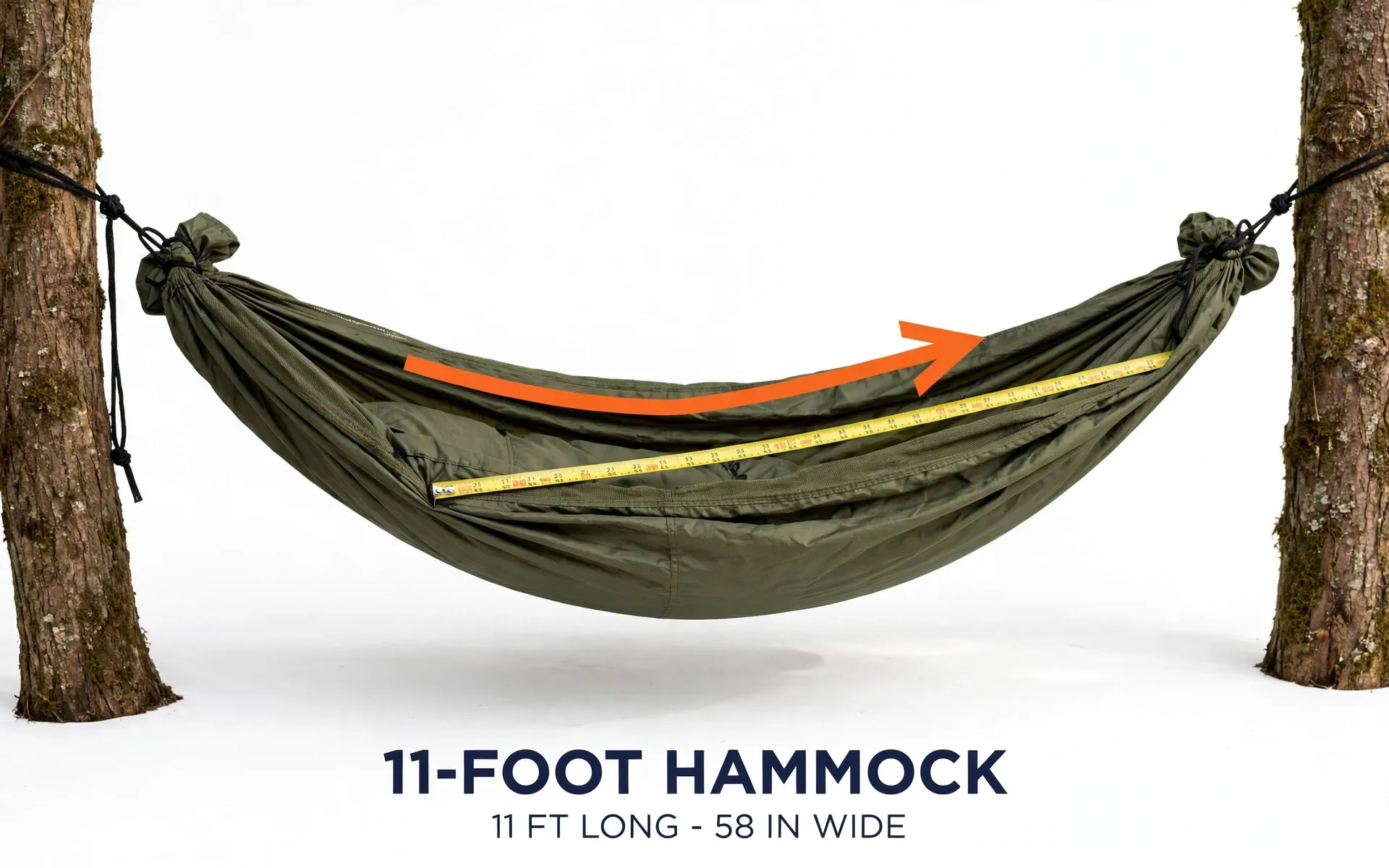
If the tarp is measured by its ridgeline, the hammock is measured by its bed — the fabric you lie in — and the standard bed length in the gathered-end hammock world is 11 feet. The Dutchware Chameleon is a modular gathered-end hammock, and its length is the industry standard rather than an exception. In Dutchware’s beginner’s guide to choosing a hammock, the standard is stated as a rule of the craft: the common hammock body is “58 inches wide and 11 feet long”. The guide is written for buyers choosing their first hammock, and it treats 11 feet as the length to buy, not as a curiosity.
The width figure is the one that varies, and the audit keeps it separate. Fifty-eight inches is the standard width; a 70-inch wide version exists for broader sleepers. Either way the length stays 11 feet, which is the point: in hammocks, length decides whether you can lie diagonally — the flat-lay position that makes a gathered-end hammock sleepable — and 11 feet is the length at which most adults can. Its 58-inch width is two and a half 23 inches spans — two would reach 46, three would overshoot to 69 — and that width, not the length, is what a buyer chooses between. The tarp above exists to cover this hammock, and the two 11-foot figures meet in the field: an 11-foot tarp over an 11-foot hammock, ridgeline over bed, with the tarp’s doors closing the ends.
Audit: EXACT — length. The maker’s guide states the standard hammock body at 11 feet long, so the headline number is the craft’s standard length, published by the maker.
Object 7: The Safavieh Courtyard Rug, Eleven Feet on the Label

Rugs are where the audit changes its tone, because rugs are sold by nominal size — and nominal, honestly used, is a different promise from a specification. The Safavieh Courtyard CY6139 is an indoor-outdoor area rug sold in several sizes, and the size that matters here is 8 by 11 feet. In the Target listing for the Courtyard CY6139, the rug is described as “Measuring 8 x 11 feet”. The 11 is the rug’s long side, the dimension that runs down a room, and it is the figure a buyer plans floor space around.
The honest complication is that mass-market rugs are sold by nominal size, and a rug that is listed at 11 feet can measure a few inches short once it is woven, finished and unrolled on your floor. That is not deception; it is the rug trade’s sizing system, and the audit’s job is to say so rather than to bless the number as a tape reading. The listing does not claim a tolerance, and the audit does not invent one. What can be said is this: the rug is sold as an 11-foot rug, the 11 is the long side, and a buyer who needs a full 132 inches of coverage should measure the rug they receive rather than trust the label to the inch. The grade below carries that warning in its name.
Audit: LISTED — length (long side). The rug is sold at 8 by 11 feet; the 11 is a nominal rug size that may measure a few inches short in practice, so it is listed, not exact.
Object 8: The Treasure Garden Umbrella, Eleven Feet of Shade

Patio umbrellas are measured by their canopy — the span of shade, not the height of the pole — and the canopy is the figure that decides whether a table stays out of the sun. The Treasure Garden AKZ Plus is a cantilever umbrella, the kind that hangs its canopy off to one side of its base so the pole does not block the table, and its model name carries the canopy size. In the dealer listing for the Treasure Garden AKZ Plus 11, the model is named “The Treasure Garden 11′ AKZ Plus Octagonal Cantilever Umbrella”, and the listing gives the canopy’s coverage as 85 square feet. An 11-foot octagonal canopy is a wide circle of shade — wide enough for a full dining table and its chairs.
The measurement kind matters here more than in any object so far, because a canopy span is a width, not a length: the tape runs across the open umbrella, edge to edge, through the pole’s offset arm. It is also the second object in this audit whose 11 feet is a span rather than a length, and the audit marks it as such. The 132-inch span is just under five 28 inches lengths laid end to end — five would overshoot to 140 — which gives a field check for anyone standing under one: five of those spans across the shade, and the canopy still has room. The listing is a dealer listing of the manufacturer’s model spec, labelled as such, and the model name itself carries the 11 — which is why the grade is LISTED rather than EXACT: the figure comes through the model system, not from a spec table the auditor could open line by line.
Audit: LISTED — width (canopy span). The umbrella is listed as an 11-foot octagonal cantilever model with 85 square feet of coverage; the 11 is the canopy’s span, carried by the model name through a dealer listing.
Object 9: The Sea Eagle SE9 Boat, Eleven Feet That Floats

Inflatable boats are measured hull-length, bow to stern, and the SE9 is the audit’s most practical object: a boat you can carry in a bag and inflate at the water. The Sea Eagle SE9 is an inflatable motormount boat — a fishing platform with a transom for a small motor — and its length decides what water it can handle. In the retailer spec table for the Sea Eagle SE9, the length is given plainly: “Length: 11 ft”, with a beam of 4.65 feet beside it. Eleven feet of inflatable boat is a serious fishing platform: long enough to stand in, short enough to pack.
The beam figure disciplines the reading the way the kayak’s beam did. Four point six five feet of beam is 55.8 inches — a wide, stable floor for casting — and it is a different measurement from the 11-foot length, in a different direction, for a different purpose. The spec table is a retailer table of the manufacturer’s specifications, labelled as such, which is why the grade below is LISTED rather than EXACT: the figure reaches the auditor through a dealer, not from the maker’s own page. That distinction is the audit’s honesty about its own chain of custody. The length is still the boat’s headline dimension — the one that decides whether it fits your vehicle deflated and your lake inflated — and the table gives it without hedging.
Audit: LISTED — length. The retailer spec table lists the SE9 at 11 feet long with a 4.65-foot beam; the 11 is the hull length, carried through a dealer listing of the manufacturer’s spec.
Object 10: The American Alligator, Eleven Feet on Average
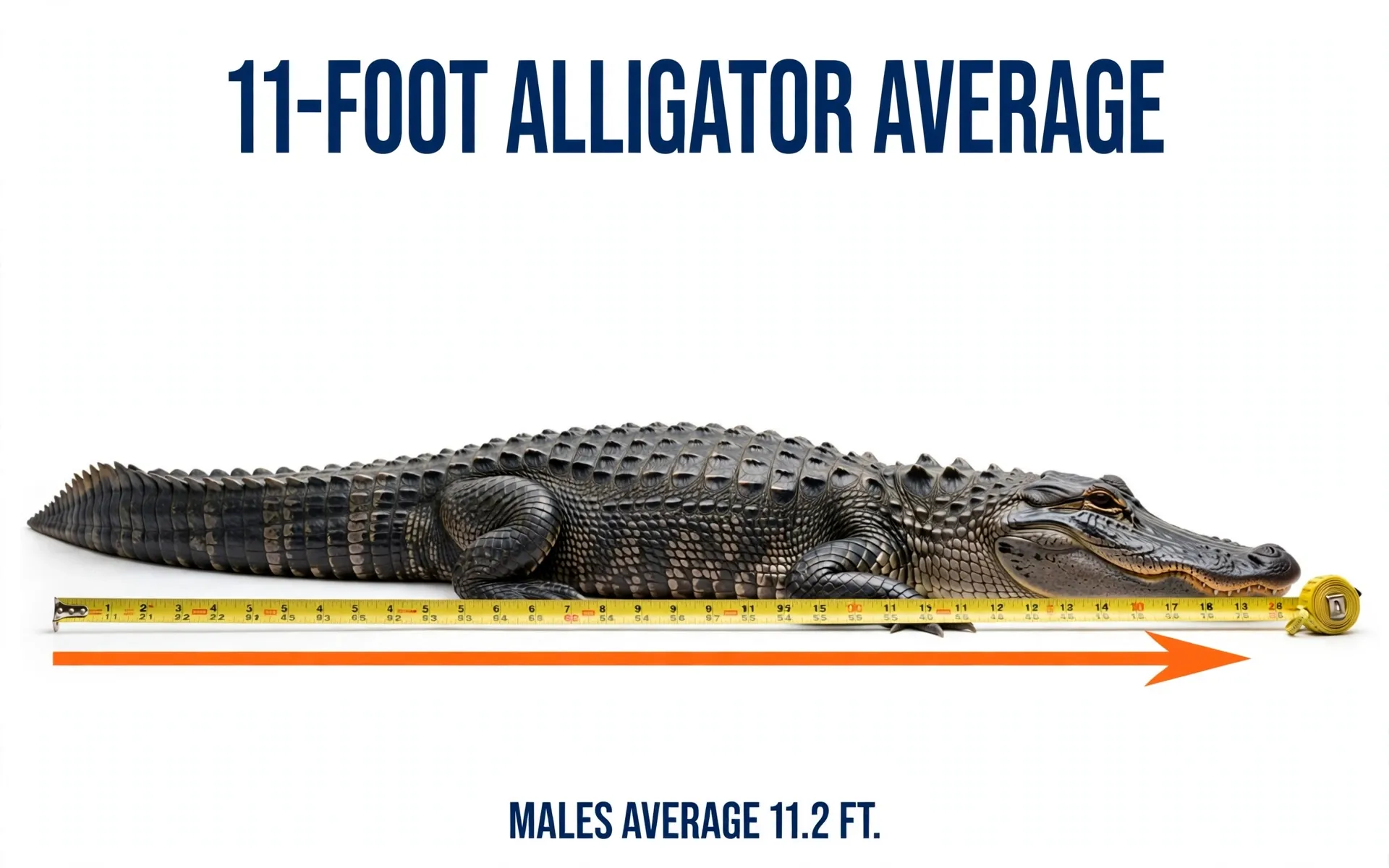
The audit’s tenth object is not a product at all, and its grade is the one most readers misread — so it gets the plainest language in this article. The American alligator is the largest reptile in North America, and adult males are big animals by any measure. In Smithsonian’s National Zoo’s alligator page, the authority figure is an average: “the average size for a male is 11.2 feet (3.4 meters)”. Eleven point two rounds to 11, which is why the alligator belongs in this audit — and the decimal is why it belongs with a warning attached.
An average is not a promise about any individual. No alligator is thereby “exactly 11 feet” — some males are shorter, some are much longer, and the average describes the middle of a population, not the length of the animal in front of you. That is the difference between this object and every EXACT object above it, and the audit marks it in the grade’s name. The average male, at 11.2 feet, is more than eight 16 inches spans laid end to end — eight would reach only 128 inches, and the average male runs past that by more than six inches. Females average smaller, which is why the audit specifies males: the 11.2 figure is a male average, and quoting it without the sex would misstate the authority’s own sentence.
Audit: AVERAGE — class average. The authority average for an adult male American alligator is 11.2 feet; no individual is thereby exactly 11 feet, and the figure is an average, not a measurement of one animal.
Object 11: The Zhuque-2E Rocket Stage, Eleven Feet Across

The audit’s last object fell out of the sky. In 2023, a bowl-shaped object turned up in a Minnesota cornfield, and experts identified it as the upper stage of a Zhuque-2E rocket — a piece of a launch vehicle that had come back down in the wrong place. The figure that matters is its width, and the source is an expert attestation carried by a reputable magazine. In Smithsonian Magazine’s report on the Minnesota object, the identification reads: the Zhuque-2E rocket’s upper stage “measures 11 feet in diameter”. Diameter, not length — the tape runs across the bowl, edge to edge, through its centre.
The measurement kind is the whole story here, and the audit insists on it. An 11-foot diameter is a different claim from an 11-foot length: a rocket stage is a wide, shallow bowl, and its diameter is its most visible dimension — the one a farmer sees from the field’s edge. The 132-inch diameter is just under nine 15 inches spans laid end to end — nine would overshoot to 135 — which gives a field check for anyone standing beside it: nine of those spans across the bowl, and the rim still has room. The grade is REPORTED rather than EXACT because the figure reaches the auditor through an expert’s attestation in a magazine report, not through a manufacturer’s spec table — and the audit says so, because a fact’s chain of custody matters most exactly when the fact fell out of the sky.
Audit: REPORTED — diameter. Experts reported the Zhuque-2E upper stage at 11 feet in diameter; the 11 is across the bowl, not along it, and the figure is a reported attestation, not a manufacturer spec.
The Audit Chart: All Eleven Objects at a Glance
Eleven objects, four grades, three measurement kinds. The chart is the audit on one card: what each 11 feet actually measures, the verified figure from the primary source, and the grade the evidence earned. The pattern reads at a glance — the exact 11s are the objects whose maker publishes the figure for that exact model, and every softer grade is a number that arrives through a listing, an average, or a report instead.
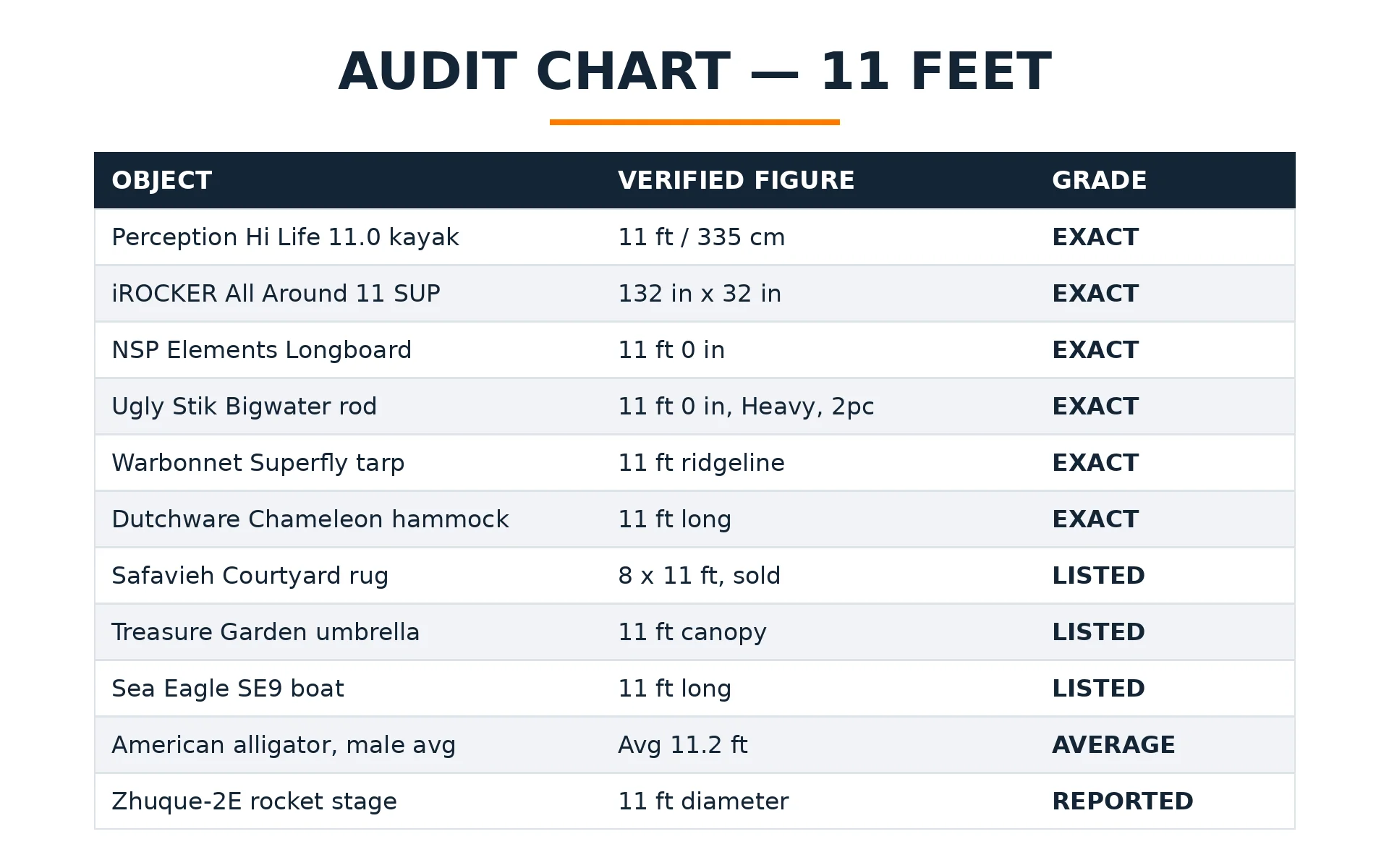
| Object | What the 11 feet measures | Verified figure | Audit grade |
|---|---|---|---|
| Perception Hi Life 11.0 kayak | Length of the hull | 11 ft / 335 cm (maker spec via dealer) | EXACT — length |
| iROCKER All Around 11 SUP | Length of the board | 132 in × 32 in × 6 in (manual spec table) | EXACT — length |
| NSP Elements Longboard | Length of the board | 11′0″, 25¾ in wide, 123.8 L (size chart) | EXACT — length |
| Ugly Stik Bigwater rod | Length of the 11′0″/Heavy/2pc variant | 11′0″/Heavy/2pc (variant list) | EXACT — length |
| Warbonnet Superfly tarp | Length of the ridgeline | 11 ft ridgeline × 10 ft width (maker) | EXACT — length |
| Dutchware Chameleon hammock | Length of the bed | 11 ft long, 58 in or 70 in wide (maker guide) | EXACT — length |
| Safavieh Courtyard CY6139 rug | Long side, sold size | 8 × 11 ft (retailer listing) | LISTED — length |
| Treasure Garden AKZ Plus umbrella | Span of the canopy | 11 ft octagonal canopy, 85 sq ft (dealer listing) | LISTED — width |
| Sea Eagle SE9 boat | Length of the hull | 11 ft long, 4.65 ft beam (retailer spec table) | LISTED — length |
| American alligator, adult male | Class average, males | Average 11.2 ft / 3.4 m (Smithsonian’s National Zoo) | AVERAGE — class average |
| Zhuque-2E rocket upper stage | Diameter of the bowl | 11 ft in diameter (expert report) | REPORTED — diameter |
Six objects pass on a manufacturer’s own figure, three arrive through listings, one is an average, and one is a report. That spread is the point of the audit: a list that stamped every object EXACT would be lying about four of them, and a list that stamped every object “about” would be hiding the six that are exact. Grades are not decoration. They are the difference between a number you can build on and a number you can only quote.
Build 11 Feet From What Is Already in the Room
Six builds from objects already in most rooms, every one stated with its true total — including the three that miss, because a build that misses honestly beats a claim that hits falsely. The units are verified: a standard ruler is 12 inches; a yardstick is 36 inches by definition of the yard it portions; a United States banknote measures 6.14 inches long; a bank card’s long edge is 3.37 inches, the 85.60-millimetre edge fixed by the card standard; US Letter paper runs 11 inches on its long edge.
| Build | Pieces | True total | Verdict |
|---|---|---|---|
| Eleven standard rulers, end to end | 11 × 12 in | 132.00 in | Dead on — the definition of the length |
| Twelve letter sheets, long edges | 12 × 11 in | 132.00 in | Dead on — twelve elevens make eleven feet |
| One yardstick + eight rulers | 36 + 96 in | 132.00 in | Dead on — three yardsticks plus a ruler and a half, by another route |
| Twenty-two dollar bills, lengthwise | 22 × 6.14 in | 135.08 in | 3.08 in over — money runs long |
| Thirty-nine bank cards, long edges | 39 × 3.37 in | 131.43 in | 0.57 in short — the closest pocket build |
| Four yardsticks, end to end | 4 × 36 in | 144.00 in | 12.00 in over — a full foot past the mark |
Three builds land dead on, and they are the three built from measuring instruments and standard paper. The pocket builds miss honestly: a dollar bill runs a little over six inches, so twenty-two must run long, at a seventh of an inch of error per bill; thirty-nine bank cards come closest, just over half an inch short — fine for judging a kayak by eye, useless for fitting a tarp. The four-yardstick build fails outright, a full foot over, and it is the build most people reach for first, because yardsticks feel like the right tool. Eleven feet rewards the tools that were made to measure it — and punishes the ones that merely look like they were.
Corrections Desk: Three Claims That Fail the Audit
Every audit ends with a log of claims that did not survive it. Each entry names the error and the sourced truth, with generic attribution only — no list is named, no rival page is linked. These are not rounding differences; they are claims that would put a wrong object on the 11-foot shelf.
1. “An 11-foot kayak” that is really 11 feet 6 inches. One rival roundup lists a popular fishing kayak at 11 feet. The manufacturer’s spec for that model is 11 feet 6 inches — half a foot longer, which is the difference between a kayak that fits your vehicle and one that does not. The claim fails the audit on the maker’s own figure, and the kayak does not appear among the eleven objects above. Rounding a spec to the nearest foot is how a 12-foot boat becomes an 11-foot claim.
2. “An 11-foot catamaran” that is really 10.99 feet. A second listing gives an inflatable catamaran as 11 feet, but its own spec is 335 centimetres — which converts to 10.99 feet, a hundredth of a foot short. The audit does not fail it harshly: 10.99 is a rounding case, not a fabrication, and a hundredth of a foot is a tenth of an inch. But an audit that calls 10.99 “exactly 11” has stopped auditing, so the catamaran stays out of the eleven and in this log, where rounding cases belong.
3. “An 11-foot shark” that averages 10 feet. A third claim puts a tiger shark on the 11-foot shelf. Published averages put the tiger shark near 10 feet — its range includes 11 feet, as the ranges of many large sharks do, but its average is not 11 feet, and a range that contains a number is not a measurement of that number. The alligator above earns its place because its average is 11.2; the tiger shark fails because its average is near 10. Averages must be quoted whole, not harvested for the number inside them.
Frequently Asked Questions
How many inches are in 11 feet?
132 inches, exactly. Every foot holds 12 inches, so 11 × 12 = 132. A quick way to remember it: 10 feet is 120 inches, then add one more foot of 12. In short, 11 ft to inches is 132 — no calculator needed.
How long is 11 feet in centimetres and metres?
335.28 centimetres exactly, which is 3.3528 metres and 3,352.8 millimetres. In other words, 11 feet to cm is 335.28 and 11 feet to meters is 3.3528. The inch is defined as exactly 2.54 centimetres, so these conversions carry no rounding at all.
How many yards is 11 feet?
Three and two-thirds yards — 3.67 when rounded. Divide 11 by 3 and you get 3.666…, which is why yard conversions for 11 feet always end in a fraction or a rounded decimal. And no, 11 feet is not 3 yards: 3 yards is only 9 feet, two feet short.
How tall is 11 feet compared to a person?
A little less than two average-height adults standing head to toe. An average adult man is about 5 feet 9 inches tall, so two of them stacked reach 11 feet 6 inches — six inches past the mark. One person standing on another’s shoulders is the closest human picture of 11 feet.
What everyday things are 11 feet long?
Things that are 11 feet long turn up in more places than you would expect: a recreational kayak, an all-round inflatable paddleboard, a longboard surfboard, a surf-casting fishing rod, a hammock tarp’s ridgeline and the hammock beneath it. This article’s audit walks through eleven of them, each checked against its maker’s own specification.
Is 11 feet big for a kayak or a paddleboard?
No — it sits right in the popular all-round range. Recreational kayaks commonly run from about 9 to 14 feet, and 11 feet is the size makers choose when they want one boat that tracks well, stays stable, and still fits on a car roof. The same is true of all-round paddleboards, where 11 feet balances glide against manoeuvrability.
Why does a rug sold as 11 feet sometimes measure less?
Because rugs are sold by nominal size, not by tape reading. A rug listed at 8 by 11 feet is made to a size system, and the finished piece can come up a few inches short after weaving and finishing. It is not deception — it is how the rug trade sizes things — but if you need a full 132 inches of coverage, measure the rug you receive rather than trusting the label to the inch.
Why do so many 11-foot claims fail?
Because 11 feet is a round-sounding number that invites rounding. Specs get rounded to the nearest foot, nominal sizes get read as tape readings, class names get read as measurements, and averages get harvested for the number inside them. The habit that catches most of them is simple: for any headline size, ask 11 feet of what, according to whom, and whether the figure is a specification, a listing, an average or a report.
Final Thoughts
The tape measure’s verdict, after eleven objects: 11 feet survives the audit — six times exactly, three times as listed, once on average, once by report. It is a real length, carried by real objects, from a kayak you can paddle to a rocket stage that fell from the sky. The number was never the problem. The problem was only ever the claims made in its name, and those, one by one, the audit has now checked.
If this changed how you read a size label, try the same test on a shorter length next: our field guide to how long is 30 inches catches even more tricks hiding behind one small number — a monitor that is 30 inches in name only, a door that is 30 inches by system rather than by tape, and a stool that wears 30 inches as a class name.
