
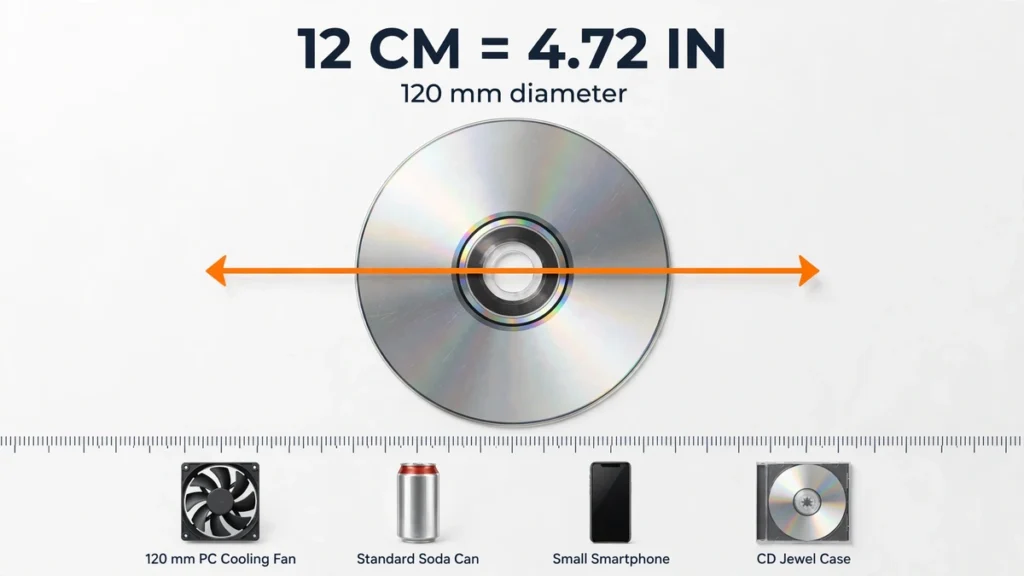
If you have ever wondered how big is 12 cm, the short answer is 4.72 inches — and the longer answer is that 12 cm is the easiest size in the whole centimetre series to picture, because it is the one size the world actually built things to. A CD is 12 cm across because a standard says so. A PC cooling fan is 12 cm square because an entire industry agreed on 120 millimetres. A soda can stands 12.22 cm tall because a can factory’s specification says so. Where 11 cm had almost nothing exact, 12 cm has two exacts and four near-misses that miss by less than half a centimetre — and every one of them is sitting in your house right now.
Below are six single, named things, each checked against its own specification, with the miss printed wherever a thing misses. Two of them are exact at 12 cm for the dimension stated, and the other four land within half a centimetre of it — close enough to trust, honest enough to print. Every object’s image sits immediately after its heading, and no object is a stack, a multiple, a fraction, or a category guess. You will not find half a ruler or a large apple here, because half a ruler is arithmetic wearing a trench coat and a large apple is a range wearing a fruit bowl. By the end you will know 12 cm as a disc, a fan, a can, a phone, a plant pot, and a passport — and you will know which of those you can trust to the millimetre and which you must measure yourself.
Quick Answer
12 cm is 4.72 inches exactly — 120 millimetres, 0.12 metres, and 0.13 yards. But do NOT round it to 5 inches: 5 inches is 12.7 cm, which is 7 millimetres too long, and 7 millimetres at this size is a gap that shows. The honest shortcut is 4 and 3/4 inches, and the honest object is a CD — 12 cm across by standard.
Why 12 Cm Is the Easiest Size in the Whole Series
Twelve centimetres is the only size in this series that the world manufactures on purpose, and the reason is the number 120. A CD is 120 millimetres across because Philips and Sony agreed on it in 1982, and every DVD and Blu-ray since has kept the same 120 mm disc. A PC cooling fan is called a "120 mm fan" because the whole cooling industry builds to a 120 × 120 mm square, and the best fan in that class is sold by that number. That is two separate industries, forty years apart, both landing on exactly 120 millimetres — and neither of them did it by accident. Eleven centimetres has no industry behind it; twelve centimetres has two.
The second reason 12 cm is easy is that it sits exactly where the imperial system stops being helpful. Four and three-quarter inches is 12.065 cm — so close to 12 cm that a tape measure cannot tell them apart — while five inches is 12.7 cm, a full 7 millimetres over. That means the inch mark you actually want is the one just past 4 and 11/16, not the round 5-inch mark your eye is drawn to. Every conversion guide that tells you to "just call it 5 inches" is handing you a 7-millimetre error and calling it a shortcut, and every guide that tells you to divide by 2.5 is handing you 4.8 inches, which is 2 millimetres over. The honest way to picture 12 cm, then, is not to convert it at all — it is to hold a CD. The disc in your drawer is 12 cm by standard, it has been 12 cm since 1982, and it will still be 12 cm when every conversion guide on the internet has been rewritten.
The 6 Objects
Each object below carries its evidence grade in the heading. EXACT means the figure is a standard's or an authority's own dimension for the named thing. LISTED means the figure is the manufacturer's or operator's published specification for the named model. The grade is the whole point: a list that never grades its numbers is asking you to trust it, and this article would rather show you the receipt.
1. A Standard CD or DVD — 12 Cm Across (EXACT)
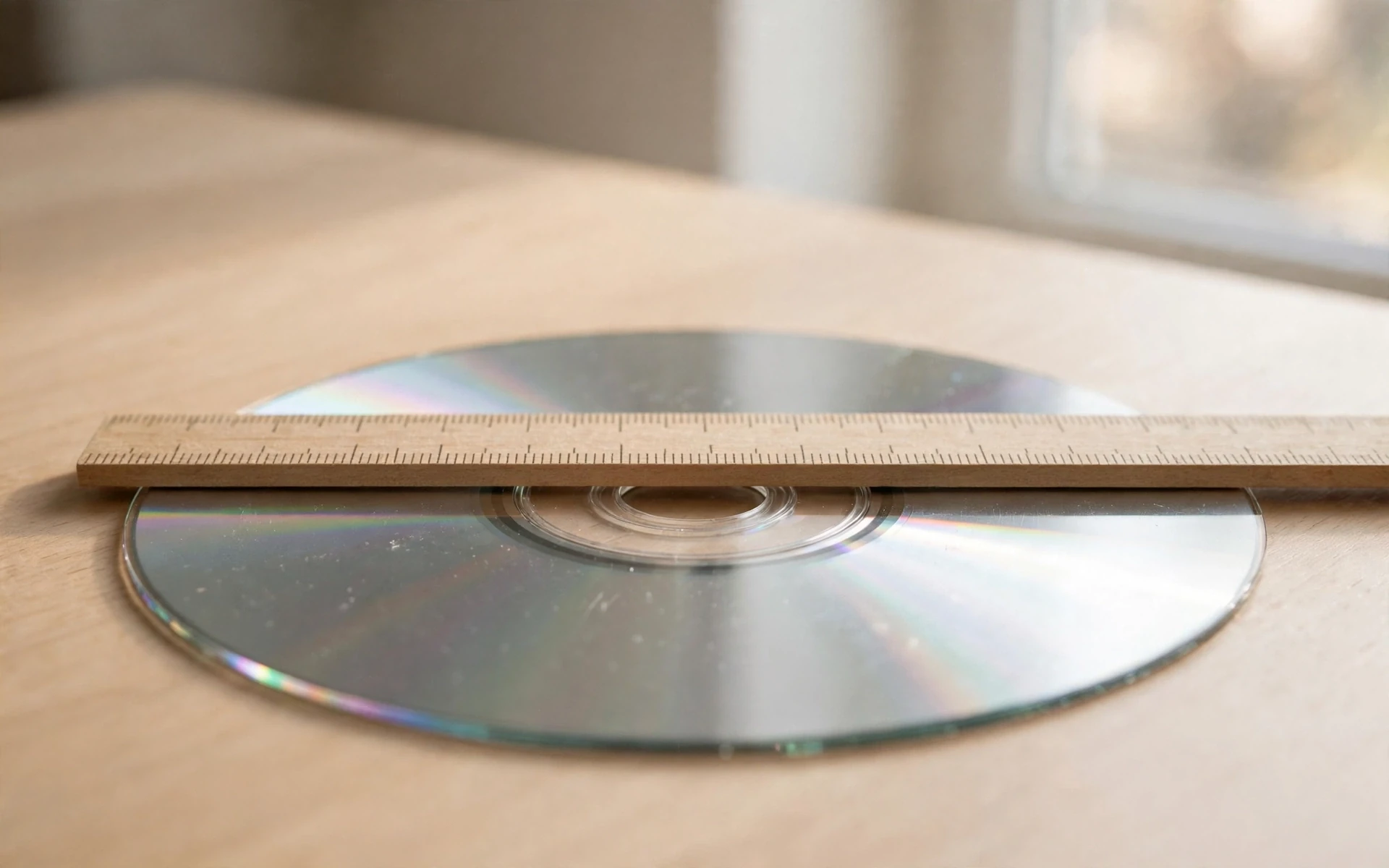
The CD is the article's cleanest exact, because its 12 cm is written into two international standards at once. A standard CD is 120 millimetres in diameter under ECMA-130, and a standard DVD is 120 millimetres in diameter under ECMA-267 and ISO/IEC 16448 — the same 12 cm disc, 1.2 mm thick, with a 15 mm hole in the middle for the spindle. Philips and Sony settled the 120 mm size in 1982, when the CD was invented to hold about 74 minutes of music, and every optical disc since — CD, DVD, Blu-ray — has kept the same diameter. Pick one up from any shelf and you are holding 12 cm in your hand, no measuring required, and the disc has been 12 cm for forty-four years.
The fitting check is the case, not the disc. A CD jewel case is 125 mm on its short side and 142 mm on its long side, so the case is half a centimetre wider than the disc it holds — which is why a shelf built for CDs needs 12.5 cm of clearance per case, not 12 cm, and a drawer built for loose discs needs 12 cm exactly. The grade is exact because the figure is a standard's own dimension for this named format, not a size family: 120 mm, by definition, and the disc in your drawer is the proof. Keep one beside your ruler and you will never have to guess 12 cm again.
2. A Noctua NF-A12x25 120 Mm PC Cooling Fan — 12 Cm Square (EXACT)
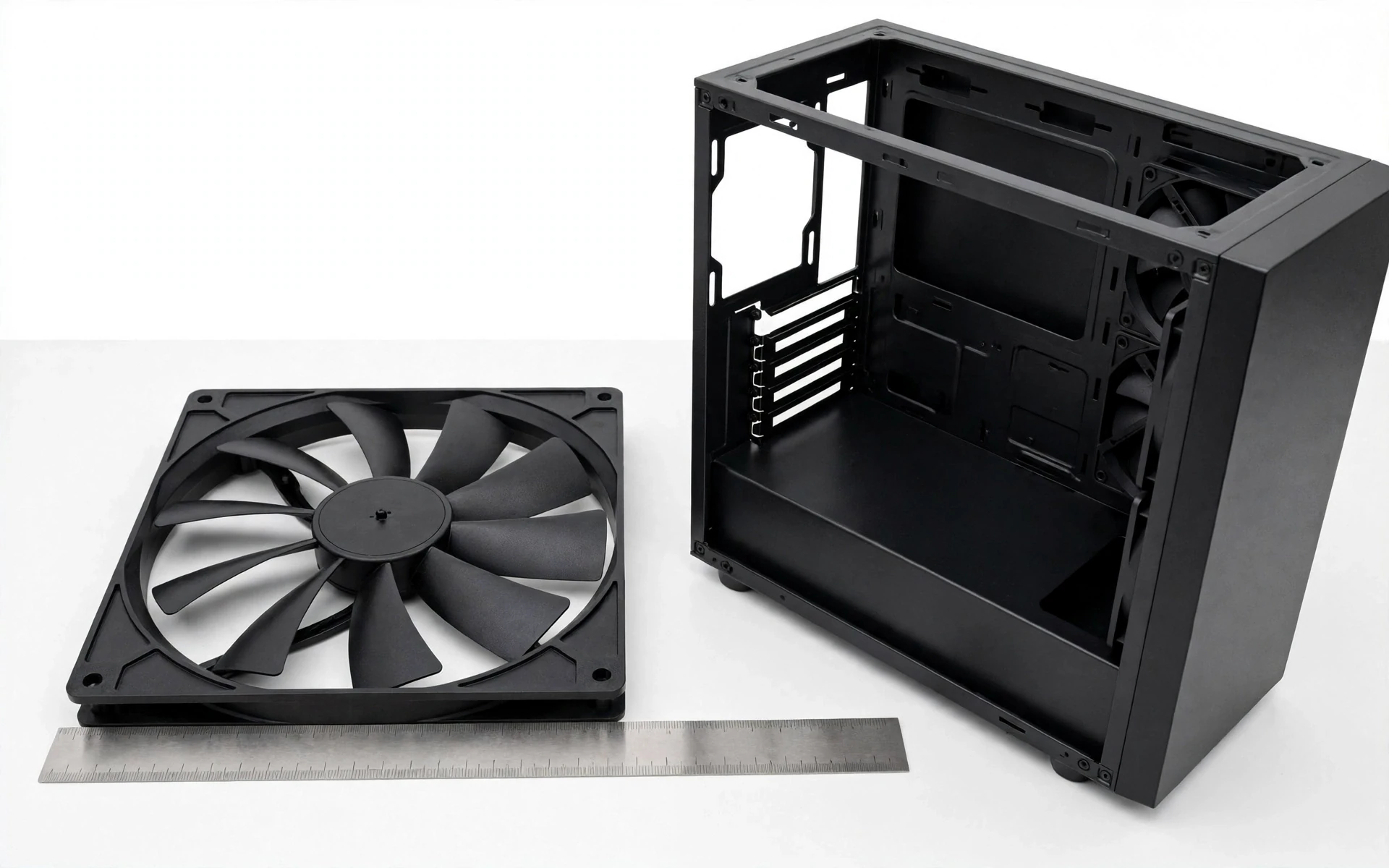
The fan is the article's most surprising exact, because it is 12 cm in two directions at once. Noctua's own specification lists the NF-A12x25 at 120 × 120 × 25 mm — twelve centimetres wide, twelve centimetres tall, and two and a half centimetres deep — with mounting holes spaced 105 × 105 mm apart, a top speed of 2,000 revolutions per minute, and airflow of 102.1 cubic metres per hour. The "120 mm fan" is not a Noctua invention: it is an industry size class, so every 120 mm fan from every maker is a 12 cm square, and the Noctua is simply the best-known, best-specified example of the class. If you have ever built a PC, you have held 12 cm in your hand and screwed it into a case.
The fitting check is the mounting holes, because the fan is 12 cm square but its screws are not. The holes sit 105 mm apart — 10.5 cm — so a case built for a 120 mm fan needs screw holes at 10.5 cm, not 12 cm, and a fan bought against the 12 cm figure alone will not tell you whether it fits your case. The grade is exact because the figure is the manufacturer's own specification for this named model, and the size class is the same number: 120 mm, by definition, on both sides. Open your PC case and measure the fan on the back panel — you are measuring 12 cm, in a square, with a specification to prove it.
3. A Standard 12 Oz Soda Can — 12.22 Cm Tall (LISTED)

The soda can is the article's most useful near-miss, because it is the 12 cm object you already own a dozen of. Ball Corporation's manufacturing specification for the standard 12 oz can gives a flanged can height of 122.22 mm — 12.22 cm — with a body diameter of 66.04 mm and a fill of 355 ml, and the finished can is commonly quoted at 4.83 inches, or 122.7 mm, once the lid dome is counted. It overshoots 12 cm by 2.2 millimetres, a miss thinner than a coin, which makes it the closest can in the world to this article's number. It is the can in your fridge, the can in the vending machine, and the can in the recycling bin — and all three are the same height.
The fitting check is the sleek can, because the same 12 ounces comes in a taller tin. The 12 oz sleek can stands about 15.6 cm tall with a narrower body, so a fridge shelf built for standard cans at 12.22 cm will not take sleek cans, and a cup holder built for a sleek can will rattle with a standard one. The grade is listed because the figure is the manufacturer's own specification for this named can format, with the deviation printed in full: 12.22 cm, not 12 cm, and the 2.2 millimetres is the whole story. Hold a can against your ruler and you are holding 12 cm, plus the thickness of a coin.
4. An Apple iPhone SE (1st Generation) — 12.38 Cm Tall (LISTED)
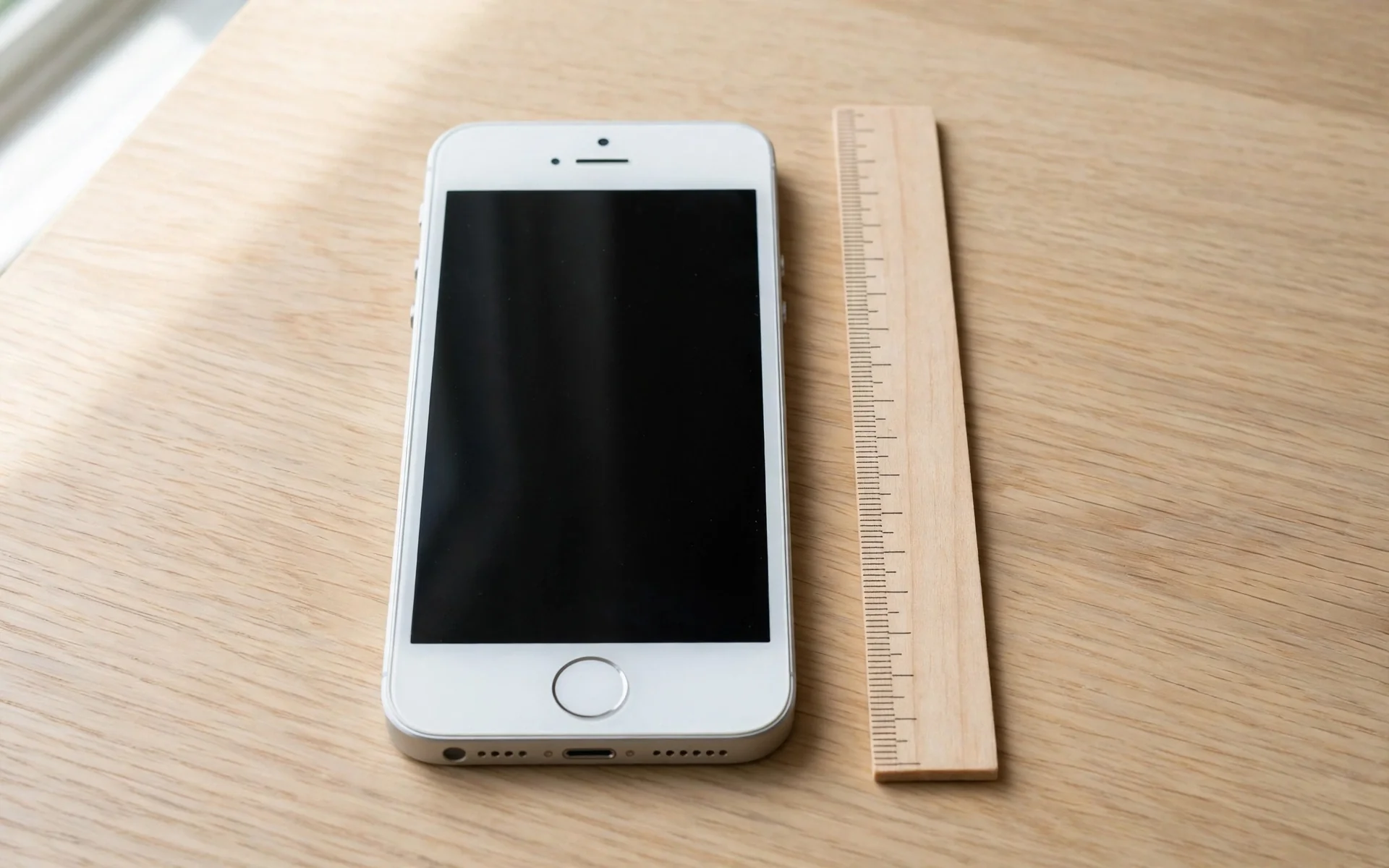
The iPhone SE is the article's most familiar near-miss, and the closest any phone ever comes to 12 cm. Apple's own technical specifications list the first-generation iPhone SE — the 2016 model with the 4-inch screen — at 123.8 mm tall, 58.6 mm wide, and 7.6 mm deep, weighing 113 grams. It overshoots 12 cm by 3.8 millimetres, a miss smaller than the width of a pencil eraser, and it is the smallest iPhone Apple made in its modern line: the phone that fits a small hand and a shirt pocket, and the phone every later "mini" was measured against. If your phone is a first-generation SE, your hand already knows 12 cm — it just knows it as 3.8 millimetres too long.
The fitting check is the direction, because the phone's height is 12.38 cm and its width is 5.86 cm — less than half. A case, a pocket, or a mount bought against "12 cm" fails by a factor of two if you measure the wrong edge, and the guides that call a compact phone "about 12 cm" never say which edge they mean. The grade is listed because the figure is the manufacturer's own specification for this named model, with the deviation printed in full: 123.8 mm, not 120 mm, and the 3.8 millimetres is the whole story. Measure your phone's height before you measure your pocket, because the phone is the object in this article you carry every day.
5. A 12 Cm Nursery Plant Pot — 12 Cm Across the Top (LISTED)

The plant pot is the article's most useful 12 cm, because it is sold by that number. Nurseries and garden centres sell small plants in pots listed as "12 cm pot", and that 12 cm is the diameter across the top rim — the measurement the pot is named for, usually printed on the base. A typical one stands about 10 to 12 cm tall, so the pot is roughly as wide as it is high, and it holds about a litre of soil. It is the pot size for a young snake plant, a prayer plant, or a coffee seedling, and it is the size most houseplants come home in before their first repot.
The fitting check is the decorative pot, and it is stricter than the nursery pot. A 12 cm nursery pot fits a decorative pot of 13 to 15 cm — never a 12 cm one, because the nursery pot's rim needs a centimetre of clearance on each side — and the pot tapers toward the base, about 9 cm across at the bottom, so a saucer bought against the base measurement leaves the rim overhanging. The grade is listed, not exact, because pot sizes are a retail standard and the height varies by maker: the diameter is the listed 12 cm, the height is whatever the mould made it, and the label on the shelf is the authority. Measure the rim, not the base, and the pot will fit the decorative pot the first time.
6. A US Passport Booklet — 12.5 Cm on Its Long Side (EXACT)

The passport is the article's largest miss, and the one with the strongest standard behind it. Every machine-readable passport booklet in the world is built to the same format — ICAO Doc 9303, the TD3 size, adopted as ISO/IEC 7810 ID-3 — which fixes the booklet at 125 × 88 mm. Closed, the booklet is 12.5 cm tall and 8.8 cm wide, so its long side overshoots 12 cm by exactly half a centimetre, and the same number holds whether the passport is American, Japanese, German, or Nigerian. It is the document in your travel bag, and it is the same size in every country on Earth.
The fitting check is the card, because the passport card is a different document at a different size. The US passport card is credit-card sized — 8.56 × 5.4 cm under ISO/IEC 7810 ID-1 — and it is valid only for land and sea travel to Canada, Mexico, and the Caribbean, while the booklet is valid everywhere. The grade is exact because the figure is a standard's own dimension for this named format: 125 mm, by definition, and the 0.5 cm miss is printed in the heading itself. Hold your passport against a ruler and you are holding 12.5 cm — half a centimetre past the number in this article's title, and the same in every country you will ever visit.
The 12-Cm Drawer Test: Check It in 30 Seconds
Twelve centimetres is a number you can check without a tape measure, because four of this article's objects are probably within arm's reach right now. First, the disc: pull a CD or DVD off the shelf and you are holding exactly 12 cm — the standard says so, and the disc has said so since 1982. Second, the can: pull a standard 12 oz can from the fridge and you are holding 12.22 cm — 2.2 millimetres over, the thickness of a coin. Third, the passport: open your travel drawer and the booklet is 12.5 cm on its long side — half a centimetre over, and the same in every country. Fourth, the fan: open your PC case and the 120 mm fan on the back panel is a 12 cm square — the size class is printed on the box it came in. None of these replaces a tape measure for anything that must fit, but all four will tell you whether 12 cm is the size you think it is before the box arrives, the pot is bought, or the case is ordered.
Where the Other Lists Get 12 Cm Wrong
Five wrong numbers about 12 cm circulate so widely that they deserve their own section, because each one is stated confidently on a page that ranks for this exact question. First, the DVD case: one popular guide calls a standard DVD or Blu-ray case "approximately 12 cm" wide, and it is not — a DVD keep case is 13.5 cm wide and 19 cm tall, so the claim is 1.5 cm short on the width and 7 cm short on the height, and the case is not a 12 cm object in any direction. Second, the palm: two guides say a man's palm is "usually right around 10 to 12 cm" wide, and it is not — the average adult male palm is about 8.5 to 9 cm across the knuckles, so the claim is a range, not a measurement, and the top of the range is a third wider than the average hand. Third, the saucer: another guide calls 12 cm "the standard diameter for a small cereal bowl or a saucer", and no standard fixes either at 12 cm — saucers run about 13 to 15 cm and small cereal bowls 12 to 15 cm by brand, so the claim dresses a range as a standard. Fourth, the five inches: guide after guide tells you to "just call it 5 inches", and 5 inches is 12.7 cm — 7 millimetres over, which is the difference between a fan that fits its case and one that does not. Fifth, the mental math: the divide-by-2.5 trick gives 4.8 inches, not 4.72 — it overstates by 0.08 inches, or 2 millimetres, and the error compounds every time you round again. None of these five numbers belongs in a 12 cm article, and all five are here so you never have to learn that from a purchase.
12 Cm Against the Sizes Around It
Twelve centimetres sits one centimetre past the DL envelope in the last article — an envelope 11 cm wide on its short side — and half a centimetre short of your passport, which is 12.5 cm on its long side. Go a little further and you reach the 3×5 index card, whose long side is 12.7 cm, which is also exactly 5 inches: the round number people keep rounding 12 cm up to, and the reason the rounding is wrong by 7 millimetres. Go further still and you reach the US dollar bill at 15.6 cm, which is 3.6 cm longer than 12 cm and the worst anchor in this whole series. The ladder runs 11, 12, 12.5, 12.7, 15.6 — and the point of it is the middle: 12 cm is the only rung with a standard behind it on both sides, a disc on one side and a fan on the other, and that is why it is the easiest size in the series to hold in your head.
How 12 Cm Compares With Other Lengths
Readers comparing nearby sizes may also want the site’s guides to 11 cm, 10 cm, 9 cm, 8 cm, and 5 cm for the centimetre series, and 12 feet, 11 feet, and 40 inches for the foot and inch series. Each of those guides follows the same rule as this one: the spec sheet, the grade, and the miss printed in full.
Frequently Asked Questions
How many inches is 12 cm?
12 cm is 4.72 inches, or 4 and 23/32 inches in fraction form. Divide 12 by 2.54 and you get 4.7244 inches — and the trap is rounding that to 5 inches, which overstates the length by 7 millimetres, or dividing by 2.5, which gives 4.8 inches and overstates it by 2 millimetres. For anything that must fit, use 4.72 inches; for a quick estimate in your head, 4 and 3/4 inches is 12.065 cm, which is close enough to picture it and only 0.65 millimetres over.
How many millimetres is 12 cm?
120 millimetres exactly. Multiply 12 by 10 and you get 120 with no rounding involved, because the centimetre is defined as exactly 10 millimetres. In metres that is 0.12 m, and in yards it is 0.13 yards rounded — exactly 0.1312 yards, which is the figure a tape measure will show if it is marked in yards.
Is 12 cm the same as 5 inches?
No, and the difference matters. Five inches is 12.7 cm, which is 7 millimetres longer than 12 cm — the height of a standard 120 mm PC fan is 12 cm, and a fan built to 5 inches would not fit a 120 mm mounting. If you cut a board to 5 inches for a 12 cm gap, you will be 7 millimetres too long, and 7 millimetres at this size is a gap that shows, not a rounding error.
What is 12 cm wide in real life?
The most exact everyday answer is a standard CD or DVD, which is 12 cm across by the ECMA-130 and ECMA-267 standards — the diameter, not the width. The next closest are a 120 mm PC cooling fan (12 cm square by its own specification), a standard 12 oz soda can (12.22 cm tall), an iPhone SE first generation (12.38 cm tall), a 12 cm nursery plant pot (12 cm across the top rim), and a US passport booklet (12.5 cm on its long side). None of the four near-misses is exact, and each one's miss is printed beside it in this article.
Is a CD really exactly 12 cm?
Yes. A standard CD is 120 mm in diameter under ECMA-130, and a standard DVD is 120 mm under ECMA-267 and ISO/IEC 16448 — the same 12 cm disc, 1.2 mm thick, with a 15 mm centre hole. The size was settled by Philips and Sony in 1982, and every optical disc since has kept it. The only discs that are not 12 cm are the mini CDs and mini DVDs, which are 8 cm across.
Is a DVD case 12 cm wide?
No. A standard DVD keep case is 13.5 cm wide, 19 cm tall, and 1.4 cm thick — so it is 1.5 cm wider than 12 cm and 7 cm taller. The claim that a DVD case is "approximately 12 cm" wide appears on a page that ranks for this question, and it is wrong in both directions. If you want a case-sized reference for 12 cm, use the disc inside the case, not the case itself.
How big is a 120 mm fan in inches?
A 120 mm fan is 4.72 inches square — 120 mm on each side, 25 mm deep, with mounting holes 105 mm (4.13 inches) apart. The "120 mm" is the size class, so every 120 mm fan from every maker is a 12 cm square, and the Noctua NF-A12x25 in this article is the named, spec-checked example. If you are replacing a fan, buy by the 120 mm size class, not by inches: a "5-inch fan" is 12.7 cm and will not fit a 120 mm mounting.
How do I measure 12 cm without a ruler?
Use a CD or DVD (12 cm across, by standard), a standard 12 oz soda can (12.22 cm tall — shave off 2 millimetres in your head), or your passport booklet (12.5 cm on its long side — shave off half a centimetre). For anything that must fit — a fan, a pot, a case — borrow or buy a real tape measure, because at 12 cm the misses in this article run from 2.2 millimetres to 5 millimetres, and guessing throws every one of them away.
Final Thoughts
Twelve centimetres is the rare measurement that is honest and still misunderstood, because 4.72 inches can be a diameter, a square, a height, a width, or a tall side — and the number alone never says which. Now you know it as a disc's diameter fixed by a standard, a fan's square fixed by an industry, a can's height fixed by a factory specification, a phone's height fixed by its maker, a plant pot's diameter fixed by its label, and a passport's long side fixed by a treaty — and you know which of those you can trust to the millimetre and which you must measure yourself. The rule that runs through all six is the same one this site always uses: trust the spec sheet, print the deviation, and let the name stay on the box where it belongs. Measure twice, in the direction the object actually travels, and 12 cm will fit the first time.
