
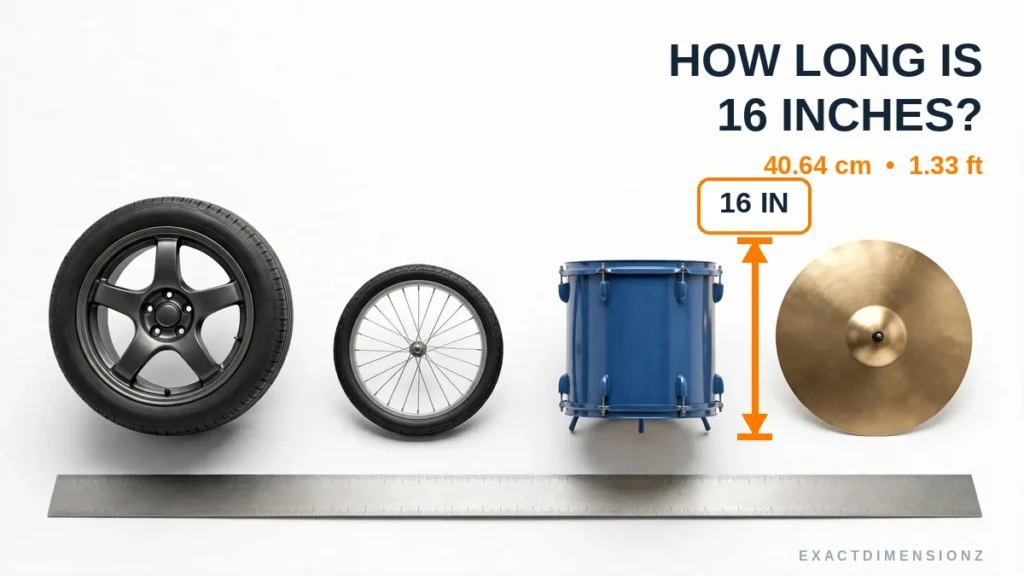
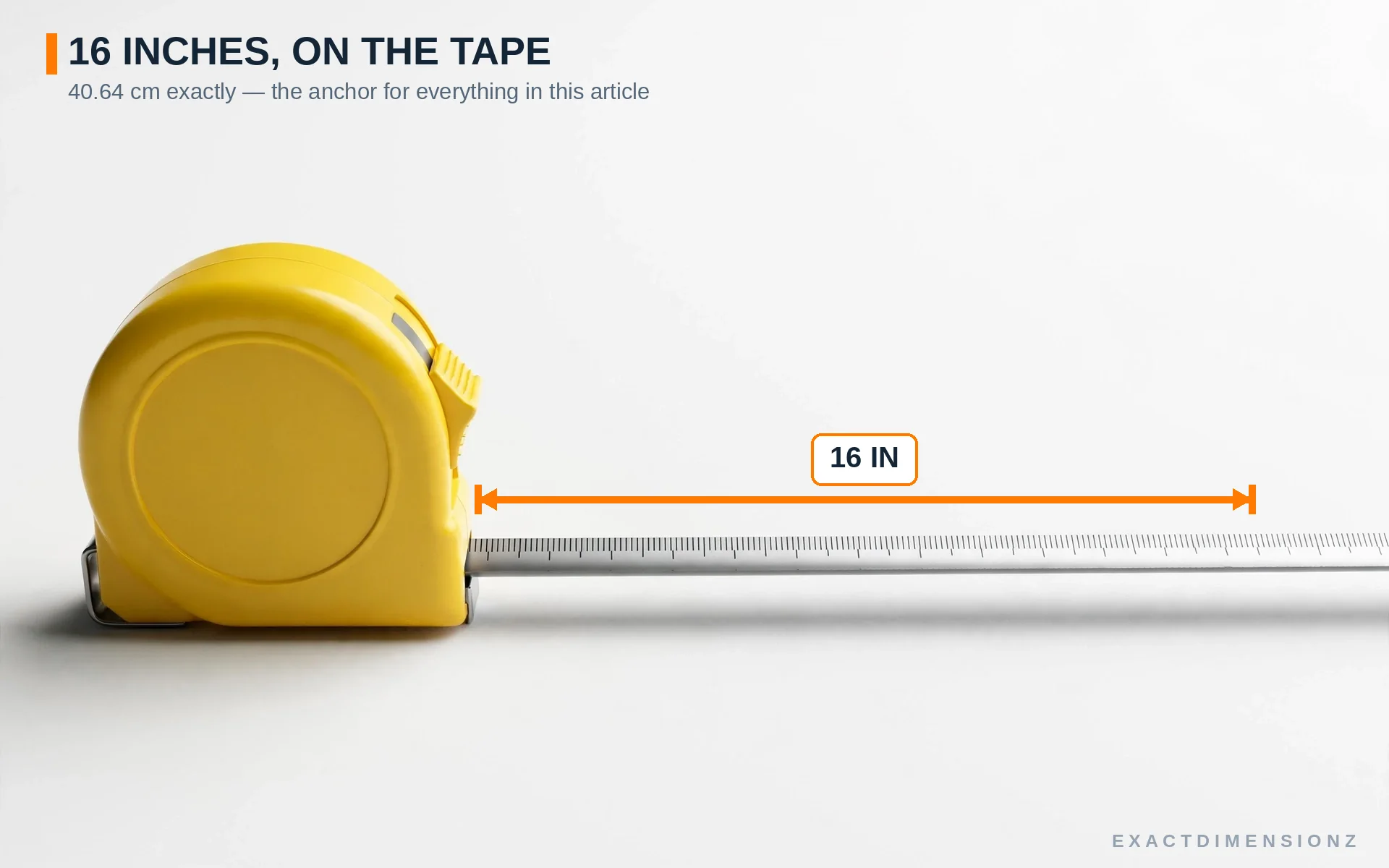
How long is 16 inches? It is a foot and four inches — 40.64 centimeters exactly — and it is the most ambiguous number in the size aisle, because “16 inches” rarely says what was measured to get it. On a laptop it is a diagonal that is secretly 16.2. On a car wheel it is a diameter hidden inside a tire that stands almost 25 inches tall. On a shirt it is not a length at all but a trip around your neck. Same two digits, five different measurements. So this article does something the others don’t: it sorts twelve references by what the 16 actually measures — diagonal, diameter, circumference, spacing, or honest end-to-end length — and gives every object a measure line stating which kind of sixteen it is, with the source behind the number. It picks up one inch past how long is 15 inches — and it starts by evicting an impostor: the bowling pin, which two of the top pages for this keyword list as a 16-inch object, is a 15-inch object wearing a borrowed inch. The rulebook proof is in the Corrections Desk at the end.
How long is 16 inches?
16 inches is exactly 40.64 centimeters — one foot, plus four inches. But the honest answer depends on what the number measures: a “16-inch” MacBook Pro is 16.2 inches across its screen’s diagonal and only 14.01 inches wide, while a 16-inch car rim is exactly 16 inches where the tire bead seats. Here is the short version before we start sorting:
Screen rulers aren’t true to size — this is a visual guide. Calibrate against a 16-inch rim’s bead seat, a sheet of 4×8 plywood’s stud layout, or a 12-inch ruler plus a 4-inch index-card edge, which makes exactly 16.
One Number, Five Kinds of Measurement

Sixteen inches is the foot itself, plus 4 inches more. That much is arithmetic. For the full range, see the complete inches size guide. The trouble starts when the number leaves the ruler and gets printed on products, because manufacturers measure different things and call all of them “16 inches.” A screen maker measures corner to corner. A wheel maker measures a seat you cannot see once the tire is on. A shirt maker measures around. A framer measures center to center, across a gap that is mostly air. None of them is lying — but they are not describing the same sixteen, and a list that mixes them without saying so is comparing diagonals to circumferences and calling it a size guide.
So every object below carries a measure line: the kind of measurement its 16 is, and the verified figure behind it. Twelve objects, five kinds of sixteen. Learn to ask “sixteen what, measured how?” and you will never be fooled by a size label again — including the labels on this page, each of which is graded out loud.
The Diagonals. Two screens, two different relationships with the truth.
1. The MacBook Pro 16
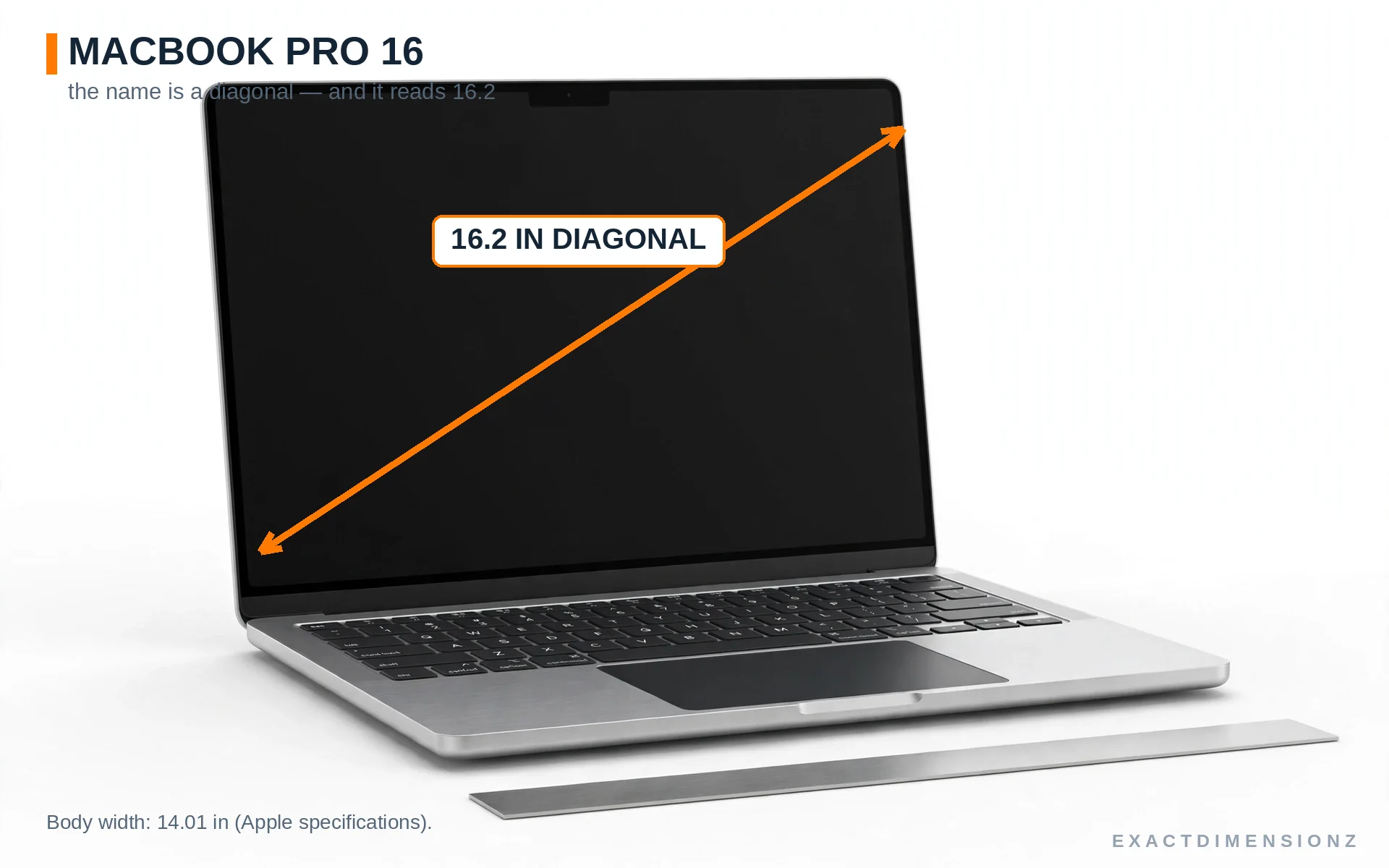
Measure: DIAGONAL — the screen is 16.2 in corner to corner; the body is 14.01 in wide. This is the flagship correction of this article.
Open the laptop that half the internet uses as its picture of sixteen inches and the first surprise is that no part of it measures 16. Apple’s own technical specifications for the MacBook Pro 16-inch give the display as a 16.2-inch diagonal and the body as 14.01 inches wide by 9.77 inches deep. Read those numbers again, because they dismantle three competitor claims at once. The screen is not “exactly 16 inches,” as one top-ranking page puts it — it is 16.2, a fifth of an inch over. The machine is not 16 inches wide, as another’s reference table claims — at 14.01 inches it is a hair over how long is 14 inches and a full two inches under its own name. And the keyboard cannot span “approximately 16 inches from edge to edge,” as the current #1 page for this keyword states, because the keyboard sits inside a body that is 14.01 inches wide in total. A keyboard wider than the laptop containing it is a neat trick, but it is not one Apple has managed.
None of this makes the MacBook a bad reference — it makes it a diagonal reference. If you picture sixteen as the corner-to-corner sweep of that big, bright display, you are picturing 16.2, close enough to feel the size and honest once the label says what it is. Just never reach for the laptop’s width when someone asks you to show them sixteen inches: you will be showing them fourteen and a whisper.
Source: Apple’s MacBook Pro technical specifications (apple.com).
2. The LG gram 16
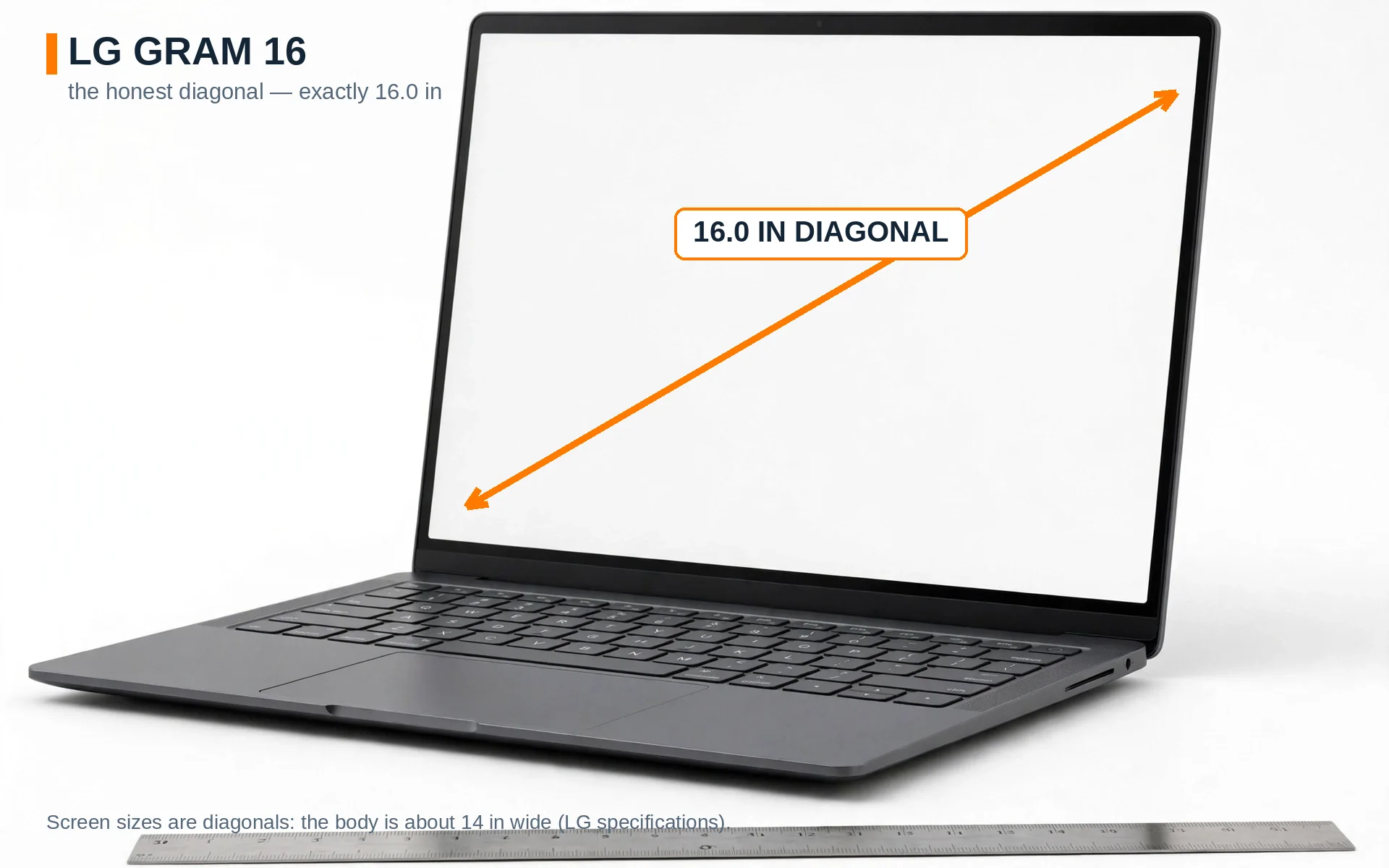
Measure: DIAGONAL — exactly 16.0 in corner to corner, by the manufacturer’s spec sheet.
Here is the rarer bird: a “16-inch” laptop whose screen actually is 16 inches — on the diagonal, which is the only way screens are ever measured. LG’s specification for the gram 16 lists the display diagonal at 16 inches (40.64 cm), a WQXGA panel in a body roughly 14 inches wide and about 9.5 inches deep. That makes the gram the honest counterweight to the MacBook above it: same class name, same kind of measurement, but this time the printed number and the panel agree to the decimal.
The lesson generalises beyond these two machines. A laptop’s inch figure is a class, and inside any class the real diagonals scatter — 16.0 here, 16.2 there, 16.3 elsewhere in the same “16-inch” shelf row. The class name tells you which shelf to look on; only the spec sheet tells you the size. Between this object and the last one, you now own both halves of that skill: picture the diagonal, then check the decimal.
Source: LG’s gram 16 product specifications (lg.com).
The Diameters. Five round objects whose 16 runs straight through the middle — each verified a different way.
3. The 16-Inch Car Wheel
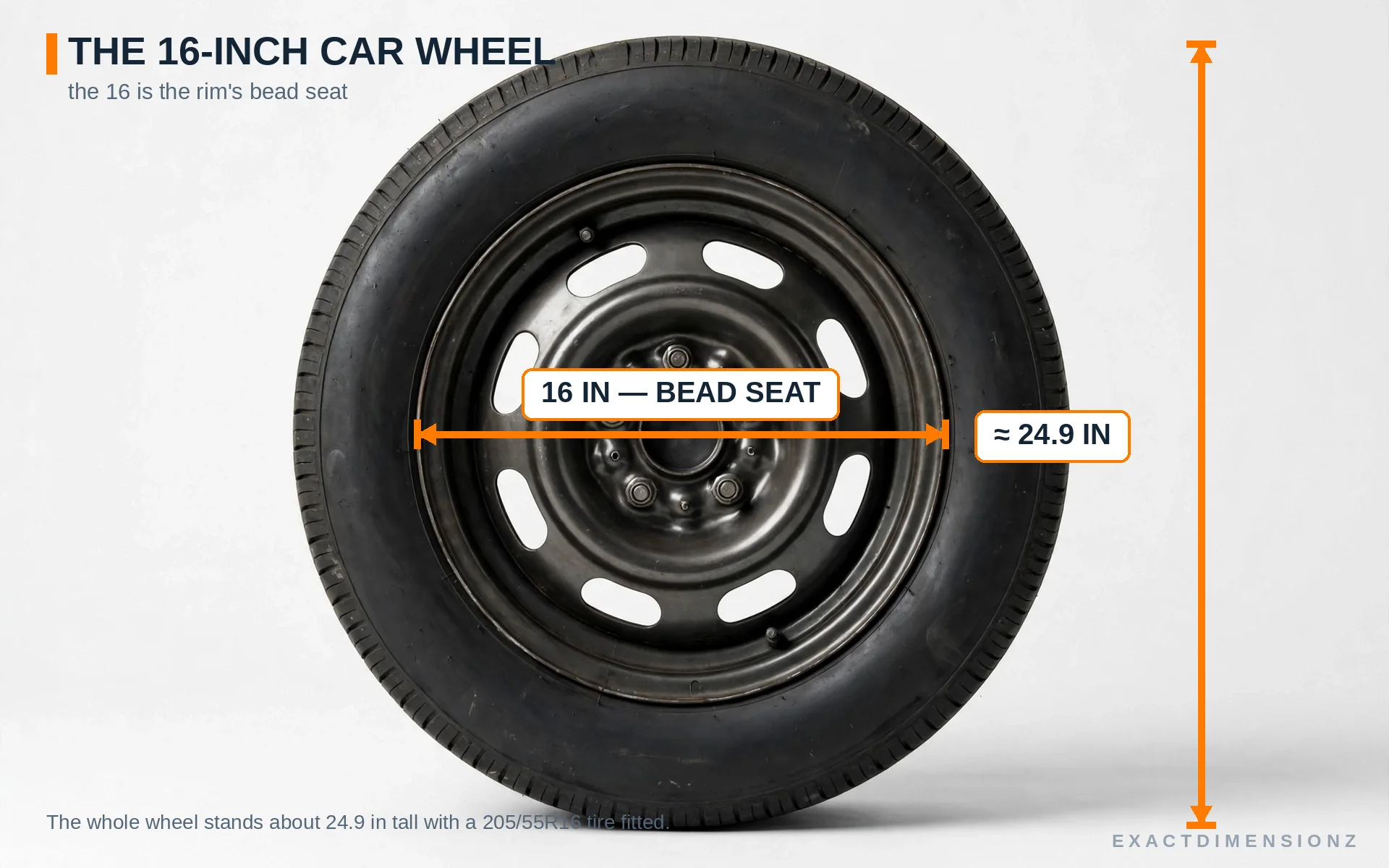
Measure: DIAMETER — exactly 16.00 in, but at the bead seat, hidden inside the tire.
This is the most precise sixteen on the list, and you cannot see it. When Toyota fits the Corolla LE with 16-inch steel wheels and P205/55R16 tires, the “16” in that tire code is the diameter of the rim at the bead seat — the ledge the tire’s bead locks onto. It is a standardised interface, held to tight tolerances so that any 16-inch tire mounts any 16-inch rim, and in that narrow sense it is an exact sixteen, defined by the wheel-and-tire industry’s own standards.
But hold the whole wheel against a tape and the sixteen disappears into much bigger numbers. The tire code itself tells the story: a 205/55R16 has a sidewall 55% as tall as its 205 mm tread width — about 4.4 inches of rubber above the rim and 4.4 below it — so the complete wheel stands roughly 24.9 inches tall. The rim’s outer lip, flange to flange, is wider than 16 too. The only true sixteen on the entire assembly is the invisible circle where rubber meets metal. As a visual reference, then, grade it carefully: the wheel shows you a 25-inch circle that contains an exact 16-inch one. Picture the rim behind the spokes, not the tire, and the reference is rock solid.
Source: Toyota’s Corolla brochure (toyota.com) — 16-in. wheels, P205/55R16 tires.
4. The Kids’ 16-Inch Bicycle Wheel
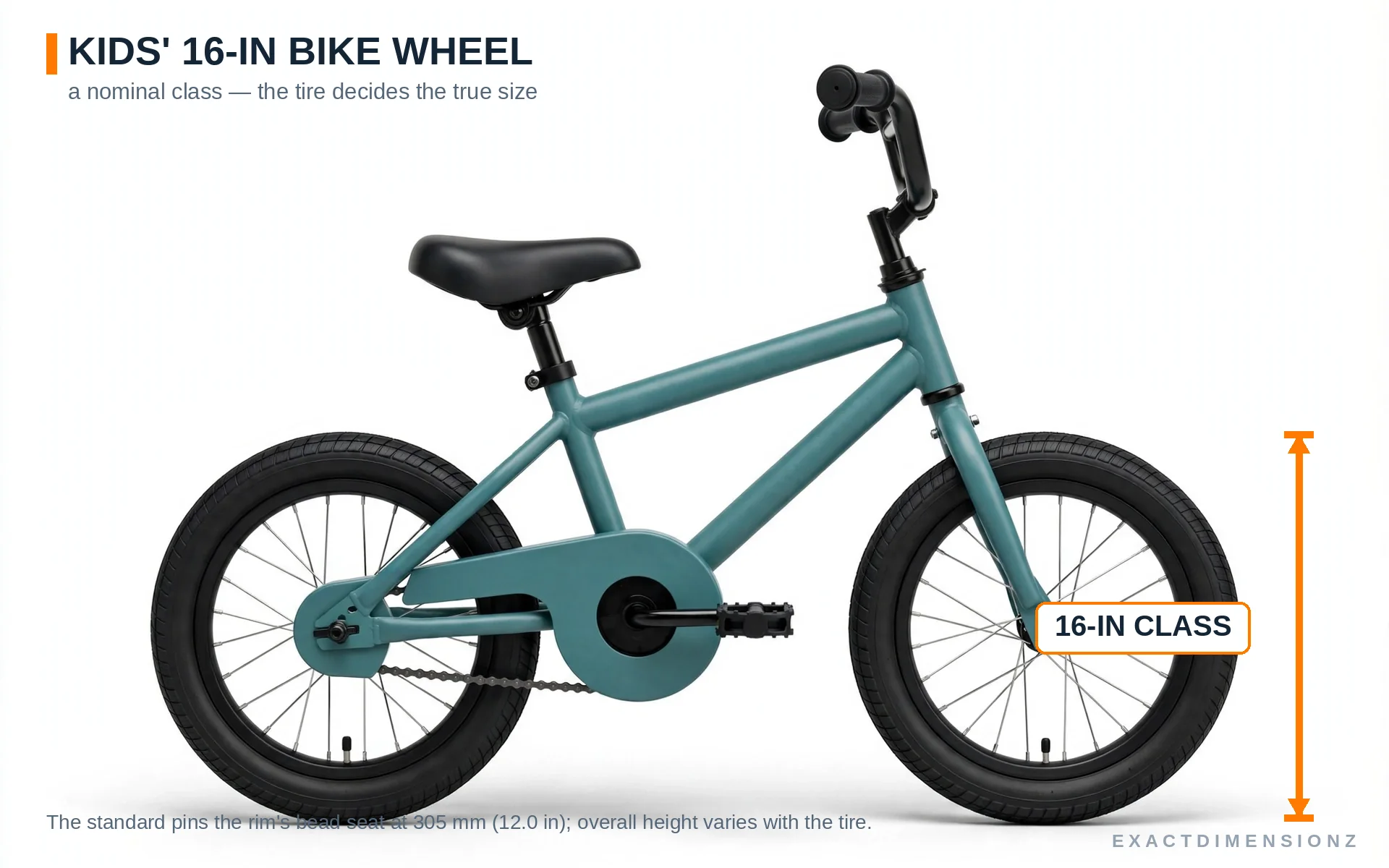
Measure: DIAMETER — a nominal class; the rim’s bead seat is 305 mm (12.0 in) and the true overall diameter depends on the tire fitted.
Children’s bikes are sold by wheel size, and 16 inches is the classic first-pedal-bike class — the woom 3, for example, is built around 16-inch wheels for riders roughly four to six years old. But bicycle inches are the loosest in this whole article. The industry’s engineering standard, ETRTO, doesn’t define the wheel by its outside at all: it defines the rim by its bead seat diameter, 305 mm — 12.0 inches. The tire makes up the rest, and how much it adds depends on the tire. Schwalbe’s own technical manual lists a plump 50-305 tire (a “16 × 2.0”) at a circumference of 1,265 mm, which works out to an overall diameter of about 15.9 inches; the narrower 37-305 tire on the woom stands noticeably shorter. Two “16-inch” wheels, side by side, can differ by most of an inch in real height.
So the kids’ wheel is a genuine, rideable reference for the neighbourhood of sixteen — and a perfect specimen of a nominal diameter: a number that names a family of wheels, anchored to a 12-inch rim you can’t see, wearing tires that decide the actual size. When a competitor page tells you a 16-inch wheel “measures 16 inches across,” it has confused the class name with a measurement. You now know which circle the standard actually pins down.
Sources: the woom 3’s published specification listing (rei.com) — wheel size 16 in, 16 × 1.4 in tires — and Schwalbe’s technical manual (Schwalbe’s own document, hosted on its content server; 305 mm bead seat, 1,265 mm circumference for a 50-305 tire).
5. The 16-Inch Floor Tom

Measure: DIAMETER — the shell is a true 16 in across; the second number in its size is the depth, 15 in.
Drum sizes are written diameter-first, and the floor tom is the cleanest diameter in music: Yamaha’s Stage Custom Birch shell pack pairs its toms as 10 and 12 inches over a floor tom specified at 16 × 15 inches — sixteen across the head, fifteen deep. Unlike the bicycle wheel above, this diameter is the physical shell itself: a tape across the bearing edge reads the number on the box, because a drumhead has to fit the shell it is clamped over, and the head sizes are standardised to the shell sizes.
The floor tom also earns its place by what it displaces. In most kits it is the biggest tom in the room — the 13-inch rack tom beside it looks like its little brother — and its sixteen is a working musician’s sixteen, measured every time a head is replaced. If you play, or know a drummer, you have probably carried one: a squat birch cylinder whose top circle is the most honest diameter in this section after the rim’s hidden one.
Source: the Stage Custom Birch shell pack’s published specifications (sweetwater.com) — floor tom 16 in diameter × 15 in deep.
6. The 16-Inch Crash Cymbal
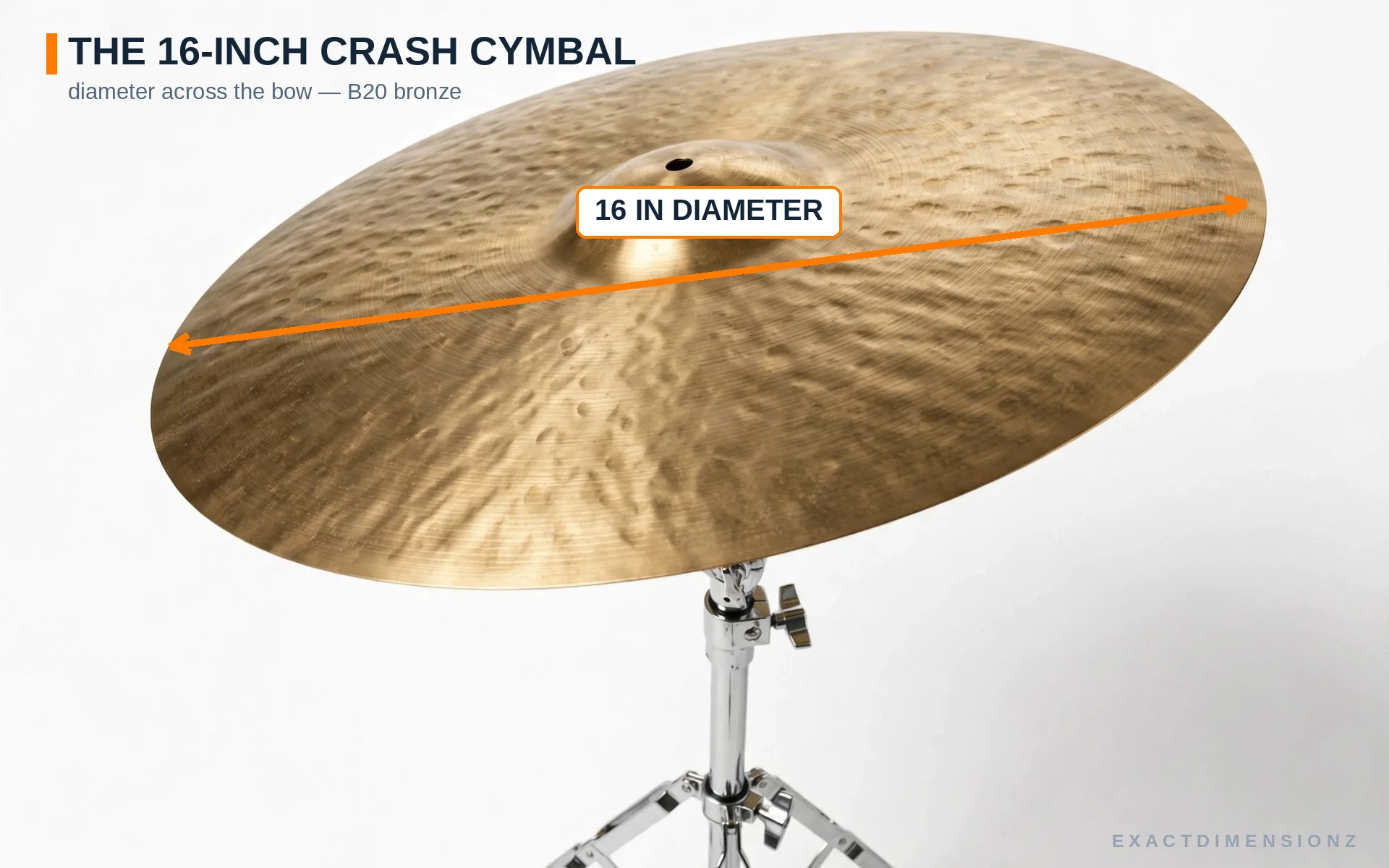
Measure: DIAMETER — 16 in across the bow, the size stamped by the maker.
Stay with the drum kit for its second sixteen. A crash cymbal’s size is its diameter, full stop: Zildjian’s A Custom line includes a 16-inch crash, a thin B20 bronze disc whose whole identity — pitch, crash speed, volume — flows from that one measurement across the bow. Cymbal diameters are working specifications, not decoration: a 16 sounds and behaves measurably differently from the 14-inch hats below it and the 18-inch crash beside it, and drummers buy by the inch because the inch is real.
There is a small honesty note, and it is the kind this site exists for. A cymbal is cast, hammered and lathed by processes that leave each individual disc a few thousandths of an inch from its nominal size, and the bow is curved, so a tape held across it reads the chord, not the arc. The 16 on a crash is a manufacturer’s size, held close by the making, rather than a machined constant like the rim’s bead seat. Graded that way — diameter, by manufacture — it is a fine, musical sixteen you can hear.
Source: the A Custom crash’s published specification (thomann.co.uk) — size 16 in, B20 bronze.
7. The Extra-Large Pizza
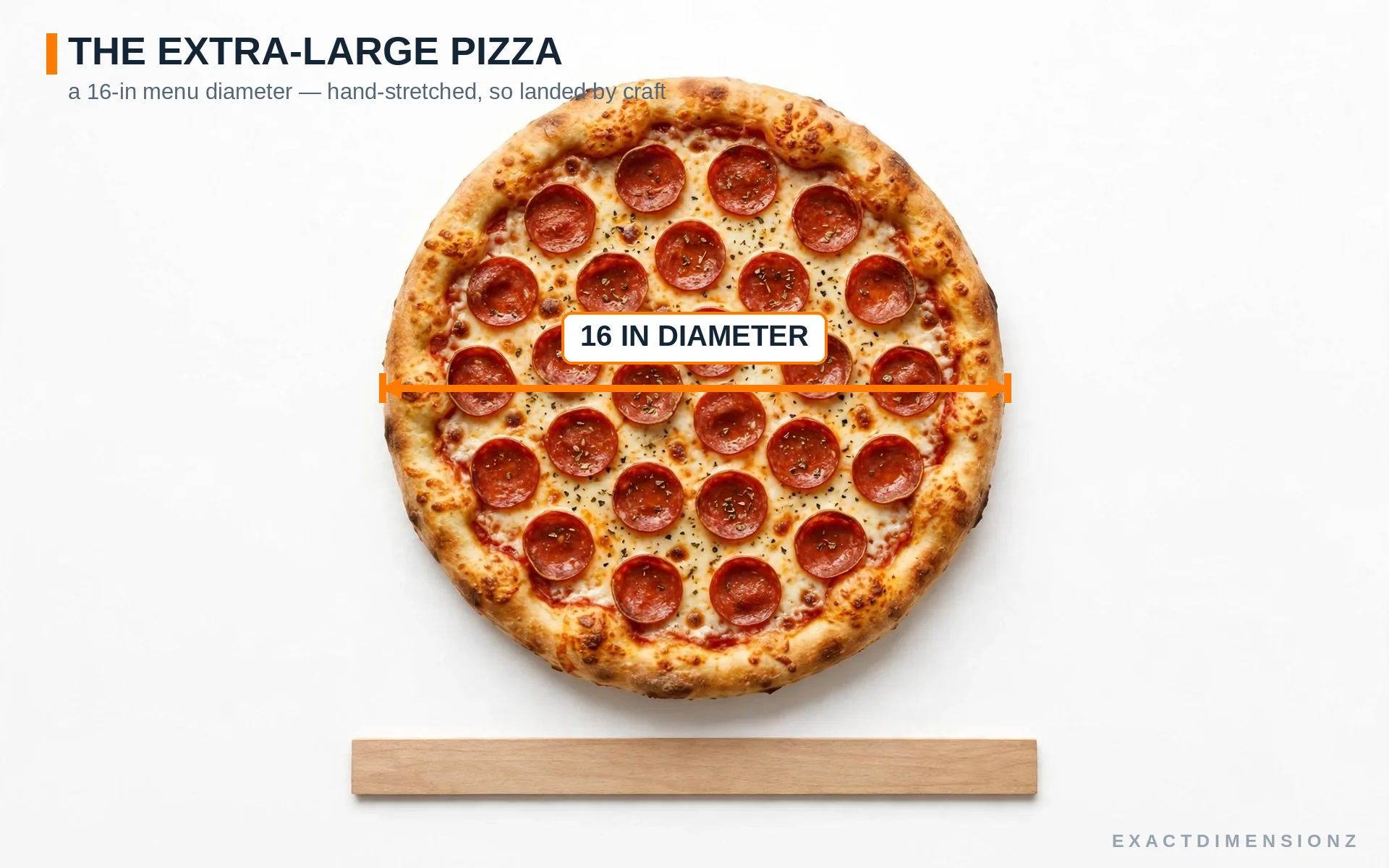
Measure: DIAMETER — a menu size, targeted by hand, landed within stretching distance.
The tastiest diameter on the list is also the least mechanical. Sixteen inches is the classic extra-large pizza: Papa John’s, for instance, sells its Extra Large as the 16-inch tier of the menu, cut into ten slices — the chain’s own nutritional details lay out the size ladder it sits on top of. Order one and you are looking at a hand-stretched disc whose target is sixteen inches of diameter and roughly 201 square inches of pizza — about 78% more food than the 12-inch medium two tiers down, which is why the modest-looking two-inch steps on a pizza menu are not modest at all.
Grade it as a diameter by intention. Dough is portioned by weight and stretched by hand or roller, so a real pie lands within a fraction of an inch of its menu size rather than on it, and a crust rim rises where a machined edge would be flat. Nobody sane rejects a pizza over a quarter-inch of stretch — but as a measurement reference it belongs in the “close, by craft” band, a notch below the rim and the drum shell. It is, however, the only reference in this article you can eat when you’re done measuring with it, and as dinner-table demonstrations of a sixteen-inch diameter go, nothing else is close.
Source: Papa John’s nutritional details (papajohns.com) — Extra Large tier.
The Sixteen You Wear. Two numbers that go around a body instead of across an object.
8. The Size-16 Shirt Collar
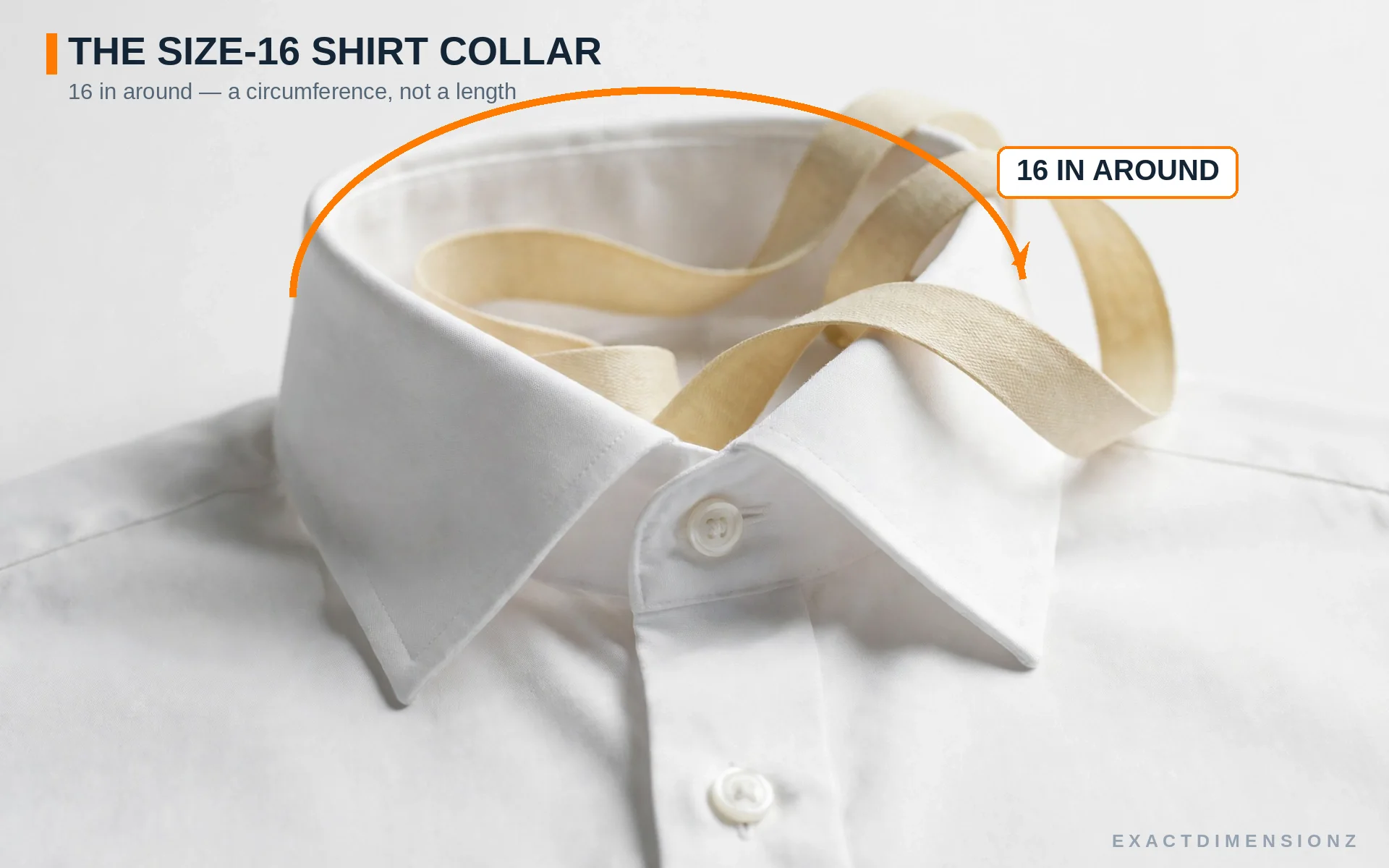
Measure: CIRCUMFERENCE — the 16 is the distance around a neck, not a length at all.
Here the number changes species. A men’s dress shirt is sized by its collar, and the collar size is a circumference: Charles Tyrwhitt’s shirts, like every traditional maker’s, are sold by collar size in inches — 14.5, 15, 15.5, 16, 16.5 and up — where the figure is the neck measurement the collar is built to close around. A size 16 wraps a sixteen-inch circle of neckband (with wearing ease built into the band itself). Straighten that circle out in your mind and it is sixteen inches of tape — but on the body it never lies straight, which is precisely the point of this section: some sixteens are loops.
As a reference it is surprisingly practical, because it is one most adults have worn. If you know your collar size, you own a calibrated loop: your neckband, unbuttoned and laid flat, runs its size in inches from button to buttonhole. It is also the only object in this article whose sixteen is measured on a person rather than a product — a reminder that half the sizes in your life are circumferences in disguise.
Source: Charles Tyrwhitt’s shirt sizing (charlestyrwhitt.com) — collar sizes offered in inches, including 16.
9. The 16-Inch Necklace
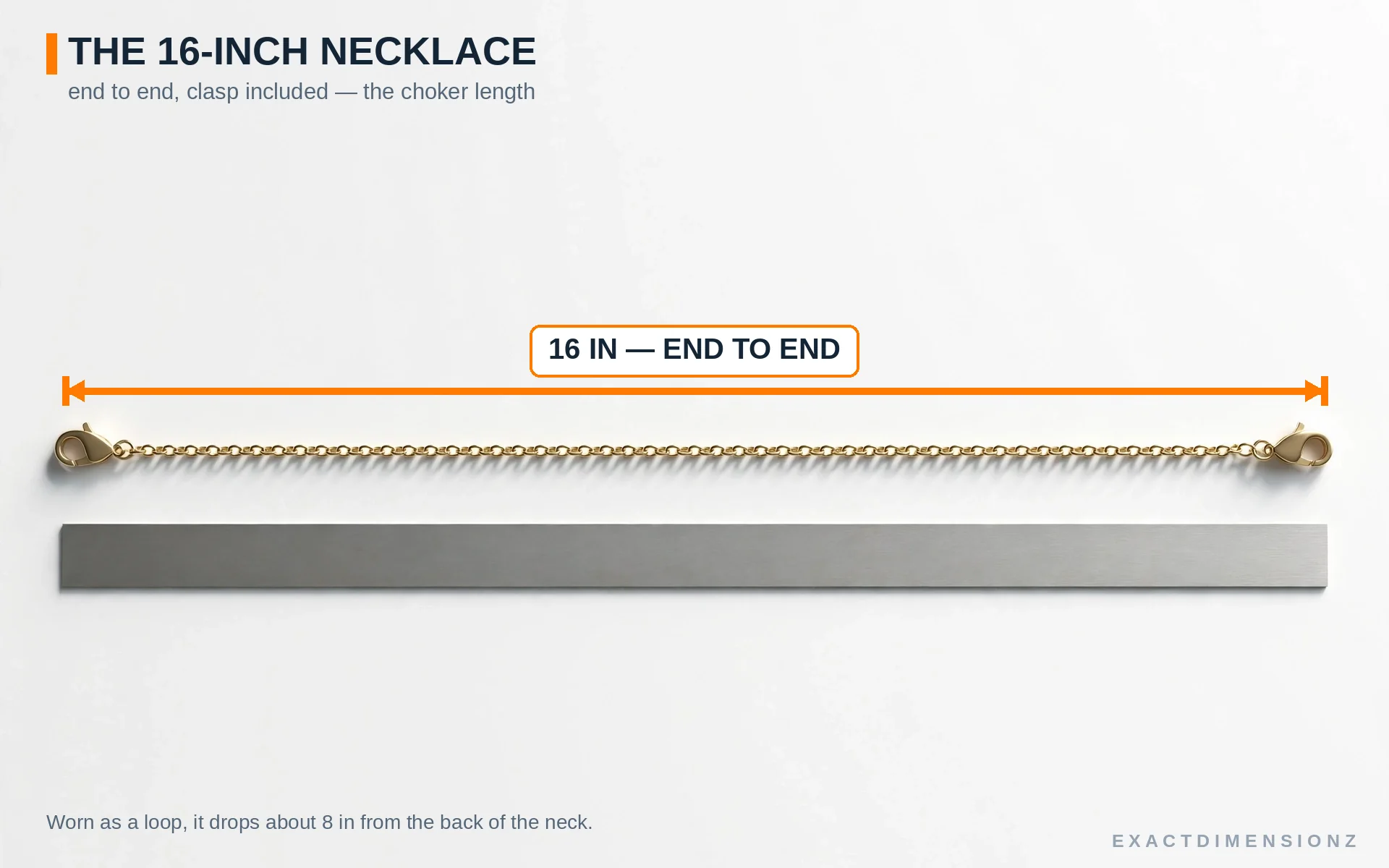
Measure: LENGTH — the chain is 16 in end to end, clasp included; worn, it becomes a loop that drops about 8 in.
Jewellers sell chains by a true length: the full end-to-end measurement, clasp included, of the chain laid straight. Sixteen inches is the industry’s choker length — Blue Nile’s necklace length guide places the choker band at 14 to 16 inches, sitting at the base of the neck, with a 16-inch chain landing at or just below the collarbone on most wearers. Of all the sixteens in this article, this is the one most likely to be resting against someone’s skin right now.
Two honest footnotes. First, the worn drop — the distance from the back of the neck to the bottom of the loop — is roughly half the chain’s length, about 8 inches for a 16-inch chain, which is why a “16-inch necklace” looks so much smaller on a model than a 16-inch ruler looks on a table: the loop spends half its length coming back. Second, the figure includes the clasp, so the chain itself is a shade under sixteen; jewellers count the whole wearable piece, and now you know to ask. Graded as what it is — a true, if clasp-inclusive, end-to-end length — the necklace is the most straightforward sixteen in the wearing section.
Source: Blue Nile’s necklace length chart (bluenile.com) — choker 14–16 in, at the base of the neck.
The Sixteens Built Into Walls and Workshops. A spacing, a nominal square, and a working length.
10. Wall Studs, 16 Inches On Center
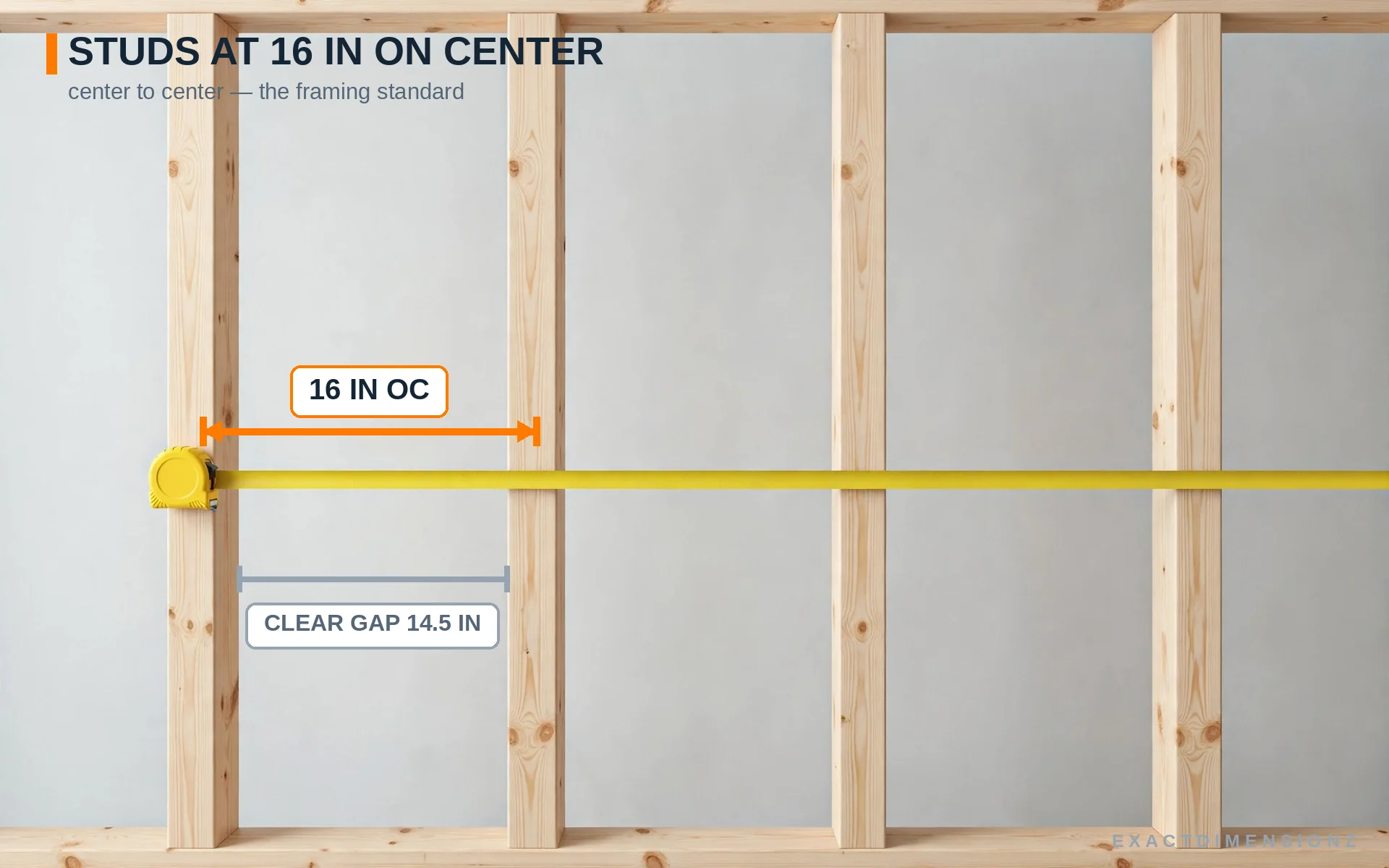
Measure: SPACING — 16.00 in from the center of one stud to the center of the next; the clear gap between them is 14.5 in.
The most consequential sixteen in this article is one you will never see, because it is inside your walls. North American framing lays out wall studs 16 inches on center — center of one stud to center of the next — a spacing written into the residential building code’s stud tables and chosen because it divides the 48-inch width of plywood, OSB and drywall sheets exactly: every sheet edge lands on a stud. Framing references such as this stud-spacing guide lay out the system and its code basis in detail.
Notice what kind of measurement this is. It is not the length of anything you can hold; it is a repeat distance, a rhythm in the wall. The actual clear space between two studs is 14.5 inches, because each stud is 1.5 inches thick and the sixteen runs center to center — so if you are visualising a gap to fit something between studs, sixteen is the wrong number to picture, and 14.5 is the right one. As a reference for sixteen itself, though, the stud bay is superb and oddly satisfying: pace out a framed wall with a tape and the marks land on sixteen again and again, the most repeated exact sixteen in the built world.
Source: framing stud spacing reference (engineerfix.com) — 16 in on center standard; 14.5 in clear between studs.
11. The 16 × 16 Floor Tile

Measure: SIDE LENGTH — a nominal size under the tile standard; the tile in the box is typically a fraction under 16 in.
Tile is sold the way masonry is sold: by a name that the standard defines as approximate. The ceramic tile standard, ANSI A137.1, defines a tile’s nominal size as its approximate facial size “for general reference” — and 16 × 16 is a standard nominal floor size. Manufacturers publish both numbers side by side: Daltile’s specification sheets, for example, print the nominal size next to the actual one in parentheses, and the pattern holds across its range — tiles are made slightly under their nominal size so that the grout joint completes the module on the floor, the same nominal-versus-actual logic as the concrete block in the 15-inch article, in miniature.
So a “16 × 16” tile is a sixteen by designation and a shade less by caliper, and once it is laid with its grout joint, the floor advances sixteen inches per tile exactly as planned. That makes the tile a genuinely useful reference with its grade stated: picture the tile in the floor, joint included, and you are picturing sixteen; picture the bare tile in your hands and you are picturing a sixteenth or three less. (This article links Daltile’s specification document as mirrored on a document host, since the manufacturer’s own sheet is distributed as a PDF: Daltile specifications.)
Source: ANSI A137.1 nominal-size definition as applied in Daltile’s published specifications (manufacturer’s document, mirror-hosted).
12. The 16-Inch Chainsaw Bar
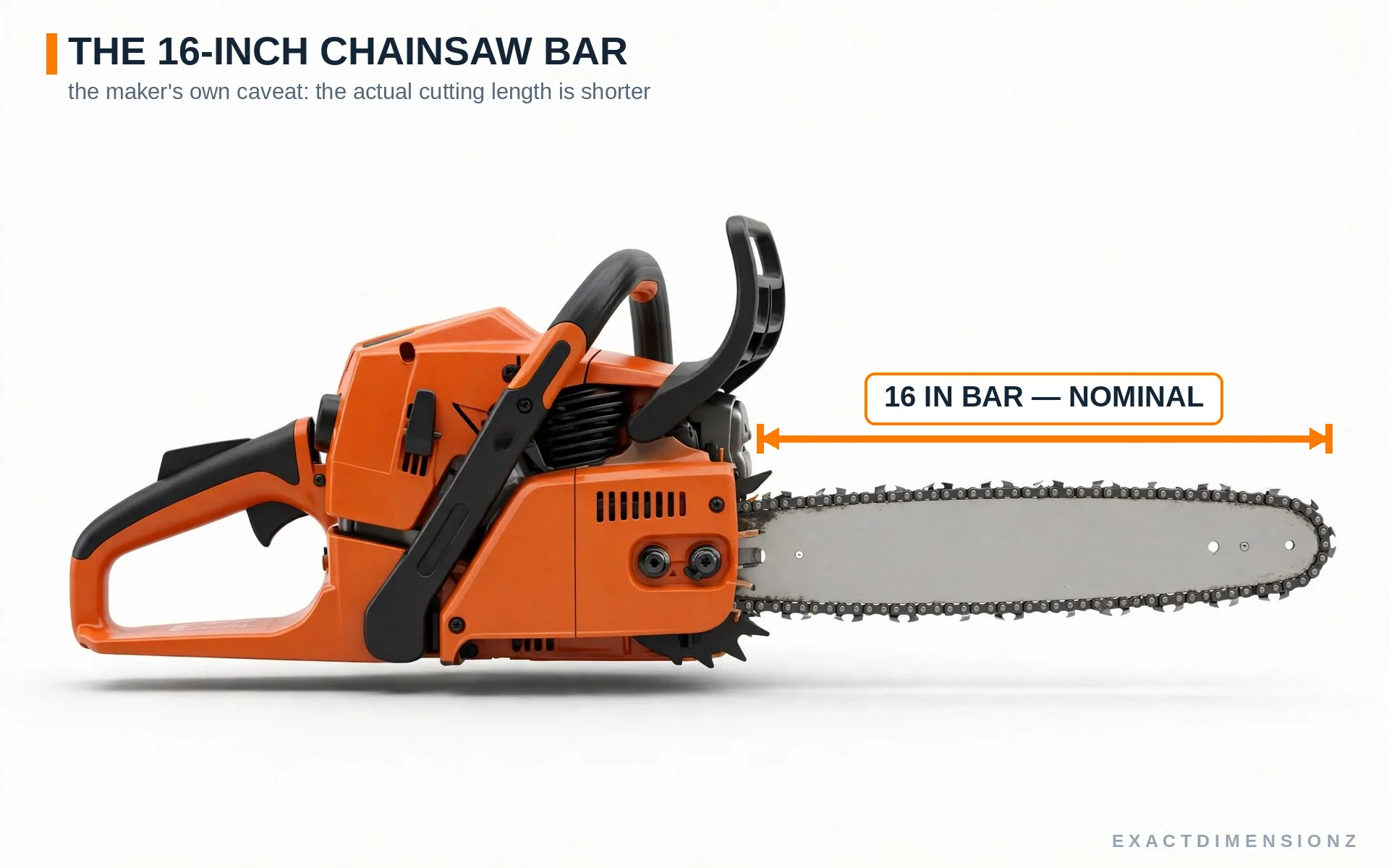
Measure: WORKING LENGTH — the bar is sold as 16 in; the maker states plainly that the actual cutting length is shorter.
End in the workshop, with the most macho sixteen on the list and the most candid manufacturer. A 16-inch guide bar is the classic homeowner chainsaw size — STIHL’s bar range runs through it, with its Light 04 guide bar listed at a bar length of 40 cm / 16 inches. The bar length is a real measurement of the bar — but it is measured as the bar’s nominal span, and part of that span disappears into the saw’s body where the bar mounts. STIHL says so itself, in its own specification tables: “The actual listed guide bar length can vary from the effective cutting length based on which powerhead it is installed on” — and in plainer language on its electric saws, “the actual cutting length is shorter than the specified bar length.”
This is the nominal-size lesson with the bark still on. The sixteen is not fake — the bar is a 16-inch-class bar, chains are sized to it in drive links, and a 16-inch bar will fell and limb small trees all day. But if you lay a tape from the saw’s bumper spike to the bar’s tip, you will measure the cutting length, and it will read under sixteen, because the industry’s number names the bar, not the cut. Graded honestly — working length, nominal by the maker’s own admission — it closes the list the way this article likes its references: impressive, useful, and labelled.
Source: STIHL’s guide bar specifications (stihlusa.com) and STIHL’s published bar-length caveat.
The Kinds Chart

Before the builds, here is the whole article on one page. Every reference is plotted at its verified measurement and tagged with its kind — the two diagonals at the top (16.0 and 16.2, neither of them a width), the diameters in the middle, and the three sixteens that are not straight lines at all along the bottom. Keep this picture in mind: “16 inches” in the wild is five different measurements wearing one number.
Build Sixteen Yourself

No rim, drum kit or framed wall within reach? Sixteen can be assembled on a table — and this table is the tool the other pages don’t give you: five common builds, each with its true total, so you know which side of the line you land on and by how much. Exactly one of them is dead on.
| Build | The maths | True total | Verdict |
|---|---|---|---|
| 12-in ruler + a 4×6 index card’s 4-in edge | 12 + 4 | 16.00 in | Dead on, by the card’s own spec |
| Two modular bricks, as laid in a wall | 7.625 + ⅜ joint + 7.625 + ⅜ | 16.00 in | Dead on — but only in the wall |
| The same two bricks, bare on a table | 7.625 × 2 | 15.25 in | 0.75 short |
| Letter paper + index card + one quarter | 11 + 4 + 0.955 | 15.96 in | 0.04 short — the near miss |
| Sixteen US quarters in a row | 0.955 × 16 | 15.28 in | 0.72 short |
| Four standard craft (popsicle) sticks | 4.5 × 4 | 18.00 in | 2.00 over |
The dead-on build deserves its moment: a standard index card is manufactured 4 × 6 inches, so its short edge is a true 4-inch span, and a ruler plus that edge is sixteen inches you can hold — the same span as how long is 11 inches plus a card and a coin nearly matches from the other direction. The bricks teach the mortar lesson from the tile section in reverse: the Brick Industry Association’s modular brick is specified at 7⅝ inches long precisely so that two of them, with their standard ⅜-inch joints, occupy exactly sixteen inches of wall — the modular brick system is engineered around the number. The quarters fail beautifully: the US Mint specifies the quarter at 0.955 inches in diameter, so the folk trick of “16 quarters = 16 inches” repeated on rival pages lands at 15.28 — the count matches the target and the coins don’t. And the craft sticks fail in the other direction: a standard stick is 4.5 inches, not the “exactly 4 inches” of the how-to pages, so four of them overshoot by a full 2 inches. (The bill build from the 15-inch article works here too, with a twist: one bill runs just past how long is 6 inches at 6.14, so two bills plus a credit card — 12.28 + 3.37 — lands at 15.65, a third of an inch shy.)
The Corrections Desk
Five claims circulate on the top pages for this keyword. All five fail against primary sources, and each is corrected by an object above. One: a bowling pin is 16 inches tall — it appears in rival reference tables at 16 inches, and one rival page uses the pin’s height as a picture of sixteen. The USBC Equipment Specifications Manual sets pin height at a 15.000-inch target with a ±1/32-inch tolerance: the pin is a fifteen, full stop, and using it for sixteen borrows an inch that doesn’t exist. Two: a 16-inch MacBook’s keyboard spans about 16 inches — the #1 page’s claim; the whole laptop is 14.01 inches wide per Apple. Three: the MacBook Pro 16 and Dell XPS 16 screens measure “exactly 16 inches” — Apple’s sheet says 16.2 for the MacBook; “exactly” is doing heavy lifting. Four: two standard bricks end to end make exactly 16 inches — only inside a wall, joints included; bare, they make 15.25. Five: a skateboard deck is 16 inches — decks run about 31–32 inches long and 7.5–10 inches wide; sixteen is neither dimension, though three different pages print it as length or width. Each correction is sourced in its section above.
Sixteen, Sorted
Sixteen inches is exactly 40.64 centimeters — and, in the wild, a question: sixteen what, measured how? A diagonal that runs 16.0 in one laptop and 16.2 in another. A diameter that is machined into a rim, nominal on a bicycle, hand-stretched on a pizza. A circumference around a neck. A spacing inside a wall. A working length its own maker warns you about. The twelve references above are all genuinely useful — once each one carries its measure line. Keep the habit this article is really teaching, and every size label you meet from now on gets the same two questions before it gets your trust: what was measured, and where does the number come from? Sixteen, sorted, is a number you can prove – and a step up to 17 inches works the same way.
