
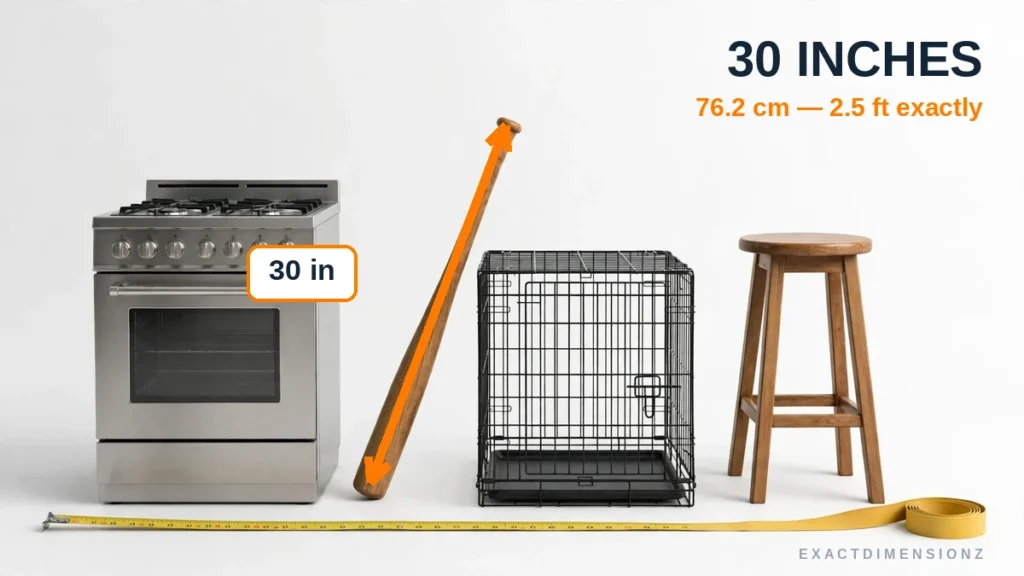
If you are asking how long is 30 inches, start with the cleanest fact in this field guide: 30 inches is exactly two and a half feet. Not about — exactly, because a foot is twelve inches and two and a half twelves make thirty with nothing left over. In metric the number is just as tidy: 76.2 centimetres exactly, 762 millimetres exactly. The complete inches size guide puts this length in context with the other sizes in the series. In the series, it follows 29 inches — one inch shorter, and comes before 40 inches — the next size in the series, which is ten inches longer. The measure itself is not the mystery. The mystery is what the world does with it once the number lands on a box, a size chart, a breed standard or a product name — because a surprising number of things called “30 inches” measure 30 only in one chosen direction, only on one line of fine print, or, in one case below, nowhere at all.
So this article works like a field guide. It does not list everything; it teaches you to identify what is in front of you, in its habitat, by the marks that separate a true sighting from a look-alike. The habitats here are ordinary ones — kitchens, doorways and bathrooms indoors; ballfields, show rings and porches outdoors; and that third, slipperier habitat, the printed label. Nine sightings follow, each checked against a primary source: the manufacturer’s own specification, the official standard, the rulebook. At nearly twice how long is 16 inches, this is a length you meet in appliances and animals rather than in paper and laptops, and it rewards one discipline above all: never ask how big a thing is until you have asked 30 inches of what.
QUICK ANSWER
30 inches = 76.2 cm exactly (762 mm • 2.5 ft exactly • 0.8333 yd). But the things called “30 inches” split by how honest the number is. True 30: a standard range across its width (GE’s spec: 30 in), a 30-inch baseball bat end to end, a 30-inch dog crate along its length. True, with the label read carefully: a vanity (countertop 30 in, cabinet 29.875 in), a door (a nominal 762 mm), a bar stool (30 is the seat height class), a Great Dane (30 is the breed’s minimum, not its typical height), a jeans inseam (a tape line, not a garment length). 30 in name only: the “30-inch” ultrawide monitor — a 29.5-inch panel in a 27.68-inch body. Nine sightings, graded below.
How to Use This Field Guide
Every sighting was identified the same way: against a primary source, never against another list. For a product, that means the manufacturer’s own specification table — the document written for installers and engineers, where a wrong number costs the company money. For an animal, the official breed standard judges actually enforce. For a garment, the maker’s own size chart and its own definition of the measurement. Each sighting names and links its source, so the identification is never taken on trust: open the spec, find the line, and the field mark explains itself. Where a figure comes from a retailer’s table of the manufacturer’s specifications, the guide says so, because a fact’s chain of custody matters.
The grading system has seven field marks. TRUE 30: a tape on the object, in the direction the name promises, reads exactly 30 inches. NOMINAL 30: the number names a sizing system — the opening a door is made for — rather than a finished measurement. FINE-PRINT 30: the object carries several close but different widths, and only one, in the smallest type, is 30. CLASS 30: 30 is the height of one part — a seat — used as a whole category’s name. FLOOR 30: the number is a minimum, a line below which the thing is disqualified, not a typical size. TAPE-LINE 30: 30 inches is real but measures one seam, not the object. NAME-ONLY 30: the number is in the product’s name, and no line on the object measures it at all. Learn the marks and the guide becomes a pocket skill: for any headline size, ask 30 inches of what, according to whom, and is the figure a promise, a class, a floor or a name?
The Measure Itself: Two and a Half Feet, Exactly
The standard is exact in every direction a reader is likely to convert it. One inch is exactly 2.54 centimetres by international definition, so 30 inches is exactly 76.20 centimetres and exactly 762.0 millimetres. In feet the conversion is this keyword’s one clean pleasure: 30 divided by 12 is 2.5, so 30 inches is exactly 2.5 feet — no rounding, no repeating decimal. In yards it is 0.8333, and that one is a rounded figure, labelled as such wherever this guide uses it; five-sixths of a yard is the exact fraction. Hold the four apart — 76.20 cm exact, 762.0 mm exact, 2.5 ft exact, 0.8333 yd rounded — and you already read specifications more carefully than most pages this article replaces.
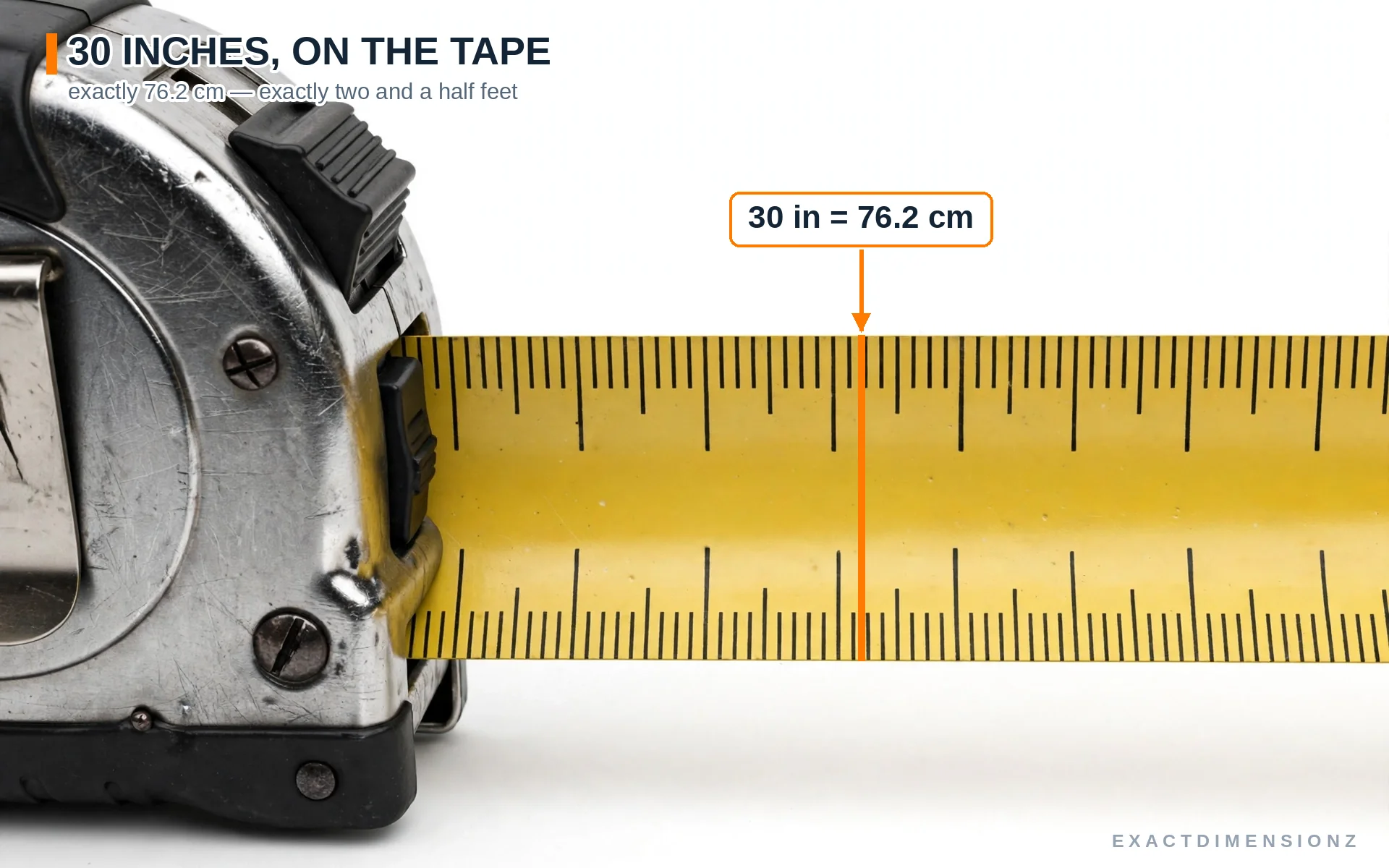
For a mental picture, comparisons beat conversions, provided they are true. A yardstick is 36 inches, so 30 inches is a yardstick with 6 inches marked off — count back six from the end and the remaining stick is this length. Against the metre, 30 inches falls short by 23.8 centimetres: the metre is 100 centimetres, this is 76.2, and the gap is roughly another 9.4 inches, so anyone filing 30 inches as “about a metre” is short-changing you by nearly a quarter of the stick.
One habit is worth forming before the sightings begin. Exactness here is a property of conversions, not of objects. Thirty inches converts to 76.20 centimetres exactly because the inch is defined exactly; no manufactured thing is thereby “exactly” anything, because manufacturing runs on tolerances, trimming and rounding. That is why the field marks grade the claim, not just the object: a range whose maker publishes a 30-inch width, a door whose declaration honestly calls its size nominal, and a monitor whose name rounds a 29.5-inch panel up to 30 are three different relationships between a number and the truth — three different species.
Sighting 1: The 30-Inch Range, the Width That Keeps Its Promise
Habitat: the kitchen.
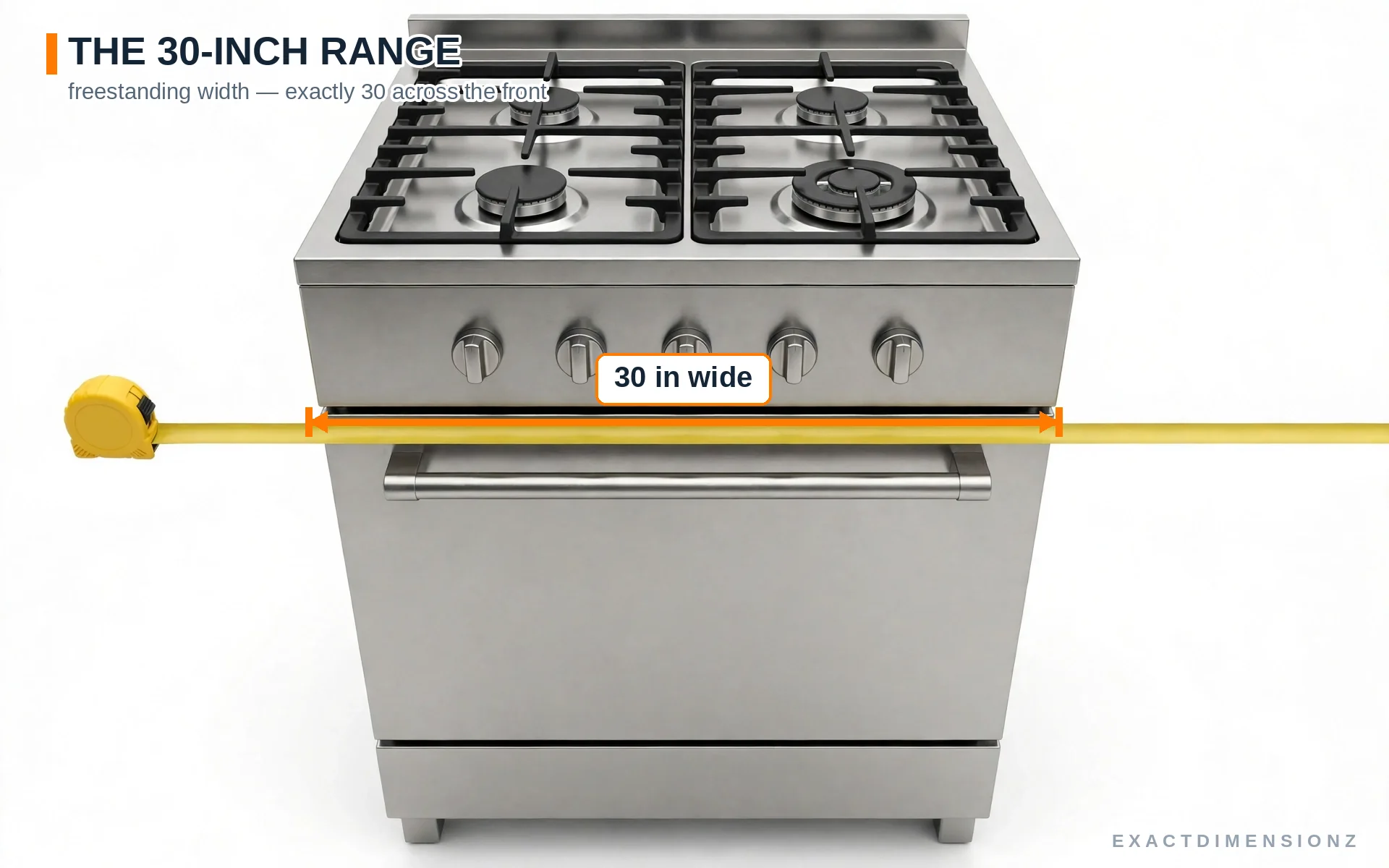
The first sighting is the one the category is named for. A standard kitchen range is a 30-inch appliance, and the number is a true measurement in the direction the buyer cares about: its width. In GE’s own specification table for its 30-inch free-standing gas range, model JGB660DPWW, two lines carry the same figure: Overall Width, 30 inches, and Cabinet Width, 30 inches. The second line earns the field mark. Cabinet width is the working dimension — the width of the body that must slide between your cabinets — and GE publishes it at exactly the width the model name promises. The 30 is not a class or a part; it is the taped width of the whole machine.
Widths that must fit a fixed opening are the most honest numbers in any catalogue, because a misfit is returned. A “30-inch” range measuring 30.4 would jam against the cabinets; one measuring 29.5 would leave a crumb-catching gap and a furious installer — so the industry plans around the opening, and the number behaves. Two and a half feet wide also means the machine spans two full 12 inches — a foot, twice over — plus half of a third: foot, foot, half-foot, and the gap is paced. Read further down GE’s table and the same spec gives the height to the cooking surface as 36 to 36.5 inches — a different figure, in a different direction, and the source of one of the errors corrected in the Misidentification Log below. The range is not 30 inches tall and never claimed to be.
Field mark: TRUE 30 — GE publishes both the overall width and the cabinet width of its 30-inch range at 30 inches, so the name and the tape agree in the direction that has to fit.
Sighting 2: The 30-Inch Interior Door, a Number That Names an Opening
Habitat: the doorway.
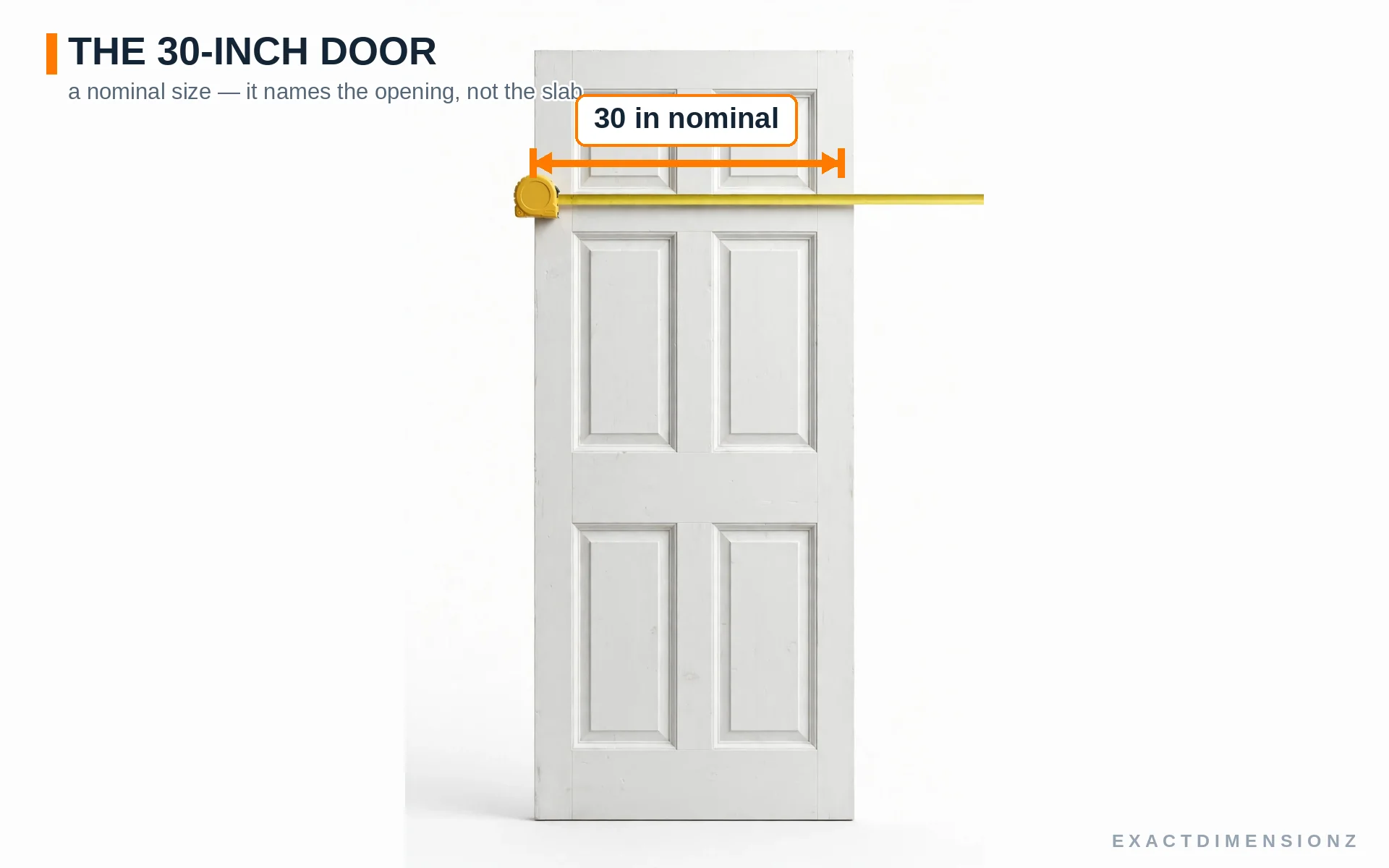
In the doorway, the same number changes its meaning. The honest document for a “30-inch” interior door is not a shop listing but JELD-WEN’s Environmental Product Declaration for its molded and flush hollow-core doors. In JELD-WEN’s declaration for its hollow-core interior door, the unit is declared at a nominal size of 762 × 2032 millimetres. Convert the first figure and something quietly satisfying appears: 762 millimetres is exactly 30.00 inches, since 30 × 25.4 = 762 by definition. And yet the document’s own word for that size is the word this sighting is graded on: nominal.
Nominal is not a dodge; it is a technical term doing honest work. A nominal door size names the opening system the door is made for — the framed hole, with its jambs, clearances and hardware — rather than guaranteeing the finished slab will tape at exactly that figure. Slabs are trimmed at fitting, clearances are deliberate, and two doors both sold as 30-inch can differ by small fractions once one is planed to swing true in an imperfect frame. The declaration prints “nominal” in the size line itself, which is the respectable face of the practice. Door widths step upward in inches as openings widen, and a 30-inch door is a little more than two 14 inches spans end to end — a useful picture when judging whether furniture will pass through the doorway the slab serves. The practical rule follows: replacing a door, measure the slab you have; planning an opening, the nominal size is exactly the right language, because the framer builds the system, not the slab.
Field mark: NOMINAL 30 — JELD-WEN declares the size as a nominal 762 × 2032 mm, and 762 mm is exactly 30 inches, but the number names the opening system, not a promised slab measurement.
Sighting 3: The 30-Inch Bathroom Vanity, One Unit With Three Widths
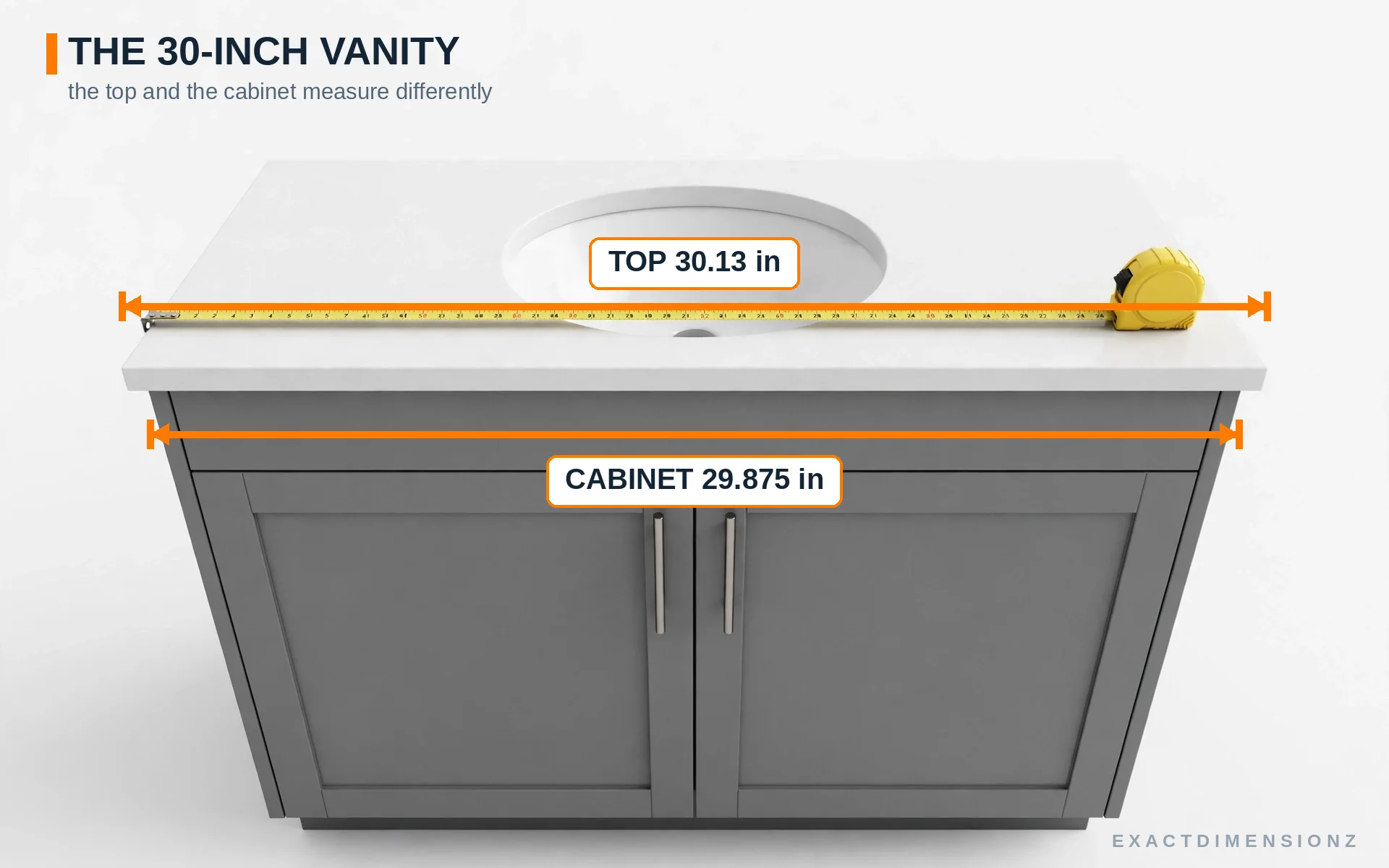
Habitat: the bathroom.
The bathroom supplies the guide’s most instructive specimen: one object carrying three different widths on a single specification sheet, only one of which is 30. The evidence is the spec table on the Home Depot Canada listing for Glacier Bay’s Rocara 30-inch vanity. Read the whole table, not the headline: Popular Width, 30.0 inches. Countertop Width, 30 inches. Assembled Width, 30.13 inches. Cabinet Width, 29.875 inches. Four lines, three distinct figures, one product name. The 30 is real — but it belongs to the countertop, while the cabinet beneath is an eighth of an inch narrower and the assembled unit an eighth wider than the name on the box.
None of those eighths is an accident. The cabinet is built slightly under size so it can be manoeuvred into place against walls that are never perfectly straight; the countertop is made to the full 30 because it is the visible, finished surface the eye and the tape meet first; and the assembled width creeps an eighth over because doors hung and tops set stack real tolerances. A buyer planning a tight alcove from the headline alone would be working from the one figure that describes neither the box that must fit nor the whole that must stand there — the full unit spans a little under three 11 inches lengths end to end. What raises the sighting from warning to credit is that every figure is printed, side by side, before delivery. That is the difference between fine print and deception: fine print is small, but it is print.
Field mark: FINE-PRINT 30 — only the countertop measures 30 inches; the cabinet is 29.875 inches and the assembled unit 30.13, all three printed on one spec sheet.
Sighting 4: The 30-Inch Bar Stool, a Seat Height Wearing a Name
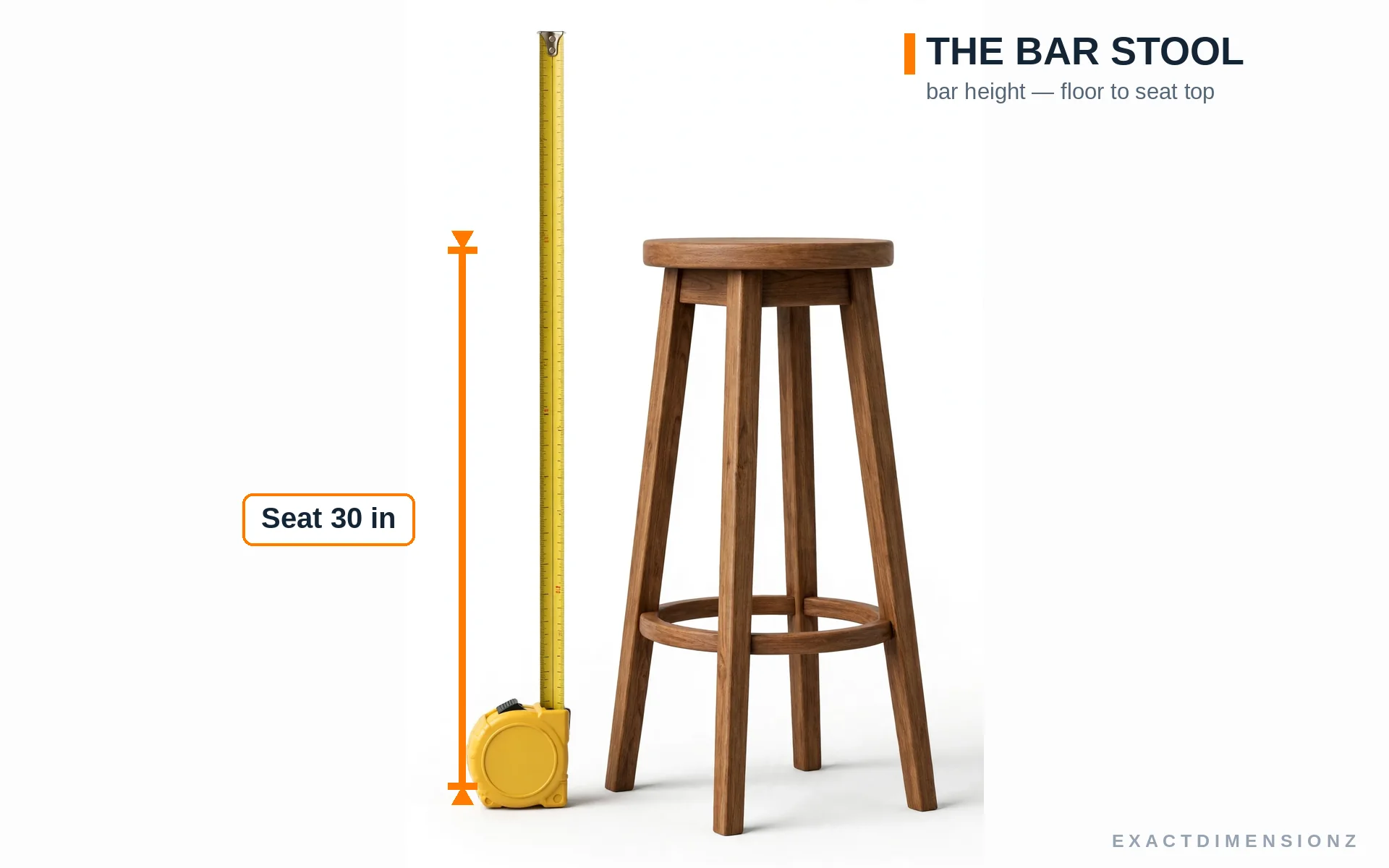
Habitat: the bar.
The fourth sighting is not, strictly, a 30-inch object at all — it is a 30-inch line drawn partway up a taller object, and the whole category is named for that line. “Bar height” is a seat-height class: the number is the floor-to-seat distance, the one measurement that decides whether you can sit at a bar counter in comfort, and it says nothing about how tall the stool stands. The specimen is the Oasis teak bar chair, listed by LoomLan’s listing for the HiTeak Oasis teak bar chair with a seat height of 30 inches — and an overall height of 46.25 inches. The object you carry through a door or picture in a room is a 46-and-a-quarter-inch object wearing a 30-inch class name. The 30 is true. It is simply not the stool.
The class exists for pairing, and pairing is its justification. Bar counters stand around 40 to 42 inches, and a 30-inch seat puts the sitter in the right relation to that surface; one rung down, counter stools carry seats of about 24 to 26 inches because kitchen counters stand at about 36 inches, and the same legroom arithmetic pairs the classes. Measured from the bottom of the counter-stool seat range, the step up to bar height is 6 inches — a half-foot that changes which counter the stool can serve, which is why the class number is a seat line: it is the number the match depends on. Where the name turns treacherous is in storage and secondhand listings, where “30-inch stool” pictures an object two and a half feet tall that arrives standing nearly four feet. The Oasis listing prints the overall height on the same page, so the careful reader is never actually deceived.
Field mark: CLASS 30 — 30 inches is the floor-to-seat line of a height class; the Oasis bar chair that carries it stands 46.25 inches tall overall.
Sighting 5: The 30-Inch Baseball Bat, Nowhere to Hide

Habitat: the ballfield.
Outdoors, the standard of honesty returns. A baseball bat’s size is its whole length — knob to barrel end, one straight line, the entire object — and a 30-inch bat measures 30 inches in the only direction it has. The primary source is the maker’s fitting system: Rawlings’ official bat sizing guide places 30- to 31-inch bats in the hands of players about five feet tall, inside a 27- to 31-inch span for players roughly eight to thirteen years old. The 30 is a working size in a graded ladder, chosen by the player’s height rather than by marketing, and the guide treats it as a fit measurement: the number you select is the number you will hold, with no diagonal convention, case split or nominal class anywhere in the system.
The guide also contains its own arithmetic — the friendliest check in this article. Bats are sold by length and “drop,” where drop is length minus weight in ounces. A 30-inch bat with a drop of 10 weighs 20 ounces, because 30 minus 10 is 20. The equation only works if the length figure is the true, whole length; a nominal length would misstate the weight class with it. Equipment that is swung and fitted to bodies tends toward this honesty, because the user’s hands audit the specification on first contact. A 30-inch bat is also just under four 8 inches spans end to end — four would overshoot to 32 — a dressing-room estimate before a tape is produced. Name, fitting chart and tape return the same figure by three independent routes, and the field mark writes itself.
Field mark: TRUE 30 — Rawlings’ sizing guide treats 30 inches as the bat’s whole knob-to-end length, and its drop arithmetic only works because that length is real.
Sighting 6: The Great Dane, Standing on the Floor of the Breed
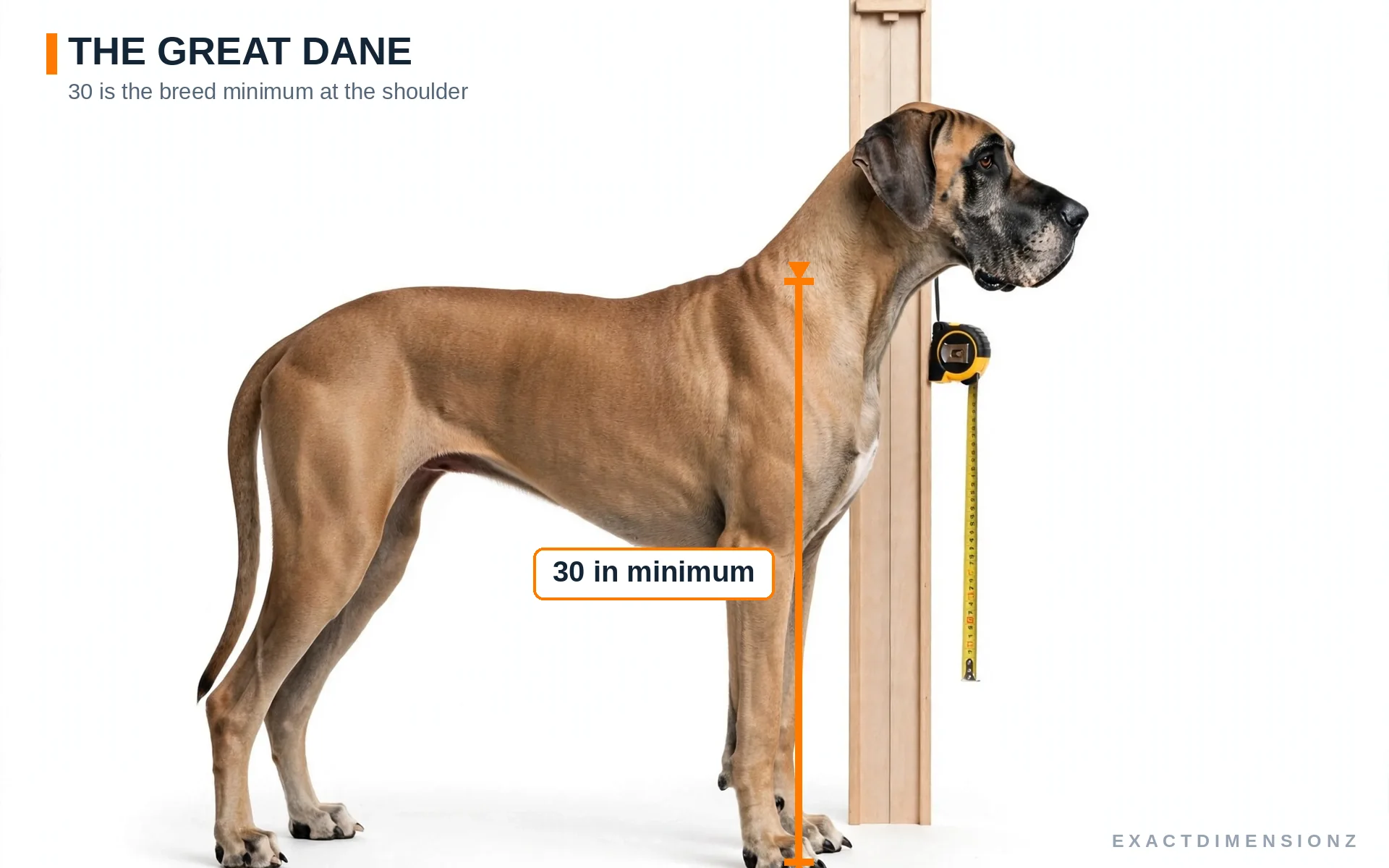
Habitat: the show ring.
The guide’s largest sighting has the strangest relationship to its number: for the Great Dane, 30 inches is not a typical height, an average or a target. It is a floor — the shortest a dog may stand and still be the breed at all. The source is the rulebook itself, the AKC’s official breed standard for the Great Dane, and its language is legal in tone because it is legal in effect: the male shall not be less than 30 inches at the shoulders, and Danes under the minimum height must be disqualified. Females are held to a parallel line — not less than 28 inches, preferably 30 or more. A male standing 29 inches at the shoulder is not a small Great Dane in the standard’s eyes; he is outside the breed’s definition.
That one word, minimum, does all the work, and misreading it is the standard error. Most males stand taller than 30 inches — the floor is the lowest legal rung, not the centre of the distribution — so “Great Danes are 30 inches tall” converts a disqualification line into a description, the same error as calling a passing exam score the class average. The height is also taken at a defined point, the shoulders; the head rides well above the line the tape reads, so the dog in the room is a taller object than its official height, as the stool was taller than its seat line. At the minimum, a male Dane stands exactly two regulation bowling pins tall — a pin’s target height is 15 inches. Numbers enforced by measurement, in public, with disqualification behind them do not drift the way catalogue numbers drift: nobody has ever rounded a breed minimum up for marketing.
Field mark: FLOOR 30 — the AKC standard sets 30 inches as the minimum shoulder height for a male Great Dane, with disqualification below it, so the number is a floor and not a typical height.
Sighting 7: The 30-Inch Dog Crate, the Longest Side Tells the Truth
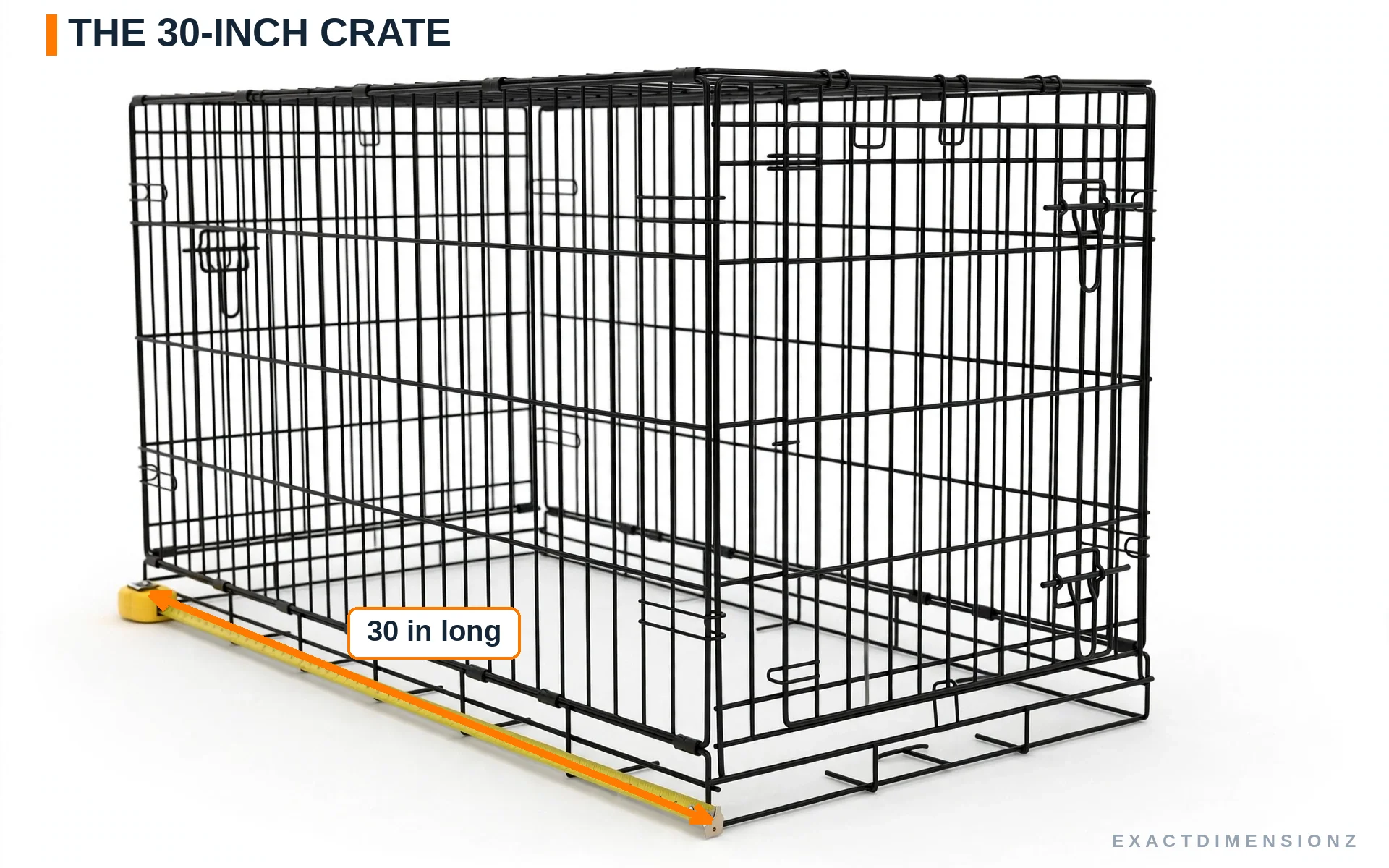
Habitat: the porch.
From the dog itself to the dog’s luggage. A folding wire crate is sold by a single number, and the guide’s question applies: 30 inches of what? For MidWest’s iCrate in its 30-inch model, the answer is the crate’s length — its longest side, and the dimension the name promises. The evidence is the manufacturer’s specification table as published on Petco’s listing for the MidWest iCrate: 30 inches long, 19 inches wide, 21 inches high. Three figures, plainly labelled, and the headline number is the largest and most useful of them — the floor length the dog actually lives on, the dimension that governs whether the animal can lie down stretched out.
The lesser figures deserve the same attention: 19 inches of width and 21 of height decide whether the crate fits the car boot, the hallway and the space under a table, and a buyer planning from the 30 alone is planning from the one dimension least likely to be the constraint. Wire crates add a finer scale altogether — the wire’s spacing and gauge are specified in millimetres on manufacturer sheets, where the crate’s paperwork meets the world of how big is 10 mm: one product, honestly dimensioned in two unit systems, inches for the box and millimetres for the wire, provided each figure names what it measures. Graded by the guide’s rules the crate passes cleanly — a real extent, in the pictured direction, on the maker’s own table.
Field mark: TRUE 30 — MidWest’s specifications give the iCrate’s length as 30 inches, its longest side, so the number in the name is the dimension it promises.
Sighting 8: The “30-Inch” Ultrawide Monitor, a Name in Search of a Measurement

Habitat: the desk.
The labels habitat holds the guide’s most elusive quarry, where numbers are printed rather than measured. MSI sells the Optix MAG301CR2 as a “30 Inch Curved Gaming Monitor,” and the name sounds like a size. Open MSI’s own specification page for the Optix MAG301CR2 and go looking for the 30. The panel size is 29.5 inches — the diagonal, the line screen sizes are supposed to name, half an inch short. The active display area is 690.432 × 291.276 millimetres, every edge and diagonal of it under 30 by wide margins. And the body — the whole physical object that must fit on your desk — is 703 millimetres wide, which converts to 27.68 inches. Three candidate measurements, three misses: not the diagonal, not the width, not the active area. No line on the object measures 30 inches. The 30 is a rounded-up class name, a shelf category wearing a measurement’s clothing.
Screen-class naming is an old habit — display diagonals have been rounded into class labels for decades, and the same habit is documented elsewhere in this series at 13 inches, where class names and tape readings part company the same way. As a filing system it is nearly harmless, since buyers comparing “30-inch class” monitors compare like with like. The harm arrives when the class name is read as a measurement — when a desk gap or a monitor arm is planned around 30 inches and the object that arrives is 27.68 inches wide behind a 29.5-inch diagonal, matching neither figure. To MSI’s credit, every true figure is published on the maker’s own page, one click from the name; this is a failure of the name, not a concealment of the facts. But a field guide exists for exactly this case: the label is confident, the object is innocent, and only the reader who checks the primary source learns that the number on the box measures nothing on the desk.
Field mark: NAME-ONLY 30 — MSI’s own specification lists a 29.5-inch panel in a body 27.68 inches wide, so the “30-inch” name corresponds to no measurement on the monitor.
Sighting 9: The 30-Inch Jeans Inseam, One Tape Line on a Longer Garment
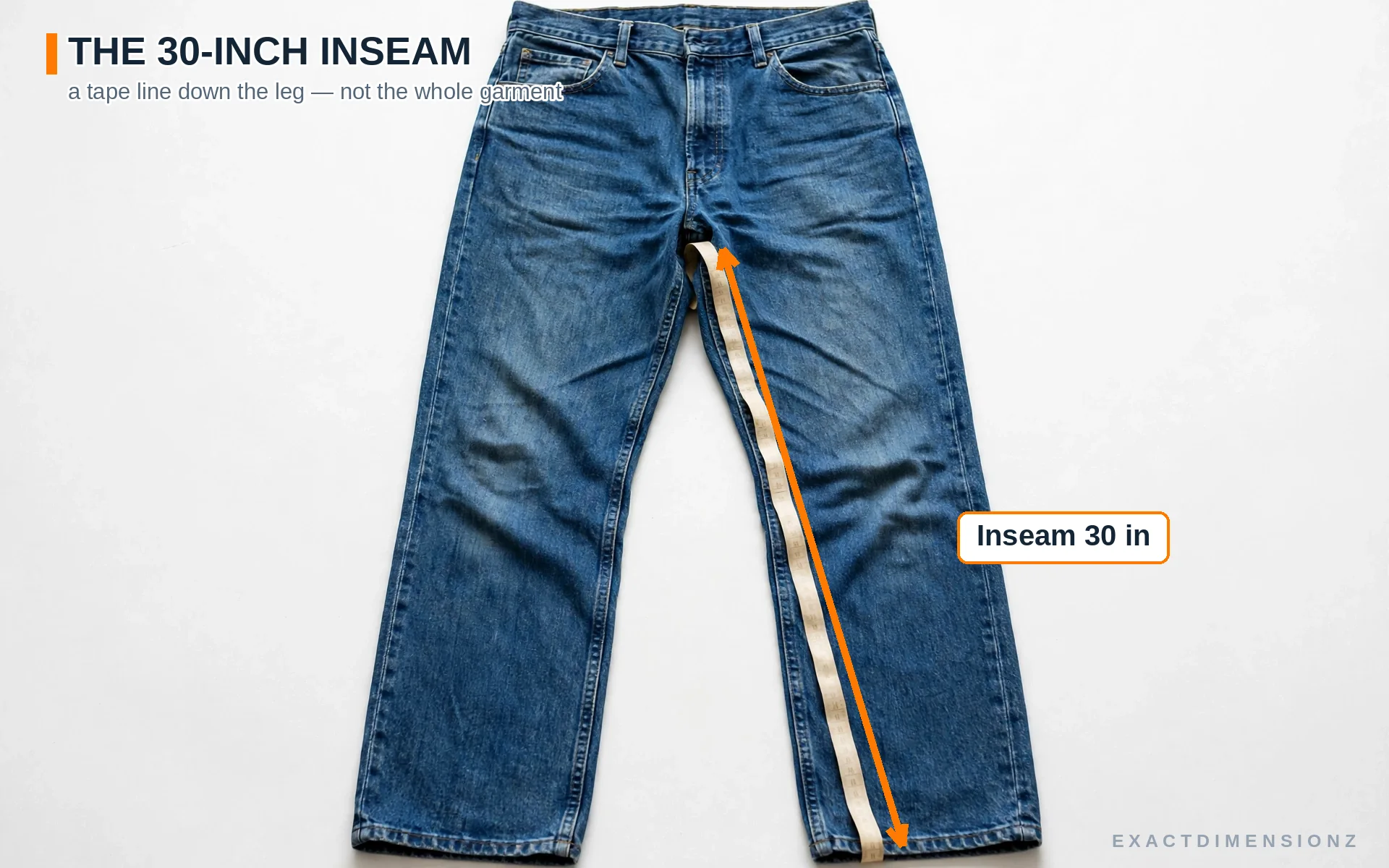
Habitat: the wardrobe.
The last sighting is the subtlest, because its number is genuinely measured — with a tape, on the garment, by the maker — and still does not mean what most buyers picture. A “30 inseam” is not the length of the jeans. It is the length of one seam: the inner leg seam, from the crotch down to the ankle. The definition is the maker’s own: Levi’s size chart defines the inseam exactly so — measure straight down the inside leg from the crotch to the ankle. Follow that instruction and a 30-inseam jean shows you its 30, honestly, along the named line. But the whole garment — rise above the crotch point, inseam below it, hem at the end — is far longer than 30 inches from waistband to cuff, and anyone picturing a two-and-a-half-foot pair of jeans has mistaken a tape line for the trousers.
The inseam system exists because legs, not garments, are what fit is about: the number that predicts whether a hem breaks cleanly over a shoe is the inner-leg line, so the industry names the size for the line that decides the fit, much as the stool is named for its seat line. The honest complication is that the sewn reality varies a little by style and wash — a 30 inseam is a specification the garment is cut and finished toward, and a tape on a given pair can sit a small fraction either side of the round number. That is tolerance, not fiction. Read correctly, the inseam is one of clothing’s most portable numbers: measure the inseam of the best-fitting pair you own and you can shop any brand’s chart with it. Read carelessly, it is a true number about a part, filed in memory as a number about the whole.
Field mark: TAPE-LINE 30 — Levi’s defines the inseam as the inside-leg line from crotch to ankle, so a 30 inseam measures that seam truly while the whole garment runs far longer.
The Field Chart: All Nine Sightings at a Glance
Nine sightings, three habitats, seven field marks. The chart is the guide on one card: what each 30 actually measures, the verified figure from the primary source, and the grade the evidence earned. The pattern reads at a glance — the true 30s are the sightings whose number is the object’s own longest or fitted extent, and every softer grade is a number measuring a system, a part, a floor or a line instead.
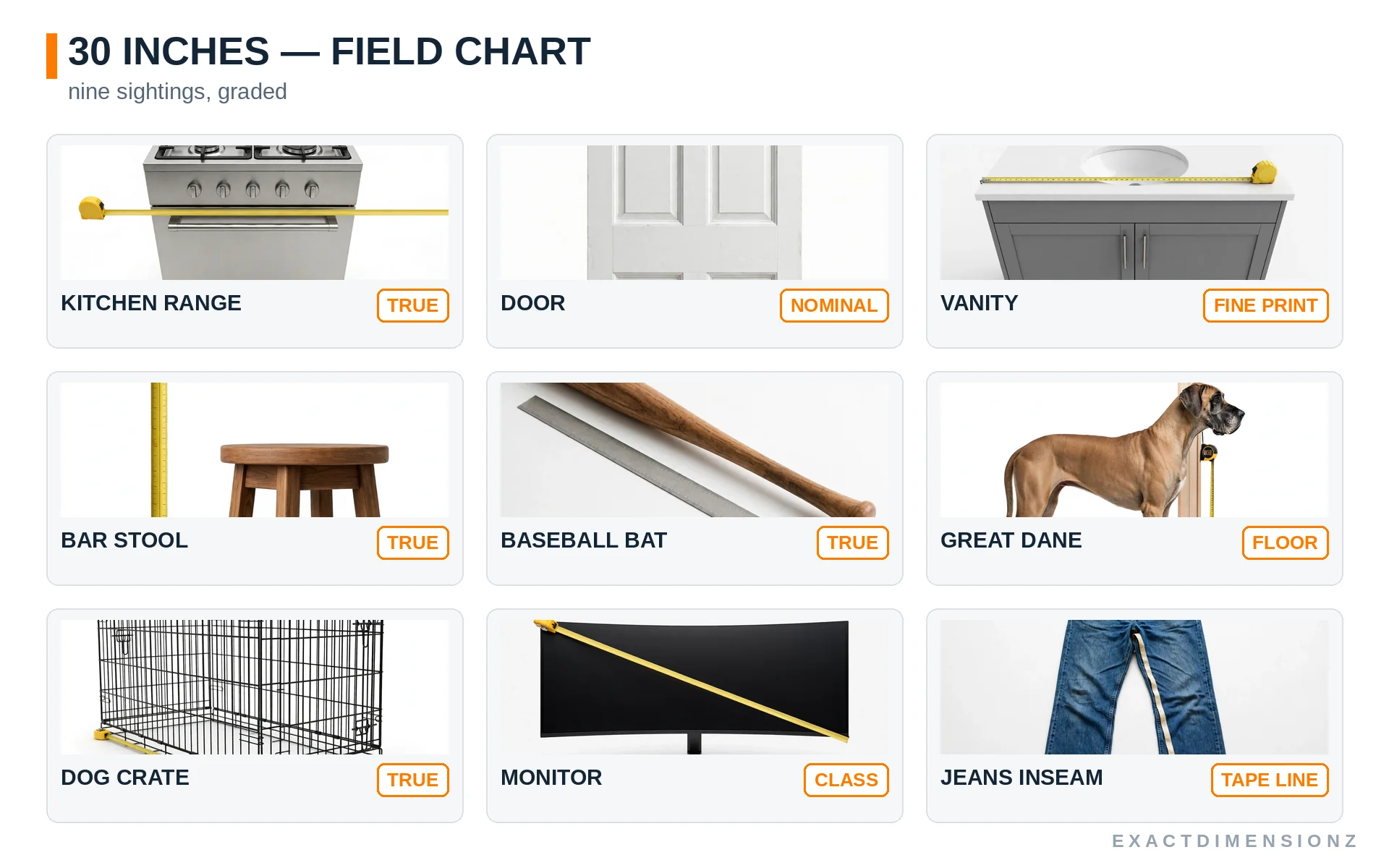
| Sighting | What the 30 measures | Verified figure | Field mark |
|---|---|---|---|
| The 30-inch range | Width of the whole appliance | Overall width 30 in; cabinet width 30 in (GE) | TRUE 30 |
| The 30-inch interior door | The opening system the door is made for | Nominal 762 × 2032 mm (JELD-WEN); 762 mm = 30.00 in | NOMINAL 30 |
| The 30-inch bathroom vanity | The countertop, one of three widths | Countertop 30 in; cabinet 29.875 in; assembled 30.13 in | FINE-PRINT 30 |
| The 30-inch bar stool | Floor-to-seat height, a class line | Seat height 30 in; overall height 46.25 in | CLASS 30 |
| The 30-inch baseball bat | Whole length, knob to barrel end | 30 in end to end; drop-10 version weighs 20 oz (Rawlings) | TRUE 30 |
| The Great Dane | Minimum shoulder height for a male | Not less than 30 in at the shoulders; under minimum, disqualified (AKC) | FLOOR 30 |
| The 30-inch dog crate | Length, the longest side | 30 L × 19 W × 21 H in (MidWest, via Petco) | TRUE 30 |
| The “30-inch” ultrawide monitor | Nothing — a rounded-up class name | Panel 29.5 in; body 703 mm wide = 27.68 in (MSI) | NAME-ONLY 30 |
| The 30-inch jeans inseam | The inside-leg seam, crotch to ankle | 30 in along the inseam line (Levi’s definition); whole garment far longer | TAPE-LINE 30 |
Three sightings measure the thing itself. Six measure something adjacent — an opening, a surface, a seat, a minimum, a seam, a category — and are honest exactly to the extent that the adjacency is disclosed. The single name-only sighting is also the sighting whose maker sells into a market where the buyer rarely measures the object before paying for it; coincidence is not evidence, but in field work, patterns are what you watch.
Build 30 Inches From What Is Already in the Room
Six builds from objects already in most rooms, every one stated with its true total — including the three that overshoot, because a build that misses honestly beats a claim that hits falsely. The units are verified: a standard ruler is 12 inches; a regulation bowling pin’s target height is 15.000 inches, within a tolerance of 1/32 of an inch; a United States banknote measures 6.14 × 2.61 inches, per the Bureau of Engraving and Printing facts collected at the US currency size reference; a bank card’s long edge is 3.37 inches, the 85.60-millimetre edge fixed by the ISO/IEC 7810 card standard; US Letter paper runs 11 inches on its long edge; and a yardstick is 36 inches by definition of the yard it portions.
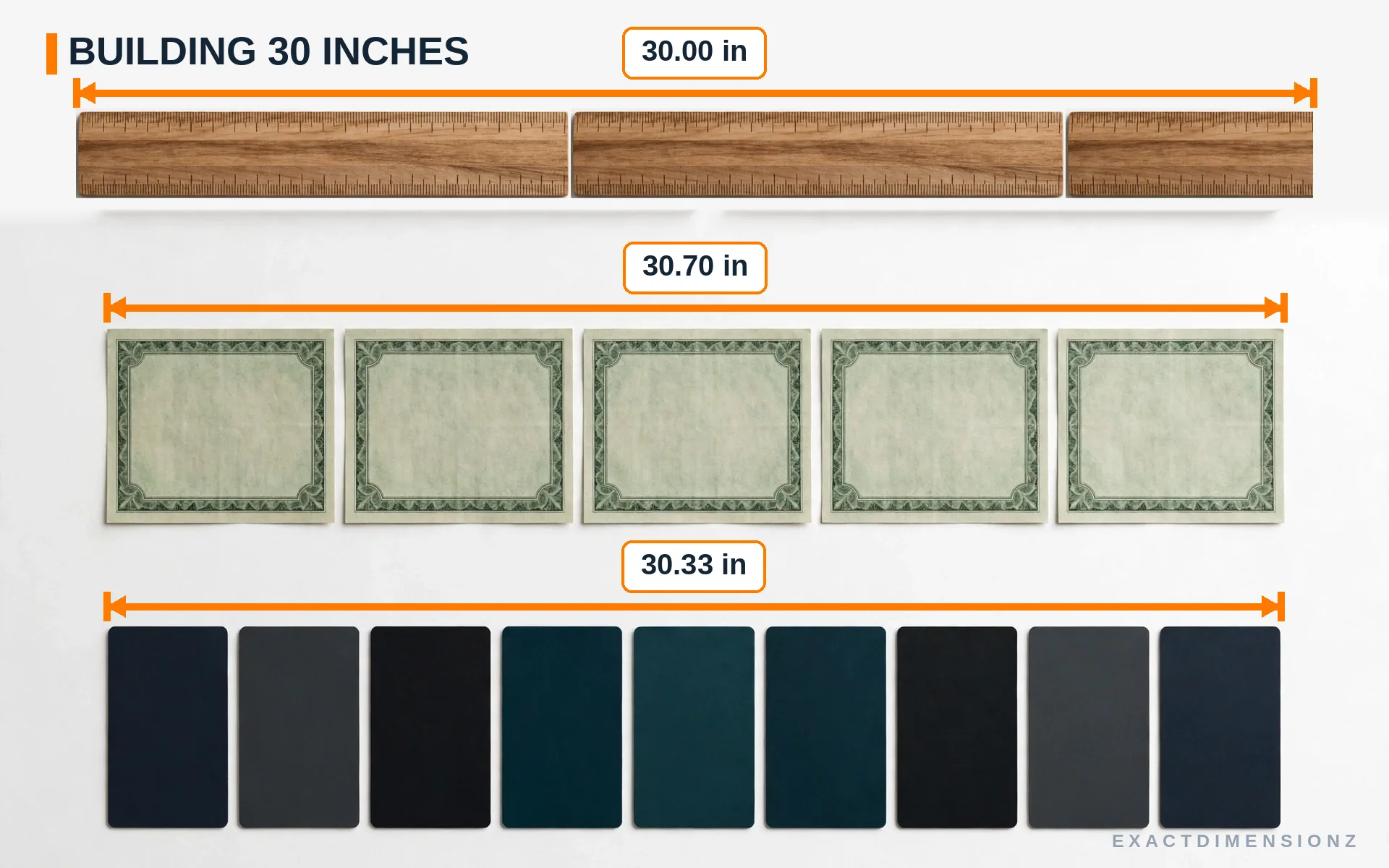
| Build | Pieces | True total | Verdict |
|---|---|---|---|
| Two and a half rulers | 2.5 × 12 in | 30.00 in | Dead on — the definition of the length |
| Two bowling pins, end to end | 2 × 15.000 in target (±1/32 each) | ≈30.00 in | Dead on, inside pin tolerance |
| A yardstick with 6 inches marked off | 36 − 6 in | 30.00 in | Dead on — count back six from the end |
| Five dollar bills, lengthwise | 5 × 6.14 in | 30.70 in | 0.70 in over — money runs long |
| Nine bank cards, long edges | 9 × 3.37 in | 30.33 in | 0.33 in over — the closest pocket build |
| Three letter sheets, long edges | 3 × 11 in | 33.00 in | 3.00 in over — paper is not a shortcut |
Three builds land dead on, and they are the three built from measuring instruments and regulated equipment. The pocket builds all overshoot: a dollar bill runs a little over six inches, so five must run long, at a seventh of an inch of error per bill; nine bank cards come closest, a third of an inch over — fine for judging a crate by eye, useless for fitting a range. The letter-paper build fails outright, three full inches over, and paper is the build most people reach for first. Thirty inches rewards the tools that were made to measure it.
The Misidentification Log: Seven Published Errors
Every field guide ends with a log of misidentifications — sightings other observers reported wrongly — and 30 inches has attracted a full page of them. Each entry names the error, who published it, and the sourced truth. These are not rounding differences; several carry their publishers’ own confidence ratings, which the log preserves for the record.
1. “Kitchen counter depth is 30 inches.” Published as the first item by one rival guide, repeated in another’s table, and rated a perfect score by a third. The truth is in Caesarstone’s guide to standard countertop depth: standard base cabinets are 24 inches deep and the finished countertop measures 25.5 inches. The claim overshoots by about 4.5 inches; a 30-inch depth is an island-with-seating figure, not the wall counter.
2. “A full-size acoustic guitar is about 30 inches.” Published by one rival roundup (rated 9/10) and repeated in another’s table. The benchmark instrument refutes it from its own page: Martin’s D-28 has a body length of 19-7/8 inches and a scale length of 25.4 inches, and the whole guitar runs about 40.5 inches overall. No extent of the instrument is 30: the body is ten under, the whole guitar ten over.
3. “Thirty inches is the standard height for kitchen counters.” Published in one rival roundup’s FAQ and repeated by another. The standard height is 36 inches, as Caesarstone’s guide to standard counter height sets out — and GE’s own range spec in Sighting 1 puts the cooking surface at 36 to 36.5 inches, the height a range is built to meet. Thirty inches is dining-table and desk height.
4. “A toddler of two or three is about 30 inches tall.” Published by three rival roundups — one adding that toddlers are “many right at the 30-inch mark”, another calling it the “average 2.5-year-old”. The WHO growth chart for boys, birth to 24 months, hosted by Alberta Health Services puts 30 inches (76.2 cm) at about the median length of a 12-month-old boy; by 24 months the median boy measures about 87 cm, roughly 34 inches. The claim misplaces the milestone by a full year or more.
5. “A dartboard measures 30 inches in circumference.” Published by one rival guide. The World Darts Federation playing rules fix the board’s overall diameter at 451 mm (17.75 in), which makes the circumference about 55.8 inches. A 30-inch circumference would belong to a board only about 9.5 inches across.
6. “A medium bicycle frame measures about 30 inches along the seat tube.” Published by one rival guide. Medium frames carry seat tubes of roughly 17 to 21 inches; no maker’s size chart lists a 30-inch seat tube — that tube would fit a rider far outside every standard chart. The number confuses the frame’s smallest tube with something else entirely.
7. “Three bricks end to end make 30 inches.” Published as a heading by one rival list, whose own text quietly corrects it to “just under four.” A standard modular brick is 7⅝ inches long; three make 22.875 inches, and even four overshoot slightly at 30.5 inches. The heading is short by more than seven inches, and it survives because a heading is read ten times for every once its paragraph is.
Field Notes: Three Questions Readers Ask
Is 30 inches exactly 2.5 feet? Yes: 2.5 × 12 = 30 exactly. A foot is 12 inches by definition, so two and a half feet and thirty inches are the same length stated two ways — the one conversion on this page that needs no asterisk.
How long is 30 inches in centimetres? 76.2 cm exactly. The inch is defined as 2.54 centimetres, and 30 × 2.54 = 76.20 — exact to the second decimal and beyond (762.0 mm on the finer scale). Where a converted figure is rounded, this guide labels it, as with the 0.8333 yards in the Quick Answer; the centimetre figure carries no such label because it needs none.
What everyday thing is exactly 30 inches? A 30-inch baseball bat end to end, knob to barrel, by its maker’s own sizing system — the whole object, in its only direction. And a standard kitchen range across its width, with the manufacturer publishing both the overall width and the cabinet width at 30 inches. A sporting-goods rack and a kitchen showroom are the two most reliable habitats in this book.
Close the guide where it opened: the measure was never the problem. Thirty inches is exactly two and a half feet, exactly 76.2 centimetres, a yardstick with six inches marked off — a clean, knowable length. What varies is the honesty of the names hung on it, and that is knowable too, provided the identification is made the field-guide way: against the primary source, in the named direction, with the field mark stated plainly. Nine sightings, seven marks, one tape. Happy spotting.
