

How long is 20 inches? On paper it is the cleanest number in the complete inches size guide: exactly 50.8 centimeters — so close to half a metre that most people assume it IS half a metre. It isn’t, and that small misunderstanding is the perfect introduction to twenty, because 20 inches is the size that products claim most loosely. It is printed on suitcases that stand nearly 22 inches tall, on monitors that measure 19.5, on bike wheels whose rims measure 16, and on picture frames whose twenty belongs to the photograph inside them. So this article runs a door. Every object below had to present its evidence to get in — a manufacturer’s spec sheet, an industry standard, a menu, a growth chart — and each one carries an admission line stating what its 20 actually measures and how strong the proof is. Fourteen objects passed. Seven famous claims did not, and they are waiting outside in Turned Away at the Door, at the end. The series has climbed a long way to get here — past how long is 16 inches and the sizes below it — and twenty turns out to be the first number big enough to need a bouncer.
How long is 20 inches?
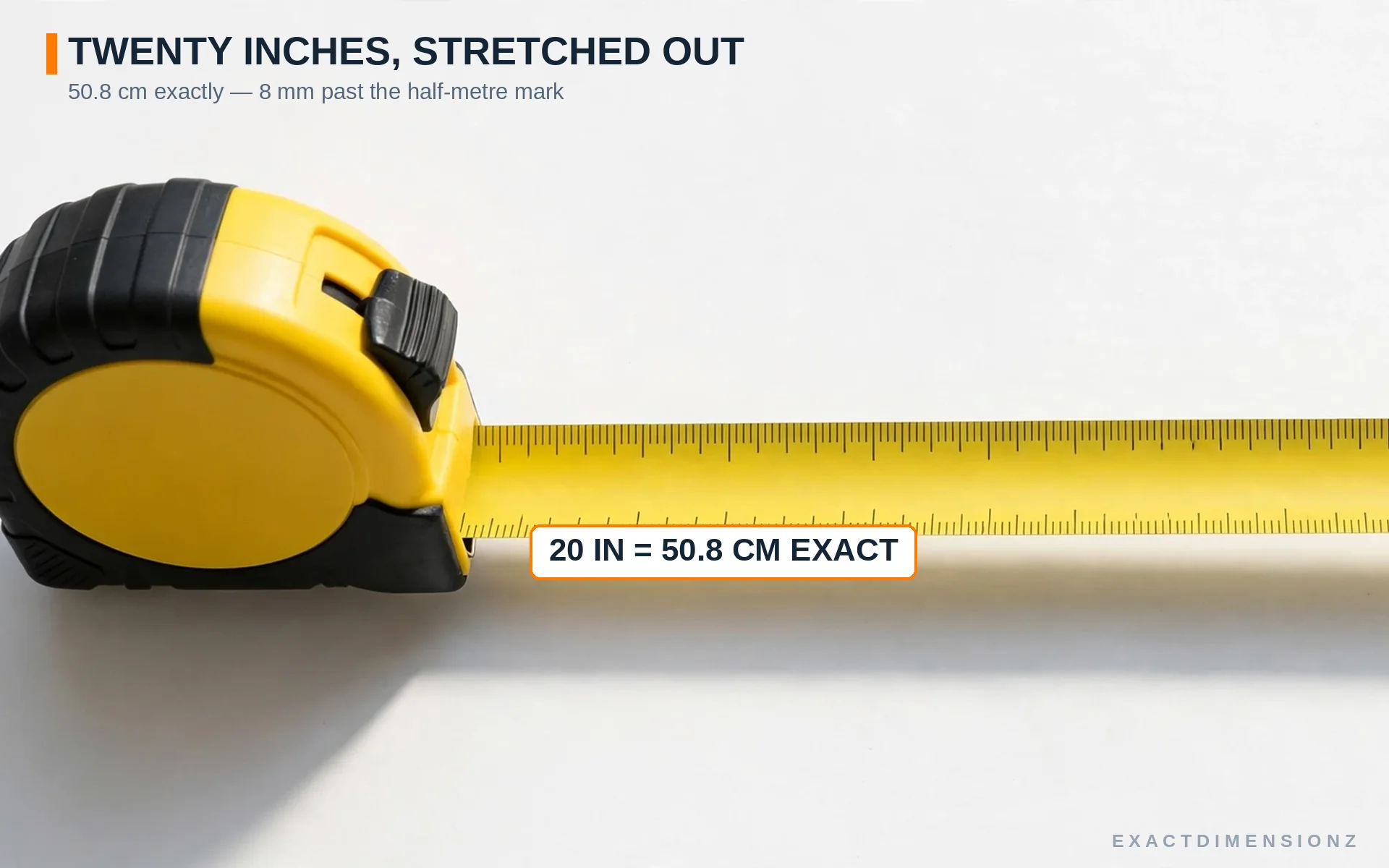
20 inches is exactly 50.8 centimeters — one foot and eight inches, and 508 millimeters exactly, with a step up to 21 inches just above it.
In feet it is 1.6667 ft (rounded), and in yards 0.5556 yd (rounded). It is NOT half a metre: 50 cm is 19.685 inches, so twenty overshoots the half-metre mark by 8 mm. But the honest answer depends on what the number measures: a “20-inch” carry-on stands 21.75 inches once its wheels count, a “20-inch” monitor shows 19.5 inches of picture, and a “20-inch” bike wheel hides a 16-inch rim. Here is the short version before the door opens:
Screen rulers aren’t true to size — this is a visual guide. Calibrate against a standard pillow’s 20-inch short side, a 20-inch bass drum’s shell, or a 12-inch ruler plus the 8-inch edge of an 8×10 photo print, which makes exactly 20.
The Door at Twenty Inches
Twenty is the foot itself, plus eight more inches — two-thirds of another foot, with a step down to 19 inches just below it. That is arithmetic, and arithmetic is not where twenty goes wrong. Twenty goes wrong at the printing press, when the number leaves the ruler and gets stamped on a box. A luggage maker measures the empty case and politely forgets the wheels. A screen maker measures a class, rounds up, and prints the class. A frame maker names the frame after the print it holds. A bike maker names the wheel after the tyre’s outside, while the rim — the part the standard actually fixes — is a 406-millimetre circle you could measure in a different article entirely. None of these numbers is a lie, exactly. All of them are incomplete, and an incomplete number, repeated often enough, hardens into folklore: ask the internet how long a baby is, and it will tell you “20 inches” with total confidence and no source at all.
So the rule at this door is simple: no number gets in on its reputation. Each object below states, in its admission line, three things — what the 20 measures (a diameter? a case? a class? a print?), the verified figure behind it, and the document the figure came from. Objects whose twenty is fixed by an engineering standard enter first. Objects whose twenty is true end-to-end follow. Objects whose twenty is real but measures something other than what you’d assume are admitted too — but their fine print is read aloud, at the door, where everyone can hear it. And the claims that couldn’t produce any evidence at all? They are at the end, in the cold, with the parlor guitar that was claimed to be 20 inches long in total. It is 38.
Stamped by a Standard. Four twenties fixed by an industry rulebook or a maker’s own size code — the strongest evidence there is.
1. The 20-Inch Bike Wheel
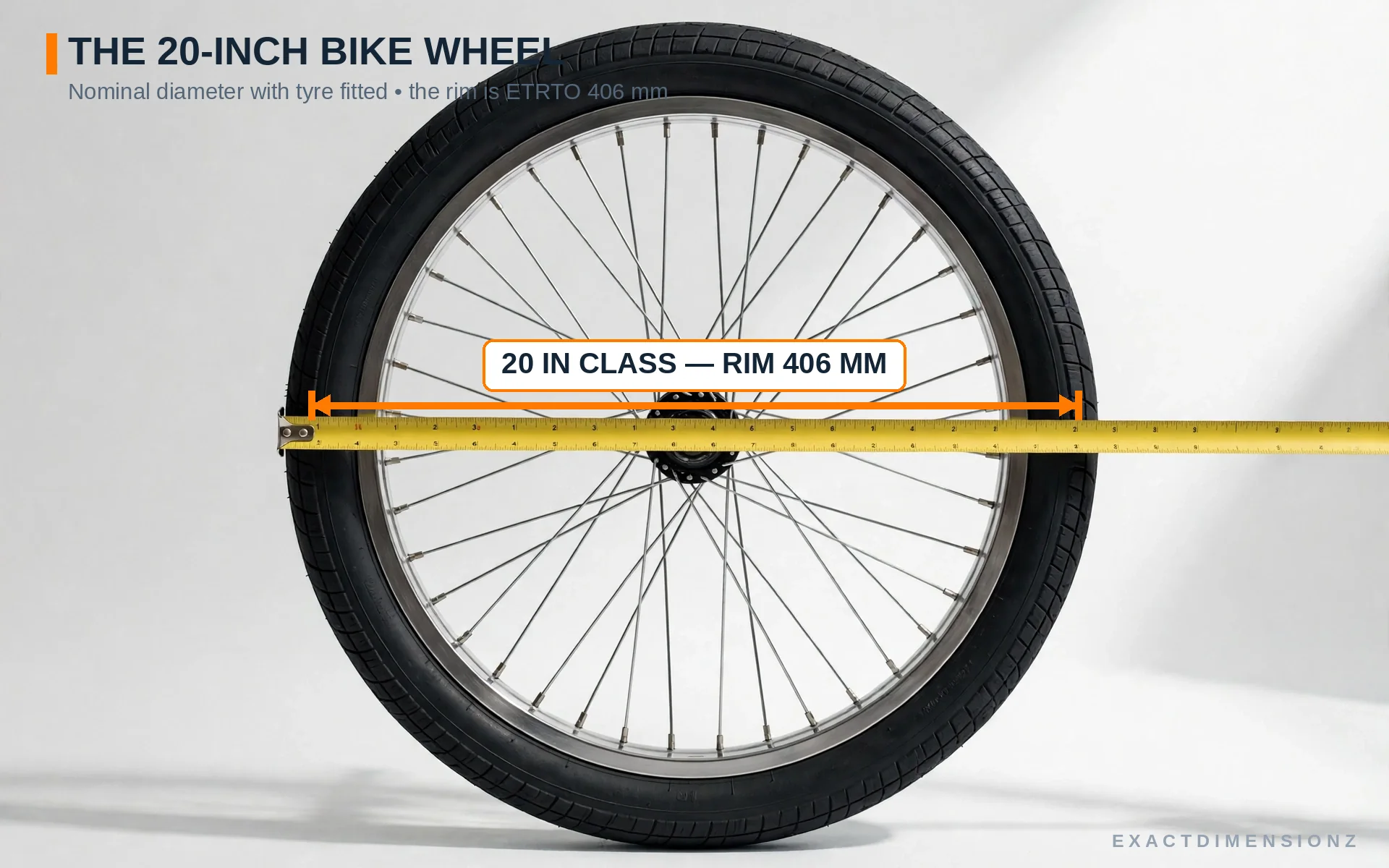
Admission: STANDARD CLASS — the “20” is the nominal overall diameter with a tyre fitted; the rim itself is an ETRTO 406 mm circle (15.98 in) at the bead seat.
The most standardised twenty on this list belongs to the wheel under every BMX bike and most older kids’ bikes — and almost none of it is visible. The tyre industry does not leave wheel sizes to marketing: it fixes them in the ETRTO standard, and Schwalbe’s Technical Info manual — the tyre maker’s own engineering document — lists the 20-inch family by its bead seat diameter: 406 mm. That is the ledge inside the rim where the tyre’s bead locks on, and it measures 15.98 inches: call it 16. The “20” is what you get when tyres join in — add a typical 50 mm tyre section (a 50-406 tyre, in the same table) above and below the rim and the whole wheel stands about 506 mm tall, roughly 19.9 inches, near enough to twenty that the class name has survived a century. Schwalbe’s table also quietly explains a trap: there are TWO wheels called 20-inch — the 406 and a narrower 451 mm road size — and their tyres do not interchange, a fact that has ambushed many parents ordering BMX tyres by the big number alone.
One rival page lists this object as a “toddler bicycle frame — 20 inches,” which mis-teaches the entire system: children’s bikes are sized by wheel diameter — 12, 16, 20, 24 — never by frame, and a toddler’s bike is a 12- or 16-inch wheel in the first place. The 20-inch wheel is the big-kid and BMX size, the launch-ramp standard. As a visual reference, picture the whole wheel: a circle a hand-span under twenty inches across, with an exactly-16-inch secret spinning inside it.
Source: Schwalbe’s Technical Info manual (ETRTO size tables; PDF hosted on the maker’s file CDN).
2. The 20-Inch Bass Drum
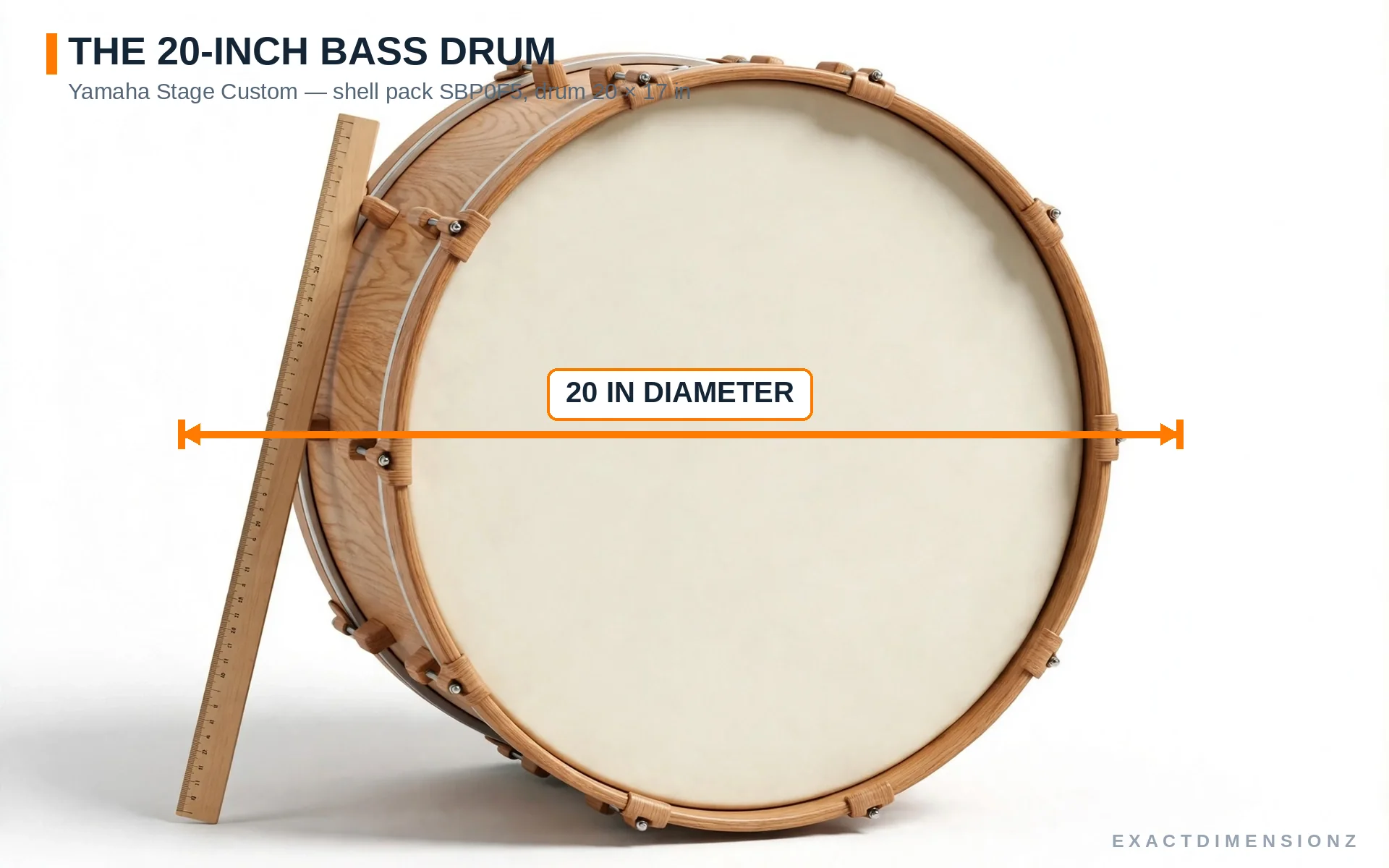
Admission: MANUFACTURER SPEC — the shell is 20 in across and 17 in deep, in the maker’s own size code: 20×17.
Drummers buy their biggest drum the way engineers buy pipe: diameter first, depth second, no adjectives. A “20-inch bass drum” is a shell whose batter head spans 20 inches, and the number is not a class or a rounding — it is the dimension the heads, hoops and lugs are all manufactured to fit. Take the Yamaha Stage Custom Birch shell pack (SBP0F50), one of the best-selling kits in its class: its bass drum, model SBB-2017, is specified at 20 inches in diameter by 17 inches deep, and every 20-inch head from every maker will seat on it, because the size is a promise the whole industry keeps.
The 20-inch bass drum is also the working drummer’s compromise, which is why it is everywhere: a 22 thumps lower but eats the car boot and the stage; an 18 is a jazz whisper; the 20 sits in the van, punches through a band, and still fits a small stage. If you need to feel twenty inches, stand in front of one at a gig: it is the circle the beater hits, roughly knee-cap to mid-shin on the player behind it, and it is exactly the width it claims to be.
Source: Yamaha Stage Custom Birch SBP0F5 specification (sweetwater.com).
3. The 20-Inch Ride Cymbal

Admission: MANUFACTURER SPEC — a cast 20-in diameter, hammered and lathed to the size in its name.
If the bass drum is twenty by engineering, the ride cymbal is twenty by foundry. A ride begins as a disc of B20 bronze — 80% copper, 20% tin — cast, rolled, hammered and lathed into a shallow dome, and its size is the diameter of that disc. The Zildjian A Custom 20-inch Ride is the reference model: Zildjian lists its size at 20 inches, and the 20-inch ride is the default ride of recorded music — the size other sizes are described against (“darker than a 20,” “crashes like an oversized 20”). A measuring tape reads a chord across the bow of a made object, so expect a few thousandths of handmade wobble either way; that is not tolerance-washing, it is what a hammered disc is.
Why does this matter for picturing twenty? Because the ride gives you twenty as a span you can hear: it is the plate-sized circle hovering at a drummer’s right hand, wide as a café table for one. Between the drum below it and the cymbal above it, an ordinary drum kit quietly contains two of the most honest twenties in this article — both admitted on manufacturer’s specifications, both measurable in the shop before money changes hands.
Source: Zildjian A Custom Ride 20” specification (sweetwater.com).
4. The Standard Bed Pillow
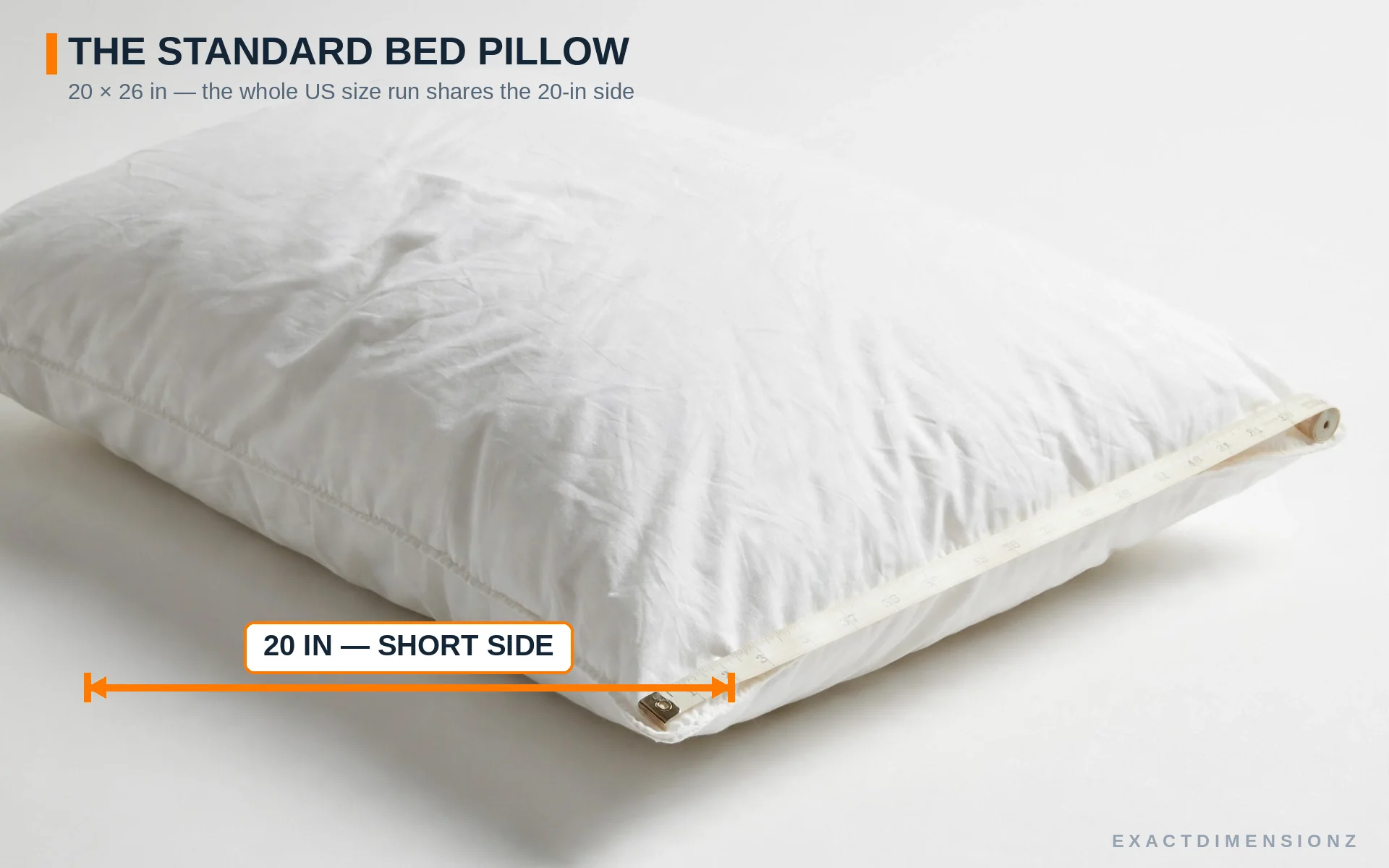
Admission: SIZE-RUN STANDARD — 20 in is the short side of the entire standard US pillow run: 20×26, 20×30, 20×36.
Here is the most useful twenty in your house, because you already own it and because an entire industry agreed on it. American pillow sizes form a ladder, and every rung shares the same short side: a Standard pillow is 20×26 inches, a Queen is 20×30, a King is 20×36, and a body pillow stretches the same 20-inch width to 54 long. The bedding maker Boll & Branch’s pillow dimension guide publishes the run exactly so — 20 inches is the fixed dimension of the American bed, the one that never changes while the lengths climb. (Stuffing and loft will puff any individual pillow a little past its tag on day one and a little under it by year three; the tag size is the standard, and the standard is 20.)
That makes the pillow the best calibration object in this article. Don’t picture twenty as an abstraction: picture the short edge of the pillow you slept on last night. It is twenty inches wide — wider than your shoulders are deep, long enough to span a carry-on suitcase and a bass drum with nothing left over, and it is sitting in the next room being exactly that size right now.
Source: Boll & Branch pillow size and dimension guide (bollandbranch.com).
True to the Tape. Four objects whose printed 20 is the tape’s 20 — measurable end to end, no decoding required.
5. The 20-Inch Hand Saw

Admission: CATALOGUED SPEC — 20 in of blade (508 mm), exactly as the maker’s catalogue prints it, teeth and all.
Workshop twenties don’t deal in classes; they deal in cut length. Stanley’s SharpTooth hand saw, model 20-047, is catalogued at a blade length of 20 inches — 508 mm — with 9 points per inch of aggressive tooth, and its 15-inch sibling sits two rows away in the same catalogue at 381 mm. (The figures come from Stanley’s hand-tools catalogue — the maker’s own document, hosted on a manuals mirror because Stanley’s catalogue library is not directly linkable; the document is Stanley’s, the hosting is disclosed.) A panel saw’s twenty is a working twenty: it is the length of steel that has to fit across the sheet goods you are cutting, which is why panel saws have settled at 20 and 26 inches for a century while their finer cousins, the tenon and dovetail saws, live down at 10–14.
The honesty detail worth stealing: Stanley prints the millimetres beside the inches — 508, the exact conversion — because a tool catalogue is one of the few places where the metric figure is the real one and nobody rounds it to “about 50 cm.” Hold that thought; it matters again in The Half-Metre Myth, below.
Source: Stanley hand-tools catalogue, SharpTooth 20-047 (manuals.plus mirror of the maker’s PDF — hosting disclosed).
6. The 20-Inch French Rolling Pin
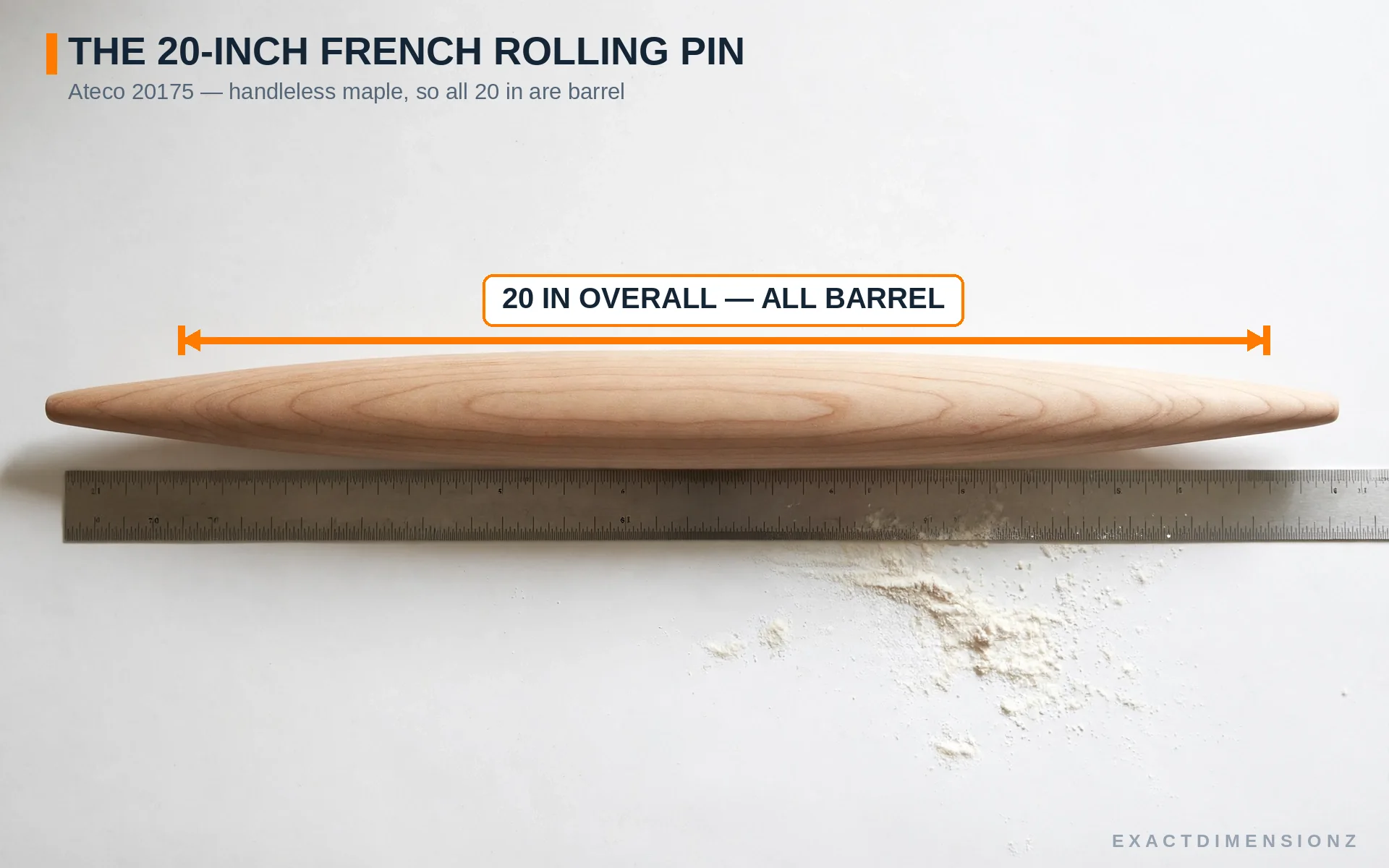
Admission: TRUE TO THE TAPE — 20 in overall, and because this pin has no handles, all twenty inches are working barrel.
This pin earns its place twice: once for what it is, and once for the rival claim it corrects. First, what it is: the French rolling pin — a single tapered baton of maple, no handles, no axle — rolls dough by palm pressure, and professional sizes run long. The Ateco 20175 is specified by its seller at an overall length of 20 inches, and on a handleless pin “overall” means the whole thing is barrel: twenty inches of rolling surface, end to end, the longest true twenty in the kitchen.
Now the correction. A rival chart states that “the standard rolling pin measures approximately 20 inches in total length including handles,” consistent across brands. It does not — and this series has the receipts: the handled pins measured for the 15-inch article ran about 17.5–19 inches in total, barrel plus handles, when we checked how long is 15 inches against manufacturer specs. The handled pin’s twenty is a rounding dressed as a standard. The French pin needs no dressing: lay a ruler beside it and the wood ends where the tape says twenty. Admitted — and the claim it replaces is waiting outside.
Source: Ateco 20175 product specification (webstaurantstore.com).
7. The 20-Inch Apartment Range
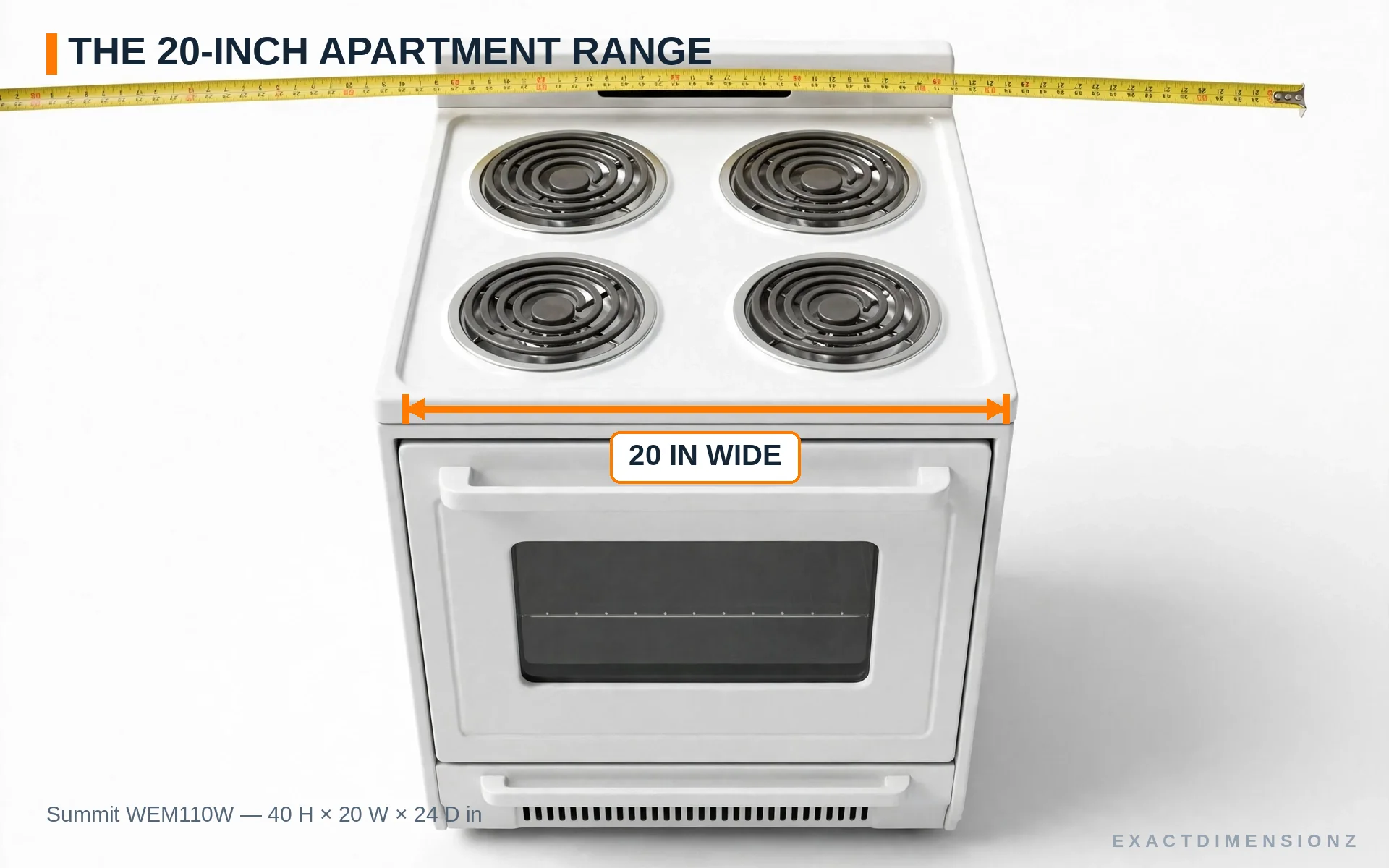
Admission: WIDTH CLASS — the 20 is the width of a compact range, dimensioned by the maker at 40 H × 20 W × 24 D inches.
North American kitchens are built around a 30-inch range opening, which makes the 20-inch range the specialist: the apartment-sized cooker that fits the galley kitchen, the in-law suite, the studio where the “kitchen” is one wall. Summit Appliance builds its name on this size, and its brochure for the WEM110W prints the dimensions plainly — 40 inches high × 20 inches wide × 24 inches deep — “slim 20 inch width, apartment-sized,” made in the USA. The twenty is a cabinet-filling dimension: it has to be true, because the cooker slides into a gap measured by somebody else’s tape, and a range that arrives at 20.4 inches wide is not approximately right, it is a return shipment.
As a reference, the apartment range gives twenty a posture: it is the width of the smallest real stove you can bake a chicken in, two-thirds the width of the standard cooker beside it in the showroom. Stand in front of one and twenty inches is hip-width, counter-edge to counter-edge — a number you can feel in a kitchen doorway.
Source: Summit WEM110W brochure (summitappliance.com, manufacturer’s PDF).
8. The 20-Inch Box Fan

Admission: CLASS SIZE — the 20 belongs to the fan and its blades; the box that houses them measures about 20.5 × 21.75 inches.
The box fan is the friendliest fraud in the hardware aisle: it is sold as a “20-inch fan,” and there genuinely is a 20-inch fan inside it — the blade disc and grille span 20 inches, as retailer specification tables for Lasko’s 20-inch box fans confirm (fan diameter: 20 in). What the name leaves out is the box. The same spec table lists the assembled product at 20.5 inches long, 21.75 inches high, 4.38 inches wide — the frame, feet and handle push the object nearly two inches past its name in height. Lasko’s own manual for the 3723 agrees in spirit, dimensioning the product at 21.2 inches wide by 22 high with a 20-inch blade inside (manual mirrored at manuals.plus — hosting disclosed).
Does the fan deserve admission? Yes — on the same terms as the bike wheel: the 20 names a real, standardised component, and the discrepancy lives in the housing, which the spec table publishes for anyone who reads it. But if you are buying a fan to fit a 20-inch window opening, the headline number will betray you by 1.75 inches of plastic. Measure the box, not the blade.
Source: Lasko 20” box fan specification table (homehardware.ca) and Lasko 3723 manual (manuals.plus mirror — hosting disclosed).
Read the Fine Print. Four twenties that are real — as long as you know which measurement the number is actually claiming.
9. The “20 Monitor”
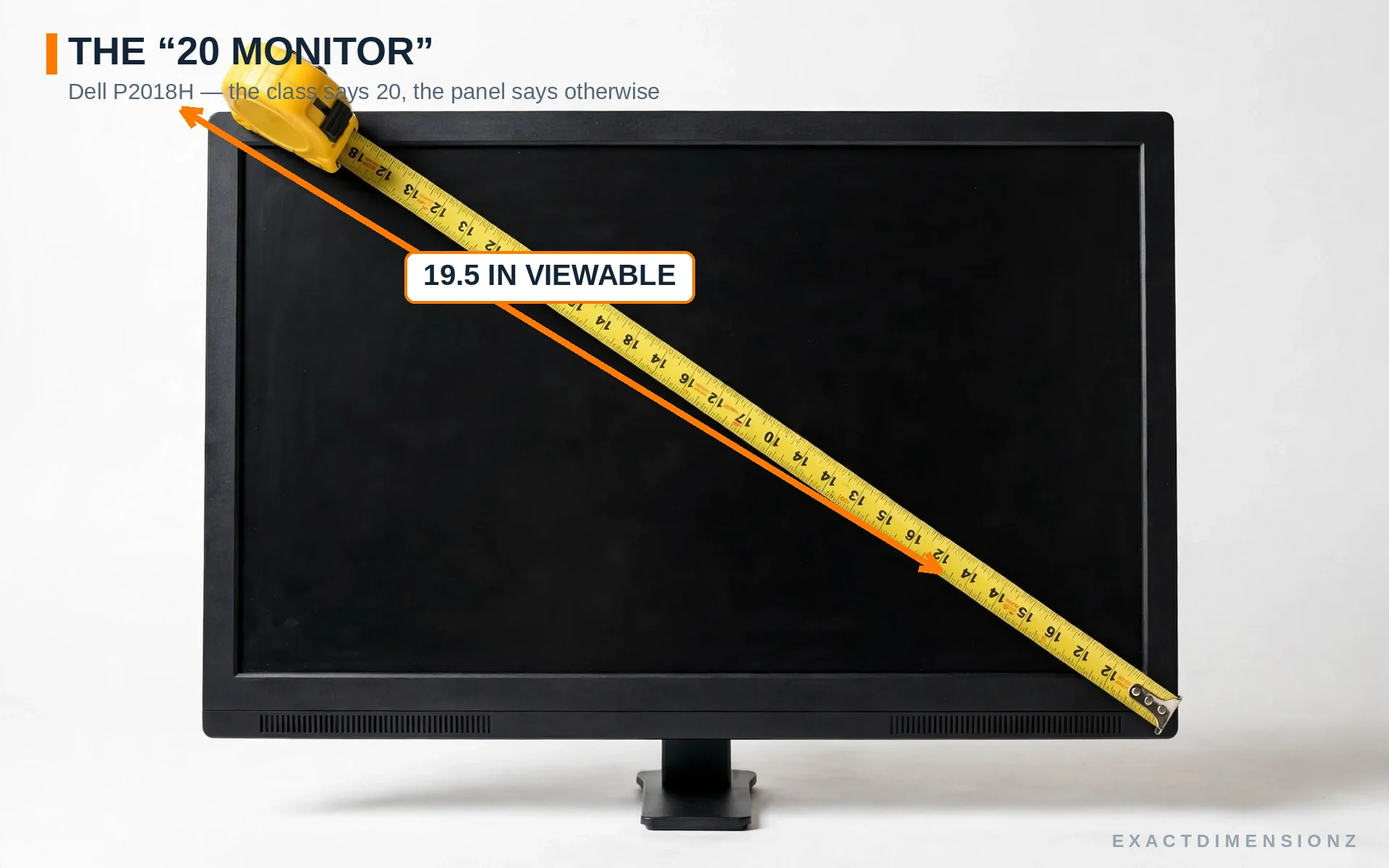
Admission: CLASS SIZE — the “20” rounds UP. Dell’s own spec sheet puts the viewable diagonal at 19.5 inches.
Meet the most instructive object in this article: a product whose official name contains a number its own spec sheet contradicts. The Dell 20 Monitor | P2018H spec sheet — the maker’s document, not a review — lists the viewable image size, diagonally, as 49.41 cm: 19.5 inches, with an active picture area 17.08 inches wide by 9.30 high. The “20” in the product name is a class label, the shelf it sits on, and it rounds half an inch UP from the panel you actually get. A rival page for this keyword states that a 20-inch monitor’s diagonal “equals exactly 20 inches” — against the manufacturer’s own PDF, that claim was never going to survive this door.
Screens are the one category where the fine print is the product: every “inch” in display marketing is a diagonal class, and inside each class the real panels scatter a few tenths either side. The P2018H is a good monitor and an honest document — Dell prints 19.5 in the fine print where anyone can find it. The lesson is simply where to look: the truth about a screen is never in its name; it is in the spec sheet’s “viewable image size” row, and on this page, that row is the admission ticket.
Source: Dell 20 Monitor P2018H product spec sheet (i.dell.com, manufacturer’s PDF).
10. The International Carry-On
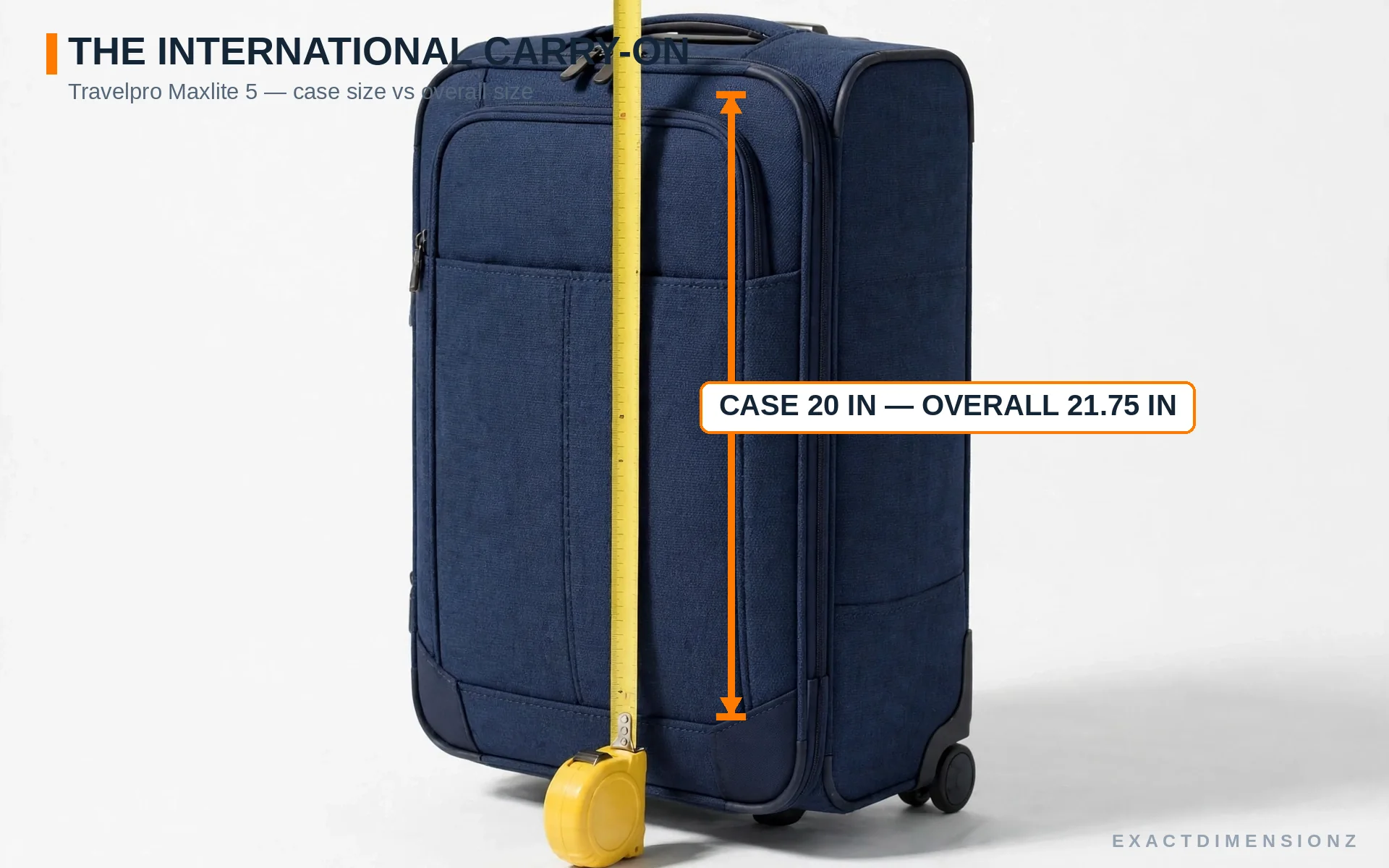
Admission: CASE MEASUREMENT — 20 in is the empty case’s height. Add the wheels and handles and the bag stands 21.75 inches.
Luggage is where twenty does its most consequential rounding, because this number argues with airport sizers. Travelpro is unusually honest about it: the product page for its Maxlite 5 International Carry-On Rollaboard publishes BOTH numbers — case dimensions 20 × 15 × 7.75 inches (the packing body alone) and overall dimensions 21.75 × 15.75 × 7.75 inches (wheels and carry handles included) — and then says the quiet part in plain text: “when airlines publish size limits they mean the overall size.” The “20-inch” in the bag’s marketing is the case height. The bag that meets the metal frame at the gate is a 21.75-inch object.
Keep the width in mind too, because a rival page for this keyword lists carry-ons as “20 inches wide” — wrong axis entirely. Widths on mainstream carry-ons run about 14–15.75 inches against airline limits built around 14 inches of width; the twenty belongs to the height column, and even there it belongs to the case, not the traveller’s reality. Admitted — as the article’s standing warning that a size printed on a tag is a starting point for questions, not an answer.
Source: Travelpro Maxlite 5 International Carry-On Rollaboard product page (travelpro.com).
11. The 16×20 Picture Frame
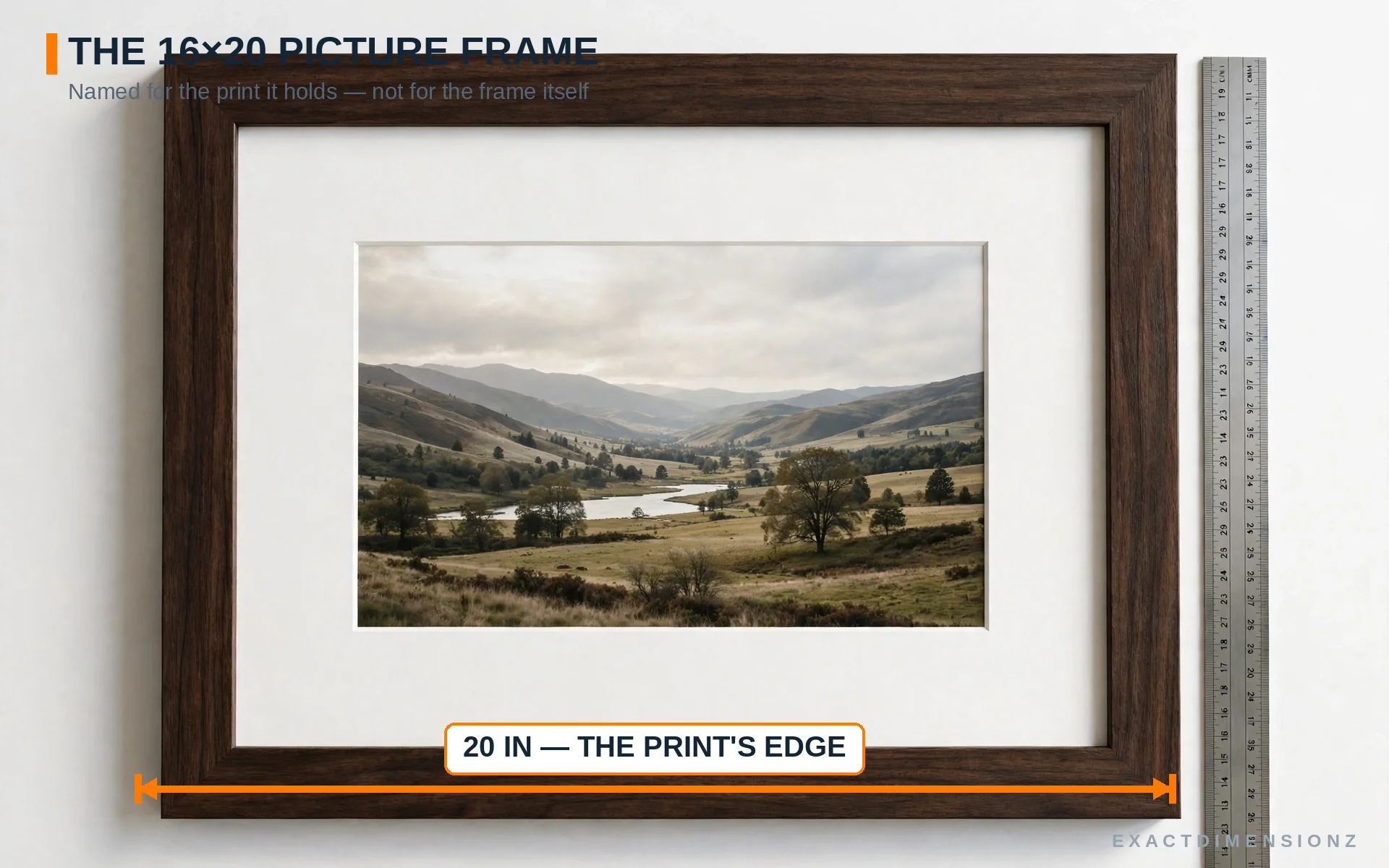
Admission: PRINT SIZE — the 20 belongs to the photograph. The frame’s outside is bigger; its window is smaller.
Walk into any frame shop and ask for a 16×20 frame, and nobody will measure a frame. Frame sizes name the print they hold — a convention so total that standard frame-size guides list “16×20” in a column of “print sizes,” right alongside 8×10 and 11×14. The 20 inches is the long edge of the paper, the glass and the backing board. The frame itself disagrees in both directions: the visible window is slightly LESS than 20, because the moulding’s lip overlaps the print’s edge by roughly a quarter inch on each side to hold it; and the outside of the frame is MORE than 20 — 20 plus twice the moulding’s width, which on a wide gallery frame adds two or three inches you will discover the first time you measure the wall space instead of the label. (It is also why a matted 11×14 print so often ends up in a 16×20 frame: the mat bridges the gap, and the “16×20” still describes the glass, not the art.)
A rival page claims a 16×20 frame “stands exactly 20 inches tall.” It stands 20 inches tall only if the moulding has no width, the lip has no overlap, and the print floats. Real frames are admitted here on honest terms: the twenty is real, standardised, and useful — it just belongs to the picture, not the wood around it.
Source: Standard picture-frame size guide (mefoto.com); frame-naming convention as practised by framers.
12. The 20-Inch “Mountain” Pizza
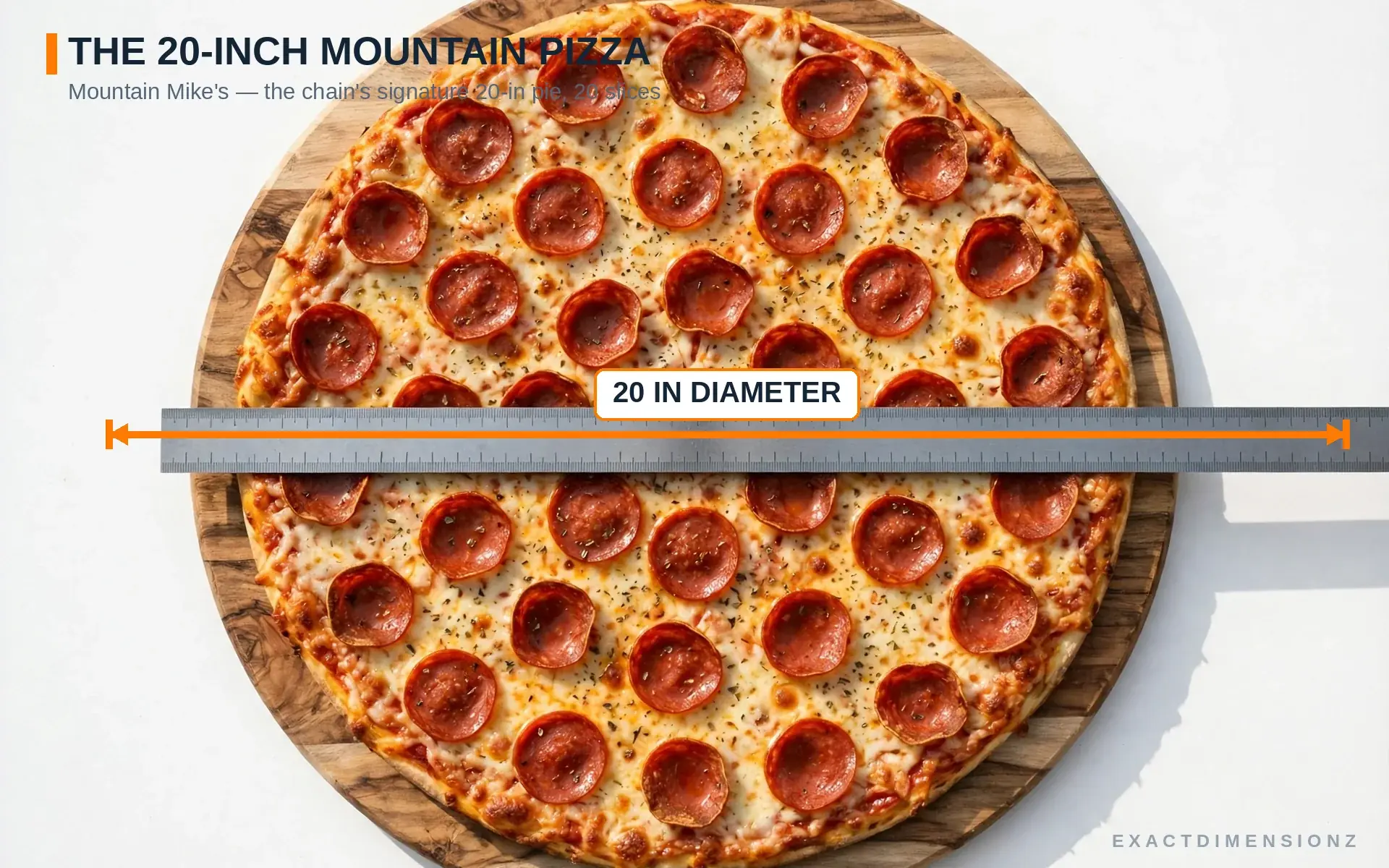
Admission: MENU DIAMETER — a made-to-order 20 inches across, from the chain that built its name on this size.
Pizza sizes are intentions: dough is portioned by weight and stretched by hand, so a menu size is a target the pizzaiolo aims at, not a machined dimension — an honest 20 within a fraction either way. Within that honest framing, the 20-inch pizza is a specialty giant. Most chains top out at 14–16 inches for a “large,” which makes the claim on one rival page — “a large pizza at most pizzerias measures 20 inches” — simply wrong. The real 20 lives at chains that stake their name on it, above all Mountain Mike’s Pizza, whose signature Mountain pizza is, in the company’s own words, a “massive 20-inch” pie with 20 slices that feeds six to eight people; the chain’s franchise announcements repeat the 20-inch Mountain as the brand’s centrepiece.
As a reference, it is the most delicious way to learn twenty: a circle wider across than the short side of your bed pillow, big enough to cover a café table and hang over the edges of the box it arrived in. Admitted as a menu diameter, with the handmade caveat printed where it belongs: on the ticket.
Source: Mountain Mike’s Pizza company releases (businesswire.com) — “20-inch Mountain” pizzas, 20 slices.
The Twenties You Wear and Are. The last two admissions: measurements that exist only on a body — one worn, one born.
13. The 20-Inch Matinee Necklace
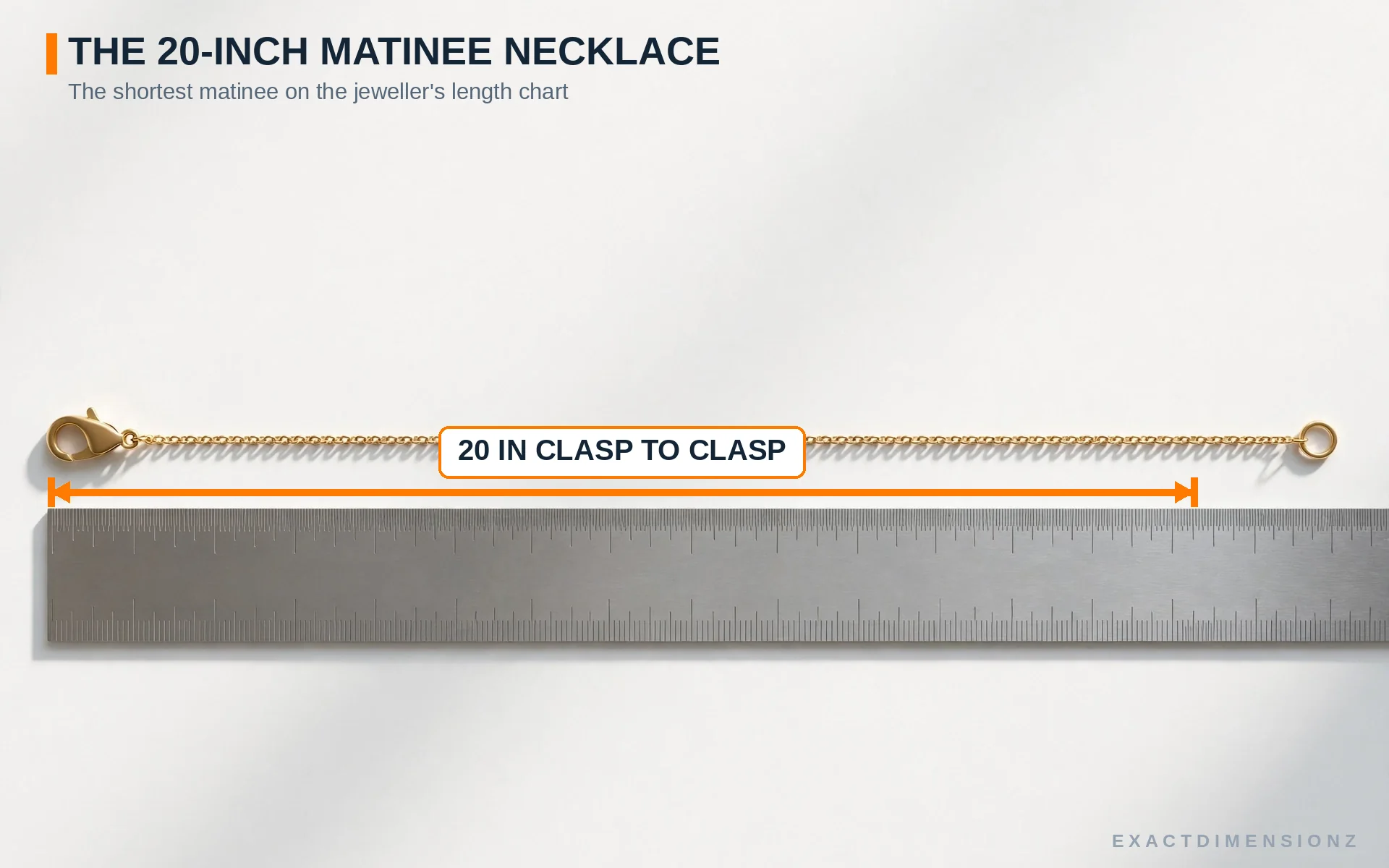
Admission: TRUE LENGTH, HALVED ON THE NECK — 20 inches clasp to clasp, which wears as a drop of about 10.
Jewellers sort chains by a ladder of named lengths, and the ladder is published: the Blue Nile necklace length chart runs collar (up to 14 in), choker (14–16), princess (18), matinee (20–24), opera (24–30) and rope (30+). A 20-inch chain is therefore the shortest matinee — the businesslike length that lands at or just above the bust — and its twenty is a true end-to-end measurement, clasp to clasp, the easiest kind to verify: unclasp it, lay it straight, read the ruler.
The fine print is geometry, not marketing. A worn chain is a loop, so its 20 inches divide between the fall down the chest and the rise up the back of the neck: the visible drop is roughly HALF the chain — about 10 inches from throat to pendant. The number on the tag and the number on the body differ by a factor of two, both honestly. If you are picturing twenty inches from a necklace, picture it straightened on the dresser, not hanging.
Source: Blue Nile necklace length chart (bluenile.com).
14. The Newborn

Admission: NEAR TWENTY — admitted as the world’s favourite rounded average. The measured median is a little under: 19.6 inches for boys, 19.3 for girls.
Every nursery wall and baby book in the English-speaking world agrees: a newborn is “about 20 inches long.” This is the only object in the article whose twenty comes from folklore rather than a spec sheet — and the folklore turns out to be a rounding, not an invention. The World Health Organization’s Child Growth Standards, built from thousands of measured babies, put the median length at birth at 49.9 cm for boys and 49.1 cm for girls — 19.6 and 19.3 inches respectively. Half of all newborns are longer than that, half shorter, and a healthy baby at exactly 20.0 is unremarkable — but the CENTRE of the distribution sits a third to two-thirds of an inch below the famous number. “Average 20 inches” is the world’s rounding, repeated until it fossilised.
The folklore matters because it is also the source of the SERP’s silliest error, waiting outside: a rival page gives “the average height of a 1-year-old” as approximately 20 inches. By twelve months the WHO median is 75.7 cm — 29.8 inches. A 20-inch one-year-old would be a medical emergency, not an average. The newborn keeps its place at this door — honestly labelled near-twenty, evidence attached — and the one-year-old stays outside with the other claims that never checked.
Source: WHO Child Growth Standards length-for-age tables (via MSD Manuals).
The Admissions Chart: Fourteen Twenties, Plotted Honestly
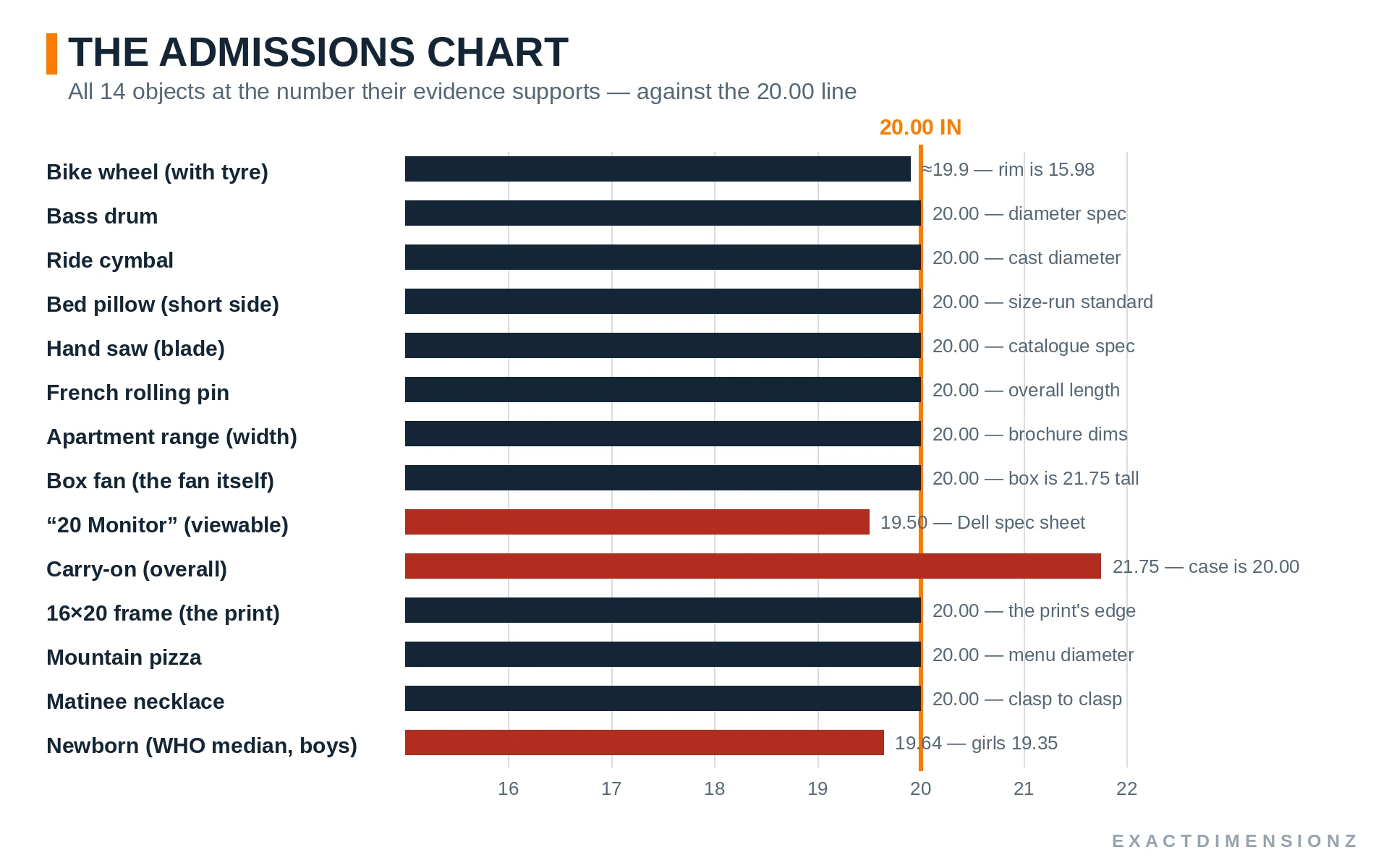
Read the chart as the article in one picture. Every object is plotted at the number its evidence supports — the measurement its admission line describes — against the 20.00 line. Ten objects sit on the line itself, because a standard, a spec sheet or a size run holds them there. Four sit off it, and those four are the education: the monitor at 19.5 viewable (the class rounds up), the newborn at 19.6 (the folklore rounds up), the bike wheel’s rim at 15.98 with its tyre bringing the assembly to ~19.9 (the standard measures a different circle), and the carry-on at 21.75 overall (the case measurement leaves the wheels outside). Nothing here is exposed as fake; everything here is exposed as specific. Twenty inches is not one size. It is a negotiation between a ruler and a label, and this chart is the treaty, signed in public.
Build Twenty Inches Yourself

No ruler long enough? Build twenty from things with published sizes — but build it with true totals, because this is the section where rival pages quietly stop doing arithmetic. Two of their favourite builds fail below, with the sums shown.
| Build | The sum | True total |
|---|---|---|
| A 12-inch ruler + the 8-inch edge of an 8×10 photo print | 12 + 8 | 20.00 in — DEAD ON |
| Six credit cards end to end (ISO card length 3.37 in) | 6 × 3.37 | 20.22 in — 0.22 OVER |
| Four standard soda cans stacked (4.83 in each) | 4 × 4.83 | 19.32 in — 0.68 SHORT |
| Three US bills end to end (6.14 in each, Bureau of Engraving and Printing) | 3 × 6.14 | 18.42 in — 1.58 SHORT |
| Two US letter sheets end to end (11 in each) | 2 × 11 | 22.00 in — 2.00 OVER |
| Two A4 sheets end to end (11.69 in each) | 2 × 11.69 | 23.38 in — 3.38 OVER |
| Your forearm and hand, heel to fingertip | varies by body | ~18–21 in — CANNOT BE VERIFIED |
The winner is the first row, and it is not close: a 12-inch ruler plus the short edge of an ordinary 8×10 photograph is exactly twenty — 8 inches carrying the ruler’s 12 home to the line, no remainder. The credit cards come second, and they expose a rival’s wording: six cards are called “almost 20 inches” on one page, but 6 × 3.37 is 20.22 — they do not fall short of twenty, they PASS it. The dollar bills run the other way: a bill is just past how long is 6 inches, so three of them strand you an inch and a half short, at 18.42 (the Bureau of Engraving and Printing publishes the note at 6.14 × 2.61 in — build with the real figure, not the folklore “about six”). And the paper builds close the case against carelessness: two letter sheets are not “pretty close to 20,” as one rival shrugs — they are 2 inches OVER it, and two A4 sheets are 3.38 over. In a section about a number, the sums are the content.
The Half-Metre Myth
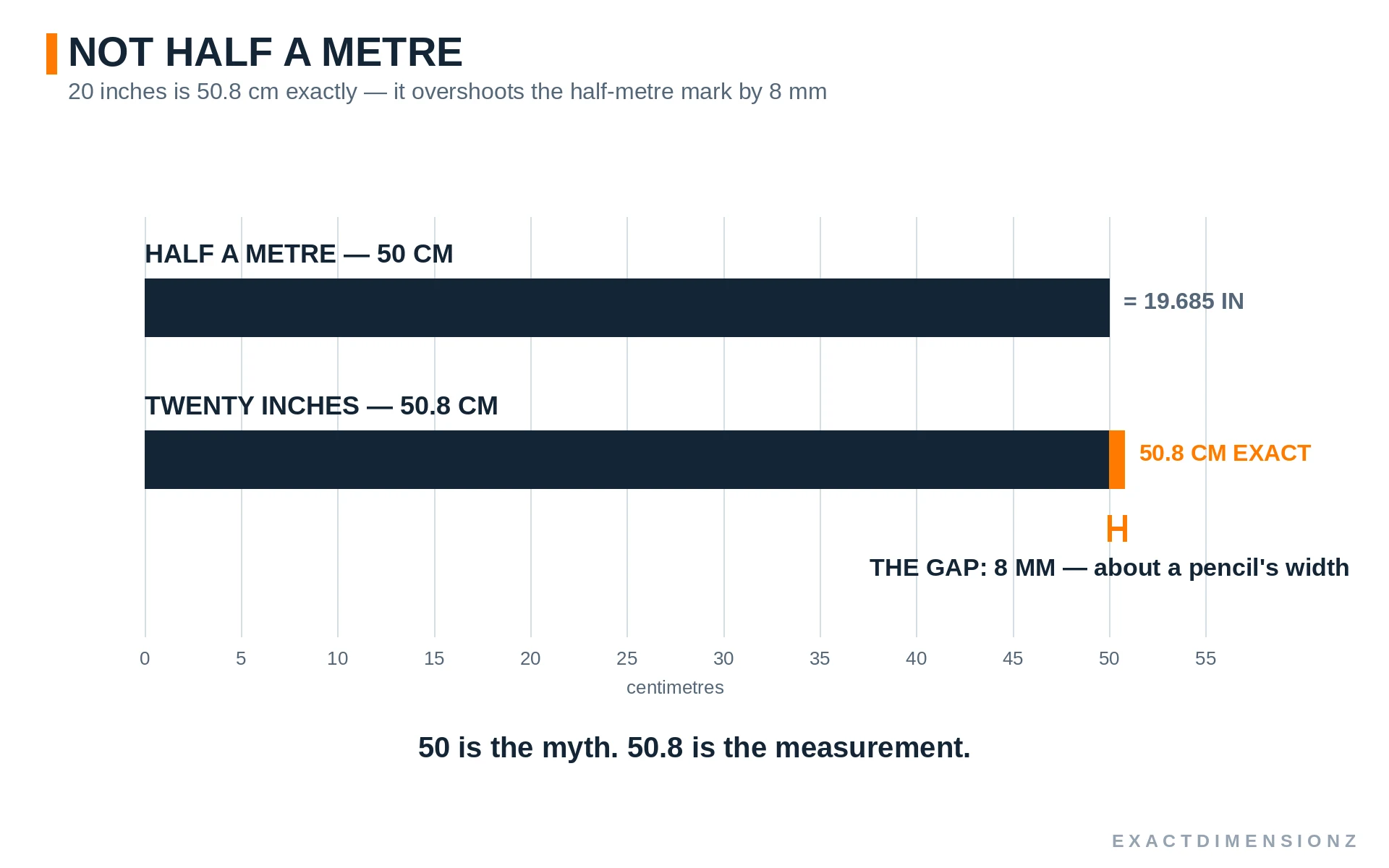
One myth deserves its own short section, because it is the first thing most readers believe about twenty: that 20 inches is half a metre. It feels right — 100 centimetres to the metre, 50 centimetres to the half, and 20 inches converts to 50.8, which LOOKS like 50 until you read the decimal. Run it the other way: half a metre, 50 cm, is 19.685 inches. Twenty inches overshoots half a metre by 0.8 centimetres — 8 mm of daylight between the two marks, about the width of a pencil. On a suitcase or a shelf board that gap is the difference between fitting and forcing. The inch is defined as exactly 2.54 cm, so the honest conversions never move: 20 in = 50.8 cm exactly, 508 mm exactly, 1.6667 ft rounded, 0.5556 yd rounded. Fifty is the myth; fifty-point-eight is the measurement. This article has used the exact figure throughout — including on the tape in the photographs, which reads 20 inches at the 50.8 cm mark, not at the 50.
Turned Away at the Door
Seven claims about 20 inches are all over the internet. None of them could show evidence at the door. They are listed here with the claim, the claimant’s error, and the figure that should replace it — starting with the largest error on the results page.
FLAGSHIP — the 20-inch parlor guitar (a measurement-take page). The claim: “parlor guitars typically measure around 20 inches in TOTAL length.” A parlor guitar is a small-bodied acoustic, but “small” is doing heroic work in that sentence: a parlor’s body alone runs roughly 18.5–19.5 inches, and the complete instrument — body, neck, headstock — measures about 36–39 inches end to end. The claim is short by some 18 inches, nearly the length of the guitar again. It is the single biggest measurement error on this keyword’s results page, and it survives because nobody pictured the object: a 20-inch guitar would be a ukulele with ambitions. The 20 inches was not measured, classed or rounded. It was invented.
The 20-inch laptop (a dimensions-chart page). The claim: 20-inch laptop screens are “commonly found in high-performance gaming laptops.” No such laptop exists in any current maker’s line-up — the largest gaming laptops on sale are 18-inch class machines, and laptop panels top out around 18 inches altogether. Twenty-inch screens are real, but they live on desks: all-in-one PCs and monitors like the Dell “20 Monitor” admitted above — which is itself 19.5 inches viewable. The claim took a desktop class, shrank it into a laptop bag, and presented the result as a category.
The microwave that is “20 inches tall” (the same chart). Countertop microwaves stand about 11–13 inches tall; the ~20-inch figure in their listings is the WIDTH class. Wrong axis — the same error the carry-on makes in reverse. A 20-inch-tall countertop microwave would not fit under a standard kitchen cabinet, which is precisely the constraint the real dimensions evolved around.
The 1-year-old who is “approximately 20 inches” (a measure-by page). The WHO median at twelve months is 29.8 inches. The claim appears to have misread newborn statistics as toddler statistics — an error of nearly 10 inches, pointed out in the newborn’s section above. Twenty inches is where human length STARTS, roughly; it is nowhere near where a one-year-old stands.
The A4 build that “comes close to 20” (the same page). The claim’s own sums refute it: two A4 long edges are 23.4 inches, “add half of another” gives 29.25 inches, and the page still calls that “pretty close to 20.” It is off by 9.25 inches — nearly half the target again. The same page offers “four and a half banknotes ≈ 20 inches”: 4.5 × 6.14 = 27.6 inches. When a build’s arithmetic is wrong by a third, the build is not a shortcut; it is a rumour with numbers in it.
The carry-on that is “20 inches wide” (from a rival list). Carry-on twenties live in the HEIGHT column — case height, as Travelpro’s own dimensions showed above — while widths run 14–15.75 inches. A 20-inch-wide carry-on would be rejected by every sizer in the airport. The page also lists a “toddler bicycle frame — 20 inches”: as the bike wheel’s section explained, children’s bikes are sized by wheel, not frame. Two axis errors in one list is a pattern, not a slip: the page collected twenties first and asked what they measured later — exactly backwards from this door.
The 20-inch hand trowel (the same rival chart again). Garden hand trowels run about 11–13 inches total, handle included — they are one-hand tools, scaled to a grip and a wrist. A 20-inch “hand trowel” would be a small spade wearing a trowel’s name. No maker, model or measurement is offered for the claim, because none exists to offer.
Twenty, Earned
Fourteen objects are inside, and the door tells you what twenty inches finally is: not a length but a claim, which survives or falls on its evidence. Sometimes the evidence is a standard — a 406-millimetre rim, a 20×26 pillow — and the number is bedrock. Sometimes it is a class, honest in the fine print and inflated in the name. Sometimes it is a folk rounding that turns out, when the growth charts open, to be nearly true. You now own the strongest twenties there are: a pillow’s short side in your own bedroom, a bass drum’s shell, a ruler plus a photograph that sum to the number dead-on, and the knowledge that twenty is fifty-point-eight, not fifty. The next time a box, a listing or a listicle tells you something is 20 inches, you know the only question that matters — twenty WHAT, measured how, and says which document? Ask it at every door.
