
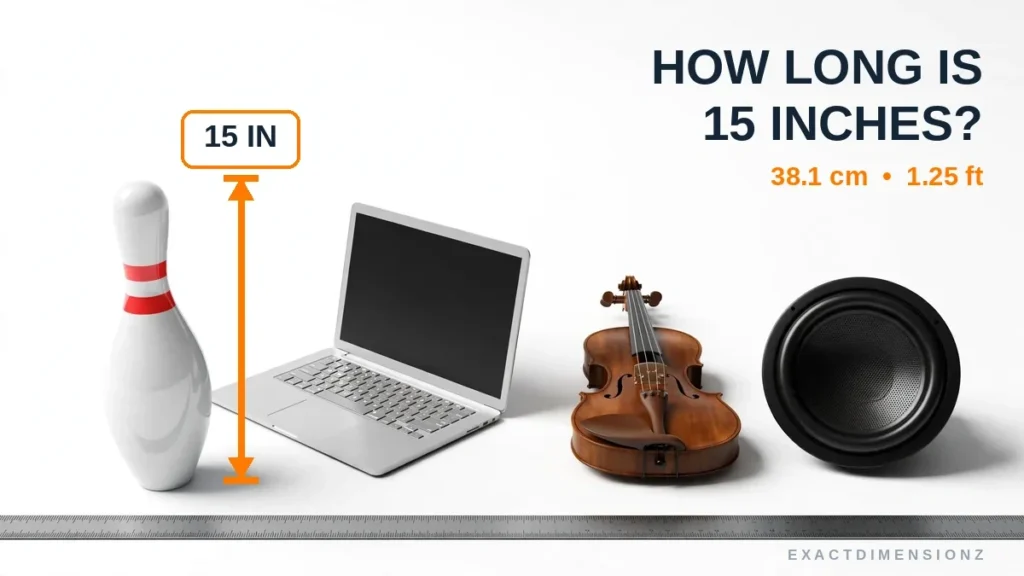
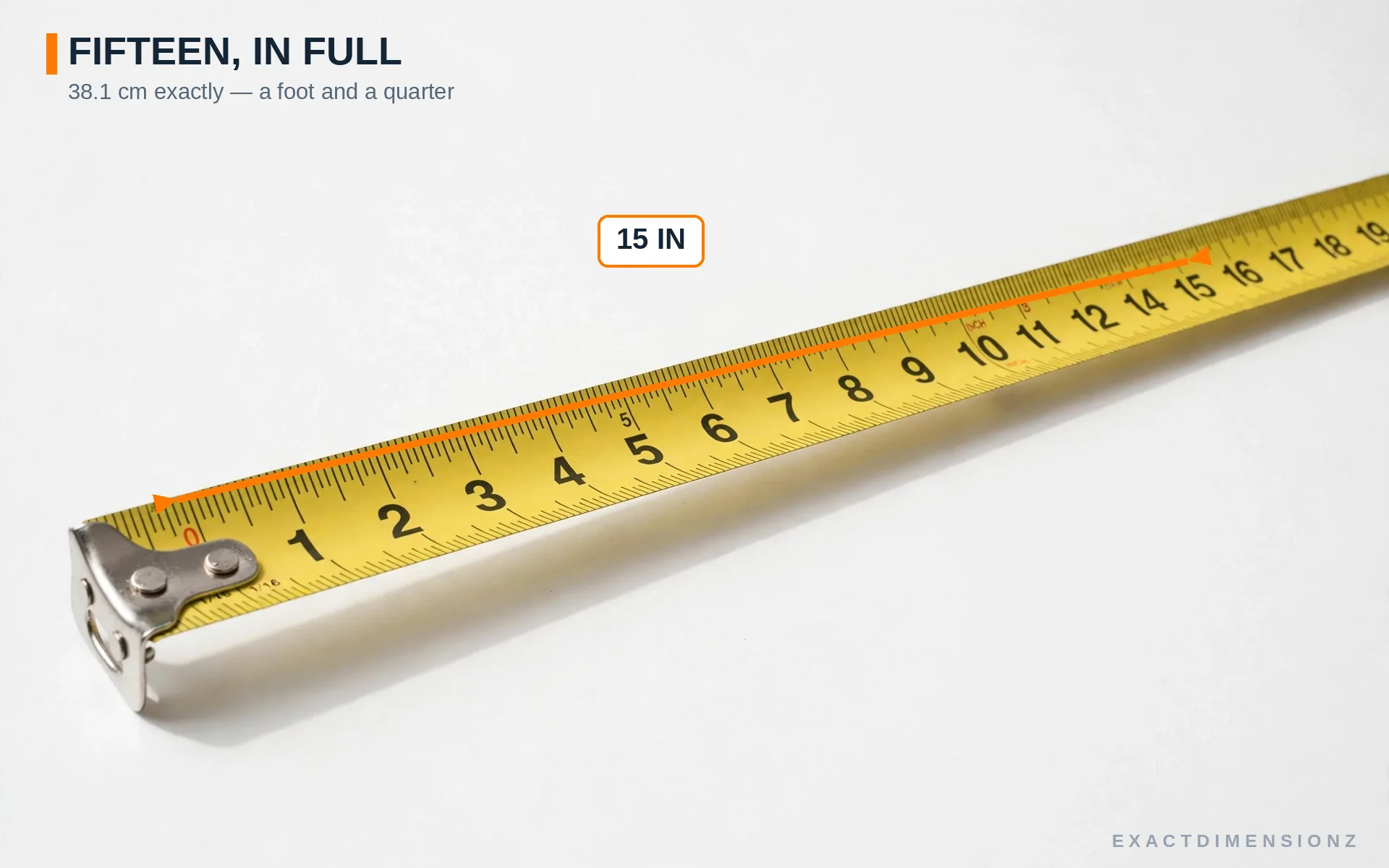
How long is 15 inches? It is a foot and a quarter — the full twelve inches of a school ruler, plus three more that run off the end of it. Fifteen inches is exactly 38.1 centimeters, and it hides in more places than you would expect: it is the regulated height of the pins at the end of a bowling lane, the body size of an orchestra instrument, and the number printed on laptop boxes by the million. It is also one of the most loosely claimed sizes in everyday life. A “15-inch” laptop is not 15 inches wide, long, or — usually — even 15 inches across its screen. So this article does something the others don’t: it grades ten references by their margin — the signed distance between the claim and the verified measurement. Every object below carries its margin, its grade, and the source behind the number, picking up one inch past how long is 14 inches. The complete inches size guide puts fifteen in context with every size from 1 to 100.
How long is 15 inches?
15 inches is exactly 38.1 centimeters — one foot, plus three inches. It is the regulated height of a bowling pin, the body length of a 15-inch viola, and the diagonal name on millions of laptops. Here is the short version before we start grading margins:
Screen rulers aren’t true to size — this is a visual guide. Calibrate against a regulation bowling pin (built to 15.000 in), a 15-inch viola body, or a 12-inch ruler plus a 3-inch span, which makes exactly 15.
Why Fifteen Always Comes With a Margin
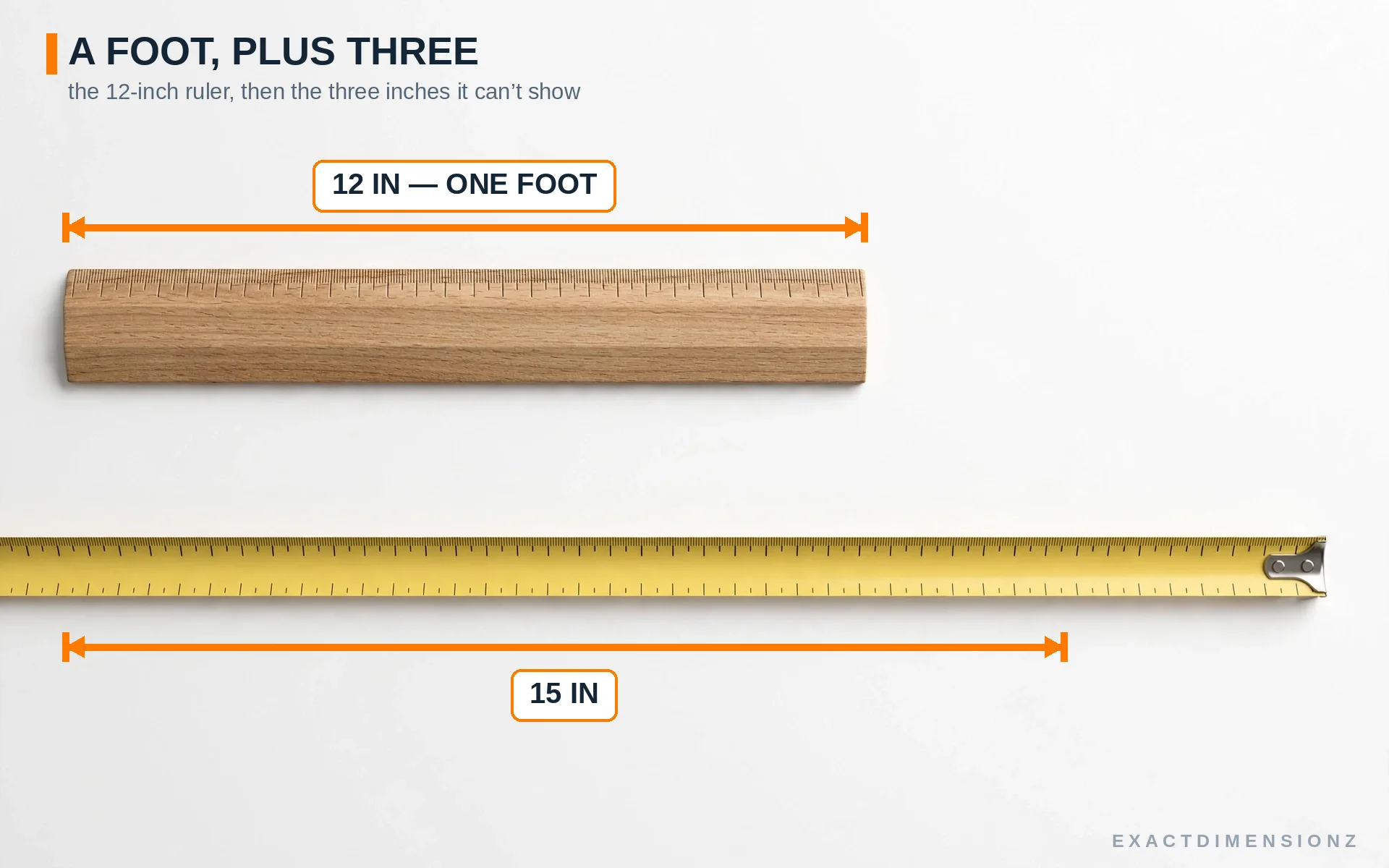
Twelve inches is a unit. Fifteen inches is an overflow: the foot itself, plus 3 inches more. Nobody’s ruler stops at fifteen, no unit is named after it, and almost nothing is manufactured to it — instead, fifteen is a number that products are called. Laptop classes are called 15. Subwoofers are called 15. Pillows are called 15. And a class name, unlike a specification, is allowed to drift.
That drift is the whole story of this length. Sometimes the name undershoots the object: a “15-inch” subwoofer’s frame actually measures 15.2 inches across. Sometimes it overshoots: three soda cans stacked in the hope of making fifteen come up half an inch short. And sometimes — rarely, and usually where a rulebook is involved — the name and the measurement agree to within a few hundredths of an inch. So instead of a flat list of things that are “about 15 inches,” this article sorts its ten references into margin bands: dead on, just over, just under, and nowhere near — with the verified number, and its source, attached to each one.
Dead On: margin zero. Three references land on 15.00 — each for a completely different reason.
1. The Bowling Pin
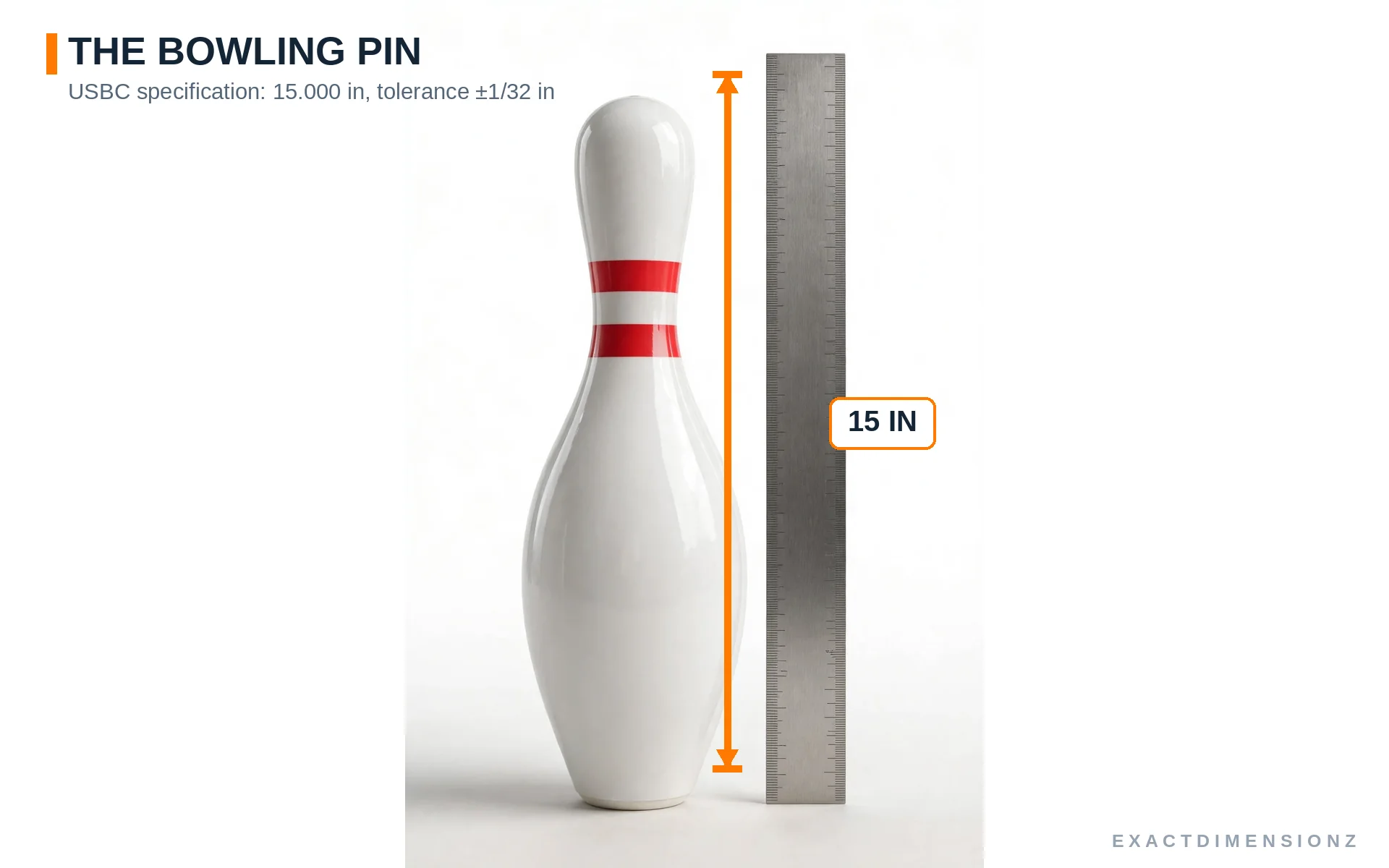
Margin: ±0.03 in — dead on, by rulebook.
The strongest reference on this list is standing at the end of every bowling lane in the country. The United States Bowling Congress equipment specifications set the height of a tenpin at a target of 15.000 inches, with a permitted manufacturing tolerance of ±1/32 inch — a legal pin may stand anywhere from 14.969 to 15.031 inches tall. You can read the figures yourself in the USBC Equipment Specifications Manual, which also caps the pin’s widest diameter at 4.766 inches, measured 4.5 inches above the base — for a feel of that width, see how long is 4 inches.
That tolerance matters, because it corrects two of the most confident claims on the internet. One leading competitor page states that a bowling pin is 15 inches with “zero tolerance for variation”; another insists it is “exactly 15 inches… no exceptions.” Both are wrong, and the rulebook proves it in one line: 15.000 is the target, and ±1/32 inch is the published margin around it. The pin still earns the top spot here — no other everyday object is held this close to fifteen by a written, enforced standard — but it earns it honestly: dead on, give or take three-hundredths of an inch.
2. The 15-Inch Viola
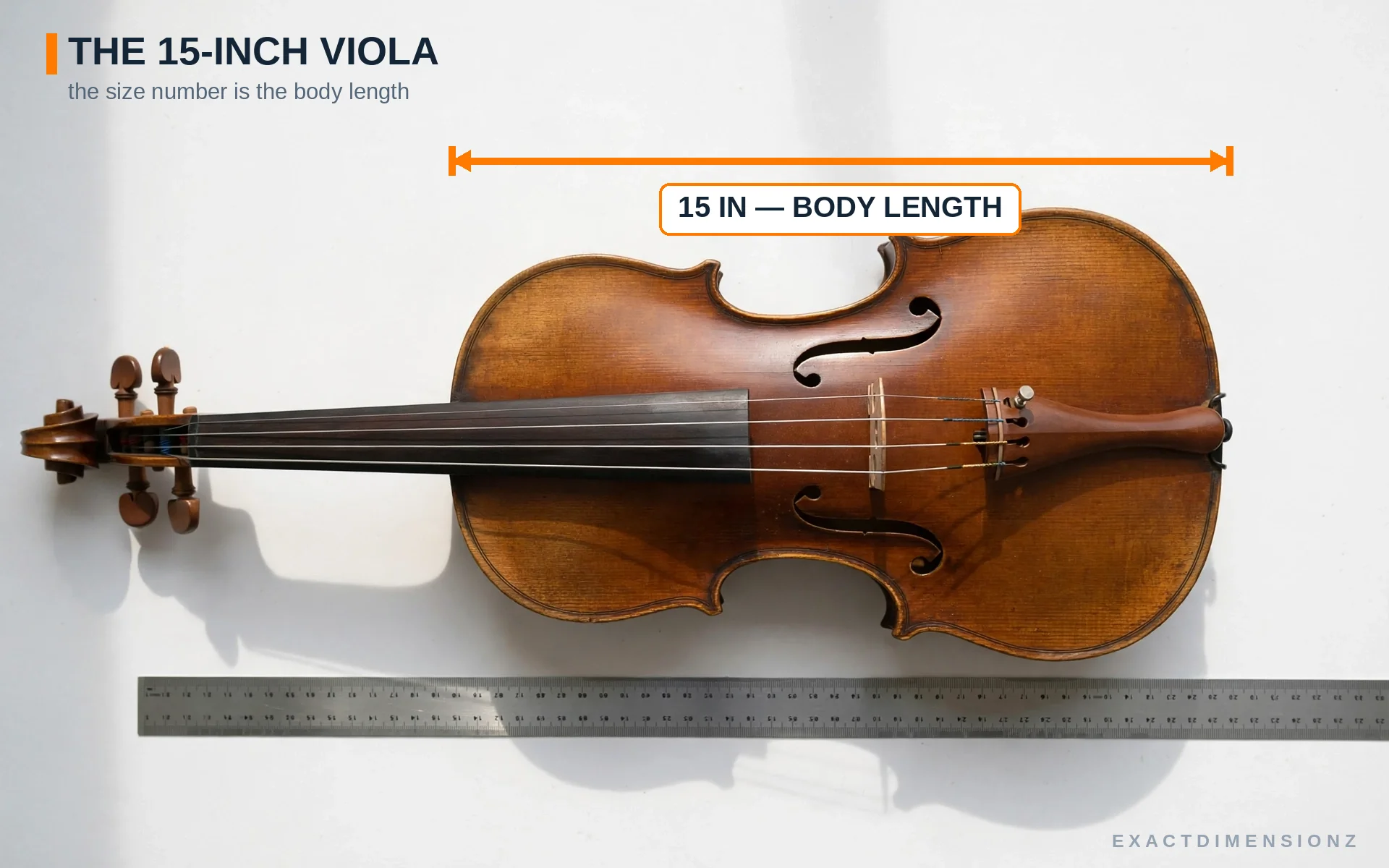
Margin: 0.00 in — dead on, by sizing system.
Violas are the odd members of the string family: violins are sized in fractions (4/4, 3/4, 1/2), but violas are sized in inches, and the inch figure is a real measurement — the length of the instrument’s body, measured along the back. A “15-inch viola” is a viola whose body is 15 inches long. Specialist string shops publish the sizing system openly; KC Strings’ instrument sizing guide, for example, matches a 15-inch viola to players whose neck-to-palm arm measurement runs about 25.5 to 26.25 inches.
Two cautions keep this reference honest. First, the 15 inches is the body only: with neck and scroll, the whole instrument runs roughly 25 inches long, so the number names a part, not the total. Second, handmade and factory instruments vary by small amounts around the nominal size — a luthier’s “15-inch” body may measure 14.9 or 15.1. Within the sizing system, though, the claim is a genuine measurement rather than a marketing rounding, which is more than most entries on this list can say.
To verify one yourself, measure the back: lay the tape along the flat rear of the body, from the edge beside the neck heel to the bottom edge, skirting the raised button in the middle. Measuring over the arched front instead adds the arch’s height to your reading and can flatter the figure by a quarter-inch — the viola world’s own small version of the diagonal trick the laptops below pull. Measured properly, back and flat, a 15-inch viola gives you a wooden, varnished, four-stringed fifteen you can tune.
3. The Surface Laptop’s Screen
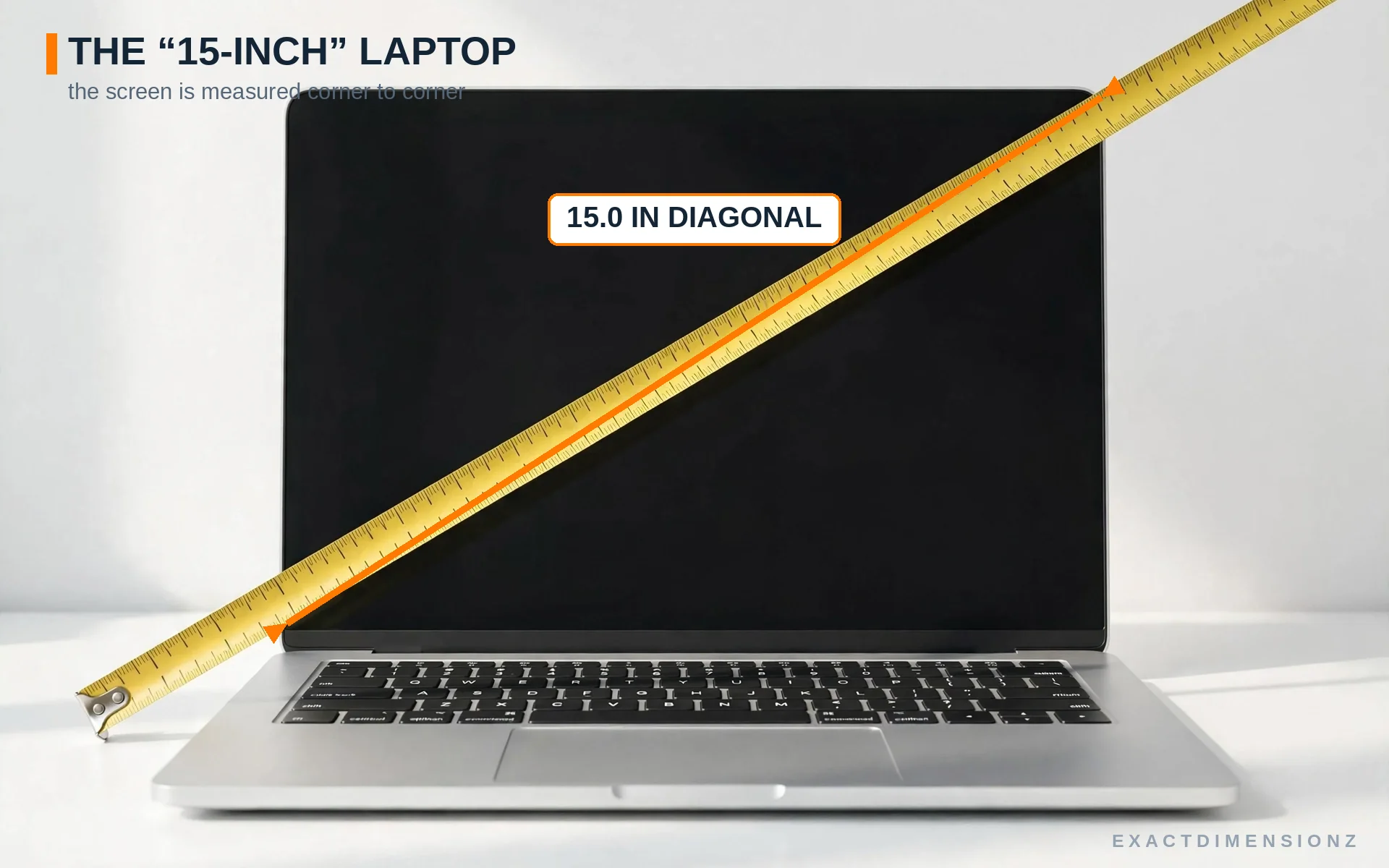
Margin: 0.00 in — dead on, but only on the diagonal.
Here is a laptop that keeps its promise — in exactly one direction. Microsoft’s Surface Laptop in its 15-inch version carries a display specified at exactly 15.0 inches, as Microsoft’s own Surface Laptop 5 spec sheet confirms. But screen sizes are diagonals: corner to corner, not width, not height. The same spec sheet gives the machine’s body as 13.4 inches long and 9.6 inches wide — there is no direction in which the laptop itself is 15 inches except across the glass.
The Surface is the exception, not the class. Apple’s “15-inch” MacBook Air has a 15.3-inch diagonal display, and the mainstream Windows “15-inch” class is built on 15.6-inch panels; a typical 15.6-inch machine like Dell’s Inspiron 15 measures about 14.11 inches wide (358.5 mm, per Dell’s published specifications). That is why competitor claims that these screens are “exactly 15 inches” — or worse, that a 15-inch laptop is 15 inches wide — collapse on contact with the manufacturers’ own numbers. Grade the Surface screen dead on, and everything else in the laptop aisle as listed-at.
The Margin Chart
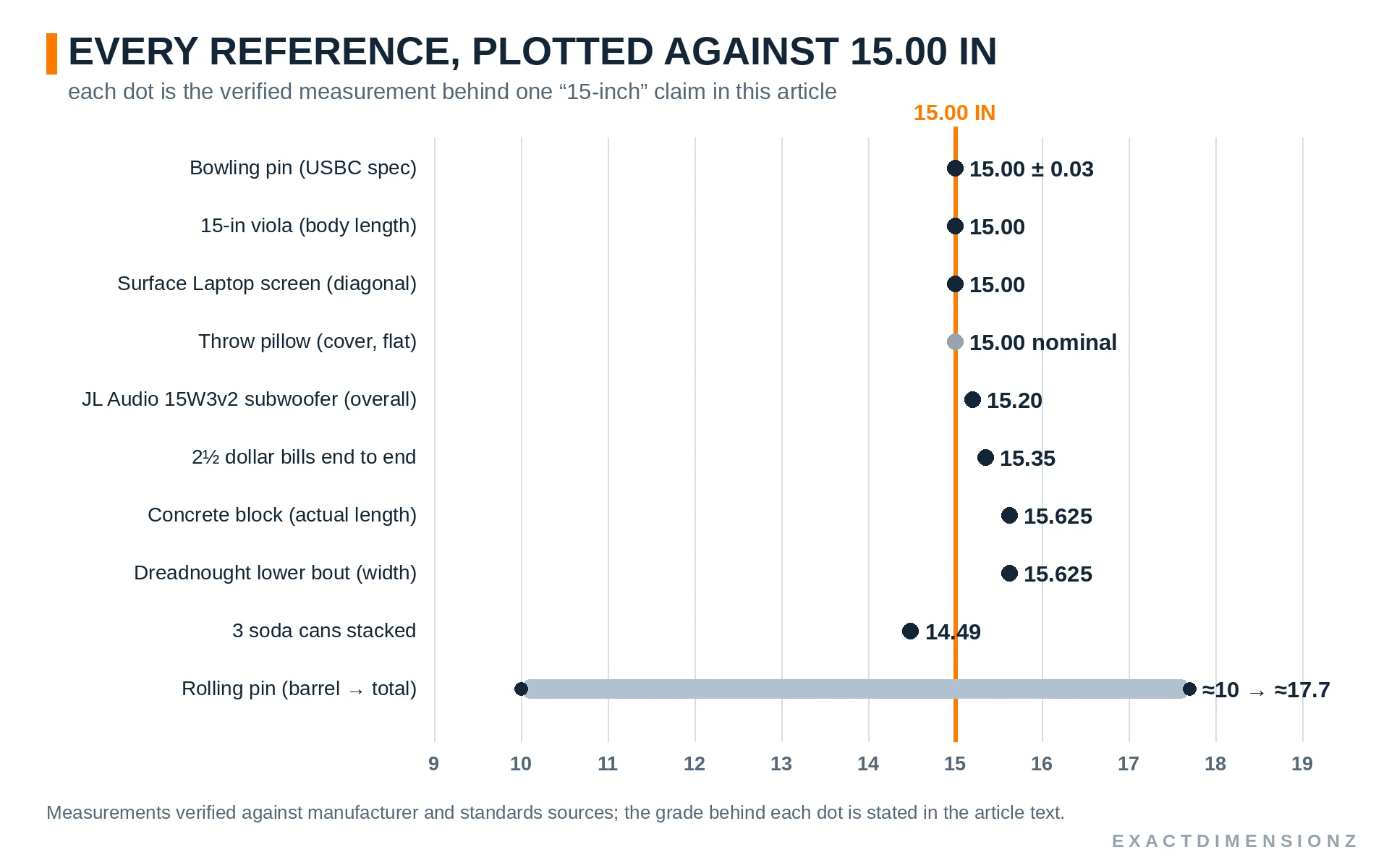
Before the overshoots, here is the whole article on one scale. Every reference in this piece is plotted against the 15.00 line at its verified measurement — the three dead-on references stacked on the line itself, the just-over group drifting right by two- to six-tenths of an inch, the soda cans falling short on the left, and the rolling pin sprawled across nearly the whole chart, because 15 inches is a number it manages to miss at both ends. Keep this picture in mind: “15 inches” in the wild means anywhere from 14.49 to 15.63 — unless a rulebook is holding it down.
Just Over: +0.20 to +0.63 in. Four references clear fifteen honestly — by being a little more than it.
4. The 15-Inch Subwoofer
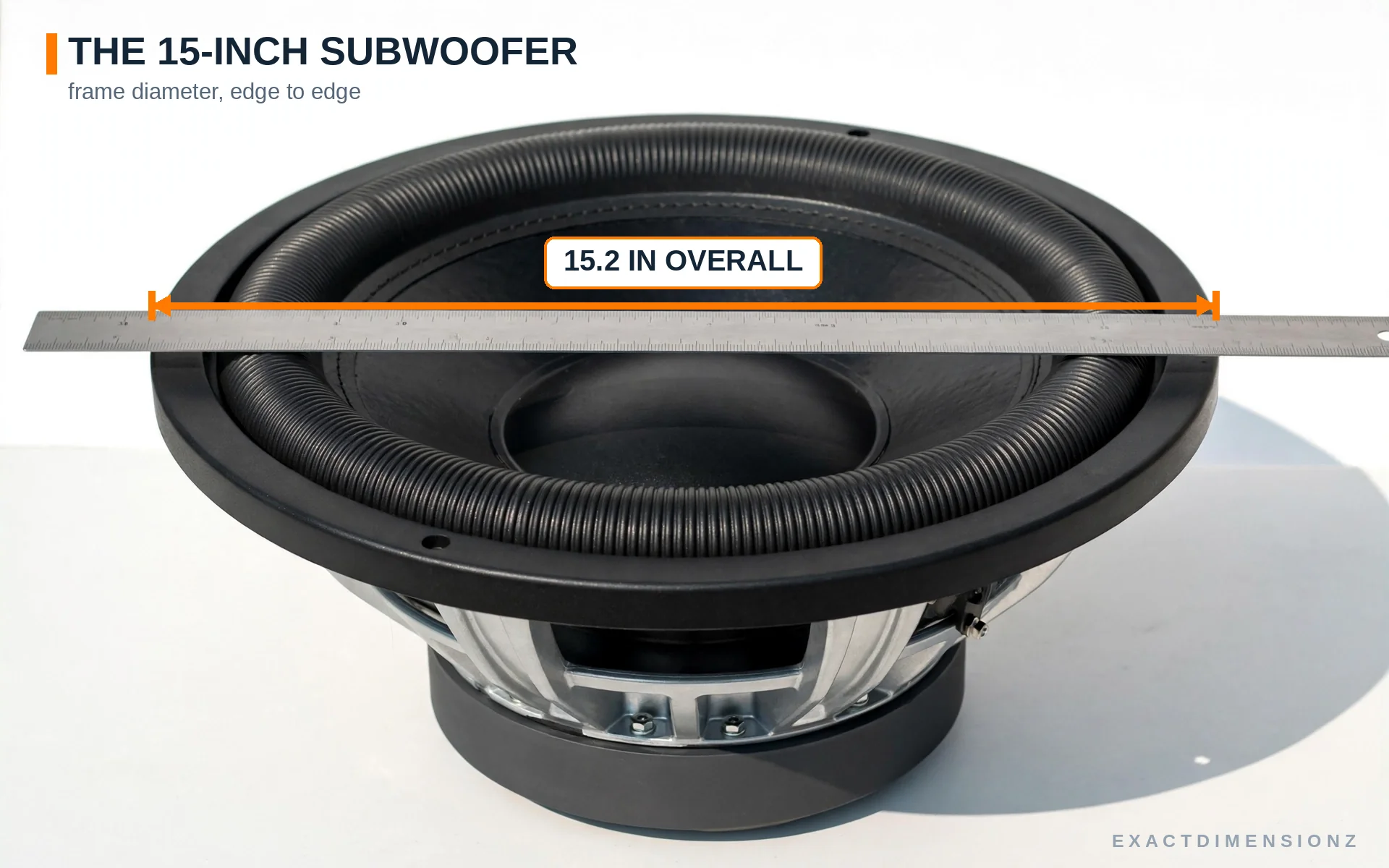
Margin: +0.20 in overall — and −1.13 in where it mounts.
Car audio sizes its subwoofers by “nominal diameter,” and JL Audio’s manuals show exactly what that politeness hides. The 15W3v2’s manual — JL Audio’s own document, hosted on the server of its parent company, Garmin — lists a nominal diameter of 15 inches (381 mm), an overall diameter of 15.2 inches, and a mounting hole diameter of 13.875 inches. One product, three different “sizes,” all printed in the manufacturer’s manual.
None of the three numbers is a lie; they measure different things. The frame really is 15.2 inches edge to edge. The hole you must cut to install it is 13.875 inches — comfortably more than 11 inches, and more than an inch under the name on the box. If you are visualizing fifteen inches, picture the subwoofer’s full frame and then shave off a fifth of an inch. If you are cutting a panel for one, forget fifteen entirely and use 13.875.
5. Two and a Half Dollar Bills

Margin: +0.35 in — built, not labeled.
Every US bill, whatever its denomination, is printed to the same dimensions: 6.14 inches long by 2.61 inches wide, per the Bureau of Engraving and Printing. A bill is therefore a pocket ruler that runs just past how long is 6 inches — and bills multiply cleanly. Two bills end to end make 12.28 inches. Add half of a third bill (3.07 inches) and the row totals 15.35 inches: a third of an inch over fifteen, and honest about the overshoot.
As a reference, the bill row has a rare virtue: it is verifiable anywhere, because the underlying unit is a government specification rather than a product claim. It is not the most precise way to land on fifteen — the build-it section below has an exact combination — but it is the best one that lives in a wallet, and its margin is printed right on the image: 15.35, not 15.
6. The Concrete Block
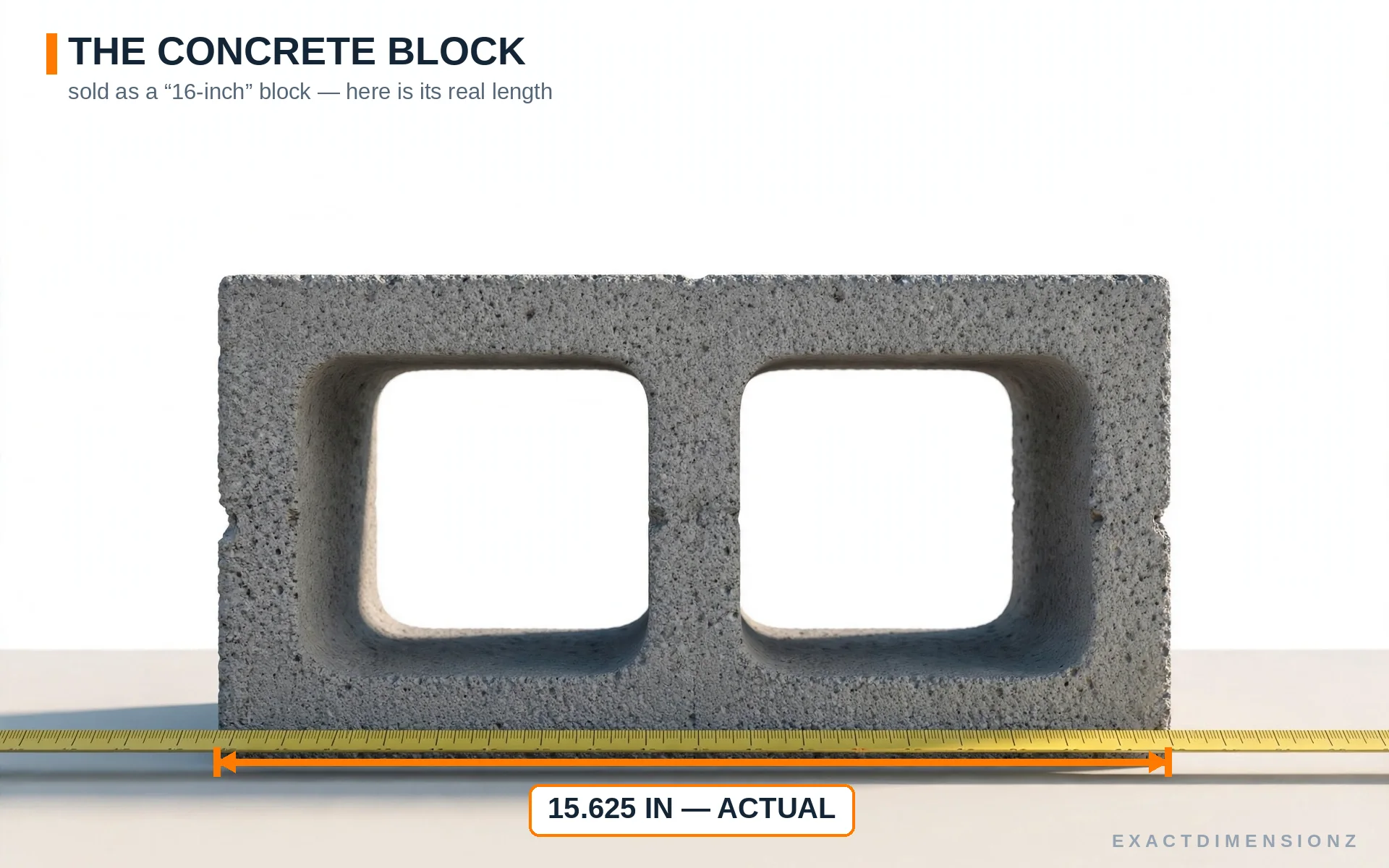
Margin: +0.625 in over fifteen — and −0.375 in under its own name.
The standard concrete masonry unit is sold as an “8 × 8 × 16” block. Measure one and every dimension comes up 3/8 of an inch short: the block is actually 7.625 × 7.625 × 15.625 inches long. This is not sloppy manufacturing — it is the system working as designed. Masonry is planned in nominal dimensions that include one standard 3/8-inch mortar joint, so the block is deliberately made undersize and the joint restores the module: 15.625 + 0.375 = exactly 16 inches in the finished wall, as masonry dimension references such as this CMU dimensions guide lay out. The sizing system itself is governed by the ASTM C90 standard.
For this article, the block is a double agent. Against its own label it runs under — a “16-inch” block that isn’t. Against fifteen it runs over by five-eighths of an inch: stand one on a garage floor and you are looking at 15.625 inches of gray concrete, the joint-largest overshoot on this list. If you remember one thing about nominal sizes, make it this block: the name describes the space the object occupies in a system, not the object.
7. The Dreadnought’s Lower Bout
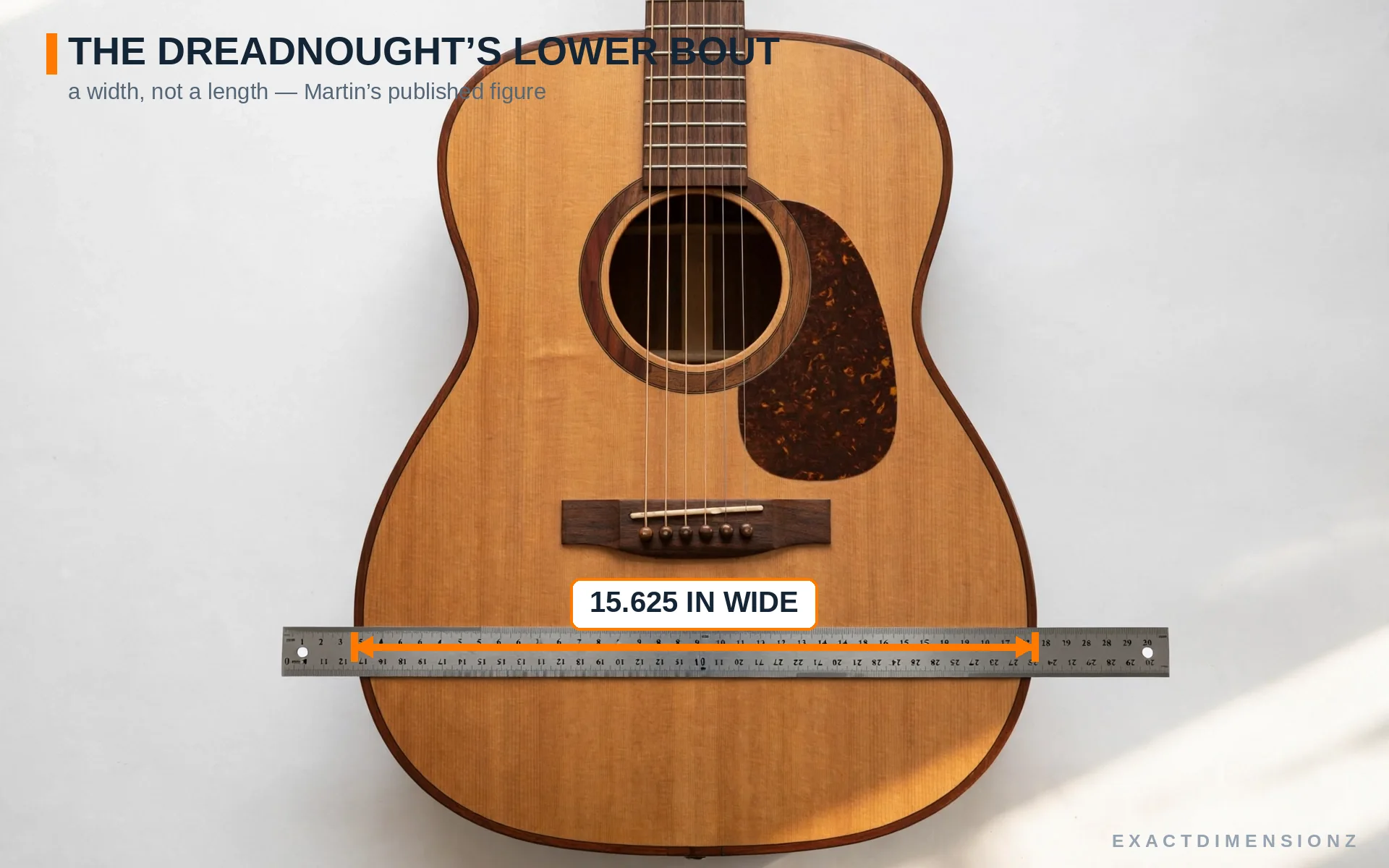
Margin: +0.625 in — a width wearing a length’s clothing.
Guitar dimensions trip up more listicles than any other entry here, because a guitar has several lengths and only one famous number. Martin’s own D-28 specification page lists the dreadnought’s body at 19-7/8 inches long, with an upper bout of 11-13/16 inches and a lower bout of 15-5/8 inches — 15.625 inches, the widest point of the body, measured side to side. That is the only dimension on the instrument anywhere near fifteen, and it is a width.
Which is why the claim floating around competitor pages — that a guitar’s “body length” is about 15 inches — is wrong in an instructive way: it takes the one 15-ish number on the spec sheet and attaches it to the wrong axis. A dreadnought laid flat is nearly twenty inches long; across its hips it is 15.625. Picture a guitar’s lower bout and you have an honest 15.6-inch reference — and, by pure coincidence, exactly the same overshoot as the concrete block above: two industries, one identical margin of +5/8.
Just Under: −0.51 in. One reference reaches for fifteen and falls half an inch short.
8. Three Soda Cans, Stacked

Margin: −0.51 in — the stack that doesn’t reach.
The standard North American 12-ounce can is an industry-standardized object: 4.83 inches tall and 2.6 inches in diameter. Stack three of them and the arithmetic is unavoidable: 3 × 4.83 = 14.49 inches. That clears 13 inches without effort — and stops a full half-inch short of fifteen. (In practice a real stack reads a hair less still, because each can’s domed base nests slightly into the rim below.)
This entry exists because a widely-read competitor page stacks the same three cans and lands on “roughly 15 inches” — using a can height of 4.96 inches that no standard can has. Feed a wrong unit into a stack and the error triples: 3 × 4.96 = 14.88 looks close to fifteen, while the true 14.49 does not. Half an inch is the difference between a reference and a rumor, and it is exactly the size of error that stacking multiplies.
Nowhere Near: the two that aren’t. One skips fifteen at both ends of itself; one is fifteen only on its tag.
9. The Rolling Pin
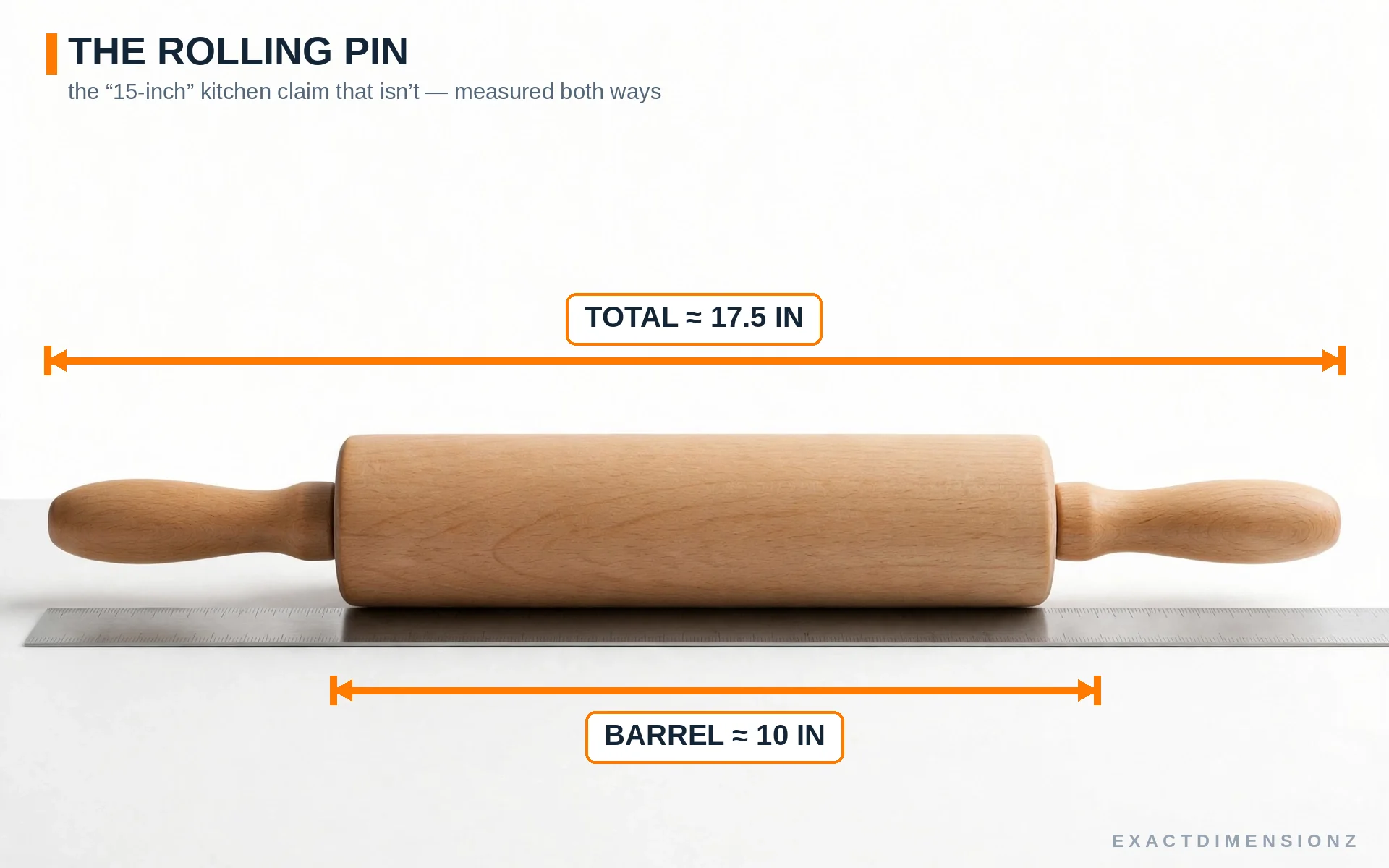
Margin: −5 in at the barrel, +2.5 in and more at the tips. Fifteen is the one length it isn’t.
A competitor page on this keyword claims the roller part of a rolling pin measures “15 to 17 inches.” Pull a classic handled pin out of a kitchen drawer and measure it both ways: the barrel — the part that touches dough — runs about 10 to 10.5 inches, and the whole pin, handle tip to handle tip, runs about 17.5 to 19 inches (a common Farberware hardwood pin, for instance, is specified at 17.7 inches overall). Fifteen inches matches neither measurement. It is a number that sounds plausible for a rolling pin and describes no part of one.
The French-style pin makes the same point from the other direction: with no handles, the entire pin is barrel — Pampered Chef’s tapered French pin is specified with a 17-inch barrel. So across the two great pin families, the barrel is either ~10 inches or ~17–20 inches, and the handled total is ~17.5–19. If a reference list tells you a rolling pin is your 15-inch yardstick, it has measured nothing at all.
10. The 15 × 15 Throw Pillow

Margin: 0.00 in on the tag — negative on the couch.
Close the list with the softest claim of all. A pillow sold as “15 × 15 inches” is describing its cover, measured flat, empty, and seam to seam. That is a real convention, not a scam — but it means the number belongs to a piece of fabric, not to the plump object on your sofa. Stuff the cover and the filling redistributes: the corners stay near the seams while the faces bow outward, and a tape pulled across the stuffed pillow’s middle typically reads an inch or more under the tag size, while corner to corner on the diagonal it spans about 21 inches.
Used with its grade stated — sold as 15 — the pillow is still a handy reference: flatten it, measure seam to seam, and you have your fifteen. Used naively, tape across the bulge, it will tell you your shelf is shorter than it is. It is the gentlest possible summary of this entire article: the number is fine, as long as you know what it was measured on.
Build Fifteen Yourself
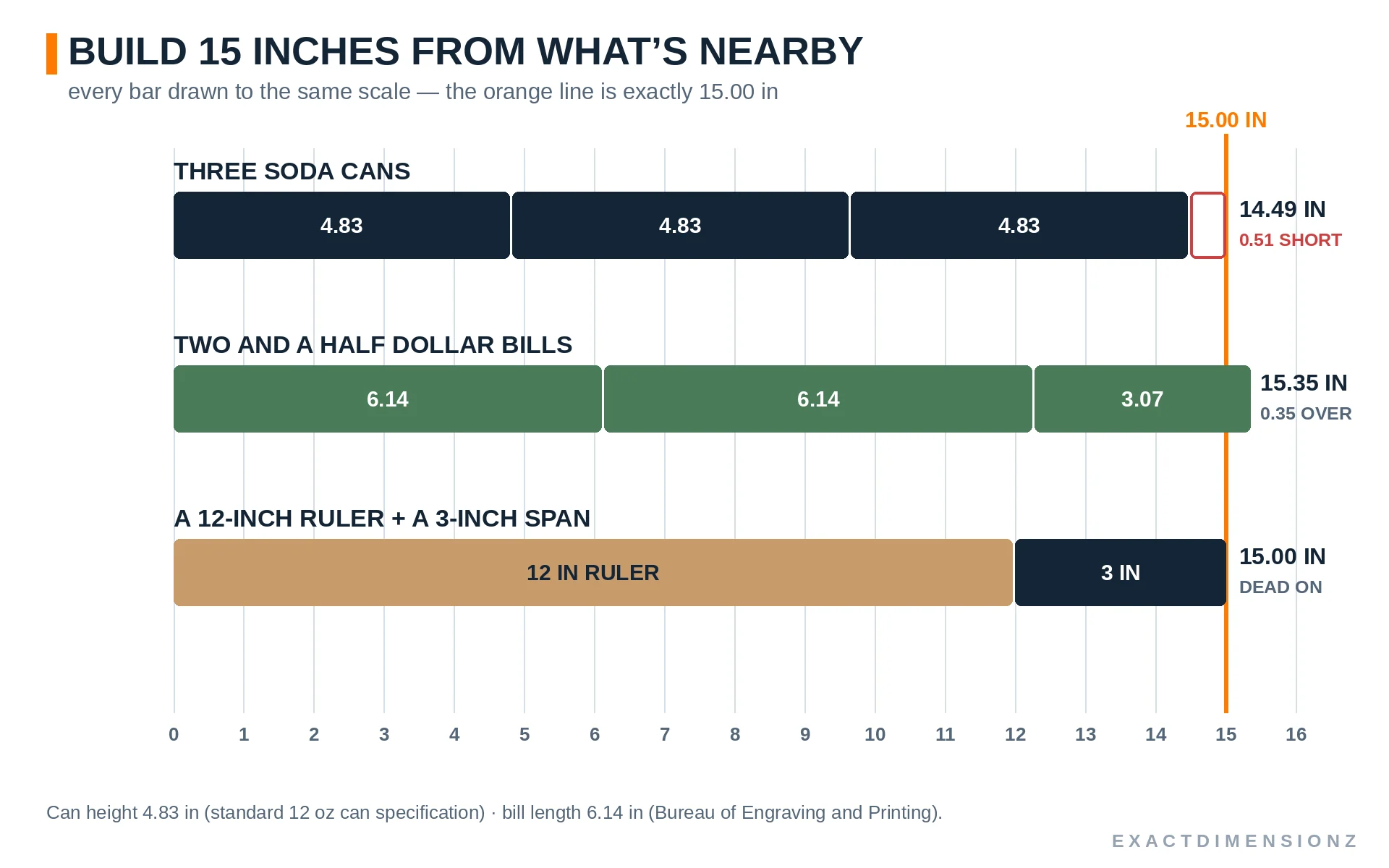
No bowling alley or music shop within reach? Fifteen can be assembled from household stock, and the chart above shows the three honest builds at one scale. The exact build is the simplest: a 12-inch ruler plus any true 3-inch span — one 8-inch span and one 7-inch span laid end to end make the same fifteen by addition. The wallet build (two and a half bills, 15.35) overshoots by a third of an inch. The fridge build (three cans, 14.49) undershoots by half an inch. Know which side of the line your build lands on, and by how much, and you know more than most pages on this keyword will tell you.
One popular shortcut deserves a warning label: the hand span. Stretched thumb-to-pinky, an adult hand spans roughly 8 to 9 inches, which makes “two hand spans” a tempting fifteen — it isn’t. Two average spans total 16 to 18 inches, overshooting by one to three inches, and hands vary enough that the error is unknowable without measuring the hand itself first. A span is a fine way to estimate a single span’s worth; as a fifteen-inch reference it carries the worst margin in this article. Use the builds above instead — their margins are printed on the chart.
The Corrections Desk
Four claims circulate on the top pages for this keyword. All four fail against primary sources, and all four are corrected by objects above. One: a bowling pin is 15 inches with “zero tolerance” — the USBC manual allows ±1/32 inch around its 15.000 target. Two: three soda cans make “roughly 15 inches” — only if a can were 4.96 inches tall; the standard can is 4.83, and the stack is 14.49. Three: a rolling pin’s roller measures 15 to 17 inches — the handled barrel is about 10, and 17-plus is the tip-to-tip total. Four: 15-inch laptop screens are “exactly 15 inches” wide or across — the name is a diagonal class size that runs 15.0 (Surface), 15.3 (MacBook Air), or 15.6 (the Windows mainstream), and no part of any of those machines is 15 inches wide. Each correction is sourced in its section above.
Fifteen, Give or Take
Fifteen inches is exactly 38.1 centimeters, exactly 1.25 feet — and, in the wild, a claim that deserves one follow-up question: fifteen what, measured where, with what margin? Where a rulebook answers (the bowling pin, ±0.03), or a sizing system answers (the viola’s body), or a spec sheet answers (the Surface screen’s diagonal, the subwoofer’s honest 15.2), fifteen is a length you can stand on. Where only a label answers — a pillow tag, a laptop class, a rolling pin that was never measured — the margin is yours to supply. Keep the graded references from this page, and fifteen stops being a rumor with good posture. It becomes a number you can prove, give or take exactly as much as stated. A step up to 16 inches is just one inch longer.
