
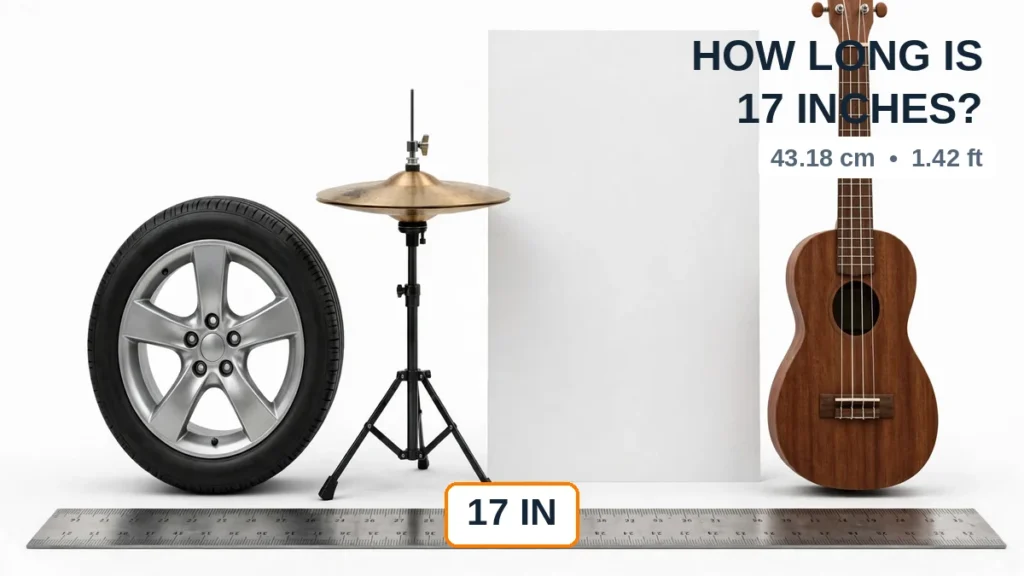
How long is 17 inches? Unroll a tape and it is 43.18 centimeters exactly — but ask the internet and you will be handed a stack of near misses wearing the number as a costume: coffee pods that add up to 16.5, quarters measured with somebody else’s ruler, a paper-towel roll that grew six inches in the telling. So this article takes one tape on a nine-stop journey — a tech bench, a garage, a kennel, a concert hall, a print shop, a tailor’s counter and a windshield — and at every stop it does what the other pages don’t: it audits the label. Each of the nine objects below carries a Tape Check line: what the label claims, what the verified figure actually is, and a grade — VERIFIED, STANDARD, CLASS NAME or NOMINAL — with the source behind the number. It begins one inch past how long is 16 inches, and it begins with a warning: seventeen is the most rounded-up number in the size aisle, and the rounding starts early — the Corrections Desk at the end names six claims that fail. From here, the tape runs one inch longer.
How long is 17 inches?
17 inches is exactly 43.18 centimeters. But the honest answer depends on what the label measured: a “17-inch” gaming laptop hides a 17.3-inch diagonal screen in a body about 15.5 inches wide, while a tabloid sheet’s long side is a true, standardised 17. Here is the short version before the tape comes out:
Screen rulers aren’t true to size — this is a visual guide. Calibrate against a tabloid sheet’s long side, a size-17 collar laid flat, or two Letter sheets side by side, which make exactly 17.
Why Seventeen Hides Better Than Any Other Number

Seventeen has three disguises, and you will meet all of them on this trip. The first is the class name: a family of products sold under the number while individual members measure something else — the laptop at Stop 1 is the biggest repeat offender in modern retail. The second is the hidden measurement: a real seventeen that lives somewhere you cannot see it, inside a tire, under a string, around a neck — accurate, but useless as a visual until someone tells you where it is. The third is the rounded neighbour: 16.5, 16.92 and 17.5 all appear on rival pages for this keyword dressed as 17, because seventeen is just awkward enough — a foot plus five inches, 8 inches twice plus one — that writers reach for the nearest stackable object and round. This article refuses all three shortcuts. Every stop states its figure to the decimal where a decimal exists, grades the label out loud, and links the source the figure came from. Nine stops, one tape, no rounding.
A word about the grades themselves, because they are the article’s real tool. VERIFIED means a standard, a spec sheet or a rule defines the figure and the object is made to it — the grade carried by the wheel’s bead seat and the tabloid’s long side. STANDARD means an official body publishes the figure as the target for a living or hand-made thing, where individuals vary around it — the Basenji’s grade. CLASS NAME means the number names a family whose members scatter around it, sometimes by a lot — the laptop’s grade, and the most common grade in modern retail. NOMINAL means a fitment or module size, held close by manufacture but defined as a class rather than a promise — the wiper blade’s grade, and the most honest of the four, because it never claimed to be anything else. Read any size label in any shop with those four grades in mind and you will know, before you ever reach for a tape, how much trust the number has earned.
Stop 1 — The Tech Bench
1. The “17-Inch” Gaming Laptop
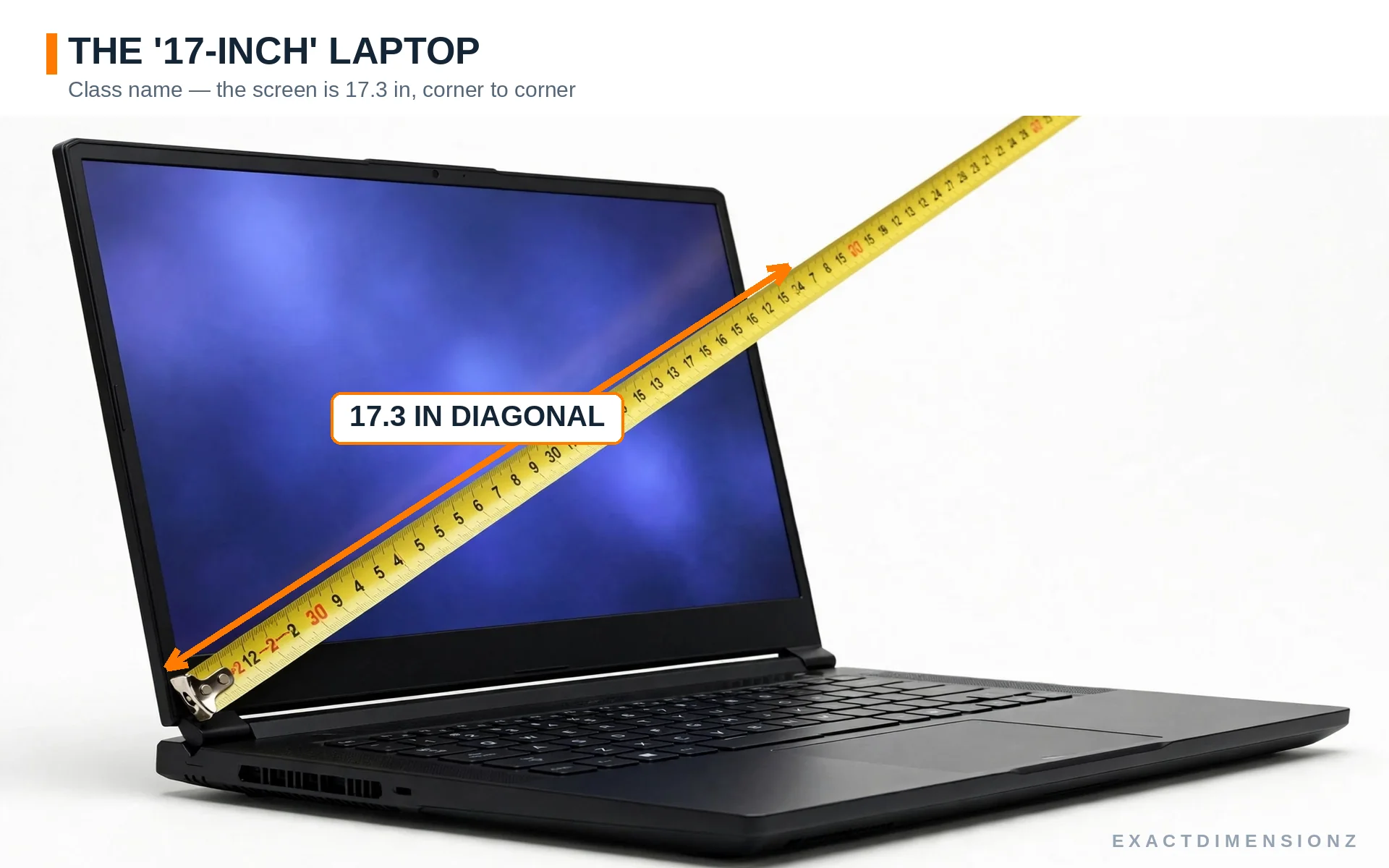
Tape Check: label says 17 — the screen is 17.3 in on the diagonal and the body is about 15.5 in wide. Grade: CLASS NAME.
The journey starts with the most misleading seventeen in everyday life. When ASUS sells the ROG Strix G17, the “17” in the name is a size class, and ASUS’s own specification gives the panel as a 17.3-inch display — measured, as all screens are, corner to corner on the diagonal. The machine underneath it is roughly fifteen and a half inches wide. So a “17-inch laptop” contains no seventeen you can point at: not the width (about 15.5), not the depth (about 11), and not even the screen, which overshoots to 17.3. The class name is a shelf label, not a measurement.
Does that make it a bad reference? No — it makes it a diagonal reference with a correction attached. Picture the corner-to-corner sweep of that big gaming display and you are picturing 17.3 inches, which is genuinely close to seventeen and feels like it across a desk. Just grade it the way this article grades it: if someone asks you to show them 17 inches and you open a G17, say “seventeen-point-three, diagonally” and you will be the most honest person in the room. The rival pages for this keyword cannot even manage that much: one of them describes laptop screens as ranging “from 13 to 15 inches in width, measured diagonally” — a sentence that confuses width with diagonal in its first breath — and the Corrections Desk returns to it.
Source: ASUS ROG Strix G17 specifications (rog.asus.com) — display 17.3 in diagonal.
Stop 2 — The Garage
2. The 17-Inch Car Wheel

Tape Check: label says 17 — the rim’s bead-seat diameter is 17.00 in; the whole wheel and tire stand roughly 28 in tall. Grade: VERIFIED, but hidden.
In the garage the tape finds the opposite problem from the laptop: a seventeen that is exact, standardised — and invisible. When Toyota fits the RAV4 LE with 17-inch steel wheels and P225/65R17 tires, as Toyota’s pressroom release describes, the “17” in that tire code is the diameter of the rim at the bead seat, the ledge the tire bead locks onto. It has to be exact: any 17-inch tire must mount any 17-inch rim, so the interface is held to tight industry tolerances. It is the most trustworthy seventeen on this whole trip.
It is also the least visible. Read the rest of the tire code and the wheel outgrows its label fast: a 225/65R17 has a sidewall 65% as tall as its 225 mm tread width — about 5.75 inches of rubber above the rim and the same below — so the complete assembly stands roughly 28.5 inches tall. Hold a tape against a RAV4’s wheel and you will measure twenty-eight and change; the seventeen is a steel circle sealed inside, doing its work unseen. As a visual reference, then, use it the way the Tape Check grades it: picture the rim behind the spokes, not the tire around it. The laptop oversold its number; the wheel undersells its size. Between the two stops, you have already met both ways a label can mislead without lying.
Source: Toyota pressroom (pressroom.toyota.com) — RAV4 LE on 17-inch steel wheels, P225/65R17 tires.
The tire code rewards one more look, because it is the rare label that grades itself. Everything about a P225/65R17 is printed on the sidewall in the open: 225 millimetres of tread width, a sidewall 65% as tall, radial construction, and the 17-inch rim it fits. A reader who learns the code never needs an article like this one for wheels again — the seventeen’s hiding place is announced in the same breath as the seventeen itself. Compare that with the laptop at Stop 1, whose spec sheet and name tell two different stories in two different places, and you have the difference between a label designed for the person fitting the part and a label designed for the person browsing the shelf.
Stop 3 — The Kennel
3. The Male Basenji
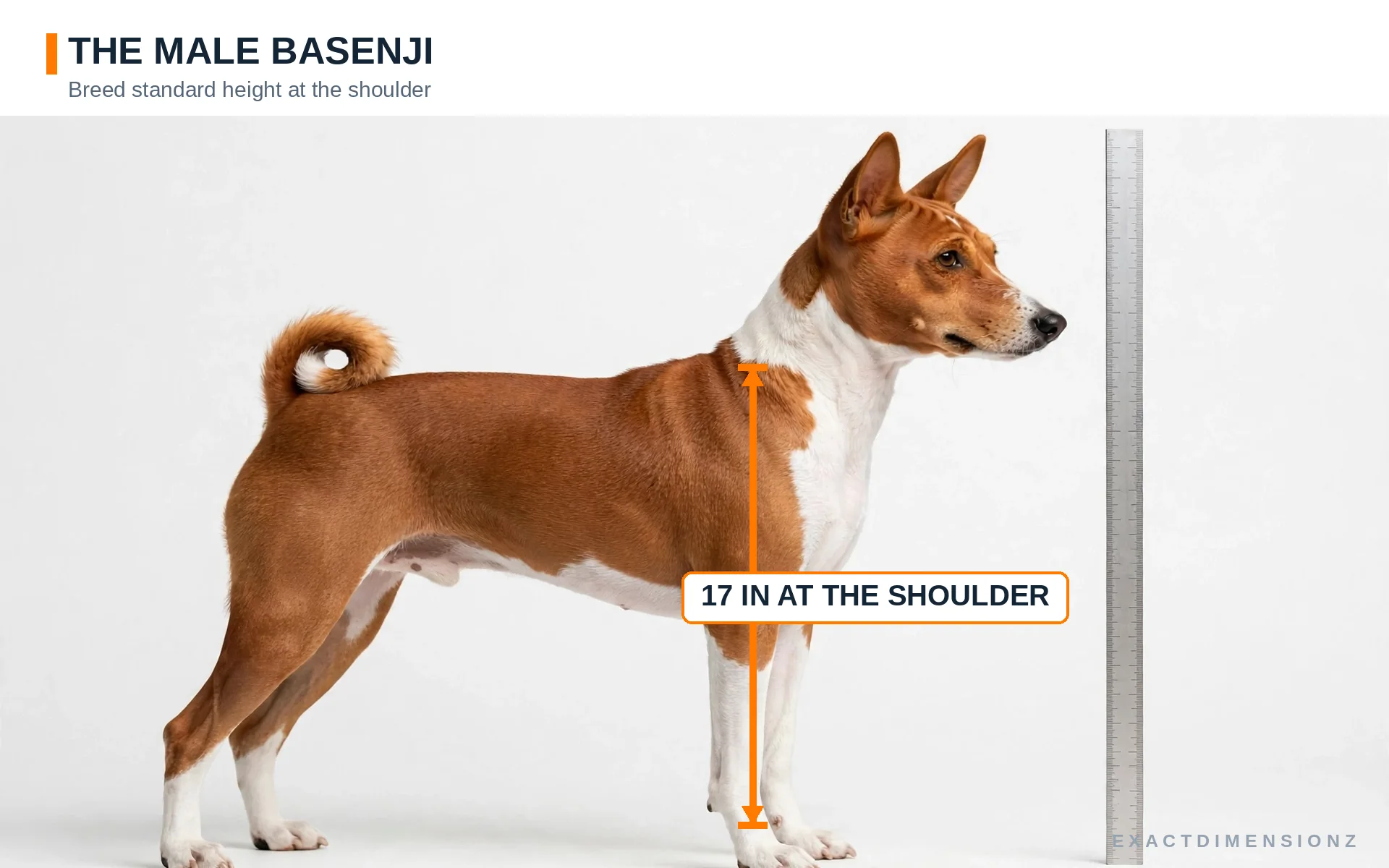
Tape Check: label says 17 — the breed standard’s ideal height for a male is 17 in at the shoulder, about 24 lb. Grade: STANDARD — a target set by the standard, not a guarantee per dog.
The third stop is alive. The Basenji, Africa’s barkless dog, is measured the way horses are: vertically, from the ground to the top of the shoulder blades — the withers. The American Kennel Club’s breed page describes a compact hunter whose males stand an average of 17 inches at the shoulder and weigh about 24 pounds, with females an inch shorter at 16. That makes the male Basenji a walking seventeen: a dog whose breed standard is written around exactly the height this article is hunting.
Grade it honestly, though, because a living measurement is a different species of number from a machined one. A rim is manufactured to its seventeen; a dog is bred toward it. Individual Basenjis scatter around the standard — a half-inch over or under is a real dog, not a defective one — and the measurement itself depends on a standing dog, a level floor and a steady hand on the wicket. So the Basenji’s Tape Check grade is STANDARD: the seventeen is the breed’s official target, published by its registry, and as a visual reference it is superb — a small, elegant dog exactly as tall at the shoulder as your tape’s 17-inch mark. Just never cite a dog the way you’d cite a rim. One of them holds still for the calipers.
Source: American Kennel Club breed standard summary (akc.org) — males average 17 in at the shoulder, ~24 lb.
Stop 4–6 — The Concert Hall
4. The 17-Inch Viola

Tape Check: label says 17 — the body length (back, excluding neck and scroll) is 17 in. Grade: VERIFIED — the largest standard viola size.
Into the concert hall, where three of our nine sevens live — and the viola is the grandest of them. Violas are not sized like violins, by fraction; they are sized by the length of the body itself, measured over the back from beside the button to the bottom edge. The British Viola Society’s sizing guide explains the system: medium violas run 16 to 16.5 inches, small ones down to 15, and large ones reach toward 18 — and StringWorks’ size guide puts the full range at 13 to 17 inches, with most adults on 15.5 to 16.5. A 17-inch viola is therefore the top of the standard range: a big instrument for a tall, long-armed player, prized because a larger body speaks with a deeper, darker voice closer to the viola’s ideal.
The seventeen here is a craftsman’s measurement, and it behaves like one. It names the body only — add the neck and scroll and the whole instrument runs well past 25 inches — and because violas are made by hand, individual 17-inch instruments sit within a few millimetres of the number rather than on it to the thousandth. Note also what it displaces: the violin sharing the stage has a body of about 14 inches, which is why the viola, reading a fifth lower, needs those extra three inches of resonating box. As a reference, the viola gives you a seventeen you can hear being tuned before you ever see it measured.
Sources: British Viola Society (britishviolasociety.co.uk) and StringWorks (stringworks.com) viola sizing guides.
5. The Tenor Ukulele’s Scale
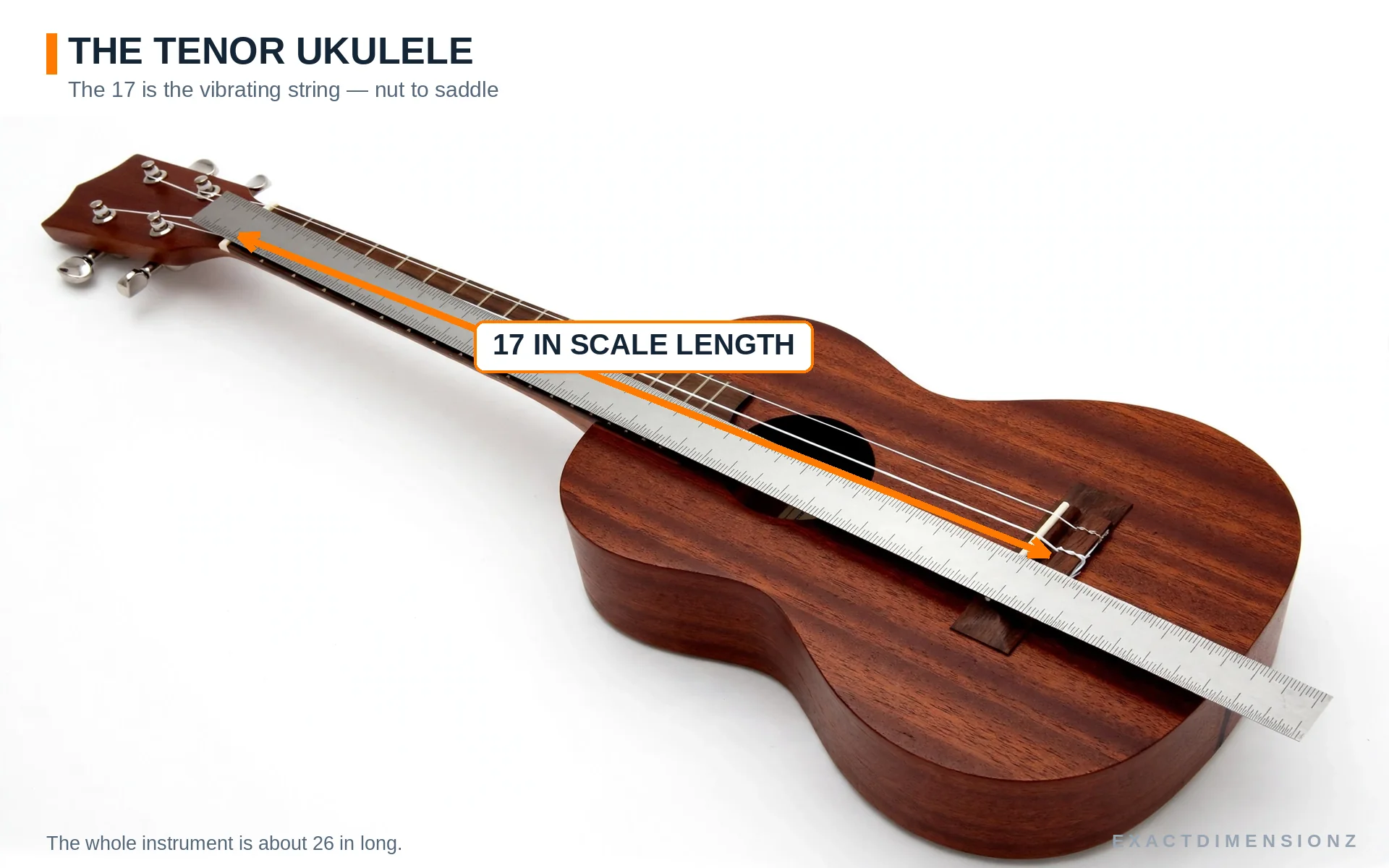
Tape Check: label says 17 — the scale length, nut to saddle, is 17 in; the whole instrument is about 26.1 in long. Grade: VERIFIED — a hidden seventeen, again.
Stay in the concert hall and shrink the instrument — but keep the seventeen. A tenor ukulele is the third size up in the ukulele family, and its defining measurement is not its body or its total length but its scale length: the vibrating length of string between the nut at the top of the neck and the saddle on the bridge. Kala’s specification table for its satin mahogany tenor — reproduced in full on this retailer’s Kala spec listing — gives the tenor’s scale length as 17 inches and its overall length as 26.125 inches. The seventeen is the part of the instrument that actually makes the pitch: fret positions, string tension and the tenor’s warm, guitar-like voice all follow from it.
This is the wheel’s trick in miniature — an exact number hidden inside a bigger object. Lay the whole ukulele on a table and your tape reads just over 26 inches; the seventeen lives along the neck, marked by two small pieces of bone and plastic. It is also a lovely calibration against its family: a soprano ukulele’s scale runs about 13 inches, a concert’s about 15, and the tenor’s 17 is what buys its extra frets and fuller low end. If the viola’s seventeen is one you hear, the ukulele’s is one you play — every chord shape your fingers learn is spaced by it.
Source: Kala tenor ukulele specifications (scale length 17 in, overall length 26.125 in), via the manufacturer’s spec table.
6. The 17-Inch Crash Cymbal

Tape Check: label says 17 — the diameter across the bow is 17 in, the maker’s stamped size. Grade: VERIFIED — by manufacture.
The concert hall’s third seventeen hangs over the drum kit. A crash cymbal’s size is its diameter, full stop, and 17 inches is a classic crash size — Zildjian’s catalogue includes 17-inch crashes such as the Z Custom crash, whose published specification lists the size plainly: 17 inches, B20 bronze. Zildjian’s own cymbal guide explains why the number matters so much to drummers: diameter drives volume, sustain and pitch, which is why crashes are bought by the inch and why the inch has to mean the same thing across every maker’s catalogue.
Grade it as a manufacturer’s diameter and it holds up well — with the same honesty note its 16-inch sibling earned in the previous article. A cymbal is cast, hammered and lathed, so each individual disc sits a few thousandths from nominal, and the bow is curved: a tape across the top reads the chord of the curve, not its arc. Within those tolerances the 17 is real, working information — a drummer swapping a 17 for an 18 hears the difference the inch makes. And unlike the laptop’s label, this seventeen describes the whole object: edge to edge, through the centre, the cymbal is its number in a way the G17 never is.
Sources: Zildjian Z Custom crash specification (scan.co.uk) — size 17 in; Zildjian’s cymbal guide (zildjian.com).
Stop 7 — The Print Shop
7. The Tabloid Sheet

Tape Check: label says 17 — the long side of ANSI B paper is 17.00 in by standard. Grade: VERIFIED — the cleanest seventeen in this article.
After three hidden and graded sevens, the print shop offers the purest one on the trip. North American paper sizes are standardised under the ANSI system, and the ANSI size table lists ANSI B — Tabloid, or Ledger — at 11 × 17 inches (279.4 × 431.8 mm). The long side of a tabloid sheet is seventeen inches not by a maker’s marketing but by the standard itself: every sheet of 11×17, from every mill, is cut to it. The Engineering ToolBox paper table lists the same Ledger/Tabloid size at 11 × 17, and the relationship to the paper in your printer is exact and elegant: a tabloid sheet is precisely two Letter sheets side by side — which is why the Build section below can make a dead-on seventeen out of ordinary office paper.
Notice, too, the family resemblance to the previous article’s world of nominal sizes — and the difference. This seventeen is not nominal. Paper is a standardised commodity, guillotined to size, and the standard’s figure is the figure on the sheet. The short side gives you how long is 11 inches for free, which makes the tabloid sheet a two-for-one reference: one sheet, two of this series’ numbers, both standardised. If you remember one visual from this article, make it this one — a big white rectangle, longer than a laptop is wide, that any office in North America can hand you.
Sources: ANSI paper size tables (designingbuildings.co.uk; EngineeringToolBox.com) — ANSI B Tabloid/Ledger 11 × 17 in.
Stop 8 — The Tailor’s Counter
8. The Size-17 Shirt Collar
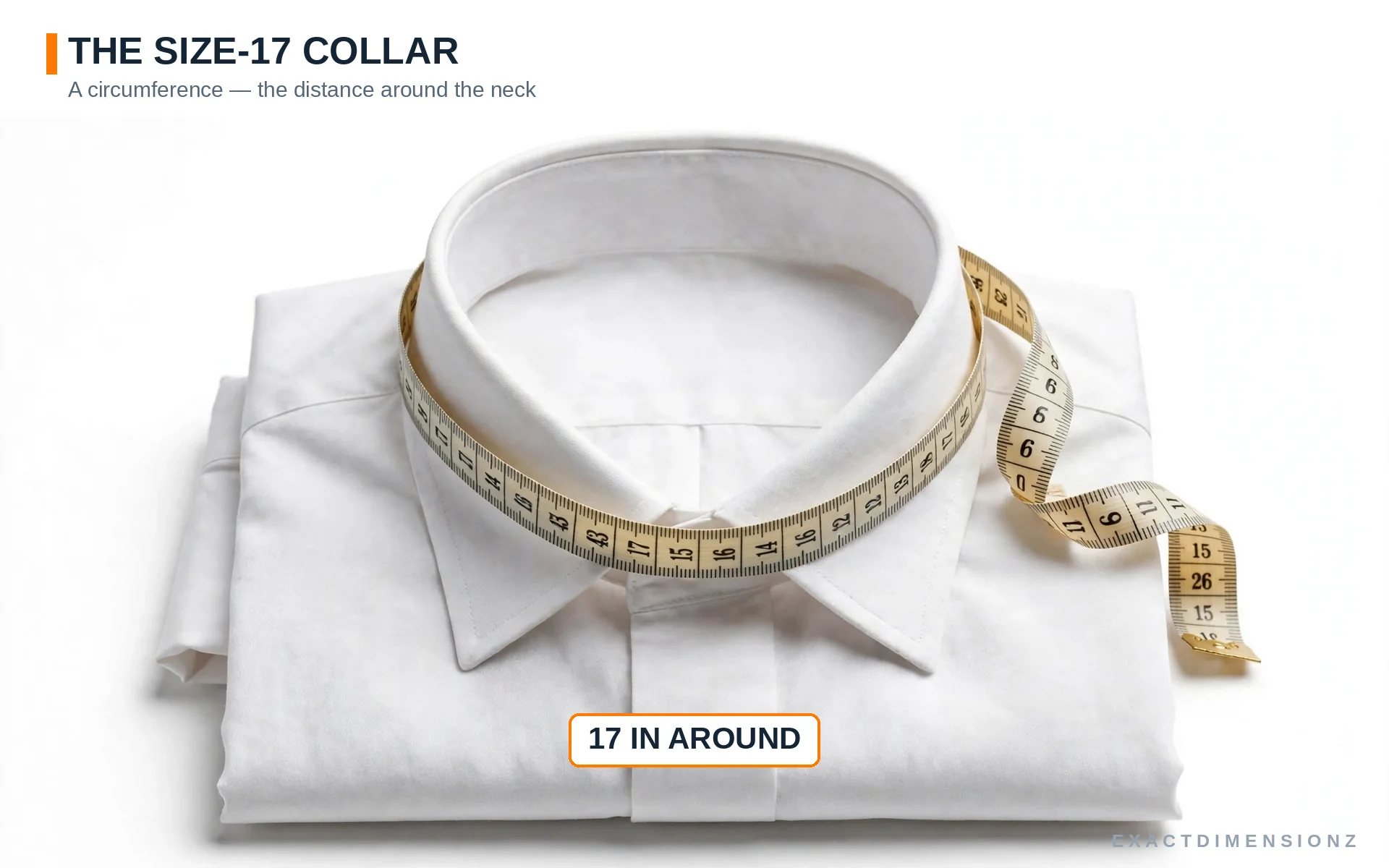
Tape Check: label says 17 — the collar size is a circumference: 17 in around the neck. Grade: VERIFIED — as a loop.
The tailor’s counter changes the tape’s job: here seventeen is not a span but a journey around. Men’s dress shirts are sized by collar, and the collar figure is the neck circumference the band is cut to close around. Size charts for traditional makers such as Charles Tyrwhitt — compiled in this size-guide breakdown — run in half-inch steps through 16, 16.5, 17.0, 17.5 and 18, with the 17 paired to a garment chest of about 50–51.5 inches depending on fit. A size 17 is a substantial collar — the top end of the standard range before sizes get scarce — and the number on its label is a true circumference, measured the way a tailor measures your neck: tape around, two fingers of ease.
As a reference it is more practical than it first looks, because it converts the abstract number into something worn against skin. Unbutton a size-17 shirt and lay the collar band flat, button to buttonhole, and the tape reads its seventeen in a straight line — the loop, unwrapped. It also quietly teaches the article’s recurring lesson in reverse: the previous article met a 16-inch collar doing the same job, and in both cases the number is honest once you know it goes around. The failure mode is only ever in the picturing — imagine a collar as a 17-inch length of cloth hanging down a chest and you have invented a shirt for a giraffe.
Source: Charles Tyrwhitt size chart compilation (shirtdetective.com) — collar size 17.0 in the maker’s half-inch-step range.
Stop 9 — The Windshield
9. The 17-Inch Wiper Blade
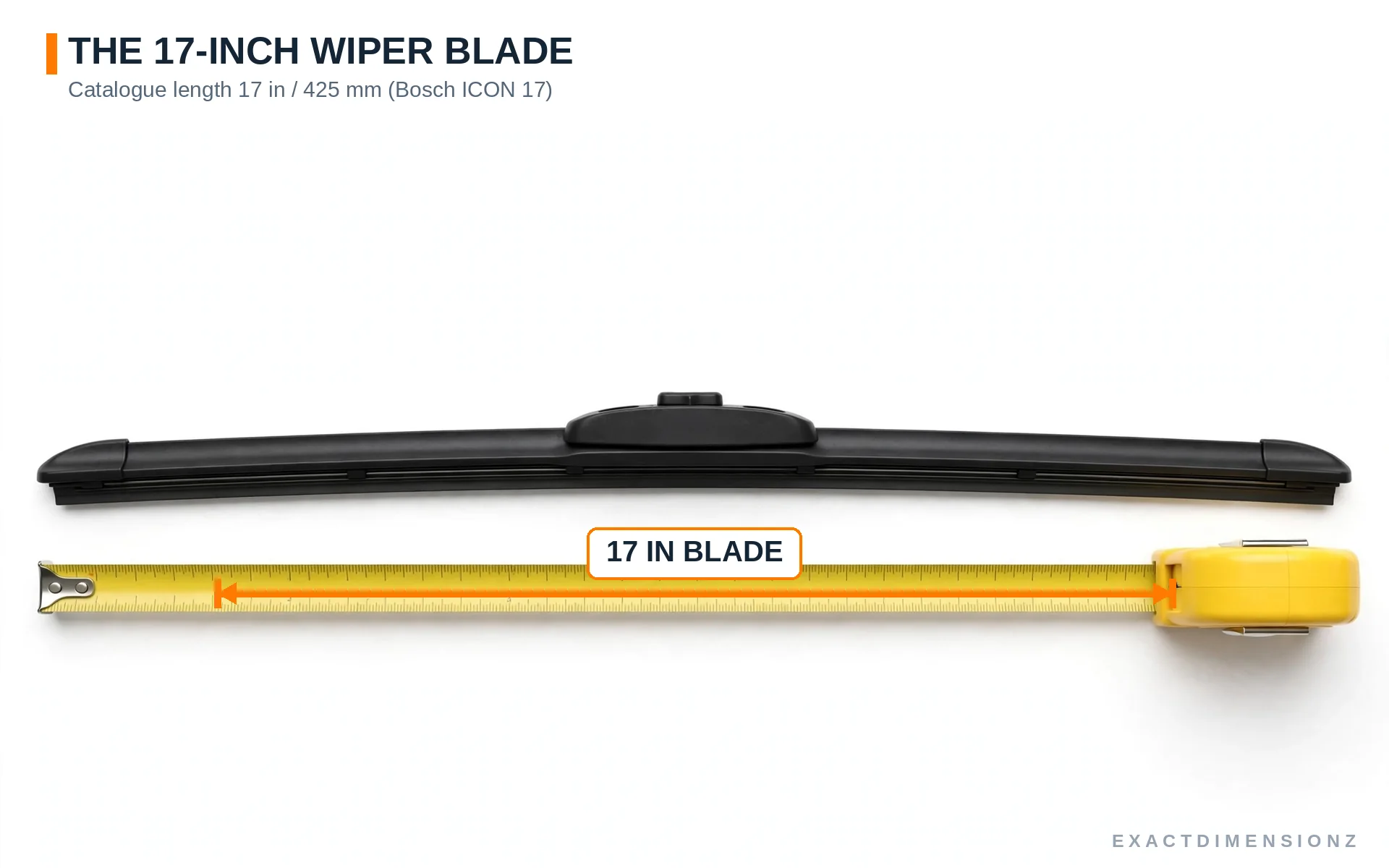
Tape Check: label says 17 — the catalogue length is 17 in / 425 mm. Grade: NOMINAL — a fitment class, held close.
The tape’s last stop is the glass in front of the driver. Wiper blades are sold by length, and 17 inches is a standard size — Bosch’s official wiper blade catalogue lists its ICON beam blades 17A and 17B at 17 inches, 425 mm, alongside the fitments each one serves. A 17-inch blade is typically a passenger-side or rear blade on smaller cars, sweeping a seventeen-inch arc of glass clean with every pass.
Its grade is the gentlest caution on the trip: NOMINAL. Blade length is a fitment class — the number names the blade your car takes, and the physical rubber sits within a small tolerance of it, because a millimetre either way changes nothing about how the blade meets the glass or clips to the arm. That is exactly how a nominal size should behave: close, standardised, and honest about being a class. Set it beside Stop 1 and the whole article snaps into focus — the wiper and the laptop are both “class” sevens, but the blade’s class sits within a whisker of 17 while the laptop’s flagship panel sits 0.3 of an inch past it. A class name is only as good as its tolerance, and now you have handled both ends of that scale.
Source: Bosch wiper blade catalogue (boschautoparts.com) — ICON 17A/17B, 17 in / 425 mm.
The Audit Chart

Nine stops, one pattern: the number was right far more often than the internet’s version of it — provided you knew where the seventeen lived and what kind of number it was. The chart above is the trip on one page: eight objects at a verified or standardised 17.0, one class name at 17.3, and every grade earned in its section. Keep the grades, not just the objects, and you can audit the next size label you meet — at any number, not just this one.
Build Seventeen Yourself
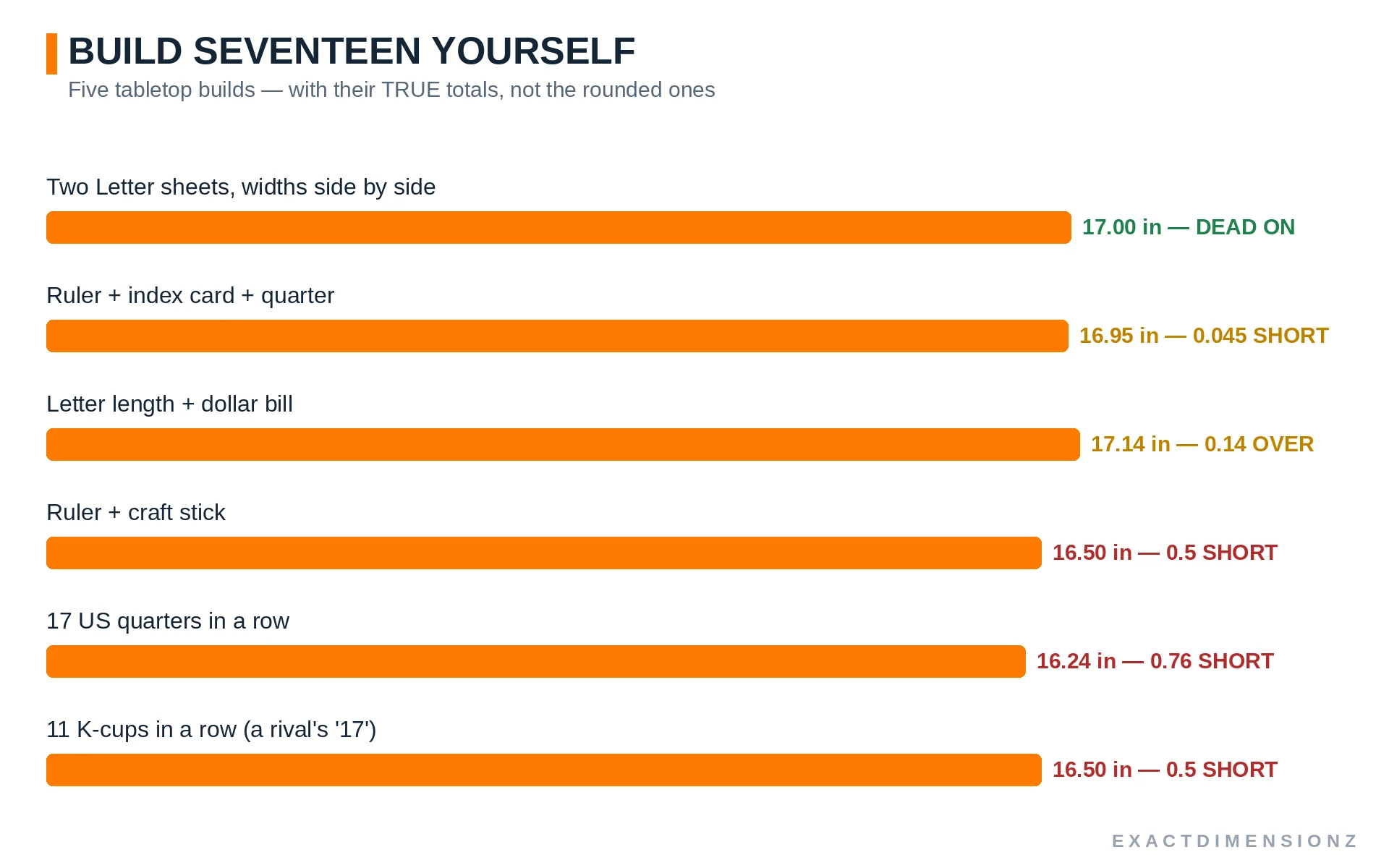
No tabloid sheet, tenor ukulele or Basenji within reach? Seventeen can be assembled on a desk — and this table is the tool the rival pages fumble, because each build carries its true total. Two of them are dead on; the rest land where the maths says, not where a headline rounds them.
| Build | The maths | True total | Verdict |
|---|---|---|---|
| Two Letter sheets, widths side by side | 8.5 + 8.5 | 17.00 in | Dead on — the standard does the work |
| One tabloid sheet, long side | 17 (ANSI B) | 17.00 in | Dead on — Stop 7, as a tool |
| 12-in ruler + 4-in index-card edge + one quarter | 12 + 4 + 0.955 | 16.96 in | 0.04 short — the near miss |
| Letter length + a dollar bill | 11 + 6.14 | 17.14 in | 0.14 over |
| 12-in ruler + one standard craft stick | 12 + 4.5 | 16.50 in | 0.50 short |
| Seventeen US quarters in a row | 0.955 × 17 | 16.24 in | 0.76 short — the count matches, the coins don’t |
The dead-on build deserves its moment. US Letter is standardised at 8.5 × 11 inches — the paper size guides list it plainly — so two sheets side by side by their widths make seventeen inches out of the most ordinary object in any office: no cutting, no folding, just the standard adding up. It is worth pausing on why this build is dead on while so many folk builds are not. It is built entirely from standardised parts: the sheet’s width is not “about” 8.5, it is 8.5 because the standard says so and the mill’s cutter obeys. Folk builds fail in proportion to how many unstandardised parts they stack — every coin, pod and craft stick brings its own small deviation, and seventeen parts later the deviations have organised themselves into half an inch of fiction. Two parts, both standardised, no fiction: that is the whole secret, and it is the same secret that made the tabloid sheet Stop 7’s cleanest seventeen. It is the print shop’s seventeen rebuilt from its halves, the same 12-inch ruler trick from earlier articles extended by a card and a coin to within four-hundredths. The quarters fail instructively, as they did at sixteen: the US Mint specifies the quarter at 0.955 inches in diameter, so a row of seventeen quarters — the build whose count matches the target — lands at 16.24, three-quarters of an inch short. And the craft stick, the standard 4.5-inch one, plus a ruler gives you the exact 16.5 that two rival pages round up into a seventeen — which brings the tape, at last, to the desk where the rounding gets corrected. (One more for the road: a dollar bill runs 6.14 inches, just past how long is 6 inches, with an index card’s 4-inch edge beside it — a pocket build that lands within a hair, the honest way.)

The Corrections Desk
Six claims circulate on the top pages for this keyword. All six fail against primary sources, and each is corrected by a stop above. One: eleven coffee pods make 17 inches. Two rival pages build seventeen out of K-cups — and their own maths confesses: 11 pods at 1.5 inches is 16.5, which one page prints and then calls 17 “when rounded off.” Half an inch is not a rounding error; it is a different number, and it is the flagship fraud of this keyword — seventeen by rounding. Two: a US quarter is 0.75 inches across, so 23 of them make about 17. The US Mint specifies the quarter at 0.955 inches; 23 quarters actually span 21.97 inches — the claim is wrong at the first coin and nearly five inches wrong by the last. Three: a roll of paper towels “typically spans 17 inches.” A standard roll stands about 11 inches tall; the claim adds six inches from nowhere (a holder, perhaps, on a good day). Four: laptop screens “range from 13 to 15 inches in width, measured diagonally.” Width and diagonal are different measurements, and the 17-inch class tops the range the sentence erases — Stop 1’s G17 carries a 17.3-inch diagonal in a body about 15.5 inches wide. Five: a standard pillow is 17 inches. A standard bed pillow is 20 × 26 inches; seventeen is neither side of it. Six: six phones make exactly 17 inches — from a page whose own table lists each phone at 5.78 inches tall (which would make 34.7) while its text quietly switches to the 2.82-inch width (which makes 16.92). Even on its own numbers, the stack is not seventeen. Each correction is sourced at its stop above; the pattern underneath all six is the one this trip was built to expose — the number was chosen first, and the objects were rounded, re-measured or invented afterwards.
Seventeen, Audited
Seventeen inches is exactly 43.18 centimeters — and, in the wild, an audit waiting to happen. A class name that overshoots to 17.3 on a gaming laptop. An exact diameter sealed inside a 28-inch wheel. A breed standard walking around a kennel on four legs. A body length, a string length and a diameter sharing one concert hall. A standardised long side in every print shop, a circumference at every tailor, a fitment class on every windshield. The nine references above are all genuinely useful — once each one carries its Tape Check. Keep the habit this trip is really teaching, and every label you meet from here gets the same three questions before it gets your trust: what was measured, what does it actually total, and where does the number come from? Seventeen, audited, is a number you can prove. For every size in the series, see the complete inches size guide.
