
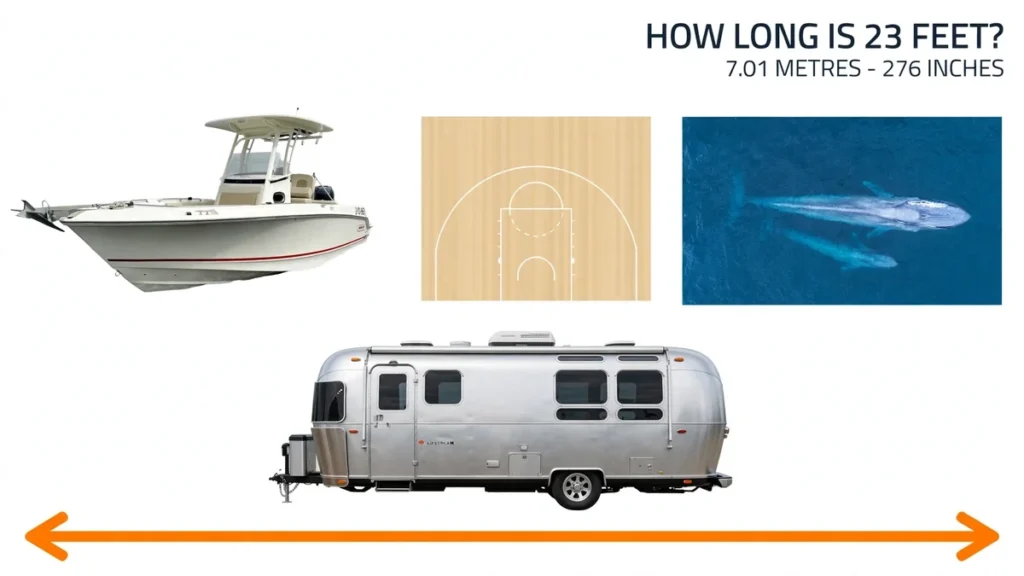
Stand at the top of the key on an NBA court, ball in your hands, and look at the rim. You are 23 feet 9 inches from the centre of the basket — nine inches past the number in this article's title — and the shot in front of you is the longest standard shot in basketball that is not a heave. The three-point line is painted exactly there because the rulebook says so, and every NBA court on Earth paints it in the same place, because the rulebook is the product. That is how long is 23 feet when it is measured the way a league measures it: not as a guess on a tape, but as a line on hardwood that decides whether a shot is worth two points or three. The line is 23 feet 9 inches at the top of the arc and 22 feet in the corners, and the nine inches between those two numbers is the whole story of 23 feet in miniature — close to a round number, never quite on it.
The second thing to know is that 23 feet is seven metres and a thumb's width. Twenty-three feet is 7.0104 metres, which means the metric shortcut — "call it seven metres" — misses by only 1.04 centimetres, the closest round-metre shortcut in this whole series, and it is also the reason almost nothing is built to be 23 feet long: manufacturers work in round numbers on both sides of the Atlantic, and 23 feet is 7.01 metres, which is round in neither system. Shipping containers come in 20- and 40-foot lengths, motorhomes in 22- and 24-foot floorplans, boats in 22- and 24-foot classes, and 23 feet falls between every one of them. The seven things below are the closest honest answers: one of them is 23 feet to the inch, one of them is a newborn animal that arrives at 23 feet on its first day of life, and the rest miss by between three and nine inches, with every miss printed. None of them is a stack, a multiple, a fraction, a sum, or a category guess.
Seven Metres and a Thumb: Where 23 Feet Sits
Twenty-three feet sits in a gap that both measurement systems walk straight past, and the reason is arithmetic, not neglect. A foot is 0.3048 metres by international agreement, so 23 feet is 7.0104 metres — and nobody manufactures anything in 7.0104-metre classes. The classes that exist are round numbers: a shipping container is 20 feet (6.10 metres) or 40 feet (12.19 metres), a Class C motorhome is sold as a 22- or 24-footer, a centre-console boat is sold as a 22- or 24-footer, and 23 feet lands between every one of those classes and on none of them. Seven metres is 22 feet 11.6 inches — four-tenths of an inch short of 23 feet — which is closer than any standard class gets. At 23 feet the honest shortcut is seven metres and a thumb, and "23 feet" is the lazy version that costs you nothing in conversation and a centimetre in a boatyard. The guides that list "things that are 23 feet long" keep reaching for the giraffe and the gymnastics beam because those are the biggest single things in a normal life with round-number names — and neither of them is 23 feet, one by five feet and the other by more than six.
Quick Answer
23 feet is 7.0104 metres exactly — 276 inches, 701.04 centimetres, 7,010.4 millimetres, and 7.67 yards. But do NOT call it 20 feet: 20 feet is 6.10 metres, which is 91 centimetres shorter than 23 feet, and do NOT call it 24 feet either: 24 feet is 7.32 metres, which is 31 centimetres longer. The honest shortcut is seven metres and a thumb — and the honest object is the Boston Whaler 230 Outrage, 23 feet from bow to stern by the maker's own specification.
The 7 Objects
The seven objects below are ordered by how close they land, and each one carries its evidence grade in the heading. EXACT means the figure is a standard's or an authority's own dimension for the named thing. LISTED means the figure is the manufacturer's published specification for the named model. AVERAGE means the figure is an authority's published average or range for the named thing. REPORTED means the figure is the largest verified measurement an expert source reports for the named thing.
1. A Boston Whaler 230 Outrage — LOA 23 Ft 0 In (LISTED)
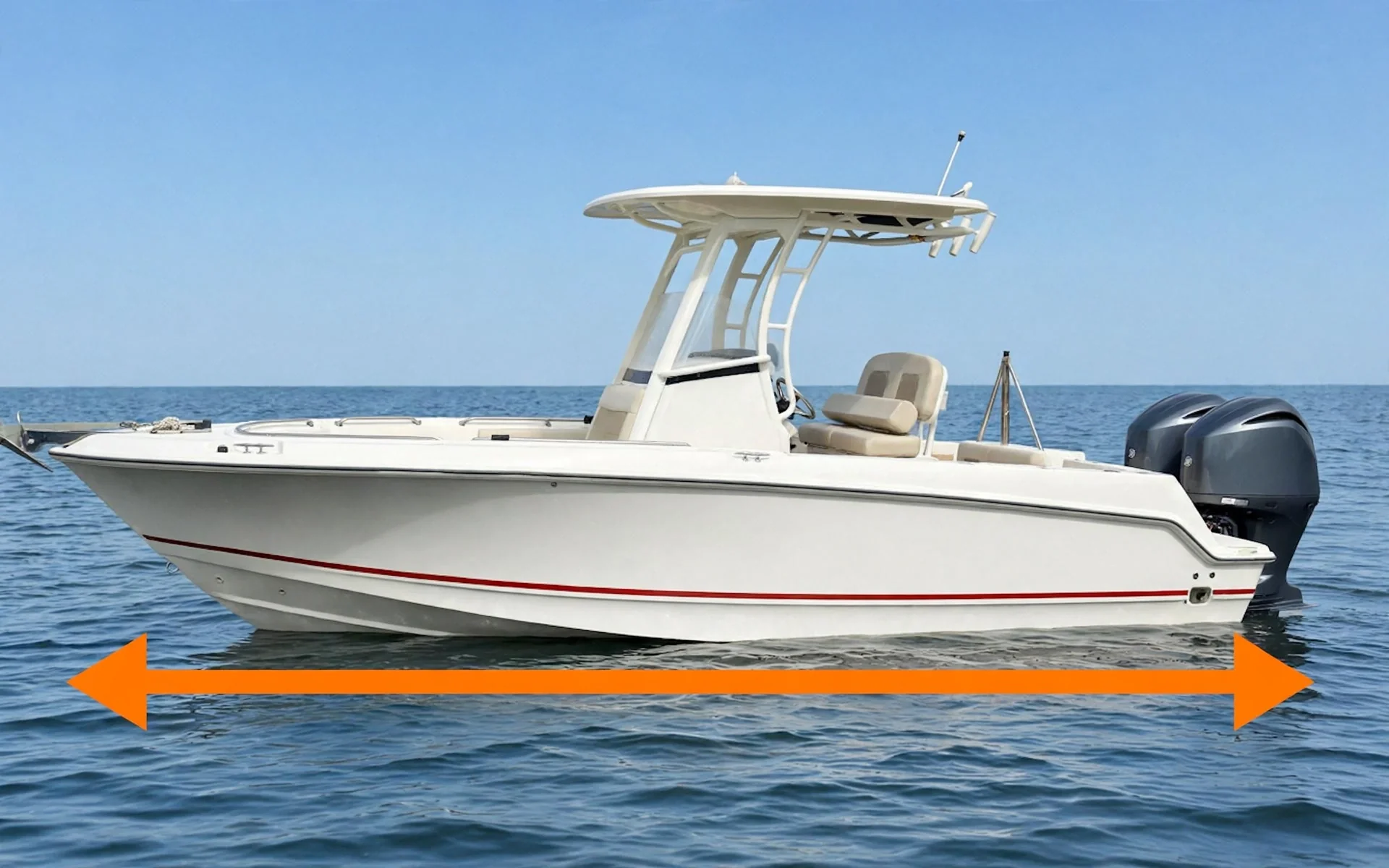
The Whaler is the article's cleanest exact-length object, because its 23 feet is written into the maker's own specification table rather than a round-number nickname. Boston Whaler lists the 230 Outrage at a length overall of 23 feet 0 inches (7.01 metres), with a beam of 8 feet 6 inches, a draft of 18.5 inches, a dry weight of 3,800 pounds, and room for 10 people — and the overall length is the figure that matters: the distance from the bow to the stern, not the hull length and not the trailer. Walk from the bow to the stern and you have walked 23 feet — no conversion required, and the same on every 230 Outrage ever built, because the mould is the product.
The fitting check is the model number, because the Whaler's "230" is a length in feet and the number is honest for once: a 230 Outrage is a 23-foot boat, where a 240 Outrage would be 24 feet and a 220 Outrage was 22. The guides that call a "medium recreational boat" 22 to 24 feet are right about the range and wrong about the usefulness — a range is not a measurement, and a berth or a trailer bought against "about 23 feet" for a boat that is actually 24 feet fails by a foot before the first tide. The grade is listed because the figure is the maker's own listing for this named model: 23 feet 0 inches, zero miss.
2. A Newborn Blue Whale Calf — About 23 Ft Long at Birth (AVERAGE)

The calf is the article's most startling object, because it is 23 feet long on the first day of its life — bigger than a full-grown African elephant is tall. The Marine Mammal Center puts it plainly: newborn blue whales can reach about 23 feet in length and weigh 5,000 to 6,000 pounds at birth, after a pregnancy of about a year, and the calf then nurses for six to seven months and roughly doubles in length, reaching on average over 52 feet by six months old. Lay a tape measure from the tip of its nose to the notch in its tail on the day it is born and you are measuring about 23 feet.
The fitting check is the word "about", because the calf's 23 feet is an average at birth and the thing people misjudge is how fast it stops being true: a calf gains up to 200 pounds a day while nursing, so by the end of its first week it is already measurably longer than 23 feet, and by six months it is more than twice as long. The guides that call a blue whale calf "23 feet" without saying "at birth" are right about the number and wrong about the confidence — it is 23 feet for about a week, not for a season. The grade is average because the figure is an authority's published birth size for the named thing: about 23 feet, 5,000 to 6,000 pounds, by the Center.
3. A Piper Cherokee PA-28-140 — 23 Ft 3.6 In Long (LISTED)

The Cherokee is the article's closest miss, because it is 23 feet 3.6 inches long and 23 feet is 23 feet — a gap of 3.6 inches, the width of a hand. Piper's own Owner's Handbook for the Cherokee 140 (PA-28-140) lists the length at 23 feet 3.6 inches (7.102 metres), with a wingspan of 30 feet 0 inches and a height of 7 feet 3.6 inches — and the length is the figure that matters: the distance from the tip of the spinner to the tip of the tail. Walk from the nose to the tail and you have walked 23 feet 3.6 inches — 3.6 inches past the number in this article's title, and the same on every Cherokee 140 ever built, because the factory jig is the product.
The fitting check is the two numbers Piper prints, because the Cherokee's 23.3 feet is its length and its 30 feet is its wingspan — and some listings round the length to "23 feet" and some to "23 feet 6 inches", which is the later Cherokee 180's figure, and the 2.4 inches between the two readings is a different model, not a rounding. A hangar or a tie-down bought against "23 feet" for this aeroplane fits on either reading, because the largest reading is still only a hand past. The grade is listed because the figure is the maker's own listing for this named model: 23 feet 3.6 inches, 3.6 inches over.
4. A Beneteau First 235 — LOA 23 Ft 4 In (LISTED)

The First 235 is the article's most honest two numbers, because it is sold as a "235" and it is 23 feet 4 inches overall and only 21 feet 7 inches of hull — and the 21 inches between those two readings is the whole lesson of the boat. Beneteau's specification data for the First 235 lists the length overall at 23 feet 4 inches (7.11 metres), with a hull length of 21 feet 7 inches, a waterline length of 20 feet 3 inches, and a beam of 8 feet 2 inches — and the overall length is the figure that matters: the distance from the tip of the bow pulpit to the tip of the transom, including the fittings the hull length leaves out. Walk from the bow to the stern and you have walked 23 feet 4 inches — 4 inches past the number in this article's title, and the same on every First 235 ever built, because the mould is the product.
The fitting check is the hull, because the First 235's 21 feet 7 inches is the fibreglass and its 23 feet 4 inches is the fibreglass plus the fittings — and some listings quote the same boat at 23.5 feet, which is the overall length with a different rounding and a different pulpit, and the inch between the two readings is the bow roller and the marketing. A berth bought against "23 feet" for this boat fits on either reading, because the largest reading is still only four inches over. The grade is listed because the figure is the maker's own listing for this named model, with both readings printed in full: 23 feet 4 inches overall, 21 feet 7 inches of hull.
5. An NBA Three-Point Line — 23 Ft 9 In at the Top of the Arc (EXACT)
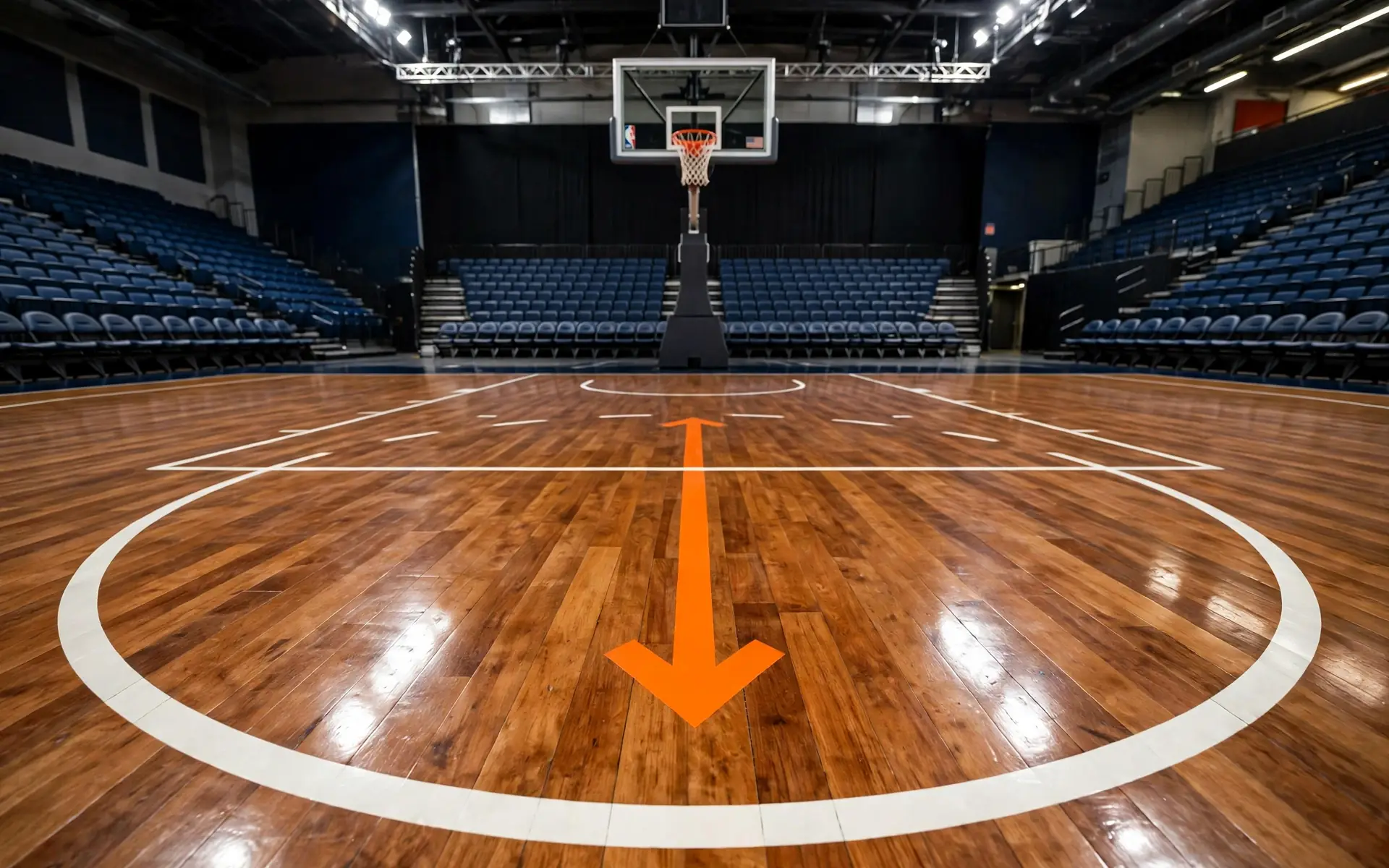
The three-point line is the article's only exact, because its 23 feet 9 inches is written into the rulebook of the sport rather than a catalogue, and it is also the article's opening scene. The NBA's Official Rules fix the three-point arc at 23 feet 9 inches from the centre of the basket, with the line running straight along the sidelines in the corners at 22 feet, three feet in from each sideline — and it has been 23 feet 9 inches since the line was introduced in the 1979–80 season, apart from three seasons in the mid-1990s when the league shortened it to a uniform 22 feet and then moved it back. Stand at the top of the key and you are standing 23 feet 9 inches from the basket — nine inches past the number in this article's title — and the same on every NBA court on the planet, because the rulebook is the product.
The fitting check is the corners, because the line's 23 feet 9 inches is the arc and its 22 feet is the corners — and the guides that call the three-point line "23 feet" never say whether they mean the arc or the corners, because they never read the rulebook, and the 21 inches between the two readings is the difference between a good shot and a bad one. A court bought against "23 feet" for a three-point line fails by nine inches at the top and by a foot in the corners if you measure the arc and forget the straight sections. The grade is exact because the figure is the governing body's own dimension for the named thing: 23 feet 9 inches on the arc, 22 feet in the corners, by the NBA.
6. An Airstream Flying Cloud 23FB — 23 Ft 9 In Exterior (LISTED)

The Airstream is the article's most honest model-year warning, because it is sold as a "23FB" and it was 23 feet 9 inches long in the 2023 specification chart and 23 feet 11 inches in the 2024 brochure — and the two inches between those two readings is a longer tongue, not a longer trailer. Airstream's specification chart lists the Flying Cloud 23FB at an exterior length of 23 feet 9 inches, with an exterior width of 8 feet, a height with air conditioning of 9 feet 7 inches, and a dry weight of 5,000 pounds — and the exterior length is the figure that matters: the distance from the tip of the hitch to the rear bumper, not the body length. Walk from the hitch to the bumper and you have walked 23 feet 9 inches — nine inches past the number in this article's title on the 2023 figure, eleven on the 2024 figure.
The fitting check is the model year, because the Airstream's "23" is a floorplan code, not a measurement, and the guides that call a 23-foot Airstream "23 feet long" are right about the direction and wrong about the distance: nine inches is not close, it is the length of a paperback book, and a campsite or a storage bay bought against "23 feet" for this trailer fails by that much before the first slide-out opens. The grade is listed because the figure is the maker's own listing for this named model: 23 feet 9 inches, nine inches over.
7. An African Savanna Elephant — 19 to 24 Ft, Trunk to Tail (AVERAGE)
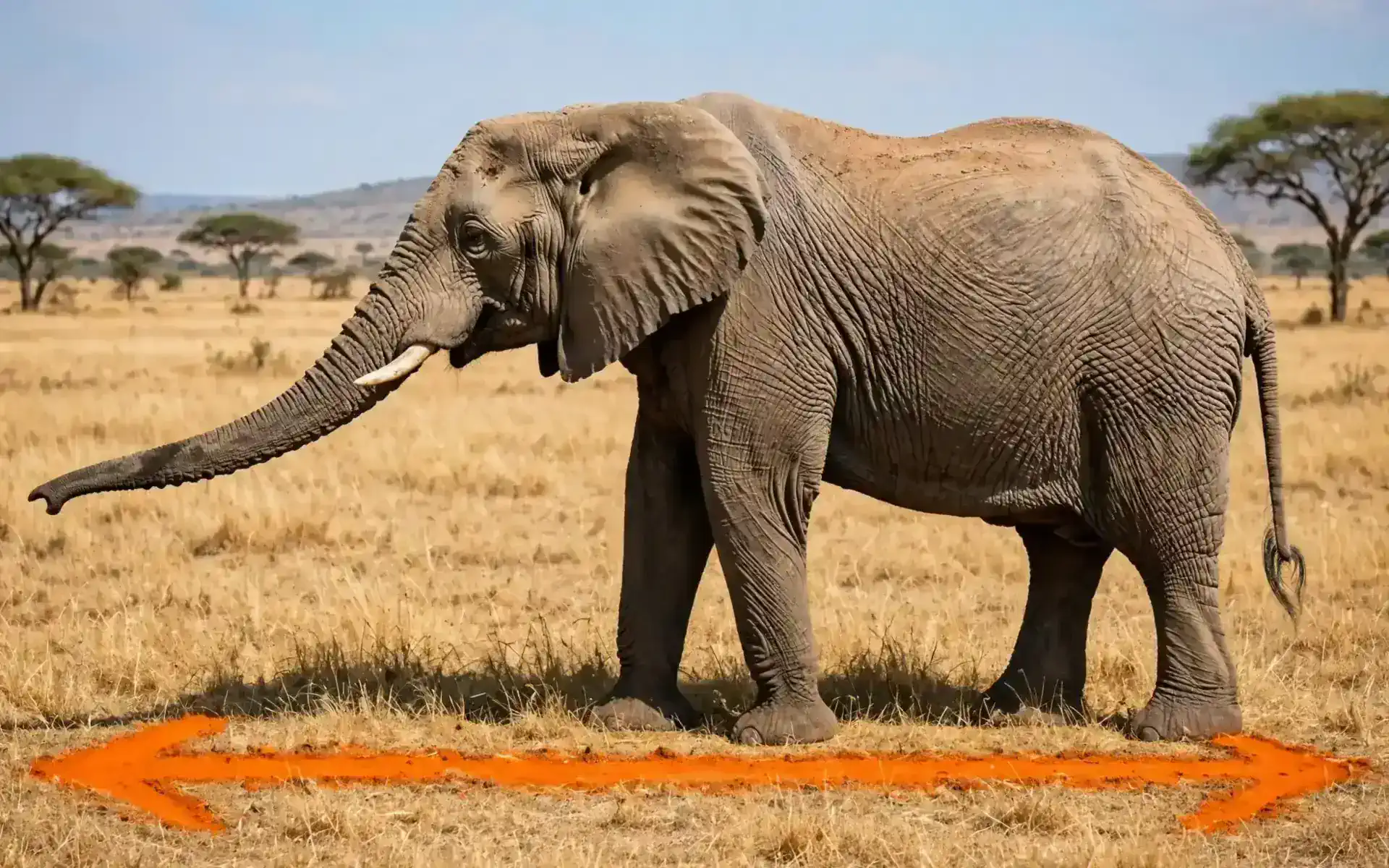
The elephant is the article's only land animal, and the one that proves 23 feet can be a middle rather than an edge. African savanna elephants measure 5.5 to 7.5 metres — 19 to 24 feet — from tail to trunk, and stand up to 13 feet at the shoulder, so an elephant at 23 feet is not a record and not a baby, it is a big adult, an ordinary animal at an ordinary size. Lay a tape measure from the tip of its trunk to the tip of its tail and you are measuring somewhere between 19 and 24 feet depending on which animal you caught — and the 23-foot animal is the one near the top of the range, not at the bottom of it.
The fitting check is the framing, because the elephant's 23 feet is the top of a range and the guides that call an elephant "23 feet long" never say whether they mean the trunk-to-tail length, the body length without the trunk, or the largest bull ever measured, because they never read the species profile. A photograph, a fence, or a transport crate bought against "23 feet" for an elephant fails by up to four feet if you measure the range and forget the trunk — and the trunk alone is six or seven feet of the animal. The grade is average because the figure is an authority's published range for the named thing: 19 to 24 feet trunk to tail, up to 13 feet at the shoulder.
The Corrections Desk: Five 23-Foot Claims That Do Not Survive a Tape Measure
Five wrong numbers about 23 feet circulate so widely that they deserve their own section, because each one is stated confidently on a page that ranks for this exact question. First, the giraffe: one popular guide says a full-grown male giraffe "can appear closer to 23 feet tall", and the San Diego Zoo Wildlife Alliance puts adult males at up to 5.5 metres — 18 feet — with the tallest giraffe ever measured at 19 feet, which is four feet short of the number in this article's title. Second, the gymnastics beam: another guide says training beams "can measure up to 23 feet", and the International Gymnastics Federation's Apparatus Norms fix the competition beam at 5 metres — 16 feet 5 inches — long, 10 centimetres wide, and 1.25 metres high, which is six and a half feet short. Third, the great white shark: another guide says a large great white "can grow to about 20 to 23 feet", and the Florida Museum puts the maximum at about 20 feet, possibly 21 feet, and calls the 23-foot reports unconfirmed — so "20 to 23" presents a rumour as the top of a range, and the largest reliably measured white shark was 21 feet. Fourth, the Hollywood Sign: another guide says half the sign "will be around 23 feet long", and the letters are 45 feet tall, so half is 22 feet 6 inches, not 23 feet — and half a thing is not a thing in any case. Fifth, the two compact cars: another guide lines up two of them and calls the result 23 feet, and its own numbers convict it — it lists the Honda Fit at 13.3 feet, so two Fits are 26 feet 7 inches, which is more than three feet over, and two of anything is a sum, not an object. One number the guides get right is worth noting because it is not an object: the Thor Four Winds 23U is sold as a "23-footer" and is actually 24 feet 10 inches long by Thor's own brochure, which is why the model name is the trap and the spec sheet is the answer. None of these five numbers belongs in a 23-foot article, and all five are here so you never have to learn that from a purchase.
Pacing It Out: Four Ways to Check 23 Feet Without a Tape
Twenty-three feet is a number you can check without a second tool, because the objects in this article are the tools — but only if you use the objects themselves, not your body. First, take the steps: the University of Iowa puts the average adult's walking step at 2.5 feet (0.762 metres), so take 9 steps and you have walked 22.5 feet — six inches short of the number in this article's title. Second, take the court: the NBA three-point line is 23 feet 9 inches from the basket at the top of the arc, so stand at the top of the key and take one step back toward the basket, and you are standing 23 feet away — but check the arc first, because the corners are 22 feet and will lie to you by a foot. Third, take the boat: a Boston Whaler 230 Outrage is 23 feet long overall, so walk from the bow to the stern and you have walked 23 feet. Fourth, take the plane: a Piper Cherokee PA-28-140 is 23 feet 3.6 inches long, so walk from the spinner to the tail and shave off a hand's width — 3.6 inches — and you have 23 feet. None of these replaces a calibrated tool for anything that must fit, but all four will tell you whether 23 feet is the size you think it is before the boat is berthed or the trailer is parked — and the Whaler is the one to trust, because its zero inches is the smallest miss you can stand on.
The 7 Objects at a Glance
| Object | Figure | Miss vs 23 ft | Grade |
|---|---|---|---|
| Boston Whaler 230 Outrage LOA | 23 ft 0 in | 0 in | LISTED |
| Blue whale calf at birth | about 23 ft | about 0 in | AVERAGE |
| Piper Cherokee PA-28-140 | 23 ft 3.6 in | 3.6 in over | LISTED |
| Beneteau First 235 LOA | 23 ft 4 in | 4 in over | LISTED |
| NBA three-point line, top of arc | 23 ft 9 in | 9 in over | EXACT |
| Airstream Flying Cloud 23FB | 23 ft 9 in | 9 in over | LISTED |
| African savanna elephant | 19–24 ft | range brackets 23 ft | AVERAGE |
Twenty-three feet sits in the gap between the round-number classes, and the gap is the story. Step up the ladder and the rungs crowd together: the 23-foot Whaler, the 23-foot calf, the 23-foot-3-inch Cherokee, the 23-foot-4-inch sailboat, the 23-foot-9-inch arc and the 23-foot-9-inch trailer, the elephant ranging across them all — and the point of it is the middle: 23 feet has one object behind it that is exact to the inch, and every object with a fixed figure sits inside a nine-inch band, which is why 23 feet is a size you can stand inside and still call it one number.
How 23 Feet Compares With Other Lengths
Readers comparing nearby sizes may also want the site’s guides to 22 feet,24 feet, 21 feet, 30 feet, 20 feet, 10 feet, and 9 feet for the foot series, and the feet hub and inches hub for the full directories. Each of those guides follows the same rule as this one: the spec sheet, the grade, and the miss printed in full.
Frequently Asked Questions
How many meters is 23 feet?
23 feet is 7.0104 metres, or 7 metres and 1.04 centimetres. Multiply 23 by 0.3048 and you get 7.0104 — and the trap is rounding that to 7 metres and forgetting the centimetre, which matters in a boatyard even if it does not matter in conversation. For anything that must fit, use 7.01 metres; for a quick estimate, seven metres is close enough and only four-tenths of an inch short.
How many inches is 23 feet?
276 inches exactly. Multiply 23 by 12 and you get 276, with no rounding that matters for anything you will ever measure by hand. In centimetres that is 701.04 cm, in millimetres it is 7,010.4 mm, and in yards it is 7.67 yards rounded — exactly 7.6667 yards, or 7 yards and 2 feet, which is the figure a tape measure will show if it is marked in yards.
How many steps does it take to walk 23 feet?
Nine steps, at the average adult's step length. The University of Iowa puts the average walking step at 2.5 feet (0.762 metres), so 9 steps cover 22.5 feet — six inches short of 23 feet — and 10 steps cover 25 feet, which is two feet over. The honest count is nine steps and a shuffle, and anyone who tells you 10 to 12 steps is rounding away the only number in the answer with a university behind it.
How long does it take to walk 23 feet?
About five seconds at a normal walking pace. At 5 kilometres an hour — a brisk walk — 23 feet takes 5.1 seconds, and at a relaxed pace it takes closer to six or seven. A car at highway speed crosses it in about a third of a second, which is why 23 feet feels long on foot and invisible from a motorway.
Is 23 feet long?
It depends on what you are measuring, and that is the honest answer. Twenty-three feet is long for a room — most living rooms are 15 to 20 feet — and short for a road, where it is about one and a half car lengths. It is the length of a centre-console boat and the distance of the longest standard shot in basketball. If you can picture a boat, you can picture 23 feet; if you can picture a room, you cannot.
What common objects are 23 feet long?
The most exact everyday answer is the Boston Whaler 230 Outrage (23 feet 0 inches overall by the maker's spec) and a newborn blue whale calf (about 23 feet at birth). Next closest are a Piper Cherokee PA-28-140 aeroplane (23 feet 3.6 inches), a Beneteau First 235 sailboat (23 feet 4 inches overall), the NBA three-point line (23 feet 9 inches at the top of the arc), and an Airstream Flying Cloud 23FB trailer (23 feet 9 inches). A big African savanna elephant measures 19 to 24 feet trunk to tail, so 23 feet sits inside its normal adult range.
How far is the NBA three-point line?
23 feet 9 inches from the centre of the basket at the top of the arc, and 22 feet in the corners. The NBA's Official Rules fix the arc at 23 feet 9 inches, with the line running straight along the sidelines three feet in from each sideline, which is what makes the corner three the shortest three-point shot in the game. The line has been 23 feet 9 inches since it was introduced in the 1979–80 season, apart from three seasons in the mid-1990s when it was shortened to a uniform 22 feet.
Is 23 feet the same as 7 meters?
No, and the difference is small enough to matter. Seven metres is 22 feet 11.6 inches, which is four-tenths of an inch shorter than 23 feet — about a centimetre. For picturing the length in your head, 7 metres is the closest round number and it will not mislead you badly; for anything that must fit — a berth, a hangar, a campsite — use 7.01 metres, which is 23 feet to within a hundredth of a metre.
Final Thoughts
Twenty-three feet is the rare measurement that is exact and still unbuyable off the shelf, because 7.01 metres can be a boat, a calf, a plane, a sailboat, an elephant, a three-point line, or a trailer — and the number alone never says which. Now you know it as a boat's length fixed by its mould, a calf's size fixed by its species, a plane's length fixed by its factory, a sailboat's length fixed by its fittings, an elephant's size fixed by its range, a line's distance fixed by its league, and a trailer's length fixed by its model year — and you know which of those you can trust to the inch and which you must measure yourself. The rule that runs through all seven is the same one this site always uses: trust the spec sheet, print the deviation, and let the name stay on the box where it belongs.
