
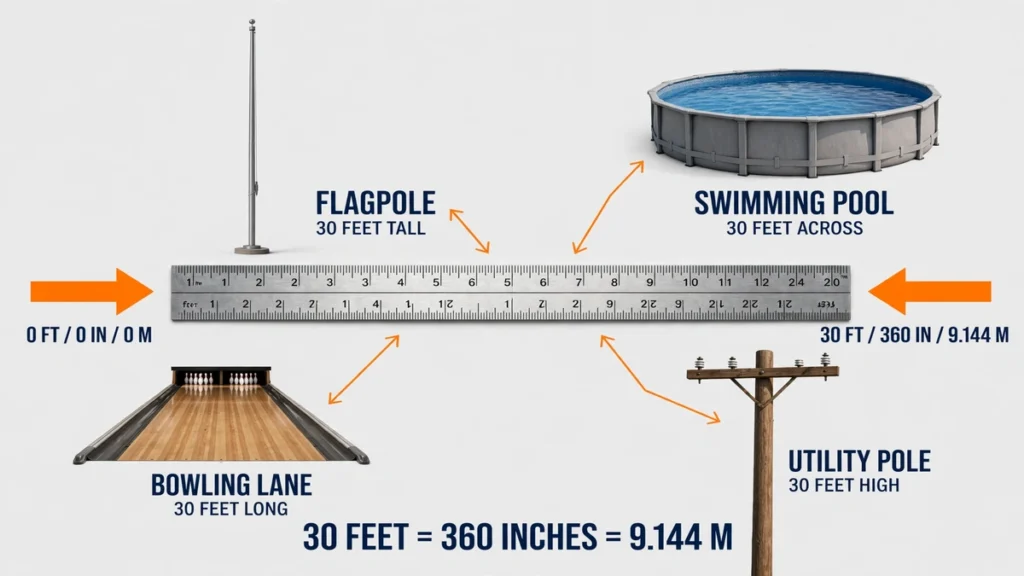
If you have ever asked how long is 30 feet, you have probably been given an answer that felt true and was not quite true. Thirty feet is the height of the flagpole at the front of a school, the length of a bus on a neighbourhood route, the distance from a bowling foul line to the middle of the lane, and the width of a volleyball court that is not, on close inspection, 30 feet wide at all. It is also the number printed on a utility pole that stands several feet shorter than its own name, and the number in a sailboat’s name that misses by a single inch. The confusion is not your fault. Thirty feet is measured in more ways — height, length, diameter, half-length, buried length, and named length — than almost any other measurement on this site, and each way of measuring changes what the number means. For the whole series, see the complete feet size guide.
Below are seven single, named things, each checked against its own specification, with the miss printed wherever a thing misses. Four are exact for the dimension stated and three are listed from a model range, class specification, or retail listing rather than a dimensioned drawing; two of the seven are labelled near-misses — a boat and a court — that both fall short of 30 feet, by different amounts, for different reasons. Every object’s image sits immediately after its heading, and no object is a stack, a multiple, or a category guess. You will not find five adults lying head to toe here, or two cars parked bumper to bumper, because a chain of people is not a thing that is 30 feet long — it is an arithmetic trick wearing a trench coat. By the end you will know 30 feet as a pole, a lane, a bus, a boat, a pool, and a court — and you will know which of those you can trust to the inch and which you must measure yourself.
Quick Answer
30 feet = 360 inches exactly = 914.4 cm = 9.144 m = 10 yards exactly. It is ten yards, not nine and not eleven, and it is the distance from a bowling foul line to the exact middle of the lane. But do NOT read every “30-foot” label as 30 feet of visible height: a 30-foot utility pole stands only about 24 feet 6 inches above the ground once it is set in soil, because 5 feet 6 inches of it is underground, and a boat called the Catalina 30 is 29 feet 11 inches long, one inch short of its own name.
Three Ways 30 Feet Fools You
The first fool is the buried foot. A pole, a flagpole, and a fence post are all sold by their total length, not by the height you see. A flagpole is the honest exception in this article — its 30 feet is exposed height, the part above the ground — but a utility pole is the opposite: its 30 feet is the whole stick, including the part in the hole. Anyone who paces off 30 feet of sky beside a utility pole and expects the top to be there will overshoot by more than five feet, because the pole’s own foundation ate the difference. The rule is simple and it generalises: for anything planted in the ground, ask whether the number is the total length or the visible height, and never assume they are the same.
The second fool is the named length. Boats, buses, and pools are routinely named for a round number that their specification then quietly contradicts. The Catalina 30 is 29 feet 11 inches; a volleyball court described as 30 feet wide is built to 9 metres, which is 29 feet 6 inches; a transit bus family offered in a “30-foot” length may measure 30 feet 7 inches in a particular configuration. None of these is a lie exactly — the name is a class, a marketing round, or a converted metric figure — but none of them is a measurement either. The rule for the whole article is therefore the same one this site always uses: trust the specification, print the deviation, and let the name stay on the hull where it belongs.
The third fool is the half and the width. Thirty feet is exactly half of a 60-foot bowling lane, and that is a real, exact 30 feet — but it is a distance along a lane, not an object 30 feet long, and it only works if you know where the lane starts and ends. Thirty feet is also, approximately, the width of a volleyball court, and that is a real dimension too — but it runs across the court, not along it, and it falls short by half a foot. Direction and fraction matter as much as the number: 30 feet of height is a pole you crane your neck at, 30 feet of length is a bus you walk past, 30 feet of diameter is a pool you swim across, and 30 feet of half-lane is a distance you bowl through. This article never prints “30 feet” without saying 30 feet of what.
The 7 Objects
1. An Eder ECX30 Commercial Flagpole — 30 Feet of Exposed Height (EXACT)
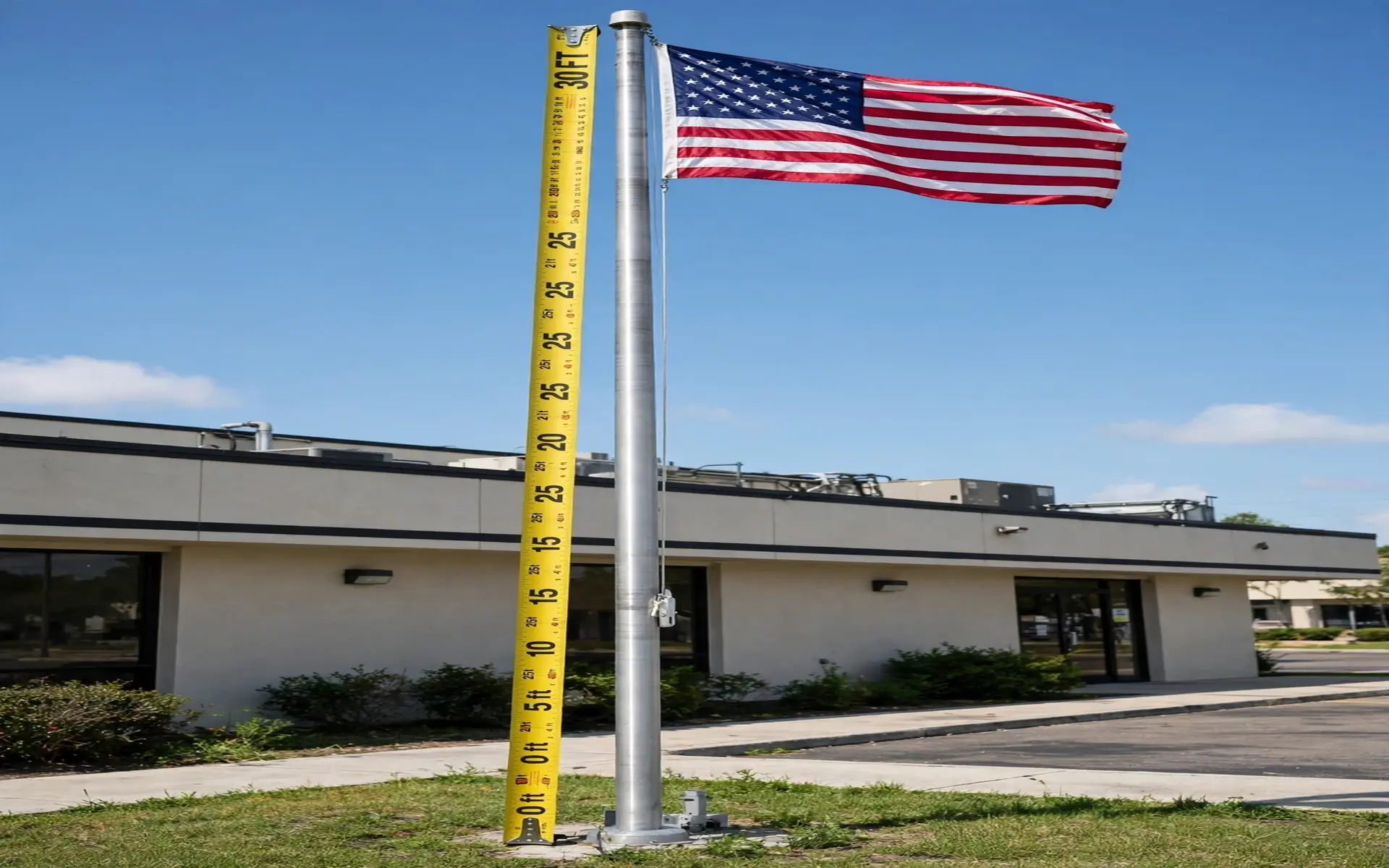
The flagpole is the article’s anchor, because it is the 30 feet most readers will stand beside without ever measuring. The Eder ECX30 is a commercial tapered aluminium flagpole whose specification lists 30 feet of exposed height, with a 5-inch butt diameter, a 3-inch top diameter, and a 0.125-inch wall — and exposed height is the key phrase. Unlike the utility pole below, this 30 feet is the part you see: the pole rises 30 feet above the ground, flies a 5-by-8-foot flag, and is rated for 85 mph winds with the flag flying. It is the standard pole for a school entrance, a dealership forecourt, or a mid-size commercial building, and it is sized by a simple proportion: the flag it flies is 10 feet long, exactly one third of the pole’s height, which is the guideline the industry uses for a flag that looks right rather than lost or oversized.
The fitting check is the foundation, and it is where the flagpole quietly stops being 30 feet. A ground-set pole needs a concrete foundation and a ground sleeve, and the overall pole length is longer than the exposed height — the buried sleeve and setting depth are extra, not part of the 30 feet. That is the honest mirror of the utility pole: here the visible number is exact and the total is longer, there the total is exact and the visible number is shorter, and confusing the two in either direction costs you feet. The grade is exact because the figure is the manufacturer’s exposed-height specification for this named model, not a retailer’s round number. Stand at the base, look up, and the top really is 30 feet above your shoes — which is more than can be said for the next pole in this article.
2. Half a Regulation Bowling Lane — 30 Feet From Foul Line to Midpoint (EXACT)
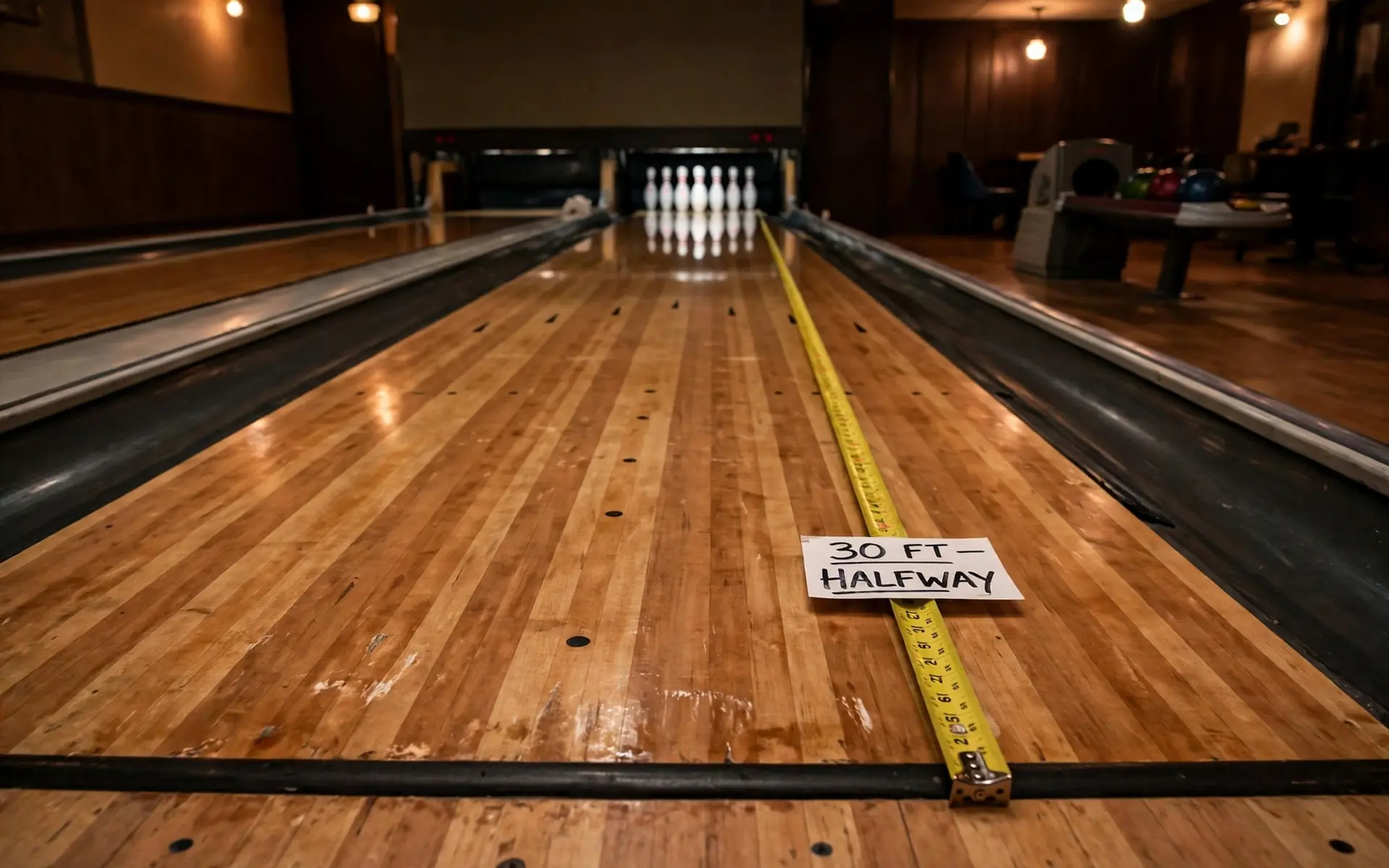
The bowling lane is the article’s most elegant exact, because its 30 feet is arithmetic you can stand inside. The United States Bowling Congress (USBC) specification puts the distance from the foul line to the centre of the headpin at exactly 60 feet, and half of 60 is 30 — so the midpoint of the lane, the spot your ball crosses halfway to the pins, is exactly 30 feet from where you release it. The lane surface itself is 41.5 inches wide, flanked by gutters, and the pin deck extends a little past the headpin, so the full physical lane bed runs a touch past 60 feet — but the playing measurement, foul line to headpin, is 60 feet by the governing body’s own rule, and its half is 30 feet with no rounding, no qualifier, and no conversion fudge.
The fitting check is where you stand, not what you buy. A bowler’s approach adds 15 feet or more behind the foul line, so the building needs roughly 75 feet of depth before a single ball return or seating row is added — and a bowler who pictures “30 feet” as the whole lane is picturing half the playing distance. The grade is exact because it is a halved governing-body specification, the strongest kind of derived measurement this article can print: 60 divided by 2 is 30, and the only way to dispute it is to dispute the 60, which the sport’s own rules fix. Next time you bowl, watch the ball cross the arrows about 14 to 16 feet down the lane, then keep watching: halfway to the pins, at the lane’s unmarked middle, it has travelled exactly 30 feet, and you have measured it without a tape.
3. A 30-Foot Utility Pole — 30 Feet Long, Only About 24 Feet 6 Inches Tall (EXACT, With a Buried Deviation)

The utility pole is the article’s best trap, because its name is the measurement and the measurement is mostly underground. Poles are manufactured and sold by total length, and a 30-foot pole is genuinely 30 feet of timber from butt to tip — but a pole is not a flagpole, and it does not stand on the ground, it stands in it. The RUS Bulletin 1728F-803 setting-depth table, the standard used for rural electric distribution lines, requires a 30-foot pole to be set 5 feet 6 inches deep in soil (3 feet 6 inches in solid rock), which leaves 24 feet 6 inches visible above grade in ordinary soil. The popular rule of thumb — bury 10 percent of the length plus 2 feet — gives 5 feet for a 30-foot pole and 25 feet visible, which is close but not the table’s figure, and this article prints the table’s figure because a standard beats a saying.
The fitting check is the wire height, not the pole height. Conductors hang below the top of the pole, so the clearance above a road or a driveway is lower than even the 24 feet 6 inches of visible pole — and a homeowner who estimates a tree’s clearance from “a 30-foot pole” overestimates the wire height by more than five feet, which is the difference between a safe trim and a call to the utility. The grade is exact for the manufactured length, with the deviation printed in full: 30 feet total, 5 feet 6 inches buried, 24 feet 6 inches above ground in soil. That is the whole lesson of this object in one line — the pole is 30 feet long and it is not 30 feet tall, and both halves of that sentence are true at the same time.
4. A Catalina 30 Sailboat — 29 Feet 11 Inches Long, 1 Inch Short (LISTED Near-Miss)

The sailboat is the article’s gentlest trap, because its miss is a single inch and its name is almost right. The Catalina 30, built by Catalina Yachts from 1974 to 2008 in more than 6,400 hulls, is one of the most popular cruising sailboats ever made in American waters — and the Catalina 30 Mark II specifications list its length overall at 29 feet 11 inches, with a 10-foot-10-inch beam, a 25-foot waterline, and a 10,200-pound displacement. The 30 in the name is a nominal class length, the way a “30-foot” slip at a marina is a class of slip, not a tape measurement of the boat that fills it. One inch is the thickness of a fender, the width of a dock line, and the entire difference between the name and the hull.
The fitting check is the slip, and it is forgiving in exactly the way the flagpole’s foundation is not. A 30-foot slip fits a 29-foot-11-inch boat with an inch to spare, which is why the near-miss has survived fifty years of production without embarrassing anyone — but a buyer who orders a fitted cover, a lift, or a trailer “for a 30-foot boat” without checking the specification can still be caught by that inch at the edges. The grade is listed near-miss rather than exact because the figure comes from the class association’s specification sheet for the Mark II rather than a single factory dimensioned drawing, and because the optional bowsprit stretches the overall length to about 32 feet — so the same boat can be 29 feet 11 inches, 30 feet in name, or 32 feet with the sprit, depending on what you count. Print the configuration, print the inch, and never quote the name.
5. A Gillig Phantom 30-Foot Transit Bus — 30 Feet Long (LISTED)

The bus is the article’s street-level 30 feet, the one you can walk past on any small-city route. The Gillig Phantom, built in Hayward, California from 1980 to 2008 and popular with small and mid-sized transit systems, was offered in lengths of 30, 35, and 40 feet, with 96-inch or 102-inch widths — and the 30-foot version is the short bus of the family, the one sized for neighbourhood routes where a 40-foot bus cannot turn comfortably. Thirty feet of bus seats roughly two dozen passengers with standing room, turns in a radius a longer bus cannot match, and fits a bus bay that a 35-foot bus would crowd. It is the vehicle length that makes a transit system feel local rather than metropolitan.
The fitting check is the bay and the turn, and it is stricter than the length. A 30-foot bus needs a bay at least 30 feet long before the pull-in and pull-out tapers are added, and a turning circle sized for its wheelbase — the 30-foot Phantom’s wheelbase is listed at 119 inches, far shorter than the 35-foot version’s — so a route planned for a 40-foot bus wastes space while a route planned for a 30-foot bus cannot take a longer substitute. The grade is listed rather than exact because the figure comes from the model’s offered length range rather than a dimensioned drawing of a single delivered bus, and individual configurations — bumpers, bike racks, destination signs — can nudge the bumper-to-bumper figure by inches. Measure the delivered bus, measure the bay, and measure the tightest turn on the route, in that order, before the route goes live.
6. A Laguna 30-Foot Round Above-Ground Pool — 30 Feet Across (LISTED)
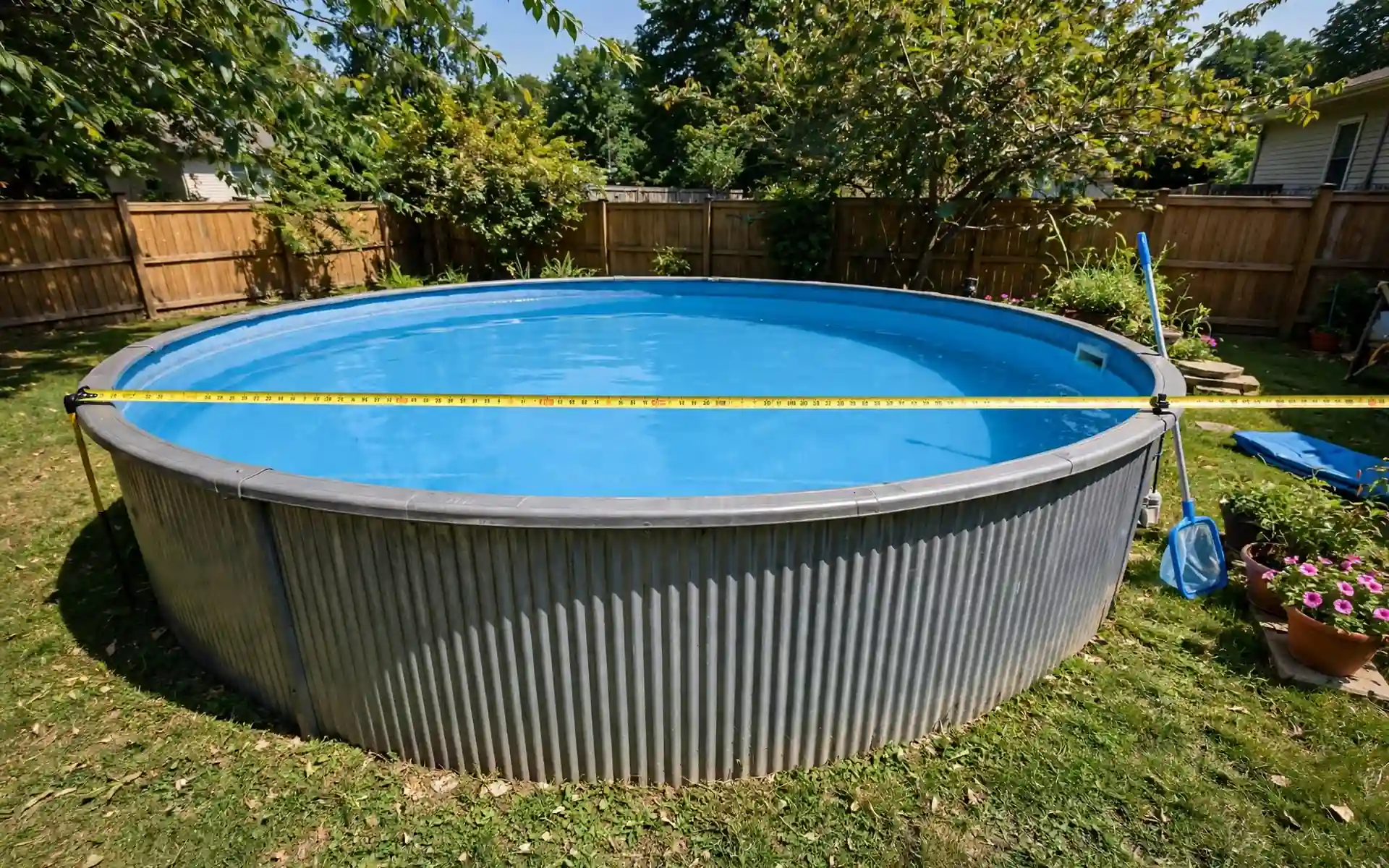
The pool is the article’s widest 30 feet, because its 30 feet runs across a circle rather than along a line. The Laguna 30-foot round pool package, with a 52-inch wall, is sold by its diameter: 30 feet from one side of the circle to the other, through the centre. That diameter makes it one of the largest round residential pools — big enough for a family to swim laps of a sort, small enough to fit a suburban backyard, and a very different shape from the rectangular pools that dominate the “30-foot pool” conversation. A round pool’s 30 feet is its widest point and its only long dimension at the same time, since every diameter of a circle is the same length, which is why a round pool is easier to picture than a rectangular one: stand at one edge, look straight across the water to the far edge, and you are looking at 30 feet.
The fitting check is the yard, not the water. A 30-foot-diameter pool needs a level pad at least 30 feet across before a single foot of walkway, pump, or fence is added, and most codes require a fence or barrier around it — so the fenced zone runs several feet past the pool on every side, and the yard that fits a 30-foot pool needs roughly 36 to 40 feet of clear width in practice. The volume follows from the diameter: at 4 feet of water depth, a 30-foot round pool holds roughly 21,000 gallons, which is the number that decides the pump, the filter, and the water bill. The grade is listed rather than exact because the figure is the retail package’s nominal diameter, and installed pools vary by a fraction of an inch with wall tension and levelling — so the tape across the water, not the box, is the final judge. Measure the pad, measure the fence line, and only then order the pool.
7. An Indoor Volleyball Court — 29 Feet 6 Inches Wide, 6 Inches Short (EXACT Near-Miss)

The volleyball court is the article’s most instructive near-miss, because its miss comes from a unit conversion rather than a marketing round. Indoor volleyball is played on a court built to the international standard of 18 metres long by 9 metres wide, and 9 metres converts to 29 feet 6.3 inches — not 30 feet, but close enough that American guides routinely round it to “30 feet wide” and move on. Each half of the court, divided by the net, is therefore a 9-by-9-metre square, about 29 feet 6 inches on each side, and the net itself is longer than the court is wide: the international net runs 9.5 to 10 metres, 31 feet 2 inches to 32 feet 10 inches, so that it overhangs the sidelines and reaches the posts outside the playing area. The court is 6 inches short of 30 feet, the net is 1 to nearly 3 feet longer than 30 feet, and both facts are true of the same game.
The fitting check is the gym, not the court. A court needs free space around it — the international rules require a free zone beyond the sidelines and end lines — so a gym that fits a “30-foot-wide” court on paper can fail by the 6 inches that rounding stole, plus the free zone that rounding never counted. The grade is exact for the 9-metre specification, with the deviation printed honestly: 9 metres is 29 feet 6 inches, which is 5.7 inches short of 30 feet, and the “30-foot court” is a rounded description, not a dimension. It is the mirror of the bowling lane: there, halving an exact 60 gives an exact 30; here, converting an exact 9 metres gives a near-miss 30 — and the difference between a halved specification and a rounded conversion is the difference between trusting a number and checking it.
The 30-Foot Walk: Pacing It Without a Tape
Before you buy, build, or book anything in this article, walk 30 feet, because the number feels different under your own feet than it looks on a specification sheet. The average adult walking step covers about 2.5 feet, so twelve ordinary steps land you close to 30 feet — ten steps if you stride long, fourteen if you step short — and the honest way to use the trick is to calibrate it first: walk a known 30 feet once, count your steps, and remember your own number rather than anyone else’s average. Ten yards is the same distance in a different unit, and a football field’s ten-yard line is a ready-made 30-foot ruler if you have a field nearby: stand on the goal line, walk to the 10-yard line, and you have walked 30 feet.
The second check is the tape itself, and this is where the article’s smallest object earns its place. A 30-foot tape measure exists precisely because 30 feet is the longest distance most people ever need to measure in one pull — a room, a garden, a driveway — and pulling it once beats pacing it twice. For anything that must fit — a flagpole foundation, a bus bay, a pool pad, a slip — use a real tape measure, because at 30 feet the misses in this article run from a single inch to more than five feet, and pacing throws every one of them away. Walk it first to feel it, tape it second to trust it, and never let a rounded name do the measuring for you.
Conversion Table
| Unit | 30 feet equals |
|---|---|
| Inches | 360 in exactly |
| Feet and inches | 30 ft 0 in |
| Centimetres | 914.4 cm exactly |
| Millimetres | 9,144 mm |
| Metres | 9.144 m exactly |
| Yards | 10 yd exactly |
| Kilometres | 0.009144 km |
| Miles | 0.005682 miles (rounded) |
| Compared with 40 feet | 10 feet shorter |
| Compared with 20 feet | 10 feet longer |
| Compared with 21 feet | 9 feet longer |
| Compared with a standard door (80 in) | 280 inches taller than the door is tall (30 ft = 360 in; a door is 80 in) |
| Square area 30 ft by 30 ft | 900 sq ft |
| Wrong figures to reject | 9.14 m rounded to 9 m, a 30-foot pole standing 30 feet tall, a Catalina 30 measuring 30 feet 0 inches, and a volleyball court 30 feet 0 inches wide are all wrong |
What 30 Feet Is Not
Thirty feet is not a school bus in general. A full-size school bus runs 35 to 40 feet, and only the short, small-route buses land near 30 — so “a school bus” without a model is not a 30-foot object, it is a range with a 30-foot end. Thirty feet is not two sedans, three compact cars, five adults, or two sharks: those are multiples and chains, and this article counts single things only, because a chain can be made to equal any length by adding links. Thirty feet is not a tennis court width, which is 36 feet for doubles and 27 feet for singles — a rival figure that belongs to neither. Thirty feet is not a 30-foot extension ladder either: the major ladder makers sell 28-foot and 32-foot extension ladders as their standard sizes around this length, and a 32-foot ladder at the standard working angle gives about 30 feet of working height, which is a working height, not a ladder length. And thirty feet is not 9 metres: 9 metres is 29 feet 6 inches, and rounding it up steals half a foot. Every one of these rejections is a measurement someone else printed as fact, and every one of them is why this article prints specifications instead of repeating names.
How 30 Feet Compares With Other Lengths
Thirty feet is one foot past 29 feet and ten past 20 feet, eleven past 19 feet and twelve past 18 feet, thirteen past 17 feet — and far longer than the inch series: at 360 inches it is four times 90 inches (7 feet 6 inches), and well past 80 inches and 70 inches. And ten feet longer takes you to 40 feet.
Frequently Asked Questions
How many inches is 30 feet?
Exactly 360 inches. Multiply 30 by 12 to get 360, with no rounding involved — 30 feet is one of the cleanest inch conversions there is, which is why it appears in tape measures, pool diameters, and flagpole heights alike.
How many metres is 30 feet — and how many centimetres?
Exactly 9.144 metres, which is 914.4 centimetres. Multiply 30 by 0.3048 to get 9.144 m, and by 30.48 to get 914.4 cm. The figure 9.14 m that many guides print is a rounding of 9.144, correct to two decimal places but not exact.
How many yards is 30 feet?
Exactly 10 yards. Divide 30 by 3 to get 10, so “ten yards” is exact, not rounded — which is why a football field’s 10-yard line is a ready-made 30-foot ruler.
Is a 30-foot utility pole really 30 feet tall?
No. A 30-foot pole is 30 feet long from butt to tip, but the standard setting depth in soil is 5 feet 6 inches, so only about 24 feet 6 inches stands above the ground. Measure the visible height, not the name, before estimating wire clearance.
Is a Catalina 30 really 30 feet long?
No, by one inch. Its specification lists 29 feet 11 inches overall, and the optional bowsprit stretches it to about 32 feet. A 30-foot slip still fits it, but a fitted cover or trailer should be ordered against the specification, not the name.
Is a volleyball court really 30 feet wide?
No, by about 6 inches. The international court is 9 metres wide, which converts to 29 feet 6 inches, and the net is longer than the court at 31 feet 2 inches to 32 feet 10 inches so it reaches the posts outside the sidelines.
How many steps is 30 feet?
About twelve ordinary adult steps at roughly 2.5 feet per step, but calibrate your own stride first: walk a known 30 feet once, count your steps, and use your own number rather than an average.
What is the easiest exact 30 feet to stand beside?
Half a bowling lane. The foul line to the headpin is 60 feet by the sport’s own specification, so the lane’s midpoint is exactly 30 feet from where you release the ball — and a 30-foot flagpole’s exposed height is the easiest exact 30 feet to stand beside outdoors.
Final Thoughts
Thirty feet is 360 inches, 914.4 centimetres, 9.144 metres, and 10 yards exactly — and once the arithmetic is right, the objects fall into place: a flagpole that really is 30 feet tall, a bowling lane whose half really is 30 feet long, a utility pole that is 30 feet long and only about 24 feet 6 inches tall, a sailboat that misses its own name by one inch, a transit bus listed at 30 feet, a round pool 30 feet across, and a volleyball court that is 29 feet 6 inches wide because 9 metres is not 30 feet. Seven objects, two honest near-misses, one buried deviation, and one rounded conversion, each with its dimension named and its grade printed. That is what 30 feet looks like when it is measured instead of repeated — and the next time a label tells you something “is 30 feet,” you now know the questions to ask first: 30 feet of what, measured how, and how much of it is underground?
