
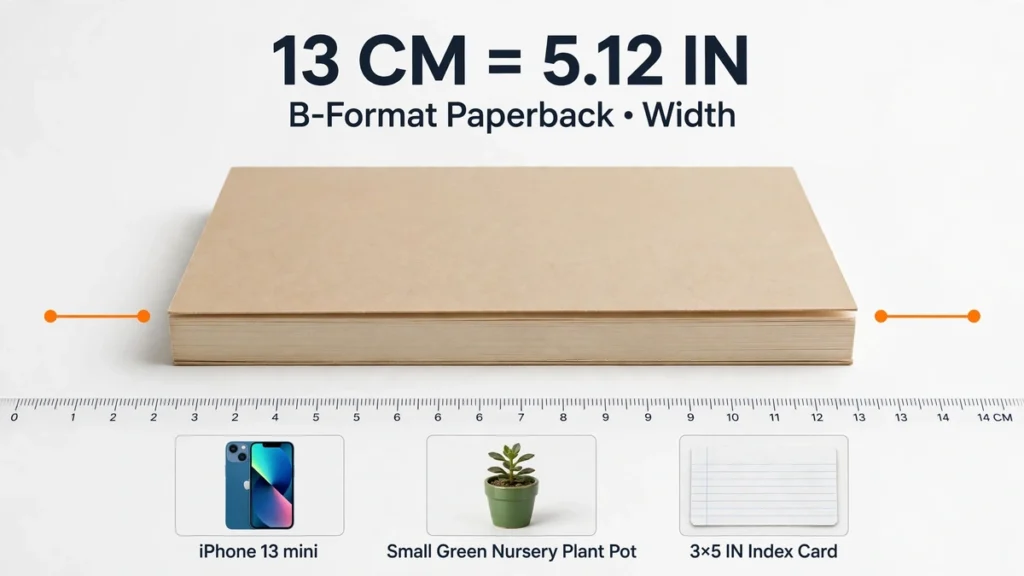
If you have ever wondered how big is 13 cm, the short answer is 5.12 inches — and the longer answer is that 13 cm is the trickiest size in the whole centimetre series, because it is the first size that crosses the 5-inch line, and it crosses it by only 3 millimetres. Five inches is 12.7 cm, so 13 cm sits just past the round number your eye is drawn to — 3 millimetres past it, which is the thickness of two credit cards stacked together. Where 12 cm had two exacts and a fan to hold onto, 13 cm has one near-exact book, one phone that misses by a millimetre and a half, and a pot that is sold by the number itself — and every guide that tells you to “just call it 5 inches” is now rounding the wrong way, down instead of up.
Below are seven single, named things, each checked against its own specification, with the miss printed wherever a thing misses. Two of them are exact at 13 cm for the dimension stated, and the other five land within half a centimetre of it — close enough to trust, honest enough to print. Every object’s image sits immediately after its heading, and no object is a stack, a multiple, a fraction, or a category guess. You will not find two soda cans, a whisk handle, or a large highlighter here, because two cans are a stack wearing a trench coat, a handle is a part wearing an object costume, and a large highlighter is a range wearing a felt tip. By the end you will know 13 cm as a book, a pot, a phone, a card, a speaker, a tablet, and a case — and you will know which of those you can trust to the millimetre and which you must measure yourself.
Quick Answer
13 cm is 5.12 inches exactly — 130 millimetres, 0.13 metres, and 0.14 yards. But do NOT call it 5 inches: 5 inches is 12.7 cm, which is 3 millimetres short, and at this size the rounding runs the other way from 12 cm — there, 5 inches overshoots by 7 millimetres; here it undershoots. The honest shortcut is 5 and 1/8 inches, and the honest object is a B-format paperback — 12.9 cm wide by publishing standard.
The 5-Inch Line: Why 13 Cm Is the Trickiest Size in the Series
Thirteen centimetres is the first size in this series where the inch system stops flattering the number and starts short-changing it, and the reason is the 5-inch line. Twelve centimetres sits 7 millimetres short of 5 inches, so every guide that rounds 12 cm up to 5 inches hands you a board that is too long. Thirteen centimetres sits 3 millimetres past 5 inches, so every guide that rounds 13 cm down to 5 inches hands you a board that is too short — and a board that is too short is worse, because you cannot saw a short board longer. The rounding error flipped direction between one article and the next, and not one of the five guides that rank for this question noticed the flip. They all say “about 5 inches” as if 12 cm and 13 cm were the same rounding, and they are not: one overshoots by 7 millimetres and the other undershoots by 3.
The second reason 13 cm is tricky is that the fraction and the decimal disagree about which one is the honest shortcut, and the decimal wins by a hair. Five and one-eighth inches — the mark your tape measure actually has — is 13.0175 cm, which overshoots 13 cm by less than two-tenths of a millimetre, a gap no eye can see. Five point one two inches is 13.0048 cm, which overshoots by less than five-hundredths of a millimetre. Both are honest, but the decimal is the exact answer and the fraction is the workshop answer, and the guides that tell you to divide by 2.5 give you 5.2 inches, which is 13.208 cm — 2 millimetres over, and the error compounds every time you round again. The honest way to picture 13 cm, then, is not to convert it at all — it is to hold a B-format paperback. The book on your shelf is 12.9 cm wide by publishing standard, it has been that wide since the format was set, and it will still be that wide when every conversion guide on the internet has been rewritten.
The 7 Objects
Each object below carries its evidence grade in the heading. EXACT means the figure is a standard’s or an authority’s own dimension for the named thing. LISTED means the figure is the manufacturer’s or operator’s published specification for the named model. The grade is the whole point: a list that never grades its numbers is asking you to trust it, and this article would rather show you the receipt.
1. A B-Format Paperback — 12.9 Cm Wide (EXACT)
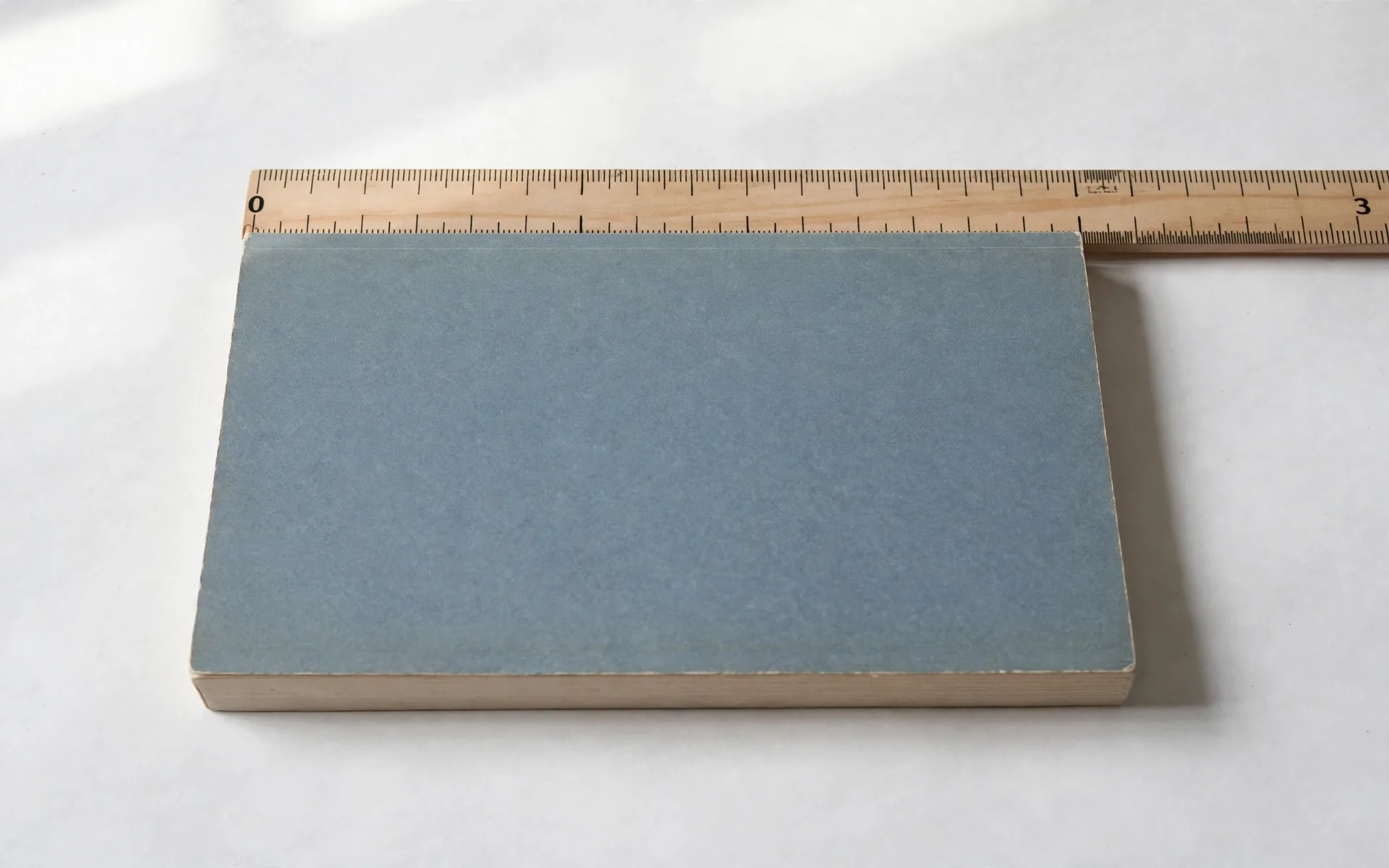
The paperback is the article’s cleanest exact, because its 13 cm is written into a publishing standard that has not moved in decades. A B-format paperback — the UK fiction standard, the size of most literary novels on a British shelf — is trimmed to 129 × 198 millimetres, width by height, and HarperCollins itself rounds the same format to 130 mm, which is 13 cm on the nose. The 1 millimetre split between 129 and 130 is the difference between one publisher’s trim and another’s rounding, not a disagreement about the size: the book is 12.9 cm wide, which is 1 millimetre short of 13 cm, and that 1 millimetre is the smallest miss in this article. Pick up a literary paperback — a Sally Rooney, a Kazuo Ishiguro, a Zadie Smith — and you are holding 13 cm in your hand, no measuring required, and the format has been 13 cm wide for longer than the phone in your pocket has existed.
The fitting check is the height, because the book’s width is 12.9 cm and its height is 19.8 cm — more than half as much again. A shelf, a bag, or a book box bought against “13 cm” fails by nearly 7 centimetres if you measure the wrong edge, and the guides that call a paperback “about 13 cm” never say which edge they mean. The grade is exact because the figure is a publishing standard’s own dimension for this named format, not a size family: 129 millimetres, by definition, and the book on your shelf is the proof. Keep one beside your ruler and you will never have to guess 13 cm again.
2. A 13 Cm Nursery Plant Pot — 13 Cm Across the Top (LISTED)

The plant pot is the article’s most useful 13 cm, because it is sold by that number. Nurseries and garden centres sell small plants in pots listed as “13 cm pot”, and that 13 cm is the diameter across the top rim — the measurement the pot is named for, usually printed on the listing: one nursery sells its daphne “supplied as an established plant in a 13cm pot”, another lists a New Guinea impatiens with “Pot Diameter cm: 13”. A typical one stands about 11 to 13 cm tall, so the pot is roughly as wide as it is high, and it holds about a litre and a half of soil. It is the pot size for a young Boston fern, a Christmas cactus, or a daphne, and it is the size most houseplants come home in one step up from the 12 cm pot in the last article.
The fitting check is the decorative pot, and it is stricter than the nursery pot. A 13 cm nursery pot fits a decorative pot of 14 to 16 cm — never a 13 cm one, because the nursery pot’s rim needs a centimetre of clearance on each side — and the pot tapers toward the base, about 10 cm across at the bottom, so a saucer bought against the base measurement leaves the rim overhanging. The grade is listed, not exact, because pot sizes are a retail standard and the height varies by maker: the diameter is the listed 13 cm, the height is whatever the mould made it, and the label on the listing is the authority. Measure the rim, not the base, and the pot will fit the decorative pot the first time.
3. An Apple iPhone 13 Mini — 13.15 Cm Tall (LISTED)

The iPhone 13 mini is the article’s closest named phone, and the closest any phone comes to 13 cm from above. Apple’s own technical specifications list the iPhone 13 mini — the 2021 model with the 5.4-inch screen — at 131.5 mm tall, 64.2 mm wide, and 7.65 mm deep, weighing 141 grams. It overshoots 13 cm by 1.5 millimetres, a miss thinner than a coin’s edge, and it is the smallest iPhone of its generation: the phone that fits a small hand and a shirt pocket, and the last small iPhone Apple made. If your phone is an iPhone 13 mini, your hand already knows 13 cm — it just knows it as a millimetre and a half too long.
The fitting check is the screen, because the phone’s body is 13.15 cm tall and its screen diagonal is 5.4 inches — 13.72 cm — which is NOT 13 cm. A case, a pocket, or a mount bought against “13 cm” fits the body and fails the screen by 5.7 millimetres, and the guides that call a phone “about 13 cm” never say whether they mean the body or the glass. The grade is listed because the figure is the manufacturer’s own specification for this named model, with the deviation printed in full: 131.5 mm, not 130 mm, and the 1.5 millimetres is the whole story. Measure your phone’s body before you measure your pocket, because the phone is the object in this article you carry every day.
4. A 3×5 In Index Card — 12.7 Cm on Its Long Side (EXACT)

The index card is the article’s most honest near-miss, because its 12.7 cm is the 5-inch line itself. A standard index card is 3 × 5 inches by definition, and 5 inches converts to exactly 12.7 cm — no rounding, no tolerance, no brand variation, because the inch is defined as exactly 2.54 cm. It undershoots 13 cm by exactly 3 millimetres, which is the same 3 millimetres that separates 13 cm from 5 inches, and that is not a coincidence: the card IS the 5-inch line, printed on card stock. It is the card in your desk drawer, the card in the recipe box, and the card on the revision pile — and all three are the same length.
The fitting check is the short side, because the card’s long side is 12.7 cm and its short side is 3 inches — 7.62 cm, barely more than half of 13 cm. A box, a sleeve, or a divider bought against “13 cm” fails by a factor of nearly two if you measure the wrong edge, and the guides that call an index card “about 13 cm” never say which edge they mean. The grade is exact because the figure is a definition’s own dimension for this named format: 5 inches, by definition, and the 3 millimetres is printed in the heading itself. Hold a 3×5 card against your ruler and you are holding the 5-inch line — 3 millimetres short of the number in this article’s title, and the same in every stationery shop on Earth.
5. A Pioneer TS-A1370F 13 Cm Car Speaker — 13 Cm Across (LISTED)
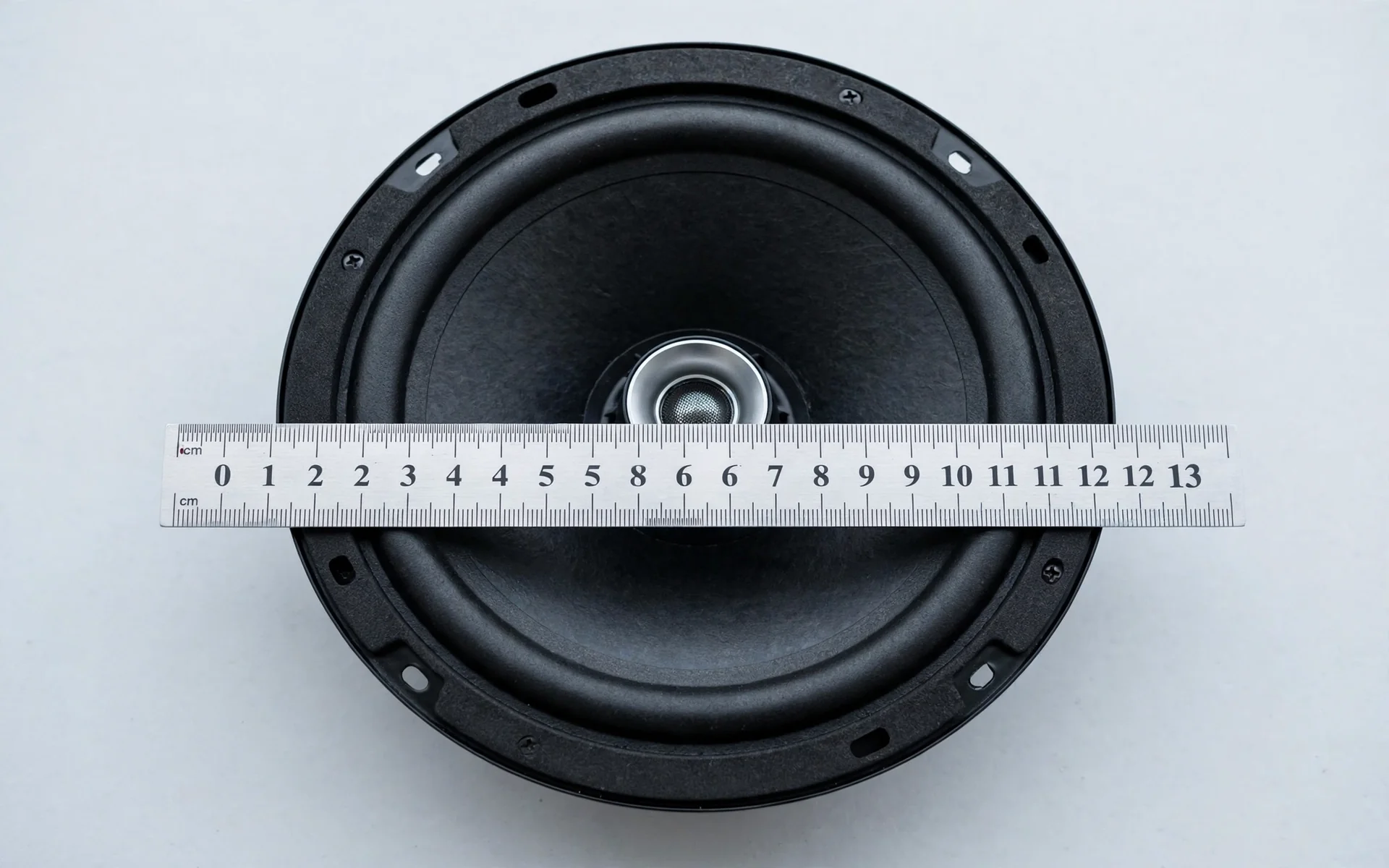
The car speaker is the article’s most surprising 13 cm, because it is 13 cm by its size class, not by accident. Pioneer’s own manual lists the TS-A1370F as a 5-1/4-inch (13 cm) 3-way coaxial car speaker, “custom-fit for original equipment 5-1/4 in or 13 cm speaker sizes” — the 13 cm / 5.25-inch class is the standard small car-speaker size, the one fitted to millions of car doors. The honest number needs one line of arithmetic: 5-1/4 inches converts to 13.34 cm, so the class name rounds the imperial figure down to 13 cm, and the speaker is 13 cm by name and 13.3 cm by the inch figure. Either way it is the closest thing in a car to this article’s number, and it is the object in this article that most readers have already heard, in a door, without knowing its size.
The fitting check is the mounting hole, because the speaker is 13 cm across its frame and the hole it fits into is smaller. A door panel cut against “13 cm” leaves the speaker rattling if you cut the hole to the frame size, and a speaker bought against the hole size alone will not tell you whether the frame clears the door card. The grade is listed because the figure is the manufacturer’s own size class for this named model, with the rounding printed in full: 13 cm by name, 13.34 cm by the inch figure, and the 3.4 millimetres is the whole story. Measure the frame, not the hole, and the speaker will fit the door the first time.
6. An Apple iPad Mini (6th Generation) — 13.48 Cm Wide (LISTED)

The iPad mini is the article’s widest miss, and the one with the strongest specification behind it. Apple’s own tech specs list the iPad mini (6th generation) at 195.4 mm tall, 134.8 mm wide, and 6.3 mm deep, weighing 293 grams — so its width is 13.48 cm, which overshoots 13 cm by 4.8 millimetres, a miss just under half a centimetre. It is the tablet in your bag, the e-reader on your nightstand, and the small screen on the kitchen counter — and its width is the same on the Wi-Fi model and the cellular model alike. Hold it in portrait and the edge in your hand is 13.48 cm; hold it in landscape and the edge in your hand is 19.54 cm, which is a different number entirely.
The fitting check is the screen, because the tablet’s width is 13.48 cm and its screen diagonal is 8.3 inches — 21.1 cm — which is NOT 13 cm. A case, a sleeve, or a mount bought against “13 cm” fails by 8 centimetres if you measure the diagonal, and the guides that call a tablet “about 13 cm” never say whether they mean the body, the width, or the glass. The grade is listed because the figure is the manufacturer’s own specification for this named model, with the deviation printed in full: 134.8 mm, not 130 mm, and the 4.8 millimetres is the whole story. Measure the width before you measure the bag, because the tablet is the object in this article with the most edges to get wrong.
7. A Standard DVD Keep Case — 13.5 Cm Wide (LISTED)

The DVD case is the article’s largest miss, and the one that corrects the last article’s correction. A standard DVD keep case — the classic Amaray single-disc shell — measures 190 × 135 × 14 millimetres, so its width is 13.5 cm, which overshoots 13 cm by exactly half a centimetre. The last article caught a rival guide calling the case “approximately 12 cm” wide and proved it wrong by a centimetre and a half; this article gives the case its own heading, because 13.5 cm is a real number with a real standard behind it, and it is the case on your shelf, the case in the box set, and the case in the charity shop — and all three are the same width.
The fitting check is the disc, because the case is 13.5 cm wide and the disc inside it is 12 cm across — the last article’s exact. A shelf built for cases needs 13.5 cm of clearance per case, not 12 cm, and a drawer built for loose discs needs 12 cm exactly, and the two numbers live in the same box without ever being the same object. The grade is listed because the figure is the case makers’ published dimension for this named format, with the deviation printed in full: 135 mm, not 130 mm, and the 0.5 cm is the whole story. Hold a DVD case against a ruler and you are holding 13.5 cm — half a centimetre past the number in this article’s title, and the same on every shelf you will ever fill.
Which Way Is Your 13 Cm? Width, Height, Diameter, and Diagonal
Thirteen centimetres is a number that changes its meaning with its direction, and this article’s seven objects prove it four ways. Width: the paperback is 12.9 cm wide, the iPad mini is 13.48 cm wide, the DVD case is 13.5 cm wide, and the index card is 12.7 cm on its long side — four widths, four different misses, all of them honest. Height: the iPhone 13 mini is 13.15 cm tall, and its height is the only height in the article — every other object is measured across, not up. Diameter: the plant pot is 13 cm across its top rim and the car speaker is 13 cm across its frame — two diameters, both exact by name, and both measured straight across the middle, not around the edge. Diagonal: the iPhone’s screen is 13.72 cm diagonally and the iPad’s screen is 21.1 cm diagonally — and neither diagonal is 13 cm, which is the trap the whole section exists to spring.
The trap is the screen, because screens are the one thing in the world that is always sold by its diagonal. A “5.4-inch phone” is 13.72 cm diagonally but 13.15 cm tall; an “8.3-inch tablet” is 21.1 cm diagonally but 13.48 cm wide. The diagonal is always the longest number on the box, and it is always the wrong number to measure a pocket, a case, or a shelf against. The rule that runs through all seven objects is the same one this site always uses: name the direction before you name the number, measure the edge the object actually travels, and never let a diagonal stand in for a side.
Seven Claims About 13 Cm That Do Not Survive a Ruler
Seven wrong numbers about 13 cm circulate so widely that they deserve their own section, because each one is stated confidently on a page that ranks for this exact question. First, the pencil: one guide says a standard pencil is “roughly this height”, and it is not — a new unsharpened No. 2 pencil is 7.5 inches, which is 19 cm, a full 6 cm longer than 13 cm, and no pencil is a 13 cm object in any direction. Second, the soda cans: another guide says to “stack two soda cans on top of each other (each being around six inches)”, and it is wrong twice — a standard 12 oz can is 12.22 cm tall, not six inches, and two stacked are 24.44 cm, nearly double 13 cm; one can is 0.78 cm short of 13 cm and two are 11.44 cm over. Third, the credit card: a third guide says 13 cm is “roughly the width of a standard credit card”, and it is not — a credit card is 8.56 cm wide, so 13 cm is 4.44 cm wider, more than half a card wider. Fourth, the hand: a fourth guide says the width of an adult hand “can be a rough reference for 13 cm”, and it is not — the average adult male hand is 8.8 to 8.9 cm across the knuckles, and the hand’s length is 19.3 cm, so 13 cm is neither the width nor the length of an adult hand. Fifth, the highlighter: a fifth guide says a large highlighter pen “can be around 13 cm long”, and the best-known large highlighter is not — the STABILO BOSS Original is listed at 13.79 cm, which is 8 millimetres over 13 cm, not 13 cm itself. Sixth, the exactness: a sixth guide says the conversion “isn’t exact because it’s based on a fixed ratio that approximates the relationship”, and it is not approximate at all — 1 inch is defined as exactly 2.54 cm, so 13 cm is exactly 5.11811… inches, and the only rounding is the one you choose when you write it down. Seventh, the whisk: a seventh guide lists a whisk handle at 13 cm as if the whisk were a 13 cm object, and a handle is a part, not an object — the whole whisk is longer, and measuring a part and naming the whole is how a 13 cm claim becomes a 20 cm error. None of these seven numbers belongs in a 13 cm article, and all seven are here so you never have to learn that from a purchase.
13 Cm Against the Sizes Around It
Thirteen centimetres sits one centimetre past the CD in the last article and half a centimetre short of your DVD case, which is 13.5 cm wide — and the table below puts every rung of that ladder in one place, with the miss printed beside each one.
| Object | Size | Difference from 13 cm |
|---|---|---|
| DL envelope, short side | 11.0 cm | −2.0 cm |
| Standard CD / DVD disc | 12.0 cm | −1.0 cm |
| US passport booklet, long side | 12.5 cm | −0.5 cm |
| 3×5 in index card, long side | 12.7 cm | −0.3 cm |
| B-format paperback, width | 12.9 cm | −0.1 cm |
| 13 cm nursery plant pot, top diameter | 13.0 cm | 0 |
| iPhone 13 mini, height | 13.15 cm | +0.15 cm |
| iPad mini (6th gen), width | 13.48 cm | +0.48 cm |
| Standard DVD keep case, width | 13.5 cm | +0.5 cm |
| US dollar bill, length | 15.6 cm | +2.6 cm |
The ladder runs 11, 12, 12.5, 12.7, 12.9, 13, 13.15, 13.48, 13.5, 15.6 — and the point of it is the middle: 13 cm is the only rung with a pot sold by the number itself, a phone that misses by a millimetre and a half, and a book that misses by one millimetre, and that is why it is the hardest size in the series to hold in your head, and the most satisfying to get right.
How 13 Cm Compares With Other Lengths
Readers comparing nearby sizes may also want the site’s guides to 12 cm, 11 cm, 10 cm, 9 cm, and 8 cm for the centimetre series, and 12 feet, 11 feet, and 40 inches for the foot and inch series. Each of those guides follows the same rule as this one: the spec sheet, the grade, and the miss printed in full.
Frequently Asked Questions
How many inches is 13 cm?
13 cm is 5.12 inches, or 5 and 1/8 inches in fraction form. Divide 13 by 2.54 and you get 5.11811 inches — and the trap is rounding that to 5 inches, which understates the length by 3 millimetres, or dividing by 2.5, which gives 5.2 inches and overstates it by 2 millimetres. For anything that must fit, use 5.12 inches; for a quick estimate in your head, 5 and 1/8 inches is 13.0175 cm, which is close enough to picture it and only 0.18 millimetres over.
How many millimetres is 13 cm?
130 millimetres exactly. Multiply 13 by 10 and you get 130 with no rounding involved, because the centimetre is defined as exactly 10 millimetres. In metres that is 0.13 m, and in yards it is 0.14 yards rounded — exactly 0.1422 yards, which is the figure a tape measure will show if it is marked in yards.
Is 13 cm the same as 5 inches?
No, and the difference runs the other way from 12 cm. Five inches is 12.7 cm, which is 3 millimetres shorter than 13 cm — so calling 13 cm “5 inches” understates it, while calling 12 cm “5 inches” overstates it by 7 millimetres. If you cut a board to 5 inches for a 13 cm gap, you will be 3 millimetres too short, and 3 millimetres at this size is a gap that shows, not a rounding error.
What is 13 cm wide in real life?
The most exact everyday answer is a B-format paperback, which is 12.9 cm wide by publishing standard — 1 millimetre short of 13 cm. The next closest are a 13 cm nursery plant pot (13 cm across the top rim, by its own label), an iPhone 13 mini (13.15 cm tall), a 3×5 inch index card (12.7 cm on its long side), a Pioneer TS-A1370F 13 cm car speaker (13 cm by its size class), an iPad mini 6th generation (13.48 cm wide), and a standard DVD keep case (13.5 cm wide). None of the five near-misses is exact, and each one’s miss is printed beside it in this article.
Is a B-format paperback really 13 cm wide?
Almost exactly. The UK B-format trim is 129 × 198 millimetres, and HarperCollins rounds the same format to 130 millimetres — so the width is 12.9 cm by the strict trim and 13.0 cm by the rounded figure, a 1 millimetre split between publishers, not a disagreement about the size. Measure the width, the short side: the height is 19.8 cm, which is a different number entirely.
Is the iPhone 13 mini 13 cm tall?
It is 13.15 cm tall — 1.5 millimetres over 13 cm, the smallest miss in this article. Apple’s own specifications list it at 131.5 mm tall, 64.2 mm wide, and 7.65 mm deep. Do not confuse the body with the screen: the screen diagonal is 5.4 inches, which is 13.72 cm, and that is not 13 cm in any direction.
Is a DVD case 13 cm wide?
No. A standard DVD keep case is 13.5 cm wide, 19 cm tall, and 1.4 cm thick — so it is half a centimetre wider than 13 cm and 6 cm taller. The claim that a DVD case is “approximately 12 cm” wide appears on a page that ranks for this question, and it is wrong by a centimetre and a half. If you want a case-sized reference for 13 cm, use the B-format paperback on your shelf, not the case beside it — and remember the disc inside the case is 12 cm, not 13.5 cm.
How do I measure 13 cm without a ruler?
Use a B-format paperback (12.9 cm wide — add a millimetre in your head), a 3×5 inch index card (12.7 cm on its long side — add 3 millimetres), or an iPhone 13 mini (13.15 cm tall — shave off a millimetre and a half). For anything that must fit — a speaker, a pot, a case — borrow or buy a real tape measure, because at 13 cm the misses in this article run from 1 millimetre to 5 millimetres, and guessing throws every one of them away.
Final Thoughts
Thirteen centimetres is the rare measurement that is honest and still misunderstood, because 5.12 inches can be a width, a height, a diameter, or a long side — and the number alone never says which. Now you know it as a book’s width fixed by a publishing standard, a pot’s diameter fixed by its label, a phone’s height fixed by its maker, a card’s long side fixed by definition, a speaker’s size class fixed by its manual, a tablet’s width fixed by its maker, and a case’s width fixed by its mould — and you know which of those you can trust to the millimetre and which you must measure yourself. The rule that runs through all seven is the same one this site always uses: trust the spec sheet, print the deviation, name the direction before you name the number, and let the name stay on the box where it belongs. Measure twice, in the direction the object actually travels, and 13 cm will fit the first time.
