
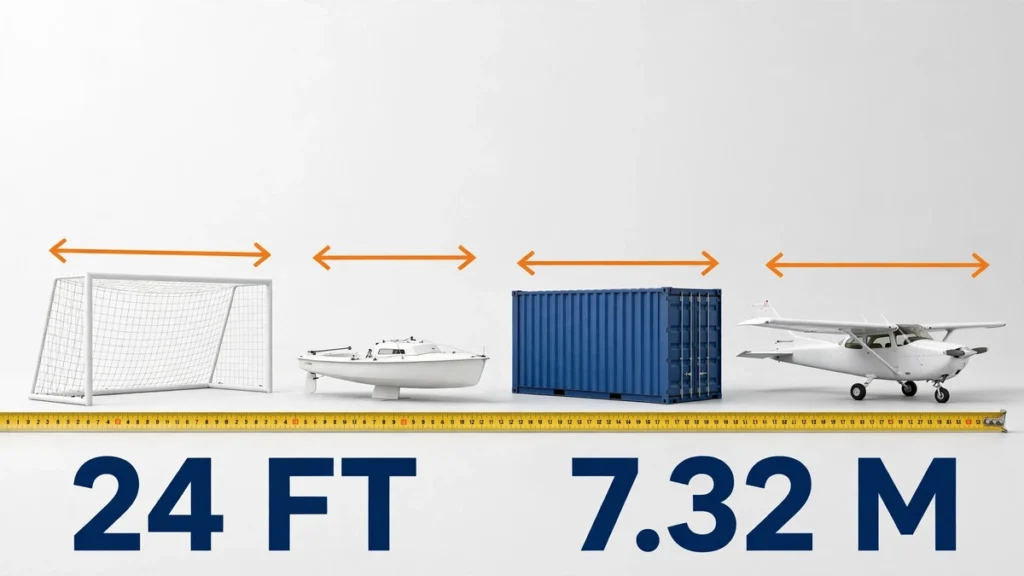
Stand in the middle of a soccer goal and spread your arms. You cannot touch both posts — not even close. The posts stand 24 feet apart, eight yards of empty goalmouth, and a goalkeeper has to defend every inch of it with nothing but reflexes and a pair of gloves. That is how long is 24 feet when it is measured the way football measures it: not as a number on a tape, but as the width a striker has to beat and a keeper has to cover. Every professional goal on Earth is the same 24 feet wide, because the rulebook is the product — and the rulebook has not changed that number since 1863.
Here is the stranger part: 24 feet is 7.32 metres, and a racing sailboat called the J/24 is also 7.32 metres long — designed by a man in Rhode Island who never met the men who wrote football’s laws, and built to a number that has nothing to do with football at all. Two rulebooks, two continents, two sports, one number. That coincidence is the story of this article, because 24 feet is the rare length in this series that is round in two systems at once: 24 feet is exactly 8 yards, and 8 yards is exactly 7.32 metres. The five things below are the closest honest answers: three of them are exact to the centimetre, and two of them carry a named model and a printed miss. None of them is a stack, a multiple, a fraction, a sum, or a category guess. By the end you will know 24 feet as a goal, a sailboat, a container, a pool, and an aeroplane — and you will know which of those you can trust to the inch and which one overshoots by exactly one.
The 8-Yard Secret: Why 24 Feet Has Real Exact Objects
Ten metres fell between the classes because 32.81 feet is nobody’s round number. Twenty-four feet has the opposite luck: it is 8 yards exactly, and the yard is the unit the old rulebooks were written in. The goal is 24 feet wide because in 1863 the Football Association fixed the goal at 8 yards, and 8 yards has been 24 feet ever since — the metric figure, 7.32 metres, is just the yard figure translated. The J/24 is 24 feet long because Rod Johnstone drew a 24-foot boat, and 7.32 metres is just the foot figure translated. Both numbers are exact because both were written in the unit the writer was thinking in, and the conversion happens to land on a clean figure in the other system.
That is also why “call it 7 metres” is the one rounding in this article that fails by a whole foot. Seven metres is 22.97 feet — 1.03 feet short of 24 — which is the length of a school ruler missing from your measurement, and a berth, a pool base, or a goal frame bought against “7 metres” fails by that much before anything is built. The honest shortcut is 7.32 metres, or 8 yards, or 24 feet 0 inches — three names for the same tape, and the only one of the three that is round in two systems. The guides that list “things that are 24 feet long” keep reaching for the Class C motorhome and the two-storey house because those are the biggest single things in a normal life with 24 in their name — and neither of them is 24 feet, one by a foot and eight inches and the other by a range a foot wide on either side. The motorhome is the object this article measures properly, in the corrections section, and the house is the object it refuses to measure at all.
Quick Answer
24 feet is 7.3152 metres exactly — 731.52 centimetres, 7,315.2 millimetres, 288 inches, and exactly 8 yards. But do NOT call it 7 metres: 7 metres is 22.97 feet, which is 1.03 feet shorter than 24 feet, and do NOT call it 25 feet either: 25 feet is 7.62 metres, which is 30 centimetres longer. The honest shortcut is 8 yards — and the honest objects are the soccer goal, 24 feet wide by the rulebook that built it, and the J/24 sailboat, 24.0 feet long by the designer who drew it.
The 5 Objects
Below, the five objects run from the closest match to the furthest, and the grade in each heading tells you how solid its number is. EXACT is for a figure set down by the standard or the authority itself — the rulebook’s own dimension for the thing it governs. LISTED is for a figure printed by the maker or the operator in the specification for that named model. AVERAGE is for a figure an authority publishes as an average or a range for the named thing. REPORTED is for the biggest measurement an expert source has actually verified for the named thing. Three of the five hit 24 feet dead on, and two of them agree on the same metric figure — 7.32 metres — fixed by two rulebooks that never spoke to each other.
1. A Regulation Soccer Goal — 24.00 Ft Wide (EXACT)
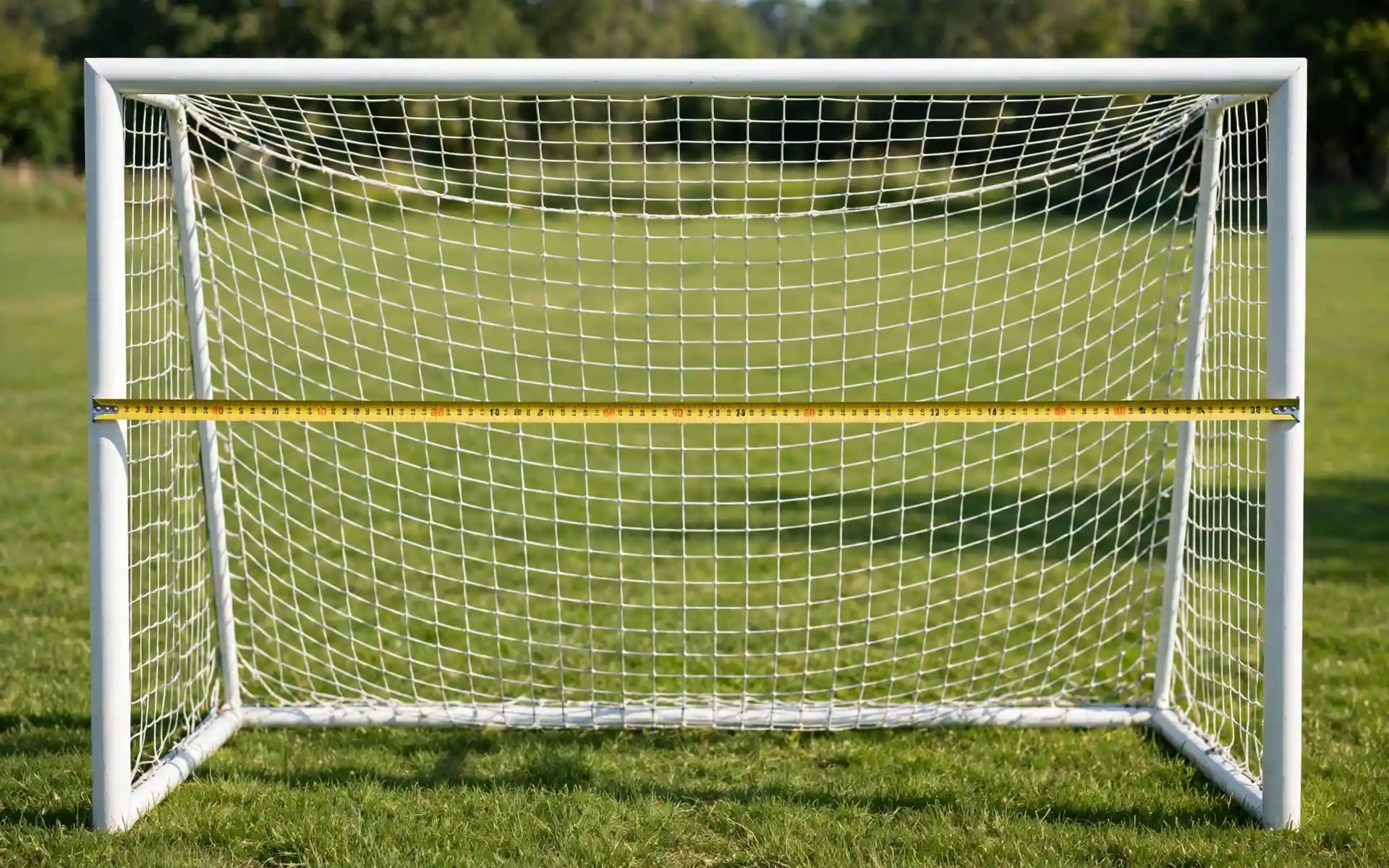
The goal is the article’s cleanest exact, because its 24 feet is written into the rulebook of the world’s most-played sport rather than a catalogue, and it is also the article’s opening scene. IFAB Law 1 fixes the distance between the inside of the posts at 7.32 metres — 8 yards, which is exactly 24 feet — and the distance from the lower edge of the crossbar to the ground at 2.44 metres, which is 8 feet. The posts and the crossbar must be white, the same shape, and no more than 12 centimetres thick, and the goal line must be the same width as the posts. Every professional goal on Earth is the same 24 feet wide, from a World Cup final to a Sunday league pitch with borrowed nets, because the rulebook is the product — and the rulebook has said 8 yards since 1863.
The fitting check is the inside edge, because the goal’s 24 feet is measured between the inside of the posts and the thing people misjudge is the post itself: a post up to 12 centimetres thick reads 24 feet 10 inches if you measure outside to outside, and a youth goal will lie to you by far more — five-a-side and seven-a-side goals are 12 feet wide, exactly half. The guides that call a soccer goal “about 24 feet wide” are right about the number and wrong about the confidence — it is not about 24 feet, it is 24 feet, to the millimetre the rulebook allows, and a goal built a centimetre narrow would not host a professional match. The grade is exact because the figure is the governing body’s own dimension for the named thing: 7.32 metres, 8 yards, 24 feet, by the Laws of the Game. Measure the inside of the posts before you measure the goalmouth, because the goal is the object in this article that every other object is judged against.
2. A J/24 One-Design Keelboat — LOA 24.0 Ft (EXACT)
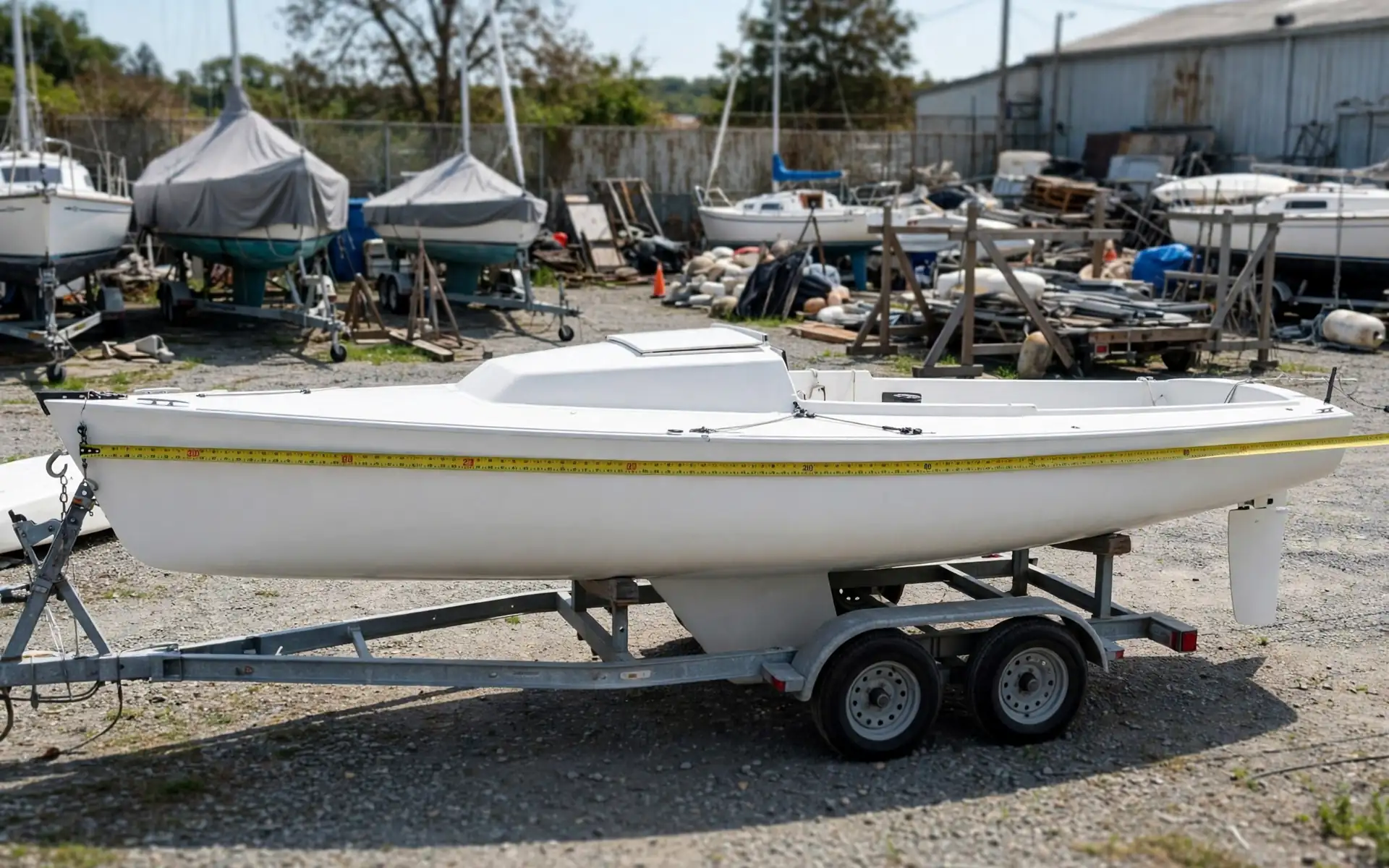
The J/24 is the article’s second exact, and the one that proves 24 feet is a number two rulebooks can land on independently. Rod Johnstone designed the J/24 in 1977 as a 24-foot one-design racing keelboatt, the first boat J/Boats ever built, and more than 5,200 of them have been built since — every one of them 7.32 metres, or 24.0 feet, from bow to stern. The rest of the specification is just as fixed: a waterline length of 20.0 feet, a beam of 8 feet 11 inches, a draft of 4 feet, and a displacement of 3,100 pounds, with a crew of three to six and a hull speed of 6 knots. Walk from the bow to the stern and you have walked 24 feet — the same 7.32 metres as the soccer goal, written by a boat designer in Rhode Island who never read a football rulebook, because the mould is the product.
The fitting check is the waterline, because the J/24’s 24 feet is its overall length and its waterline is 20 feet — four feet shorter — and the thing people misjudge is which length a berth is sold against. A berth bought against “24 feet” for this boat fits on the overall length, because the largest reading is the one that matters, and the 4 feet between the waterline and the overall length is the bow overhang, the stern, and the racing. The guides that call a 24-foot sailboat “about 24 feet” never say whether they mean the hull, the waterline, or the trailer, because they never read the specification — and the boat-specs page that lists the Beneteau First 24 at 24 feet is measuring a class name, not a hull, which is a correction for later in this article. The grade is exact because the figure is the class’s own dimension for the named thing: 7.32 metres overall, 24.0 feet, by the J/24 specification. Measure the bow to the stern before you measure the berth, because the J/24 is the object in this article you sail.
3. A Conexwest 24-Foot Storage Container — 24 Ft Long Externally (EXACT)
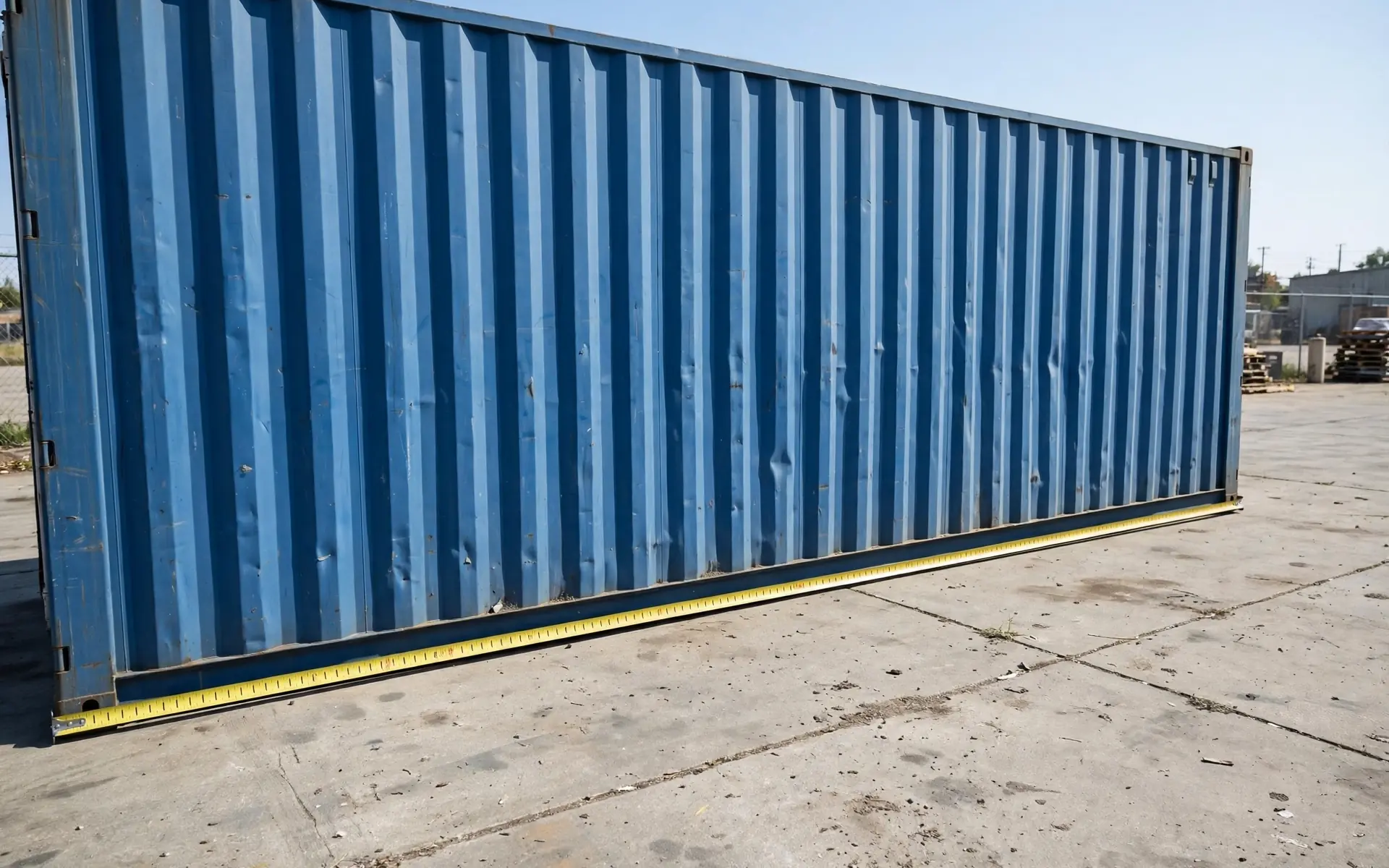
The container is the article’s third exact, and the one that settles an argument the other lists get wrong. Conexwest lists its 24-foot storage container at 24 feet long, 8 feet wide, and about 8.6 feet high externally — a corten-steel box with corner castings on all eight corners, a marine plywood floor, and secure closing cargo doors, sold refurbished from $3,425. The 24-foot size is not an ISO standard — the standard sizes are 20 and 40 feet — but it is a real size all the same: Matson Navigation has run 24-foot containers on its West Coast to Hawaii routes since 1958, and the firm sells them today for job-site storage, pop-up retail, and mobile offices. Park one on a site and walk from the door end to the far end, and you have walked 24 feet — the same on every 24-foot container of the type, because the steel is the product.
The fitting check is the wall, because the container’s 24 feet is its exterior and its interior is 23 feet 5 inches long, 7 feet 8 inches wide, and 7 feet 10 inches high — and the 7 inches between the two readings is the thickness of the walls and the door, which is the difference between a load that fits and a load that does not. A storage bay bought against “24 feet” for this container fails by 7 inches if you measure the outside and load the inside, and the guides that say “standard containers come only in 20 and 40 feet” are right about the ISO standard and wrong about the world: the 24-footer exists, it is for sale, and it has been crossing the Pacific since before the ISO standard was written. The grade is exact because the figure is the seller’s own listing for the named size, with both readings printed in full: 24 feet outside, 23 feet 5 inches inside. Measure the inside before you measure the load, because the container is the object in this article you pack.
4. An Intex Ultra XTR 24-Foot Round Pool — 24 Ft Across (LISTED)
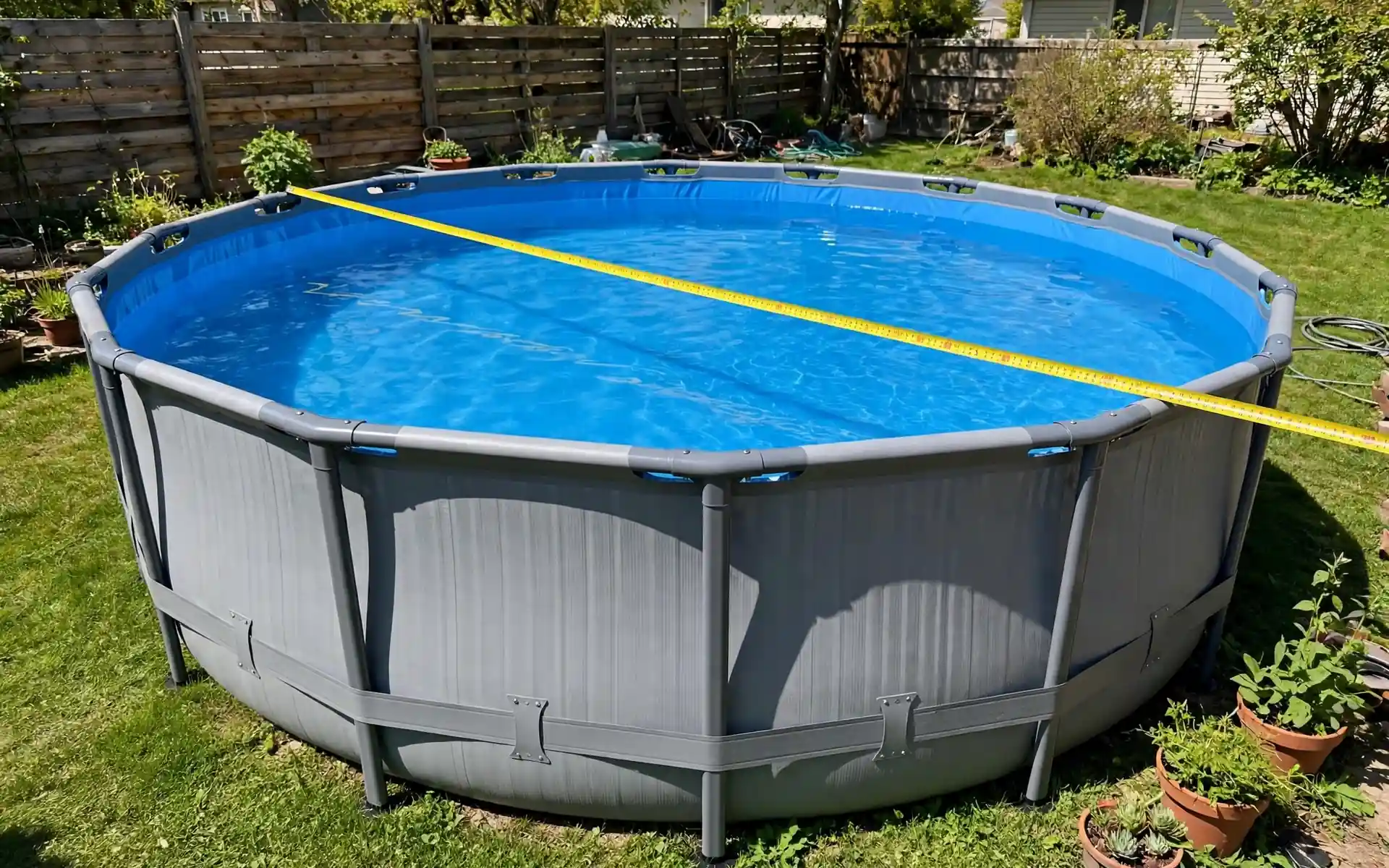
The pool is the most domestic of the five, because it is the 24 feet you are most likely to already own, or to have swum in. Intex’s Ultra XTR above-ground pool, model 26339EH, is sold as 24 feet by 52 inches: a round steel-frame pool, 288 inches across and 52 inches high, holding 12,481 gallons at 90 percent full, with a recommended water depth of 46 inches and a sand filter pump in the box. The 24 feet is its diameter — the distance straight across the middle, through the centre — which works out to about 452 square feet of swimming surface, and it is the most popular big backyard pool size in the United States, which is why so many readers have already stood in 24 feet without knowing it. Swim from one side to the other and you have crossed 24 feet — the same on every 26339EH ever sold, because the frame is the product.
The fitting check is the middle, because the pool’s 24 feet is a diameter and the thing people misjudge is the rim: measure around the edge and you get the circumference, about 75.4 feet, which is three times the number in this article’s title, and measure the wall height and you get 52 inches, which is the depth, not the width. A level base bought against “24 feet” for this pool also needs more than 24 feet of ground, because the frame legs splay out past the wall and the ladder and the pump need their own space — and the guides that call a 24-foot pool “the most popular size” are right about the popularity and silent about the base, because they never set one up. The grade is listed because the figure is the maker’s own listing for this named model, with the deviation printed in full: 24 feet across, 0 inches of miss, 52 inches high. Measure across the middle before you measure the base, because the pool is the object in this article you swim in.
5. A Cessna 152 — 24 Ft 1 In Long (LISTED)

The Cessna is the article’s only miss, and the one that closes the list by a single inch. The Cessna 152 is the most-flown training aeroplane ever built — a two-seat, high-wing trainer with a 110-horsepower Lycoming engine, in production from 1978 to 1985, and still the aeroplane thousands of pilots take their first lesson in today. Its Pilot’s Operating Handbook prints the overall length in the three-view drawing as 24 feet 1 inch, from the propeller spinner to the tail — 7.34 metres — with a wingspan of 33 feet 4 inches and a height of 8 feet 6 inches. Walk from the spinner to the tail and you have walked 24 feet 1 inch — one inch past the number in this article’s title, and the same on every 152 ever built, because the type certificate is the product.
The fitting check is the spinner, because the aeroplane’s extra inch lives in the propeller’s nose cone, and the thing people misjudge is where an aeroplane’s length starts: measure from the cowling instead of the spinner and you lose the inch and land on 24 feet exactly, which is the wrong tape for the right number. The guides that call the 152 “24 feet long” round the inch away and never say so, because an inch sounds like nothing — and an inch is the difference between this article’s only miss and its fourth exact, which is why the inch is printed here instead of rounded away. The grade is listed because the figure is the maker’s own handbook dimension for the named model, with the deviation printed in full: 24 feet 1 inch, one inch over. Measure the spinner before you measure the hangar, because the Cessna is the object in this article you fly.
Six 24-Foot Claims That Fall Apart on the Spec Sheet
Half a dozen confident claims about 24 feet keep turning up on pages that rank for this question, and every one of them comes apart when you check it against the document that actually sets the number. They are collected here, with the paper that disproves each one named, so the mistake stops with this page instead of travelling into a purchase. First, the Beneteau First 24: one popular guide says its hull measures 24 feet, and Beneteau’s own specification sheet says the length overall is 7.29 metres — 23 feet 11 inches, one inch short — and the “24” is the class name, not the tape, which is the same trap as the motorhome below. Second, the newborn blue whale: another guide says a calf is “typically about 23 to 25 feet long”, and the Marine Mammal Center puts a newborn calf at about 23 feet — a foot short of 24 — so the guide’s range starts where the truth ends: its low number is the top of the real birth range, and its high number runs two feet past it. Third, the compact Class C motorhome: another guide says compact models “cluster right around 24 feet”, and Winnebago’s own specification sheet lists the View 24D — the most famous “24” motorhome there is — at 25 feet 8 inches long, which is a foot and eight inches over, and the “24” is a floorplan code, not a measurement. Fourth, the container that does not exist: one rival FAQ says standard containers come only in 20-foot and 40-foot lengths, so 24 feet has no container — and the firm sells a 24-foot container with the size in its name, and Matson has run 24-foot containers to Hawaii since 1958, so the FAQ is right about the ISO standard and wrong about the world. Fifth, the large male orca: another guide says a big male sits “right at about 24 feet”, and males span 20 to 26 feet with females topping out around 23 — a range, not a figure, and no authority lists a 24-foot orca, so the guide is describing the middle of a range and calling it a measurement. Sixth, the multiples: another guide counts three 8-foot banquet tables end to end and four adults lying head to toe as things that are 24 feet long, and three tables are a multiple and four adults are a stack, and this article does not count multiples or stacks — though the tables are a genuinely useful check, which is where they belong, in the next section. None of the six earns a place in the list above — each one fails the same test the five objects passed. Read them as warnings, not as alternatives, and the next 24-foot claim you meet will be easier to judge.
Checking 24 Feet With What Is Already Around You
You can put 24 feet to the test with things already in the room, provided you measure the things themselves and not your own body against them. First, take the goal: a regulation soccer goal is 24.00 feet between the posts by the rulebook, so stand in the middle of any full-size goal and spread your arms, and you are standing inside 24 feet — but check the goal first, because a five-a-side goal is 12 feet wide and will lie to you by exactly half. Second, take the steps: the University of Iowa puts the average adult’s walking step at 2.5 feet, so take 9 steps and you have walked 22.5 feet — a foot and a half short — and take 10 steps and you have walked 25 feet, a foot over, so the honest count is 9 steps and a shuffle, and anyone who tells you 10 paces is rounding away a foot. Third, take the road: a standard highway lane is 12 feet wide, so two lanes side by side are exactly 24 feet — stand on the edge of a two-lane road and you are looking at 24 feet of width, and a two-car garage is about the same, roughly 24 feet across. Fourth, take the tables: a standard folding banquet table is 8 feet long, so three of them end to end are exactly 24 feet — a check, not an object, and the one in this article you can build in a village hall. A tape measure still wins for anything that has to fit, but these four checks will tell you whether 24 feet is the size you imagined before the pool is filled or the container is ordered — and of the four, the goal is the one to believe, because standing inside it puts you exactly on the number.
The 5 Objects at a Glance
| Object | Figure | Miss vs 24 ft | Grade |
|---|---|---|---|
| Regulation soccer goal | 24.00 ft wide | 0 | EXACT |
| J/24 sailboat LOA | 24.0 ft | 0 | EXACT |
| Conexwest 24-ft container | 24 ft exterior | 0 | EXACT |
| Intex Ultra XTR 24-ft pool | 24 ft diameter | 0 | LISTED |
| Cessna 152 | 24 ft 1 in | 1 in over | LISTED |
Look down the table and the spread is almost nothing: the goal, the sailboat and the container all read 24 feet, the pool reads 24 feet across, and the aeroplane reads a single inch over. That tight spread is the whole argument — a goal you can stand in, a sailboat you can sail, a container you can pack, a pool you can swim in, an aeroplane you can fly, and not one of them more than an inch from the number. A length with five witnesses that close together is one you can picture, and trust, as a single size.
How 24 Feet Compares With Other Lengths
If 24 feet is not quite the size you are after, the neighbouring guides are the next place to look: 23 feet and 25 feet sit closest on either side, with 30 feet, 20 feet, 10 feet and 9 feet further along the foot series, and 9 meters and 8 meters covering the nearest metric lengths; the inches hub and the feet hub list every guide in each series. Every one of them is built the same way as this page — the published specification quoted, the evidence grade stated, and the miss printed alongside the number.
Frequently Asked Questions
How many meters is 24 feet?
7.3152 meters exactly, which most people round to 7.32 meters. The arithmetic is 24 × 0.3048, and the number that catches people out is the round one next door: call it 7 meters and you lose 1.03 feet, call it 8 meters and you gain 2.25 feet. Where the fit matters, work with 7.3152 meters; where you only need the picture in your head, 7.32 meters does the job and sits just 4.8 millimetres over.
How many inches is 24 feet?
288 inches exactly. Twelve inches to the foot, twenty-four feet on the tape — multiply them and the answer is 288, with no rounding hiding anywhere in it. In centimetres that is 731.52 cm, in millimetres it is 7,315.2 mm, and in yards it is exactly 8 yards — the only one of the conversions in this article that comes out whole, which is why “8 yards” is the honest shortcut.
How many yards is 24 feet?
Exactly 8 yards. There are 3 feet in a yard, and 24 divided by 3 is 8, with nothing left over — which is the reason 24 feet has exact objects where 10 metres had a gap: 8 yards is a round number in the system the old rulebooks were written in, and the soccer goal is 24 feet wide because the goal was fixed at 8 yards in 1863. In metres, 8 yards is 7.32 metres, which is the same figure as the J/24 sailboat’s length.
How many steps does it take to walk 24 feet?
Nine steps, plus a short shuffle to finish. Work from the average adult step of 2.5 feet — the University of Iowa’s figure — and the count lands between two whole numbers: nine steps carry you 22.5 feet, a foot and a half short, and a tenth step carries you to 25 feet, a foot past. The true count is 9.6 steps, so a flat “ten paces” quietly drops a foot.
Is 24 feet the same as 7 meters?
No — a whole foot separates them. Seven meters comes to 22.97 feet, which leaves you 1.03 feet short of 24 feet, about the length of a school ruler. As a picture in your head, 7 meters will steer you wrong by that much; where the thing has to fit — a pool base, a container bay, a berth — work in 7.32 meters, which lands within 5 millimetres of 24 feet.
What common objects are 24 feet long?
Start with the three that land on the number: a regulation soccer goal, 24.00 feet between the posts under the Laws of the Game; a J/24 sailboat, 24.0 feet from bow to stern; and a 24-foot storage container, 24 feet long on the outside. The other two are an Intex Ultra XTR 24-foot round pool, 24 feet across, and a Cessna 152 trainer, 24 feet 1 inch, a single inch over. And do not be caught by the names: a Beneteau First 24 measures 23 feet 11 inches and a Winnebago View 24D measures 25 feet 8 inches, so neither one is 24 feet at all.
How wide is a soccer goal?
Exactly 24 feet — 7.32 metres, or 8 yards — measured between the inside of the goalposts, with the crossbar 8 feet above the ground. The Laws of the Game fix both numbers, and the posts and crossbar must be white and no more than 12 centimetres thick. Measure the inside of the posts: outside to outside reads up to 24 feet 10 inches, and a youth goal is 12 feet wide, exactly half.
Is a shipping container 24 feet long?
Yes — 24-foot containers are real, even though they are not an ISO standard size. The firm sells a 24-foot storage container that measures 24 feet long externally (23 feet 5 inches inside), and Matson Navigation has run 24-foot containers on its West Coast to Hawaii routes since 1958. The ISO standard sizes are 20 and 40 feet, but 24 feet sits between them as a genuine size, not a gap.
Final Thoughts
Twenty-four feet is the rare measurement that is round in two systems and exact in both, because 8 yards can be a goal, a sailboat, a container, a pool, and an aeroplane — and the number alone never says which. Now you know it as a goal’s width fixed by its federation, a sailboat’s length fixed by its designer, a container’s length fixed by its steel, a pool’s diameter fixed by its frame, and an aeroplane’s length fixed by its handbook — and you know which of those you can trust to the centimetre and which one overshoots by a single inch. Five objects, one habit behind all of them: go to the document that sets the number, say plainly where the tape disagrees with the name, and leave the name on the box where it belongs. Check the measurement in the direction the thing actually travels, do it twice, and 24 feet will fit the first time you build for it.
