
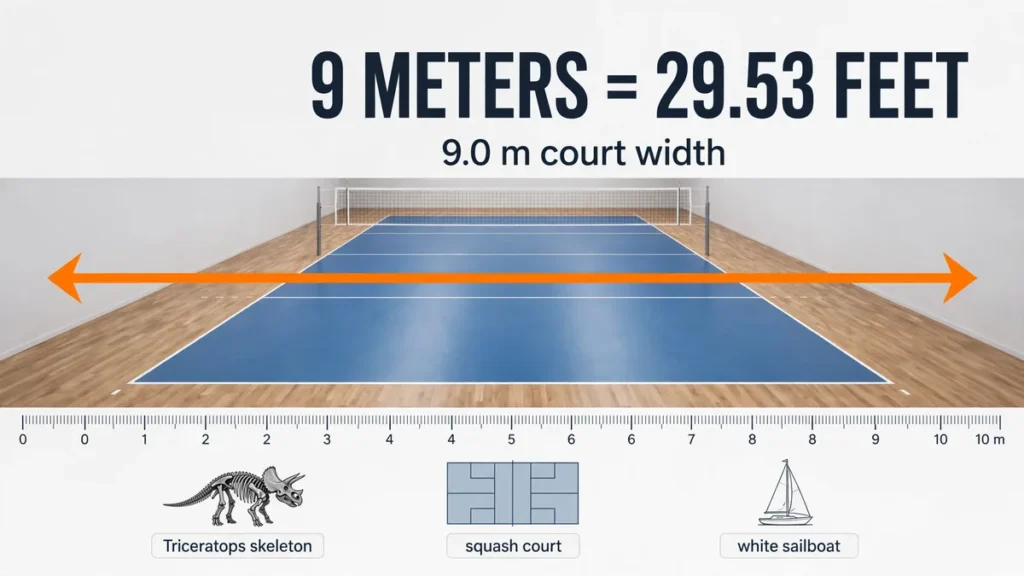
If you have ever wondered how long is 9 meters, the short answer is 29.53 feet — and the longer answer is that 9 meters is the length where the number 30 stops telling the truth. Three meters is 9.84 feet, and everyone rounds it to 10 without much harm. Six meters is 19.69 feet, and everyone rounds it to 20, and that lie is nearly four inches. Nine meters is 29.53 feet, and everyone rounds it to 30, and that lie is 14.4 centimetres — five and two-thirds inches, the width of a hand and a thumb. It is the difference between a pole that clears the wires and one that does not, and between a boat that fits the berth and one that sticks out past the pontoon. Nine meters is the first length in this series where the rounding itself is bigger than the smallest object in the article, because every object in this article is sold as a “30-foot” thing, and not one of them is 30 feet long.
Below are eight single, named things, each checked against its own specification, with the miss printed wherever a thing misses. Two of them are exact at 9 metres for the dimension stated — a volleyball court, drawn 9 metres wide by the federation that governs it, and a Triceratops, whose largest adults reach 9 metres nose to tail — and the other six land between 1 centimetre short of it and 75 centimetres over it. Three of them are “30-foot” objects that are not 30 feet: a utility pole that is 30 feet of timber but only 25 feet above the ground, a sailboat sold as a “30-footer” whose hull is 29 feet 6 inches and whose overall length is 31 feet 3 inches, and a travel trailer that is 29 feet 5 inches and a third of a hand short. Every object’s image sits immediately after its heading, and no object is a stack, a multiple, a fraction, a sum, or a category guess. You will not find two station wagons here, or four golf carts, or five shower curtains, because two station wagons is arithmetic wearing a roof rack, and you will not find an extension cord plus two newborn babies, because a baby is not a unit of length. By the end you will know 9 metres as a court, a dinosaur, a net, a squash court, a sailboat, a trailer, a pole, and a house — and you will know which of those you can trust to the centimetre and which you must measure yourself.
Quick Answer
9 meters is 29.53 feet exactly — 900 centimetres, 9,000 millimetres, 354.33 inches, and 9.84 yards. But do NOT call it 30 feet: 30 feet is 9.144 metres, which is 14.4 centimetres longer than 9 metres, and 14.4 centimetres at this size is the difference between a pole that stands clear and one that fouls the wires. The honest shortcut is 29 feet 6 inches — and the honest object is a volleyball court, 9 metres wide by the rulebook that built it.
The 30-Foot Trap: Why 9 Metres Is Not 30 Feet
Nine metres is the first length in this series that you cannot buy under its own name in an imperial shop, and it is also the first where the shop’s name for it is wrong in two directions at once. Nobody sells a “9-metre” anything in feet and inches. They sell 30-foot poles, 30-foot boats, 30-foot trailers, and 30-foot tape measures, and every one of those is a rounding of 9 metres that has quietly drifted away from it — and the drift is not the same in every case. A 30-foot utility pole is 9.144 metres of timber — 14.4 centimetres over — but only 25 feet of it ever stands above the ground, which is 7.62 metres, or 1.38 metres under. A Beneteau Oceanis 30.1 is sold as a 30-footer, but its hull is 29 feet 6 inches (8.99 metres, 1 centimetre under) and its length overall is 31 feet 3 inches (9.53 metres, 53 centimetres over). A Jayco Jay Flight 264BH is 29 feet 5 inches (8.97 metres, 3.4 centimetres under). The number 30 is doing three jobs at once: it is a nominal size, a label on a brochure; it is a timber length, a distance on a lorry; and it is a length on the ground, a distance you can walk — and at 9 metres those three jobs finally come apart, in opposite directions, on the same page.
The second reason 9 metres feels like a trap rather than a length is that it is the height of the world you live under, and the world rounds it up. A three-storey house stands about 9 metres tall if its roof is flat, and 10.5 to 12 metres tall if its roof is pitched, which means the roofline of every street of townhouses is a 9-metre line drawn across the sky — and the guides that list “things that are 9 metres long” keep reaching for doors and curtains and violin bows because those are the biggest single objects in a normal life, and even nine of them do not fit: nine door frames are 6.86 metres, twelve violin bows are 8.99 metres, five shower curtains are 9.144 metres — every one of them misses by a margin the guide never prints. The guides also keep reaching for the volleyball net, because the net hangs over a court that is 9 metres wide and the net is the thing you can see — but the net is 9.5 metres long indoors and 8.5 metres on the beach, and neither is 9 metres. Stand on the centre line and you are standing on 9 metres; stand under the net and you are standing under 9.5.
The 8 Objects
Each object below carries its evidence grade in the heading. EXACT means the figure is a standard’s or an authority’s own dimension for the named thing. LISTED means the figure is the manufacturer’s or operator’s published specification for the named model. AVERAGE means the figure is an authority’s published average or range for the named thing. REPORTED means the figure is the largest verified measurement an expert source reports for the named thing. The grade is the whole point: a list that never grades its numbers is asking you to trust it, and this article would rather show you the receipt.
1. A Volleyball Court — 9.0 M Wide (EXACT)

The court is the article’s cleanest exact, because its 9 metres is written into the rulebook of the sport rather than a catalogue. The FIVB’s Official Volleyball Rules 2025–2028, Rule 1.1, fix the playing court as a rectangle measuring 18 metres by 9 metres, surrounded by a free zone at least 3 metres wide on all sides, and the centre line divides it into two courts of 9 by 9 metres each — so the width is 9 metres by the federation’s own dimension, and every court on Earth that hosts an international match is the same 9 metres wide, because the rulebook is the product. Stand on the centre line and look across the court, and you are looking at 9 metres — no conversion required, and the same in every hall on the planet.
The fitting check is the net, because the court’s 9 metres is its width and the net that hangs over it is 9.5 to 10 metres long — and the guides that call a volleyball net “9 metres” are measuring the wrong object: the net overhangs the court by 25 to 50 centimetres on each side so the posts can stand outside the lines, which puts the posts 10 to 11 metres apart. A hall, a net, or a court bought against “9 metres” fails by half a metre if you measure the net and forget the overhang, and the guides that tell you to picture a net never say whether they mean the court, the net, or the posts, because they never opened the rulebook. The grade is exact because the figure is the governing body’s own dimension for the named thing: 18 by 9 metres, by the FIVB. Measure the lines before you measure the net, because the court is the object in this article that every other object is judged against.
2. A Triceratops — Up to 9.0 M Long (REPORTED)

The Triceratops is the article’s oldest exact, and the one that makes 9 metres feel like a animal rather than a number. Britannica gives the adult Triceratops a body length of up to 30 feet — 9 metres — and the Smithsonian’s own gallery signage says the same, that the species could grow up to 30 feet (9 m) long, and those are the top ends of the range, not the average: individual adults ran 7.9 to 9.0 metres, stood 2.9 to 3.0 metres tall at the shoulder, and weighed 5,450 to 7,260 kilogrammes. Lay a tape measure from the tip of its nose to the end of its tail and you are looking at 9 metres — 0 centimetres past the number in this article’s title at the top end, and the same for every Triceratops that ever walked the Late Cretaceous, because the fossils are the product.
The fitting check is the average, because a Triceratops’s 9 metres is the largest verified adult and the average adult was 7.9 to 9.0 metres — so a typical animal was anything up to a metre short. A museum hall, a model, or a garden built against “9 metres” for a Triceratops fails by up to a metre if you measure the record and forget the range, and the guides that call the dinosaur “9 metres long” never say whether they mean the average or the largest, because they never looked at the fossils. The grade is reported because the figure is the largest verified measurement an expert source reports for the named thing: 9 metres, by Britannica and the Smithsonian. Stand beside the skeleton and you will feel the 9 metres — it is the length of a city bus.
3. An Indoor Volleyball Net — 9.5 M Long (EXACT)

The net is the article’s most useful correction, because it is the object two rival guides call “9 metres” and the rulebook says is not. The FIVB’s Official Volleyball Rules, Rule 2.2, fix the indoor net at 1 metre wide and 9.50 to 10 metres long, made of 10-centimetre square black mesh, with 25 to 50 centimetres of it hanging past the side bands on each side — so the shortest legal indoor net is 9.5 metres, which is 50 centimetres past the number in this article’s title, and the longest is a full metre past it. The net’s top sits 2.43 metres high for men and 2.24 metres for women, and the posts stand 2.55 metres tall. Hang a tape measure along the top of the net and you are measuring 9.5 metres — and the same in every hall on the planet, because the rulebook is the product.
The fitting check is the beach, because the net’s 9.5 metres is the indoor figure and the beach volleyball net is 8.5 metres long — a full metre shorter, and 50 centimetres under 9 metres — so a net bought against “9 metres” fails by half a metre in either direction depending on which sand you stand on, and the guides that call a volleyball net “usually nine meters” never say whether they mean indoors or on the beach, because they never measured either. The grade is exact because the figure is the governing body’s own dimension for the named thing: 9.50 to 10 metres, by the FIVB. Measure the rulebook before you measure the net, because the net is the object in this article that catches the rivals out.
4. A Squash Court — 9.75 M Long (LISTED)
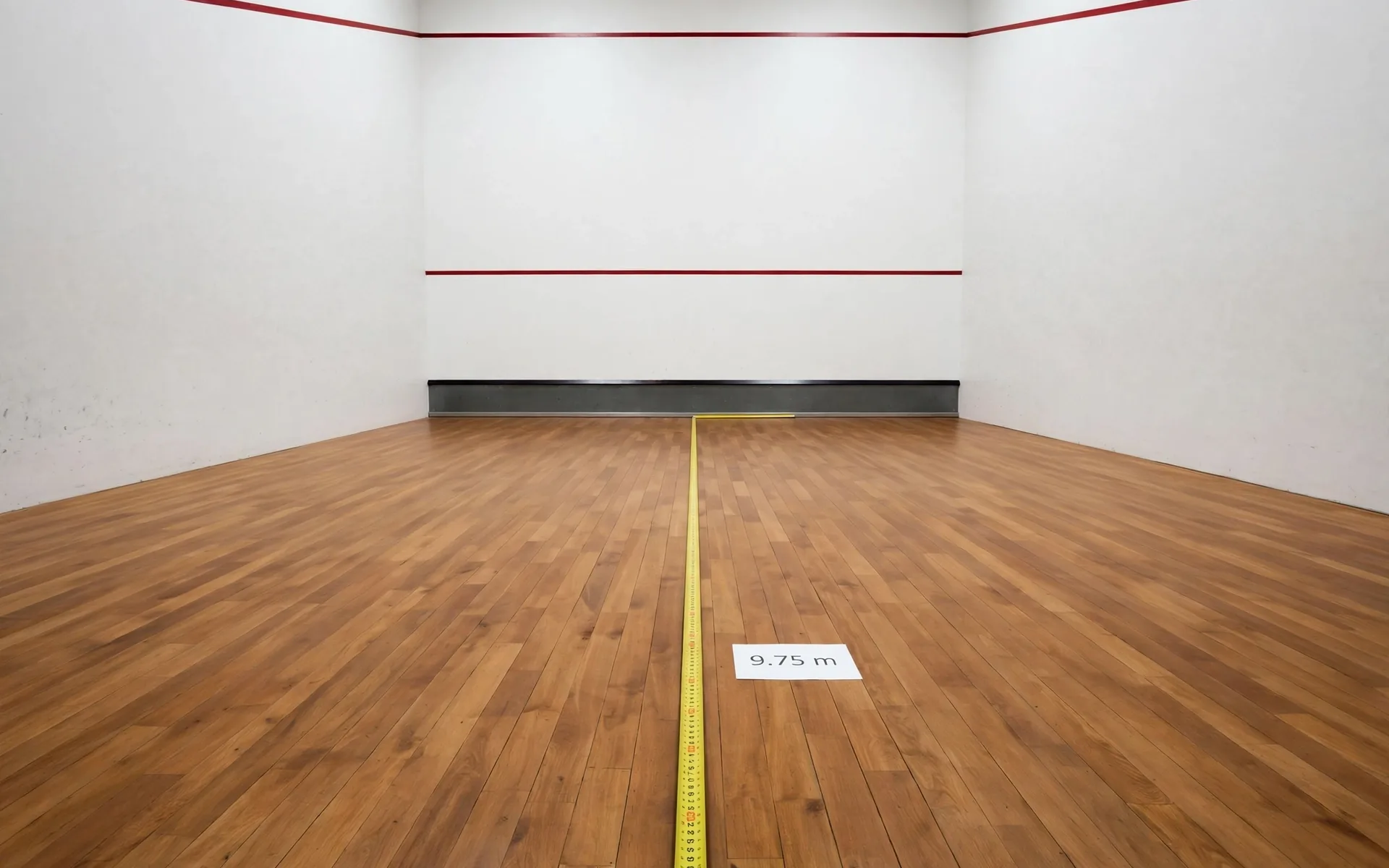
The squash court is the article’s largest miss, and the only rival object that survives fact-checking — which is why it is here with its miss printed. The World Squash Federation’s Specifications for Squash Courts fix a singles court at 9,750 millimetres long and 6,400 millimetres wide, measured between the playing surfaces 1 metre above the floor, with a tolerance of just plus or minus 10 millimetres, a diagonal of 11,665 millimetres, a front-wall line 4.57 metres high, and a tin 0.48 metres high at the base of the front wall — so the court’s length is 9.75 metres, which is 75 centimetres past the number in this article’s title, and the same in every club on the planet, because the specification is the product. Walk from the front wall to the back wall and you have walked 9.75 metres — three-quarters of a metre past 9.
The fitting check is the tolerance, because the court’s 9.75 metres is fixed to within 10 millimetres — the tightest tolerance in this article — and the guides that call a squash court “close to 9 meters” are right about the direction and wrong about the distance: 75 centimetres is not close, it is the length of a squash racquet and a half, and a court built against “9 metres” fails by that much before the first ball is hit. A doubles court is the same 9.75 metres long and 7.62 metres wide, so the length never changes, only the width. The grade is listed because the figure is the federation’s own specification for the named thing: 9,750 millimetres, by the WSF. Measure the back wall before you measure the front, because the squash court is the object in this article that proves a near-miss can still be exact.
5. A Beneteau Oceanis 30.1 Sailboat — Hull 8.99 M, LOA 9.53 M (LISTED)

The sailboat is the article’s most honest two numbers, because it is sold as a “30-footer” and it is neither 30 feet long nor 9 metres long in any single figure. Beneteau’s own specification lists the Oceanis 30.1 at a length overall of 31 feet 3 inches — 9.53 metres — and a hull length of 29 feet 6 inches — 8.99 metres — with a beam of 2.99 metres and a light displacement of 4,120 kilogrammes. The hull is 1 centimetre short of 9 metres — the closest miss in this article that is not exact — and the length overall is 53 centimetres over it, and the 54 centimetres between them is the bow roller, the swim platform, and the marketing: the “30.1” in the name is a model number, not a measurement, and the boat is 30 feet long only if you measure the brochure. Lay a tape measure along the hull from bow to stern and you are measuring 8.99 metres — and the same on every Oceanis 30.1 ever built, because the mould is the product.
The fitting check is the berth, because the boat’s 8.99 metres is its hull and its 9.53 metres is its overall length, and a berth or a marina slip bought against “9 metres” for this boat fails by 54 centimetres if you measure the hull and forget the bow roller. A “30-footer” is 9.144 metres, which is neither of this boat’s numbers — the hull is 15 centimetres short of 30 feet and the overall is 39 centimetres over it — and the guides that call a 9-metre cruiser “a 30-footer” never say whether they mean the hull, the overall, or the name on the transom, because they never read the specification. The grade is listed because the figure is the maker’s own listing for this named model, with both deviations printed in full: 8.99 metres of hull, 9.53 metres overall. Measure the hull before you measure the berth, because the sailboat is the object in this article you sail.
6. A Jayco Jay Flight SLX 264BH Travel Trailer — 29 Ft 5 In = 8.97 M (LISTED)

The trailer is the article’s closest single-vehicle miss, because it is 29 feet 5 inches long and 9 metres is 29 feet 6 and a third inches — a gap of one and a third inches, or 3.4 centimetres, the width of a thumb. Jayco’s own 2024 Jay Flight flyer lists the 264BH at an exterior length of 29 feet 5 inches, an exterior width of 8 feet, a travel height of 10 feet 6 inches with air conditioning, a dry weight of 4,755 pounds, a gross vehicle weight rating of 6,200 pounds, and sleeping for 7 to 9 people — and the exterior length is the figure that matters: the distance from the hitch to the rear bumper. Park one in the driveway and walk from the hitch to the bumper, and you have walked 8.97 metres — 3.4 centimetres short of the number in this article’s title, and the same on every 264BH of that model year, because the factory jig is the product.
The fitting check is the box, because the trailer’s 29 feet 5 inches is its overall length and its box — the living space without the hitch — is only 25 feet 5 inches, which is 7.75 metres, or 1.25 metres shorter — so a driveway or a campsite bought against “9 metres” for this trailer fails by more than a metre if you measure the overall and forget the hitch. The grade is listed because the figure is the maker’s own listing for this named model, with the deviation printed in full: 29 feet 5 inches, 3.4 centimetres short. Measure the hitch before you measure the driveway, because the trailer is the object in this article you tow.
7. A 30-Foot Utility Pole — 9.144 M of Timber, 25 Ft Above Grade (LISTED)
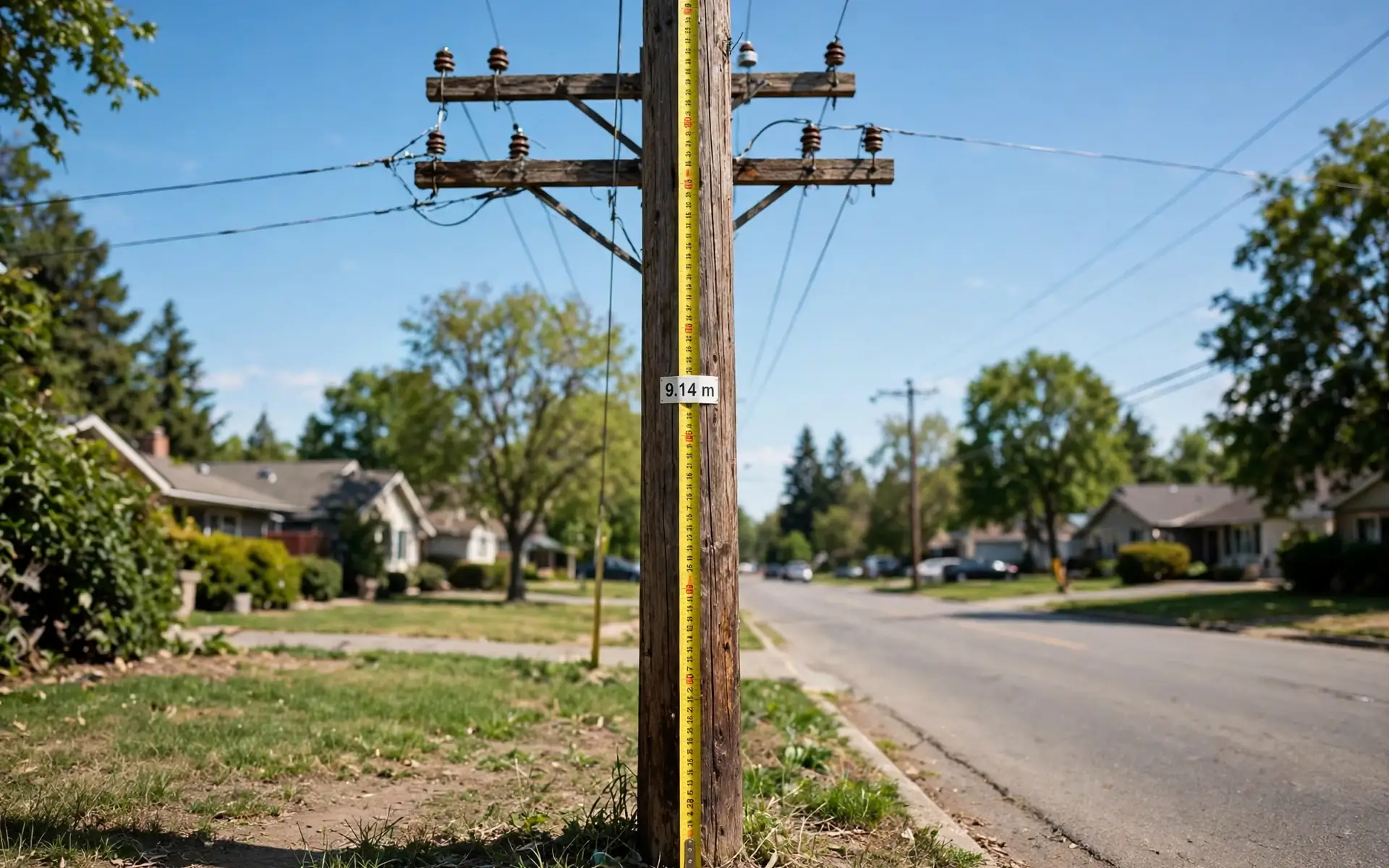
The pole is the article’s most useful two numbers, because it is 30 feet long and you will never see 30 feet of it. The ANSI O5.1 wood-pole standard fixes pole lengths in 5-foot steps — 25, 30, 35, 40 feet — and a 30-foot Class 3 southern yellow pine pole is 30 feet of timber, which is 9.144 metres, or 14.4 centimetres past the number in this article’s title, with a minimum top circumference of 23 inches and a minimum circumference of 32 inches measured 6 feet from the butt. But the pole is buried about 5 feet in the ground — the ANSI setting-depth table puts a 30-foot pole 5.5 feet deep in soil — so only about 25 feet of it ever stands above the grade, which is 7.62 metres, or 1.38 metres short of 9 metres. Stand beside a 30-foot pole and you are standing beside 7.62 metres of timber and 1.52 metres of buried wood.
The fitting check is the wires, because the pole’s 30 feet is its timber and its 25 feet is its height above the ground, and a clearance bought against “30 feet” for a pole fails by a metre and a half if you measure the timber and forget the hole. The guides that call a telephone pole “9 to 10 metres” never say whether they mean the timber or the height above the ground, because they never read the standard. The grade is listed because the figure is the standard’s own dimension for the named class: 30 feet of timber, 25 feet above grade. Measure the ground line before you measure the top, because the pole is the object in this article you drive past every day without seeing.
8. A Three-Storey Townhome — About 9 M With a Flat Roof (AVERAGE)

The house is the article’s most familiar near-miss, and the one that proves the “3 storeys times 3 metres” shortcut wrong. The building-height guides agree on the shape of the numbers: a typical 3-storey house runs 9 to 14 metres (30 to 45 feet) tall, a standard residential one runs 30 to 35 feet (9.1 to 10.6 metres), and a flat-roof townhome runs 28 to 32 feet (8.5 to 9.7 metres) — so the flat-roof townhome is the only 3-storey form that lands on 9 metres, and it lands there at the bottom of its range. The arithmetic is the trap: each floor is 2.4 to 2.7 metres of ceiling plus about 0.25 metres of floor structure, so three floors are 7.95 to 8.85 metres before the roof, and a pitched roof adds 1.5 to 3 metres more — which is why a 3-storey house with a pitched roof stands 10.5 to 12 metres tall, and why one Australian planning zone caps a neighbourhood at 9 metres and 2 storeys, not 3: a third storey does not fit under a 9-metre cap. Stand at the kerb and look at the parapet of a flat-roof townhome, and you are looking at about 9 metres.
The fitting check is the roof, because the house’s 9 metres is its flat-roof parapet and its ridge runs 1.5 to 3 metres higher — so a ladder or a scaffold bought against “9 metres” for a house fails by up to 3 metres if you measure the parapet and forget the roof. A house with a steep gable roof stands 12 metres or more, which is 3 metres over, and the guides that call three-storey houses “about 9 metres” never say whether they mean the parapet, the ridge, or the flat roof, because they never climbed up to check. The grade is average because the figure is an authority’s published range for the named thing: about 9 metres with a flat roof. Measure the parapet before you measure the ridge, because the house is the object in this article you live under.
Six Numbers the Other Lists Get Wrong
Six wrong numbers about 9 metres circulate so widely that they deserve their own section, because each one is stated confidently on a page that ranks for this exact question. First, the volleyball net: two popular guides call a volleyball net “9 metres” or “usually nine meters”, and the FIVB’s own rules say the indoor net is 9.50 to 10 metres long and the beach net is 8.5 metres — neither is 9 metres, and the court is the 9-metre thing, not the net. Second, the door frame: one popular guide says doorframes measure 1 metre wide and tells you to line up nine of them, and a standard interior door is 762 millimetres wide and 2,032 millimetres tall — nine door frames are 6.86 metres, which is 2.14 metres short, and the guide has confused the door’s height with its width. Third, the “30-footer”: another guide calls a 9-metre cruiser “a 30-footer” as if the two were the same, and 30 feet is 9.144 metres — 14.4 centimetres over — and the Beneteau Oceanis 30.1 proves the name is not a measurement at all, because its hull is 8.99 metres and its overall length is 9.53 metres, and neither of those is 30 feet. Fourth, the station wagons: one guide parks two of them bumper to bumper and calls the result “close to 9 meters”, and its own figure is 4.8768 metres per wagon — two of them are 9.75 metres, which is 75 centimetres over, and the guide’s own numbers convict it. Fifth, the octopus: one guide writes that “the world’s largest person weighed 600 pounds and measured 9 meters in length” and then, in the same paragraph, that octopuses “grow to be 5 meters long when fully mature” — a sentence that confuses a person with an octopus and contradicts itself before it ends. Sixth, the white willow: another guide says a fully grown white willow “can reach exactly 9 meters in their mid-life before they start stretching toward their 20-meter limit” — a tree that grows to 20 metres is not a 9-metre object because it passes through 9 metres once on its way up. None of these six numbers belongs in a 9-metre article, and all six are here so you never have to learn that from a purchase.
Checking 9 Metres With What Is Already Around You
Nine metres is a number you can check without a second tool, because the objects in this article are the tools — but only if you use the objects themselves, not your body. First, take the volleyball court: the court is exactly 9.0 metres wide by the federation’s own rule, so walk to a sports hall and count one court from sideline to sideline and you have 9 metres — but check the court first, because a beach volleyball court is 16 by 8 metres, and its width is a metre short and will lie to you by exactly that much. Second, take the squash court: a singles court is 9.75 metres long by the federation’s own specification, so walk from the front wall to the back wall and shave off 75 centimetres — the length of a squash racquet and a half — and you have 9 metres. Third, take the trailer: a Jayco Jay Flight 264BH is 29 feet 5 inches long, so walk from the hitch to the bumper and add 3.4 centimetres — the width of a thumb — and you have 9 metres, but measure the overall length, not the box, because the box is 25 feet 5 inches and will lie to you by more than a metre. Fourth, take the sailboat: a Beneteau Oceanis 30.1 has a hull 8.99 metres long, so walk from bow to stern and add 1 centimetre — the thickness of a fingernail — and you have 9 metres, but measure the hull, not the length overall, because the overall is 9.53 metres and will lie to you by 53 centimetres. None of these replaces a calibrated tool for anything that must fit, but all four will tell you whether 9 metres is the size you think it is before the boat is berthed or the trailer is parked — and the volleyball court is the one to trust, because its zero centimetres is the smallest miss you can walk on a sports hall floor.
The 8 Objects at a Glance
| Object | Figure | Miss vs 9 m | Grade |
|---|---|---|---|
| Volleyball court width | 9.00 m | 0 cm | EXACT |
| Triceratops (largest adults) | up to 9.00 m | 0 cm | REPORTED |
| Beneteau Oceanis 30.1 hull | 8.99 m | 1 cm short | LISTED |
| Jayco Jay Flight 264BH | 8.97 m | 3.4 cm short | LISTED |
| 30-foot utility pole (timber) | 9.144 m | 14.4 cm over | LISTED |
| Indoor volleyball net | 9.50 m | 50 cm over | EXACT |
| Beneteau Oceanis 30.1 LOA | 9.53 m | 53 cm over | LISTED |
| Squash court | 9.75 m | 75 cm over | LISTED |
| Three-storey townhome (flat roof) | about 9 m | range 8.5–9.7 m | AVERAGE |
Nine metres sits three metres past the parking bay that was exact at 6 metres, the bay painted on the kerb. Step up the ladder and the rungs crowd together: the 8.97-metre trailer, the 8.99-metre boat hull, the 9-metre court and the 9-metre dinosaur, the 9.144-metre pole, the 9.5-metre net, the 9.53-metre boat overall, the 9.75-metre squash court — and the point of it is the middle: 9 metres is the only rung with two exact objects behind it that you can walk on, a court painted on a sports hall floor and a dinosaur that walked the Earth 66 million years ago, and every object in this article sits inside a 78-centimetre band, which is why 9 metres is the widest size in the series to stand inside and still call it one number.
How 9 Metres Compares With Other Lengths
Readers comparing nearby sizes may also want the site’s guides to 30 feet, 20 feet, 10 feet, and 9 feet for the foot series, 1 meter, 2 meters, 3 meters, 8 meters, and 10 meters for the metre series, and the inches hub and feet hub for the full directories. Each of those guides follows the same rule as this one: the spec sheet, the grade, and the miss printed in full.
Frequently Asked Questions
How many feet is 9 meters?
9 meters is 29.53 feet, or 29 feet 6 and 1/3 inches in feet and inches. Multiply 9 by 3.28084 and you get 29.52756 feet — and the trap is rounding that to 30 feet, which overstates the length by 14.4 centimetres, or reading the 0.53 as 5 inches, which understates it by more than an inch. For anything that must fit, use 29.53 feet; for a quick estimate in your head, 29 feet 6 inches is close enough to picture it and only a third of an inch short.
Is 9 meters the same as 30 feet?
No, and the difference matters more than it did at 6 metres. Thirty feet is 9.144 metres, which is 14.4 centimetres longer than 9 metres — nearly 6 inches. If you buy a 30-foot pole for a 9-metre gap, it will not fit; if you cut a 30-foot board for a 9-metre space, you will have nearly 6 inches left over. The honest shortcut is 29 feet 6 inches, which is 9 metres to within a third of an inch.
How many inches is 9 meters?
354.33 inches exactly. Multiply 9 by 39.3701 and you get 354.3309 inches, with no rounding that matters for anything you will ever measure by hand. In centimetres that is 900 cm, in millimetres it is 9,000 mm, and in yards it is 9.84 yards rounded — exactly 9.8425 yards, which is the figure a tape measure will show if it is marked in yards.
How many yards is 9 meters?
9.84 yards. Nine metres is 9 yards plus about 9 per cent more, because a metre is about 3 inches longer than a yard, and those 3 inches add up nine times over. Do not confuse 9 metres with 9 yards: 9 yards is only 8.23 metres, which is 77 centimetres short — more than two and a half feet — and that is how boat berths and fence panels end up wrong.
How tall is 9 meters compared to a person?
About 5.3 times the height of an average adult. Most adults stand between 1.6 and 1.8 metres tall, so 9 metres is roughly five and a third people stacked head to toe — taller than the tallest human in history three times over, since the tallest man ever measured reached 2.72 metres and three of him would still fall 84 centimetres short of 9.
What is 9 meters long in real life?
The most exact everyday answer is a volleyball court (9.0 m wide by the federation’s own rule). The next closest are a Triceratops at its largest verified size (9.0 m), a Beneteau Oceanis 30.1 sailboat hull (8.99 m), and a Jayco Jay Flight 264BH travel trailer (8.97 m). A 30-foot utility pole is 9.144 m of timber but only 7.62 m above the ground, an indoor volleyball net is 9.5 m long, and a squash court is 9.75 m long — the largest miss in this article.
How do I measure 9 meters without a tape measure?
Use a volleyball court if you have one — it is 9.0 metres wide by the federation’s own rule. Otherwise use a squash court (9.75 m — shave off 75 centimetres), a Jayco Jay Flight 264BH trailer (29 ft 5 in — add 3.4 centimetres), or a Beneteau Oceanis 30.1 hull (8.99 m — add 1 centimetre). For anything that must fit — a boat, a trailer, a pole — borrow or buy a real tape measure, because at 9 metres the misses in this article run from zero to 75 centimetres, and guessing throws every one of them away.
Is a volleyball net 9 meters long?
No — and this is the most common wrong number about 9 metres. The FIVB’s rules fix the indoor volleyball net at 9.50 to 10 metres long, which is 50 centimetres to a metre over 9 metres, and the beach volleyball net at 8.5 metres, which is 50 centimetres under. The thing that is 9 metres is the court, not the net: the court is 18 by 9 metres, and the net overhangs it by 25 to 50 centimetres on each side so the posts can stand outside the lines. If you buy a net against “9 metres”, you will be half a metre out in either direction depending on which sand you stand on.
Final Thoughts
Nine metres is the rare measurement that is honest and still misunderstood, because 29.53 feet can be a court, a dinosaur, a net, a squash court, a sailboat, a trailer, a pole, or a house — and the number alone never says which. Now you know it as a court’s width fixed by its federation, an animal’s length fixed by its fossils, a net’s length fixed by its rulebook, a squash court’s length fixed by its specification, a boat’s hull fixed by its mould, a trailer’s length fixed by its factory, a pole’s timber fixed by its standard, and a house’s height fixed by its floors — and you know which of those you can trust to the centimetre and which you must measure yourself. The rule that runs through all eight is the same one this site always uses: trust the spec sheet, print the deviation, and let the name stay on the box where it belongs. Measure twice, in the direction the object actually travels, and 9 metres will fit the first time.
