
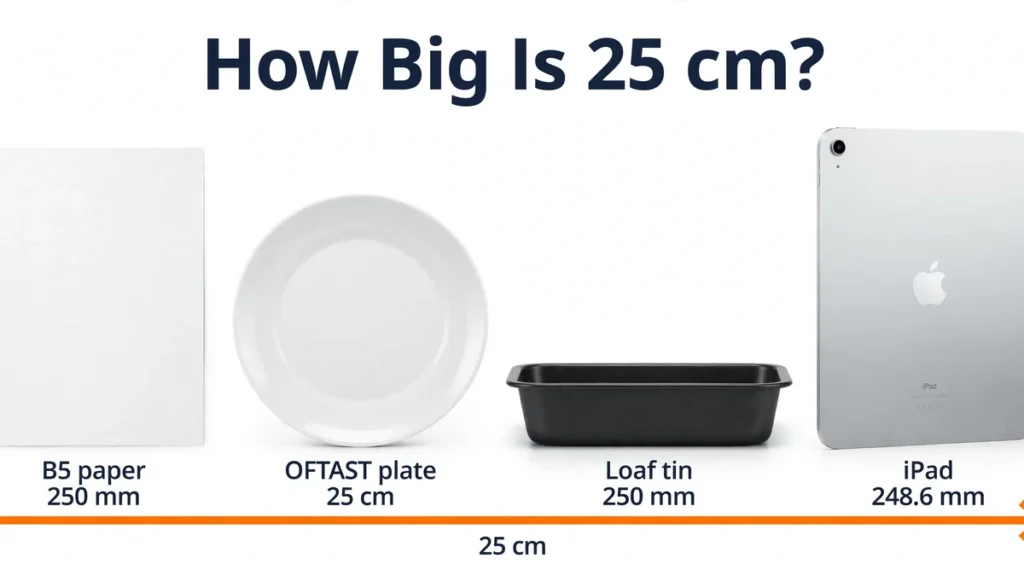
Walk down a bakeware aisle and you will find the same tin sold as 25 cm on one shelf and as 10 inches on the next — sometimes both numbers printed on the same box. The two numbers are not the same size. Ten inches is 25.4 cm, and 25 cm is 9.84 inches, and the 4 mm between them is the difference between a cake that fits the tin and a batter that sits 3% deeper than the recipe expects. This article is about that 4 mm: what 25 cm actually is, eight things that really measure it, and why the labels keep rounding the gap away.
Twenty-five centimetres is 9.84 inches, 250 millimetres, and exactly a quarter of a metre. It is 83% of a school ruler, 4 mm shorter than a true 10 inches, and 2.14 cm longer than 9 inches. The eight objects below are the closest honest answers to it: three land on 25 cm exactly, one is sold as 25 cm but measures 26.9 cm across the outside, and four miss by 0.8 to 11.5 millimetres with the miss printed in full — and every one of them carries the source that proves it.
Quick Answer
25 cm is 9.84 inches — 4 mm short of 10 inches.
Twenty-five centimetres is 9.84 inches, 250 millimetres, and exactly a quarter of a metre. Three objects land on it exactly — a B5 sheet, an OFTAST plate and a loaf tin — a fourth is sold as 25 cm but measures 26.9 cm across, and four more miss by 0.8 to 11.5 millimetres, with the miss printed in full.
The bar above shows twenty-five 1 cm segments, but it is a diagram, not a ruler: screen sizes vary, so it explains the measurement rather than measuring it. For a real measurement, use the objects below or a tape measure.
The 4 mm Trap, Printed on the Tin Itself
Ten inches is 25.4 cm by definition — one inch is exactly 25.4 mm since the 1959 international agreement on the yard and the pound — so 25 cm is 4.0 mm shorter than 10 inches, and the gap is about the thickness of five bank cards stacked together. It is eight times the 0.5 mm trap in our 19 cm article, and unlike that one, this trap is printed on the products themselves. A tin sold as “25 cm (10 inch)” is selling two sizes at once, and the buyer who trusts the imperial number gets a tin 4 mm wider than the metric number promises. The rounding is harmless on a shelf label and expensive in a cake tin, a tablet sleeve, or a shoe that has to fit a foot.
The labels that lie are the evidence. One bakeware brand sells a tin as “25 cm (10 inch)” on the same box. Tala’s own size table lists its springform as “25cm / 10 inch”. IKEA labels its 25 cm OFTAST plate “9¾ in” — 24.77 cm — where the rounding runs the other way, understating the plate by 2.3 mm. And Nike’s shoe box prints “25.5” for a foot that measures 25.0 cm. Four labels, four different roundings, one 4 mm gap. The honest shorthand is “just under 10 inches” — “10 inches” hides the 4 mm, and “9.84 inches” is the number the tape actually reads.
The error most people make is dividing by 2.5 instead of 2.54: 25 divided by 2.5 is exactly 10 inches, which erases the whole gap in one step, and that is how “25 cm = 10 inches” survives in conversion guides that never check their own arithmetic. Ten inches converts to 25.4 cm, so 25 cm sits 4 mm short of the 10-inch mark and 2.14 cm past the 9-inch mark — closer to 10 inches than to 9, but on neither of them. Nine inches is 22.86 cm, so the gap from 9 to 10 inches is a full 2.54 cm wide, and 25 cm sits 2.14 cm of the way across it.
| Tape mark | Value | Against 25 cm |
|---|---|---|
| 9 in | 22.86 cm | 2.14 cm short |
| 9 13/16 in | 24.92 cm | 0.8 mm short |
| 9 7/8 in | 25.08 cm | 0.8 mm over |
| 9 27/32 in | 25.00 cm | 0.03 mm over |
On a tape measure, the nearest sixteenth-inch marks are 9 13/16 inches at 24.92 cm and 9 7/8 inches at 25.08 cm — one 0.8 mm short, the other 0.8 mm over, a hair either side of the number. The honest fraction is 9 27/32 inches at 25.00 cm, which is 0.03 mm over, but thirty-seconds are not printed on most tapes, so the practical reading is the 9 13/16 mark plus a hair, or the 9 7/8 mark minus one. And 25 cm is 83% of a 30 cm ruler — mark off 25 of the 30 centimetres and the remaining 5 cm is the length you have left over.
8 Things That Are 25 cm
The eight objects are ordered by how close they land on 25 cm, closest first, and each one carries its evidence grade in the heading. EXACT means the figure is a standard’s or an authority’s own dimension for the named thing. LISTED means the figure is the manufacturer’s published specification for the named model. REPORTED means the figure is calculated from an official published value — the basketball’s diameter comes from its official circumference, not from a published diameter. Three of the eight land on 25 cm exactly, a fourth is sold as 25 cm but measures 26.9 cm across the outside, and the last four miss by 0.8 to 11.5 millimetres, with the miss printed in full — and the point of the ordering is that the miss grows as you read, so the last object is the one that stretches the number furthest.
A published 25 cm designation does not mean every manufactured unit measures mathematically 25.000 cm. Plates are sold by a diameter that varies by a fraction of a millimetre between firings, cake tins by a nominal size that describes the cake rather than the tin, shoes by a size chart that rounds a foot length to the nearest sixteenth of an inch, books by a trim height that varies a few millimetres by publisher. What follows is what the source actually says, with the axis named every time, so you can check it yourself.
1. ISO B5 Sheet of Paper, Long Edge — Exactly 250 mm (EXACT)
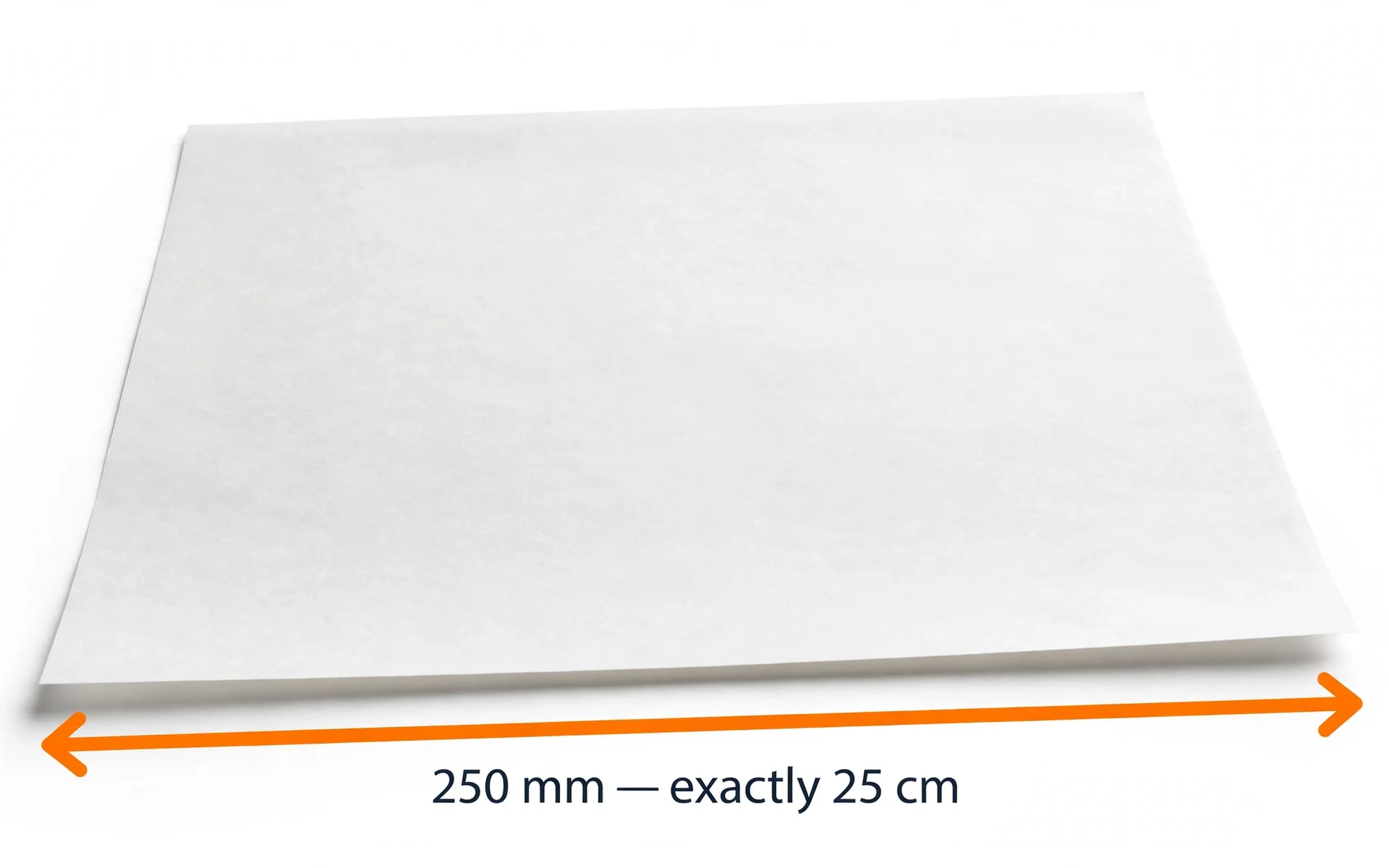
The B5 sheet is the article’s cleanest land-on, because its 25 cm is not a measurement of a thing that happens to be 25 cm long — it is the standard itself. ISO 216 defines B5 as 176 × 250 mm, so the sheet’s long edge runs exactly 250 mm, with no deviation to print. Hold a B5 notebook or a B5 sheet of paper and its longest side is the number itself, which is why it is the pocket reference in the measuring section below, and why it is the object to reach for when someone asks what 25 cm looks like.
The fitting check is the word “ISO”, because B5 is not one size in every country. A Japanese JIS B5 sheet is 182 × 257 mm — 7 mm longer than ISO B5 — so a notebook bought as “B5” in Japan overshoots the number by 7 mm. Check where the notebook was made before you trust it as a ruler: ISO B5 is 250 mm, JIS B5 is 257 mm, and the 7 mm between them is the trap inside the paper section. The grade is exact because the figure is the standard’s own dimension for the named format, with the deviation printed in full: 250 mm, zero millimetres off.
2. IKEA OFTAST Plate, White, 25 cm — Diameter Exactly 25.00 cm (LISTED)
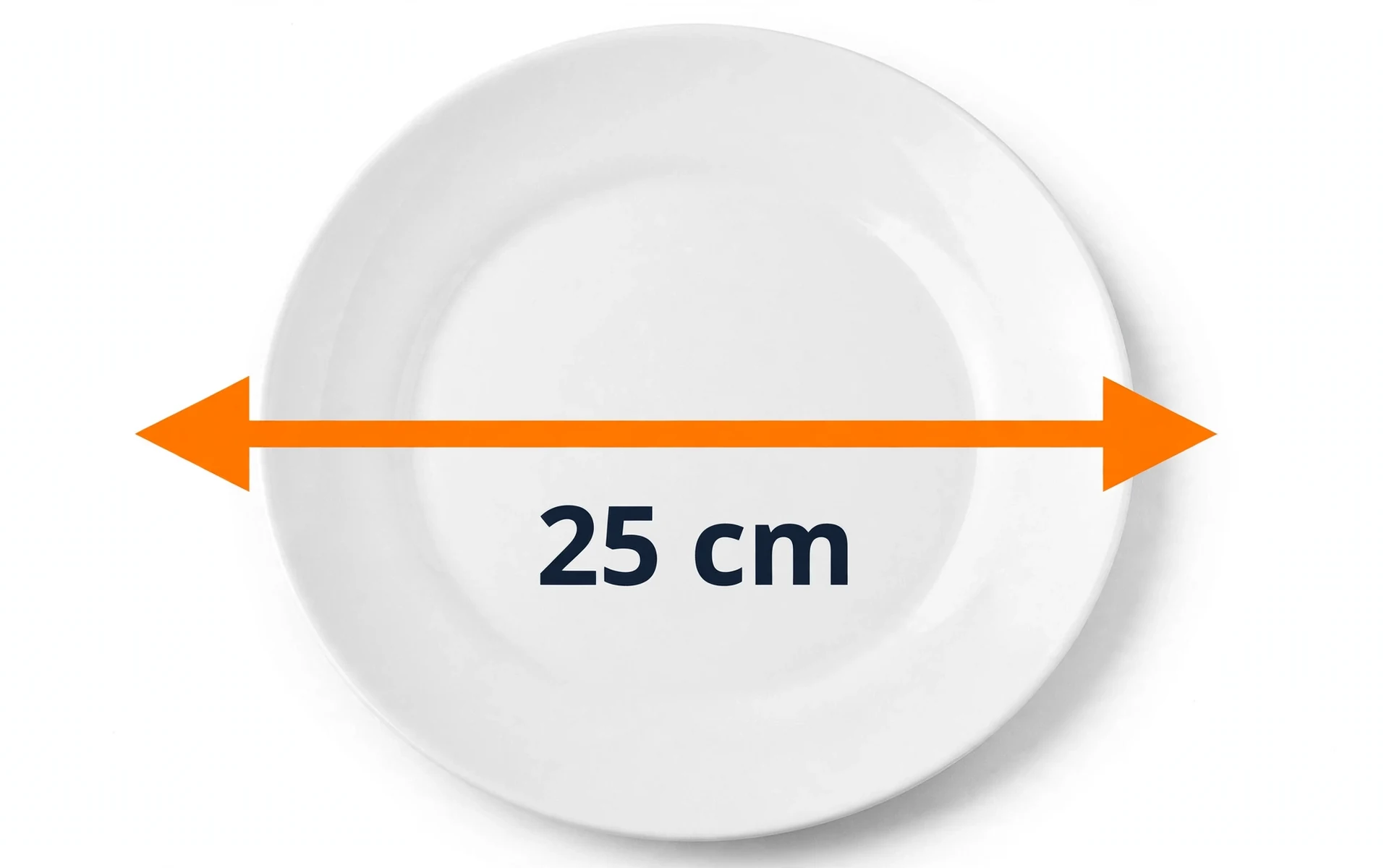
The plate is the article’s most useful land-on, because it is the one you already own and can measure tonight. IKEA’s product page lists the OFTAST plate, white, at 25 cm — the diameter across the rim — so the plate measures 25.00 cm edge to edge, with no deviation to print. Set it on the table and its width is the number itself, which is why it is the pocket reference in the measuring section below, and why it is the object that settles the dinner-plate question in the corrections section.
The fitting check is the word “plate”, because the 25 cm belongs to this plate and not to OFTAST in general. This is a different plate from the IKEA OFTAST side plate in our 19 cm article — that one is 19 cm across, this one is 25 cm, and the two are not interchangeable. A plate rack bought against “25 cm” holds this OFTAST and not the side plate, and a dinner plate bought against “OFTAST” without a size could be either. The grade is listed because the figure is the manufacturer’s published specification for the named product, with the deviation printed in full: 25.00 cm, zero millimetres off. If your kitchen has an OFTAST dinner plate, you have a 25 cm ruler that also holds your dinner.
3. Vogue Non-Stick Loaf Tin 250 mm (Model GD003) — Length Exactly 250 mm (LISTED)
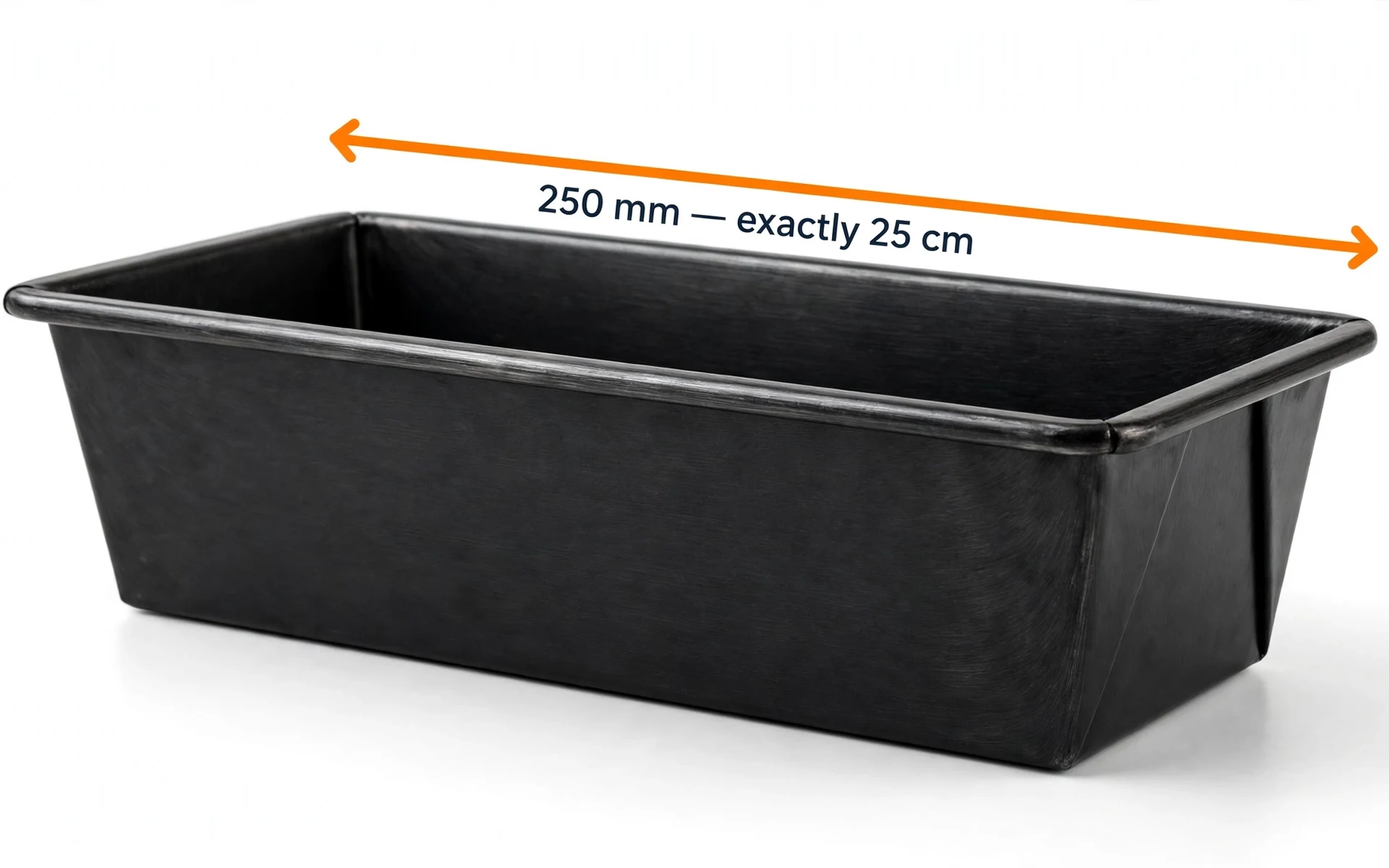
The loaf tin is the article’s most surprising land-on, because a tin that looks like an ordinary bread pan turns out to be a precision measurement — and the one that carries the “2 lb” trap inside the object list itself. The retailer’s specification, carrying the manufacturer’s model and dimensions, lists the Vogue GD003 at 78 × 250 × 100 mm, so the tin runs 250 mm long, with no deviation to print. Lay it on the bench and its longest side is the number itself, which is why it sits third on this page and why it is the object that proves the trap is not a theory but a label you can hold.
The fitting check is the label, because this tin is sold as a “250 mm loaf tin” and not as a 2 lb tin — and the distinction matters. A real 2 lb (900 g) tin is 21 to 23 cm long, so a “2 lb” tin that measures 250 mm is not a 2 lb tin at all. The grade is listed because the figure is the manufacturer’s published specification for the named model, with the deviation printed in full: 250 mm, zero millimetres off. Buy the tin by its millimetres, not by the weight on the box, and the loaf comes out the size the recipe expects.
4. Tala Performance 25 cm Springform Cake Tin (10A10649) — 25 cm Nominal (LISTED)
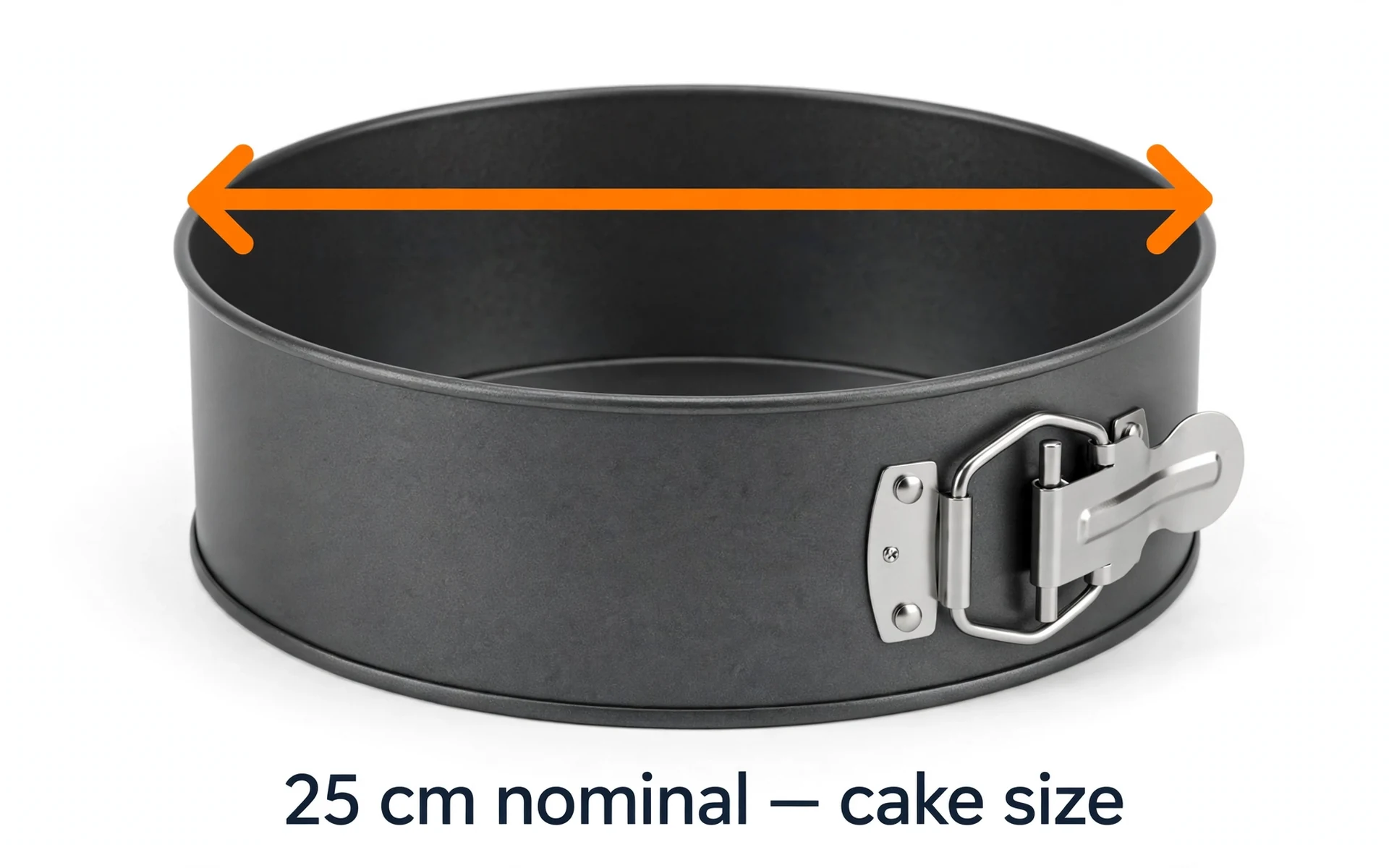
The springform is the article’s most instructive land-on, because its 25 cm is real and not real at the same time. Tala’s own product page sells the Performance 25 cm springform cake tin, model 10A10649, and lists the tin’s outside at 269 × 269 × 70 mm — so the 25 cm is the nominal cake diameter, the size of the cake it bakes, and the tin itself measures 26.9 cm across the outside. The cake is 25 cm; the tin is 26.9 cm; both numbers are true, and they describe different things.
The fitting check is the word “nominal”, because the 25 cm belongs to the cake and not to the tin. A shelf slot cut to 25 cm does not hold this tin — it needs 26.9 cm — and a cake board bought against “25 cm” holds the cake and not the tin. The grade is listed because the figure is the manufacturer’s published designation for the named model, with the deviation printed in full: 25 cm nominal, 269 mm outside, 1.9 cm between them. This is the object that teaches the whole article’s lesson in one tin: the number on the label is the size of the thing it makes, not always the size of the thing itself.
5. The Foot Inside a US Men’s 7.5 Shoe — 9 13/16 in (24.92 cm) (LISTED)
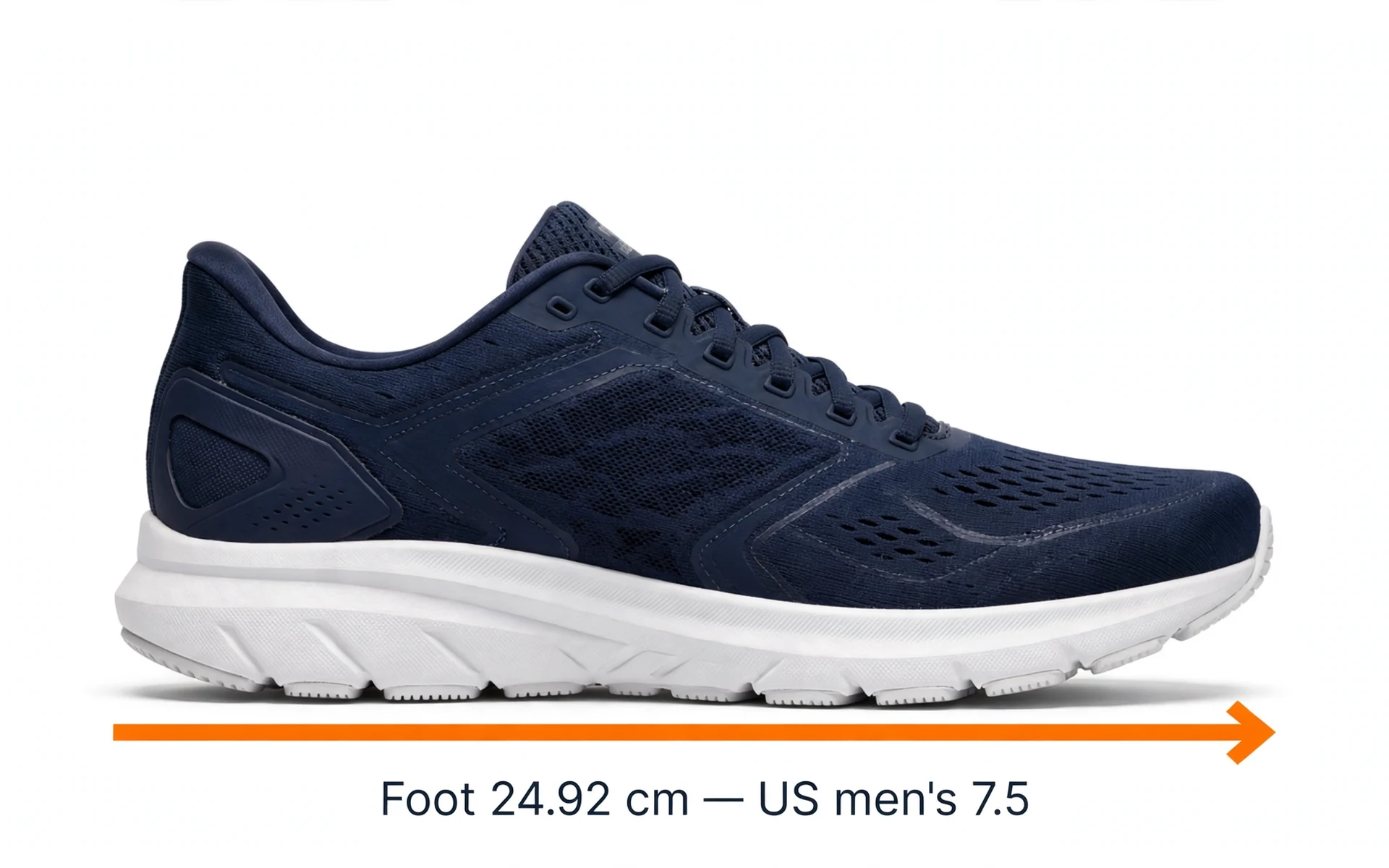
The foot is the article’s only body measurement, and the one that comes with two numbers that must not be confused. Nike’s men’s footwear size chart lists a US men’s 7.5 against a foot length of 9 13/16 inches — 24.92 cm — so the foot inside the shoe runs 24.92 cm, 0.8 mm short of 25 cm, about the thickness of a sheet of paper. The same column reads US women’s 9, UK 6.5 and EU 40.5, so a 25 cm foot takes a men’s 7.5 or a women’s 9, and the two are the same foot in two different shoes.
The fitting check is the box, because the number printed on the shoe box is not the foot length. Nike’s chart warns that the CM size on shoe boxes and labels differs from foot length, and the box for a men’s 7.5 says “25.5” — a different number for a different thing, the box size rather than the foot. The grade is listed because the figure is the manufacturer’s published size chart for the named size, with the deviation printed in full: 24.92 cm, 0.8 mm short. Measure your foot, not the box, and buy the shoe that fits the foot you have.
6. Apple iPad (10th Generation) — Height 248.6 mm (LISTED)
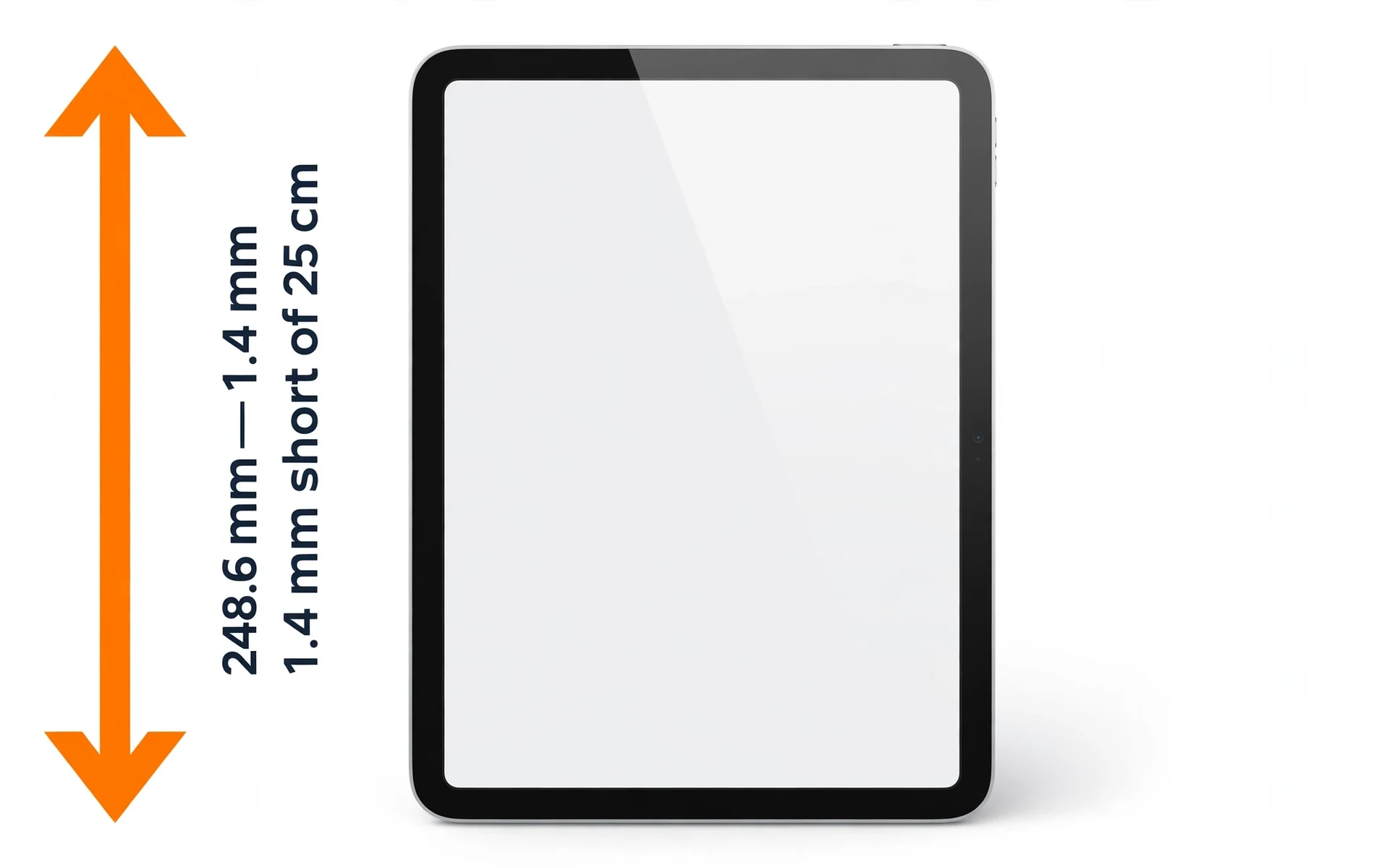
The iPad is the article’s most useful near-miss, because it is 1.4 mm short of 25 cm and almost everyone has one to measure against. Apple’s technical specifications list the iPad (10th generation) at 248.6 mm tall and 179.5 mm wide, so the tablet stands 248.6 mm — 1.4 mm short of 25 cm, about the thickness of a fingernail. Hold it upright and its height is the closest thing to 25 cm in the tech drawer, which is why it is the measuring tool in the section below.
The fitting check is the screen, because the 10.9 inches on the box is the screen diagonal and not the body height. A 10.9-inch diagonal is 27.7 cm across the corner, and the body is 24.86 cm tall, so a sleeve bought against “10.9 inches” fits the screen and not the body. The grade is listed because the figure is the manufacturer’s published specification for the named model, with the deviation printed in full: 248.6 mm, 1.4 mm short. Measure the body, not the screen, and the sleeve fits the first time.
7. US No. 10 Business Envelope, Long Edge — 241.3 mm (EXACT)
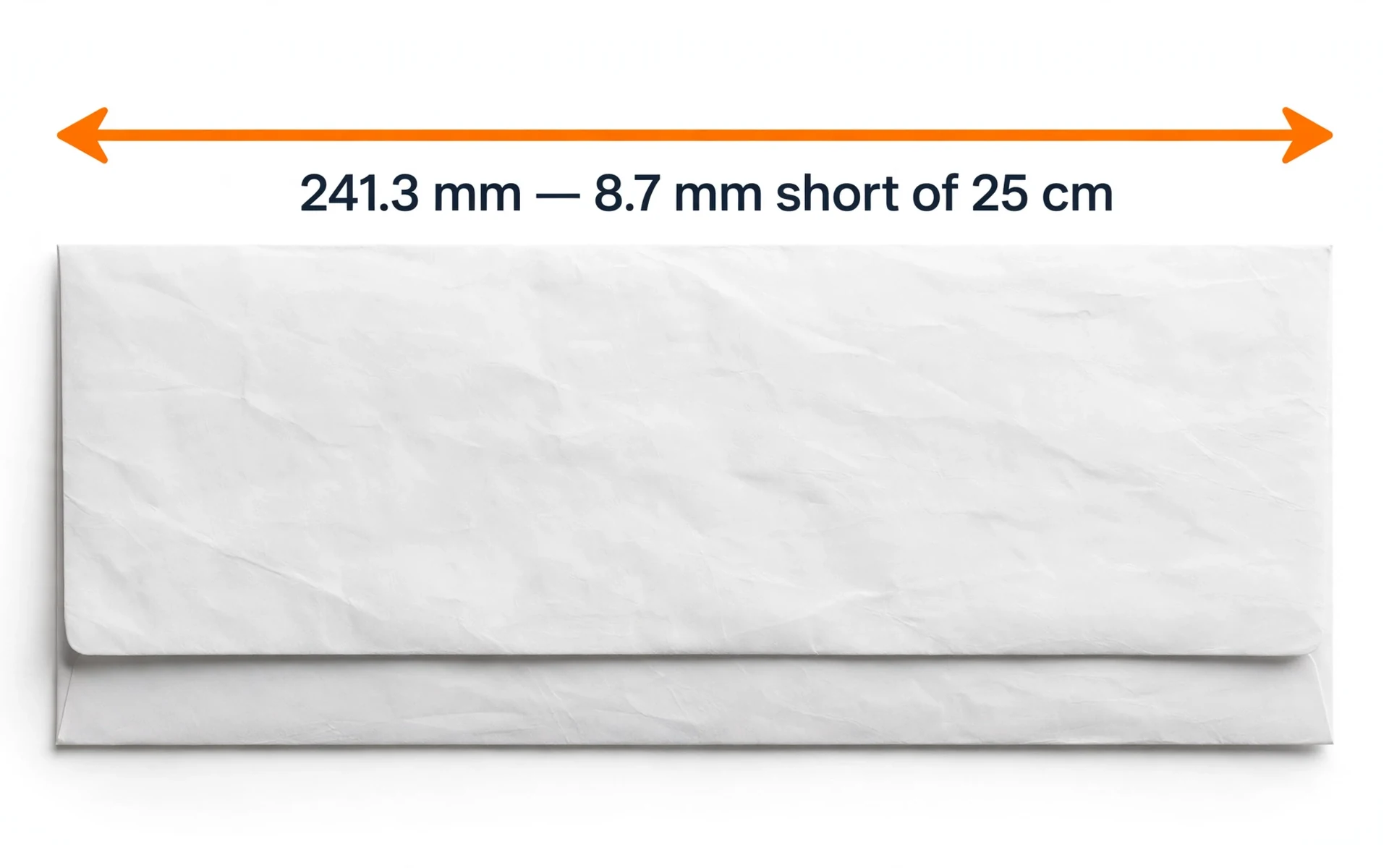
The envelope is the article’s furthest honest undershoot and its best office reference, because it is 8.7 mm short of 25 cm and in almost every desk drawer. New York’s envelope regulation defines the No. 10 envelope as 4⅛ × 9½ inches, so its long edge runs 241.3 mm — 8.7 mm short of 25 cm, just under a centimetre. Lay it flat and its long edge ends visibly short of the mark, and “add nine millimetres” is the honest instruction for closing the gap.
The fitting check is the tolerance, because the 241.3 mm is the nominal size and real envelopes vary. The postal service allows ±1/16 inch (±1.6 mm) of manufacturing tolerance, so a compliant No. 10 runs 239.7 to 242.9 mm long — always at least 7 mm short of 25 cm, never on it. The grade is exact because the figure is the government’s own definition for the named size, with the deviation printed in full: 241.3 mm, 8.7 mm short. If the envelope on your desk is 25 cm long, it is not a No. 10 — it is an envelope that happens to be 25 cm, and the standard is the reason it is close.
8. Size 7 Men’s Basketball, Diameter — About 23.9 cm (REPORTED)
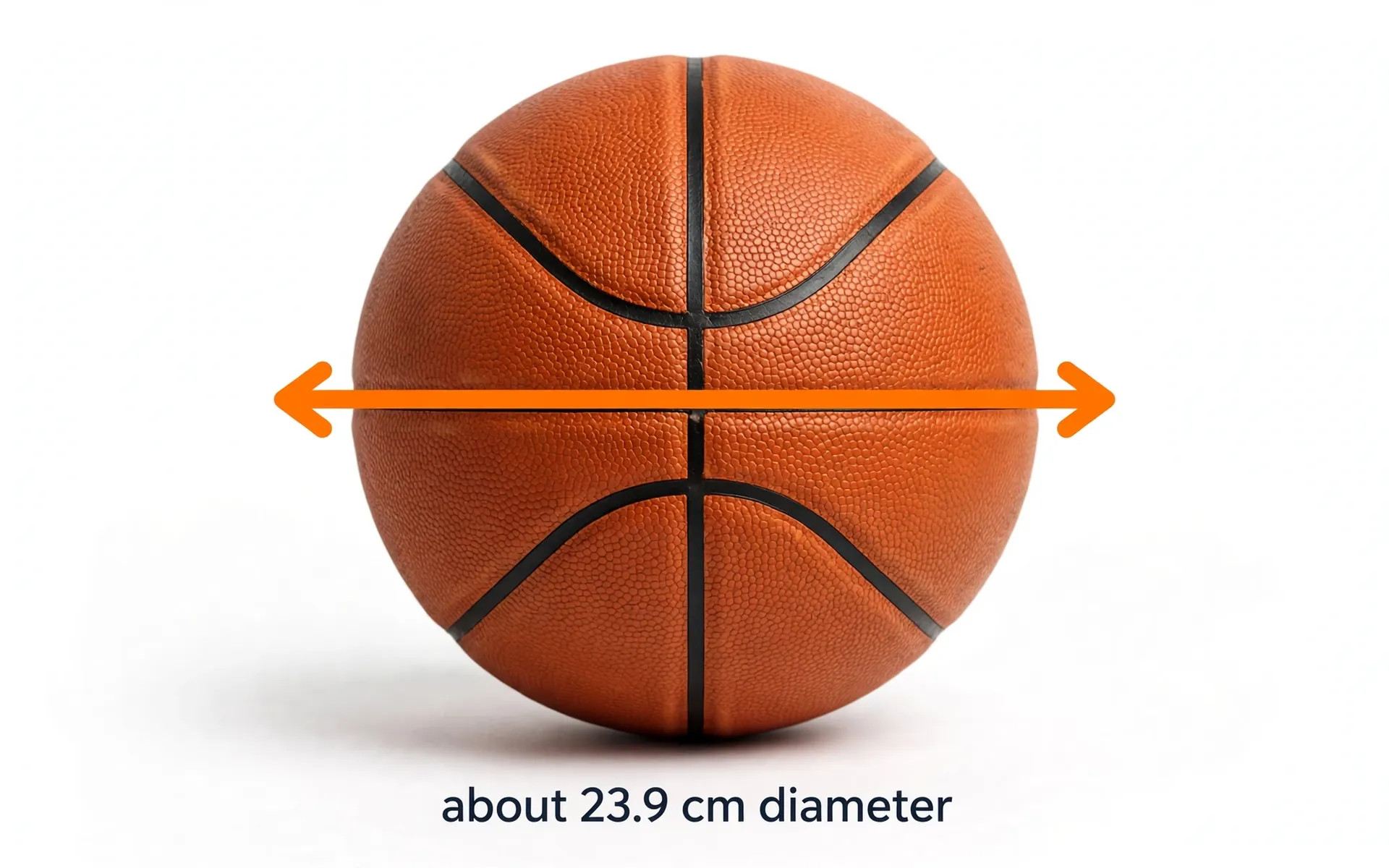
The basketball is the article’s furthest miss, and the weakest fit on the page — which is why it is last, and why the miss is printed largest. The official size-7 ball has a circumference of 29.5 inches (74.93 cm), and dividing by π gives a diameter of 9.39 inches — 23.85 cm — so the ball runs about 23.9 cm across, 11.5 mm short of 25 cm, just over a centimetre. Hold it in both hands and it ends visibly short of the mark, and “add a centimetre” is the honest instruction for closing the gap.
The fitting check is the word “about”, because the diameter is calculated, not published. No governing body publishes a ball diameter — it publishes a circumference, and the diameter is arithmetic from it. The international size-7 range allows 750 to 770 mm of circumference, which is 23.87 to 24.51 cm of diameter, so even the largest legal ball is still half a centimetre short of 25 cm. The grade is reported because the figure is calculated from the official circumference, with the deviation printed in full: about 23.9 cm, 11.5 mm short. Say “about 23.9 cm” and you are right; say “the ball is 23.85 cm” as if someone measured it and you are claiming a precision nobody published.
The Tin That Is 25 cm and 26.9 cm at the Same Time
The Tala springform on this page is 25 cm and 26.9 cm at the same time, and it is not a contradiction — it is the difference between a nominal size and a physical size. The 25 cm is the cake: the diameter of the sponge the tin bakes, the number the recipe means when it says “25 cm tin”. The 269 mm is the tin: the outside of the metal, including the rim and the base, the number the shelf means when it asks whether the tin fits. Both numbers come from Tala’s own product page, and neither is wrong — they answer different questions.
The Vogue loaf tin is the same lesson in the other direction. It is sold as 250 mm, and 250 mm is its physical length, so the number on the listing is the number on the tin. But a rival list calls it a “2 lb loaf tin”, and a real 2 lb (900 g) tin is 21 to 23 cm long — Tala’s own 2 lb loaf pan is 24.4 × 14.4 cm on the outside and 23.0 × 13.0 cm on the inside. The Vogue tin is 2 cm longer than the longest real 2 lb tin, so the “2 lb” label is the error, not the 250 mm. The loaf tin is 25 cm long; it is not a 2 lb tin; the two statements are independent, and only one of them is true.
Nominal sizes are everywhere once you start looking: shoes are sold by a size that is not the foot length, screens by a diagonal that is not the body height, cake tins by the cake they bake rather than the metal they are made of. The Wüsthof Classic chef’s knife sold as “10 inch” is 26 cm long — a full centimetre past 25 cm — which is the trap in product form: the “10-inch” knife is not 25 cm, it is 26 cm, and the inch number is the nominal size. The habit worth keeping is the one this section is built on: ask what the number measures — the cake or the tin, the foot or the box, the screen or the body — and the label stops lying.
Five “25 cm” Claims That Don’t Measure Up
| What a rival list claims | What it actually measures | The difference |
|---|---|---|
| A DVD case is roughly 25 cm tall | A DVD keep case is 190 mm tall — 19 cm | 6 cm short — it is a 19 cm object, not a 25 cm one |
| A basketball rim is about 24 cm across | A regulation rim is 18 in (45.72 cm) across; ~24 cm is the ball | Nearly 2× — the writer confused the ball with the rim |
| A balance beam is 25 cm wide | A competition beam is 10 cm wide | 15 cm over — the writer is off by a handspan and a half |
| A women’s 8.5 shoe is a 25 cm foot | A women’s 8.5 is a 24.5 cm foot; 25.0 cm is women’s 9 | 5 mm short — one whole size out |
| A wrist-to-fingertip hand is about 25 cm | The average man’s hand is 19.3 cm wrist to fingertip | 5.7 cm over — the writer confused hand length with forearm length |
Five of these deserve a longer correction. The DVD case is the most repeated error in the ranking pages: a rival list calls it “roughly 25 cm” because a DVD case looks tall, and the writer never checked the format standard. A standard DVD keep case is 190 mm tall — 19 cm, 6 cm short of 25 cm — which is why it is an object in our 19 cm article and a correction in this one. The basketball rim is the most confident error: a rival list says the rim is about 24 cm across, but a regulation rim is 18 inches (45.72 cm) inside diameter, and ~24 cm is the ball’s diameter — the writer confused the ball with the rim and is off by nearly two times. The balance beam is the most careless error: a rival list says a competition beam is 25 cm wide, but the apparatus standard sets it at 10 cm wide, 5 m long and 125 cm high — the writer is 15 cm out, a handspan and a half. The shoe is the most expensive error: a rival list says a women’s 8.5 is a 25 cm foot, but Nike’s own chart puts a women’s 8.5 on a 24.5 cm foot, and 25.0 cm is a women’s 9 — one whole size out, which is a shoe that does not fit. And the hand is the most ordinary error: a rival list says a wrist-to-fingertip hand is about 25 cm, but the published average for a man’s hand is 19.3 cm — the writer confused hand length with forearm length and is 5.7 cm out.
Two near-misses deserve a line of their own. Two bank cards laid end to end are 17.12 cm, not 25 cm — three cards are 25.68 cm, 6.8 mm over, and the page that claims two cards is one whole card short. And a 15-inch laptop is about 34 cm wide, not 25 cm — 9 to 10 inches is its depth, and the depth (23.76 cm on a 15-inch MacBook Air) is the near-miss, not the width. The width is the number that matters for a sleeve, and the writer who confuses width with depth buys a sleeve that does not fit.
How to Measure 25 cm Without a Ruler
| Method | What you get | How close it is |
|---|---|---|
| B5 sheet, long edge | 250 mm | Exact — the best pocket reference |
| Three bank cards, end to end | 256.8 mm | 6.8 mm over — take off seven millimetres |
| Your own foot, if it is a men’s 7.5 | 24.92 cm | 0.8 mm short — measure your foot first |
| Tape measure, 9 13/16 in mark | 24.92 cm | 0.8 mm short — add a hair |
| iPad 10th gen, standing upright | 248.6 mm | 1.4 mm short — add a millimetre and a half |
| No. 10 envelope, long edge | 241.3 mm | 8.7 mm short — add nine millimetres |
The B5 method is the best of the six, because the miss is zero and the sheet is in almost every home and office. The bank-card method is the one to use when there is nothing to measure with — three cards are 25.68 cm, so lay three cards end to end and take off seven millimetres. The foot method is the one to use when you are buying shoes — if your foot measures 24.92 cm, you are a men’s 7.5, and your foot is the reference. The tape method is the most accurate, because the 9 13/16-inch mark is 0.8 mm from the number and the tape is the tool the number came from. The iPad method is the one to use when the tablet is already in your hand — stand it upright and its height is 248.6 mm, 1.4 mm short.
The fitting check is the zero mark, because 25 cm starts at the 0 line and not at the end of the ruler. Most plastic rulers carry a few millimetres of blank plastic past the last graduation, so if you measure from the physical edge of the ruler instead of from the 0 mark you will read long by that margin — about 3 mm on a cheap ruler, which is three-quarters of the 4 mm gap this whole article is about. Measure from 0, and the ruler is honest; measure from the edge, and the ruler lies by almost as much as the trap.
25 cm in Every Unit
| Unit | Value |
|---|---|
| Millimetres | 250 mm |
| Metres | 0.25 m |
| Inches | 9.84 in (9 13/16 in) |
| Feet | 0.82 ft |
| Yards | 0.27 yd |
Twenty-five centimetres is 250 millimetres, and a centimetre is 10 millimetres, so the conversion is a multiplication by ten that never needs a calculator. In inches it is 25 divided by 2.54, which is 9.8425 inches, rounded to 9.84 — and the rounding is honest, because 9.84 inches times 2.54 is 24.9936 cm, six hundredths of a millimetre from the mark. In feet it is 0.82, or 0 ft 9.84 in if you want feet and inches rather than a decimal. 20 cm is 5 cm shorter than 25 cm, and 40 cm is 15 cm longer, and 18 cm is 7 cm shorter, and 25 cm is exactly five times 5 cm, which is why the sizes sit next to each other in cases, shelves and tablet sleeves. Centimetres are the unit on shopping listings, inches are the unit in US hardware and bakeware, and millimetres are the unit in engineering and 3D printing — and 25 cm is exactly a quarter of a metre, so four of them make a metre, and the quarter is the reason the number shows up in recipes, rulers and shoe charts at once.
The 25 cm Fit-Check: Before You Buy
– Shoes: a 25 cm foot takes US men’s 7.5, US women’s 9, UK 6.5 and EU 40.5 on Nike’s chart. Measure both feet to the longest toe, buy to the longer foot, and ignore the “25.5” on the box — that is the box size, not your foot. If the measurement falls between sizes, size up.
– Cake tin: a 25 cm tin is 4 mm narrower than a 10-inch pan, so the same batter sits about 3% deeper — the area arithmetic, (25 ÷ 25.4)² = 96.9%. Expect a slightly longer bake and check with a skewer, and buy the tin by its millimetres, not by the “10 inch” on the box.
– Tablet sleeve: never trust a “10.9-inch” label alone. The 10.9 inches is the screen diagonal, and the body is 248.6 mm tall — check the body height in the specifications, not the screen size on the box. A sleeve with a 25 cm interior holds the iPad with 1.4 mm to spare; a sleeve built to the screen diagonal does not hold the body at all.
– Shelf and drawer depth: 25 cm is a depth that fits B5 books and A4 folders standing, with room to spare. A shelf cut to 25 cm holds a B5 notebook exactly and an A4 folder with 4.7 cm of clearance on the long side; a shelf cut to “10 inches” is 4 mm deeper, which is the difference between a folder that slides in and one that catches.
The rule underneath all four is the same: measure the space, add clearance, and never trust a “10-inch” label alone. The label is a screen size, a nominal size, or a rounded size; the tape is the size. Four millimetres is the price of trusting the label, and a cake that runs over the tin is the receipt.
Frequently Asked Questions
Is 25 cm exactly 10 inches?
No. Twenty-five centimetres is 9.84 inches, and 10 inches is 25.4 cm, so 25 cm falls 4 mm short of 10 inches. Call it “just under 10 inches” and you are right; call it “10 inches” and you are 4 mm wrong, which matters when the thing has to fit — a cake tin, a tablet sleeve, or a shoe.
How many inches is 25 cm?
Twenty-five centimetres is 9.84 inches, or 9 13/16 inches as a fraction. The conversion is 25 divided by 2.54, because one inch is defined as exactly 2.54 cm. On a tape measure, the nearest sixteenth-inch marks are 9 13/16 inches at 24.92 cm and 9 7/8 inches at 25.08 cm.
What everyday objects are 25 cm long?
Eight verified objects, tightest first: an ISO B5 sheet at exactly 250 mm on the long edge, an IKEA OFTAST dinner plate at 25.00 cm across, a Vogue 250 mm loaf tin at exactly 250 mm long, a Tala 25 cm springform tin (25 cm nominal, 269 mm outside), a US men’s 7.5 foot at 24.92 cm, an Apple iPad 10th generation at 248.6 mm tall, a US No. 10 envelope at 241.3 mm on the long edge, and a size 7 basketball at about 23.9 cm across. Every one is verified against the manufacturer’s own specification or the format standard.
What shoe size is a 25 cm foot?
A 25 cm foot takes US men’s 7.5, US women’s 9, UK 6.5 and EU 40.5 on Nike’s size chart. The box label says “25.5” — that is the CM box size, not the foot length — so measure your foot to the longest toe and buy to the longer foot, and if the measurement falls between sizes, size up rather than down.
Is a B5 notebook 25 cm long?
An ISO B5 notebook is 25 cm long on its long edge (176 × 250 mm), but a Japanese JIS B5 notebook is 182 × 257 mm — 7 mm longer. Check where the notebook was made before you trust it as a ruler: ISO B5 is exactly 25 cm, JIS B5 is 25.7 cm.
Will a 25 cm cake tin work for a recipe calling for a 10-inch pan?
Yes, with a 4 mm narrower tin the same batter sits about 3% deeper — the area arithmetic, (25 ÷ 25.4)² = 96.9% of the 10-inch pan’s area — so expect a slightly longer bake and check with a skewer. The cake will be the same; the bake time is the only thing that changes.
How do I measure 25 cm without a ruler?
A B5 sheet’s long edge is exactly 250 mm; three bank cards end to end are 256.8 mm, so take off seven millimetres; your own foot if it measures 24.92 cm (men’s 7.5); a 30 cm ruler read to the 25 mark; or an iPad 10th generation stood upright, 248.6 mm, 1.4 mm short. Measure from the ruler’s zero mark, not from the plastic edge, or you will read about 3 mm long.
What is 25 cm in mm, feet and meters?
Twenty-five centimetres is 250 millimetres, 0.82 feet, and 0.25 metres — exactly a quarter of a metre, so four of them make a metre. In inches it is 9.84, or 9 13/16 on a tape measure.
Final Thoughts
Twenty-five centimetres is a length that lives 4 mm short of 10 inches, and the 4 mm is the whole article. The eight objects that measure it — a sheet of paper, a dinner plate, a loaf tin, a springform, a foot, a tablet, an envelope and a basketball — are all things you can find tonight without buying anything, and every one of them carries the number its source actually publishes, with the miss printed next to it. That is the difference between a measurement and a slogan: the measurement can be checked, and the slogan cannot.
The habit worth keeping is the one this article is built on. Do not take the round number, and do not take the name. Ask what the number measures — the cake or the tin, the foot or the box, the screen or the body — look up the specification, and print the miss when there is one. A tin that is 25 cm and 26.9 cm at the same time is not a contradiction; it is a reminder that the label is a promise about one thing, and the tape is the truth about the other.
