
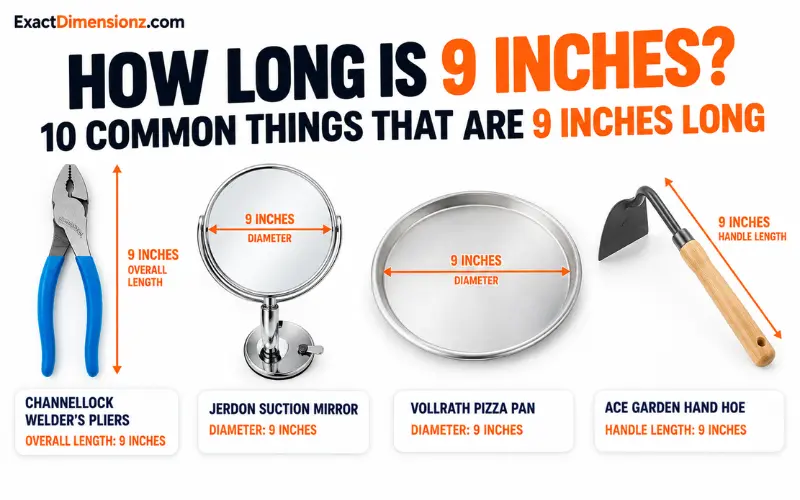
If you are wondering how long is 9 inches, the simplest answer is this: three-quarters of a foot. That is 22.86 centimeters, or 228.6 millimeters — three inches short of a full ruler, and just a little longer than a 20-centimeter school ruler. It is the length of a pair of long pliers, the diameter of a small pizza pan, and the width of a dinner plate, all in one number. The complete inches size guide shows how 9 inches fits alongside every other size.
The tricky part is not the math. It is knowing which part of a real object actually measures 9 inches — because a “9-inch” cake pan is 9 inches only on its baking surface, a “9-inch” garden hoe is 9 inches only in its handle, and one respected tool on this list measures 9.03 inches, not 9.00. Below are 10 real objects with a verified 9-inch dimension, each one labelled with exactly which side counts, so you can picture 9 inches without guessing.
How long is 9 inches?
9 inches is exactly three-quarters of a foot — 22.86 cm, or 228.6 mm. Since 1959 the inch has been fixed by international agreement at exactly 2.54 centimeters — it is not measured afresh each time, it is defined that way. That is why 9 inches works out to precisely 22.86 cm and 228.6 mm, with no rounding anywhere in the chain.
Before you trust a “9-inch” label, find the part it measures
A “9-inch” label is a claim about one edge of one object, never about the whole thing. The pliers on this list are 9 inches from the end of a handle to the tip of the jaws. The mirror is 9 inches straight across its face. The cake pan is 9 inches across the surface you bake on, and half an inch wider once you count the rim. The garden hoe is 9 inches in the handle alone. Same number, four different places to put the tape — and the label never tells you which one it means unless you read the specification underneath it.
There are two different kinds of numbers in this article, and mixing them up is where most mistakes start. The conversions are settled by definition: because the inch is fixed at 2.54 cm, 9 inches is 22.86 cm, 228.6 mm, three-quarters of a foot, and a quarter of a yard, every time, on every page. The objects are a different matter. Their 9 inches comes from the maker’s or retailer’s published specification, and this article reports what that specification says — including the cases where the specification is a baking surface, a handle, a rounded figure, or a size that is a hair over the mark — instead of pretending somebody walked around with a tape measure.
1. CHANNELLOCK 360 9-Inch Welder’s Pliers
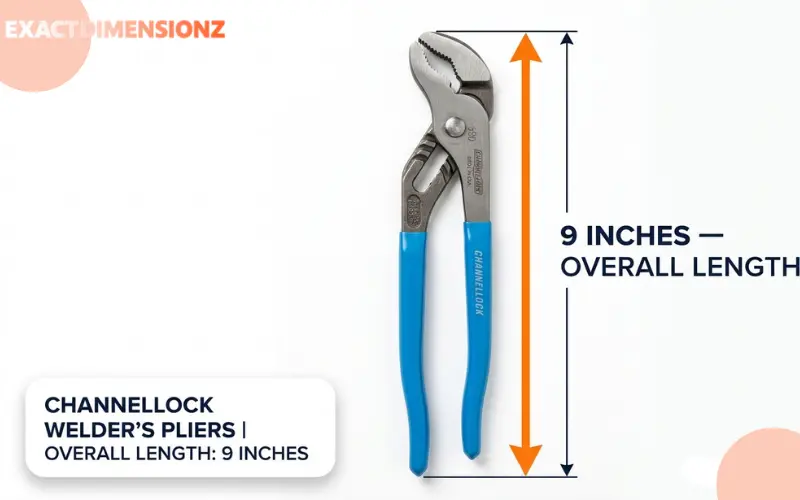
A pair of long pliers is the cleanest way to see 9 inches as a straight line, because the whole tool is the measurement. CHANNELLOCK’s 360 welder’s pliers list an overall length of 9.0 inches, or 228.6 mm, from the end of one handle to the end of the jaws. Hold them next to a ruler and the tool reaches the 9-inch mark exactly.
These pliers also show why tool specifications beat product names. The name says “9-inch,” but the manufacturer’s own spec sheet is what confirms that the 9 inches means overall length — not jaw length, not handle length, but the complete tool end to end.
Measurement: 9.0-inch overall length. Evidence: LISTED (manufacturer specification, freshly re-verified). Source: CHANNELLOCK 360 9-inch Welder’s Pliers — CHANNELLOCK.
2. CHANNELLOCK 86 XLT Rescue Tool (About 9 Inches, Not Exactly)
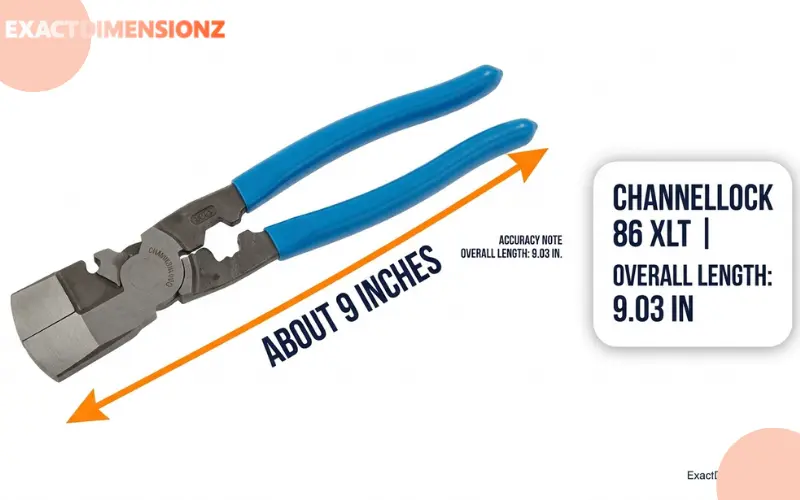
This is the honesty object on the list, and it earns its place precisely because it is not exactly 9 inches. The manufacturer gives the 86 XLT Rescue Tool’s product dimensions as 9.03 inches long, 3.76 inches wide, and 0.45 inches thick. Its overall length is 9.03 inches, or about 229.36 mm — three-hundredths of an inch over 9 inches, which is less than a millimeter.
Put it next to an exact 9-inch ruler and the difference is invisible to the eye. But the distinction still matters for anyone writing about measurements: this tool is about 9 inches long, not exactly 9.00 inches. An object can be an excellent visual comparison for 9 inches without measuring exactly 9.00 inches, and saying so is what separates a careful guide from a careless one.
Measurement: 9.03-inch overall length (about 9 inches, not exactly 9.00). Evidence: LISTED (manufacturer specification, freshly re-verified). Source: CHANNELLOCK 86 XLT Rescue Tool — CHANNELLOCK.
3. Jerdon 9-Inch Diameter Suction Mirror
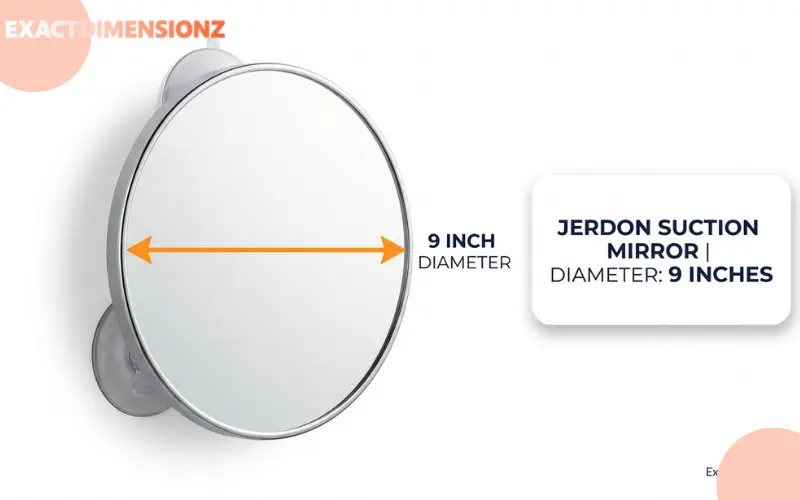
A round mirror gives you 9 inches as a width rather than a length, and that change of shape is worth feeling. Jerdon’s JSC5 wall-mount suction mirror has a 9-inch diameter: measured straight across the middle, through the center, edge to edge, the distance is 9 inches. The mirror attaches with three suction cups and offers regular and magnified viewing, but the measurement that matters here is the circle itself.
A 9-inch circle looks larger than a 9-inch pliers, even though the number is identical — the shape spreads the same distance over more visible space. That is a useful warning against judging a measurement by how big an object feels.
Measurement: 9-inch diameter. Evidence: LISTED (manufacturer specification). Source: Jerdon Style 9-inch suction mirror — Jerdon Style.
4. Vollrath 9-Inch Solid Press-Cut Pizza Pan
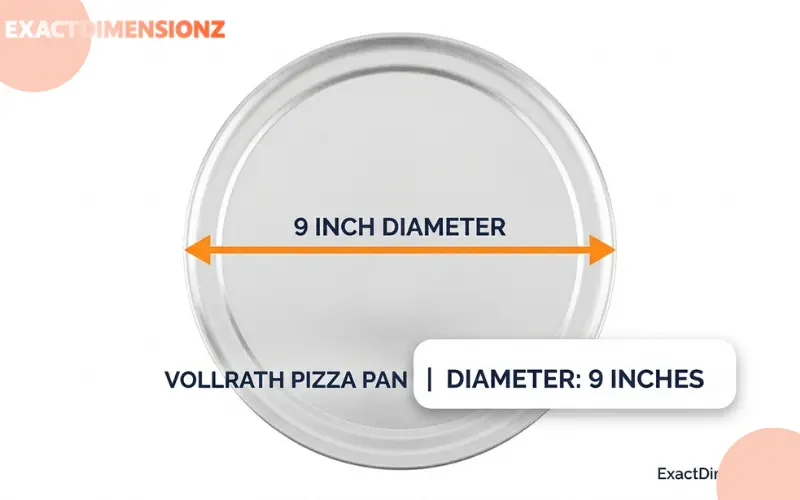
A pizza pan is the kitchen object most people will actually meet at 9 inches. Vollrath’s solid press-cut pan lists a 9-inch diameter — given by the maker as 22.9 cm, a rounded figure for the exact 22.86 cm — made from 3000-Series aluminum with a defined rim for shaping dough. The 9 inches is the diameter across the pan, not its height or thickness.
Place the pan on a table and draw a straight line across its center: that line is 9 inches. And remember the pan lesson for every round object on this list — when a listing says “9-inch pan,” the number almost always means the diameter across the cooking surface.
Measurement: 9-inch diameter (maker gives 22.9 cm, rounded). Evidence: LISTED (manufacturer specification). Source: Vollrath 9-inch solid pizza pan — Vollrath.
5. STANLEY FATMAX 43-605 9-Inch Torpedo Level
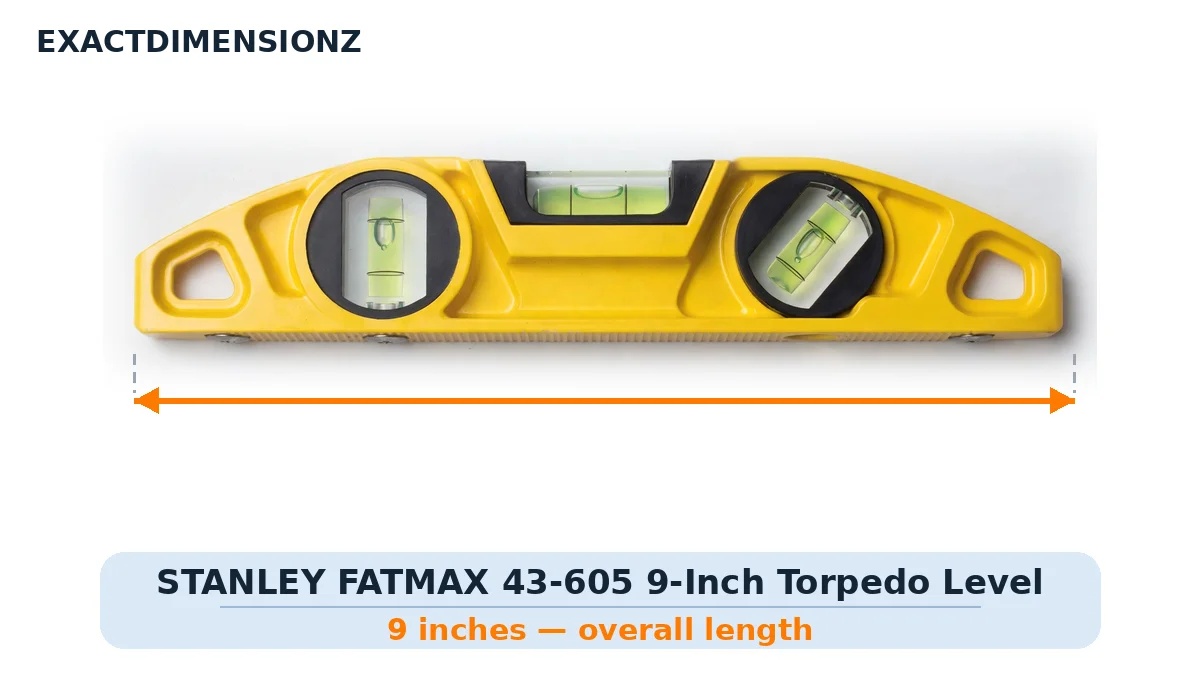
A torpedo level is the one object on this list that is a measuring tool itself, which makes it a fitting reference: the thing you would check a shelf with is itself 9 inches long. STANLEY’s 43-605 FATMAX torpedo level is a 9-inch level in a die-cast aluminum body, with solid block vials for level, plumb, and 45 degrees, a pipe groove underneath for rounded surfaces, and rare-earth magnets that hold it to metal while your hands are busy.
Hold it against a ruler and the comparison is immediate, because there is no diameter, baking surface, or handle to untangle — the level is the length. Set it on a shelf you have just hung and you get the point of the whole article in one gesture: the tool tells you whether something else is straight, and its own 9 inches is the distance from one end of the body to the other.
Measurement: 9-inch level (overall length). Evidence: LISTED (manufacturer product page). Source: STANLEY 43-605 FATMAX Torpedo Level — STANLEY.
6. USA Pan 9-Inch Round Cake Pan
The cake pan is the most instructive object in this guide, because its specifications draw a line most listings blur. USA Pan’s 9-inch round cake pan has a 9 × 9 × 2-inch baking surface — but outside dimensions of 9.5 × 9.5 × 2 inches. So the 9-inch measurement applies to the baking surface, not to the complete outside width of the pan.
Calling the entire pan “exactly 9 inches wide” would be wrong by half an inch. That half inch is the whole point: always check whether a listed 9 inches means the working surface or the outside of the object. Kitchen products are where this distinction shows up most, because the useful cooking area and the outside size are rarely identical.
Measurement: 9-inch baking surface (outer dimensions 9.5 inches). Evidence: LISTED (manufacturer specification). Source: USA Pan 9-inch round cake pan — USA Pan.
7. USA Pan 9-Inch Pie Pan
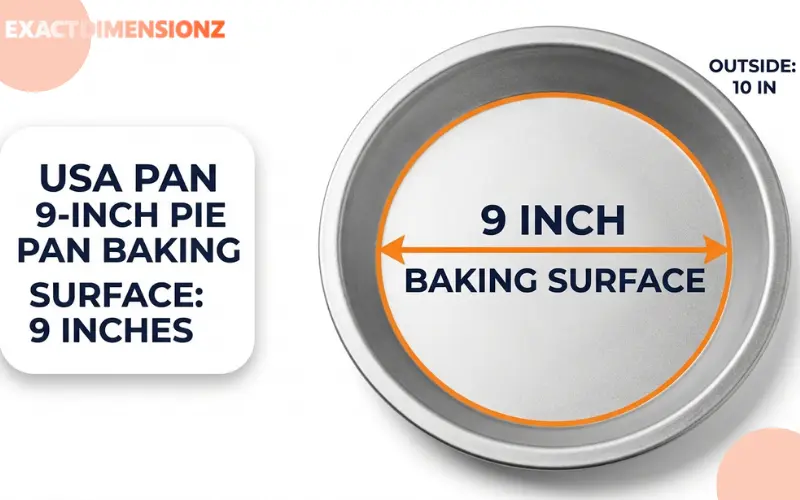
A pie pan confirms the cake pan’s lesson with a slightly bigger gap. USA Pan’s 9-inch pie pan has a 9 × 9 × 1.5-inch baking surface, while its outer dimensions are 10 × 10 × 1.5 inches. Again, the 9-inch measurement refers to the baking surface, not the complete outside width — a full inch of difference this time.
It would be incorrect to say the complete pan is only 9 inches wide. But as a working-area reference it is perfect: measure from one side of the baking surface to the other and you have a 9-inch span, in an object most kitchens already contain.
Measurement: 9-inch baking surface (outer dimensions 10 inches). Evidence: LISTED (manufacturer specification). Source: USA Pan 9-inch pie pan — USA Pan.
8. WÜSTHOF Classic Ikon 9-Inch Chef’s Knife
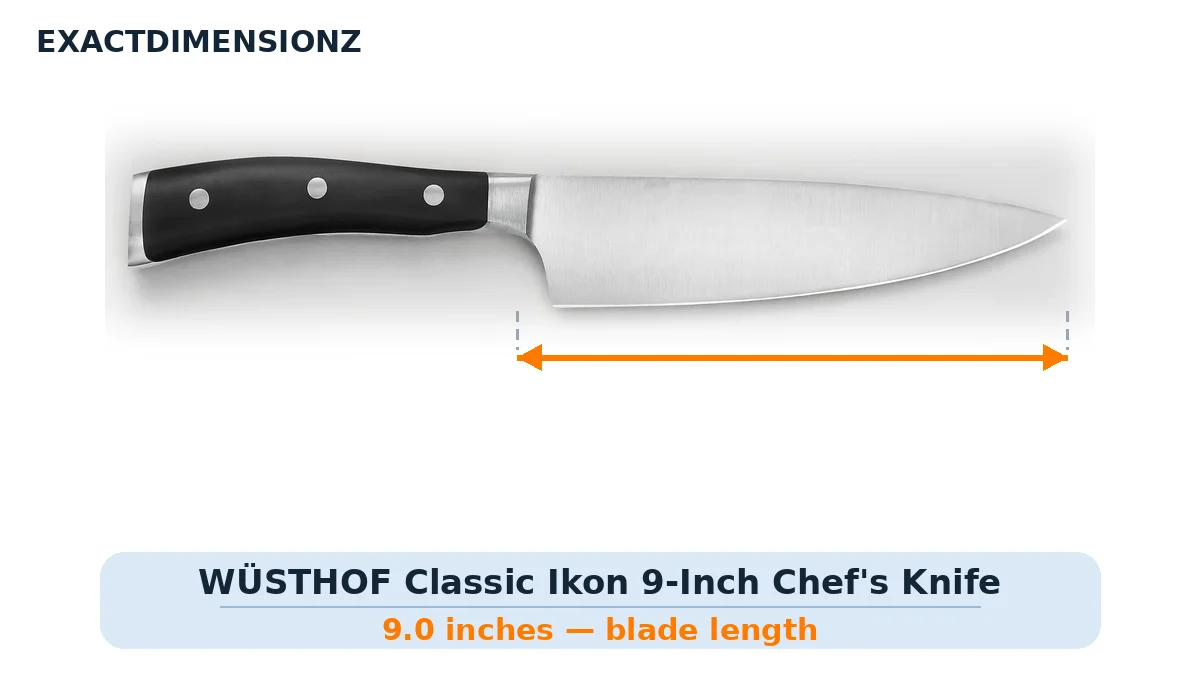
A chef’s knife is the sharpest illustration on this list of why the dimension word matters, because the same knife carries two honest lengths at once. WÜSTHOF’s Classic Ikon 9-inch chef’s knife has a blade 9.0 inches long and a handle 4.5 inches long, so the knife you pick up is 13.5 inches from butt to tip — and only the blade is 9. Calling the whole knife “9 inches” would be wrong by half its own length.
Lay the blade flat next to a ruler and the 9 inches runs from the bolster to the point, a clean straight edge you can see in one glance. It is also a useful everyday reference precisely because it is not the whole object: whenever a product name gives you one number for a thing made of two parts, check which part the number belongs to before you trust it.
Measurement: 9.0-inch blade length (handle 4.5 inches; 13.5 inches overall). Evidence: LISTED (manufacturer specification table). Source: WÜSTHOF Classic Ikon 9″ Chef’s Knife — WÜSTHOF.
9. Ace 9-Inch Garden Hand Hoe Handle
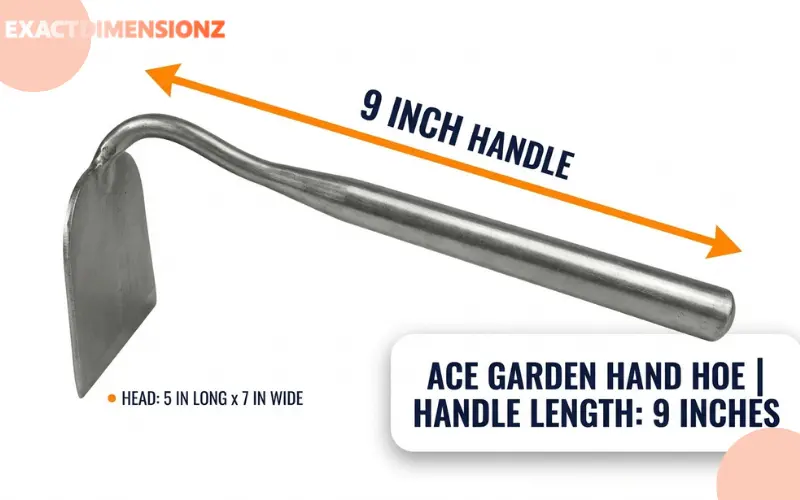
A garden hand hoe shows how 9 inches can describe one part of a tool rather than the whole thing. The Ace metal garden hand hoe listed by Stine Home + Yard has a 9-inch handle, while its head is listed separately at 5 inches long and 7 inches wide. The entire tool is not 9 inches long — the handle is.
Hold the handle next to a ruler and the handle itself gives you a clean 9-inch reference, with the head extending beyond it. When a product page says “9-inch handle,” it does not mean every part of the tool is 9 inches — and reading the specification that carefully is the difference between using a reference and misusing one.
Measurement: 9-inch handle length (head 5 × 7 inches, separate). Evidence: LISTED (retailer listing). Source: Ace 9-inch garden hand hoe — Stine Home + Yard.
10. Bond 9-Inch Garden Auger
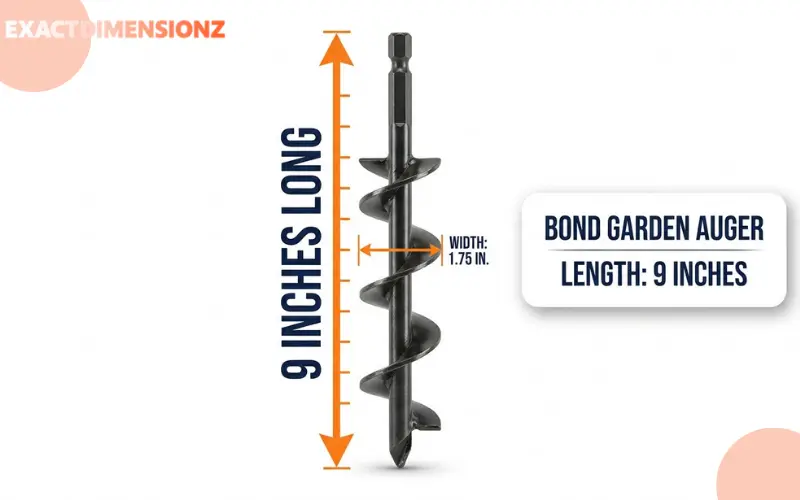
A garden auger closes the list with the simplest kind of 9 inches there is: a straight length. The Bond 6707 garden auger is listed as 9 inches long and 1.75 inches wide — a steel tool for digging planting holes and aerating soil. From one end to the other, its listed length is 9 inches, with no diameter, baking surface, or handle trick to untangle.
It is much narrower than a 9-inch circular pan, but both use the same basic measurement — which is the point the whole article has been making. Nine inches is a distance, not a shape, and it shows up in steel tools just as honestly as in kitchen pans.
Measurement: 9-inch overall length. Evidence: LISTED (retailer listing). Source: Bond 9-inch garden auger — Sutherlands.
Close to 9 inches — but not 9 inches
Some familiar things look about 9 inches but are not, and naming them keeps you from using a wrong reference. A 20-centimeter ruler is 2.86 cm short of 9 inches — close enough for a rough visual, but 20 cm is only 7.87 inches, and the gap matters for anything that must fit. A standard sheet of letter paper is 8.5 inches wide, half an inch short. A 8-inch object is exactly one inch short, and a 10-inch object is exactly one inch over — both close enough to fool the eye at a glance, neither one 9 inches.
The other trap is the foot itself. Nine inches is three-quarters of a foot, not “almost a foot” in any vague sense: 12 minus 9 is exactly 3 inches. And 23 centimeters is not 9 inches either, though it is close — 23 cm equals about 9.055 inches, so 9 inches falls about 0.14 cm short of it. For a quick estimate, “about 23 cm” works; for exact work, use 22.86 cm.
How to measure 9 inches without a ruler
If you have no measuring tool handy, build the distance from parts you already know. Three 3-inch sections laid end to end make exactly 9 inches. Or start from a foot: a 12-inch ruler divided into four equal sections gives four 3-inch parts, and three of them make 9 inches. A 6-inch section plus a 3-inch section also makes 9 inches.
For scale against longer lengths: 4 feet is five 9-inch lengths plus 3 inches, 6 feet is exactly eight 9-inch lengths, and 12 feet is exactly sixteen of them. For anything that matters — a pan that must fit an oven, a tool handle, a planting hole — use a ruler or a product with a published dimension, not a guess.
Frequently asked questions
How do I convert 9 inches to centimeters without a calculator?
Multiply by 2.5 and then add a little: 9 × 2.5 is 22.5, and the exact answer is 22.86 cm, because one inch is precisely 2.54 cm. For anything you are buying or building, use 22.86 cm; “about 23 cm” is fine only when you are picturing the size in your head.
How long is 9 inches in millimeters?
9 inches is 228.6 millimeters. One inch contains exactly 25.4 millimeters, so 9 × 25.4 = 228.6 mm. You may also see 9 inches written as approximately 229 mm when a manufacturer rounds to the nearest whole millimeter — the exact conversion is still 228.6 mm.
Is 9 inches three-quarters of a foot?
Yes, exactly. One foot is 12 inches, and 9 ÷ 12 = 0.75, so 9 inches is three-quarters of a foot. It is exactly 3 inches shorter than a full foot, which makes a 12-inch ruler the easiest way to picture it: cover one quarter and the remaining three quarters are 9 inches.
Is 9 inches close to 23 cm?
Close, but not equal. Nine inches is 22.86 cm, while 23 cm equals about 9.055 inches — so 9 inches falls about 0.14 cm short of 23 cm. For a rough visual comparison “about 23 cm” is fine, but for exact work use 22.86 cm.
How big is 9 inches visually?
Picture three-quarters of a standard ruler, or a dinner plate’s diameter, or a pair of long pliers held end to end. A 9-inch circle, like a small pizza pan, looks larger than a 9-inch straight tool even though the measurement is identical — shape changes the impression, not the number.
Which object on this list is the best one to picture 9 inches with?
It depends on the shape you need. For a straight line, picture the welder’s pliers or the torpedo level — the whole tool is the measurement, end to end. For a circle, picture a pizza pan across its middle. For a single edge of a longer object, picture the chef’s knife blade, which is 9 inches while the knife as a whole is 13.5. Pick the shape that matches what you are measuring, and the number stops being abstract.
How can I measure 9 inches without a ruler?
Use three 3-inch sections end to end, three-quarters of a 12-inch ruler, or a 6-inch section plus a 3-inch section. A 20-centimeter ruler can help you estimate, but remember it falls 2.86 cm short of 9 inches, so it is an approximation, not a substitute.
Why do two “9-inch” products measure differently?
Because the two labels are naming different edges. One product’s 9 inches is its baking surface while its outside is 9.5; another’s is its handle while its head is a separate size; a third is a rounded figure the maker printed for convenience. The rescue tool on this list is the clearest case: it measures 9.03 inches, three-hundredths over the mark. The label is not lying — it is just answering a question you did not ask. Always read the specification line that says which dimension the number belongs to.
Final Thoughts
The next time a listing says “9-inch” and nothing else, stop before you picture anything. Ask which edge the seller measured — the whole tool, the circle across, the surface you cook on, or just the handle — and then check the specification for that exact word. If the listing cannot name the edge, it has not really given you a measurement at all; it has given you a nickname for one.
That one check is worth more than memorizing the conversions, because the conversions never change and the labels always do. Keep the pliers in mind as your straight-line reference and a pan as your round one, and 9 inches becomes something you can see in your hands: 22.86 cm, three-quarters of a foot, and exactly as long as the tool in front of you — measured where the maker said it was measured.
