
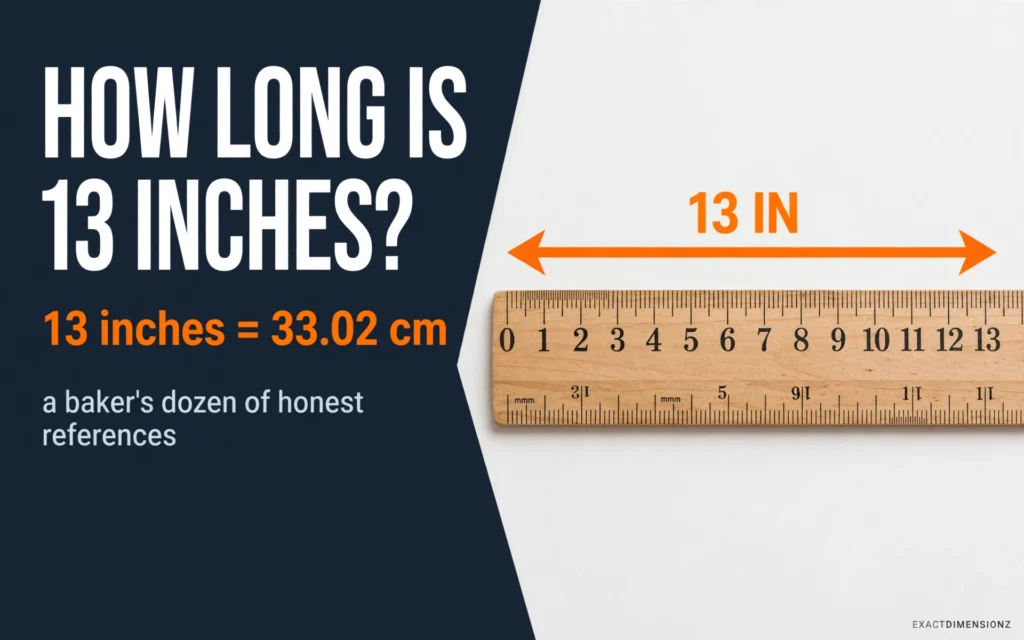
How long is 13 inches? It’s one inch past the most familiar length on Earth — the foot — and that single extra inch makes it the sneakiest measurement in your house. Thirteen inches is 33.02 centimeters, or 1.0833 feet, and it hides in your laptop, your baking pans, your drums, and your dinner table. The problem is that “13 inches” is also one of the least honest labels in retail: it’s a class name, a rounded promise, and occasionally a flat-out wish. So here are a baker’s dozen of them — thirteen references, each with an honest evidence grade, because a reference you can’t trust is worse than no reference at all. See the complete inches size guide for the full series.
How long is 13 inches?
13 inches is exactly 33.02 centimeters — one inch longer than a foot. It’s the laptop on your desk, the 9×13 pan in your oven, the charger plate under your dinner. Here’s the short version before we count out the baker’s dozen:
12 in (one foot)
13 in
Screen rulers aren’t true to size — this bar is a visual guide, not a measuring tool. Calibrate against a real 12-inch ruler plus one inch, a 9×13 baking pan, or a 13×19 photo print.
Quick Answer: How Long Is 13 Inches?
13 inches is 33.02 centimeters — exactly one inch longer than a foot. It is the short side of a 13×19 photo print, the long side of a 9×13 baking pan, and the family name of a “13-inch” laptop whose screen is really 13.3 inches measured diagonally.
The inch is defined as exactly 2.54 cm (NIST Special Publication 811), so the centimeter, millimeter and meter figures are exact by definition — only the feet figure is rounded.
Why 13 Is the Awkward Middle Child
Twelve inches is a foot — the most familiar length in the imperial system, the one you can picture without thinking (see how long is 12 inches). A step up to 14 inches is… well, nothing special either. Two inches further on, about 15 inches is no landmark either. But 13 sits in between, belonging to no unit, ending no ruler, and that’s exactly why it’s the least honest number on the shelf.
No school ruler runs to 13. No tape measure stops there. So when a product claims “13 inches,” it’s almost always a class name or a rounded wish: a laptop whose screen is really 13.3, a pan that varies by a quarter inch, a shoe size that drifts by brand. Thirteen is where nominal sizing runs wild — which is why this article grades every single reference. A baker’s dozen: thirteen objects, thirteen verdicts. There are three different ways “13 inches” bends the truth, and they are worth telling apart, because each one needs a different kind of caution. The first is the class name: a laptop, a drum or a shoe size borrows the number the way a clothing size borrows a letter — it tells you which family the thing belongs to, not what a ruler would say. The second is the nominal size: a pan, a charger plate or a lamp shade is sold as 13 inches because that is the size it was designed around, and the real piece lands a quarter inch either side of it. The third is the honest rounding: a screen measured diagonally, a plush bear measured at its squishiest, a print measured before the border is trimmed. None of these is a lie, exactly — but none of them is a ruler either. The rule that sorts them is simple: ask “13 inches of what, measured how?” If the answer is a diagonal, a class, or a design target, treat the number as a hint. If the answer is a cut edge — paper, a ruler, a print — you can trust it blind.
A Baker’s Dozen of Honest References
Thirteen objects, thirteen evidence grades. “Sold as 13” means the label says so but the object varies. “Listed at 13” means it’s the product’s name or class, honestly rounded. “Exactly 13 by manufacture” means the spec is written down and enforced.
1. The 13-Inch-Class Laptop
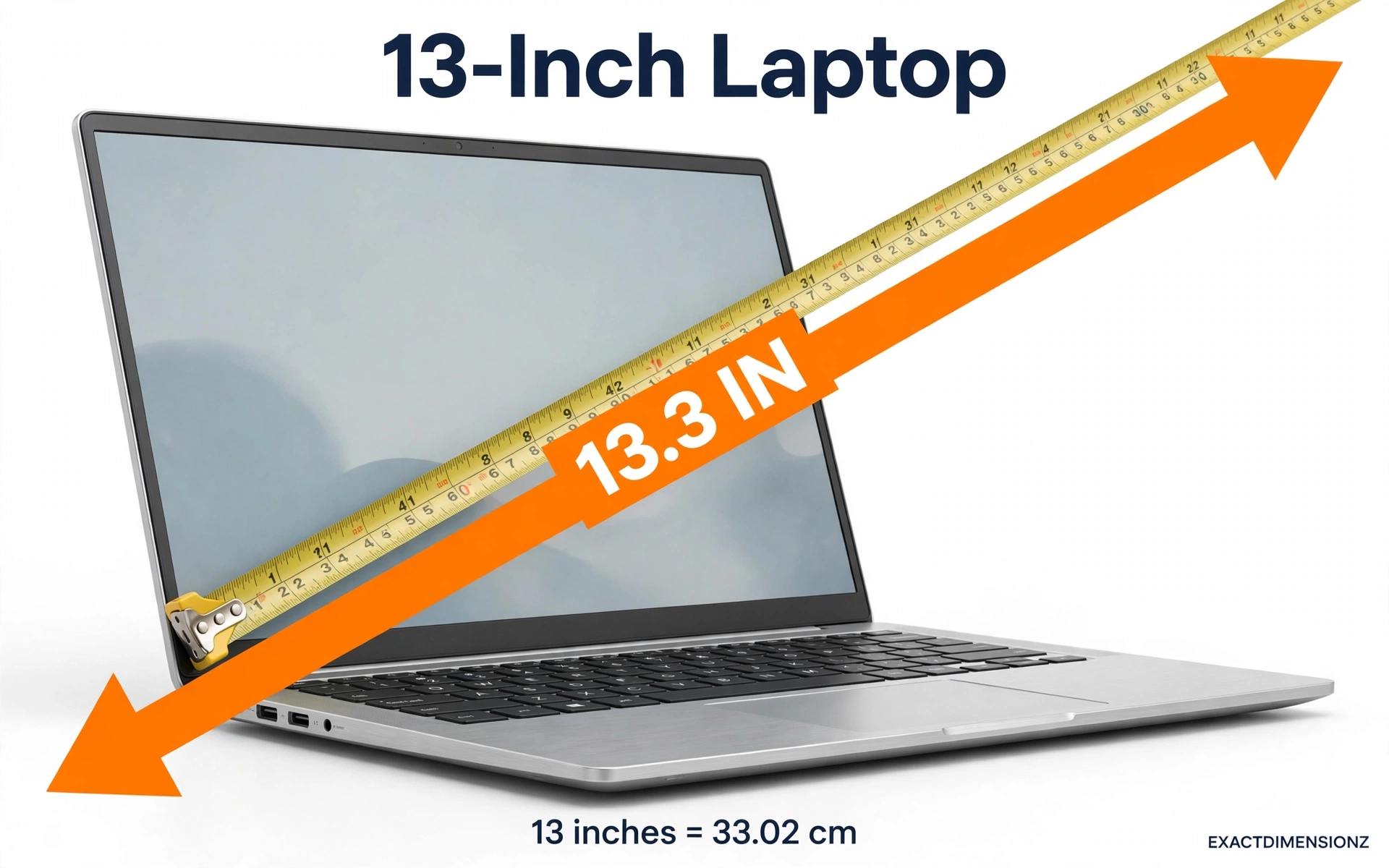
Evidence: listed at 13 by class name — the screen is actually 13.3 inches, measured diagonally.
The most-searched 13-inch object in the world isn’t 13 inches. Apple’s 13-inch MacBook Pro (2016–2022) carries a 13.3-inch display; the MacBook Air M2 stretches to 13.6. Screen sizes are always diagonal — corner to corner, never across — so the laptop body itself is barely 12 inches wide.
One inch up from the 12-inch MacBook class (see how long is 12 inches), and a perfect lesson: “13-inch laptop” is a family name, not a measurement. Use it to picture the size; use a ruler to prove it. Apple’s own spec sheet makes the point better than any argument: the 13-inch MacBook Pro (M1, 2020) carries a 13.3-inch display measured diagonally, and the machine itself is only 11.97 inches wide — a full inch narrower than the number on the box. The MacBook Air with the M2 chip stretches the same trick further, with a 13.6-inch display in a body that is still 11.97 inches wide. So the “13-inch laptop” is narrower than 13 inches in every direction except the diagonal, and the class name survives because every maker measures screens the same way: corner to corner, bezel not included, body not counted. Read the number as “the size of screen this machine competes with,” and it is honest. Read it as a measurement of the machine, and it is off by an inch.
2. The 9×13 Baking Pan
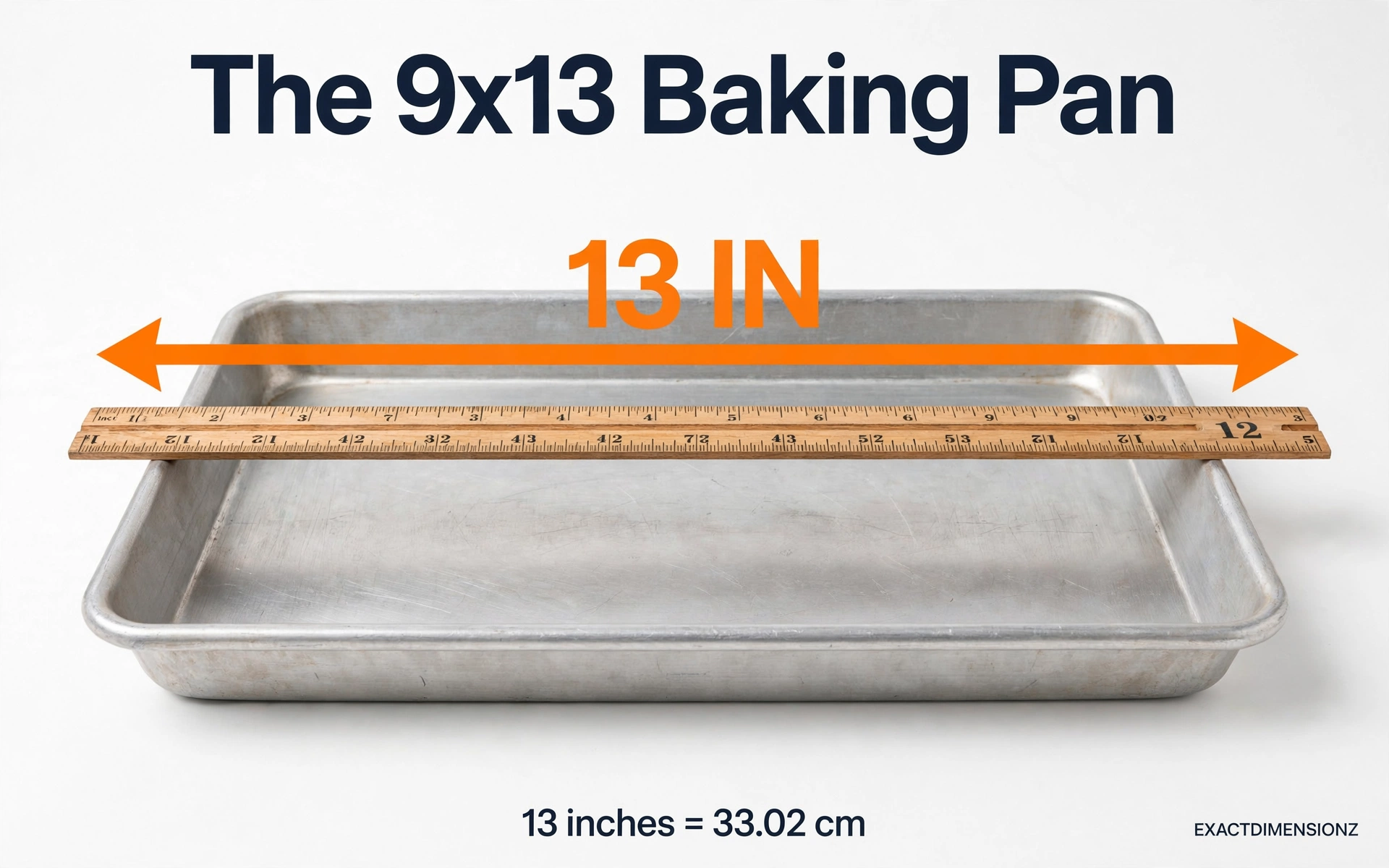
Evidence: sold as 13 (nominal — pans vary by about a quarter inch).
The 9×13 is America’s most iconic pan — the one every casserole recipe on Earth is written for. Its long side is sold as 13 inches, and most pans land within a quarter inch of it either way. Stamped aluminum stretches; nobody’s brownies care.
As a reference it’s excellent: everyone has one, or knows someone who does. Just don’t calibrate a bookshelf against it.
3. The 13-Inch Pizza Pan
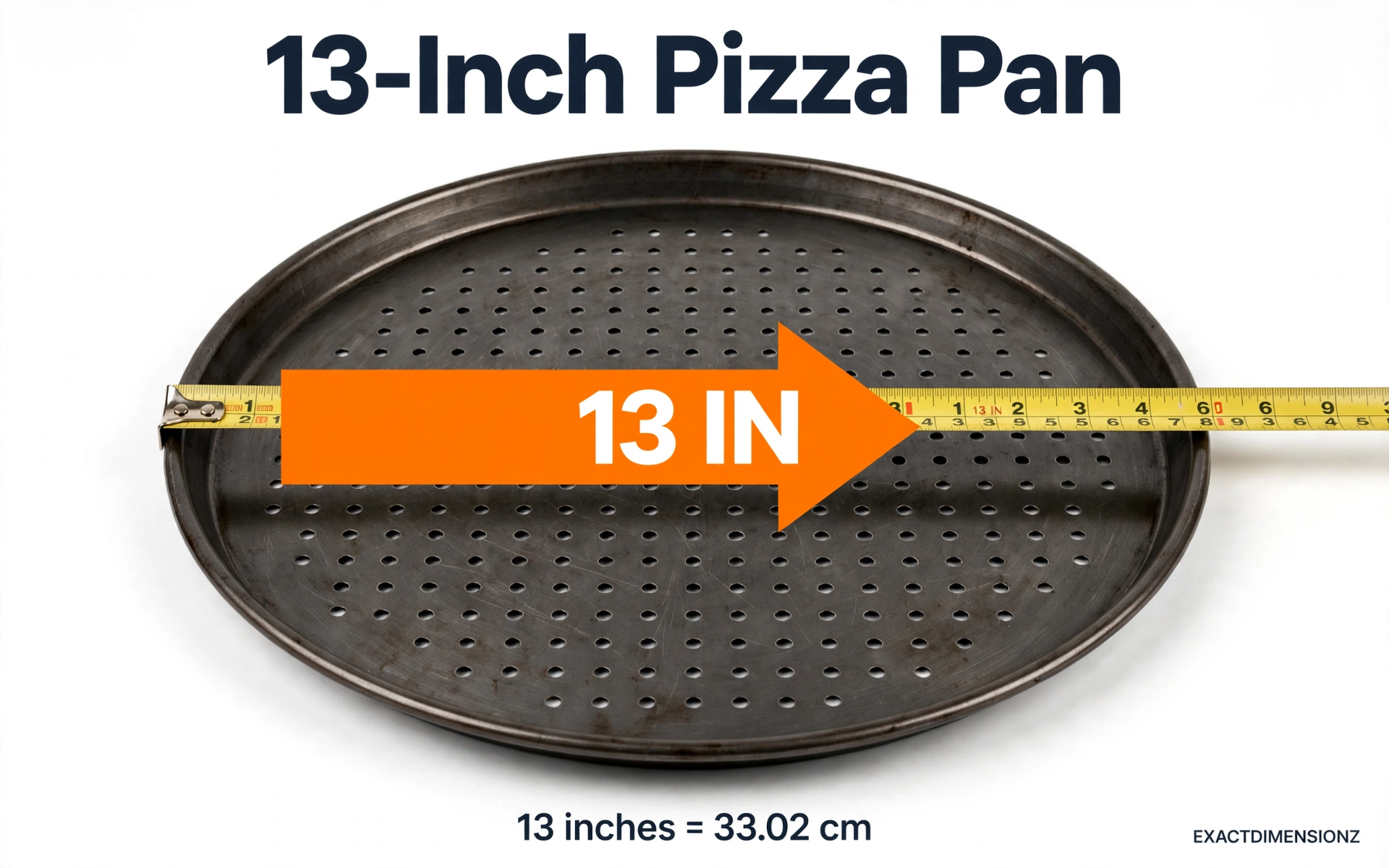
Evidence: sold as 13 (nominal).
Thirteen inches is a real pizza-pan size — the standard “small” in many pizzerias sits between the 12-inch personal and the 14-inch medium. Perforated, dark-coated, or plain aluminum, they’re all sold as 13-inch and all land close.
One honest caveat: a 13-inch pan makes a pizza that’s slightly under 13 inches, because the dough has to fit inside the rim. The pan is the reference; the pizza is the rounding error.
4. The 13.25-Inch Skillet
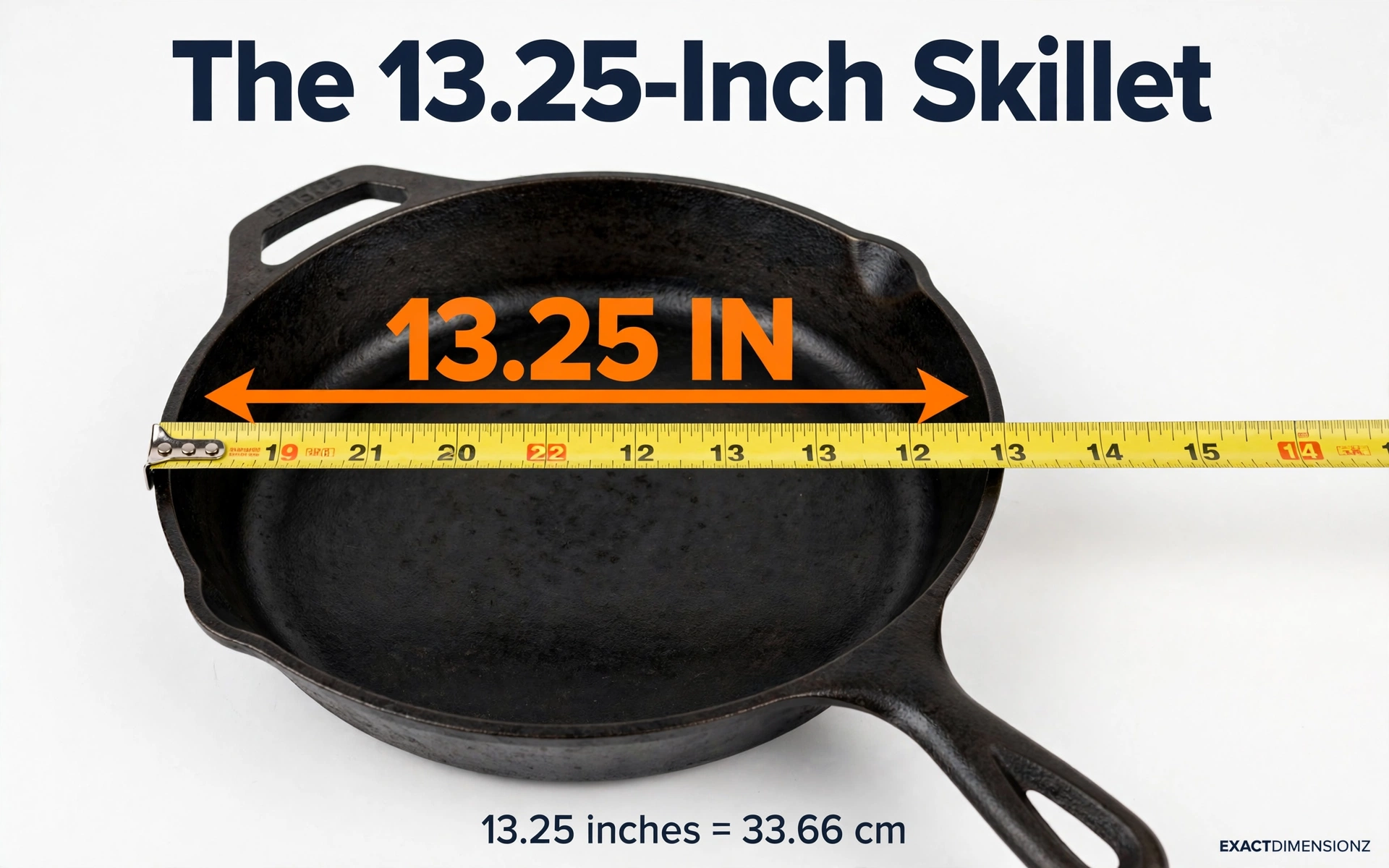
Evidence: listed at 13.25 — not 13.
This one is here to correct the internet. Several size-reference sites list a “13-inch skillet” as a thing that is 13 inches. The pan in question is Lodge’s L12SK3, sold as the 13.25-inch skillet — and the “12” in its model number is the nominal size class, not the measurement: the pan outgrew its own name by a quarter inch. That quarter inch is printed right on the spec sheet.
The quarter inch is printed right on the spec sheet, and Lodge’s own listing sells the pan as the 13.25-inch skillet, 20.75 inches long overall including the handle and 10.5 pounds heavy. The naming confusion even follows the accessories: the lid made for this “12-inch” skillet is itself sold as a 13.25-inch lid. So the skillet earns its place on this list twice over — once as a warning that a famous size label can be a quarter inch wrong, and once as proof that the maker’s own paperwork tells the truth if you read past the model number. Measure it rim to rim, spouts included, and it is 13.25 inches; call it a 13-inch skillet, and you have rounded somebody else’s fact into shape.
The image label says 13.25 IN, not 13 IN, because this article doesn’t round other people’s facts into shape. Close to a foot-plus-an-inch? Sure. Exactly 13? Never was.
5. The 13-Inch Charger Plate
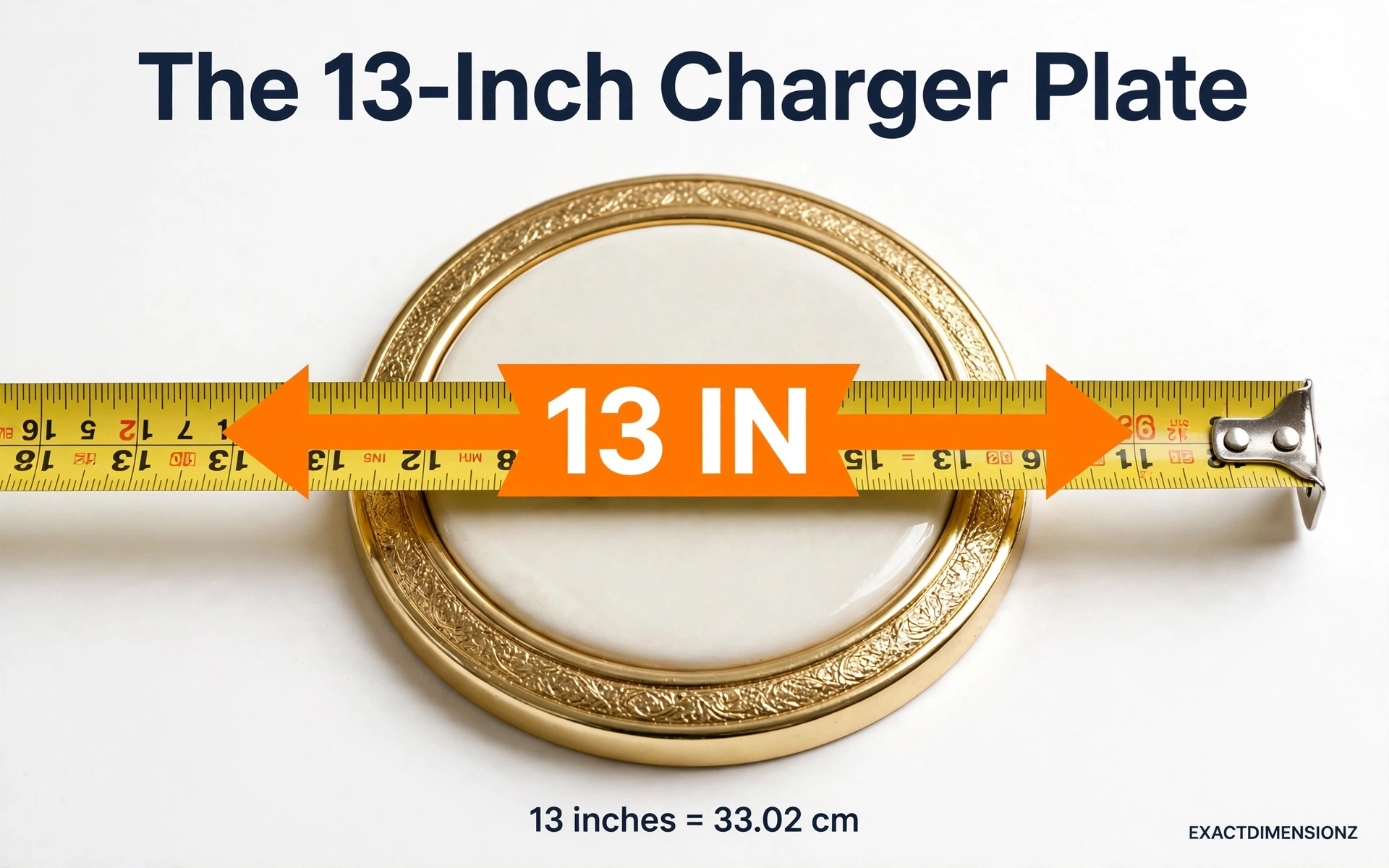
Evidence: sold as 13 (nominal — typically 12.5 to 13.5 inches).
Charger plates — the decorative plates that sit under your dinner plate at a set table — are standardized at 13 inches, which makes them the sleeper reference of this whole list. They’re in millions of dining rooms, and unlike laptop screens, nobody measures them diagonally.
Manufacturers round a little (12.5 to 13.5 is the honest range), so grade it “sold as 13.” But for eyeballing a foot-plus-an-inch at the dinner table, it’s the best reference in the house.
6. The 13×19 Photo Print
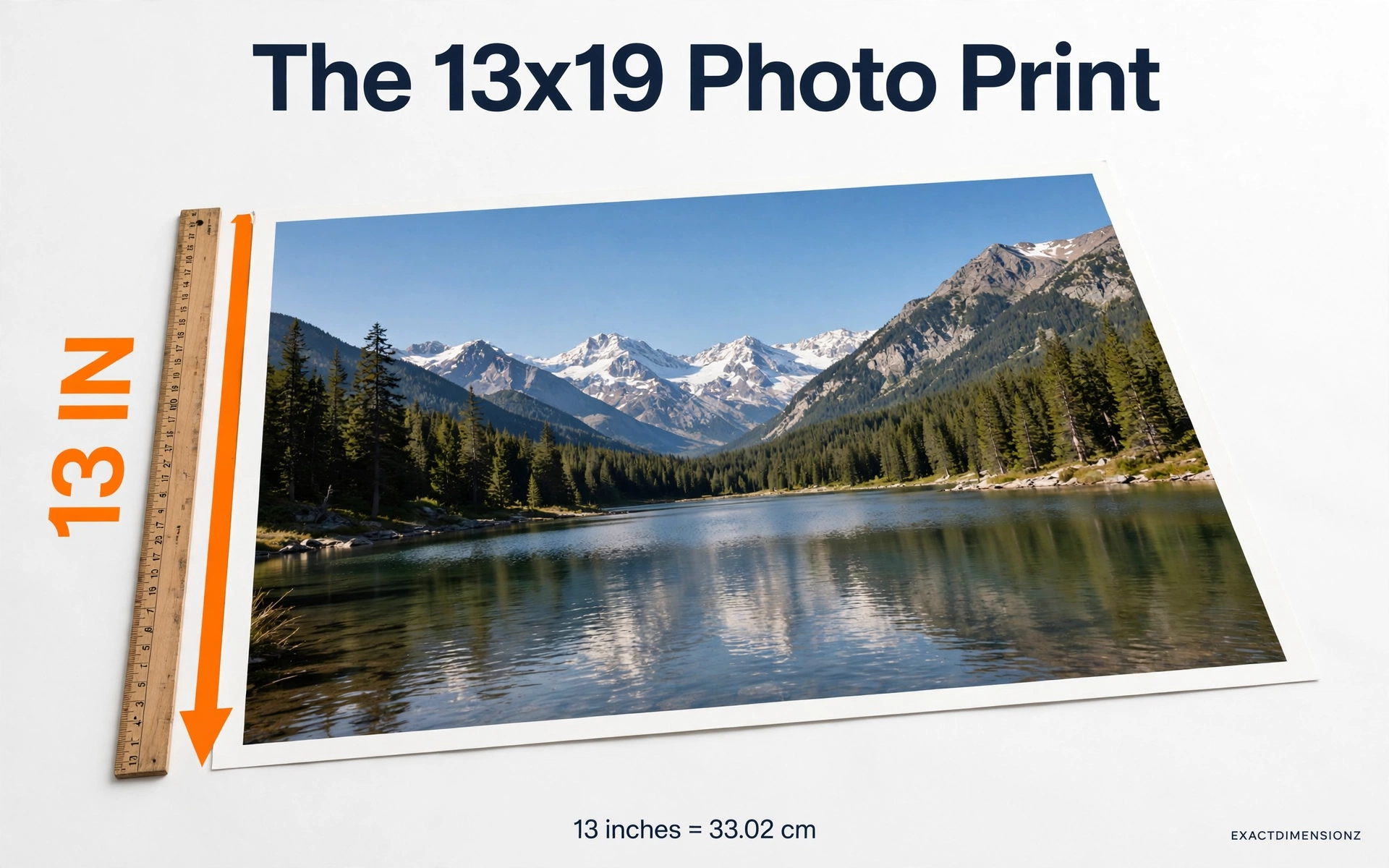
Evidence: exactly 13 by manufacture.
Thirteen-by-nineteen — “Super B” — is a real, standardized large-format paper size. Inkjet photo paper cut to 13×19 is exactly 13 inches on the short side, because paper is one of the few things the world still cuts to a ruler’s tolerance.
This is the gold standard of the baker’s dozen: a reference you can trust blind. If a photographer friend has a 13×19 print, you are holding exactly 13 inches.
7. The 13-Inch Placemat
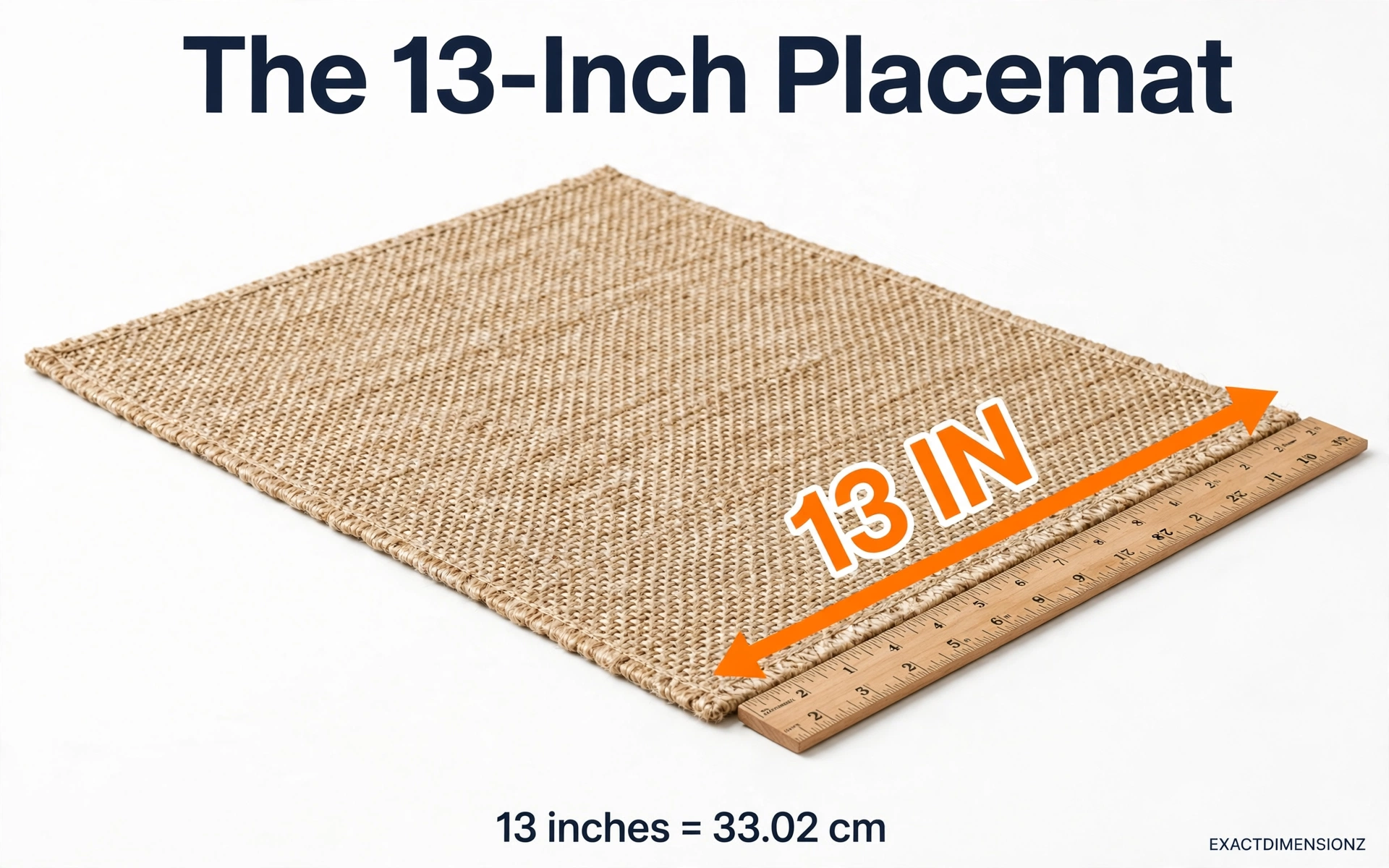
Evidence: sold as 13 (nominal).
Thirteen-by-nineteen is also the standard placemat size — the same Super B proportions, woven instead of printed. Restaurants and home dining sets sell them as 13-inch, and fabric being fabric, they land within a half inch.
Pair it with the photo print above: same nominal rectangle, different material, different honesty grade. Paper is cut; fabric is sewn. The grade tells you which to trust.
8. The 13-Inch Lamp Shade
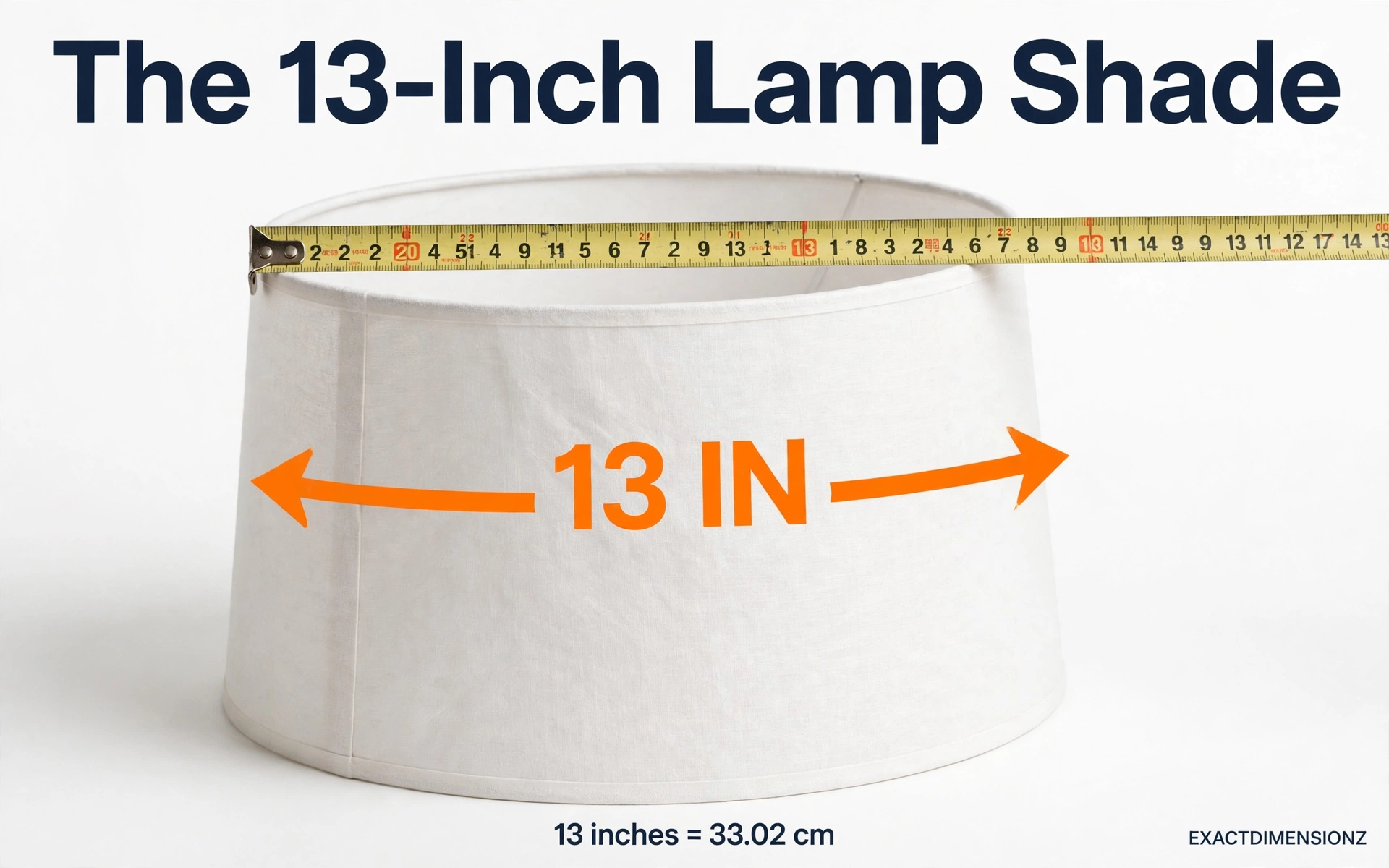
Evidence: sold as 13 (nominal).
Thirteen-inch drum shades are one of the most common lamp shade sizes sold — the diameter, that is, not the height. They’re on bedside tables and living-room lamps everywhere, which makes them a genuinely useful at-home reference.
Fabric stretches over frames, so treat the 13 as a class name. Still: if you can picture your lamp shade, you can picture 13 inches.
9. The 13-Inch Rack Tom
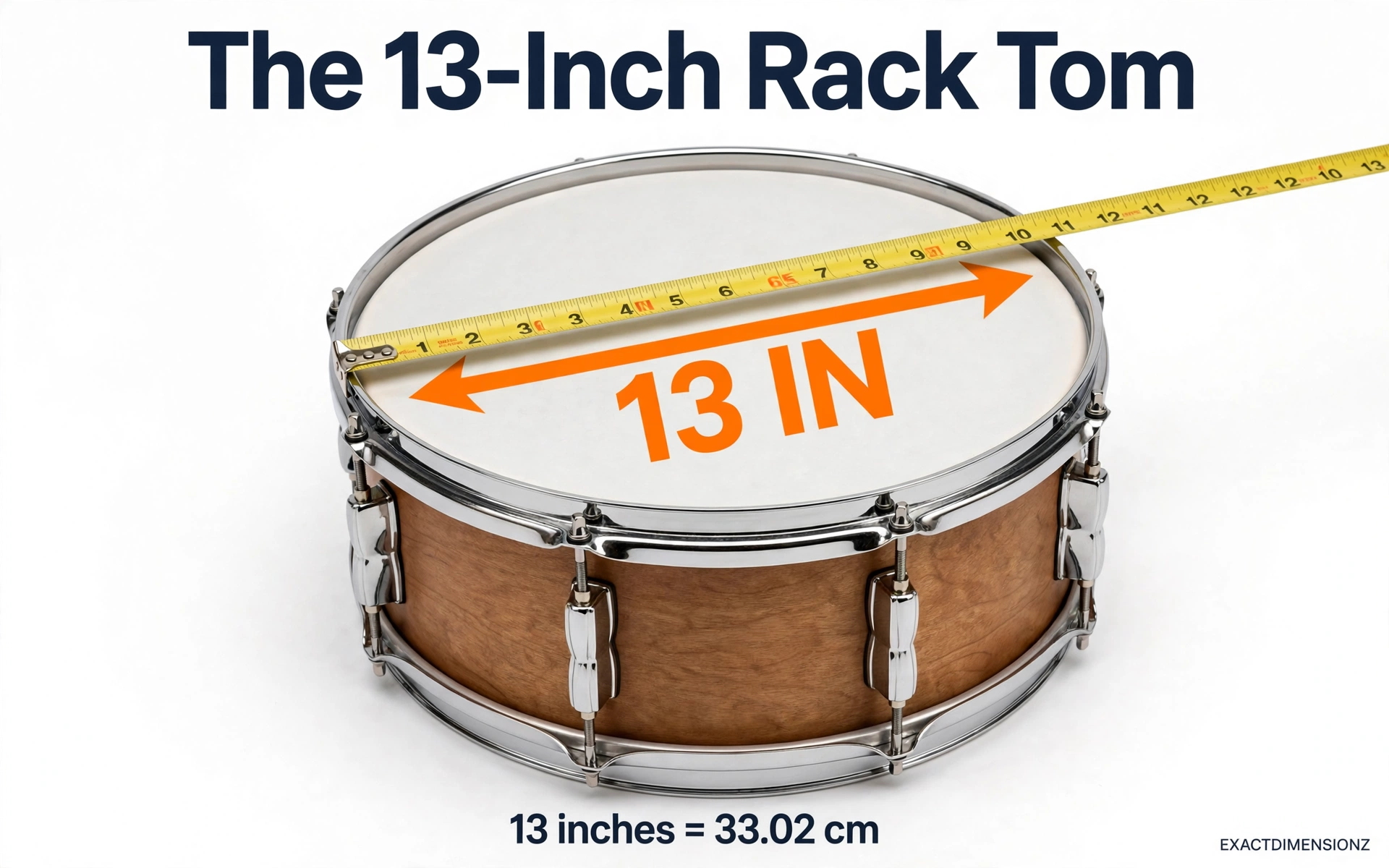
Evidence: sold as 13 (nominal drum size).
Drummers know: rack toms come in 10, 12, 13, 14, and 16 inches, and those numbers are the drumhead diameters. A 13-inch rack tom is a real, standard size — the middle voice of a thousand rock kits.
Drum shells are built to take a 13-inch head, so the hardware is honest even if the wood varies by a hair. Musicians get a free measuring tool with every kit. The same holds at about 10 inches, the smallest size in the list.
10. The 13-Inch Hi-Hats

Evidence: sold as 13 (real cymbal size).
Fourteen inches is the standard hi-hat size — but 13-inch hi-hats are a real, catalogued thing, favored by funk and jazz players for their quicker chick. Cymbal diameters are among the most honestly labeled measurements in music: a 13-inch cymbal is 13 inches of bronze.
Pair them with the rack tom above and the drummer’s corner of the stage becomes a 13-inch showroom.
11. The Men’s US Size 13 Shoe
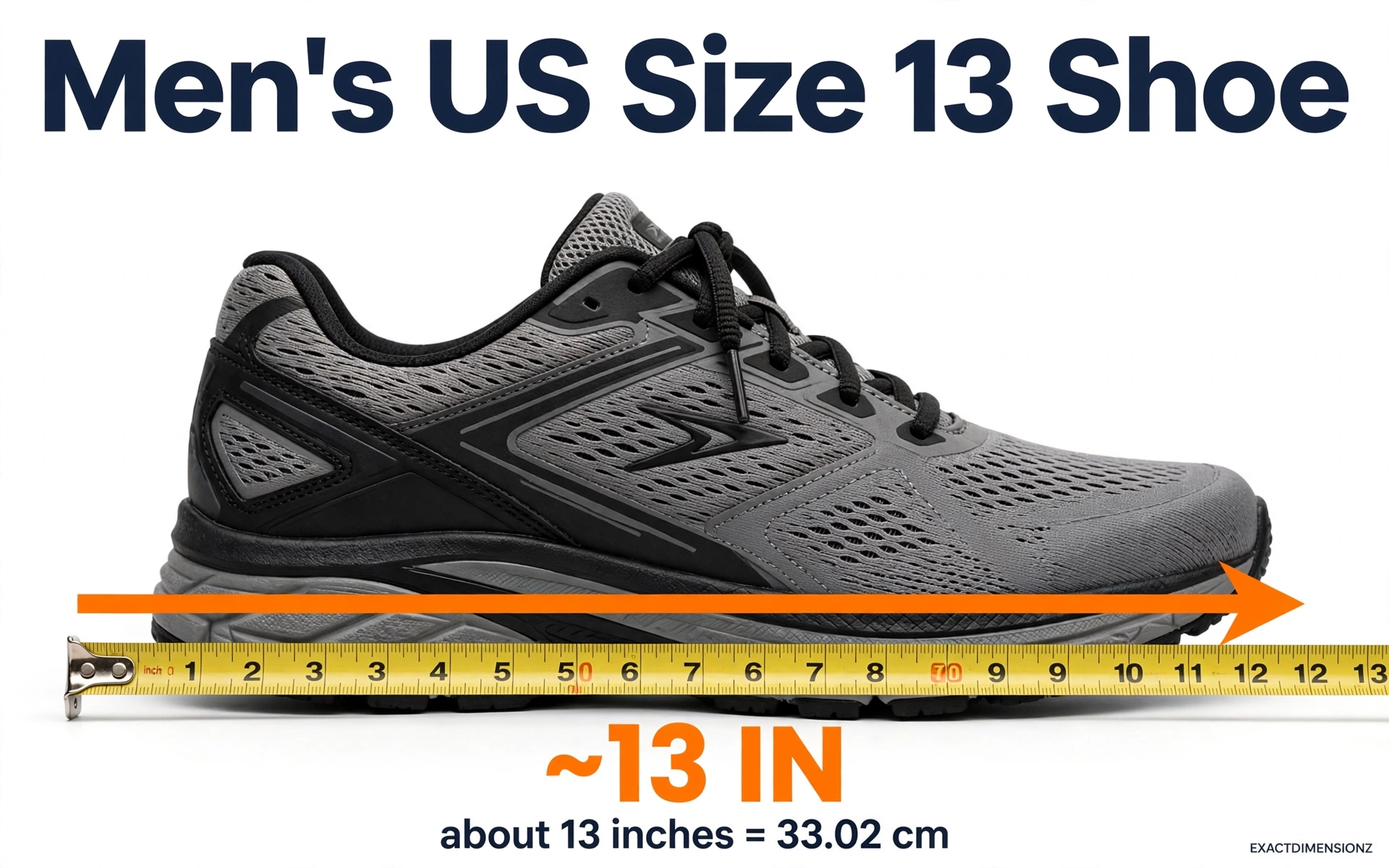
Evidence: listed at about 13 (varies by brand).
A men’s US size 13 fits a foot about 11 11/16 inches (29.7 cm) long — and the shoe itself runs about 12.2 inches outside, the 31 cm printed on the box. The 12.2-inch figure belongs to the shoe, not the foot: Nike’s own size chart warns that the CM size on the box is different from foot length, and the two get mixed up constantly. Hence the grade: “listed at about 13,” with the tilde doing honest work.
That mix-up is the whole story of shoe sizing. The same foot is a US men’s 13, a UK 12, an EU 47.5 and a CM 31, and none of those numbers is a measurement of the foot — they are positions on four different scales, each with its own rounding. Two shoes in the same size can differ noticeably between brands, because every maker builds on a slightly different last and adds a different amount of toe room. So the size-13 shoe keeps its grade — “listed at about 13” — but the honest version of the claim is narrower than the old one: the shoe is about 13 inches long, the foot inside it is about eleven and eleven-sixteenths, and the size number itself is a label, not a length.
One size up from the size-12 class and a full two inches past the size-11 shoe from how long is 11 inches. Shoe sizes are a wish, not a ruler — but as a rough reference, a big sneaker reads instantly as “about 13 inches.”
12. The 13-Inch Teddy Bear
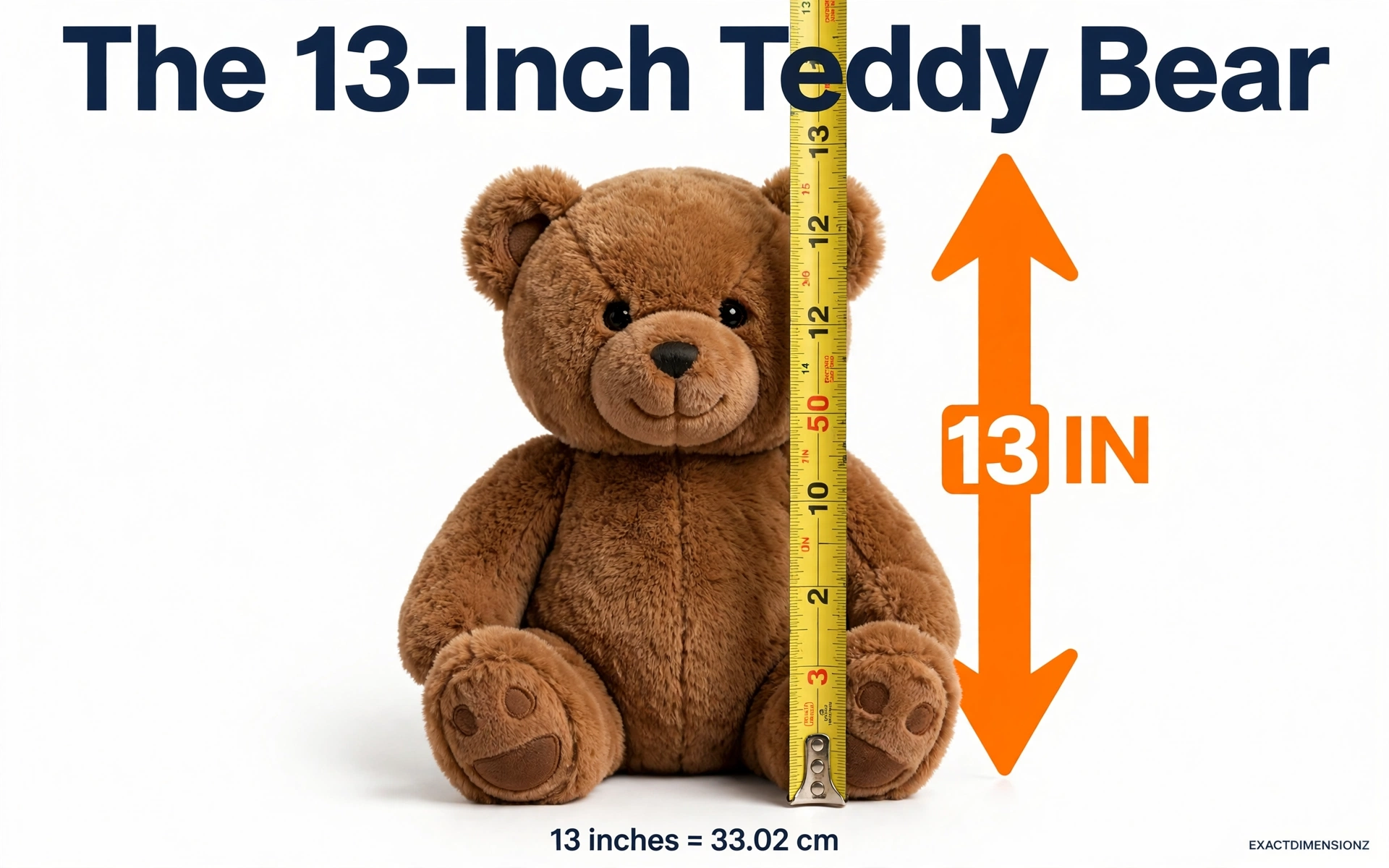
Evidence: sold as 13 (nominal).
Thirteen-inch plush bears are a standard gift size — big enough to hug, small enough to ship. Manufacturers sell them as 13 inches tall, and plush being plush, they land within a squishy half inch.
It’s the softest reference on this list and the least precise, which is exactly why it carries its grade openly. For a kid asking “how big is 13 inches,” though, nothing beats the bear on their bed.
13. A Ruler Plus a Thumb
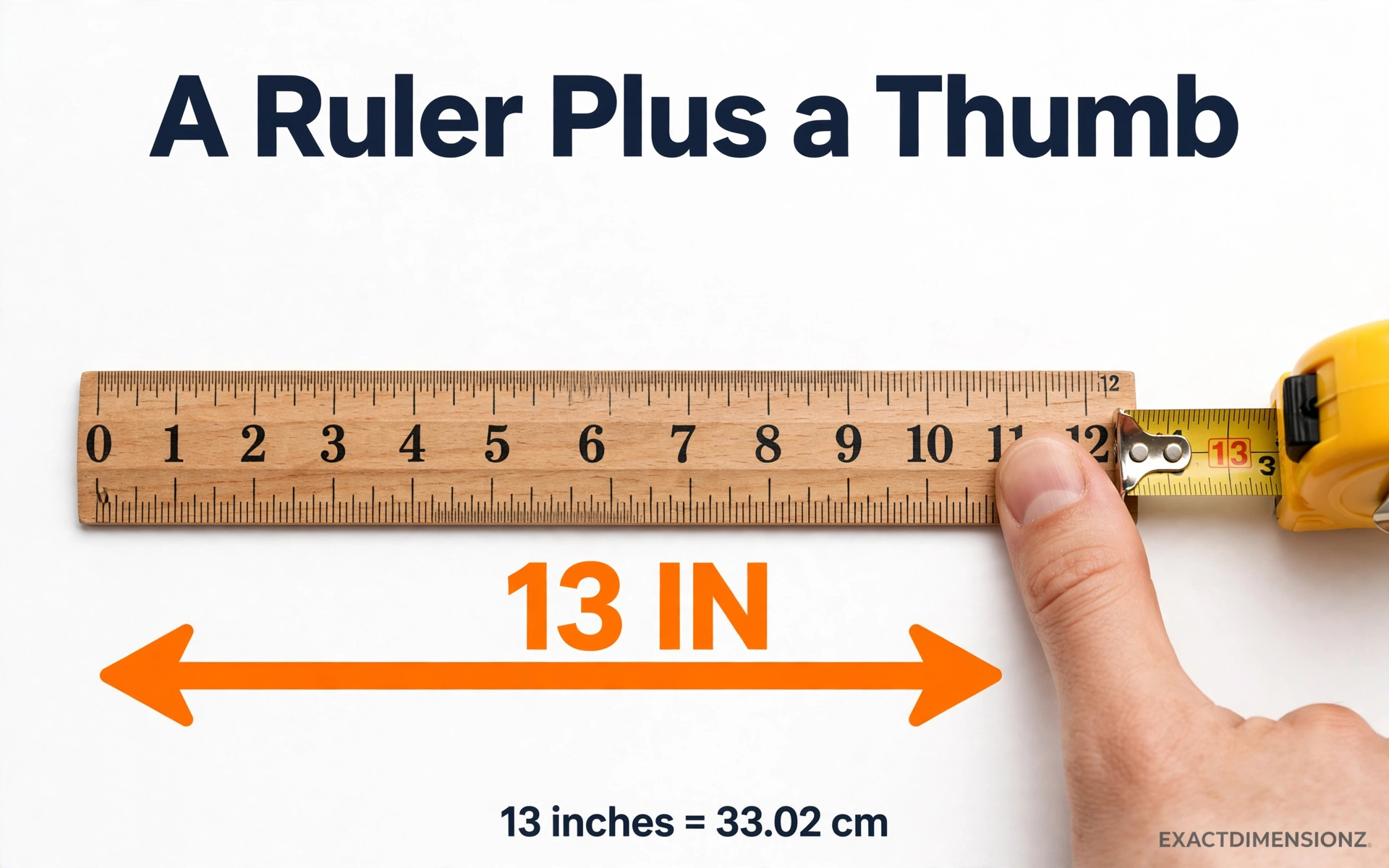
Evidence: measured about 13 (honest anchor).
The closing trick, and the most honest object here: a 12-inch school ruler — exactly 12 by manufacture — plus your thumb’s last joint, which runs about an inch on most adults. Lay them end to end and you’ve built 13 inches out of the two most available measuring tools in the world.
It’s approximate by exactly one thumb’s worth, and it says so on the label. When no product in the house quite hits 13, build it: a foot you can prove, plus an inch you can see.
13 vs. 12: What One Extra Inch Changes
Thirteen is twelve’s awkward shadow — one inch longer than a full foot, and that inch changes the character of every reference. A 12-inch ruler is a tool; a 13-inch laptop is a class name. Twelve inches gets you a footlong sub; thirteen gets you a pizza pan and a drum kit. The foot is a standard. Thirteen is an accident. It sits eleven inches short of the two-foot mark.
That accident is also why 13 is worth its own article instead of a footnote on the 12-inch page. Nobody’s mental image of “a foot” stretches cleanly to 13 — the eye rounds down. So keep the two numbers separate in your head: 12 is the anchor, 13 is the anchor plus a thumb. The graded references above are what stop the rounding. The gap is exactly 2.54 centimeters — one inch is one inch — but what that inch does depends on where it lands. On a ruler it is almost nothing. On a pizza it is dinner for one more person: a 13-inch pizza covers about 132.7 square inches against a 12-inch pizza’s 113.1, which is roughly 17 percent more pizza for a single inch of diameter, because area grows with the square of the width. On a laptop it is a whole product class: the 12-inch MacBook class gives way to 13.3- and 13.6-inch screens in bodies barely 12 inches wide, and the buyer who thinks they are gaining an inch of machine is really gaining an inch of diagonal glass. And in the kitchen it is the difference between a pan that fits the recipe and one that leaves the casserole shallow — every 9×13 recipe ever written assumes that thirteenth inch. So the honest way to picture the gap is not “a foot plus a thumb” but “a foot, plus whatever the extra inch is doing in that particular object” — and the objects above are the only way to know.
Build 13 Inches From Pocket Change
No ruler, no pan, no drummer in the house? Try the change jar. A US quarter is 0.069 inches thick — stack 188 of them and you get 12.97 inches: thirteen inches of pocket change, worth $47, standing about as tall as a wine bottle.
Each quarter is thinner than 10 mm, which is why the stack stays honest: fine units, exact arithmetic, one rounded total. Nobody will ever build this tower on purpose — but as proof that 13 inches is just thirteen inches of anything, it’s unbeatable. (And if you’d rather build it from bills: two dollar bills laid end to end are 12.28 inches, and the last 0.72 inches is roughly an eighth of a third bill laid lengthwise — about 0.77 inches, a hair over what you need. Every US bill measures 6.14 by 2.61 inches, a size unchanged since 1929. The math is exact; the scissors work is on you.)
Quarters are not the only coin that stacks to thirteen inches — they are just the most expensive way to do it. A dime is 0.053 inches thick, so 245 dimes reach 12.99 inches for $24.50. A nickel is 0.077 inches thick, so 169 nickels reach 13.01 inches for $8.45, making the nickel tower the cheapest thirteen inches in the change jar. The quarter stack is the showpiece, though: 188 quarters, $47.00, and a column about as tall as a wine bottle that no sane person will ever build. All three thicknesses come from the same place — the U.S. Mint’s published coin specifications — which is what makes the stacks arithmetic instead of guesswork.
One warning before you start stacking: coin thicknesses are nominal specifications with manufacturing tolerances, so a real tower of 188 circulated quarters will land a hair off 12.97 inches — worn edges, dirt, and a slightly tilted stack all eat a fraction of an inch. That is why the grades matter. The quarter stack is a demonstration, not a calibration tool. If you need thirteen inches you can trust, use the 13×19 print or the ruler-plus-thumb from the list above; if you need thirteen inches you can laugh at, build the tower.
How to Measure 13 Inches Without a Ruler
No ruler in the house is not the same as no measurement in the house — it just means you have to rank your substitutes by trust instead of grabbing the nearest one. Here they are, best first. The most trustworthy is the 13×19 photo print. Paper is cut to a tolerance a ruler would envy, and the short side is exactly 13 inches — 330.2 millimeters, no rounding, no class name, no wishful thinking. If a photographer friend has one, you are holding a ruler that happens to have a picture on it. Next best is the ruler-plus-thumb: a 12-inch school ruler, which is exactly 12 inches by manufacture, plus the last joint of your thumb, which runs about an inch on most adults. The catch is the word “about” — thumbs vary, so check yours against the ruler once and remember your own number. After that one check, you own a thirteen-inch measure you carry everywhere. Third is the 9×13 baking pan, long side. It is in nearly every kitchen and it is honestly graded: sold as 13 inches, landing within about a quarter inch either way. Good enough to check whether a shelf gap will take a laptop; not good enough to cut a shelf. Fourth is the two-bill trick: two dollar bills end to end reach 12.28 inches, and roughly an eighth of a third bill laid lengthwise covers the remaining 0.72 inches. It overshoots by about a twentieth of an inch, which is fine for eyeballing and useless for cutting. What not to use: the laptop and the shoe. The laptop’s “13 inches” is a diagonal screen class, and the machine is barely 12 inches wide. The shoe’s “13” is a size label that changes meaning between countries and brands. Both are fine for picturing thirteen inches. Neither is a measuring tool.
Carry 13 Inches With You
Thirteen inches is the measurement with no ruler — one inch past the most familiar length on Earth, hiding in your laptop’s class name, your baking pans, your drummer’s kit, and the charger plate under your dinner. The 13×19 print and the ruler-plus-thumb are the ones you can trust blind: cut to a spec, or built from one. The laptop, the pans, and the shoe are honest approximations — listed at 13, useful, but not rulers. And the 13.25-inch skillet is the reminder to check: a label that says 13 and a spec that says otherwise are two different things.
Keep the graded references — print, pan, plate, ruler-plus-thumb — and the baker’s dozen stops being unlucky. Thirteen inches, honestly measured, is just a foot with ambition. It is still a long way from the five-foot mark, which is why one honest object beats a bare number.
13 Inches: Frequently Asked Questions
How many centimeters is 13 inches?
13 inches is 33.02 centimeters. Multiply 13 by 2.54 and you get 33.02, and because the inch has been defined as exactly 2.54 centimeters since the 1959 international yard and pound agreement, that figure is exact rather than rounded — there is no measurement error hiding in it, only arithmetic. The same multiplication gives 330.2 millimeters and 0.3302 meters. So if a pattern, a print size or a product page gives you 33 centimeters, it has rounded down by two hundredths; if it gives you 33.02, it has done the sum properly.
How many feet is 13 inches?
13 inches is 1.0833 feet — one foot plus one inch, with the extra inch worth a twelfth of a foot, or 0.0833. It is also 0.3611 yards, a little more than a third of a yard. The feet figure is the only one of the four conversions that has to be rounded, because a twelfth of a foot never comes out even; 1.0833 is 13 divided by 12, cut off at four decimal places. For everyday use, “a foot and an inch” is the number to carry in your head, and 1.0833 is the number to type into a calculator.
Is a 13-inch laptop actually 13 inches?
Not in any direction you can measure with a ruler. A “13-inch” laptop is named for its screen, and screens are measured diagonally, corner to corner. Apple’s own spec sheet lists the 13-inch MacBook Pro’s display as 13.3 inches diagonally, and the machine itself is only 11.97 inches wide — a full inch narrower than the number on the box. The MacBook Air with the M2 chip goes further, with a 13.6-inch display in a body that is still 11.97 inches wide. So the class name is honest about which family the machine belongs to and wrong about the size of the machine. Use it to picture the laptop; use a ruler to prove it.
What things are exactly 13 inches long?
Very few — and that is the point of the graded list above. The one reference on this page that is exactly 13 inches is the short side of a 13×19 photo print, because paper is cut to a ruler’s tolerance and Super B is a standardized sheet size. Everything else is honest approximation: the 9×13 pan lands within about a quarter inch of 13, charger plates run 12.5 to 13.5 inches, plush bears land within a squishy half inch, and shoes vary by brand. The rule is simple — if it was cut, it is exact; if it was sewn, cast, molded or sized, it is “sold as” 13, and the grade tells you how far to trust it.
How much bigger is a 13-inch pizza than a 12-inch pizza?
About 17 percent bigger, even though the diameter only grows by one inch. A 13-inch pizza covers roughly 132.7 square inches against a 12-inch pizza’s 113.1, because area grows with the square of the diameter — add an inch across and you add a ring of pizza all the way around, not just a strip on one side. That is also why the diameter is a misleading way to compare pizzas: a single inch sounds like almost nothing, but it is dinner for one more person. The same arithmetic is why the 13-inch pan matters in baking — a 9×13 pan holds about 8 percent more than a 9×12 would, and every casserole recipe written for it assumes that thirteenth inch.
How many quarters stacked make 13 inches?
188 quarters, stacked flat, reach 12.97 inches — three hundredths short of thirteen, and worth exactly $47.00. The U.S. Mint lists a quarter at 0.069 inches thick, so the stack is arithmetic, not a guess: 188 times 0.069 is 12.972. If you would rather spend less, 245 dimes reach 12.99 inches for $24.50, and 169 nickels reach 13.01 inches for $8.45, because dimes are 0.053 inches thick and nickels are 0.077. Real towers will land a hair off those numbers — worn edges and a tilted stack eat a fraction of an inch — so treat the stacks as demonstrations, not calibration tools.
What foot size is 13 inches?
A men’s US size 13 fits a foot about 11 11/16 inches (29.7 cm) long, and the shoe itself runs about 12.2 inches outside — the 31 cm printed on the box. The two numbers get mixed up constantly, because the 31 cm is the CM size label, not the foot length, and Nike’s own size chart warns that the box label and the foot length are different quantities. The same foot is a UK 12 and an EU 47.5, and every one of those numbers is a position on a scale, not a measurement. Two shoes in the same size can differ noticeably between brands, so a size 13 is “about 13 inches” the way a class name is — useful for picturing it, useless for measuring with it.
How can I measure 13 inches without a ruler?
Four ways, ranked by trust. Best is a 13×19 photo print — its short side is exactly 13 inches. Next is a 12-inch ruler plus your thumb’s last joint, about an inch on most adults; check your own thumb against the ruler once and you own the measure. Third is a 9×13 baking pan, long side, good to about a quarter inch. Fourth is two dollar bills end to end (12.28 inches) plus roughly an eighth of a third bill laid lengthwise for the last 0.72 inches, overshooting by about a twentieth of an inch. Do not use a laptop or a shoe as a measuring tool — the laptop’s 13 inches is a diagonal screen class and the shoe’s 13 is a size label, and both will mislead you by an inch or more.
Final Thoughts
Thirteen inches turns out to be a test of honesty more than a test of length. A foot is a standard — everybody agrees what it is, everybody can picture it, and a ruler proves it in a second. Thirteen inches has no ruler, no standard, and no agreement, so every object that claims the number has to be asked what it means by it — and most of them mean something slightly different. That is why the baker’s dozen is graded instead of just listed: the print and the ruler-plus-thumb are the two you can trust blind, the pan and the plate and the drum are the ones you can trust with a quarter inch of grace, and the laptop, the shoe and the bear are the ones you enjoy and never measure with. Keep the graded list, not the bare number. The next time a listing says “13 inches,” you will know to ask whether it was cut, cast, sewn, sized or sold — and you will know which of those answers is worth believing. Thirteen inches, honestly measured, is just a foot with ambition. The ambition is fine. The honesty is the whole article.
