
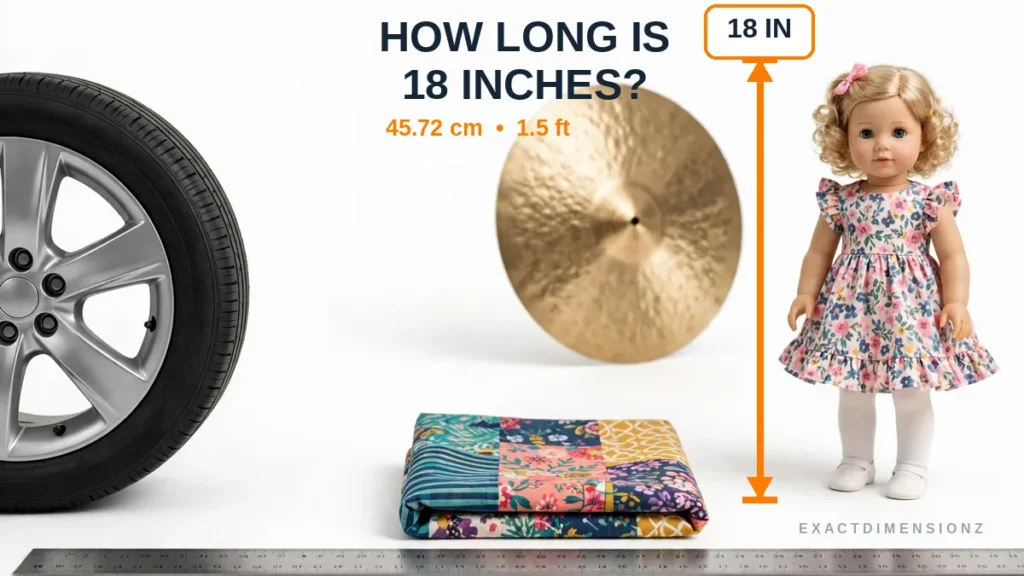
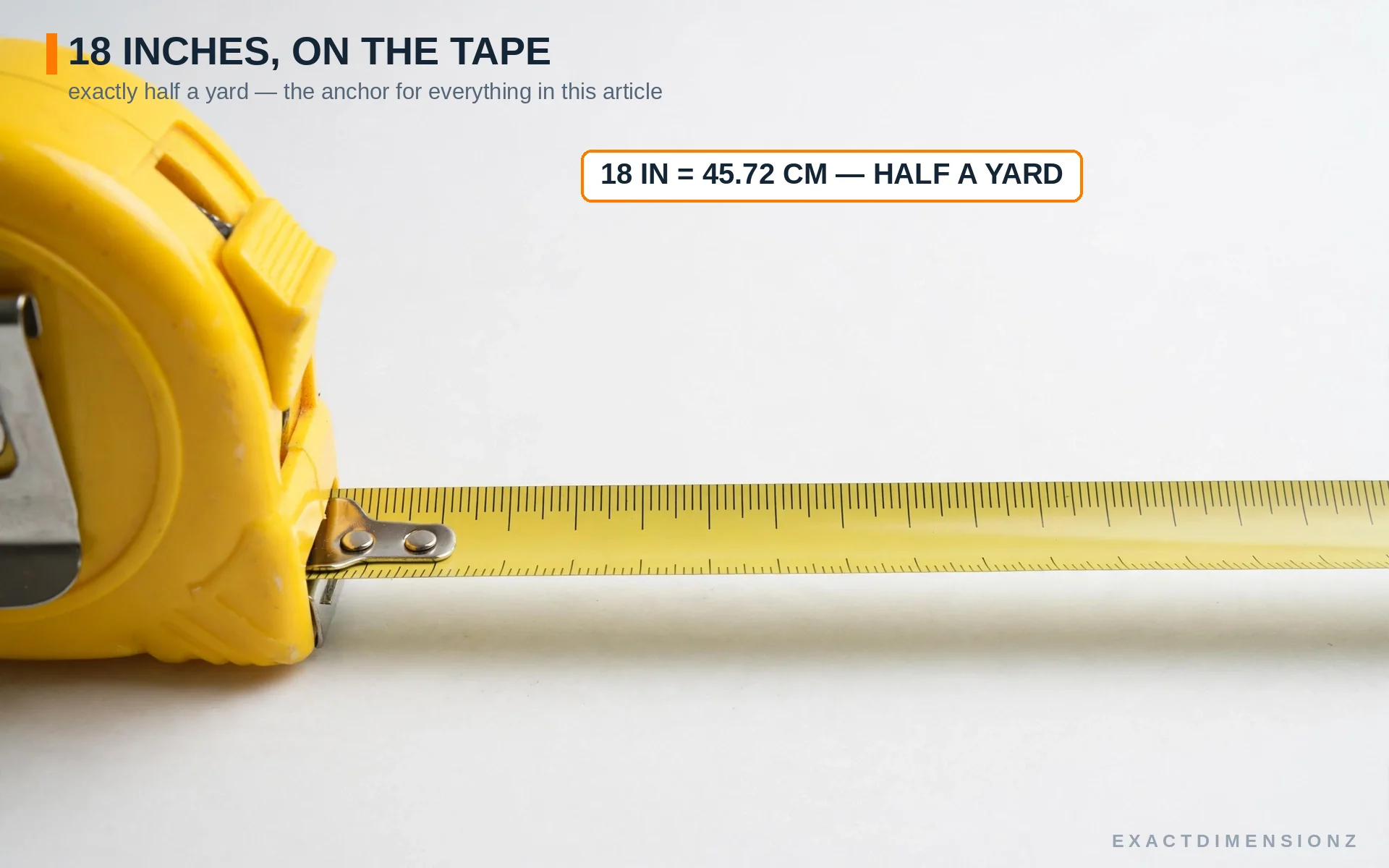
How long is 18 inches? It is a foot and a half — and, better than that, it is exactly half a yard: 45.72 centimeters, no rounding, no apology. See the complete inches size guide for the full series. Eighteen is the first length in this series whose yard conversion lands dead on a clean fraction, and that makes it a useful test of a question the other lengths never forced: when a label says “18 inches,” who is guaranteeing that number? Sometimes a definition guarantees it — half a yard cannot be anything else. Sometimes an industry standard guarantees it, the way a tire’s bead seat must be 18.00 or the tire will not mount. Sometimes only a manufacturer’s spec sheet guarantees it, and sometimes nothing guarantees it at all except habit — a menu, a shelf tag, a folk trick repeated until it sounds like a fact. So this article grades thirteen references by their stamp: the authority standing behind the number, printed on a stamp line under every object. It picks up two inches past how long is 16 inches — and it ends by revoking a few stamps entirely, including the most repeated shortcut on the internet for this length: two dollar bills, which are said to make “almost exactly 18 inches.” They make 12.28. The arithmetic is in the Corrections Desk, and it is not close.
How long is 18 inches?
18 inches is exactly 45.72 centimeters — one and a half feet, and exactly half a yard. But the honest answer depends on who guarantees the number: a half-yard fabric cut is 18 inches by definition and an 18-inch car wheel hides its exact 18 at the rim’s bead seat, while the famous two-dollar-bill shortcut makes only 12.28 inches. Here is the short version before we start checking stamps:
Screen rulers aren’t true to size — this is a visual guide. Calibrate against a half-yard cut of fabric (18 inches by definition), an 18-inch doll, or a 12-inch ruler plus a 6-inch index-card edge, which makes exactly 18.
Who Guarantees the Number?

Eighteen inches is the foot itself, plus half of itself again. 17 inches — one inch shorter sits just below it, and 19 inches — one inch longer just above it. That much is arithmetic, and arithmetic is the strongest guarantee on this page: a yard is 36 inches by definition, so half a yard is 18 inches by definition, and no factory, menu board or marketing department can vote it up or down. But most eighteens you will ever meet are not arithmetic. They are claims, and claims have issuers. A tire maker issues one kind, bound by a standard so strict that a rim a tenth of an inch off would refuse its tire. An airline issues another, enforced by a metal sizer bin at the gate. A pizza chain issues a third, which turns out — when you read its own size list — to say something else entirely.
So every object below carries a stamp line: who guarantees its 18, and how hard that guarantee bites. Thirteen objects, three grades of authority — guaranteed by rule, guaranteed by the maker, guaranteed by custom. Learn to ask “who says so, and what happens if they’re wrong?” and you will grade every size label you meet from now on — including the ones on this page, each of which names its guarantor out loud.
Guaranteed by Rule. Four eighteens that a definition, a standard or a regulation holds in place — the hardest stamps in the article.
1. The Half-Yard Fabric Cut
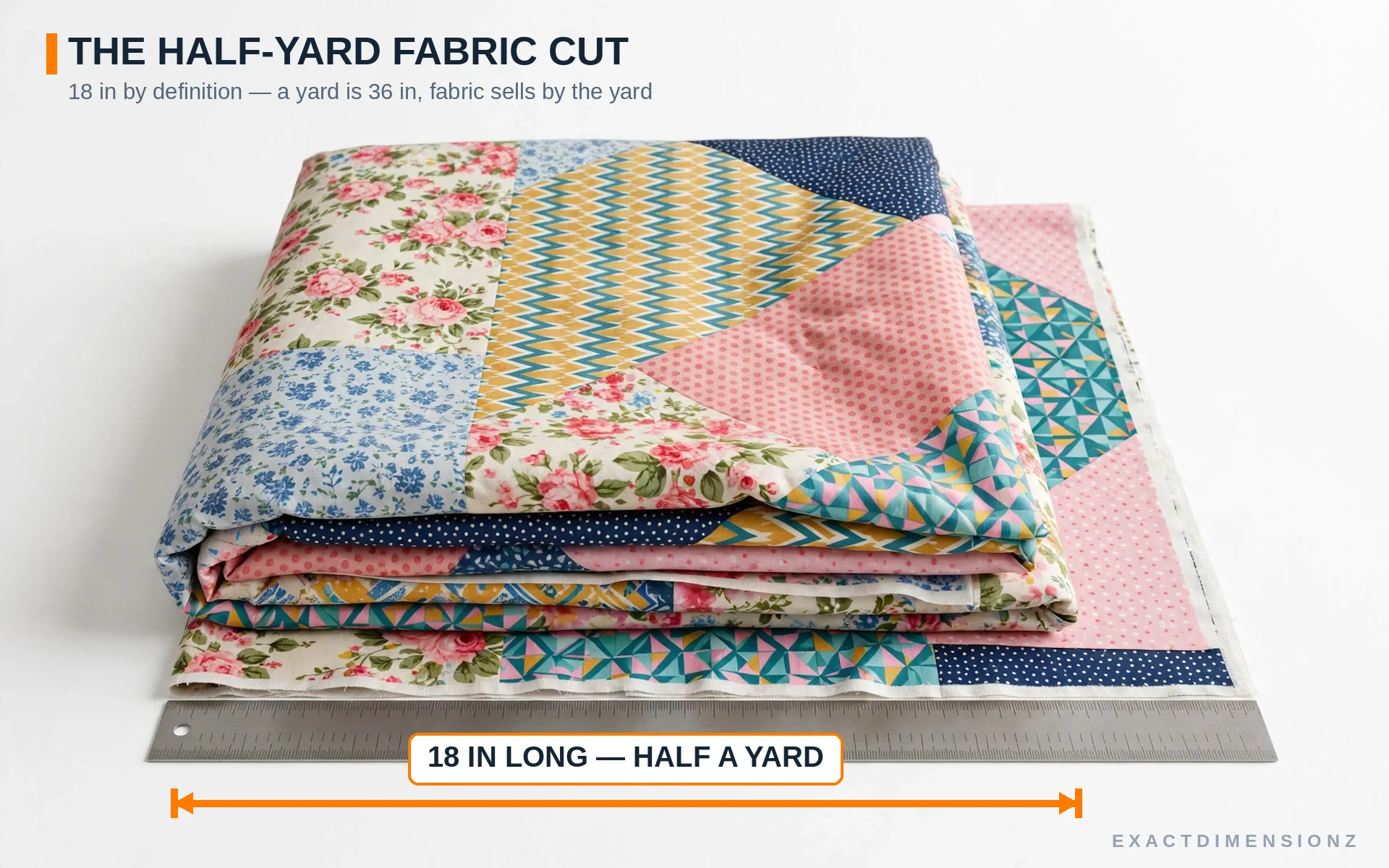
Stamp: DEFINITION — exactly 18.00 in, because a yard is 36 in and fabric is sold by the yard.
Begin with the only reference on this list that cannot be wrong. Fabric is sold by the yard, and the yard is 36 inches by definition — so when the person at the cutting counter sells you half a yard, the length that comes off the bolt is 18 inches, exactly, whatever the fabric’s width (44 or 45 inches for quilting cotton, more for home décor). Fabric-cutting references lay the system out plainly: a half yard is an 18-inch length at the fabric’s full width, a quarter yard is 9, and the popular fat quarter is simply that same half yard cut crosswise into an 18 × 22 piece.
Two honest footnotes keep the stamp clean. First, the guarantee covers the length off the bolt; a human with shears can cut a ragged edge, and shops often add a whisker of generosity, so your cut may run a hair over — under, and the shop owes you fabric. Second, the 18 says nothing about width: a half yard of 60-inch decorator fabric is a much bigger piece of cloth than a half yard of 44-inch quilting cotton, at the same guaranteed length. Within those footnotes, though, this is the reference to calibrate all the others against — the one eighteen in the article issued by arithmetic itself. If you sew, you already own it: the folded half-yard cuts in the fabric drawer are eighteen inches long by definition, and the bolt ends in any fabric shop will prove it on request.
Source: fabric yardage references (opnquilting.com) — half yard = 18 in × width of fabric; yard = 36 in by definition.
2. The 18-Inch Car Wheel
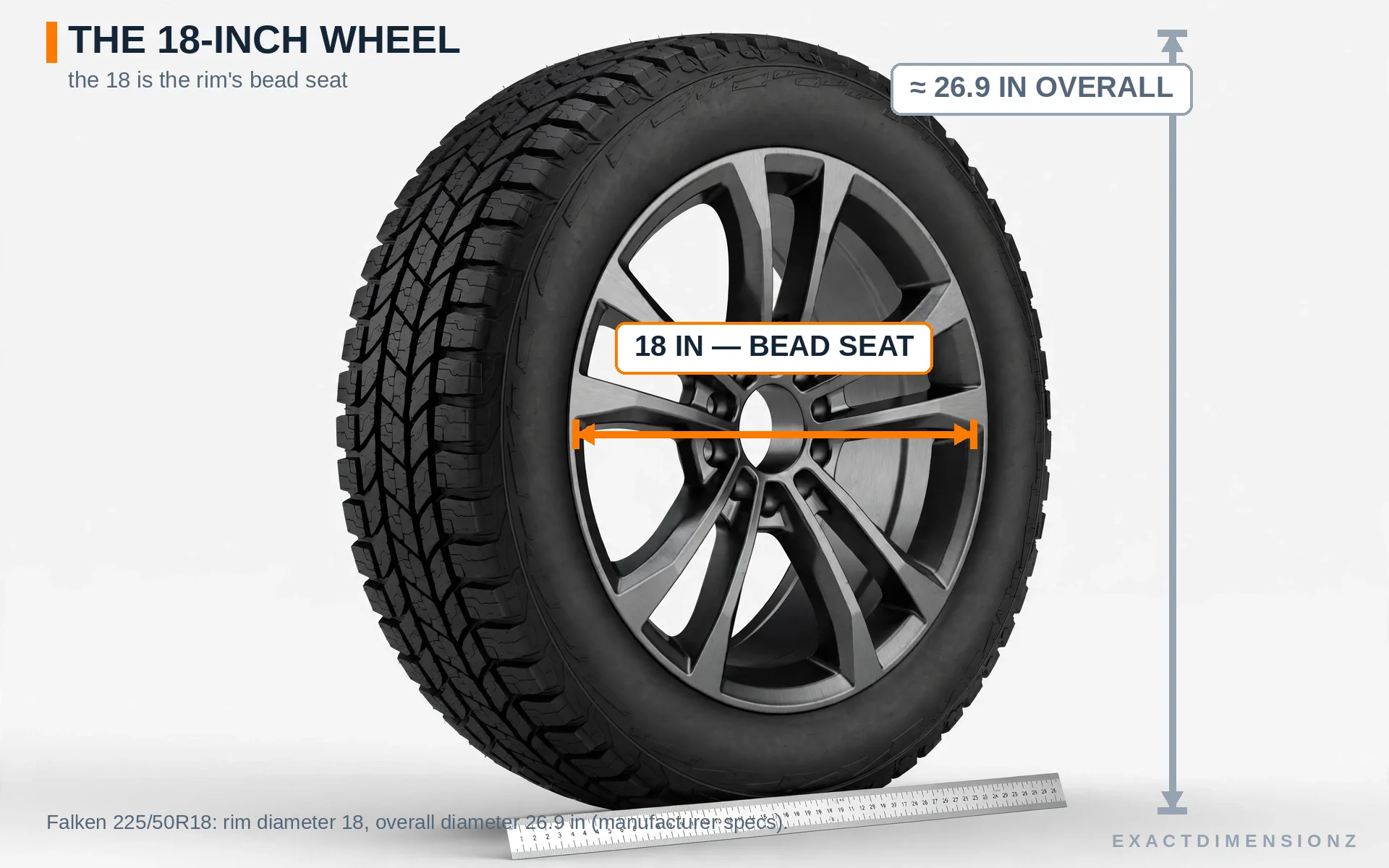
Stamp: INDUSTRY STANDARD — exactly 18.00 in at the bead seat, the ledge every 18-inch tire must fit.
The second-hardest stamp in the article is, once again, a circle you cannot see. In a tire code like 225/50R18, the “18” is the diameter of the wheel rim at its bead seat — the ledge the tire’s bead locks onto — and it is standardised across the whole tire industry, because interchangeability is the point: any maker’s 225/50R18 must mount any maker’s 18-inch rim. Falken’s published specifications for its Wildpeak A/T Trail in 225/50R18 list the rim diameter at 18 and the tire’s overall diameter at 26.9 inches — and that second number is the one your eyes will meet in a parking lot.
Do the sidewall maths and the picture resolves. A 225/50 tire’s sidewall is 50% of its 225 mm tread width — 112.5 mm, a little over 4 inches of rubber above the rim and the same below it: 18 + 4.43 + 4.43 ≈ 26.9 inches, matching the spec sheet. So the complete wheel stands nearly 27 inches tall, the rim’s outer lip measures more than 18 across, and the only exact eighteen on the whole assembly is the hidden seat where rubber meets metal. Grade it the way the stamp reads: as a rim reference it is machined truth; as a picture of eighteen inches it is a 27-inch circle containing an exact one. Picture the rim behind the spokes, not the tire around it.
Source: Falken Wildpeak A/T Trail specifications (manufacturer’s figures via its spec listing) — rim diameter 18, overall diameter 26.9 in, sidewall 4.4 in.
3. The Airline Personal Item
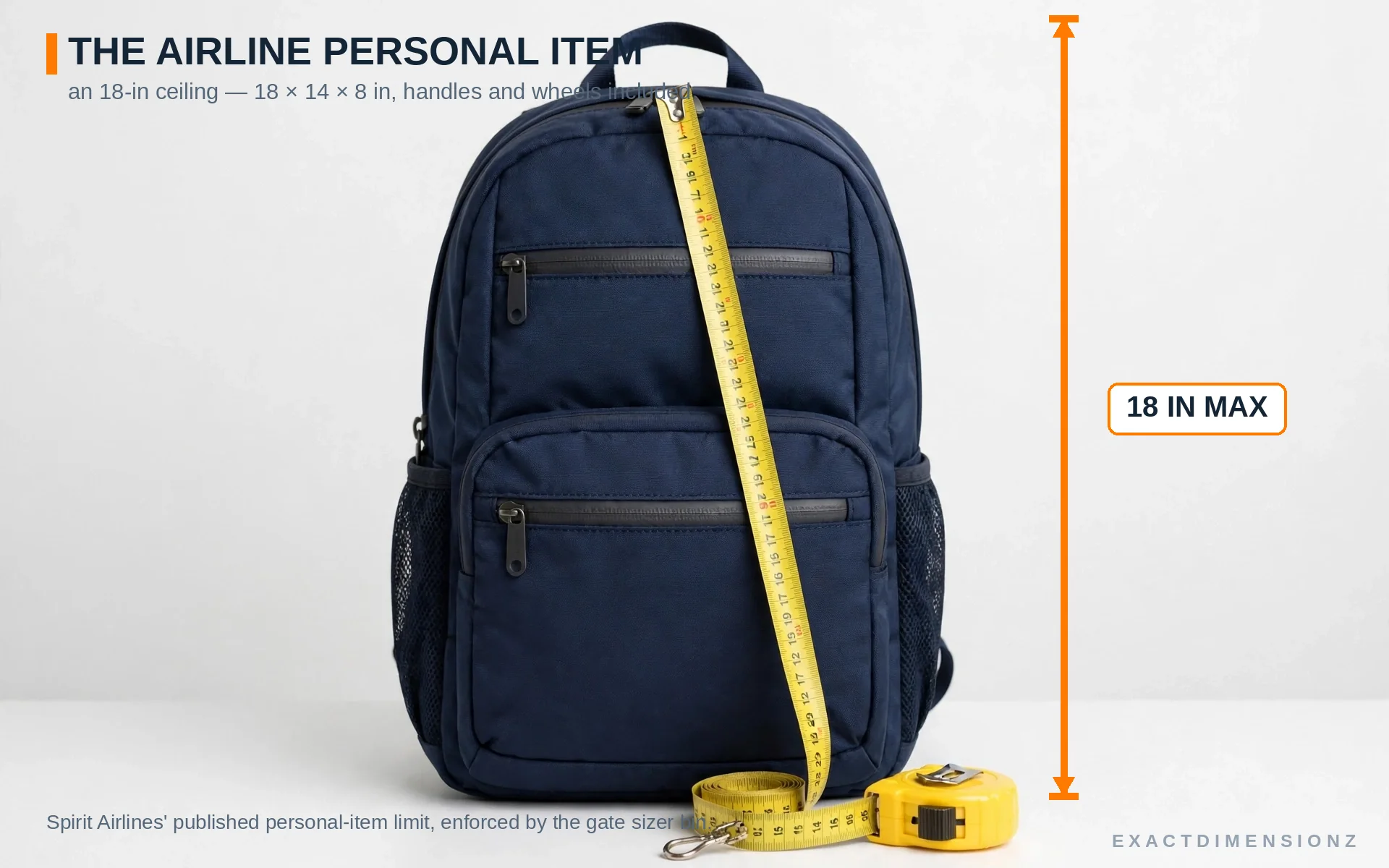
Stamp: AIRLINE RULE — 18 in is a maximum, enforced by a sizer bin: 18 × 14 × 8 in, handles and wheels included.
Here is an eighteen with a bailiff. Spirit Airlines — the carrier whose baggage rules are enforced most literally in American aviation — allows one free personal item per passenger, and its own support pages state the limit flatly: dimensions must not exceed 18 x 14 x 8 inches, including handles and wheels. The bag must fit entirely in the smaller sizer bin and slide under the seat in front of you; an inch over, and the item is reclassified as a carry-on, with a fee to match. You can read the rule on Spirit’s own baggage information page.
Notice how this eighteen differs from every other in the article. It is not the size of an object; it is the size of a permission — a ceiling, not a measurement. Bags sold as “personal item size” are built a shade under it (the 8 inches of depth is the dimension that quietly disqualifies most backpacks), and the sizer bin at the gate is the physical form of the guarantee: your bag either demonstrates eighteen inches or it doesn’t, in public, for money. As a reference, then, the personal-item sizer is the most tested eighteen in everyday life — thousands of bags a day are held against it. If you fly the budget carriers, you have watched this number earn its stamp.
Source: Spirit Airlines’ published baggage rules (spirit.com) — personal item maximum 18 × 14 × 8 in including handles and wheels.
4. The 18 × 18 Floor Tile

Stamp: STANDARD, NOMINAL — 18 in is the module size under ANSI A137.1; the tile in the box is made a fraction under.
Tile is sold the way masonry is sold: by a name that the governing standard defines as approximate. The ceramic tile standard, ANSI A137.1, defines a tile’s nominal size as its approximate facial size, stated “for general reference” — and 18 × 18 is a standard nominal floor size, the big square format of American kitchens and entryways. Manufacturers publish both numbers side by side: Daltile’s specification sheets print the nominal size next to the actual one in parentheses, and tiles are made slightly under their nominal size so that the grout joint completes the module on the floor — laid with its joint, the floor advances exactly 18 inches per tile, as planned. (This article links Daltile’s specification document as mirrored on a document host, since the manufacturer’s own sheet is distributed as a PDF: Daltile specifications.)
So the tile’s stamp is a standard’s stamp — real authority, honestly labelled approximate. Rival pages call the 18 × 18 tile “exactly 18 inches,” and that word exactly is precisely what the standard declines to say. Picture the tile in the floor, joint included, and you are picturing eighteen; picture the bare tile in your hands and you are picturing a fraction less, the width of a grout line short. That is not a defect in the reference — it is the reference, graded the way its own standard grades it.
Source: ANSI A137.1 nominal-size definition as applied in Daltile’s published specifications (manufacturer’s document, mirror-hosted).
Guaranteed by the Maker. Five eighteens that stand or fall on a manufacturer’s own published numbers — no standard forces them, but the maker has printed them and can be held to them.
5. The Razer Blade 18
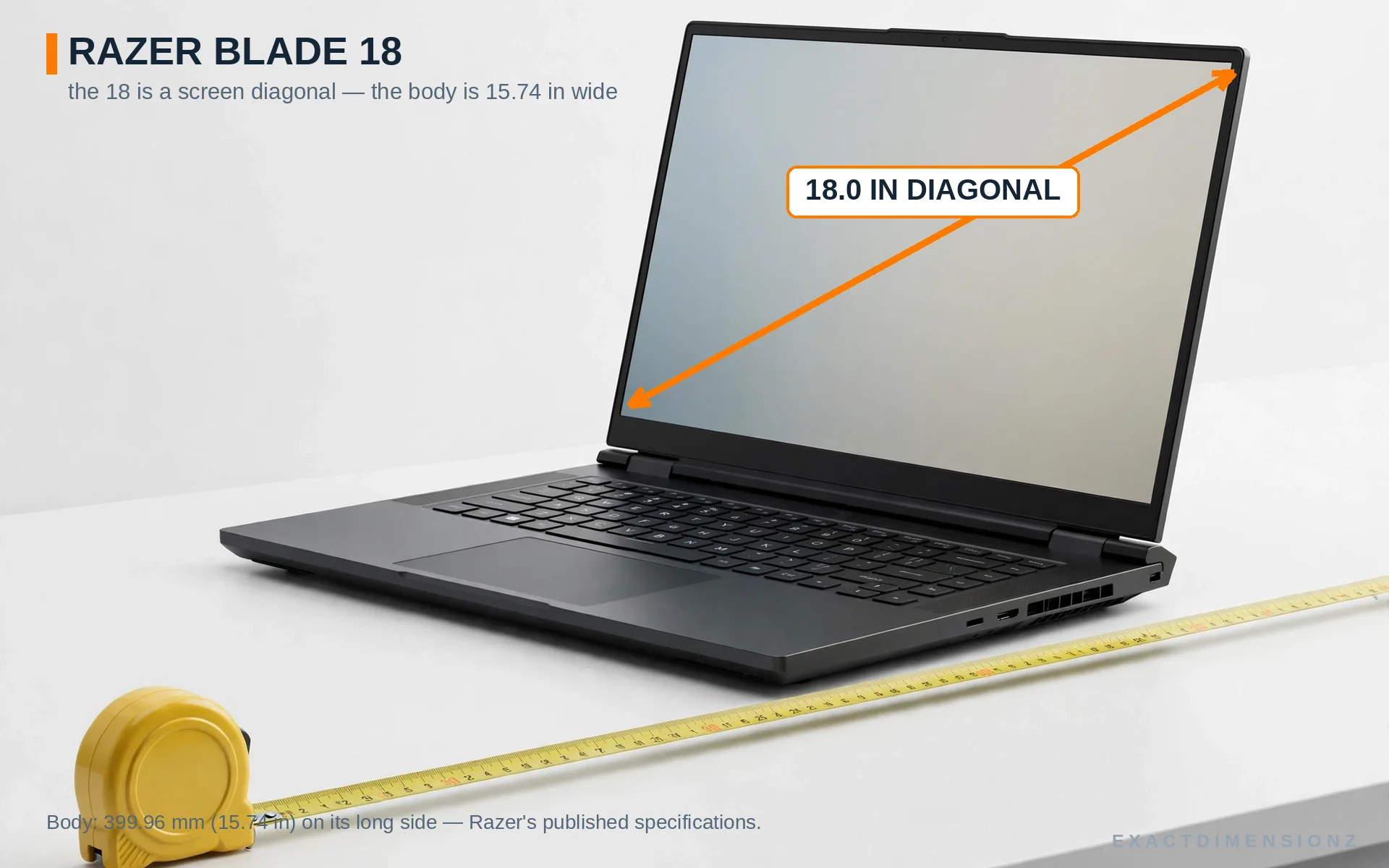
Stamp: MANUFACTURER’S SPEC SHEET — the screen is 18.0 in on the diagonal; the body is 15.74 in wide. This is the flagship correction of this article.
Yes, an “18-inch laptop” exists — Razer builds one — and no, it does not rescue the claim printed in a rival’s reference table, “Laptop Width — 18 inches.” Razer’s own support specifications for the Blade 18 give the machine’s long side as 399.96 mm — 15.74 inches — and its display as an 18-inch panel, measured the way all screens are measured: corner to corner, on the diagonal. So the biggest laptop in the mainstream wears its eighteen diagonally, spans a hair under sixteen inches across its body — squarely in 15-inch territory by width — and is eighteen inches wide in no direction at all. A keyboard, a lid, a desk footprint of eighteen inches: none of them exists on this machine, or on any laptop Razer’s rivals could name.
Grade the Blade the way this series grades every screen: the diagonal is real, and unusually honest — unlike the 16-inch class, where the panels scatter from 16.0 to 16.2, Razer’s 18-inch panel is an 18.0. Picture the corner-to-corner sweep of that huge display and you are picturing eighteen inches fairly. Just know which eighteen you are picturing — and when a reference table tells you a laptop is 18 inches wide, you are reading a number nobody measured, guaranteed by nobody. The Corrections Desk returns to that table.
Source: Razer’s Blade 18 support specifications (razer.com) — 18-in display; body 399.96 mm (15.74 in) on its long side.
6. The American Girl Doll

Stamp: BRAND STANDARD — 18.0 in tall, the founding dimension of an entire product ecosystem, unchanged since 1986.
Some guarantees are written in standards documents; this one is written in forty years of product line. When American Girl launched in 1986, it built the company on a single dimension: a doll 18 inches tall, large enough to feel like a companion rather than a figurine, with a whole economy of clothing, furniture and accessories made to her scale. The company has described its dolls as 18-inch in its own product literature and announcements ever since — its 2019 holiday announcement, for example, introduces that year’s Girl of the Year as “an 18-inch doll,” in the same breath as the books and accessories built around her.
The stamp’s strength is compatibility. An ecosystem only works if the dimension holds: a dress sewn for one 18-inch doll must fit the next, a bed built for the line must fit them all, and millions of third-party makers sew and build to the same number. If the dolls drifted, the ecosystem would notice before anyone’s ruler did. That makes the American Girl doll the most handled hard eighteen in this article — stand one upright and you are looking at eighteen inches of height, head to toe, guaranteed by a brand whose entire catalogue is a standing bet that the number is true. Rival pages list the doll too; what they don’t tell you is why you can trust it.
Source: American Girl’s product descriptions and company announcements (americangirl.com; company press release) — dolls are 18 inches tall.
7. The 18-Inch Dishwasher
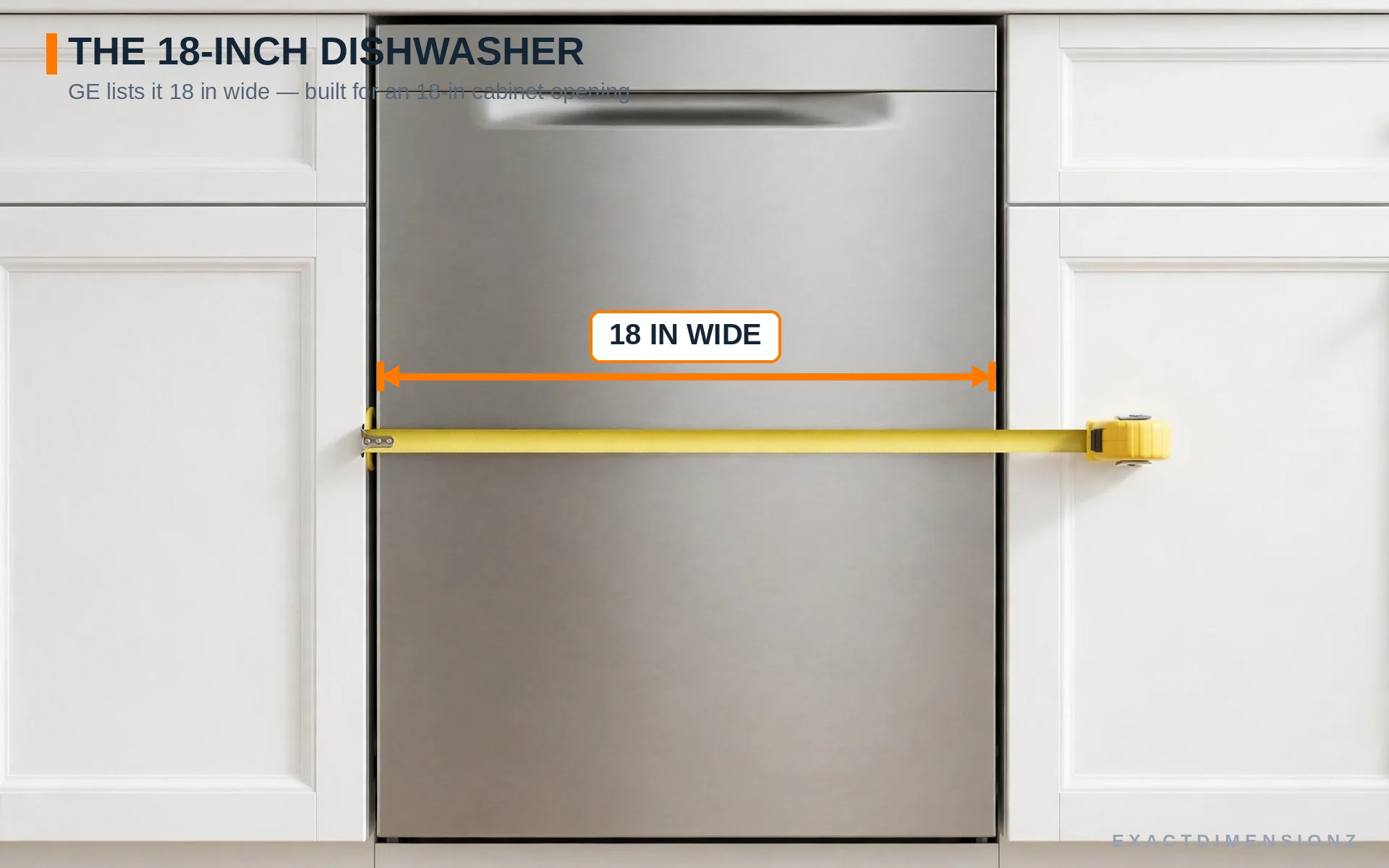
Stamp: MANUFACTURER’S DIMENSION — GE lists its 18-inch built-ins at 18 in wide, sized for an 18-inch cabinet opening.
The compact dishwasher is the kitchen’s answer to the apartment problem, and its defining number is a width. GE Appliances’ own page for its Spacemaker 18-inch built-in dishwasher gives the dimensions as 32 1/2 H x 18 W x 22 1/2 D — eighteen inches of width, holding roughly eight place settings where a full-size machine takes twenty-four inches of counter run. The class exists because cabinetry is modular: an 18-inch dishwasher is manufactured to slide into an 18-inch cabinet opening, so the maker’s number is checked by every installer who ever fits one.
Grade it as what it is: a manufacturer’s stated dimension for a product class, with the usual appliance footnote that the cabinet cut-out is the number that matters at installation and makers publish it separately (for GE’s Profile 18-inch models, an 18-inch cut-out width). As a visual reference the dishwasher is better than it first sounds — it is eighteen inches you can stand in front of, at exactly the width of the cabinet gap it fills, in a great many small kitchens. It is also, not coincidentally, the reference that proves this article’s premise from the appliance aisle: the number is trustworthy precisely because a maker’s warranty and a carpenter’s opening both stand behind it.
Source: GE Appliances’ product specifications (geappliances.com) — Spacemaker 18″ Built-In Dishwasher, dimensions 32 1/2 H x 18 W x 22 1/2 D.
8. The 18-Inch Crash Cymbal
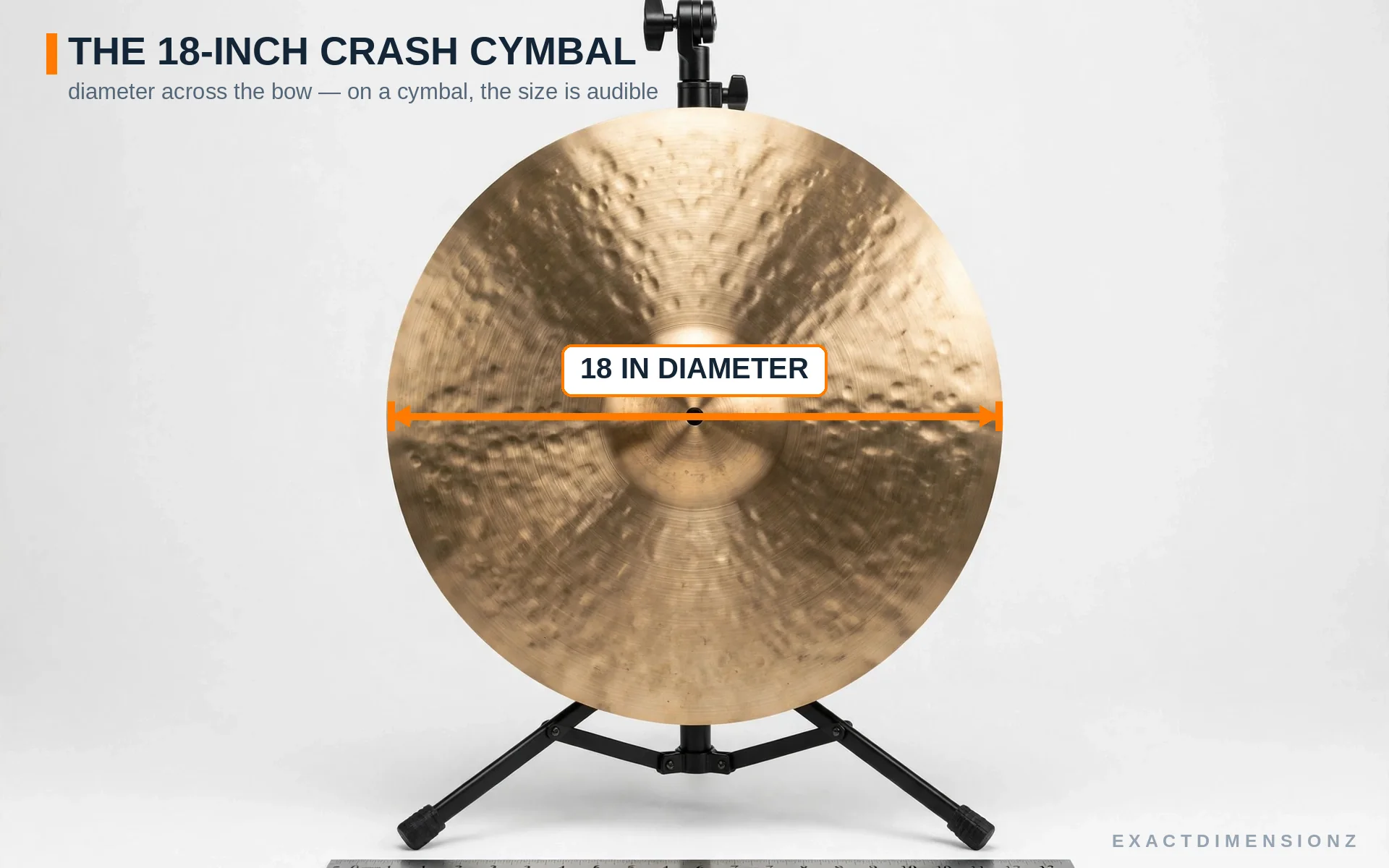
Stamp: MAKER’S SIZE — 18 in across the bow, the diameter the cymbal is cast, hammered and sold by.
Back to the drum kit, where diameters are working specifications rather than decoration. Zildjian’s A Custom line — among the most played cymbals on earth — includes an 18-inch crash, a B20 bronze disc whose pitch, crash speed and volume all flow from that one measurement across the bow. Drummers buy crashes by the inch because the inch is audible: the same line’s 16-inch crash speaks faster and higher, its 18 sits lower and blooms longer, and a kit’s whole accent palette is laid out in these two-inch steps.
The honesty note is the one this site always files for cast metal: a cymbal is cast, hammered and lathed by processes that leave each individual disc a few thousandths of an inch from its nominal size, and the bow is curved, so a tape held across it reads the chord, not the arc. The 18 on a crash is therefore a maker’s size, held close by the making — a shade softer than the rim’s machined standard in object 2, a shade harder than the menu and shelf-tag customs coming below. Graded that way, it is a fine, loud eighteen you can hear from the street.
Source: the A Custom crash’s published specification (thomann.co.uk) — size 18 in, B20 bronze.
9. The 18-Inch Foam Roller
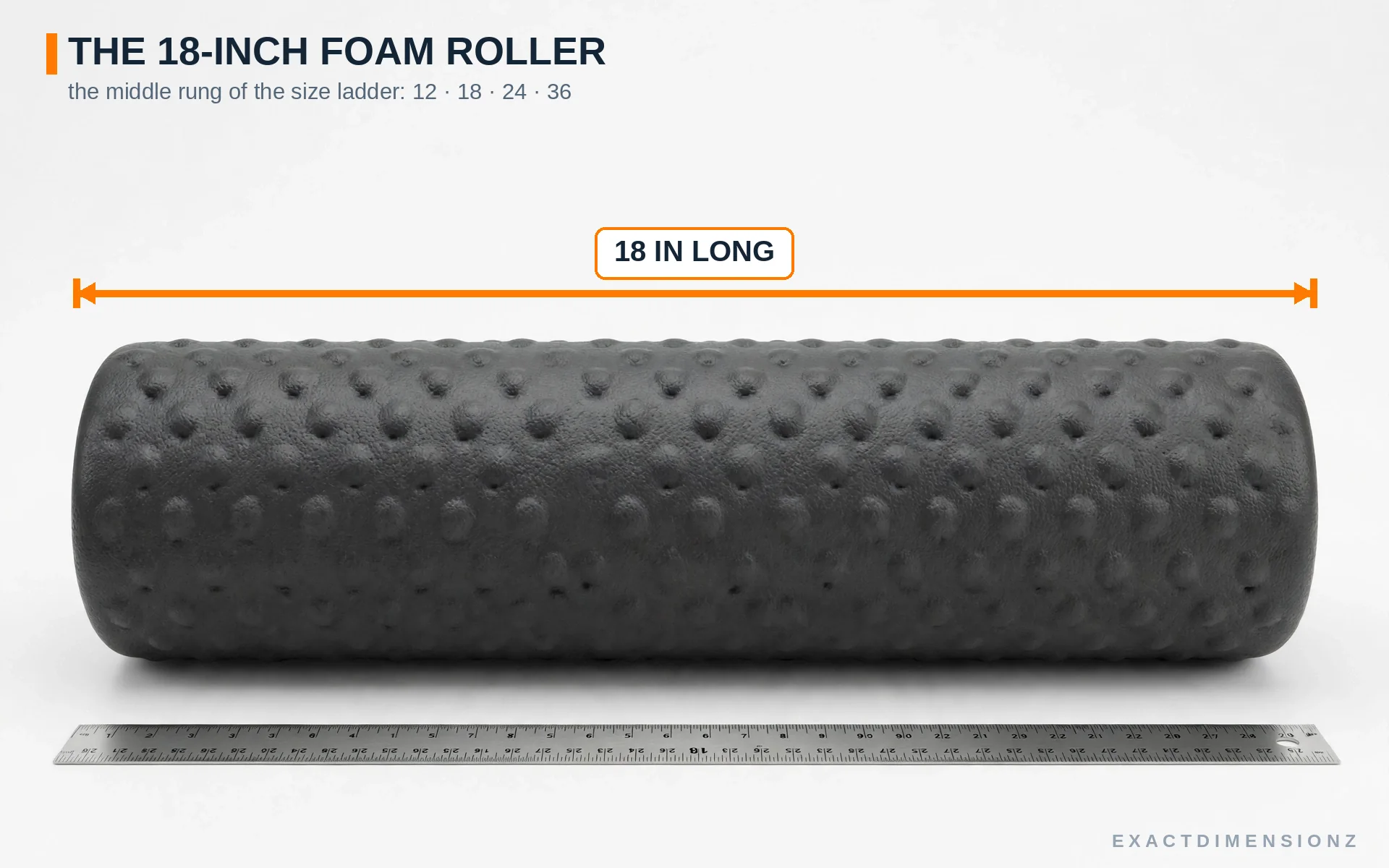
Stamp: MANUFACTURER’S SIZE LADDER — 18 in is the middle rung of a standard ladder: 12, 18, 24, 36.
Foam rollers are sold in a length ladder — 12, 18, 24, 36 inches — and the 18 is the ladder’s useful middle: long enough to lie across both shoulder blades, short enough to live in a closet. Gaiam’s Restore line sells its 18-inch roller for exactly that middle work — “at 18 inches long… the ideal size to effectively target and isolate smaller muscle groups in the back, arms, and legs” — and the same 18-inch length recurs across makers because the ladder, not any single brand, is the standard here. For scale, the best-known travel roller, TriggerPoint’s GRID, runs 13 inches — five inches shorter, and noticeably stingier under a back.
A foam roller is also one of the easiest eighteens to verify in the wild: it is a plain cylinder of stated length, with no diagonal, nominal or clasp-inclusive tricks — lay a tape along it and the maker’s number is simply there, or not. That plainness is its charm as a reference. Of the five maker-stamped objects in this section, the roller carries the least machinery behind its guarantee — no installer’s cut-out, no ecosystem, no spec-sheet diagonal — just a size ladder every maker repeats. It holds up anyway, which is what a ladder is for.
Source: Gaiam Restore foam roller product specifications (manufacturer’s figures via its product listing) — 18 inches long; standard roller ladder 12/18/24/36 in.
Guaranteed by Custom. Four eighteens that no regulation and no spec sheet enforces — the number survives because an industry habit holds it. Habits are usually honest here, but they are the softest stamps in the article, and one of them (object 12) carries the chain-store error the Corrections Desk revokes.
10. The Princess Necklace

Stamp: TRADE CUSTOM, TRUE LENGTH — 18 in is the chain’s actual end-to-end length, clasp included, by the trade’s own convention.
The jeweller’s length ladder is one of the oldest size customs in retail: choker 16, princess 18, matinee 20–24, opera 28–36. Blue Nile’s necklace length guide defines the princess length — “an 18-inch necklace that sits at the collarbone” — and, usefully, defines what “length” means for a chain: the full length of the necklace including the clasp, laid flat and straight. That inclusion is the whole honesty game with necklaces: a chain sold at 18 inches delivers 18 inches of chain, clasp and all, and the number is measured end to end rather than in some flattering arc around a neck.
So the princess necklace carries custom’s best-behaved stamp: a convention everyone in the trade shares, defining a true length anyone can verify with a ruler on a table. What it cannot guarantee is the drop — where the pendant lands depends on the wearer’s neck, not the chain — which is why the guide talks about collarbone position in averages. As a reference for eighteen inches itself, though, it is impeccable: uncoil a princess chain on the counter and you are looking at exactly the number on its tag, by a custom older than the ruler in your drawer.
Source: Blue Nile’s necklace length guide (bluenile.com) — princess length 18 in at the collarbone; chain length includes the clasp.
11. The 18-Inch Woofer
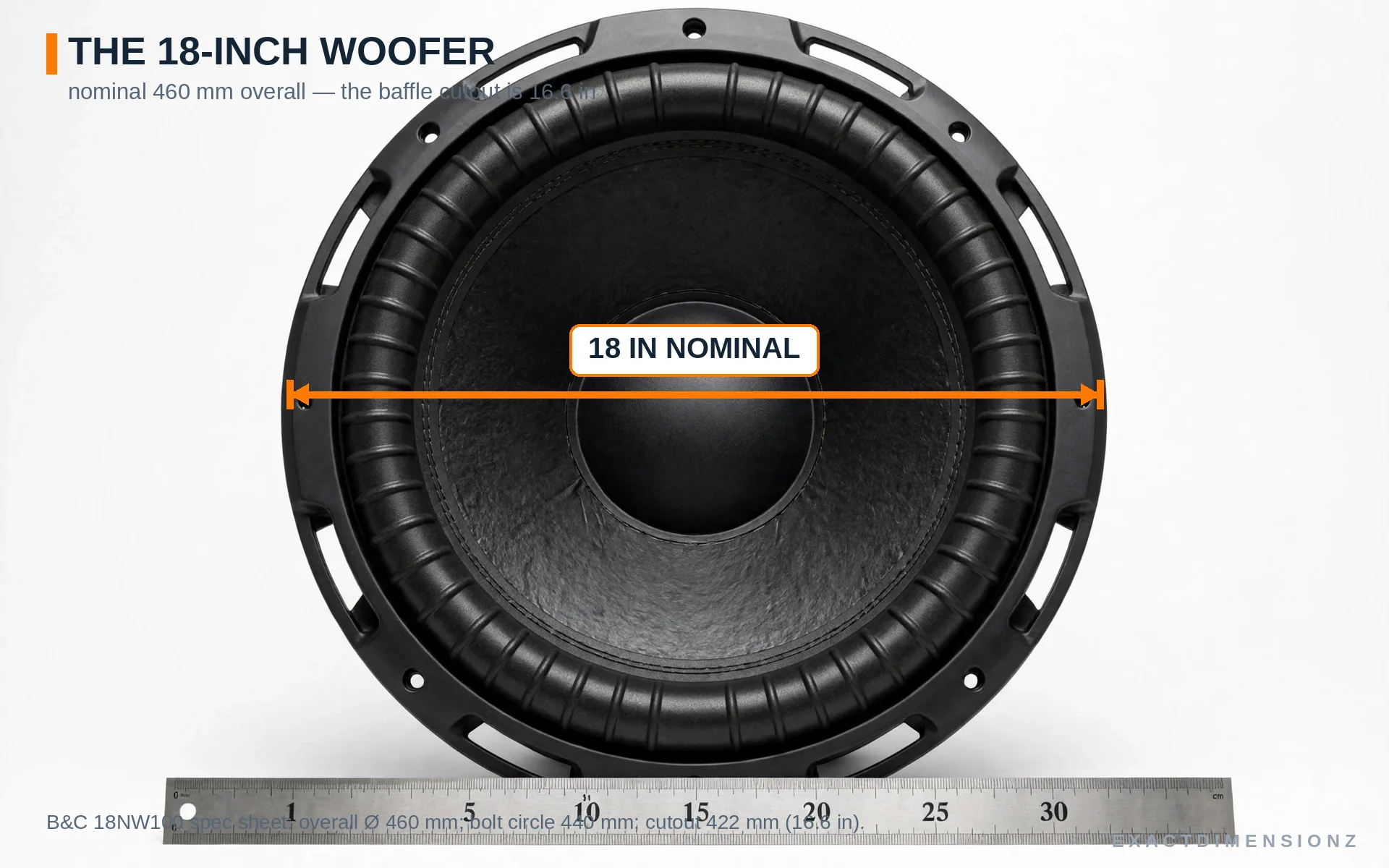
Stamp: MAKER’S NOMINAL CLASS — 18 in (460 mm) overall, on the maker’s own spec sheet; the hole it mounts in is 16.6 in.
Professional sound sizes its drivers by nominal diameter, and the honest makers publish every real dimension behind the name. B&C Speakers’ spec sheet for its 18NW100 woofer — an industry-workhorse 18-inch subwoofer driver, linked here as hosted on a pro-audio retailer’s document mirror — lists the nominal diameter as 460 mm (18.0 in) and the overall diameter as the same 460 mm, then adds the numbers that matter in the workshop: a bolt circle of 440 mm (17.3 in) and a baffle cutout of 422 mm — 16.6 inches. The driver that is “18 inches” drops into a hole that is sixteen and change.
That is nominal sizing done right: the class name is round, and every working dimension is printed next to it for anyone cutting plywood. Compare the stool and sofa listings this site has graded before, where nominal numbers arrive with no sheet behind them at all. The woofer’s stamp is custom — the whole pro-audio industry calls this driver “18-inch” — but it is custom with its arithmetic showing: overall 460 mm, as named. Use it as the reference for what an eighteen-inch class looks like, and keep the 16.6-inch cutout in mind as the article’s quietest lesson: in nominal country, always ask which diameter the number is measuring.
Source: B&C 18NW100 spec sheet (manufacturer’s document, retailer-hosted mirror) — nominal/overall diameter 460 mm (18.0 in), bolt circle 440 mm, baffle cutout 422 mm (16.6 in).
12. The 18-Inch Pizza
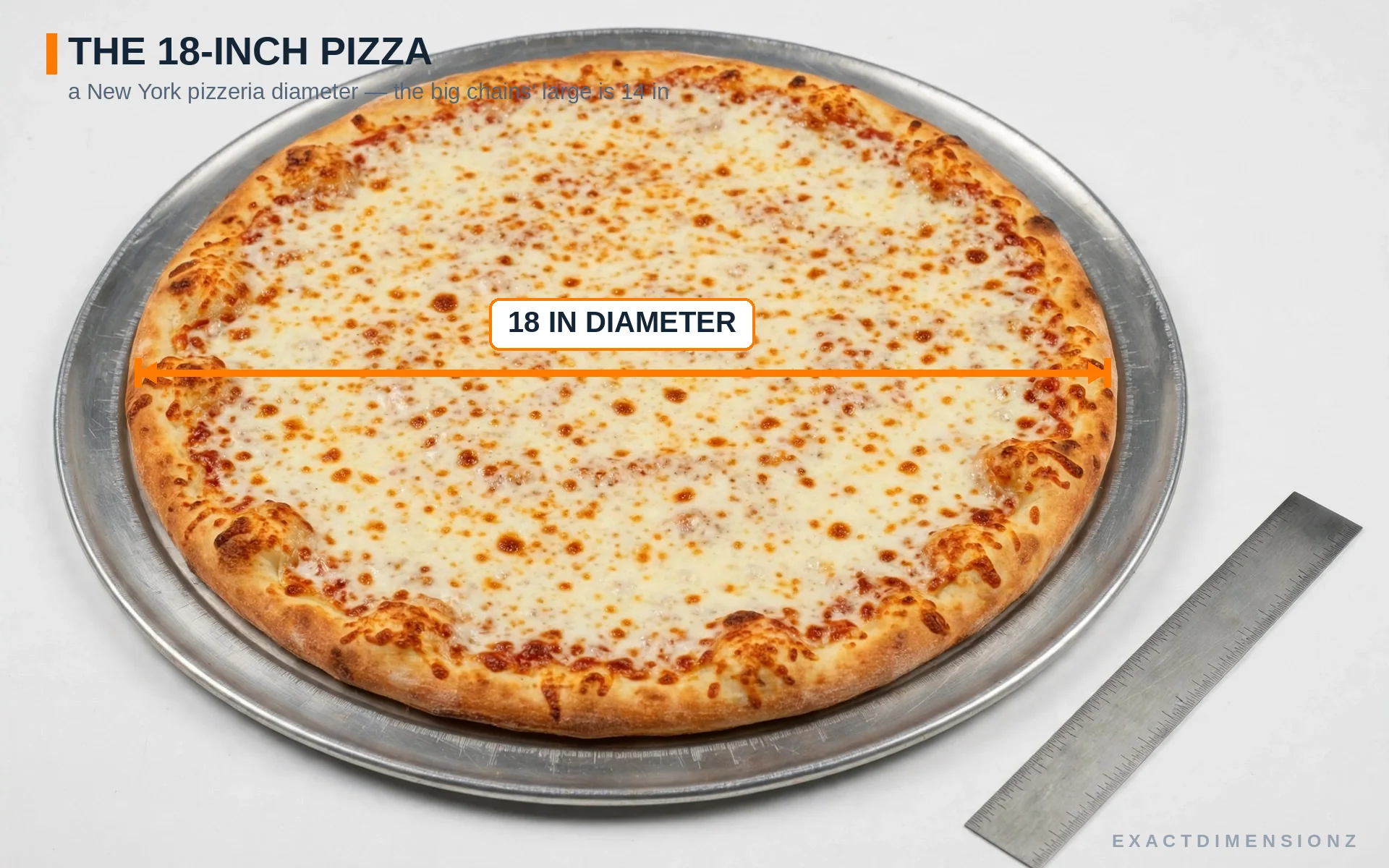
Stamp: MENU CUSTOM — the diameter on the box, at the shops that make it. The chains don’t: their large is 14.
The eighteen-inch pizza is real, beloved, and almost impossible to order from the places rival articles say sell it. In New York, 18 inches is the classic pizzeria pie — the one folded by the slice — and warehouse and independent shops honour the size on their menus. But a widely read rival calls the 18-inch pizza the “flagship large at Domino’s, Pizza Hut, and Papa John’s.” Read the chains’ own size charts instead. A published comparison of the major chains’ pizza sizes lists them plainly: Domino’s large is 14 inches (its extra-large is 16), Pizza Hut’s large is 14, and Papa John’s large is 14 (its XL, 16). Not one of the big three tops out at 18; two of them never reach it at all.
So grade the pizza’s stamp exactly: at the counter that actually bakes it, 18 inches is the diameter across the crust, give or take the hand-tossed wobble of a dough stretched by a person — pizzerias do not caliper their pies, and an honest reference says so. As a visual for eighteen inches the pizza is superb: a big round eighteen you can eat, roughly the area of two 12-inch pizzas’ worth of lunch. Just order it where it exists. And when a size article tells you the chains’ flagship large is eighteen inches, you have learned something about the article, not the pizza — the Corrections Desk formalises the revocation below.
Source: the major chains’ published pizza size charts (comparison at pizzacalculator.ca) — Domino’s Large 14 in / XL 16 in; Pizza Hut Large 14 in; Papa John’s Large 14 in / XL 16 in.
13. The 18 × 18 Throw Pillow
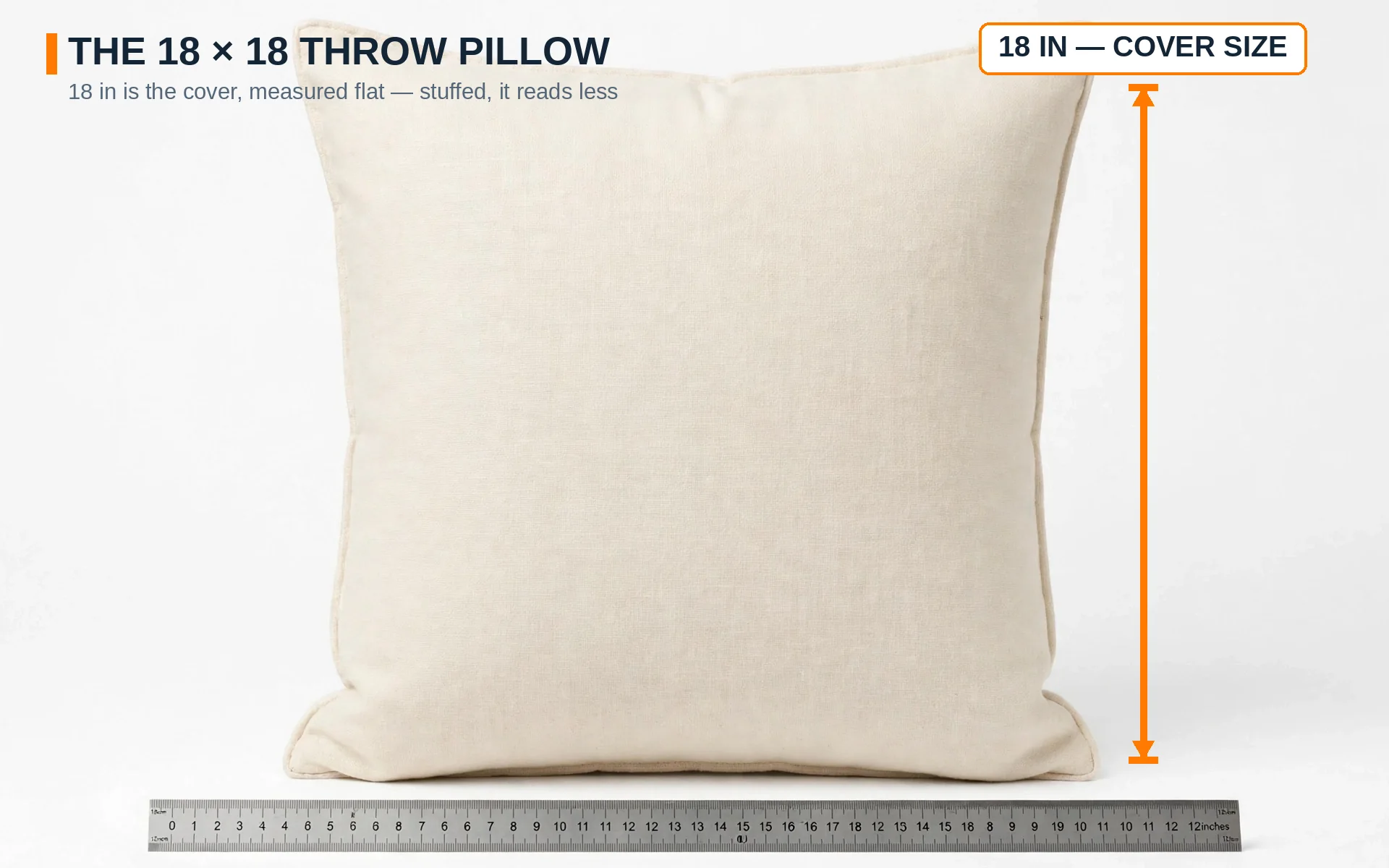
Stamp: RETAIL CUSTOM — 18 in is the cover’s size class, measured flat and unstretched; stuffed, it reads less.
The world’s most common cushion wears the article’s softest stamp, and it is still worth grading honestly. An “18 × 18” throw pillow is, by the home-textile trade’s working convention, an 18-inch cover measured flat — seam to seam, empty — designed to take an insert that is often itself sold as 20-inch, deliberately overfilled so the pillow looks plump. Fill it, and the plumpness pulls the faces in: across the stuffed pillow, a tape reads noticeably less than eighteen, which is geometry, not fraud — the fabric bows outward, and the straight-line width narrows.
So the pillow closes the thirteen with the mirror image of the tile that opened the standard group: there, the floor delivers the nominal 18 the bare tile withholds; here, the flat cover delivers an 18 the stuffed object gives back. Both are customs with their definitions in the open, usable the moment you know which state of the object the number describes. Picture the cover, flat on the worktable, seam to seam — that is the eighteen the tag promises, and the only one it does.
Source: home-textile retail convention (cover measured flat, seam to seam; inserts commonly sold oversized for fill) — graded as custom; no single authority publishes this size.
The Authority Chart: Thirteen Eighteens, Graded

Thirteen objects, three stamps, one exact conversion. The chart lines every reference in this article up twice: once by its verified measurement, and once by the authority behind it. Read down the stamp column and the article’s argument makes itself. At the top sits the half-yard cut, whose 18.00 no one can amend, and the wheel’s bead seat, held to its number by an industry’s need to interchange. The maker’s five follow, each only as good as its maker’s printed word — which, for GE’s dimension, Razer’s diagonal, American Girl’s ecosystem and the roller ladder, is good indeed. The customs close the column: honest where their definitions are printed (the necklace’s clasp-inclusive length, the woofer’s spec sheet), softer where they ride on habit (the stuffed pillow, the hand-stretched pizza). And below the line, in the revocation row, sit the claims that failed grading entirely — the two-dollar-bill shortcut and its companions, handled next but one. Keep the chart’s habit — measurement, then guarantor — and no size label will ever grade itself for you again.
Build Eighteen Yourself: Six Ways, Two of Them Exact

Eighteen’s exactness makes it buildable: half a yard resolves into household parts more cleanly than any length this series has tackled, and two of the six builds below land on 18.00 with no fudge at all. The first pairs the two most standardised rectangles in American life. A US index card is 4 × 6 inches by definition of the product — and a 12-inch ruler plus the card’s long edge is 12 + 6 = 18.00 inches, dead on, the arithmetic the half yard promises. The second is older than the index card: craft sticks — popsicle sticks — are moulded to a standard 4.5 inches, and four of them end to end are 4 × 4.5 = 18.00, dead on again. Between them sits the build this series has been waiting to grade: three dollar bills. A US bill is 6.14 inches long by the Bureau of Engraving and Printing’s own figures, so three of them make 18.42 inches — four-tenths over, the closest honest money-build in the article, and the direct refutation of the famous two-bill claim, debunked in the Corrections Desk below.
| What you line up | The maths | Total | Verdict |
|---|---|---|---|
| A 12-in ruler + an index card’s 6-in edge | 12 + 6 | 18.00 in | dead on |
| Four standard craft sticks | 4.5 × 4 | 18.00 in | dead on |
| Three US dollar bills | 6.14 × 3 | 18.42 in | 0.42 over — closest money build |
| Letter paper’s long side + a dollar bill | 11 + 6.14 | 17.14 in | 0.86 short |
| 18 US quarters in a row | 0.955 × 18 | 17.19 in | 0.81 short |
| Six credit cards end to end | 3.37 × 6 | 20.2 in | 2.2 over — skip it |
The short builds are instructive failures. Eighteen quarters — the US Mint’s coin specifications give the quarter’s diameter as 0.955 inches — line up to just 17.19 inches: eighteen of them cannot make eighteen, a small poem about denominations. A sheet of letter paper contributes its 11-inch long side and still leaves the line nearly an inch short with a bill beside it; and six credit cards, at the card standard’s 3.37 inches apiece, overshoot past 20 — the credit card is a 6-inch-class measuring myth all by itself. Note what made the exact builds exact: not luck, but guarantors — a card size that’s a product definition, a stick length that’s a mould standard, and sticks overshooting the sixteen-inch mark by exactly 2 inches. Where a guarantee stands behind the parts, the sum stands too. That is the whole article, in one table.
The Corrections Desk
Six claims about 18 inches, checked against the sources that should have settled them. One desk, one verdict each: claims are corrected, not mocked — every source below is genuinely trying to answer this question, and the two errors this desk treats most seriously are the ones repeated most often.
Claim 1 (the flagship): “Line up two dollar bills and you have almost exactly 18 inches.” A long-running reference for this length advises exactly that. Measure the money: the Bureau of Engraving and Printing gives a US bill’s length as 6.14 inches, so two bills make 12.28 inches — not “almost” eighteen, but short of it by 5.72 inches, nearly a third of the target missing. Even three bills overshoot slightly, at 18.42. The claim is wrong by the length of an entire third bill, on the primary source its own author could have read. Verdict: revoked. For eighteen inches of currency, the honest figure is three bills and a known 0.42 over — or better, the ruler and index card above, which are exact.
Claim 2: “The 18-inch pizza is the flagship large at Domino’s, Pizza Hut and Papa John’s.” Checked against the chains’ own size charts: Domino’s large is 14 inches (XL 16), Pizza Hut’s large is 14, Papa John’s large is 14 (XL 16). The 18-inch pie is a New York pizzeria and warehouse-club size, not a big-three flagship at any of the three chains named. Verdict: revoked — the reference in object 12 stands, the attribution does not.
Claim 3: “A full-size violin is about 18 inches long.” A full-size (4/4) violin runs about 23.5 inches overall, with a body of roughly 14 inches — one figure far above 18, the other well below it; the claim matches neither the instrument nor its case-sized parts. Verdict: revoked; no part of the violin’s standard dimensions supplies an 18-inch reference.
Claim 4: “Laptop width: 18 inches” (from a rival’s reference table). The widest mainstream 18-inch-class laptop, Razer’s Blade 18, measures 15.74 inches on its long side by its maker’s own spec sheet; its 18 is a diagonal. No laptop in the class is 18 inches wide. Verdict: revoked — a diagonal filed as a width, the same filing error this desk corrected for 16 inches, repeated a class up.
Claim 5: “Three pencils end to end — each exactly 6 inches — make a precise 18.” A standard #2 pencil is 7.5 inches long unsharpened, not 6; three of them make 22.5 inches, and the claim’s tidy arithmetic collapses with its first premise. (Its cousin — the “18-inch rolling pin is the most common size” — fares no better: barrel and overall lengths vary by maker, and no source is offered.) Verdict: revoked; the pencil is not a 6-inch unit for any build.
Claim 6: “Youth bats start at 18 inches” / “Softball rules set an 18-inch minimum bat length.” Bat sizing published by the makers (Rawlings’ bat sizing guide) starts tee-ball at 24–26 inches — no 18-inch bat exists in Rawlings’ or Easton’s lineups — and softball’s rules cap bat length at 34 inches rather than flooring it at 18. An 18-inch bat would be a toy novelty, not a regulation starting point. Verdict: revoked on both halves; the 24–26-inch tee-ball bat is the real small-bat reference, a full six inches past this article’s subject.
Eighteen, Stamped
So: how long is 18 inches? It is the friendliest number this series has met — exactly half a yard, a foot and a half, 45.72 centimeters with nothing rounded — and also the best classroom. Within its thirteen references you can watch every grade of guarantee at work: a definition that cannot fail, a standard enforced by interchange and sizer bins, five makers printing numbers they can be held to, and four customs that hold only as long as their definitions stay printed beside them. Carry the question with you — who guarantees this number, and what happens if they’re wrong? — and eighteen inches becomes more than a length. It becomes the last size anyone can sell you ungraded.
