

If you have ever wondered how big is 14 cm, the short answer is 5.51 inches — and the longer answer is that 14 cm is the one size in the whole centimetre series that the inch world already built things to. Five and a half inches is 13.97 cm, which means 14 cm is just three-tenths of a millimetre past the 5½-inch mark on your tape measure — closer than the thickness of a sheet of paper. That is why a trade paperback is 13.97 cm across its short side, why a kitchen knife is sold with a 14 cm blade, and why the teaspoon in your drawer and the pen on your desk both land within half a centimetre of it. Where 12 cm had a disc and a fan fixed by standards, 14 cm has a whole cluster of everyday things that all point at the same half-inch mark — and every one of them is sitting in your house right now.
Below are five single, named things, each checked against its own specification, with the miss printed wherever a thing misses. One of them is exact at 14 cm for the dimension stated, one misses by three-tenths of a millimetre, and the other three land within seven millimetres of it — close enough to trust, honest enough to print. Every object’s image sits immediately after its heading, and no object is a stack, a multiple, a fraction, or a category guess. You will not find three-quarters of a pencil or one-and-a-half credit cards here, because three-quarters of a pencil is arithmetic wearing a trench coat and one-and-a-half credit cards is a multiple wearing a wallet. By the end you will know 14 cm as a book, a blade, a pen, a phone, and a spoon — and you will know which of those you can trust to the millimetre and which you must measure yourself.
Quick Answer
14 cm is 5.51 inches — 140 millimetres, 0.14 metres, and 0.15 yards. But do NOT round it to 6 inches: 6 inches is 15.24 cm, which is 1.24 cm too long, and at this size that is a gap that shows. The honest shortcut is 5 and 1/2 inches, which is 13.97 cm — just 0.3 millimetres short — and the honest object is a trade paperback, 13.97 cm across its short side by its own trim size.
Why 14 Cm Is the 5½-Inch Size in Disguise
Fourteen centimetres is the only size in this series that the imperial system reaches by accident, and the reason is the number five and a half. A tape measure marked in inches has a mark every sixteenth of an inch, but the marks your eye actually lands on are the whole inches and the half inches — and 5½ inches is 13.97 cm, which is 14 cm to within three-tenths of a millimetre. That is not a coincidence you have to believe: it is arithmetic. The paperback on your shelf is printed at a 5.5 × 8.5 inch trim because American printers settled on that size decades ago, and the trim’s own specification gives the width as 13.97 cm. The knife in your kitchen drawer is sold as a 14 cm blade because German cutlers sell blades in whole centimetres, and 14 cm happens to be the metric name for the same length. Two different measurement worlds, one building in half inches and the other in whole centimetres, both landing on the same object — and neither of them did it by accident.
The second reason 14 cm is easy is that it is the size where rounding finally stops lying to you. Twelve centimetres rounded to 5 inches is 7 millimetres wrong, and every guide that tells you to “just call it 5 inches” is handing you a gap that shows. Fourteen centimetres rounded to 5½ inches is 0.3 millimetres wrong, which is thinner than a sheet of printer paper and smaller than the width of the ink line on your ruler. The divide-by-2.5 trick, on the other hand, gives 5.6 inches — 2.3 millimetres over — so the lazy mental math is seven times worse than the honest half-inch shortcut. The honest way to picture 14 cm, then, is not to convert it at all — it is to hold a paperback. The book on your shelf is 13.97 cm across its short side by its own trim size, it has been that size since the trade paperback was invented, and it will still be that size when every conversion guide on the internet has been rewritten.
The 5 Objects
Each object below carries its evidence grade in the heading. EXACT means the figure is a standard’s or an authority’s own dimension for the named thing. LISTED means the figure is the manufacturer’s or operator’s published specification for the named model. REPORTED means the figure comes from a design or museum record rather than a specification sheet. AVERAGE means the figure is the midpoint of a published range for the named thing. The grade is the whole point: a list that never grades its numbers is asking you to trust it, and this article would rather show you the receipt.
1. A US Trade Paperback (5.5 × 8.5 In Trim) — 13.97 Cm Wide (EXACT)

The paperback is the article’s cleanest near-exact, because its 13.97 cm is written into a printer’s own specification. Amazon’s Kindle Direct Publishing lists the 5.5 × 8.5 inch paperback trim as 13.97 × 21.59 cm — the width is 13.97 cm, the height is 21.59 cm — and it is one of the standard trade-paperback sizes in the United States, the size used for general non-fiction, young-adult fantasy, and books like Colleen Hoover’s It Ends With Us. Pick up any trade paperback printed at that trim and its short side is 13.97 cm, which misses 14 cm by three-tenths of a millimetre — a gap thinner than a sheet of paper, and the closest any object in this article comes to the number in its title.
The fitting check is the trim, because “a paperback” alone means nothing. The 6 × 9 inch trade trim is 15.24 cm wide — a full centimetre wider than this article’s number — and a mass-market paperback is 4.25 × 6.88 inches, only 10.8 cm across its short side, so a book bought against “about 14 cm” can be three centimetres wrong in either direction if you never check the trim. The grade is exact because the figure is a standard trim size’s own dimension for this named format: 5.5 inches is 13.97 cm by definition, and the book on your shelf is the proof. Keep one beside your ruler and you will never have to guess 14 cm again.
2. A Wüsthof Classic Utility Knife — 14 Cm Blade (LISTED)
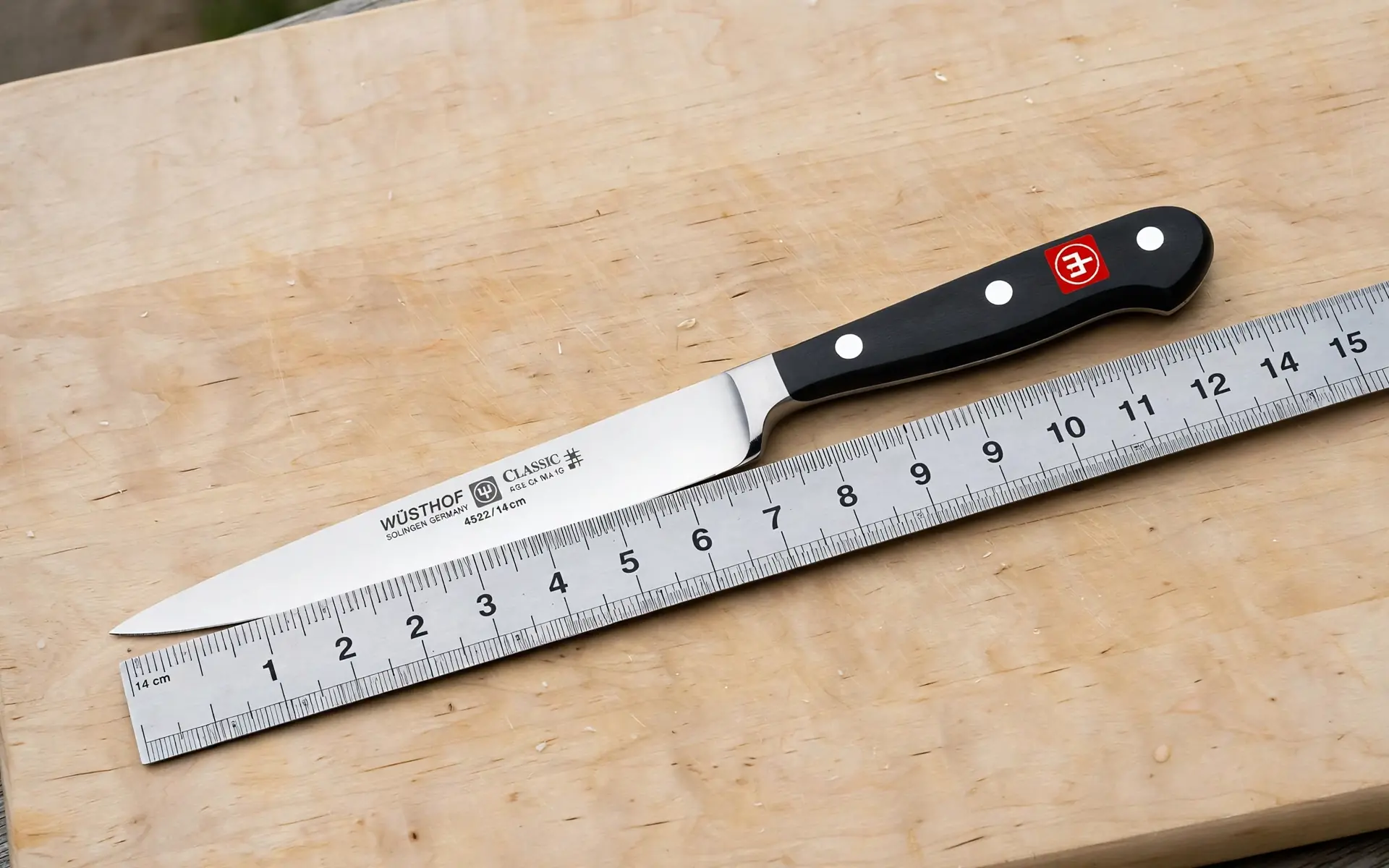
The knife is the article’s only exact, because it is sold by the number in this article’s title. Wüsthof’s own specification lists the Classic Utility Knife at a blade length of 14 cm — model 1040100714, blade 2.5 cm wide, handle 10.8 cm long, forged from a single piece of steel in Solingen, Germany, and hardened to 58 Rockwell. Fourteen centimetres is the blade, not the knife: the blade is the part that cuts, and it is the part the maker measures. The utility knife sits between the paring knife and the chef’s knife in every kitchen drawer, and it is the knife you reach for when a tomato, an apple, or a sandwich needs a blade that is exactly this long.
The fitting check is the whole knife, because the blade is 14 cm and the knife is not. Blade plus handle is 24.8 cm, so a knife block slot, a drawer organiser, or a sheath bought against “14 cm” fails by nearly eleven centimetres if you measure the wrong part — and Wüsthof’s 14 cm chef’s knife, santoku, and boning knife all carry the same 14 cm blade, so the utility knife is the named example of a whole family of 14 cm blades, not the only one. The grade is listed because the figure is the manufacturer’s own specification for this named model: 14 cm, by name, on the box. Open your kitchen drawer and measure the blade of your utility knife — you are measuring 14 cm, with a specification to prove it.
3. A BIC Cristal Ballpoint Pen Without Its Cap — 14.45 Cm (REPORTED)
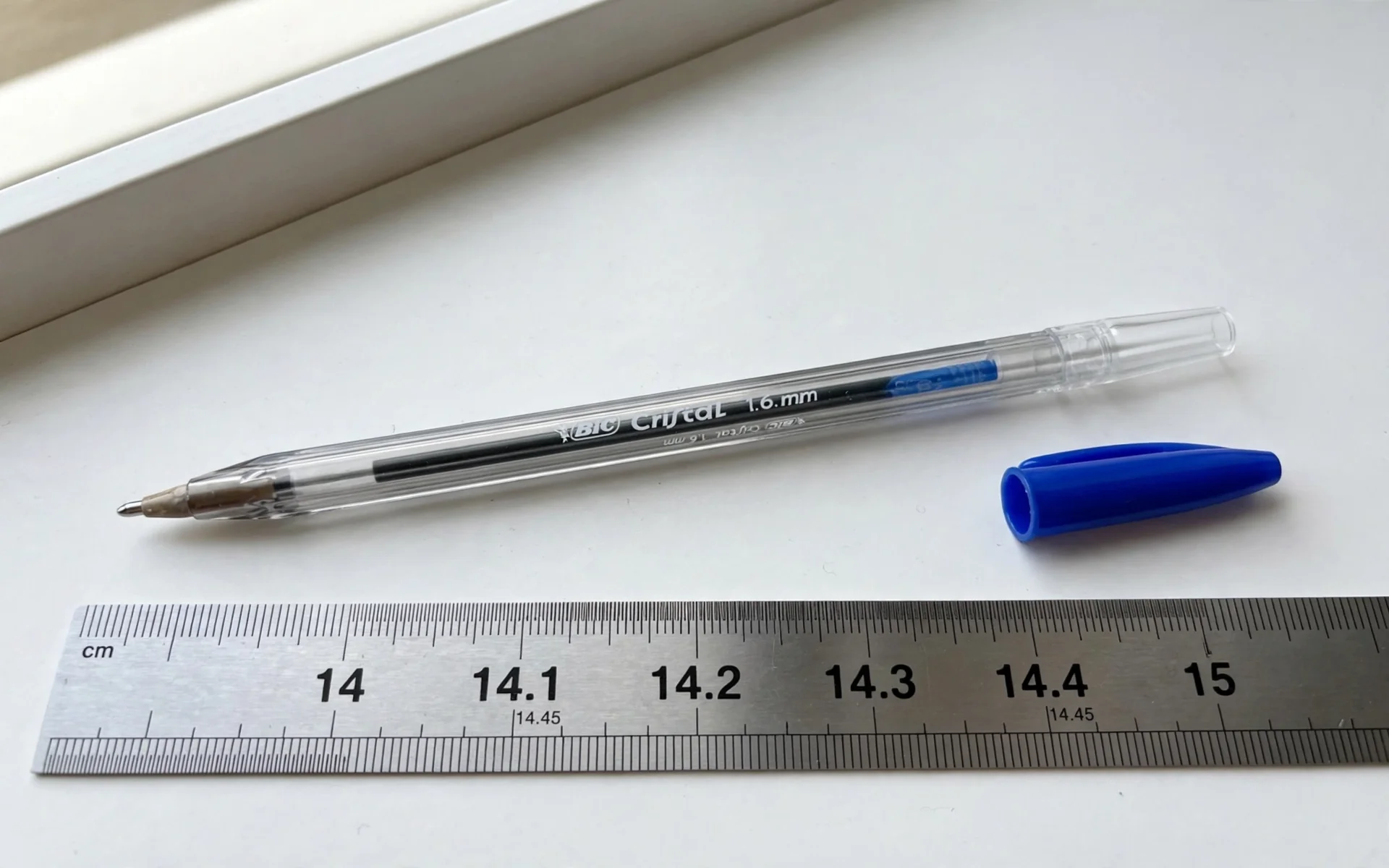
The pen is the article’s most famous near-miss, and the one that corrects a claim you have probably already read. The BIC Cristal — the best-selling pen in history, in the permanent design collection of the Museum of Modern Art in New York — is recorded at 14.9 cm long with its cap on and 14.45 cm long with its cap off, and the cap is the whole story: uncapped, the pen overshoots 14 cm by 4.5 millimetres, a miss about the width of a pencil lead, and capped it overshoots by 9 millimetres, nearly a full centimetre. It is the pen in your desk drawer, the pen in your car’s cup holder, and the pen at the bottom of every bag you own — and all three are the same length, once you know whether the cap is on.
The fitting check is the claim, because one popular guide calls this pen “almost exactly 5.5 inches” without its cap, and it is not. Five and a half inches is 13.97 cm; the uncapped pen is 14.45 cm, which is 5.69 inches — nearly half a centimetre past the number the guide promises — so a pen used as a 5.5-inch reference will measure everything half a centimetre long. The grade is reported, not listed, because no BIC specification sheet states the uncapped length: the figure comes from the pen’s design record, and this article prints it with that limit stated in full. Measure your pen with the cap off before you trust it, because the pen is the object in this article that other guides get wrong.
4. An Apple iPhone 15 Pro — 14.66 Cm Tall (LISTED)

The iPhone 15 Pro is the article’s most familiar near-miss, and the closest any current phone comes to 14 cm. Apple’s own technical specifications list the iPhone 15 Pro at 146.6 mm tall, 70.6 mm wide, and 8.25 mm deep, weighing 187 grams — a titanium frame, a 6.1-inch screen, and a height that overshoots 14 cm by 6.6 millimetres, a miss about the thickness of two stacked coins. It is the phone in your pocket, the phone on your desk, and the phone in the hand of the person next to you — and it is the same height in every country, because Apple builds one phone and ships it everywhere.
The fitting check is the direction, because the phone’s height is 14.66 cm and its width is 7.06 cm — almost exactly half. A case, a pocket, or a car mount bought against “14 cm” fails by a factor of two if you measure the wrong edge, and the 6.1-inch screen is measured diagonally, which is 15.5 cm — a third number that is neither the height nor the width. The iPhone 15 without the Pro is taller still, at 147.6 mm, so “an iPhone 15” and “an iPhone 15 Pro” are different numbers, and the guides that say “a large smartphone” never say which phone they mean. The grade is listed because the figure is the manufacturer’s own specification for this named model, with the deviation printed in full: 146.6 mm, not 140 mm, and the 6.6 millimetres is the whole story. Measure your phone’s height before you measure your pocket, because the phone is the object in this article you carry every day.
5. A Standard Teaspoon — About 14 Cm Long (AVERAGE)
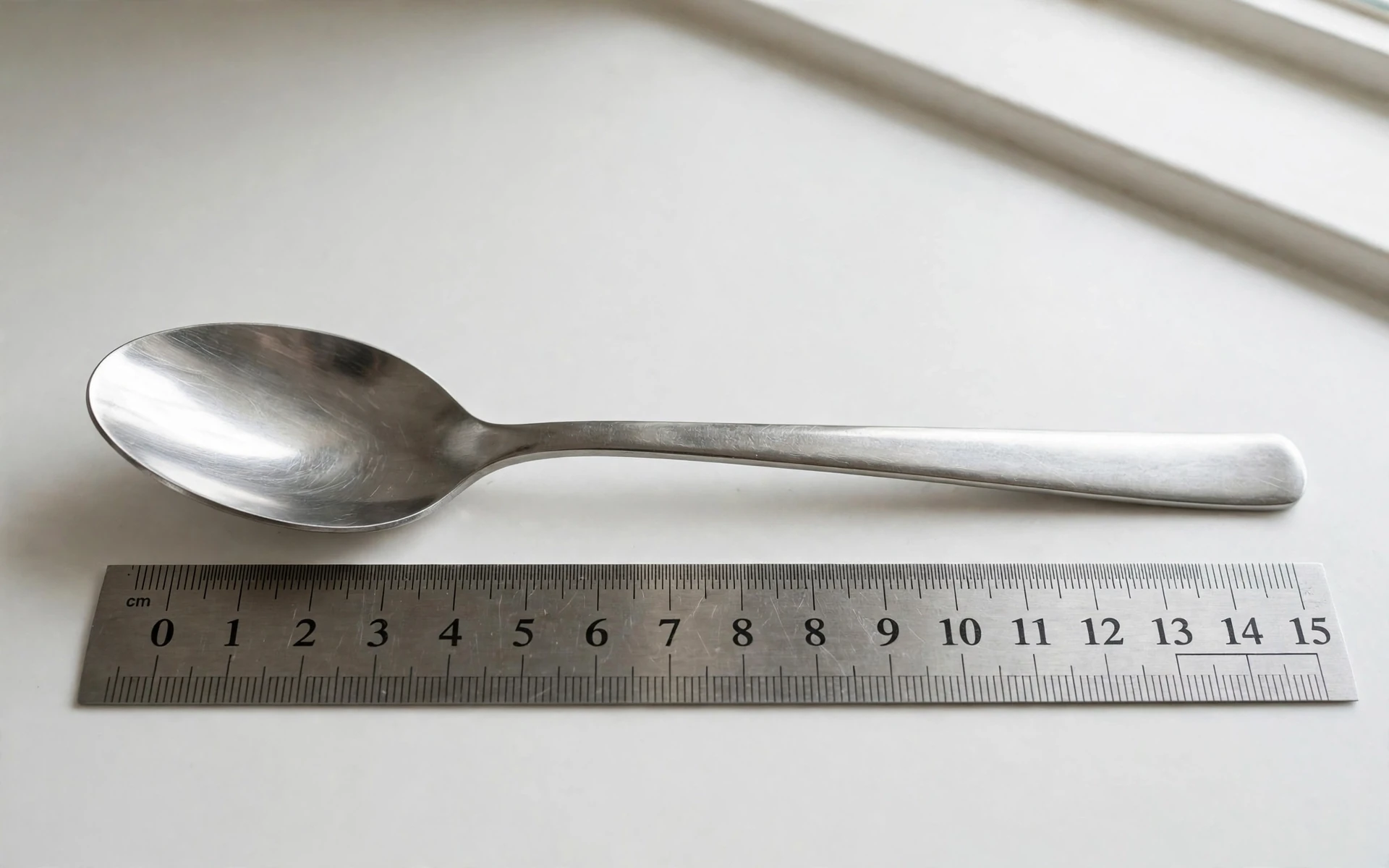
The teaspoon is the article’s most useful 14 cm, because it is the one object in this list that almost everyone owns — and the one whose grade is the most honest. Teaspoons run 13 to 15 cm long by maker, or 5 to 6 inches, and the usual figure given for a standard teaspoon is about 5.5 inches — 14 cm, the midpoint of the range, not a single fixed number. A teaspoon holds exactly 5 ml by definition, because the food-labelling teaspoon is a volume, but its length is not standardised anywhere: one brand’s teaspoon is 13 cm, another’s is 15 cm, and yours is probably somewhere in between. It is the spoon you stir your coffee with, the spoon you measure baking soda with, and the spoon at every place setting — and all three are about 14 cm, give or take a centimetre.
The fitting check is the tablespoon, and it is a third too long. A tablespoon runs 7 to 8 inches, 18 to 20 cm, so a “spoon” bought against 14 cm can be a third too long if you grab the wrong one, and a measuring teaspoon — the kind on a metal ring — is shorter still, about 10 cm, because it is built for volume, not for eating. The grade is average, not listed, because no standard fixes a teaspoon’s length: the range is 13 to 15 cm, the midpoint is 14 cm, and the label on the drawer is whatever the maker made it. Measure your own teaspoon before you trust it, and the spoon will tell you 14 cm the first time.
The 14-Cm Hand Test: Five Checks in a Minute
Fourteen centimetres is a number you can check without a tape measure, because all five of this article’s objects are probably within arm’s reach right now. First, the book: pull a trade paperback off the shelf and measure its short side — if it is a 5.5 × 8.5 inch trim, you are holding 13.97 cm, three-tenths of a millimetre short of the number. Second, the pen: pull a BIC Cristal from your drawer, take the cap off, and you are holding 14.45 cm — half a centimetre over, and the pen every other guide gets wrong. Third, the spoon: pull a teaspoon from the drawer and you are holding about 14 cm — the middle of a 13 to 15 cm range, and the only object in this article you should measure before you trust. Fourth, the knife: open the kitchen drawer and the utility knife’s blade is 14 cm — exact, by the maker’s own specification, and the only exact in the article. Fifth, the phone: the iPhone 15 Pro in your pocket is 14.66 cm tall — two-thirds of a centimetre over, and the same height in every country. None of these replaces a tape measure for anything that must fit, but all five will tell you whether 14 cm is the size you think it is before the book is bought, the knife is ordered, or the case is fitted.
Where the Other Lists Get 14 Cm Wrong
Five wrong numbers about 14 cm circulate so widely that they deserve their own section, because each one is stated confidently on a page that ranks for this exact question. First, the pen: one popular guide calls a BIC Cristal without its cap “almost exactly 5.5 inches”, and it is not — the pen is 14.45 cm uncapped, which is 5.69 inches, and 14.9 cm capped, which is 5.87 inches, so the claim is wrong by half a centimetre at best and nearly a centimetre at worst. Second, the credit card: another guide says 14 cm is “roughly the length of a credit card”, and it is not — a credit card is 8.56 cm under ISO/IEC 7810 ID-1, barely sixty percent of 14 cm, and you would need one and six-tenths of a card end to end. Third, the A6 postcard: a third guide calls the A6 height “nearly 14 cm”, and it is not — A6 is 10.5 × 14.8 cm, so the long side is eight-tenths of a centimetre over, nearly a full centimetre, not “nearly” anything. Fourth, the mental math: guide after guide tells you to divide by 2.5, and 14 divided by 2.5 is 5.6 inches — 2.3 millimetres over, seven times worse than the honest 5½-inch shortcut, which is 0.3 millimetres short. Fifth, the half-foot: one guide implies 14 cm is about half a foot, and it is not — half a foot is 15.24 cm, so 14 cm is 1.24 cm short of half a foot, and 0.46 feet, not 0.5. None of these five numbers belongs in a 14 cm article, and all five are here so you never have to learn that from a purchase.
14 Cm on the Size Ladder
Fourteen centimetres sits one centimetre past the passport in the last article’s ladder — a passport booklet is 12.5 cm on its long side — and three-tenths of a millimetre past the paperback in this article, which is 13.97 cm across its short side. Go a little further and you reach the BIC Cristal without its cap at 14.45 cm, then the iPhone 15 Pro at 14.66 cm, then the A6 postcard at 14.8 cm, then half a foot at 15.24 cm, and then the US dollar bill at 15.6 cm, which is 1.6 cm longer than 14 cm and the worst anchor in this whole series. The ladder runs 12, 12.5, 13.97, 14, 14.45, 14.66, 14.8, 15.24, 15.6 — and the point of it is the middle: 14 cm is the only rung with a cluster behind it, a book, a blade, a pen, a phone, and a spoon all landing within seven millimetres of the same number, and that is why it is the easiest size in the series to hold in your hand.
How 14 Cm Compares With Other Lengths
Readers comparing nearby sizes may also want the site’s guides to 12 cm, 11 cm, 10 cm, 9 cm, and 8 cm for the centimetre series, and 12 feet, 11 feet, and 40 inches for the foot and inch series. Each of those guides follows the same rule as this one: the spec sheet, the grade, and the miss printed in full.
Frequently Asked Questions
How many inches is 14 cm?
14 cm is 5.5118 inches, or 5.51 inches rounded to two decimal places. Divide 14 by 2.54 and you get 5.5118 — and the trap is rounding that to 6 inches, which overstates the length by 1.24 cm, or dividing by 2.5, which gives 5.6 inches and overstates it by 2.3 millimetres. For anything that must fit, use 5.51 inches; for a quick estimate in your head, 5 and 1/2 inches is 13.97 cm, which is close enough to picture it and only 0.3 millimetres short.
How many millimetres is 14 cm?
140 millimetres exactly. Multiply 14 by 10 and you get 140 with no rounding involved, because the centimetre is defined as exactly 10 millimetres. In metres that is 0.14 m, in feet it is 0.46 ft, and in yards it is 0.15 yards rounded — exactly 0.1531 yards, which is the figure a tape measure will show if it is marked in yards.
Is 14 cm the same as 5 and a half inches?
Very nearly, and the difference is the smallest in this whole series. Five and a half inches is 13.97 cm, so 14 cm is 0.3 millimetres longer — thinner than a sheet of printer paper, and smaller than the width of the ink line on your ruler. For anything you measure by eye, 5½ inches is the honest shortcut; for anything that must fit, use 5.51 inches, because 0.3 millimetres is still a real number, even if your eye cannot see it.
What is 14 cm wide in real life?
The most exact everyday answer is a Wüsthof Classic utility knife, whose blade is 14 cm by the maker’s own specification — the only exact in this article. The next closest are a US trade paperback at the 5.5 × 8.5 inch trim (13.97 cm across its short side), a BIC Cristal ballpoint pen without its cap (14.45 cm), an iPhone 15 Pro (14.66 cm tall), and a standard teaspoon (about 14 cm, the midpoint of a 13 to 15 cm range). None of the four near-misses is exact, and each one’s miss is printed beside it in this article.
Is a BIC Cristal pen really 5.5 inches long?
No, and this is the most repeated wrong number about 14 cm. A BIC Cristal is 14.9 cm long with its cap on (5.87 inches) and 14.45 cm long with its cap off (5.69 inches) — so even uncapped it is 0.48 cm longer than 5.5 inches, which is 13.97 cm. The pen is a good 14 cm reference once you know the real number, but it is not a 5.5-inch reference, and any guide that calls it one will measure everything half a centimetre long.
How big is an iPhone 15 Pro?
An iPhone 15 Pro is 14.66 cm tall, 7.06 cm wide, and 8.25 mm deep, weighing 187 grams, under Apple’s own technical specifications. Its 6.1-inch screen is measured diagonally, which is 15.5 cm — a different number from the height — and the iPhone 15 without the Pro is taller, at 14.76 cm. If you are buying a case, buy it for the 14.66 cm height and the 7.06 cm width, not for the screen size.
What US shoe size is a 14 cm foot?
A foot 14 cm long is a US Toddler size 7, a UK/Australia size 6, or an EU size 23 — the size of a child of about two years old. Shoe-size charts give the foot length, not the shoe length, so a 14 cm foot needs about a centimetre of growing room: look for an insole of about 15 cm, and always measure both feet, because children’s feet grow about 1 to 1.5 cm every three to four months at that age.
How do I measure 14 cm without a ruler?
Use a trade paperback’s short side (13.97 cm — shave off nothing, it is 0.3 millimetres short), a standard teaspoon (about 14 cm — measure yours first, because teaspoons run 13 to 15 cm), or a BIC Cristal without its cap (14.45 cm — shave off half a centimetre in your head). For anything that must fit — a knife blade, a phone case, a book trim — borrow or buy a real tape measure, because at 14 cm the misses in this article run from 0.3 millimetres to 6.6 millimetres, and guessing throws every one of them away.
Final Thoughts
Fourteen centimetres is the rare measurement that is honest and still misunderstood, because 5.51 inches can be a width, a blade, a length, a height, or a spoon — and the number alone never says which. Now you know it as a book’s width fixed by a printer’s trim size, a blade’s length fixed by its maker, a pen’s length fixed by its design record, a phone’s height fixed by its maker, and a spoon’s length fixed by the middle of its range — and you know which of those you can trust to the millimetre and which you must measure yourself. The rule that runs through all five is the same one this site always uses: trust the spec sheet, print the deviation, and let the name stay on the box where it belongs. Measure twice, in the direction the object actually travels, and 14 cm will fit the first time.
