
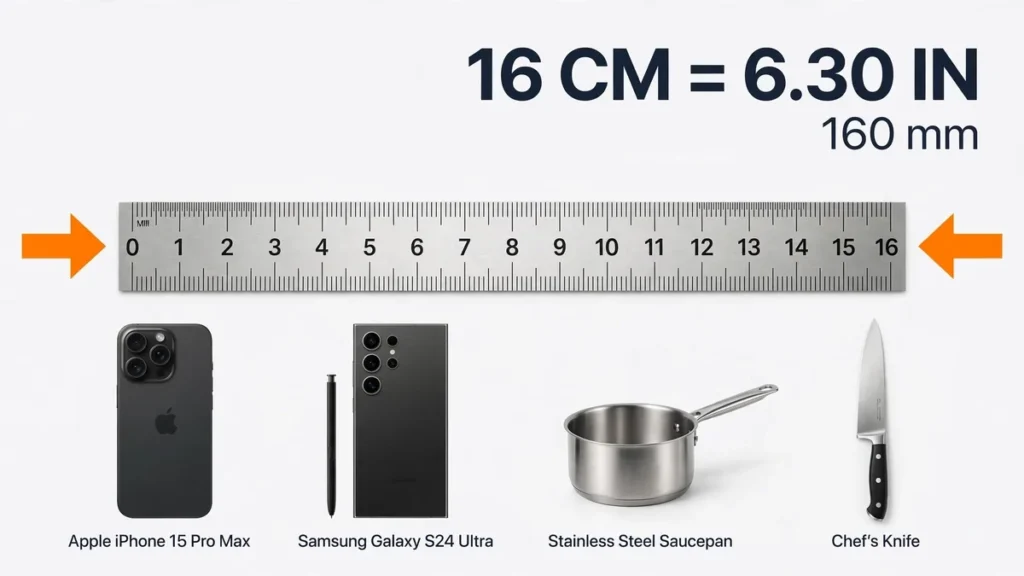
If you have ever wondered how big is 16 cm, the short answer is 6.30 inches — and the longer answer is that 16 cm is the size no tape measure will ever mark for you. Sixteen centimetres is 6.2992 inches, and no tape measure in the world has a 6.2992-inch mark. The mark just below it, 6 and 1/4 inches, is 15.875 cm — a millimetre and a quarter short — and the mark just above it, 6 and 5/16 inches, is 16.038 cm — four tenths of a millimetre over. So 16 cm lives between two marks, closer to the upper one, and every guide that tells you to "just call it 6 and a quarter" is handing you an error and calling it close enough, while every guide that tells you to divide by 2.5 is handing you 6.4 inches — which is 2.5 millimetres too long and wrong in the other direction entirely.
Below are seven single, named things, each checked against its own specification, with the miss printed wherever a thing misses. Four of them are exact at 16 cm for the dimension stated — a saucepan, a cake tin, a chef's knife blade, and a surgical forceps, all four sold by the number 16 cm — and the other three land within five and a half millimetres of it, two of them within two and a half. Every object's image sits immediately after its heading, and no object is a stack, a multiple, a fraction, or a category guess. You will not find two credit cards or a hamster here, because two credit cards are arithmetic wearing a wallet and a hamster is a range wearing fur. By the end you will know 16 cm as a phone, a pan, a blade, a tin, a forceps, a bigger phone, and a car speaker — and you will know which of those you can trust to the millimetre and which you must measure yourself.
Quick Answer
16 cm is 6.30 inches exactly — 160 millimetres, 0.16 metres, and 0.17 yards. But do NOT round it to 6 and 1/4 inches: 6 and 1/4 inches is 15.875 cm, which is 1.25 millimetres too short, and do NOT divide by 2.5 either — that gives 6.4 inches, which is 2.5 millimetres too long. The honest fraction is 6 and 5/16 inches, which is 16.04 cm, and the honest object is a 16 cm saucepan — 16 cm across its top by the maker's own specification.
Why 16 Cm Is the Quarter-Inch Problem
Sixteen centimetres is the only size in this series where the honest answer does not exist on the tool most people measure with, and that is why the problem works. A metric ruler has a 16 cm mark — it is printed right there, one centimetre past 15 — but an imperial tape measure does not, because 16 cm is 6.2992 inches and tape measures are marked in sixteenths. The nearest sixteenth below is 6 and 1/4 inches, which is 15.875 cm, a millimetre and a quarter short; the nearest sixteenth above is 6 and 5/16 inches, which is 16.038 cm, four tenths of a millimetre over. So the tape measure forces a choice, and every choice is wrong by something — and the guides that tell you to "just use 6 and a quarter" have chosen the worse of the two errors without telling you, because the upper mark is three times closer than the lower one.
The second reason 16 cm is a problem is that the round number on the imperial side undershoots this time, which is the reverse of the last article's trap. Six inches is 15.24 cm — seven and a half millimetres short of 16 cm — so the guide that tells you 16 cm is "about 6 inches" is not rounding, it is shrinking, and a sleeve, a frame, or a pan bought against "about 6 inches" will be 7.6 millimetres too small. And the divide-by-2.5 shortcut is worse still: 16 divided by 2.5 is 6.4 inches, which is 16.26 cm, two and a half millimetres too long — the shortcut overshoots in the opposite direction from the rounding, so a reader who uses both is wrong twice and never in the same direction. The honest way to picture 16 cm, then, is not to convert it at all — it is to hold a thing that is sold as 16 cm. The saucepan in your kitchen is 16 cm across its top by the maker's own specification, the knife in your drawer has a 16 cm blade by its maker's own specification, and neither of them needs a tape measure to prove it.
The 7 Objects
Each object below carries its evidence grade in the heading. EXACT means the figure is a standard's or an authority's own dimension for the named thing. LISTED means the figure is the manufacturer's or operator's published specification for the named model. REPORTED means the figure is a museum or reference record for the named thing, not the maker's own sheet. The grade is the whole point: a list that never grades its numbers is asking you to trust it, and this article would rather show you the receipt.
1. An Apple iPhone 15 Pro Max — 15.99 Cm Tall (LISTED)

The iPhone 15 Pro Max is the article's closest near-miss, and the closest any phone ever comes to 16 cm. Apple's own technical specifications list the iPhone 15 Pro Max at 159.9 mm tall, 76.7 mm wide, and 8.25 mm deep, weighing 221 grams — 15.99 cm on its long edge, which misses 16 cm by one tenth of a millimetre, a miss thinner than a sheet of paper and smaller than the manufacturing tolerance of the phone itself. It is the phone in the jacket pocket of everyone who bought the biggest iPhone of 2023, the phone on the desk beside the coffee, and the phone in the hand of the person reading this article on a smaller one — and its height is the one dimension you never have to guess, because Apple printed it in its own specification sheet.
The fitting check is the screen, because the phone's height is 15.99 cm and its screen is 6.7 inches measured diagonally — a different number in a different direction, and 17.02 cm across the diagonal at that. A case, a sleeve, or a car mount bought against "16 cm" fails if you measure the diagonal, and the guides that call a Pro Max "about 16 cm" are right about the height and wrong about everything else they imply — a case adds about two to three millimetres and pushes the phone past 16 cm entirely, and a screen protector bought by the 6.7-inch figure fits the glass, not the phone. The grade is listed because the figure is the manufacturer's own specification for this named model, with the deviation printed in full: 159.9 mm, not 160 mm, and the tenth of a millimetre is the whole story. Measure your phone's height before you measure your pocket, because the phone is the object in this article you carry every day.
2. A de Buyer ALCHIMY Saucepan Ø16 Cm — 16 Cm Across the Top (LISTED)

The saucepan is the article's first exact, and the most useful one, because it is the 16 cm object you already own a version of. The de Buyer ALCHIMY stainless-steel saucepan is sold as Ø16 cm, and the maker's own specification gives its top inner diameter as exactly 16 cm, its inner height as 8 cm, and its usable volume as 1.7 litres — the pan that melts butter, warms a single serving of soup, and cooks rice for two, and every 16 cm saucepan from every maker is the same width across the top, because the 16 cm is the size the pan is sold by. Hold one against a ruler and the rim runs from zero to sixteen with nothing to argue about, no conversion required, and the pan has been 16 cm since the day it left the factory.
The fitting check is the base, because the pan's top is 16 cm and its induction base is 12.5 cm — three and a half centimetres narrower — and the pan with its handle is 33 cm long overall. A lid bought against "16 cm" fits the top and only the top, a hob zone bought against "16 cm" wastes three and a half centimetres of heat if you match it to the rim instead of the base, and a drawer slot measured at 16 cm will not take a pan that is 33 cm long with its handle on. The grade is listed because the figure is the manufacturer's own specification for this named model: 16 cm across the top, by the maker's own sheet, and the zero millimetre miss is printed in the heading itself. Hold a 16 cm saucepan against a ruler and you are holding 16 cm — exactly, in steel, and the same in every kitchen you will ever cook in.
3. A Wüsthof Classic Half Bolster Chef's Knife — 16 Cm Blade (LISTED)
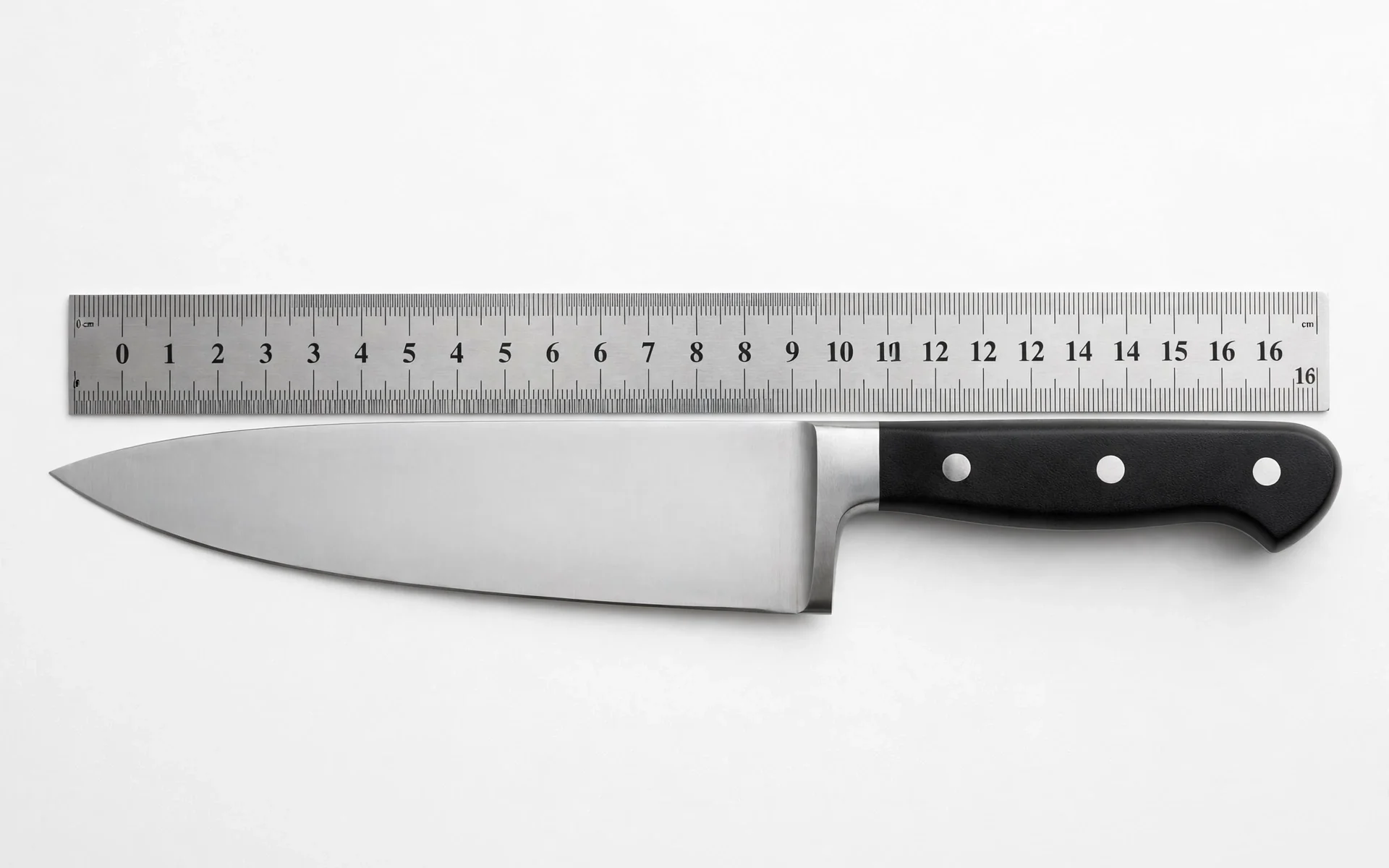
The chef's knife is the article's sharpest exact, because its 16 cm is written on the blade's own specification sheet. The Wüsthof Classic Half Bolster Chef's Knife is sold as 16 cm, and Wüsthof's own specification gives its blade length as exactly 16 cm, its blade width as 4.0 cm, and its handle as 11.2 cm — a forged X50CrMoV15 steel blade from Solingen, the all-rounder that minces, chops, and slices in every professional and home kitchen, and every 16 cm chef's knife from every maker is the same length along the cutting edge, because the 16 cm is the size the knife is sold by. Lay one beside a ruler and the edge runs from the bolster to the tip at sixteen centimetres with nothing to argue about.
The fitting check is the whole knife, because the blade is 16 cm and the knife is 27.2 cm long overall — eleven centimetres of handle past the number on the box. A knife roll, a drawer slot, or a magnetic strip bought against "16 cm" fails by eleven centimetres if you measure the blade and buy for the knife, and the guides that call a 16 cm knife "a 6-inch knife" are using the rounded nickname — 6 inches is 15.24 cm, not 16 cm — so the inch label is the wrong number and the centimetre blade is the right one. The grade is listed because the figure is the manufacturer's own specification for this named model: 16 cm of blade, by the maker's own sheet, and the zero millimetre miss is printed in the heading itself. Hold a 16 cm chef's knife against a ruler and you are holding 16 cm — exactly, in steel, and the same in every kitchen you will ever cook in.
4. A Meyer Bakemaster 16 Cm Springform Cake Tin — 16 Cm Diameter (LISTED)
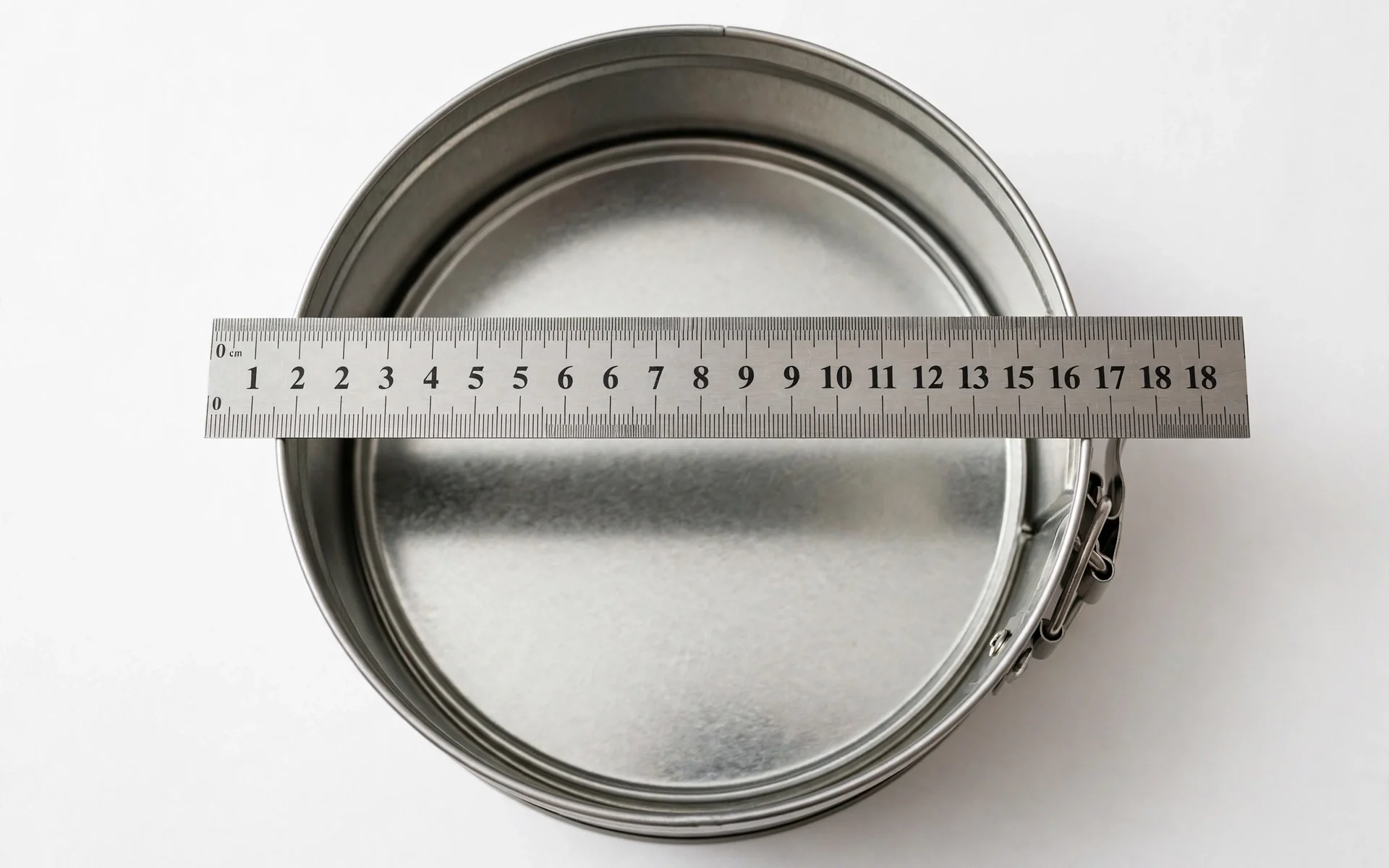
The cake tin is the article's roundest exact, because its 16 cm is the diameter of the cake it bakes. The Meyer Bakemaster 16 cm springform cake tin is sold as 16 cm, and the maker's specification gives its diameter as exactly 16 cm and its height as 7 cm — cold-rolled carbon steel, round, with a removable base, the tin that bakes the small birthday cake, the single-layer sponge, and the cheesecake for four, and every 16 cm round tin from every maker is the same width across the top, because the 16 cm is the size the tin is sold by. Set one on a ruler and the rim runs from zero to sixteen with nothing to argue about, and the cake that comes out of it is 16 cm across too.
The fitting check is the inch tin, because a 16 cm tin is 16 cm and a 6-inch tin is 15.24 cm — seven and a half millimetres narrower — and a recipe written for a 6-inch tin bakes thinner and faster in a 16 cm tin, while a recipe written for a 16 cm tin overflows a 6-inch tin. The guides that call a 16 cm tin "a 6-inch tin" are using the rounded nickname and never say which tin they mean, and the shops that sell both will hand you the wrong one if you ask for "six inch" when you meant sixteen centimetres. The grade is listed because the figure is the manufacturer's own specification for this named model: 16 cm diameter, by the maker's own sheet, and the zero millimetre miss is printed in the heading itself. Hold a 16 cm cake tin against a ruler and you are holding 16 cm — exactly, in steel, and the same in every bakery you will ever bake in.
5. A Kelly Hemostatic Forceps, Curved, 16 Cm — 16 Cm Long (LISTED)

The forceps is the article's most surprising exact, because it is the 16 cm object nobody expects to find in a kitchen drawer. The Kelly hemostatic forceps — the ring-handled clamp with a ratchet lock that surgeons use to hold a blood vessel shut — is sold in two standard lengths, 14 cm and 16 cm, and the maker's specification sheet for the curved 16 cm model gives its length as exactly 16.0 cm, stainless steel, with transverse serrations covering the distal half of the jaws. It is the instrument in every operating theatre, every veterinary surgery, and every first-aid kit that stocks one, and every 16 cm Kelly from every maker is the same length from hinge to tip, because the 16 cm is the size the instrument is sold by.
The fitting check is the inch label, because the same instrument is sold as "6.25-inch" and 6.25 inches is 15.875 cm — a millimetre and a quarter short of 16 cm — so the inch label rounds the other way from the knife's: the knife's "6 inch" label is 7.6 mm short of its 16 cm blade, while the forceps' "6.25 inch" label is 1.25 mm short of its 16 cm body. And the two standard lengths are the trap in the other direction: a 14 cm Kelly is two centimetres shorter, and a tray, a pouch, or a sterilisation wrap bought against "a Kelly" without saying which length will not take the 16 cm one. The grade is listed because the figure is the manufacturer's own specification for this named instrument: 16.0 cm, by the maker's own sheet, and the zero millimetre miss is printed in the heading itself. Hold a 16 cm Kelly forceps against a ruler and you are holding 16 cm — exactly, in steel, and the same in every theatre you will ever work in.
6. A Samsung Galaxy S24 Ultra — 16.23 Cm Tall (LISTED)
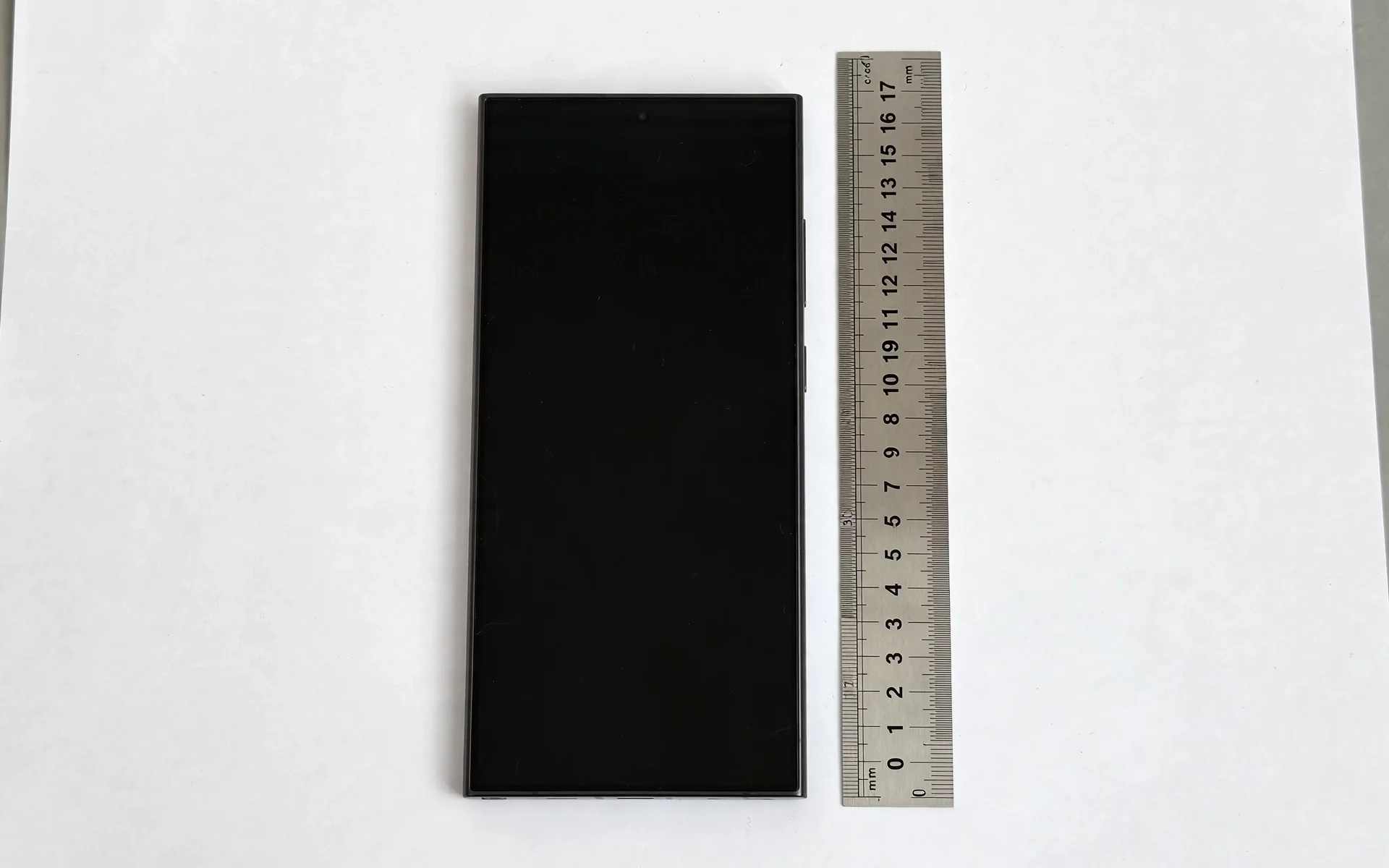
The Galaxy S24 Ultra is the article's tallest phone, and the object that proves 16 cm has a far side. Samsung's own specification sheet lists the Galaxy S24 Ultra at 162.3 mm tall, 79.0 mm wide, and 8.6 mm thick, weighing 232 grams — 16.23 cm on its long edge, which overshoots 16 cm by 2.3 millimetres, the width of the S Pen slot and the flat top edge that make the Ultra the tallest mainstream flagship on sale. It is the phone in the pocket of everyone who wanted the biggest Android of 2024, the phone with the stylus in its belly, and the phone whose height is the one dimension you never have to guess, because Samsung printed it in its own specification sheet.
The fitting check is the screen, because the phone's height is 16.23 cm and its screen is 6.8 inches measured diagonally — a different number in a different direction, and 17.27 cm across the diagonal at that. A case, a sleeve, or a car mount bought against "16 cm" fails if you measure the diagonal, and the guides that call the S24 Ultra "roughly 16 cm" are right about the direction and wrong about the precision — the phone is 2.3 millimetres past 16 cm, and a sleeve cut to exactly 16 cm will not take it. The grade is listed because the figure is the manufacturer's own specification for this named model, with the deviation printed in full: 162.3 mm, not 160 mm, and the 2.3 millimetres is the whole story. Measure your phone's height before you measure your pocket, because the phone is the object in this article you carry every day.
7. A Focal Universal ICU 165 Car Speaker — 16.5 Cm Across (EXACT)
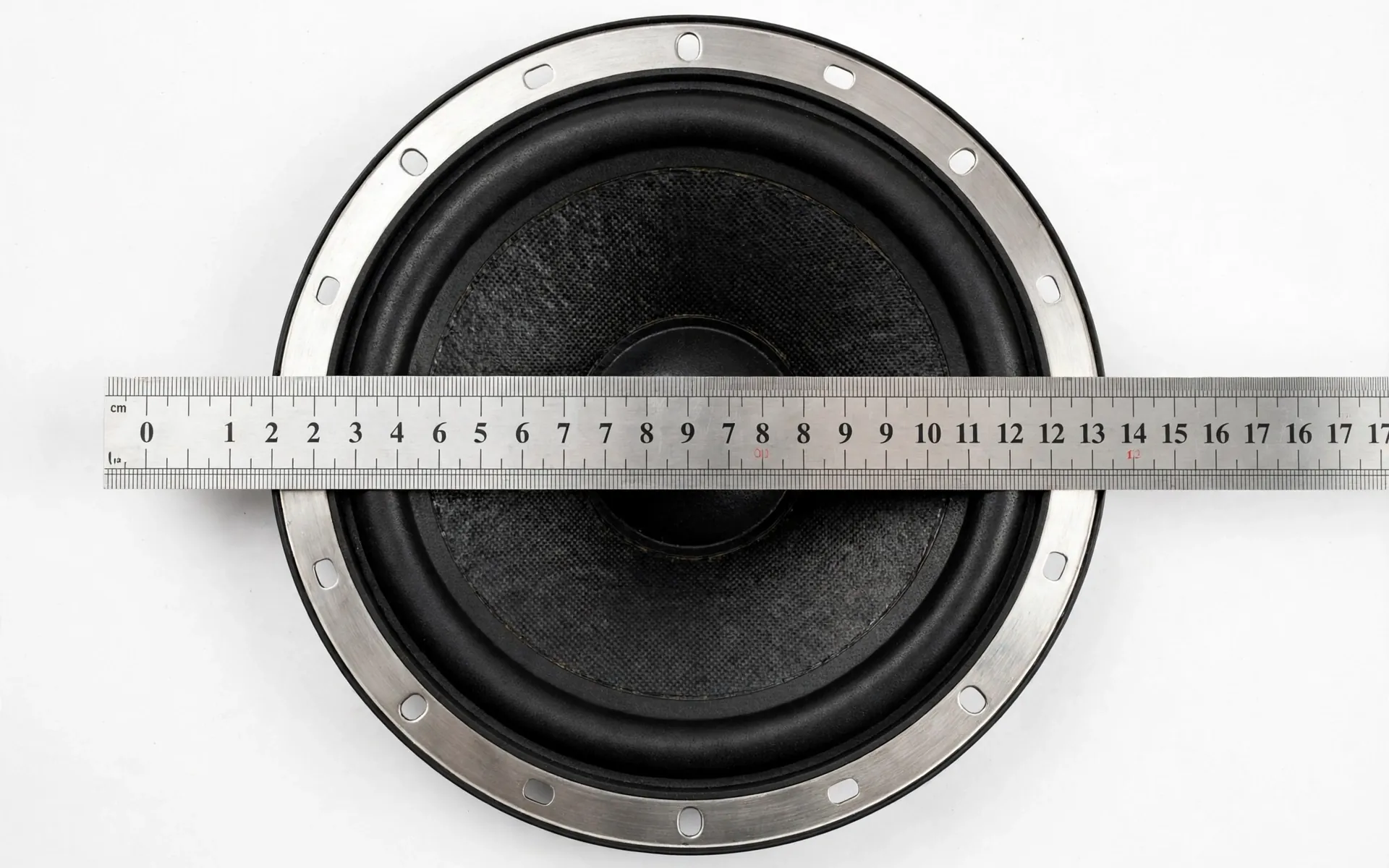
The car speaker is the article's largest miss, and the one with the strongest standard behind it. The Focal Universal ICU 165 is sold as a 6.5-inch coaxial car speaker, and the maker's own listing gives it as 6.5-inch (16.5 cm) — 6.5 inches times 2.54 is 16.51 cm by definition of the inch, so the frame of every 6.5-inch speaker in the world is 16.5 cm across, whether it is a Focal, a Pioneer, a JL Audio, or the factory speaker in the door of the car you drove here in. It overshoots 16 cm by exactly 5.1 millimetres, and the same number holds whether the speaker is a coaxial, a component woofer, or a midrange driver. It is the speaker in your car door, and it is the same size in every car door that takes a 6.5-inch speaker.
The fitting check is the hole, because the speaker's frame is 16.5 cm and the hole it fits is 138 mm — two and three-quarter centimetres narrower — and the mounting depth is 49 mm, so a door cut for a 16 cm speaker will not take it and a door with less than 49 mm of depth behind the panel will not take it either. The guides that call a 6.5-inch speaker "about 16 cm" never say whether they mean the frame, the cone, or the cutout, and never mention that the "6.5-inch" label is a nominal size — the frame is 16.51 cm, the cutout is 13.8 cm, and neither of them is 16 cm. The grade is exact because the figure is the standard size's own dimension for this named model: 6.5 inches, by definition of the inch, and the 5.1-millimetre miss is printed in the heading itself. Hold a 6.5-inch speaker against a ruler and you are holding 16.51 cm — five millimetres past the number in this article's title, and the same in every car door you will ever open.
16 Cm Has No Ruler of Its Own
Sixteen centimetres is a number you can measure without a second tool, but not with the ruler you probably own — because there is no standard 16 cm ruler. The rulers the world actually sells are 15 cm and 30 cm, and the 15 cm ruler stops one centimetre short of the number in this article's title. That is the whole practical problem of 16 cm: the tool that measures it is always the wrong length, and the fix is to measure in two steps instead of one. First, lay your 15 cm ruler against the object and mark where it ends — that mark is 15 cm. Second, measure one more centimetre past the mark: the width of your thumbnail is about a centimetre, the width of a standard pencil is about a centimetre, and the short edge of a credit card is 5.4 cm, so a fifth of it is about a centimetre. Third, check the other direction: hold the object against the phone in your pocket — an iPhone 15 Pro Max is 15.99 cm tall, which is 16 cm to within a tenth of a millimetre, and a Galaxy S24 Ultra is 16.23 cm tall, which is 2.3 millimetres past it — so if the object matches the Pro Max, it is 16 cm, and if it matches the Ultra, it is 16.2 cm. Fourth, remember the pan: a 16 cm saucepan is 16 cm across its top by the maker's own specification, so the lid that fits it is 16 cm, the tin that stacks in it is 16 cm, and the shelf that holds it needs 16 cm plus the handle. None of these replaces a calibrated tool for anything that must fit, but all four will tell you whether 16 cm is the size you think it is before the sleeve is ordered, the speaker is bought, or the tin is baked in.
Where the Other Lists Get 16 Cm Wrong
Seven wrong numbers about 16 cm circulate so widely that they deserve their own section, because each one is stated confidently on a page that ranks for this exact question. First, the pencil: one popular guide calls a standard pencil "about 16 cm" in one section and "about 19 cm" in another — the same article contradicts itself by three centimetres, and the true figure is 19 cm, because a standard unsharpened pencil is 7.5 inches long. Second, the divide-by-2.5 shortcut: another guide walks you through dividing 16 by 2.5 and lands on 6.4 inches, and 16 cm is 6.30 inches — the shortcut overstates by 2.5 millimetres, which is a canyon in tailoring and machining. Third, the butter knife: one popular guide says a standard butter knife "often measures right between 15 and 17 centimetres", and a range is not a measurement — no named knife, no figure, and a range that spans two centimetres. Fourth, the credit cards: two guides tell you to lay two credit cards end to end, and two cards are 17.12 cm — more than a centimetre over — and a multiple is arithmetic, not an object. Fifth, the six-inch pot: one popular guide says a 16 cm pot is the same as a 6-inch pot, and a 6-inch pot is 15.24 cm — a 16 cm pot is a different, larger pot, and the nursery will hand you the smaller one if you ask for six inches. Sixth, the CD: one popular guide says a CD is "roughly 16 cm" across, and a CD is 12 cm in diameter — the claim is four centimetres wrong. Seventh, the hamster and the banana: two guides offer a Syrian hamster at "15 to 17 cm" and a large banana at "15 to 18 cm", and ranges of living things are not measurements — no two hamsters are the same length, and no banana is straight. None of these seven numbers belongs in a 16 cm article, and all seven are here so you never have to learn that from a purchase.
16 Cm Against the Sizes Around It
Sixteen centimetres sits one centimetre past the ruler in the last article — a 15 cm scale by definition — and four millimetres past your dollar bill, which is 15.6 cm on its long side. Step up the ladder and the rungs crowd together: the iPhone 15 at 14.76 cm, the A5 sheet at 14.8 cm, the BIC Cristal at 14.9 cm, the 6-inch ruler at 15.24 cm — which is also exactly 6 inches, the round number people keep rounding 16 cm down to, and the reason the rounding is wrong by 7.6 millimetres — then the dollar bill at 15.6 cm, the iPhone 15 Pro Max at 15.99 cm, the saucepan, the knife, the cake tin, and the forceps all at 16 cm exactly, the Galaxy S24 Ultra at 16.23 cm, and the car speaker at 16.51 cm. The ladder runs 12, 14.76, 14.8, 14.9, 15.24, 15.6, 15.99, 16, 16.23, 16.51 — and the point of it is the middle: 16 cm is the only rung with four tools behind it that are sold by the number itself, a saucepan on one side and a surgical instrument on the other, and that is why it is the easiest size in the series to buy by the number.
How 16 Cm Compares With Other Lengths
Readers comparing nearby sizes may also want the site’s guides to 15 cm, 14 cm, 13 cm, 12 cm, 11 cm, and 10 cm for the centimetre series, and 12 feet, 11 feet, and 40 inches for the foot and inch series. Each of those guides follows the same rule as this one: the spec sheet, the grade, and the miss printed in full.
Frequently Asked Questions
How many inches is 16 cm?
16 cm is 6.30 inches, or 6 and 5/16 inches in fraction form. Divide 16 by 2.54 and you get 6.2992 inches — and the trap is rounding that to 6 and 1/4 inches, which is 15.875 cm and 1.25 millimetres short, or dividing by 2.5, which gives 6.4 inches and is 2.5 millimetres too long. For anything that must fit, use 6.30 inches; for a quick estimate in your head, 6 and 5/16 inches is 16.04 cm, which is close enough to picture it and only 0.4 millimetres over.
How many millimetres is 16 cm?
160 millimetres exactly. Multiply 16 by 10 and you get 160 with no rounding involved, because the centimetre is defined as exactly 10 millimetres. In metres that is 0.16 m, in feet it is 0.52 ft, and in yards it is 0.17 yards rounded — exactly 0.1750 yards, which is the figure a tape measure will show if it is marked in yards.
Is 16 cm the same as 6 inches?
No, and the difference matters more than it did at 15 cm. Six inches is 15.24 cm, which is 7.6 millimetres shorter than 16 cm — the length of a 6-inch cake tin is 15.24 cm, and a recipe written for a 16 cm tin overflows it. If you buy a 6-inch pot for a 16 cm space, you will be 7.6 millimetres short, and 7.6 millimetres at this size is a gap that shows, not a rounding error.
What is 16 cm wide in real life?
The most exact everyday answers are the four things sold by the number itself: a 16 cm saucepan (16 cm across the top), a 16 cm springform cake tin (16 cm diameter), a 16 cm chef's knife blade, and a 16 cm Kelly forceps. The next closest are an Apple iPhone 15 Pro Max (15.99 cm tall — one tenth of a millimetre short), a Samsung Galaxy S24 Ultra (16.23 cm tall), and a 6.5-inch car speaker (16.51 cm across). Each one's miss is printed beside it in this article.
Is an iPhone 15 Pro Max really 16 cm tall?
Almost exactly. An iPhone 15 Pro Max is 159.9 mm tall according to Apple's own technical specifications — 15.99 cm, which misses 16 cm by one tenth of a millimetre, thinner than a sheet of paper and smaller than the phone's own manufacturing tolerance. The guides that call it "about 16 cm" are right for once, and the 6.7-inch figure you see in shops is the screen measured diagonally, not the phone's height.
Is a 6.5-inch car speaker 16 cm across?
No — it is 16.51 cm across, which is 5.1 millimetres past 16 cm. A 6.5-inch speaker is 6.5 inches times 2.54, which is 16.51 cm by definition of the inch, and the maker's own listing gives the Focal ICU 165 as 6.5-inch (16.5 cm). The trap is the hole: the frame is 16.5 cm but the mounting cutout is only 138 mm, so a door cut for a 16 cm speaker will not take it.
How big is a Galaxy S24 Ultra in inches?
A Galaxy S24 Ultra is 6.39 inches tall, 3.11 inches wide, and 0.34 inches thick, weighing 8.18 ounces — 162.3 × 79.0 × 8.6 mm in Samsung's own specification sheet. The 6.8-inch figure you see in shops is the screen measured diagonally, not the phone's height, and the phone is only 3.11 inches wide — less than half of 16 cm. If you are buying a case or a sleeve, buy by the 162.3 mm height, not by the screen size.
How do I measure 16 cm without a ruler?
Use a 16 cm saucepan if you have one — it is 16 cm across the top by the maker's own specification. Otherwise use your iPhone 15 Pro Max (15.99 cm tall — add a tenth of a millimetre in your head), your Galaxy S24 Ultra (16.23 cm tall — shave off 2.3 millimetres), or a 15 cm ruler plus one more centimetre past its end mark. For anything that must fit — a sleeve, a speaker, a tin — borrow or buy a real tape measure, because at 16 cm the misses in this article run from a tenth of a millimetre to five, and guessing throws every one of them away.
Final Thoughts
Sixteen centimetres is the rare measurement that is sold by its own number and still misunderstood, because 6.30 inches can be a phone, a pan, a blade, a tin, a forceps, a bigger phone, or a car speaker — and the number alone never says which. Now you know it as a phone's height fixed by its maker, a pan's diameter fixed by its maker, a blade's length fixed by its maker, a tin's diameter fixed by its maker, a forceps' length fixed by its maker, a bigger phone's height fixed by its maker, and a speaker's frame fixed by the definition of the inch — and you know which of those you can trust to the millimetre and which you must measure yourself. The rule that runs through all seven is the same one this site always uses: trust the spec sheet, print the deviation, and let the name stay on the box where it belongs. Measure twice, in the direction the object actually travels, and 16 cm will fit the first time.
