
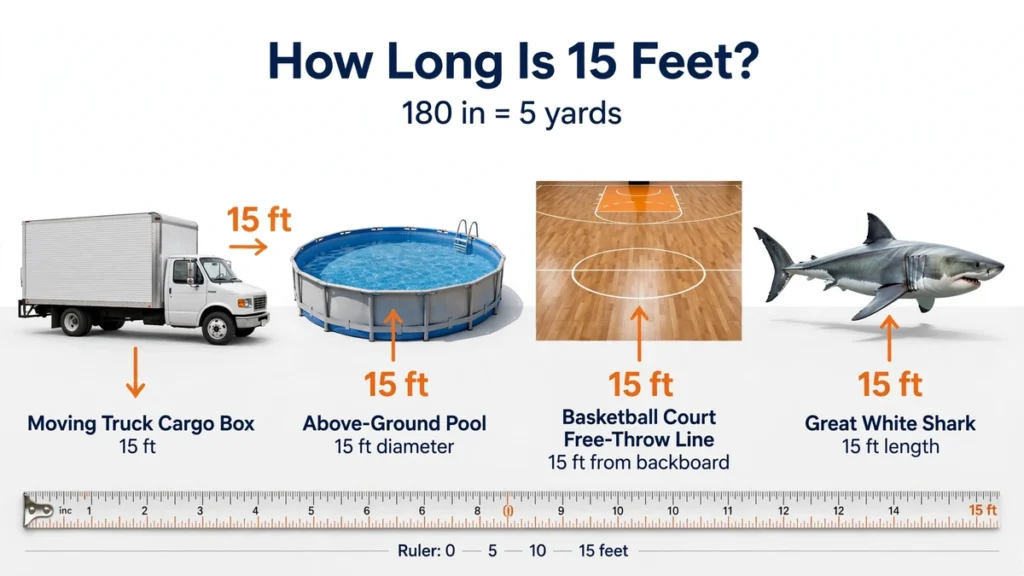
If you have ever wondered how long is 15 feet, you have probably been given the one clean fact about it — that it is exactly 5 yards — and then a list that falls apart on inspection. Fifteen feet is 180 inches, or 4.572 metres, and it is the rare length in this series that converts to a whole number of yards without a fraction. Sixteen feet is one foot longer. That cleanliness is also its trap: because 15 feet sounds tidy, lists feel free to fill it with anything “about” 15 feet — a sedan that is really 15.9 feet, a canoe that is really 16, a giraffe’s neck that is really 6. The number is exact; the objects usually are not.
This article, part of the complete feet size guide, leads with the three anchors that actually check out — a truck’s cargo box, a pool’s diameter, and a court’s rulebook distance — then adds a shark average and two composites that are labelled as composites, not smuggled in as singles. Every object carries its evidence grade, and every object’s image sits immediately after its heading. By the end you will know 15 feet as a truck you can load, a pool you can walk across, a line you can stand behind, an animal you can respect at a distance, and two honest additions — and you will know, for each one, whether it is exact, average, or added together.
Quick Answer
15 feet = 180 inches exactly = 457.2 cm = 4.572 m = exactly 5 yards. As a distance it is about six adult steps; as a room wall it is the longest wall of a 10-by-15-foot bedroom; and as a truck it is the cargo box that moves a one-to-two-bedroom apartment — but the whole truck with cab is longer, about 22 feet 6 inches.
Exact, Average, or Added Together? Read This First
Every comparison in this article carries one of three labels, and the label is part of the claim. EXACT means a manufacturer dimension or a governing-body rule fixes the figure: the truck’s cargo box, the pool’s listed diameter, and the free-throw line are exact. AVERAGE means an authority range or typical figure, not a measurement of one individual — used here only for the shark. ADDED TOGETHER means the figure is the sum of smaller labelled pieces: three 5-foot benches, two 7.5-foot trees. The composites are not second-class citizens, but they are not single objects either, and this article never lets you mistake one for the other. If a list elsewhere does not tell you which kind its numbers are, it has not finished its job.
The 6 Objects
The Three Anchors: Truck, Pool, and Court Line
1. 15-Foot Moving Truck — 15-Foot Cargo Box, Not a 15-Foot Truck (EXACT)

A 15-foot moving truck is the article’s first anchor, and its name needs the same honesty as its measurement. The cargo box has an interior cargo length of exactly 15 feet, with a box roughly 15 feet long, 7 feet 8 inches wide, and 7 feet 2 inches high, giving about 764 cubic feet of space. That is EXACT: the manufacturer’s own interior dimension, not a marketing round-up.
The qualification is the point. The whole truck with cab is longer — roughly 22 feet 6 inches overall — so “the truck is 15 feet long” without the words “cargo box” is wrong by seven feet. What the 15 feet buys you is a move: the box is the standard size for a one-to-two-bedroom apartment, holding a queen bed, a sofa, a dining set, and the boxes that go with them, if they are loaded well. Measure the driveway before moving day, because the truck you must park is 22 feet long, and the box you must fill is 15.
2. 15-Foot Round Above-Ground Pool — 15 Feet Across, Edge to Edge (EXACT)

A 15-foot round above-ground pool measures 15 feet across — its diameter, edge to edge. The manufacturer’s size table lists the 15-foot diameter for its round metal-frame pools, and walking from one edge to the other, across the water, is walking 15 feet. That is EXACT, with one honest note: the figure is the listed frame diameter, joint to joint, so the waterline width is a fraction less once the wall and liner are counted. The article says “listed diameter” rather than implying millimetre-perfect water width.
A diameter is a different kind of 15 feet from the truck’s length, and the difference is worth feeling. A 15-foot pool needs a yard patch 15 feet across plus clearance around it for the ladder, the filter, and the feet of whoever walks around it — a 15-foot circle eats more yard than a 15-foot line eats wall. If your yard is 15 feet wide, a 15-foot pool does not fit in it, because the circle needs the full 15 feet and the clearance needs more. Measure the yard in both directions, because a circle punishes a short side that a rectangle forgives.
3. Basketball Free-Throw Line — Exactly 15 Feet From the Backboard (EXACT)

The free-throw line in basketball is exactly 15 feet from the plane of the face of the backboard. That is EXACT, by governing-body rule, and it is a distance, not a physical object — the article says so plainly, because standing on the line and looking at the backboard is the purest way to feel 15 feet: an empty gap, measured by rule, with nothing in it but air and expectation.
This is the object to use when someone asks what 15 feet feels like in a gym. Stand on the line, look at the backboard, and the space between you and the glass is 15 feet — the same 15 feet as the truck’s cargo box and the pool’s diameter, but with nothing to lean on. It is also the easiest 15 feet to find without buying anything: any court with a marked free-throw line already has one painted on the floor. Pace it, stand on it, shoot from it, and the number becomes a place you have stood.
The Animal: An Average, Not a Specimen
4. Adult Female Great White Shark — 15 to 16 Feet on Average (AVERAGE)
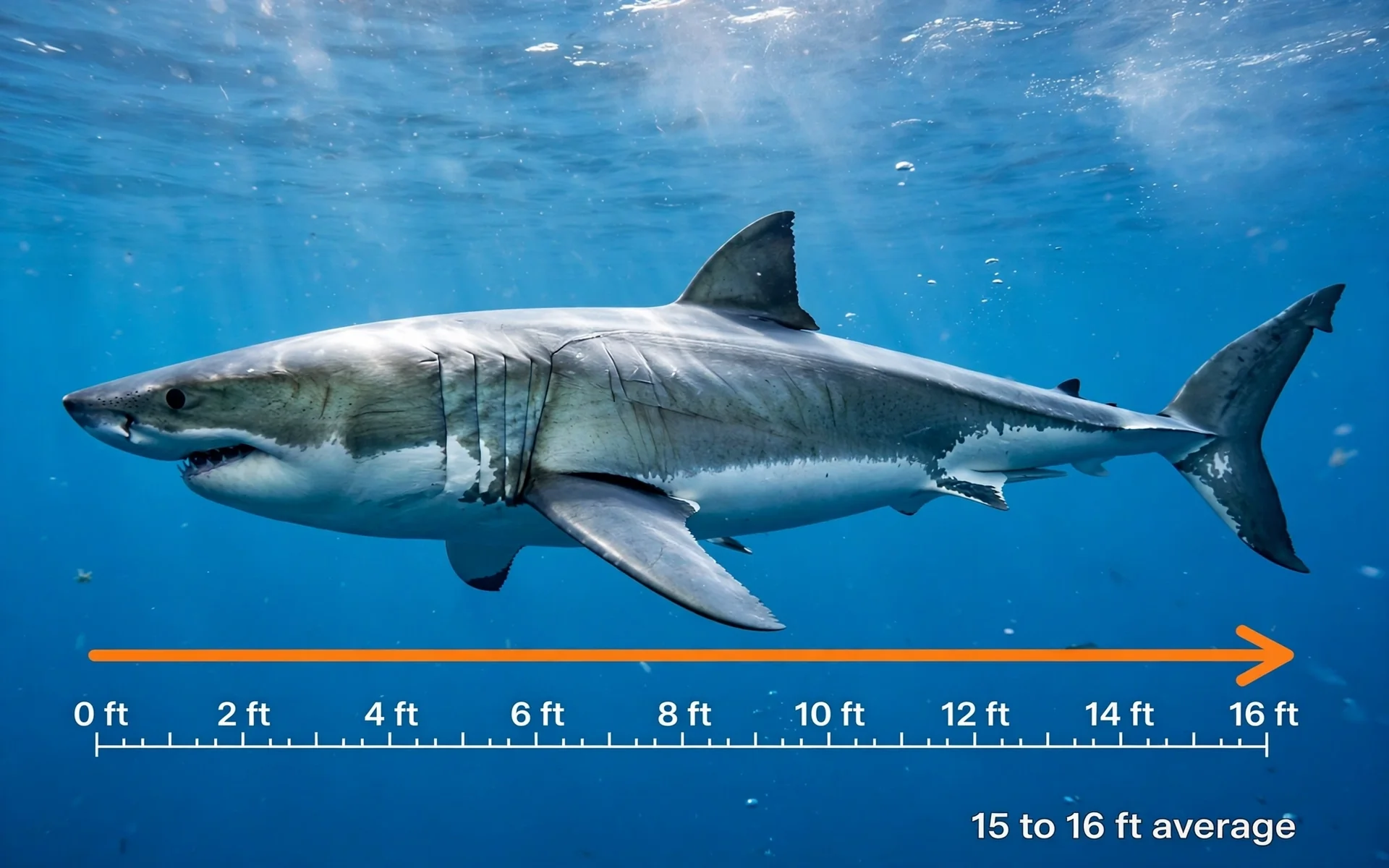
An adult female great white shark averages 15 to 16 feet long, with males smaller at roughly 11 to 13 feet and exceptional females reaching toward 20 feet. That is AVERAGE, a sex-specific authority figure, and the article never flattens it into “a great white shark is 15 feet.” Most females are in the 15-to-16-foot band; a male is not; a record female is not. The range is the fact.
Why include an animal you will never measure with a tape? Because it is the only way to picture 15 feet as a living length, and because it corrects the two errors other lists make with sharks: quoting a male’s size for the species, or quoting a record specimen as if it were typical. A 15-foot female is not a monster; she is the middle of her sex’s range, swimming a length equal to a truck’s cargo box and a pool’s diameter. Respect the range, and the animal becomes a yardstick instead of a myth.
Added Together — Labelled, Not Hidden
5. Three 5-Foot Benches End to End — Exactly 15 Feet, Added Together (LISTED Composite)
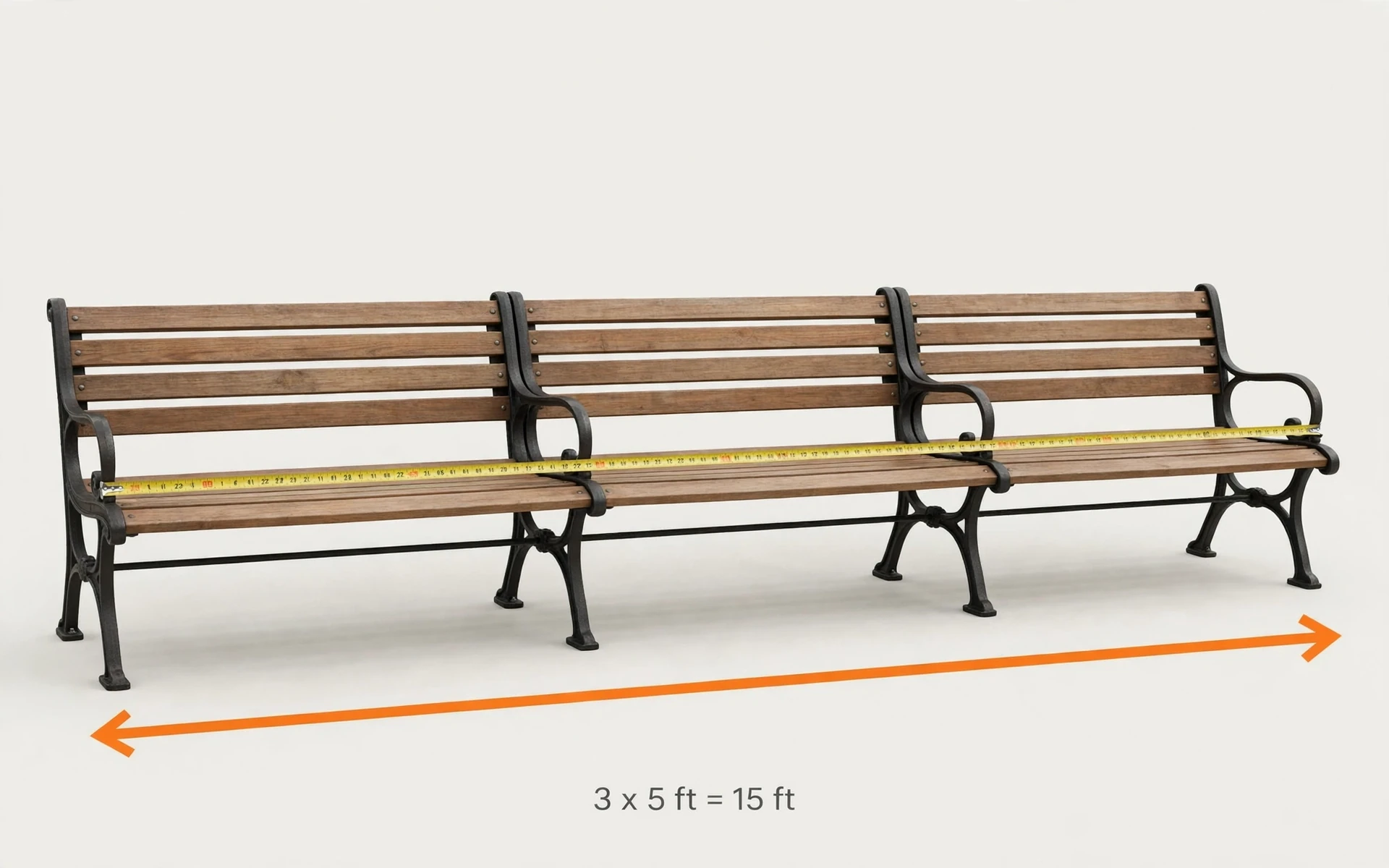
Three 60-inch benches placed end to end span exactly 15 feet: three times 60 inches is 180 inches. That is LISTED as a composite — each bench carries an overall width of 60 inches from its manufacturer’s specification, and the 15 feet is the sum, not a single bench. The article labels it added together in the heading, because a row of three benches is a useful picture of 15 feet and a dishonest one only if you pretend it is one object.
The picture is worth keeping precisely because it is honest about its construction. A park bench row, a waiting-room run, or three benches along a garden path: each is a place where 15 feet already exists in the world, assembled from fives. Count the benches, multiply by five feet, and you have measured 15 feet without a tape — and you have done it without pretending any one bench is 15 feet long.
6. Two 7.5-Foot Artificial Christmas Trees, One Atop the Other — Exactly 15 Feet, Added Together (LISTED Composite)

Two 7.5-foot artificial Christmas trees, one stacked atop the other, reach exactly 15 feet: two times 7.5 feet is 15 feet. That is LISTED as a composite — each tree carries a listed height of 7.5 feet, and the 15 feet is the doubled figure, not a single tree. The article labels it added together, and adds the real-world note that a topper or a stand would add a little more in an actual home.
The stack is the article’s most seasonal yardstick, and its honesty is its charm. Nobody owns a 15-foot Christmas tree; plenty of households own a 7.5-foot one, and two of them, imagined one atop the other, give a height nobody can picture from a number alone. Fifteen feet is roughly two Christmas trees tall — a sentence you can say at a family gathering and have everyone see, instantly, without a tape measure in the room.
Claims to Avoid: Two Errors This Article Does Not Repeat
A rival list claims half a standard 20-foot shipping container is 15 feet. It is not: half of 20 feet is 10 feet, and the claim fails on arithmetic a child can check. Another claims a giraffe’s neck is about 15 feet long. It is not: the whole giraffe is in that range, and its neck is roughly 6 feet — the article’s giraffe entry in the previous piece in this series says so with the range printed. Both errors survive because readers trust lists more than arithmetic; this article prints the arithmetic, so the errors die here.
How to Measure 15 Feet at Home Without a Tape Measure
Stand on a basketball free-throw line and look at the backboard: that gap is 15 feet, painted on the floor of any court. Or walk six adult steps heel to toe — check your stride against a known distance first, because strides vary. Or pace the longest wall of a 10-by-15-foot bedroom, which is 15 feet by definition. Or picture two 7.5-foot Christmas trees, one atop the other. For anything that must fit — a truck in a driveway, a pool in a yard, a sofa against a wall — use a real tape measure, because at 15 feet a few inches are the whole difference between fitting and finding out on delivery day.
Where 15 Feet Matters: Moving Day, Backyard, and Gym
Fifteen feet is a moving-day number, a backyard number, and a gym number all at once. On moving day it is the cargo box that decides whether one trip suffices; in the backyard it is the pool diameter that decides whether the yard suffices; in the gym it is the line that decides whether the shot counts. In every case the rule is the same: measure the space in the same direction as the thing, add clearance for the parts that stick out — the truck’s cab, the pool’s ladder, the shooter’s follow-through — and never round a limit down. Do not round 4.572 metres to 4.5 metres in a building or spec context either: that rounding loses nearly three inches, and three inches at 15 feet is a gap you can see.
Conversion Table
| Unit | 15 feet equals |
|---|---|
| Inches | 180 in |
| Centimetres | 457.2 cm |
| Millimetres | 4,572 mm |
| Metres | 4.572 m |
| Yards | 5 yd exactly |
| Miles | 0.00284 miles (about 1/350 mile) |
| Compared with 14 feet | 1 foot longer |
| Compared with 13 feet | 2 feet longer |
| Compared with a 10-by-15-ft room | The longest wall |
| Compared with a standard door (6 ft 8 in) | About 2.25 doors tall |
| Compared with a standard 8-ft ceiling | 1.875 ceilings |
How 15 Feet Compares With Other Lengths
Fifteen feet is one foot longer than 14 feet, two feet longer than 13 feet, and three feet longer than 12 feet. Against the inch series it is four and a half times 40 inches, six times 30 inches, and nine times 20 inches. And against the newest inch article, it is 130 inches past 50 inches and more than sixteen times 11 inches.
Frequently Asked Questions
How long is 15 feet in inches, cm, and meters?
180 inches, 457.2 centimetres, and 4.572 metres. It is also exactly 5 yards — the one clean conversion in this series, since 15 divided by 3 is 5 with nothing left over.
How can I picture 15 feet without a tape measure?
Stand on a basketball free-throw line and look at the backboard — that gap is exactly 15 feet. Or walk six adult steps, pace the longest wall of a 10-by-15-foot bedroom, or picture two 7.5-foot Christmas trees stacked. For anything that must fit, use a real tape measure.
Is a car 15 feet long?
Some are close, but do not use “a car” as a 15-foot object. Mid-size sedans commonly run 15.9 to about 16 feet — nearly a foot over — and compacts run shorter. A car is a near-miss in both directions, which is why this article uses a truck’s cargo box, a pool, and a court line instead of a car.
How many steps does it take to walk 15 feet?
About six adult steps, heel to toe. Strides vary, so check your own stride against a measured distance before relying on it for anything that matters — a long-striding adult may cover 15 feet in five steps, a shorter one in seven.
What size room has a 15-foot wall?
A 10-by-15-foot bedroom is the classic example: its longest wall is 15 feet. A 15-foot wall holds a sofa plus side tables comfortably, and it is the wall to measure before ordering a sectional, which can easily run past 10 feet on its own.
How far is the basketball free-throw line, and is it really 15 feet?
Yes, really 15 feet — measured from the plane of the face of the backboard to the free-throw line, by rule. It is one of the few 15-foot figures in sport that is exact rather than approximate, which is why this article uses it as an anchor.
What fits inside a 15-foot moving truck?
A one-to-two-bedroom apartment: a queen bed, a sofa, a dining set, and the boxes that go with them, in about 764 cubic feet of cargo space. Load heavy items low and forward, fill gaps with soft items, and remember the whole truck with cab is about 22 feet 6 inches long when you plan the parking.
Is 15 feet the same as 15 yards — and how many yards is 15 feet?
No. Fifteen feet is 5 yards, not 15 yards — 15 yards would be 45 feet, three times as long. Divide feet by 3 to get yards: 15 divided by 3 is exactly 5.
Final Thoughts
Fifteen feet is the cleanest number in this series and the easiest to get wrong, because its clean conversion invites sloppy objects. It is 180 inches, 4.572 metres, exactly 5 yards, a truck’s cargo box, a pool’s diameter, a court’s rulebook line, a female shark’s average, and two honest additions — three benches and two trees — labelled as additions, not disguised as singles. No sedans rounded down, no canoes rounded up, no container halves that fail arithmetic, no necks mistaken for whole animals. Just six proofs, each labelled exact, average, or added together, so that the next time someone says “15 feet,” you do not have to guess what that looks like. You have already loaded it, walked across it, stood behind it, respected it at a distance, and counted it in benches and trees — and you know exactly which kind of proof each one was.
