
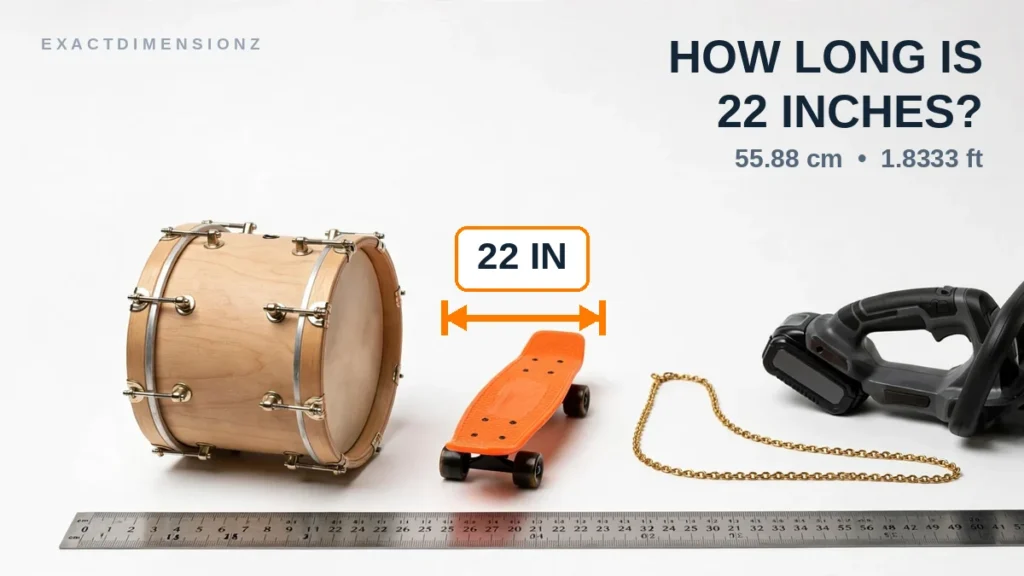
If you are wondering how long is 22 inches, the answer is 55.88 centimeters — exactly. That is 558.8 millimeters, or 0.5588 meters: ten inches short of a yard, six inches past a 16-inch laptop, and the largest measurement most people meet as a rule rather than a description. It is the height of the biggest bag you may carry into an aircraft cabin, the diameter of the drum at the center of a rock kit, and the depth of the bathroom counter you wash at. See the complete inches size guide, with 21 inches — one inch shorter and 23 inches — one inch longer on either side.
The tricky part is not the number. It is knowing which edge of a real object actually measures 22 inches — because a “22-inch” monitor shows 21.5 inches, a “22-inch” kettle measures 22.5 across the bowl, and one “22-inch” carry-on bag stands 23 inches overall, a full inch over the airline limit. Below are 12 real things with a verified 22-inch dimension, each one checked against a primary source and graded honestly, so you can see not just what 22 inches looks like, but which claims you can trust.
How long is 22 inches?
22 inches is exactly 55.88 cm — 558.8 mm, or 0.5588 meters. The inch is defined against the centimeter (one inch is exactly 2.54 cm), so these conversions are exact, not rounded estimates. In feet it is 1.833 feet, or 1 foot 10 inches.
The one rule: name the dimension
A product described as “22 inches” is not 22 inches in every direction, and that single fact causes most of the confusion around this measurement. A drum is 22 inches across its shell. A skateboard is 22 inches nose to tail. A hedge trimmer is 22 inches in its blade alone, on a 36-inch tool. A monitor sold as 22 inches shows 21.5 inches on the diagonal. The number 22 inches is always the same — but the edge it describes changes with every product.
One more distinction matters. The conversions in this article are exact by definition: 22 inches is exactly 55.88 cm, exactly 558.8 mm, and exactly 0.5588 meters. The feet and yards figures are rounded for readability (1.833 feet, 0.611 yards). The objects, on the other hand, are listed at 22 inches — those are the makers’ and retailers’ published specifications, and this article grades them as such rather than pretending someone went out with a tape measure. Each object below carries one of three verdicts. FULL VALUE means a tape laid on the object, in the direction the name promises, reads the full 22.00. SMALL SPREAD means the claim survives but with a cut — a class name instead of a diagonal, a bowl wider than the grate it feeds, a length so rare it falls off the official chart. SHORT-CHANGED means the exchange runs against you: the object measures materially more, or materially other, than the 22 you were sold, in the direction you will actually use.
1. The Airline Carry-On Limit: 22 × 14 × 9 Inches
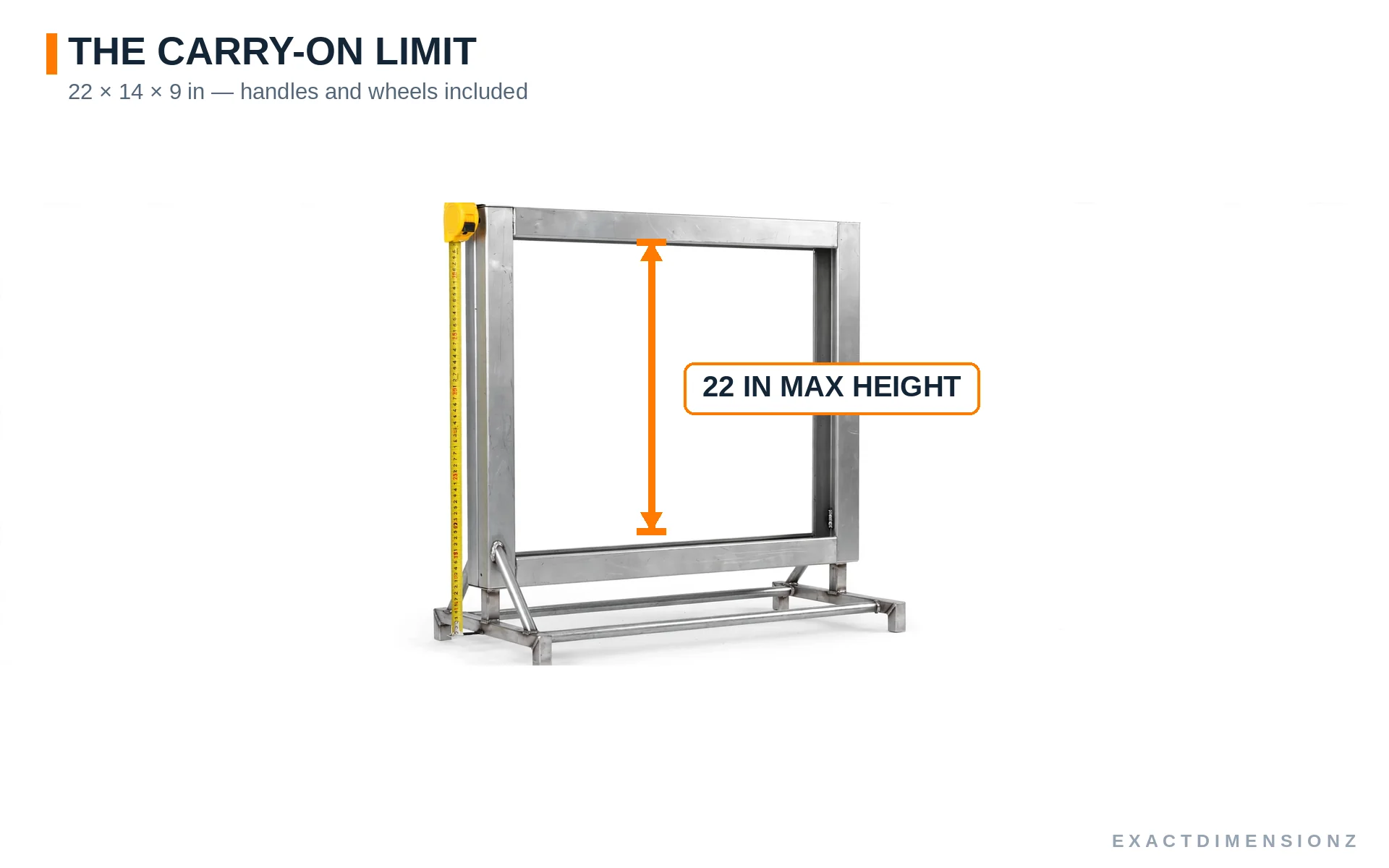
The first item on this list is not an object. It is the rule the other claims get judged by. The largest US airlines publish the same maximum carry-on size: 22 × 14 × 9 inches, handles and wheels included. The clause does all the work — the limit applies to the whole object you roll up to the sizer, not to the fabric box inside it.
Why does the limit lead the article? Because it is the only 22 on this list with an enforcement mechanism. Nobody measures your kettle. Nobody audits your necklace. But a carry-on that exceeds 22 inches in overall height can be pulled out of the boarding line and gate-checked, at the worst possible moment, for a fee. Every “22-inch bag” sold anywhere is implicitly a claim about this rule — which is why the rule itself comes first, face up, before any bag is allowed to testify. Hold this number: 22.00, overall, everything included.
Measurement: 22-inch overall height ceiling, handles and wheels included. Evidence: LISTED (carrier limits via luggage-maker tables). Source: airline-limit table on Travelpro’s product page — Travelpro. Verdict: FULL VALUE — it is the benchmark itself.
2. Yamaha Stage Custom Birch Bass Drum: 22 × 17 Inches
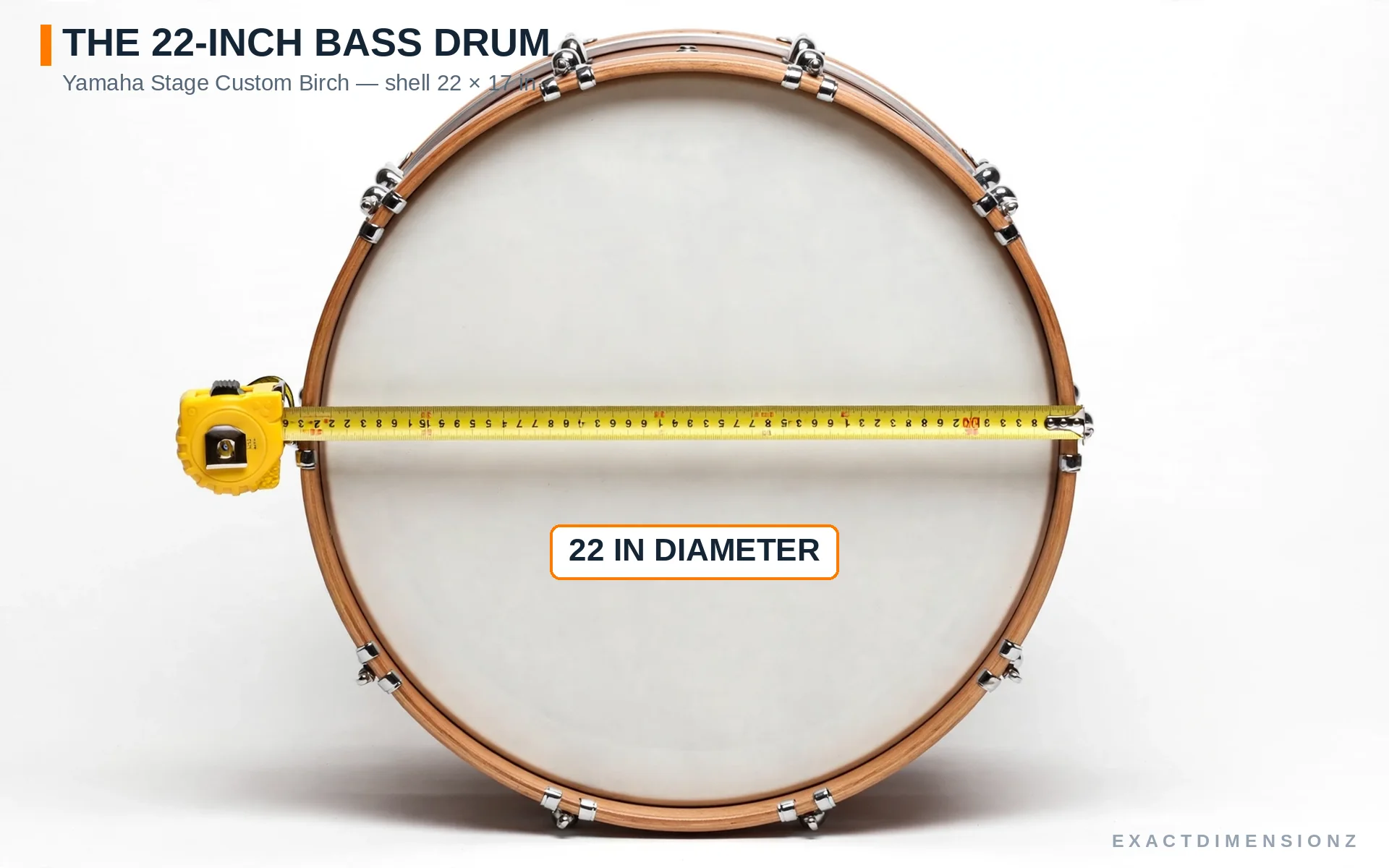
Drum sizes are written as diameter × depth, and the first number is the one the whole kit is named around. Yamaha’s Stage Custom Birch shell pack is built around a bass drum specified at 22″ × 17″: a shell 22 inches across, 17 inches deep. The 22 is the diameter of the front head, the direction a tape crosses when you measure the drum face to face, and it is the dimension that decides which heads, hoops and port rings fit.
The fine print is small and honest. A drum shell is a manufactured cylinder, and like every manufactured cylinder it carries a production tolerance; the figure is a specification, not a promise that every shell reads 22.000 on calipers. But unlike a screen class or a luggage label, the tolerance here is a fraction of a millimetre either side of a real target — the number is the design, not the marketing. Twenty-two-inch bass drums anchor the standard rock kit for a reason: the size is a genuine industrial standard, shared across brands, heads and hardware.
Measurement: 22-inch shell diameter. Evidence: LISTED (manufacturer specification via retailer listing). Source: Yamaha Stage Custom Birch shell pack — Sweetwater. Verdict: FULL VALUE.
3. Penny Original 22 Skateboard
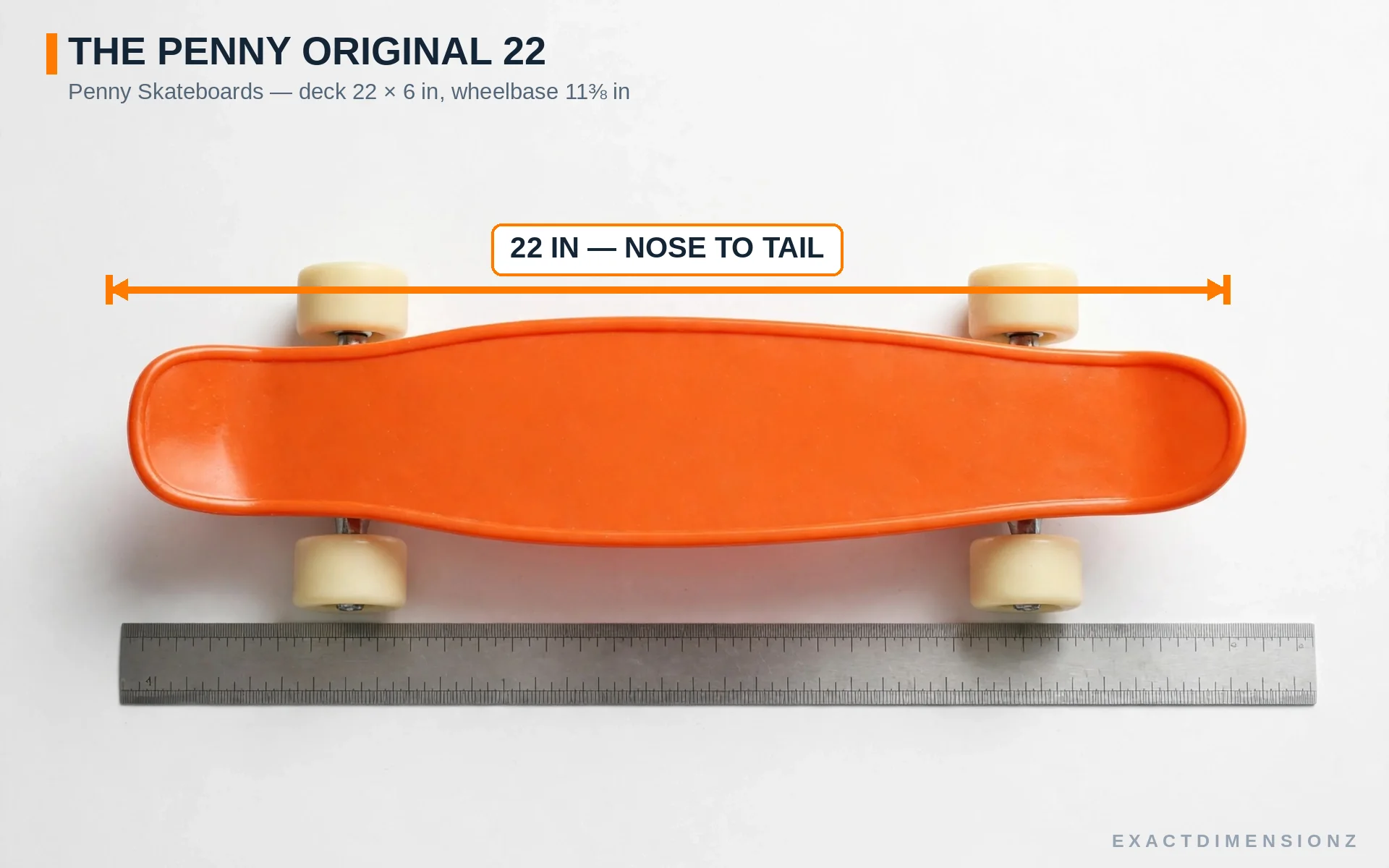
A real 22-inch skateboard exists, and it is exact. The Penny Original 22 is a plastic cruiser whose own product page specifies the deck at 22″ long × 6″ wide, with an 11⅜-inch wheelbase. The 22 is the whole board, nose to tail, the longest line on the object, in the direction anyone would measure a skateboard.
The context is what makes the claim interesting. A standard popsicle skateboard deck runs 31 to 33 inches long; the Penny is a deliberate miniature, a 1970s-style plastic cruiser revived as its own category. So the claim “skateboards are about 22 inches” is false of skateboards in general and precisely true of this one named product line. The ruling reflects that split: the claim pays in full, but only the named claimant collects.
Measurement: 22-inch deck length, nose to tail. Evidence: LISTED (manufacturer specification). Source: Penny Original 22 — Penny Skateboards. Verdict: FULL VALUE.
4. BLACK+DECKER LHT2220 Hedge Trimmer: 22-Inch Blade
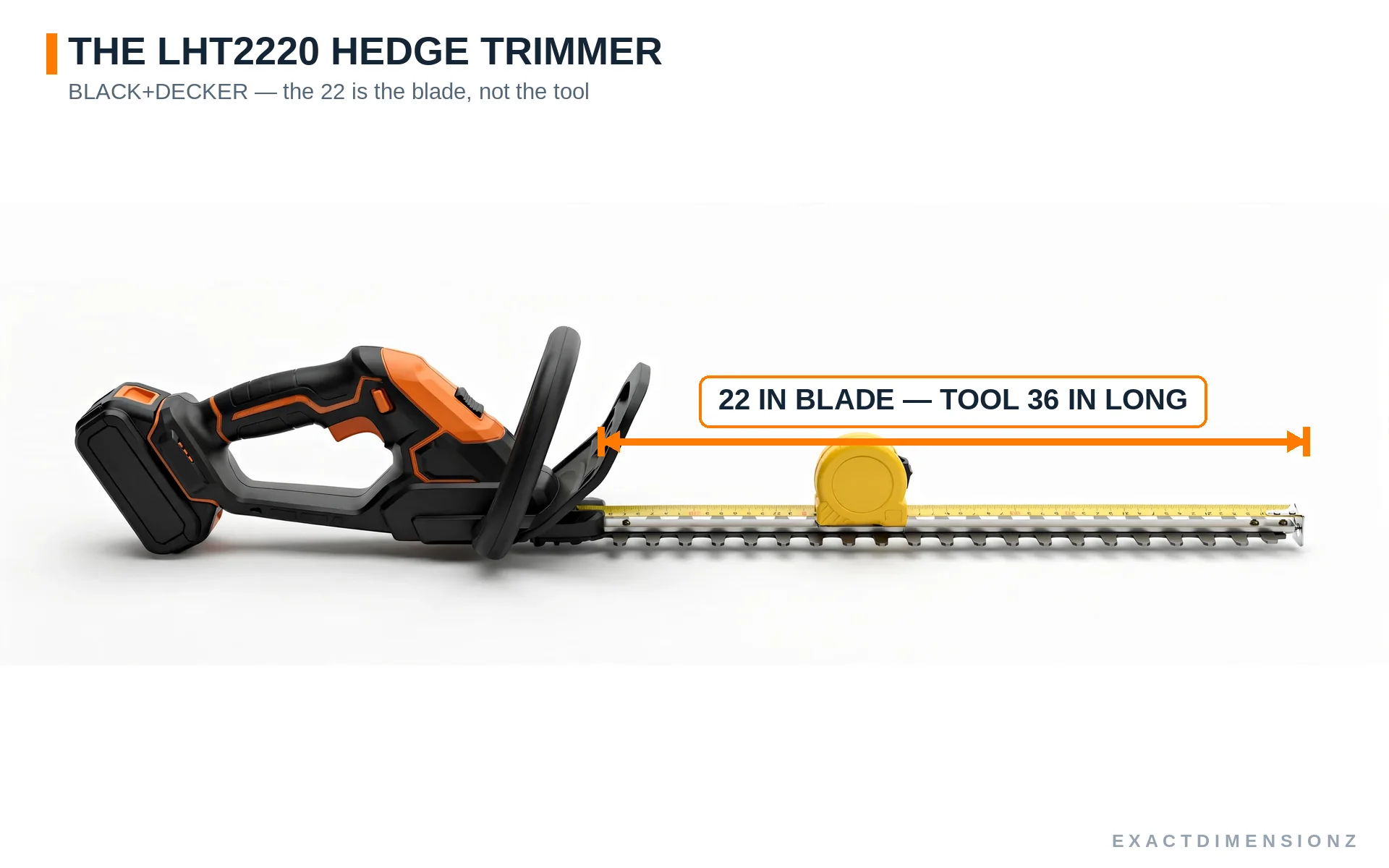
Tool sizing names the working part, and the LHT2220 is a clean example of the convention done honestly. BLACK+DECKER’s specification for the trimmer lists blade length: 22 inches, a dual-action steel blade rated to cut branches up to ¾ inch thick. The same table lists the product’s overall dimensions: 36 inches long × 6.7 wide × 7.75 high. Both numbers are the maker’s; neither is hidden. The 22 is the part that cuts. The 36 is the part you store.
This is the respectable face of part-naming, and it is worth separating from the luggage game later in this list. A hedge trimmer’s blade length is the figure a buyer genuinely shops by — it sets the width of hedge you can shear in one pass — and the overall length is printed one line away in the same table. If your shed wall is the constraint, read the second number. If the hedge is, read the first.
Measurement: 22-inch blade length (tool 36 inches overall). Evidence: LISTED (manufacturer manual specifications). Source: BLACK+DECKER LHT2220 manual documentation — Manuals.plus. Verdict: FULL VALUE, direction named.
5. The 22-Inch-Deep Vanity Top
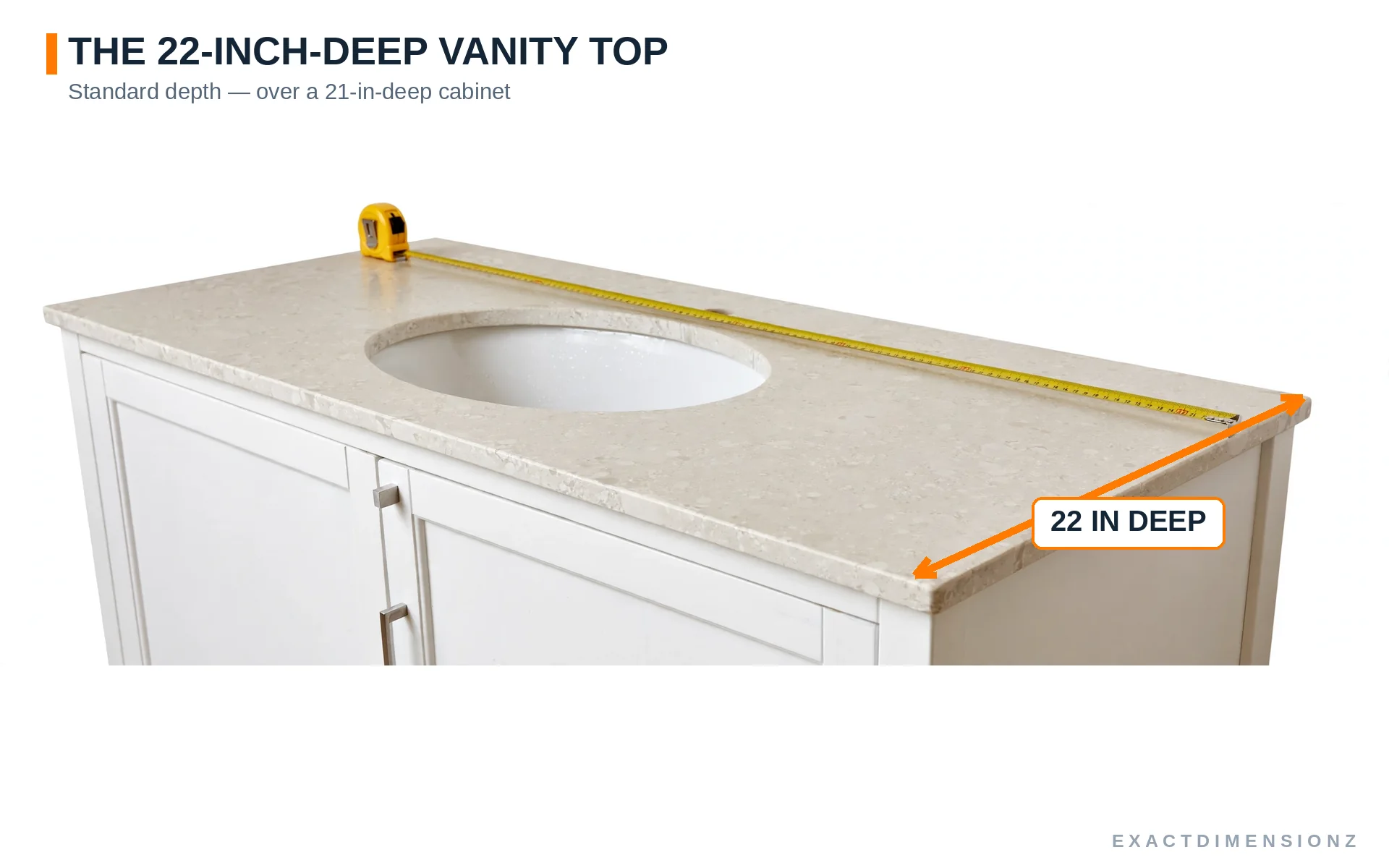
Bathroom vanity tops are sold by width, but their second dimension is one of the most standardized numbers in the house: 22 inches, front to back. Retailer specification tables state it flatly — a standard top lists a product depth of 22 inches — and the 22 is real, with a job: the cabinet beneath a standard top is 21 inches deep, so the top’s extra inch buys a half-inch drip overhang at the front and clearance at the wall. The top is 22 because the box under it is 21.
This claim earns its full value with a small lesson attached. The 22-inch depth is not a marketing rounding of some 21.6-inch reality; it is a coordinated standard between two industries — cabinet makers build to 21 deep, stone and cultured-marble makers cap them at 22 — and the inch of difference is deliberate engineering, the overhang that keeps water off the cabinet face. When two specification tables from two trades agree on a number and its reason, the number can be trusted.
Measurement: 22-inch depth, wall to front edge (over a 21-inch cabinet). Evidence: LISTED (retailer specification). Source: Home Decorators Collection vanity top specifications — Home Depot. Verdict: FULL VALUE.
6. The 22-Inch Matinee Necklace
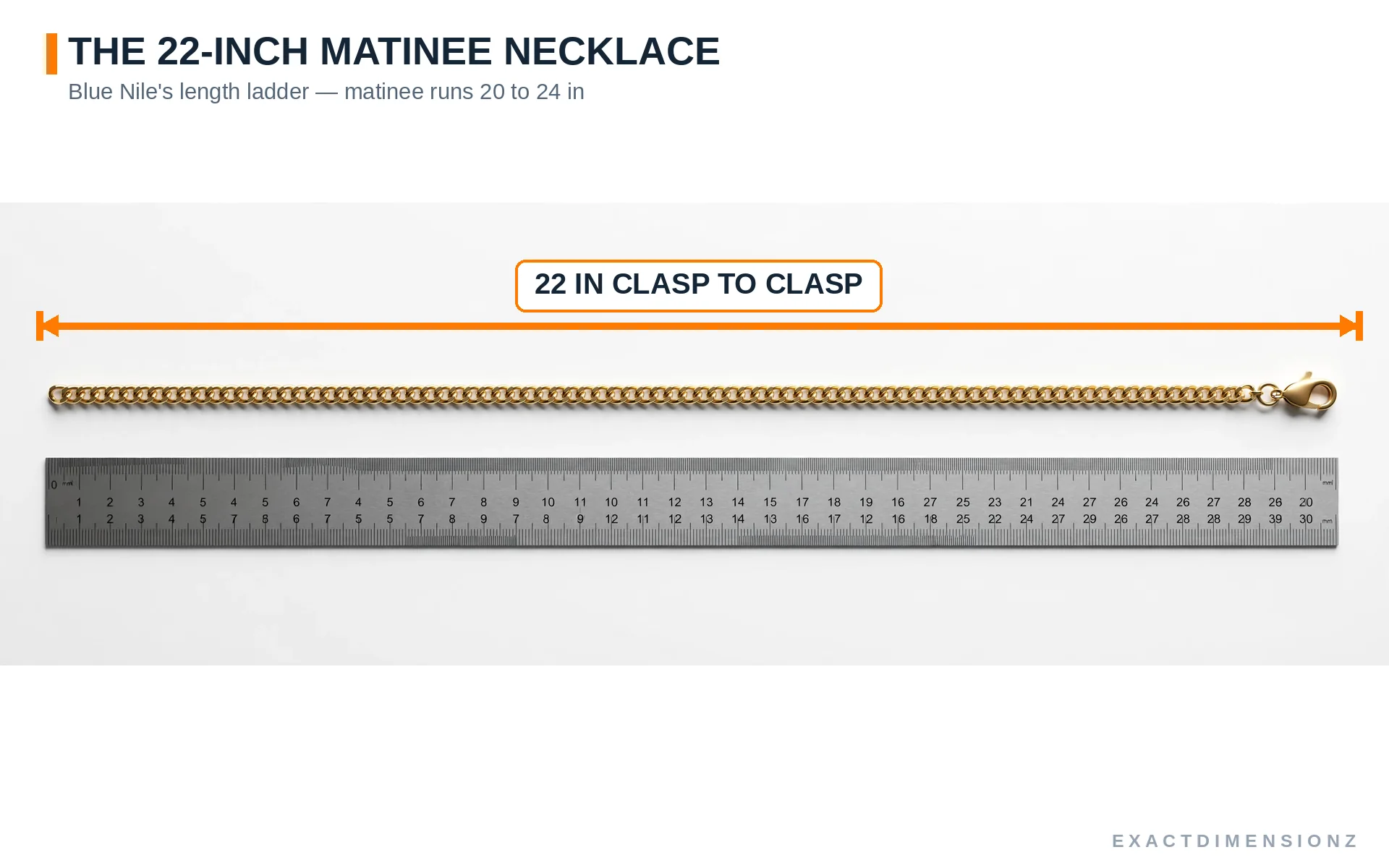
Necklace lengths form a named ladder — collar, choker, princess, matinee, opera, rope — and the matinee rung is defined as 20 to 24 inches, which makes a 22-inch chain the middle of a named size, not a rounding of one. Jewellers publish the ladder openly: matinee, 20–24 inches, falling at the collarbone-to-bust line. And the measurement convention is the honest one: a chain’s stated length is its full end-to-end length, clasp included, laid straight. A 22-inch necklace is 22 inches of chain.
The spread, such as it is, appears only when the necklace is worn. A straight 22 inches becomes a loop, and a loop hangs at roughly half its length — an 11-inch drop from clasp to the bottom of the curve. Nothing is lost; the geometry is simply different from the tape’s. The same loop arithmetic ambushes buyers of every flexible 22 — cables, belts, chains — where the worn or routed length is never the full length. As a length claim, though, this is among the cleanest in the article: a named size, an open standard, a measurement that includes its own hardware.
Measurement: 22 inches clasp to clasp (worn drop ≈ 11 inches). Evidence: LISTED (published necklace-length chart). Source: necklace length chart — Blue Nile. Verdict: FULL VALUE.
7. MidWest iCrate 22 Dog Crate
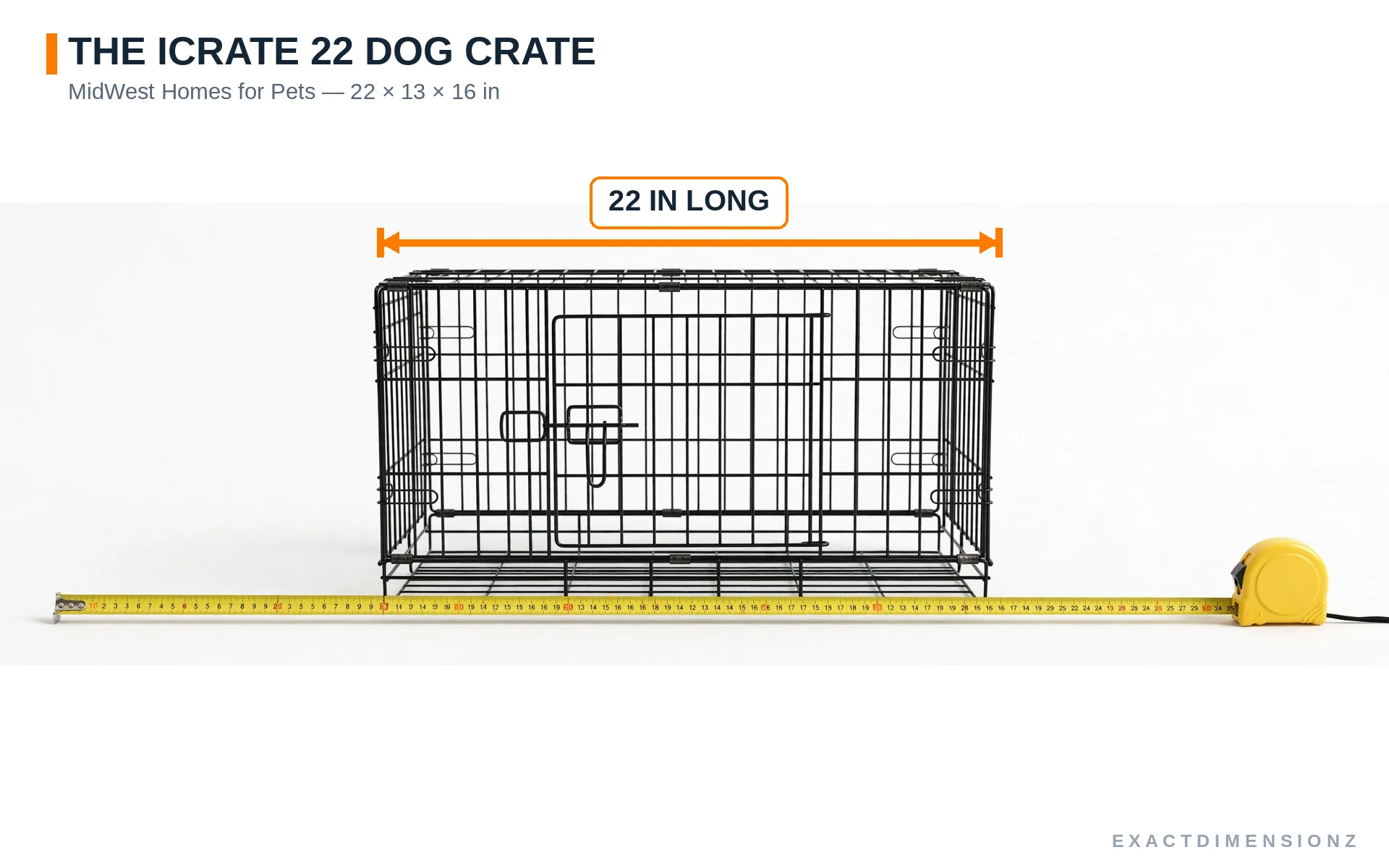
The last full-value payout of the day is a size ladder again. MidWest’s iCrate folding wire crates climb in named sizes — 18, 22, 24, 30, 36, 42, 48 — and the number is the crate’s assembled length. For the 22 model, the manufacturer’s own answer in the product Q&A states the dimensions plainly: 22 inches in length by 13 inches in width and 16 inches in height. Outside, end to end, the crate is 22.00 inches long.
Two honest footnotes ride on the receipt. First, the 22 is an outside length; the dog inside lives with the interior, which is the same figure minus the wire gauge and the floor pan’s edges — a difference of millimetres, not inches, but the reason crate sizing guides tell you to measure the dog, not the label. Second, the ladder itself is nominal in the respectable sense: each rung is a real assembled dimension, but the rungs are spaced for the showroom rather than for any particular dog. A claim can be exactly true and still be the wrong size for your animal.
Measurement: 22-inch assembled length (22 × 13 × 16 inches). Evidence: LISTED (manufacturer-answered dimensions via retailer). Source: MidWest iCrate 22 — Chewy. Verdict: FULL VALUE.
8. Weber Original Kettle “22”: Bowl 22.5, Grate ≈ 21.5
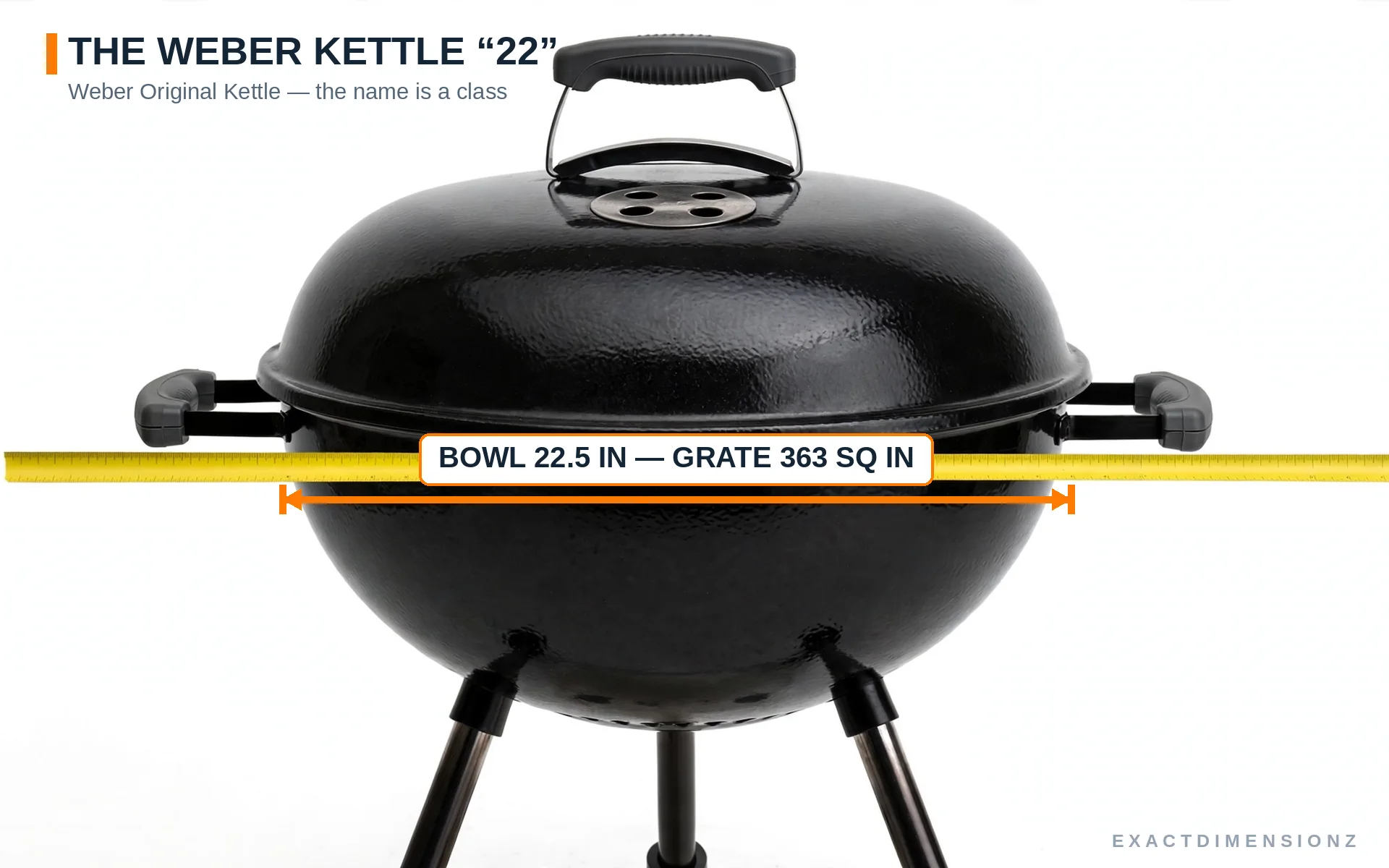
America’s most famous grill is sold as a 22-inch kettle, and its paperwork tells a more interesting story in three numbers. Weber’s specifications for the Original Kettle give the bowl and lid diameter as 22.5 inches, the cooking area as 363 square inches, and the assembled footprint as 39.5 inches high × 22.5 wide × 27 deep, handles included. Start with the bowl: the object named 22 measures 22.5 across, a half-inch over. Then do the grate arithmetic. A true 22-inch circle holds π × 11² = 380.1 square inches. Weber’s grate holds 363 — the area of a circle about 21.5 inches across. The fire grate sits inside the bowl, so the cooking surface is smaller than both the name and the bowl.
Which number is “the size” of a grill? For the lid, the cover and the replacement parts, it is 22.5. For the food, it is 363 square inches — the only figure that decides how many burgers fit. For the name on the box, it is 22, a class label the whole charcoal industry shares, close to everything and equal to nothing. This is a small spread rather than a short-change because nothing here is hidden and the deviations are small — but note that the reader who pictured a 22-inch cooking circle overpictures the grate by 17 square inches, about a burger and a half.
Measurement: bowl 22.5 inches; grate 363 sq in (≈ 21.5-inch circle). Evidence: LISTED (manufacturer specifications via manual documentation). Source: Weber Original Kettle specifications — Manuals.plus. Verdict: SMALL SPREAD.
9. Dell P2219H “22 Monitor”: 21.5 Inches You Can See
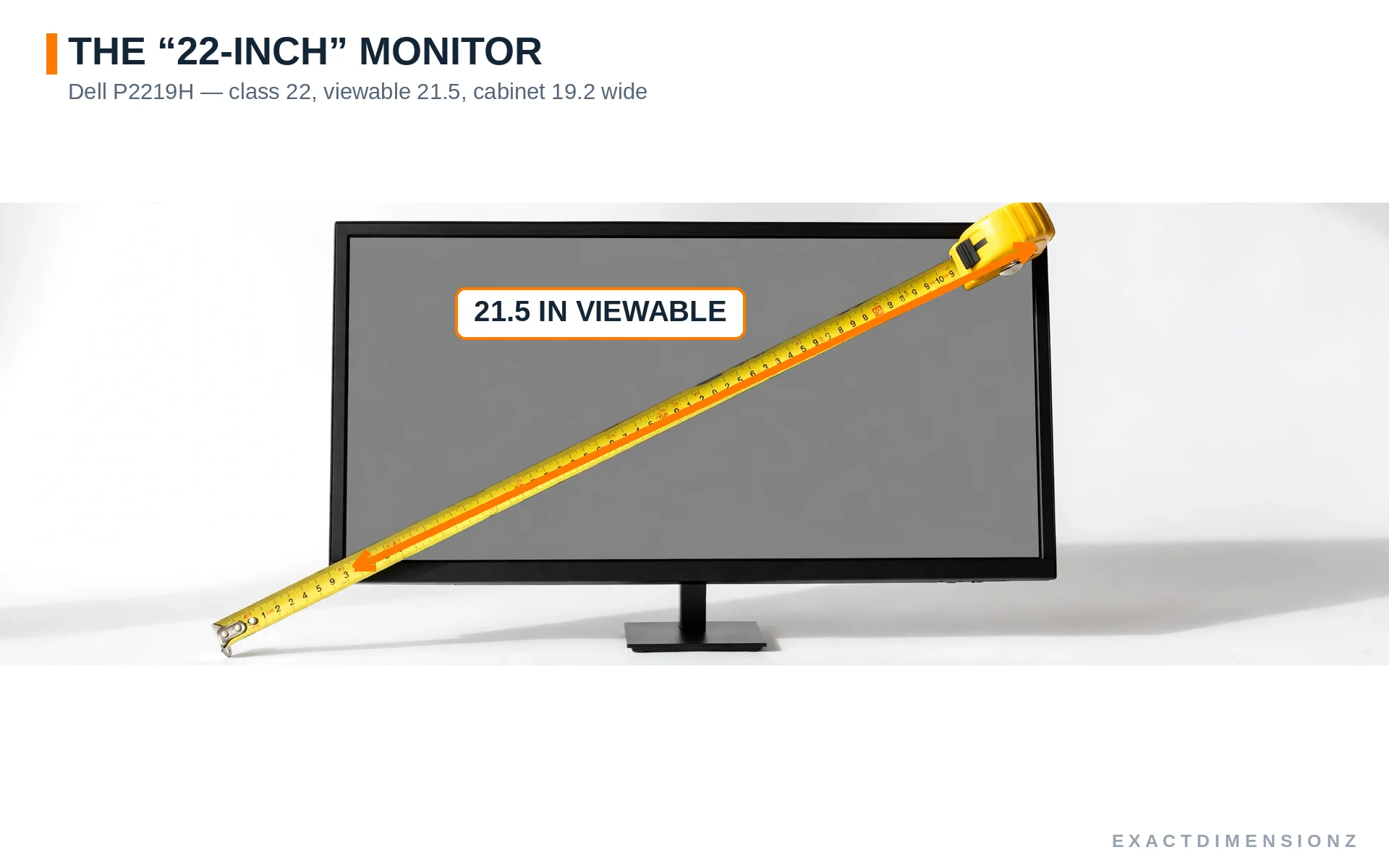
Screens are the oldest repeat customer for this kind of audit, and the P2219H shows the standard class arithmetic in one tidy spec sheet. Dell markets the monitor in the 22-inch class — 55.9 centimetres, as its own materials put it. The user guide gives the viewable image: 54.6 centimetres, which is a 21.5-inch diagonal, with an active area of 18.74 inches wide × 10.54 inches tall. And the cabinet the screen lives in measures 487.3 millimetres across: 19.2 inches wide. Claimed 22; received 21.5 on the diagonal the class is named for, and 19.2 in the direction a desk actually cares about.
None of this is Dell being dishonest — the guide prints every figure, and the class convention is an industry treaty, not a trick. But the treaty’s cost lands on the buyer who comparison-shops by the headline: two “22-inch” monitors from two brands can carry different viewable diagonals, and a “22” bought to fill a 22-inch-wide alcove leaves nearly three inches of air beside it, because the cabinet is 19.2 wide. The class number is the least useful of the three figures on the sheet, and it is the only one on the box.
Measurement: 21.5-inch viewable diagonal in a 19.2-inch-wide cabinet. Evidence: LISTED (manufacturer user guide). Source: Dell P2219H user guide (manual mirror) — Manuals.plus. Verdict: SMALL SPREAD.
10. The 22-Inch Newborn: Real Length, Rare Baby
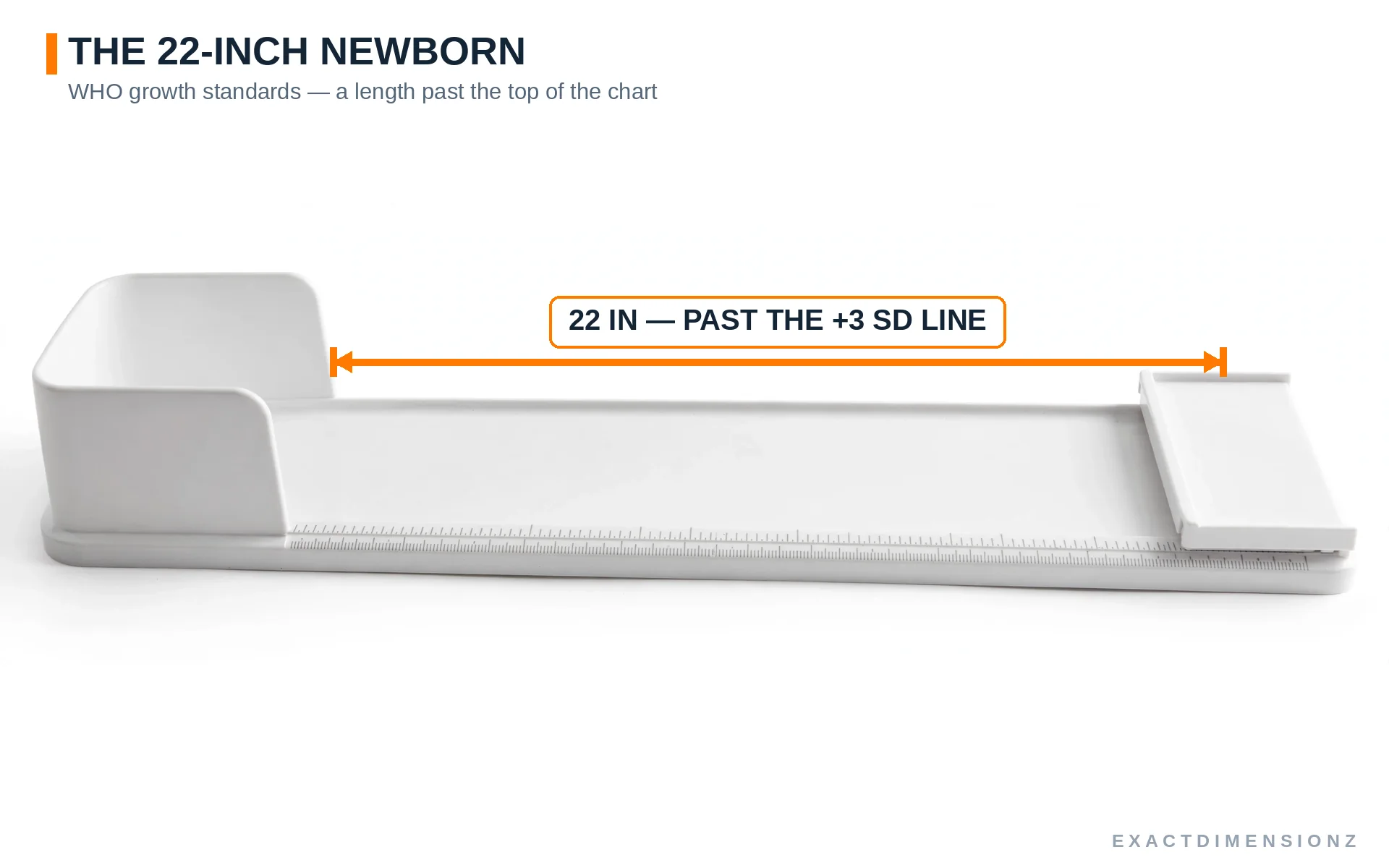
The strangest claim on this list is a person. “About the length of a newborn” is a stock comparison for 22 inches, and newborns are indeed measured head to heel on a length board in their first hour — so how long is a newborn, officially? The World Health Organization’s Child Growth Standards, built from thousands of measured infants across six countries, put the median birth length at 49.9 centimetres for boys (19.6 inches) and 49.1 for girls. The +2 SD lines — roughly the 97th percentile — sit at 53.7 and 52.9 centimetres. Twenty-two inches is 55.88 centimetres. That is beyond the +3 SD line for both sexes (about 55.5 cm for boys, 54.7 for girls): off the top of the chart the world’s paediatricians actually use.
Read the ruling carefully, because it is the opposite of the usual fraud. The measurement is real — a 22-inch newborn is possible, and maternity wards do record them — but as a comparison it inverts the truth: it presents a one-in-a-thousand-plus baby as the typical one. A reader who pictures “a newborn” at 22 inches is picturing a baby longer than at least 99.9% of the babies in the WHO reference population, more than six centimetres longer than the median. The claim is graded at a spread not because the number is false, but because the company it keeps — “about the length of” — is.
Measurement: 55.88 cm birth length, beyond the WHO +3 SD line for both sexes. Evidence: LISTED (authority growth standards, carried from the old article’s cited source). Source: WHO Child Growth Standards, length-for-age — World Health Organization. Verdict: SMALL SPREAD — the length exists; the typicality does not.
11. Travelpro Maxlite 5 “22-Inch” Rollaboard: 23 Inches at the Sizer

Here the benchmark from the top of the article comes back to settle the most popular claim on it. Travelpro’s Maxlite 5 rollaboard is sold as a 22-inch carry-on, and its own specification table prints two numbers: the case measures 21 × 14 × 9 inches, and the overall bag measures 23 × 14.5 × 9 inches. The carriers’ limit, printed on the same page, is 22 × 14 × 9 inches overall. The “22-inch” bag exceeds the 22-inch limit by a full inch in the only direction the sizer measures.
How does the name survive? By measuring the part instead of the whole — the fabric case is 21 inches, a figure with its own honesty problem, since 21 is not 22 either. The name appears to be the average of the case and the whole, which is to say it is neither measurement. To Travelpro’s credit, both real numbers are printed on one page, which is more transparency than most of the industry offers; the quarrel is with the headline, not the paperwork. But the traveller at the sizer is holding the headline. A bag bought as “22-inch, carry-on approved” can be gate-checked by the rule its own product page reproduces.
Measurement: case 21 inches; overall 23.00 inches (limit 22). Evidence: LISTED (manufacturer specification table). Source: Travelpro Maxlite 5 specifications — Travelpro. Verdict: SHORT-CHANGED. Check it yourself: measure any “22-inch” spinner floor to top of handle hardware, wheels on the ground. If it reads 23, you own this receipt.
12. The 22-Inch Wheel Wearing a 275/50R22 Tire
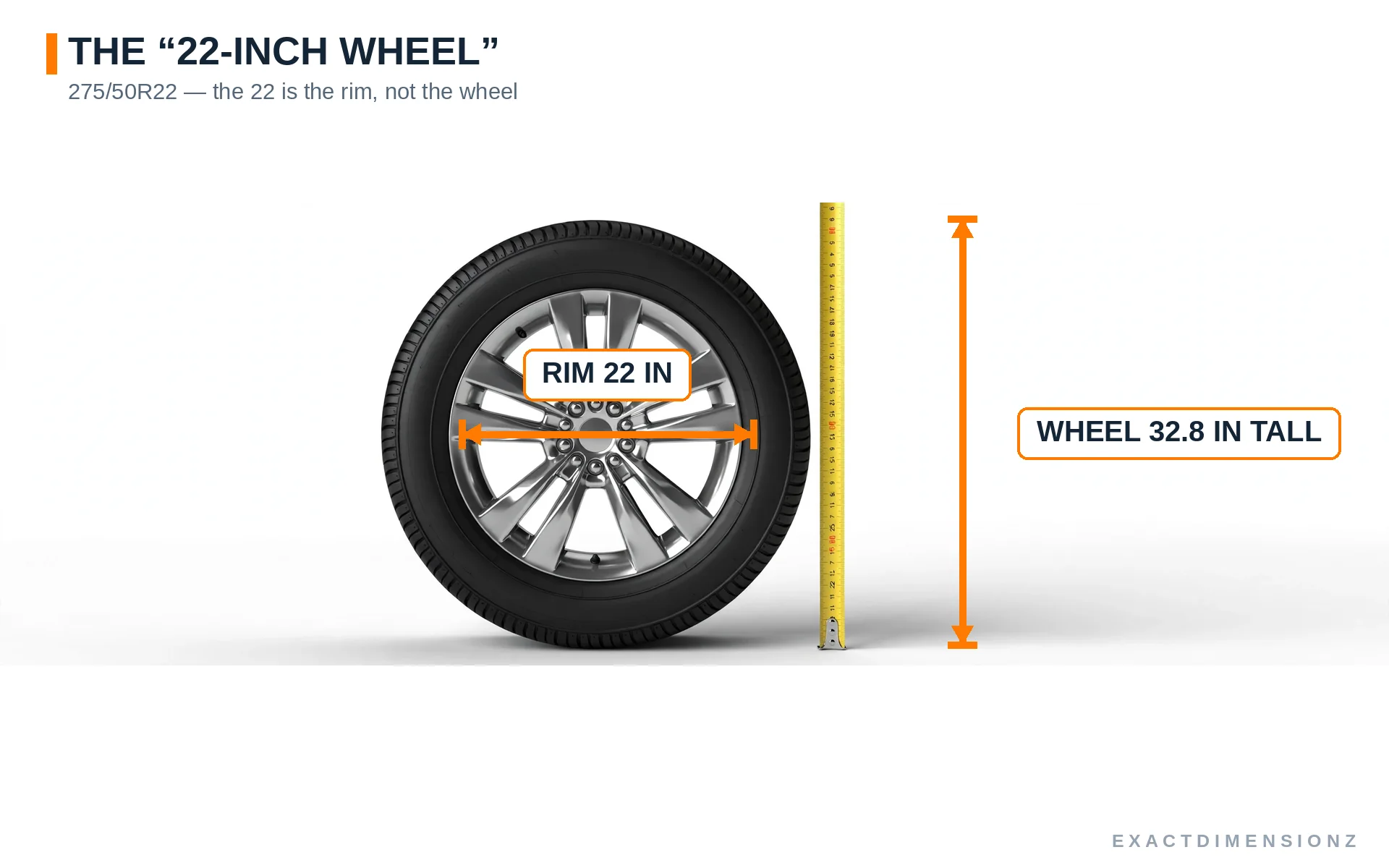
The final object is the deepest burying of a number in the article. A “22-inch wheel” names the rim: 22 inches at the bead seat, the ledge the tire’s bead locks onto, measurable only with the tire off. The tire code tells you the rest, if you read it properly. Take a common fitment, the 275/50R22: 275 millimetres of tread width; a sidewall 50% of that width, 137.5 millimetres, which is 5.41 inches of rubber above the rim and 5.41 below; then the 22 of rim. Add it up — 22 + 5.41 + 5.41 — and the wheel that rolls up to the kerb stands 32.8 inches tall, a figure the tire makers publish openly.
This is not deception; it is engineering notation mistaken for a size. The rim diameter is the number that decides which tires fit, which is why the trade leads with it. But the mental image matters: a reader who pictures a “22-inch wheel” pictures something the height of a kitchen counter’s edge, when the assembly in the wheel arch is nearly 33 inches — closer to a yard than to the number in its name. Of the twelve claims on this list, this is the largest gap between the name and the object: 10.8 inches of tire wrapped around a true 22.
Measurement: rim 22 inches; complete wheel 32.8 inches tall. Evidence: LISTED (tire size code and published tire specifications). Source: 275/50R22 size table — TireSizes. Verdict: SHORT-CHANGED — or rather, over-delivered in every direction except the name.
The verdict table: all twelve claims, settled
Every receipt, on one ledger. Read the middle column slowly: it is the only one a tape measure would sign.
| Claim | What was received | Verdict |
|---|---|---|
| Airline carry-on limit, 22 × 14 × 9 | 22.00 in overall — the ceiling itself | FULL VALUE (benchmark) |
| Yamaha bass drum, 22 × 17 | 22.00 in of shell diameter | FULL VALUE |
| Penny Original 22 skateboard | 22.00 in of deck, nose to tail | FULL VALUE |
| BLACK+DECKER LHT2220 trimmer | 22.00 in of blade (tool: 36 in long) | FULL VALUE |
| Standard vanity top, 22 in deep | 22.00 in of depth over a 21 in cabinet | FULL VALUE |
| 22-inch matinee necklace | 22.00 in clasp to clasp (drop ≈ 11 in) | FULL VALUE |
| MidWest iCrate 22 dog crate | 22.00 in of assembled length | FULL VALUE |
| Weber Original Kettle “22” | Bowl 22.5 in; grate 363 sq in ≈ a 21.5 in circle | SMALL SPREAD |
| Dell P2219H “22 Monitor” | 21.5 in viewable diagonal; cabinet 19.2 in wide | SMALL SPREAD |
| A 22-inch newborn | 55.88 cm — beyond the WHO +3 SD line | SMALL SPREAD |
| Travelpro Maxlite 5 “22-inch” rollaboard | Case 21 in; overall 23.00 in — over the limit | SHORT-CHANGED |
| “22-inch wheel” with a 275/50R22 tire | Rim 22 in; complete wheel 32.8 in tall | SHORT-CHANGED |
The pattern across twelve objects is the same one this kind of audit finds at every size: the number is most honest where a standard enforces it (airline limits, drum shells, crate ladders, plumbing depths) and loosest where a class name replaces a measurement (screens, kettles, luggage, wheels). Seven full payouts, three small spreads, two short-changes — a better rate than most sizes manage, because 22 happens to be a working dimension in several trades at once. The failures, notably, are two of the most purchased objects on the list.
How to measure 22 inches without a tape measure
If you have no measuring tool handy, build the distance from parts you already know — and cost every build honestly, whether it flatters the build or not. Two US Letter sheets, each 11 inches on the long edge, overlapped by exactly 2 inches, span 22.00 inches dead on — the cleanest build on this page, and the only exact one. Twenty-three quarters in a row come to 21.97 inches, short by 0.03, because a quarter is 0.955 inches across, not an inch; the honest row needs the extra coin and still lands three-hundredths short. Dollar bills do not tile to 22 at all: three lengthwise (3 × 6.14) plus one sideways (2.61) make only 21.03 inches. Six bank cards laid long edge to long edge make 20.22 inches, and seven overshoot at 23.59 — no whole count works. Counts are not lengths, at any denomination.
For scale against nearby lengths: 22 inches sits six inches past 16 inches, twelve inches past 10 inches, and thirteen inches past 9 inches. It is ten inches past 12 inches. It is ten inches longer than a foot, twenty-six inches shorter than 4 feet, fifty inches shorter than 6 feet, and a hundred and twenty-two inches shorter than 12 feet. For anything that matters — a bag that must fit a sizer, a drum head, a vanity top — use a tape measure or a product with a published dimension, not a guess.
Frequently asked questions
How many centimeters are in 22 inches?
22 inches is exactly 55.88 centimeters. One inch is defined as exactly 2.54 centimeters, so 22 × 2.54 = 55.88 cm. For a quick everyday estimate you can round it to about 56 cm, but 55.88 cm is the exact figure.
How long is 22 inches in feet and yards?
22 inches is 1.833 feet, or 1 foot 10 inches, and 0.611 yards. The feet and yards figures are rounded for readability; the exact conversions are 55.88 cm, 558.8 mm, and 0.5588 meters.
Is a 22-inch monitor really 22 inches?
Not on the screen you can see. Monitor sizes are class names: a monitor sold in the 22-inch class typically shows about 21.5 inches on the viewable diagonal, and its cabinet is narrower still — the Dell in this article measures 19.2 inches wide. Always check the spec sheet’s “viewable image size” and “width” figures, not the class name on the box.
Is a 22-inch carry-on bag actually 22 inches?
Not always. The airline limit of 22 × 14 × 9 inches applies to the whole bag, handles and wheels included. Some bags sold as “22-inch” measure 23 inches overall — a full inch over the limit — because the headline counts the case, not the hardware. Measure floor to top of handle hardware, wheels on the ground, before you trust the hangtag.
What everyday things are 22 inches long?
Verified examples include a 22-inch bass drum shell, a Penny Original 22 skateboard deck, a 22-inch hedge trimmer blade, a standard 22-inch-deep vanity top, a 22-inch matinee necklace, and a 22-inch dog crate. The drum and the skateboard are the easiest straight-line references; the vanity top is the easiest household one.
Is 22 inches the same as 56 centimeters?
No, but it is close. Twenty-two inches is 55.88 cm, while 56 cm equals about 22.047 inches — so 22 inches falls 0.12 cm short of 56 cm. For a rough visual comparison “about 56 cm” works; for exact work, use 55.88 cm.
How can I measure 22 inches without a tape measure?
Use two US Letter sheets overlapped by exactly 2 inches for a dead-on 22.00-inch span, or twenty-three quarters in a row for 21.97 inches — close enough to fool anyone, three-hundredths short. Dollar bills and bank cards do not tile to 22 in any whole count. For an exact result, though, nothing replaces a proper tape measure.
Why is a product sold as 22 inches sometimes not exactly 22 inches?
Because the 22 inches may describe only one dimension — a diameter, a blade, a baking surface, a rim, or a case — while the rest of the object measures something else, or because the listed size is a class name rather than a measurement. A kettle sold as 22 measures 22.5 across the bowl; a monitor sold as 22 shows 21.5 on the diagonal; a bag sold as 22 stands 23 overall. Always check the specification for the exact dimension word before treating an object as an exact 22-inch reference.
Final Thoughts
So, how long is 22 inches? It is 55.88 cm, 558.8 mm, 0.5588 meters, and 1 foot 10 inches — and, more usefully, it is the height of the biggest bag you may carry onto a plane, the diameter of a bass drum, and the depth of the counter you wash at. The single habit that will serve you best is the one this article opened with: always ask which dimension the 22 inches belongs to. Diameter, blade, depth, diagonal, rim, and class name are six different answers, and knowing which one you are looking at is the difference between measuring right and guessing wrong.
Pick one object you have actually seen — a drum, a skateboard, a carry-on standing in an airport line — and 22 inches will stop being a number and start being a distance you can feel. And the next time a listing just says “22-inch” with no dimension attached, you will know exactly which question to ask before you trust it.
