
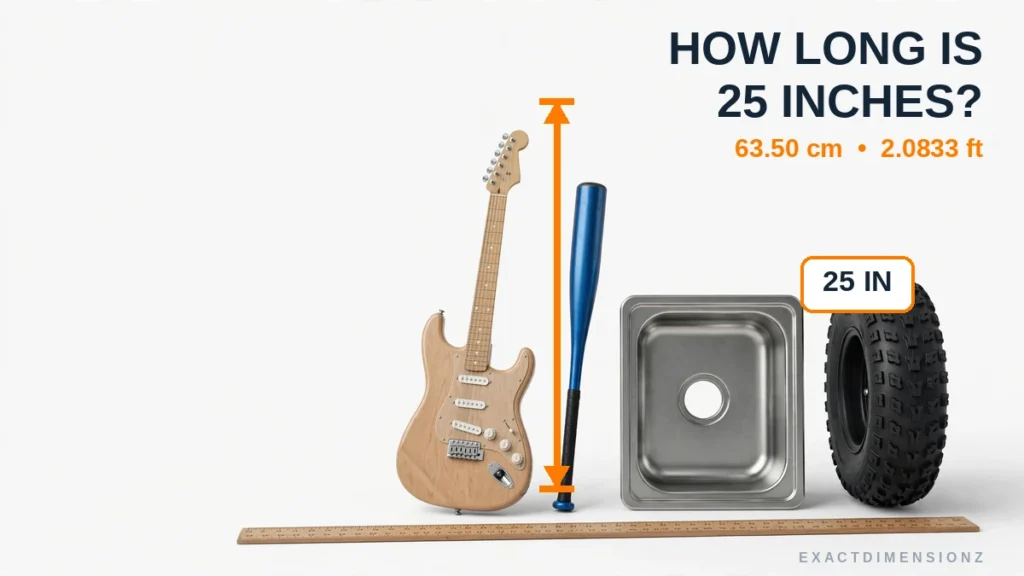
How long is 25 inches? The first reading is the easy one: 25 inches = 63.50 cm exactly (635.0 mm), which is 2.0833 feet or 0.6944 yards — a whisker over two 12-inch rulers laid end to end, plus one extra inch. For the wider picture, see the complete inches size guide, which covers every inches size from 1 to 100. That is the number on the label. This article is about the second reading: what a tape measure, a spec sheet, or a standard says when you check the label against the thing itself.
We took ten things that are sold, stamped, or widely described as “25 inches” and read each one twice. First reading: the claim. Second reading: the figure the manufacturer’s own documents, a governing standard, or plain arithmetic supports. Three of the ten hold exactly. Four hold only with a footnote attached. And three fail outright — including one claim, repeated by the top-ranking articles for this search, that overshoots reality by more than nine inches.
Twenty-five is a treacherous size precisely because it feels so safe. It is a quarter of a hundred, half of fifty, the kind of round number that invites filing instead of measuring — and products get filed at 25 far more often than they get measured at it. Screens are binned into it, wheels are classed by it, luggage is named for a fraction of it. The roundness is the risk: nobody double-checks a number that looks this tidy, which is why this article exists.
Every object below carries a Reading line — label, tape, verdict — and a short test you can run yourself with a tape measure, a sidewall code, or a size chart. Nothing here is graded on a retailer’s rounded name when the maker publishes a real figure. Where the label and the tape disagree, we print both and show the difference, down to the closing table, where every disagreement is listed as a Δ.
QUICK ANSWER
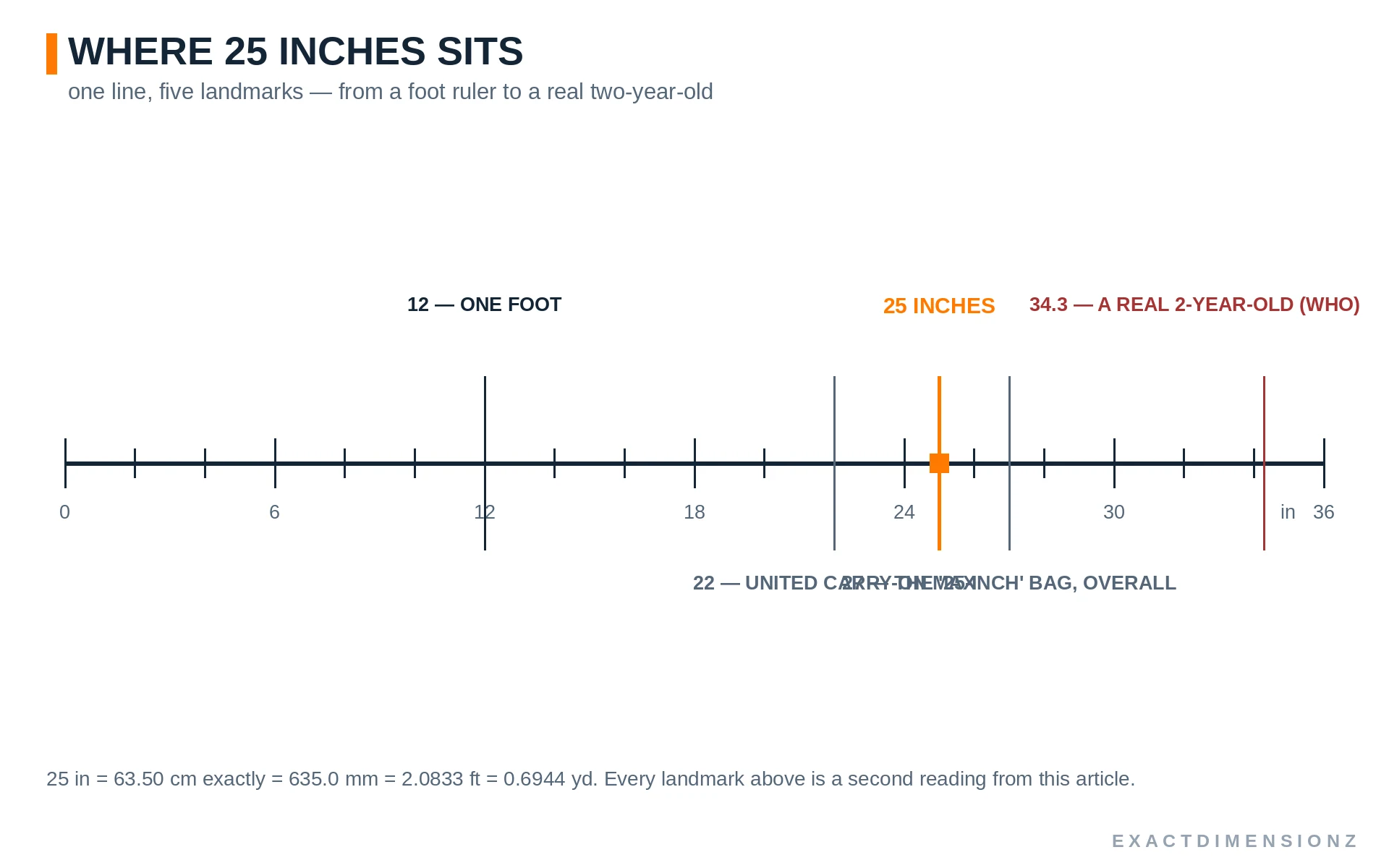
25 inches = 63.50 cm exactly (635.0 mm • 2.0833 ft • 0.6944 yd). But read the labels twice and the ten “25-inch” things in this article split three ways. The reading holds: a PRS Custom 24’s scale length, a Rawlings 25-inch tee-ball bat and a Hoyt 25-inch archery riser each measure exactly 25.00 in. Holds with a footnote: a 195/65R15 tire computes to 24.98 in; an Elkay sink is 25 in across the rim but 24⅞ in at the cutout; a Travelpro “25-inch” case stands 27 in overall; a Maxxis ATV tire coded 25 measures 25.4 in. The reading fails: a “25-inch” Alienware monitor shows 24.5 in of picture, a “25-inch” wheelchair wheel is a 559 mm size class (22.01 in at the bead seat) — and a typical 2-year-old is not 25 in tall but about 34.3 in (WHO).
How the Second Reading Works
The rule of this article is simple: a size is not a measurement until something other than the name confirms it. So the second reading always comes from the strongest source available. A manufacturer’s specification sheet beats a product title. A governing standard — a USA Baseball certification, the WHO growth standards, the ETRTO tire-and-wheel codes — beats a blog’s estimate. And when no document exists, arithmetic on verified units beats both.
The verdicts come in three grades. The reading holds means the tape figure is the label figure: 25.00 inches, on the part the label names. Holds with a footnote means 25 is real but is not the whole story — the case is 25 inches while the bag stands 27, the rim is 25 inches while the hole you cut is 24⅜. The reading fails means no honest measurement of the thing produces 25: the number is a size class, a rounded bin, or simply wrong.
The hierarchy matters because the sources disagree by design. A retailer’s title rounds for the shelf; a spec sheet is written for the engineer and the warranty claim, so it cannot afford to round; a standard exists so that parts from different makers fit each other, so it rounds least of all. When Travelpro’s title says 25 and Travelpro’s spec table says 25.00 for the case and 27.00 for the bag, the table is not contradicting the title — it is doing a different job, and it is the table’s job we grade.
One habit runs through all ten readings: ask what the number names. Sometimes 25 inches names a whole object, end to end. Sometimes it names one part — a string, a riser, a case — while the object around it is longer. And sometimes it names nothing physical at all, just the shelf the product sits on. The label rarely tells you which. The second reading does.
The First Group: Three Readings That Hold
1. The PRS Custom 24’s Scale Length — 25 Inches of String

Reading: Label 25 in · Tape 25.00 in · Verdict: the reading holds (Δ 0.00).
A guitar’s scale length is the vibrating length of its strings — the distance from the nut to the bridge — and it is the one dimension on a guitar that is defined to the hundredth. PRS’s own specification table for the Custom 24 prints it without decoration: “Scale Length | 25″.” The Custom 24 is the guitar that built PRS, and its 25-inch scale is deliberate — it sits between the two classic scale lengths of the electric guitar, which is why the model is famous among players who find one rival too loose and the other too tight.
Notice what the 25 does not claim. It is not the length of the guitar; the full instrument is far longer, headstock to strap button. The label names a working part, names it honestly, and the part measures exactly what the table says. That is rarer in this article than you might expect — of our ten readings, the guitar is one of only three where label and tape agree to the last decimal with no footnote waiting underneath.
Scale length is not an abstract figure; it sets the instrument’s physics. For the same string gauge tuned to the same pitch, a longer scale pulls tighter and speaks brighter, a shorter scale feels slacker under the fingers. The 25-inch middle path is the Custom 24’s whole argument — and it only works because the number is exact. A “25-inch class” scale would be useless to a luthier cutting fret slots, since the 12th fret must sit at precisely half the string: 12.50 inches, not a class average. Instruments are built to the second reading or they do not play in tune.
Check it yourself: on any guitar, run a tape from the edge of the nut to the bridge saddle along a string. That span is the scale. Then find the 12th fret: it sits at exactly half the scale, 12.5 inches on this guitar — a hair under 13 inches — which is why the octave fret divides the string into two equal, identically tuned halves.
2. The Rawlings REMIX 25-Inch Tee-Ball Bat — 25 Inches, End to End

Reading: Label 25 in · Tape 25.00 in · Verdict: the reading holds (Δ 0.00).
Tee-ball bats are sized the honest way: the number is the product. Rawlings’ product data for the REMIX T-Ball Bat lists Item Length: 25 Inches, dimensions 25″L × 2.25″W, a −12 drop (25 inches long, 13 ounces), and grading by USA Baseball — the bat is certified for USA Baseball tee-ball leagues, where bat length is a regulated measurement, not a marketing bin. The REMIX line is manufactured in a 24/25/26-inch run, so the 25 on this bat is a real size in a real ladder, not a rounding of 24.6.
The barrel, for scale, is 2¼ inches across — picture 2 inches plus a quarter. A five-year-old swinging this bat is holding an object whose headline dimension survives any tape you put on it, knob to end cap. Youth sports gear is full of nominal sizes — glove sizes run notoriously small — which makes the bat a useful control case for this whole article: when a league measures the thing, the label learns to tell the truth.
The drop figure shows the same discipline. A −12 drop on a 25-inch bat means 13 ounces — length minus weight, printed on the product — so the bat’s two headline numbers are locked to each other by arithmetic anyone can audit. Sizing charts hang the 25-inch bat on the youngest players, roughly the under-seven tee-ball years, and because leagues certify the equipment, the chart, the sticker, and the tape all have to agree. When they do, a parent can buy by the label with total confidence — the label has a referee.
Check it yourself: lay the bat on a table and run the tape along its top from the knob’s end to the barrel’s end cap. On a certified bat it lands on the printed size; on an uncertified toy bat, it often doesn’t.
3. The Hoyt Formula SR Riser — 25 Inches of Riser, Not of Bow
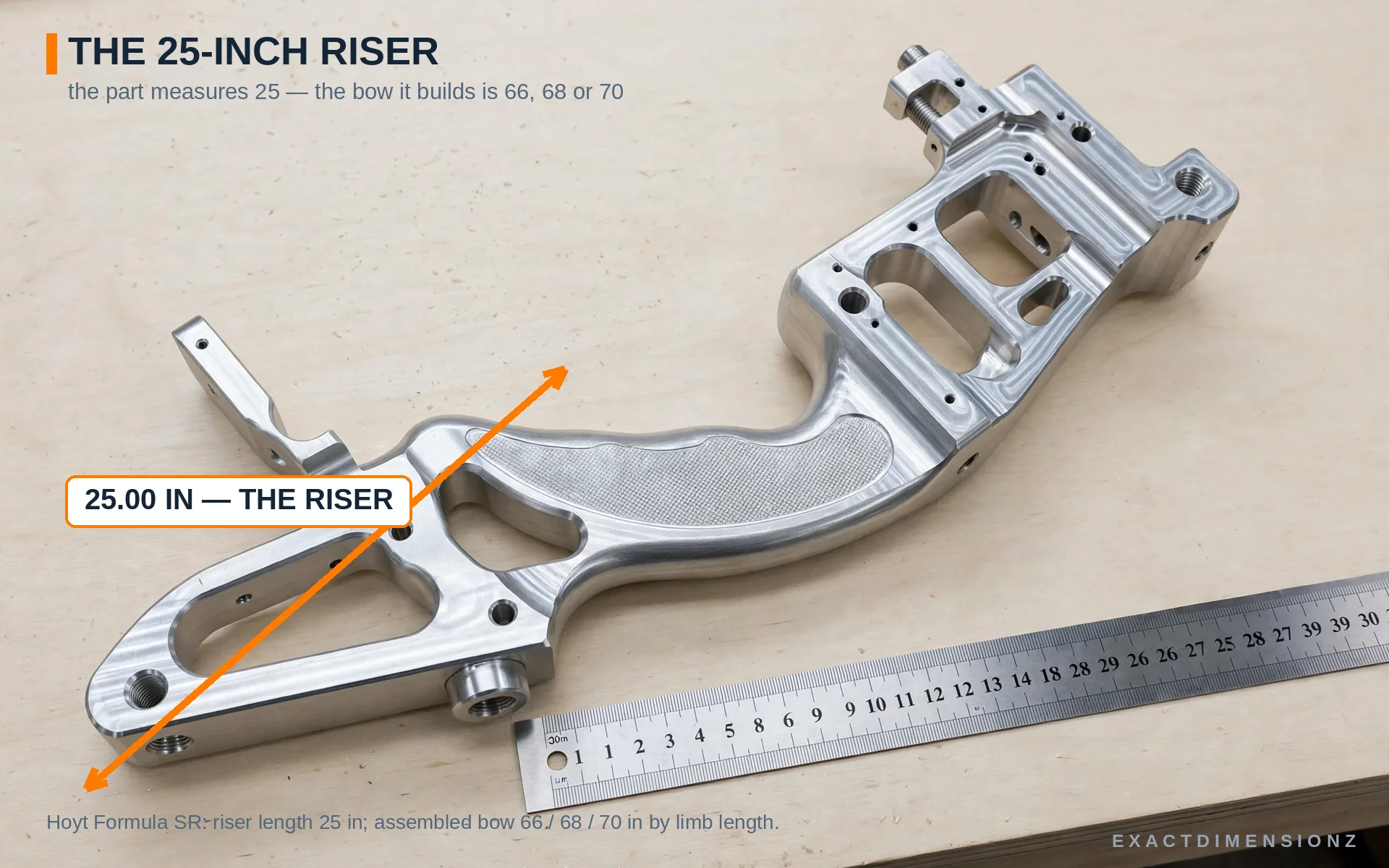
Reading: Label 25 in · Tape 25.00 in · Verdict: the reading holds (Δ 0.00) — the 25 names the riser, and the riser is 25.
In target archery, the riser is the central handle section of a recurve bow — the part the archer actually buys, grips, and tunes. Hoyt’s Formula SR page lists the riser length plainly: 25″. It is the standard target riser size, the middle of the 23/25/27-inch ladder that Olympic-style archers choose from, and measured end to end, the riser is exactly that.
The footnote that isn’t: bolt a set of limbs to this riser and the assembled bow measures 66, 68, or 70 inches depending on limb length — Hoyt prints those figures on the same page. A careless article could list “a 25-inch bow” and be wrong by 41 inches. Hoyt doesn’t; the label names the part, the part is in the product’s name, and nobody in archery reads “25-inch riser” as a claim about the bow. We grade it a clean hold, and a model of how part-dimensions should be labelled.
The 25 also anchors the bow’s arithmetic. Target archers choose riser and limb lengths together to build a bow that fits their draw: a 25-inch riser with medium limbs makes the 68-inch bow that sits at the centre of the target world, with short limbs giving 66 and long limbs 70. Every one of those totals is just the riser’s honest 25 plus a limb figure — the part-dimension is the foundation the whole sizing system is summed from. A class-rounded riser would quietly corrupt every bow built on it.
Check it yourself: a riser is measured end to end across its full casting, limb bolt to limb bolt’s outer faces. If a listing ever gives you a bow’s length instead, it will be one of the assembled figures — 66, 68, or 70 — never 25.
The Second Group: Four That Hold — With a Footnote
4. The 195/65R15 Car Tire — the 25 You Have to Compute
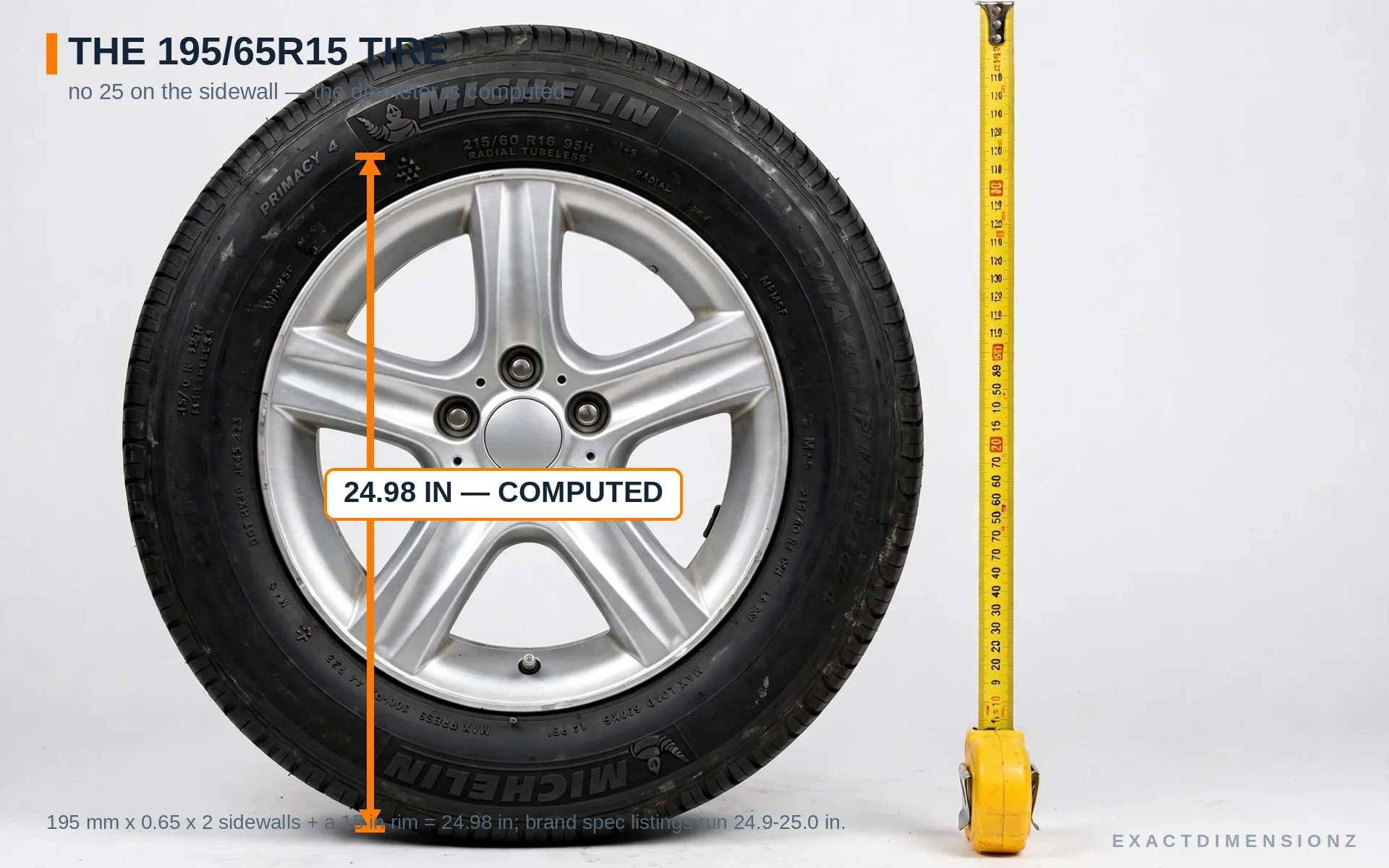
Reading: Label — no number printed · Tape 24.98 in computed, 24.9–25.0 in listed · Verdict: holds with a footnote (Δ −0.02).
No passenger tire wears “25 inches” on its sidewall. The size code 195/65R15 hides the figure in arithmetic: 195 mm of width, a sidewall 65% of that (126.75 mm), twice — once at the top of the wheel, once at the bottom — plus a 15-inch rim. The rim, by the way, is a true 15 inches; the sidewalls add 253.5 mm (9.98 in); the total is 634.5 mm, which is an overall diameter of 24.98 inches. The 25 here is real, but it is computed, not printed — and it wobbles by brand. Spec listings for P195/65R15 tires show most models at an overall diameter of 25″, with individual touring models at 24.9″, and size references give the diameter as 635 mm — 25 inches on the nose.
That tenth of an inch of brand-to-brand spread is exactly why tire people swap wheels by overall diameter rather than by size code: two tires with identical sidewall codes can roll slightly differently. The label holds — as a computation, with the brand’s own spec table as the final word.
The computed figure has a driving consequence you can check against the same listings: at 24.98 inches of diameter, the tire’s circumference is about 78.5 inches, which works out to roughly 807 revolutions per mile — the figure the spec tables print for this size. Swap to a brand whose 195/65R15 reads 24.9 and the count moves by a few revolutions per mile; that drift, small as it is, is the entire reason your speedometer’s honesty depends on which brand’s “same size” tire you bought.
Check it yourself: take any sidewall code A/BRC and compute C × (B ÷ 100) × 2 ÷ 25.4 + R. If the result lands within a tenth of a round number, the round number is the tire’s honest second reading.
5. The Elkay 25 × 22 Kitchen Sink — 25 Across the Rim, 24⅜ in the Counter
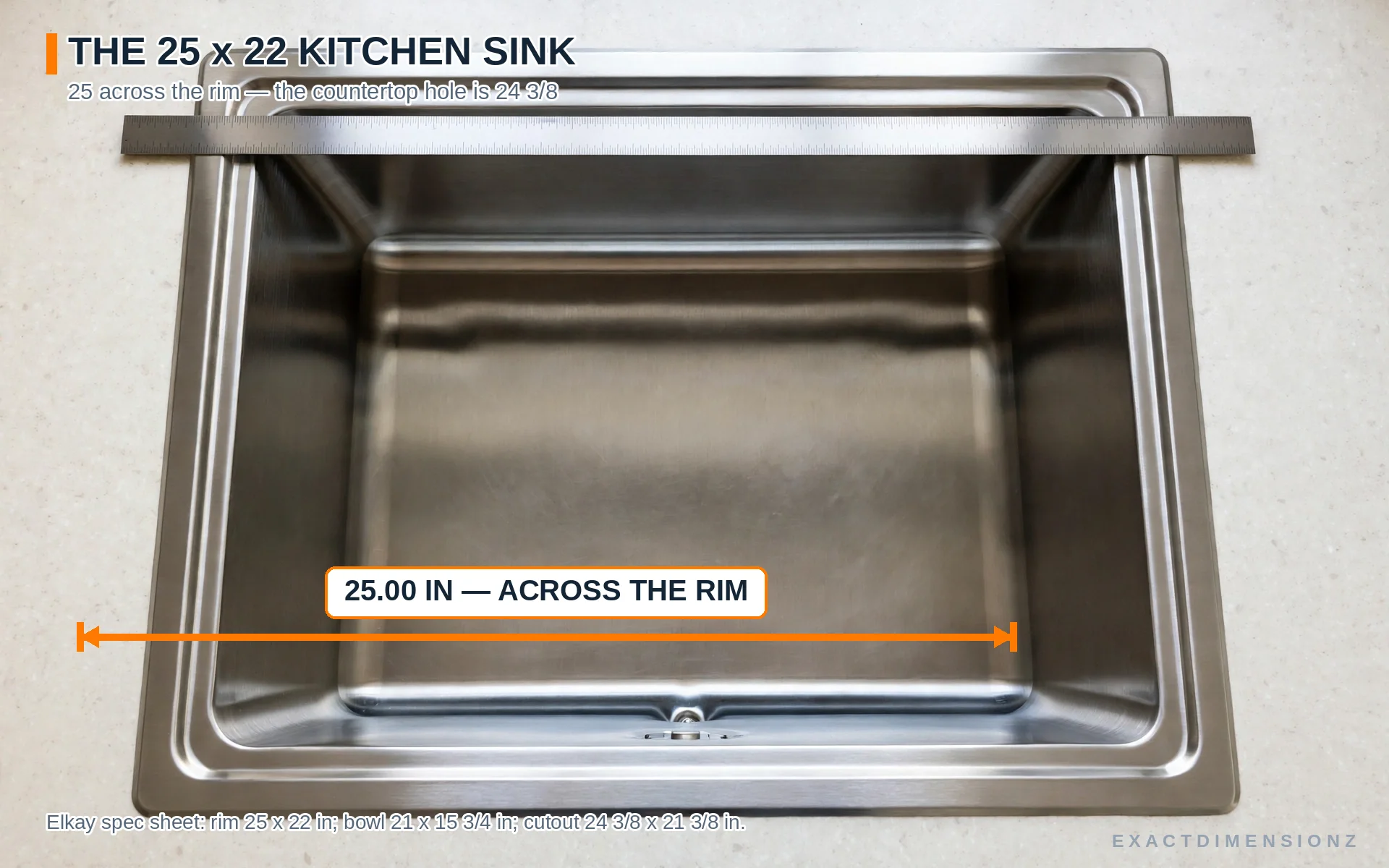
Reading: Label 25 in · Tape 25.00 in across the rim — and 24.375 in where it matters · Verdict: holds with a footnote (Δ −0.63 to the cutout).
A top-mount sink is sold by its outside rim dimensions, and Elkay’s are honest: the manufacturer’s spec sheet gives Sink Dimensions 25″ × 22″, and the rim of the sink does measure 25 inches across. But the same sheet prints two more numbers the headline hides: the bowl inside is 21″ × 15¾” — the short side a quarter-inch shy of 16 inches — and the hole you must cut in the countertop is 24⅜” × 21⅜”. The 25-inch sink fits through a 24.375-inch hole because the rim overlaps the counter on every side; that overlap is the entire design.
So the label holds, with the most practical footnote in this article: if you are replacing a sink, the dimension that decides whether the new one fits is the cutout, and the cutout is not 25. Renovators learn this once, expensively.
The second number deserves the same respect. The sink’s 22 inches of depth is rim-to-rim as well; the bowl behind it is 21⅜ at the cutout line, and the whole unit is dimensioned to drop into a standard kitchen counter run while leaving working counter in front of and behind the rim. Every figure on the spec sheet is doing a job — rim for the brochure, bowl for the cook, cutout for the installer — and the installer’s is the only one that can ruin a countertop if you read the wrong line.
Check it yourself: measure any drop-in sink twice — rim edge to rim edge, then the cabinet opening beneath. The difference, about five-eighths of an inch here, is the flange doing its job.
6. The Travelpro Maxlite 5 “25-Inch” Spinner — a 27-Inch Bag
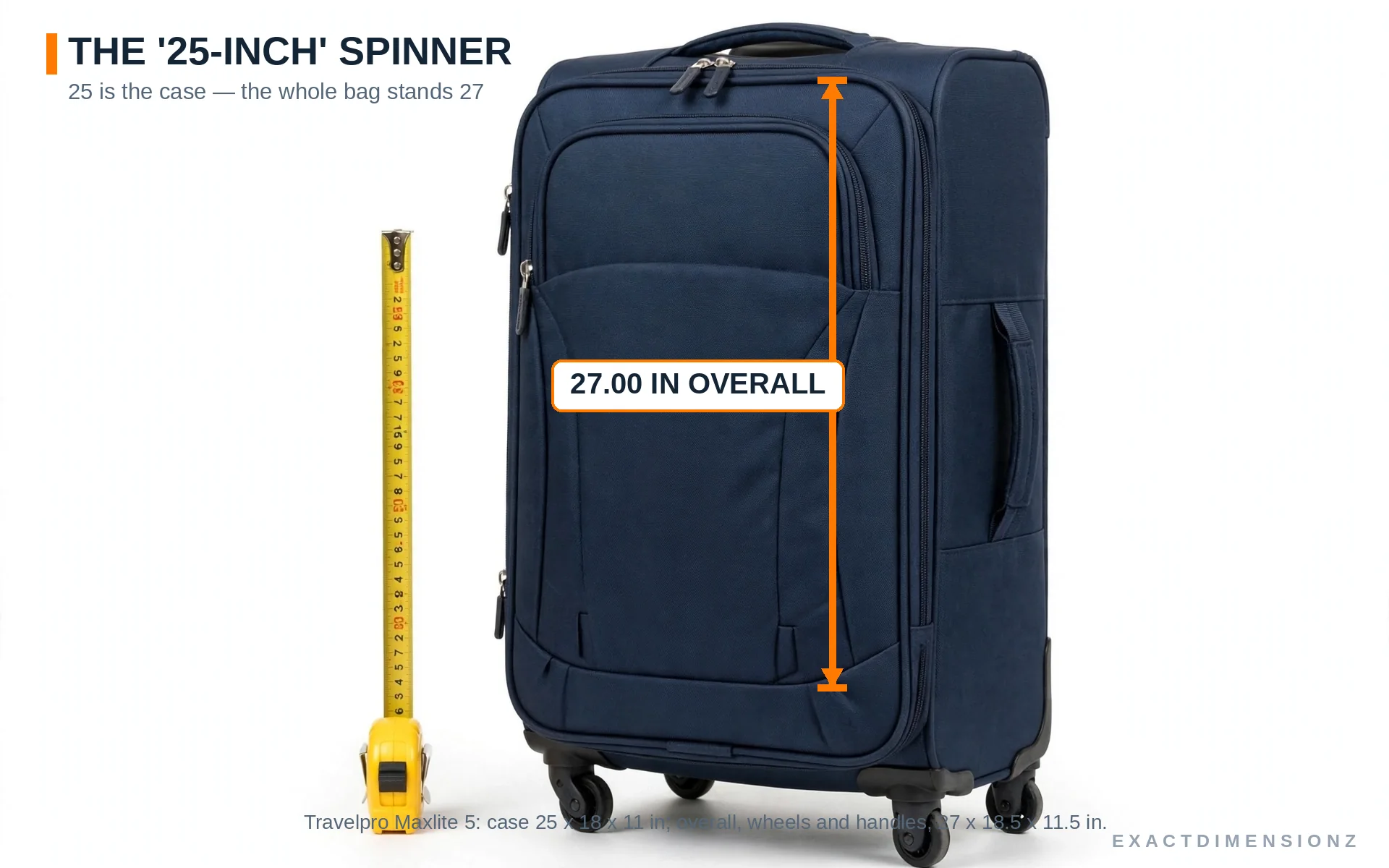
Reading: Label 25 in · Tape 25.00 in the case — 27.00 in the bag · Verdict: holds with a footnote (Δ +2.00).
To its credit, Travelpro prints both readings itself. The Maxlite 5’s product page lists Case Dimensions: 25 × 18 × 11 in — and, directly above them, Overall Dimensions including wheels and carry handles: 27 × 18.5 × 11.5 in, at 6.8 lb and 91 litres. The “25-inch” name describes the box; the object you roll through the airport stands 27 inches tall. Two full inches of the bag — spinner wheels below, carry handle above — live outside its name.
Those two inches decide real arguments. United’s maximum carry-on is 22 × 14 × 9 inches, wheels and handles included — a limit this bag exceeds in every direction, which is why Travelpro itself sells it as a “Medium Check-In.” Yet rival articles for this very search list a 25-inch suitcase as carry-on luggage. It is not, and the manufacturer’s own two-line spec is the whole proof.
One more quiet expansion hides in the fine print: the case itself expands up to 2 inches in depth for extra packing capacity, so even the honest 25.00 case figure describes the bag in only one of its configurations. Travelpro discloses that too. The pattern to notice is that none of this article’s suitcase corrections required detective work — the manufacturer published every figure we used. The second reading failed only in articles that never looked.
Check it yourself: measure any suitcase the airline way — floor to the top of the retracted handle, wheels on — and compare it with the “size” in its name. A two-inch gap on spinner luggage is typical, and it is always the traveller’s problem, never the label’s.
7. The Maxxis Bighorn 2.0 AT25×8R12 — the Label Says 25, Maxxis Says 25.4
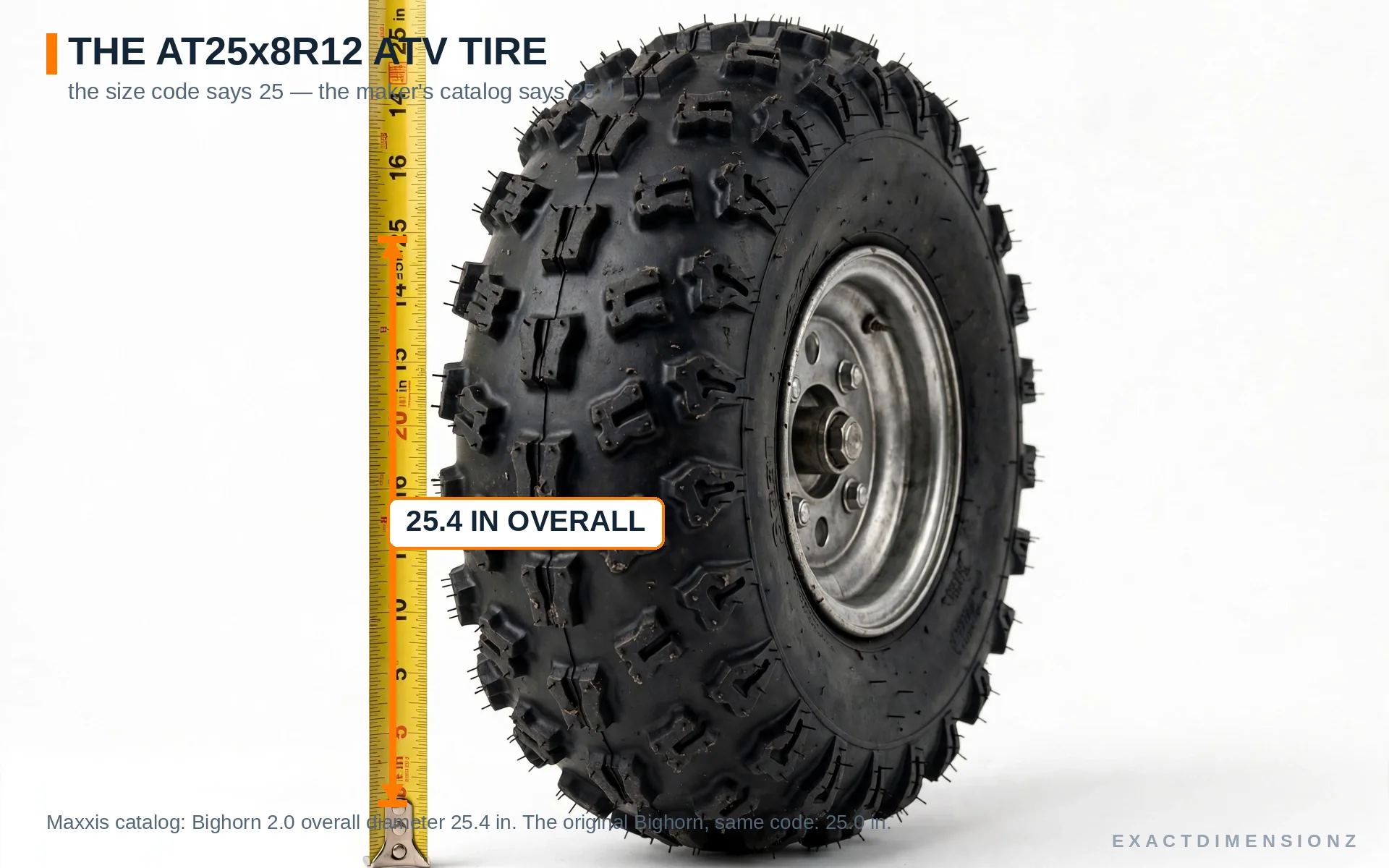
Reading: Label 25 · Tape 25.4 in overall diameter · Verdict: holds with a footnote (Δ +0.40).
ATV tires carry their nominal diameter in the size code — AT25×8R12 reads as a 25-inch tire, 8 inches wide, on a 12-inch radial rim. But Maxxis’s own ATV catalog (read here via a mirror of the manufacturer’s catalog, since Maxxis serves the original as a download) gives the Bighorn 2.0 in this size an overall diameter of 25.4 inches. The original Bighorn, size code identical, is listed at 25.0. Same label, two different second readings, four-tenths of an inch apart — the code is a class, and the catalog table is the measurement.
Four-tenths sounds small until it is ground clearance, gearing, and a speedometer reading low. ATV and UTV owners fitting mixed front and rear tires live by the catalog’s overall-diameter column for exactly this reason: the sidewall gets you to the right shelf, the table gets you to the right tire.
The pairing makes the lesson concrete: the matching rear tire, AT25×10R12, carries the same 25 in its code and the same story in the catalog — the 2.0’s rear is likewise listed at 25.4 inches overall. A machine running “25s” front and rear is actually running on 25.4s, and its ground clearance, final gearing, and speedometer were all engineered against the catalog figure, not the code. Nobody at Maxxis is confused about this; the confusion only starts when the code gets quoted as a measurement.
Check it yourself: overall diameter in a tire catalog means inflated, unloaded, at the specified pressure (7 psi for this Bighorn). Your tape across the tread of a mounted, inflated tire should land near the catalog figure — near 25.4 here, not on the 25 in the code.
The Third Group: Three Readings That Fail
8. The Alienware AW2524HF — a “25-Inch” Monitor With a 24.5-Inch Screen
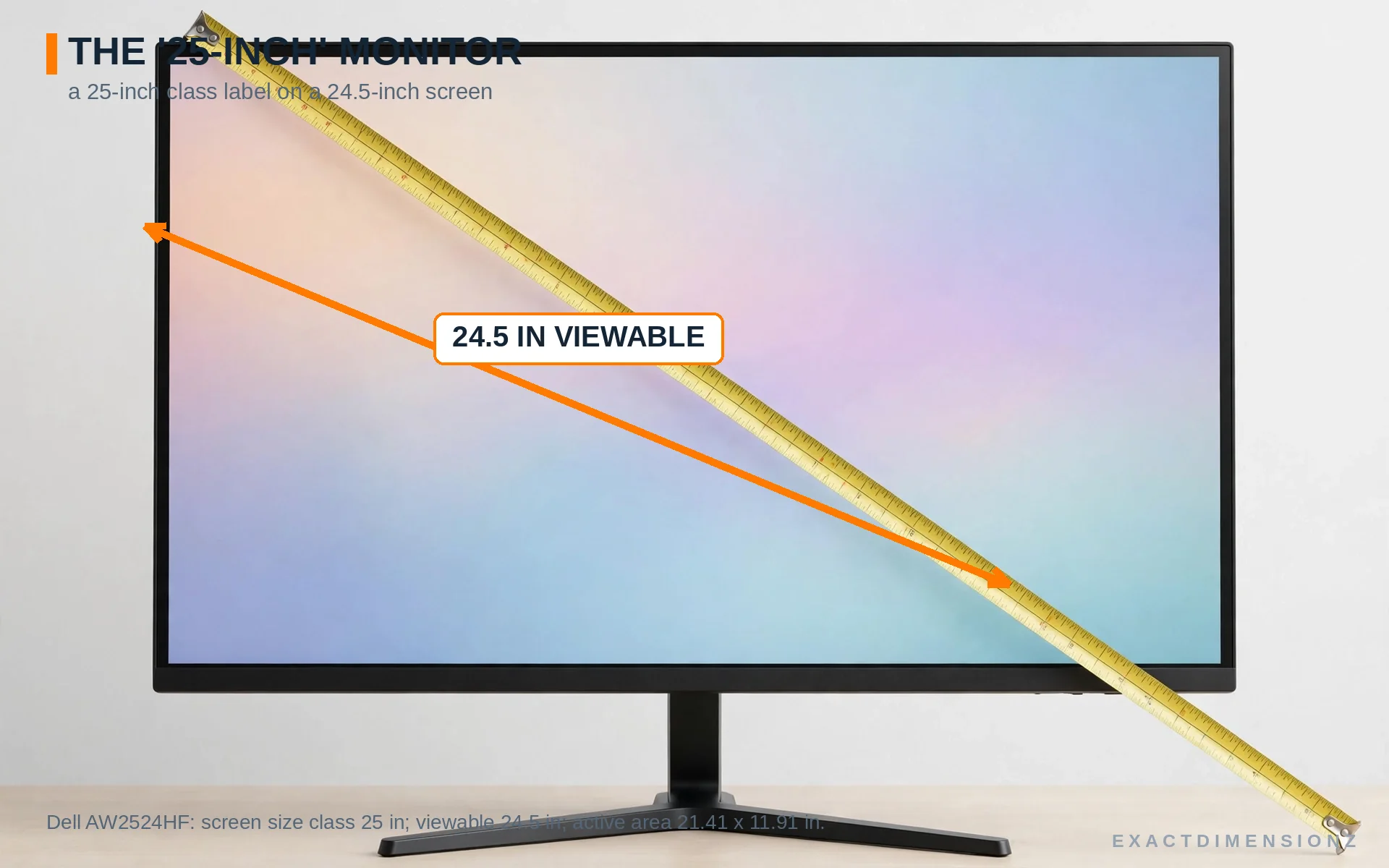
Reading: Label 25 in class · Tape 24.5 in viewable · Verdict: the reading fails (Δ −0.50).
Monitors are the purest size-class case in consumer electronics, and Dell documents it against itself. The AW2524HF’s tech specs list, in adjacent rows: Screen Size Class 25″, Viewable Screen Size 24.5″, and an active display area of 21.41″ × 11.91″. The screen you actually look at — corner to corner of lit picture — measures 24.5 inches diagonally. The “25” is the name of the shelf this panel sits on, rounded up by half an inch, and the rounding is the industry’s convention rather than one brand’s trick: panels are binned into classes, and the class is what gets printed on the box.
Half an inch of diagonal is not trivia on a desk: it is the difference between the monitor you planned the space for and the one that arrives, and it is why every serious monitor review quotes the viewable figure. Dell, to be fair, publishes all three numbers; the failure belongs to any article — and there are many — that repeats “25-inch screen” without the second reading.
The model makes it worse, because this is not an office panel bought by the pallet — the AW2524HF is Dell’s 500 Hz esports flagship, sold to players who choose it precisely by its dimensions: small enough to take in at a glance, fast enough for tournament play. Its buyer is the most measurement-literate customer in the monitor market, and the box still leads with the class. If the class convention survives even here, it survives because shoppers compare classes against classes — a 24.5-inch viewable quietly competing against other brands’ 24.5s, all wearing “25” on the front.
Check it yourself: measure the lit image corner to corner with the screen on, bezel excluded. On any class-labelled monitor, expect the tape to land a few tenths under the box number.
9. The 25-Inch Wheelchair Wheel — a Number That Measures Nothing
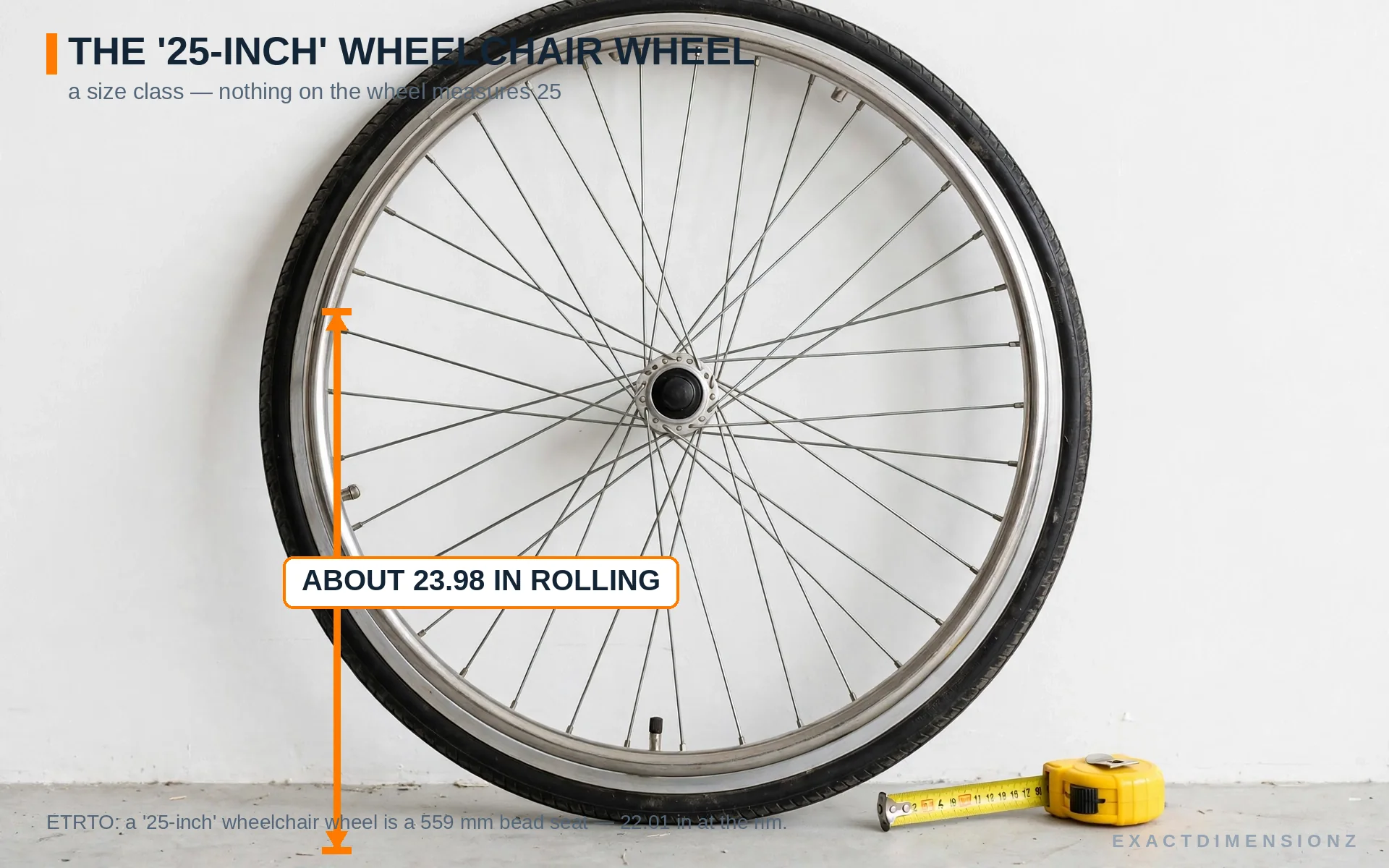
Reading: Label 25 in · Tape 22.01 in at the bead seat, ≈23.98 in rolling · Verdict: the reading fails (Δ −1.02 against the rolling figure; −2.99 against the rim).
Wheelchair wheels carry the strangest 25 in this article, because the number corresponds to no part of the wheel at all. The sizes are coded in the ETRTO system: the standard conversion table maps a “25-inch” wheelchair wheel to a 559 mm bead seat diameter — the diameter the tire bead actually grips — and 559 mm is 22.01 inches. Fit the standard tire for that wheel, a 25-559 (one inch wide), and the rolling diameter works out to about 609 mm: 23.98 inches. Rim: 22. Wheel as it rolls: 24. Label: 25. The inch name is a legacy class label, useful only as a lookup key into the millimetre code — retailers list the tire itself as ’25” × 1″ (559 mm)’, class and code side by side.
This is not a scam; it is a filing system. Wheelchair users order by the ETRTO code because the code is the only figure that guarantees a fit — two “25-inch” tires of different widths share the 559 bead seat and differ in height. But as a measurement, 25 inches fails completely: nothing on the wheel, tyre on or off, is 25 inches long.
The clincher is a coincidence the conversion table exposes: 559 mm is also the bead seat of the 26-inch mountain-bike wheel. The same physical rim standard answers to “25” on a wheelchair and “26” on a bicycle — which is how the wheelchair literature ends up noting, without blinking, that a 25-inch wheelchair rim fits a 26-inch mountain-bike tire. Two folk names for one measured thing, an inch apart. Whenever two labels disagree about the same object, at least one of them is a class; here, both are.
Check it yourself: read the three-digit number moulded into any wheelchair or bicycle tire’s sidewall (for example, 25-559). That second number is the bead seat in millimetres — divide by 25.4 and you have the only diameter on the wheel that a standard guarantees.
10. “A 2-Year-Old Is 25 Inches Tall” — the Claim That Fails by Nine Inches
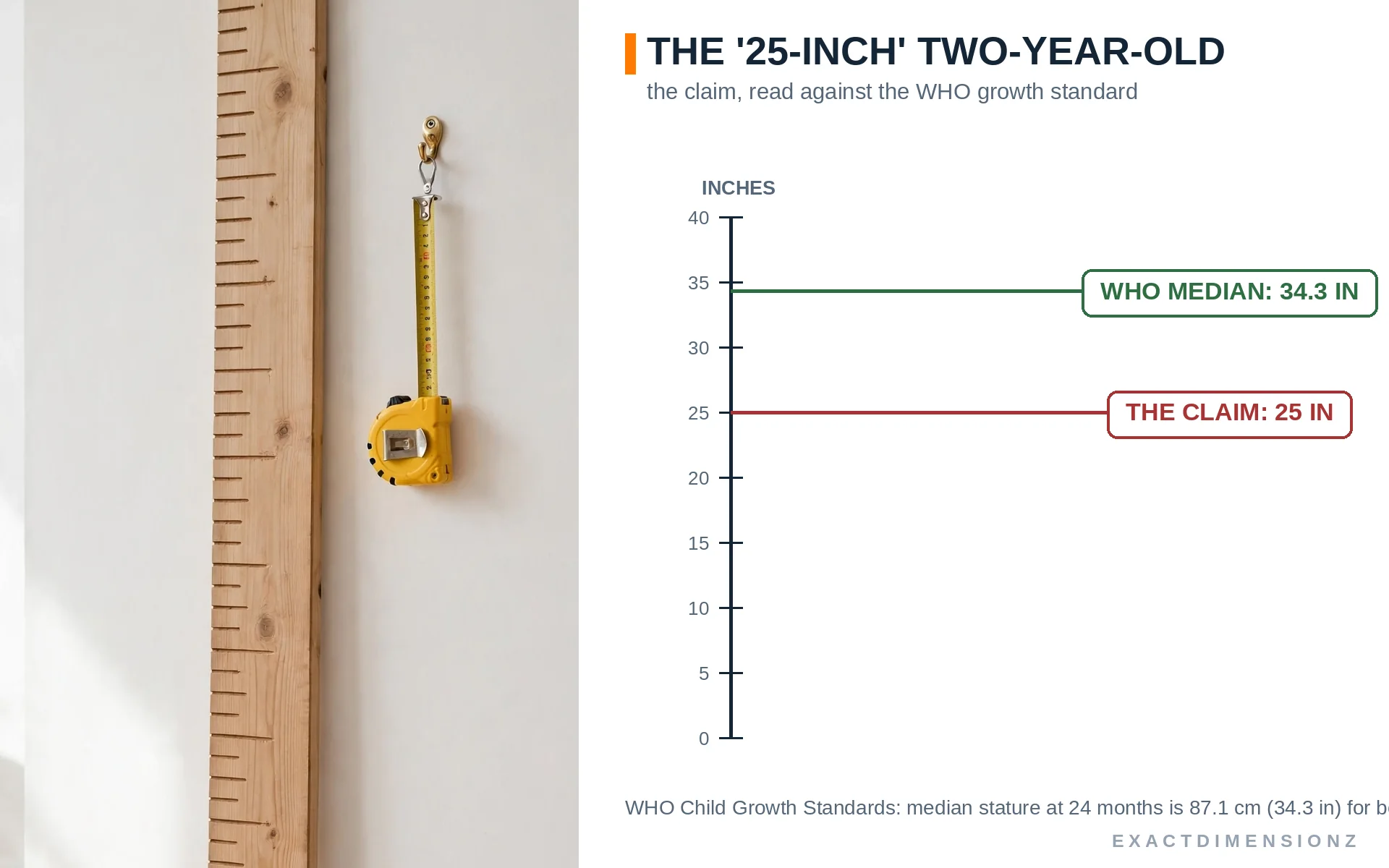
Reading: Label 25 in · Tape ≈34.3 in (WHO median, 24 months) · Verdict: the reading fails (Δ +9.30).
The most repeated “fact” in the rival articles for this search is that 25 inches is about the height of a typical two-year-old. It is not close. The WHO Child Growth Standards — the reference paediatricians actually use — put median stature at 24 months at 87.1 cm for boys, which is 34.3 inches; the worked WHO example at infantchart lands a 24-month-old boy of 87.1 cm exactly on the 50th percentile, and the WHO LMS tables reproduced by MSD Manuals give the girls’ median at the same age as 86.4 cm — 34.0 inches. A typical two-year-old overshoots the claim by more than nine inches, roughly the length of the child’s own forearm and hand.
Where does 25 inches actually sit on the chart? At 63.5 cm, it is the median recumbent length of a baby of about four months. Somebody, somewhere, appears to have read the wrong row of a growth chart — or confused a two-year-old’s height in some other unit entirely — and the error has been copied from article to article ever since, which is precisely how a claim earns its second reading here. (One refinement for the record: at 24 months the WHO switches from recumbent length to standing stature, which reads about 0.7 cm shorter. It changes the verdict not at all.)
Put the claim in percentile terms and its size becomes vivid: a 24-month-old who actually measured 63.5 cm would sit more than seven standard deviations below the WHO median — off the printed chart entirely, in territory that triggers medical workups, not listicles. Real two-year-olds cluster tightly around 34 inches, give or take an inch and a half. A claim nine inches adrift is not a rounding choice or a different-but-defensible average; it is a different child, about twenty months younger.
Check it yourself: pick any WHO-based growth chart and find 63.5 cm on the length-for-age curve. It crosses the median line at three to five months — nowhere near the second birthday.
Build 25 Inches From Things Already on Your Desk
The honest way to feel 25 inches is to build it from units whose sizes are set by standards, not by memory. A US letter sheet is 11 inches long; a US legal sheet is 14 inches. Lay them end to end and you get the single exact build in this table — 25.00 inches, dead on, from two sheets of paper. The money builds come close without arriving: a dollar bill is 6.14 inches long (the Bureau of Engraving and Printing’s figure, a hair over 6 inches), so four of them reach 24.56; a US quarter is 0.955 inches across per the US Mint, so 26 of them reach 24.83. We print the shortfalls rather than rounding them into matches, because rounding a build is how the errors in the Corrections Desk below are born.
| Build | Units used | Honest total | vs 25 in |
|---|---|---|---|
| Letter sheet + legal sheet, end to end | 11 in + 14 in | 25.00 in | dead on |
| Quarters in a row | 26 × 0.955 in | 24.83 in | 0.17 short |
| Dollar bills, end to end | 4 × 6.14 in | 24.56 in | 0.44 short |
| Soda cans, stacked | 5 × 4.83 in | 24.15 in | 0.85 short |
| Credit cards, end to end | 7 × 3.37 in | 23.59 in | 1.41 short |
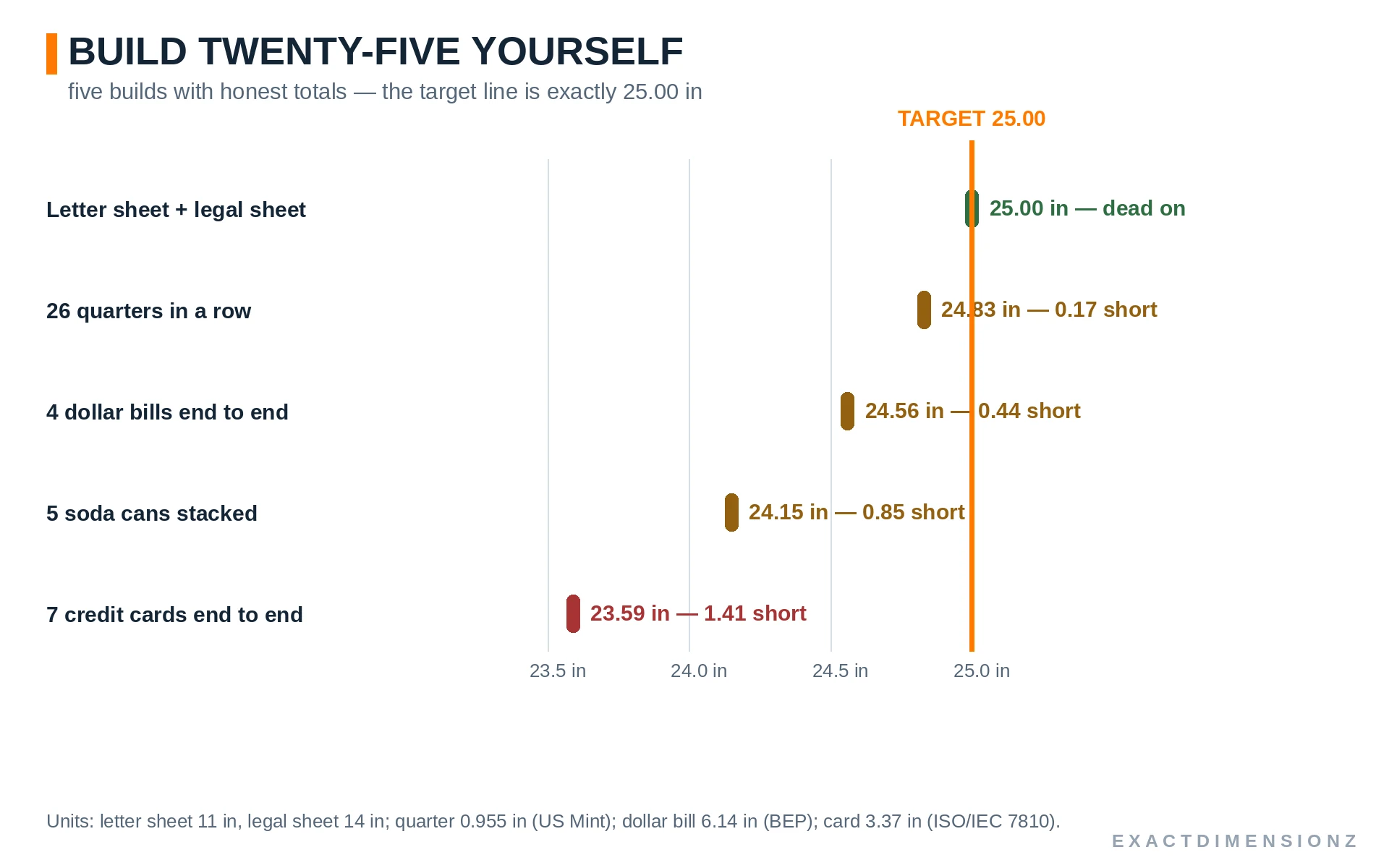
Keep the paper build. Letter-plus-legal is the rare party trick that survives its second reading: two standard sheets, one straight line, exactly 25.00 inches — the same figure the guitar’s strings and the tee-ball bat reached, from the two most ordinary objects in the article.
The Second Reading, All Ten
Here is the whole article on one table: the label, the tape, and the Δ — the signed difference between them. Negative means the label overstates the thing; positive means the thing outgrows its label; and the toddler row shows what a copied error looks like in numbers.
| Object | Label | Second reading (tape) | Δ | Verdict |
|---|---|---|---|---|
| PRS Custom 24 scale length | 25 in | 25.00 in of string | 0.00 | Holds |
| Rawlings REMIX tee-ball bat | 25 in | 25.00 in end to end | 0.00 | Holds |
| Hoyt Formula SR riser | 25 in | 25.00 in of riser | 0.00 | Holds |
| 195/65R15 car tire | size code | 24.98 in computed Ø | −0.02 | Footnote |
| Elkay 25 × 22 sink | 25 in | 25.00 rim · 24.375 cutout | −0.63 | Footnote |
| Travelpro Maxlite 5 spinner | 25 in | 25.00 case · 27.00 overall | +2.00 | Footnote |
| Maxxis Bighorn 2.0 ATV tire | 25 | 25.4 in overall Ø | +0.40 | Footnote |
| Alienware AW2524HF monitor | 25 in class | 24.5 in viewable | −0.50 | Fails |
| 25-in wheelchair wheel | 25 in class | 22.01 in bead seat · ≈23.98 rolling | −1.02 | Fails |
| “A 2-year-old’s height” | 25 in | ≈34.3 in (WHO median) | +9.30 | Fails |
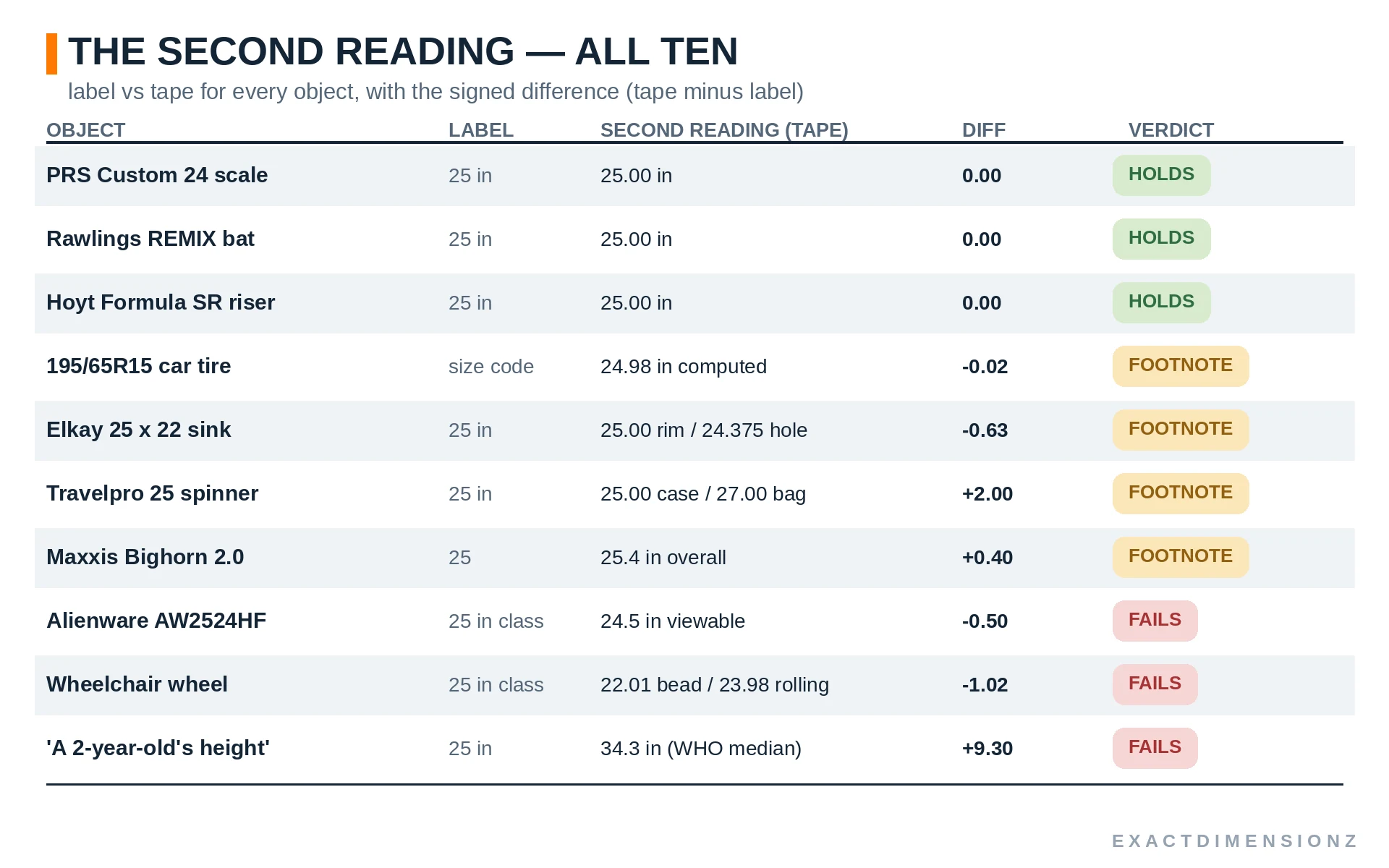
Read down the Δ column and the pattern of the whole series shows itself: the closer a number sits to a regulated measurement — a league-certified bat, a luthier’s scale, an archer’s riser — the tighter the reading. The further it drifts into classes, codes, and copied claims, the wider the gap grows.
The Corrections Desk: Six Claims That Fail Their Second Reading
1. “A typical 2-year-old is 25 inches tall.” Printed by one rival 25-inch article and repeated by another. The WHO median stature at 24 months is ≈34.3 inches for boys and ≈34.0 for girls. The claim is short by about 9.3 inches — 25 inches is a four-month-old’s median length. This is the flagship error for this keyword, and it leads our tenth reading above.
2. “A 25-inch suitcase is carry-on size.” One rival page frames the 25-inch case as acceptable cabin luggage, and another lists a “Carry-On Rolling Suitcase Height — 25 inches” outright. United’s carry-on maximum is 22 × 14 × 9 inches including wheels and handles; Travelpro’s own 25-inch spinner stands 27 inches overall and is sold as a checked bag. A 25-inch case goes in the hold.
3. “A children’s bicycle wheel is 25 inches.” The same rival list again. Children’s wheel sizes climb 12, 16, 20, 24 inches and then join the adult ladder at 26. There is no 25-inch rung; the size does not exist in the standard ladder.
4. “A 25-inch tire diameter is commonly found on mountain bikes.” A rival page claims it. Mountain-bike wheels are 26, 27.5, and 29 inches; the only common “25-inch wheel” anywhere near cycling is the wheelchair size class decoded in our ninth reading — a 559 mm bead seat. Two different claims, both wrong the same way: treating a class label as a diameter.
5. “A medium dog crate is 25 inches long.” A rival list claims it. MidWest’s Life Stages crate range — the category’s standard line — runs 22, 24, 30, 36, 42, and 48 inches, with the medium class at 30. There is no 25-inch crate in the ladder to point at.
6. Ball-count builds that miss, printed as matches. one rival 25-inch article offers nine baseballs as a way to picture 25 inches while printing their total as 26.1 inches, and three size-5 shoes at 25.68 inches as “just a little past” — overshoots presented as equivalents, plus a football diameter typed as “8.6 meters.” A build that misses by an inch is a build of a different number; our builds table above prints its shortfalls in the open.
The 30-Second Habit: Reading Any Size Label Twice
You do not need this article’s ten objects to use its method. The second reading is three questions, and they take half a minute. What does the number name — the whole object, or one part of it, like a string, a riser, or a case? Is it a measurement or a class — a figure somebody’s tape produced, or a bin the product was filed under, like a monitor’s diagonal or a wheelchair wheel’s inch name? And whose figure is it — the manufacturer’s spec sheet, a governing standard, or a retailer’s rounded title? The first two questions tell you what to measure; the third tells you whom to trust when the tape and the title disagree.
Twenty-five inches itself never changes: 63.50 cm, 635.0 mm, 2.0833 feet, every time, on every tape. What changes is how honestly the things wearing its name were measured. Three of our ten wore it exactly, four wore it with fine print, and three were never wearing it at all. Read every label twice — the second reading is the one that fits. Next to it sit 24 inches — one inch shorter and 26 inches — one inch longer.
